

- Industry Size (2026)
- USD 2.90 Bn
- Forecast (2036)
- USD 4.50 Bn
- CAGR (2026 to 2036)
- 7.2%
Skin Bioactive Market Forecast and Outlook 2026 to 2036
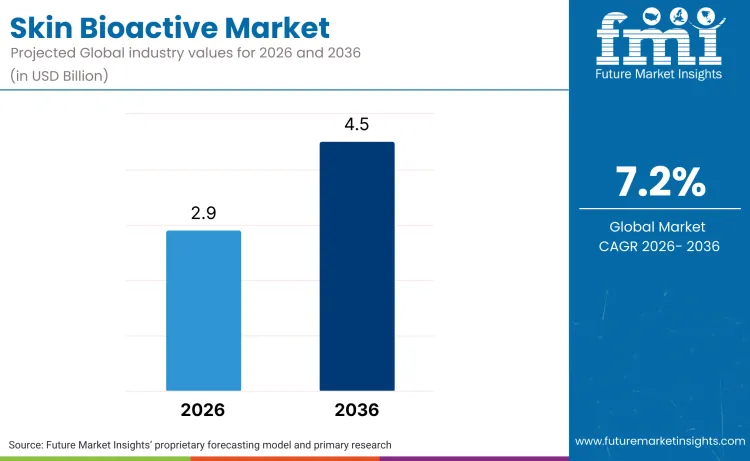
The global skin bioactives market is valued at approximately USD 2.90 billion in 2026 and is projected to reach around USD 4.50 billion by 2036, expanding at a CAGR of about 7.2%. As per Future Market Insights, category momentum is being shaped by a structural shift from surface-level hydration toward longevity-based bioactives and precision delivery systems, where ingredient efficacy is increasingly linked to cellular repair, barrier resilience, and microbiome modulation. Product activity between 2024 and 2026 reflects rising commercialization of nano-scale hyaluronic acid, biomimetic proteins, and fermentation-derived actives, as seen in Givaudan’s launch of PrimalHyal UltraReverse and Silk-iCare through white biotechnology platforms. Leading ingredient suppliers and beauty conglomerates are prioritizing green fractionation and solvent-free extraction to replace synthetic actives with bio-equivalent molecules, reinforcing compliance readiness across the US, EU, and China while improving bioavailability and traceability across premium and dermatological portfolios.
The shift toward longevity positioning and regulatory-aligned bioactive pipelines is supporting stronger uptake across skincare, nutraceuticals, and scalp health applications, where peptides, postbiotics, and precision-delivered actives are gaining prominence. Asia-Pacific continues to emerge as the most dynamic innovation corridor, supported by accelerated NCI filings in China, patent leadership in South Korea’s bioactive haircare segment, and rising biotech-led ingredient development across India and Southeast Asia. Strategic investments in white biotechnology, microbiome modulation, and precision delivery platforms are shaping how brands position new launches across masstige and prestige tiers. Reflecting this strategic pivot toward longevity science, L’Oréal CEO Nicolas Hieronimus stated that the industry is “entering a new era of science, where beauty and longevity will be intertwined for the wellbeing of the population,” underscoring the role of bioactives as a core growth lever across dermatological and premium skincare portfolios through 2036.
Summary of the Skin Bioactive Market
What Is Growth Outlook for the Skin Bioactives Market as per Future Market Insights Projection?
Future Market Insights projects the skin bioactives market to grow at a 7.2% CAGR from 2026 to 2036, expanding from approximately USD 2.90 billion in 2026 to around USD 4.50 billion by 2036.
FMI Research Approach: FMI proprietary forecasting model based on bottom-up revenue estimation, tracking adoption of bioactive ingredients across skincare, haircare, nutraceutical, and dermo-cosmetic portfolios, and demand modeling linked to longevity positioning, barrier repair needs, and microbiome-focused routines.
How Do FMI Analysts Perceive the Skin Bioactives Market to Evolve?
FMI analysts perceive the market shifting from surface-level hydration and aesthetic claims toward longevity-based bioactives and precision delivery systems. Skin bioactives are increasingly positioned around cellular repair, microbiome balance, and barrier resilience, with fermentation-derived actives, biomimetic proteins, and nano-scale hyaluronic systems gaining wider commercial traction across mass, masstige, and prestige portfolios.
FMI Research Approach: Assessment of product pipelines centered on longevity and metabolic beauty claims, evaluation of ingredient platforms using white biotechnology and green fractionation, and analysis of reformulation activity linked to regulatory readiness across major markets.
Which Country or Region Holds the Largest Share in the Global Skin Bioactives Market?
Asia-Pacific holds the largest share of the global skin bioactives market by value, supported by accelerated NCI filings in China, patent leadership in South Korea for bioactive haircare ingredients, and rising biotech-led ingredient development across India and Southeast Asia.
FMI Research Approach: FMI region-level demand assessment across skincare and dermo-cosmetic manufacturing hubs, tracking of ingredient commercialization pipelines, and monitoring of regulatory-driven adoption of novel bioactives.
How Large Will the Skin Bioactives Market Be by 2036?
The global skin bioactives market is projected to reach around USD 4.50 billion by 2036.
FMI Research Approach: FMI long-term forecast by region, product type, and application, incorporating scaling assumptions for fermentation-derived bioactives, microbiome-friendly ingredients, and longevity-positioned actives across skincare and ingestible beauty formats.
What Is the Definition of the Skin Bioactives Market?
The skin bioactives market comprises functional active ingredients used in topical skincare, haircare, and ingestible beauty formulations that are designed to deliver biological effects such as barrier repair, microbiome modulation, pigmentation control, anti-inflammatory response, and longevity-linked cellular support.
FMI Research Approach: FMI market taxonomy and inclusion-exclusion framework covering peptides, proteins, postbiotics, hyaluronic complexes, vitamins, botanical and fermentation-derived actives, while excluding inert emollients, basic humectants, and non-functional cosmetic fillers.
What Are Globally Unique Trends Shaping the Skin Bioactives Market?
Globally unique trends include the shift toward longevity-based bioactives, growing adoption of white biotechnology and green fractionation, accelerated regulatory-driven ingredient innovation in China, and rising integration of microbiome-friendly and precision-delivered actives across dermo-cosmetic portfolios.
FMI Research Approach: Analysis of ingredient-level innovation trends, regulatory pathway evolution across the US, EU, and China, region-wise growth differentials in bioactive adoption, and expansion of bioactives across routine daily skincare, scalp health, and in-and-out beauty routines.
Stick-Based Body Lotions Market Key Takeaways
| Metric | Details |
|---|---|
| Industry Size (2026) | USD 2.90 Billion |
| Industry Value (2036) | USD 4.50 Billion |
| CAGR (2026-2036) | 7.2% |
Source: Future Market Insights (FMI) analysis, based on proprietary forecasting model and primary research.
Why Is the Demand for Skin Bioactives Growing?
Expectations around skincare performance are changing as skin bioactives move beyond surface-level hydration toward longevity-based bioactives and precision delivery systems embedded within routine care. According to Future Market Insights, brands and consumers are placing increasing value on ingredients that support barrier resilience, microbiome balance, and cellular repair, rather than short-term cosmetic effects alone. Earlier generations of actives were often positioned around visible moisturization or immediate sensorial benefits, which limited their perceived role in long-term skin health. That perception is shifting as fermentation-derived actives, biomimetic proteins, and nano-scale hyaluronic systems gain visibility within mainstream dermo-cosmetic and prestige skincare assortments.
Brand and ingredient platform strategies illustrate this shift. Givaudan has advanced longevity positioning through launches such as PrimalHyal UltraReverse and Silk-iCare, reflecting the pivot toward white biotechnology and green fractionation to replace synthetic actives with bio-equivalent molecules. L’Oréal continues to scale bioactive-heavy portfolios within dermatological beauty, reinforcing routine-use positioning for clinically backed actives across daily skincare regimens. FMI notes that suppliers and brands integrating bioactives into core product architectures, with consistent efficacy, safety substantiation, and regulatory readiness, are better placed to drive repeat adoption as the market transitions from aesthetic-led claims toward longevity, resilience, and preventive skin health outcomes.
How Is the Skin Bioactives Market Segmented?
The skin bioactives market is segmented by product type, application, and sales channel, reflecting how active ingredients integrate into daily beauty and wellness routines. By product type, the market includes collagen peptides, hyaluronic acid, vitamins A, C, and E, polyphenols, probiotics, and other functional actives. Collagen peptides lead demand due to strong use in firmness support and skin repair formulas, while vitamins and hyaluronic acid anchor routine maintenance and hydration programs. Probiotics and polyphenols gain relevance in barrier care and oxidative stress management. By application, skincare holds the largest share, followed by nutraceuticals and haircare, reflecting in-and-out routines and rising scalp health focus. Specialty stores and pharmacies lead distribution, with online channels expanding through direct-to-consumer models.
Why Do Collagen Peptides Hold a Leading Share by Product Type?
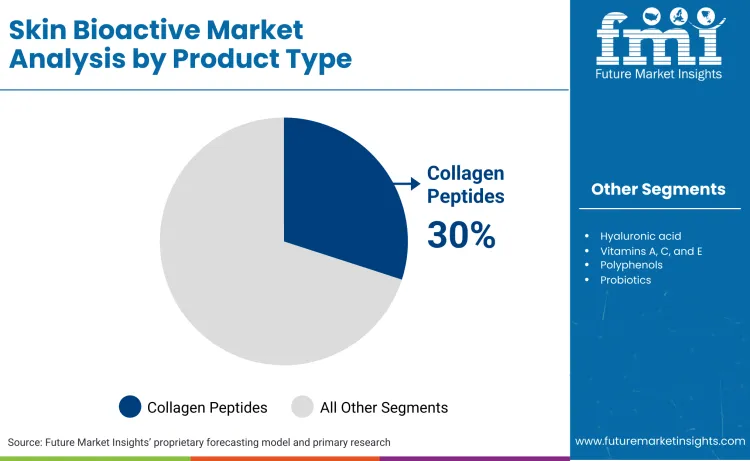
Collagen peptides account for a leading share of the skin bioactives market, contributing roughly 30% of total product type revenues in 2026, driven by their central role in firmness support, wrinkle softening, and skin structure maintenance across both topical and ingestible formats. Their adoption is reinforced by the category shift toward longevity-based bioactives, where collagen signaling and extracellular matrix support are positioned as core mechanisms of skin resilience. Collagen peptides are increasingly integrated into high-efficacy serums, dermo-cosmetic treatments, and beauty-from-within supplements, supporting repeat usage across daily routines. The expansion of precision delivery systems, including liposomal encapsulation and slow-release platforms for retinol and vitamin C combinations, has improved tolerability and performance outcomes, further anchoring collagen peptides within performance-led product portfolios. FMI observes that collagen-based bioactives function as anchor ingredients for routine anti-aging and longevity positioning, allowing them to sustain higher usage frequency than polyphenols, probiotics, or niche botanical actives.
Why Does Skincare Represent the Largest Application Segment?
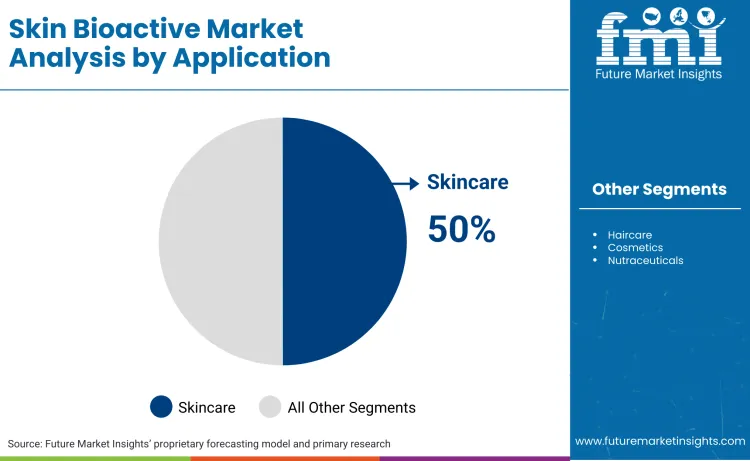
Skincare represents the largest application segment for skin bioactives, accounting for approximately 50% of total market demand in 2026, reflecting the deep integration of bioactive ingredients into daily facial and body care routines. The transition from surface-level hydration toward metabolic beauty has expanded the use of peptides, hyaluronic complexes, vitamins, and postbiotics within serums, repair creams, and dermo-cosmetic treatments positioned around barrier restoration and longevity signaling. Clinical prestige brands and dermatological portfolios continue to normalize daily bioactive usage as part of preventive skin health management, rather than episodic treatment. The strong revenue performance of dermatological beauty divisions among leading multinationals underscores how bioactive-heavy skincare remains the primary commercialization pathway for new ingredient platforms. FMI notes that skincare absorbs the fastest translation of bioactive innovation due to rapid feedback loops from visible efficacy, supporting its sustained leadership over haircare, nutraceuticals, and pharmaceutical dermatology applications.
Why Do Specialty Stores Lead the Sales Channel?
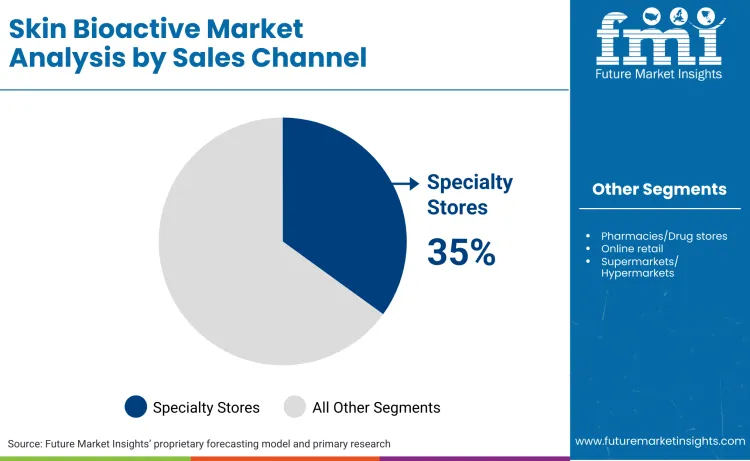
Specialty stores account for an estimated 35% of skin bioactives sales in 2026, reflecting the category’s dependence on ingredient education, efficacy positioning, and guided regimen building. Bioactive-led products often require consumer understanding of concentration levels, delivery systems, and compatibility with sensitive or compromised skin, which aligns with consultation-oriented retail environments. Specialty beauty retail supports discovery of high-potency serums, longevity-focused treatments, and bioactive-enriched dermo-cosmetic lines positioned around clinical outcomes. Consumers seeking performance-driven skincare show greater confidence in curated retail settings that provide product comparison and ingredient-level storytelling. FMI notes that specialty-led distribution anchors first-time bioactive adoption, while online channels, which account for close to 30% of sales, increasingly support replenishment and routine repurchase once efficacy expectations are established.
How Are Longevity Bioactives and Precision Delivery Redefining Skin Actives Innovation?
Longevity-oriented bioactives and precision delivery platforms are reshaping how skin actives are developed and positioned. Ingredient innovation is moving beyond surface hydration toward measurable biological outcomes linked with barrier resilience, cellular stress modulation, and long-term skin function. Givaudan has advanced this shift through PrimalHyal UltraReverse, which applies nano-scale hyaluronic architectures to longevity positioning rather than short-term moisturization. Parallel work on Silk-iCare reflects rising investment in biomimetic proteins produced via white biotechnology to reinforce skin barrier performance. BASF Beauty Care is expanding enzymatically hydrolyzed peptide systems for scalp and skin stress mitigation, highlighting the broader transition toward fermentation and solvent-free extraction routes. Future Market Insights observes that this technological evolution is establishing bioactives as performance-driven inputs validated through delivery science rather than purely cosmetic sensorial enhancers.
Why Are Multi-Category Bioactive Portfolios Becoming Central to Brand Growth Strategies?
Bioactive portfolio expansion across skincare, haircare, and ingestible beauty formats is strengthening competitive positioning by allowing companies to leverage shared ingredient platforms across multiple consumer touchpoints. Shiseido is reinvesting heavily through its SHIFT 2025 strategy to scale bio-based actives across Asia-Pacific product lines, reflecting a deliberate move to anchor growth around science-backed differentiation. Amorepacific is prioritizing bio-sourced compounds supported by Korea’s deep patent base in cosmetic bioactives, reinforcing its leadership in fermentation-driven ingredient pipelines. In prestige beauty, Estée Lauder continues to concentrate category resilience around bioactive-heavy skincare lines, offsetting softness in discretionary makeup demand. FMI notes that multi-category bioactive integration improves return on R&D spend while building continuity between dermatological, premium skincare, and beauty-from-within positioning across mature and high-growth markets.
What Is Driving Deeper Formulation Discipline in Next-Generation Skin Bioactives?
Formulation discipline is intensifying as performance expectations rise alongside tightening regulatory and safety substantiation requirements. Ingredient developers are refining molecular profiles, delivery stability, and compatibility across diverse climates and skin types to ensure consistent outcomes during long-term use. Givaudan Active Beauty has shifted toward regulatory-aligned alternatives such as Silybidiol to address photo-pollution and oxidative stress without relying on restricted compound classes. In East Asia, Caregen’s biomimetic peptide platforms illustrate how sustained-release design is being used to improve tolerability in repeated-use scalp and skin applications. FMI highlights that evolving NMPA safety pathways in China and parallel global compliance tightening are elevating formulation rigor, pushing suppliers toward high-purity, scalable bioactive systems capable of delivering reproducible biological effects across mass, masstige, and prestige formulations.
What Is the Country-wise Outlook for the Skin Bioactives Market?
Country-level growth for the skin bioactives market shows clear variation, influenced by regulatory readiness, biotechnology adoption, R&D intensity, and consumer willingness to adopt science-backed and longevity-focused ingredients. China leads with a 7.8% CAGR, supported by accelerated New Cosmetic Ingredient approvals and strong domestic bio-fermentation capabilities. India follows at 7.5%, driven by rapid patent growth, integration of biotechnology with traditional botanicals, and premiumization of clinical bioactives. Germany records 7.2% growth, reflecting leadership in white biotechnology and strict EU green chemistry mandates. The United States posts a 7.3% CAGR, indicating steady expansion in a mature but high-value market shaped by MoCRA enforcement. The United Kingdom grows at 7.1%, supported by dermo-skinification trends and pharmacy-led adoption of high-efficacy bioactives.
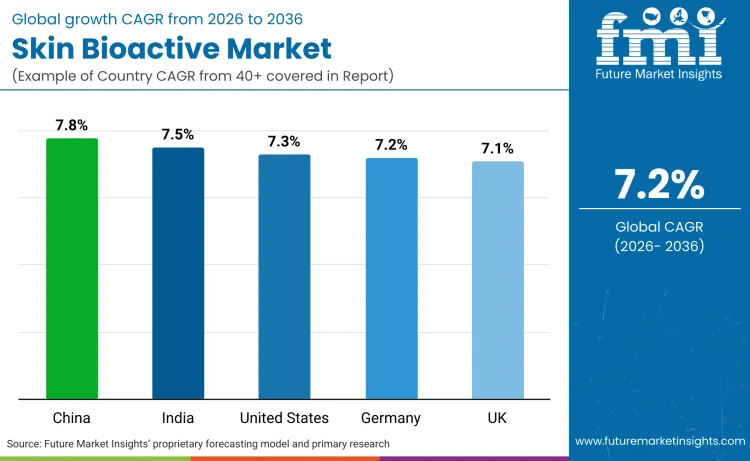
| Country | CAGR (2026 to 2036) |
|---|---|
| China | 7.8% |
| India | 7.5% |
| United States | 7.3% |
| Germany | 7.2% |
| UK | 7.1% |
Source: FMI historical analysis and 2026–2036 forecast data.
Why Is China Leading Growth in the Skin Bioactives Market?
China’s 7.8% CAGR is driven by the rapid evolution of its regulatory environment under the NMPA’s innovation-led New Cosmetic Ingredient framework. Accelerated approval timelines for biotechnology-derived and Traditional Chinese Medicine-based bioactives have significantly reduced lab-to-market cycles, encouraging aggressive domestic R&D investment. Growth is concentrated in fermented peptides, postbiotics, and sensitive-skin actives targeting inflammation, barrier disruption, and post-procedure recovery. Urban consumers increasingly favor scenario-specific bioactives addressing pollution exposure and early-stage ageing rather than broad cosmetic claims. Strong e-commerce penetration further supports adoption, as bioactive-heavy products benefit from education-led digital discovery and repeat purchasing. Growth is shaped more by increased usage frequency and intellectual property creation than by population expansion, positioning China as both a consumption and innovation hub.
What Is Supporting Growth in India’s Skin Bioactives Market?
India’s 7.5% CAGR reflects expanding urban personal care awareness and rising acceptance of high-efficacy, science-backed bioactives. Growth is anchored in a clinical Ayurvedic fusion model, where peptides, vitamins, and fermentation-derived actives are increasingly combined with traditional botanicals. Rapid growth in domestic patent filings and updated AYUSH guidelines allowing protection of synergistic bioactive combinations have strengthened innovation momentum. Demand is driven by climate-adaptive bioactives addressing hyperpigmentation, oxidative stress, and barrier damage linked to high UV exposure and pollution. Improved access through online platforms and growing masstige availability is enabling adoption beyond early adopters. This shift supports steady expansion across urban and semi-urban markets without altering established skincare routines.
Why Is Growth Steady in the United States Skin Bioactives Market?
The United States posts a 7.3% CAGR, reflecting steady expansion within a mature but high-value bioactives market. Enforcement of the Modernization of Cosmetics Regulation Act has increased compliance costs, safety substantiation requirements, and adverse event reporting obligations. This environment favors brands with strong clinical, regulatory, and pharmacovigilance capabilities, particularly within dermatologist-recommended and clinical-prestige segments. Growth is concentrated in longevity bioactives, barrier repair, and post-procedure care rather than broad cosmetic experimentation. Bioactives are typically layered into existing skincare routines rather than replacing them, limiting rapid volume shifts. While regulatory tightening slows disruptive innovation, it strengthens long-term value creation and supports consistent adoption through premium, pharmacy, and dermatological channels.
Why Is Germany Showing Consistent Growth in the Skin Bioactives Market?
Germany’s 7.2% CAGR is supported by its leadership in white biotechnology, fermentation, and solvent-free extraction technologies. Strict EU green chemistry mandates are accelerating the replacement of synthetic actives with bio-fermented peptides, algae-derived compounds, and biosurfactants. Consumers demonstrate strong preference for formulation integrity, controlled dosing, and environmental accountability, aligning well with circular bio-economy models. Adoption is deliberate and science-led, with bioactives primarily integrated through dermo-cosmetic and pharmacy channels rather than trend-driven retail. Growth is reinforced by strong R&D infrastructure and intellectual property generation rather than rapid consumer turnover. This disciplined adoption pattern supports moderate but consistent expansion anchored in regulatory leadership and sustainable innovation.
What Is Driving Growth in the United Kingdom’s Skin Bioactives Market?
The United Kingdom’s 7.1% CAGR is driven by rising dermo-skinification and pharmacy-led adoption of high-potency bioactives. Post-Brexit regulatory flexibility has enabled stronger emphasis on evidence-backed formulations, particularly for sensitive skin, barrier repair, and scalp-health applications. Consumers show high trust in pharmacist-recommended and dermatologist-aligned products, supporting premium bioactive uptake. Growth is concentrated in clinically positioned skincare rather than mass-market cosmetics, limiting rapid volume expansion. While price sensitivity remains a constraint, premiumization and demand for validated efficacy continue to underpin steady growth. Bioactives are increasingly positioned as essential performance drivers within daily skincare routines, supporting consistent adoption across specialist retail and pharmacy channels.
What Is the Competitive Outlook for the Skin Bioactives Market?
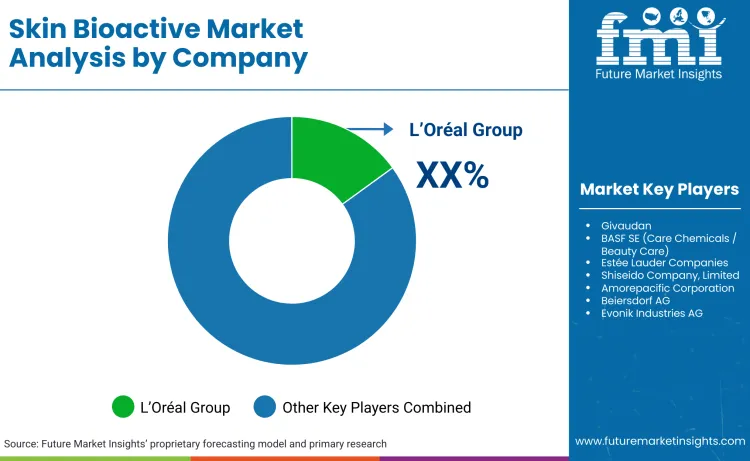
The competitive landscape for skin bioactives is led by global ingredient suppliers and beauty groups that are repositioning portfolios from surface-level hydration toward longevity-based bioactives and precision delivery platforms. Players such as Givaudan, BASF Beauty Care, Shiseido, Amorepacific, and Estée Lauder Companies benefit from deep R&D capabilities, regulatory readiness, and established premium skincare and dermatological franchises. Givaudan has strengthened its position through the launch of PrimalHyal UltraReverse and Silk-iCare, reflecting its ability to commercialize white biotechnology and green fractionation outputs at scale. Competitive positioning in this market is less about immediate volume leadership and more about controlling high-purity bioactive pipelines, delivery technologies, and regulatory-compliant ingredient portfolios that can be deployed across multiple brands and regions.
Future Market Insights observes that competition is increasingly centered on formulation credibility, safety substantiation, and biological performance validation rather than rapid line extensions. Companies such as Shiseido and Amorepacific emphasize bio-based compound development and patent-backed ingredient platforms, while Estée Lauder concentrates growth around science-backed prestige skincare ranges. At the same time, biotech-first firms including Caregen and Botanee Group are strengthening competitive intensity through aggressive patent filings and localized bioactive innovation aligned with China and Korea regulatory pathways. FMI notes that long-term advantage will depend on the ability to integrate proprietary bioactives seamlessly into routine skincare, haircare, and beauty-from-within systems rather than treating bioactives as standalone premium differentiators.
Recent Developments:
- In March 2025, Givaudan launched PrimalHyal UltraReverse, a nano-scale hyaluronic acid bioactive designed to act at the DNA signaling level for skin longevity applications. The launch reflects the category shift from surface hydration toward longevity-based bioactives supported by precision delivery systems and positions advanced hyaluronic platforms as functional actives within premium anti-ageing formulations.
- In April 2024, Givaudan Active Beauty introduced Silk-iCare, a vegan biomimetic silk protein developed through white biotechnology to support barrier repair and skin resilience. This technical launch highlights growing use of bio-equivalent proteins as alternatives to synthetic conditioning agents, supporting the broader move toward green fractionation and sustainable bioactive sourcing within high-performance skincare formulations.
- In October 2025, China’s NMPA added Lauroyl Alanine and two other cosmetic actives to the IECIC II following completion of a three-year safety monitoring period. This regulatory update expands the pool of approved bioactives available for unrestricted use in the Chinese market and signals accelerating regulatory support for new ingredient commercialization within functional skincare and haircare applications.
Key Players in Skin Bioactives Market
- L’Oréal Group
- Givaudan
- BASF SE (Care Chemicals / Beauty Care)
- Estée Lauder Companies
- Shiseido Company, Limited
- Amorepacific Corporation
- Beiersdorf AG
- Evonik Industries AG
- Botanee Group (Winona)
- Caregen Co., Ltd.
Market Definition
The skin bioactives market captures revenue from biologically active ingredients and finished formulations designed to deliver functional skin benefits beyond basic cosmetic effects. In this assessment, the market covers commercially available bioactive compounds positioned for skin longevity, barrier repair, hydration support, oxidative stress management, microbiome balance, and visible skin performance improvement. Market sizing reflects the value generated from finished consumer products and ingredient platforms supplied to cosmetic, dermatological, nutraceutical, and personal care manufacturers, analyzed by product type, application, sales channel, and region, and reported in USD billion.
The scope includes peptides and proteins, hyaluronic acid complexes, vitamins and antioxidant systems, probiotics and postbiotics, polyphenols, and other biotech-derived or bio-sourced actives used in skincare, haircare, cosmetics, nutraceuticals, and select dermatological applications. Products positioned for daily skin maintenance, longevity-oriented care, barrier reinforcement, and functional skin health are included. Sales through specialty beauty retail, pharmacies and drug stores, online platforms, and selected mass retail channels are counted. Geographic coverage spans North America, Europe, Asia Pacific, Latin America, and the Middle East & Africa.
The market excludes basic cosmetic bases without functional bioactive claims, inert emollients and occlusives without biological activity, fragrance-only ingredients, color cosmetics without active skin benefit positioning, and non-functional fillers. Revenues from bulk agricultural raw materials, non-bioactive excipients, packaging, contract manufacturing services, and logistics are excluded. Products developed solely for prescription pharmaceutical use without cosmetic or consumer wellness positioning fall outside the defined market scope.
Scope of Report
| Items | Values |
|---|---|
| Quantitative Units (2026) | USD 2.90 Billion |
| Product Type | Collagen peptides; Hyaluronic acid; Vitamins A, C, and E; Polyphenols; Probiotics; Others |
| Application | Skincare; Haircare; Cosmetics; Nutraceuticals; Pharmaceuticals |
| Sales Channel | Specialty stores; Pharmacies/Drug stores; Online retail; Supermarkets/Hypermarkets; Others |
| Regions Covered | North America, Europe, Asia Pacific, Latin America, Middle East & Africa |
| Countries Covered | United States, Germany, United Kingdom, India, China, Brazil, and 40+ countries |
| Key Companies Profiled | L’Oréal Group; Givaudan; BASF SE; Estée Lauder Companies; Shiseido Co.; Amorepacific; Beiersdorf AG; Evonik Industries; Botanee Group; Caregen |
| Additional Attributes | Dollar sales by product type, application, and sales channel; country-wise growth analysis; adoption trends for longevity-positioned bioactives and precision delivery platforms; regulatory readiness across the US, EU, and China; commercialization of fermentation-derived, microbiome-friendly, and biomimetic actives across dermo-cosmetic, masstige, and prestige portfolios |
Source: FMI historical analysis and forecast data
Skin Bioactive Market by Segment
By Product Type:
- Collagen peptides
- Hyaluronic acid
- Vitamins A, C, and E
- Polyphenols
- Probiotics
- Others
By Application:
- Skincare
- Haircare
- Cosmetics
- Nutraceuticals
- Pharmaceuticals
By Sales Channel:
- Specialty stores
- Pharmacies/Drug stores
- Online retail
- Supermarkets/Hypermarkets
- Others
By Region:
- North America
- Europe
- Asia Pacific
- Latin America
- Middle East & Africa
Frequently Asked Questions
What is the current global market size for Skin Bioactives?
The global skin bioactives market is valued at approximately USD 2.90 billion in 2026, supported by rising use of peptides, postbiotics, and fermentation-derived actives across skincare, haircare, nutraceutical, and dermo-cosmetic formulations.
What is the projected CAGR for the Skin Bioactives market?
Market revenues are projected to grow at a 7.2% CAGR from 2026 to 2036, reaching around USD 4.50 billion by the end of the forecast period, driven by longevity positioning and precision delivery platforms.
Which segment currently dominates the industry?
Skincare dominates the market with close to a 50% share, reflecting deep integration of bioactive ingredients into daily facial and body care routines focused on barrier repair and long-term skin performance.
What are the primary risks or barriers to adoption?
Key barriers include higher formulation and sourcing costs for biotech-derived actives, longer regulatory validation timelines for novel ingredients, stability challenges across climates, and the need for stronger clinical substantiation to support longevity-linked claims.
Who are the leading players in the Skin Bioactives space?
Leading players include L’Oréal Group, Givaudan, BASF SE, Estée Lauder Companies, Shiseido Company, Limited, Amorepacific Corporation, Beiersdorf AG, Evonik Industries AG, Botanee Group (Winona), and Caregen Co., Ltd.
Preview the report firsthand - request a free sample
Get SampleGet the brochure for pricing and purchase details.
Get PDFTable of Content
- Executive Summary
- Global Skin Bioactives Market Outlook
- Demand Side Trends
- Supply Side Trends
- Bioactive Innovation and Technology Roadmap
- Strategic Analysis and Recommendations
- Market Overview
- Market Coverage and Taxonomy
- Market Definition, Scope, and Limitations
- Research Methodology
- Chapter Orientation
- Analytical Framework and Assumptions
- Market Structure and Signal Identification
- Benchmarking and Cross-Market Comparability
- Market Sizing and Forecast Modeling
- Research Design and Evidence Framework
- Secondary Research Sources
- Primary Research Inputs
- Data Validation and Triangulation
- Quality Control and Audit Trail
- Market Background
- Market Dynamics
- Drivers
- Restraints
- Opportunities
- Trends
- Scenario Forecast Analysis
- Opportunity Mapping
- Product Life Cycle Analysis
- Value Chain Analysis
- Supply Chain Analysis
- Regulatory Landscape
- Market Dynamics
- Global Skin Bioactives Market Analysis 2021 to 2025 and Forecast 2026 to 2036
- Historical Market Size Value Analysis
- Current and Future Market Size Projections
- Y-o-Y Growth Trend Analysis
- Absolute Dollar Opportunity Analysis
- Global Skin Bioactives Market Analysis by Product Type
- Collagen Peptides
- Hyaluronic Acid
- Vitamins A, C, and E
- Polyphenols
- Probiotics
- Others
- Global Skin Bioactives Market Analysis by Application
- Skincare
- Haircare
- Cosmetics
- Nutraceuticals
- Pharmaceuticals
- Global Skin Bioactives Market Analysis by Sales Channel
- Specialty Stores
- Pharmacies and Drug Stores
- Online Retail
- Supermarkets and Hypermarkets
- Others
- Global Skin Bioactives Market Analysis by Region
- North America
- Europe
- Asia Pacific
- Latin America
- Middle East and Africa
- North America Skin Bioactives Market Analysis
- Market Size and Forecast by Country
- Market Analysis by Product Type
- Market Analysis by Application
- Market Analysis by Sales Channel
- Market Attractiveness Analysis
- Europe Skin Bioactives Market Analysis
- Market Size and Forecast by Country
- Market Analysis by Product Type
- Market Analysis by Application
- Market Analysis by Sales Channel
- Market Attractiveness Analysis
- Asia Pacific Skin Bioactives Market Analysis
- Market Size and Forecast by Country
- Market Analysis by Product Type
- Market Analysis by Application
- Market Analysis by Sales Channel
- Market Attractiveness Analysis
- Latin America Skin Bioactives Market Analysis
- Market Size and Forecast by Country
- Market Attractiveness Analysis
- Middle East and Africa Skin Bioactives Market Analysis
- Market Size and Forecast by Country
- Market Attractiveness Analysis
- Key Countries Analysis
- China
- India
- United States
- Germany
- United Kingdom
- Brazil
- Market Structure and Competition Analysis
- Competition Dashboard
- Competitive Benchmarking
- Market Share Analysis of Leading Players
- Company Profiles
- L’Oréal Group
- Givaudan
- BASF SE
- Estée Lauder Companies
- Shiseido Company, Limited
- Amorepacific Corporation
- Beiersdorf AG
- Evonik Industries AG
- Botanee Group (Winona)
- Caregen Co., Ltd.
- Assumptions and Acronyms Used


