

- Industry Size (2026)
- USD 470.0 Mn
- Forecast (2036)
- USD 841.7 Mn
- CAGR (2026 to 2036)
- 6.0%
High-Temperature Composite Exhaust and Thrust Reverser External Panels Market Size, Market Forecast, and Outlook By FMI
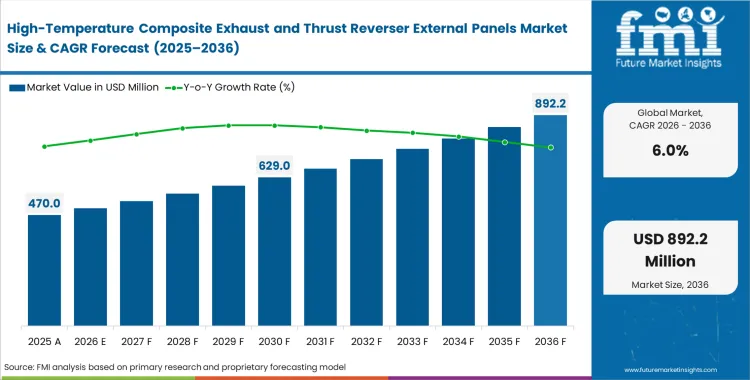
The high-temperature composite exhaust and thrust reverser external panels market crossed a valuation of USD 443.4 million in 2025. Sales are estimated to cross USD 470.0 million in 2026 at a CAGR of 6.0% during the forecast period. Continuous investment in thermal-acoustic weight reduction leads expected total valuation of USD 841.7 million through 2036 as airframe manufacturers replace legacy titanium components with continuous-fiber ceramic matrices in extreme-heat zones.
Summary of High-Temperature Composite Exhaust and Thrust Reverser External Panels Market
- The market is forecast to reach USD 841.7 million by 2036.
- The market is expected to grow at a CAGR of 6.0% from 2026 to 2036.
- The market was estimated at USD 443.4 million in 2025.
- The forecast period represents an incremental opportunity of USD 371.7 million.
- This market focuses on high-temperature composite panels used in nacelle exhaust and thrust reverser zones, where thermal resistance, durability, and weight optimization are critical.
- Demand is driven by expanding commercial aircraft fleets and increasing nacelle content in next-generation aircraft programs.
- Advanced composite materials are gaining traction as they help manage higher operating temperatures without adding the weight of metallic alternatives.
- Thrust reverser panels lead the product segment with a 58.0% share due to higher component complexity and maintenance requirements.
- CFRP dominates the material segment with a 46.0% share, supported by its established performance across current nacelle systems.
- Commercial aircraft account for 64.0% of demand, reflecting the largest installed base and production pipeline.
- The 300–600°C temperature range holds a 49.0% share, representing the most common operating band for nacelle external panels.
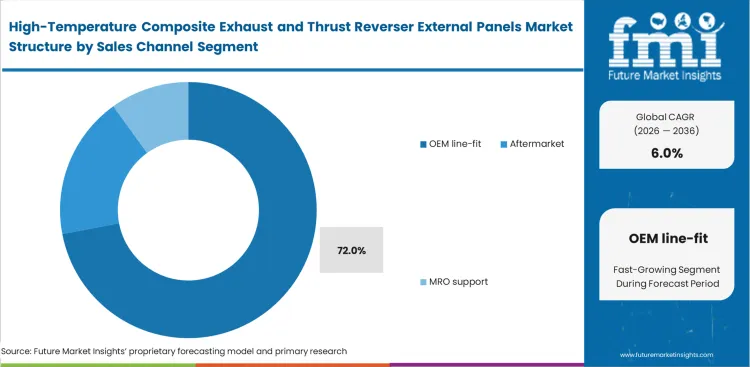
- OEM line-fit leads the sales channel with a 72.0% share, driven by strong factory installation volumes.
- China, India, and the UAE are the fastest-growing markets, with China leading at a 7.4% CAGR.
- Collins Aerospace, Safran Nacelles, Spirit AeroSystems, FACC AG, and GKN Aerospace are key participants in the competitive landscape.
Weight pressure in nacelle exhaust areas keeps panel design under close commercial review. Legacy metallic solutions can manage heat, though they also add mass in areas where every reduction supports fuel efficiency and payload economics. Composite thrust reverser external panels are gaining attention because they address this thermal and weight tradeoff more effectively. Adoption depends on whether thermal barriers, hybrid layouts, and processing methods can meet durability targets under repeated heat exposure without adding cost or slowing production flow.
Certification progress for hybrid thermal barrier systems remains a key factor shaping how high-temperature nacelle composite structures enter new aircraft programs. Replacement potential also increases where operators assess newer panel systems against lifecycle cost in fleets facing heavier maintenance exposure. Penetration is therefore tied not only to thermal performance, but also to certification timing, production practicality, and long-term service economics. This keeps material selection in nacelle exhaust sections closely linked to both aircraft efficiency targets and maintenance cost control.
China is expected to record a 7.4% CAGR as domestic commercial programs continue specifying lightweight China aircraft exhaust panel components to meet stricter fuel-burn targets. India is estimated to register a 7.1% CAGR, supported by large narrowbody delivery backlogs that keep nacelle-efficiency improvements commercially relevant. The United Arab Emirates is anticipated to post a 6.9% CAGR, where fleet expansion continues to favor advanced thermal barriers suited to hot-weather operation. Demand in the United States is set to rise at a CAGR of 5.8% through 2036, supported by ongoing upgrade cycles and a broad base of nacelle-related manufacturing and maintenance activity. France is projected to see a 5.7% CAGR as Airbus-linked component localization remains steady. United Kingdom adoption is likely to advance at a 5.4% CAGR, supported by specialized exhaust nozzle engineering capability. Canada is forecast to record a 5.2% CAGR on the back of steady business jet production requiring localized thrust reverser assemblies.
Segmental Analysis
High-Temperature Composite Exhaust and Thrust Reverser External Panels Market Analysis by Product Type
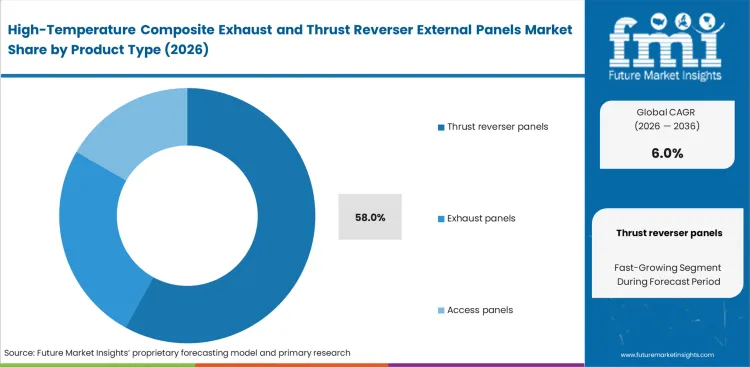
Thrust reverser panels lead this segment because they combine wide surface coverage, higher thermal exposure, actuation integration, and stricter acoustic requirements within the nacelle system. Aircraft exhaust panel size also matters commercially, as larger panel formats create a stronger case for advanced composites where weight savings, thermal control, and installation efficiency all carry measurable value. Product complexity is materially higher here than in simpler access or localized exhaust-panel formats, which keeps composite substitution more important in this category. Thrust reverser panels are expected to hold 58.0% share of the Product Type segment in 2026. Acoustic damping, thermal resistance, and repeated load performance must all be managed in the same part, which keeps qualification standards tight and limits easier substitution.
- Initial specification: Panel selection starts early because thrust reverser assemblies offer one of the clearest opportunities to reduce nacelle weight without removing required functional coverage. Material choice at this stage has a direct effect on downstream fuel efficiency and installation outcomes.
- Validation hurdles: Qualification remains demanding because these panels must withstand repeated reverse-thrust cycles, thermal stress, and acoustic loading without delamination or loss of dimensional stability. Testing time and validation cost stay higher than for less integrated nacelle components.
- Expansion lock-in: Once a panel geometry and material system are qualified on an aircraft program, follow-on demand tends to remain tied to the same approved configuration across later production and replacement cycles. Entry barriers stay elevated even after the initial certification is complete.
High-Temperature Composite Exhaust and Thrust Reverser External Panels Market Analysis by Material System
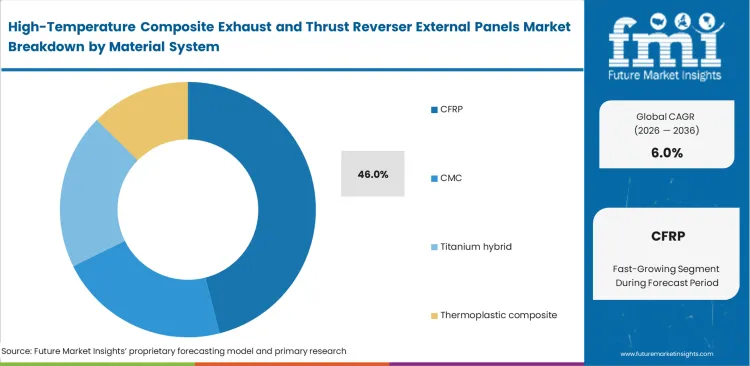
CFRP is anticipated to capture 46.0% share of the Material System segment in 2026. Material preference remains stronger in the CFRP vs CMC for aircraft exhaust panels discussion, where the operating range stays closer to 300°C to 400°C, because degradation behavior is better understood, qualification pathways are more established, and integration risk is lower than with newer high-temperature composite systems. That reduces validation burden, supports steadier production ramp-up, and keeps adoption commercially practical where thermal exposure is demanding but does not yet require the highest heat tolerance. Recycling limits and disposal cost still weigh on lifecycle economics, yet those constraints have not been enough to displace CFRP in applications where certification depth and manufacturing readiness remain more important.
- Procurement leverage: Long production history supports better pricing discipline and more stable sourcing conditions than newer ceramic-based systems. Cost exposure stays lower where buyers can work within established supply chains and qualified material formats.
- Operational hiding costs: Repeated heat cycling can gradually introduce resin-matrix cracking that is not always visible during routine checks. Inspection effort rises over time because confirmation often depends on non-destructive testing rather than surface condition alone.
- Lifecycle reality: End-of-life handling for high-temperature thermoset systems remains more difficult than for simpler metallic alternatives. Disposal and recovery costs can narrow part of the upfront savings once panels reach retirement age.
High-Temperature Composite Exhaust and Thrust Reverser External Panels Market Analysis by Aircraft Platform
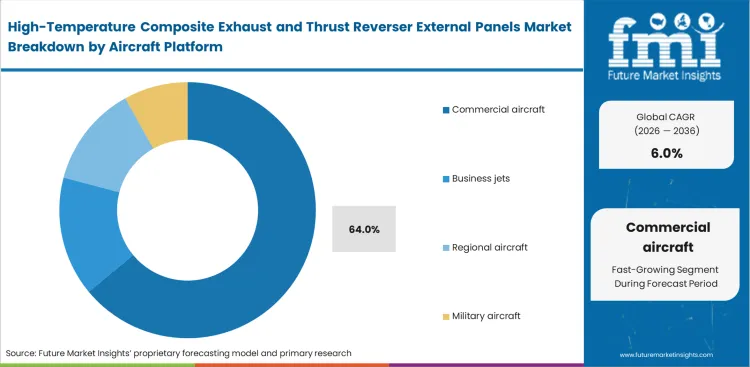
Commercial aircraft remain the largest demand base because high production volumes, deeper fleet backlogs, and stronger pressure to reduce nacelle weight keep panel innovation concentrated in this platform category. Demand for narrowbody thrust reverser external panels stays particularly strong within this group, as fuel-efficiency gains scale more clearly across large in-service fleets and high-delivery programs. Standardized aircraft dimensions also help aircraft exhaust panel manufacturers run more repeatable composite production programs across major commercial platforms. Repair expectations add further weight to this segment, since operators need approved replacement pathways for heat-exposed panels that are harder to restore quickly on the line. Commercial aircraft are projected to secure 64.0% share of the Aircraft Platform segment in 2026. Continued dependence on spare availability and consistent aerodynamic conditions keeps commercial aircraft ahead within the segment.
- Primary failure prevention: Continuous heat exposure can gradually affect panel shape and aerodynamic tolerance around exhaust zones. Composite layup design remains important where airflow stability and dimensional consistency have to be preserved over repeated operating cycles.
- Residual vulnerability: Ground handling contact remains a common cause of unscheduled panel removal. Rapid patching is more difficult in high-temperature panel systems, which increases dependence on available certified spares.
- Value capture requirement: Fuel-efficiency benefits are best preserved when nacelle surfaces remain smooth and properly aligned. Surface condition matters commercially, since performance losses can build when panel fit or finish deteriorates in service.
High-Temperature Composite Exhaust and Thrust Reverser External Panels Market Analysis by Temperature Class
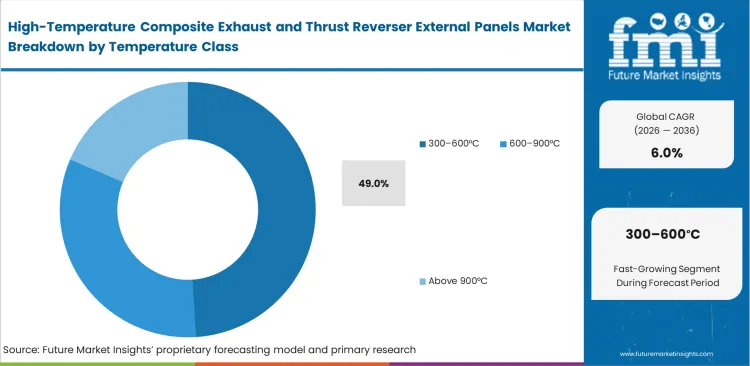
Panel demand remains concentrated in the 300-600°C range because much of the nacelle and thrust reverser envelope operates under demanding thermal conditions without moving into the highest exhaust-core extremes. The 300-600°C band is estimated to account for 49.0% share of the Temperature Class segment in 2026. This range matters commercially because it is wide enough to require more advanced material systems than standard composites, yet still compatible with broader fastening, processing, and production methods than ultra-high-temperature applications. It also represents the range where manufacturers most often compare CFRP and CMC use in aircraft exhaust and thrust reverser panels, since material choice here directly affects weight, processing complexity, and thermal margin. Route pattern and climate exposure can still alter panel life materially, which keeps temperature-band selection closely tied to maintenance planning as well as material choice.
- Production control: Material availability is broader in this range than in hotter classifications, which helps maintain steadier sourcing conditions and better pricing discipline. Qualified supply depth also reduces the risk of depending on a very narrow resin base.
- Supply bottlenecks: Resin availability can still tighten when aerospace demand shifts suddenly across adjacent programs. Inventory planning remains important where panel output depends on uninterrupted access to qualified inputs.
- Long-term landscape: Future engine platforms are likely to place more parts under higher thermal stress. Material systems proven in the 300-600°C range remain an important bridge between today’s volume applications and hotter next-generation requirements.
High-Temperature Composite Exhaust and Thrust Reverser External Panels Market Analysis by Sales Channel
High-Temperature Composite Exhaust and Thrust Reverser External Panels Market Analysis by Sales Channel
OEM line-fit remains the dominant sales channel because high-temperature nacelle panels enter the market first through certified aircraft production programs rather than through the slower replacement cycle. OEM line-fit is poised to garner 72.0% share of the Sales Channel segment in 2026. Channel concentration stays high at this stage because dimensional accuracy, certification continuity, and installation fit are all locked into the original program build standard. Early supplier approval also carries longer commercial value, since the same part pedigree often shapes later demand for aftermarket nacelle exhaust panel replacement, aircraft hot-section external panel repair, and adjacent aircraft structural health monitoring access panels program requirements across the installed fleet. Restricted data access and proprietary part control further strengthen this position, leaving aftermarket participation narrower in panel categories tied closely to original nacelle design authority.
- Initial cost baseline: Full-rate OEM production supports better unit economics by spreading tooling, process control, and scrap-management costs across larger output volumes. Margin quality depends heavily on yield discipline during line-fit supply.
- Operational drift: Repeated heat exposure can gradually reduce acoustic performance before more visible panel deterioration appears. In-service monitoring matters even where the part remains dimensionally acceptable for continued use.
- Total cost exposure: Long-term platform economics depend partly on how proprietary replacement panels are priced and sourced over the service life of the aircraft. Downstream maintenance costs can rise materially where approved supply options remain narrow.
High-Temperature Composite Exhaust and Thrust Reverser External Panels Market Drivers, Restraints, and Opportunities
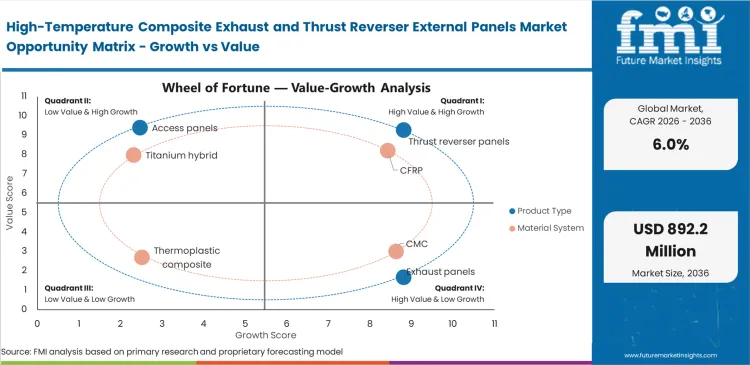
Immediate fuel-burn penalties on heavy metallic nacelles compel fleet operators to demand composite alternatives on every new aircraft delivery. Procurement directors refuse payload restrictions associated with legacy titanium exhaust systems when competing carriers operate lighter platforms. Users determining if they can composite exhaust panels replace titanium in aircraft recognize that delaying continuous-fiber structure transition costs operators millions in excess fuel consumption. Commercial reality forces tier-one nacelle integrators to rapidly qualify ceramic and thermoplastic matrices. Urgency relies entirely on airlines maximizing passenger counts without exceeding maximum takeoff weights on long-haul routes.
Certification backlogs at specialized thermal-acoustic testing facilities represent primary structural friction slowing broader adoption. Chief engineers await aviation authorities validating thousands of simulated thermal cycles. Bottlenecks persist because only a handful of global facilities possess capability to simultaneously test extreme heat, acoustic dampening, and reverse-thrust explosive pressure. Independent MROs attempt bypassing this by developing localized repair patches. Purchasing teams utilize strict composite nacelle panel procurement checklist protocols to ensure replacement parts survive full certification scrutiny required for major structural panels.
Opportunities in the High-Temperature Composite Exhaust and Thrust Reverser External Panels Market
- Thermoplastic automated layup: Transitioning from thermosets to thermoplastics allows robotics to melt and fuse panels without autoclave curing. Production managers cut manufacturing cycle times dramatically accelerating tier-one RFQ composite nacelle panels delivery schedules.
- Digital twin thermal tracking: Embedding sensors into repairable composite leading edge components alongside exhaust panels allows real-time matrix degradation monitoring. Fleet technical directors utilize data to schedule precise predictive maintenance.
- Acoustic-core hybridization: Designing sandwich panels with differing thermal resistance on inner versus outer faces optimizes weight precisely. Structural engineers deliver superior noise attenuation while further reducing total mass.
Regional Analysis
Based on regional analysis, high-temperature composite exhaust and thrust reverser external panels market is segmented into East Asia, South Asia, Middle East, North America, and Europe across 40 plus countries.
.webp "Top Country Growth Comparison High Temperature Composite Exhaust And Thrust Reverser External Panels Market Cagr (2026 2036)")
| Country | CAGR (2026 to 2036) |
|---|---|
| China | 7.4% |
| India | 7.1% |
| United Arab Emirates | 6.9% |
| United States | 5.8% |
| France | 5.7% |
| United Kingdom | 5.4% |
| Canada | 5.2% |
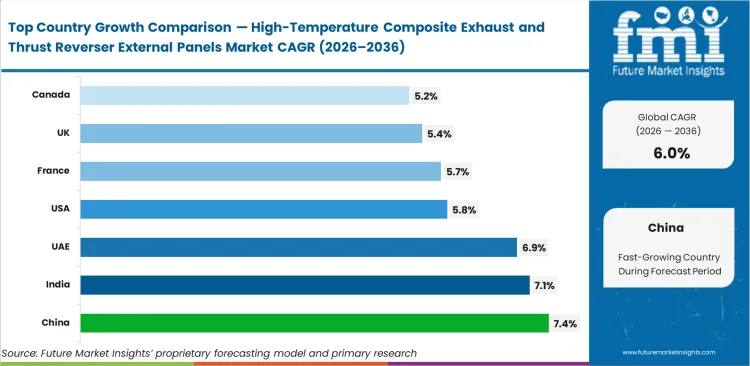
Source: Future Market Insights (FMI) analysis, based on proprietary forecasting model and primary research
East Asia High-Temperature Composite Exhaust and Thrust Reverser External Panels Market Analysis
Domestic aircraft production build-out and tighter localization of nacelle-content supply give this region a distinct growth profile. Demand is being shaped by the need to place more composite exhaust and thrust reverser panel capability closer to final aircraft programs, while also reducing dependence on imported high-value nacelle components. Processing depth matters here because panel qualification, layup precision, and thermal-performance consistency are all difficult to scale quickly without a stronger local manufacturing base. Regional growth depends on how effectively East Asia can combine fleet expansion, production localization, and qualified composite processing within the same supply chain.
- China: Localized aircraft production quotas and domestic airframe expansion are keeping China at the center of regional demand. Demand for high-temperature composite exhaust and thrust reverser external panels in the country is expected to rise at a CAGR of 7.4% from 2026 to 2036 as local nacelle-content capability expands alongside commercial aircraft manufacturing programs. Supply growth also matters here because broader in-country panel production can shorten replacement lead times and strengthen access to qualified components for domestic fleets. China is likely to remain the main East Asian market where production scale and local content requirements reinforce each other.
FMI's report includes Japan, South Korea, and Taiwan. Maintenance facilities in these adjacent aviation hubs are also moving toward newer ultrasonic inspection protocols tailored to high-temperature resin systems, which can improve defect detection in service-exposed panels. Singapore is another market covered in the report, where advanced MRO capability and tighter inspection discipline are likely to support broader adoption of qualified composite panel maintenance over time.
South Asia & Middle East High-Temperature Composite Exhaust and Thrust Reverser External Panels Market Analysis
Hot-weather operation, airborne particulate exposure, and high aircraft utilization give this region a more demanding operating profile for nacelle exterior components than many other markets. Panel selection is shaped by thermal endurance, acoustic performance, and the ability to maintain service reliability in environments where heat soak and surface wear can shorten part life. Local demand also reflects a split between South Asia’s large narrowbody fleet expansion and the Middle East’s concentration of long-haul widebody activity, which creates different panel requirements within the same regional grouping. Commercial importance rests on whether suppliers can support harsher operating conditions without pushing maintenance burden or replacement timing beyond acceptable limits.
- India: Large narrowbody order books keep India commercially important in this market, especially where standardized thrust reverser and exhaust panel demand scales with delivery volume and daily aircraft utilization. Reliability matters more here because high-cycle operations leave little room for panel-related downtime across expanding domestic and regional fleets. Demand for high-temperature composite exhaust and thrust reverser external panels in India is expected to rise at a 7.1% CAGR from 2026 to 2036, as it keeps the stronger regional opportunities for suppliers able to combine repeatable quality with steady replacement support.
- United Arab Emirates: Widebody concentration and long-haul operating intensity give the United Arab Emirates a different demand profile from India. Demand in the country is projected to increase at a CAGR of 6.9% during 2026 to 2036 as operators continue favoring higher-specification panel systems suited to harsh operating conditions and tight fleet-availability targets. Thermal soak, desert exposure, and longer flight cycles place more weight on panel durability and high-temperature material performance across nacelle hot-zone applications. This keeps the UAE more exposed to premium panel demand than to volume replacement cycles.
FMI's report includes Saudi Arabia, Qatar, Bangladesh, and Sri Lanka. Aviation authorities across these markets are also moving toward more consistent testing parameters for thermal-acoustic degradation linked to sand ingestion, a shift that can improve comparability in panel validation and repair assessment. Oman is likely to gain relevance as regional fleet support capability broadens and hot-weather operating conditions keep demand for durable nacelle exterior panels commercially important.
North America & Europe High-Temperature Composite Exhaust and Thrust Reverser External Panels Market Analysis
Certification depth, mature aerospace manufacturing, and long-established nacelle supply chains keep this regional grouping commercially important for higher-specification exhaust and thrust reverser panel programs. Demand is supported by a mix of installed-fleet upgrades, OEM production continuity, and closer alignment between material development and qualification pathways. Cost control also matters more here than in earlier-stage markets, since manufacturers are under steady pressure to improve processing efficiency without weakening thermal or acoustic performance. Regional relevance comes from capability concentration, regulatory familiarity, and the ability to move qualified panel technologies into production with lower execution risk.
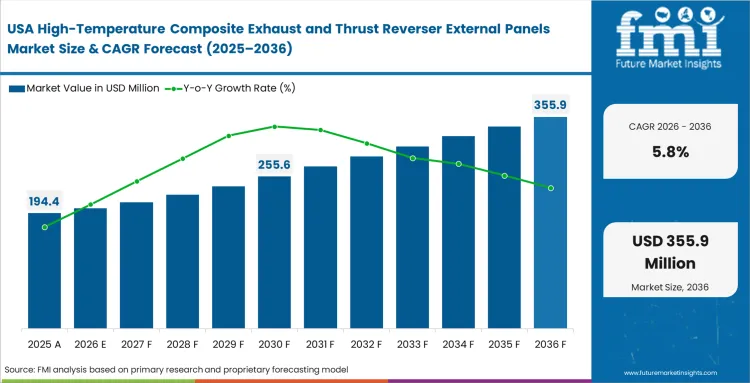
- United States: Large installed fleets and broad aerospace manufacturing capability keep the United States central to regional demand. Ongoing upgrade cycles across commercial aircraft programs continue to support panel replacement and higher-specification nacelle content, especially where qualification standards leave limited room for material inconsistency. Demand for high-temperature composite exhaust and thrust reverser external panels in the country is expected to rise at a 5.8% CAGR during the forecast period. Strong aftermarket depth and recurring retrofit activity keep the country closely tied to steady replacement demand.
- France: Close linkage to major commercial aircraft programs gives France a strong production position in this market. Demand in France is projected to advance at a 5.7% CAGR from the 2026 base. Composite panel demand remains closely tied to final assembly activity, localized nacelle-content supply, and short logistics loops that help maintain production discipline. Panel availability and manufacturing coordination remain especially important in the French market.
- United Kingdom: Specialized thermal and acoustic engineering capability continues to support the United Kingdom’s role in this category. Technical depth is more important here than scale alone, particularly in panel applications where resonance control, material behavior, and performance stability carry higher qualification weight. Adoption of high-temperature composite exhaust and thrust reverser external panels in the United Kingdom is likely to increase at a CAGR of 5.4% from 2026 to 2036. Such capability keeps the country relevant where engineering complexity matters more than output size.
- Canada: Business jet production gives Canada a different demand profile from the larger commercial-aircraft markets in this grouping. Smaller production runs and higher customization needs place more value on flexible manufacturing response and a tighter fit with program-specific panel requirements. Demand in Canada is forecast to rise at a 5.2% CAGR from 2026 to 2036 as tailored thrust reverser and exhaust-panel support remains relevant to business aviation output. Commercial value in Canada stays concentrated in specialized, lower-volume work rather than broad-based nacelle panel scale.
FMI's report includes Germany, Italy, Spain, and Mexico. Availability of specialized thermal-composite repair autoclaves across these secondary manufacturing centers continues to influence how quickly operators can adopt newer materials on regional routes. Poland is another market covered in the report, with aerospace manufacturing expansion and improving processing capability likely to strengthen its role in regional support over time.
Competitive Aligners for Market Players
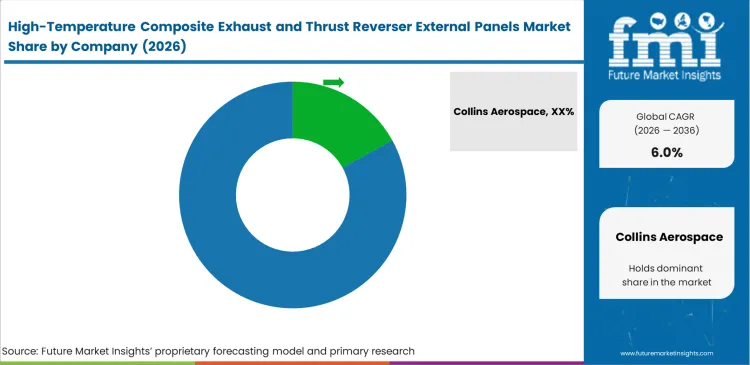
Thermal-acoustic panel design for high-bypass engines remains concentrated among suppliers with deeper qualification experience, validated acoustic datasets, and established certification records. Supplier standing in this market is shaped as much by approval depth as by manufacturing capability, which keeps participation in composite thrust reverser panels relatively narrow. Entry into selected thrust reverser applications depends on automated layup precision, repeatable processing quality, and the ability to convert process control into qualified panel supply. Competition at the upper end is therefore driven less by scale alone and more by proven execution within certified nacelle structures.
Incumbent suppliers benefit from a longer record of flight-hour exposure, which gives aircraft programs greater confidence in material behavior under repeated thermal and acoustic loading. Newer ceramic and thermoplastic solutions continue to move more slowly because on-wing degradation data remains limited even where laboratory results appear encouraging. Alternative material systems gain credibility where accelerated thermal-cycling simulation, early design-stage participation, and compatibility with adjacent aerospace material systems support qualification. Displacing established thrust reverser panel vendors depends less on equipment access and more on proving long-duration reliability before program formats are fixed.
Large commercial airlines still seek to avoid full dependence on a single supplier for high-wear nacelle components, especially where replacement cost and turnaround time carry direct operational impact. Independent repair capability is becoming more important in this setting because approved repair pathways can reduce reliance on fully proprietary supply channels. Modular exhaust-panel designs are also increasing the commercial value of serviceability, replacement planning, and field-level repair support. Competitive position now extends beyond panel supply alone, with greater weight placed on suppliers that can combine hardware support with degradation tracking, maintenance visibility, and lifecycle service. This keeps aftermarket capability closely tied to long-term value in nacelle panel programs.
Key Players in High-Temperature Composite Exhaust and Thrust Reverser External Panels Market
- Collins Aerospace
- Safran Nacelles
- Spirit AeroSystems
- FACC AG
- GKN Aerospace
Scope of the Report
| Metric | Value |
|---|---|
| Quantitative Units | USD 470.0 million to USD 841.7 million, at a CAGR of 6.0% |
| Market Definition | Engineered thermal-acoustic components forming outer aerodynamic shells of aircraft nacelle exhaust systems save weight under continuous extreme heat. |
| Segmentation | Product Type, Material System, Aircraft Platform, Temperature Class, Sales Channel, Region |
| Regions Covered | North America, Latin America, Europe, Asia Pacific, Middle East and Africa |
| Countries Covered | China, India, United Arab Emirates, United States, France, United Kingdom, Canada |
| Key Companies Profiled | Collins Aerospace, Safran Nacelles, Spirit AeroSystems, FACC AG, GKN Aerospace |
| Forecast Period | 2026 to 2036 |
| Approach | Aircraft delivery modeling linked to nacelle shipset requirements. |
Source: Future Market Insights (FMI) analysis, based on proprietary forecasting model and primary research
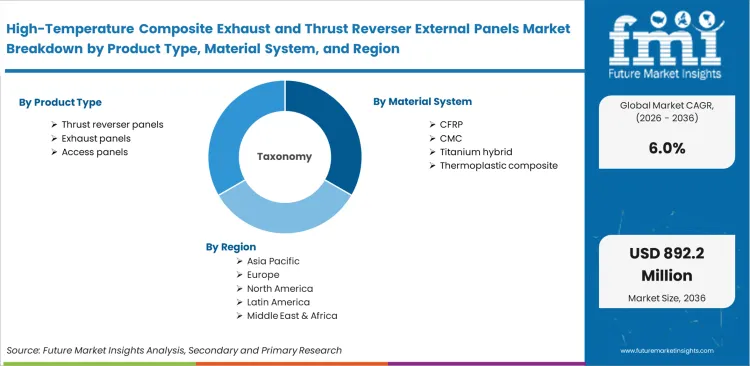
High-Temperature Composite Exhaust and Thrust Reverser External Panels Market Analysis by Segments
Product Type
- Thrust reverser panels
- Exhaust panels
- Access panels
Material System
- CFRP
- CMC
- Titanium hybrid
- Thermoplastic composite
Aircraft Platform
- Commercial aircraft
- Business jets
- Regional aircraft
- Military aircraft
Temperature Class
- 300-600°C
- 600-900°C
- Above 900°C
Sales Channel
- OEM line-fit
- Aftermarket
- MRO support
Region
- North America
- Latin America
- Europe
- Asia Pacific
- Middle East and Africa
Bibliography
- Wu, D., Chen, X., & Qiu, H. (2024). Test Scheme Design and Numerical Simulation of Composite Thrust Reverser Cascade. Aerospace, 11(8), 641.
- Riva, M., Airoldi, A., Morandini, M., Żurawski, R., Cavalli, L., & Boiocchi, M. (2024). Engineering of a CMC aeronautical muffler. Composites Part C: Open Access, 14, 100483.
- Wang, Z., Zhang, Y., Liu, Y., Wang, J., Zhou, X., & Pan, R. (2024). Study on the Pyrolysis and Fire Extinguishing Performance of High-Temperature-Resistant Ultrafine Dry Powder Fire Extinguishing Agents for Aviation Applications. Molecules, 29(15), 3500.
- Ramachandran, K., Bear, J. C., & Jayaseelan, D. D. (2025). Oxide-Based Ceramic Matrix Composites for High-Temperature Environments: A Review. Advanced Engineering Materials.
- Canale, G., Rubino, F., & Citarella, R. (2024). Design aspects of a CMC coating-like system for hot surfaces of aero engine components. Forces in Mechanics, 14, 100251.
This bibliography is provided for reader reference. The full FMI report contains the complete reference list with primary source documentation.
This Report Addresses
- Certification bottlenecks restricting continuous-fiber ceramic matrix integration within commercial nacelle assemblies.
- Weight-reduction imperatives forcing airframe engineers to abandon legacy titanium exhaust nozzle structures.
- Acoustic dampening requirements complicating layup processes for massive thrust reverser panels.
- Independent MRO challenges regarding access to proprietary high-temperature composite repair data.
- Operational cost impacts associated with specialized disposal procedures for degraded thermal thermosets.
- Regional production shifts driven by massive narrowbody delivery backlogs in Asian assembly hubs.
- Supplier lock-in dynamics tied directly to long-term aerospace qualification and flight-hour accumulation.
- Predictive maintenance transition utilizing digital thermal tracking within translating cowl architectures.
Frequently Asked Questions
What is the baseline valuation for high-temperature composite nacelle panels in 2026?
The sector crosses USD 470.0 million in 2026, driven directly by the uncompromising weight reduction targets established for next-generation high-bypass turbofan engines. This figure signals a permanent industry departure from heavy metallic containment structures toward highly engineered acoustic-thermal matrices.
Why do thrust reverser panels command the dominant 58.0% share position?
These specific assemblies represent the largest physical surface area within the heated nacelle envelope. Airframe integrators prioritize these massive panels for composite transition because swapping them yields the most dramatic payload recovery per engineering dollar spent.
What structural mechanism keeps CFRP at 46.0% despite the emergence of advanced ceramics?
Decades of accumulated flight-hour data give standard carbon fiber polymers an insurmountable certification advantage. Chief engineers specify this material for the 300°C boundary layers because aviation authorities already explicitly understand its long-term degradation profile, instantly clearing the qualification bottleneck.
Why does the commercial aircraft platform dominate demand dynamics?
Massive global order backlogs for fuel-efficient narrowbody airliners act as the primary volume engine for composite panel manufacturers. Fleet acquisition vice presidents mandate lightweight thermal structures to explicitly offset the increased mass of newer geared turbofan engines.
How does the OEM line-fit channel secure its 72.0% market position?
Nacelle systems require absolute dimensional perfection and are fully integrated before reaching the airframe factory. Supplier program managers lock in these initial builds because securing the primary assembly contract effectively guarantees decades of captive aftermarket replacement revenue.
What explains the growth divergence between China and the United States?
China advances at 7.4% through aggressive state-backed localization mandates forcing Western integrators to build domestic composite facilities. The United States tracks at 5.8% by focusing on continuous engineering upgrades across its massive installed base of legacy airframes.
Why do operators in the Middle East degrade thermal panels faster than European carriers?
Continuous ground-idle operations in extreme desert heat push the boundary layer dangerously close to the maximum thermal limit of baseline composites. Airlines flying these routes suffer accelerated matrix micro-cracking, completely destroying standard predictive maintenance schedules.
What barrier prevents independent MROs from capturing thrust reverser repair volume?
Tier-one integrators enforce strict intellectual property clauses protecting the exact acoustic geometries of their high-temperature panels. Facilities lacking this proprietary data cannot legally reproduce or certify major structural repairs, enforcing a powerful aftermarket monopoly.
How do acoustic dampening requirements complicate exhaust panel production?
Nacelle panels cannot just contain heat; they must actively attenuate engine noise. This dual requirement forces panels into highly complex sandwich-core layups, fundamentally preventing manufacturers from simply scaling up standard flat-panel aerospace production lines.
What penalty do airlines face if they delay the transition from titanium to composites?
Operators retaining heavy metallic exhaust systems suffer immediate payload restrictions and increased fuel consumption on every flight. This operational drag rapidly erodes route profitability, punishing carriers competing against fully composite-equipped rival fleets.
How does thermoplastic automation alter the supplier competitive landscape?
Switching from thermoset to thermoplastic matrices allows robotics to fuse panels without lengthy autoclave curing cycles. Facilities mastering this automated process slash production times by weeks, devastating the delivery schedules of competitors reliant on legacy manufacturing.
Why are specialized disposal procedures becoming a financial liability?
Extreme-heat thermoset resins resist standard chemical breakdown at the end of their operational lifecycle. Environmental compliance officers face escalating, highly specialized disposal fees that systematically erase the initial procurement savings generated by the composites.
What capability determines success for new entrants in the thermal panel sector?
Challenger suppliers must invest massive capital into accelerated thermal-cycling testing rigs. Proving mathematical reliability before gathering actual flight hours remains the only viable strategy to bypass the historical flight-data advantage held by incumbent integrators.
How do airlines attempt to break the tier-one supplier aftermarket monopoly?
Procurement executives actively fund mid-tier aerostructure companies to develop completely independent, FAA-approved repair protocols. Establishing these separate certification pathways provides the only leverage operators have to negotiate down exorbitant replacement panel pricing.
Why do narrowbody aircraft delivery backlogs dictate composite innovation?
The sheer volume of single-aisle aircraft required over the next decade justifies the massive non-recurring engineering costs associated with developing new ceramic matrices. Suppliers only recover their R&D investments by deploying technologies across thousands of identical airframes.
What specific risk do line mechanics introduce to high-temperature nacelles?
Ground handling equipment strikes routinely damage the aerodynamic surfaces of translating cowls. Because high-heat matrices resist rapid tarmac patching, a simple cart strike often forces a complete, highly expensive component swap rather than a quick composite repair.
How do future geared turbofan designs threaten current material specifications?
Next-generation propulsion designs inherently run hotter to maximize fuel efficiency, pushing the thermal envelope closer to 600°C. Material science directors must constantly reformulate their resins today to prevent catastrophic delamination on tomorrow's engine platforms.
Why do Gulf carriers willingly pay premium acquisition costs for ceramic matrices?
Operating high-frequency, long-haul routes requires absolute engine reliability. Technical operations leads specify expensive, hardened thermal packages strictly to avoid the massive revenue losses associated with grounding widebody aircraft for unscheduled structural repairs.
What operational shift occurs when suppliers embed sensors into thermal panels?
Digital thermal tracking allows fleet engineers to monitor the microscopic degradation of the composite matrix in real time. This explicit data stream shifts operators from reactive panel replacement toward highly optimized, predictive maintenance scheduling.
How does the 300-600°C temperature class dictate manufacturing processes?
This thermal band represents the precise threshold where standard aerospace composites fail but heavy metals become unnecessary. Assembly line supervisors can execute standard fastening techniques here without requiring the exotic, highly expensive joining methods demanded by turbine-core components.
What role do European acoustic engineering centers play in the supply chain?
Facilities located in France and the United Kingdom lead the global development of hybridized noise-attenuation structures. Solving the complex resonance issues created by modern engines establishes a massive intellectual property barrier that protects their market share.
Why do business jet applications require specialized production models?
Corporate aircraft require highly customized, lower-volume thrust reverser assemblies compared to commercial airliners. Procurement teams prioritize suppliers demonstrating agile, flexible production runs, allowing these specialized facilities to command significant margins over mass-producers.
Preview the report firsthand - request a free sample
Get SampleGet the brochure for pricing and purchase details.
Get PDFTable of Content
- Executive Summary
- Global Market Outlook
- Demand-side Trends
- Supply-side Trends
- Technology Roadmap Analysis
- Analysis and Recommendations
- Market Overview
- Market Coverage / Taxonomy
- Market Definition / Scope / Limitations
- Research Methodology
- Chapter Orientation
- Analytical Lens and Working Hypotheses
- Market Structure, Signals, and Trend Drivers
- Benchmarking and Cross-market Comparability
- Market Sizing, Forecasting, and Opportunity Mapping
- Research Design and Evidence Framework
- Desk Research Programme (Secondary Evidence)
- Company Annual and Sustainability Reports
- Peer-reviewed Journals and Academic Literature
- Corporate Websites, Product Literature, and Technical Notes
- Earnings Decks and Investor Briefings
- Statutory Filings and Regulatory Disclosures
- Technical White Papers and Standards Notes
- Trade Journals, Industry Magazines, and Analyst Briefs
- Conference Proceedings, Webinars, and Seminar Materials
- Government Statistics Portals and Public Data Releases
- Press Releases and Reputable Media Coverage
- Specialist Newsletters and Curated Briefings
- Sector Databases and Reference Repositories
- FMI Internal Proprietary Databases and Historical Market Datasets
- Subscription Datasets and Paid Sources
- Social Channels, Communities, and Digital Listening Inputs
- Additional Desk Sources
- Expert Input and Fieldwork (Primary Evidence)
- Primary Modes
- Qualitative Interviews and Expert Elicitation
- Quantitative Surveys and Structured Data Capture
- Blended Approach
- Why Primary Evidence is Used
- Field Techniques
- Interviews
- Surveys
- Focus Groups
- Observational and In-context Research
- Social and Community Interactions
- Stakeholder Universe Engaged
- C-suite Leaders
- Board Members
- Presidents and Vice Presidents
- R&D and Innovation Heads
- Technical Specialists
- Domain Subject-matter Experts
- Scientists
- Physicians and Other Healthcare Professionals
- Governance, Ethics, and Data Stewardship
- Research Ethics
- Data Integrity and Handling
- Primary Modes
- Tooling, Models, and Reference Databases
- Desk Research Programme (Secondary Evidence)
- Data Engineering and Model Build
- Data Acquisition and Ingestion
- Cleaning, Normalisation, and Verification
- Synthesis, Triangulation, and Analysis
- Quality Assurance and Audit Trail
- Market Background
- Market Dynamics
- Drivers
- Restraints
- Opportunity
- Trends
- Scenario Forecast
- Demand in Optimistic Scenario
- Demand in Likely Scenario
- Demand in Conservative Scenario
- Opportunity Map Analysis
- Product Life Cycle Analysis
- Supply Chain Analysis
- Investment Feasibility Matrix
- Value Chain Analysis
- PESTLE and Porter’s Analysis
- Regulatory Landscape
- Regional Parent Market Outlook
- Production and Consumption Statistics
- Import and Export Statistics
- Market Dynamics
- Global Market Analysis 2021 to 2025 and Forecast, 2026 to 2036
- Historical Market Size Value (USD Million) Analysis, 2021 to 2025
- Current and Future Market Size Value (USD Million) Projections, 2026 to 2036
- Y-o-Y Growth Trend Analysis
- Absolute $ Opportunity Analysis
- Global Market Pricing Analysis 2021 to 2025 and Forecast 2026 to 2036
- Global Market Analysis 2021 to 2025 and Forecast 2026 to 2036, By Product Type
- Introduction / Key Findings
- Historical Market Size Value (USD Million) Analysis By Product Type , 2021 to 2025
- Current and Future Market Size Value (USD Million) Analysis and Forecast By Product Type , 2026 to 2036
- Thrust reverser panels
- Exhaust panels
- Access panels
- Thrust reverser panels
- Y-o-Y Growth Trend Analysis By Product Type , 2021 to 2025
- Absolute $ Opportunity Analysis By Product Type , 2026 to 2036
- Global Market Analysis 2021 to 2025 and Forecast 2026 to 2036, By Material System
- Introduction / Key Findings
- Historical Market Size Value (USD Million) Analysis By Material System, 2021 to 2025
- Current and Future Market Size Value (USD Million) Analysis and Forecast By Material System, 2026 to 2036
- CFRP
- CMC
- Titanium hybrid
- Thermoplastic composite
- CFRP
- Y-o-Y Growth Trend Analysis By Material System, 2021 to 2025
- Absolute $ Opportunity Analysis By Material System, 2026 to 2036
- Global Market Analysis 2021 to 2025 and Forecast 2026 to 2036, By Aircraft Platform
- Introduction / Key Findings
- Historical Market Size Value (USD Million) Analysis By Aircraft Platform, 2021 to 2025
- Current and Future Market Size Value (USD Million) Analysis and Forecast By Aircraft Platform, 2026 to 2036
- Commercial aircraft
- Business jets
- Regional aircraft
- Military aircraft
- Commercial aircraft
- Y-o-Y Growth Trend Analysis By Aircraft Platform, 2021 to 2025
- Absolute $ Opportunity Analysis By Aircraft Platform, 2026 to 2036
- Global Market Analysis 2021 to 2025 and Forecast 2026 to 2036, By Temperature Class
- Introduction / Key Findings
- Historical Market Size Value (USD Million) Analysis By Temperature Class, 2021 to 2025
- Current and Future Market Size Value (USD Million) Analysis and Forecast By Temperature Class, 2026 to 2036
- 300–600°C
- 600–900°C
- Above 900°C
- 300–600°C
- Y-o-Y Growth Trend Analysis By Temperature Class, 2021 to 2025
- Absolute $ Opportunity Analysis By Temperature Class, 2026 to 2036
- Global Market Analysis 2021 to 2025 and Forecast 2026 to 2036, By Sales Channel
- Introduction / Key Findings
- Historical Market Size Value (USD Million) Analysis By Sales Channel, 2021 to 2025
- Current and Future Market Size Value (USD Million) Analysis and Forecast By Sales Channel, 2026 to 2036
- OEM line-fit
- Aftermarket
- MRO support
- OEM line-fit
- Y-o-Y Growth Trend Analysis By Sales Channel, 2021 to 2025
- Absolute $ Opportunity Analysis By Sales Channel, 2026 to 2036
- Global Market Analysis 2021 to 2025 and Forecast 2026 to 2036, By Region
- Introduction
- Historical Market Size Value (USD Million) Analysis By Region, 2021 to 2025
- Current Market Size Value (USD Million) Analysis and Forecast By Region, 2026 to 2036
- North America
- Latin America
- Western Europe
- Eastern Europe
- East Asia
- South Asia and Pacific
- Middle East & Africa
- Market Attractiveness Analysis By Region
- North America Market Analysis 2021 to 2025 and Forecast 2026 to 2036, By Country
- Historical Market Size Value (USD Million) Trend Analysis By Market Taxonomy, 2021 to 2025
- Market Size Value (USD Million) Forecast By Market Taxonomy, 2026 to 2036
- By Country
- USA
- Canada
- Mexico
- By Product Type
- By Material System
- By Aircraft Platform
- By Temperature Class
- By Sales Channel
- By Country
- Market Attractiveness Analysis
- By Country
- By Product Type
- By Material System
- By Aircraft Platform
- By Temperature Class
- By Sales Channel
- Key Takeaways
- Latin America Market Analysis 2021 to 2025 and Forecast 2026 to 2036, By Country
- Historical Market Size Value (USD Million) Trend Analysis By Market Taxonomy, 2021 to 2025
- Market Size Value (USD Million) Forecast By Market Taxonomy, 2026 to 2036
- By Country
- Brazil
- Chile
- Rest of Latin America
- By Product Type
- By Material System
- By Aircraft Platform
- By Temperature Class
- By Sales Channel
- By Country
- Market Attractiveness Analysis
- By Country
- By Product Type
- By Material System
- By Aircraft Platform
- By Temperature Class
- By Sales Channel
- Key Takeaways
- Western Europe Market Analysis 2021 to 2025 and Forecast 2026 to 2036, By Country
- Historical Market Size Value (USD Million) Trend Analysis By Market Taxonomy, 2021 to 2025
- Market Size Value (USD Million) Forecast By Market Taxonomy, 2026 to 2036
- By Country
- Germany
- UK
- Italy
- Spain
- France
- Nordic
- BENELUX
- Rest of Western Europe
- By Product Type
- By Material System
- By Aircraft Platform
- By Temperature Class
- By Sales Channel
- By Country
- Market Attractiveness Analysis
- By Country
- By Product Type
- By Material System
- By Aircraft Platform
- By Temperature Class
- By Sales Channel
- Key Takeaways
- Eastern Europe Market Analysis 2021 to 2025 and Forecast 2026 to 2036, By Country
- Historical Market Size Value (USD Million) Trend Analysis By Market Taxonomy, 2021 to 2025
- Market Size Value (USD Million) Forecast By Market Taxonomy, 2026 to 2036
- By Country
- Russia
- Poland
- Hungary
- Balkan & Baltic
- Rest of Eastern Europe
- By Product Type
- By Material System
- By Aircraft Platform
- By Temperature Class
- By Sales Channel
- By Country
- Market Attractiveness Analysis
- By Country
- By Product Type
- By Material System
- By Aircraft Platform
- By Temperature Class
- By Sales Channel
- Key Takeaways
- East Asia Market Analysis 2021 to 2025 and Forecast 2026 to 2036, By Country
- Historical Market Size Value (USD Million) Trend Analysis By Market Taxonomy, 2021 to 2025
- Market Size Value (USD Million) Forecast By Market Taxonomy, 2026 to 2036
- By Country
- China
- Japan
- South Korea
- By Product Type
- By Material System
- By Aircraft Platform
- By Temperature Class
- By Sales Channel
- By Country
- Market Attractiveness Analysis
- By Country
- By Product Type
- By Material System
- By Aircraft Platform
- By Temperature Class
- By Sales Channel
- Key Takeaways
- South Asia and Pacific Market Analysis 2021 to 2025 and Forecast 2026 to 2036, By Country
- Historical Market Size Value (USD Million) Trend Analysis By Market Taxonomy, 2021 to 2025
- Market Size Value (USD Million) Forecast By Market Taxonomy, 2026 to 2036
- By Country
- India
- ASEAN
- Australia & New Zealand
- Rest of South Asia and Pacific
- By Product Type
- By Material System
- By Aircraft Platform
- By Temperature Class
- By Sales Channel
- By Country
- Market Attractiveness Analysis
- By Country
- By Product Type
- By Material System
- By Aircraft Platform
- By Temperature Class
- By Sales Channel
- Key Takeaways
- Middle East & Africa Market Analysis 2021 to 2025 and Forecast 2026 to 2036, By Country
- Historical Market Size Value (USD Million) Trend Analysis By Market Taxonomy, 2021 to 2025
- Market Size Value (USD Million) Forecast By Market Taxonomy, 2026 to 2036
- By Country
- Kingdom of Saudi Arabia
- Other GCC Countries
- Turkiye
- South Africa
- Other African Union
- Rest of Middle East & Africa
- By Product Type
- By Material System
- By Aircraft Platform
- By Temperature Class
- By Sales Channel
- By Country
- Market Attractiveness Analysis
- By Country
- By Product Type
- By Material System
- By Aircraft Platform
- By Temperature Class
- By Sales Channel
- Key Takeaways
- Key Countries Market Analysis
- USA
- Pricing Analysis
- Market Share Analysis, 2025
- By Product Type
- By Material System
- By Aircraft Platform
- By Temperature Class
- By Sales Channel
- Canada
- Pricing Analysis
- Market Share Analysis, 2025
- By Product Type
- By Material System
- By Aircraft Platform
- By Temperature Class
- By Sales Channel
- Mexico
- Pricing Analysis
- Market Share Analysis, 2025
- By Product Type
- By Material System
- By Aircraft Platform
- By Temperature Class
- By Sales Channel
- Brazil
- Pricing Analysis
- Market Share Analysis, 2025
- By Product Type
- By Material System
- By Aircraft Platform
- By Temperature Class
- By Sales Channel
- Chile
- Pricing Analysis
- Market Share Analysis, 2025
- By Product Type
- By Material System
- By Aircraft Platform
- By Temperature Class
- By Sales Channel
- Germany
- Pricing Analysis
- Market Share Analysis, 2025
- By Product Type
- By Material System
- By Aircraft Platform
- By Temperature Class
- By Sales Channel
- UK
- Pricing Analysis
- Market Share Analysis, 2025
- By Product Type
- By Material System
- By Aircraft Platform
- By Temperature Class
- By Sales Channel
- Italy
- Pricing Analysis
- Market Share Analysis, 2025
- By Product Type
- By Material System
- By Aircraft Platform
- By Temperature Class
- By Sales Channel
- Spain
- Pricing Analysis
- Market Share Analysis, 2025
- By Product Type
- By Material System
- By Aircraft Platform
- By Temperature Class
- By Sales Channel
- France
- Pricing Analysis
- Market Share Analysis, 2025
- By Product Type
- By Material System
- By Aircraft Platform
- By Temperature Class
- By Sales Channel
- India
- Pricing Analysis
- Market Share Analysis, 2025
- By Product Type
- By Material System
- By Aircraft Platform
- By Temperature Class
- By Sales Channel
- ASEAN
- Pricing Analysis
- Market Share Analysis, 2025
- By Product Type
- By Material System
- By Aircraft Platform
- By Temperature Class
- By Sales Channel
- Australia & New Zealand
- Pricing Analysis
- Market Share Analysis, 2025
- By Product Type
- By Material System
- By Aircraft Platform
- By Temperature Class
- By Sales Channel
- China
- Pricing Analysis
- Market Share Analysis, 2025
- By Product Type
- By Material System
- By Aircraft Platform
- By Temperature Class
- By Sales Channel
- Japan
- Pricing Analysis
- Market Share Analysis, 2025
- By Product Type
- By Material System
- By Aircraft Platform
- By Temperature Class
- By Sales Channel
- South Korea
- Pricing Analysis
- Market Share Analysis, 2025
- By Product Type
- By Material System
- By Aircraft Platform
- By Temperature Class
- By Sales Channel
- Russia
- Pricing Analysis
- Market Share Analysis, 2025
- By Product Type
- By Material System
- By Aircraft Platform
- By Temperature Class
- By Sales Channel
- Poland
- Pricing Analysis
- Market Share Analysis, 2025
- By Product Type
- By Material System
- By Aircraft Platform
- By Temperature Class
- By Sales Channel
- Hungary
- Pricing Analysis
- Market Share Analysis, 2025
- By Product Type
- By Material System
- By Aircraft Platform
- By Temperature Class
- By Sales Channel
- Kingdom of Saudi Arabia
- Pricing Analysis
- Market Share Analysis, 2025
- By Product Type
- By Material System
- By Aircraft Platform
- By Temperature Class
- By Sales Channel
- Turkiye
- Pricing Analysis
- Market Share Analysis, 2025
- By Product Type
- By Material System
- By Aircraft Platform
- By Temperature Class
- By Sales Channel
- South Africa
- Pricing Analysis
- Market Share Analysis, 2025
- By Product Type
- By Material System
- By Aircraft Platform
- By Temperature Class
- By Sales Channel
- USA
- Market Structure Analysis
- Competition Dashboard
- Competition Benchmarking
- Market Share Analysis of Top Players
- By Region
- By Product Type
- By Material System
- By Aircraft Platform
- By Temperature Class
- By Sales Channel
- Competition Analysis
- Competition Deep Dive
- Collins Aerospace
- Overview
- Product Portfolio
- Profitability by Market Segments (Product/Age /Sales Channel/Region)
- Sales Footprint
- Strategy Overview
- Marketing Strategy
- Product Strategy
- Channel Strategy
- Safran Nacelles
- Spirit AeroSystems
- FACC AG
- GKN Aerospace
- Collins Aerospace
- Competition Deep Dive
- Assumptions & Acronyms Used


