

- Industry Size (2026)
- 1650.8 Mn
- Forecast (2036)
- USD 2085.6 Mn
- CAGR (2026 to 2036)
- 2.40%
Exhaust Flexible Couplings Market Size, Market Forecast and Outlook By FMI
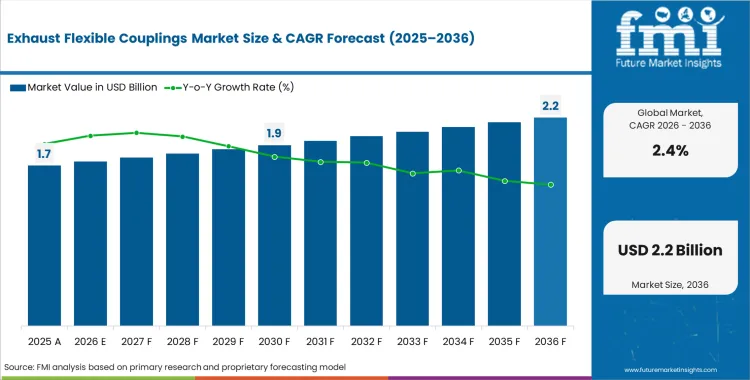
The exhaust flexible couplings market was valued at USD 1.6 billion in 2025 with the sales consistently rising, it is poised to surpass USD 1.7 billion in 2026 at a CAGR of 2.4% during the forecast period. Demand outlook carries total industry valuation to USD 2.1 billion through 2036 as internal combustion engines require longer-lasting thermal stress mitigation under tightening emission test cycles.
Summary of Exhaust Flexible Couplings Market
- Market Snapshot
- The exhaust flexible couplings market progressed at USD 1.6 billion in 2025 and is projected to reach USD 2.1 billion by 2036.
- The industry is expected to grow at a 2.4% CAGR from 2026 to 2036, creating an incremental opportunity of USD 0.4 billion over the period.
- This is a mature automotive exhaust component market where competitiveness depends on OE supply relationships, corrosion-resistant materials, and the ability to meet durability and NVH requirements across light and commercial vehicles.
- Demand remains tied to ongoing ICE and hybrid vehicle production, plus replacement demand from the aging installed fleet in major vehicle markets.
- Demand and Growth Drivers
- Demand is supported by continued global vehicle output, which keeps exhaust-line content relevant in passenger cars, LCVs, and HCVs that still rely on combustion-based drivetrains.
- Emissions regulation still matters because tighter EPA and Euro 7 frameworks keep exhaust system integrity, durability, and compliance performance under engineering scrutiny.
- Replacement demand remains important because aging fleets in Europe and other mature markets sustain aftermarket purchases for wear-prone exhaust joints and pipes.
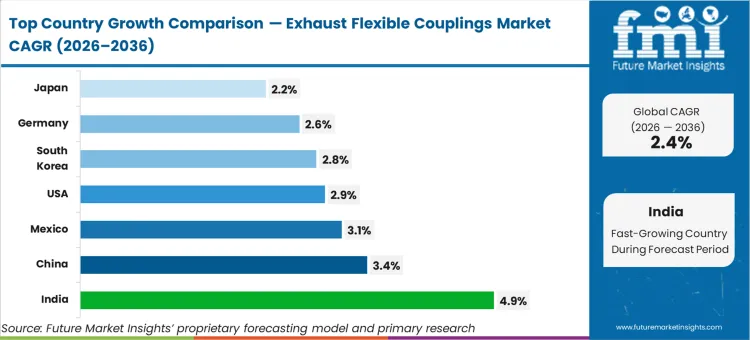
- Among key countries, India leads at 4.9% CAGR, followed by China at 3.4%, Mexico at 3.1%, U.S. at 2.9%, South Korea at 2.8%, Germany at 2.6%, and Japan at 2.2%.
- Growth stays moderate rather than high because the market is mature and part of the long-term addressable base gradually shifts down as EV penetration rises.
- Product and Segment View
- The market covers flexible joints used in exhaust systems, mainly built in stainless steel or other heat-resistant alloys to absorb vibration, misalignment, and thermal movement.
- These components are used across passenger vehicles, light commercial vehicles, and heavy commercial vehicles in both OEM fitment and replacement channels.
- First Fit (OEM) segment is estimated to account for 78% share in 2026, as automakers prioritize components that are built directly into the exhaust system during the initial assembly process.
- Supported by a massive global manufacturing base, Passenger Cars is anticipated to capture 66% of the market in 2026.
- Braided Flex Pipe serving the widest variety of standard vehicle exhaust configurations, this product type is expected to represent 54% of market share in 2026.
- Essential for meeting strict heat and rust resistance standards, stainless steel material is projected to secure 71% share in 2026.
- The scope includes flexible couplings, flex pipes, bellows, and ball-joint style connectors used in automotive exhaust routing, but excludes full exhaust systems, catalytic converters, mufflers, manifolds, and non-automotive industrial exhaust assemblies.
- Geography and Competitive Outlook
- India, China, and Mexico are the fastest-growing national markets in this set, while the U.S., Germany, and Japan remain stable high-value demand bases tied to large vehicle fleets and established supplier ecosystems.
- Competition is shaped by OE program wins, metallurgy capability, weld quality, and geographic manufacturing coverage rather than by branding alone.
- Key participants include BOSAL, Tenneco, FORVIA, Eberspächer, Benteler, Sango, and SJG Sejong.
- The market appears fragmented to moderately consolidated, with several regional and OE-focused suppliers still active beyond the leading group, including Dinex, Katcon, and Magna Flow.
Purchasing teams at every level of the car industry are running out of time to find parts that can handle the extreme heat of modern engines. The currently available engines run much hotter, resulting in standard connectors wearing out too early that leads to annoying rattles and dangerous exhaust leaks. Car makers that do not switch to better braided pipes risk facing massive and expensive repair recalls. In the past, buyers treated these exhaust joints like simple, cheap hardware, but now they are carefully checking exactly what kind of metal a supplier uses. It is becoming clear that the quality of the metal, along with the shape of the part, determines if a vehicle stays legal and quiet.
As car companies start demanding parts that last for 150,000 miles without a single leak, the traditional way of manufacturing things changes forever. Sourcing teams stop using cheap steel the moment a part fails a noise test. Moving to higher-quality metal mixes, as it remains the only way to make sure the car stays smooth and quiet, even after years of heavy driving.
India is anticipated to lead growth in this market, with demand likely to rise at a CAGR of 4.9% through 2036 as domestic factories increase vehicle output aligned with newer standards. China follows with the market expected to expand at a CAGR of 3.4%, supported by the rapid replacement and upgrade of aging delivery truck fleets. Mexico is projected to witness 3.1% CAGR during the forecast period as manufacturing activity and component demand continue to improve. Sales in the United States are likely to grow at a CAGR of 2.9%, driven by stronger buyer preference for localized parts production. South Korea is expected to record 2.8% CAGR through 2036, reflecting steady industrial demand and continued vehicle manufacturing activity. Germany is set to post a CAGR of 2.6% in the market, supported by its established automotive supply base. Japan is forecast to see 2.2% CAGR over the assessment period, indicating a more moderate pace shaped by its mature manufacturing environment.
Segmental Analysis
Exhaust Flexible Couplings Market Analysis by Sales Channel
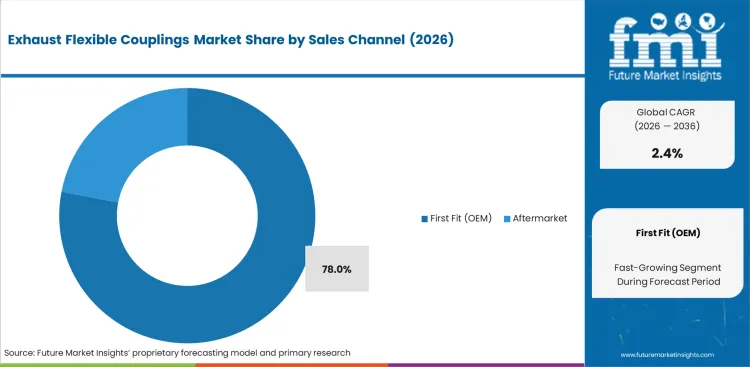
Vehicle manufacturers define vibration-control requirements early in the factory design cycle, which gives original-fit suppliers a structural advantage in component specification and sourcing. The First Fit (OEM) segment is estimated to account for 78.0% share in 2026, supported by long production programs and tighter integration with vehicle platform development. Purchasing teams at major automakers typically prefer long-term supply agreements that extend across the full lifecycle of a vehicle model, which strengthens OEM alignment from launch through replacement planning. Independent repair channels face greater difficulty matching factory-grade fit, durability, and vibration performance with off-the-shelf alternatives. FMI analysis indicates that tight packaging around catalytic converter connections also requires highly customized geometries, making it harder for generic replacement brands to replicate original equipment designs with the same precision.
- Platform Lock-In: Vehicle architectures demand specific harmonic isolation profiles. Procurement officers sign multi-year agreements covering entire production runs.
- Validation Hurdles: Factory parts undergo extreme thermal cycle testing. Independent suppliers avoid investing in equivalent certification processes.
- Warranty Protection: Automakers mandate exact replacement specifications for early failures. Dealership networks exclusively install authorized components during covered repairs.
Exhaust Flexible Couplings Market Analysis by Vehicle Type
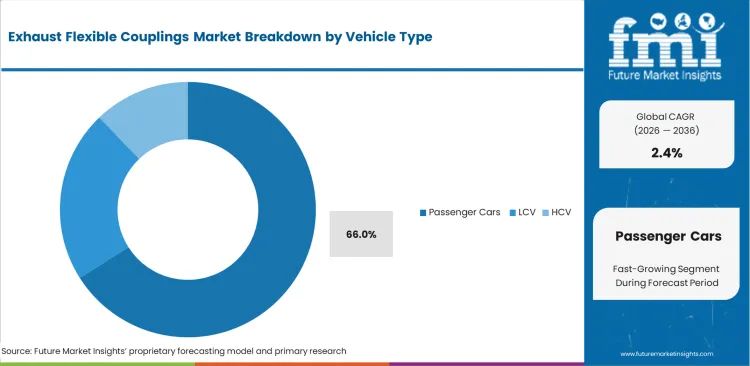
Mass production realities explain why Passenger Cars are anticipated to emerge with 66% market share in 2026. Car factories produce these vehicles in the millions, giving purchasing teams huge leverage to negotiate lower prices on exhaust components. Commercial trucks use completely different methods to manage engine heat, leaving regular cars as the main source of demand for these specific metal joints. Engineers working on smaller sedans also face the challenge of routing exhaust gases through very tight bends, which wears out standard pipes much faster. Placing heavy automotive mufflers further back in the system shifts all the vibration control work to the front, making high-quality flexible pipes essential for keeping the cabin quiet.
- Acoustic Tuning: Commuter cabins require near-silent operation. Chassis engineers tune flex pipes to cancel specific engine frequencies.
- Packaging Constraints: Compact engine bays limit routing options. Component designers invent tighter bend radii to fit restricted spaces.
- Volume Economics: Millions of units rolling off assembly lines dictate pricing power. Purchasing managers leverage scale to compress supplier margins.
Exhaust Flexible Couplings Market Analysis by Product Type
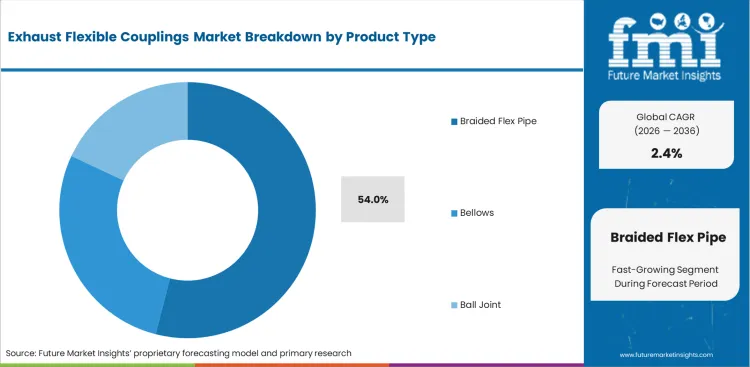
Engine setups that sit sideways in the car create a lot of twisting motion that easily tears standard exhaust pipes apart. Car designers specifically choose metal joints with protective wire mesh on the outside and smooth liners on the inside to absorb this constant movement. Pure, unprotected metal bellows are too fragile and often get damaged by rocks or debris bouncing off the road. FMI's assessment shows that a cracked automotive exhaust manifold is often caused by a weak flexible joint further down the line failing to absorb the engine's shaking. Supplying the best mix of strength and flexibility is why the Braided Flex Pipe segment is projected to secure a 54% share in 2026. Choosing the right braided design prevents severe damage to expensive engine blocks and keeps warranty claims low.
- Lateral Absorption: Transverse engine layouts generate extreme twisting forces. Powertrain engineers specify braided designs to counteract torque roll.
- Internal Flow: Smooth inner liners prevent exhaust gas turbulence. System designers reduce backpressure while maintaining flexibility.
- External Shielding: Woven wire mesh protects delicate inner corrugations. Maintenance supervisors observe fewer failures from stone strikes or road debris.
Exhaust Flexible Couplings Market Analysis by Material
Engine exhaust creates highly acidic moisture during short trips, which eats through basic steel very quickly. High temperatures push car makers to use metals that resist this constant chemical attack and hold their shape under extreme heat. These durability requirements explain why the stainless steel segment is estimated to represent 71% of the market in 2026. FMI analysts note that temperatures inside automotive three-way catalytic converter setups routinely get too hot for standard metals to handle. Using more expensive exotic alloys remains too costly for everyday commuter cars, making specific stainless grades the absolute baseline to avoid massive rust-related repair bills.
- Corrosion Resistance: Acidic moisture collects during short driving trips. Material scientists mandate high-chromium content to prevent rust-through.
- Thermal Endurance: Exhaust gases reach extreme temperatures under heavy load. Quality inspectors reject alloys that lose tensile strength when heated.
- Formability Limits: Complex bellows require deep drawing without tearing. Manufacturing directors select specific stainless grades that survive aggressive cold-forming.
Exhaust Flexible Couplings Market Drivers, Restraints, And Opportunities
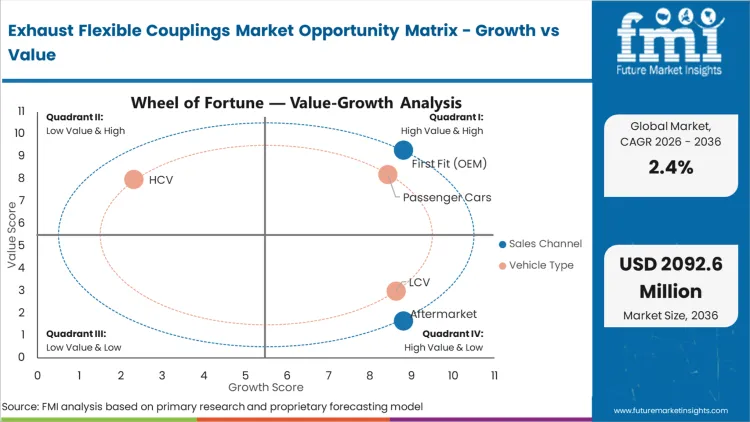
Strict rules around vehicle noise and pollution are forcing engineers to completely rethink how exhaust systems are built. Modern testing easily catches the small leaks that happen when stiff metal pipes crack under intense engine heat. Waiting for upgradation to better flexible joints puts car companies at direct risk of fines and delayed vehicle launches. Upgrading the automotive exhaust headers requires matching flexible connections further down the line that can handle the extra stiffness. Purchasing teams are now moving quickly to lock in contracts with specialized metal suppliers before rival brands buy all the available material.
Testing a newly shaped metal joint takes up to eighteen months of real-world driving, which creates a major roadblock for updating vehicle lines. Car makers will not approve a new design without hard proof that it can survive millions of miles on the road. This long approval process stops the industry from quickly switching to lighter, more efficient metals. Companies building new global emission control catalyst systems often have to delay their own product launches just because they are waiting for a compatible flexible joint to finish testing. The facilities that certify these parts simply cannot process every new design quickly enough to keep up with the demand.
- Marine Integration: Boat builders require similar isolation for emission control catalyst for marine setups. Powertrain directors gain valuable volume improvements in hybrid marine applications.
- Lightweight Alloy Adoption: Metallurgists develop thin-wall titanium configurations for performance vehicles. Chassis engineers shed critical mass without sacrificing exhaust manifolds and downpipes durability.
- Two-Wheeler Miniaturization: Motorcycle engineers adopt compact emission control catalyst for motorcycle dampeners. R&D teams slash physical prototyping costs significantly by translating automotive designs.
Regional Analysis
Based on regional analysis, exhaust flexible couplings market is segmented into North America, Latin America, Europe, Asia-Pacific, Oceania, and Middle East and Africa across 40 plus countries.
.webp "Top Country Growth Comparison Exhaust Flexible Couplings Market Cagr (2026 2036)")
| Country | CAGR (2026 to 2036) |
|---|---|
| India | 4.9% |
| China | 3.4% |
| Mexico | 3.1% |
| USA | 2.9% |
| South Korea | 2.8% |
| Germany | 2.6% |
| Japan | 2.2% |
Source: Future Market Insights (FMI) analysis, based on proprietary forecasting model and primary research
Asia-Pacific Exhaust Flexible Couplings Market Analysis
Rapidly growing domestic car factories across Asia are changing how local suppliers operate. Assembly plants need parts that can survive rough, unpaved roads and heavily loaded commercial trucks without breaking. Fleet owners are upgrading their entire exhaust systems to meet new air quality rules. FMI analysts note that this pushes truck companies to use much stronger metal connectors. Global car brands are moving their factories here and they prefer buying parts from local metal shops to keep costs down. Export-focused brands also demand higher quality parts to sell their cars globally, which raises the bar for everyone making car parts in the region. Integrating diesel particulate filter systems adds backpressure, testing the physical limits of existing pipe connectors.
- India: Domestic factories are building passenger cars at a massive scale, and demand for exhaust flexible couplings in India is anticipated to showcase a CAGR of 4.9% through 2036. Local parts suppliers are quickly expanding their metal-shaping factories to keep up with these massive car orders. Automakers expect these suppliers to deliver millions of parts with zero defects, especially since the local roads cause severe wear and tear on engine mounts. Securing these high-volume contracts requires proving that the metal joints will not crack under extreme daily vibration.
- China: Massive investments in upgrading commercial truck fleets drive a constant need for reliable replacement parts. The Exhaust Flexible Couplings market in China is expected to witness a rise in CAGR of 3.4% during the study period, as local factories use advanced robotic welding to build stronger parts. These automated factories give local suppliers a huge advantage over competitors who still rely on older, slower building methods. Fleet managers refuse to buy weak parts that cause their trucks to break down and lose money.
- South Korea: Export-focused car brands demand completely silent cabins for their premium sedans, making noise control a top priority. South Korea is set to record a CAGR of 2.8% in exhaust flexible couplings adoption during the assessment period. Selling cars in international markets requires passing strict noise and vibration tests. Automakers here force their suppliers to design exact metal shapes that block out all engine rattling before the cars leave the factory floor.
- Japan: Relentless focus on making hybrid cars run further on less fuel forces engineers to pack engine parts into very tight spaces. With a focus on this efficiency, Japan is projected to witness 2.2% CAGR in the exhaust flexible couplings market through 2036. Building smaller metal joints that still survive high heat and intense shaking is extremely difficult. Suppliers who figure out how to shrink these parts without making them weaker win the most profitable contracts.
FMI's report includes Vietnam, Thailand, and Indonesia. Expanding manufacturing zones in these neighboring countries share similar raw material needs, creating purchasing opportunities for diversified parts suppliers. Car makers across the broader region continue to share building techniques to keep their assembly lines moving smoothly.
North America Exhaust Flexible Couplings Market Analysis
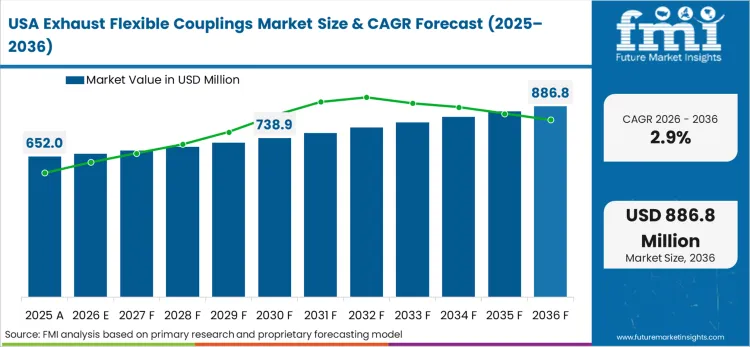
Heavy reliance on large pickup trucks shapes exactly how metal parts must perform in this region. Towing heavy trailers creates extreme heat that melts standard internal pipes very quickly. Supply chains stretch across borders, meaning raw metal tubes are drawn in one country, braided in another, and assembled near the final car factory. Advanced automotive emission test equipment installed right at these factories ensures no weak joints make it into a finished vehicle. Buyers focus entirely on securing steady shipments of high-quality steel to keep up with the constant demand for bigger trucks.
- Mexico: Factory managers rely on a skilled local workforce to weave complex wire meshes right next to major car assembly hubs. Exhaust flexible couplings sales in Mexico are poised to reach a CAGR of 3.1% during the assessment period, supported by this close physical proximity. Being located just miles away from the largest consumer markets guarantees a steady flow of long-term orders. Local suppliers who deliver parts exactly when the car factories need them easily beat out competitors shipping from overseas.
- USA: American drivers strongly prefer massive, heavy-duty pickup trucks, which forces parts makers to build oversized, incredibly tough metal joints. The U.S. sector is expected to register a CAGR of 2.9% through 2036 due to this constant need for heavy-duty hardware. Car makers in Detroit will only sign long-term deals with suppliers who prove their parts can survive years of intense pulling and shaking. Mastering this high-torque vibration control is the only way to survive in this specific truck-heavy environment.
FMI's report includes Canada. Heavy-duty farming and construction equipment built locally rely on the exact same thick-walled metal tubing, pushing suppliers to expand their factory capacities. Cross-border parts sharing remains the fastest way to keep truck assembly lines fully stocked.
Europe Exhaust Flexible Couplings Market Analysis
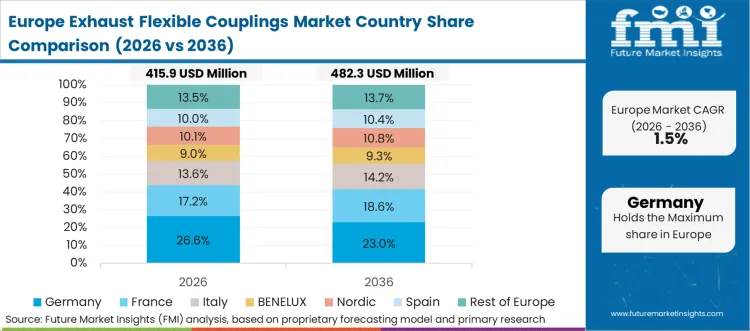
Strict environmental rules across the continent force car makers to completely rethink how they handle tailpipe gases. European authorities regularly check vehicles on the road to make sure they are not leaking harmful emissions, which heavily penalizes any car with cracked pipes. Purchasing teams look for suppliers who can provide advanced commercial vehicle SCR components that fit perfectly into tight car frames. FMI's assessment indicates that local metal buyers prioritize suppliers using highly purified steel that resists rusting during cold, wet winters. European brands risk massive fines if their exhaust parts fail early, making durability the main deciding factor.
- Germany: Engineering teams at premium German car brands demand the absolute highest quality metal forming for their luxury vehicles. Germany is anticipated to see exhaust flexible couplings grow at a CAGR of 2.6% over the forecast period as these strict standards become normal. These high-end cars run at very high speeds, generating intense heat that destroys average metal pipes in months. Local parts makers focus entirely on supplying specialized heat-resistant alloys to keep these expensive engines running flawlessly.
FMI's report includes the United Kingdom, France, and Italy. Car factories in these nations face similar pressures to reduce vehicle weight without losing strength, encouraging the use of newer, thinner metals. Regional parts makers are increasingly sharing their robotic welding techniques to meet the strict continental quality demands.
Competitive Aligners for Market Players
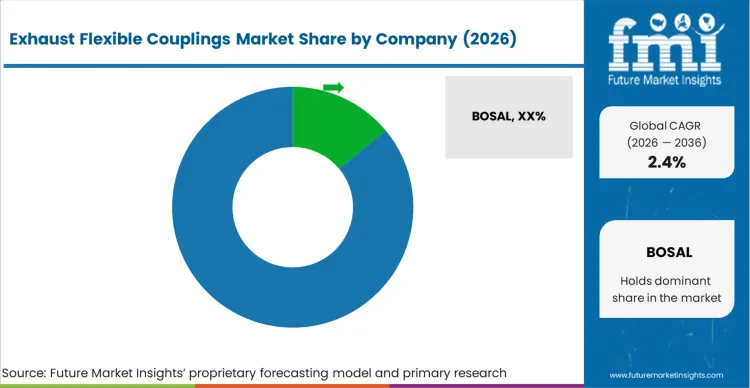
Car brands almost never rely on a single supplier to build their exhaust systems. Purchasing departments split massive vehicle orders across several different companies to keep prices competitive and guarantee a backup plan if one factory runs late. Parts makers who build highly automated, easily adjustable assembly lines often win extra business the moment a rival gets affected. Being able to shift production quickly is a basic requirement to survive in this sector. This flexibility is becoming even more critical as makers of lawn mowers and generators start demanding emission control catalyst for small engines, which rely on the exact same metal joints.
Older, established suppliers hold a massive head start simply because they own years of sound-testing records. Companies like FORVIA and Eberspächer use this long history to predict exactly how engine components like EGR coolers will shake and rattle the rest of the car. Stopping a vehicle from making a high-pitched whistling noise on the highway takes months of real-world driving and physical testing. Car makers refuse to gamble their reputation on unproven designs from new companies. A single bad batch of noisy parts easily triggers thousands of expensive dealership visits, forcing buyers to stick strictly with proven vendors.
Securing these massive volume contracts comes down to making millions of identical parts without a single mistake. Big names like BOSAL and Tenneco hold their positions through a deep understanding of how metals bend and survive extreme heat over years of use. Auto companies evaluate these partners heavily on their automated welding setups and how tightly they track raw materials. When a major vehicle brand builds cars globally, a metal joint stamped in Europe must fit and perform exactly like one assembled in Asia. There is zero room for variation, which completely locks smaller local shops out of competing for major vehicle platforms.
Key Players in Exhaust Flexible Couplings Market
- BOSAL
- Tenneco
- FORVIA (Faurecia)
- Eberspächer
- Benteler
- Sango
- SJG Sejong
Scope of the Report
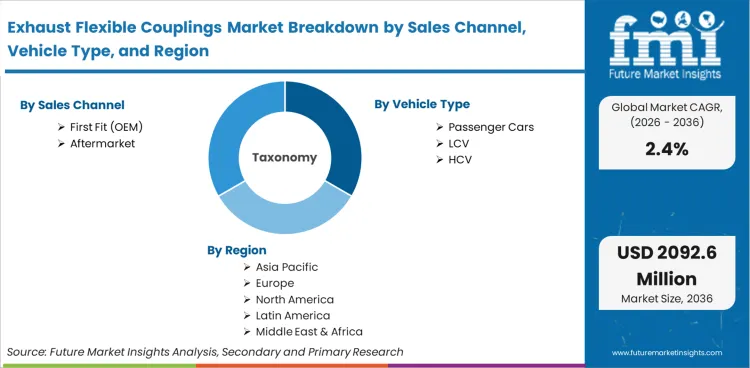
| Metric | Value |
|---|---|
| Quantitative Units | USD 1.7 billion to USD 2.1 billion, at a CAGR of 2.4% |
| Market Definition | Exhaust flexible couplings function as critical mechanical buffers that absorb vibration and thermal stress between engine blocks and rigid tailpipe structures. |
| Segmentation | By Sales Channel, By Vehicle Type, By Product Type, By Material, and Region |
| Regions Covered | North America, Latin America, Europe, East Asia, South Asia, Oceania, Middle East and Africa |
| Countries Covered | USA, China, India, Germany, Japan, South Korea, Mexico |
| Key Companies Profiled | BOSAL, Tenneco, FORVIA (Faurecia), Eberspächer, Benteler, Sango, SJG Sejong |
| Forecast Period | 2026 to 2036 |
| Approach | Global combustion engine vehicle production volumes mapped against standard component attachment rates. |
Source: Future Market Insights (FMI) analysis, based on proprietary forecasting model and primary research
Segments
By Sales Channel:
- First Fit (OEM)
- Aftermarket
By Vehicle Type:
- Passenger Cars
- LCV
- HCV
By Product Type:
- Braided Flex Pipe
- Bellows
- Ball Joint
By Material:
- Stainless Steel
- Other Alloys
Region:
- Asia Pacific
- India
- China
- Japan
- South Korea
- Indonesia
- Australia & New Zealand
- ASEAN
- Rest of Asia Pacific
- Europe
- Germany
- Italy
- France
- United Kingdom
- Spain
- Benelux
- Nordics
- Central & Eastern Europe
- Rest of Europe
- North America
- United States
- Canada
- Mexico
- Latin America
- Brazil
- Argentina
- Chile
- Rest of Latin America
- Middle East & Africa
- Kingdom of Saudi Arabia
- United Arab Emirates
- South Africa
- Turkey
- Rest of Middle East & Africa
Bibliography
- European Union. (2024). Regulation (EU) 2024/1257 of the European Parliament and of the Council of 24 April 2024 on type-approval of motor vehicles and engines and of systems, components and separate technical units intended for such vehicles, with respect to their emissions and battery durability (Euro 7), amending Regulation (EU) 2018/858 of the European Parliament and of the Council and repealing Regulations (EC) No 715/2007 and (EC) No 595/2009 of the European Parliament and of the Council, Commission Regulation (EU) No 582/2011, Commission Regulation (EU) 2017/1151, Commission Regulation (EU) 2017/2400 and Commission Implementing Regulation (EU) 2022/1362. Official Journal of the European Union.
- U.S. Environmental Protection Agency. (2024). Final Rule: Multi-Pollutant Emissions Standards for Model Years 2027 and Later Light-Duty and Medium-Duty Vehicles.
- Magesh, A., Ganesan, U., & Sundararajan, R. (2024). Key parameters that affect the fatigue life of metal bellows-type expansion joint: Another look. Materials Today Communications, 38, 108400.
- Zhou, S. (2024). Fatigue Life Analysis and Structural Parameter Optimization of Metal Bellows in Automotive Exhaust System based on Finite Element Model. International Journal of Vehicle Structures and Systems, 16(5).
- Chinchanikar, S., Mulik, H., Varude, P., Atole, S., & Mundada, N. (2024). A review of emerging hydroforming technologies: Design considerations, parametric studies, and recent innovations. Journal of Engineering and Applied Science, 71, 205.
- Imtiaz, H. H., Schaffer, P., Liu, Y., Hesse, P., Bergmann, A., & Kupper, M. (2024). Qualitative and Quantitative Analyses of Automotive Exhaust Plumes for Remote Emission Sensing Application Using Gas Schlieren Imaging Sensor System. Atmosphere, 15(9), 1023.
This bibliography is provided for reader reference. The full FMI report contains the complete reference list with primary source documentation.
This Report Addresses
- Component substitution risks associated with emerging high-temperature alloy requirements in passenger vehicle exhaust systems.
- Acoustic failure patterns driving warranty claims for low-grade stainless steel bellow configurations.
- Supply chain consolidation among tier-1 coupling manufacturers dictating pricing leverage across global markets.
- Impact of stringent emission cycles on physical durability requirements of braided flex pipes.
- Divergence in sourcing strategies between aftermarket distributors and factory-direct original equipment buyers.
- Heavy-duty truck requirements forcing engineers to rethink lateral vibration absorption techniques.
- Regional production shifts moving wire braiding operations closer to primary assembly hubs.
- Material science advancements enabling thinner-wall titanium connectors without sacrificing structural integrity.
Frequently Asked Questions
What was the Exhaust Flexible Couplings valuation in 2025?
Sales recorded a valuation of USD 1.6 billion in 2025 based on baseline production volumes.
What is the projected value for Exhaust Flexible Couplings by 2036?
Demand is poised to cross USD 2.1 billion by 2036 as durability mandates intensify globally.
What CAGR is anticipated from 2026 to 2036?
Sales are expected to expand at a 2.4% CAGR during the forecast period.
Which sales channel leads the sector?
First Fit (OEM) captures 78% share by locking in multi-year factory integration contracts.
Why does the aftermarket struggle to gain share?
Independent distributors cannot easily replicate precise harmonic tuning required by modern engine bays.
Which vehicle type dominates component volume?
Passenger Cars command 66% share due to massive global assembly line output constraints.
How do heavy commercial vehicles differ in component needs?
Trucks require significantly thicker braids to handle extreme torque roll and higher exhaust gas temperatures.
What product type leads adoption?
Braided Flex Pipe secures 54% share by providing optimal protection against both lateral movement and internal turbulence.
Why are pure bellows losing favor in specific applications?
Exposed corrugations suffer damage from road debris unless protected by external wire mesh.
Which material controls the supply chain?
Stainless Steel represents 71% share because it effectively resists acidic condensation during cold starts.
Why aren't exotic alloys used more frequently?
Titanium and high-nickel blends remain cost-prohibitive for standard commuter passenger platforms.
Which country leads growth across South Asia?
India tracks at a 4.9% CAGR driven by rapidly scaling domestic automobile manufacturing volumes.
What drives Chinese demand for advanced connectors?
China expands at 3.4% CAGR as commercial fleets upgrade hardware to meet strict new emission protocols.
How do United States buyers behave?
United States purchasers push a 2.9% CAGR by demanding ultra-durable components for heavy-duty pickup trucks.
Why is Mexico an important production hub?
Proximity to major assembly plants helps Mexico grow at 3.1% CAGR while offering competitive labor costs.
What structural pressure forces automakers to upgrade flex pipes?
Stricter acoustic regulations penalize microscopic leaks caused by thermal fatigue in rigid pipes.
How do warranty claims influence procurement?
Purchasing directors avoid cheap steel to prevent catastrophic engine manifold damage claims.
What role do interlock liners play?
Smooth internal liners reduce exhaust backpressure while preventing whistling noises at high engine speeds.
Why is automated welding critical for tier-1 suppliers?
Automakers demand absolute consistency across millions of units to prevent localized part failures.
Preview the report firsthand - request a free sample
Get SampleGet the brochure for pricing and purchase details.
Get PDFTable of Content
- Executive Summary
- Global Market Outlook
- Demand-side Trends
- Supply-side Trends
- Technology Roadmap Analysis
- Analysis and Recommendations
- Market Overview
- Market Coverage / Taxonomy
- Market Definition / Scope / Limitations
- Research Methodology
- Chapter Orientation
- Analytical Lens and Working Hypotheses
- Market Structure, Signals, and Trend Drivers
- Benchmarking and Cross-market Comparability
- Market Sizing, Forecasting, and Opportunity Mapping
- Research Design and Evidence Framework
- Desk Research Programme (Secondary Evidence)
- Company Annual and Sustainability Reports
- Peer-reviewed Journals and Academic Literature
- Corporate Websites, Product Literature, and Technical Notes
- Earnings Decks and Investor Briefings
- Statutory Filings and Regulatory Disclosures
- Technical White Papers and Standards Notes
- Trade Journals, Industry Magazines, and Analyst Briefs
- Conference Proceedings, Webinars, and Seminar Materials
- Government Statistics Portals and Public Data Releases
- Press Releases and Reputable Media Coverage
- Specialist Newsletters and Curated Briefings
- Sector Databases and Reference Repositories
- FMI Internal Proprietary Databases and Historical Market Datasets
- Subscription Datasets and Paid Sources
- Social Channels, Communities, and Digital Listening Inputs
- Additional Desk Sources
- Expert Input and Fieldwork (Primary Evidence)
- Primary Modes
- Qualitative Interviews and Expert Elicitation
- Quantitative Surveys and Structured Data Capture
- Blended Approach
- Why Primary Evidence is Used
- Field Techniques
- Interviews
- Surveys
- Focus Groups
- Observational and In-context Research
- Social and Community Interactions
- Stakeholder Universe Engaged
- C-suite Leaders
- Board Members
- Presidents and Vice Presidents
- R&D and Innovation Heads
- Technical Specialists
- Domain Subject-matter Experts
- Scientists
- Physicians and Other Healthcare Professionals
- Governance, Ethics, and Data Stewardship
- Research Ethics
- Data Integrity and Handling
- Primary Modes
- Tooling, Models, and Reference Databases
- Desk Research Programme (Secondary Evidence)
- Data Engineering and Model Build
- Data Acquisition and Ingestion
- Cleaning, Normalisation, and Verification
- Synthesis, Triangulation, and Analysis
- Quality Assurance and Audit Trail
- Market Background
- Market Dynamics
- Drivers
- Restraints
- Opportunity
- Trends
- Scenario Forecast
- Demand in Optimistic Scenario
- Demand in Likely Scenario
- Demand in Conservative Scenario
- Opportunity Map Analysis
- Product Life Cycle Analysis
- Supply Chain Analysis
- Investment Feasibility Matrix
- Value Chain Analysis
- PESTLE and Porter’s Analysis
- Regulatory Landscape
- Regional Parent Market Outlook
- Production and Consumption Statistics
- Import and Export Statistics
- Market Dynamics
- Global Market Analysis 2021 to 2025 and Forecast, 2026 to 2036
- Historical Market Size Value (USD Million) Analysis, 2021 to 2025
- Current and Future Market Size Value (USD Million) Projections, 2026 to 2036
- Y-o-Y Growth Trend Analysis
- Absolute $ Opportunity Analysis
- Global Market Pricing Analysis 2021 to 2025 and Forecast 2026 to 2036
- Global Market Analysis 2021 to 2025 and Forecast 2026 to 2036, By Sales Channel
- Introduction / Key Findings
- Historical Market Size Value (USD Million) Analysis By Sales Channel , 2021 to 2025
- Current and Future Market Size Value (USD Million) Analysis and Forecast By Sales Channel , 2026 to 2036
- First Fit (OEM)
- Aftermarket
- First Fit (OEM)
- Y-o-Y Growth Trend Analysis By Sales Channel , 2021 to 2025
- Absolute $ Opportunity Analysis By Sales Channel , 2026 to 2036
- Global Market Analysis 2021 to 2025 and Forecast 2026 to 2036, By Vehicle Type
- Introduction / Key Findings
- Historical Market Size Value (USD Million) Analysis By Vehicle Type, 2021 to 2025
- Current and Future Market Size Value (USD Million) Analysis and Forecast By Vehicle Type, 2026 to 2036
- Passenger Cars
- LCV
- HCV
- Passenger Cars
- Y-o-Y Growth Trend Analysis By Vehicle Type, 2021 to 2025
- Absolute $ Opportunity Analysis By Vehicle Type, 2026 to 2036
- Global Market Analysis 2021 to 2025 and Forecast 2026 to 2036, By Product Type
- Introduction / Key Findings
- Historical Market Size Value (USD Million) Analysis By Product Type, 2021 to 2025
- Current and Future Market Size Value (USD Million) Analysis and Forecast By Product Type, 2026 to 2036
- Braided Flex Pipe
- Bellows
- Ball Joint
- Braided Flex Pipe
- Y-o-Y Growth Trend Analysis By Product Type, 2021 to 2025
- Absolute $ Opportunity Analysis By Product Type, 2026 to 2036
- Global Market Analysis 2021 to 2025 and Forecast 2026 to 2036, By Region
- Introduction
- Historical Market Size Value (USD Million) Analysis By Region, 2021 to 2025
- Current Market Size Value (USD Million) Analysis and Forecast By Region, 2026 to 2036
- North America
- Latin America
- Western Europe
- Eastern Europe
- East Asia
- South Asia and Pacific
- Middle East & Africa
- Market Attractiveness Analysis By Region
- North America Market Analysis 2021 to 2025 and Forecast 2026 to 2036, By Country
- Historical Market Size Value (USD Million) Trend Analysis By Market Taxonomy, 2021 to 2025
- Market Size Value (USD Million) Forecast By Market Taxonomy, 2026 to 2036
- By Country
- USA
- Canada
- Mexico
- By Sales Channel
- By Vehicle Type
- By Product Type
- By Country
- Market Attractiveness Analysis
- By Country
- By Sales Channel
- By Vehicle Type
- By Product Type
- Key Takeaways
- Latin America Market Analysis 2021 to 2025 and Forecast 2026 to 2036, By Country
- Historical Market Size Value (USD Million) Trend Analysis By Market Taxonomy, 2021 to 2025
- Market Size Value (USD Million) Forecast By Market Taxonomy, 2026 to 2036
- By Country
- Brazil
- Chile
- Rest of Latin America
- By Sales Channel
- By Vehicle Type
- By Product Type
- By Country
- Market Attractiveness Analysis
- By Country
- By Sales Channel
- By Vehicle Type
- By Product Type
- Key Takeaways
- Western Europe Market Analysis 2021 to 2025 and Forecast 2026 to 2036, By Country
- Historical Market Size Value (USD Million) Trend Analysis By Market Taxonomy, 2021 to 2025
- Market Size Value (USD Million) Forecast By Market Taxonomy, 2026 to 2036
- By Country
- Germany
- UK
- Italy
- Spain
- France
- Nordic
- BENELUX
- Rest of Western Europe
- By Sales Channel
- By Vehicle Type
- By Product Type
- By Country
- Market Attractiveness Analysis
- By Country
- By Sales Channel
- By Vehicle Type
- By Product Type
- Key Takeaways
- Eastern Europe Market Analysis 2021 to 2025 and Forecast 2026 to 2036, By Country
- Historical Market Size Value (USD Million) Trend Analysis By Market Taxonomy, 2021 to 2025
- Market Size Value (USD Million) Forecast By Market Taxonomy, 2026 to 2036
- By Country
- Russia
- Poland
- Hungary
- Balkan & Baltic
- Rest of Eastern Europe
- By Sales Channel
- By Vehicle Type
- By Product Type
- By Country
- Market Attractiveness Analysis
- By Country
- By Sales Channel
- By Vehicle Type
- By Product Type
- Key Takeaways
- East Asia Market Analysis 2021 to 2025 and Forecast 2026 to 2036, By Country
- Historical Market Size Value (USD Million) Trend Analysis By Market Taxonomy, 2021 to 2025
- Market Size Value (USD Million) Forecast By Market Taxonomy, 2026 to 2036
- By Country
- China
- Japan
- South Korea
- By Sales Channel
- By Vehicle Type
- By Product Type
- By Country
- Market Attractiveness Analysis
- By Country
- By Sales Channel
- By Vehicle Type
- By Product Type
- Key Takeaways
- South Asia and Pacific Market Analysis 2021 to 2025 and Forecast 2026 to 2036, By Country
- Historical Market Size Value (USD Million) Trend Analysis By Market Taxonomy, 2021 to 2025
- Market Size Value (USD Million) Forecast By Market Taxonomy, 2026 to 2036
- By Country
- India
- ASEAN
- Australia & New Zealand
- Rest of South Asia and Pacific
- By Sales Channel
- By Vehicle Type
- By Product Type
- By Country
- Market Attractiveness Analysis
- By Country
- By Sales Channel
- By Vehicle Type
- By Product Type
- Key Takeaways
- Middle East & Africa Market Analysis 2021 to 2025 and Forecast 2026 to 2036, By Country
- Historical Market Size Value (USD Million) Trend Analysis By Market Taxonomy, 2021 to 2025
- Market Size Value (USD Million) Forecast By Market Taxonomy, 2026 to 2036
- By Country
- Kingdom of Saudi Arabia
- Other GCC Countries
- Turkiye
- South Africa
- Other African Union
- Rest of Middle East & Africa
- By Sales Channel
- By Vehicle Type
- By Product Type
- By Country
- Market Attractiveness Analysis
- By Country
- By Sales Channel
- By Vehicle Type
- By Product Type
- Key Takeaways
- Key Countries Market Analysis
- USA
- Pricing Analysis
- Market Share Analysis, 2025
- By Sales Channel
- By Vehicle Type
- By Product Type
- Canada
- Pricing Analysis
- Market Share Analysis, 2025
- By Sales Channel
- By Vehicle Type
- By Product Type
- Mexico
- Pricing Analysis
- Market Share Analysis, 2025
- By Sales Channel
- By Vehicle Type
- By Product Type
- Brazil
- Pricing Analysis
- Market Share Analysis, 2025
- By Sales Channel
- By Vehicle Type
- By Product Type
- Chile
- Pricing Analysis
- Market Share Analysis, 2025
- By Sales Channel
- By Vehicle Type
- By Product Type
- Germany
- Pricing Analysis
- Market Share Analysis, 2025
- By Sales Channel
- By Vehicle Type
- By Product Type
- UK
- Pricing Analysis
- Market Share Analysis, 2025
- By Sales Channel
- By Vehicle Type
- By Product Type
- Italy
- Pricing Analysis
- Market Share Analysis, 2025
- By Sales Channel
- By Vehicle Type
- By Product Type
- Spain
- Pricing Analysis
- Market Share Analysis, 2025
- By Sales Channel
- By Vehicle Type
- By Product Type
- France
- Pricing Analysis
- Market Share Analysis, 2025
- By Sales Channel
- By Vehicle Type
- By Product Type
- India
- Pricing Analysis
- Market Share Analysis, 2025
- By Sales Channel
- By Vehicle Type
- By Product Type
- ASEAN
- Pricing Analysis
- Market Share Analysis, 2025
- By Sales Channel
- By Vehicle Type
- By Product Type
- Australia & New Zealand
- Pricing Analysis
- Market Share Analysis, 2025
- By Sales Channel
- By Vehicle Type
- By Product Type
- China
- Pricing Analysis
- Market Share Analysis, 2025
- By Sales Channel
- By Vehicle Type
- By Product Type
- Japan
- Pricing Analysis
- Market Share Analysis, 2025
- By Sales Channel
- By Vehicle Type
- By Product Type
- South Korea
- Pricing Analysis
- Market Share Analysis, 2025
- By Sales Channel
- By Vehicle Type
- By Product Type
- Russia
- Pricing Analysis
- Market Share Analysis, 2025
- By Sales Channel
- By Vehicle Type
- By Product Type
- Poland
- Pricing Analysis
- Market Share Analysis, 2025
- By Sales Channel
- By Vehicle Type
- By Product Type
- Hungary
- Pricing Analysis
- Market Share Analysis, 2025
- By Sales Channel
- By Vehicle Type
- By Product Type
- Kingdom of Saudi Arabia
- Pricing Analysis
- Market Share Analysis, 2025
- By Sales Channel
- By Vehicle Type
- By Product Type
- Turkiye
- Pricing Analysis
- Market Share Analysis, 2025
- By Sales Channel
- By Vehicle Type
- By Product Type
- South Africa
- Pricing Analysis
- Market Share Analysis, 2025
- By Sales Channel
- By Vehicle Type
- By Product Type
- USA
- Market Structure Analysis
- Competition Dashboard
- Competition Benchmarking
- Market Share Analysis of Top Players
- By Regional
- By Sales Channel
- By Vehicle Type
- By Product Type
- Competition Analysis
- Competition Deep Dive
- BOSAL
- Overview
- Product Portfolio
- Profitability by Market Segments (Product/Age /Sales Channel/Region)
- Sales Footprint
- Strategy Overview
- Marketing Strategy
- Product Strategy
- Channel Strategy
- Tenneco
- FORVIA (Faurecia)
- Eberspächer
- Benteler
- Sango
- SJG Sejong
- BOSAL
- Competition Deep Dive
- Assumptions & Acronyms Used


