

- Industry Size (2026)
- USD 1.9 Bn
- Forecast (2036)
- USD 3.1 Bn
- CAGR (2026 to 2036)
- 5.0%
Exhaust Valve Actuator Market Size, Market Forecast and Outlook By FMI
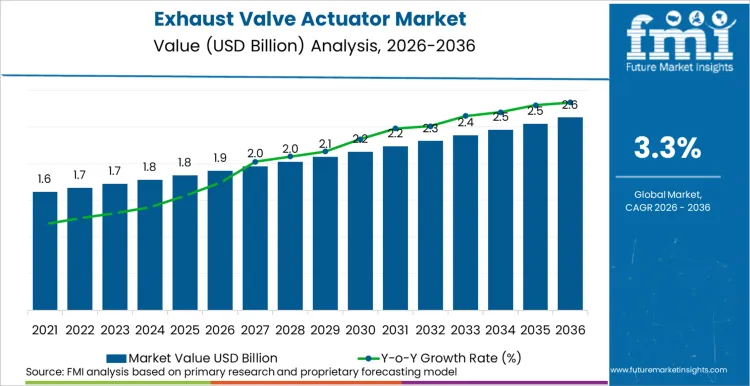
The exhaust valve actuator market was valued at USD 1.8 billion in 2025. Sales are estimated to cross USD 1.9 billion in 2026 at a CAGR of 5.0% during the forecast period. Steady rise in investment propels growth to USD 3.1 billion through 2036 as EPA 2027 multi-pollutant standards compel powertrain architects to mandate active thermal bypass loops for immediate catalyst light-off.
Summary of Exhaust Valve Actuator Market
- Market Snapshot
- The global landscape for exhaust valve actuator market established a valuation of USD 1.8 billion in 2025, with projections pushing it toward a substantial USD 3.1 billion by the year 2036.
- Expanding at a 5.0% CAGR from 2026 through the next decade, this industry is on track to unlock a fresh incremental opportunity worth USD 1.2 billion.
- Winning contracts in this space heavily depends on strict technical specifications, meaning automakers choose their suppliers based on how fast a valve responds, how long it lasts under extreme heat, and how well it keeps the vehicle legally compliant with emission laws.
- Traditional gas and diesel engines still dominate the roads today, anchoring the need for dependable actuators to manage turbochargers, backpressure, and everyday exhaust flow in both commuter cars and large commercial trucks.
- Demand And Growth Drivers
- Governments around the world are getting much stricter about vehicle pollution, which directly forces automakers to buy highly precise air and exhaust control systems for their light and medium-duty fleets.
- Car manufacturers overwhelmingly prefer the pinpoint accuracy of software-driven components, allowing electric actuation to easily dominate the landscape with a 76% slice of the market.
- Because these complex valves must be baked into the engine's original blueprint rather than bolted on later as an afterthought, factory-installed First Fit units account for an overwhelming 87% of all sales.
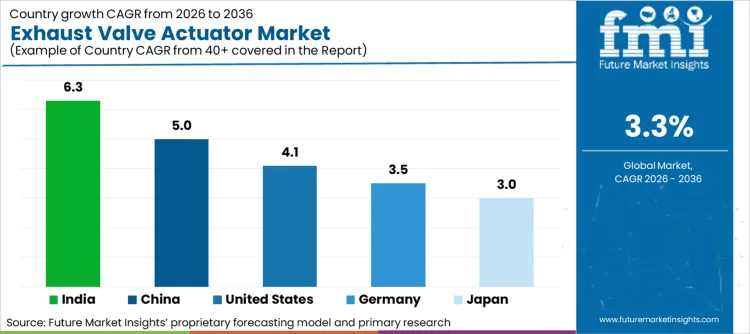
- Looking at regional expansion, India sets the fastest pace with a 6.3% CAGR, closely trailed by China expanding at a 5.0% CAGR and Mexico rising at a 4.4% CAGR, while established manufacturing hubs like the USA track at a 4.1% CAGR, South Korea at a 3.9% CAGR, Germany at a 3.5% CAGR, and Japan at a steady 3.0% CAGR.
- The inevitable transition toward fully electric vehicles acts as a natural speed bump for this industry, gradually shrinking the long-term need for exhaust-related parts in older, mature car markets.
- Product And Segment View
- At its core, this industry revolves around the specific mechanical and electric devices responsible for managing intense gas flow and pressure inside a vehicle's tailpipe network.
- You will typically find these vital components regulating turbochargers or adjusting acoustic exhaust flaps across everything from standard family sedans to heavy-duty commercial haulers.
- Securing an 87% portion of the total industry, the First Fit channel proves just how critical it is for engineers to integrate and calibrate these emission systems before the car ever leaves the factory floor.
- Capturing a commanding 76% of the space, electric actuators have become the standard choice over older pneumatic versions because they react instantly to complex commands from the car's main computer.
- Whether it is tuning the sound of a sports car or routing hot air to warm up a catalytic converter, exhaust flap applications sit at the top of the use-case list with a solid 49% foothold.
- The sheer volume of everyday commuters being built globally means passenger cars naturally drive the bulk of demand, holding a massive 73% position.
- Representing an 84% share of the landscape, standard internal combustion setups along with gas-hybrid models will comfortably remain the primary foundation for actuator sales through the coming decade.
- It is important to note that this analysis focuses strictly on the standalone smart valves themselves, leaving out entire turbocharger assemblies or full pipe networks.
- Geography And Competitive Outlook
- Emerging manufacturing powerhouses like India, China, and Mexico are seeing the most rapid local expansion, while nations like the USA and Germany maintain their status as highly profitable, stable centers for advanced emissions engineering.
- The battle for automaker contracts comes down to who can build a part that survives extreme heat and integrates flawlessly into a car's brain, with major names like BorgWarner, Bosch, Denso, Hitachi Astemo, MAHLE, Pierburg, and FORVIA leading the charge.
Powertrain calibration specialists face shrinking margins for error during cold-start emissions testing, making passive exhaust components obsolete. Choosing legacy vacuum controls risks failing real-driving emissions compliance protocols under varying load conditions. Procurement teams prioritizing piece-price over thermal durability frequently face catastrophic warranty claims when inferior motors bind at 900°C. One non-obvious reality complicating this transition involves packaging constraints; modern hybrid architectures leave minimal physical clearance for high-torque motors near catalytic converters, actively shaping automotive exhaust valve actuator demand. Engineering teams must source ultra-compact exhaust flexible couplings and related smart valves that survive immense radiant heat without melting internal circuitry.
Once engine control software integrates direct diagnostic feedback loops from smart valves, fault detection becomes instantaneous. Such architectural integration forces OEMs to adopt units with built-in position sensors rather than simple open-loop motors. Mandated OBD-II compliance protocols effectively eliminate basic mechanical flaps from future platform designs.
India is expected to lead the exhaust valve actuator market, with demand rising at a CAGR of 6.3% from 2026 to 2036 as BS-VI Phase 2 rules push active exhaust controls into compact, cost-sensitive vehicle platforms. China follows with 5.0% CAGR, supported by efforts to improve internal combustion engine efficiency and defend ICE competitiveness against battery electric vehicles. Mexico is projected to record 4.4% CAGR during the forecast period, helped by expanding nearshore assembly for North American vehicle programs. The United States is likely to grow at a CAGR of 4.1%, driven by stricter EPA multipollutant requirements. South Korea is set to post 3.9% CAGR through continued hybrid electric vehicle platform development. Germany is forecast to expand at 3.5% CAGR as legacy diesel platforms continue to phase out, while Japan is anticipated to witness 3.0% CAGR, reflecting its mature hybrid production base.
Segmental Analysis
Exhaust Valve Actuator Market Analysis by Sales Channel
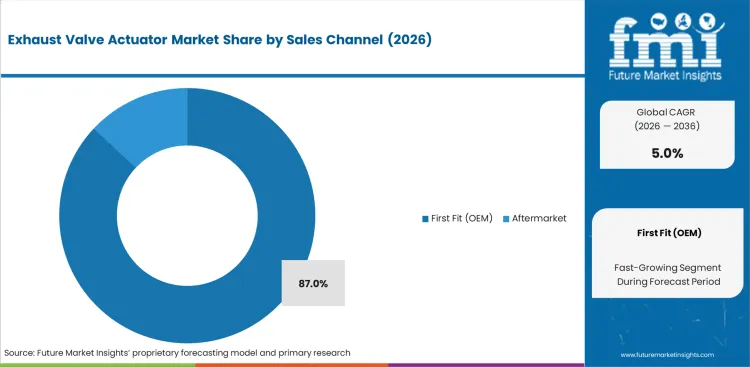
As carmakers design a new vehicle today, they hardwire the exhaust valve's software directly into the engine's main brain. This integration is so deep that the First Fit (OEM) channel is expected to completely dominate the landscape, capturing an 87% share in 2026 as independent shops struggle to compete. Aftermarket repairs are incredibly rare unless there is a physical crash, mostly because local mechanics simply do not have the dealership-level software codes needed to wake up a new smart valve. While some might think the replacement market will boom as cars get older, the reality is that these actuators fail as sealed units and require factory-level authorization to fix. Automakers are so focused on preventing massive warranty claims that they essentially lock out cheaper, third-party alternatives right from the blueprint stage.
- Initial design lock-in: Powertrain architects embed specific actuator response maps into core engine software during vehicle development. Tier-1 suppliers gain absolute exclusivity for platform lifespans.
- Diagnostic calibration barriers: Dealership technicians require proprietary communication protocols to initialize replacement units. Independent repair facilities face severe limitations when attempting aftermarket substitutions.
- Warranty exposure mitigation: Procurement managers demand 150,000-mile survival guarantees under extreme thermal stress. Suppliers failing these rigorous accelerated aging tests lose lucrative OEM contracts immediately.
Exhaust Valve Actuator Market Analysis by Actuation Type
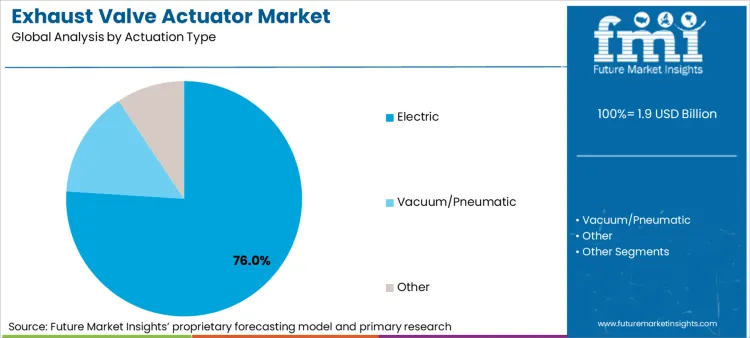
Electric models are officially pushing older vacuum-based systems into retirement, holding a projected 76% share in 2026. The reason for this massive change is the modern emission tests demanding split-second adjustments that old pneumatic setups cannot deliver. Engineers rely on high-torque electric motors because they resist carbon buildup much better than vacuum solenoids, which tend to lag and cause sudden pollution spikes when a driver steps hard on the gas. Even though these electric motors feel heavy in your hand, they actually make the entire car lighter because engineers can finally strip away all the messy, complicated vacuum hoses and reserve tanks that used to clutter the engine bay.
- Transient Load Management: Calibration specialists utilize millisecond response times to manage sudden throttle changes. Actuators failing to track these rapid commands trigger immediate emission compliance failures.
- Thermal Degradation Resistance: Metallurgy experts specify high-grade alloys for internal gear trains exposed to extreme heat. Units built with inferior materials bind permanently after extended high-load highway driving.
- Diagnostic Integration Value: Electrical architectures allow continuous position monitoring via dedicated sensor pins. Engineering teams leverage this data to preemptively detect carbon buildup before catastrophic sticking occurs.
Exhaust Valve Actuator Market Analysis by Application
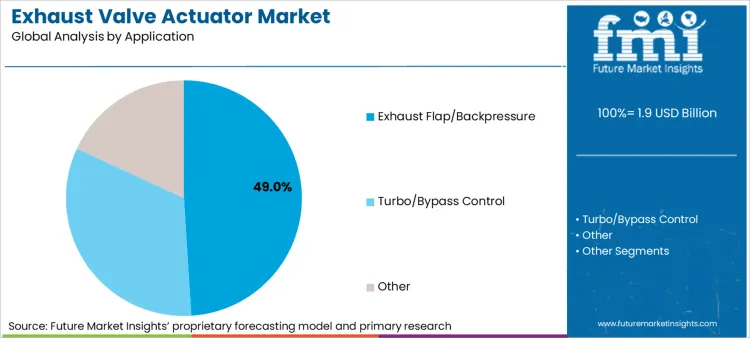
Controlling sound and heat has become an obsession for engineers working on high-end cars. They heavily rely on active exhaust flaps to cancel out the annoying, droning noises that happen when a car shuts down half its cylinders on the highway to save gas. Hybrid cars use these same flaps to hide the rough shudder of the gas engine constantly waking up and turning off. While normal engine valves handle the actual burning of fuel, these active flaps act like volume knobs for the tailpipe, making them so crucial to the driving experience that the Exhaust Flap application is poised to secure a commanding 49% share in 2026 across the industry.
- Acoustic Signature Tuning: NVH engineers map flap opening angles against engine RPM to eliminate cabin drone. Miscalibrated systems ruin passenger comfort during highway cruising scenarios.
- Thermal Bypass Routing: System architects direct cold exhaust gases away from main mufflers to accelerate catalyst heating. Slow actuation delays light-off times, risking immediate EPA test failures.
- Linkage Wear Prevention: Mechanical design teams must engineer connecting rods that survive extreme vibrational harmonics. Inadequate pivot tolerances lead to audible metallic rattling during cold engine starts.
Exhaust Valve Actuator Market Analysis by Vehicle Segment
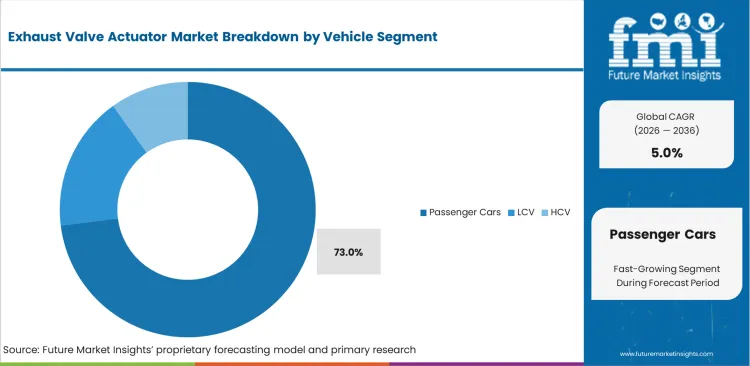
The sheer volume of everyday cars rolling off assembly lines dictates how fast new exhaust tech gets adopted worldwide. Driven by tough new global emission rules, automakers are slapping active exhaust management onto almost every everyday commuter car, helping passenger cars claim an estimated 73% share in 2026 as the primary volume driver. We are now witnessing the sophisticated heat and airflow parts on compact hatchbacks that used to be strictly reserved for six-figure luxury sedans. While it might look like car companies are just shrinking down the heavy-duty parts used in big diesel trucks, the truth is that squeezing a high-powered motor into the tiny, searing-hot space under a passenger car requires a completely custom, pancake-flat design.
- Volume Scale Economics: Procurement directors leverage million-unit passenger car platforms to drive down piece-part costs. Suppliers securing these contracts fund next-generation R&D through massive volume metrics.
- Packaging Space Constraints: Design engineers must fit high-torque motors into impossibly tight transmission tunnels. Actuators failing dimensional envelopes face immediate rejection during digital mockup phases.
- Fleet Compliance Pressure: Strategy officers mandate active thermal management to meet tightening corporate average fuel economy targets. Brands missing these technological transitions face severe financial penalties.
Exhaust Valve Actuator Market Analysis by Powertrain
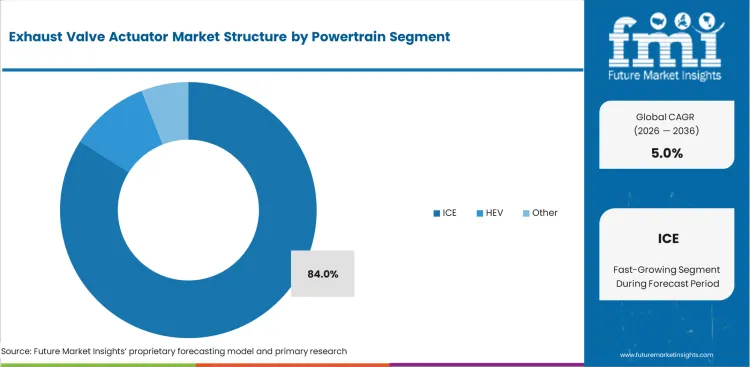
With an expected 84% share in 2026, traditional internal combustion engine (ICE) vehicles are keeping demand incredibly high as automakers scramble to meet incoming regulations. Car companies are working overtime to squeeze every last drop of efficiency out of their classic gas engines to keep them legally allowed on the road. While fully electric cars do not need exhaust pipes, the current transition period still relies heavily on these highly tuned gas engines. The challenge is actually worse for hybrids, because their engines turn on and off so often that the exhaust never gets hot enough to burn away sticky carbon buildup, forcing executives to spend millions upgrading dying gas engine designs while simultaneously trying to fund their future electric fleets.
- Late-Stage Optimization: Calibration engineers deploy active valves to squeeze minor emission reductions from aging engine blocks. These marginal gains keep legacy platforms legally viable for final production cycles.
- Carbon Fouling Mitigation: Maintenance specialists observe severe carbon buildup on flaps operating in low-temperature hybrid drive cycles. Actuator motors must possess sufficient reserve torque to break through this hardened residue.
- Capital Allocation Tension: Platform directors hesitate to approve expensive new actuator designs for fading ICE architectures. Suppliers offering modular solutions across multiple aging platforms win remaining high-volume contracts.
Exhaust Valve Actuator Market Drivers, Restraints, and Opportunities
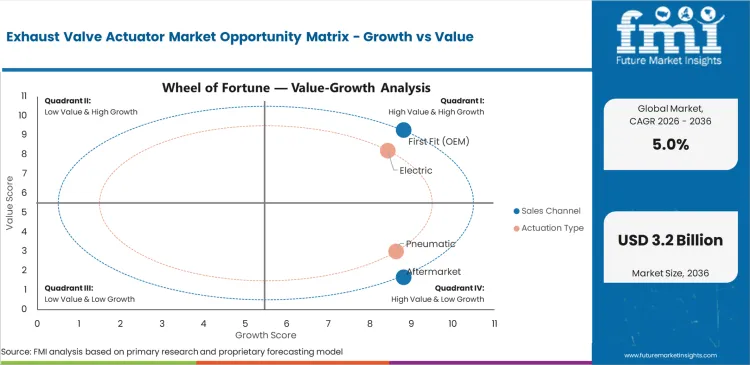
Automakers face intense pressure to heat up catalytic converters the exact moment an engine starts. Older, passive exhaust pipes simply take too long to warm up, and regulators now issue severe penalties for the pollution created during those first few seconds of cranking. To solve this, engineers use smart actuators that bypass cold metal and push raw exhaust heat directly where it is needed. Failing to make this shift means a car brand risks being banned from selling its vehicles in major markets. Beyond just meeting emission rules, these parts also solve a critical problem with vehicle sound. Premium car buyers absolutely reject the harsh, droning noise that happens when an engine shuts down a few cylinders to save fuel. Engineers rely on high-speed exhaust flaps to constantly tune the exhaust note. This strategy turns a forced regulatory upgrade into a marketable audio feature that complements automotive exhaust headers, expanding the broader emissions control components category.
Finding physical space for these smart valves creates a massive headache for vehicle designers. The area underneath a modern car is incredibly cramped, forcing engineers to mount sensitive electronic actuators right next to exhaust pipes radiating 900°C heat. That extreme temperature easily melts plastic gears and destroys internal circuitry. Bolting on heavy thermal shields is rarely a viable option because it adds unacceptable weight and manufacturing cost. Design teams constantly fight to find a mounting spot that remains cool enough for the motor to survive, yet sits close enough to the valve to ensure precise mechanical control. Trying to mount the motor safely away from the heat and connecting it with cables offers a temporary fix, but those cables stretch and lose precision as the vehicle ages. That loss of mechanical accuracy makes it incredibly difficult to maintain seamless integration with any global emission control catalyst over the lifespan of the car.
- Hybrid Thermal Management: Powertrain directors require specialized hardware to manage frequent engine stop-start cycles. Developing units resistant to extreme thermal shock secures contracts as a leading exhaust thermal management actuator provider.
- Integrated Smart Modules: Purchasing managers prefer buying complete, pre-calibrated exhaust sections. Suppliers combining automotive electric coolant valve technologies with exhaust flaps into single modules capture higher margins.
- OBD-II Diagnostic Software: Calibration engineers need robust algorithms to monitor actuator health. Offering advanced predictive maintenance software alongside physical hardware creates lucrative recurring revenue streams.
Regional Analysis
.webp "Top Country Growth Comparison Exhaust Valve Actuator Market Cagr (2026 2036)")
The global push for cleaner air is reshaping how car parts are made everywhere, with different parts of the world growing at their own pace based on how quickly their local governments enforce new emission rules. As automakers balance environmental pressure with production costs, regional strategies are shifting dramatically to keep up with these localized demands.
| Country | CAGR (2026 to 2036) |
|---|---|
| India | 6.3% |
| China | 5.0% |
| Mexico | 4.4% |
| USA | 4.1% |
| South Korea | 3.9% |
| Germany | 3.5% |
| Japan | 3.0% |
Source: Future Market Insights (FMI) analysis, based on proprietary forecasting model and primary research
Asia-Pacific Exhaust Valve Actuator Market Analysis
Car manufacturers across this merged region are handling totally different challenges depending on their local buyers. India's strict new pollution rules mean carmakers have to quickly figure out how to put advanced thermal parts into affordable, compact cars without raising the sticker price. China is trying to make traditional gas engines run as cleanly as possible so they can still compete with the massive wave of electric vehicles. Over in Japan and South Korea, the focus is heavily on hybrid cars, which require incredibly tough parts that can survive the engine constantly turning on and off in daily traffic.
- India: Car companies here are rushing to find local suppliers for these smart exhaust parts because importing them from overseas is simply too expensive for their budget-conscious market. This urgent push to build things locally is a big reason why India is expected to see demand grow at a steady CAGR of 6.3% through 2036, giving homegrown manufacturers a huge advantage over international rivals.
- China: Demand in China is projected to rise at a 5.0% CAGR over the forecast period, as manufacturers continue improving the efficiency of conventional internal combustion engines. The focus remains on lowering emissions and operating costs to keep these platforms competitive. Progress in this area could also strengthen future export potential for locally developed engine technologies.
- South Korea: Because hybrid cars turn their engines on and off constantly during a single drive, the exhaust parts get blasted with sudden, extreme temperature changes. To solve this mechanical headache, engineers in South Korea are projecting a 3.9% CAGR through 2036 as they actively work on designing high-tech actuators that won't crack under stress, helping brands cut down on expensive warranty repairs.
- Japan: Since the country already manufactures a massive number of hybrid vehicles, their factory buyers are able to negotiate great long-term deals for these specialized, high-temperature motors. This cost advantage helps keep their hybrid fleets highly profitable worldwide, supporting steady market expansion with a 3.0% CAGR expected by the time the forecast window closes.
Cross-border collaboration among East Asian and South Asian Tier-1 suppliers continues to accelerate innovation in advanced ceramic gear trains and high-temperature metallurgy. This shared technical integration ultimately cements the broader Asia-Pacific region's position as a critical, highly optimized manufacturing hub for next-generation emissions control components.
North America & Latin America Exhaust Valve Actuator Market Analysis
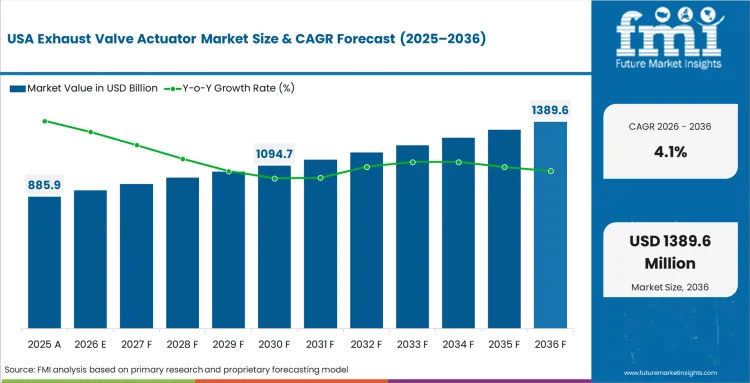
New environmental rules in the USA mean that carmakers now have to trap and route exhaust heat the absolute second you start your engine, which takes a lot of clever engineering. To make this happen without going over budget, companies are shifting a lot of their complex assembly work southward. By bringing these heavy, complicated exhaust modules closer to home, brands can keep up with the strict demands of American drivers while keeping their supply chains moving smoothly.
- Mexico: With a projected 4.4% CAGR over the next ten years, Mexico is rapidly becoming the go-to destination for building these intricate exhaust systems. Setting up factories right next door to the United States helps automotive brands save a fortune on international shipping costs while relying on a highly skilled local workforce.
- USA.: Engineers are installing high-speed exhaust flaps to stop the annoying buzzing sound that happens inside large pickup trucks when certain engine cylinders shut off to save gas. This dedication to keeping the cabin quiet and comfortable for picky truck buyers is why the USA sector is anticipated to register a 4.1% CAGR through 2036, making it a reliable and highly specialized growth spot.
Regional procurement directors are increasingly prioritizing vendors who establish dedicated testing facilities directly adjacent to major vehicle assembly plants. This strategic nearshoring fundamentally optimizes supply chain logistics, reduces inventory holding costs across the hemisphere, and ensures strict adherence to unified North American quality protocols.
Europe Exhaust Valve Actuator Market Analysis
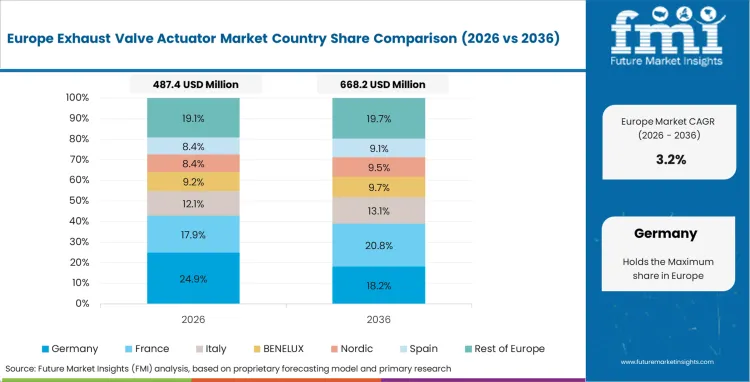
Europe’s incredibly strict Euro 7 rules are forcing auto companies to completely scrap their older, passive exhaust designs. The continent's lawmakers now want complete transparency, meaning every single emission-critical part needs to be individually tracked and monitored. To deal with this headache, car brands are refusing to buy individual pieces, asking their suppliers to deliver fully assembled, smart exhaust systems that plug right into the car's main computer.
- Germany: The difficult move away from traditional diesel engines means German factories are having to spend an enormous amount of money to completely retool their assembly lines. Fortunately, the companies that manage to build these advanced new systems will be able to sell them globally, fueling a 3.5% CAGR as they adapt to and conquer these tight environmental regulations.
European original equipment manufacturers continue to reject decentralized architectures, demanding instead that Tier-1 providers supply complete cold-end modules featuring pre-calibrated actuators communicating seamlessly with central engine control units. Failure to deliver these integrated diagnostic solutions effectively locks sub-suppliers out of next-generation platform bidding entirely.
Competitive Aligners for Market Players
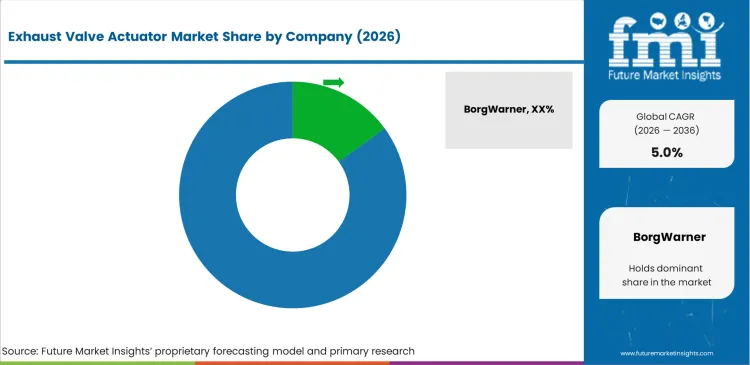
Contract awards in this segment increasingly go to suppliers that can deliver complete systems rather than standalone components. Automakers no longer want to source individual motors in isolation. They prefer fully assembled and validated exhaust flap modules from established suppliers such as BorgWarner and MAHLE. Vendors that can supply an integrated cold-end exhaust section with pre-calibrated software are in a stronger position to win OEM programs. This leaves independent motor makers with fewer direct entry points and pushes many of them into sub-supplier roles under larger system integrators.
Established companies benefit from something less visible but equally important: years of accumulated test data. They understand how different materials respond to repeated exposure to temperatures near 900°C, and that operating history gives them an advantage that new entrants cannot build quickly. A startup may reverse-engineer a motor design, though it still cannot replicate years of salt-spray, thermal cycling, and carbon-deposit validation without extensive physical testing. Bosch extends this advantage by adding predictive software that helps identify likely failures earlier in the component life cycle. Smaller exhaust valve actuator suppliers often try to compete on price, though lower-cost bids tend to lose ground when automakers apply strict durability requirements during qualification.
Automakers are still trying to avoid excessive dependence on a small group of large vendors. Purchasing teams are standardizing core architectures more carefully and asking suppliers to develop modular components that can fit different exhaust pipe sizes without a full redesign. This gives manufacturers room to divide volume across multiple qualified OEM suppliers and preserve bargaining leverage. The next major challenge will come from plug-in hybrids, where repeated engine cycling creates heavier condensation and faster carbon buildup. Suppliers that can engineer components to withstand those conditions will be better positioned as exhaust control requirements become more demanding.
Key Players in Exhaust Valve Actuator Market
- BorgWarner
- Bosch
- Denso
- Hitachi Astemo
- MAHLE
- Pierburg (Rheinmetall)
- FORVIA
Scope of the Report
| Metric | Value |
|---|---|
| Quantitative Units | USD 1.9 billion to USD 3.1 billion, at a CAGR of 5.0% |
| Market Definition | Electromechanical devices designed to modulate gas flow, backpressure, and acoustic signatures within vehicle exhaust systems to meet stringent emission targets. |
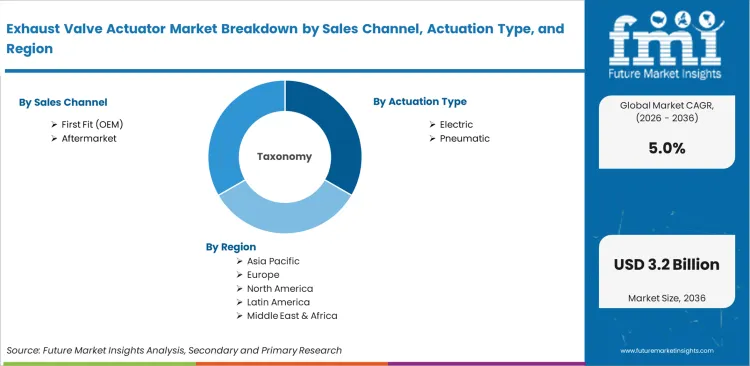
| Segmentation | By Sales Channel, By Actuation Type, By Application, By Vehicle Segment, By Powertrain, and By Region |
| Regions Covered | North America, Latin America, Europe, East Asia, South Asia & Pacific, Middle East & Africa |
| Countries Covered | USA, China, India, Germany, Japan, South Korea, Mexico |
| Key Companies Profiled | BorgWarner, Bosch, Denso, Hitachi Astemo, MAHLE, Pierburg (Rheinmetall), FORVIA |
| Forecast Period | 2026 to 2036 |
| Approach | Vehicle production volume forecasts anchored total addressable component sizing |
Source: Future Market Insights (FMI) analysis, based on proprietary forecasting model and primary research
Segments:
By Sales Channel
- First Fit (OEM)
- Aftermarket
By Actuation Type
- Electric
- Pneumatic
By Application
- Exhaust Flap
- Turbo Control
- Other
By Vehicle Segment
- Passenger Cars
- LCV
- HCV
By Powertrain
- ICE
- HEV
- Other
Region
- Asia Pacific
- India
- China
- Japan
- South Korea
- Indonesia
- Australia & New Zealand
- ASEAN
- Rest of Asia Pacific
- Europe
- Germany
- Italy
- France
- United Kingdom
- Spain
- Benelux
- Nordics
- Central & Eastern Europe
- Rest of Europe
- North America
- United States
- Canada
- Mexico
- Latin America
- Brazil
- Argentina
- Chile
- Rest of Latin America
- Middle East & Africa
- Kingdom of Saudi Arabia
- United Arab Emirates
- South Africa
- Turkey
- Rest of Middle East & Africa
Bibliography
- USA Environmental Protection Agency. (2024). Final Rule: Multi-Pollutant Emissions Standards for Model Years 2027 and Later Light-Duty and Medium-Duty Vehicles. USA Environmental Protection Agency.
- United Nations Economic Commission for Europe. (2024). UN Regulation No. 154 Rev.3 Amend.1. UNECE.
- Kim, J., Vallinmaki, M., Tuominen, T., & Mikulski, M. (2024). Variable valve actuation for efficient exhaust thermal management in an off-road diesel engine. Applied Thermal Engineering, 246, 122940.
- Krakowian, K. (2024). Impact of Multi-Valve Exhaust Gas Recirculation (EGR) System on Nitrogen Oxides Emissions in a Multi-Cylinder Engine. Energies, 17(24), 6473.
- Kuroda, J., Imanaga, M., & Kuroda, Y. (2024). Study on linear actuators for intake and exhaust systems of internal combustion engines (Analytical consideration of thrust characteristics by permanent magnet array). In Advances in Vehicle Control and Safety (AVEC 2024). Springer.
This bibliography is provided for reader reference. The full FMI report contains the complete reference list with primary source documentation.
This Report Addresses
- Diagnostics integration requirements for smart electric actuators.
- Cold-start catalyst light-off strategies driven by EPA 2027 mandates.
- Passenger car packaging constraints limiting high-torque motor dimensions.
- Component localization efforts among Indian Tier-1 component suppliers.
- Warranty exposure risks tied to thermal degradation of plastic gear trains.
- Acoustic tuning strategies deployed by NVH engineers for hybrid powertrains.
- First Fit (OEM) dominance over independent aftermarket replacement channels.
- Modular platform strategies allowing procurement teams to split volume contracts.
Frequently Asked Questions
what is an exhaust valve actuator?
It is an electromechanical or pneumatic device that controls exhaust gas flow, manages backpressure, and modulates acoustic signatures to meet strict emission and NVH targets.
how does an exhaust valve actuator work?
These actuators receive signals from the engine control unit to open or close internal flaps, redirecting hot exhaust gases for rapid catalyst heating or muting cabin drone.
how big is the exhaust valve actuator market?
The industry valuation stands at USD 1.9 billion in 2026, driven by global implementation of stringent multi-pollutant emission regulations.
summarize exhaust valve actuator market size and CAGR?
Demand is projected to expand from USD 1.9 billion in 2026 to USD 3.1 billion by 2036, advancing at a 5.0% CAGR.
why are electric exhaust actuators gaining share?
Electric variants offer millisecond response times and continuous position monitoring via OBD-II sensors, capabilities pneumatic systems cannot replicate.
which companies make exhaust valve actuators?
Major Tier-1 suppliers dominating production include BorgWarner, Bosch, Denso, Hitachi Astemo, MAHLE, Pierburg, and FORVIA.
electric vs pneumatic exhaust actuator: which is better?
Electric actuators provide superior resistance to carbon binding and precise transient load control, making them the mandated choice for modern emission compliance.
compare electric and pneumatic exhaust valve actuators for OEMs?
OEMs specify electric models to ensure instantaneous diagnostic feedback and eliminate complex vacuum hoses, whereas pneumatic versions suffer from unacceptable response hysteresis.
which countries are growing fastest in exhaust valve actuators?
India leads global growth at a 6.3% CAGR, followed by China at 5.0%, as domestic automakers rapidly localize active exhaust components.
What drives the 5.0% CAGR through 2036?
Strict Euro 7 and EPA 2027 emission standards force automakers to adopt active thermal management for immediate cold-start catalyst efficiency.
Why does the First Fit (OEM) segment lead sales channels?
Deep software integration into proprietary engine controllers makes aftermarket substitution nearly impossible without dealership-level diagnostic tools.
What operational constraint slows pneumatic actuator adoption?
Vacuum solenoids suffer from delayed reaction times and hysteresis, causing emission compliance failures during rapid transient load changes.
Why is the USA market expanding steadily?
Acoustic engineers use active exhaust flaps to eliminate severe cabin drone caused by cylinder deactivation in large pickup trucks.
What hidden cost impacts procurement decisions?
Specifying cheaper plastic gear trains often results in catastrophic warranty claims when components melt near 900°C catalytic converters.
Why does India show the fastest growth rate?
BS-VI Phase 2 mandates compel domestic automakers to rapidly integrate active exhaust controls into cost-sensitive compact vehicle platforms.
How do hybrid powertrains affect actuator durability?
Frequent engine stop-start cycles prevent exhaust systems from reaching self-cleaning temperatures, increasing the risk of severe carbon fouling.
What advantages do electric actuators offer over pneumatic types?
High-torque stepper motors provide millisecond response times and continuous position monitoring via dedicated sensor pins for OBD-II compliance.
Why do Tier-1 suppliers dominate the competitive landscape?
OEMs refuse to buy standalone motors, demanding fully validated exhaust modules complete with pre-calibrated diagnostic software loops.
How do passenger car constraints differ from commercial vehicles?
Extreme transmission tunnel packaging limitations force engineers to design bespoke, ultra-compact pancake motors for light-duty vehicles.
What risk do independent repair shops face?
Lacking proprietary software authorization codes, independent technicians cannot initialize replacement smart valves after installation.
How does thermal shock influence engineering designs?
Metallurgy experts must specify high-grade alloys to prevent internal gear binding after years of rapid heating and cooling cycles.
What is the primary function of exhaust flap applications?
NVH specialists map flap opening angles against engine RPM to mute harsh frequencies and optimize vehicle acoustic signatures.
Why does China represent a major growth region?
Domestic engine architects deploy advanced backpressure systems to squeeze maximum thermal efficiency from combustion platforms competing with EVs.
Preview the report firsthand - request a free sample
Get SampleGet the brochure for pricing and purchase details.
Get PDFTable of Content
- Executive Summary
- Global Market Outlook
- Demand-side Trends
- Supply-side Trends
- Technology Roadmap Analysis
- Analysis and Recommendations
- Market Overview
- Market Coverage / Taxonomy
- Market Definition / Scope / Limitations
- Research Methodology
- Chapter Orientation
- Analytical Lens and Working Hypotheses
- Market Structure, Signals, and Trend Drivers
- Benchmarking and Cross-market Comparability
- Market Sizing, Forecasting, and Opportunity Mapping
- Research Design and Evidence Framework
- Desk Research Programme (Secondary Evidence)
- Company Annual and Sustainability Reports
- Peer-reviewed Journals and Academic Literature
- Corporate Websites, Product Literature, and Technical Notes
- Earnings Decks and Investor Briefings
- Statutory Filings and Regulatory Disclosures
- Technical White Papers and Standards Notes
- Trade Journals, Industry Magazines, and Analyst Briefs
- Conference Proceedings, Webinars, and Seminar Materials
- Government Statistics Portals and Public Data Releases
- Press Releases and Reputable Media Coverage
- Specialist Newsletters and Curated Briefings
- Sector Databases and Reference Repositories
- FMI Internal Proprietary Databases and Historical Market Datasets
- Subscription Datasets and Paid Sources
- Social Channels, Communities, and Digital Listening Inputs
- Additional Desk Sources
- Expert Input and Fieldwork (Primary Evidence)
- Primary Modes
- Qualitative Interviews and Expert Elicitation
- Quantitative Surveys and Structured Data Capture
- Blended Approach
- Why Primary Evidence is Used
- Field Techniques
- Interviews
- Surveys
- Focus Groups
- Observational and In-context Research
- Social and Community Interactions
- Stakeholder Universe Engaged
- C-suite Leaders
- Board Members
- Presidents and Vice Presidents
- R&D and Innovation Heads
- Technical Specialists
- Domain Subject-matter Experts
- Scientists
- Physicians and Other Healthcare Professionals
- Governance, Ethics, and Data Stewardship
- Research Ethics
- Data Integrity and Handling
- Primary Modes
- Tooling, Models, and Reference Databases
- Desk Research Programme (Secondary Evidence)
- Data Engineering and Model Build
- Data Acquisition and Ingestion
- Cleaning, Normalisation, and Verification
- Synthesis, Triangulation, and Analysis
- Quality Assurance and Audit Trail
- Market Background
- Market Dynamics
- Drivers
- Restraints
- Opportunity
- Trends
- Scenario Forecast
- Demand in Optimistic Scenario
- Demand in Likely Scenario
- Demand in Conservative Scenario
- Opportunity Map Analysis
- Product Life Cycle Analysis
- Supply Chain Analysis
- Investment Feasibility Matrix
- Value Chain Analysis
- PESTLE and Porter’s Analysis
- Regulatory Landscape
- Regional Parent Market Outlook
- Production and Consumption Statistics
- Import and Export Statistics
- Market Dynamics
- Global Market Analysis 2021 to 2025 and Forecast, 2026 to 2036
- Historical Market Size Value (USD Million) Analysis, 2021 to 2025
- Current and Future Market Size Value (USD Million) Projections, 2026 to 2036
- Y-o-Y Growth Trend Analysis
- Absolute $ Opportunity Analysis
- Global Market Pricing Analysis 2021 to 2025 and Forecast 2026 to 2036
- Global Market Analysis 2021 to 2025 and Forecast 2026 to 2036, By Sales Channel
- Introduction / Key Findings
- Historical Market Size Value (USD Million) Analysis By Sales Channel , 2021 to 2025
- Current and Future Market Size Value (USD Million) Analysis and Forecast By Sales Channel , 2026 to 2036
- First Fit (OEM)
- Aftermarket
- First Fit (OEM)
- Y-o-Y Growth Trend Analysis By Sales Channel , 2021 to 2025
- Absolute $ Opportunity Analysis By Sales Channel , 2026 to 2036
- Global Market Analysis 2021 to 2025 and Forecast 2026 to 2036, By Actuation Type
- Introduction / Key Findings
- Historical Market Size Value (USD Million) Analysis By Actuation Type, 2021 to 2025
- Current and Future Market Size Value (USD Million) Analysis and Forecast By Actuation Type, 2026 to 2036
- Electric
- Pneumatic
- Electric
- Y-o-Y Growth Trend Analysis By Actuation Type, 2021 to 2025
- Absolute $ Opportunity Analysis By Actuation Type, 2026 to 2036
- Global Market Analysis 2021 to 2025 and Forecast 2026 to 2036, By Application
- Introduction / Key Findings
- Historical Market Size Value (USD Million) Analysis By Application, 2021 to 2025
- Current and Future Market Size Value (USD Million) Analysis and Forecast By Application, 2026 to 2036
- Exhaust Flap
- Turbo Control
- Other
- Exhaust Flap
- Y-o-Y Growth Trend Analysis By Application, 2021 to 2025
- Absolute $ Opportunity Analysis By Application, 2026 to 2036
- Global Market Analysis 2021 to 2025 and Forecast 2026 to 2036, By Vehicle Segment
- Introduction / Key Findings
- Historical Market Size Value (USD Million) Analysis By Vehicle Segment, 2021 to 2025
- Current and Future Market Size Value (USD Million) Analysis and Forecast By Vehicle Segment, 2026 to 2036
- Passenger Cars
- LCV
- HCV
- Passenger Cars
- Y-o-Y Growth Trend Analysis By Vehicle Segment, 2021 to 2025
- Absolute $ Opportunity Analysis By Vehicle Segment, 2026 to 2036
- Global Market Analysis 2021 to 2025 and Forecast 2026 to 2036, By Powertrain
- Introduction / Key Findings
- Historical Market Size Value (USD Million) Analysis By Powertrain, 2021 to 2025
- Current and Future Market Size Value (USD Million) Analysis and Forecast By Powertrain, 2026 to 2036
- ICE
- HEV
- Other
- ICE
- Y-o-Y Growth Trend Analysis By Powertrain, 2021 to 2025
- Absolute $ Opportunity Analysis By Powertrain, 2026 to 2036
- Global Market Analysis 2021 to 2025 and Forecast 2026 to 2036, By Region
- Introduction
- Historical Market Size Value (USD Million) Analysis By Region, 2021 to 2025
- Current Market Size Value (USD Million) Analysis and Forecast By Region, 2026 to 2036
- North America
- Latin America
- Western Europe
- Eastern Europe
- East Asia
- South Asia and Pacific
- Middle East & Africa
- Market Attractiveness Analysis By Region
- North America Market Analysis 2021 to 2025 and Forecast 2026 to 2036, By Country
- Historical Market Size Value (USD Million) Trend Analysis By Market Taxonomy, 2021 to 2025
- Market Size Value (USD Million) Forecast By Market Taxonomy, 2026 to 2036
- By Country
- USA
- Canada
- Mexico
- By Sales Channel
- By Actuation Type
- By Application
- By Vehicle Segment
- By Powertrain
- By Country
- Market Attractiveness Analysis
- By Country
- By Sales Channel
- By Actuation Type
- By Application
- By Vehicle Segment
- By Powertrain
- Key Takeaways
- Latin America Market Analysis 2021 to 2025 and Forecast 2026 to 2036, By Country
- Historical Market Size Value (USD Million) Trend Analysis By Market Taxonomy, 2021 to 2025
- Market Size Value (USD Million) Forecast By Market Taxonomy, 2026 to 2036
- By Country
- Brazil
- Chile
- Rest of Latin America
- By Sales Channel
- By Actuation Type
- By Application
- By Vehicle Segment
- By Powertrain
- By Country
- Market Attractiveness Analysis
- By Country
- By Sales Channel
- By Actuation Type
- By Application
- By Vehicle Segment
- By Powertrain
- Key Takeaways
- Western Europe Market Analysis 2021 to 2025 and Forecast 2026 to 2036, By Country
- Historical Market Size Value (USD Million) Trend Analysis By Market Taxonomy, 2021 to 2025
- Market Size Value (USD Million) Forecast By Market Taxonomy, 2026 to 2036
- By Country
- Germany
- UK
- Italy
- Spain
- France
- Nordic
- BENELUX
- Rest of Western Europe
- By Sales Channel
- By Actuation Type
- By Application
- By Vehicle Segment
- By Powertrain
- By Country
- Market Attractiveness Analysis
- By Country
- By Sales Channel
- By Actuation Type
- By Application
- By Vehicle Segment
- By Powertrain
- Key Takeaways
- Eastern Europe Market Analysis 2021 to 2025 and Forecast 2026 to 2036, By Country
- Historical Market Size Value (USD Million) Trend Analysis By Market Taxonomy, 2021 to 2025
- Market Size Value (USD Million) Forecast By Market Taxonomy, 2026 to 2036
- By Country
- Russia
- Poland
- Hungary
- Balkan & Baltic
- Rest of Eastern Europe
- By Sales Channel
- By Actuation Type
- By Application
- By Vehicle Segment
- By Powertrain
- By Country
- Market Attractiveness Analysis
- By Country
- By Sales Channel
- By Actuation Type
- By Application
- By Vehicle Segment
- By Powertrain
- Key Takeaways
- East Asia Market Analysis 2021 to 2025 and Forecast 2026 to 2036, By Country
- Historical Market Size Value (USD Million) Trend Analysis By Market Taxonomy, 2021 to 2025
- Market Size Value (USD Million) Forecast By Market Taxonomy, 2026 to 2036
- By Country
- China
- Japan
- South Korea
- By Sales Channel
- By Actuation Type
- By Application
- By Vehicle Segment
- By Powertrain
- By Country
- Market Attractiveness Analysis
- By Country
- By Sales Channel
- By Actuation Type
- By Application
- By Vehicle Segment
- By Powertrain
- Key Takeaways
- South Asia and Pacific Market Analysis 2021 to 2025 and Forecast 2026 to 2036, By Country
- Historical Market Size Value (USD Million) Trend Analysis By Market Taxonomy, 2021 to 2025
- Market Size Value (USD Million) Forecast By Market Taxonomy, 2026 to 2036
- By Country
- India
- ASEAN
- Australia & New Zealand
- Rest of South Asia and Pacific
- By Sales Channel
- By Actuation Type
- By Application
- By Vehicle Segment
- By Powertrain
- By Country
- Market Attractiveness Analysis
- By Country
- By Sales Channel
- By Actuation Type
- By Application
- By Vehicle Segment
- By Powertrain
- Key Takeaways
- Middle East & Africa Market Analysis 2021 to 2025 and Forecast 2026 to 2036, By Country
- Historical Market Size Value (USD Million) Trend Analysis By Market Taxonomy, 2021 to 2025
- Market Size Value (USD Million) Forecast By Market Taxonomy, 2026 to 2036
- By Country
- Kingdom of Saudi Arabia
- Other GCC Countries
- Turkiye
- South Africa
- Other African Union
- Rest of Middle East & Africa
- By Sales Channel
- By Actuation Type
- By Application
- By Vehicle Segment
- By Powertrain
- By Country
- Market Attractiveness Analysis
- By Country
- By Sales Channel
- By Actuation Type
- By Application
- By Vehicle Segment
- By Powertrain
- Key Takeaways
- Key Countries Market Analysis
- USA
- Pricing Analysis
- Market Share Analysis, 2025
- By Sales Channel
- By Actuation Type
- By Application
- By Vehicle Segment
- By Powertrain
- Canada
- Pricing Analysis
- Market Share Analysis, 2025
- By Sales Channel
- By Actuation Type
- By Application
- By Vehicle Segment
- By Powertrain
- Mexico
- Pricing Analysis
- Market Share Analysis, 2025
- By Sales Channel
- By Actuation Type
- By Application
- By Vehicle Segment
- By Powertrain
- Brazil
- Pricing Analysis
- Market Share Analysis, 2025
- By Sales Channel
- By Actuation Type
- By Application
- By Vehicle Segment
- By Powertrain
- Chile
- Pricing Analysis
- Market Share Analysis, 2025
- By Sales Channel
- By Actuation Type
- By Application
- By Vehicle Segment
- By Powertrain
- Germany
- Pricing Analysis
- Market Share Analysis, 2025
- By Sales Channel
- By Actuation Type
- By Application
- By Vehicle Segment
- By Powertrain
- UK
- Pricing Analysis
- Market Share Analysis, 2025
- By Sales Channel
- By Actuation Type
- By Application
- By Vehicle Segment
- By Powertrain
- Italy
- Pricing Analysis
- Market Share Analysis, 2025
- By Sales Channel
- By Actuation Type
- By Application
- By Vehicle Segment
- By Powertrain
- Spain
- Pricing Analysis
- Market Share Analysis, 2025
- By Sales Channel
- By Actuation Type
- By Application
- By Vehicle Segment
- By Powertrain
- France
- Pricing Analysis
- Market Share Analysis, 2025
- By Sales Channel
- By Actuation Type
- By Application
- By Vehicle Segment
- By Powertrain
- India
- Pricing Analysis
- Market Share Analysis, 2025
- By Sales Channel
- By Actuation Type
- By Application
- By Vehicle Segment
- By Powertrain
- ASEAN
- Pricing Analysis
- Market Share Analysis, 2025
- By Sales Channel
- By Actuation Type
- By Application
- By Vehicle Segment
- By Powertrain
- Australia & New Zealand
- Pricing Analysis
- Market Share Analysis, 2025
- By Sales Channel
- By Actuation Type
- By Application
- By Vehicle Segment
- By Powertrain
- China
- Pricing Analysis
- Market Share Analysis, 2025
- By Sales Channel
- By Actuation Type
- By Application
- By Vehicle Segment
- By Powertrain
- Japan
- Pricing Analysis
- Market Share Analysis, 2025
- By Sales Channel
- By Actuation Type
- By Application
- By Vehicle Segment
- By Powertrain
- South Korea
- Pricing Analysis
- Market Share Analysis, 2025
- By Sales Channel
- By Actuation Type
- By Application
- By Vehicle Segment
- By Powertrain
- Russia
- Pricing Analysis
- Market Share Analysis, 2025
- By Sales Channel
- By Actuation Type
- By Application
- By Vehicle Segment
- By Powertrain
- Poland
- Pricing Analysis
- Market Share Analysis, 2025
- By Sales Channel
- By Actuation Type
- By Application
- By Vehicle Segment
- By Powertrain
- Hungary
- Pricing Analysis
- Market Share Analysis, 2025
- By Sales Channel
- By Actuation Type
- By Application
- By Vehicle Segment
- By Powertrain
- Kingdom of Saudi Arabia
- Pricing Analysis
- Market Share Analysis, 2025
- By Sales Channel
- By Actuation Type
- By Application
- By Vehicle Segment
- By Powertrain
- Turkiye
- Pricing Analysis
- Market Share Analysis, 2025
- By Sales Channel
- By Actuation Type
- By Application
- By Vehicle Segment
- By Powertrain
- South Africa
- Pricing Analysis
- Market Share Analysis, 2025
- By Sales Channel
- By Actuation Type
- By Application
- By Vehicle Segment
- By Powertrain
- USA
- Market Structure Analysis
- Competition Dashboard
- Competition Benchmarking
- Market Share Analysis of Top Players
- By Regional
- By Sales Channel
- By Actuation Type
- By Application
- By Vehicle Segment
- By Powertrain
- Competition Analysis
- Competition Deep Dive
- BorgWarner
- Overview
- Product Portfolio
- Profitability by Market Segments (Product/Age /Sales Channel/Region)
- Sales Footprint
- Strategy Overview
- Marketing Strategy
- Product Strategy
- Channel Strategy
- Bosch
- Denso
- Hitachi Astemo
- MAHLE
- Pierburg (Rheinmetall)
- FORVIA
- BorgWarner
- Competition Deep Dive
- Assumptions & Acronyms Used


