

- Industry Size (2026)
- USD 14.8 Bn
- Forecast (2036)
- USD 18.3 Bn
- CAGR (2026 to 2036)
- 2.1%
Exhaust Manifolds and Downpipes Market Size, Market Forecast and Outlook By FMI
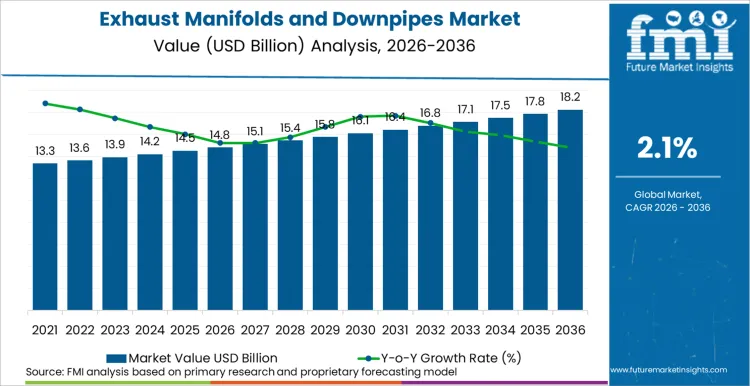
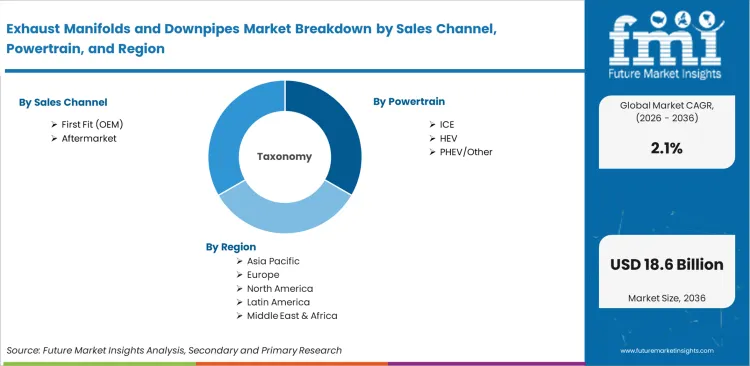
The exhaust manifolds and downpipes market crossed a valuation of USD 14.5 billion in 2025. The industry is expected to reach USD 14.8 billion in 2026 at a CAGR of 2.1% during the forecast period. Demand outlook carries the market valuation to USD 18.3 billion by 2036 as engine manufacturers redesign thermal management systems to meet stricter emission regulations ahead of full electrification transitions.
Summary of Exhaust Manifolds and Downpipes Market
- Market Snapshot
- The market is valued at USD 14.5 billion in 2025 and is projected to reach USD 18.3 billion by 2036.
- Generating an incremental opportunity of USD 3.5 billion, the sector is forecast to expand at a 2.1% CAGR between 2026 and 2036.
- Engine-side exhaust manifolds and their downstream connecting pipes form the core of this hardware sector, covering both pure combustion and hybrid vehicle platforms.
- Success in this mature manufacturing space relies heavily on metallurgical expertise and exact factory fitment rather than software integration. Hard engineering elements like thermal durability dictate supplier survival.
- Demand and Growth Drivers
- Global assembly lines continue churning out millions of combustion and hybrid platforms requiring specialized hot-end exhaust routing. This massive installed manufacturing base guarantees strong, continuous factory orders.
- Aging vehicle fleets across established economies generate reliable replacement volume. Independent repair shops consistently consume service parts to keep older models running smoothly.
- Strict emission mandates force automakers to maximize exhaust system performance. Designing high-value manifolds remains a commercial necessity even as total vehicle production volumes flatten.
- Regional expansion highlights India leading at 4.6%, with Mexico and China following at 3.4% and 3.1% respectively. Mature industrial bases like the U.S. at 2.8%, South Korea at 2.2%, Germany at 1.8%, and Japan at 1.6%, reflect slower trajectories focused heavily on platform optimization.
- Total addressable market size naturally shrinks as automakers introduce battery-electric vehicles. These new electric architectures eliminate the need for traditional hot-end emission routing entirely.
- Product and Segment View
- Core materials like cast iron and stainless steel define this manufacturing space, which channels manifolds and downpipes to both factory assembly lines and aftermarket repair shops across all vehicle weight classes.
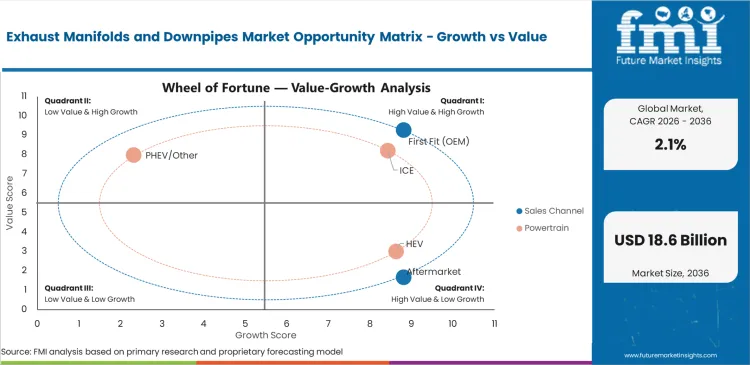
- Anticipated to represent an 83% share in 2026, the First Fit (OEM) segment dominates purchasing behavior. Automakers require highly customized, program-specific validations for all primary hot-end hardware.
- Battery-electric architectures completely remove these components, leaving the ICE powertrain segment poised to secure an 86% share in 2026. This dominant position relies entirely on automakers extending the lifespan of traditional combustion engines to bridge the electric transition.
- Cost efficiency and excellent heat retention keep heavy-duty applications running smoothly, helping the Cast Iron material segment account for a 46% share in 2026. Stainless steel trails closely at 44% by serving the rapid heat-transfer needs of smaller vehicle engines.
- Massive global production scales dictate category leadership, leaving the Passenger Cars segment projected to command a 69% share in 2026. Fitting complex emission systems into these incredibly tight engine bays pushes component values higher across the industry.
- Serving as the primary anchor bolted directly to the hot engine block, the Exhaust Manifold component is estimated to emerge with a 56% share in 2026. This intensive heat exposure forces suppliers to spend heavily on durable, long-lasting casting techniques.
- Analytical boundaries for this sector strictly exclude full electric vehicles. Secondary emission components like mufflers, standalone particulate filters, and catalytic converters also sit outside this primary hardware scope.
- Geography and Competitive Outlook
- Developing industrial hubs in India, Mexico, and China generate the fastest demand spikes. The United States provides a highly stable revenue floor through a mix of heavy commercial factory orders and massive aftermarket consumption.
- Heavyweight suppliers like Tenneco, FORVIA Faurecia, and Eberspächer share the landscape with Futaba Industrial, Yutaka Giken, and Dorman Products. These manufacturers blend deep factory-level design capabilities with extensive replacement parts distribution networks.
- Market control remains moderately spread out across multiple regional specialists with Tenneco leading the competitive field in majority sectors.
- Suppliers win contracts based on reliable welding, stamping precision, and the ability to deliver heavy castings anywhere in the world. Software disruption matters very little compared to proving a metal pipe can survive extreme engine heat over a ten-year lifespan.
Procurement teams at automotive companies are under growing pressure to source exhaust manifolds and downpipes that can withstand the rapid thermal cycling associated with hybrid engines. This creates a trade-off between thinner materials that support faster catalyst warm-up and heavier-gauge metal that offers better long-term crack resistance. Manufacturers that fail to secure supply from qualified producers in time may face sourcing constraints as older foundries move away from low-volume, specialized orders. Plug-in hybrids also require tighter thermal and packaging tolerances than conventional gasoline vehicles, which is reshaping production planning across the exhaust systems supply chain.
As new government tests for cold engine becomes official, engineers will stop using simple separate pipes and move toward all-in-one automotive exhaust systems units. This effect moves control away from basic pipe suppliers and into the hands of advanced metal foundries that can cast complex, single-piece housings. The car makers are starting to use these same designs across many different models worldwide, affecting the time it takes to get raw materials drop significantly. This change is a major signal for anyone witnessing how the supplier landscape is evolving.
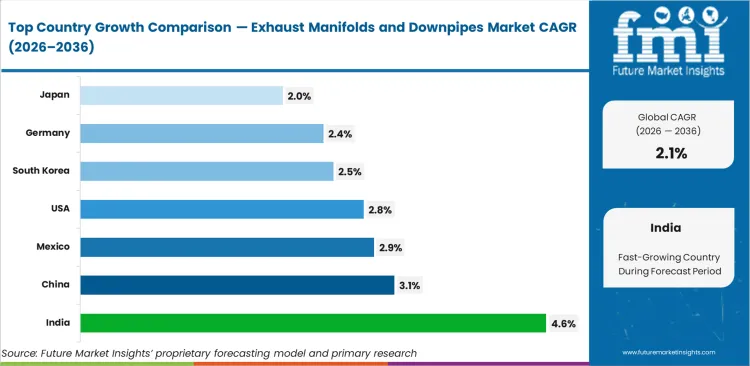
India is expected to lead regional growth in this market, with demand rising at a CAGR of 4.6% through 2036 as local manufacturers upgrade engines to comply with tighter national emission standards. China follows at 3.1%, supported by strong investment in domestically developed hybrid technologies. Mexico is projected to witness 2.9% CAGR during the forecast period as a larger share of North American production shifts there for cost-efficient manufacturing of complex components. The United States is likely to grow at a CAGR of 2.8%, driven by demand for high-value parts used in heavy commercial trucks. South Korea is forecast to record 2.5% CAGR, while Germany is set to post 2.4% and Japan 2.0% through 2036. These mature markets remain active, though growth is tied more to refining existing product platforms than to major capacity expansion.
Segmental Analysis
Exhaust Manifolds and Downpipes Market Analysis by Sales Channel
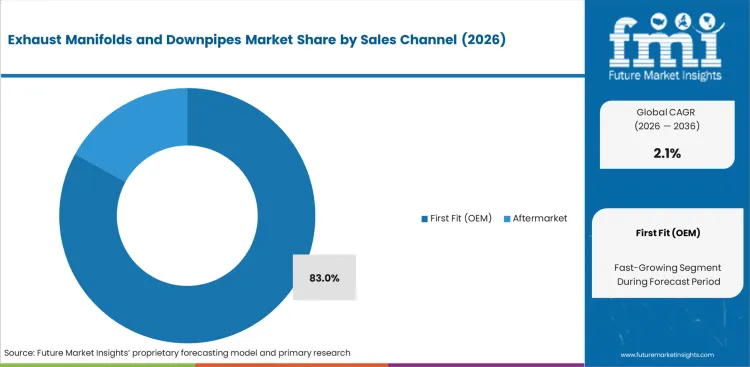
Automakers now build primary exhaust parts directly into the engine block, completely changing how these components are replaced. The First Fit (OEM) segment is estimated to account for 83.0% share in 2026 as this factory-level integration becomes the standard. Engine designers need highly precise heat management to meet modern emission rules, forcing them to cast the automotive exhaust manifold together with the cylinder head or weld it permanently to the turbocharger. Independent repair shops cannot easily swap these unified parts using basic tools. Even separate downpipes now contain complex sensors that require specific software to calibrate after installation. Installing third-party pipes often triggers engine errors and voids vehicle warranties. Everyday parts distributors lose high-profit replacement sales because vehicle owners must return to official dealership service centers for specialized repairs.
- Initial Architecture Lock: Engine designers eliminate bolting flanges and cast the manifold directly into the aluminum cylinder head. Procurement directors negotiate these contracts alongside block casting agreements rather than initiating separate exhaust bidding wars.
- Downstream Integration: Tier-1 suppliers deliver complete hot-end modules featuring the downpipe and primary catalyst pre-welded. Assembly plant managers achieve significant line-speed improvements by bolting one unified assembly instead of installing multiple discrete pipes.
- Aftermarket Exclusion: Service technicians confront welded, sensor-heavy hot ends that cannot be swapped with basic hand tools. Dealership service directors capture all remaining replacement revenue by controlling access to the automotive engine management sensors calibration software required for functional installation.
Exhaust Manifolds and Downpipes Market Analysis by Powertrain
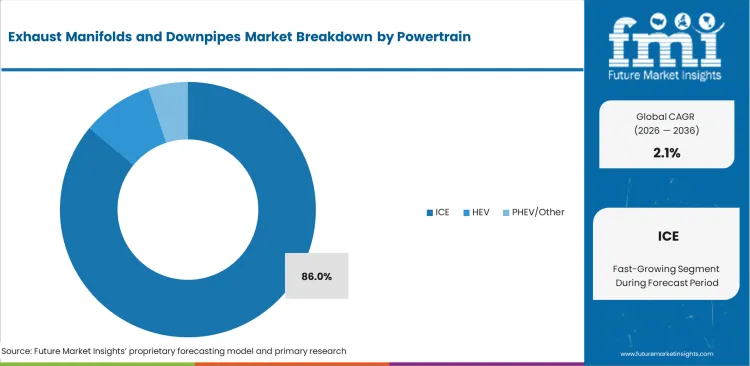
Vehicle manufacturers are heavily upgrading traditional combustion engines to pass strict upcoming emission tests before fully shifting to electric platforms. Design teams must use complex, double-walled exhaust structures just to keep emission catalysts hot during slow city driving. Driven by these engineering demands, the ICE category is expected to represent 86.0% of the market share in 2026. Upgrading these casting methods adds major costs for parts suppliers, especially as the total number of pure combustion engines produced begins to level off. Standard engines now require the same expensive, heat-retaining materials originally created for plug-in hybrids simply to meet Euro 7 standards. Delaying these material upgrades risks failing emission certifications on top-selling passenger cars. Finding enough space to fit automotive mufflers and these hotter, bulkier systems under the vehicle is also becoming much harder for assembly plants.
- Base Material Procurement: Purchasing managers source thicker wall castings to handle increased backpressure from restrictive particulate filters. Foundries charge premium rates for these complex molds, destroying legacy internal combustion profit margins.
- Hidden Operational Burden: Fleet maintenance supervisors discover that advanced thermal coatings degrade rapidly under heavy commercial use. Replacing these coated components requires sourcing complete assemblies rather than swapping individual automotive head gasket seals.
- Lifecycle Comparison Reality: Chief financial officers evaluating total platform costs realize that achieving Euro 7 compliance on ICE architectures requires hot-end spending nearly equivalent to entry-level battery electric vehicle battery packs, mitigating the immediate EV transition impact on exhaust suppliers.
Exhaust Manifolds and Downpipes Market Analysis by Material
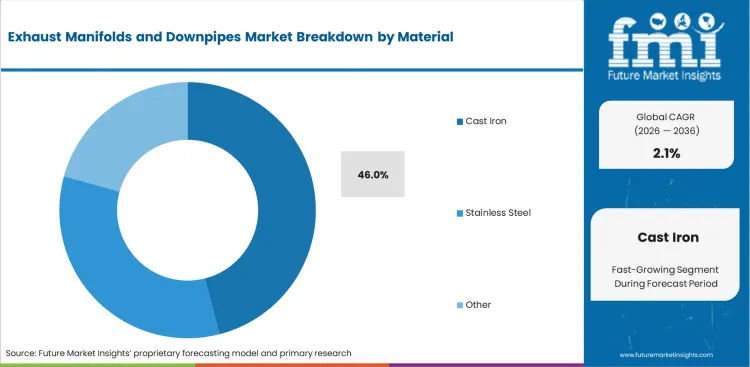
Selecting the correct metal for exhaust parts determines whether a vehicle can pass mandatory cold-start emission tests. Commercial truck designers rely on thick iron structures to keep heat near the engine, which helps activate the automotive catalytic converter quickly in freezing weather. As thinner metals provide fast heat transfer for smaller cars, iron stays the preferred choice for heavy, vibrating trucks. Lighter aluminum or composite materials are popular in other car parts, but they often crack instantly from the intense heat and stress of a bolted-on turbocharger. Using thin stainless steel on heavy-duty trucks leads to cracked manifolds and expensive product recalls. Basic gaskets and seals also fail if the surrounding metals expand too much from extreme heat differences. The cast iron segment is anticipated to emerge with a 46.0% share in 2026 as it reliably traps and holds heat under these harsh conditions. This enduring durability ensures iron will remain a staple in heavy-duty commercial manufacturing for years to come.
- Cold Condition Superiority: Metallurgy leads select high-silicon molybdenum iron to prevent micro-fracturing during rapid temperature spikes. Engine builders ensure commercial trucks survive extreme duty cycles without cracking primary exhaust structures.
- High Vibration Tolerance: Chassis engineers utilize massive iron castings to damp harmonic resonance generated by large displacement diesel engines. Downstream exhaust components survive longer because the manifold absorbs the destructive vibrational energy.
- Weight Penalty Acceptance: Product planners accept the significant mass penalty of iron manifolds because the material cost savings offset the fuel efficiency loss. Automakers avoid spending heavily on exotic alloys for price-sensitive commercial vehicle segments.
Exhaust Manifolds and Downpipes Market Analysis by Vehicle Type
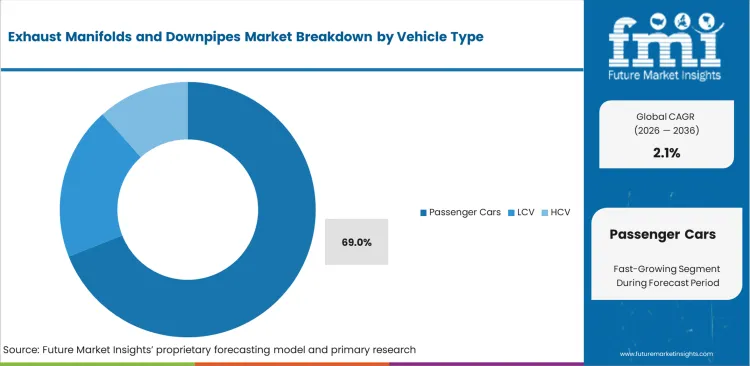
Tight spaces under the hood force major changes to how automakers design and fit modern exhaust parts. The passenger cars segment is likely to hold a share of 69.0% in 2026, as small vehicle frames require highly customized and complex exhaust shapes. Engineers have to place glowing-hot exhaust manifolds just inches away from heat-sensitive steering electronics and plastic walls. This close physical spacing requires expensive cooling systems and thick heat shields that push up the build cost of each vehicle. Fitting a complete automotive three way catalytic converter system into a shrinking engine space acts as a major cost multiplier for automakers. Factory workers also face difficulties installing these tightly packed parts, often needing special robotics just to tighten the mounting bolts. A single spacing mistake during the design phase can melt surrounding plastic components during everyday driving.
- Clearance Failure Prevention: Packaging engineers design asymmetrical downpipes to route high-temperature gases safely around steering columns. Thermal degradation of nearby wiring harnesses drops to zero when optimal routing geometries are achieved, a key factor shaping the LCV exhaust downpipe market.
- Residual Heat Management: Service technicians struggle to access routine maintenance items blocked by massive, heat-shielded manifold assemblies. Dealerships increase flat-rate billing hours because mechanics must remove entire exhaust sections just to reach basic engine sensors.
- Compact Platform Necessity: Vehicle architects rely on integrated manifold-catalyst modules to shorten the overall length of transverse engine layouts. Smaller engine footprints allow designers to increase passenger cabin volume without expanding exterior vehicle dimensions.
Exhaust Manifolds and Downpipes Market Analysis by Component
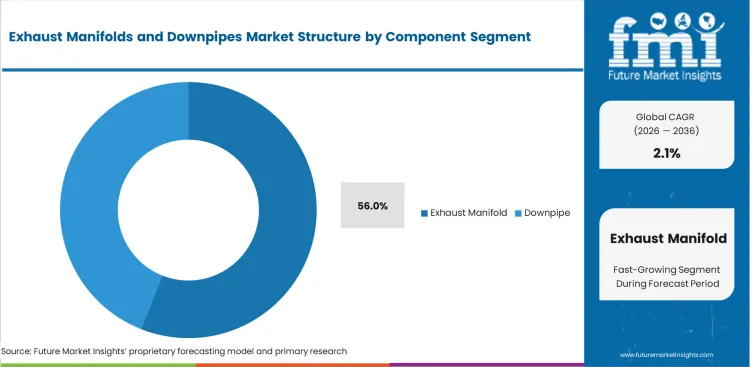
Modern emission systems combine multiple individual parts into single, solid units to improve efficiency and save space. Engine builders use the manifold to guide exhaust gases and as a heavy-duty bracket to hold turbochargers and primary emission filters. Serving as the main anchor for all the heat management parts that follow it, the exhaust manifold segment is forecast to command a 56.0% share in 2026. This dual purpose forces car companies to spend heavily on making strong manifold castings while treating the rest of the downstream exhaust pipes as basic, low-cost items. Today's manifolds also act like thermal batteries, holding exactly enough heat to keep the emission control catalyst working properly when the driver takes their foot off the gas pedal. Buying cheap, welded pipes instead of solid cast manifolds often leads to broken turbochargers and expensive warranty repairs caused by engine vibration.
- Initial Specification Trigger: Powertrain architects define the manifold flange geometry before finalizing any other engine bay parameter. Tier-1 suppliers lock in long-term supply agreements by co-developing these mounting points directly with the automaker.
- Thermal Validation Criteria: Qualification engineers subject manifold castings to thousands of extreme heating and cooling cycles on engine dynamometers. Suppliers passing these brutal tests guarantee their components will never warp or leak under actual driving conditions.
- Renewal Margin Compression: Purchasing directors ruthlessly drive down piece prices on legacy manifold designs once initial tooling costs are fully amortized. Foundries must secure next-generation platform contracts constantly to maintain healthy operating margins.
Exhaust Manifolds and Downpipes Market Drivers, Restraints, and Opportunities
Upcoming Euro 7 emission rules require automakers to redesign the exhaust setups on their remaining combustion engines. As new regulations penalize vehicles that fail to filter exhaust the exact second the engine starts, traditional cast iron pipes are no longer viable for passenger cars. Engineers now rely on double-walled stainless steel manifolds that trap heat to warm up emission filters instantly. This transition pushes car companies to stop buying separate exhaust flexible couplings and instead purchase complete, pre-assembled exhaust units. Acquiring these advanced parts remains difficult because few suppliers have the machinery to build them, and any shortage of these specific components directly stops vehicle production lines.
Space limitations dictate how fast car companies can switch to these new all-in-one exhaust modules. Fitting a bulky, heat-shielded exhaust unit into a small car often means redesigning the steering system and front crash frame. These physical constraints force automakers to manage two separate supply chains forcing them to continue buying older pipe designs for current cars while slowly introducing the new modules on upcoming vehicle models to control heat damage. While temporary welded options exist to bridge the gap, they create multiple weak spots that break easily under engine vibration, causing major maintenance problems for the operation managers.
- Thermal Insulation Integration: Specialized coating suppliers develop spray-on ceramics that replace bulky stamped metal heat shields. Packaging engineers reclaim critical millimeters of engine bay clearance while improving corrosion resistance in automotive downpipes.
- Hybrid-Specific Metallurgy: Foundries formulate novel iron-nickel alloys designed explicitly to survive the rapid stop-start thermal shock of plug-in hybrid engines. Tier-1 suppliers command premium pricing for these durable castings.
- Unified Casting Architectures: Advanced manufacturers successfully cast the automotive intake manifold and exhaust routing channels into a single complex cylinder head unit. Assembly plants drastically reduce engine build times by eliminating external bolting procedures.
Regional Analysis
Based on regional analysis, the exhaust manifolds and downpipes market is segmented into North America, Asia Pacific, and Europe across 40 plus countries.
.webp "Top Country Growth Comparison Exhaust Manifolds And Downpipes Market Cagr (2026 2036)")
| Country | CAGR (2026 to 2036) |
|---|---|
| India | 4.6% |
| China | 3.1% |
| Mexico | 2.9% |
| USA | 2.8% |
| South Korea | 2.5% |
| Germany | 2.4% |
| Japan | 2.0% |
Source: Future Market Insights (FMI) analysis, based on proprietary forecasting model and primary research
North America Exhaust Manifolds and Downpipes Market Analysis
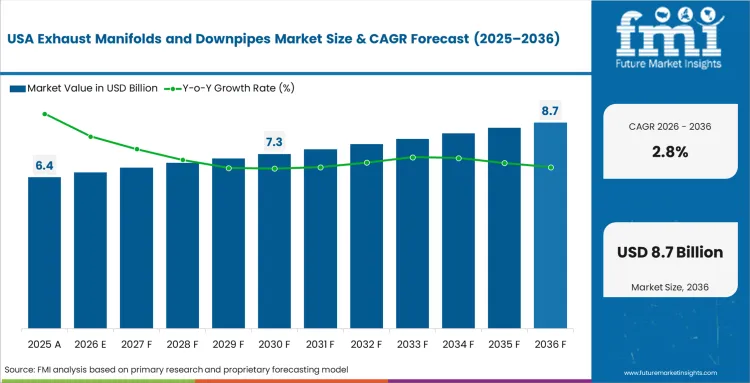
Heavy commercial vehicle requirements define engineering priorities across North America. Operation managers value million-mile durability over lightweight construction, prompting regional foundries to specialize in massive ductile iron castings capable of resisting extreme vibrational fatigue. Domestic metalcasters secure long-term contracts by producing these complex geometries for large-displacement diesel platforms. Tier-1 suppliers operating in this geography focus primarily on managing the intense heat generated during active filter regeneration cycles.
- U.S.: Powertrain directors specify thick-walled iron manifolds to ensure downstream catalysts remain active during prolonged idling periods. Demand in the United States is anticipated to rise at a CAGR of 2.8% through 2036, supported by this regulatory push. Capturing these heavy-duty casting contracts provides domestic foundries with decades of high-margin recurring revenue.
- Mexico: Automakers are aggressively nearshoring labor-intensive stainless steel tube fabrication to stabilize North American assembly lines and reduce reliance on overseas suppliers. The Mexican sector is forecast to record steady increase in pace at a CAGR of 2.9% through 2036, as procurement teams leverage lower regional labor rates to offset the high material costs associated with complex hybrid exhaust architectures. This production shift positions local fabricators to directly challenge established Asian tube-bending conglomerates.
FMI’s analysis of the North American landscape also evaluates emerging supply chain shifts across Canada. Automotive manufacturers continue evaluating cross-border casting partnerships to secure reliable volumes of high-stress thermal components before the next wave of commercial emission deadlines takes effect.
Asia Pacific Exhaust Manifolds and Downpipes Market Analysis
Aggressive localization mandates force international automakers to establish advanced foundry capacity directly within emerging Asian manufacturing hubs. Government policies now demand full domestic production of critical emission control components rather than simply offering generic manufacturing incentives. Tier-1 suppliers must build local casting facilities or risk losing access to the highest-volume vehicle assembly plants in the world. This rapid industrialization creates severe shortages of specialized metallurgy engineers capable of validating complex high-temperature alloys. Securing regional regulatory approvals requires utilizing advanced automotive emission test equipment locally instead of relying on European testing centers.
- India: The implementation of real-driving emission standards forces domestic automakers to abandon rudimentary exhaust piping in favor of highly engineered thermal modules. India is expected to grow at a CAGR of 4.6% through 2036, driven largely by R&D directors scrambling to localize the production of insulated downpipes to protect profit margins on price-sensitive compact vehicles. Suppliers who establish validated high-silicon casting lines immediately dominate the regional commercial vehicle supply chain.
- China: Massive state investments in plug-in hybrid architectures demand specialized exhaust manifolds that can survive constant internal combustion stop-start cycles without cracking. Purchasing managers prioritize suppliers offering double-walled stainless steel solutions over traditional iron foundries. Anticipating heavy reliance on these complex architectures, China is ready to witness 3.1% CAGR through 2036. Chinese tier-1 suppliers are rapidly moving away from producing simple aftermarket replacement pipes to engineering fully integrated OEM hot-end modules.
- South Korea: Export-focused automakers demand flawless initial quality on integrated exhaust systems to minimize costly warranty claims in overseas markets. Quality control directors implement rigorous x-ray inspection protocols on all manifold castings to detect micro-porosity before installation. Achieving zero-defect casting rates becomes the primary competitive differentiator for local metallurgical suppliers, supporting a market where South Korea is expected to see sales incline at a CAGR of 2.5% over the forecast period.
- Japan: Precision engineering dictates that future platform margins depend entirely on optimizing existing material usage rather than expanding production volumes. The market in Japan is estimated to progress at a CAGR of 2.0% during the study period, reflecting a mature engineering culture focused strictly on stripping microscopic amounts of weight from established hybrid platform exhaust architectures. Material scientists experiment with exotic thin-wall casting techniques to improve vehicle fuel efficiency without sacrificing structural integrity.
FMI's comprehensive assessment of the Asia Pacific region extends to emerging manufacturing hubs across the ASEAN bloc. The interplay between established export powerhouses and rapidly industrializing domestic markets dictates where tier-1 suppliers allocate their next round of high-temperature casting investments.
Europe Exhaust Manifolds and Downpipes Market Analysis
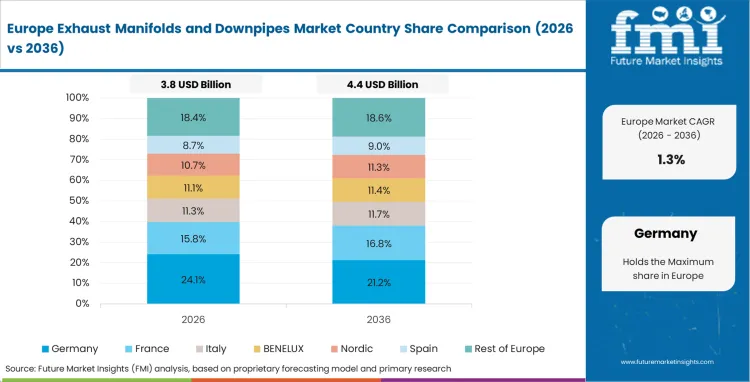
Lawmakers require instantaneous emission compliance from the exact moment an engine starts, forcing radical changes to how manifolds capture and retain initial combustion heat. Engineering teams abandon traditional bolt-on assemblies and choose to integrate exhaust routing directly into advanced cylinder heads. This change in method displaces independent automotive turbocharger manufacturers who previously relied on standard mounting flanges. Regional foundries capable of casting these unified aluminum and iron megastructures secure absolute dominance over the European supply chain.
- Germany: Premium automakers invest heavily in active thermal management systems by incorporating electronic wastegate routing directly into primary manifold castings. Powertrain architects demand flawless surface finishes on internal exhaust runners to maximize turbocharger spooling efficiency. Demand across Germany is set to rise at a CAGR of 2.4% through 2036, as strict European tolerance standards make it harder for independent foundries with limited compliance capability to remain active in premium vehicle programs.
FMI's report includes extensive coverage of the United Kingdom, France, and Italy. Legislative friction between European Union regulators and domestic automotive unions determines how quickly these nations transition away from legacy cast iron supply chains.
Competitive Aligners for Market Players
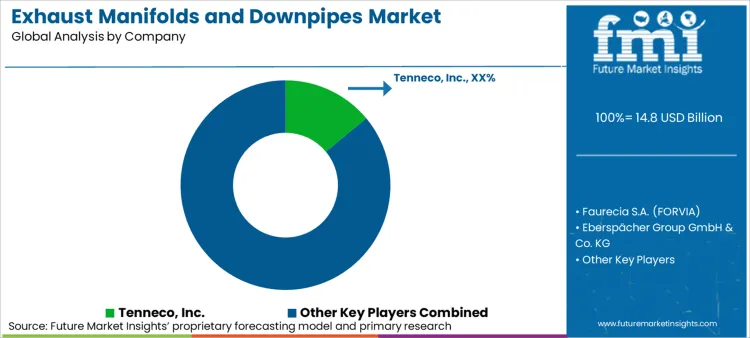
The gap between leading tier-1 suppliers and basic tube manufacturers is shaped largely by metallurgical and systems-integration capability. Vehicle manufacturers rarely want to coordinate multiple vendors to assemble emission-control components on their own. They prefer complete, ready-to-install modules from suppliers that can handle design, validation, and production within one program structure. This gives companies such as Tenneco and Faurecia (FORVIA) a stronger position with OEMs, as they have the capital base to support advanced testing, materials development, and full-system engineering. Competition within integrated assemblies increasingly depends on sealing performance, durability, and thermal control across the full exhaust module.
Established casting suppliers hold another advantage through long operating histories and accumulated validation data. Eberspächer and BOSAL can draw on extensive records of material stress performance to demonstrate that their castings can withstand repeated thermal cycling in hybrid powertrains. That track record remains valuable for automakers that prioritize proven reliability over aggressive price bids. New entrants may try to compete on cost, though lower-priced prototypes often struggle during standard validation when dimensional stability and thermal fatigue resistance come under review. Long-standing suppliers are also better positioned to manage input volatility when they have stronger access to molybdenum grades and specialized stainless steel.
Automakers, even so, do not want excessive dependence on a small number of major suppliers. Procurement teams often spread contracts for older vehicle platforms across selected mid-tier manufacturers to preserve pricing leverage and supply flexibility. Specialized companies such as Friedrich Boysen and Dinex avoid direct volume competition by focusing on heavy commercial vehicle exhaust systems that require different engineering priorities from passenger vehicle programs. Competitive strength increasingly comes from mastering thin-wall casting techniques that reduce weight while maintaining thermal performance, which keeps these firms relevant in a market that rewards both precision and durability.
Key Players in Exhaust Manifolds and Downpipes Market
- Tenneco
- Faurecia (FORVIA)
- Eberspächer
- BOSAL
- Friedrich Boysen
- Sango
- Sejong Industrial
- Dinex
- MagnaFlow
Scope of the Report
| Metric | Value |
|---|---|
| Quantitative Units | USD 14.8 billion to USD 18.3 billion, at a CAGR of 2.1% |
| Market Definition | Primary thermal boundaries capturing cylinder exhaust and routing pressure into downstream aftertreatment systems to ensure rapid catalyst light-off. |
| Segmentation | By Sales Channel, Powertrain, Material, Vehicle Type, Component, and Region |
| Regions Covered | North America, Latin America, Western Europe, Eastern Europe, Asia Pacific Excluding Japan (APEJ), Japan, Middle East and Africa (MEA) |
| Countries Covered | USA, China, India, Germany, Japan, South Korea, Mexico |
| Key Companies Profiled | Tenneco, Faurecia (FORVIA), Eberspächer, BOSAL, MagnaFlow, Friedrich Boysen, Sango, Sejong Industrial, Dinex |
| Forecast Period | 2026 to 2036 |
| Approach | Annual internal combustion and hybrid vehicle production volumes tracked against average hot-end component cost per platform. |
Source: Future Market Insights (FMI) analysis, based on proprietary forecasting model and primary research
Segments
Sales Channel:
- First Fit (OEM)
- Aftermarket
Powertrain:
- ICE
- HEV
- PHEV/Other
Material:
- Cast Iron
- Stainless Steel
- Other
Vehicle Type:
- Passenger Cars
- LCV
- HCV
Component:
- Exhaust Manifold
- Downpipe
Region:
- Asia Pacific
- India
- China
- Japan
- South Korea
- Indonesia
- Australia & New Zealand
- ASEAN
- Rest of Asia Pacific
- Europe
- Germany
- Italy
- France
- United Kingdom
- Spain
- Benelux
- Nordics
- Central & Eastern Europe
- Rest of Europe
- North America
- United States
- Canada
- Mexico
- Latin America
- Brazil
- Argentina
- Chile
- Rest of Latin America
- Middle East & Africa
- Kingdom of Saudi Arabia
- United Arab Emirates
- South Africa
- Turkey
- Rest of Middle East & Africa
Bibliography
- Automobile Manufacturers Committee. (2025). The automobile industry pocket guide 2025/2026. European Automobile Manufacturers’ Association.
- Bureau of Transportation Statistics. (2024). ANNUAL REPORT 2024. USA Department of Transportation.
- Japan Automobile Manufacturers Association, Inc. (2024, September 26). The Motor Industry of Japan 2024. JAMA.
- Society of Indian Automobile Manufacturers. (2025, August 28). SIAM Annual Report 2024-25. SIAM.
This bibliography is provided for reader reference. The full FMI report contains the complete reference list with primary source documentation.
This Report Addresses
- Euro 7 cold-start mandates forcing integration of hot-end thermal modules.
- Cast iron retaining heavy-duty dominance against lightweight stainless steel alternatives.
- Hybrid engine cycling causing severe thermal shock on legacy pipe designs.
- Automakers co-casting manifolds directly into modern aluminum cylinder heads.
- Foundries capturing premium margins through complex high-silicon metallurgical processes.
- BS-VI Phase 2 localization accelerating advanced foundry expansion across India.
- Commercial vehicle lifecycle targets dictating thick-walled vibration-resistant architectures.
- Dealership service centers monopolizing downstream revenue via sensor calibration requirements.
Frequently Asked Questions
How big is the exhaust manifolds and downpipes market?
Revenue reaches USD 14.8 billion in 2026 as powertrain directors spend heavily on complex thermal management to meet stringent cold-start emission regulations on existing internal combustion platforms.
What are the latest exhaust manifold market trends driving growth?
Sales advance at a 2.1% CAGR through 2036 because the increasing unit cost of hybrid-specific exhaust modules successfully offsets the gradual plateau in pure combustion engine manufacturing.
Which sales channel leads procurement?
First Fit (OEM) captures 83.0% share since independent replacement cycles collapse entirely when engine designers weld primary emission structures directly to turbochargers, requiring full dealership intervention for major repairs.
Why does cast iron maintain significant material share?
Cast iron holds 46.0% share by offering unmatched thermal retention in freezing ambient conditions, allowing commercial fleet operators to ensure downstream catalysts light off rapidly without shattering under intense mechanical vibration.
What structural gate accelerates adoption of unified modules?
Once regulators finalize testing protocols mandating instantaneous emission compliance, discrete pipes fail, forcing supply chain managers to source pre-welded manifold-catalyst assemblies from advanced tier-1 foundries.
How does hybrid adoption impact component design?
Plug-in hybrids constantly cycle internal combustion engines on and off, creating violent temperature swings that compel metallurgy leads to specify expensive double-walled stainless alloys to survive this thermal shock without cracking.
Why do passenger cars dictate packaging innovation?
Representing 69.0% share, incredibly compact passenger car engine bays force vehicle architects to invent complex asymmetrical downpipes to route red-hot exhaust safely around sensitive electronic steering components and wiring harnesses.
What specific friction slows aftermarket penetration?
Modern downpipes integrate highly sensitive pressure arrays requiring proprietary software, meaning independent mechanics lack access to this calibration data, which results in automatic warranty voidance and severe check-engine faults upon installation.
How does India outpace broader regional averages?
India expands at a 4.6% trajectory because aggressive localization of commercial vehicles forces domestic suppliers to build advanced foundry capacity, transforming rudimentary pipe fabricators into sophisticated metallurgical producers.
What differentiates USA commercial demand from European passenger trends?
United States demand prioritizes heavy-duty diesel durability to keep massive iron castings profitable, whereas European engineering abandons discrete pipes entirely by casting exhaust runners directly into aluminum cylinder heads to maximize turbocharger efficiency.
How do foundries maintain competitive leverage?
Incumbent casters possess exclusive thermal cycle data profiles, causing challengers attempting to undercut pricing to consistently fail OEM validation testing because their prototype manifolds warp under sustained dynamometer loads.
Why is downpipe design becoming more critical?
Automakers integrate particulate filters directly behind the primary catalyst, forcing the downpipe to support massive structural weight while simultaneously managing the extreme heat generated during active filter regeneration cycles.
How does nearshoring alter North American supply chains?
Purchasing managers utilize Mexican fabricators to absorb heavy labor-intensive tube bending volume to stabilize North American assembly lines, avoiding the shipping delays associated with trans-Pacific logistics routes.
Why do automakers accept the weight penalty of iron?
Product planners accept iron's massive weight penalty in commercial trucks because exotic lightweight alloys cost exponentially more, and the material savings easily offset minor fuel efficiency losses in price-sensitive heavy-duty segments.
What forces Tier-1 suppliers to consolidate?
Automakers demand fully assembled hot-end modules to avoid fatal engineering delays caused by coordinating multiple vendors for cold-start compliance, forcing massive tier-1 conglomerates to acquire smaller fabrication shops to offer complete turnkey solutions.
How do engineers prevent heat damage in compact bays?
Packaging teams deploy asymmetrical routing and thick ceramic coatings to ensure high-temperature exhaust gases bypass sensitive plastic bulkheads without requiring bulky traditional stamped metal heat shields.
Why do independent turbocharger manufacturers struggle?
Engine designers integrate the turbine housing directly into the exhaust manifold casting, eliminating standard mounting flanges and locking independent turbo suppliers out of modern premium vehicle platforms entirely.
How do Japanese engineers approach platform maturity?
Mature engineering cultures in Japan focus strictly on stripping microscopic weight from established architectures, meaning future platform margins depend on optimizing thin-wall casting techniques rather than overhauling fundamental exhaust routing designs.
What happens when purchasing teams delay material upgrades?
Delaying the transition to high-silicon alloys results in catastrophic certification failures and massive recall campaigns when standard castings shatter under the increased backpressure generated by modern particulate filters.
How do service directors benefit from module integration?
Dealerships increase flat-rate billing hours because routine maintenance access becomes severely restricted by massive heat-shielded assemblies, forcing mechanics to remove entire exhaust sections merely to access basic engine components.
Why are thermal insulating coatings replacing heat shields?
Packaging engineers utilize advanced spray-on ceramics to reclaim critical millimeters of clearance, allowing them to fit massive catalytic converters closer to the engine block without melting adjacent composite structures.
What determines future profitability for mid-tier suppliers?
Mid-tier fabricators must secure specialized commercial vehicle contracts that mass-market producers ignore, as engineering complex, low-volume exhaust systems for heavy equipment offers high margins protected from intense automotive price wars.
Explain the exhaust manifolds and downpipes market by segment behavior?
The market structurally pivots around the First Fit channel capturing 83.0% share and the ICE powertrain retaining 86.0% share, as original equipment manufacturers mandate fully integrated hot-end modules directly into engine blocks to meet immediate Euro 7 compliance.
Which companies lead the exhaust manifolds and downpipes market consolidation?
Global tier-1 suppliers like Tenneco and Faurecia leverage immense capital reserves and proprietary metallurgical data to outbid smaller foundries for comprehensive hot-end OEM module contracts.
Preview the report firsthand - request a free sample
Get SampleGet the brochure for pricing and purchase details.
Get PDFTable of Content
- Executive Summary
- Global Market Outlook
- Demand-side Trends
- Supply-side Trends
- Technology Roadmap Analysis
- Analysis and Recommendations
- Market Overview
- Market Coverage / Taxonomy
- Market Definition / Scope / Limitations
- Research Methodology
- Chapter Orientation
- Analytical Lens and Working Hypotheses
- Market Structure, Signals, and Trend Drivers
- Benchmarking and Cross-market Comparability
- Market Sizing, Forecasting, and Opportunity Mapping
- Research Design and Evidence Framework
- Desk Research Programme (Secondary Evidence)
- Company Annual and Sustainability Reports
- Peer-reviewed Journals and Academic Literature
- Corporate Websites, Product Literature, and Technical Notes
- Earnings Decks and Investor Briefings
- Statutory Filings and Regulatory Disclosures
- Technical White Papers and Standards Notes
- Trade Journals, Industry Magazines, and Analyst Briefs
- Conference Proceedings, Webinars, and Seminar Materials
- Government Statistics Portals and Public Data Releases
- Press Releases and Reputable Media Coverage
- Specialist Newsletters and Curated Briefings
- Sector Databases and Reference Repositories
- FMI Internal Proprietary Databases and Historical Market Datasets
- Subscription Datasets and Paid Sources
- Social Channels, Communities, and Digital Listening Inputs
- Additional Desk Sources
- Expert Input and Fieldwork (Primary Evidence)
- Primary Modes
- Qualitative Interviews and Expert Elicitation
- Quantitative Surveys and Structured Data Capture
- Blended Approach
- Why Primary Evidence is Used
- Field Techniques
- Interviews
- Surveys
- Focus Groups
- Observational and In-context Research
- Social and Community Interactions
- Stakeholder Universe Engaged
- C-suite Leaders
- Board Members
- Presidents and Vice Presidents
- R&D and Innovation Heads
- Technical Specialists
- Domain Subject-matter Experts
- Scientists
- Physicians and Other Healthcare Professionals
- Governance, Ethics, and Data Stewardship
- Research Ethics
- Data Integrity and Handling
- Primary Modes
- Tooling, Models, and Reference Databases
- Desk Research Programme (Secondary Evidence)
- Data Engineering and Model Build
- Data Acquisition and Ingestion
- Cleaning, Normalisation, and Verification
- Synthesis, Triangulation, and Analysis
- Quality Assurance and Audit Trail
- Market Background
- Market Dynamics
- Drivers
- Restraints
- Opportunity
- Trends
- Scenario Forecast
- Demand in Optimistic Scenario
- Demand in Likely Scenario
- Demand in Conservative Scenario
- Opportunity Map Analysis
- Product Life Cycle Analysis
- Supply Chain Analysis
- Investment Feasibility Matrix
- Value Chain Analysis
- PESTLE and Porter’s Analysis
- Regulatory Landscape
- Regional Parent Market Outlook
- Production and Consumption Statistics
- Import and Export Statistics
- Market Dynamics
- Global Market Analysis 2021 to 2025 and Forecast, 2026 to 2036
- Historical Market Size Value (USD Million) Analysis, 2021 to 2025
- Current and Future Market Size Value (USD Million) Projections, 2026 to 2036
- Y-o-Y Growth Trend Analysis
- Absolute $ Opportunity Analysis
- Global Market Pricing Analysis 2021 to 2025 and Forecast 2026 to 2036
- Global Market Analysis 2021 to 2025 and Forecast 2026 to 2036, By Sales Channel
- Introduction / Key Findings
- Historical Market Size Value (USD Million) Analysis By Sales Channel , 2021 to 2025
- Current and Future Market Size Value (USD Million) Analysis and Forecast By Sales Channel , 2026 to 2036
- First Fit (OEM)
- Aftermarket
- First Fit (OEM)
- Y-o-Y Growth Trend Analysis By Sales Channel , 2021 to 2025
- Absolute $ Opportunity Analysis By Sales Channel , 2026 to 2036
- Global Market Analysis 2021 to 2025 and Forecast 2026 to 2036, By Powertrain
- Introduction / Key Findings
- Historical Market Size Value (USD Million) Analysis By Powertrain, 2021 to 2025
- Current and Future Market Size Value (USD Million) Analysis and Forecast By Powertrain, 2026 to 2036
- ICE
- HEV
- PHEV/Other
- ICE
- Y-o-Y Growth Trend Analysis By Powertrain, 2021 to 2025
- Absolute $ Opportunity Analysis By Powertrain, 2026 to 2036
- Global Market Analysis 2021 to 2025 and Forecast 2026 to 2036, By Material
- Introduction / Key Findings
- Historical Market Size Value (USD Million) Analysis By Material, 2021 to 2025
- Current and Future Market Size Value (USD Million) Analysis and Forecast By Material, 2026 to 2036
- Cast Iron
- Stainless Steel
- Other
- Cast Iron
- Y-o-Y Growth Trend Analysis By Material, 2021 to 2025
- Absolute $ Opportunity Analysis By Material, 2026 to 2036
- Global Market Analysis 2021 to 2025 and Forecast 2026 to 2036, By Vehicle Type
- Introduction / Key Findings
- Historical Market Size Value (USD Million) Analysis By Vehicle Type, 2021 to 2025
- Current and Future Market Size Value (USD Million) Analysis and Forecast By Vehicle Type, 2026 to 2036
- Passenger Cars
- LCV
- HCV
- Passenger Cars
- Y-o-Y Growth Trend Analysis By Vehicle Type, 2021 to 2025
- Absolute $ Opportunity Analysis By Vehicle Type, 2026 to 2036
- Global Market Analysis 2021 to 2025 and Forecast 2026 to 2036, By Component
- Introduction / Key Findings
- Historical Market Size Value (USD Million) Analysis By Component, 2021 to 2025
- Current and Future Market Size Value (USD Million) Analysis and Forecast By Component, 2026 to 2036
- Exhaust Manifold
- Downpipe
- Exhaust Manifold
- Y-o-Y Growth Trend Analysis By Component, 2021 to 2025
- Absolute $ Opportunity Analysis By Component, 2026 to 2036
- Global Market Analysis 2021 to 2025 and Forecast 2026 to 2036, By Region
- Introduction
- Historical Market Size Value (USD Million) Analysis By Region, 2021 to 2025
- Current Market Size Value (USD Million) Analysis and Forecast By Region, 2026 to 2036
- North America
- Latin America
- Western Europe
- Eastern Europe
- East Asia
- South Asia and Pacific
- Middle East & Africa
- Market Attractiveness Analysis By Region
- North America Market Analysis 2021 to 2025 and Forecast 2026 to 2036, By Country
- Historical Market Size Value (USD Million) Trend Analysis By Market Taxonomy, 2021 to 2025
- Market Size Value (USD Million) Forecast By Market Taxonomy, 2026 to 2036
- By Country
- USA
- Canada
- Mexico
- By Sales Channel
- By Powertrain
- By Material
- By Vehicle Type
- By Component
- By Country
- Market Attractiveness Analysis
- By Country
- By Sales Channel
- By Powertrain
- By Material
- By Vehicle Type
- By Component
- Key Takeaways
- Latin America Market Analysis 2021 to 2025 and Forecast 2026 to 2036, By Country
- Historical Market Size Value (USD Million) Trend Analysis By Market Taxonomy, 2021 to 2025
- Market Size Value (USD Million) Forecast By Market Taxonomy, 2026 to 2036
- By Country
- Brazil
- Chile
- Rest of Latin America
- By Sales Channel
- By Powertrain
- By Material
- By Vehicle Type
- By Component
- By Country
- Market Attractiveness Analysis
- By Country
- By Sales Channel
- By Powertrain
- By Material
- By Vehicle Type
- By Component
- Key Takeaways
- Western Europe Market Analysis 2021 to 2025 and Forecast 2026 to 2036, By Country
- Historical Market Size Value (USD Million) Trend Analysis By Market Taxonomy, 2021 to 2025
- Market Size Value (USD Million) Forecast By Market Taxonomy, 2026 to 2036
- By Country
- Germany
- UK
- Italy
- Spain
- France
- Nordic
- BENELUX
- Rest of Western Europe
- By Sales Channel
- By Powertrain
- By Material
- By Vehicle Type
- By Component
- By Country
- Market Attractiveness Analysis
- By Country
- By Sales Channel
- By Powertrain
- By Material
- By Vehicle Type
- By Component
- Key Takeaways
- Eastern Europe Market Analysis 2021 to 2025 and Forecast 2026 to 2036, By Country
- Historical Market Size Value (USD Million) Trend Analysis By Market Taxonomy, 2021 to 2025
- Market Size Value (USD Million) Forecast By Market Taxonomy, 2026 to 2036
- By Country
- Russia
- Poland
- Hungary
- Balkan & Baltic
- Rest of Eastern Europe
- By Sales Channel
- By Powertrain
- By Material
- By Vehicle Type
- By Component
- By Country
- Market Attractiveness Analysis
- By Country
- By Sales Channel
- By Powertrain
- By Material
- By Vehicle Type
- By Component
- Key Takeaways
- East Asia Market Analysis 2021 to 2025 and Forecast 2026 to 2036, By Country
- Historical Market Size Value (USD Million) Trend Analysis By Market Taxonomy, 2021 to 2025
- Market Size Value (USD Million) Forecast By Market Taxonomy, 2026 to 2036
- By Country
- China
- Japan
- South Korea
- By Sales Channel
- By Powertrain
- By Material
- By Vehicle Type
- By Component
- By Country
- Market Attractiveness Analysis
- By Country
- By Sales Channel
- By Powertrain
- By Material
- By Vehicle Type
- By Component
- Key Takeaways
- South Asia and Pacific Market Analysis 2021 to 2025 and Forecast 2026 to 2036, By Country
- Historical Market Size Value (USD Million) Trend Analysis By Market Taxonomy, 2021 to 2025
- Market Size Value (USD Million) Forecast By Market Taxonomy, 2026 to 2036
- By Country
- India
- ASEAN
- Australia & New Zealand
- Rest of South Asia and Pacific
- By Sales Channel
- By Powertrain
- By Material
- By Vehicle Type
- By Component
- By Country
- Market Attractiveness Analysis
- By Country
- By Sales Channel
- By Powertrain
- By Material
- By Vehicle Type
- By Component
- Key Takeaways
- Middle East & Africa Market Analysis 2021 to 2025 and Forecast 2026 to 2036, By Country
- Historical Market Size Value (USD Million) Trend Analysis By Market Taxonomy, 2021 to 2025
- Market Size Value (USD Million) Forecast By Market Taxonomy, 2026 to 2036
- By Country
- Kingdom of Saudi Arabia
- Other GCC Countries
- Turkiye
- South Africa
- Other African Union
- Rest of Middle East & Africa
- By Sales Channel
- By Powertrain
- By Material
- By Vehicle Type
- By Component
- By Country
- Market Attractiveness Analysis
- By Country
- By Sales Channel
- By Powertrain
- By Material
- By Vehicle Type
- By Component
- Key Takeaways
- Key Countries Market Analysis
- USA
- Pricing Analysis
- Market Share Analysis, 2025
- By Sales Channel
- By Powertrain
- By Material
- By Vehicle Type
- By Component
- Canada
- Pricing Analysis
- Market Share Analysis, 2025
- By Sales Channel
- By Powertrain
- By Material
- By Vehicle Type
- By Component
- Mexico
- Pricing Analysis
- Market Share Analysis, 2025
- By Sales Channel
- By Powertrain
- By Material
- By Vehicle Type
- By Component
- Brazil
- Pricing Analysis
- Market Share Analysis, 2025
- By Sales Channel
- By Powertrain
- By Material
- By Vehicle Type
- By Component
- Chile
- Pricing Analysis
- Market Share Analysis, 2025
- By Sales Channel
- By Powertrain
- By Material
- By Vehicle Type
- By Component
- Germany
- Pricing Analysis
- Market Share Analysis, 2025
- By Sales Channel
- By Powertrain
- By Material
- By Vehicle Type
- By Component
- UK
- Pricing Analysis
- Market Share Analysis, 2025
- By Sales Channel
- By Powertrain
- By Material
- By Vehicle Type
- By Component
- Italy
- Pricing Analysis
- Market Share Analysis, 2025
- By Sales Channel
- By Powertrain
- By Material
- By Vehicle Type
- By Component
- Spain
- Pricing Analysis
- Market Share Analysis, 2025
- By Sales Channel
- By Powertrain
- By Material
- By Vehicle Type
- By Component
- France
- Pricing Analysis
- Market Share Analysis, 2025
- By Sales Channel
- By Powertrain
- By Material
- By Vehicle Type
- By Component
- India
- Pricing Analysis
- Market Share Analysis, 2025
- By Sales Channel
- By Powertrain
- By Material
- By Vehicle Type
- By Component
- ASEAN
- Pricing Analysis
- Market Share Analysis, 2025
- By Sales Channel
- By Powertrain
- By Material
- By Vehicle Type
- By Component
- Australia & New Zealand
- Pricing Analysis
- Market Share Analysis, 2025
- By Sales Channel
- By Powertrain
- By Material
- By Vehicle Type
- By Component
- China
- Pricing Analysis
- Market Share Analysis, 2025
- By Sales Channel
- By Powertrain
- By Material
- By Vehicle Type
- By Component
- Japan
- Pricing Analysis
- Market Share Analysis, 2025
- By Sales Channel
- By Powertrain
- By Material
- By Vehicle Type
- By Component
- South Korea
- Pricing Analysis
- Market Share Analysis, 2025
- By Sales Channel
- By Powertrain
- By Material
- By Vehicle Type
- By Component
- Russia
- Pricing Analysis
- Market Share Analysis, 2025
- By Sales Channel
- By Powertrain
- By Material
- By Vehicle Type
- By Component
- Poland
- Pricing Analysis
- Market Share Analysis, 2025
- By Sales Channel
- By Powertrain
- By Material
- By Vehicle Type
- By Component
- Hungary
- Pricing Analysis
- Market Share Analysis, 2025
- By Sales Channel
- By Powertrain
- By Material
- By Vehicle Type
- By Component
- Kingdom of Saudi Arabia
- Pricing Analysis
- Market Share Analysis, 2025
- By Sales Channel
- By Powertrain
- By Material
- By Vehicle Type
- By Component
- Turkiye
- Pricing Analysis
- Market Share Analysis, 2025
- By Sales Channel
- By Powertrain
- By Material
- By Vehicle Type
- By Component
- South Africa
- Pricing Analysis
- Market Share Analysis, 2025
- By Sales Channel
- By Powertrain
- By Material
- By Vehicle Type
- By Component
- USA
- Market Structure Analysis
- Competition Dashboard
- Competition Benchmarking
- Market Share Analysis of Top Players
- By Regional
- By Sales Channel
- By Powertrain
- By Material
- By Vehicle Type
- By Component
- Competition Analysis
- Competition Deep Dive
- Tenneco
- Overview
- Product Portfolio
- Profitability by Market Segments (Product/Age /Sales Channel/Region)
- Sales Footprint
- Strategy Overview
- Marketing Strategy
- Product Strategy
- Channel Strategy
- Faurecia (FORVIA)
- Eberspächer
- BOSAL
- Friedrich Boysen
- Sango
- Sejong Industrial
- Dinex
- MagnaFlow
- Tenneco
- Competition Deep Dive
- Assumptions & Acronyms Used


