

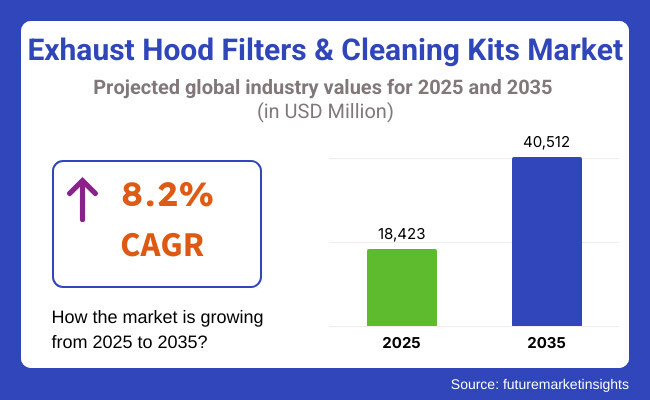
- Industry Size (2025)
- USD 18423 Mn
- Forecast (2035)
- USD 40512 Mn
- CAGR (2025 to 2035)
- 8.2%
Exhaust Hood Filters and Cleaning Kits Market Size and Share Forecast Outlook (2025 to 2035)
The exhaust hood filters and cleaning kits market would grow tremendously between 2025 and 2035 because of rising demands for fire safety and sanitation in domestic and business kitchens. The market worth about USD 18,423 million in 2025 would be USD 40,512 million in 2035 growing with a compound growth rate of 8.2% yearly from 2025 to 2035.
There are some drivers for market growth. The heightened enforcement of health and safety regulations by state agencies on business food kitchen areas, primarily restaurants, hotels, and manufacturing plants where food is prepared, is one of the most primitive drivers of growth.
Grease clog prevention and fire suppression require clean kits and hood exhaust filters. This will also create a healthy environment. McDonald's and Subway fast foods, for example, put regular hoods cleaning at the front for it is the major catalyst for achieving cleanliness as well as stringent fire code approval.
Additionally, innovation in self-cleaning filter technology as well as environmentally friendly cleaning agents are changing maintenance effectiveness, minimizing labor expenses, and being environmentally friendly.
Exhaust hood cleaners as well as cleaning packages can be separated based on their material composition as well as cleaning mode. Of all of them, the most common are the baffle filter, mesh filter, and charcoal filter. Baffle filters, that have been installed in commercial installations, are successful in trapping grease while ensuring sufficient air flow.
Mesh filters installed in houses are inexpensive and lightweight but need to be cleaned from time to time. Charcoal filters, installed by ductless range hoods, successfully remove odours and clean indoor air. Increasing need for green cleaning kits, including enzyme cleaners and steam cleaner systems, is being driven by food service operators' need to get greener in maintenance procedures.
Regional Market Trends in Exhaust Hood Filters and Cleaning Kits
North America
North America is the leadership market position for exhaust hood filters and cleaning kits because of a well-established food service industry. America and Canada have very strong health and safety regulations that demand frequent cleaning of the exhaust system.
Chain restaurants such as Burger King and Starbucks also have strict cleaning procedures that demand self-cleaning kits and efficient filters. Additionally, the country's shift towards energy-efficient grease control systems and filter systems is driving growth in the region.
Europe
The biggest market for exhaust hood filter and cleaning kits is Europe, where demand has been primarily emanating from Germany, France, and the UK. It is here that restaurant population density per square mile is banking on next-generation filtration equipment to provide EU levels of air cleanliness.
Michelin eateries, for instance, will be introducing advanced baffle filters and chemical cleaner-free air purity and safety machinery. European companies are turning towards recyclable filter media and aqueous cleaners in order to fulfil sustainability targets.
Asia-Pacific
Asia-Pacific will lead exhaust hood filters and cleaning kit market growth owing to rising urbanization, rising disposable incomes, and restaurant industry expansion. Industry drivers are Japan, China, India, and South Korea. Cleanability filters and high-performance filters demand is being fueled by the rapidly growing Indian quick-service restaurant (QSR) market, with brands such as Domino's and KFC.
In China, anti-pollution measures are compelling foodservice players to fit high-performance filtration systems and automated cleaning kits. Counterfeit product sales and lack of uniform compliance with health and sanitation standards are also starting to become growth inhibiting factors for the industry.
Challenges and Opportunities
Challenge
Compliance with Health and Fire Safety Standards
Compliance with strict fire and health-focused safety standards is the most difficult challenge to the exhaust hood filter and cleaning kits industry. Commercial kitchens are not able to maintain normal maintenance schedules due to operational limitations. Cleaning of the exhaust system has to be properly executed in order to prevent grease fires, indoor air quality issues, and penalties from regulations.
Such bodies, for example, the United States National Fire Protection Association (NFPA) and the European Committee for Standardization (CEN), are very strict on exhaust system maintenance, which is very expensive to food service businesses in terms of man hours and installation expense.
Opportunity
Self-Cleaning and Green Technologies
Self-cleaning exhaust filters and green cleaning kits are a good opportunity for the industry. Technology in the form of steam cleaning equipment with automated units, enzyme-based cleaners, and high-efficient grease collection technology is rendering food establishments maintenance friendly as well as environment friendly.
Those companies with AI-driven monitoring tools reminding customers about filter cleaning are becoming more and more market trendy. Other applications of green cleaning products like plant-based degreasers and water-conserving sprays also uphold compatibility with green demands and regulation pressures.
Shifts in the Exhaust Hood Filters and Cleaning Kits Market from 2020 to 2024 and Future Trends 2025 to 2035
In 2020 to 2024, exhaust hood filter and cleaning kit sales skyrocketed as there was even greater concern about cleanliness when food was served at restaurants under pandemic-spurred health mania. High-end grease filtration equipment and chemical-free cleaning products were all the rage in recent times. Staff and material shortages penalized each business regardless, but so did the mania for demand for hassle-free and automated product.
Green cleaning technologies, smart filtration technologies, and tough environmental regulations will dominate the market prior to 2025 to 2035. IoT-based exhaust hood monitoring system integration will make real-time maintenance monitoring possible to reduce the risk of fire and ensure optimum efficiency. Commercial cooking places and restaurants will create demand for high-efficiency exhaust hood filters and quality cleaning kits in exponential numbers for safety and sustainability.
Market Shifts: A Comparative Analysis (2020 to 2024 vs. 2025 to 2035)
| Market Shift | 2020 to 2024 |
|---|---|
| Regulatory Landscape | Regulatory bodies emphasized the importance of having clean kitchen equipment to prevent fire hazards and ensure food safety. Compliance with standards like NFPA 96 became compulsory, and implementation of exhaust hood filters and cleaning kits picked up pace. |
| Technological Advancements | Manufacturers imported filters that had higher grease capture capability and cleaning kits that simplified maintenance. Innovations included stainless steel baffle filters and automatic cleaning devices. |
| Product Diversification | The market saw a range of products for different kitchen configurations and sizes, from under-cabinet to wall-mounted exhaust hoods. Cleaning kits were also more sophisticated, offering solutions for different levels of grease accumulation. |
| Environmental Sustainability | Growing green awareness for the environmental impact of kitchen use made reusable filters and eco-friendly cleaning products become common. These trends were not yet prevalent, though. |
| Supply Chain Dynamics | The supply chain was bedevilled by worldwide events, leading to increased prices and slower delivery. The manufacturers began investigating local production and sourcing to battle these issues. |
| Market Growth Drivers | Expansion in the foodservice sector, as well as heightened care about kitchen safety and hygiene, fueled market growth. Urbanization and quick-service restaurant expansion also contributed to heightened demand. |
| Market Shift | 2025 to 2035 |
|---|---|
| Regulatory Landscape | Governments everywhere will likely introduce stricter regulations with an emphasis on energy efficiency and environmental sustainability in commercial kitchens. The shift will drive the adoption and expansion of electric and eco-friendly exhaust hood systems. |
| Technological Advancements | The industry is expected to experience intelligent technology integration, such as IoT-enabled monitoring systems, to allow real-time maintenance alerts and performance optimization. Technologies in filter materials will also enhance efficiency and durability. |
| Product Diversification | Product lines will be widening to include modular and customizable exhaust hood systems in order to offer customized solutions in accordance with unique kitchen requirements. This improved cleaning kits that use biodegradable and non-toxic cleaning agents will attract environmentally conscious customers. |
| Environmental Sustainability | Sustainability will be at the forefront with the widespread application of recyclable and reusable filters. Cleaning kits will primarily be composed of environmentally friendly agents due to worldwide efforts to reduce carbon footprints in business activities. |
| Supply Chain Dynamics | Supply chains are likely to be strengthened through localized production and diversified sourcing patterns. This will reduce dependence on a sole supplier and ensure product supply stability. |
| Market Growth Drivers | The rise in cloud kitchens and food delivery platforms is most likely to boost demand for efficient exhaust systems significantly. Additionally, technological advancements and rising regulatory requirements will propel the market as well. |
Country-Wise Outlook
United States
The United States experienced steady growth in the exhaust hood filters and cleaning kits market from 2020 to 2024 as a result of rising fire protection codes and a robust foodservice industry. As stated by the National Fire Protection Association (NFPA), fires in the kitchen comprised a high rate of commercial properties that were burned, a further indication of the significance of proper exhaust systems.
The market will continue to increase throughout 2025 to 2035, at a Compound Annual Growth Rate (CAGR) of about 8.2%. Increasing adoption of IoT-based monitoring systems and increased focus on energy-saving and green kitchen operations will be driving growth.
| Country | CAGR (2025 to 2035) |
|---|---|
| USA | 8.2% |
United Kingdom
In the United Kingdom, commercial exhaust hood filter and cleaning kit sales were growing moderately between 2020 and 2024 on the strength of health and safety legislation and greater emphasis on cleanliness of commercial kitchens. The Health and Safety Executive (HSE) had issued guidelines that mandated periodic maintenance of kitchen exhaust facilities, leading to growing use of cleaning kits.
Forward to 2025 to 2035, the market will have a growth of 8.1% CAGR. Growth will be initiated by segments such as growth in the hotel industry and imposition of more stringent environmental regulations, leading to adoption of energy-efficient and eco-friendly exhaust solutions.
| Country | CAGR (2025 to 2035) |
|---|---|
| UK | 8.1% |
European Union
European Union exhaust hood filters and cleaning kit market recorded good growth from 2020 to 2024 owing to high environmental regulations and energy efficiency drive. The European Commission directives on energy-related products (ErPs) make stringent demands upon kitchen exhaust equipment, and subsequent sales of eligible products have ensued.
The market will grow step-wise between 2025 and 2035 with an expected CAGR of 8.3%. It will be sustained by ongoing urbanization, expansion of the foodservice sector, and ongoing improvement in filter technology to counter shifting regulatory landscapes.
| Region | CAGR (2025 to 2035) |
|---|---|
| European Union | 8.3% |
Japan
Japan's exhaust hood filter and cleaning kit market grew stepwise between 2020 and 2024 as a result of an upgraded foodservice industry and a cultural emphasis on hygiene. Ministry of Health, Labour and Welfare regulation requiring periodic kitchen exhaust system maintenance spurred the utilization of cleaning kits.
The market will also increase at a CAGR of 8.2% during the period 2025 to 2035, led by developments in filter materials and combining automation with cleaning. Furthermore, demand for labor-saving equipment and an aging population will propel demand for high-end exhaust hood systems.
| Country | CAGR (2025 to 2035) |
|---|---|
| Japan | 8.2% |
South Korea
The South Korean exhaust hood filter and cleaning kit market also expanded robustly in 2020 to 2024 with the foodservice building industry thriving all over the world and increasing kitchen cleanliness awareness. KATS stipulated regulations to emphasize that the exhaust system should be kept clean without risk of fire.
The market would grow at an 8.2% CAGR rate between the forecast period of 2025 to 2035 due to faster dissemination of quick food chains and more usage of smart kitchen appliances. Power and environmental-friendly policies by the government would also further boost growth in the market.
| Country | CAGR (2025 to 2035) |
|---|---|
| South Korea | 8.2% |
Segmentation Forecast - Exhaust Hood Filters and Cleaning Kit Market
Under Cabinet Exhaust Hood Filters Hold the Largest Market Share Thanks to Space Saving and Cost Effectiveness
Under cabinet exhaust hood filters hold the largest market share thanks to their space-saving design and cost effectivity. They are used to a wide extent in home kitchens as well as small-scale business organizations where space saving is a foremost consideration. The under cabinet models are also influenced by increased demand for modular kitchens, particularly in urban apartment residential building spaces.
In addition, manufacturers are integrating sophisticated filtration systems, such as multi-layer baffle filters, to enhance grease and smoke elimination efficiency, becoming the favourite choice among homeowners as well as restaurateurs.
Wall Mounted Exhaust Hoods Witness Increased Demand in Commercial Kitchens
Wall exhaust hood filters are widely utilized, especially in restaurants and food processing, because of their superior ventilation properties. Equipment is enhanced with ample airflow and may achieve greater areas of cooking, therefore achieving best amounts of removal of suspended smoke and grease.
Increasing application of quick-service restaurants (QSRs) and cloud kitchens in the world demands good wall-mount exhaust hoods. Restaurant cleanliness legislations as well as indoor air influence use of superior wall-mounted filtration technology.
Filterless Technology Is a New Favourite due to Low Energy Cost and Maintenance
Filterless technology is becoming increasingly popular in today's kitchens with minimal maintenance requirements and higher energy efficiency. These centrifugal power-driven exhaust hoods do not employ conventional filters and operate very well to remove grease and odours.
Such premium brands are equipping them with auto-cleaning features to make their use even more convenient, particularly for luxury residential and commercial kitchen applications. Growing demands for smart and automated kitchen appliances continue to drive the growth of the filterless technology market.
Baffle Filters Lead the Market Due to High Efficiency and Easy Maintenance
Among filter options, baffle filters have a larger market share because they are better at capturing grease and easier to clean. These types of filters, which are commonly found in residential and commercial exhaust hoods, easily eliminate smoke with compliance in fire safety codes.
Among these, stainless steel baffle filters are very sought after because they are much more durable and can handle high temperatures. Also, the increasing requirement for heavy-duty ventilation systems used in commercial kitchens continues to drive the demand for baffle filters.
Online Retail Stores Drive Growth with Increasing E-Commerce Penetration
Online retail stores are becoming a substantial distribution channel for exhaust hood filters and cleaning kits, driven by the growing need for easy shopping experiences. E-commerce sites provide enormous ranges of filters, affordable prices, and door-step delivery, drawing residential and small business consumers.
Increased use of electronic payment systems and aggressive promotion activities by top manufacturers also drive increasing online sales. Consumers also get the advantage of in-depth product description, customer reviews, and assembly guides, thereby making the overall shopping experience better.
Hypermarkets and Specialty Stores Are Main Channels for Commercial Buyers
While internet-based sales are increasing, hypermarkets, supermarkets, and specialty stores are still the desired distribution channels for business and professional buyers. These stores incorporate product demonstration by hands, accessing experts, and after-sales support, which are powerful drivers of purchase decisions in the restaurant and hospitality sectors.
Availability of specialty kitchen appliance departments at big retail chains also maximizes the convenience and visibility of high-end exhaust hood filters and cleaning kits. Second, warehouse clubs appeal to bulk buyers, e.g., large commercial-sized kitchens and institutional buyers, contributing to offline distribution channels.
Competitive Outlook
Market for exhaust hood filters and cleaning kits is competitive, dominated by top global makers as well as local players driving industry growth. Market-share leaders are the major manufacturers that have strong market shares, with emphasis on product performance, life of material, and rigorous standards of hygiene and safety features.
They are developing self-cleaning technology, high-performance grease filtering, and eco-friendly cleaning chemicals. The sector is made up of well-established brands with broad distribution networks and new companies that specialize in niche use, collectively defining the industry profile.
Market Share Analysis by Company
| Company Name | Estimated Market Share (%) |
|---|---|
| Halton Group | 14-19% |
| CaptiveAire Systems | 12-16% |
| Ecolab Inc. | 10-14% |
| Dover Corporation (Avtec) | 6-10% |
| Accurex (Greenheck) | 5-9% |
| Other Companies (combined) | 45-55% |
Key Company Offerings and Activities
| Company Name | Key Offerings/Activities |
|---|---|
| Halton Group | Develops high-performance grease filtration and UV-C self-cleaning exhaust systems. Focuses on energy efficiency and compliance with international ventilation standards. |
| CaptiveAire Systems | Specializes in commercial kitchen ventilation, including high-efficiency baffle filters and automatic water-wash hood systems. Invests in smart technology for fire prevention and air quality improvement. |
| Ecolab Inc. | Provides specialized cleaning kits and degreasers for exhaust hoods, focusing on food safety and sustainability. Offers advanced chemical formulations for grease removal with minimal environmental impact. |
| Dover Corporation (Avtec) | Manufactures durable exhaust hood filters and ventilation systems tailored for high-volume foodservice operations. Emphasizes stainless steel and corrosion-resistant materials. |
| Accurex (Greenheck) | Produces energy-efficient hood ventilation solutions with high-capture grease filters. Known for modular, easy-to-install exhaust filtration systems for commercial kitchens. |
Key Company Insights
Halton Group (14-19%)
Halton Group is a leader in high-efficiency exhaust hood filtration, providing innovative kitchen air purification and grease separation solutions. The company is a specialist in self-cleaning UV-C filtration technology that minimizes fire risks and provides better air quality for commercial kitchens. Halton has a good presence in Europe and North America and is driving innovation towards energy efficiency and sustainability objectives.
CaptiveAire Systems (12-16%)
CaptiveAire Systems is a well-known commercial kitchen ventilation firm, and heavy-duty exhaust hood filters and fire safety systems are renowned achievements of the company. The company invests in intelligent ventilation technology that safeguards the kitchen while minimizing energy consumption. CaptiveAire controls the American market with an extensive distribution network and high levels of product customization to suit various foodservice facilities.
Ecolab Inc. (10-14%)
Ecolab Inc. is a leading commercial kitchen exhaust hood cleaning kit and degreaser supplier. Food safety and sanitation are emphasized by the company, and environmentally friendly products that easily dissolve grime and grease are offered. Ecolab has a huge network of service representatives with on-site maintenance and training, hence being a good partner for large restaurant chains and institutional foodservice facilities.
Dover Corporation (Avtec) (6-10%)
Dover Corporation, through its Avtec division, is a high-quality, continuous-duty rugged exhaust hood filter expert in foodservice high-volume use. Avtec utilizes stainless steel and corrosion-resistant materials to make its products more durable and efficient. Avtec's ability to offer custom ventilation programs enables it to supply quick-service restaurants, hospitals, and large-sized catering businesses.
Accurex (Greenheck) (5-9%)
Accurex, a Greenheck company, manufactures energy-efficient and modular exhaust hood filter systems. High-capture grease filters from Company are engineered to maximize kitchen ventilation performance and minimize maintenance requirements. Accurex is expanding presence in North America and is well known for delivering easy-to-install, flexible solutions for foodservice operations of all sizes.
Other Key Players (45-55% Combined)
Beyond these major players, several companies collectively contribute to market innovation, affordability, and customized exhaust filtration solutions. These include:
- Imperial Systems, Inc.
- Air Quality Engineering, Inc.
- ProTex Technologies
- CK Direct Ltd.
- Halgo Power
- Larkin Industries
- Spring Air Systems
Key Segments of the Exhaust Hood Filters and Cleaning Kits Market
By Product Type:
- Under Cabinet
- Wall Mounted
- Ceiling Mounted
- Others
By Technology:
- Filterless Technology
- Extraction Technology
By Filter Type:
- Baffle
- Mesh
- Charcoal
- Grease
- Aluminium Grease Filter
- Paper Grease Filter
- Stainless Steel Grease Filter
By Distribution Channel:
- Offline Stores
- Hypermarkets/ Supermarkets
- Independent Stores
- Warehouse Stores
- Multi Brand Stores
- Specialty Stores
- Online Retail Stores
By Region:
- North America
- Latin America
- Europe
- Asia Pacific
- Middle East and Africa
Frequently Asked Questions
What was the overall size of the exhaust hood filters and cleaning kits market in 2025?
The overall market size for the exhaust hood filters and cleaning kits market was USD 18,423 million in 2025.
How big is the exhaust hood filters and cleaning kits market expected to be in 2035?
The exhaust hood filters and cleaning kits market is expected to reach USD 40,512 million in 2035.
What will drive the demand for the exhaust hood filters and cleaning kits market during the forecast period?
The growing emphasis on hygiene and fire safety regulations in commercial kitchens, along with increasing adoption of advanced filtration systems, fuels the exhaust hood filters and cleaning kits market during the forecast period.
List the top 5 countries contributing to the exhaust hood filters and cleaning kits market?
The top 5 countries driving the development of the exhaust hood filters and cleaning kits market are the USA, Germany, China, Canada, and the UK.
Which is the leading segment in the exhaust hood filters and cleaning kits market?
On the basis of product type, baffle filters are expected to command a significant share over the forecast period.
Preview the report firsthand - request a free sample
Get SampleGet the brochure for pricing and purchase details.
Get PDFTable of Content
- Executive Summary
- Industry Introduction, including Taxonomy and Market Definition
- Market Trends and Success Factors, including Macro-economic Factors, Market Dynamics, and Recent Industry Developments
- Global Market Demand Analysis 2020 to 2024 and Forecast 2025 to 2035, including Historical Analysis and Future Projections
- Global Market Analysis 2020 to 2024 and Forecast 2025 to 2035
- Product Type
- Technology
- Filter Type
- Distribution Channel
- Global Market Analysis 2020 to 2024 and Forecast 2025 to 2035, By Product Type
- Under Cabinet
- Wall Mounted
- Ceiling Mounted
- Others
- Global Market Analysis 2020 to 2024 and Forecast 2025 to 2035, By Technology
- Filterless Technology
- Extraction Technology
- Global Market Analysis 2020 to 2024 and Forecast 2025 to 2035, By Filter Type
- Baffle
- Mesh
- Charcoal
- Grease
- Aluminium Grease Filter
- Paper Grease Filter
- Stainless Steel Grease Filter
- Global Market Analysis 2020 to 2024 and Forecast 2025 to 2035, By Distribution Channel
- Offline Stores
- Hypermarkets/Supermarkets
- Independent Stores
- Warehouse Stores
- Multi Brand Stores
- Specialty Stores
- Online Retail Stores
- Offline Stores
- Global Market Analysis 2020 to 2024 and Forecast 2025 to 2035, By Region
- North America
- Latin America
- Western Europe
- Eastern Europe
- East Asia
- South Asia Pacific
- Middle East and Africa
- North America Sales Analysis 2020 to 2024 and Forecast 2025 to 2035, by Key Segments and Countries
- Latin America Sales Analysis 2020 to 2024 and Forecast 2025 to 2035, by Key Segments and Countries
- Western Europe Sales Analysis 2020 to 2024 and Forecast 2025 to 2035, by Key Segments and Countries
- Eastern Europe Sales Analysis 2020 to 2024 and Forecast 2025 to 2035, by Key Segments and Countries
- East Asia Sales Analysis 2020 to 2024 and Forecast 2025 to 2035, by Key Segments and Countries
- South Asia Pacific Sales Analysis 2020 to 2024 and Forecast 2025 to 2035, by Key Segments and Countries
- Middle East and Africa Sales Analysis 2020 to 2024 and Forecast 2025 to 2035, by Key Segments and Countries
- Sales Forecast 2025 to 2035 by Product Type, Technology, Filter Type, and Distribution Channel for 30 Countries
- Competition Outlook, including Market Structure Analysis, Company Share Analysis by Key Players, and Competition Dashboard
- Company Profile
- Bosch Group
- Siemens
- Asko Appliances
- Blodgett
- UNOX
- Franklin Machines
- Thermador
- Halifax
- Halton
- Accurex


