

- Industry Size (2026)
- USD 1.5 Bn
- Forecast (2036)
- USD 3.2 Bn
- CAGR (2026 to 2036)
- 7.9%
Rack Cooling Manifolds Market Forecast and Outlook 2026 to 2036
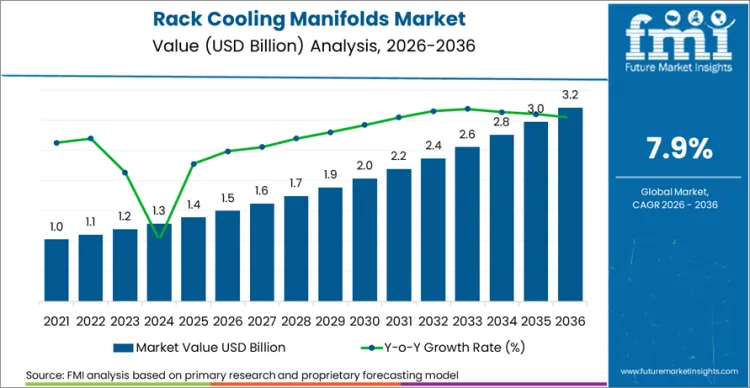
Rack cooling manifolds market revenue is projected to total USD 1.5 billion in 2026, increasing to USD 3.2 billion by 2036, at a CAGR of 7.9%. FMI analysis indicates the market is undergoing a rapid shift from air-based thermal management to precision liquid cooling distribution, driven by the unsustainable thermal loads of AI clusters and high-performance computing (HPC). The 2026–2027 period will be defined by the standardization of manifold interfaces and the integration of advanced sensors for real-time coolant monitoring.
Growth is anchored in the global hyperscale data center construction boom and the associated power density crisis. In Q4 2025, the USA Department of Energy released its Energy Efficiency for Information Technology roadmap, identifying liquid cooling as a mandatory pathway for data centers exceeding 50 kW per rack to participate in federal demand-response programs. This policy directly incentivizes the adoption of advanced rack-level cooling distribution systems.
Schneider Electric SE launched its EcoStruxure Liquid Cooling Ready program in February 2026, offering pre-configured rack manifolds with standardized quick-disconnect fittings. The program targets a 40% reduction in deployment time for high-density AI racks, responding to hyperscaler demands for faster time-to-market for new compute capacity.
Technical innovation focuses on reducing coolant volume and eliminating single points of failure. Vertiv Holdings Co. disclosed in its 2025 annual report the commercialization of a modular, dual-path manifold system for its Liebert DCD direct-to-chip cooling units. This design allows for the hot-swapping of pump modules and individual server cooling loops without draining the entire system, a critical requirement for maintaining uptime in AI training environments.
Asetek A/S announced a strategic partnership with a major semiconductor OEM in Q3 2025 to co-develop next-generation cold-plate manifolds with embedded microchannel geometries optimized for future CPU and GPU thermal design power (TDP) exceeding 1000W.
Rittal GmbH & Co. KG completed an expansion of its manufacturing capacity for aluminum manifold extrusions in Germany in early 2026, citing a 300% year-over-year increase in orders for its LCP direct cooling solutions from European HPC and financial trading data centers.
Summary of Rack Cooling Manifolds Market
What is the Long-Term Growth Outlook for the Rack Cooling Manifold Market?
FMI projects the global rack cooling manifold market to expand from USD 1.5 billion in 2026 to USD 3.2 billion by 2036, registering a 7.9% CAGR. Market expansion reflects the irreversible industry shift from perimeter air conditioning to enclosed, rack-level liquid cooling. Manifolds are the central distribution arteries of this transition, evolving from simple piping into systems that manage pressure, flow, and temperature differentials across dozens of high-heat components within a single rack.
This growth is propelled by the exponential power demands of AI accelerators, the economic necessity of reducing data center water usage, and the physical limits of air cooling. Demand is accelerating for manifolds that support hybrid cooling topologies, facilitate maintenance without downtime, and provide granular thermal data for integration with data center infrastructure management (DCIM) platforms.
FMI Research Approach: This projection is derived from FMI’s proprietary forecasting framework integrating hyperscaler capital expenditure announcements, rack power density forecasts from chip manufacturers, regulatory timelines for data center efficiency, and procurement data from colocation and enterprise IT operators.
How do FMI Analysts Expect the Rack Cooling Manifold Market to Evolve Structurally?
FMI analysts anticipate a transition from custom, project-specific manifold designs to standardized, modular, and pre-configured distribution kits. This evolution is driven by the need for speed and repeatability in data center deployment. The market will stratify into high-performance manifolds for pure liquid cooling (direct-to-chip, immersion) and hybrid manifolds that integrate with rear-door heat exchangers for moderate-density applications.
Innovations such as additive-manufactured manifolds with optimized internal fluid channels, manifolds with integrated dielectric leak detection sensors, and passive two-phase cooling distribution systems are redefining performance benchmarks. Manifolds are increasingly designed as part of a rack’s structural frame, contributing to mechanical stability while minimizing footprint.
FMI Research Approach: Insights are informed by analysis of product roadmaps from cooling specialists, patent filings related to fluid dynamics and connector technologies, and design wins announced by OEMs for next-generation server platforms.
Which Geographies Command the Largest Share of the Rack Cooling Manifold Market?
China leads the global rack cooling manifold market, advancing at an estimated 12.4% CAGR, driven by its national computing initiative mandating high efficiency for new data centers and the concentrated build-out of AI infrastructure. The United States follows with an 11.9% CAGR, underpinned by massive hyperscaler investments in AI clusters and favorable tax incentives for energy-efficient infrastructure.
South Korea and the UK represent high-growth markets, expanding at 10.4% and 10.9% CAGR, respectively. South Korea’s growth is fueled by its dominant semiconductor industry requiring advanced thermal testing and HPC, while the UK’s growth is linked to strict planning regulations limiting power and water consumption for new data center facilities.
FMI Research Approach: Country-level forecasts are built using analysis of national digital infrastructure strategies, local climate-related water usage restrictions, semiconductor fab investment locations, and primary interviews with regional system integrators.
What Will Be the Market Size of Rack Cooling Manifolds by 2036?
By 2036, the rack cooling manifold market is expected to reach USD 3.2 billion. This growth will be supported by the near-ubiquitous adoption of some form of liquid cooling for racks over 30kW, the proliferation of edge data centers with challenging environmental conditions, and the retrofit of existing enterprise data centers for AI workloads. The market will see a significant revenue shift toward intelligent manifolds with embedded control logic, which command a substantial price premium over passive distribution units.
FMI Research Approach: Long-term market sizing incorporates data center construction forecasts, technology adoption curves for liquid cooling, server shipment projections by workload type, and average manifold content per rack analysis.
What are some Globally Distinct Trends Shaping the Rack Cooling Manifold Market?
Globally, the market is being shaped by the convergence of chip thermal design, sustainability regulation, and data center operational economics. The shift toward heterogeneous computing (CPUs, GPUs, TPUs) within a single rack is driving demand for multi-zone manifolds capable of delivering different flow rates and temperatures to various components.
Sustainability regulations, particularly in the EU and Singapore, are imposing strict limits on power usage effectiveness (PUE) and water usage effectiveness (WUE), making dry-cooler compatible, low-pressure-drop manifold systems essential. Concurrently, the operational need for server repairability and upgradeability is promoting the adoption of quick-disconnect fittings and tool-less manifold reconfiguration, moving away from hard-plumbed, brazed solutions.
FMI Research Approach: Trend analysis is informed by regulatory tracking of data center efficiency standards, sustainability reports from cloud providers, technology validation data from chipmaker thermal labs, and total cost of ownership models from colocation operators.
Rack Cooling Manifolds Market Key Takeaways
| Metrics | Values |
|---|---|
| Expected Value (2026E) | USD 1.5 billion |
| Projected Value (2036F) | USD 3.2 billion |
| CAGR (2026-2036) | 7.9% |
Source: Future Market Insights (FMI) analysis, based on proprietary forecasting model and primary research
Why is the Rack Cooling Manifolds Market Growing?
The AI infrastructure supercycle is forcing a fundamental redesign of data center thermal management from the rack outward. Meta’s Open Compute Project (OCP) Advanced Cooling Solutions subgroup released specifications in Q1 2026 for a universal rack manifold interface. This initiative aims to decouple server cooling loop design from facility coolant distribution, allowing for vendor-agnostic hot-swap of compute trays. The standardization effort, backed by Google and Microsoft, is creating a massive, uniform addressable market for compliant manifold systems and accelerating adoption beyond early adopters.
Water scarcity is transforming cooling system design criteria. The 2026 update to Singapore’s BCA-IMDA Green Mark for Data Centers reduced the maximum allowable WUE by 25% for new facilities. This regulation directly benefits closed-loop, refrigerant-based cooling systems that utilize rack manifolds, as they consume zero onsite water for heat rejection. Major colocation providers in the region are now specifying manifolds designed for compatibility with high-temperature chillers that can leverage warmer ambient air or seawater for cooling, a design constraint that prioritizes manifold efficiency.
Edge computing deployments in telecommunications and retail are driving demand for rugged, self-contained cooling solutions. Verizon’s 2026 edge infrastructure blueprint details the deployment of thousands of micro-modular data units at cell tower aggregation sites. These units utilize integrated rack manifolds connected to outdoor dry coolers, capable of operating in ambient temperatures from -40°C to 55°C without humidity control. This application requires manifolds constructed from corrosion-resistant materials like stainless steel and equipped with fail-safe valves, creating a specialized, high-reliability segment.
How is Rack Cooling Manifolds Market Segmented?
The rack cooling manifold segment landscape is defined by cooling methodology and material suitability for dielectric fluids. Cold-plate manifolds dominate high-heat-flux applications for direct component cooling, while aluminum remains the preferred material for its manufacturability and thermal properties. The AI/HPC rack segment is the primary driver for innovation and premium pricing.
How is Direct Cooling Driving Dominance for Cold-Plate Manifolds?
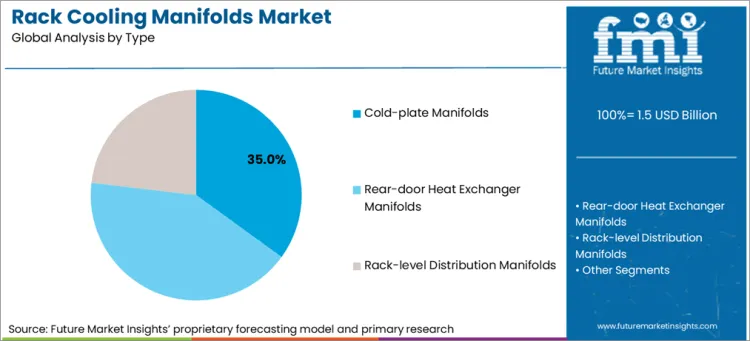
Cold-plate manifolds account for a 35% market share, representing the dominant sub-segment. This leadership is due to their direct integration with the highest heat-generating components (CPUs, GPUs), offering the most efficient path for heat removal. CoolIT Systems, Inc. secured a landmark supply agreement in January 2026 with a leading server OEM for its next-generation manifolded cold-plate assemblies. These assemblies feature a common manifold supplying multiple, individually adjustable cold plates, allowing for dynamic cooling allocation based on real-time processor load, a critical capability for AI inference workloads.
Which Economic and Performance Factors are Preserving Aluminum's Dominance?
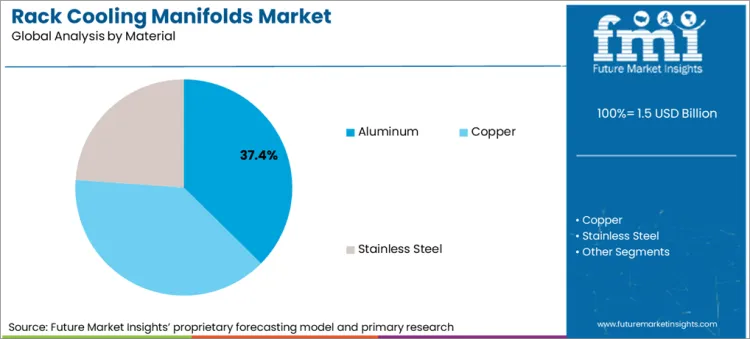
Aluminum commands a 37.4% share of the material segment. Its dominance is rooted in an optimal balance of thermal conductivity, weight, cost, and ease of extrusion into complex manifold shapes. Motivair Corporation’s 2026 product launch focused on aluminum manifolds with an internal nano-coating to prevent galvanic corrosion when using mixed-metal cooling loops. This technological advancement mitigates a key historical risk, further entrenching aluminum’s position for large-scale, cost-sensitive deployments like hyperscale data centers.
What Role does the AI/HPC Rack Segment Play in Defining Global Innovation?
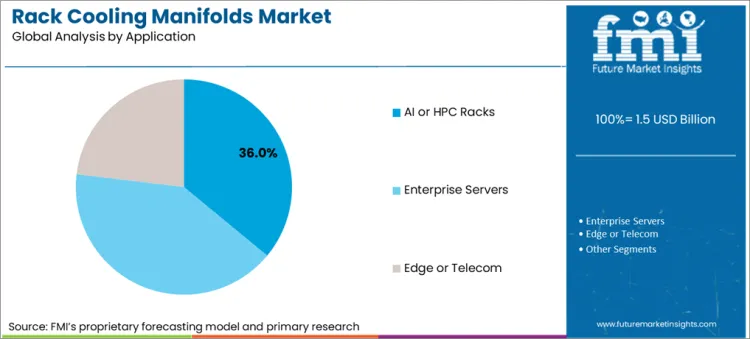
AI or HPC Racks represent the largest application segment with a 36% share. This segment sets the technical roadmap for the entire market due to its extreme thermal density and reliability requirements. The UK’s Isambard-AI supercomputer project, slated for commissioning in late 2026, specified a total liquid cooling system where the rack manifolds are designed to handle variable flow rates from 50 to 200 liters per minute per rack. This requirement for dynamic, high-flow-capacity distribution is pushing manufacturers to develop new pump-integrated manifold units and sophisticated control algorithms, innovations that later trickle down to enterprise server segments.
What Drivers, Restraints, Opportunities, and Trends Prevail in the Rack Cooling Manifolds Market?
Market expansion is driven by binding energy efficiency regulations. The EU Energy Efficiency Directive’s recast, effective January 2026, mandates that all new data centers over 500 kW report a PUE of 1.3 or lower, a target unattainable with traditional air cooling for AI workloads. This regulation acts as a powerful demand catalyst for liquid cooling systems and their associated manifold infrastructure, compelling facility operators across Europe to invest in rack-level thermal distribution upgrades.
While demand is robust, supply chain constraints for precision components present a significant restraint. Financial disclosures from Vertiv in early 2026 highlighted prolonged lead times and cost inflation for specialized ceramic and polymer seals rated for dielectric fluid compatibility and high temperatures. These components are critical for leak-free manifold operation, and their scarcity can bottleneck the production of complete cooling distribution units.
Technical innovation is defined by the move toward two-phase cooling distribution. Green Revolution Cooling, Inc. demonstrated a prototype rack manifold system in Q4 2025 that distributes a two-phase refrigerant instead of single-phase water or dielectric fluid. This system utilizes the latent heat of vaporization for highly efficient heat capture at the cold plate, allowing the manifold to operate with significantly lower pump power and flow rates, reducing overall system energy consumption.
The trend toward server immersion cooling creates a parallel market for submerged distribution manifolds. Iceotope Technologies Limited announced a partnership with a global IT distributor in March 2026 to offer pre-filled, sealed immersion tanks with integrated fluid distribution manifolds. This model shifts the manifold from a customer-installed component to a factory-sealed part of a consumable cooling appliance, changing the sales and service model for cooling suppliers.
Analysis of Rack Cooling Manifolds Market by Key Countries
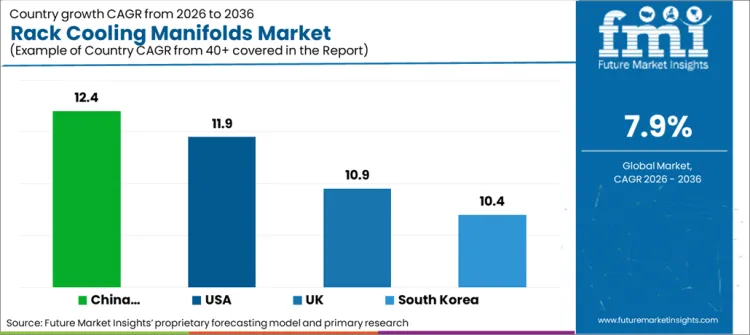
The following analysis examines the strategic evolution of the rack cooling manifold market in China (12.4%), USA (11.9%), South Korea (10.4%), and the UK (10.9%). These countries represent the core innovation and deployment zones, each shaped by distinct policy environments, industrial bases, and climate-related imperatives.
| Country | CAGR (2026-2036) |
|---|---|
| China | 12.4% |
| USA | 11.9% |
| South Korea | 10.4% |
| UK | 10.9% |
Source: Future Market Insights (FMI) analysis, based on proprietary forecasting model and primary research
How are National Computing Initiatives scaling Demand for Rack Cooling Manifolds in China?
China is projected to expand at a 12.4% CAGR through 2036, driven by its "East Data West Computing" national project. This initiative mandates that new data center clusters built in western provinces for processing eastern data must achieve a PUE below 1.25. The arid climate of these western regions makes liquid cooling with dry heat rejection the only viable path to compliance.
This has triggered a centralized procurement program for standardized rack cooling solutions, where domestic manufacturers like Huawei Digital Power and Inspur are developing manifold systems specifically for the large-scale, modular data hall designs prescribed by the state.
Which Hyperscaler Investment Patterns are defining Rack Cooling Manifolds Demand in USA?
USA’s rack cooling manifolds landscape is set for an 11.9% CAGR, fueled by concentrated hyperscaler investment in AI data center corridors in states like Virginia, Ohio, and Texas. The scale of these projects, often exceeding 500 MW, allows for deep customization of cooling infrastructure.
AWS’s 2026 design guide for its dedicated AI clusters specifies a rack manifold design that integrates with its proprietary Orion chip cooling system. This level of co-engineering between hyperscaler and cooling vendor creates high-value, long-term contracts but raises barriers to entry for suppliers without deep co-design capabilities and on-site technical support teams.
What Role does the Semiconductor Ecosystem Play in South Korea's Market Growth?
South Korea’s 10.4% CAGR is tied to its global leadership in memory and logic semiconductor manufacturing. Samsung Electronics and SK Hynix operate massive R&D data centers for chip design and testing, which serve as first adopters for extreme cooling technologies. The manifolds deployed in these environments must handle not only high power but also the precise temperature stability (±0.1°C) required for silicon characterization.
This demand for ultra-precision has fostered a local ecosystem of specialized fluid handling companies, making South Korea a testing ground for next-generation manifold sensor and control technologies before they reach broader commercial markets.
How are Climate Commitments and Planning Laws Shaping the UK Market?
The UK’s 10.9% CAGR is largely influenced by its legally binding net-zero targets and restrictive planning laws around power and water use. The Greater London Authority’s 2026 London Plan Supplementary Guidance effectively bans new data centers from using potable water for cooling. This forces all new builds in the critical London market to adopt closed-loop liquid cooling with air-cooled condensers.
Manifold systems for this market must be optimized for compatibility with lower-temperature differentials and environmentally acceptable refrigerants, prioritizing material compatibility and leakage integrity over absolute maximum heat removal capacity.
What is the Competition Outlook for Rack Cooling Manifolds?
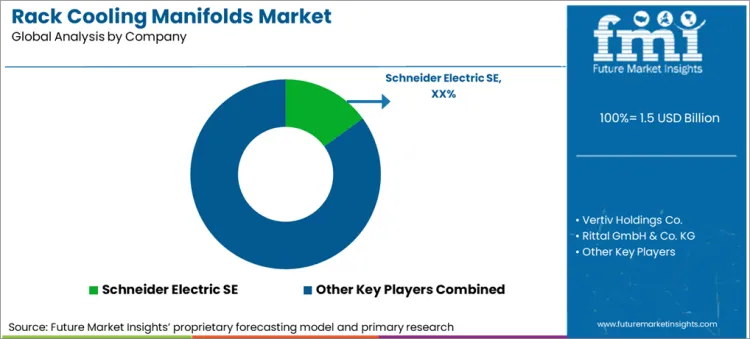
Competitive intensity reflects the convergence of IT hardware, facilities infrastructure, and fluid dynamics engineering. The landscape is consolidating around vertically integrated players that can provide the manifold, pumps, controls, and facility connection as a validated, warranty-backed system. Competition is increasingly based on total cost of ownership models that factor in energy savings, water savings, and server performance gains from lower junction temperatures. Success depends on partnerships with server OEMs, chip manufacturers, and hyperscale engineering teams.
Specialist liquid cooling companies proving the viability of their technology for niche HPC applications defined strategic evolution prior to 2024. Suppliers focused on achieving high-profile reference designs with national labs and universities.
The observable strategic direction for 2026 and beyond is the acquisition of component specialists by broad-line infrastructure providers. Schneider Electric’s acquisition of a leading manufacturer of quick-disconnect fittings in late 2025 exemplifies this trend, aiming to control a critical component in the manifold assembly and secure supply for its integrated rack solutions.
Strategic leadership is shifting toward providing cooling as a managed service. In early 2026, Vertiv Holdings Co. announced a 10-year contract with a European hyperscaler to provide and maintain the entire liquid cooling infrastructure, including all rack manifolds, under a performance-based agreement where payment is partially tied to achieved PUE. This model transfers performance risk to the cooling supplier and makes the manifold a revenue-generating asset over its lifecycle.
Recent Developments
- Vertiv Holdings Co. was selected in February 2026 as the sole cooling infrastructure provider for a new 350 MW AI data center campus in the southwestern United States, a contract valued at over USD 200 million and centered on its pumped refrigerant distribution manifold technology.
- Asetek A/S received a patent in November 2025 for a “Manifold with Turbulence-Inducing Inserts” designed to improve heat transfer efficiency in high-flow scenarios by 15%, a key innovation for cooling next-generation GPUs.
- CoolIT Systems, Inc. and NVIDIA announced a joint validation program in Q1 2026 for direct-to-chip cooling manifolds compatible with NVIDIA’s Blackwell platform, ensuring seamless integration and performance optimization for AI servers.
Key Players Profiled
- Schneider Electric SE
- Vertiv Holdings Co.
- Rittal GmbH & Co. KG
- Asetek A/S
- CoolIT Systems, Inc.
- Motivair Corporation
- Chilldyne, Inc.
- Green Revolution Cooling, Inc.
- Iceotope Technologies Limited
Market Definition
The rack cooling manifolds market comprises revenue generated from the design, manufacture, and supply of fluid distribution assemblies that route liquid coolant within a server rack to heat exchangers, cold plates, or immersion tanks. These manifolds manage pressure, flow, and temperature distribution to multiple heat sources, ensuring efficient thermal transfer. The market includes rigid and flexible manifolds constructed from aluminum, copper, stainless steel, and engineered plastics.
The market scope covers manifolds used in data centers, high-performance computing facilities, and edge computing installations for cooling IT equipment. Revenue includes value from integrated valves, sensors, quick-disconnect fittings, and control units bundled with the manifold assembly. The market excludes facility-level primary cooling distribution piping, chilled water plant equipment, and individual cold plates or heat sinks unless sold as part of an integrated manifold distribution unit.
Scope of Report
| Items | Values |
|---|---|
| Quantitative Units | USD 1.5 billion |
| Type | Cold-plate Manifolds; Rear-door Heat Exchanger Manifolds; Rack-level Distribution Manifolds |
| Material | Aluminum; Copper; Stainless Steel |
| Application | AI or HPC Racks; Enterprise Servers; Edge or Telecom |
| Regions Covered | North America, Western Europe, Eastern Europe, East Asia, South Asia & Pacific, Latin America, Middle East & Africa |
| Countries | China, USA, South Korea, UK and 40+ countries |
| Key Companies | Schneider Electric SE, Vertiv Holdings Co., Rittal GmbH & Co. KG, Asetek A/S, CoolIT Systems, Inc., Motivair Corporation, Chilldyne, Inc., Green Revolution Cooling, Inc., Iceotope Technologies Limited |
Source: Future Market Insights (FMI) analysis, based on proprietary forecasting model and primary research
Rack Cooling Manifolds Market Key Segments
By Type
- Cold-plate Manifolds
- Rear-door Heat Exchanger Manifolds
- Rack-level Distribution Manifolds
By Material
- Aluminum
- Copper
- Stainless Steel
By Application
- AI or HPC Racks
- Enterprise Servers
- Edge or Telecom
By Region
- North America
- Western Europe
- Eastern Europe
- East Asia
- South Asia & Pacific
- Latin America
- Middle East & Africa
Bibliography
- Schneider Electric SE. (2026). EcoStruxure for Data Centers: Liquid Cooling Adoption Report. Schneider Electric.
- Vertiv Holdings Co. (2025). Annual Report: Thermal Management Solutions. Vertiv.
- USA Department of Energy. (2025). Energy Efficiency Roadmap for Information and Communications Technology.
- Open Compute Project Foundation. (2026). Advanced Cooling Solutions: Mechanical Interface Specification.
- European Commission. (2025). Implementing Measures for the Energy Efficiency Directive (Recast).
- Meta Platforms, Inc. (2026). Infrastructure Sustainability Report.
Frequently Asked Questions
What is the expected value of the rack cooling manifolds market in 2026?
The rack cooling manifolds market is expected to reach USD 1.5 billion in 2026, supported by the rapid adoption of liquid cooling for AI data centers and high-density computing.
What is the projected value by 2036 and CAGR from 2026 to 2036?
By 2036, the market is projected to reach USD 3.2 billion, expanding at a CAGR of 7.9% between 2026 and 2036.
How is the rise of AI infrastructure influencing manifold design?
The exponential heat loads from AI accelerator racks are driving demand for high-flow-capacity, reliable manifolds that support direct-to-chip cooling, require zero maintenance interventions, and provide detailed thermal telemetry for dynamic cooling control.
What role does sustainability regulation play in shaping the market?
Regulations mandating low PUE and WUE are forcing a wholesale shift from air to liquid cooling in new data centers, making the cooling manifold a critical, non-optional component of modern data center infrastructure to comply with legal efficiency thresholds.
Which application segment is driving the highest-value demand?
AI or HPC Racks lead demand, accounting for the largest share due to their extreme thermal density, which necessitates the most advanced and performance-critical manifold systems, commanding premium pricing.
Preview the report firsthand - request a free sample
Get SampleGet the brochure for pricing and purchase details.
Get PDFTable of Content
- Executive Summary
- Global Market Outlook
- Demand-side Trends
- Supply-side Trends
- Technology Roadmap Analysis
- Analysis and Recommendations
- Market Overview
- Market Coverage / Taxonomy
- Market Definition / Scope / Limitations
- Research Methodology
- Chapter Orientation
- Analytical Lens and Working Hypotheses
- Market Structure, Signals, and Trend Drivers
- Benchmarking and Cross-market Comparability
- Market Sizing, Forecasting, and Opportunity Mapping
- Research Design and Evidence Framework
- Desk Research Programme (Secondary Evidence)
- Company Annual and Sustainability Reports
- Peer-reviewed Journals and Academic Literature
- Corporate Websites, Product Literature, and Technical Notes
- Earnings Decks and Investor Briefings
- Statutory Filings and Regulatory Disclosures
- Technical White Papers and Standards Notes
- Trade Journals, Industry Magazines, and Analyst Briefs
- Conference Proceedings, Webinars, and Seminar Materials
- Government Statistics Portals and Public Data Releases
- Press Releases and Reputable Media Coverage
- Specialist Newsletters and Curated Briefings
- Sector Databases and Reference Repositories
- FMI Internal Proprietary Databases and Historical Market Datasets
- Subscription Datasets and Paid Sources
- Social Channels, Communities, and Digital Listening Inputs
- Additional Desk Sources
- Expert Input and Fieldwork (Primary Evidence)
- Primary Modes
- Qualitative Interviews and Expert Elicitation
- Quantitative Surveys and Structured Data Capture
- Blended Approach
- Why Primary Evidence is Used
- Field Techniques
- Interviews
- Surveys
- Focus Groups
- Observational and In-context Research
- Social and Community Interactions
- Stakeholder Universe Engaged
- C-suite Leaders
- Board Members
- Presidents and Vice Presidents
- R&D and Innovation Heads
- Technical Specialists
- Domain Subject-matter Experts
- Scientists
- Physicians and Other Healthcare Professionals
- Governance, Ethics, and Data Stewardship
- Research Ethics
- Data Integrity and Handling
- Primary Modes
- Tooling, Models, and Reference Databases
- Desk Research Programme (Secondary Evidence)
- Data Engineering and Model Build
- Data Acquisition and Ingestion
- Cleaning, Normalisation, and Verification
- Synthesis, Triangulation, and Analysis
- Quality Assurance and Audit Trail
- Market Background
- Market Dynamics
- Drivers
- Restraints
- Opportunity
- Trends
- Scenario Forecast
- Demand in Optimistic Scenario
- Demand in Likely Scenario
- Demand in Conservative Scenario
- Opportunity Map Analysis
- Product Life Cycle Analysis
- Supply Chain Analysis
- Investment Feasibility Matrix
- Value Chain Analysis
- PESTLE and Porter’s Analysis
- Regulatory Landscape
- Regional Parent Market Outlook
- Production and Consumption Statistics
- Import and Export Statistics
- Market Dynamics
- Global Market Analysis 2021 to 2025 and Forecast, 2026 to 2036
- Historical Market Size Value (USD Million) Analysis, 2021 to 2025
- Current and Future Market Size Value (USD Million) Projections, 2026 to 2036
- Y-o-Y Growth Trend Analysis
- Absolute $ Opportunity Analysis
- Global Market Pricing Analysis 2021 to 2025 and Forecast 2026 to 2036
- Global Market Analysis 2021 to 2025 and Forecast 2026 to 2036, By Type
- Introduction / Key Findings
- Historical Market Size Value (USD Million) Analysis By Type , 2021 to 2025
- Current and Future Market Size Value (USD Million) Analysis and Forecast By Type , 2026 to 2036
- Cold-plate Manifolds
- Rear-door Heat Exchanger Manifolds
- Rack-level Distribution Manifolds
- Cold-plate Manifolds
- Y-o-Y Growth Trend Analysis By Type , 2021 to 2025
- Absolute $ Opportunity Analysis By Type , 2026 to 2036
- Global Market Analysis 2021 to 2025 and Forecast 2026 to 2036, By Material
- Introduction / Key Findings
- Historical Market Size Value (USD Million) Analysis By Material, 2021 to 2025
- Current and Future Market Size Value (USD Million) Analysis and Forecast By Material, 2026 to 2036
- Aluminum
- Copper
- Stainless Steel
- Aluminum
- Y-o-Y Growth Trend Analysis By Material, 2021 to 2025
- Absolute $ Opportunity Analysis By Material, 2026 to 2036
- Global Market Analysis 2021 to 2025 and Forecast 2026 to 2036, By Application
- Introduction / Key Findings
- Historical Market Size Value (USD Million) Analysis By Application, 2021 to 2025
- Current and Future Market Size Value (USD Million) Analysis and Forecast By Application, 2026 to 2036
- AI or HPC Racks
- Enterprise Servers
- Edge or Telecom
- AI or HPC Racks
- Y-o-Y Growth Trend Analysis By Application, 2021 to 2025
- Absolute $ Opportunity Analysis By Application, 2026 to 2036
- Global Market Analysis 2021 to 2025 and Forecast 2026 to 2036, By Region
- Introduction
- Historical Market Size Value (USD Million) Analysis By Region, 2021 to 2025
- Current Market Size Value (USD Million) Analysis and Forecast By Region, 2026 to 2036
- North America
- Latin America
- Western Europe
- Eastern Europe
- East Asia
- South Asia and Pacific
- Middle East & Africa
- Market Attractiveness Analysis By Region
- North America Market Analysis 2021 to 2025 and Forecast 2026 to 2036, By Country
- Historical Market Size Value (USD Million) Trend Analysis By Market Taxonomy, 2021 to 2025
- Market Size Value (USD Million) Forecast By Market Taxonomy, 2026 to 2036
- By Country
- USA
- Canada
- Mexico
- By Type
- By Material
- By Application
- By Country
- Market Attractiveness Analysis
- By Country
- By Type
- By Material
- By Application
- Key Takeaways
- Latin America Market Analysis 2021 to 2025 and Forecast 2026 to 2036, By Country
- Historical Market Size Value (USD Million) Trend Analysis By Market Taxonomy, 2021 to 2025
- Market Size Value (USD Million) Forecast By Market Taxonomy, 2026 to 2036
- By Country
- Brazil
- Chile
- Rest of Latin America
- By Type
- By Material
- By Application
- By Country
- Market Attractiveness Analysis
- By Country
- By Type
- By Material
- By Application
- Key Takeaways
- Western Europe Market Analysis 2021 to 2025 and Forecast 2026 to 2036, By Country
- Historical Market Size Value (USD Million) Trend Analysis By Market Taxonomy, 2021 to 2025
- Market Size Value (USD Million) Forecast By Market Taxonomy, 2026 to 2036
- By Country
- Germany
- UK
- Italy
- Spain
- France
- Nordic
- BENELUX
- Rest of Western Europe
- By Type
- By Material
- By Application
- By Country
- Market Attractiveness Analysis
- By Country
- By Type
- By Material
- By Application
- Key Takeaways
- Eastern Europe Market Analysis 2021 to 2025 and Forecast 2026 to 2036, By Country
- Historical Market Size Value (USD Million) Trend Analysis By Market Taxonomy, 2021 to 2025
- Market Size Value (USD Million) Forecast By Market Taxonomy, 2026 to 2036
- By Country
- Russia
- Poland
- Hungary
- Balkan & Baltic
- Rest of Eastern Europe
- By Type
- By Material
- By Application
- By Country
- Market Attractiveness Analysis
- By Country
- By Type
- By Material
- By Application
- Key Takeaways
- East Asia Market Analysis 2021 to 2025 and Forecast 2026 to 2036, By Country
- Historical Market Size Value (USD Million) Trend Analysis By Market Taxonomy, 2021 to 2025
- Market Size Value (USD Million) Forecast By Market Taxonomy, 2026 to 2036
- By Country
- China
- Japan
- South Korea
- By Type
- By Material
- By Application
- By Country
- Market Attractiveness Analysis
- By Country
- By Type
- By Material
- By Application
- Key Takeaways
- South Asia and Pacific Market Analysis 2021 to 2025 and Forecast 2026 to 2036, By Country
- Historical Market Size Value (USD Million) Trend Analysis By Market Taxonomy, 2021 to 2025
- Market Size Value (USD Million) Forecast By Market Taxonomy, 2026 to 2036
- By Country
- India
- ASEAN
- Australia & New Zealand
- Rest of South Asia and Pacific
- By Type
- By Material
- By Application
- By Country
- Market Attractiveness Analysis
- By Country
- By Type
- By Material
- By Application
- Key Takeaways
- Middle East & Africa Market Analysis 2021 to 2025 and Forecast 2026 to 2036, By Country
- Historical Market Size Value (USD Million) Trend Analysis By Market Taxonomy, 2021 to 2025
- Market Size Value (USD Million) Forecast By Market Taxonomy, 2026 to 2036
- By Country
- Kingdom of Saudi Arabia
- Other GCC Countries
- Turkiye
- South Africa
- Other African Union
- Rest of Middle East & Africa
- By Type
- By Material
- By Application
- By Country
- Market Attractiveness Analysis
- By Country
- By Type
- By Material
- By Application
- Key Takeaways
- Key Countries Market Analysis
- USA
- Pricing Analysis
- Market Share Analysis, 2025
- By Type
- By Material
- By Application
- Canada
- Pricing Analysis
- Market Share Analysis, 2025
- By Type
- By Material
- By Application
- Mexico
- Pricing Analysis
- Market Share Analysis, 2025
- By Type
- By Material
- By Application
- Brazil
- Pricing Analysis
- Market Share Analysis, 2025
- By Type
- By Material
- By Application
- Chile
- Pricing Analysis
- Market Share Analysis, 2025
- By Type
- By Material
- By Application
- Germany
- Pricing Analysis
- Market Share Analysis, 2025
- By Type
- By Material
- By Application
- UK
- Pricing Analysis
- Market Share Analysis, 2025
- By Type
- By Material
- By Application
- Italy
- Pricing Analysis
- Market Share Analysis, 2025
- By Type
- By Material
- By Application
- Spain
- Pricing Analysis
- Market Share Analysis, 2025
- By Type
- By Material
- By Application
- France
- Pricing Analysis
- Market Share Analysis, 2025
- By Type
- By Material
- By Application
- India
- Pricing Analysis
- Market Share Analysis, 2025
- By Type
- By Material
- By Application
- ASEAN
- Pricing Analysis
- Market Share Analysis, 2025
- By Type
- By Material
- By Application
- Australia & New Zealand
- Pricing Analysis
- Market Share Analysis, 2025
- By Type
- By Material
- By Application
- China
- Pricing Analysis
- Market Share Analysis, 2025
- By Type
- By Material
- By Application
- Japan
- Pricing Analysis
- Market Share Analysis, 2025
- By Type
- By Material
- By Application
- South Korea
- Pricing Analysis
- Market Share Analysis, 2025
- By Type
- By Material
- By Application
- Russia
- Pricing Analysis
- Market Share Analysis, 2025
- By Type
- By Material
- By Application
- Poland
- Pricing Analysis
- Market Share Analysis, 2025
- By Type
- By Material
- By Application
- Hungary
- Pricing Analysis
- Market Share Analysis, 2025
- By Type
- By Material
- By Application
- Kingdom of Saudi Arabia
- Pricing Analysis
- Market Share Analysis, 2025
- By Type
- By Material
- By Application
- Turkiye
- Pricing Analysis
- Market Share Analysis, 2025
- By Type
- By Material
- By Application
- South Africa
- Pricing Analysis
- Market Share Analysis, 2025
- By Type
- By Material
- By Application
- USA
- Market Structure Analysis
- Competition Dashboard
- Competition Benchmarking
- Market Share Analysis of Top Players
- By Regional
- By Type
- By Material
- By Application
- Competition Analysis
- Competition Deep Dive
- Schneider Electric SE
- Overview
- Product Portfolio
- Profitability by Market Segments (Product/Age /Sales Channel/Region)
- Sales Footprint
- Strategy Overview
- Marketing Strategy
- Product Strategy
- Channel Strategy
- Vertiv Holdings Co.
- Rittal GmbH & Co. KG
- Asetek A/S
- CoolIT Systems, Inc.
- Motivair Corporation
- Chilldyne, Inc.
- Green Revolution Cooling, Inc.
- Iceotope Technologies Limited
- Schneider Electric SE
- Competition Deep Dive
- Assumptions & Acronyms Used


