

- Industry Size (2026)
- USD 3.2 Bn
- Forecast (2036)
- USD 13.9 Bn
- CAGR (2026 to 2036)
- 15.8%
Direct-to-Chip Cold Plate Market Forecast and Outlook 2026 to 2036
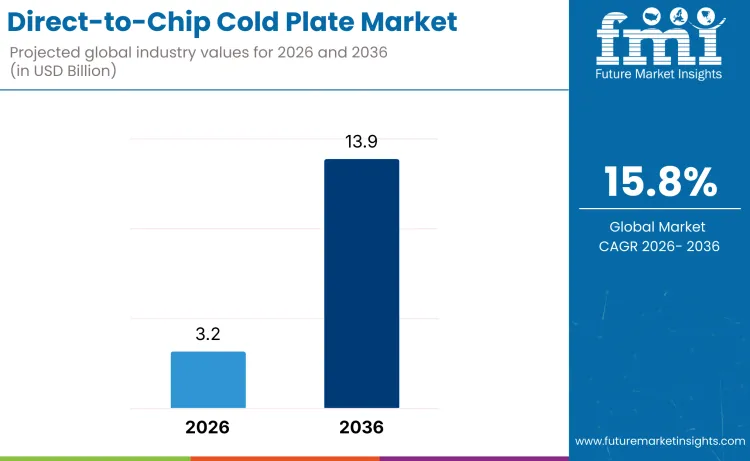
A move from USD 3.2 billion in 2026 to USD 13.9 billion by 2036 places the Direct-to-Chip Cold Plate Market on a 15.8% CAGR path. Demand is concentrated in high density computing environments where thermal limits directly constrain processor utilization, including hyperscale data centers, high performance computing clusters, and advanced AI training systems. Adoption remains uneven because many facilities still operate at power densities that can be handled by air or rear door cooling. Geographic concentration follows regions with large scale data center investment and advanced server integration ecosystems, notably North America, parts of East Asia, and Western Europe.
System architecture and risk management, rather than component price, drive purchasing decisions in this segment. Once a cold plate design is validated with a given processor generation and server layout, it becomes embedded across entire platform families to avoid thermal qualification risk and downtime exposure. Operators with large, standardized fleets move first because they can amortize design and maintenance complexity across many racks. Smaller operators adopt selectively due to integration cost and service skill requirements. The market expands through the scaling of high density compute deployments, not through broad conversion of conventional server rooms.
Quick Stats for Direct-to-Chip Cold Plate Market
- Direct-to-Chip Cold Plate Market Value (2026): USD 3.2 billion
- Direct-to-Chip Cold Plate Market Forecast Value (2036): USD 13.9 billion
- Direct-to-Chip Cold Plate Market Forecast CAGR 2026 to 2036: 15.8%
- Leading Type in Direct-to-Chip Cold Plate Market: Microchannel cold plates
- Key Growth Regions in Direct-to-Chip Cold Plate Market: Asia Pacific, North America, Europe
- Top Players in Direct-to-Chip Cold Plate Market: Asetek, Lytron (Parker Hannifin), CoolIT Systems, Alphacool, Marlow Industries, Panasonic Liquid Cooling Solutions, Modular Cooling Concepts
What is the Growth Forecast for Direct-to-Chip Cold Plate Market through 2036?
The direct-to-chip cold plate market is expanding because thermal management has become a performance limiter rather than a facilities problem. When the market sits near USD 1.3 billion and then moves through USD 1.7 billion and USD 2.3 billion, adoption is still concentrated in high-performance computing, AI training clusters, and advanced data center pods where air cooling can no longer hold clock speeds under sustained load. The step to about USD 3.2 billion marks the point where cold plates are no longer treated as experimental infrastructure but as part of standard rack design for dense compute. Growth in this phase is driven by rack power density and chip thermal design power increases, not by the number of data centers alone. Each new platform generation simply carries more cooling hardware per server.
As deployments scale, the market moves through roughly USD 4.3 billion, USD 5.8 billion, and USD 7.8 billion as liquid cooling becomes embedded in mainstream server and accelerator platforms. By the time spending reaches around USD 9.0 to 10.4 billion and then climbs toward USD 12.0 and USD 13.9 billion, the dominant driver is replication rather than experimentation. Cold plate designs are reused across many sites and product lines, which multiplies volumes per platform cycle. Value growth comes from higher cooling content per rack and broader adoption across performance tiers, not from price inflation. Competitive advantage rests on thermal interface reliability, mechanical integration with server platforms, and supply chain capacity, since operators prioritize uptime, serviceability, and predictable performance over marginal efficiency gains.
Direct-to-Chip Cold Plate Market Key Takeaways
| Metric | Value |
|---|---|
| Market Value (2026) | USD 3.2 billion |
| Forecast Value (2036) | USD 13.9 billion |
| Forecast CAGR 2026 to 2036 | 15.8% |
How Is the Direct-to-Chip Cold Plate Market Enhancing High-Performance Thermal Management?
Direct-to-chip cold plates are increasingly adopted to manage heat dissipation in high-performance computing, data centers, and power electronics. Historically, conventional heat sinks and air-cooling solutions struggled to remove concentrated heat from processors, GPUs, and high-density electronics, resulting in performance throttling and reduced equipment lifespan. Modern cold plates use precision-machined channels, high-conductivity metals, and optimized flow paths to provide direct cooling to critical components, improving thermal uniformity and system reliability. Data center operators, server manufacturers, and industrial electronics integrators prioritize cooling efficiency, material reliability, and compatibility with existing liquid-cooling infrastructure. Early adoption focused on hyperscale computing facilities, while current demand spans edge data centers, AI processing units, and high-power industrial electronics, driven by increased processing density, component longevity, and energy efficiency requirements. Thermal conductivity, pressure drop, and corrosion resistance influence supplier selection.
Maintaining stable component temperatures and preventing thermal hotspots is central to system performance. Compared with traditional indirect cooling solutions, direct-to-chip cold plates emphasize high heat transfer efficiency, precise temperature control, and minimized thermal gradients. Cost structures depend on material quality, manufacturing precision, and fluid channel design, concentrating margins among suppliers capable of delivering reliable, high-performance products. Manufacturers adopt these cold plates to optimize device performance, extend equipment life, and reduce thermal-related failures. By 2036, direct-to-chip cold plates are expected to become standard in high-performance computing and industrial electronics, supporting efficient thermal management, equipment reliability, and consistent operational performance.
What Factors Are Shaping the Demand for Direct-to-Chip Cold Plates, Segment wise by Design Type and Application, in 2026?
The Direct-to-Chip Cold Plate Market in 2026 is segmented by design type and by application. By thermal design, demand is divided into microchannel cold plates, flat plate cold plates, grooved channel cold plates, and embedded jet impingement cold plates, each offering different balances between heat transfer efficiency, pressure drop, and manufacturability. By application, demand is organized around high performance computing, data centers, telecom and 5G infrastructure, and automotive electronics, which differ in power density, service access requirements, and acceptable cooling system complexity. These segments reflect how system designers match cooling architecture to both chip heat flux and deployment constraints.
Why Do Microchannel Cold Plates Lead Through Thermal Density Requirements?
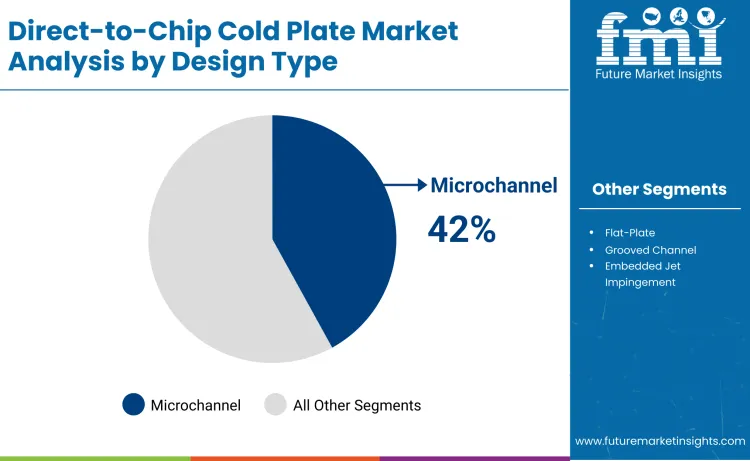
Microchannel cold plates account for about 42% of demand in 2026 because they are well suited to removing very high heat flux from modern processors and accelerators. Their fine channel structures increase surface area and promote turbulent flow at the chip interface, which improves heat transfer performance within limited footprint. In high power devices, this allows designers to keep junction temperatures within limits without resorting to full immersion or larger cooling assemblies. Although manufacturing is more complex, these plates have become standard in many high density compute modules. The need to cool ever higher power chips within fixed package sizes keeps microchannel designs as the primary choice in performance driven systems.
Flat plate, grooved, and jet impingement designs address different tradeoffs. Flat plates are simpler and cheaper, but their heat transfer capacity is lower, which limits use to moderate power devices. Grooved channels improve performance somewhat while keeping machining simpler. Jet impingement offers very high local cooling, yet it adds pumping complexity and is harder to service. These options are used where system cost, reliability, or maintenance access take priority. They grow alongside microchannel designs, but they do not displace them in the highest density applications that drive most spending.
Why Does High Performance Computing Anchor Application Demand?
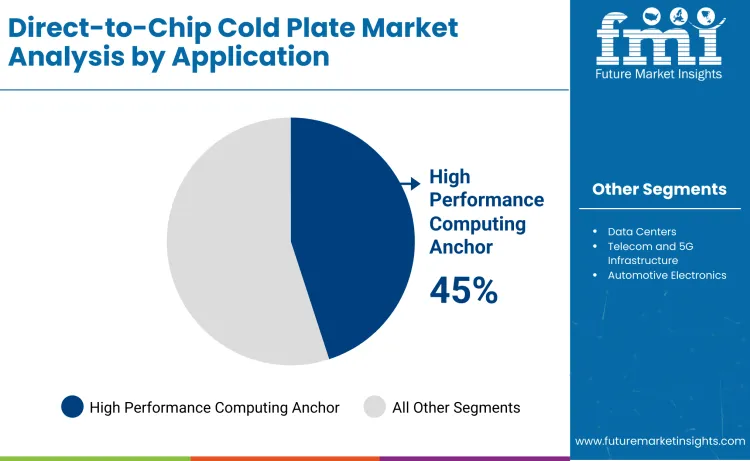
High performance computing represents about 45% of demand in 2026 because it concentrates the highest chip power densities in the smallest physical spaces. Clusters for scientific computing, AI training, and simulation deploy large numbers of accelerators and CPUs that cannot be cooled effectively with air alone. Direct to chip liquid cooling allows operators to increase rack density while keeping energy use and noise under control. Once a platform is designed around cold plates, the same approach is replicated across many nodes and often across multiple installations. This replication effect and the extreme thermal requirements explain why HPC remains the largest single application segment.
Data centers, telecom, and automotive electronics follow different adoption curves. General data centers adopt direct liquid cooling selectively, often in high density zones rather than across entire halls. Telecom and 5G equipment uses cold plates in compact, sealed enclosures, but unit volumes are smaller. Automotive electronics prioritize reliability and vibration tolerance, which slows adoption of complex liquid loops. These segments are important and expanding, yet none matches the combination of power density, standardization, and scale found in high performance computing deployments.
How Are the Key Dynamics of Thermal Density Pressure, Integration Risk, and Platform Standardization Reshaping the Direct-to-Chip Cold Plate Market through 2036?
The category is being driven by rising chip heat flux, constrained air cooling headroom, and the need to stabilize performance at scale. At the same time, adoption is slowed by integration risk because cold plates touch sockets, boards, pumps, and facility plumbing, making any change architectural. This tension creates strong incentives to standardize platforms so designs can be replicated across racks and sites with predictable results. Operators want fewer variants, clear service models, and documented reliability. The outcome is a market shaped less by component novelty and more by governance, qualification economics, and the ability to embed cold plates into repeatable, supportable compute platforms.
Why Are Thermal Density and Performance Stability Requirements Driving the Direct-to-Chip Cold Plate Market through 2036?
Demand is anchored in physics rather than refresh cycles. Accelerators and high core count CPUs concentrate heat in small footprints that air cooling struggles to handle without unacceptable noise, power, and space penalties. Direct to chip cold plates move heat at the source, enabling higher sustained clocks and more predictable throttling behavior. For operators, this translates into better performance per rack and tighter control of hotspots. Once a platform is tuned around liquid cooling, the cold plate becomes part of the performance envelope, not an accessory. Volume then follows deployment of dense compute platforms and replication of validated rack designs rather than opportunistic retrofits.
What Integration Risk and Operational Disruption Fears Are Slowing Wider Adoption?
The main barrier is architectural exposure. Cold plates require precise mechanical fit, leak managed connections, and coordination with pumps, manifolds, and monitoring. A failure affects expensive silicon and can take nodes offline. Retrofitting existing fleets is complex because boards, enclosures, and service procedures were not designed for liquid. Qualification cycles are long, and responsibility boundaries between IT and facilities become blurred. Operators therefore move cautiously, preferring pilots and new builds over conversions. Even when economics is compelling, the perceived cost of mistakes is high, which stretches decision timelines and confines rapid adoption to greenfield or tightly controlled platform launches.
How Is Platform Standardization Changing How Cold Plates Are Specified and Deployed?
The trend is toward treating cooling as a platform element. Hyperscalers and system vendors increasingly define reference racks where the cold plate, socket, plumbing, and controls are qualified together. This allows faster replication across sites and reduces interface risk. Procurement shifts to framework agreements covering families of parts rather than one off selections. Service models and spares are also standardized to simplify operations. Once a platform is approved, it can be rolled out at scale without reengineering. Over time, competition moves from individual plate performance to inclusion in certified platforms, documentation quality, and ability to support multiyear deployment roadmaps.
What is the Demand for Direct-to-Chip Cold Plates by Country?
| Country | CAGR (%) |
|---|---|
| US | 14.5% |
| UK | 14.0% |
| China | 16.8% |
| India | 17.5% |
| Brazil | 15.0% |
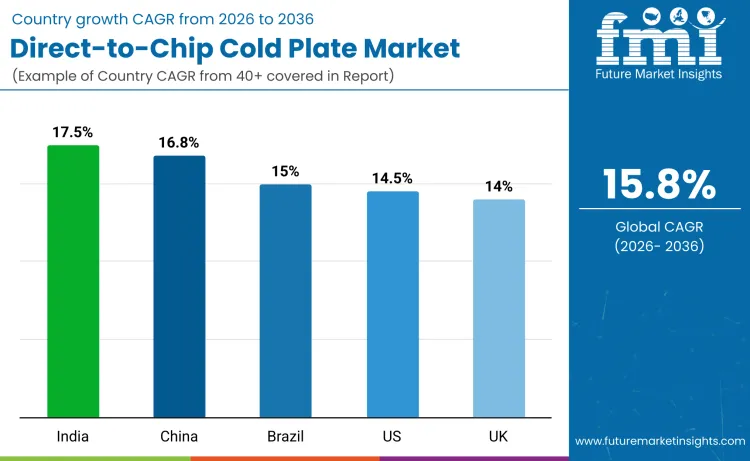
Demand for direct-to-chip cold plates is rising as electronics and data center manufacturers adopt efficient cooling solutions to manage high-performance processors, reduce thermal resistance, and improve device reliability. India leads with a 17.5% CAGR, driven by expansion of data centers, high-performance computing adoption, and demand for advanced cooling systems. China follows at 16.8%, supported by growing semiconductor and electronics manufacturing and integration of efficient thermal management solutions. Brazil records 15.0% growth, shaped by industrial adoption of high-performance computing and electronics cooling requirements. The US grows at 14.5%, influenced by server and data center upgrades. The UK shows 14.0% CAGR, reflecting steady adoption in high-performance computing and electronics applications.
How is the United States experiencing growth in the direct-to-chip cold plate market?
United States is experiencing growth at a CAGR of 14.5%, driven by demand in high-performance computing, data center liquid cooling, and advanced electronics manufacturing in Silicon Valley, Austin, and Boston. Capital intensity and payback expectations favor adoption of direct-to-chip cold plates that offer efficient thermal management, reduced energy consumption, and minimal downtime. Industry concentration among semiconductor manufacturers and data center operator’s anchors demand. Investments focus on high-quality materials, thermal efficiency, and integration with existing cooling systems. Growth reflects increasing need for compact, high-performance cooling solutions to support faster processors and dense server configurations.
- High-performance computing and data centers drive adoption.
- Semiconductor clusters concentrate demand.
- Capital-intensive projects favor efficient cooling solutions.
- Integration and thermal performance guide investment.
How is the United Kingdom witnessing growth in the direct-to-chip cold plate market?
United Kingdom is witnessing growth at a CAGR of 14%, supported by data centers and electronics R&D hubs in London, Manchester, and Edinburgh. Exposure to export markets and global technology cycles influences procurement decisions, encouraging adoption of efficient and reliable cold plate solutions. Market concentration around leading research institutes and industrial clients anchors growth. Investments prioritize thermal efficiency, system reliability, and integration with advanced server architectures. Growth reflects the country’s focus on high-speed computing, energy efficiency, and maintaining competitiveness in electronics manufacturing.
- Data centers and R&D hubs drive adoption.
- Export exposure influences procurement.
- Industry clusters concentrate demand.
- Reliability and thermal efficiency guide investment.
How is China experiencing growth in the direct-to-chip cold plate market?
China is experiencing growth at a CAGR of 16.8%, fueled by expanding semiconductor fabrication, cloud computing, and AI-driven data centers in Shanghai, Shenzhen, and Beijing. Currency risk and import cost sensitivity affect sourcing of advanced cooling components, prompting investments in domestic manufacturing of high-efficiency cold plates. Market concentration is high in industrial zones, and urban technology clusters anchor demand. Growth reflects rapid digitalization, large-scale server deployment, and the need for reliable thermal management under high-density workloads.
- Semiconductor fabrication and cloud computing drive adoption.
- Industrial and urban tech clusters concentrate demand.
- Domestic production mitigates import cost sensitivity.
- High-efficiency solutions enhance system reliability.
How is India witnessing growth in the direct-to-chip cold plate market?
India is experiencing growth at a CAGR of 17.5%, supported by adoption in data centers, cloud computing facilities, and electronics manufacturing hubs in Bengaluru, Hyderabad, and Pune. Financing availability and favorable credit conditions enable companies to invest in capital-intensive direct-to-chip cold plate solutions. Urban industrial zones concentrate demand, and investments focus on energy-efficient, high-performance cooling with long payback periods. Growth reflects rapid expansion of IT infrastructure, increasing server density, and integration of advanced thermal management systems in Indian data centers.
- Data centers and IT hubs drive adoption.
- Urban industrial clusters concentrate demand.
- Financing and credit availability support investment.
- Energy-efficient and high-performance cooling guides deployment.
How is Brazil experiencing growth in the direct-to-chip cold plate market?
Brazil is experiencing growth at a CAGR of 15%, driven by adoption in industrial electronics, telecom, and regional data centers in São Paulo, Rio de Janeiro, and Paraná. Business confidence and investment sentiment influence procurement, encouraging early adoption of advanced thermal management systems. Market concentration is moderate, with regional dispersion across industrial hubs. Investments focus on reliable performance, long service life, and integration with existing cooling infrastructure. Growth reflects expanding IT infrastructure, localized industrial electronics demand, and interest in high-efficiency cooling solutions to improve operational reliability.
- Industrial electronics and telecom drive adoption.
- Regional industrial hubs concentrate demand.
- Business confidence shapes procurement.
- Performance and long service life guide investment.
Direct-to-Chip Cold Plate Market How Are Suppliers Positioning Their Cooling Solutions for High-Performance Electronics?
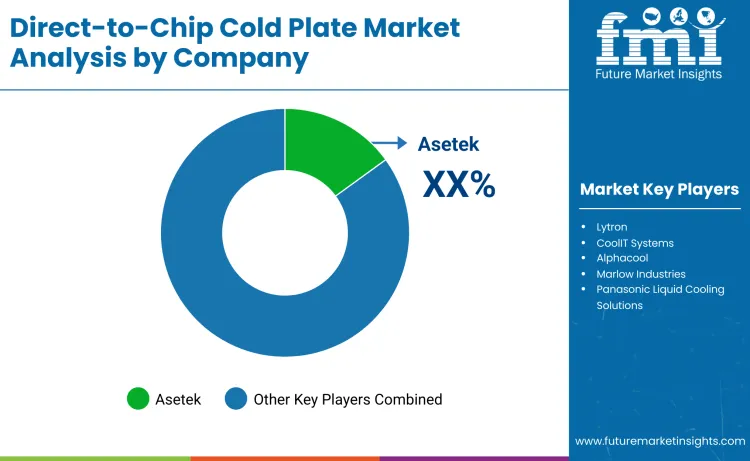
Competition in the direct- to- chip cold plate market is shaped by thermal performance, material selection, and compatibility with diverse electronic platforms. Asetek supplies cold plates engineered to deliver efficient heat transfer for CPUs and GPUs in high- performance computing, leveraging channel design and manufacturing precision to manage high power density. Lytron (a Parker Hannifin brand) provides a range of cold plate solutions tailored for industrial, telecom, and data center applications, emphasising low thermal resistance and robust build quality. CoolIT Systems develops integrated cold plates paired with liquid cooling loops, focusing on modularity and ease of integration with rack or server architectures. Alphacool offers customizable cold plate designs with emphasis on high surface area and flow optimisation for varied thermal loads.
Marlow Industries delivers cold plates with proven thermal performance in power electronics and automotive electronics applications, supported by testing for reliability under cycling conditions. Panasonic Liquid Cooling Solutions provides cold plates designed for electromechanical systems requiring compact form factors and consistent cooling across fluctuating loads. Modular Cooling Concepts supplies engineered cold plate assemblies intended for bespoke applications, where mechanical interface flexibility and coolant path design are priorities. Other regional and specialist suppliers contribute tailored cold plates for niche requirements. Market differentiation arises from thermal resistance performance, materials (copper vs aluminium), manufacturing tolerances, and ability to integrate with pumps and manifold systems. Suppliers that support detailed thermal modelling, validation data, and application engineering help buyers manage heat in demanding electronics environments without compromising reliability or service life.
Key Players in the Direct-to-Chip Cold Plate Market
- Asetek
- Lytron (Parker Hannifin)
- CoolIT Systems
- Alphacool
- Marlow Industries
- Panasonic Liquid Cooling Solutions
- Modular Cooling Concepts
Scope of the Report
| Items | Values |
|---|---|
| Quantitative Units (2026) | USD billion |
| Design Type | Microchannel Cold Plates, Flat-Plate Cold Plates, Grooved Channel Cold Plates, Embedded Jet Impingement Cold Plates |
| Application | High-Performance Computing, Data Centers, Telecom and 5G Infrastructure, Automotive Electronics |
| Regions Covered | Asia Pacific, Europe, North America, Latin America, Middle East & Africa |
| Countries Covered | China, Japan, South Korea, India, Australia & New Zealand, ASEAN, Germany, United Kingdom, France, Italy, Spain, Nordic, BENELUX, United States, Canada, Mexico, Brazil, Chile, Saudi Arabia, Turkey, South Africa, and other regional markets |
| Key Companies Profiled | Asetek, Lytron (Parker Hannifin), CoolIT Systems, Alphacool, Marlow Industries, Panasonic Liquid Cooling Solutions, Modular Cooling Concepts |
| Additional Attributes | Dollar sales by design type and application; microchannel plates as the leading design; high-performance computing as the largest application; demand driven by rising chip power density and rack-level thermal limits; procurement shaped by platform qualification, integration risk, and lifecycle reliability; growth concentrated in hyperscale, HPC, and AI server deployments rather than general-purpose data centers. |
Direct-to-Chip Cold Plate Market Segmentation
Design Type:
- Microchannel cold plates
- Flat-plate cold plates
- Grooved channel cold plates
- Embedded jet impingement cold plates
Application:
- High-performance computing
- Data centers
- Telecom and 5G infrastructure
- Automotive electronics
Region
- Asia Pacific
- China
- Japan
- South Korea
- India
- Australia & New Zealand
- ASEAN
- Rest of Asia Pacific
- Europe
- Germany
- United Kingdom
- France
- Italy
- Spain
- Nordic
- BENELUX
- Rest of Europe
- North America
- United States
- Canada
- Mexico
- Latin America
- Brazil
- Chile
- Rest of Latin America
- Middle East & Africa
- Kingdom of Saudi Arabia
- Other GCC Countries
- Turkey
- South Africa
- Other African Union
- Rest of Middle East & Africa
Bibliography
- European Commission, Joint Research Centre. (2024). EU code of conduct on data centre energy efficiency: Best practices for the EU data centre sector. Publications Office of the European Union.
- United States Department of Energy. (2024). Energy-efficient liquid cooling technologies for high-performance computing and AI data centres. Office of Energy Efficiency and Renewable Energy.
- International Energy Agency 4E Data Centres Working Group. (2024). Policy development on energy efficiency of data centres: Final report on liquid cooling and thermal management. IEA 4E.
Frequently Asked Questions
How big is the Direct-to-Chip Cold Plate Market in 2026?
The global Direct-to-Chip Cold Plate Market is estimated to be valued at USD 3.2 billion in 2026.
What will be the size of Direct-to-Chip Cold Plate Market in 2036?
The market size for the Direct-to-Chip Cold Plate Market is projected to reach USD 13.9 billion by 2036.
How much will be the Direct-to-Chip Cold Plate Market growth between 2026 and 2036?
The Direct-to-Chip Cold Plate Market is expected to grow at a 15.8% CAGR between 2026 and 2036.
What are the key product types in the Direct-to-Chip Cold Plate Market?
The key product types in Direct-to-Chip Cold Plate Market are microchannel cold plates , flat‑plate cold plates, grooved channel cold plates and embedded jet impingement cold plates.
Which application segment to contribute significant share in the Direct-to-Chip Cold Plate Market in 2026?
In terms of application, high‑performance computing segment to command 45.0% share in the Direct-to-Chip Cold Plate Market in 2026.
Preview the report firsthand - request a free sample
Get SampleGet the brochure for pricing and purchase details.
Get PDFTable of Content
- Executive Summary
- Global Market Outlook
- Demand-side Trends
- Supply-side Trends
- Technology Roadmap Analysis
- Analysis and Recommendations
- Market Overview
- Market Coverage / Taxonomy
- Market Definition / Scope / Limitations
- Market Background
- Market Dynamics
- Drivers
- Restraints
- Opportunity
- Trends
- Scenario Forecast
- Demand in Optimistic Scenario
- Demand in Likely Scenario
- Demand in Conservative Scenario
- Opportunity Map Analysis
- Product Life Cycle Analysis
- Supply Chain Analysis
- Investment Feasibility Matrix
- Value Chain Analysis
- PESTLE and Porter’s Analysis
- Regulatory Landscape
- Regional Parent Market Outlook
- Production and Consumption Statistics
- Import and Export Statistics
- Market Dynamics
- Global Market Analysis 2021 to 2025 and Forecast, 2026 to 2036
- Historical Market Size Value (USD Million) Analysis, 2021 to 2025
- Current and Future Market Size Value (USD Million) Projections, 2026 to 2036
- Y-o-Y Growth Trend Analysis
- Absolute $ Opportunity Analysis
- Global Market Pricing Analysis 2021 to 2025 and Forecast 2026 to 2036
- Global Market Analysis 2021 to 2025 and Forecast 2026 to 2036, By Design Type
- Introduction / Key Findings
- Historical Market Size Value (USD Million) Analysis By Design Type, 2021 to 2025
- Current and Future Market Size Value (USD Million) Analysis and Forecast By Design Type, 2026 to 2036
- Microchannel cold plates
- Flat‑plate cold plates
- Grooved channel cold plates
- Embedded jet impingement cold plates
- Microchannel cold plates
- Y-o-Y Growth Trend Analysis By Design Type, 2021 to 2025
- Absolute $ Opportunity Analysis By Design Type, 2026 to 2036
- Global Market Analysis 2021 to 2025 and Forecast 2026 to 2036, By Application
- Introduction / Key Findings
- Historical Market Size Value (USD Million) Analysis By Application, 2021 to 2025
- Current and Future Market Size Value (USD Million) Analysis and Forecast By Application, 2026 to 2036
- High‑performance computing
- Data centers
- Telecom and 5G infrastructure
- Automotive electronics
- High‑performance computing
- Y-o-Y Growth Trend Analysis By Application, 2021 to 2025
- Absolute $ Opportunity Analysis By Application, 2026 to 2036
- Global Market Analysis 2021 to 2025 and Forecast 2026 to 2036, By Region
- Introduction
- Historical Market Size Value (USD Million) Analysis By Region, 2021 to 2025
- Current Market Size Value (USD Million) Analysis and Forecast By Region, 2026 to 2036
- North America
- Latin America
- Western Europe
- Eastern Europe
- East Asia
- South Asia and Pacific
- Middle East & Africa
- Market Attractiveness Analysis By Region
- North America Market Analysis 2021 to 2025 and Forecast 2026 to 2036, By Country
- Historical Market Size Value (USD Million) Trend Analysis By Market Taxonomy, 2021 to 2025
- Market Size Value (USD Million) Forecast By Market Taxonomy, 2026 to 2036
- By Country
- USA
- Canada
- Mexico
- By Design Type
- By Application
- By Country
- Market Attractiveness Analysis
- By Country
- By Design Type
- By Application
- Key Takeaways
- Latin America Market Analysis 2021 to 2025 and Forecast 2026 to 2036, By Country
- Historical Market Size Value (USD Million) Trend Analysis By Market Taxonomy, 2021 to 2025
- Market Size Value (USD Million) Forecast By Market Taxonomy, 2026 to 2036
- By Country
- Brazil
- Chile
- Rest of Latin America
- By Design Type
- By Application
- By Country
- Market Attractiveness Analysis
- By Country
- By Design Type
- By Application
- Key Takeaways
- Western Europe Market Analysis 2021 to 2025 and Forecast 2026 to 2036, By Country
- Historical Market Size Value (USD Million) Trend Analysis By Market Taxonomy, 2021 to 2025
- Market Size Value (USD Million) Forecast By Market Taxonomy, 2026 to 2036
- By Country
- Germany
- UK
- Italy
- Spain
- France
- Nordic
- BENELUX
- Rest of Western Europe
- By Design Type
- By Application
- By Country
- Market Attractiveness Analysis
- By Country
- By Design Type
- By Application
- Key Takeaways
- Eastern Europe Market Analysis 2021 to 2025 and Forecast 2026 to 2036, By Country
- Historical Market Size Value (USD Million) Trend Analysis By Market Taxonomy, 2021 to 2025
- Market Size Value (USD Million) Forecast By Market Taxonomy, 2026 to 2036
- By Country
- Russia
- Poland
- Hungary
- Balkan & Baltic
- Rest of Eastern Europe
- By Design Type
- By Application
- By Country
- Market Attractiveness Analysis
- By Country
- By Design Type
- By Application
- Key Takeaways
- East Asia Market Analysis 2021 to 2025 and Forecast 2026 to 2036, By Country
- Historical Market Size Value (USD Million) Trend Analysis By Market Taxonomy, 2021 to 2025
- Market Size Value (USD Million) Forecast By Market Taxonomy, 2026 to 2036
- By Country
- China
- Japan
- South Korea
- By Design Type
- By Application
- By Country
- Market Attractiveness Analysis
- By Country
- By Design Type
- By Application
- Key Takeaways
- South Asia and Pacific Market Analysis 2021 to 2025 and Forecast 2026 to 2036, By Country
- Historical Market Size Value (USD Million) Trend Analysis By Market Taxonomy, 2021 to 2025
- Market Size Value (USD Million) Forecast By Market Taxonomy, 2026 to 2036
- By Country
- India
- ASEAN
- Australia & New Zealand
- Rest of South Asia and Pacific
- By Design Type
- By Application
- By Country
- Market Attractiveness Analysis
- By Country
- By Design Type
- By Application
- Key Takeaways
- Middle East & Africa Market Analysis 2021 to 2025 and Forecast 2026 to 2036, By Country
- Historical Market Size Value (USD Million) Trend Analysis By Market Taxonomy, 2021 to 2025
- Market Size Value (USD Million) Forecast By Market Taxonomy, 2026 to 2036
- By Country
- Kingdom of Saudi Arabia
- Other GCC Countries
- Turkiye
- South Africa
- Other African Union
- Rest of Middle East & Africa
- By Design Type
- By Application
- By Country
- Market Attractiveness Analysis
- By Country
- By Design Type
- By Application
- Key Takeaways
- Key Countries Market Analysis
- USA
- Pricing Analysis
- Market Share Analysis, 2025
- By Design Type
- By Application
- Canada
- Pricing Analysis
- Market Share Analysis, 2025
- By Design Type
- By Application
- Mexico
- Pricing Analysis
- Market Share Analysis, 2025
- By Design Type
- By Application
- Brazil
- Pricing Analysis
- Market Share Analysis, 2025
- By Design Type
- By Application
- Chile
- Pricing Analysis
- Market Share Analysis, 2025
- By Design Type
- By Application
- Germany
- Pricing Analysis
- Market Share Analysis, 2025
- By Design Type
- By Application
- UK
- Pricing Analysis
- Market Share Analysis, 2025
- By Design Type
- By Application
- Italy
- Pricing Analysis
- Market Share Analysis, 2025
- By Design Type
- By Application
- Spain
- Pricing Analysis
- Market Share Analysis, 2025
- By Design Type
- By Application
- France
- Pricing Analysis
- Market Share Analysis, 2025
- By Design Type
- By Application
- India
- Pricing Analysis
- Market Share Analysis, 2025
- By Design Type
- By Application
- ASEAN
- Pricing Analysis
- Market Share Analysis, 2025
- By Design Type
- By Application
- Australia & New Zealand
- Pricing Analysis
- Market Share Analysis, 2025
- By Design Type
- By Application
- China
- Pricing Analysis
- Market Share Analysis, 2025
- By Design Type
- By Application
- Japan
- Pricing Analysis
- Market Share Analysis, 2025
- By Design Type
- By Application
- South Korea
- Pricing Analysis
- Market Share Analysis, 2025
- By Design Type
- By Application
- Russia
- Pricing Analysis
- Market Share Analysis, 2025
- By Design Type
- By Application
- Poland
- Pricing Analysis
- Market Share Analysis, 2025
- By Design Type
- By Application
- Hungary
- Pricing Analysis
- Market Share Analysis, 2025
- By Design Type
- By Application
- Kingdom of Saudi Arabia
- Pricing Analysis
- Market Share Analysis, 2025
- By Design Type
- By Application
- Turkiye
- Pricing Analysis
- Market Share Analysis, 2025
- By Design Type
- By Application
- South Africa
- Pricing Analysis
- Market Share Analysis, 2025
- By Design Type
- By Application
- USA
- Market Structure Analysis
- Competition Dashboard
- Competition Benchmarking
- Market Share Analysis of Top Players
- By Regional
- By Design Type
- By Application
- Competition Analysis
- Competition Deep Dive
- Asetek
- Overview
- Product Portfolio
- Profitability by Market Segments (Product/Age /Sales Channel/Region)
- Sales Footprint
- Strategy Overview
- Marketing Strategy
- Product Strategy
- Channel Strategy
- Lytron (Parker Hannifin)
- CoolIT Systems
- Alphacool
- Marlow Industries
- Panasonic Liquid Cooling Solutions
- Modular Cooling Concepts
- Asetek
- Competition Deep Dive
- Assumptions & Acronyms Used
- Research Methodology


