

- Industry Size (2026)
- USD 960.0 Mn
- Forecast (2036)
- USD 1719.2 Mn
- CAGR (2026 to 2036)
- 6.0%
Cold Lamination Machine Market Forecast and Outlook 2026 to 2036
The cold lamination machine market is likely to be valued at USD 960.0 million in 2026 and is forecasted to reach USD 1,719.2 million by 2036 at a CAGR of 6.0%. Value formation is driven by finishing-stage dependency within digital printing, signage, and display production rather than expansion of printing hardware fleets. Cold lamination machines occupy a functional niche where heat exposure introduces risk to substrate stability, ink adhesion, or surface appearance. Capital allocation is therefore linked to material mix, job variability, and finishing quality requirements rather than throughput scale alone. Procurement decisions emphasize pressure uniformity, roller alignment accuracy, film handling reliability, and format flexibility, as lamination defects directly translate into material waste and rework cost.
Growth characteristics reflect service-layer economics across print shops, advertising studios, and signage producers. Short-run customization, frequent job changeovers, and wide substrate diversity increase reliance on cold lamination as a risk-mitigation step in finishing workflows. Replacement demand emerges as manual and entry-level laminators fail to maintain pressure consistency under sustained use. Investment cadence remains sensitive to floor space constraints, operator skill availability, and job mix volatility. Automation adoption progresses selectively, constrained by setup complexity and cost recovery timelines. Expansion remains utilization-led, supported by finishing standardization and workflow stabilization rather than volume-driven scale effects or substitution of thermal lamination systems.
Quick Stats for Cold Lamination Machine Market
- Cold Lamination Machine Market Value (2026): USD 960.0 million
- Cold Lamination Machine Market Forecast Value (2036): USD 1,719.2 million
- Cold Lamination Machine Market Forecast CAGR 2026 to 2036: 6.0%
- Leading Machine Width by Demand Share: 650 to 1,300 mm
- Fastest-Growing Countries: India, China, Vietnam, Indonesia, Mexico
- Top Players in Global Demand: ACCO Brands (GBC), Fellowes, Royal Sovereign, GMP Co., Ltd., Vivid Laminating Technologies, Kala, D&K Group, SEAL (Canon Solutions), Easymount, Rhin-O-Tuff
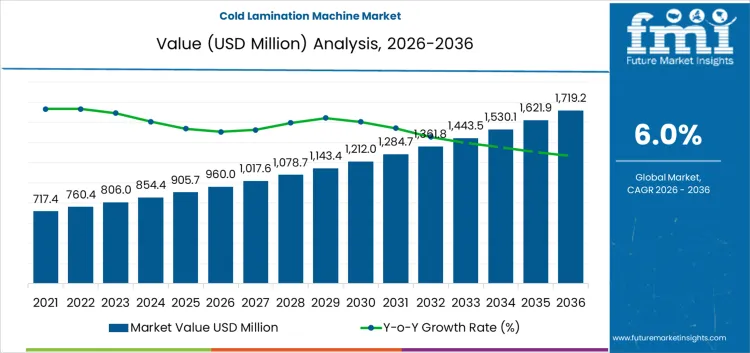
Cold Lamination Machine Market Key Takeaways
| Metric | Value |
|---|---|
| Market Value (2026) | USD 960.0 million |
| Market Forecast Value (2036) | USD 1,719.2 million |
| Forecast CAGR 2026 to 2036 | 6.0% |
Why is the Demand for Cold Lamination Machine Growing?
Demand for cold lamination machines is increasing as print service providers, signage producers, and packaging converters require equipment that can protect and finish heat-sensitive materials without exposing them to elevated temperatures. Cold lamination machines use pressure and adhesive films to encapsulate digital prints, posters, and substrates such as PVC, canvas, and PET without heat, preserving color fidelity and surface integrity. Production planners specify these machines for applications where thermal exposure can distort media or affect ink adhesion, including wide-format printing, label production, and photographic finishing. Procurement teams evaluate roll width capacity, feed precision, and film tension control to ensure chosen equipment aligns with workflow throughput targets and supports consistent lamination quality across varied substrates.
Demand correlates with growth in short-run and customized print jobs where reliable lamination enhances product durability and aesthetic appeal without introducing heat-related defects. Adoption of cold lamination technology is reinforced by increased utilization in retail graphics, trade show displays, and point-of-sale materials that require robust surface protection against abrasion and moisture. Operators value machines that deliver uniform adhesive application and adjustable pressure settings to handle thin, delicate media alongside heavier substrates. Integration with pre-press and finishing workflows supports efficient production schedules in busy print shops and commercial print environments. Service and maintenance support for rollers, film feed systems, and tension controls further influences purchasing decisions. These product-specific performance and operational criteria are contributing to sustained growth in the cold lamination machine market.
How Are the Segments Classified in the Cold Lamination Machine Market?
Demand for cold lamination machines is shaped by surface protection needs, visual presentation standards, and workflow efficiency across printing environments. These machines support finishing of graphics, documents, and display materials without heat exposure. Adoption aligns with growth in digital printing, signage production, and short-run customization. Equipment selection prioritizes lamination width compatibility, process consistency, and operator control. Segment classification reflects differentiation by machine working width, operational end-use setting, and automation capability. Structure highlights how format size, usage context, and process control level influence specification priorities, utilization intensity, and purchasing behavior across lamination operations.
Which Machine Width Represents the Largest Share of Demand?
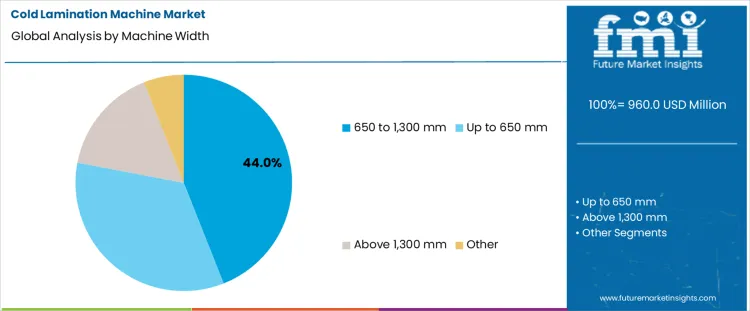
Machines with 650 to 1,300 mm width hold 44.0%, representing the largest share among width categories due to versatility. This range accommodates posters, banners, and standard signage formats used in commercial printing. Compatibility with common media sizes supports broad application coverage without oversizing equipment. Floor space requirements remain manageable for print shops and in-house facilities. Narrower machines address document-focused tasks with limited format flexibility. Wider machines serve large-format graphics with higher capital and space requirements. Width segmentation reflects preference for balanced capacity supporting diverse lamination needs across mixed-format production environments.
Key Points
- Mid-range widths support common signage and poster formats.
- Versatility reduces need for multiple machine sizes.
- Other widths serve narrow document or large-format applications.
Which End Use Accounts for the Highest Share of Demand?
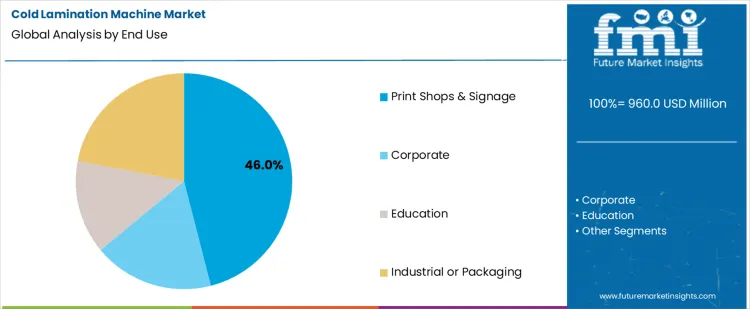
Print shops and signage providers hold 46.0%, representing the largest share among end-use settings due to continuous finishing demand. These operators laminate graphics to improve durability, appearance, and handling resistance. High job turnover increases equipment utilization rates. Lamination supports value-added services within competitive print environments. Corporate users apply lamination for internal communication materials with lower volume. Education settings use machines for instructional materials and displays. Industrial and packaging users apply lamination for protective overlays. End-use segmentation reflects concentration where finishing frequency and service differentiation drive consistent machine deployment.
Key Points
- Print shops rely on lamination for value-added services.
- High job volume sustains frequent machine usage.
- Other users apply lamination for internal or protective purposes.
Which Automation Level Drives the Largest Share of Demand?
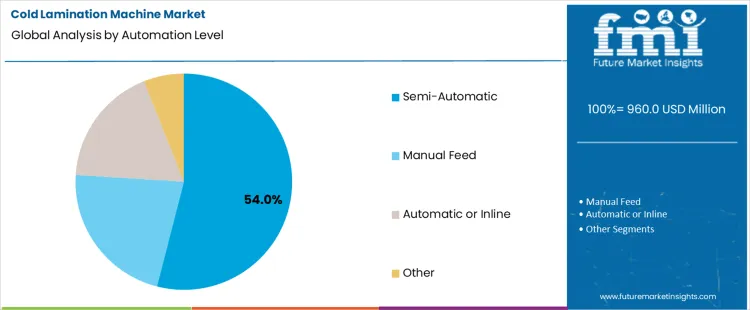
Semi-automatic machines hold 54.0%, representing the largest share among automation levels due to balance of control and efficiency. Operators retain manual alignment while assisted rollers ensure consistent lamination pressure. This configuration supports varied media types without complex setup. Capital requirements remain accessible for small and mid-sized facilities. Manual feed machines address low-volume tasks with higher labor input. Automatic or inline systems support high-throughput environments with greater integration complexity. Automation segmentation reflects preference for solutions offering operational flexibility, moderate investment, and reliable output quality across diverse lamination workflows.
Key Points
- Semi-automatic systems balance control and productivity.
- Assisted operation supports consistent lamination quality.
- Other automation levels serve low-volume or high-throughput needs.
What are the Key Dynamics in the Cold Lamination Machine Market?
Demand for cold lamination machines reflects finishing requirements for printed graphics, signage, photographs, and packaging materials without heat exposure. Adoption concentrates in print service providers, advertising studios, photo labs, and industrial graphics production. Global scope aligns with growth in large-format printing and surface protection needs. Usage centers on pressure-based laminators handling films, foils, and adhesives for visual enhancement and durability.
How do print finishing requirements and material sensitivity shape adoption?
Cold lamination enables surface protection and visual enhancement without thermal stress on substrates. Demand increases where heat-sensitive media such as vinyl, PVC, inkjet prints, foam boards, and pressure-sensitive films risk distortion under hot lamination. Large-format graphics producers rely on cold laminators for banners, vehicle wraps, floor graphics, and display panels. Uniform pressure control ensures bubble-free adhesion and consistent finish quality. Adjustable roller gap and tension systems support varied media thickness and film types. Print shops value compatibility with solvent, eco-solvent, UV, and latex inks. Adoption reflects operational need for flexibility across substrates rather than throughput speed alone.
How do equipment cost, operator dependency, and space constraints influence market scalability?
Cold lamination machines involve capital cost tied to roller precision, frame rigidity, and width capacity. Demand sensitivity rises where small print shops operate under tight equipment budgets. Manual and semi-automatic systems remain operator-dependent, affecting consistency and productivity. Floor space requirements limit installation in compact facilities. Misalignment and pressure inconsistency increase material waste, affecting operating economics. Maintenance of rollers and tension mechanisms affects long-term performance. Width-specific demand limits standardization across applications. Competition from outsourcing finishing services constrains volume expansion among low-utilization users.
How Is Demand for Cold Lamination Machines Evolving Globally?
Demand for cold lamination machines is expanding globally due to growth in print finishing, surface protection requirements, and short-run graphics production. Usage aligns with signage, packaging prototypes, advertising displays, and document preservation where heat-sensitive substrates are common. Print service providers prioritize cold lamination to avoid distortion of vinyl, foam boards, and digital prints. Expansion of commercial printing and advertising services supports equipment uptake. Growth rates in India at 7.4%, China at 6.8%, Vietnam at 6.4%, Indonesia at 6.2%, and Mexico at 5.5% indicate sustained expansion driven by print service density, retail branding activity, and lifecycle replacement of manual finishing processes.
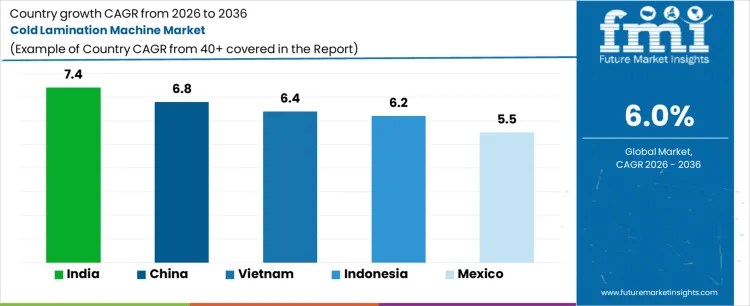
| Country | CAGR (%) |
|---|---|
| India | 7.4% |
| China | 6.8% |
| Vietnam | 6.4% |
| Indonesia | 6.2% |
| Mexico | 5.5% |
What Is Driving Strong Growth of Cold Lamination Machine Demand in India?
Cold lamination machine demand in India is growing at a CAGR of 7.4%, supported by expansion of signage, advertising, and digital print service providers. Retail branding, political campaigns, and local advertising generate continuous demand for laminated graphics. Heat-sensitive substrates such as vinyl and flex boards favor cold lamination processes. Small and mid-sized print shops invest in mechanized finishing to improve throughput consistency. Tier-2 and Tier-3 city print clusters expand equipment adoption. Demand growth reflects service-sector intensity and short-run print volumes rather than industrial-scale packaging conversion.
- Expansion of retail and outdoor signage printing
- High usage of heat-sensitive digital print substrates
- Mechanization of finishing in small print shops
- Growth of print services in non-metro cities
Why Is China Sustaining Expansion in Cold Lamination Machine Demand?
China is expanding at a CAGR of 6.8%, driven by large-scale advertising production and export-oriented print manufacturing. Commercial print houses process high volumes of posters, displays, and promotional materials requiring surface protection. Automation integration supports consistent lamination quality across wide-format outputs. Domestic equipment manufacturing supports availability across capacity ranges. Replacement demand emerges as shops upgrade from manual rollers to motorized systems. Demand growth reflects production scale and advertising output rather than transition to thermal lamination alternatives.
- High-volume advertising and display production
- Automation adoption for consistent lamination quality
- Strong domestic cold laminator manufacturing base
- Upgrade from manual to motorized lamination systems
How Is Vietnam Influencing Growth of Cold Lamination Machine Adoption?
Cold lamination machine demand in Vietnam is growing at a CAGR of 6.4%, shaped by expansion of print services supporting retail, exports, and events. Digital printing adoption increases need for post-print surface protection. Advertising agencies and print shops favor cold lamination for flexible substrates. Cost sensitivity encourages mid-range machines with reliable pressure control. Growth of commercial hubs supports steady installation rates. Demand growth reflects service-sector development and digital print expansion rather than consolidation of large print factories.
- Growth of digital print service providers
- Retail and event-driven graphics production
- Preference for cold lamination on flexible media
- Adoption of mid-range, cost-efficient machines
What Factors Are Supporting Cold Lamination Machine Demand in Indonesia?
Indonesia is expanding at a CAGR of 6.2%, influenced by advertising, education materials, and local print services. Schools, offices, and copy centers use lamination for document protection. Climate conditions increase need for moisture-resistant finishes. Small print shops adopt cold lamination to avoid heat-related print damage. Urban commercial activity sustains steady equipment utilization. Growth reflects practical finishing requirements and service expansion rather than industrial-scale print automation.
- Document protection needs in education and offices
- Humid climate increasing lamination usage
- Small print shop adoption for digital prints
- Stable demand from urban commercial activity
Why Is Mexico Experiencing Measured Growth in Cold Lamination Machine Demand?
Cold lamination machine demand in Mexico is growing at a CAGR of 5.5%, supported by commercial printing for retail, corporate branding, and service centers. Print shops serving multinational clients require consistent finishing quality. Cold lamination supports vinyl graphics and display materials used in stores. Replacement demand arises as older manual equipment is retired. Import-based equipment supply ensures standardized options. Growth remains measured, reflecting steady print service demand and equipment renewal rather than rapid expansion of print capacity.
- Retail and corporate branding print requirements
- Use of vinyl and display graphics
- Replacement of manual lamination equipment
- Standardized equipment availability through imports
What is the competitive landscape of demand for the cold lamination machine market globally?
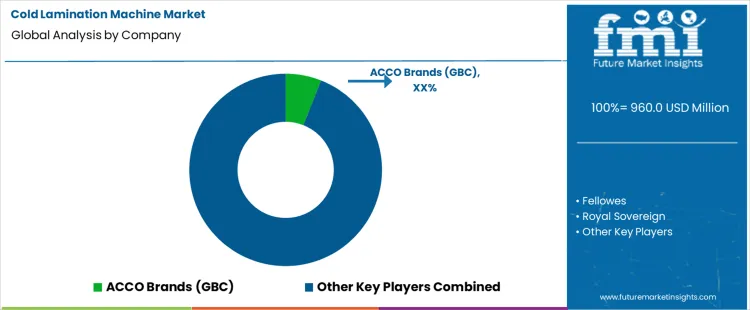
Demand for cold lamination machines is driven by office and print finishing needs, education and small business use, and growth of signage, graphics, and document protection applications where heat-free lamination preserves sensitive substrates. Buyers evaluate roll width capacity, feed accuracy, lamination speed, pressure uniformity, media thickness support, and ease of use for varied materials. Procurement teams prioritize suppliers with broad product portfolios, reliable service support, global distribution reach, and solutions that balance performance with cost-effectiveness. Trend in the global market reflects increased adoption of digital print finishing, emphasis on damage protection for printed materials, and demand for compact, user-friendly systems suitable for diverse environments.
ACCO Brands (GBC) holds leading positioning through a comprehensive portfolio of cold lamination machines and finishing solutions supported by broad retail and commercial distribution. Fellowes supports demand with versatile cold laminators and related office finishing equipment designed for ease of operation and reliability. Royal Sovereign participates with cold lamination and finishing platforms tailored to wide-format graphics and signage production. GMP Co., Ltd. supplies cold lamination solutions often used in professional print and large-format environments, emphasizing quality and durability. Vivid Laminating Technologies contributes cold roll laminators and finishing accessories positioned for small business and print shop applications. Competitive differentiation depends on roll width capability, pressure consistency, ease of setup, service support, and ability to meet diverse user needs across office, education, and commercial print sectors.
Key Players in the Cold Lamination Machine Market
- ACCO Brands (GBC)
- Fellowes
- Royal Sovereign
- GMP Co., Ltd.
- Vivid Laminating Technologies
- Kala
- D&K Group
- SEAL (Canon Solutions)
- Easymount (Vivid)
- Rhin-O-Tuff
Scope of the Report
| Items | Values |
|---|---|
| Quantitative Units | USD million |
| Machine Width | 650 to 1,300 mm; Up to 650 mm; Above 1,300 mm; Other |
| End Use | Print Shops & Signage; Corporate; Education; Industrial or Packaging |
| Automation Level | Semi-Automatic; Manual Feed; Automatic or Inline; Other |
| Sales Channel | Dealer or Distributor; Direct OEM Sales; E-commerce; Rental or Used |
| Regions Covered | Asia Pacific, Europe, North America, Latin America, Middle East & Africa |
| Countries Covered | India, China, Vietnam, Indonesia, Mexico, and 40+ countries |
| Key Companies Profiled | ACCO Brands; Fellowes; Royal Sovereign; GMP Co., Ltd.; Vivid Laminating Technologies; Kala; D&K Group; SEAL; Easymount; Rhin-O-Tuff |
| Additional Attributes | Dollar sales by machine width, automation level, and end use; throughput capacity, nip pressure control, and temperature uniformity affecting film adhesion and finish quality; suitability for wide-format graphics, signage, and packaging substrates; uptime, maintenance intervals, and roller durability under continuous operation; energy consumption and safety features influencing institutional procurement; dealer-led sales dominance in emerging regions with growing rental and used-equipment circulation. |
Cold Lamination Machine Market by Segment
Machine Width:
- 650 to 1,300 mm
- Up to 650 mm
- Above 1,300 mm
- Other
End Use:
- Print Shops & Signage
- Corporate
- Education
- Industrial or Packaging
Automation Level:
- Semi-Automatic
- Manual Feed
- Automatic or Inline
- Other
Sales Channel:
- Dealer or Distributor
- Direct OEM Sales
- E-commerce
- Rental or Used
Region:
- Asia Pacific
- China
- Japan
- South Korea
- India
- Australia & New Zealand
- ASEAN
- Rest of Asia Pacific
- Europe
- Germany
- United Kingdom
- France
- Italy
- Spain
- Nordic
- BENELUX
- Rest of Europe
- North America
- United States
- Canada
- Mexico
- Latin America
- Brazil
- Chile
- Rest of Latin America
- Middle East & Africa
- Kingdom of Saudi Arabia
- Other GCC Countries
- Turkey
- South Africa
- Other African Union
- Rest of Middle East & Africa
Bibliography
- International Organization for Standardization. (2024). Graphic technology—Requirements for print finishing equipment safety and operational performance (ISO 21828:2024). ISO.
- Society for Imaging Science and Technology. (2024). Post-print finishing technologies for wide-format graphics and heat-sensitive substrates. Proceedings of the IS&T International Symposium on Electronic Imaging.
- Organisation for Economic Co-operation and Development. (2024). Small and medium enterprise adoption of digital printing and finishing technologies. OECD Publishing.
Frequently Asked Questions
How big is the cold lamination machine market in 2026?
The global cold lamination machine market is estimated to be valued at USD 960.0 million in 2026.
What will be the size of cold lamination machine market in 2036?
The market size for the cold lamination machine market is projected to reach USD 1,719.2 million by 2036.
How much will be the cold lamination machine market growth between 2026 and 2036?
The cold lamination machine market is expected to grow at a 6.0% CAGR between 2026 and 2036.
What are the key product types in the cold lamination machine market?
The key product types in cold lamination machine market are 650 to 1,300 mm, up to 650 mm, above 1,300 mm and other.
Which end use segment to contribute significant share in the cold lamination machine market in 2026?
In terms of end use, print shops & signage segment to command 46.0% share in the cold lamination machine market in 2026.
Preview the report firsthand - request a free sample
Get SampleGet the brochure for pricing and purchase details.
Get PDFTable of Content
- Executive Summary
- Global Market Outlook
- Demand-side Trends
- Supply-side Trends
- Technology Roadmap Analysis
- Analysis and Recommendations
- Market Overview
- Market Coverage / Taxonomy
- Market Definition / Scope / Limitations
- Market Background
- Market Dynamics
- Drivers
- Restraints
- Opportunity
- Trends
- Scenario Forecast
- Demand in Optimistic Scenario
- Demand in Likely Scenario
- Demand in Conservative Scenario
- Opportunity Map Analysis
- Product Life Cycle Analysis
- Supply Chain Analysis
- Investment Feasibility Matrix
- Value Chain Analysis
- PESTLE and Porter’s Analysis
- Regulatory Landscape
- Regional Parent Market Outlook
- Production and Consumption Statistics
- Import and Export Statistics
- Market Dynamics
- Global Market Analysis 2021 to 2025 and Forecast, 2026 to 2036
- Historical Market Size Value (USD Million) Analysis, 2021 to 2025
- Current and Future Market Size Value (USD Million) Projections, 2026 to 2036
- Y-o-Y Growth Trend Analysis
- Absolute $ Opportunity Analysis
- Global Market Pricing Analysis 2021 to 2025 and Forecast 2026 to 2036
- Global Market Analysis 2021 to 2025 and Forecast 2026 to 2036, By Machine Width
- Introduction / Key Findings
- Historical Market Size Value (USD Million) Analysis By Machine Width , 2021 to 2025
- Current and Future Market Size Value (USD Million) Analysis and Forecast By Machine Width , 2026 to 2036
- 650 to 1,300 mm
- Up to 650 mm
- Above 1,300 mm
- Other
- 650 to 1,300 mm
- Y-o-Y Growth Trend Analysis By Machine Width , 2021 to 2025
- Absolute $ Opportunity Analysis By Machine Width , 2026 to 2036
- Global Market Analysis 2021 to 2025 and Forecast 2026 to 2036, By End Use
- Introduction / Key Findings
- Historical Market Size Value (USD Million) Analysis By End Use, 2021 to 2025
- Current and Future Market Size Value (USD Million) Analysis and Forecast By End Use, 2026 to 2036
- Print Shops & Signage
- Corporate
- Education
- Industrial or Packaging
- Print Shops & Signage
- Y-o-Y Growth Trend Analysis By End Use, 2021 to 2025
- Absolute $ Opportunity Analysis By End Use, 2026 to 2036
- Global Market Analysis 2021 to 2025 and Forecast 2026 to 2036, By Automation Level
- Introduction / Key Findings
- Historical Market Size Value (USD Million) Analysis By Automation Level, 2021 to 2025
- Current and Future Market Size Value (USD Million) Analysis and Forecast By Automation Level, 2026 to 2036
- Semi-Automatic
- Manual Feed
- Automatic or Inline
- Other
- Semi-Automatic
- Y-o-Y Growth Trend Analysis By Automation Level, 2021 to 2025
- Absolute $ Opportunity Analysis By Automation Level, 2026 to 2036
- Global Market Analysis 2021 to 2025 and Forecast 2026 to 2036, By Sales Channel
- Introduction / Key Findings
- Historical Market Size Value (USD Million) Analysis By Sales Channel, 2021 to 2025
- Current and Future Market Size Value (USD Million) Analysis and Forecast By Sales Channel, 2026 to 2036
- Dealer or Distributor
- Direct OEM Sales
- E-commerce
- Rental or Used
- Dealer or Distributor
- Y-o-Y Growth Trend Analysis By Sales Channel, 2021 to 2025
- Absolute $ Opportunity Analysis By Sales Channel, 2026 to 2036
- Global Market Analysis 2021 to 2025 and Forecast 2026 to 2036, By Region
- Introduction
- Historical Market Size Value (USD Million) Analysis By Region, 2021 to 2025
- Current Market Size Value (USD Million) Analysis and Forecast By Region, 2026 to 2036
- North America
- Latin America
- Western Europe
- Eastern Europe
- East Asia
- South Asia and Pacific
- Middle East & Africa
- Market Attractiveness Analysis By Region
- North America Market Analysis 2021 to 2025 and Forecast 2026 to 2036, By Country
- Historical Market Size Value (USD Million) Trend Analysis By Market Taxonomy, 2021 to 2025
- Market Size Value (USD Million) Forecast By Market Taxonomy, 2026 to 2036
- By Country
- USA
- Canada
- Mexico
- By Machine Width
- By End Use
- By Automation Level
- By Sales Channel
- By Country
- Market Attractiveness Analysis
- By Country
- By Machine Width
- By End Use
- By Automation Level
- By Sales Channel
- Key Takeaways
- Latin America Market Analysis 2021 to 2025 and Forecast 2026 to 2036, By Country
- Historical Market Size Value (USD Million) Trend Analysis By Market Taxonomy, 2021 to 2025
- Market Size Value (USD Million) Forecast By Market Taxonomy, 2026 to 2036
- By Country
- Brazil
- Chile
- Rest of Latin America
- By Machine Width
- By End Use
- By Automation Level
- By Sales Channel
- By Country
- Market Attractiveness Analysis
- By Country
- By Machine Width
- By End Use
- By Automation Level
- By Sales Channel
- Key Takeaways
- Western Europe Market Analysis 2021 to 2025 and Forecast 2026 to 2036, By Country
- Historical Market Size Value (USD Million) Trend Analysis By Market Taxonomy, 2021 to 2025
- Market Size Value (USD Million) Forecast By Market Taxonomy, 2026 to 2036
- By Country
- Germany
- UK
- Italy
- Spain
- France
- Nordic
- BENELUX
- Rest of Western Europe
- By Machine Width
- By End Use
- By Automation Level
- By Sales Channel
- By Country
- Market Attractiveness Analysis
- By Country
- By Machine Width
- By End Use
- By Automation Level
- By Sales Channel
- Key Takeaways
- Eastern Europe Market Analysis 2021 to 2025 and Forecast 2026 to 2036, By Country
- Historical Market Size Value (USD Million) Trend Analysis By Market Taxonomy, 2021 to 2025
- Market Size Value (USD Million) Forecast By Market Taxonomy, 2026 to 2036
- By Country
- Russia
- Poland
- Hungary
- Balkan & Baltic
- Rest of Eastern Europe
- By Machine Width
- By End Use
- By Automation Level
- By Sales Channel
- By Country
- Market Attractiveness Analysis
- By Country
- By Machine Width
- By End Use
- By Automation Level
- By Sales Channel
- Key Takeaways
- East Asia Market Analysis 2021 to 2025 and Forecast 2026 to 2036, By Country
- Historical Market Size Value (USD Million) Trend Analysis By Market Taxonomy, 2021 to 2025
- Market Size Value (USD Million) Forecast By Market Taxonomy, 2026 to 2036
- By Country
- China
- Japan
- South Korea
- By Machine Width
- By End Use
- By Automation Level
- By Sales Channel
- By Country
- Market Attractiveness Analysis
- By Country
- By Machine Width
- By End Use
- By Automation Level
- By Sales Channel
- Key Takeaways
- South Asia and Pacific Market Analysis 2021 to 2025 and Forecast 2026 to 2036, By Country
- Historical Market Size Value (USD Million) Trend Analysis By Market Taxonomy, 2021 to 2025
- Market Size Value (USD Million) Forecast By Market Taxonomy, 2026 to 2036
- By Country
- India
- ASEAN
- Australia & New Zealand
- Rest of South Asia and Pacific
- By Machine Width
- By End Use
- By Automation Level
- By Sales Channel
- By Country
- Market Attractiveness Analysis
- By Country
- By Machine Width
- By End Use
- By Automation Level
- By Sales Channel
- Key Takeaways
- Middle East & Africa Market Analysis 2021 to 2025 and Forecast 2026 to 2036, By Country
- Historical Market Size Value (USD Million) Trend Analysis By Market Taxonomy, 2021 to 2025
- Market Size Value (USD Million) Forecast By Market Taxonomy, 2026 to 2036
- By Country
- Kingdom of Saudi Arabia
- Other GCC Countries
- Turkiye
- South Africa
- Other African Union
- Rest of Middle East & Africa
- By Machine Width
- By End Use
- By Automation Level
- By Sales Channel
- By Country
- Market Attractiveness Analysis
- By Country
- By Machine Width
- By End Use
- By Automation Level
- By Sales Channel
- Key Takeaways
- Key Countries Market Analysis
- USA
- Pricing Analysis
- Market Share Analysis, 2025
- By Machine Width
- By End Use
- By Automation Level
- By Sales Channel
- Canada
- Pricing Analysis
- Market Share Analysis, 2025
- By Machine Width
- By End Use
- By Automation Level
- By Sales Channel
- Mexico
- Pricing Analysis
- Market Share Analysis, 2025
- By Machine Width
- By End Use
- By Automation Level
- By Sales Channel
- Brazil
- Pricing Analysis
- Market Share Analysis, 2025
- By Machine Width
- By End Use
- By Automation Level
- By Sales Channel
- Chile
- Pricing Analysis
- Market Share Analysis, 2025
- By Machine Width
- By End Use
- By Automation Level
- By Sales Channel
- Germany
- Pricing Analysis
- Market Share Analysis, 2025
- By Machine Width
- By End Use
- By Automation Level
- By Sales Channel
- UK
- Pricing Analysis
- Market Share Analysis, 2025
- By Machine Width
- By End Use
- By Automation Level
- By Sales Channel
- Italy
- Pricing Analysis
- Market Share Analysis, 2025
- By Machine Width
- By End Use
- By Automation Level
- By Sales Channel
- Spain
- Pricing Analysis
- Market Share Analysis, 2025
- By Machine Width
- By End Use
- By Automation Level
- By Sales Channel
- France
- Pricing Analysis
- Market Share Analysis, 2025
- By Machine Width
- By End Use
- By Automation Level
- By Sales Channel
- India
- Pricing Analysis
- Market Share Analysis, 2025
- By Machine Width
- By End Use
- By Automation Level
- By Sales Channel
- ASEAN
- Pricing Analysis
- Market Share Analysis, 2025
- By Machine Width
- By End Use
- By Automation Level
- By Sales Channel
- Australia & New Zealand
- Pricing Analysis
- Market Share Analysis, 2025
- By Machine Width
- By End Use
- By Automation Level
- By Sales Channel
- China
- Pricing Analysis
- Market Share Analysis, 2025
- By Machine Width
- By End Use
- By Automation Level
- By Sales Channel
- Japan
- Pricing Analysis
- Market Share Analysis, 2025
- By Machine Width
- By End Use
- By Automation Level
- By Sales Channel
- South Korea
- Pricing Analysis
- Market Share Analysis, 2025
- By Machine Width
- By End Use
- By Automation Level
- By Sales Channel
- Russia
- Pricing Analysis
- Market Share Analysis, 2025
- By Machine Width
- By End Use
- By Automation Level
- By Sales Channel
- Poland
- Pricing Analysis
- Market Share Analysis, 2025
- By Machine Width
- By End Use
- By Automation Level
- By Sales Channel
- Hungary
- Pricing Analysis
- Market Share Analysis, 2025
- By Machine Width
- By End Use
- By Automation Level
- By Sales Channel
- Kingdom of Saudi Arabia
- Pricing Analysis
- Market Share Analysis, 2025
- By Machine Width
- By End Use
- By Automation Level
- By Sales Channel
- Turkiye
- Pricing Analysis
- Market Share Analysis, 2025
- By Machine Width
- By End Use
- By Automation Level
- By Sales Channel
- South Africa
- Pricing Analysis
- Market Share Analysis, 2025
- By Machine Width
- By End Use
- By Automation Level
- By Sales Channel
- USA
- Market Structure Analysis
- Competition Dashboard
- Competition Benchmarking
- Market Share Analysis of Top Players
- By Regional
- By Machine Width
- By End Use
- By Automation Level
- By Sales Channel
- Competition Analysis
- Competition Deep Dive
- ACCO Brands (GBC)
- Overview
- Product Portfolio
- Profitability by Market Segments (Product/Age /Sales Channel/Region)
- Sales Footprint
- Strategy Overview
- Marketing Strategy
- Product Strategy
- Channel Strategy
- Fellowes
- Royal Sovereign
- GMP Co., Ltd.
- Vivid Laminating Technologies
- Kala
- D&K Group
- SEAL (Canon Solutions)
- Easymount (Vivid)
- Rhin-O-Tuff
- ACCO Brands (GBC)
- Competition Deep Dive
- Assumptions & Acronyms Used
- Research Methodology


