

- Market Size (2026)
- USD 420.0 Mn
- Forecast (2036)
- USD 737.8 Mn
- CAGR (2026 to 2036)
- 5.8%
Cold-Chain Friendly Post-Harvest Sanitizing Mist Market Size, Market Forecast and Outlook By FMI
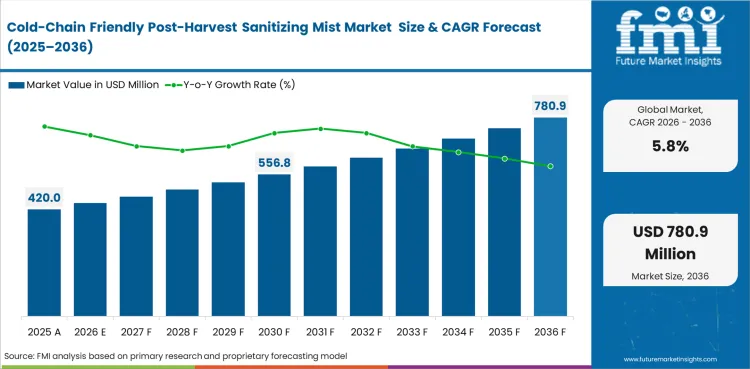
The cold-chain friendly post-harvest sanitizing mist market was valued at USD 397.0 million in 2025. The market is set to reach USD 420.0 million by 2026-end and grow at a CAGR of 5.8% between 2026 and 2036 to reach USD 737.8 million by 2036. Peracetic blends are projected to dominate the chemistry segment with 34.0%, while packhouses are projected to lead the end-user segment with 42.0%.
Summary of the Cold-Chain Friendly Post-Harvest Sanitizing Mist Market
- Demand and Growth Drivers
- Fresh produce operators are placing greater weight on low-residue sanitation across cold rooms and packing lines. Dispatch zones also hold importance as shelf-life loss and rejection risk create direct financial cost. Food-contact surface sanitizers and the food and beverage disinfection market provide adjacent hygiene context.
- Growth reflects broader use of peracetic acid, chlorine dioxide, and hydrogen-peroxide sanitation programs in food-contact settings.
- Water reuse requirements and tighter contamination control are supporting market expansion.
- Product and Segment View
- Demand is higher for oxidizing chemistries because produce handlers need broad antimicrobial action with workable residue and rinse profiles. Food and beverage industrial disinfection and cleaning products show similar chemistry preference in adjacent applications.
- Packhouses and cold rooms account for a large application share because both points combine high produce throughput with defined sanitation checkpoints.
- Concentrates hold stronger appeal in the formulation segment because many facilities need flexible dosing across room size and treatment cycle.
- Geography and Competitive Outlook
- China, India, Brazil, and Mexico are expanding at rapid pace as cold-chain capacity is widening and produce exports are anticipated to rise during the forecast period. Cold chain monitoring and real-time temperature tracking platforms reflect adjacent infrastructure demand.
- The United States, Spain, and the Netherlands continue to account for a significant share. Revenue growth in these markets are generated from process upgrades and tighter hygiene execution than from first-time installation.
- Competition remains fragmented across produce-focused post-harvest suppliers, food sanitation specialists, and oxidizing chemistry companies.
- Analyst Opinion
- Nikhil Kaitwade, Principal Analyst, states: “Demand is likely to stay firm in produce programs that need low-residue sanitation and low added moisture. Adoption is likely to be strongest where the chemistry fits cold-chain handling without raising process friction.”
- Cold-Chain Friendly Post-Harvest Sanitizing Mist Market Value Analysis
- Growth is moderate because mist-based sanitation fits selected cold-chain handling points. Wider adoption remains limited by crop response and the easier acceptance of simpler sanitation formats.
- Pricing power remains limited in standard fruit and vegetable handling. Specialist in the industry value is stronger in export-led fruit programs and in closed-room sanitation.
- Future sales depend more on operating process and produce compatibility than on chemistry strength alone.
Key Takeaways
- Market value reached USD 397.0 million in 2025.
- Market size is projected to rise to USD 737.8 million by 2036.
- CAGR for 2026 to 2036 is estimated at 5.8%.
- Incremental opportunity between 2026 and 2036 is about USD 317.8 million.
- Peracetic blends are projected to account for 34.0% of chemistry demand in 2026.
- China is projected to post the fastest country growth at a 7.1% CAGR through 2036. India is predicted to follow with a 6.9% CAGR over the same period.
- Commercial value is higher in packhouses and cold rooms due to strong hygiene needs across high-throughput produce handling.
Cold-Chain Friendly Post-Harvest Sanitizing Mist Market Definition
Cold-chain friendly post-harvest sanitizing mist includes sanitizing chemistries used after harvest. The scope includes mist or fog application systems used in produce handling. These products reduce microbial contamination across produce-contact zones and cold rooms. They are used in packing areas, bins, and related handling spaces. Market value covers products and application programs designed for cold-chain conditions.
Cold-Chain Friendly Post-Harvest Sanitizing Mist Market Inclusions
Scope includes peracetic acid blends, chlorine dioxide systems, hydrogen peroxide systems, and electrolyzed-water based programs. It also includes related post-harvest mist sanitation products. Scope also includes service support and dosing guidance. Application-linked sanitation programs are included when sold with the product.
Cold-Chain Friendly Post-Harvest Sanitizing Mist Market Exclusions
Scope excludes broad warehouse disinfection outside produce handling. It also excludes household sanitizers and non-food industrial fogging chemicals. General hard-surface cleaners are also excluded from this market. Standard produce wash chemistry is not included in this market. This applies to products sold only for dip tanks or flume systems. Mist-only or fog-linked relevance is necessary for inclusion. Products without such relevance fall outside the scope.
Cold-Chain Friendly Post-Harvest Sanitizing Mist Market Research Methodology
- Primary Research: Interviews with produce handlers, post-harvest chemical suppliers, packhouse operators, and cold-chain service participants.
- Desk Research: Review of food safety guidance, produce sanitation papers, public company product pages, and post-harvest handling literature.
- Market sizing and forecasting: Bottom-up use-point mapping across chemistry type, application stage, and end-user adoption combined with pricing benchmarks.
- Data validation: Cross-check of segment logic, country growth pattern, and supplier participation against public evidence and FMI internal review.
Why is the Cold-Chain Friendly Post-Harvest Sanitizing Mist Market Growing?
- Cold-chain produce operations need sanitation that works in enclosed spaces without visible residue or long restart delays.
- Export-focused handlers place more weight on contamination control because rejection, shrink, and shelf-life loss can reduce packhouse margin.
- Demand is stronger in operations that use mist application to reduce water use when compared with heavier wash-based routines.
Produce handlers now evaluate sanitation options more carefully by room condition and crop sensitivity. Process continuity also shapes the choice. Mist treatment is gaining ground in operations that need broad surface coverage without excess water carryover in storage.
Packhouse operating costs and margin pressure support this shift because contamination events can raise loss across high throughput produce lines. When microbial spread reaches bins or belts the site can face rejection and line stoppage. Crates, grading areas, and cold-room surfaces add the same risk. Mist-based sanitation matters in these settings because it supports broader surface treatment with lower water load and less process disruption.
Adoption remains selective because facilities need control over application routines and room closure. Chemistry handling must remain consistent. Smaller sites with weaker process control often prefer simpler sanitation formats.
Market Segmentation Analysis
- Peracetic blends are expected to account for 34.0% of the chemistry segment because food-contact sanitation teams already know the residue and rinse profile.
- Packhouses are projected to contribute 42.0% of the end-user segment because sorting and packing are concentrated in one operating node.
- Fruit is likely to hold 38.0% of the produce-type segment because export value and appearance sensitivity raise the cost of post-harvest loss.
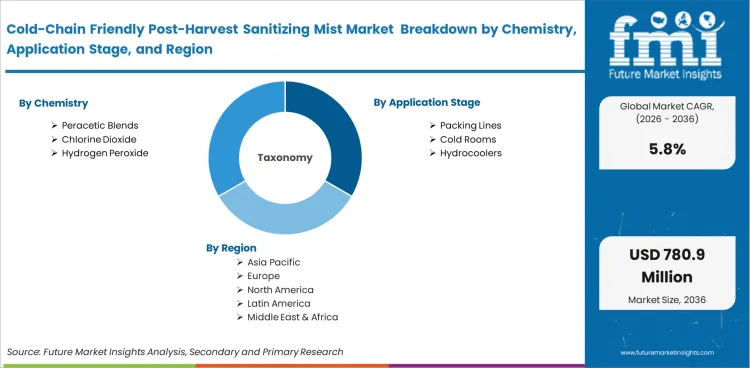
The market for cold-chain friendly post-harvest sanitizing mist is divided into groups based on chemistry, application stage, produce type, formulation, end user, and region. By chemistry, the market includes peracetic blends, chlorine dioxide, hydrogen peroxide, electrolyzed water, and organic acids. Based on application stage, it is segmented into packing lines, cold rooms, bin sanitation, hydrocoolers, and preload bays. By produce type, the market covers fruit, leafy greens, berries, melons, and mushrooms. By formulation, the market includes concentrates, ready-to-use products, stabilized blends, generated gas, and water-soluble packs. By end user, the market includes packhouses, exporters, cold stores, fresh-cut plants, and cooperatives.
Insights into the Peracetic Blends Segment
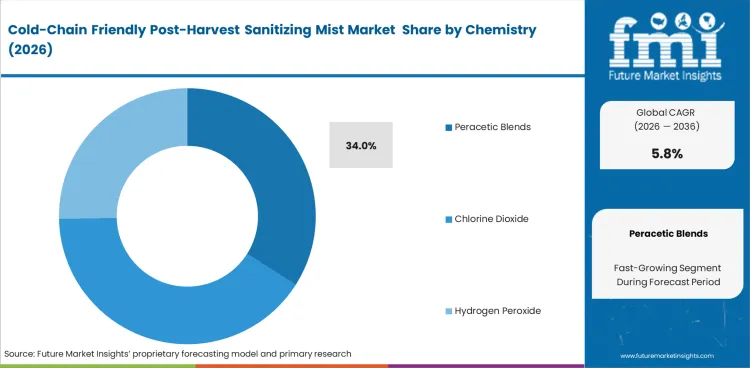
- Peracetic blends are expected to account for 34.0% of chemistry demand in 2026 because low-residue sanitation and broad antimicrobial action support repeat use.
- Chlorine dioxide and hydrogen peroxide support adjoining treatment programs when crop response and contact time differ.
Insights into the Packing Lines Segment
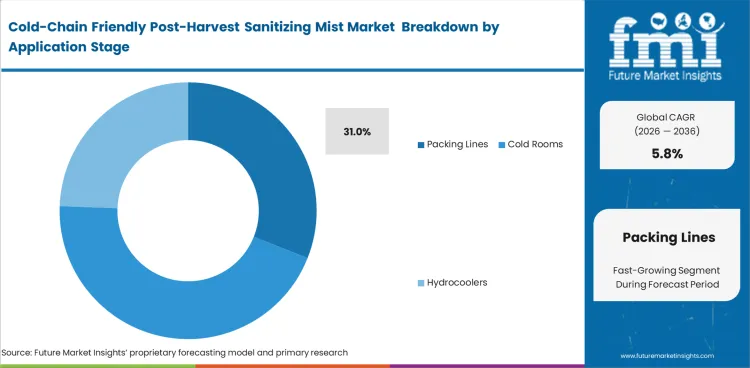
- Packing lines are projected to contribute 31.0% of application-stage demand in 2026 because this stage combines heavy produce movement with frequent surface contact. Contamination-transfer risk remains direct at this point.
- Cold rooms and bin sanitation generate steady product use in programs that seek cleaner turnover between lots and stronger storage hygiene.
Insights into the Packhouses Segment
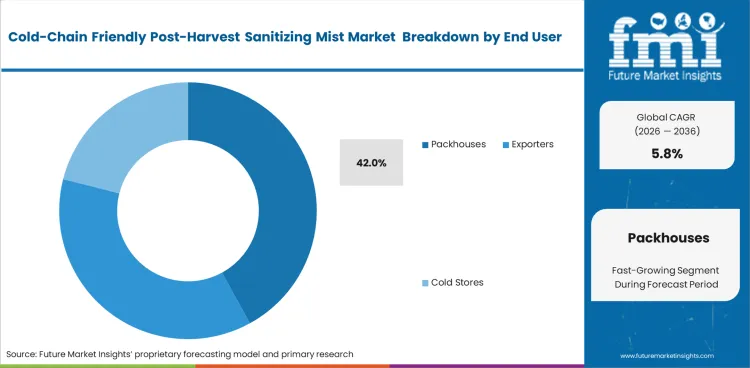
- Packhouses are likely to secure 42.0% of end-user demand in 2026 because sanitation decisions and outbound quality control are concentrated in one operating node.
- Exporters and cold stores spend more steadily when complaints and rejected shipments begin to rise.
Cold-Chain Friendly Post-Harvest Sanitizing Mist Market Drivers, Restraints, and Opportunities
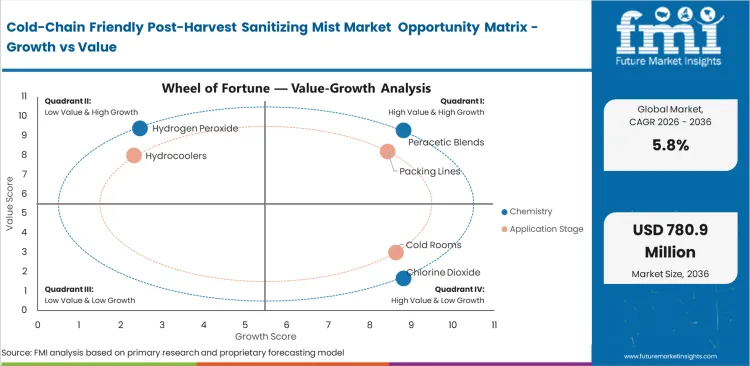
- Wider cold-chain handling of fresh produce is supporting mist-based sanitation in enclosed and controlled spaces.
- Adoption is limited by crop sensitivity and worker handling requirements. Repeatable room-level application control is still required.
- Opportunity is stronger in export-facing fruit programs and in water-conscious packhouses. It is rising in operations that are moving toward integrated hygiene systems.
Demand is moving away from broad sanitation buying toward selective post-harvest treatment choices. Produce compatibility and operating fit now shape more of the decision. Suppliers that combine chemistry reliability with simple dosing and technical guidance are expected to gain more market dominance among their peers competing only on product strength.
Residue-Sensitive Produce Handling
Cold-chain sanitation programs are judged closely on residue profile because fruit quality and shelf-life performance can be affected by treatment fit. A 2025 study reported pathogen reduction of 0.79 to 2.41 log CFU/g. The study stated that antimicrobial washes maintained produce quality without affecting shelf life. Supplier advantage depends on antimicrobial performance paired with low added handling burden on sensitive crops. [1]
Water Management and Closed-Space Sanitation
Water management and closed-space sanitation create value by treating surfaces and handling zones with less water load than heavy wash-based routines. A 2024 Foods study states that fogging significantly reduced the analyzed pathogens and describes fogging as an up-and-coming technology. A 2026 review notes broad coverage and potential for more sustainable water and chemical use in food-processing sanitation. This advantage matters most in cold rooms and packhouses that need enclosed-space sanitation without repeated water-heavy cleaning cycles. Produce packaging and fresh food packaging reflect adjacent handling economics. [2]
Analysis of Cold-Chain Friendly Post-Harvest Sanitizing Mist Market By Key Countries
.webp "Top Country Growth Comparison Cold Chain Friendly Post Harvest Sanitizing Mist Market Cagr (2026 2036)")
| Country | CAGR |
|---|---|
| China | 7.1% |
| India | 6.9% |
| Brazil | 6.4% |
| Mexico | 6.2% |
| Spain | 5.8% |
| Netherlands | 5.6% |
| United States | 5.4% |
Source: FMI analysis based on primary research and proprietary forecasting model
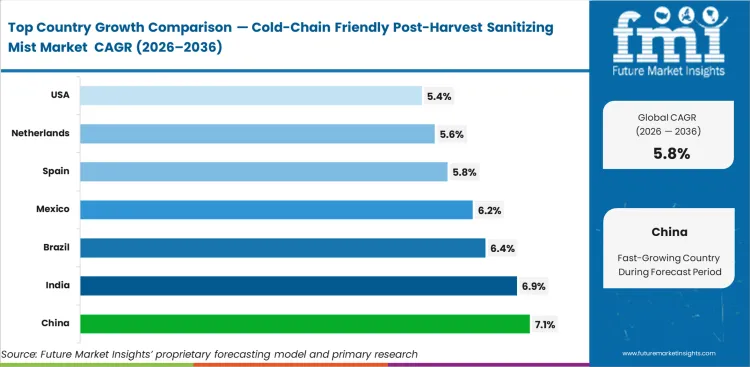
Cold-Chain Friendly Post-Harvest Sanitizing Mist Market Cagr Analysis By Country
- China leads with a CAGR of 7.1% during the forecast period because cold-chain expansion and large produce flows create room for first-time sanitation upgrades.
- India follows at 6.9% as organized handling and food safety execution improve across commercial produce supply chains.
- Brazil and Mexico post CAGRs of 6.4% and 6.2% because export-facing fruit and vegetable trade supports adoption.
- Spain and the Netherlands record CAGRs of 5.8% and 5.6%. Continued investment in process control and handling quality supports demand across mature produce systems.
- The United States registers a CAGR of 5.4%. Demand gains come more from product replacement and sanitation refinement.
- Faster growth appears in markets that are adding cold-chain infrastructure. Mature markets are expanding through operational upgrades.
Demand Outlook for Cold-Chain Friendly Post-Harvest Sanitizing Mist in China
China is gaining importance because fresh produce movement and cold-chain capacity are increasing. Demand for cold-chain friendly post-harvest sanitizing mist in China is expected to rise at a CAGR of 7.1% through 2036. Storage growth and export handling needs support that outlook. Supplier position improves in programs that combine technical support with large-scale dosing control.
- Growing fruit and vegetable logistics create more sanitation points.
- Cold-room sanitation gains importance in high-turnover facilities.
- Export quality control supports spending in higher-value produce channels.
Future Outlook for Cold-Chain Friendly Post-Harvest Sanitizing Mist in India
India has good potential because cold-chain handling is improving across produce lines. Sales of cold-chain friendly post-harvest sanitizing mist in India are likely to increase at a CAGR of 6.9% through 2036. Packhouse growth and tighter food safety execution support the outlook. Suppliers perform better when products control microbes without adding handling work for delicate crops. IoT for cold-chain monitoring and food safety testing services add adjacent infrastructure support.
- Packhouse growth is increasing structured sanitation spending.
- Loss reduction in fruits and vegetables keeps direct financial value.
- Technical support matters where process control is uneven.
Opportunity Analysis of Cold-Chain Friendly Post-Harvest Sanitizing Mist in Brazil
Brazil has strong importance because export-focused fruit programs raise the cost of storage loss and contamination. Demand for cold-chain friendly post-harvest sanitizing mist in Brazil is expected to rise at a CAGR of 6.4% through 2036. Export handling and post-harvest quality control support the outlook. Commercial value is higher in operations that serve long-distance channels with shelf-life sensitivity.
- Export fruit supply chains support sanitation spending.
- Transit-related quality loss increases treatment value.
- Supplier preference rises for products with practical field support.
In-depth Analysis of Cold-Chain Friendly Post-Harvest Sanitizing Mist in Mexico
Mexico is growing because cross-border produce movement increases pressure on handling quality and contamination control. Adoption of cold-chain friendly post-harvest sanitizing mist in Mexico is forecast to grow at a CAGR of 6.2% through 2036. Fresh produce exports and packhouse sanitation needs support the outlook. Supplier acceptance is higher in sites that need line fit without dispatch delays. Packaged fresh fruits and fresh produce trays reflect nearby handling demand.
- Export-focused operations need cleaner turnover between lots.
- Packhouse sanitation supports more consistent quality.
- Fast-moving produce channels prefer easy-to-apply formats.
Sales Analysis of Cold-Chain Friendly Post-Harvest Sanitizing Mist in the United States
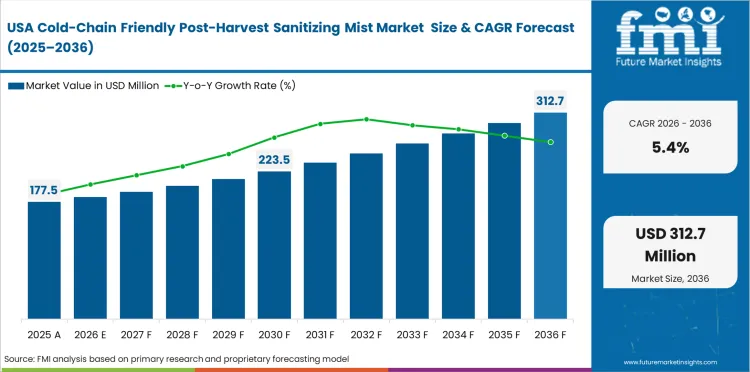
United States demand is rising because food safety practice and cold storage use are well established. The cold-chain friendly post-harvest sanitizing mist market in the United States is set to expand at a CAGR of 5.4% through 2036. Replacement demand and process upgrades support the outlook. Supplier edge depends less on chemistry access and more on service and application support. Nearby food testing and pathogen testing services add adjacent quality-control context.
- Mature operations value repeatable sanitation performance.
- Replacement demand supports premium chemistry programs.
- Technical service matters in regulated produce environments.
Competitive Landscape and Strategic Positioning
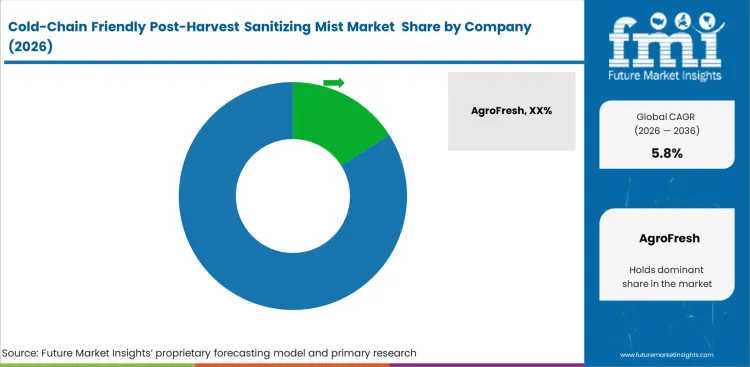
- Competition is spread across oxidizing chemistry suppliers and post-harvest produce specialists.
- Supplier advantage usually depends on technical support and produce-safe chemistry positioning. Fit with cold-room or packhouse routines also hold importance in the same decision.
- New entrants face a harder path in programs that require proof of compatibility and stable post-harvest results.
Established suppliers matter because operators do not choose on chemistry label alone. Product acceptance depends on crop sensitivity and worker handling rules. Water management goals
Market outlook favors companies already selling into produce hygiene and broader food-contact sanitation programs. Existing channel access and field support can reduce qualification time and switching risk. Disinfectant fogging and misting chemicals for large facilities offer related insights on mist-based disinfection systems.
Key Companies in the Cold-Chain Friendly Post-Harvest Sanitizing Mist Market
Global companies active in the Cold-Chain Friendly Post-Harvest Sanitizing Mist market include:
Produce-focused post-harvest suppliers such as AgroFresh and BioSafe Systems.
Food sanitation and antimicrobial program suppliers such as Solenis and Ecolab. Enviro Tech Chemical Services operates in the same field.
Oxidizing chemistry suppliers with broader technical depth include Evonik and UPL.
Competitive Benchmarking: Cold-Chain Friendly Post-Harvest Sanitizing Mist
| Company | Produce Chemistry | Post-harvest Coverage | Technical Support | Geographic Footprint |
|---|---|---|---|---|
| AgroFresh | High | Strong | Strong | Global |
| BioSafe Systems | High | Strong | Medium | North America |
| Solenis | Medium | Strong | Strong | Global |
| Ecolab | Medium | Medium | Strong | Global |
| Enviro Tech Chemical Services | High | Medium | Medium | North America |
| Evonik | High | Medium | Strong | Global |
Source: Future Market Insights competitive analysis, 2026. Ratings reflect relative positioning based on produce chemistry relevance, post-harvest coverage, and technical support.
Key Developments in Cold-Chain Friendly Post-Harvest Sanitizing Mist
- In March 2024 AgroFresh acquired Pace International LLC. The deal expanded its post-harvest portfolio across produce treatment and technical services. [3]
- In February 2025 BioSafe Systems stated that SaniDate 12.0 was the first registered preharvest irrigation water treatment approved by EPA and FDA. The announcement increased its relevance for produce-focused food safety programs. [4]
- In 2026 Evonik promoted VIGOROX Ceres for crop washing applications based on peracetic-acid chemistry. The update reinforced Evonik’s position in post-harvest antimicrobial treatment
Key Players in the Cold-Chain Friendly Post-Harvest Sanitizing Mist:
Major Global Players:
- AgroFresh
- Solenis
- Ecolab
- Evonik
Emerging Players/Startups
- BioSafe Systems
- Enviro Tech Chemical Services
- UPL
Report Scope and Coverage
| Parameter | Details |
|---|---|
| Quantitative Units | USD million for value and CAGR from 2026 to 2036 |
| Market Definition | Post-harvest mist or fog sanitation products used in cold-chain produce handling environments |
| Regions Covered | North America, Latin America, Europe, Asia Pacific |
| Countries Covered | China, India, Brazil, Mexico, Spain, Netherlands, United States |
| Key Companies Profiled | AgroFresh, BioSafe Systems, Solenis, Ecolab, Enviro Tech Chemical Services, Evonik, UPL |
| Forecast Period | 2026 to 2036 |
| Approach | Primary interviews, desk research, segment mapping, and FMI forecasting model |
Cold-Chain Friendly Post-Harvest Sanitizing Mist Market by Segments
Cold-Chain Friendly Post-Harvest Sanitizing Mist Market Segmented by Chemistry:
- Peracetic blends
- Chlorine dioxide
- Hydrogen peroxide
- Electrolyzed water
- Organic acids
Cold-Chain Friendly Post-Harvest Sanitizing Mist Market Segmented by Application Stage:
- Packing lines
- Cold rooms
- Bin sanitation
- Hydrocoolers
- Preload bays
Cold-Chain Friendly Post-Harvest Sanitizing Mist Market Segmented by Produce Type:
- Fruit
- Leafy greens
- Berries
- Melons
- Mushrooms
Cold-Chain Friendly Post-Harvest Sanitizing Mist Market Segmented by Formulation:
- Concentrates
- Ready-to-use
- Stabilized blends
- Generated gas
- Water-soluble packs
Cold-Chain Friendly Post-Harvest Sanitizing Mist Market Segmented by End User:
- Packhouses
- Exporters
- Cold stores
- Fresh-cut plants
- Cooperatives
Cold-Chain Friendly Post-Harvest Sanitizing Mist Market Segmented by Region:
- North America
- USA
- Canada
- Mexico
- Latin America
- Brazil
- Chile
- Rest of Latin America
- Western Europe
- Germany
- UK
- Italy
- Spain
- France
- Nordic
- BENELUX
- Rest of Western Europe
- Eastern Europe
- Russia
- Poland
- Hungary
- Balkan & Baltic
- Rest of Eastern Europe
- East Asia
- China
- Japan
- South Korea
- South Asia and Pacific
- India
- ASEAN
- Australia & New Zealand
- Rest of South Asia and Pacific
- Middle East & Africa
- Kingdom of Saudi Arabia
- Other GCC Countries
- Turkiye
- South Africa
- Other African Union
Rest of Middle East & Africa
Research Sources and Bibliography
- Mina, H. A., Buckley, D. A., Burnett, J., & Deering, A. J. (2025). Evaluation of commercially available produce antimicrobial washes to improve the quality and microbial safety of fresh produce. International Journal of Food Microbiology, 441, Article 111318.
- Pierozan, M. B., Alves, J. d. S., Horn, L. D., Santos, P. A. d., Silva, M. A. P. d., Egea, M. B., Minafra, C., Cappato, L. P., & Costa, A. C. (2024). Inactivation of Salmonella Typhimurium, Escherichia coli, and Staphylococcus aureus in tilapia fillets (Oreochromis niloticus) with lactic and peracetic acid through fogging and immersion. Foods, 13(10), 1520.
- AgroFresh Solutions, Inc. (2024, March 27). AgroFresh acquires Pace International LLC expanding post-harvest solutions portfolio.
- BioSafe Systems. (2025, February 25). SaniDate® 12.0 named FIRST registered preharvest irrigation water treatment by EPA and FDA.
- Frank Long, Laura Strawn, Lester Schonberger, and Renee Boyer. (2024, July). Sanitizers for Vegetables in Harvest and Post-Harvest Water for Small Farmers.
- Yuqiao Jin and Achyut Adhikari. (2025, May). Emerging and Innovative Technologies for the Sanitization of Fresh Produce: Advances, Mechanisms, and Applications for Enhancing Food Safety and Quality.
- Hansel A. Mina, David A. Buckley, Jack Burnett, and Amanda J. Deering. (2025, October). Evaluation of commercially available produce antimicrobial washes to improve the quality and microbial safety of fresh produce.
- Weiwei Jin, Fengxian Su, Huan Zhou, Qiaojun Jiang, Yan Li, Haijun Zhao, and Tao Luo. (2024, October). Effects of Chlorine Dioxide on the Postharvest Storage Quality of Fresh-Cut Button Mushrooms (Agaricus bisporus).
This Report Answers
- Market scope for cold-chain friendly post-harvest sanitizing mist?
- Market size in 2025, 2026, and 2036?
- Expected CAGR from 2026 to 2036?
- Leading chemistry segment?
- Leading application-stage segment?
- Packhouse demand rationale?
- Fastest-growing country markets?
- Main factors limiting broader adoption?
- Active companies across this market?
- Main capabilities used in competitive benchmarking?
- Recent developments shaping supplier positioning?
- Full segmentation across chemistry, application stage, produce type, formulation, and end user?
Frequently Asked Questions
What is cold-chain friendly post-harvest sanitizing mist?
It is a post-harvest sanitation segment covering mist or fog-applied antimicrobial products used in cold-chain produce handling environments.
Why is demand rising for this market?
Demand is rising because produce handlers need cleaner storage and packing conditions with low residue and low added water burden.
Which chemistry leads the market?
Peracetic blends lead because food-contact sanitation teams already know their residue profile and rinse fit.
Why do packhouses account for the largest share?
Packhouses control sorting, packing, and dispatch in one operating node, thus sanitation spending is easier to justify there.
Which countries are growing fastest?
China and India lead, followed by Brazil and Mexico, due to expanding cold-chain capacity and produce handling infrastructure.
What limits adoption?
Crop sensitivity, worker handling rules, and the need for repeatable room-level application control limit broader rollout.
Which operations get the most value from these products?
Exporters, packhouses, and cold stores gain more value in programs facing direct financial loss from quality failure and shipment rejection.
Is this the same as general produce wash chemistry?
No. This market covers mist and fog sanitation programs linked with cold-chain handling rather than all produce sanitation chemicals.
Preview the report firsthand - request a free sample
Get SampleGet the brochure for pricing and purchase details.
Get PDFTable of Content
- Key Takeaways
- Market Size and CAGR
- Top Growth Driver
- Fastest Growing Segment
- Leading Region
- Key Companies
- Emerging Opportunities
- Executive Summary
- Global Market Outlook
- Demand-side Trends
- Supply-side Trends
- Technology Roadmap Analysis
- Analysis and Recommendations
- Analyst Perspective (What is happening? Why now? What should investors know?)
- Key Questions Answered
- How large is the market?
- What is the CAGR?
- What are key trends?
- Which region dominates?
- Who are the leaders?
- Market Overview
- Market Coverage / Taxonomy
- Market Definition / Scope / Limitations
- Research Methodology
- Chapter Orientation
- Analytical Lens and Working Hypotheses
- Market Structure, Signals, and Trend Drivers
- Benchmarking and Cross-market Comparability
- Market Sizing, Forecasting, and Opportunity Mapping
- Research Design and Evidence Framework
- Desk Research Programme (Secondary Evidence)
- Expert Input and Fieldwork (Primary Evidence)
- Tooling, Models, and Reference Databases
- Data Engineering and Model Build
- Quality Assurance and Audit Trail
- Market Background
- Market Dynamics (Drivers, Restraints, Opportunity, Trends)
- Scenario Forecast (Optimistic, Likely, Conservative)
- Impact Analysis
- AI Impact
- Sustainability Impact
- Regulatory Impact
- Technology Impact
- Consumer / Buyer Analysis
- Purchase Drivers
- Adoption Barriers
- Buyer Journey
- Opportunity Map Analysis
- Product Life Cycle Analysis
- Supply Chain Analysis
- Investment Feasibility Matrix
- Value Chain Analysis
- PESTLE and Porter's Analysis
- Regulatory Landscape
- Regional Parent Market Outlook
- Production and Consumption Statistics
- Import and Export Statistics
- Global Market Analysis and Forecast, 2021 to 2036
- Historical Market Size Value (USD Million) Analysis, 2021 to 2025
- Current and Future Market Size Value (USD Million) Projections, 2026 to 2036
- Y-o-Y Growth Trend Analysis
- Absolute $ Opportunity Analysis
- Global Market Pricing Analysis, 2021 to 2036
- Global Market Analysis and Forecast, By Chemistry, 2021 to 2036
- Introduction / Key Findings
- Historical Market Size Value (USD Million) Analysis By Chemistry, 2021 to 2025
- Current and Future Market Size Value (USD Million) Analysis and Forecast By Chemistry, 2026 to 2036
- Peracetic blends
- Chlorine dioxide
- Hydrogen peroxide
- Electrolyzed water
- Organic acids
- Peracetic blends
- Y-o-Y Growth Trend Analysis By Chemistry, 2021 to 2025
- Absolute $ Opportunity Analysis By Chemistry, 2026 to 2036
- Global Market Analysis and Forecast, By Application Stage, 2021 to 2036
- Introduction / Key Findings
- Historical Market Size Value (USD Million) Analysis By Application Stage, 2021 to 2025
- Current and Future Market Size Value (USD Million) Analysis and Forecast By Application Stage, 2026 to 2036
- Packing lines
- Cold rooms
- Bin sanitation
- Hydrocoolers
- Preload bays
- Packing lines
- Y-o-Y Growth Trend Analysis By Application Stage, 2021 to 2025
- Absolute $ Opportunity Analysis By Application Stage, 2026 to 2036
- Global Market Analysis and Forecast, By Produce Type, 2021 to 2036
- Introduction / Key Findings
- Historical Market Size Value (USD Million) Analysis By Produce Type, 2021 to 2025
- Current and Future Market Size Value (USD Million) Analysis and Forecast By Produce Type, 2026 to 2036
- Fruit
- Leafy greens
- Berries
- Melons
- Mushrooms
- Fruit
- Y-o-Y Growth Trend Analysis By Produce Type, 2021 to 2025
- Absolute $ Opportunity Analysis By Produce Type, 2026 to 2036
- Global Market Analysis and Forecast, By Formulation, 2021 to 2036
- Introduction / Key Findings
- Historical Market Size Value (USD Million) Analysis By Formulation, 2021 to 2025
- Current and Future Market Size Value (USD Million) Analysis and Forecast By Formulation, 2026 to 2036
- Concentrates
- Ready-to-use
- Stabilized blends
- Generated gas
- Water-soluble packs
- Concentrates
- Y-o-Y Growth Trend Analysis By Formulation, 2021 to 2025
- Absolute $ Opportunity Analysis By Formulation, 2026 to 2036
- Global Market Analysis and Forecast, By End User, 2021 to 2036
- Introduction / Key Findings
- Historical Market Size Value (USD Million) Analysis By End User, 2021 to 2025
- Current and Future Market Size Value (USD Million) Analysis and Forecast By End User, 2026 to 2036
- Packhouses
- Exporters
- Cold stores
- Fresh-cut plants
- Cooperatives
- Packhouses
- Y-o-Y Growth Trend Analysis By End User, 2021 to 2025
- Absolute $ Opportunity Analysis By End User, 2026 to 2036
- Global Market Analysis and Forecast, By Region, 2021 to 2036
- Introduction
- Historical Market Size Value (USD Million) Analysis By Region, 2021 to 2025
- Current Market Size Value (USD Million) Analysis and Forecast By Region, 2026 to 2036
- North America
- Latin America
- Western Europe
- Eastern Europe
- East Asia
- South Asia and Pacific
- Middle East & Africa
- Market Attractiveness Analysis By Region
- North America Market Analysis and Forecast, By Country, 2021 to 2036
- Historical Market Size Value (USD Million) Trend Analysis By Market Taxonomy, 2021 to 2025
- Market Size Value (USD Million) Forecast By Market Taxonomy, 2026 to 2036
- By Country
- USA
- Canada
- By Chemistry
- By Application Stage
- By Produce Type
- By Formulation
- By End User
- By Country
- Market Attractiveness Analysis
- By Country
- By Chemistry
- By Application Stage
- By Produce Type
- By Formulation
- By End User
- Key Takeaways
- Latin America Market Analysis and Forecast, By Country
- Historical Market Size Value (USD Million) Trend Analysis By Market Taxonomy, 2021 to 2025
- Market Size Value (USD Million) Forecast By Market Taxonomy, 2026 to 2036
- By Country
- Brazil
- Mexico
- Chile
- Rest of Latin America
- By Chemistry
- By Application Stage
- By Produce Type
- By Formulation
- By End User
- By Country
- Market Attractiveness Analysis
- By Country
- By Chemistry
- By Application Stage
- By Produce Type
- By Formulation
- By End User
- Key Takeaways
- Western Europe Market Analysis and Forecast, By Country
- Historical Market Size Value (USD Million) Trend Analysis By Market Taxonomy, 2021 to 2025
- Market Size Value (USD Million) Forecast By Market Taxonomy, 2026 to 2036
- By Country
- Germany
- UK
- Italy
- Spain
- France
- Nordic
- BENELUX
- Rest of Western Europe
- By Chemistry
- By Application Stage
- By Produce Type
- By Formulation
- By End User
- By Country
- Market Attractiveness Analysis
- By Country
- By Chemistry
- By Application Stage
- By Produce Type
- By Formulation
- By End User
- Key Takeaways
- Eastern Europe Market Analysis and Forecast, By Country
- Historical Market Size Value (USD Million) Trend Analysis By Market Taxonomy, 2021 to 2025
- Market Size Value (USD Million) Forecast By Market Taxonomy, 2026 to 2036
- By Country
- Russia
- Poland
- Hungary
- Balkan & Baltic
- Rest of Eastern Europe
- By Chemistry
- By Application Stage
- By Produce Type
- By Formulation
- By End User
- By Country
- Market Attractiveness Analysis
- By Country
- By Chemistry
- By Application Stage
- By Produce Type
- By Formulation
- By End User
- Key Takeaways
- East Asia Market Analysis and Forecast, By Country
- Historical Market Size Value (USD Million) Trend Analysis By Market Taxonomy, 2021 to 2025
- Market Size Value (USD Million) Forecast By Market Taxonomy, 2026 to 2036
- By Country
- China
- Japan
- South Korea
- By Chemistry
- By Application Stage
- By Produce Type
- By Formulation
- By End User
- By Country
- Market Attractiveness Analysis
- By Country
- By Chemistry
- By Application Stage
- By Produce Type
- By Formulation
- By End User
- Key Takeaways
- South Asia and Pacific Market Analysis and Forecast, By Country
- Historical Market Size Value (USD Million) Trend Analysis By Market Taxonomy, 2021 to 2025
- Market Size Value (USD Million) Forecast By Market Taxonomy, 2026 to 2036
- By Country
- India
- ASEAN
- Australia & New Zealand
- Rest of South Asia and Pacific
- By Chemistry
- By Application Stage
- By Produce Type
- By Formulation
- By End User
- By Country
- Market Attractiveness Analysis
- By Country
- By Chemistry
- By Application Stage
- By Produce Type
- By Formulation
- By End User
- Key Takeaways
- Middle East & Africa Market Analysis and Forecast, By Country
- Historical Market Size Value (USD Million) Trend Analysis By Market Taxonomy, 2021 to 2025
- Market Size Value (USD Million) Forecast By Market Taxonomy, 2026 to 2036
- By Country
- Kingdom of Saudi Arabia
- Other GCC Countries
- Türkiye
- South Africa
- Other African Union
- Rest of Middle East & Africa
- By Chemistry
- By Application Stage
- By Produce Type
- By Formulation
- By End User
- By Country
- Market Attractiveness Analysis
- By Country
- By Chemistry
- By Application Stage
- By Produce Type
- By Formulation
- By End User
- Key Takeaways
- Key Countries Market Analysis
- USA
- Pricing Analysis
- Market Share Analysis, 2025
- By Chemistry
- By Application Stage
- By Produce Type
- By Formulation
- By End User
- Canada
- Pricing Analysis
- Market Share Analysis, 2025
- By Chemistry
- By Application Stage
- By Produce Type
- By Formulation
- By End User
- Mexico
- Pricing Analysis
- Market Share Analysis, 2025
- By Chemistry
- By Application Stage
- By Produce Type
- By Formulation
- By End User
- Brazil
- Pricing Analysis
- Market Share Analysis, 2025
- By Chemistry
- By Application Stage
- By Produce Type
- By Formulation
- By End User
- Chile
- Pricing Analysis
- Market Share Analysis, 2025
- By Chemistry
- By Application Stage
- By Produce Type
- By Formulation
- By End User
- Germany
- Pricing Analysis
- Market Share Analysis, 2025
- By Chemistry
- By Application Stage
- By Produce Type
- By Formulation
- By End User
- UK
- Pricing Analysis
- Market Share Analysis, 2025
- By Chemistry
- By Application Stage
- By Produce Type
- By Formulation
- By End User
- Italy
- Pricing Analysis
- Market Share Analysis, 2025
- By Chemistry
- By Application Stage
- By Produce Type
- By Formulation
- By End User
- Spain
- Pricing Analysis
- Market Share Analysis, 2025
- By Chemistry
- By Application Stage
- By Produce Type
- By Formulation
- By End User
- France
- Pricing Analysis
- Market Share Analysis, 2025
- By Chemistry
- By Application Stage
- By Produce Type
- By Formulation
- By End User
- India
- Pricing Analysis
- Market Share Analysis, 2025
- By Chemistry
- By Application Stage
- By Produce Type
- By Formulation
- By End User
- ASEAN
- Pricing Analysis
- Market Share Analysis, 2025
- By Chemistry
- By Application Stage
- By Produce Type
- By Formulation
- By End User
- Australia & New Zealand
- Pricing Analysis
- Market Share Analysis, 2025
- By Chemistry
- By Application Stage
- By Produce Type
- By Formulation
- By End User
- China
- Pricing Analysis
- Market Share Analysis, 2025
- By Chemistry
- By Application Stage
- By Produce Type
- By Formulation
- By End User
- Japan
- Pricing Analysis
- Market Share Analysis, 2025
- By Chemistry
- By Application Stage
- By Produce Type
- By Formulation
- By End User
- South Korea
- Pricing Analysis
- Market Share Analysis, 2025
- By Chemistry
- By Application Stage
- By Produce Type
- By Formulation
- By End User
- Russia
- Pricing Analysis
- Market Share Analysis, 2025
- By Chemistry
- By Application Stage
- By Produce Type
- By Formulation
- By End User
- Poland
- Pricing Analysis
- Market Share Analysis, 2025
- By Chemistry
- By Application Stage
- By Produce Type
- By Formulation
- By End User
- Hungary
- Pricing Analysis
- Market Share Analysis, 2025
- By Chemistry
- By Application Stage
- By Produce Type
- By Formulation
- By End User
- Kingdom of Saudi Arabia
- Pricing Analysis
- Market Share Analysis, 2025
- By Chemistry
- By Application Stage
- By Produce Type
- By Formulation
- By End User
- Türkiye
- Pricing Analysis
- Market Share Analysis, 2025
- By Chemistry
- By Application Stage
- By Produce Type
- By Formulation
- By End User
- South Africa
- Pricing Analysis
- Market Share Analysis, 2025
- By Chemistry
- By Application Stage
- By Produce Type
- By Formulation
- By End User
- USA
- Market Structure Analysis
- Competition Dashboard
- Competition Benchmarking
- Market Share Analysis of Top Players
- By Regional
- By Chemistry
- By Application Stage
- By Produce Type
- By Formulation
- By End User
- Emerging Startups
- Innovation Benchmarking
- Competition Analysis
- Competition Deep Dive
- AgroFresh
- Overview
- Product Portfolio
- Profitability by Market Segments
- Sales Footprint
- Strategy Overview
- Marketing Strategy
- Product Strategy
- Channel Strategy
- Solenis
- Ecolab
- Evonik
- BioSafe Systems
- Enviro Tech Chemical Services
- UPL
- AgroFresh
- Case Studies
- Success Stories
- Recent Developments
- Competition Deep Dive
- Assumptions & Acronyms Used


