

- Industry Size (2026)
- USD 0.5 Bn
- Forecast (2036)
- USD 2.0 Bn
- CAGR (2026 to 2036)
- 15.1%
Cover-Crop Friendly Selective Herbicide Co-Pack Market Forecast and Outlook 2026 to 2036
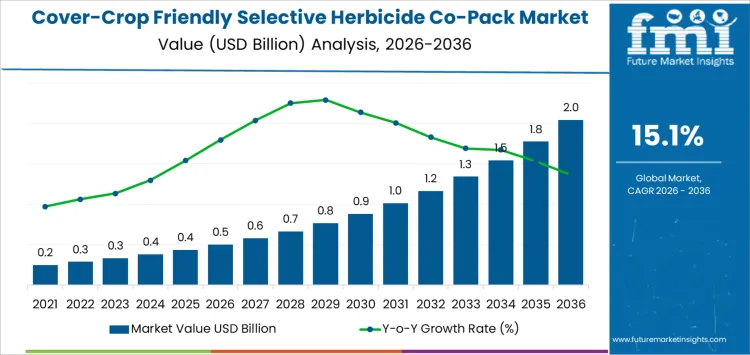
The global cover-crop friendly selective herbicide co-pack market is projected to grow from USD 0.5 billion in 2026 to USD 2.0 billion by 2036, with a robust CAGR of 15.1%. The increasing adoption of eco-friendly farming practices, including cover cropping, is driving this market. Selective herbicide + safener blends lead the market with a 37% share due to their ability to effectively control weeds while protecting cover crops. Early-season selective suppression strategies, holding the largest share of 35%, are key to ensuring optimal crop establishment by managing weed competition during early growth stages.
Quick Stats for Cover-Crop Friendly Selective Herbicide Co-Pack Market
- Cover-Crop Friendly Selective Herbicide Co-Pack Market Value (2026): USD 0.5 billion
- Cover-Crop Friendly Selective Herbicide Co-Pack Market Forecast Value (2036): USD 2.0 billion
- Cover-Crop Friendly Selective Herbicide Co-Pack Market Forecast CAGR: 15.1%
- Leading Co-Pack Composition in Cover-Crop Friendly Selective Herbicide Co-Pack Market: Selective Herbicide + Safener Blends (37%)
- Key Growth Regions in Cover-Crop Friendly Selective Herbicide Co-Pack Market: USA, Brazil, Argentina, France, Australia
- Key Players in Cover-Crop Friendly Selective Herbicide Co-Pack Market: UPL Sustainable Ag Solutions, Albaugh Specialty Crop Programs, Rotam CropSciences, RedEagle International, Nichino America
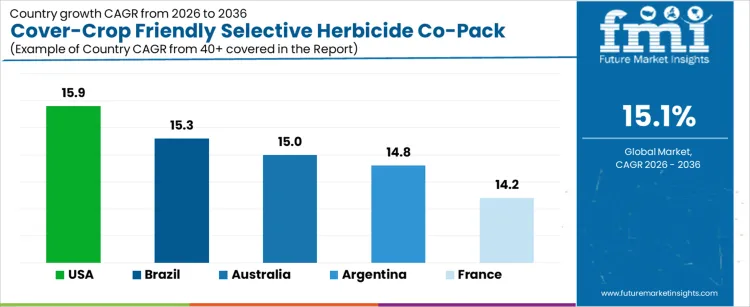
The USA leads the market with a 15.9% CAGR, supported by strong demand for integrated weed control solutions in no-till and cover-crop systems. Brazil follows with a 15.3% growth rate, driven by its large-scale agricultural sector and a growing focus on eco-friendly herbicide alternatives. Argentina’s market grows at 14.8%, as it embraces cover crops to enhance soil health and reduce chemical use. France and Australia also show steady growth, at 14.2% and 15.0%, respectively, driven by their focus on eco-friendly farming solutions. The demand for herbicides that work harmoniously with cover crops to promote soil health and reduce environmental impact continues to drive market growth globally.
Cover‑Crop Friendly Selective Herbicide Co‑Pack Market Key Takeaways
| Metric | Value |
|---|---|
| Industry Value (2026) | USD 0.5 billion |
| Forecast Value (2036) | USD 2.0 billion |
| Forecast CAGR (2026 to 2036) | 15.1% |
How is the Global Cover-Crop Friendly Selective Herbicide Co-Pack Sector Advancing?
The global cover-crop friendly selective herbicide co-pack market is expanding rapidly as growers adopt eco-friendly crop production systems that integrate weed management with soil conservation practices. Cover crops are planted between cash crops to improve soil structure, suppress erosion, enhance nutrient cycling, and increase organic matter. Traditional herbicide programs can adversely affect cover crops or limit the choice of species growers can establish. Cover-crop friendly selective herbicide co-packs are formulated to control weeds effectively while being compatible with cover crop species, enabling growers to protect their soil health without sacrificing weed control performance.
Demand for these co-packs is rising alongside increased adoption of regenerative and conservation agriculture practices around the world. Growers want herbicide solutions that fit into diversified cropping systems where cover crops play an essential role in building resilience against soil degradation, reducing input costs, and supporting climate-smart farming goals. Advances in formulation science have improved selectivity and crop safety, allowing herbicides to target specific weed species while minimizing harm to cover crop plants. Co-pack formats that combine complementary herbicides simplify application and help optimize timing relative to cover crop growth stages.
What is the Segment-Wise Analysis for the Global Cover-Crop Friendly Selective Herbicide Co-Pack Market?
The global cover-crop friendly selective herbicide co-pack market is segmented by co-pack composition type and weed control strategy. Selective herbicide + safener blends lead the market with a 37% share, offering effective weed control while protecting cover crops. Other significant co-pack compositions include herbicide + residue-friendly adjuvant packs, low-dose sequential herbicide kits, and cover-crop termination-safe formulations. In terms of weed control strategies, early-season selective suppression holds the largest share at 35%, followed by inter-crop weed management, cover-crop preservation programs, and precision & spot-spray programs.
How Do Selective Herbicide + Safener Blends Lead the Global Cover-Crop Friendly Selective Herbicide Co-Pack Market?
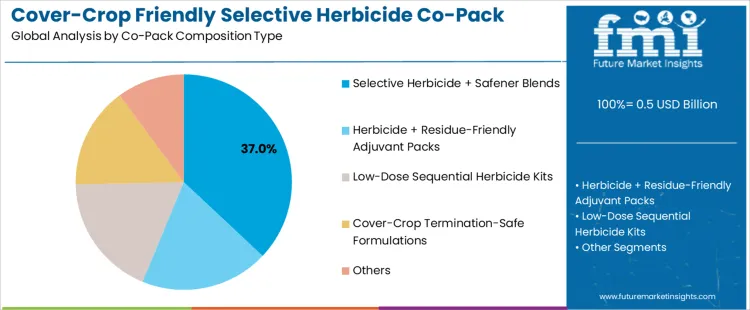
Selective herbicide + safener blends hold a 37% share in the global cover-crop friendly selective herbicide co-pack market due to their ability to control weeds effectively while protecting cover crops. Safeners are added to herbicide formulations to reduce their toxicity to non-target plants, ensuring that cover crops are not harmed during weed control. This combination is ideal for growers who want to control weeds without jeopardizing the health of their cover crops. As demand for eco-friendlier and crop-safe herbicide solutions increases, these blends are becoming increasingly popular in cover-crop management, solidifying their leadership in the market.
Why Does Early-Season Selective Suppression Hold the Largest Market Share in the Global Herbicide Co-Pack Market?
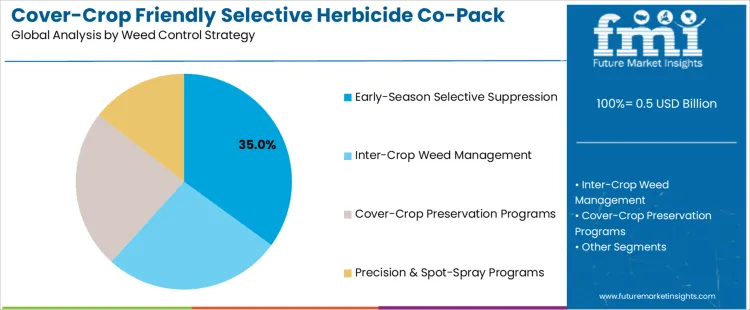
Early-season selective suppression holds the largest share of 35% in the global cover-crop friendly selective herbicide co-pack market due to its effectiveness in managing weeds during the critical early stages of crop growth. During this period, controlling weed competition is essential for ensuring optimal crop establishment and growth. Early-season selective suppression strategies allow farmers to target weeds without harming young crops, which is especially important in no-till or cover-crop systems. This approach helps maximize crop yield potential while minimizing herbicide use, driving its dominance in the market as an eco-friendly weed management solution.
What is Shaping the Cover‑Crop Friendly Selective Herbicide Co‑Pack Market?
Cover crops improve soil structure, fertility, and water retention, but they can complicate weed control because many conventional herbicides harm non‑target cover species. Co‑pack formulations combine selective herbicides that control troublesome weeds while preserving cover crop growth, offering growers integrated solutions aligned with conservation goals. Regulatory focus on soil health, erosion reduction, and reduced chemical input further drives demand for herbicide co‑packs that are compatible with diverse cover crop mixes and cropping rotations.
What Challenges Are Limiting Adoption of Cover‑Crop Friendly Selective Herbicide Co‑Packs?
Adoption can be limited by cost concerns and complexity of matching co‑pack products to specific cover crop and cash crop combinations. Co‑packs may carry higher upfront prices compared with single‑active herbicides, making budget‑sensitive growers hesitant without clear ROI insights. Variability in cover crop species, planting dates, and local weed pressures can make herbicide selection and timing complex, requiring agronomic expertise. Limited regional agronomy support or inconsistent trial data on co‑pack performance under diverse conditions can also slow uptake. Regulatory differences in herbicide labeling and co‑pack approvals across markets add further complexity.
What Key Trends Are Shaping the Cover‑Crop Friendly Selective Herbicide Co‑Pack Market?
Key trends include the development of tailored co‑pack combinations optimized for specific cover crop and cash crop sequences, improving selectivity and weed control outcomes. There is rising interest in bio‑based and low‑toxicity herbicide actives that align with environmental stewardship goals while preserving beneficial cover species. Integration with precision application technologies such as variable‑rate sprayers and digital weed mapping enhances placement accuracy and reduces chemical use. Collaborative initiatives between crop protection companies, seed growers, and regenerative agriculture advisors are accelerating co‑pack adoption.
What is the Growth Outlook for the Cover-Crop Friendly Selective Herbicide Co-Pack Market by Country?
| Country | CAGR (%) |
|---|---|
| USA | 15.9% |
| Brazil | 15.3% |
| Argentina | 14.8% |
| France | 14.2% |
| Australia | 15.0% |
The cover-crop friendly selective herbicide co-pack market is growing rapidly, with the USA leading at a 15.9% CAGR, driven by increasing demand for eco-friendly and integrated weed control solutions that align with cover crop practices. Brazil follows closely with 15.3%, supported by its large agricultural base and the rising focus on eco-friendly herbicide alternatives. Argentina’s market grows at 14.8%, fueled by the country’s widespread adoption of cover crops and the need for more efficient, selective herbicide solutions. France’s market grows at 14.2%, driven by growing demand for herbicide programs that support soil health and biodiversity. Australia’s market grows at 15.0%, as farmers look for solutions to control weeds while maintaining cover crop benefits in their farming systems.
Why is the USA Leading in the Cover-Crop Friendly Selective Herbicide Co-Pack Market?
The USA’s cover-crop friendly selective herbicide co-pack market is growing at 15.9%, driven by the increasing adoption of eco-friendly farming practices and the demand for integrated pest and weed management solutions that work in harmony with cover crops. Cover crops are increasingly used in the USA to improve soil health, reduce erosion, and boost organic matter, but managing weeds effectively while maintaining the benefits of cover crops remains a challenge. Selective herbicides that are compatible with cover crops help control weeds without negatively affecting the desired crops. As American farmers continue to focus on durability and improve their farming systems, demand for herbicide co-packs that promote both weed control and soil health is rising.
What is Driving the Growth of the Cover-Crop Friendly Selective Herbicide Co-Pack Market in Brazil?
Brazil’s cover-crop friendly selective herbicide co-pack market is growing at 15.3%, driven by the country’s large agricultural industry and the increasing adoption of cover crops, particularly in crops like soybeans and corn. As Brazil’s farmers face the dual challenge of controlling weeds and improving soil health, selective herbicides that work well with cover crops provide an eco-friendly solution. These herbicide co-packs allow for effective weed management without harming cover crops, which are essential for improving soil fertility and preventing erosion. With the Brazilian government’s support for eco-friendly farming practices and growing awareness of the environmental benefits of cover crops, the demand for cover-crop friendly herbicide solutions is expected to continue growing. Brazil’s strong agricultural output and focus on increasing durability make it a key market for herbicide co-packs compatible with cover crops.
How is the Cover-Crop Friendly Selective Herbicide Co-Pack Market Expanding in Argentina?
Argentina’s cover-crop friendly selective herbicide co-pack market is growing at 14.8%, driven by the country’s large-scale agricultural operations and the need for efficient weed management solutions that work in conjunction with cover crops. Argentina’s agricultural sector, particularly in crops like soybeans and wheat, has been increasingly adopting cover cropping as part of eco-friendly farming practices. The demand for herbicides that control weeds without harming cover crops is rising, as farmers look to improve soil health and boost yields while minimizing the impact on the environment. The growing focus on reducing chemical use and increasing the effectiveness of integrated weed management systems is driving the market for cover-crop friendly herbicide co-packs in Argentina.
What is Contributing to the Growth of the Cover-Crop Friendly Selective Herbicide Co-Pack Market in France?
France’s cover-crop friendly selective herbicide co-pack market is growing at 14.2%, supported by the country’s strong emphasis on eco-friendly agriculture and integrated pest management systems. France is increasingly adopting cover crops to improve soil health, enhance biodiversity, and reduce chemical inputs in farming. Selective herbicides that are compatible with cover crops offer a way to manage weeds effectively while preserving the benefits of cover cropping. With France’s regulatory framework promoting durability and eco-friendly farming solutions, the demand for herbicide co-packs designed to work with cover crops is rising. As European farmers increasingly adopt regenerative farming techniques and focus on soil health, the market for cover-crop friendly selective herbicide co-packs in France is expected to grow steadily.
What is Driving the Growth of the Cover-Crop Friendly Selective Herbicide Co-Pack Market in Australia?
Australia’s cover-crop friendly selective herbicide co-pack market is growing at 15.0%, driven by the need for eco-friendly farming solutions in the country’s large agricultural sector. Farmers in Australia are increasingly adopting cover crops to improve soil health, manage erosion, and increase water retention. The challenge of controlling weeds in no-till and cover crop systems is leading to the adoption of selective herbicides that do not harm cover crops. These herbicide co-packs provide an eco-friendly solution by ensuring weed control while maintaining the ecological benefits of cover crops. With Australia’s focus on precision farming and reducing the environmental impact of agriculture, the demand for these herbicide solutions is rising. As the country continues to prioritize soil health and eco-friendly farming practices, the market for cover-crop friendly selective herbicide co-packs is expected to expand.
How are Companies Competing in the Cover-Crop Friendly Selective Herbicide Co-Pack Market?
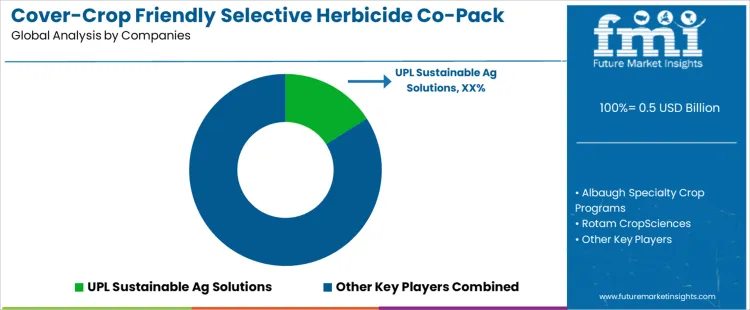
In the cover-crop friendly selective herbicide co-pack market, UPL Sustainable Ag Solutions, Albaugh Specialty Crop Programs, Rotam CropSciences, RedEagle International, Nichino America, and others compete with product brochures emphasizing effective weed control while supporting cover crop and soil health goals. UPL’s brochures present selective herbicide solutions designed for integrated crop protection approaches with attention to durability and farmer-centric innovation. Performance attributes and usage guidance are provided to help growers manage weeds without harming desirable cover crops when used as part of a co-pack strategy. Strategic emphasis is placed on flexible formulations and compatibility with diverse farming systems.
Albaugh Specialty Crop Programs feature herbicide product literature that includes selective chemistries for broadleaf and grass weeds suited to specialty and rotational crop systems. These brochures highlight product performance, broad crop applicability, and stewardship considerations that align with cover crop practices. Rotam CropSciences materials describe a wide range of herbicides developed with quality and safety in mind to fit into integrated weed management plans that respect soil cover goals. RedEagle International positions its herbicide offerings as cost-effective, proven chemistries that deliver residual weed control while enabling flexibility in application rates and timing. Competitive messaging emphasizes value and ease of adoption by growers looking for affordable but effective selective control.
Nichino America brochures focus on weed control products with alternative modes of action that help manage herbicide resistance and fit within broader integrated pest and resistance management programs. Its literature often includes guidance on strategic use to preserve cover crop benefits and promote long-term durability of farm systems.
Key Players in Cover-Crop Friendly Selective Herbicide Co-Pack Market
- UPL Sustainable Ag Solutions
- Albaugh Specialty Crop Programs
- Rotam CropSciences
- RedEagle International
- Nichino America
- Others
Scope of Report
| Items | Values |
|---|---|
| Quantitative Units (2026) | USD 0.5 billion |
| Co-Pack Composition Type | Selective Herbicide + Safener Blends, Herbicide + Residue-Friendly Adjuvant Packs, Low-Dose Sequential Herbicide Kits, Cover-Crop Termination-Safe Formulations, Others |
| Weed Control Strategy | Early-Season Selective Suppression, Inter-Crop Weed Management, Cover-Crop Preservation Programs, Precision & Spot-Spray Programs |
| Regions Covered | Asia Pacific, Europe, North America, Latin America, Middle East & Africa |
| Countries Covered | USA, China, Japan, South Korea, India, Australia & New Zealand, ASEAN, Germany, UK, France, Italy, Spain, Nordic, BENELUX, Brazil, Chile, Mexico, Saudi Arabia, Other GCC Countries, Turkey, South Africa, Other African Union |
| Key Companies Profiled | UPL Sustainable Ag Solutions, Albaugh Specialty Crop Programs, Rotam CropSciences, RedEagle International, Nichino America, Others |
| Additional Attributes | Dollar sales by co-pack composition type, weed control strategy, and region; regional CAGR and growth outlook; distribution channels including agricultural suppliers, herbicide co-pack manufacturers, and eco-friendly farming programs; innovation trends in cover-crop friendly herbicide co-packs; competitive positioning of global vs regional suppliers. |
Cover-Crop Friendly Selective Herbicide Co-Pack Market by Segments
Co-Pack Composition Type
- Selective Herbicide + Safener Blends
- Herbicide + Residue-Friendly Adjuvant Packs
- Low-Dose Sequential Herbicide Kits
- Cover-Crop Termination-Safe Formulations
- Others
Weed Control Strategy
- Early-Season Selective Suppression
- Inter-Crop Weed Management
- Cover-Crop Preservation Programs
- Precision & Spot-Spray Programs
Region:
- Asia Pacific
- China
- Japan
- South Korea
- India
- Australia & New Zealand
- ASEAN
- Rest of Asia Pacific
- Europe
- Germany
- United Kingdom
- France
- Italy
- Spain
- Nordic
- BENELUX
- Rest of Europe
- North America
- United States
- Canada
- Mexico
- Latin America
- Brazil
- Chile
- Rest of Latin America
- Middle East & Africa
- Kingdom of Saudi Arabia
- Other GCC Countries
- Turkey
- South Africa
- Other African Union
- Rest of Middle East & Africa
Frequently Asked Questions
How big is the cover-crop friendly selective herbicide co-pack market in 2026?
The global cover-crop friendly selective herbicide co-pack market is estimated to be valued at USD 0.5 billion in 2026.
What will be the size of cover-crop friendly selective herbicide co-pack market in 2036?
The market size for the cover-crop friendly selective herbicide co-pack market is projected to reach USD 2.0 billion by 2036.
How much will be the cover-crop friendly selective herbicide co-pack market growth between 2026 and 2036?
The cover-crop friendly selective herbicide co-pack market is expected to grow at a 15.1% CAGR between 2026 and 2036.
What are the key product types in the cover-crop friendly selective herbicide co-pack market?
The key product types in cover-crop friendly selective herbicide co-pack market are selective herbicide + safener blends, herbicide + residue-friendly adjuvant packs, low-dose sequential herbicide kits, cover-crop termination-safe formulations and others.
Which weed control strategy segment to contribute significant share in the cover-crop friendly selective herbicide co-pack market in 2026?
In terms of weed control strategy, early-season selective suppression segment to command 35.0% share in the cover-crop friendly selective herbicide co-pack market in 2026.
Preview the report firsthand - request a free sample
Get SampleGet the brochure for pricing and purchase details.
Get PDFTable of Content
- Executive Summary
- Global Market Outlook
- Demand-side Trends
- Supply-side Trends
- Technology Roadmap Analysis
- Analysis and Recommendations
- Market Overview
- Market Coverage / Taxonomy
- Market Definition / Scope / Limitations
- Market Background
- Market Dynamics
- Drivers
- Restraints
- Opportunity
- Trends
- Scenario Forecast
- Demand in Optimistic Scenario
- Demand in Likely Scenario
- Demand in Conservative Scenario
- Opportunity Map Analysis
- Product Life Cycle Analysis
- Supply Chain Analysis
- Investment Feasibility Matrix
- Value Chain Analysis
- PESTLE and Porter’s Analysis
- Regulatory Landscape
- Regional Parent Market Outlook
- Production and Consumption Statistics
- Import and Export Statistics
- Market Dynamics
- Global Market Analysis 2021 to 2025 and Forecast, 2026 to 2036
- Historical Market Size Value (USD Million) Analysis, 2021 to 2025
- Current and Future Market Size Value (USD Million) Projections, 2026 to 2036
- Y-o-Y Growth Trend Analysis
- Absolute $ Opportunity Analysis
- Global Market Pricing Analysis 2021 to 2025 and Forecast 2026 to 2036
- Global Market Analysis 2021 to 2025 and Forecast 2026 to 2036, By Co-Pack Composition Type
- Introduction / Key Findings
- Historical Market Size Value (USD Million) Analysis By Co-Pack Composition Type , 2021 to 2025
- Current and Future Market Size Value (USD Million) Analysis and Forecast By Co-Pack Composition Type , 2026 to 2036
- Selective Herbicide + Safener Blends
- Herbicide + Residue-Friendly Adjuvant Packs
- Low-Dose Sequential Herbicide Kits
- Cover-Crop Termination-Safe Formulations
- Others
- Y-o-Y Growth Trend Analysis By Co-Pack Composition Type , 2021 to 2025
- Absolute $ Opportunity Analysis By Co-Pack Composition Type , 2026 to 2036
- Global Market Analysis 2021 to 2025 and Forecast 2026 to 2036, By Weed Control Strategy
- Introduction / Key Findings
- Historical Market Size Value (USD Million) Analysis By Weed Control Strategy, 2021 to 2025
- Current and Future Market Size Value (USD Million) Analysis and Forecast By Weed Control Strategy, 2026 to 2036
- Early-Season Selective Suppression
- Inter-Crop Weed Management
- Cover-Crop Preservation Programs
- Precision & Spot-Spray Programs
- Y-o-Y Growth Trend Analysis By Weed Control Strategy, 2021 to 2025
- Absolute $ Opportunity Analysis By Weed Control Strategy, 2026 to 2036
- Global Market Analysis 2021 to 2025 and Forecast 2026 to 2036, By Region
- Introduction
- Historical Market Size Value (USD Million) Analysis By Region, 2021 to 2025
- Current Market Size Value (USD Million) Analysis and Forecast By Region, 2026 to 2036
- North America
- Latin America
- Western Europe
- Eastern Europe
- East Asia
- South Asia and Pacific
- Middle East & Africa
- Market Attractiveness Analysis By Region
- North America Market Analysis 2021 to 2025 and Forecast 2026 to 2036, By Country
- Historical Market Size Value (USD Million) Trend Analysis By Market Taxonomy, 2021 to 2025
- Market Size Value (USD Million) Forecast By Market Taxonomy, 2026 to 2036
- By Country
- USA
- Canada
- Mexico
- By Co-Pack Composition Type
- By Weed Control Strategy
- By Country
- Market Attractiveness Analysis
- By Country
- By Co-Pack Composition Type
- By Weed Control Strategy
- Key Takeaways
- Latin America Market Analysis 2021 to 2025 and Forecast 2026 to 2036, By Country
- Historical Market Size Value (USD Million) Trend Analysis By Market Taxonomy, 2021 to 2025
- Market Size Value (USD Million) Forecast By Market Taxonomy, 2026 to 2036
- By Country
- Brazil
- Chile
- Rest of Latin America
- By Co-Pack Composition Type
- By Weed Control Strategy
- By Country
- Market Attractiveness Analysis
- By Country
- By Co-Pack Composition Type
- By Weed Control Strategy
- Key Takeaways
- Western Europe Market Analysis 2021 to 2025 and Forecast 2026 to 2036, By Country
- Historical Market Size Value (USD Million) Trend Analysis By Market Taxonomy, 2021 to 2025
- Market Size Value (USD Million) Forecast By Market Taxonomy, 2026 to 2036
- By Country
- Germany
- UK
- Italy
- Spain
- France
- Nordic
- BENELUX
- Rest of Western Europe
- By Co-Pack Composition Type
- By Weed Control Strategy
- By Country
- Market Attractiveness Analysis
- By Country
- By Co-Pack Composition Type
- By Weed Control Strategy
- Key Takeaways
- Eastern Europe Market Analysis 2021 to 2025 and Forecast 2026 to 2036, By Country
- Historical Market Size Value (USD Million) Trend Analysis By Market Taxonomy, 2021 to 2025
- Market Size Value (USD Million) Forecast By Market Taxonomy, 2026 to 2036
- By Country
- Russia
- Poland
- Hungary
- Balkan & Baltic
- Rest of Eastern Europe
- By Co-Pack Composition Type
- By Weed Control Strategy
- By Country
- Market Attractiveness Analysis
- By Country
- By Co-Pack Composition Type
- By Weed Control Strategy
- Key Takeaways
- East Asia Market Analysis 2021 to 2025 and Forecast 2026 to 2036, By Country
- Historical Market Size Value (USD Million) Trend Analysis By Market Taxonomy, 2021 to 2025
- Market Size Value (USD Million) Forecast By Market Taxonomy, 2026 to 2036
- By Country
- China
- Japan
- South Korea
- By Co-Pack Composition Type
- By Weed Control Strategy
- By Country
- Market Attractiveness Analysis
- By Country
- By Co-Pack Composition Type
- By Weed Control Strategy
- Key Takeaways
- South Asia and Pacific Market Analysis 2021 to 2025 and Forecast 2026 to 2036, By Country
- Historical Market Size Value (USD Million) Trend Analysis By Market Taxonomy, 2021 to 2025
- Market Size Value (USD Million) Forecast By Market Taxonomy, 2026 to 2036
- By Country
- India
- ASEAN
- Australia & New Zealand
- Rest of South Asia and Pacific
- By Co-Pack Composition Type
- By Weed Control Strategy
- By Country
- Market Attractiveness Analysis
- By Country
- By Co-Pack Composition Type
- By Weed Control Strategy
- Key Takeaways
- Middle East & Africa Market Analysis 2021 to 2025 and Forecast 2026 to 2036, By Country
- Historical Market Size Value (USD Million) Trend Analysis By Market Taxonomy, 2021 to 2025
- Market Size Value (USD Million) Forecast By Market Taxonomy, 2026 to 2036
- By Country
- Kingdom of Saudi Arabia
- Other GCC Countries
- Turkiye
- South Africa
- Other African Union
- Rest of Middle East & Africa
- By Co-Pack Composition Type
- By Weed Control Strategy
- By Country
- Market Attractiveness Analysis
- By Country
- By Co-Pack Composition Type
- By Weed Control Strategy
- Key Takeaways
- Key Countries Market Analysis
- USA
- Pricing Analysis
- Market Share Analysis, 2025
- By Co-Pack Composition Type
- By Weed Control Strategy
- Canada
- Pricing Analysis
- Market Share Analysis, 2025
- By Co-Pack Composition Type
- By Weed Control Strategy
- Mexico
- Pricing Analysis
- Market Share Analysis, 2025
- By Co-Pack Composition Type
- By Weed Control Strategy
- Brazil
- Pricing Analysis
- Market Share Analysis, 2025
- By Co-Pack Composition Type
- By Weed Control Strategy
- Chile
- Pricing Analysis
- Market Share Analysis, 2025
- By Co-Pack Composition Type
- By Weed Control Strategy
- Germany
- Pricing Analysis
- Market Share Analysis, 2025
- By Co-Pack Composition Type
- By Weed Control Strategy
- UK
- Pricing Analysis
- Market Share Analysis, 2025
- By Co-Pack Composition Type
- By Weed Control Strategy
- Italy
- Pricing Analysis
- Market Share Analysis, 2025
- By Co-Pack Composition Type
- By Weed Control Strategy
- Spain
- Pricing Analysis
- Market Share Analysis, 2025
- By Co-Pack Composition Type
- By Weed Control Strategy
- France
- Pricing Analysis
- Market Share Analysis, 2025
- By Co-Pack Composition Type
- By Weed Control Strategy
- India
- Pricing Analysis
- Market Share Analysis, 2025
- By Co-Pack Composition Type
- By Weed Control Strategy
- ASEAN
- Pricing Analysis
- Market Share Analysis, 2025
- By Co-Pack Composition Type
- By Weed Control Strategy
- Australia & New Zealand
- Pricing Analysis
- Market Share Analysis, 2025
- By Co-Pack Composition Type
- By Weed Control Strategy
- China
- Pricing Analysis
- Market Share Analysis, 2025
- By Co-Pack Composition Type
- By Weed Control Strategy
- Japan
- Pricing Analysis
- Market Share Analysis, 2025
- By Co-Pack Composition Type
- By Weed Control Strategy
- South Korea
- Pricing Analysis
- Market Share Analysis, 2025
- By Co-Pack Composition Type
- By Weed Control Strategy
- Russia
- Pricing Analysis
- Market Share Analysis, 2025
- By Co-Pack Composition Type
- By Weed Control Strategy
- Poland
- Pricing Analysis
- Market Share Analysis, 2025
- By Co-Pack Composition Type
- By Weed Control Strategy
- Hungary
- Pricing Analysis
- Market Share Analysis, 2025
- By Co-Pack Composition Type
- By Weed Control Strategy
- Kingdom of Saudi Arabia
- Pricing Analysis
- Market Share Analysis, 2025
- By Co-Pack Composition Type
- By Weed Control Strategy
- Turkiye
- Pricing Analysis
- Market Share Analysis, 2025
- By Co-Pack Composition Type
- By Weed Control Strategy
- South Africa
- Pricing Analysis
- Market Share Analysis, 2025
- By Co-Pack Composition Type
- By Weed Control Strategy
- USA
- Market Structure Analysis
- Competition Dashboard
- Competition Benchmarking
- Market Share Analysis of Top Players
- By Regional
- By Co-Pack Composition Type
- By Weed Control Strategy
- Competition Analysis
- Competition Deep Dive
- UPL Sustainable Ag Solutions
- Overview
- Product Portfolio
- Profitability by Market Segments (Product/Age /Sales Channel/Region)
- Sales Footprint
- Strategy Overview
- Marketing Strategy
- Product Strategy
- Channel Strategy
- Albaugh Specialty Crop Programs
- Rotam CropSciences
- RedEagle International
- Nichino America
- Others
- UPL Sustainable Ag Solutions
- Competition Deep Dive
- Assumptions & Acronyms Used
- Research Methodology


