

- Industry Size (2026):USD 71 Mn
- Forecast (2036)
- USD 196.2 Mn
- CAGR (2026 to 2036)
- 10.7%
Buffer-Strip Friendly Edge-of-Field Nutrient Program Market Forecast and Outlook 2026 to 2036
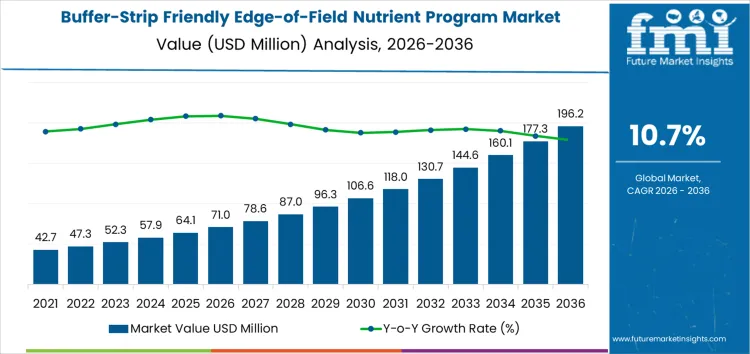
The buffer-strip friendly edge-of-field nutrient program market is valued at USD 71 million in 2026 and is expected to reach USD 196.2 million by 2036, growing at a compound annual growth rate (CAGR) of 10.7%. The performance of this market will be influenced by cost structures that reflect both the complexity of developing tailored nutrient programs and the regulatory compliance required for edge-of-field solutions. Pricing control will be essential for vendors, as they must balance the costs of specialized products with the need to remain competitive in a niche market. Margin concentration is expected to increase as larger players, with established relationships and economies of scale, capture a significant portion of the market value. Smaller companies may find it challenging to maintain pricing power while managing costs effectively. Ultimately, value will be captured by those who can offer sustainable, cost-effective solutions that align with long-term agricultural practices, particularly those that address environmental concerns and regulatory needs.
Quick Stats of the Buffer-Strip Friendly Edge-of-Field Nutrient Program Market
- Buffer-Strip Friendly Edge-of-Field Nutrient Program Market Value (2026): USD 71 million
- Buffer-Strip Friendly Edge-of-Field Nutrient Program Market Forecast Value (2036): USD 196.2 million
- Buffer-Strip Friendly Edge-of-Field Nutrient Program Market Global Forecast CAGR (2026-2036): 10.7%
- Buffer-Strip Friendly Edge-of-Field Nutrient Program Market Leading Segment: Sales Channel (Ag-Retailers) 60%
- Key Growth Regions in Buffer-Strip Friendly Edge-of-Field Nutrient Program Market: India
- Top Players in Buffer-Strip Friendly Edge-of-Field Nutrient Program Market: Nutrien, Yara International, BASF, Corteva, Syngenta, UPL
What is the Growth Forecast for the Buffer-Strip Friendly Edge-of-Field Nutrient Program Market through 2036?
The early growth curve of the buffer-strip friendly edge-of-field nutrient program market will be characterized by significant acceleration as farmers and agricultural producers increasingly recognize the environmental and regulatory benefits of adopting these nutrient programs. From 2026 to 2031, the market will grow from USD 71 million to USD 122.2 million, driven by rising awareness and demand for sustainable farming practices that minimize nutrient runoff. This early phase will be marked by adoption driven by regulatory pressure and a shift toward more eco-conscious agricultural practices. The first inflection point will occur around 2029–2030, when the technology gains more widespread adoption as it becomes a standard practice for complying with water quality regulations and environmental goals.
From 2031 to 2036, the market will enter a more stable, mature growth phase. While the market will continue to grow, the pace of expansion will slow slightly as the technology becomes standard practice in mainstream agriculture. From USD 122.2 million in 2031, the market will rise to USD 196.2 million by 2036, reflecting steady, incremental growth driven by continuing adoption and optimization. During this period, innovation will still play a role, but growth will be more predictable, as buffer-strip friendly nutrient programs become entrenched in farming operations seeking long-term sustainability and compliance. The second inflection point will occur when the market reaches a saturation point, with growth shifting from rapid adoption to ongoing refinement and optimization of the programs.
Buffer-Strip Friendly Edge-of-Field Nutrient Program Market Key Takeaways
| Metric | Value |
|---|---|
| Industry Sales Value (2026) | USD 71 million |
| Industry Forecast Value (2036) | USD 196.2 million |
| Industry Forecast CAGR (2026-2036) | 10.7% |
What Is Driving the Demand for Buffer-Strip Friendly Edge-of-Field Nutrient Program Market?
Historical demand for nutrient programs that are compatible with buffer strips and other edge of field conservation practices stems from long standing challenges in managing agricultural nutrient losses to surface waters. Traditional fertilizer use practices often applied nutrients uniformly without accounting for runoff pathways, leading to nitrogen and phosphorus transport off fields into water bodies where they contribute to eutrophication and degraded water quality. Conservation science established edge of field practices such as vegetated buffer strips, filter strips, and riparian vegetation zones to intercept surface runoff and trap sediment, nutrients, and pesticides before they reach streams or lakes. These buffers slow water flow, enhance infiltration, and filter particulate and dissolved nutrients, reducing pollutant movement from agricultural lands. Scientific research and agricultural extension guidance have promoted integration of nutrient management plans with conservation buffers to enhance nutrient retention in soils and improve buffer effectiveness in reducing exports of nitrogen and phosphorus from intensively farmed landscapes.
Future demand for buffer strip friendly edge of field nutrient programs is expected to grow as regulatory frameworks, sustainability standards, and market incentives encourage agriculture to reduce non point source pollution and demonstrate stewardship outcomes. Growing emphasis on integrated nutrient management includes tailored fertilizer timing, rate, and placement that align with conservation buffers to limit runoff and leaching while maintaining crop productivity. Farmers and land managers increasingly adopt whole farm strategies that combine soil nutrient optimization with vegetative edge of field practices designed to process both surface and subsurface flows before they exit fields. These practices can form part of broader watershed scale nutrient reduction efforts that support water quality goals and meet emerging compliance requirements. Other factors likely to influence uptake include expansion of digital tools that link fertilizer application data with buffer performance metrics, incentive programs that compensate producers for ecosystem services, and adoption of precision agriculture technologies that refine nutrient inputs to match crop needs and landscape features. Technical considerations such as site specific design and maintenance of buffers, and alignment of nutrient programs with field hydrology, may affect adoption rates, but ongoing research and policy support are expected to sustain growth in demand for nutrient programs that are buffer strip friendly.
What are the Leading Segments in the Global Buffer-Strip Friendly Edge-of-Field Nutrient Program Market?
The global buffer-strip friendly edge-of-field nutrient program market is segmented by form and sales channel. Among forms, granular fertilizers lead the market, capturing 45% of the share, followed by liquid, powder, and suspension forms. Granular fertilizers are preferred for their controlled release and efficiency in edge-of-field applications, making them ideal for nutrient management in buffer strips. On the sales channel side, ag-retailers dominate, holding 60% of the share, followed by direct-to-farmer, online marketplaces, and cooperatives. Ag-retailers play a critical role in distributing these specialized nutrient programs to large-scale agricultural operations and offering expert advice on buffer-strip management.
What Drives the Growth of Granular Fertilizers in the Buffer-Strip Friendly Edge-of-Field Nutrient Program Market?
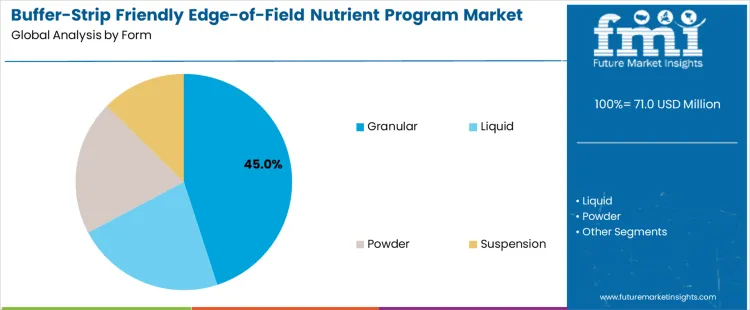
Granular fertilizers are the leading form in the buffer-strip friendly edge-of-field nutrient program market, holding 45% of the share. This demand is driven by the controlled-release properties of granular products, which are well-suited for use in edge-of-field nutrient management systems. These fertilizers minimize nutrient runoff and improve soil health by slowly releasing nutrients over time, reducing the risk of nutrient loss into water bodies. Granular fertilizers are also highly versatile, easily applied through common spreading equipment, and can be applied in a wide range of field conditions.
As regulatory requirements around nutrient management become stricter and farmers increasingly focus on sustainability, granular fertilizers are a popular choice for implementing buffer-strip friendly practices. Their ability to improve water quality by reducing nutrient runoff, while promoting efficient nutrient uptake by crops, makes them essential in achieving both environmental and agricultural goals. The increasing adoption of buffer-strip management practices to protect waterways and meet environmental standards will further support the demand for granular fertilizers in this market.
What is Driving the Demand for Ag-Retailers in the Buffer-Strip Friendly Edge-of-Field Nutrient Program Market?
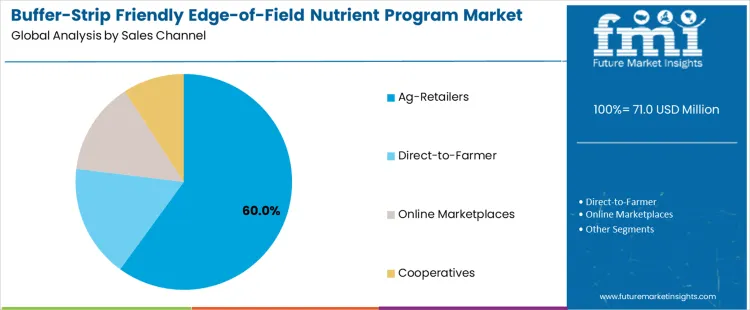
Ag-retailers are the leading sales channel in the buffer-strip friendly edge-of-field nutrient program market, capturing 60% of the share. This demand is driven by ag-retailers' established distribution networks and their ability to provide farmers with specialized advice on effective nutrient management for buffer strips. Ag-retailers offer a range of products tailored to meet the specific needs of edge-of-field programs, ensuring that farmers receive the right type of fertilizer for their operations.
They also provide essential services, such as soil testing, nutrient application recommendations, and support in complying with environmental regulations. The increasing focus on sustainable farming practices and the need to reduce nutrient runoff into water systems have made ag-retailers a key source of knowledge and supplies for buffer-strip management. As the demand for environmentally friendly nutrient programs continues to rise, ag-retailers will maintain their dominant position in this market, offering farmers the tools and expertise necessary to implement successful nutrient management strategies.
What are the Key Dynamics in the Buffer-Strip Friendly Edge-of-Field Nutrient Program Market?
The buffer-strip friendly edge-of-field nutrient program market centres on nutrient management systems that reduce losses to adjacent land and water through vegetated buffer zones. These programs integrate fertilizer choices, application timing, and placement to limit nutrient movement beyond crop fields. Adoption reflects interaction between agricultural practices and environmental goals for water quality protection. Growers and land managers evaluate programs based on nutrient efficiency, impact on yields, and compatibility with buffer strip design. Regulatory frameworks on riparian protection and runoff control influence uptake. Data on nutrient movement and field performance help shape product development and service offerings.
What are the Main Drivers Supporting Growth in This Market?
Growth in this market is driven by increasing regulatory focus on reducing nutrient runoff into surface waters. Authorities are implementing guidelines and reporting requirements that encourage practices aligned with buffer strip effectiveness. Scientific evidence on benefits of edge of field practices in controlling phosphorus and nitrogen losses is influencing adoption. Farmers and land managers are seeking solutions that maintain soil fertility while protecting downstream water quality. Advances in soil testing, nutrient modelling, and decision support tools help tailor programs to local conditions. Stakeholder emphasis on sustainable land use and compliance with environmental standards reinforces market interest.
What Restraints Are Limiting Market Expansion?
Market expansion is constrained by variability in landscape and soil conditions, which affects buffer strip performance and complicates standard program design. Implementation costs for comprehensive nutrient programs and buffer establishment can deter some land owners. Limited access to technical advisory services and data interpretation support may reduce confidence in expected outcomes. Differences in regional regulations and incentive structures for nutrient management and buffer protection create complexity for suppliers and end users. Some growers prioritise short term production costs over long term nutrient control, which can slow adoption of tailored edge of field programs.
What Emerging Trends Are Shaping the Future of This Market?
Emerging trends include increased use of precision nutrient application technologies that align fertilizer placement with buffer strip effectiveness zones. Integration of sensors, soil moisture data, and nutrient transport models is supporting targeted nutrient management decisions. Collaboration between agronomists, environmental scientists, and technology providers is expanding to generate local evidence on program benefits. There is rising interest in combining nutrient management programs with conservation practices such as cover cropping and grass waterways to enhance buffer strip performance. Development of monitoring platforms that track nutrient loss metrics over time is aiding adaptive management and compliance reporting.
What is the Country-Wise Analysis of the Buffer-Strip Friendly Edge-of-Field Nutrient Program Market?
The buffer-strip friendly edge-of-field nutrient program market is experiencing growth as part of the global push for sustainable agricultural practices aimed at improving water quality and minimizing nutrient runoff. These programs focus on implementing buffer strips along field edges to reduce nutrient leaching and improve soil and water quality. Developed markets like the USA and the Netherlands are seeing steady demand for these programs due to their commitment to environmental sustainability, water conservation, and regulatory requirements for reducing agricultural runoff. Emerging markets like India and China are also witnessing rapid growth, as these countries work to enhance agricultural sustainability and reduce the environmental impact of farming. As the agricultural sector globally focuses on reducing nutrient pollution and improving farming practices, the market for buffer-strip friendly edge-of-field nutrient programs is expected to expand significantly.
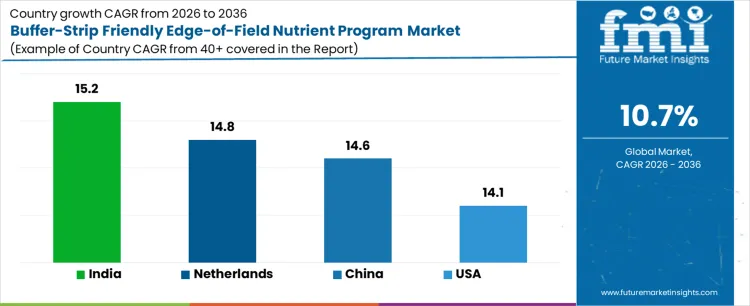
| Country | CAGR (2026-2036) |
|---|---|
| USA | 14.1% |
| Netherlands | 14.8% |
| India | 15.2% |
| China | 14.6% |
What is the Growth Outlook for the Buffer-Strip Friendly Edge-of-Field Nutrient Program Market in the USA?
The buffer-strip friendly edge-of-field nutrient program market in the USA is expected to grow steadily, with a projected CAGR of 14.1% from 2026 to 2036. The U.S. agricultural industry is increasingly focused on reducing nutrient runoff and improving water quality, particularly in areas where excess fertilizers can lead to water pollution. The implementation of buffer strips along field edges is gaining traction as an effective way to reduce nutrient loss and protect waterways. The U.S. government’s emphasis on sustainable farming practices and water quality improvement, combined with growing consumer demand for environmentally responsible farming, is expected to drive continued adoption of buffer-strip friendly edge-of-field nutrient programs. With strong policy support and growing awareness of the importance of nutrient management, the market for these programs is projected to expand in the coming years.
What is the Market Outlook for the Buffer-Strip Friendly Edge-of-Field Nutrient Program Market in the Netherlands?
The Netherlands is projected to experience steady growth in the buffer-strip friendly edge-of-field nutrient program market, with a projected CAGR of 14.8% from 2026 to 2036. As a leader in sustainable agriculture and water quality management, the Netherlands has been at the forefront of adopting practices that reduce nutrient pollution and improve farming sustainability. Buffer-strip friendly programs are becoming increasingly popular as Dutch farmers seek to implement environmentally responsible nutrient management practices that protect soil health and reduce nutrient runoff into water bodies. The Dutch government’s strong support for environmental sustainability and water conservation, coupled with the country’s commitment to reducing nutrient pollution from agriculture, is expected to drive continued demand for buffer-strip friendly nutrient programs. As sustainability continues to be a priority, the market for these programs is expected to grow steadily.
What is the Growth Forecast for the Buffer-Strip Friendly Edge-of-Field Nutrient Program Market in India?
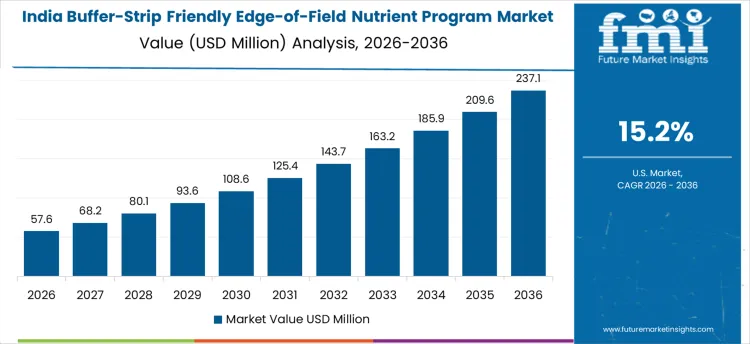
India is expected to experience the highest growth in the buffer-strip friendly edge-of-field nutrient program market, with a projected CAGR of 15.2% from 2026 to 2036. India, with its vast agricultural base, faces significant challenges related to nutrient pollution, water quality, and the overuse of fertilizers. The adoption of buffer-strip friendly programs is gaining momentum as farmers seek effective ways to improve soil fertility and reduce the environmental impact of fertilizer use. The government’s growing emphasis on sustainable agriculture, soil health, and water conservation is driving the adoption of practices like buffer strips to reduce nutrient loss. India’s large-scale farming operations and increasing awareness of environmental issues position the country as a high-growth market for buffer-strip friendly nutrient programs. The market is expected to expand rapidly as sustainable farming practices become more integrated into India’s agricultural sector.
What is the Market Outlook for the Buffer-Strip Friendly Edge-of-Field Nutrient Program Market in China?
China is projected to experience strong growth in the buffer-strip friendly edge-of-field nutrient program market, with a projected CAGR of 14.6% from 2026 to 2036. China, as one of the largest agricultural producers globally, is increasingly focused on improving sustainability and reducing the environmental impact of farming. The country’s agricultural practices have led to concerns about water quality and the overuse of fertilizers, and there is growing interest in implementing buffer strips as a solution to reduce nutrient runoff and improve water quality. The Chinese government has introduced policies to promote sustainable agriculture and address nutrient pollution, and the adoption of buffer-strip friendly programs aligns with these goals. With China’s large agricultural sector and strong governmental support for sustainable farming practices, the market for these nutrient management programs is expected to grow steadily.
What are the Growth Prospects for the Buffer-Strip Friendly Edge-of-Field Nutrient Program Market Globally?
Globally, the buffer-strip friendly edge-of-field nutrient program market is poised for significant growth as countries around the world focus on reducing nutrient pollution and improving the environmental sustainability of agriculture. The adoption of buffer strips, which help mitigate nutrient runoff, is becoming a key practice for improving soil health and water quality. Governments worldwide are introducing regulations to reduce nutrient loss from agricultural fields, and buffer-strip friendly nutrient programs are seen as an effective solution. As the agricultural sector continues to embrace sustainability and precision farming, the global market for buffer-strip friendly edge-of-field nutrient programs is expected to expand rapidly. The combination of regulatory support, environmental concerns, and the growing demand for eco-friendly farming practices will drive growth in this market across both developed and emerging economies.
What is the Competitive Landscape for the Buffer-Strip Friendly Edge-of-Field Nutrient Program Market?
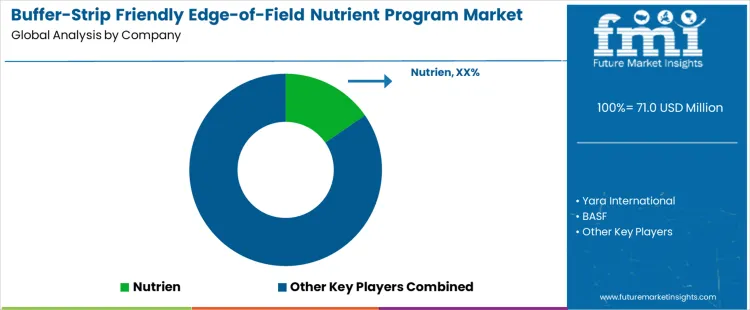
The buffer-strip friendly edge-of-field nutrient program market is expanding as farmers and agricultural companies increasingly seek environmentally responsible solutions to optimize nutrient management while minimizing runoff and pollution in sensitive areas. Nutrien leads the market with its innovative edge-of-field nutrient programs designed to improve crop productivity while protecting buffer strips and surrounding ecosystems. Their focus on sustainable agriculture, product performance, and regulatory compliance has positioned them as a dominant player in this sector. Yara International, BASF, and Corteva are significant competitors, each providing specialized nutrient management solutions that protect water quality and ensure efficient nutrient use. Yara International focuses on optimizing nutrient efficiency and sustainability in agriculture, while BASF and Corteva offer solutions aimed at minimizing nutrient loss and reducing environmental impact in agricultural practices.
Syngenta and UPL further contribute to the competitive landscape by offering their own nutrient programs that cater to sustainable farming practices and buffer strip protection. Syngenta delivers solutions that enhance soil and water quality while supporting optimal crop growth, and UPL emphasizes environmentally friendly practices in nutrient management. These companies compete by focusing on product innovation, sustainability, and their ability to meet the growing demand for nutrient management systems that preserve water quality and reduce the environmental footprint of farming. As environmental concerns around nutrient runoff and water quality continue to drive agricultural practices, the market for buffer-strip friendly edge-of-field nutrient programs is expected to grow, encouraging further innovation and competition in the sector.
Key Players of the Buffer-Strip Friendly Edge-of-Field Nutrient Program Market
- Nutrien
- Yara International
- BASF
- Corteva
- Syngenta
- UPL
Scope of the Report
| Items | Values |
|---|---|
| Quantitative Units (2026) | USD million |
| Crop | Cereals, Oilseeds, Fruits, Vegetables |
| Form | Granular, Liquid, Powder, Suspension |
| Sales Channel | Ag retailers, direct to farmer, Online Marketplaces, Cooperatives |
| Companies | Nutrien, Yara International, BASF, Corteva, Syngenta, UPL |
| Regions Covered | North America, Latin America, Western Europe, Eastern Europe, South Asia & Pacific, East Asia, Middle East & Africa |
| Countries Covered | United States, Canada, Mexico, Brazil, Argentina, Germany, France, United Kingdom, Italy, Spain, Netherlands, China, India, Japan, South Korea, ANZ, GCC Countries, South Africa |
| Additional Attributes | Dollar by sales by crop, form, sales channel, and region. Includes analysis of market trends in buffer strip-friendly edge-of-field nutrient program adoption, nutrient management performance in edge-of-field and buffer strip systems, cost and formulation factors, regulatory and environmental considerations affecting nutrient management for buffer strips, adoption patterns among growers and land managers, market share and competitive positioning of key companies, innovations in nutrient program technologies, and evaluation of impact on nutrient loss mitigation, soil health, crop yield, and buffer strip ecological outcomes. |
Buffer-Strip Friendly Edge-of-Field Nutrient Program Market Segmentation
Crop:
- Cereals
- Oilseeds
- Fruits
- Vegetables
Form:
- Granular
- Liquid
- Powder
- Suspension
Sales Channel:
- Ag-Retailers
- Direct-to-Farmer
- Online Marketplaces
- Cooperatives
Region:
- Asia Pacific
- China
- Japan
- South Korea
- India
- Australia & New Zealand
- ASEAN
- Rest of Asia Pacific
- Europe
- Germany
- United Kingdom
- France
- Italy
- Spain
- Nordic
- BENELUX
- Rest of Europe
- North America
- United States
- Canada
- Mexico
- Latin America
- Brazil
- Chile
- Rest of Latin America
- Middle East & Africa
- Kingdom of Saudi Arabia
- Other GCC Countries
- Turkey
- South Africa
- Other African Union
- Rest of Middle East & Africa
Frequently Asked Questions
How big is the buffer-strip friendly edge-of-field nutrient program market in 2026?
The global buffer-strip friendly edge-of-field nutrient program market is estimated to be valued at USD 71.0 million in 2026.
What will be the size of buffer-strip friendly edge-of-field nutrient program market in 2036?
The market size for the buffer-strip friendly edge-of-field nutrient program market is projected to reach USD 196.2 million by 2036.
How much will be the buffer-strip friendly edge-of-field nutrient program market growth between 2026 and 2036?
The buffer-strip friendly edge-of-field nutrient program market is expected to grow at a 10.7% CAGR between 2026 and 2036.
What are the key crop types in the buffer-strip friendly edge-of-field nutrient program market?
The key crop types in buffer-strip friendly edge-of-field nutrient program market are cereals, oilseeds, fruits and veg.
Which form segment will contribute significant share in the buffer-strip friendly edge-of-field nutrient program market in 2026?
In terms of form, granular segment to command 45.0% share in the buffer-strip friendly edge-of-field nutrient program market in 2026.
Preview the report firsthand - request a free sample
Get SampleGet the brochure for pricing and purchase details.
Get PDFTable of Content
- Executive Summary
- Global Market Outlook
- Demand-side Trends
- Supply-side Trends
- Technology Roadmap Analysis
- Analysis and Recommendations
- Market Overview
- Market Coverage / Taxonomy
- Market Definition / Scope / Limitations
- Market Background
- Market Dynamics
- Drivers
- Restraints
- Opportunity
- Trends
- Scenario Forecast
- Demand in Optimistic Scenario
- Demand in Likely Scenario
- Demand in Conservative Scenario
- Opportunity Map Analysis
- Product Life Cycle Analysis
- Supply Chain Analysis
- Investment Feasibility Matrix
- Value Chain Analysis
- PESTLE and Porter’s Analysis
- Regulatory Landscape
- Regional Parent Market Outlook
- Production and Consumption Statistics
- Import and Export Statistics
- Market Dynamics
- Global Market Analysis 2021 to 2025 and Forecast, 2026 to 2036
- Historical Market Size Value (USD Million) Analysis, 2021 to 2025
- Current and Future Market Size Value (USD Million) Projections, 2026 to 2036
- Y-o-Y Growth Trend Analysis
- Absolute $ Opportunity Analysis
- Global Market Pricing Analysis 2021 to 2025 and Forecast 2026 to 2036
- Global Market Analysis 2021 to 2025 and Forecast 2026 to 2036, By Crop
- Introduction / Key Findings
- Historical Market Size Value (USD Million) Analysis By Crop , 2021 to 2025
- Current and Future Market Size Value (USD Million) Analysis and Forecast By Crop , 2026 to 2036
- Cereals
- Oilseeds
- Fruits
- Veg
- Cereals
- Y-o-Y Growth Trend Analysis By Crop , 2021 to 2025
- Absolute $ Opportunity Analysis By Crop , 2026 to 2036
- Global Market Analysis 2021 to 2025 and Forecast 2026 to 2036, By Form
- Introduction / Key Findings
- Historical Market Size Value (USD Million) Analysis By Form, 2021 to 2025
- Current and Future Market Size Value (USD Million) Analysis and Forecast By Form, 2026 to 2036
- Granular
- Liquid
- Powder
- Suspension
- Granular
- Y-o-Y Growth Trend Analysis By Form, 2021 to 2025
- Absolute $ Opportunity Analysis By Form, 2026 to 2036
- Global Market Analysis 2021 to 2025 and Forecast 2026 to 2036, By Sales Channel
- Introduction / Key Findings
- Historical Market Size Value (USD Million) Analysis By Sales Channel, 2021 to 2025
- Current and Future Market Size Value (USD Million) Analysis and Forecast By Sales Channel, 2026 to 2036
- Ag-Retailers
- Direct-to-Farmer
- Online Marketplaces
- Cooperatives
- Ag-Retailers
- Y-o-Y Growth Trend Analysis By Sales Channel, 2021 to 2025
- Absolute $ Opportunity Analysis By Sales Channel, 2026 to 2036
- Global Market Analysis 2021 to 2025 and Forecast 2026 to 2036, By Region
- Introduction
- Historical Market Size Value (USD Million) Analysis By Region, 2021 to 2025
- Current Market Size Value (USD Million) Analysis and Forecast By Region, 2026 to 2036
- North America
- Latin America
- Western Europe
- Eastern Europe
- East Asia
- South Asia and Pacific
- Middle East & Africa
- Market Attractiveness Analysis By Region
- North America Market Analysis 2021 to 2025 and Forecast 2026 to 2036, By Country
- Historical Market Size Value (USD Million) Trend Analysis By Market Taxonomy, 2021 to 2025
- Market Size Value (USD Million) Forecast By Market Taxonomy, 2026 to 2036
- By Country
- USA
- Canada
- Mexico
- By Crop
- By Form
- By Sales Channel
- By Country
- Market Attractiveness Analysis
- By Country
- By Crop
- By Form
- By Sales Channel
- Key Takeaways
- Latin America Market Analysis 2021 to 2025 and Forecast 2026 to 2036, By Country
- Historical Market Size Value (USD Million) Trend Analysis By Market Taxonomy, 2021 to 2025
- Market Size Value (USD Million) Forecast By Market Taxonomy, 2026 to 2036
- By Country
- Brazil
- Chile
- Rest of Latin America
- By Crop
- By Form
- By Sales Channel
- By Country
- Market Attractiveness Analysis
- By Country
- By Crop
- By Form
- By Sales Channel
- Key Takeaways
- Western Europe Market Analysis 2021 to 2025 and Forecast 2026 to 2036, By Country
- Historical Market Size Value (USD Million) Trend Analysis By Market Taxonomy, 2021 to 2025
- Market Size Value (USD Million) Forecast By Market Taxonomy, 2026 to 2036
- By Country
- Germany
- UK
- Italy
- Spain
- France
- Nordic
- BENELUX
- Rest of Western Europe
- By Crop
- By Form
- By Sales Channel
- By Country
- Market Attractiveness Analysis
- By Country
- By Crop
- By Form
- By Sales Channel
- Key Takeaways
- Eastern Europe Market Analysis 2021 to 2025 and Forecast 2026 to 2036, By Country
- Historical Market Size Value (USD Million) Trend Analysis By Market Taxonomy, 2021 to 2025
- Market Size Value (USD Million) Forecast By Market Taxonomy, 2026 to 2036
- By Country
- Russia
- Poland
- Hungary
- Balkan & Baltic
- Rest of Eastern Europe
- By Crop
- By Form
- By Sales Channel
- By Country
- Market Attractiveness Analysis
- By Country
- By Crop
- By Form
- By Sales Channel
- Key Takeaways
- East Asia Market Analysis 2021 to 2025 and Forecast 2026 to 2036, By Country
- Historical Market Size Value (USD Million) Trend Analysis By Market Taxonomy, 2021 to 2025
- Market Size Value (USD Million) Forecast By Market Taxonomy, 2026 to 2036
- By Country
- China
- Japan
- South Korea
- By Crop
- By Form
- By Sales Channel
- By Country
- Market Attractiveness Analysis
- By Country
- By Crop
- By Form
- By Sales Channel
- Key Takeaways
- South Asia and Pacific Market Analysis 2021 to 2025 and Forecast 2026 to 2036, By Country
- Historical Market Size Value (USD Million) Trend Analysis By Market Taxonomy, 2021 to 2025
- Market Size Value (USD Million) Forecast By Market Taxonomy, 2026 to 2036
- By Country
- India
- ASEAN
- Australia & New Zealand
- Rest of South Asia and Pacific
- By Crop
- By Form
- By Sales Channel
- By Country
- Market Attractiveness Analysis
- By Country
- By Crop
- By Form
- By Sales Channel
- Key Takeaways
- Middle East & Africa Market Analysis 2021 to 2025 and Forecast 2026 to 2036, By Country
- Historical Market Size Value (USD Million) Trend Analysis By Market Taxonomy, 2021 to 2025
- Market Size Value (USD Million) Forecast By Market Taxonomy, 2026 to 2036
- By Country
- Kingdom of Saudi Arabia
- Other GCC Countries
- Turkiye
- South Africa
- Other African Union
- Rest of Middle East & Africa
- By Crop
- By Form
- By Sales Channel
- By Country
- Market Attractiveness Analysis
- By Country
- By Crop
- By Form
- By Sales Channel
- Key Takeaways
- Key Countries Market Analysis
- USA
- Pricing Analysis
- Market Share Analysis, 2025
- By Crop
- By Form
- By Sales Channel
- Canada
- Pricing Analysis
- Market Share Analysis, 2025
- By Crop
- By Form
- By Sales Channel
- Mexico
- Pricing Analysis
- Market Share Analysis, 2025
- By Crop
- By Form
- By Sales Channel
- Brazil
- Pricing Analysis
- Market Share Analysis, 2025
- By Crop
- By Form
- By Sales Channel
- Chile
- Pricing Analysis
- Market Share Analysis, 2025
- By Crop
- By Form
- By Sales Channel
- Germany
- Pricing Analysis
- Market Share Analysis, 2025
- By Crop
- By Form
- By Sales Channel
- UK
- Pricing Analysis
- Market Share Analysis, 2025
- By Crop
- By Form
- By Sales Channel
- Italy
- Pricing Analysis
- Market Share Analysis, 2025
- By Crop
- By Form
- By Sales Channel
- Spain
- Pricing Analysis
- Market Share Analysis, 2025
- By Crop
- By Form
- By Sales Channel
- France
- Pricing Analysis
- Market Share Analysis, 2025
- By Crop
- By Form
- By Sales Channel
- India
- Pricing Analysis
- Market Share Analysis, 2025
- By Crop
- By Form
- By Sales Channel
- ASEAN
- Pricing Analysis
- Market Share Analysis, 2025
- By Crop
- By Form
- By Sales Channel
- Australia & New Zealand
- Pricing Analysis
- Market Share Analysis, 2025
- By Crop
- By Form
- By Sales Channel
- China
- Pricing Analysis
- Market Share Analysis, 2025
- By Crop
- By Form
- By Sales Channel
- Japan
- Pricing Analysis
- Market Share Analysis, 2025
- By Crop
- By Form
- By Sales Channel
- South Korea
- Pricing Analysis
- Market Share Analysis, 2025
- By Crop
- By Form
- By Sales Channel
- Russia
- Pricing Analysis
- Market Share Analysis, 2025
- By Crop
- By Form
- By Sales Channel
- Poland
- Pricing Analysis
- Market Share Analysis, 2025
- By Crop
- By Form
- By Sales Channel
- Hungary
- Pricing Analysis
- Market Share Analysis, 2025
- By Crop
- By Form
- By Sales Channel
- Kingdom of Saudi Arabia
- Pricing Analysis
- Market Share Analysis, 2025
- By Crop
- By Form
- By Sales Channel
- Turkiye
- Pricing Analysis
- Market Share Analysis, 2025
- By Crop
- By Form
- By Sales Channel
- South Africa
- Pricing Analysis
- Market Share Analysis, 2025
- By Crop
- By Form
- By Sales Channel
- USA
- Market Structure Analysis
- Competition Dashboard
- Competition Benchmarking
- Market Share Analysis of Top Players
- By Regional
- By Crop
- By Form
- By Sales Channel
- Competition Analysis
- Competition Deep Dive
- Nutrien
- Overview
- Product Portfolio
- Profitability by Market Segments (Product/Age /Sales Channel/Region)
- Sales Footprint
- Strategy Overview
- Marketing Strategy
- Product Strategy
- Channel Strategy
- Yara International
- BASF
- Corteva
- Syngenta
- UPL
- Nutrien
- Competition Deep Dive
- Assumptions & Acronyms Used
- Research Methodology


