

- Industry Size (2026)
- USD 162.8 Mn
- Forecast (2036)
- USD 422.3 Mn
- CAGR (2026 to 2036)
- 10.0%
Residue-Sensitive Baby-Leaf Salad Nutrient Program Market Forecast and Outlook 2026 to 2036
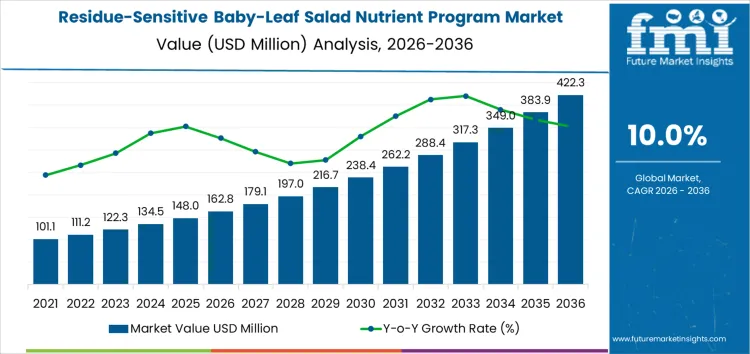
The residue-sensitive baby-leaf salad nutrient program market is valued at USD 162.8 million in 2026 and is projected to reach USD 422.3 million by 2036, expanding at a CAGR of 10.0%. Growth reflects structural pressure from food safety regulation rather than expansion of leafy green acreage alone. Baby-leaf salads occupy a high-risk category due to raw consumption, short growth cycles, and limited tolerance for post-harvest mitigation. Value concentrates around nutrient programs that demonstrate predictable residue control, nitrate management, and repeat audit performance. Pricing power accrues to suppliers able to document low residual behavior across multiple harvest cycles under intensive production conditions.
Quick Stats for Residue-Sensitive Baby-Leaf Salad Nutrient Program Market
- Residue-Sensitive Baby-Leaf Salad Nutrient Program Market Value (2026): USD 162.8 million
- Residue-Sensitive Baby-Leaf Salad Nutrient Program Market Forecast Value (2036): USD 422.3 million
- Forecast CAGR (2026 to 2036): 10.0%
- Leading Crop Category in Global Demand: Vegetables 50%
- Fastest-Growing Countries: India, China, Netherlands, USA
- Key Players in Global Demand: ICL Group Ltd., Haifa Group, Yara International, Nutrien, BASF, UPL
Demand formation is driven by retailer enforcement and certification dependency rather than discretionary grower preference. Fresh-cut salad processors and private-label brands impose upstream nutrient specifications as part of supplier qualification, reducing flexibility in input selection. Switching costs remain elevated because nutrient programs influence nitrate levels, leaf texture, and shelf-life stability within narrow harvest windows. Procurement therefore favors proven formulations over experimental alternatives. Capital investment prioritizes formulation purity, application timing protocols, and compliance documentation instead of yield enhancement. Adoption remains highest where contract continuity depends on demonstrated residue performance rather than output volume.
Residue-Sensitive Baby-Leaf Salad Nutrient Program Market Key Takeaways
| Metric | Value |
|---|---|
| Market Value (2026) | USD 162.8 million |
| Market Forecast Value (2036) | USD 422.3 million |
| Forecast CAGR (2026-2036) | 10.0% |
Why is the Demand for Residue-Sensitive Baby-Leaf Salad Nutrient Program Market Growing?
Demand for residue-sensitive baby-leaf salad nutrient programs is growing globally due to increasing consumer and regulatory focus on food safety, minimal chemical residues, and high quality fresh produce. Baby-leaf greens, including spinach, arugula, lettuce, and mixed salad blends, are consumed raw in salads and fresh packaged products, which increases emphasis on nutrient inputs that support growth while minimizing residual agrochemicals. Growers adopt tailored nutrient programs that balance essential macro- and micronutrients with optimized timing, application rates, and soil or soilless media compatibility to reduce reliance on broad-spectrum inputs that can leave undesirable residues.
Regulatory frameworks in multiple regions set strict limits on pesticide, fertilizer, and heavy metal residues in fresh produce, which reinforces use of fertility solutions designed for low residual impact and documented compliance. Expansion of retail quality standards, third-party certifications, and consumer demand for clean-label fresh greens strengthen procurement of nutrient strategies that support safe, traceable production. Advances in precision agronomy, nutrient delivery technology, and real-time monitoring enhance nutrient use efficiency while reducing excess application. Growers leverage fertigation systems, controlled environment agriculture, and data-driven programs to maintain consistent quality and reduce variability. Retail and foodservice demand for safe, high-quality baby-leaf salads reinforces sustained adoption of residue-sensitive nutrient programs in global leafy greens supply chains.
How Is the Residue-Sensitive Baby-Leaf Salad Nutrient Program Market Structured Globally?
The global residue-sensitive baby-leaf salad nutrient program market is shaped by stringent food safety thresholds, rapid crop cycles, and high visibility of residue compliance in fresh produce supply chains. Baby-leaf salads are consumed raw, harvested frequently, and supplied into retail, foodservice, and export channels that enforce strict maximum residue limits. Nutrient programs in this segment prioritize low-salt formulations, rapid nutrient uptake, minimal persistence in soil or leaf tissue, and compatibility with short pre-harvest intervals. Adoption is strongest in controlled-environment agriculture, intensive open-field vegetable systems, and supplier networks serving premium retail and export-oriented leafy greens.
Which Crop Segment Accounts for the Largest Share of Global Demand?
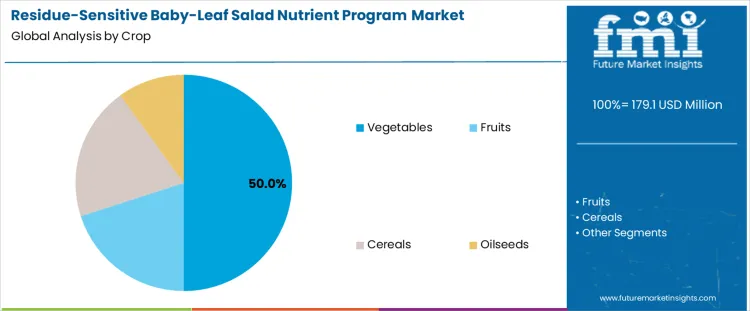
Vegetables represent the largest crop segment at 50.0%, reflecting the dominance of baby-leaf lettuce, spinach, arugula, and mixed salad greens in residue-sensitive production systems. These crops require frequent nutrient inputs that support fast biomass accumulation while maintaining clean leaf surfaces and low residual nutrient presence at harvest. Fruits account for 20.0% of demand, primarily linked to tender leafy or immature fruit crops used in fresh salad blends and specialty mixes. Cereals also represent 20.0%, driven by the use of young cereal leaves and microgreen-style applications where residue compliance mirrors baby-leaf standards. Oilseeds hold a smaller 10.0% share, limited to niche salad and sprout applications with similar safety expectations.
Key Takeaways
- Vegetables dominate due to raw consumption and short harvest cycles
- Fruits and cereals reflect crossover into specialty salad formats
- Oilseeds remain a minor but compliance-sensitive niche
Which Form Is Most Widely Used in Residue-Sensitive Nutrient Programs?
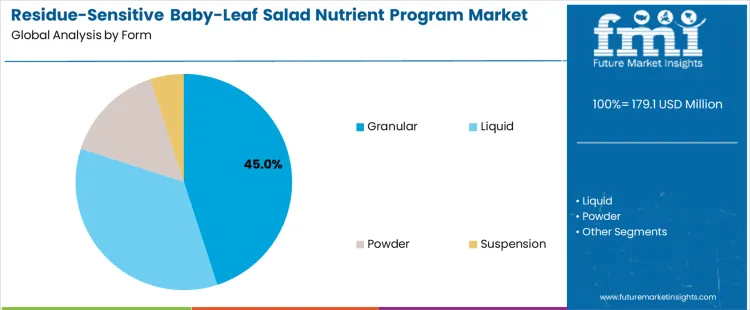
Granular formulations lead the market with a 45.0% share, supported by their controlled release behavior, reduced foliar contact, and lower risk of direct leaf residue. Granular nutrients are widely used in soil-based and substrate systems supplying baby-leaf operations at scale. Liquid formulations account for 35.0%, favored in fertigation and precision irrigation systems where rapid nutrient uptake and tight dose control are required. Powder forms represent 15.0%, typically used in custom-mixed or dissolved feeding programs under closely monitored conditions. Suspension-based products account for 5.0%, reflecting limited use due to handling complexity and residue management considerations.
Key Takeaways
- Granular forms dominate due to low leaf-contact risk
- Liquids support precision feeding in controlled systems
- Powders and suspensions remain specialized solutions
Which Sales Channel Holds the Largest Share Globally?
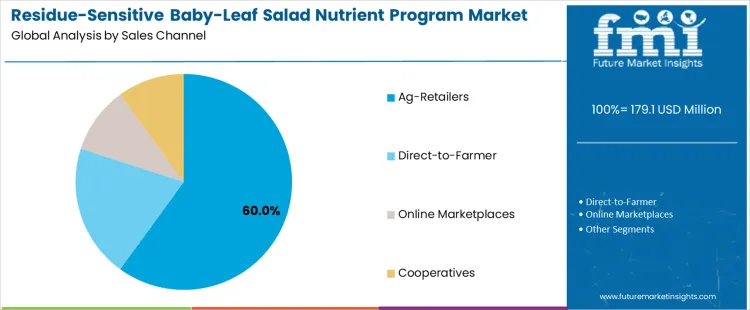
Ag-retailers account for the largest sales channel share at 60.0%, reflecting their central role in supplying residue-compliant nutrient programs to commercial vegetable growers. Retailers provide localized advisory support, product stewardship, and compliance guidance aligned with regional residue regulations. Direct-to-farmer sales represent 20.0%, driven by large growers and vertically integrated salad producers seeking customized nutrient programs and closer technical collaboration. Online marketplaces contribute 10.0%, mainly supporting replenishment purchases and standardized inputs for smaller producers. Cooperatives also account for 10.0%, facilitating collective procurement and shared compliance frameworks among member growers.
Key Takeaways
- Ag-retailers dominate due to advisory and compliance support
- Direct sales enable customization for large producers
- Online and cooperative channels serve smaller-scale operations
What are the Key Dynamics in the Residue-Sensitive Baby-Leaf Salad Nutrient Program Market?
Global demand rises as commercial baby-leaf salad growers adopt nutrient programs designed to support rapid crop growth while minimizing detectable nutrient and chemical residues. Residue-sensitive nutrient programs focus on precise nutrient forms, controlled application timing, and efficient uptake to meet strict food safety thresholds. Adoption aligns with growth in fresh-cut leafy green consumption, expansion of greenhouse and indoor farming, and increasing retailer enforcement of residue limits. Usage spans baby spinach, arugula, mixed greens, and specialty salad blends supplied to retail, foodservice, and private-label fresh produce channels across major producing regions.
How do food safety requirements and retail quality standards shape adoption?
Retailers, processors, and foodservice buyers require baby-leaf salads to meet low residue thresholds to protect brand integrity and comply with audit protocols. Growers supplying these channels implement nutrient programs that prioritize rapid nutrient assimilation and reduced residual presence at harvest. Precision fertigation and substrate-based delivery systems support accurate dosing aligned with short crop cycles. Agronomy teams adjust nutrient formulations based on growth stage, light intensity, and harvest timing to limit excess nutrient accumulation. Traceability and documentation of nutrient inputs strengthen compliance with third-party certifications. Demand increases where residue performance directly affects supplier approval and long-term contract retention.
How do cost constraints, operational complexity, and regulatory variation influence market scalability?
Residue-sensitive nutrient programs require advanced formulations, frequent monitoring, and skilled management, increasing cost relative to standard fertility approaches. Short crop cycles limit margin for corrective action, raising operational risk for inexperienced growers. Investment in sensors, dosing systems, and analytical testing adds capital burden, particularly for small and mid-scale producers. Regulatory residue limits and buyer specifications vary across regions, complicating program standardization for global suppliers. Consistent performance depends on alignment between nutrient chemistry, application timing, and environmental control. Long-term market growth depends on cost-effective nutrient solutions, simplified monitoring tools, and clearer alignment between regulatory thresholds and retail residue expectations across leafy green supply chains.
How Is Demand for Residue-Sensitive Baby-Leaf Salad Nutrient Programs Evolving Globally?
Demand for residue-sensitive baby-leaf salad nutrient programs is increasing globally due to stricter residue limits, rapid harvest cycles, and retailer scrutiny of leafy greens safety. India leads with a 13.2% CAGR, supported by expansion of protected cultivation and export-oriented fresh produce. China follows at 12.8%, driven by urban greenhouse scale-up and food safety enforcement. Netherlands records 12.6%, reflecting precision horticulture leadership and zero-residue production targets. USA posts a 12.1% CAGR, shaped by retailer specifications and short shelf-life management requirements. Growth reflects shift toward nutrient programs engineered to minimize residual salts, nitrates, and trace elements while sustaining color, texture, and yield in baby-leaf production.
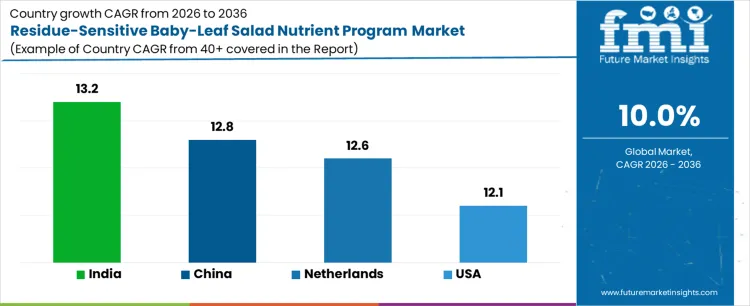
| Country | CAGR (%) |
|---|---|
| India | 13.2% |
| China | 12.8% |
| Netherlands | 12.6% |
| USA | 12.1% |
What is driving accelerated adoption of residue-sensitive nutrient programs in India?
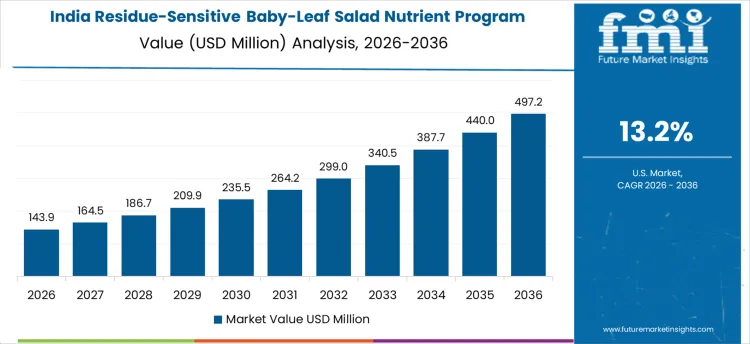
India demand is driven by growth of baby-leaf salad production under protected cultivation and rising export volumes to residue-regulated markets. CAGR of 13.2% reflects adoption of nutrient programs designed to limit nitrate accumulation and residual mineral salts in spinach, arugula, and mixed baby greens. Fast crop cycles require precise nutrient timing to avoid carryover at harvest. Export buyers impose strict residue thresholds, influencing upstream nutrient selection. Growers adopt fertigation programs emphasizing controlled nitrogen forms and balanced micronutrients. Domestic suppliers expand compliant formulations and testing support. Growth remains export-aligned and quality-led, supported by premium fresh produce positioning and regulatory compliance needs.
- Expansion of protected baby-leaf cultivation
- Export-driven residue and nitrate compliance
- Precision timing for fast harvest cycles
- Adoption of compliant fertigation formulations
How is China sustaining strong growth in residue-sensitive baby-leaf nutrition?
China demand reflects rapid expansion of urban greenhouse leafy green production and tighter food safety enforcement. CAGR of 12.8% is supported by nutrient programs that reduce residual buildup under intensive cultivation. Operators supplying supermarkets and foodservice require consistent compliance with residue limits. Controlled environment systems amplify sensitivity to nutrient carryover, increasing need for calibrated formulations. Government oversight and testing frequency reinforce adoption of compliant nutrient strategies. Domestic input suppliers invest in low-residue nutrient blends and application guidance. Growth remains scale-driven and regulation-aligned, supported by urban demand and modernization of leafy green supply chains.
- Urban greenhouse expansion for baby-leaf salads
- Retail and foodservice residue requirements
- Need for calibrated nutrition under intensive systems
- Increased testing and regulatory oversight
What supports Netherlands’ leadership in residue-sensitive baby-leaf nutrient programs?
Netherlands demand reflects advanced greenhouse horticulture and leadership in zero-residue leafy green production. CAGR of 12.6% is supported by precision nutrient programs tailored to baby-leaf crops grown on substrates and hydroponic systems. Growers require exact control of nitrate levels, electrical conductivity, and micronutrient balance. Research institutions collaborate with growers to refine low-residue feeding protocols. Export markets demand documented compliance and consistency. Nutrient recycling and runoff reduction further shape program design. Growth remains innovation-led and technology-focused, aligned with Netherlands’ role as a benchmark for residue-controlled leafy green production.
- Advanced precision fertigation systems
- Strong focus on nitrate and EC control
- Research-led refinement of nutrient protocols
- Export-driven compliance and documentation
What factors are shaping demand growth in the USA for residue-sensitive baby-leaf nutrition?
USA demand is shaped by retailer-imposed residue standards, rapid turnover of baby-leaf products, and liability sensitivity. CAGR of 12.1% reflects adoption of nutrient programs that minimize residual nitrates and salts at harvest. Growers supplying packaged salads prioritize consistent compliance and shelf-life stability. Precision fertigation systems support targeted nutrient delivery. Sustainability goals encourage reduced nutrient runoff and waste. Domestic suppliers provide baby-leaf-specific nutrient programs aligned with audit requirements. Growth remains compliance-focused and operations-led, supported by large-scale commercial leafy green production and retailer accountability frameworks.
- Retailer-driven residue compliance requirements
- High turnover and short shelf-life constraints
- Use of precision fertigation for nutrient control
- Alignment with sustainability and audit standards
What is the competitive landscape of demand for residue-sensitive baby-leaf salad nutrient programs globally?
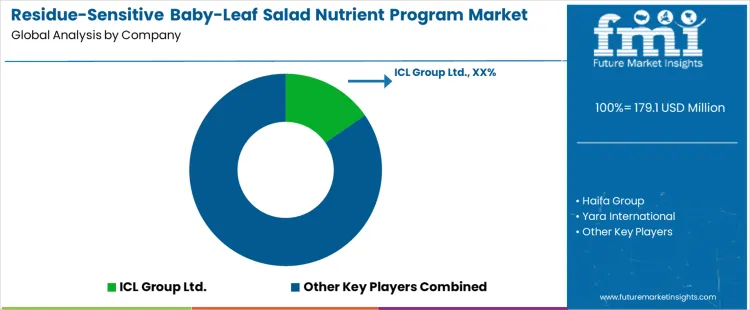
Demand for residue-sensitive baby-leaf salad nutrient programs is driven by short crop cycles, stringent retailer residue limits, and fresh-cut quality requirements. Baby-leaf lettuce, spinach, and mixed greens require tightly controlled nitrogen forms, low heavy metal inputs, and balanced micronutrients to avoid nitrate accumulation and leaf burn. Buyers evaluate nutrient purity, solubility, uptake efficiency, and compatibility with hydroponic, floating raft, and soilless systems. Procurement teams prioritize suppliers with residue-risk management protocols, documented compliance with food safety standards, and agronomic guidance tailored to rapid harvest windows. Trend in the global market reflects expansion of protected cultivation, private-label sourcing pressure, and increased scrutiny of upstream inputs used in ready-to-eat leafy greens.
ICL Group Ltd. holds leading positioning through precision nutrient programs and low-residue specialty fertilizers designed for baby-leaf production systems. Haifa Group supplies high-purity, water-soluble fertilizers widely adopted in fertigation and hydroponic leafy green operations. Yara International supports demand with premium nitrogen solutions and digital advisory tools focused on nitrate control and yield uniformity. Nutrien contributes liquid and soluble fertilizer technologies aligned with large-scale leafy green production. BASF participates through micronutrient technologies and nutrient efficiency solutions supporting residue-sensitive crop management. Competitive differentiation depends on residue control reliability, formulation precision, agronomic support depth, and ability to meet retailer-driven food safety requirements consistently.
Key Players in the Residue-Sensitive Baby-Leaf Salad Nutrient Program Market
- ICL Group Ltd.
- Haifa Group
- Yara International
- Nutrien
- BASF
- UPL
Scope of the Report
| Items | Values |
|---|---|
| Quantitative Units | USD million |
| Crop | Vegetables; Fruits; Cereals; Oilseeds |
| Form | Granular; Liquid; Powder; Suspension |
| Sales Channel | Ag-Retailers; Direct-to-Farmer; Online Marketplaces; Cooperatives |
| Regions Covered | Asia Pacific, Europe, North America, Latin America, Middle East & Africa |
| Countries Covered | India, China, Netherlands, USA, and 40+ countries |
| Key Companies Profiled | ICL Group Ltd.; Haifa Group; Yara International; Nutrien; BASF; UPL |
| Additional Attributes | Dollar sales by crop and form; adoption trends for low-residue nutrient programs in baby-leaf salad production; residue compliance, nutrient uptake efficiency, and leaf quality performance metrics; compatibility with fertigation, hydroponic, and controlled-environment systems; formulation purity, rapid uptake, and wash-off behavior considerations; regulatory compliance with residue limits and food safety standards influencing residue-sensitive nutrient program selection. |
Residue-Sensitive Baby-Leaf Salad Nutrient Program Market by Segment
Crop:
- Vegetables
- Fruits
- Cereals
- Oilseeds
Form
- Granular
- Liquid
- Powder
- Suspension
Sales Channel
- Ag-Retailers
- Direct-to-Farmer
- Online Marketplaces
- Cooperatives
Region:
- Asia Pacific
- China
- Japan
- South Korea
- India
- Australia & New Zealand
- ASEAN
- Rest of Asia Pacific
- Europe
- Germany
- United Kingdom
- France
- Italy
- Spain
- Nordic
- BENELUX
- Rest of Europe
- North America
- United States
- Canada
- Mexico
- Latin America
- Brazil
- Chile
- Rest of Latin America
- Middle East & Africa
- Kingdom of Saudi Arabia
- Other GCC Countries
- Turkey
- South Africa
- Other African Union
- Rest of Middle East & Africa
Frequently Asked Questions
How big is the residue-sensitive baby-leaf salad nutrient program market in 2026?
The global residue-sensitive baby-leaf salad nutrient program market is estimated to be valued at USD 162.8 million in 2026.
What will be the size of residue-sensitive baby-leaf salad nutrient program market in 2036?
The market size for the residue-sensitive baby-leaf salad nutrient program market is projected to reach USD 422.3 million by 2036.
How much will be the residue-sensitive baby-leaf salad nutrient program market growth between 2026 and 2036?
The residue-sensitive baby-leaf salad nutrient program market is expected to grow at a 10.0% CAGR between 2026 and 2036.
What are the key crop types in the residue-sensitive baby-leaf salad nutrient program market?
The key crop types in residue-sensitive baby-leaf salad nutrient program market are vegetables, fruits, cereals and oilseeds.
Which form segment will contribute significant share in the residue-sensitive baby-leaf salad nutrient program market in 2026?
In terms of form, granular segment to command 45.0% share in the residue-sensitive baby-leaf salad nutrient program market in 2026.
Preview the report firsthand - request a free sample
Get SampleGet the brochure for pricing and purchase details.
Get PDFTable of Content
- Executive Summary
- Global Market Outlook
- Demand-side Trends
- Supply-side Trends
- Technology Roadmap Analysis
- Analysis and Recommendations
- Market Overview
- Market Coverage / Taxonomy
- Market Definition / Scope / Limitations
- Market Background
- Market Dynamics
- Drivers
- Restraints
- Opportunity
- Trends
- Scenario Forecast
- Demand in Optimistic Scenario
- Demand in Likely Scenario
- Demand in Conservative Scenario
- Opportunity Map Analysis
- Product Life Cycle Analysis
- Supply Chain Analysis
- Investment Feasibility Matrix
- Value Chain Analysis
- PESTLE and Porter’s Analysis
- Regulatory Landscape
- Regional Parent Market Outlook
- Production and Consumption Statistics
- Import and Export Statistics
- Market Dynamics
- Global Market Analysis 2021 to 2025 and Forecast, 2026 to 2036
- Historical Market Size Value (USD Million) Analysis, 2021 to 2025
- Current and Future Market Size Value (USD Million) Projections, 2026 to 2036
- Y-o-Y Growth Trend Analysis
- Absolute $ Opportunity Analysis
- Global Market Pricing Analysis 2021 to 2025 and Forecast 2026 to 2036
- Global Market Analysis 2021 to 2025 and Forecast 2026 to 2036, By Crop
- Introduction / Key Findings
- Historical Market Size Value (USD Million) Analysis By Crop , 2021 to 2025
- Current and Future Market Size Value (USD Million) Analysis and Forecast By Crop , 2026 to 2036
- Vegetables
- Fruits
- Cereals
- Oilseeds
- Vegetables
- Y-o-Y Growth Trend Analysis By Crop , 2021 to 2025
- Absolute $ Opportunity Analysis By Crop , 2026 to 2036
- Global Market Analysis 2021 to 2025 and Forecast 2026 to 2036, By Form
- Introduction / Key Findings
- Historical Market Size Value (USD Million) Analysis By Form, 2021 to 2025
- Current and Future Market Size Value (USD Million) Analysis and Forecast By Form, 2026 to 2036
- Granular
- Liquid
- Powder
- Suspension
- Granular
- Y-o-Y Growth Trend Analysis By Form, 2021 to 2025
- Absolute $ Opportunity Analysis By Form, 2026 to 2036
- Global Market Analysis 2021 to 2025 and Forecast 2026 to 2036, By Sales Channel
- Introduction / Key Findings
- Historical Market Size Value (USD Million) Analysis By Sales Channel, 2021 to 2025
- Current and Future Market Size Value (USD Million) Analysis and Forecast By Sales Channel, 2026 to 2036
- Ag-Retailers
- Direct-to-Farmer
- Online Marketplaces
- Cooperatives
- Ag-Retailers
- Y-o-Y Growth Trend Analysis By Sales Channel, 2021 to 2025
- Absolute $ Opportunity Analysis By Sales Channel, 2026 to 2036
- Global Market Analysis 2021 to 2025 and Forecast 2026 to 2036, By Region
- Introduction
- Historical Market Size Value (USD Million) Analysis By Region, 2021 to 2025
- Current Market Size Value (USD Million) Analysis and Forecast By Region, 2026 to 2036
- North America
- Latin America
- Western Europe
- Eastern Europe
- East Asia
- South Asia and Pacific
- Middle East & Africa
- Market Attractiveness Analysis By Region
- North America Market Analysis 2021 to 2025 and Forecast 2026 to 2036, By Country
- Historical Market Size Value (USD Million) Trend Analysis By Market Taxonomy, 2021 to 2025
- Market Size Value (USD Million) Forecast By Market Taxonomy, 2026 to 2036
- By Country
- USA
- Canada
- Mexico
- By Crop
- By Form
- By Sales Channel
- By Country
- Market Attractiveness Analysis
- By Country
- By Crop
- By Form
- By Sales Channel
- Key Takeaways
- Latin America Market Analysis 2021 to 2025 and Forecast 2026 to 2036, By Country
- Historical Market Size Value (USD Million) Trend Analysis By Market Taxonomy, 2021 to 2025
- Market Size Value (USD Million) Forecast By Market Taxonomy, 2026 to 2036
- By Country
- Brazil
- Chile
- Rest of Latin America
- By Crop
- By Form
- By Sales Channel
- By Country
- Market Attractiveness Analysis
- By Country
- By Crop
- By Form
- By Sales Channel
- Key Takeaways
- Western Europe Market Analysis 2021 to 2025 and Forecast 2026 to 2036, By Country
- Historical Market Size Value (USD Million) Trend Analysis By Market Taxonomy, 2021 to 2025
- Market Size Value (USD Million) Forecast By Market Taxonomy, 2026 to 2036
- By Country
- Germany
- UK
- Italy
- Spain
- France
- Nordic
- BENELUX
- Rest of Western Europe
- By Crop
- By Form
- By Sales Channel
- By Country
- Market Attractiveness Analysis
- By Country
- By Crop
- By Form
- By Sales Channel
- Key Takeaways
- Eastern Europe Market Analysis 2021 to 2025 and Forecast 2026 to 2036, By Country
- Historical Market Size Value (USD Million) Trend Analysis By Market Taxonomy, 2021 to 2025
- Market Size Value (USD Million) Forecast By Market Taxonomy, 2026 to 2036
- By Country
- Russia
- Poland
- Hungary
- Balkan & Baltic
- Rest of Eastern Europe
- By Crop
- By Form
- By Sales Channel
- By Country
- Market Attractiveness Analysis
- By Country
- By Crop
- By Form
- By Sales Channel
- Key Takeaways
- East Asia Market Analysis 2021 to 2025 and Forecast 2026 to 2036, By Country
- Historical Market Size Value (USD Million) Trend Analysis By Market Taxonomy, 2021 to 2025
- Market Size Value (USD Million) Forecast By Market Taxonomy, 2026 to 2036
- By Country
- China
- Japan
- South Korea
- By Crop
- By Form
- By Sales Channel
- By Country
- Market Attractiveness Analysis
- By Country
- By Crop
- By Form
- By Sales Channel
- Key Takeaways
- South Asia and Pacific Market Analysis 2021 to 2025 and Forecast 2026 to 2036, By Country
- Historical Market Size Value (USD Million) Trend Analysis By Market Taxonomy, 2021 to 2025
- Market Size Value (USD Million) Forecast By Market Taxonomy, 2026 to 2036
- By Country
- India
- ASEAN
- Australia & New Zealand
- Rest of South Asia and Pacific
- By Crop
- By Form
- By Sales Channel
- By Country
- Market Attractiveness Analysis
- By Country
- By Crop
- By Form
- By Sales Channel
- Key Takeaways
- Middle East & Africa Market Analysis 2021 to 2025 and Forecast 2026 to 2036, By Country
- Historical Market Size Value (USD Million) Trend Analysis By Market Taxonomy, 2021 to 2025
- Market Size Value (USD Million) Forecast By Market Taxonomy, 2026 to 2036
- By Country
- Kingdom of Saudi Arabia
- Other GCC Countries
- Turkiye
- South Africa
- Other African Union
- Rest of Middle East & Africa
- By Crop
- By Form
- By Sales Channel
- By Country
- Market Attractiveness Analysis
- By Country
- By Crop
- By Form
- By Sales Channel
- Key Takeaways
- Key Countries Market Analysis
- USA
- Pricing Analysis
- Market Share Analysis, 2025
- By Crop
- By Form
- By Sales Channel
- Canada
- Pricing Analysis
- Market Share Analysis, 2025
- By Crop
- By Form
- By Sales Channel
- Mexico
- Pricing Analysis
- Market Share Analysis, 2025
- By Crop
- By Form
- By Sales Channel
- Brazil
- Pricing Analysis
- Market Share Analysis, 2025
- By Crop
- By Form
- By Sales Channel
- Chile
- Pricing Analysis
- Market Share Analysis, 2025
- By Crop
- By Form
- By Sales Channel
- Germany
- Pricing Analysis
- Market Share Analysis, 2025
- By Crop
- By Form
- By Sales Channel
- UK
- Pricing Analysis
- Market Share Analysis, 2025
- By Crop
- By Form
- By Sales Channel
- Italy
- Pricing Analysis
- Market Share Analysis, 2025
- By Crop
- By Form
- By Sales Channel
- Spain
- Pricing Analysis
- Market Share Analysis, 2025
- By Crop
- By Form
- By Sales Channel
- France
- Pricing Analysis
- Market Share Analysis, 2025
- By Crop
- By Form
- By Sales Channel
- India
- Pricing Analysis
- Market Share Analysis, 2025
- By Crop
- By Form
- By Sales Channel
- ASEAN
- Pricing Analysis
- Market Share Analysis, 2025
- By Crop
- By Form
- By Sales Channel
- Australia & New Zealand
- Pricing Analysis
- Market Share Analysis, 2025
- By Crop
- By Form
- By Sales Channel
- China
- Pricing Analysis
- Market Share Analysis, 2025
- By Crop
- By Form
- By Sales Channel
- Japan
- Pricing Analysis
- Market Share Analysis, 2025
- By Crop
- By Form
- By Sales Channel
- South Korea
- Pricing Analysis
- Market Share Analysis, 2025
- By Crop
- By Form
- By Sales Channel
- Russia
- Pricing Analysis
- Market Share Analysis, 2025
- By Crop
- By Form
- By Sales Channel
- Poland
- Pricing Analysis
- Market Share Analysis, 2025
- By Crop
- By Form
- By Sales Channel
- Hungary
- Pricing Analysis
- Market Share Analysis, 2025
- By Crop
- By Form
- By Sales Channel
- Kingdom of Saudi Arabia
- Pricing Analysis
- Market Share Analysis, 2025
- By Crop
- By Form
- By Sales Channel
- Turkiye
- Pricing Analysis
- Market Share Analysis, 2025
- By Crop
- By Form
- By Sales Channel
- South Africa
- Pricing Analysis
- Market Share Analysis, 2025
- By Crop
- By Form
- By Sales Channel
- USA
- Market Structure Analysis
- Competition Dashboard
- Competition Benchmarking
- Market Share Analysis of Top Players
- By Regional
- By Crop
- By Form
- By Sales Channel
- Competition Analysis
- Competition Deep Dive
- ICL Group Ltd.
- Overview
- Product Portfolio
- Profitability by Market Segments (Product/Age /Sales Channel/Region)
- Sales Footprint
- Strategy Overview
- Marketing Strategy
- Product Strategy
- Channel Strategy
- Haifa Group
- Yara International
- Nutrien
- BASF
- UPL
- ICL Group Ltd.
- Competition Deep Dive
- Assumptions & Acronyms Used
- Research Methodology


