

- Industry Size (2026)
- USD 91.7 Mn
- Forecast (2036)
- USD 477.8 Mn
- CAGR (2026 to 2036)
- 18.9%
Nutrient-Loss-Reporting Digital Fertilizer Service Market Forecast and Outlook 2026 to 2036
The nutrient-loss-reporting digital fertilizer service market is projected to grow from USD 91.7 million in 2026 to USD 477.8 million by 2036, reflecting a compound annual growth rate (CAGR) of 18.9%. For decision-makers, this market presents both strategic opportunities and challenges. Economic exposure will primarily stem from the need for significant investment in digital infrastructure, with returns likely realized over a longer horizon. Prioritization should focus on aligning with evolving regulatory frameworks that demand greater transparency in nutrient use and loss.
The timing of adoption is crucial, as early movers can capitalize on the growing emphasis on sustainability and resource optimization within agriculture. However, the complexity of integrating digital solutions into existing farm operations can create barriers, requiring careful consideration of adoption costs and potential disruptions. Companies that effectively balance cost, innovation, and regulatory alignment will secure long-term value in this rapidly evolving market. Strategic decisions must be data-driven, focusing on scalability and operational integration.
Quick Stats of the Nutrient-Loss-Reporting Digital Fertilizer Service Market
- Nutrient-Loss-Reporting Digital Fertilizer Service Market Value (2026): USD 91.7 million
- Nutrient-Loss-Reporting Digital Fertilizer Service Market Forecast Value (2036): USD 477.8 million
- Nutrient-Loss-Reporting Digital Fertilizer Service Market Global Forecast CAGR (2026-2036): 18.9%
- Nutrient-Loss-Reporting Digital Fertilizer Service Market Leading Segment: Sales Channel (Ag-Retailers) 60%
- Key Growth Regions in Nutrient-Loss-Reporting Digital Fertilizer Service Market: India
- Top Players in Nutrient-Loss-Reporting Digital Fertilizer Service Market: Nutrien, Bayer, Corteva, Syngenta, Yara International, Trimble
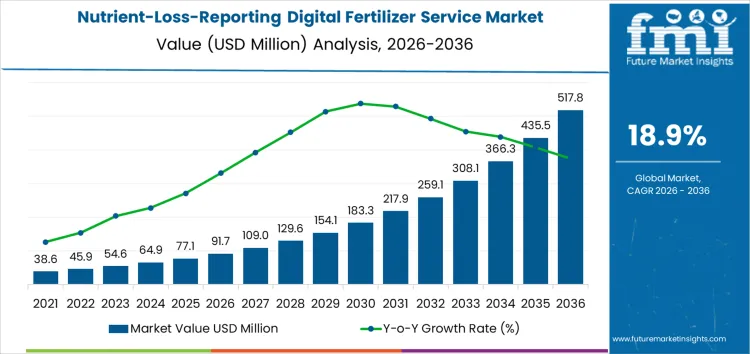
What is the Growth Forecast for the Nutrient-Loss-Reporting Digital Fertilizer Service Market through 2036?
The inflection point mapping for the nutrient-loss-reporting digital fertilizer service market reveals critical moments when the growth trajectory shifts significantly. The initial phase from 2026 to 2031 will be characterized by rapid acceleration, with the market expanding from USD 91.7 million to USD 218.5 million. The first inflection point is expected around 2028–2029, when adoption of nutrient-loss-reporting services begins to increase significantly. This shift will be driven by growing awareness among farmers of the need to optimize fertilizer use and the financial and environmental benefits of using digital services to track and reduce nutrient loss. As regulatory pressure on sustainable farming practices intensifies, the adoption of such digital tools will accelerate.
From 2031 to 2036, the market will experience stable and continued growth as the technology matures. The market will increase from USD 218.5 million in 2031 to USD 477.8 million in 2036, reflecting a more predictable expansion. The second inflection point will likely occur in the early 2030s when the technology becomes standard in precision farming. During this phase, the growth rate will stabilize, and the market will become more integrated into mainstream agricultural practices, with farmers increasingly relying on nutrient-loss-reporting services to comply with environmental regulations and enhance farm management practices.
Nutrient-Loss-Reporting Digital Fertilizer Service Market Key Takeaways
| Metric | Value |
|---|---|
| Industry Sales Value (2026) | USD 91.7 million |
| Industry Forecast Value (2036) | USD 477.8 million |
| Industry Forecast CAGR (2026-2036) | 18.9% |
What Is Driving the Demand for Nutrient Loss Reporting Digital Fertilizer Service Market?
Historical demand for nutrient loss reporting digital fertilizer services originated from the long standing challenge in agriculture of inefficient nutrient use and associated environmental impacts. Traditional fertilizer management often relied on blanket application rates without real time data on soil conditions, crop needs, or nutrient movement, which contributed to excess nutrient leaching, runoff, and greenhouse gas emissions. Over the past decade, advances in precision agriculture have introduced digital platforms that support nutrient management by capturing and analyzing soil, crop, and environmental data to guide fertilization decisions.
Digital nutrient management tools such as web based systems that assess nutrient flows, soil organic matter, and nitrate leaching risks have been developed to provide structured nutrient balance information and decision support for farmers and advisors. These systems integrate agronomic data to improve nutrient use efficiency and to reduce losses to the environment, responding to scientific and regulatory emphasis on improving nutrient management practices. Expansion of decision support systems for integrated nutrient planning provided early context for services that can report on nutrient loss outcomes and support corrective action at field scale.
Future demand for nutrient loss reporting digital fertilizer services is expected to grow as agriculture seeks tools that link digital data, sustainability reporting, and regulatory compliance. Digital services that quantify nutrient loss such as nitrogen leaching or phosphorus runoff support farm level nutrient optimization, enabling users to make evidence based fertilizer decisions that minimize environmental impact. Growth factors include increasing adoption of precision agriculture technologies such as soil sensors, satellite imagery, and decision support software that enhance data accuracy and reporting capabilities, and rising regulatory and market incentives for demonstrating sustainable nutrient management practices.
These digital services can provide field specific insights into nutrient dynamics, helping farmers and advisers to identify inefficiencies and adjust fertilizer application timing and rate accordingly. Broader global trends in digital farming underscore the role of data driven nutrient management in improving crop productivity while reducing unnecessary nutrient inputs and associated losses, with digital tools facilitating real time monitoring and adaptive management. Technical and adoption challenges such as data accessibility, integration with existing farm management systems, and digital literacy among users may influence uptake of nutrient loss reporting services, but ongoing development of intuitive platforms and decision support systems is likely to support market expansion.
What are the Leading Segments in the Global Nutrient-Loss-Reporting Digital Fertilizer Service Market?
The global nutrient-loss-reporting digital fertilizer service market is structured around platform type and end user. Mobile app platforms account for the leading share at 50%, followed by web dashboards, API integration tools, and IoT device-based systems. On the demand side, farmers represent the largest end-user group with 45%, followed by agronomists, food processors, and regulators. Adoption is shaped by on-field usability, compliance reporting needs, and integration with nutrient management practices across agricultural systems.
Why Do Mobile App Platforms Lead the Nutrient-Loss-Reporting Digital Fertilizer Service Market?
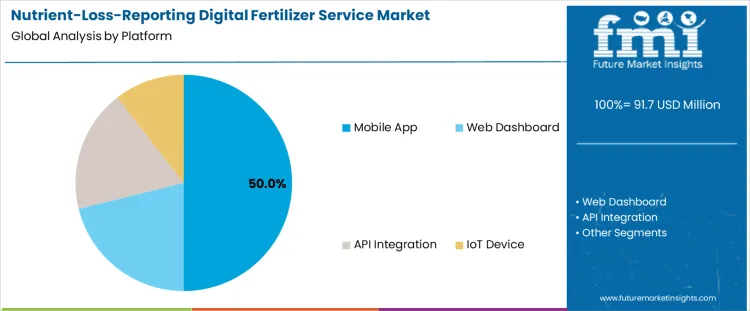
Mobile app platforms hold the leading share at 50% in the nutrient-loss-reporting digital fertilizer service market due to their direct usability at the farm level and real-time data access. These platforms allow nutrient application data, soil conditions, weather inputs, and runoff indicators to be logged during routine field operations. Mobile apps support immediate visibility into nitrogen, phosphorus, and potassium loss risks, enabling timely adjustments in fertilizer practices. Their offline functionality and sync capability support use in low-connectivity rural areas, which remains critical for broad adoption. Integration with GPS-enabled devices, variable-rate applicators, and farm management systems allows mobile apps to act as centralized reporting tools. Many platforms also generate standardized nutrient-loss reports aligned with compliance frameworks, retailer requirements, or carbon and sustainability programs. Ease of updates, lower deployment costs, and rapid scalability further strengthen adoption compared with hardware-heavy IoT systems. Agronomic decision support embedded within mobile interfaces supports fertilizer timing and placement decisions without requiring advanced technical training. The dominance of mobile apps is reinforced by growing smartphone penetration among growers and service providers. As nutrient-loss reporting becomes embedded within routine farm recordkeeping, mobile app platforms remain the preferred interface for continuous monitoring, documentation, and operational decision support.
Why Do Farmers Represent the Largest End User in Nutrient-Loss-Reporting Digital Fertilizer Services?
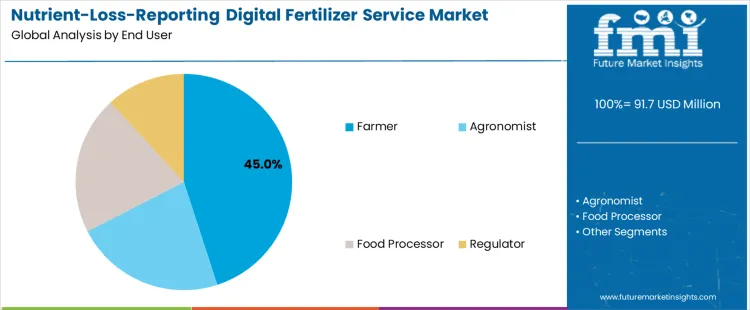
Farmers account for 45% of end-user demand in the nutrient-loss-reporting digital fertilizer service market due to direct responsibility for nutrient application decisions and field-level compliance. These services support farmers in tracking nutrient inputs against crop uptake, weather variability, and soil conditions, helping reduce runoff and volatilization risks. Digital reporting tools allow farmers to document fertilizer efficiency improvements for participation in sustainability-linked programs, supply-chain audits, or incentive schemes. Increased scrutiny around nutrient losses has shifted reporting from advisory roles to operational requirements at the farm level. Farmers use these platforms to support nutrient budgeting, seasonal planning, and post-application analysis without relying solely on third-party consultants. Access to simplified dashboards and alerts supports practical decision-making under variable field conditions. Reporting tools also assist in meeting retailer sourcing standards and regional nutrient management rules. As fertilizer costs rise and efficiency becomes a priority, farmers increasingly adopt digital services that quantify loss reduction outcomes. This direct economic and regulatory relevance positions farmers as the primary adopters of nutrient-loss-reporting platforms across cropping systems.
What are the Key Dynamics in the Nutrient Loss Reporting Digital Fertilizer Service Market?
The nutrient loss reporting digital fertilizer service market involves software and platforms that capture, analyse, and report data on nutrient runoff, leaching, and emissions linked to fertilizer use. These services integrate soil tests, weather data, and application records to quantify nutrient loss and support compliance with environmental standards. Growers, advisors, and regulators assess tools on data accuracy, compatibility with existing management systems, and reporting formats. Policy frameworks on water quality and greenhouse gas reduction influence demand. Service providers form partnerships with agribusinesses, research bodies, and technology firms to expand data sources and analytical models.
What are the Main Drivers Supporting Growth in This Market?
Growth in the nutrient loss reporting digital fertilizer service market is driven by regulatory emphasis on nutrient management and environmental protection. Governments and watershed authorities are increasing reporting requirements for nutrient runoff and water quality. Agricultural producers seek tools that help meet compliance while demonstrating responsible stewardship. Advances in sensor technology, remote sensing, and data analytics improve the quality and timeliness of nutrient loss estimates. Demand for transparent reporting from supply chain partners and end markets encourages adoption of digital services. Integration with decision support systems that optimise fertilizer placement and timing adds value for users.
What are the Key Restraints That Could Slow Market Expansion?
The market faces restraints related to cost and technical capacity of end users. Small scale farmers may find subscription fees, hardware investment, and training requirements prohibitive. Variability in data availability, such as inconsistent sensor coverage or limited soil sampling, can reduce confidence in nutrient loss estimates. Differences in regulatory requirements across regions create complexity for service providers aiming for broad applicability. Concerns about data privacy and ownership may limit willingness to share farm level information. Integration with existing farm management systems can be challenging where legacy software lacks open data standards.
What Emerging Trends Are Shaping Future Development in This Market?
Emerging trends include greater use of machine learning and predictive models that estimate nutrient loss under different scenarios. Integration of real time sensor feeds with mobile and cloud based platforms supports more frequent monitoring and adaptive nutrient management. Partnerships between digital service providers and agronomic advisers are increasing to offer combined technical support and interpretation of nutrient loss reports. Standardisation of data formats and reporting frameworks is advancing to facilitate interoperability and compliance. Interest in linking nutrient loss reporting with incentive programs, such as water quality credits or environmental performance metrics, is influencing how services are marketed and adopted.
What is the Country-Wise Analysis of the Nutrient-Loss-Reporting Digital Fertilizer Service Market?
The nutrient-loss-reporting digital fertilizer service market is growing rapidly, driven by the increasing demand for precision agriculture and the need to reduce nutrient runoff in farming. These digital services help farmers track and manage fertilizer use more efficiently by providing data on nutrient loss and suggesting strategies to optimize fertilizer application. As concerns over the environmental impact of excessive fertilizer use and nutrient pollution rise, these digital services are becoming essential for sustainable farming practices.
Developed markets such as the USA and Germany are experiencing steady growth, driven by the growing emphasis on digital agriculture and environmental regulations. Emerging markets like India and China are witnessing rapid growth due to their large agricultural sectors, where optimizing fertilizer use and minimizing nutrient loss are becoming critical for improving productivity and sustainability. As the global push for more efficient and environmentally responsible farming practices continues, the market for nutrient-loss-reporting digital fertilizer services is expected to expand significantly.
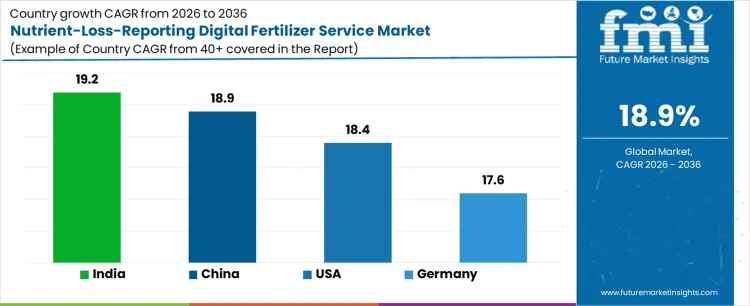
| Country | CAGR (2026-2036) |
|---|---|
| USA | 18.4% |
| Germany | 17.6% |
| India | 19.2% |
| China | 18.9% |
What is the Growth Outlook for the Nutrient-Loss-Reporting Digital Fertilizer Service Market in the USA?
The nutrient-loss-reporting digital fertilizer service market in the USA is expected to grow steadily, with a projected CAGR of 18.4% from 2026 to 2036. As the USA agricultural industry increasingly adopts precision farming practices, the demand for digital services that help optimize fertilizer use is growing. The USA market is driven by government initiatives and regulations aimed at reducing nutrient runoff and minimizing environmental impacts, as well as the growing recognition of the role of technology in improving farming efficiency. Digital services that report on nutrient loss and provide actionable insights for better fertilizer management are seen as essential tools for USA farmers looking to improve sustainability and productivity. With growing consumer demand for environmentally responsible farming and government support for climate-smart agriculture, the market for nutrient-loss-reporting digital fertilizer services in the USA is set to experience continued growth.
What is the Market Outlook for the Nutrient-Loss-Reporting Digital Fertilizer Service Market in Germany?
Germany is projected to experience steady growth in the nutrient-loss-reporting digital fertilizer service market, with a projected CAGR of 17.6% from 2026 to 2036. Germany has been a leader in adopting sustainable agricultural practices and precision farming technologies, making it a key market for nutrient-loss-reporting digital services. These services help farmers track nutrient efficiency, optimize fertilizer use, and reduce nutrient pollution, which aligns with Germany’s strong regulatory framework for environmental protection. As the European Union continues to enforce stricter environmental regulations and sustainability targets, the demand for digital fertilizer services that can report nutrient loss and suggest improvements is expected to rise. With the growing focus on reducing the environmental footprint of agriculture, Germany’s market for nutrient-loss-reporting digital fertilizer services is expected to continue expanding.
What is the Growth Forecast for the Nutrient-Loss-Reporting Digital Fertilizer Service Market in India?
India is projected to see the highest growth in the nutrient-loss-reporting digital fertilizer service market, with a projected CAGR of 19.2% from 2026 to 2036. As one of the largest agricultural producers globally, India faces significant challenges related to nutrient management and environmental sustainability. The need to optimize fertilizer use and reduce nutrient runoff is critical for improving crop yields and reducing the environmental impact of agriculture. Digital fertilizer services that track nutrient loss and suggest improvements are becoming increasingly important as Indian farmers seek more efficient and sustainable ways to manage fertilizers. With government support for sustainable farming practices and growing awareness of the need for precision agriculture, India’s market for nutrient-loss-reporting digital fertilizer services is expected to grow rapidly in the coming years.
What is the Market Outlook for the Nutrient-Loss-Reporting Digital Fertilizer Service Market in China?
China is expected to experience significant growth in the nutrient-loss-reporting digital fertilizer service market, with a projected CAGR of 18.9% from 2026 to 2036. As the world’s largest agricultural producer, China faces mounting pressure to improve nutrient use efficiency and reduce the environmental impact of fertilizer application. The government’s focus on sustainable agriculture and reducing fertilizer waste aligns with the adoption of digital services that provide real-time data on nutrient loss and fertilizer management. These digital services help Chinese farmers optimize fertilizer use, reduce costs, and minimize environmental damage. With a large agricultural base and growing government incentives for adopting precision farming technologies, the market for nutrient-loss-reporting digital fertilizer services in China is expected to see rapid growth.
What are the Growth Prospects for the Nutrient-Loss-Reporting Digital Fertilizer Service Market Globally?
Globally, the nutrient-loss-reporting digital fertilizer service market is set to expand significantly as the agricultural sector increasingly embraces precision farming and sustainable practices. Digital fertilizer services that help farmers optimize nutrient use, minimize waste, and reduce nutrient runoff are becoming critical components of sustainable agriculture worldwide. With growing concerns about the environmental impact of fertilizer use, particularly in terms of water pollution and greenhouse gas emissions, these digital services offer a solution to improve both productivity and sustainability. Governments, particularly in developed countries, are introducing policies that encourage the adoption of digital farming technologies. As more countries focus on improving nutrient management and reducing agricultural emissions, the global market for nutrient-loss-reporting digital fertilizer services is poised for rapid growth. This growth will be driven by both technological advancements and the increasing need for more efficient and eco-friendly farming solutions.
What is the Competitive Landscape for the Nutrient-Loss-Reporting Digital Fertilizer Service Market?
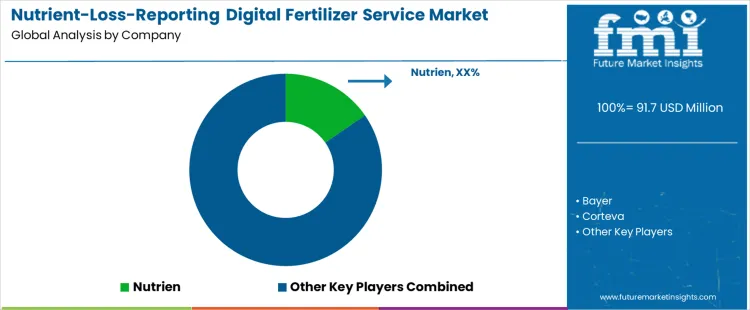
The nutrient-loss-reporting digital fertilizer service market is expanding as the agricultural industry increasingly adopts technology to improve nutrient management and reduce environmental impact. Nutrien leads the market with its advanced digital fertilizer services, offering solutions that track and report nutrient losses in real-time, helping farmers optimize fertilizer use and reduce waste. Their focus on digital innovation, sustainability, and regulatory compliance has positioned them as a dominant player. Bayer, Corteva, and Syngenta are significant competitors, each providing specialized digital tools and services that help farmers manage nutrient application and minimize losses. Bayer offers digital farming solutions that improve nutrient efficiency, while Corteva and Syngenta focus on providing integrated services that optimize fertilizer use through digital technologies.
Yara International and Trimble further contribute to the competitive landscape by offering their own nutrient-loss-reporting solutions. Yara International specializes in nutrient management technologies that improve fertilizer efficiency and sustainability, while Trimble provides precision agriculture tools that help farmers manage inputs effectively. These companies compete by focusing on product innovation, sustainability, and the ability to meet the growing demand for precision farming solutions. As environmental regulations around nutrient loss become stricter and digital farming technologies gain popularity, the market for nutrient-loss-reporting digital fertilizer services is expected to continue growing, driving further innovation and competition in the sector.
Key Players of the Nutrient-Loss-Reporting Digital Fertilizer Service Market
- Nutrien
- Bayer
- Corteva
- Syngenta
- Yara International
- Trimble
Scope of the Report
| Items | Values |
|---|---|
| Quantitative Units (2026) | USD million |
| Platform | Mobile App, Web Dashboard, API Integration, IoT Device |
| End User | Farmer, Agronomist, Food Processor, Regulator |
| Sales Channel | Ag Retailers, Direct to Farmer, Online Marketplaces, Cooperatives |
| Companies | Nutrien, Bayer, Corteva, Syngenta, Yara International, Trimble |
| Regions Covered | North America, Latin America, Western Europe, Eastern Europe, South Asia & Pacific, East Asia, Middle East & Africa |
| Countries Covered | United States, Canada, Mexico, Brazil, Argentina, Germany, France, United Kingdom, Italy, Spain, Netherlands, China, India, Japan, South Korea, ANZ, GCC Countries, South Africa |
| Additional Attributes | Dollar by sales by platform, end user, sales channel, and region. Includes analysis of market trends in nutrient loss reporting digital fertilizer services, performance of digital platforms in tracking and reporting nutrient losses, cost and adoption drivers, integration with existing farm management systems, regulatory and compliance considerations for nutrient reporting, demand by user segment including farmers and regulators, market share and competitive positioning of key companies, innovations in digital nutrient loss reporting technologies, and evaluation of impact on nutrient management outcomes, environmental reporting accuracy, and decision support for sustainable fertilizer practices. |
Nutrient-Loss-Reporting Digital Fertilizer Service Market Segmentation
Platform
- Mobile App
- Web Dashboard
- API Integration
- IoT Device
End User
- Farmer
- Agronomist
- Food Processor
- Regulator
Sales Channel
- Ag-Retailers
- Direct-to-Farmer
- Online Marketplaces
- Cooperatives
Region
- Asia Pacific
- China
- Japan
- South Korea
- India
- Australia & New Zealand
- ASEAN
- Rest of Asia Pacific
- Europe
- Germany
- United Kingdom
- France
- Italy
- Spain
- Nordic
- BENELUX
- Rest of Europe
- North America
- United States
- Canada
- Mexico
- Latin America
- Brazil
- Chile
- Rest of Latin America
- Middle East & Africa
- Kingdom of Saudi Arabia
- Other GCC Countries
- Turkey
- South Africa
- Other African Union
- Rest of Middle East & Africa
Frequently Asked Questions
How big is the nutrient-loss-reporting digital fertilizer service market in 2026?
The global nutrient-loss-reporting digital fertilizer service market is estimated to be valued at USD 91.7 million in 2026.
What will be the size of nutrient-loss-reporting digital fertilizer service market in 2036?
The market size for the nutrient-loss-reporting digital fertilizer service market is projected to reach USD 517.8 million by 2036.
How much will be the nutrient-loss-reporting digital fertilizer service market growth between 2026 and 2036?
The nutrient-loss-reporting digital fertilizer service market is expected to grow at a 18.9% CAGR between 2026 and 2036.
What are the key product types in the nutrient-loss-reporting digital fertilizer service market?
The key product types in nutrient-loss-reporting digital fertilizer service market are mobile app, web dashboard, api integration and iot device.
Which end user segment to contribute significant share in the nutrient-loss-reporting digital fertilizer service market in 2026?
In terms of end user, farmer segment to command 45.0% share in the nutrient-loss-reporting digital fertilizer service market in 2026.
Preview the report firsthand - request a free sample
Get SampleGet the brochure for pricing and purchase details.
Get PDFTable of Content
- Executive Summary
- Global Market Outlook
- Demand-side Trends
- Supply-side Trends
- Technology Roadmap Analysis
- Analysis and Recommendations
- Market Overview
- Market Coverage / Taxonomy
- Market Definition / Scope / Limitations
- Market Background
- Market Dynamics
- Drivers
- Restraints
- Opportunity
- Trends
- Scenario Forecast
- Demand in Optimistic Scenario
- Demand in Likely Scenario
- Demand in Conservative Scenario
- Opportunity Map Analysis
- Product Life Cycle Analysis
- Supply Chain Analysis
- Investment Feasibility Matrix
- Value Chain Analysis
- PESTLE and Porter’s Analysis
- Regulatory Landscape
- Regional Parent Market Outlook
- Production and Consumption Statistics
- Import and Export Statistics
- Market Dynamics
- Global Market Analysis 2021 to 2025 and Forecast, 2026 to 2036
- Historical Market Size Value (USD Million) Analysis, 2021 to 2025
- Current and Future Market Size Value (USD Million) Projections, 2026 to 2036
- Y-o-Y Growth Trend Analysis
- Absolute $ Opportunity Analysis
- Global Market Pricing Analysis 2021 to 2025 and Forecast 2026 to 2036
- Global Market Analysis 2021 to 2025 and Forecast 2026 to 2036, By Platform
- Introduction / Key Findings
- Historical Market Size Value (USD Million) Analysis By Platform , 2021 to 2025
- Current and Future Market Size Value (USD Million) Analysis and Forecast By Platform , 2026 to 2036
- Mobile App
- Web Dashboard
- API Integration
- IoT Device
- Mobile App
- Y-o-Y Growth Trend Analysis By Platform , 2021 to 2025
- Absolute $ Opportunity Analysis By Platform , 2026 to 2036
- Global Market Analysis 2021 to 2025 and Forecast 2026 to 2036, By End User
- Introduction / Key Findings
- Historical Market Size Value (USD Million) Analysis By End User, 2021 to 2025
- Current and Future Market Size Value (USD Million) Analysis and Forecast By End User, 2026 to 2036
- Farmer
- Agronomist
- Food Processor
- Regulator
- Farmer
- Y-o-Y Growth Trend Analysis By End User, 2021 to 2025
- Absolute $ Opportunity Analysis By End User, 2026 to 2036
- Global Market Analysis 2021 to 2025 and Forecast 2026 to 2036, By Sales Channel
- Introduction / Key Findings
- Historical Market Size Value (USD Million) Analysis By Sales Channel, 2021 to 2025
- Current and Future Market Size Value (USD Million) Analysis and Forecast By Sales Channel, 2026 to 2036
- Ag-Retailers
- Direct-to-Farmer
- Online Marketplaces
- Cooperatives
- Ag-Retailers
- Y-o-Y Growth Trend Analysis By Sales Channel, 2021 to 2025
- Absolute $ Opportunity Analysis By Sales Channel, 2026 to 2036
- Global Market Analysis 2021 to 2025 and Forecast 2026 to 2036, By Region
- Introduction
- Historical Market Size Value (USD Million) Analysis By Region, 2021 to 2025
- Current Market Size Value (USD Million) Analysis and Forecast By Region, 2026 to 2036
- North America
- Latin America
- Western Europe
- Eastern Europe
- East Asia
- South Asia and Pacific
- Middle East & Africa
- Market Attractiveness Analysis By Region
- North America Market Analysis 2021 to 2025 and Forecast 2026 to 2036, By Country
- Historical Market Size Value (USD Million) Trend Analysis By Market Taxonomy, 2021 to 2025
- Market Size Value (USD Million) Forecast By Market Taxonomy, 2026 to 2036
- By Country
- USA
- Canada
- Mexico
- By Platform
- By End User
- By Sales Channel
- By Country
- Market Attractiveness Analysis
- By Country
- By Platform
- By End User
- By Sales Channel
- Key Takeaways
- Latin America Market Analysis 2021 to 2025 and Forecast 2026 to 2036, By Country
- Historical Market Size Value (USD Million) Trend Analysis By Market Taxonomy, 2021 to 2025
- Market Size Value (USD Million) Forecast By Market Taxonomy, 2026 to 2036
- By Country
- Brazil
- Chile
- Rest of Latin America
- By Platform
- By End User
- By Sales Channel
- By Country
- Market Attractiveness Analysis
- By Country
- By Platform
- By End User
- By Sales Channel
- Key Takeaways
- Western Europe Market Analysis 2021 to 2025 and Forecast 2026 to 2036, By Country
- Historical Market Size Value (USD Million) Trend Analysis By Market Taxonomy, 2021 to 2025
- Market Size Value (USD Million) Forecast By Market Taxonomy, 2026 to 2036
- By Country
- Germany
- UK
- Italy
- Spain
- France
- Nordic
- BENELUX
- Rest of Western Europe
- By Platform
- By End User
- By Sales Channel
- By Country
- Market Attractiveness Analysis
- By Country
- By Platform
- By End User
- By Sales Channel
- Key Takeaways
- Eastern Europe Market Analysis 2021 to 2025 and Forecast 2026 to 2036, By Country
- Historical Market Size Value (USD Million) Trend Analysis By Market Taxonomy, 2021 to 2025
- Market Size Value (USD Million) Forecast By Market Taxonomy, 2026 to 2036
- By Country
- Russia
- Poland
- Hungary
- Balkan & Baltic
- Rest of Eastern Europe
- By Platform
- By End User
- By Sales Channel
- By Country
- Market Attractiveness Analysis
- By Country
- By Platform
- By End User
- By Sales Channel
- Key Takeaways
- East Asia Market Analysis 2021 to 2025 and Forecast 2026 to 2036, By Country
- Historical Market Size Value (USD Million) Trend Analysis By Market Taxonomy, 2021 to 2025
- Market Size Value (USD Million) Forecast By Market Taxonomy, 2026 to 2036
- By Country
- China
- Japan
- South Korea
- By Platform
- By End User
- By Sales Channel
- By Country
- Market Attractiveness Analysis
- By Country
- By Platform
- By End User
- By Sales Channel
- Key Takeaways
- South Asia and Pacific Market Analysis 2021 to 2025 and Forecast 2026 to 2036, By Country
- Historical Market Size Value (USD Million) Trend Analysis By Market Taxonomy, 2021 to 2025
- Market Size Value (USD Million) Forecast By Market Taxonomy, 2026 to 2036
- By Country
- India
- ASEAN
- Australia & New Zealand
- Rest of South Asia and Pacific
- By Platform
- By End User
- By Sales Channel
- By Country
- Market Attractiveness Analysis
- By Country
- By Platform
- By End User
- By Sales Channel
- Key Takeaways
- Middle East & Africa Market Analysis 2021 to 2025 and Forecast 2026 to 2036, By Country
- Historical Market Size Value (USD Million) Trend Analysis By Market Taxonomy, 2021 to 2025
- Market Size Value (USD Million) Forecast By Market Taxonomy, 2026 to 2036
- By Country
- Kingdom of Saudi Arabia
- Other GCC Countries
- Turkiye
- South Africa
- Other African Union
- Rest of Middle East & Africa
- By Platform
- By End User
- By Sales Channel
- By Country
- Market Attractiveness Analysis
- By Country
- By Platform
- By End User
- By Sales Channel
- Key Takeaways
- Key Countries Market Analysis
- USA
- Pricing Analysis
- Market Share Analysis, 2025
- By Platform
- By End User
- By Sales Channel
- Canada
- Pricing Analysis
- Market Share Analysis, 2025
- By Platform
- By End User
- By Sales Channel
- Mexico
- Pricing Analysis
- Market Share Analysis, 2025
- By Platform
- By End User
- By Sales Channel
- Brazil
- Pricing Analysis
- Market Share Analysis, 2025
- By Platform
- By End User
- By Sales Channel
- Chile
- Pricing Analysis
- Market Share Analysis, 2025
- By Platform
- By End User
- By Sales Channel
- Germany
- Pricing Analysis
- Market Share Analysis, 2025
- By Platform
- By End User
- By Sales Channel
- UK
- Pricing Analysis
- Market Share Analysis, 2025
- By Platform
- By End User
- By Sales Channel
- Italy
- Pricing Analysis
- Market Share Analysis, 2025
- By Platform
- By End User
- By Sales Channel
- Spain
- Pricing Analysis
- Market Share Analysis, 2025
- By Platform
- By End User
- By Sales Channel
- France
- Pricing Analysis
- Market Share Analysis, 2025
- By Platform
- By End User
- By Sales Channel
- India
- Pricing Analysis
- Market Share Analysis, 2025
- By Platform
- By End User
- By Sales Channel
- ASEAN
- Pricing Analysis
- Market Share Analysis, 2025
- By Platform
- By End User
- By Sales Channel
- Australia & New Zealand
- Pricing Analysis
- Market Share Analysis, 2025
- By Platform
- By End User
- By Sales Channel
- China
- Pricing Analysis
- Market Share Analysis, 2025
- By Platform
- By End User
- By Sales Channel
- Japan
- Pricing Analysis
- Market Share Analysis, 2025
- By Platform
- By End User
- By Sales Channel
- South Korea
- Pricing Analysis
- Market Share Analysis, 2025
- By Platform
- By End User
- By Sales Channel
- Russia
- Pricing Analysis
- Market Share Analysis, 2025
- By Platform
- By End User
- By Sales Channel
- Poland
- Pricing Analysis
- Market Share Analysis, 2025
- By Platform
- By End User
- By Sales Channel
- Hungary
- Pricing Analysis
- Market Share Analysis, 2025
- By Platform
- By End User
- By Sales Channel
- Kingdom of Saudi Arabia
- Pricing Analysis
- Market Share Analysis, 2025
- By Platform
- By End User
- By Sales Channel
- Turkiye
- Pricing Analysis
- Market Share Analysis, 2025
- By Platform
- By End User
- By Sales Channel
- South Africa
- Pricing Analysis
- Market Share Analysis, 2025
- By Platform
- By End User
- By Sales Channel
- USA
- Market Structure Analysis
- Competition Dashboard
- Competition Benchmarking
- Market Share Analysis of Top Players
- By Regional
- By Platform
- By End User
- By Sales Channel
- Competition Analysis
- Competition Deep Dive
- Nutrien
- Overview
- Product Portfolio
- Profitability by Market Segments (Product/Age /Sales Channel/Region)
- Sales Footprint
- Strategy Overview
- Marketing Strategy
- Product Strategy
- Channel Strategy
- Bayer
- Corteva
- Syngenta
- Yara International
- Trimble
- Nutrien
- Competition Deep Dive
- Assumptions & Acronyms Used
- Research Methodology


