

- Industry Size (2026)
- USD 1.2 Bn
- Forecast (2036)
- USD 2.0 Bn
- CAGR (2026 to 2036)
- 5.0%
Digital Concierge Service Market Forecast and Outlook 2026 to 2036
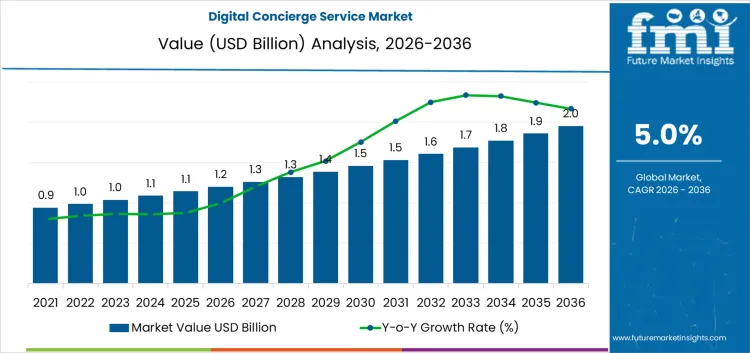
The digital concierge service market is poised to be valued at USD 1.2 billion in 2026, rising to USD 2.0 billion by 2036 at a 5% CAGR. Growth trajectory is primarily influenced by operational structures, the number of guests served, and the hours of operation at various properties, rather than the latest technology trends. Adoption of digital concierge systems hinges on how operators categorize guest requests, set escalation protocols, and define language capabilities prior to selecting a vendor. Once integrated into everyday operations, any changes to the workflow can disrupt staff training and affect response metrics.
To achieve commercial success in the digital concierge segment, businesses must prioritize customer retention, expand account offerings, and uphold strict operational standards as opposed to experiencing rapid client turnover. Implementation teams play a crucial role in customizing knowledge databases, establishing routing protocols, and managing permissions tailored to each type of property.
Ongoing maintenance of content and rule updates contributes significantly to the overall quality of service, often outweighing the impact of new feature rollouts. Support teams are strategically scheduled to manage peak times around check-ins and major events, while quality assurance teams analyze communication transcripts and resolution pathways to minimize errors.
Quick Stats for Digital Concierge Service Market
- Digital Concierge Service Market Value (2026): USD 1.2 billion
- Digital Concierge Service Market Forecast Value (2036): USD 2.0 billion
- Digital Concierge Service Market Forecast CAGR 2026 to 2036: 5.0%
- Leading Service Type in Digital Concierge Service Market: Mobile app-based digital concierge services
- Leading End Use Sector in Digital Concierge Service Market: Hospitality (hotels and resorts)
- Key Growth Regions in Digital Concierge Service Market: Asia Pacific, Europe, North America
- Top Players in Digital Concierge Service Market: Oracle Corporation, IBM, Salesforce, Intelity, ALICE
What Is the Growth Forecast for the Digital Concierge Service Market through 2036?
Service design standards and customer experience policy shape spending in the digital concierge service market more than short term travel or retail traffic swings. In 2026, at about USD 1.2 billion, deployments are concentrated in hotels, residential complexes, healthcare facilities, and premium office properties where service workflows are centrally defined. Platform selection tends to be part of broader property management or tenant service systems, which ties adoption to renovation cycles and contract renewals rather than to monthly operating budgets. Usage expands as operators extend the same interface across more sites and functions. The steady rise reflects wider rollout within existing portfolios rather than rapid entry into entirely new sectors.
Contract structure and operating economics guide the later phase of the digital concierge service market. As value approaches roughly USD 2.0 billion by 2036, buyers focus on uptime, data handling reliability, and integration with access control, booking, and billing systems. Providers invest more in support coverage and system stability as installed bases grow. The move from the low one billions into the two billion range reflects accumulated multi-site contracts and renewals rather than a single demand wave. Companies that maintain stable service delivery, predictable pricing, and consistent system performance tend to retain long term accounts and expand within existing customer groups.
Digital Concierge Service Market Key Takeaways
| Metric | Value |
|---|---|
| Market Value (2026) | USD 1.2 billion |
| Forecast Value (2036) | USD 2.0 billion |
| Forecast CAGR 2026 to 2036 | 5.0% |
How Is the Digital Concierge Service Market Changing Guest and Tenant Service Delivery?
Digital concierge services provide centralized request handling, information access, and service coordination through kiosks, mobile apps, or in room systems. Hotels, residential towers, and mixed use properties use them to manage bookings, maintenance requests, deliveries, and local service inquiries. Earlier front desk and call based models depended on staff availability and manual logging, which limited response consistency during peak periods. Digital platforms shift this work into structured workflows with time stamps, escalation rules, and usage tracking. Property operators evaluate these systems by uptime, integration with property management software, and ease of use for staff and occupants. Deployment often starts in high traffic buildings where staffing cost and service variability create visible operating pressure and measurable service delays.
Commercial adoption is driven by operations managers and asset owners because service response affects retention and contract renewals. Early installations focused on guest facing features, which delivered mixed results without back end process alignment. Current programs emphasize ticket routing, vendor coordination, and performance reporting across departments. Vendors compete on system reliability, integration depth, and data security rather than interface design alone. Buyers compare total cost through staffing needs, response time reduction, and complaint resolution rates, not license fees. Implementation effort, training, and change management shape project timelines. Over time, demand follows portfolio consolidation and remote management models, where consistent service delivery across many sites becomes harder to achieve with local teams alone and requires auditable, repeatable digital workflows.
How is the Digital Concierge Service Market Segmented by Service Type and End Use Sector?
Specification in Digital Concierge Service Market is driven by service workflow design, data governance rules, and system integration strategy rather than by front end interface preference. Once guest or user journeys are mapped and approved, the concierge layer becomes part of the operating model and is embedded into core systems. This links demand to property openings, platform standardization programs, and service redesign initiatives. Segment structure reflects differences in interaction modality, automation depth, and integration burden. Buyers prioritize reliability, response consistency, and auditability because concierge outputs affect service delivery and operational records. Volume development therefore follows portfolio level digitization plans and platform consolidation efforts rather than short term occupancy or footfall changes.
How Does Service Type Selection Influence Operating Model and Integration Complexity in the Digital Concierge Service Market?
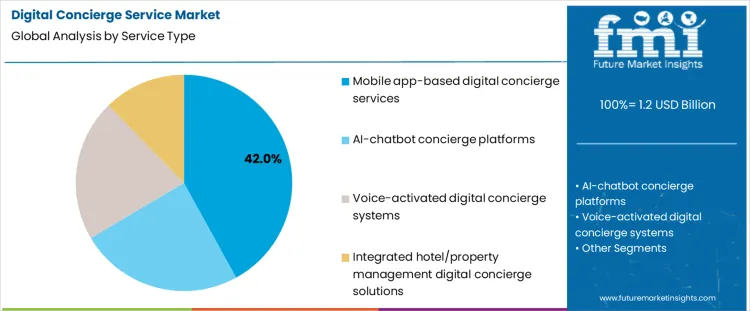
Mobile app based digital concierge services represent about 42% of demand in the Digital Concierge Service Market because they align with existing customer engagement strategies and support controlled feature expansion. These systems integrate with booking, access control, and service request platforms, which centralizes data and workflow management. AI chatbot concierge platforms address high volume, repetitive queries, reducing staff load while increasing requirements for intent management and content governance. Voice activated digital concierge systems are applied where hands free interaction or accessibility is prioritized, though they introduce acoustic environment constraints and privacy considerations. Integrated hotel or property management solutions embed concierge functions into core systems, which increases deployment scope and validation effort.
From an operational perspective, service type choice establishes governance and support structures. App based and integrated platforms require coordinated release management and interface testing. Chatbot systems impose continuous content tuning and exception handling procedures. Voice based systems add hardware, network, and environmental qualification requirements. Once a service architecture is selected, changes are constrained because user training, back office processes, and data interfaces are aligned to that model. Demand by service type therefore follows platform strategy and enterprise system roadmaps rather than short term experimentation with user interfaces.
Why Does End Use Sector Determine Volume Concentration and Compliance Requirements in the Digital Concierge Service Market?
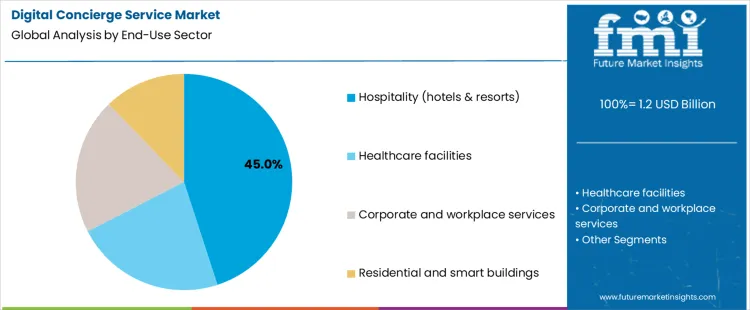
Hospitality accounts for about 45% of demand in the Digital Concierge Service Market because hotels and resorts manage high volumes of recurring service interactions related to rooms, amenities, and local services. This environment benefits from standardized workflows and measurable service response times. Healthcare facilities adopt digital concierge functions to manage navigation, appointments, and visitor services, where data protection and operational accuracy impose stricter controls. Corporate and workplace services apply concierge platforms to manage facilities, meeting services, and employee requests within defined service level agreements. Residential and smart buildings use these systems for access, maintenance, and community services, often across distributed property portfolios.
End use sector also shapes procurement and approval processes. Hospitality groups implement platforms through brand wide programs and phased rollouts. Healthcare providers require formal security, privacy, and compliance reviews before deployment. Corporate environments integrate concierge functions into workplace management systems under centralized IT governance. Residential operators balance functionality with tenant acceptance and property management integration. The resulting demand structure concentrates volume in hospitality while compliance intensity increases in healthcare and enterprise settings. Segment shares therefore move with property development pipelines, digital transformation programs, and regulatory oversight requirements rather than with short term service usage fluctuations.
How Is the Digital Concierge Service Market Being Shaped by Service Consistency and Experience Management?
The Digital Concierge Service Market is defined by how hotels, residential complexes, hospitals, and corporate campuses manage guest and visitor interactions at scale. As service volumes grow and staffing models become tighter, digital concierge platforms are used to standardize responses, route requests, and maintain service records. Buyers evaluate solutions based on reliability, ease of use, and integration with existing property management or facility systems. Selection decisions involve operations, guest services, and management teams. This positions digital concierge services as operational coordination tools rather than as optional front-end features, making uptime, data handling, and workflow fit central to purchasing decisions.
How Is Multi-Site Standardization Changing Expectations in The Digital Concierge Service Market?
Organizations operating multiple properties increasingly want consistent service processes across all locations. This is changing expectations in the Digital Concierge Service Market toward platforms that can be deployed with the same interface, rules, and reporting structures everywhere. Managers prefer systems that support centralized oversight while allowing local execution. This reduces training effort and makes performance comparison easier. As a result, buyers focus on configuration control, role management, and reporting clarity rather than on cosmetic interface features. Suppliers are judged on their ability to support fleet-level rollout and long-term platform consistency.
Where Is Scalable Demand Being Created in The Digital Concierge Service Market?
Scalable demand is being created in environments where high volumes of routine requests need to be handled quickly and consistently. Large hotels, mixed-use developments, healthcare facilities, and corporate campuses generate steady interaction traffic related to navigation, maintenance, bookings, and general inquiries. The Digital Concierge Service Market benefits when these organizations replace fragmented communication channels with a single coordinated service interface. There is also opportunity in offering bundled services such as analytics, service optimization, and integration support. Providers that embed their systems into daily operations can secure recurring contracts across multiple sites and long service periods.
Why Do Change Management and Staff Adoption Limit Faster Rollout in The Digital Concierge Service Market?
Even well-designed digital service systems require staff and users to change established habits. Front desk teams, facility staff, and service managers may resist new workflows or worry about increased transparency of response times and performance. Integrating digital concierge services with existing systems also requires planning and process redesign. The Digital Concierge Service Market therefore faces slower rollout in organizations that lack clear service governance or internal alignment. Budget approval is often easier than behavioral change, which makes adoption speed depend more on organizational readiness than on software capability.
What is the Demand for Digital Concierge Service by Country?
| Country | CAGR |
|---|---|
| USA | 4.5% |
| UK | 4.2% |
| China | 5.5% |
| India | 5.8% |
| Brazil | 5.0% |
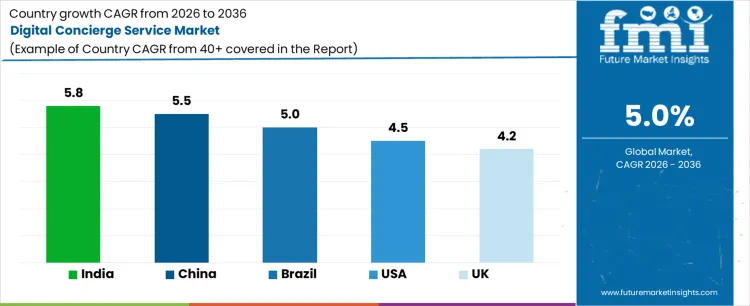
Demand for digital concierge services is rising as hotels, residential complexes, corporate offices, and healthcare facilities adopt software based guest and customer engagement platforms to improve service efficiency and reduce staffing pressure. India leads with a 5.8% CAGR, supported by rapid growth in organized hospitality, premium residential projects, and technology driven customer service models. China follows at 5.5%, driven by large scale commercial real estate, smart building adoption, and integrated lifestyle service platforms. Brazil records 5.0%, reflecting increasing use in hotels and mixed use developments. The USA grows at 4.5%, shaped by steady adoption in hospitality and senior living facilities. The UK, at 4.2%, reflects a mature service market with gradual digital transition.
How Do Hotel Modernization and Guest Experience Platforms Shape Demand in the United States?
Service digitization programs keep the digital concierge service market in the United States on a 4.5% CAGR path. Hotels, residential complexes, corporate campuses, and healthcare facilities account for most deployments. Operators select platforms based on system reliability, integration with property management software, and data security controls. Procurement usually occurs through multi-site service contracts rather than individual location purchases. Content management teams configure local recommendations, booking tools, and support workflows. Training programs influence staff adoption and response consistency. Replacement demand appears when legacy systems fail to support mobile access or analytics features. Service providers manage updates and feature expansion across portfolios. Usage data supports refinement of service menus. Budget planning follows property upgrade cycles. Commercial position depends on enterprise account access and stable service delivery rather than competition for small single site contracts.
Why Do Brand Standards and Portfolio Management Drive Adoption in the United Kingdom?
Brand governance systems place the digital concierge service market in the United Kingdom on a 4.2% CAGR trajectory. Hotel groups, mixed use developments, and managed office spaces represent the main users. Platform choice follows corporate standards covering data handling, accessibility, and content control. Procurement flows through central teams responsible for multi property portfolios. Rollout planning aligns with refurbishment schedules and rebranding programs. Local teams configure language, transport links, and booking partners within approved frameworks. Training programs affect service response quality. Replacement decisions follow contract reviews or platform capability gaps. Service providers coordinate support across regions. Performance reports feed into brand audits. Budget approval cycles shape deployment timing. Commercial access depends on inclusion in approved vendor lists and proven service reliability rather than competition for isolated property contracts.
What Role Do Large Scale Developments and Platform Integration Play in China?
Urban mixed use projects place the digital concierge service market in China on a 5.5% growth path. Business districts, residential towers, airports, and high end retail complexes account for most implementations. Developers specify platforms that integrate access control, payments, and tenant services. Local technology firms supply systems aligned with domestic data standards. Procurement bundles software within broader building management packages. Installation schedules follow construction milestones. Operations teams manage content updates and user support workflows. Usage analytics guide feature adjustments. Replacement occurs when property owners upgrade digital infrastructure stacks. Regional service teams provide on site support. Training supports consistent response across shifts. Payment terms follow property management contracts. Commercial success depends on placement within large development programs and integration partnerships rather than fragmented sales to single buildings.
How Do Real Estate Digitization and Managed Services Shape Demand in India?
Property technology adoption fixes the digital concierge service market in India at a 5.8% CAGR. Premium residential projects, business parks, hospitals, and hotels represent core customers. Platform selection focuses on mobile access, multilingual support, and local service directories. Many deployments occur through managed service agreements with property operators. Integration with visitor management and maintenance systems receives attention. Training programs influence resident and staff usage levels. Content updates follow tenant mix changes. Replacement demand appears when older systems lack scalability or analytics features. Regional service partners handle onboarding and support. Usage data supports service refinement. Budget cycles align with project handover schedules. Commercial results depend on relationships with large property developers and operators rather than competition for single building installations.
How Do Hospitality Chains and Urban Developments Shape Spending in Brazil?
Service modernization keeps the digital concierge service market in Brazil near a 5.0% CAGR. Hotel chains, serviced apartments, and mixed use developments form the main client base. Platform choice reflects language support, ease of use, and integration with booking and maintenance systems. Procurement often occurs through group contracts covering several properties. Implementation aligns with renovation and opening schedules. Local teams curate content for transport, dining, and services. Training influences response speed and consistency. Replacement follows contract renewal or platform obsolescence. Service providers maintain regional support teams. Performance dashboards inform management reviews. Budget approval cycles influence rollout pace. Commercial position depends on distributor and integrator partnerships and dependable support rather than competition for one off property level deployments.
How Do Platform Providers Compete for Adoption in the Digital Concierge Service Market?
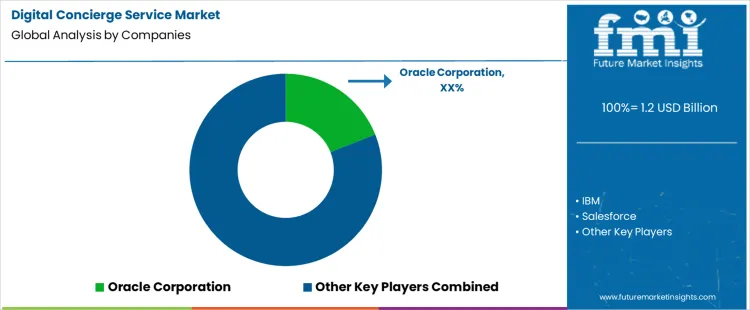
Digital concierge service adoption follows property workflow design rather than software feature checklists. Hotel groups map guest request paths, staff dispatch rules, escalation handling, and reporting needs before naming platforms. Oracle, IBM, Salesforce, Intelity, ALICE enter that planning stage through different entry points. Oracle and Salesforce arrive through property management and CRM integration footprints. IBM positions around data handling, security frameworks, and enterprise support models. Intelity and ALICE focus on front desk operations, housekeeping coordination, and service response tracking. Once a chain standardizes message routing, task queues, and staff devices, retraining cost keeps platforms in place for several years. Buyers treat these systems as operational infrastructure rather than optional guest experience layers. Contract scope often covers multiple properties and multiyear support cycles.
Competition reflects integration depth, deployment discipline, and service continuity more than interface polish. Owners review API stability, uptime records, data residency handling, and audit support during technical evaluation. Regional rollouts favor vendors with field onboarding teams and multilingual training assets. Oracle benefits from existing PMS and back office links inside large groups. Salesforce gains positions where customer data workflows already anchor operations. IBM secures roles in properties that prioritize governance and security reviews. Intelity and ALICE win where operations teams seek focused service orchestration and faster staff adoption. Budget committees examine license structure, device support, and change management workload. Market outcomes differ by chain size, ownership model, and property standardization strategy.
Key Players of Digital Concierge Service Market
- Oracle Corporation
- IBM
- Salesforce
- Intelity
- ALICE (Hospitality Technology Platform)
Scope of the Report
| Items | Values |
|---|---|
| Quantitative Units (2026) | USD billion |
| Service Type | Mobile app-based digital concierge services, AI-chatbot concierge platforms, Voice-activated digital concierge systems, Integrated hotel and property management digital concierge solutions |
| End-Use Sector | Hospitality (hotels and resorts), Healthcare facilities, Corporate and workplace services, Residential and smart buildings |
| Region | Asia Pacific, Europe, North America, Latin America, Middle East & Africa |
| Countries Covered | China, Japan, South Korea, India, Australia & New Zealand, ASEAN, Germany, United Kingdom, France, Italy, Spain, Nordic, BENELUX, United States, Canada, Mexico, Brazil, Chile, Saudi Arabia, Turkey, South Africa, and other regional markets |
| Key Companies Profiled | Oracle Corporation, IBM, Salesforce, Intelity, ALICE (Hospitality Technology Platform) |
| Additional Attributes | Dollar by sales by service type and end-use sector; demand shaped by multi-site property portfolios and service workflow standardization; adoption driven by integration with property systems, uptime requirements, and audit trails; procurement through multi-year service contracts; focus on response time, staffing efficiency, and service quality consistency rather than interface features. |
Digital Concierge Service Market Segmentation
Service Type:
- Mobile app-based digital concierge services
- AI-chatbot concierge platforms
- Voice-activated digital concierge systems
- Integrated hotel/property management digital concierge solutions
End-Use Sector:
- Hospitality (hotels & resorts)
- Healthcare facilities
- Corporate and workplace services
- Residential and smart buildings
Region:
- Asia Pacific
- China
- Japan
- South Korea
- India
- Australia & New Zealand
- ASEAN
- Rest of Asia Pacific
- Europe
- Germany
- United Kingdom
- France
- Italy
- Spain
- Nordic
- BENELUX
- Rest of Europe
- North America
- United States
- Canada
- Mexico
- Latin America
- Brazil
- Chile
- Rest of Latin America
- Middle East & Africa
- Kingdom of Saudi Arabia
- Other GCC Countries
- Turkey
- South Africa
- Other African Union
- Rest of Middle East & Africa
Bibliography
- International Organization for Standardization. (2024). Data quality—Master data—Part 51: Data governance and data quality framework (ISO 8000-51). ISO.
- National Institute of Standards and Technology. (2024). The NIST cybersecurity framework (CSF) 2.0. U.S. Department of Commerce.
- Ministry of Electronics and Information Technology. (2025). Digital Personal Data Protection Rules, 2025. Government of India.
- International Organization for Standardization. (2023). Artificial intelligence management system—Requirements (ISO/IEC 42001). ISO.
- European Union. (2024). Regulation (EU) 2024/1684 establishing harmonised rules on artificial intelligence (Artificial Intelligence Act). Official Journal of the European Union.
Frequently Asked Questions
How big is the digital concierge service market in 2026?
The global digital concierge service market is estimated to be valued at USD 1.2 billion in 2026.
What will be the size of digital concierge service market in 2036?
The market size for the digital concierge service market is projected to reach USD 2.0 billion by 2036.
How much will be the digital concierge service market growth between 2026 and 2036?
The digital concierge service market is expected to grow at a 5.0% CAGR between 2026 and 2036.
What are the key product types in the digital concierge service market?
The key product types in digital concierge service market are mobile app‑based digital concierge services , ai‑chatbot concierge platforms, voice‑activated digital concierge systems and integrated hotel/property management digital concierge solutions.
Which end‑use sector segment to contribute significant share in the digital concierge service market in 2026?
In terms of end‑use sector, hospitality (hotels & resorts) segment to command 45.0% share in the digital concierge service market in 2026.
Preview the report firsthand - request a free sample
Get SampleGet the brochure for pricing and purchase details.
Get PDFTable of Content
- Executive Summary
- Global Market Outlook
- Demand-side Trends
- Supply-side Trends
- Technology Roadmap Analysis
- Analysis and Recommendations
- Market Overview
- Market Coverage / Taxonomy
- Market Definition / Scope / Limitations
- Market Background
- Market Dynamics
- Drivers
- Restraints
- Opportunity
- Trends
- Scenario Forecast
- Demand in Optimistic Scenario
- Demand in Likely Scenario
- Demand in Conservative Scenario
- Opportunity Map Analysis
- Product Life Cycle Analysis
- Supply Chain Analysis
- Investment Feasibility Matrix
- Value Chain Analysis
- PESTLE and Porter’s Analysis
- Regulatory Landscape
- Regional Parent Market Outlook
- Production and Consumption Statistics
- Import and Export Statistics
- Market Dynamics
- Global Market Analysis 2021 to 2025 and Forecast, 2026 to 2036
- Historical Market Size Value (USD Million) Analysis, 2021 to 2025
- Current and Future Market Size Value (USD Million) Projections, 2026 to 2036
- Y-o-Y Growth Trend Analysis
- Absolute $ Opportunity Analysis
- Global Market Pricing Analysis 2021 to 2025 and Forecast 2026 to 2036
- Global Market Analysis 2021 to 2025 and Forecast 2026 to 2036, By Service Type
- Introduction / Key Findings
- Historical Market Size Value (USD Million) Analysis By Service Type , 2021 to 2025
- Current and Future Market Size Value (USD Million) Analysis and Forecast By Service Type , 2026 to 2036
- Mobile app‑based digital concierge services
- AI‑chatbot concierge platforms
- Voice‑activated digital concierge systems
- Integrated hotel/property management digital concierge solutions
- Mobile app‑based digital concierge services
- Y-o-Y Growth Trend Analysis By Service Type , 2021 to 2025
- Absolute $ Opportunity Analysis By Service Type , 2026 to 2036
- Global Market Analysis 2021 to 2025 and Forecast 2026 to 2036, By End‑Use Sector
- Introduction / Key Findings
- Historical Market Size Value (USD Million) Analysis By End‑Use Sector, 2021 to 2025
- Current and Future Market Size Value (USD Million) Analysis and Forecast By End‑Use Sector, 2026 to 2036
- Hospitality (hotels & resorts)
- Healthcare facilities
- Corporate and workplace services
- Residential and smart buildings
- Hospitality (hotels & resorts)
- Y-o-Y Growth Trend Analysis By End‑Use Sector, 2021 to 2025
- Absolute $ Opportunity Analysis By End‑Use Sector, 2026 to 2036
- Global Market Analysis 2021 to 2025 and Forecast 2026 to 2036, By Region
- Introduction
- Historical Market Size Value (USD Million) Analysis By Region, 2021 to 2025
- Current Market Size Value (USD Million) Analysis and Forecast By Region, 2026 to 2036
- North America
- Latin America
- Western Europe
- Eastern Europe
- East Asia
- South Asia and Pacific
- Middle East & Africa
- Market Attractiveness Analysis By Region
- North America Market Analysis 2021 to 2025 and Forecast 2026 to 2036, By Country
- Historical Market Size Value (USD Million) Trend Analysis By Market Taxonomy, 2021 to 2025
- Market Size Value (USD Million) Forecast By Market Taxonomy, 2026 to 2036
- By Country
- USA
- Canada
- Mexico
- By Service Type
- By End‑Use Sector
- By Country
- Market Attractiveness Analysis
- By Country
- By Service Type
- By End‑Use Sector
- Key Takeaways
- Latin America Market Analysis 2021 to 2025 and Forecast 2026 to 2036, By Country
- Historical Market Size Value (USD Million) Trend Analysis By Market Taxonomy, 2021 to 2025
- Market Size Value (USD Million) Forecast By Market Taxonomy, 2026 to 2036
- By Country
- Brazil
- Chile
- Rest of Latin America
- By Service Type
- By End‑Use Sector
- By Country
- Market Attractiveness Analysis
- By Country
- By Service Type
- By End‑Use Sector
- Key Takeaways
- Western Europe Market Analysis 2021 to 2025 and Forecast 2026 to 2036, By Country
- Historical Market Size Value (USD Million) Trend Analysis By Market Taxonomy, 2021 to 2025
- Market Size Value (USD Million) Forecast By Market Taxonomy, 2026 to 2036
- By Country
- Germany
- UK
- Italy
- Spain
- France
- Nordic
- BENELUX
- Rest of Western Europe
- By Service Type
- By End‑Use Sector
- By Country
- Market Attractiveness Analysis
- By Country
- By Service Type
- By End‑Use Sector
- Key Takeaways
- Eastern Europe Market Analysis 2021 to 2025 and Forecast 2026 to 2036, By Country
- Historical Market Size Value (USD Million) Trend Analysis By Market Taxonomy, 2021 to 2025
- Market Size Value (USD Million) Forecast By Market Taxonomy, 2026 to 2036
- By Country
- Russia
- Poland
- Hungary
- Balkan & Baltic
- Rest of Eastern Europe
- By Service Type
- By End‑Use Sector
- By Country
- Market Attractiveness Analysis
- By Country
- By Service Type
- By End‑Use Sector
- Key Takeaways
- East Asia Market Analysis 2021 to 2025 and Forecast 2026 to 2036, By Country
- Historical Market Size Value (USD Million) Trend Analysis By Market Taxonomy, 2021 to 2025
- Market Size Value (USD Million) Forecast By Market Taxonomy, 2026 to 2036
- By Country
- China
- Japan
- South Korea
- By Service Type
- By End‑Use Sector
- By Country
- Market Attractiveness Analysis
- By Country
- By Service Type
- By End‑Use Sector
- Key Takeaways
- South Asia and Pacific Market Analysis 2021 to 2025 and Forecast 2026 to 2036, By Country
- Historical Market Size Value (USD Million) Trend Analysis By Market Taxonomy, 2021 to 2025
- Market Size Value (USD Million) Forecast By Market Taxonomy, 2026 to 2036
- By Country
- India
- ASEAN
- Australia & New Zealand
- Rest of South Asia and Pacific
- By Service Type
- By End‑Use Sector
- By Country
- Market Attractiveness Analysis
- By Country
- By Service Type
- By End‑Use Sector
- Key Takeaways
- Middle East & Africa Market Analysis 2021 to 2025 and Forecast 2026 to 2036, By Country
- Historical Market Size Value (USD Million) Trend Analysis By Market Taxonomy, 2021 to 2025
- Market Size Value (USD Million) Forecast By Market Taxonomy, 2026 to 2036
- By Country
- Kingdom of Saudi Arabia
- Other GCC Countries
- Turkiye
- South Africa
- Other African Union
- Rest of Middle East & Africa
- By Service Type
- By End‑Use Sector
- By Country
- Market Attractiveness Analysis
- By Country
- By Service Type
- By End‑Use Sector
- Key Takeaways
- Key Countries Market Analysis
- USA
- Pricing Analysis
- Market Share Analysis, 2025
- By Service Type
- By End‑Use Sector
- Canada
- Pricing Analysis
- Market Share Analysis, 2025
- By Service Type
- By End‑Use Sector
- Mexico
- Pricing Analysis
- Market Share Analysis, 2025
- By Service Type
- By End‑Use Sector
- Brazil
- Pricing Analysis
- Market Share Analysis, 2025
- By Service Type
- By End‑Use Sector
- Chile
- Pricing Analysis
- Market Share Analysis, 2025
- By Service Type
- By End‑Use Sector
- Germany
- Pricing Analysis
- Market Share Analysis, 2025
- By Service Type
- By End‑Use Sector
- UK
- Pricing Analysis
- Market Share Analysis, 2025
- By Service Type
- By End‑Use Sector
- Italy
- Pricing Analysis
- Market Share Analysis, 2025
- By Service Type
- By End‑Use Sector
- Spain
- Pricing Analysis
- Market Share Analysis, 2025
- By Service Type
- By End‑Use Sector
- France
- Pricing Analysis
- Market Share Analysis, 2025
- By Service Type
- By End‑Use Sector
- India
- Pricing Analysis
- Market Share Analysis, 2025
- By Service Type
- By End‑Use Sector
- ASEAN
- Pricing Analysis
- Market Share Analysis, 2025
- By Service Type
- By End‑Use Sector
- Australia & New Zealand
- Pricing Analysis
- Market Share Analysis, 2025
- By Service Type
- By End‑Use Sector
- China
- Pricing Analysis
- Market Share Analysis, 2025
- By Service Type
- By End‑Use Sector
- Japan
- Pricing Analysis
- Market Share Analysis, 2025
- By Service Type
- By End‑Use Sector
- South Korea
- Pricing Analysis
- Market Share Analysis, 2025
- By Service Type
- By End‑Use Sector
- Russia
- Pricing Analysis
- Market Share Analysis, 2025
- By Service Type
- By End‑Use Sector
- Poland
- Pricing Analysis
- Market Share Analysis, 2025
- By Service Type
- By End‑Use Sector
- Hungary
- Pricing Analysis
- Market Share Analysis, 2025
- By Service Type
- By End‑Use Sector
- Kingdom of Saudi Arabia
- Pricing Analysis
- Market Share Analysis, 2025
- By Service Type
- By End‑Use Sector
- Turkiye
- Pricing Analysis
- Market Share Analysis, 2025
- By Service Type
- By End‑Use Sector
- South Africa
- Pricing Analysis
- Market Share Analysis, 2025
- By Service Type
- By End‑Use Sector
- USA
- Market Structure Analysis
- Competition Dashboard
- Competition Benchmarking
- Market Share Analysis of Top Players
- By Regional
- By Service Type
- By End‑Use Sector
- Competition Analysis
- Competition Deep Dive
- Oracle Corporation
- Overview
- Product Portfolio
- Profitability by Market Segments (Product/Age /Sales Channel/Region)
- Sales Footprint
- Strategy Overview
- Marketing Strategy
- Product Strategy
- Channel Strategy
- IBM
- Salesforce
- Intelity
- ALICE (Hospitality Technology Platform)
- Oracle Corporation
- Competition Deep Dive
- Assumptions & Acronyms Used
- Research Methodology


