

- Market Size (2026)
- USD 1.3 Bn
- Forecast (2036)
- USD 2.8 Bn
- CAGR (2026 to 2036)
- 7.2%
Digital Brake Control and Antiskid Systems Market Size, Forecast, and Outlook By FMI
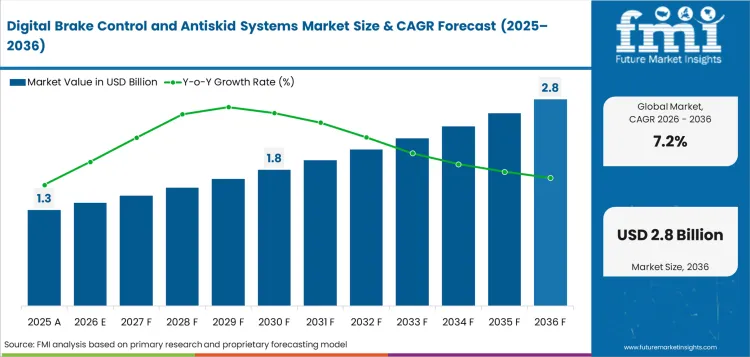
The digital brake control and antiskid systems market was valued at USD 1.3 billion in 2025 and is expected to reach USD 1.4 billion in 2026. Demand is forecast to reach USD 2.8 billion at 7.2% CAGR by 2036.
Summary of the Digital Brake Control and Antiskid Systems Market
- Demand and Growth Drivers
- Aircraft operators are focusing more on digital brake control as it helps stop wheels from locking during landing. This improves runway safety and reduces tire damage.
- Aircraft are flying more often on short and regional routes. This means brakes are used more frequently and need better control systems.
- Airlines are replacing older analog antiskid units because spare parts are harder to find and maintenance is becoming more difficult.
- Product and Segment View
- Digital antiskid control units lead as they track wheel speed and reduce skid risk during braking.
- Brake-by-wire control units are gaining use because they replace some hydraulic functions with electronic control. This helps improve system checks and fault detection.
- OEM fitment leads because brake control systems must be built into the aircraft design before the aircraft is certified for service.
- Geography and Competitive Outlook
- India and China are expected to grow faster because both countries are adding more aircraft. This increases demand for certified braking electronics.
- The United States remains important as it has a large aircraft fleet and many defense aircraft upgrade programs.
- Suppliers with tested antiskid software and brake hardware experience will have an advantage as aircraft makers need systems that are proven safe.
- Analyst Opinion
- Nikhil Kaitwade, Principal Consultant at FMI says, “Digital brake control is becoming a safety decision for aircraft operators. It helps aircraft stop more safely on wet runways and supports fleets that fly many routes each day. Suppliers that offer reliable antiskid control and simple maintenance checks will be preferred in new aircraft and retrofit programs.”
- Digital Brake Control and Antiskid Systems Market Value Analysis
- Brake control electronics add value as they help aircraft stop safely and reduce tire damage during hard landings.
- Digital antiskid control units help control wheel speed during braking. This reduces skidding and lowers avoidable brake wear.
- Commercial aircraft keep demand active because they fly many routes each day. These aircraft need reliable braking and quick fault checks.
- OEM fitment remains the main route because brake controllers must match the aircraft landing gear design before certification.
- Suppliers with certified software and proven valve integration can gain repeat orders as airlines replace older brake systems.
Key Takeaways, Market Size, and Forecast
- The digital brake control and antiskid systems market stood at USD 1.3 billion in 2025.
- By 2036, the industry is forecast to reach USD 2.8 billion.
- Demand is expected to grow at 7.2% CAGR during the assessment period.
- The market is predicted to add USD 1.4 billion in incremental opportunity over 2026 to 2036.
- Digital antiskid control units are expected to lead with 46.0% share in 2026.
- OEM fitment is anticipated to represent 54.0% of sales channel demand in 2026.
- During the forecast period, India at 8.6% CAGR and China at 8.1% CAGR lead country-level growth.
Runway excursion risk is changing how brake control is bought. Airlines and aircraft programs are treating it as part of certification and fleet reliability. The regulatory pressure is clear. Under 14 CFR §25.735, installed antiskid systems must operate across expected runway conditions without external adjustment. They must also take priority over automatic braking. The rule also requires stored energy for at least six full brake applications when antiskid is not operating. This increases the need for suppliers to prove control performance and backup-energy readiness. Fleet data is adding urgency. EASA reported that 9 of 10 known degraded A220 anti-skid events involved European-registered BD-500 aircraft. It also referred to a 24-month corrective-action window from the December 30, 2025 effective date. For operators, that creates a practical timeline to reduce winter-route risk. MRO demand is also likely to rise. FAA AD 2025-24-02 estimates that 737 inspections and tests will require 7 work-hours, or about USD 595 per product. This makes antiskid system checks and hose-routing inspections near-term service opportunities.
Digital Brake Control and Antiskid Systems Market Definition
The digital brake control and antiskid systems market covers electronic units and software used to control aircraft wheel braking. These systems help aircraft stop safely and reduce wheel skid during landing. The scope includes brake control units, antiskid control units, brake-by-wire controllers, autobrake modules, and brake temperature monitoring interfaces.
Digital Brake Control and Antiskid Systems Market Inclusions
Scope excludes automotive ABS modules, railway brake controllers, and industrial skid prevention electronics. Mechanical brake discs and wheels are excluded unless they are sold with the digital control unit. General aircraft wiring and hydraulic parts are excluded unless they are part of a certified brake control package. Tire pressure monitoring is excluded unless it supports brake control or antiskid decisions.
Digital Brake Control and Antiskid Systems Market Exclusions
Scope excludes automotive ABS modules, railway brake controllers and industrial skid prevention electronics. Mechanical brake discs and wheels are excluded unless sold with the digital control unit. General aircraft wiring harnesses and hydraulic manifolds are excluded unless they are bundled as part of a certified brake control package. Tire pressure monitoring is excluded unless it feeds the brake control or antiskid logic.
Digital Brake Control and Antiskid Systems Market Research Methodology
- Primary Research: FMI analysts reviewed aircraft brake electronics suppliers, aircraft integration needs, and MRO feedback across major aviation countries.
- Desk Research: The study used public data from aviation regulators, company technical releases, and aerospace trade bodies.
- Market sizing and forecasting: Market size was estimated by checking the installed aircraft base and the value of brake control systems used in aircraft.
- Data validation: Forecast checks compared aircraft deliveries, fleet use, brake electronics adoption and retrofit activity across civil and defense aviation.
Why is the Digital Brake Control and Antiskid Systems Market Growing?
- Fleet renewal is increasing OEM demand as new aircraft need brake control electronics built into landing gear and wheel brake packages.
- Antiskid rules make digital brake logic important because certified aircraft must prevent wheel skid during landing.
- Retrofit programs are replacing older analog units because defense and regional aircraft are being used for longer service periods.
Digital brake control demand is rising because aircraft brakes must correct pressure quickly during landing. FAA rules say an installed antiskid system must work on expected runway surfaces without manual adjustment. The same rule gives antiskid control priority over automatic braking when autobrake is installed. This makes control software and wheel-speed tracking important for aircraft brake certification.
Traffic recovery supports brake electronics demand. IATA reported 3.8% year-over-year growth in global passenger demand in January 2026. Load factor reached 82.0%. Higher aircraft use increases brake cycles and raises the need for safe stopping performance. It also supports maintenance demand linked with air transport MRO activity.
Market Segmentation Analysis
- Digital antiskid control units lead the system mix in 2026 with 46.0% share because wheel-speed correction supports braking safety.
- Commercial aircraft form the main aircraft base as high-cycle airline use lifts their 2026 contribution to 58.0%.
- Brake-by-wire systems gain 31.0% share during 2026 as electric control improves brake diagnostics.
- OEM fitment stays ahead during the forecast period because brake controllers need early certification alignment, with 54.0% share in 2026.
- Frequent landing cycles keep narrow-body aircraft ahead, taking 39.0% of demand in 2026.
The market for digital brake control and antiskid systems is divided into five primary segment groups based on system type, aircraft type, architecture, sales channel and end use. System type covers digital antiskid control units and brake-by-wire control units. It covers autobrake control modules and brake temperature monitoring interfaces. Aircraft type includes commercial aircraft and business jets. It includes regional aircraft and military aircraft. Architecture covers hydraulic brake control and electric brake control. Electro-hydraulic brake control is included. Sales channel explains how systems enter aircraft programs and replacement cycles. End use separates narrow-body aircraft, wide-body aircraft, regional aircraft, military platforms, and business aviation.
Insights into Digital Brake Control and Antiskid Systems Market by System Type
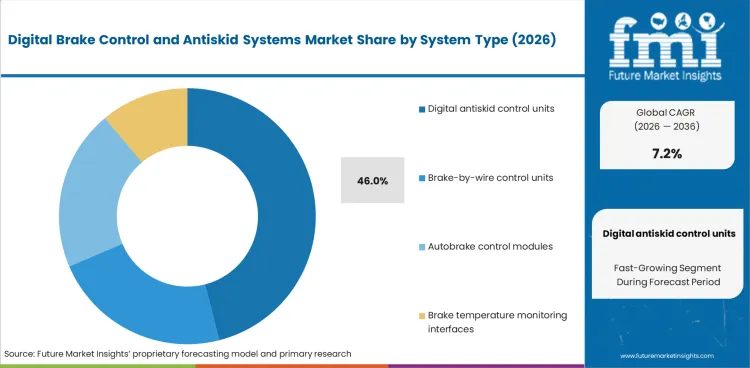
- Digital antiskid control units hold 46.0% share between 2026 to 2036. These units track wheel speed and help prevent wheel lock during landing.
- Autobrake modules help larger aircraft slow down in a controlled way after touchdown. Brake temperature monitoring interfaces help maintenance staff check heat buildup after hard stops.
Insights into Digital Brake Control and Antiskid Systems Market by Aircraft Type
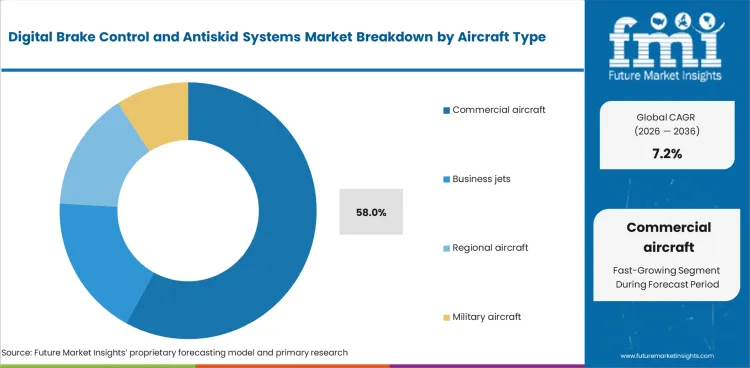
- Commercial aircraft account for 58.0% share in 2026. Airlines use these systems often because aircraft land many times each day and need regular brake checks.
- Business jets need compact control units that add less weight. Military aircraft use digital antiskid upgrades to replace older analog systems during service life extension programs.
Insights into Digital Brake Control and Antiskid Systems Market by Architecture
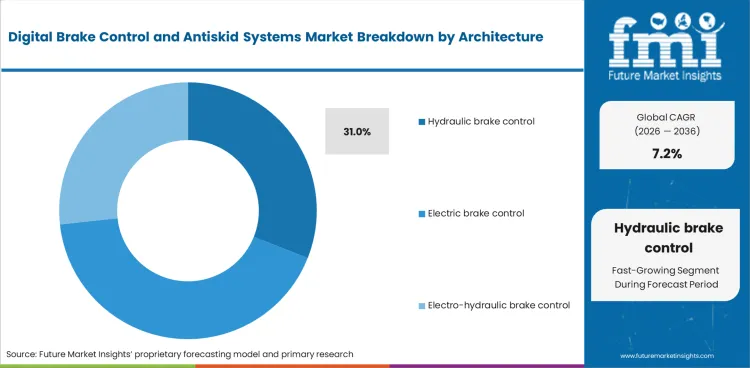
- During the assessment period, bake-by-wire systems hold 31.0% share. Electronic control helps improve fault checks and lowers reliance on hydraulic parts in newer aircraft.
- Hydraulic brake control continues across existing fleets because many aircraft still use proven brake layouts. Electro-hydraulic systems give operators a practical upgrade path during the forecast period.
Insights into Digital Brake Control and Antiskid Systems Market by Sales Channel
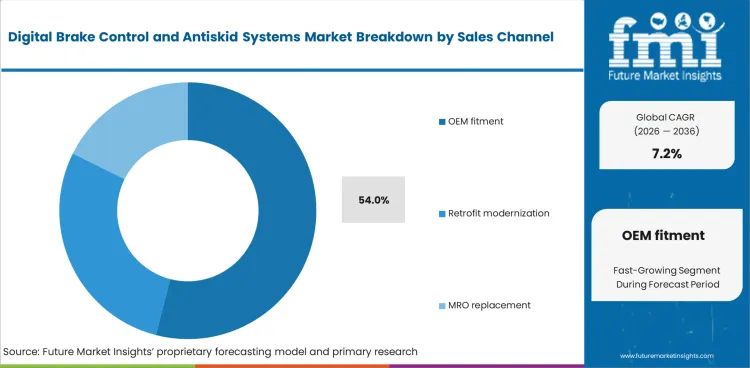
- OEM fitment stays ahead through early aircraft integration. The route holds 54.0% in the same period because brake controllers must align with aircraft design before certification is completed.
- Retrofit modernization supports older fleets with outdated analog controllers. MRO replacement demand grows with aircraft use because brake faults can affect flight availability.
Insights into Digital Brake Control and Antiskid Systems Market by End Use
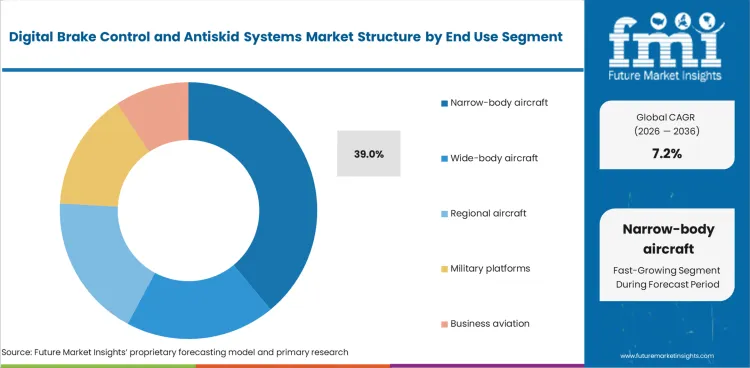
- Narrow-body aircraft hold 39.0% share by 2036 as they fly frequent short-haul routes. Repeated landings increase the need for reliable brake control electronics.
- Wide-body aircraft need more advanced braking systems because of higher aircraft weight. Regional aircraft need reliable antiskid control for short runway operations.
Digital Brake Control and Antiskid Systems Market Drivers, Restraints, and Opportunities
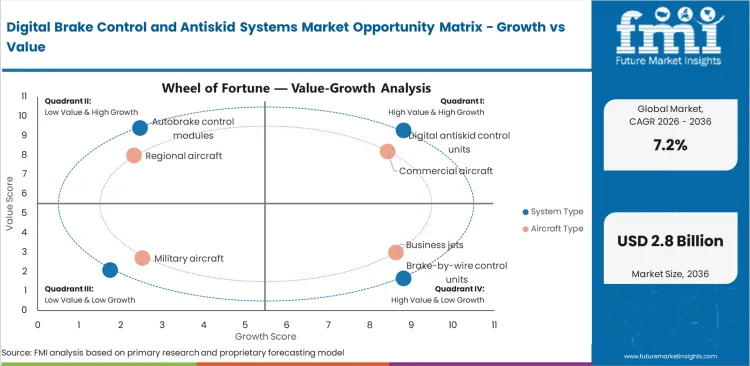
- Runway safety is increasing demand for digital antiskid control units because these systems help prevent wheel skid during landing.
- Certification and integration costs can slow adoption because older aircraft need approved brake control upgrades.
- Brake-by-wire and health monitoring create retrofit opportunities because defense fleets need safer braking and easier fault checks.
Digital Antiskid Logic Is Improving Runway Control
Modern antiskid systems monitor wheel speed during landing and reduce brake pressure when a wheel is close to skidding. Crane Aerospace & Electronics states that the control unit sends correction signals to the antiskid valve, which lowers brake pressure and helps the tire maintain runway grip. Digital control also supports built-in testing and clearer fault checks. This makes antiskid electronics important for landing performance, tire protection, and maintenance planning. Certification Cost Is Slowing Small Fleet Upgrades
Brake control electronics must meet strict aircraft safety rules before they can be installed. The eCFR requires brake assemblies to absorb stopping energy across approved stop conditions and wear levels. This means the brake system must prove that it can stop the aircraft safely under certified runway conditions. Smaller operators may delay upgrades because approved retrofit kits can be costly or slow to obtain.
Electric Braking Creates a Higher-value Upgrade Route
Electric brake control gives aircraft makers and operators a better upgrade path. Safran Landing Systems states that its control units can support hydraulic or electric braking systems. Safran also uses automated braking and proprietary antiskid algorithms in its brake control portfolio. Electric actuation supports the shift toward more electric aircraft systems. This links digital braking with aircraft electric motors demand as more aircraft functions move from hydraulic control to electric control.
Analysis of Digital Brake Control and Antiskid Systems Market by Key Countries
.webp "Top Country Growth Comparison Digital Brake Control And Antiskid Systems Market Cagr (2026 2036)")
| Country | CAGR |
|---|---|
| United States | 6.2% |
| China | 8.1% |
| India | 8.6% |
| Germany | 6.9% |
| France | 7.1% |
| Japan | 6.5% |
| United Kingdom | 6.7% |
Source: Future Market Insights, 2026.
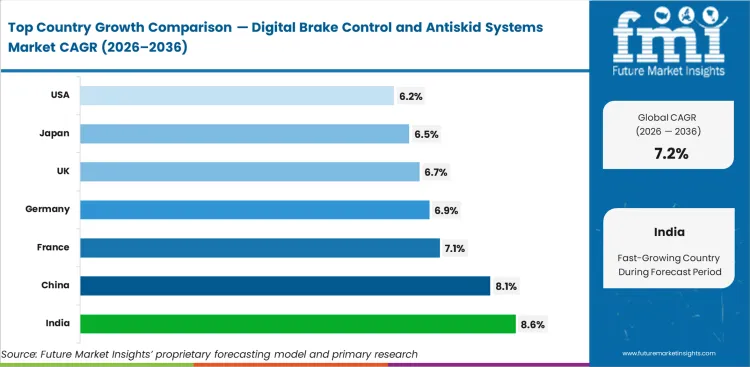
Digital Brake Control and Antiskid Systems Market CAGR Analysis by Country
- India records the fastest pace at 8.6% CAGR between 2026 and 2036 as airline capacity growth raises brake cycle intensity.
- China’s market expands at 8.1% CAGR in the forecast period as aircraft movements and transport aircraft fleets increase.
- France benefits from landing and braking system production depth, with demand rising at 7.1% CAGR by 2036.
- In Germany, aerospace suppliers serving civil and defense platforms support 6.9% CAGR during the assessment period.
- The United States grows at 6.2% CAGR as its large fleet base keeps MRO replacement active.
- The United Kingdom reaches 6.7% CAGR by 2036 as aerospace suppliers and airline maintenance demand support steady adoption.
- Demand for the global digital brake control and antiskid systems is forecast to rise at 7.2% CAGR during the forecast period.
Demand Outlook for Digital Brake Control and Antiskid Systems Market in the United States
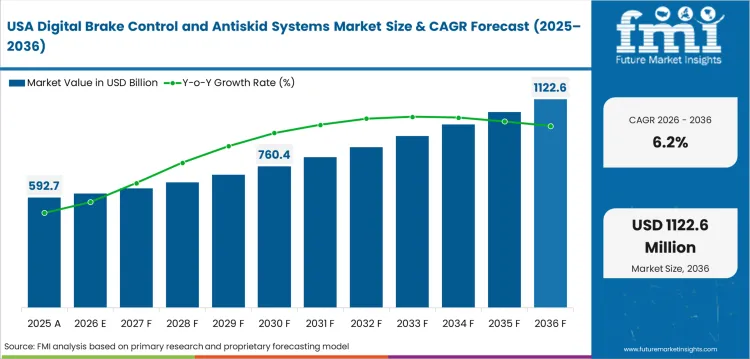
The United States is projected to grow at 6.2% CAGR through 2036 because it has a large aircraft fleet. Boeing delivered 600.0 commercial aircraft in 2025 across its main jet programs. Defense aircraft add demand for antiskid control units and brake-by-wire upgrades. Washington supports new aircraft integration. Ohio adds depth through brake system manufacturing.
- Ohio braking suppliers support wheel and brake production for civil and defense aircraft.
- Washington aircraft production keeps demand active for brake control electronics at the OEM stage.
- Texas maintenance providers need replacement controllers and brake system test support.
Sales Analysis of Digital Brake Control and Antiskid Systems Market in China
China is anticipated to grow at 8.1% CAGR during the forecast period as aircraft use increases. CAAC reported 770.1 million passenger trips in 2025. Passenger growth reached 5.5% year over year. Commercial airlines recorded 14.6 million flight hours and 5.5 million takeoffs. Higher aircraft use means more landings. This raises brake wear and increases the need for digital control units.
- Shanghai suppliers support domestic aircraft system integration.
- Xi’an aerospace activity strengthens local brake electronics capability.
- Chengdu and Tianjin create demand through airline fleet activity and maintenance capacity.
Demand Outlook for Digital Brake Control and Antiskid Systems Market in India
Fleet growth is increasing brake use in India which is likely to grow at 8.6% CAGR by 2036 as airline capacity expands. IATA recorded 3.4% growth in India’s domestic demand in January 2026. Load factor reached 87.2% in the same month. Higher aircraft use increases the need for reliable antiskid electronics and faster fault checks.
- Bengaluru suppliers can support component testing and electronics integration.
- Hyderabad maintenance activity creates demand for brake control spares and test equipment.
- Delhi airline operations need controller availability for high-cycle narrow-body fleets.
Opportunity Analysis of Digital Brake Control and Antiskid Systems Market in Germany
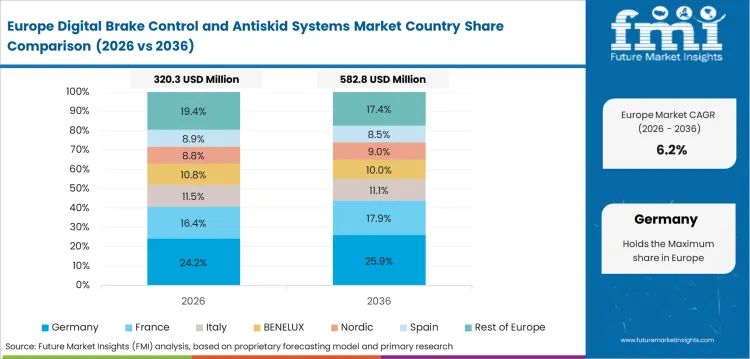
Germany is projected to grow at 6.9% CAGR during the assessment period as aerospace suppliers serve civil and defense aircraft. Destatis reported 7.8% month-on-month growth in real manufacturing orders in December 2025. Large orders lifted the monthly result. Brake electronics demand will depend on certified suppliers and qualified systems. Hamburg and Munich offer clear routes for brake control integration.
- Hamburg aircraft supply chains support brake electronics documentation and repair planning.
- Munich defense suppliers need rugged control units for military aircraft upgrades.
- Bremen aerospace activity creates demand for testing and systems engineering support.
Sales Analysis of Digital Brake Control and Antiskid Systems Market in France
France benefits from its landing and braking system base. Demand is expected to rise at 7.1% CAGR through 2036. GIFAS reported French aerospace revenue of EUR 85.6 billion in 2025. Order intake reached EUR 88.6 billion. Civil aeronautics contributed EUR 63.3 billion in revenue. Safran Landing Systems adds local strength through braking and steering control systems.
- Toulouse aircraft programs need brake control units that match certification plans.
- Molsheim landing systems activity supports braking manifolds and control hardware.
- Lyon-area carbon brake investment strengthens the wheel and brake supply base.
Future Outlook for Digital Brake Control and Antiskid Systems Market in Japan
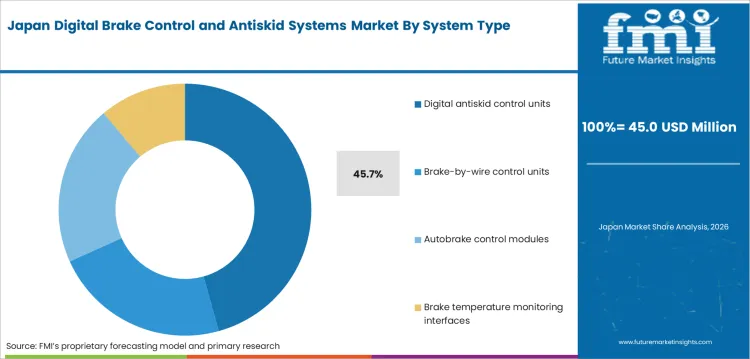
Japan is forecast to grow at 6.5% CAGR during the forecast period. Aerospace suppliers in the country focus on precision components and defense aircraft support. SJAC brings together around 130.0 companies linked to aircraft and space technologies. Brake control demand will come from imported commercial fleets and domestic defense aircraft. Tokyo operators need reliable spares and performance data before controller upgrades. Nagoya supports system qualification work.
- Nagoya suppliers support aerospace components and system qualification work.
- Tokyo airline operators need controller spares linked to fleet reliability.
- Gifu defense aviation activity supports retrofit demand for military aircraft.
Future Outlook for Digital Brake Control and Antiskid Systems Market in the United Kingdom
The United Kingdom benefits from aerospace supply chains and airport activity. UK CAA reported 302.0 million passenger journeys in 2025. Passenger journeys rose 2.0% from 2024. ADS reported 156.0 commercial aircraft orders in January 2026. Demand is projected to grow at 6.7% CAGR by 2036 as long-term order depth supports suppliers and MRO providers.
- Midlands suppliers can support brake control electronics and aircraft wiring integration.
- Bristol aerospace activity creates demand for system engineering and qualification work.
- London-area operators need maintenance access for high-cycle aircraft braking systems.
Competitive Landscape and Strategic Positioning
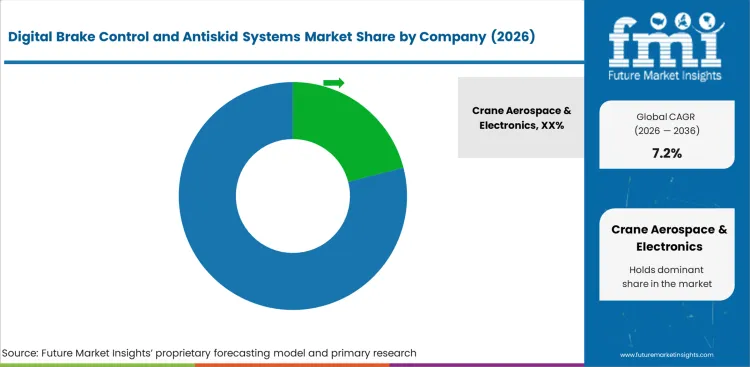
Competition is centered on certified brake control software and landing systems integration.
Brake control suppliers compete on antiskid response, autobrake functions and built-in test capability.
Wheel and brake specialists gain advantage when they package controllers with brake hardware.
Entry barriers include airworthiness approval, fault tolerance and aircraft-level validation.
Competitive positioning depends on certified braking logic. Crane Aerospace & Electronics states that its Mark IV digital antiskid system is standard equipment on current-production Boeing aircraft. The company lists Mark V brake-by-wire systems for regional and business aircraft. Crane has a clear role in the shift toward digital brake control.
Collins Aerospace has scale in wheels and brakes. RTX states that Collins wheels and brakes are installed on more than 30,000.0 commercial and military aircraft. RTX cites DURACARB technology for longer service life and lower maintenance needs. Brake hardware scale can support controller demand when aircraft programs expand.
Key Companies in the Digital Brake Control and Antiskid Systems Market
- Brake Control Specialists: Crane Aerospace & Electronics and Safran Landing Systems hold strong positions through antiskid logic, autobrake functions and brake-by-wire control.
- Integrated Wheel and Brake Suppliers: Parker Meggitt and Collins Aerospace compete through brake hardware, control interfaces and aftermarket access.
- Adjacent System Participants: Honeywell International Inc., Beringer Aero and Lufthansa Technik support adjacent braking, MRO and aircraft system needs.
Competitive Benchmarking: Digital Brake Control and Antiskid Systems Market
| Company | Brake Control Depth | Brake Hardware Integration | Certification Support | Geographic Footprint |
|---|---|---|---|---|
| Crane Aerospace & Electronics | High | Medium | High | Global with USA strength |
| Safran Landing Systems | High | High | High | Global with French production depth |
| Parker Meggitt | High | High | Medium | Europe and North America centered |
| Collins Aerospace | Medium | High | Medium | Global with USA production depth |
| Honeywell International Inc. | Medium | Medium | Medium | Global aerospace systems base |
| Beringer Aero | Low | Medium | Low | Europe and general aviation focused |
| Lufthansa Technik AG | Low | Medium | Medium | Europe centered MRO network |
Source: Future Market Insights competitive analysis, 2026.
Key Developments in Digital Brake Control and Antiskid Systems Market
- In April 2025, AAR CORP completed the sale of its Landing Gear Overhaul business to GA Telesis for USD 51 million. The deal is adjacent to the market because landing gear MRO consolidation can affect wheel and control-system service channels.
- In November 2025, Lufthansa Technik and Etihad Airways formed a strategic MRO partnership covering A380 landing gear services and wider component support. The development is adjacent to digital brake control demand as landing gear maintenance creates service touchpoints for braking-system inspection and related electronics checks.
Key Players in the Digital Brake Control and Antiskid Systems Market
Major Global Players
- Crane Aerospace & Electronics
- Safran Landing Systems
- Parker Meggitt
- Collins Aerospace
- Honeywell International Inc.
Specialist and Regional Players
- Beringer Aero
- Lufthansa Technik AG
- AAR Corp.
Report Scope and Coverage
| Parameter | Details |
|---|---|
| Quantitative Units | USD 1.4 billion to USD 2.8 billion at 7.2% CAGR |
| Market Definition | Digital aircraft brake control electronics used for antiskid braking and brake pressure control |
| Regions Covered | North America, Latin America, Western Europe, Eastern Europe, East Asia, South Asia and Pacific, Middle East and Africa |
| Countries Covered | United States, China, India, Germany, France, Japan, United Kingdom and more than thirty countries |
| Key Companies Profiled | Crane Aerospace & Electronics, Safran Landing Systems, Parker Meggitt, Collins Aerospace,, Beringer Aero |
| Forecast Period | 2026 to 2036 |
| Approach | Hybrid bottom-up and top-down methodology using supplied values, fleet data, brake control adoption and supplier activity |
Source: Future Market Insights, 2026.
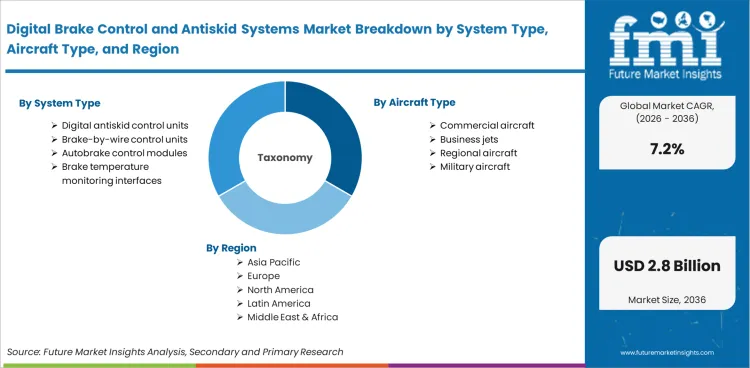
Digital Brake Control and Antiskid Systems Market Breakdown by System Type, Aircraft Type, Architecture, Sales Channel, End Use, and Region
Digital Brake Control and Antiskid Systems Market Segmented by System Type
- Digital antiskid control units
- Brake-by-wire control units
- Autobrake control modules
- Brake temperature monitoring interfaces
Digital Brake Control and Antiskid Systems Market Segmented by Aircraft Type
- Commercial aircraft
- Business jets
- Regional aircraft
- Military aircraft
Digital Brake Control and Antiskid Systems Market Segmented by Architecture
- Hydraulic brake control
- Electric brake control
- Electro-hydraulic brake control
Digital Brake Control and Antiskid Systems Market Segmented by Sales Channel
- OEM fitment
- Retrofit modernization
- MRO replacement
Digital Brake Control and Antiskid Systems Market Segmented by End Use
- Narrow-body aircraft
- Wide-body aircraft
- Regional aircraft
- Military platforms
- Business aviation
Digital Brake Control and Antiskid Systems Market by Region
-
- North America
- United States
- Canada
- Mexico
- Latin America
- Brazil
- Chile
- Rest of Latin America
- Western Europe
- Germany
- United Kingdom
- Italy
- Spain
- France
- Nordic
- BENELUX
- Rest of Western Europe
- Eastern Europe
- Russia
- Poland
- Hungary
- Balkan and Baltic
- Rest of Eastern Europe
- East Asia
- China
- Japan
- South Korea
- South Asia and Pacific
- India
- ASEAN
- Australia and New Zealand
- Rest of South Asia and Pacific
- Middle East and Africa
- Kingdom of Saudi Arabia
- Other GCC Countries
- Turkiye
- South Africa
- Other African Union
- Rest of Middle East and Africa
- North America
Research Sources and Bibliography
- AAR CORP. (2025, April 1). AAR completes sale of landing gear overhaul business. AAR CORP. https://www.aarcorp.com/en/newsroom/press-releases/2025/aar-completes-sale-of-landing-gear-overhaul-business/
- Lufthansa Technik AG. (2025, November 17). Etihad Airways and Lufthansa Technik form strategic MRO partnership. Lufthansa Technik. https://www.lufthansa-technik.com/en/new-cooperations-across-a-multitude-of-fields-etihad-airways-and-lufthansa-technik-form-strategic-mro-partnership-2f8168fd18a92d17
- Meggitt PLC. (Retrieved 2026, May 15). Brake control systems for aerospace and defence. Meggitt. https://www.meggitt.com/products-services/brake-control-systems/
- RTX. (2026, January 21). RTX’s Collins Aerospace signs three-year parts distribution agreements for C-130 wheels and brakes. RTX. https://www.rtx.com/news/news-center/2026/01/21/rtxs-collins-aerospace-signs-three-year-parts-distribution-agreements-for-c-130
- Electronic Code of Federal Regulations. (Retrieved 2026, May 15). 14 CFR § 25.735 - Brakes and braking systems. National Archives and Records Administration. https://www.ecfr.gov/current/title-14/chapter-I/subchapter-C/part-25/subpart-D/subject-group-ECFR495a8df09c94c2f/section-25.735
- Crane Aerospace & Electronics. (Retrieved 2026, May 15). Brake control overview. Crane Aerospace & Electronics. https://www.craneae.com/brake-control-overview
- Crane Aerospace & Electronics. (Retrieved 2026, May 15). Antiskid systems. Crane Aerospace & Electronics. https://www.craneae.com/antiskid-systems
- Safran Group. (Retrieved 2026, May 15). ATA 32 landing, braking and steering control systems. Safran Group. https://www.safran-group.com/products-services/landing-braking-and-steering-control-systems
- International Air Transport Association. (2026, March 2). 2026 begins with 3.8% air passenger demand growth. International Air Transport Association. https://www.iata.org/en/pressroom/2026-releases/2026-03-02-02/
- The Boeing Company. (2026, January 13). Boeing announces fourth quarter deliveries. The Boeing Company. https://investors.boeing.com/investors/news/press-release-details/2026/Boeing-Announces-Fourth-Quarter-Deliveries/default.aspx
- Civil Aviation Administration of China. (2026, April 22). CAAC releases statistical bulletin of civil aviation industry development in 2025. Civil Aviation Administration of China. https://www.caac.gov.cn/English/News/202604/t20260422_230642.html
- Federal Statistical Office. (2026, February 5). New orders in manufacturing in December 2025: +7.8% on the previous month. Destatis. https://www.destatis.de/EN/Press/2026/02/PE26_041_421.html
- Groupement des Industries Françaises Aéronautiques et Spatiales. (2026, May 12). 2025 results: The French aerospace industry remains strongly positioned for the future. GIFAS. https://www.gifas.fr/en/news/the-french-aerospace-industry-remains-strongly-positioned-for-the-future-2025-results
- The Society of Japanese Aerospace Companies. (Retrieved 2026, May 15). The Society of Japanese Aerospace Companies. The Society of Japanese Aerospace Companies. https://www.sjac.or.jp/en/top/
- UK Civil Aviation Authority. (2026, February 24). UK aviation officially breaks records with over 300m passenger journeys in 2025. UK Civil Aviation Authority. https://www.caa.co.uk/newsroom/news/uk-aviation-officially-breaks-records-with-over-300m-passenger-journeys-in-2025/
- ADS Group. (2026, February 26). Record start to 2026 as aircraft orders hit six-year high. ADS Group. https://www.adsgroup.org.uk/knowledge/record-start-to-2026-as-aircraft-orders-hit-six-year-high/
This Report Answers
What is the current and future size of the digital brake control and antiskid systems market?
How fast will the digital brake control and antiskid systems market expand during the assessment period?
Which system type is forecast to lead digital brake control and antiskid systems demand by 2026?
Which aircraft type creates the main demand base for digital brake control and antiskid systems?
How do antiskid requirements and runway stopping rules affect system adoption?
Which countries are forecast to record faster expansion during the forecast period?
How does OEM fitment influence digital brake control and antiskid systems revenue?
How does brake temperature monitoring improve fleet maintenance quality?
Who are the main companies active in digital brake control and antiskid systems?
How does FMI estimate and validate the digital brake control and antiskid systems forecast?
Frequently Asked Questions
What is the global market demand for Digital Brake Control and Antiskid Systems in 2026?
In 2026, the global digital brake control and antiskid systems market is modeled at USD 1.4 billion as OEM fitment widens.
How big will the Digital Brake Control and Antiskid Systems Market be in 2036?
By 2036, the digital brake control and antiskid systems market is forecast to reach USD 2.8 billion as retrofit demand expands.
How much will Digital Brake Control and Antiskid Systems demand grow during the forecast period?
Digital brake control and antiskid systems demand is modeled to expand at 7.2% CAGR during the assessment period.
Which system type is forecast to lead the Digital Brake Control and Antiskid Systems Market in 2026?
Digital antiskid control units are forecast to lead with 46.0% share in 2026 due to wheel-speed control needs.
Which sales channel is forecast to lead Digital Brake Control and Antiskid Systems demand?
OEM fitment is forecast to lead with 54.0% share in 2026 because brake control electronics need aircraft-level certification.
Which country will grow fastest in the Digital Brake Control and Antiskid Systems Market?
India is forecast to post 8.6% CAGR through 2036 as fleet growth and domestic air traffic raise brake control demand.
What does the Digital Brake Control and Antiskid Systems Market include?
The market includes antiskid control units, brake-by-wire controllers, autobrake modules and brake temperature monitoring interfaces used in aircraft.
How does FMI estimate the Digital Brake Control and Antiskid Systems Market forecast?
FMI uses market anchors, fleet data, aircraft deliveries, brake control adoption and supplier activity to validate the forecast.
Why are antiskid systems important in aircraft braking?
Antiskid systems reduce locked-wheel risk by adjusting brake pressure based on wheel speed and runway condition signals.
Are digital brake control systems used in military aircraft?
Yes. Military aircraft use digital brake control systems for upgrade programs, runway control and legacy analog controller replacement.
Preview the report firsthand - request a free sample
Get SampleGet the brochure for pricing and purchase details.
Get PDFTable of Content
- Executive Summary
- Global Market Outlook
- Demand-side Trends
- Supply-side Trends
- Technology Roadmap Analysis
- Analysis and Recommendations
- Market Overview
- Market Coverage / Taxonomy
- Market Definition / Scope / Limitations
- Research Methodology
- Chapter Orientation
- Analytical Lens and Working Hypotheses
- Market Structure, Signals, and Trend Drivers
- Benchmarking and Cross-market Comparability
- Market Sizing, Forecasting, and Opportunity Mapping
- Research Design and Evidence Framework
- Desk Research Programme (Secondary Evidence)
- Company Annual and Sustainability Reports
- Peer-reviewed Journals and Academic Literature
- Corporate Websites, Product Literature, and Technical Notes
- Earnings Decks and Investor Briefings
- Statutory Filings and Regulatory Disclosures
- Technical White Papers and Standards Notes
- Trade Journals, Industry Magazines, and Analyst Briefs
- Conference Proceedings, Webinars, and Seminar Materials
- Government Statistics Portals and Public Data Releases
- Press Releases and Reputable Media Coverage
- Specialist Newsletters and Curated Briefings
- Sector Databases and Reference Repositories
- FMI Internal Proprietary Databases and Historical Market Datasets
- Subscription Datasets and Paid Sources
- Social Channels, Communities, and Digital Listening Inputs
- Additional Desk Sources
- Expert Input and Fieldwork (Primary Evidence)
- Primary Modes
- Qualitative Interviews and Expert Elicitation
- Quantitative Surveys and Structured Data Capture
- Blended Approach
- Why Primary Evidence is Used
- Field Techniques
- Interviews
- Surveys
- Focus Groups
- Observational and In-context Research
- Social and Community Interactions
- Stakeholder Universe Engaged
- C-suite Leaders
- Board Members
- Presidents and Vice Presidents
- R&D and Innovation Heads
- Technical Specialists
- Domain Subject-matter Experts
- Scientists
- Physicians and Other Healthcare Professionals
- Governance, Ethics, and Data Stewardship
- Research Ethics
- Data Integrity and Handling
- Primary Modes
- Opportunity
- Trends
- Desk Research Programme (Secondary Evidence)
- Scenario Forecast
- Demand in Optimistic Scenario
- Demand in Likely Scenario
- Demand in Conservative Scenario
- Opportunity Map Analysis
- Product Life Cycle Analysis
- Supply Chain Analysis
- Investment Feasibility Matrix
- Value Chain Analysis
- PESTLE and Porter’s Analysis
- Regulatory Landscape
- Regional Parent Market Outlook
- Production and Consumption Statistics
- Import and Export Statistics
- Global Market Analysis 2021 to 2025 and Forecast, 2026 to 2036
- Historical Market Size Value (USD Million) Analysis, 2021 to 2025
- Current and Future Market Size Value (USD Million) Projections, 2026 to 2036
- Y-o-Y Growth Trend Analysis
- Absolute $ Opportunity Analysis
- Global Market Pricing Analysis 2021 to 2025 and Forecast 2026 to 2036
- Global Market Analysis 2021 to 2025 and Forecast 2026 to 2036, By System Type
- Introduction / Key Findings
- Historical Market Size Value (USD Million) Analysis By System Type , 2021 to 2025
- Current and Future Market Size Value (USD Million) Analysis and Forecast By System Type , 2026 to 2036
- Digital antiskid control units
- Brake-by-wire control units
- Autobrake control modules
- Brake temperature monitoring interfaces
- Digital antiskid control units
- Y-o-Y Growth Trend Analysis By System Type , 2021 to 2025
- Absolute $ Opportunity Analysis By System Type , 2026 to 2036
- Global Market Analysis 2021 to 2025 and Forecast 2026 to 2036, By Aircraft Type
- Introduction / Key Findings
- Historical Market Size Value (USD Million) Analysis By Aircraft Type, 2021 to 2025
- Current and Future Market Size Value (USD Million) Analysis and Forecast By Aircraft Type, 2026 to 2036
- Commercial aircraft
- Business jets
- Regional aircraft
- Military aircraft
- Commercial aircraft
- Y-o-Y Growth Trend Analysis By Aircraft Type, 2021 to 2025
- Absolute $ Opportunity Analysis By Aircraft Type, 2026 to 2036
- Global Market Analysis 2021 to 2025 and Forecast 2026 to 2036, By Architecture
- Introduction / Key Findings
- Historical Market Size Value (USD Million) Analysis By Architecture, 2021 to 2025
- Current and Future Market Size Value (USD Million) Analysis and Forecast By Architecture, 2026 to 2036
- Hydraulic brake control
- Electric brake control
- Electro-hydraulic brake control
- Hydraulic brake control
- Y-o-Y Growth Trend Analysis By Architecture, 2021 to 2025
- Absolute $ Opportunity Analysis By Architecture, 2026 to 2036
- Global Market Analysis 2021 to 2025 and Forecast 2026 to 2036, By Sales Channel
- Introduction / Key Findings
- Historical Market Size Value (USD Million) Analysis By Sales Channel, 2021 to 2025
- Current and Future Market Size Value (USD Million) Analysis and Forecast By Sales Channel, 2026 to 2036
- OEM fitment
- Retrofit modernization
- MRO replacement
- OEM fitment
- Y-o-Y Growth Trend Analysis By Sales Channel, 2021 to 2025
- Absolute $ Opportunity Analysis By Sales Channel, 2026 to 2036
- Global Market Analysis 2021 to 2025 and Forecast 2026 to 2036, By End Use
- Introduction / Key Findings
- Historical Market Size Value (USD Million) Analysis By End Use, 2021 to 2025
- Current and Future Market Size Value (USD Million) Analysis and Forecast By End Use, 2026 to 2036
- Narrow-body aircraft
- Wide-body aircraft
- Regional aircraft
- Military platforms
- Business aviation
- Narrow-body aircraft
- Y-o-Y Growth Trend Analysis By End Use, 2021 to 2025
- Absolute $ Opportunity Analysis By End Use, 2026 to 2036
- Global Market Analysis 2021 to 2025 and Forecast 2026 to 2036, By Region
- Introduction
- Historical Market Size Value (USD Million) Analysis By Region, 2021 to 2025
- Current Market Size Value (USD Million) Analysis and Forecast By Region, 2026 to 2036
- North America
- Latin America
- Western Europe
- Eastern Europe
- East Asia
- South Asia and Pacific
- Middle East & Africa
- Market Attractiveness Analysis By Region
- North America Market Analysis 2021 to 2025 and Forecast 2026 to 2036, By Country
- Historical Market Size Value (USD Million) Trend Analysis By Market Taxonomy, 2021 to 2025
- Market Size Value (USD Million) Forecast By Market Taxonomy, 2026 to 2036
- By Country
- USA
- Canada
- Mexico
- By System Type
- By Aircraft Type
- By Architecture
- By Sales Channel
- By End Use
- By Country
- Market Attractiveness Analysis
- By Country
- By System Type
- By Aircraft Type
- By Architecture
- By Sales Channel
- By End Use
- Key Takeaways
- Latin America Market Analysis 2021 to 2025 and Forecast 2026 to 2036, By Country
- Historical Market Size Value (USD Million) Trend Analysis By Market Taxonomy, 2021 to 2025
- Market Size Value (USD Million) Forecast By Market Taxonomy, 2026 to 2036
- By Country
- Brazil
- Chile
- Rest of Latin America
- By System Type
- By Aircraft Type
- By Architecture
- By Sales Channel
- By End Use
- By Country
- Market Attractiveness Analysis
- By Country
- By System Type
- By Aircraft Type
- By Architecture
- By Sales Channel
- By End Use
- Key Takeaways
- Western Europe Market Analysis 2021 to 2025 and Forecast 2026 to 2036, By Country
- Historical Market Size Value (USD Million) Trend Analysis By Market Taxonomy, 2021 to 2025
- Market Size Value (USD Million) Forecast By Market Taxonomy, 2026 to 2036
- By Country
- Germany
- UK
- Italy
- Spain
- France
- Nordic
- BENELUX
- Rest of Western Europe
- By System Type
- By Aircraft Type
- By Architecture
- By Sales Channel
- By End Use
- By Country
- Market Attractiveness Analysis
- By Country
- By System Type
- By Aircraft Type
- By Architecture
- By Sales Channel
- By End Use
- Key Takeaways
- Eastern Europe Market Analysis 2021 to 2025 and Forecast 2026 to 2036, By Country
- Historical Market Size Value (USD Million) Trend Analysis By Market Taxonomy, 2021 to 2025
- Market Size Value (USD Million) Forecast By Market Taxonomy, 2026 to 2036
- By Country
- Russia
- Poland
- Hungary
- Balkan & Baltic
- Rest of Eastern Europe
- By System Type
- By Aircraft Type
- By Architecture
- By Sales Channel
- By End Use
- By Country
- Market Attractiveness Analysis
- By Country
- By System Type
- By Aircraft Type
- By Architecture
- By Sales Channel
- By End Use
- Key Takeaways
- East Asia Market Analysis 2021 to 2025 and Forecast 2026 to 2036, By Country
- Historical Market Size Value (USD Million) Trend Analysis By Market Taxonomy, 2021 to 2025
- Market Size Value (USD Million) Forecast By Market Taxonomy, 2026 to 2036
- By Country
- China
- Japan
- South Korea
- By System Type
- By Aircraft Type
- By Architecture
- By Sales Channel
- By End Use
- By Country
- Market Attractiveness Analysis
- By Country
- By System Type
- By Aircraft Type
- By Architecture
- By Sales Channel
- By End Use
- Key Takeaways
- South Asia and Pacific Market Analysis 2021 to 2025 and Forecast 2026 to 2036, By Country
- Historical Market Size Value (USD Million) Trend Analysis By Market Taxonomy, 2021 to 2025
- Market Size Value (USD Million) Forecast By Market Taxonomy, 2026 to 2036
- By Country
- India
- ASEAN
- Australia & New Zealand
- Rest of South Asia and Pacific
- By System Type
- By Aircraft Type
- By Architecture
- By Sales Channel
- By End Use
- By Country
- Market Attractiveness Analysis
- By Country
- By System Type
- By Aircraft Type
- By Architecture
- By Sales Channel
- By End Use
- Key Takeaways
- Middle East & Africa Market Analysis 2021 to 2025 and Forecast 2026 to 2036, By Country
- Historical Market Size Value (USD Million) Trend Analysis By Market Taxonomy, 2021 to 2025
- Market Size Value (USD Million) Forecast By Market Taxonomy, 2026 to 2036
- By Country
- Kingdom of Saudi Arabia
- Other GCC Countries
- Turkiye
- South Africa
- Other African Union
- Rest of Middle East & Africa
- By System Type
- By Aircraft Type
- By Architecture
- By Sales Channel
- By End Use
- By Country
- Market Attractiveness Analysis
- By Country
- By System Type
- By Aircraft Type
- By Architecture
- By Sales Channel
- By End Use
- Key Takeaways
- Key Countries Market Analysis
- USA
- Pricing Analysis
- Market Share Analysis, 2025
- By System Type
- By Aircraft Type
- By Architecture
- By Sales Channel
- By End Use
- Canada
- Pricing Analysis
- Market Share Analysis, 2025
- By System Type
- By Aircraft Type
- By Architecture
- By Sales Channel
- By End Use
- Mexico
- Pricing Analysis
- Market Share Analysis, 2025
- By System Type
- By Aircraft Type
- By Architecture
- By Sales Channel
- By End Use
- Brazil
- Pricing Analysis
- Market Share Analysis, 2025
- By System Type
- By Aircraft Type
- By Architecture
- By Sales Channel
- By End Use
- Chile
- Pricing Analysis
- Market Share Analysis, 2025
- By System Type
- By Aircraft Type
- By Architecture
- By Sales Channel
- By End Use
- Germany
- Pricing Analysis
- Market Share Analysis, 2025
- By System Type
- By Aircraft Type
- By Architecture
- By Sales Channel
- By End Use
- UK
- Pricing Analysis
- Market Share Analysis, 2025
- By System Type
- By Aircraft Type
- By Architecture
- By Sales Channel
- By End Use
- Italy
- Pricing Analysis
- Market Share Analysis, 2025
- By System Type
- By Aircraft Type
- By Architecture
- By Sales Channel
- By End Use
- Spain
- Pricing Analysis
- Market Share Analysis, 2025
- By System Type
- By Aircraft Type
- By Architecture
- By Sales Channel
- By End Use
- France
- Pricing Analysis
- Market Share Analysis, 2025
- By System Type
- By Aircraft Type
- By Architecture
- By Sales Channel
- By End Use
- India
- Pricing Analysis
- Market Share Analysis, 2025
- By System Type
- By Aircraft Type
- By Architecture
- By Sales Channel
- By End Use
- ASEAN
- Pricing Analysis
- Market Share Analysis, 2025
- By System Type
- By Aircraft Type
- By Architecture
- By Sales Channel
- By End Use
- Australia & New Zealand
- Pricing Analysis
- Market Share Analysis, 2025
- By System Type
- By Aircraft Type
- By Architecture
- By Sales Channel
- By End Use
- China
- Pricing Analysis
- Market Share Analysis, 2025
- By System Type
- By Aircraft Type
- By Architecture
- By Sales Channel
- By End Use
- Japan
- Pricing Analysis
- Market Share Analysis, 2025
- By System Type
- By Aircraft Type
- By Architecture
- By Sales Channel
- By End Use
- South Korea
- Pricing Analysis
- Market Share Analysis, 2025
- By System Type
- By Aircraft Type
- By Architecture
- By Sales Channel
- By End Use
- Russia
- Pricing Analysis
- Market Share Analysis, 2025
- By System Type
- By Aircraft Type
- By Architecture
- By Sales Channel
- By End Use
- Poland
- Pricing Analysis
- Market Share Analysis, 2025
- By System Type
- By Aircraft Type
- By Architecture
- By Sales Channel
- By End Use
- Hungary
- Pricing Analysis
- Market Share Analysis, 2025
- By System Type
- By Aircraft Type
- By Architecture
- By Sales Channel
- By End Use
- Kingdom of Saudi Arabia
- Pricing Analysis
- Market Share Analysis, 2025
- By System Type
- By Aircraft Type
- By Architecture
- By Sales Channel
- By End Use
- Turkiye
- Pricing Analysis
- Market Share Analysis, 2025
- By System Type
- By Aircraft Type
- By Architecture
- By Sales Channel
- By End Use
- South Africa
- Pricing Analysis
- Market Share Analysis, 2025
- By System Type
- By Aircraft Type
- By Architecture
- By Sales Channel
- By End Use
- USA
- Market Structure Analysis
- Competition Dashboard
- Competition Benchmarking
- Market Share Analysis of Top Players
- By Regional
- By System Type
- By Aircraft Type
- By Architecture
- By Sales Channel
- By End Use
- Competition Analysis
- Competition Deep Dive
- Crane Aerospace & Electronics
- Overview
- Product Portfolio
- Profitability by Market Segments (Product/Age /Sales Channel/Region)
- Sales Footprint
- Strategy Overview
- Marketing Strategy
- Product Strategy
- Channel Strategy
- Safran Landing Systems
- Parker Meggitt
- Collins Aerospace
- Honeywell International Inc.
- Beringer Aero
- Lufthansa Technik AG
- Crane Aerospace & Electronics
- Competition Deep Dive
- Assumptions & Acronyms Used


