

- Market Size (2026)
- USD 0.6 Bn
- Forecast (2036)
- USD 1.3 Bn
- CAGR (2026 to 2036)
- 8.0%
Steer-By-Wire and Brake-By-Wire HMI Controller Systems Market Size, Market Forecast and Outlook By FMI
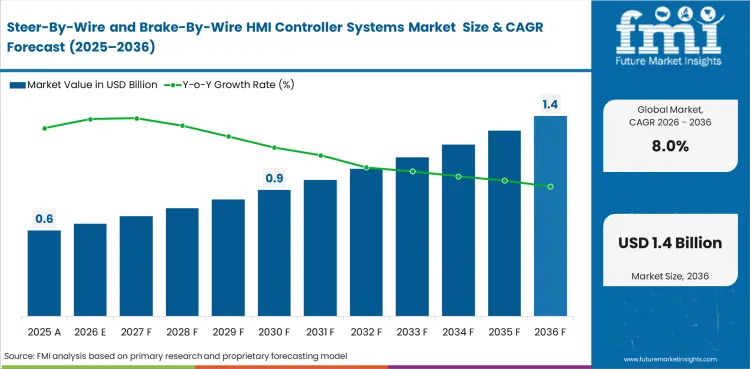
The steer-by-wire and brake-by-wire HMI controller systems market was valued at USD 0.5 billion in 2025 and is estimated to cross 0.6 billion in 2026. Revenue is projected to reach 1.3 billion by 2036 at a CAGR of 8.0%. OEM fitment is estimated to represent 84.0% of 2026 demand. Brake-by-Wire is projected to account for 76.0% of system demand in 2026.
Summary of the Steer-By-Wire and Brake-By-Wire HMI Controller Systems Market
- Demand and Growth Drivers
- Electric car sales exceeded 17 million in 2024 and passed a 20% sales share, which lifts demand for decoupled braking controls and new cockpit packaging.
- UNECE work on full power steering provisions and early serial launches in Lexus RZ and NIO ET9 support real program movement for steer-by-wire interfaces.
- Bosch expects more than 5.5 million vehicles to carry its brake-by-wire system by 2030, which supports a broader supplier order base for controller modules.
- Product and Segment View
- Brake-by-Wire leads system demand with a 76.0% 2026 share as pedal-side electronics reach production long before full linkless steering.
- Pedal Controllers are estimated to capture 54.0% of 2026 revenue and Passenger Cars are projected to hold 71.0% share.
- Scope includes force feedback and signal processing hardware connected with broader automotive human-machine interface (HMI) programs.
- Geography and Competitive Outlook
- China leads with a 10.1% CAGR while Japan and South Korea follow due to EV scale and local steering suppliers.
- ZF Bosch Nexteer JTEKT and Hyundai Mobis hold strong current positions across integrated by-wire chassis programs.
- Competitive intensity is moderate today, and qualification depth and fail-safe design keep entry barriers high for new controller suppliers.
- Analyst Opinion
- Nikhil Kaitwade, Principal Consultant at FMI says, “Demand is moving from premium programs into broader chassis electronics sourcing. Brake input modules are projected to scale first, while steer input modules follow as OEM confidence improves. Suppliers with steering expertise and brake software integration are best placed for future by-wire programs.”
- Steer-By-Wire and Brake-By-Wire HMI Controller Systems Market Value Analysis
- Early revenue came from premium EV programs and advanced chassis pilots.
- Current demand is lifted by pedal decoupling in EV architectures and higher software content inside chassis control.
- Steering-side demand is smaller today, and serial launches in 2025 moved the segment into concept status.
- OEM sourcing is dominant since controller feel and redundancy must clear full vehicle validation before start of production.
Key Takeaways
- The steer-by-wire and brake-by-wire HMI controller systems market reached an estimated USD 0.5 billion in 2025.
- Total market value is projected to reach 1.3 billion by 2036 under broader by-wire adoption across premium EV and software-defined vehicle programs.
- Demand is forecast to expand at a CAGR of 8.0% from 2026 to 2036.
- The incremental opportunity between 2026 and 2036 is estimated at USD 0.7 billion.
- OEM fitment is expected to hold 84.0% share in 2026 as safety validation keeps sourcing inside vehicle development programs.
- China at 10.1% and Japan at 9.4% are expected to record the fastest national expansion through 2036.
Steer-By-Wire and Brake-By-Wire HMI Controller Systems Market Definition
This market includes driver input controllers used in linkless steering and decoupled braking systems. Scope covers steering wheel or yoke input modules, pedal feel controllers, force feedback units, signal processing hardware, and safety backup elements placed on the driver input side. Use stays centered on passenger vehicles and high-value commercial programs with advanced chassis electronics.
Steer-By-Wire and Brake-By-Wire HMI Controller Systems Market Inclusions
Coverage includes OEM-fit steering input controllers, brake pedal simulator controllers, redundant signal modules, force feedback devices, and associated interface electronics used in production vehicles. Revenue includes software-loaded controller hardware and backup power support connected with by-wire steering or braking interfaces. Demand connected with the larger x-by-wire field is included only on the cockpit input side.
Steer-By-Wire and Brake-By-Wire HMI Controller Systems Market Exclusions
Scope excludes steering racks, brake calipers, full chassis domain controllers, wheel-end actuators, suspension modules, and generic cockpit displays sold without by-wire control functionality. Conventional EPS wheels and standard hydraulic brake pedals stay outside coverage unless a by-wire HMI control layer is present.
Steer-By-Wire and Brake-By-Wire HMI Controller Systems Market Research Methodology
- Primary Research: Analysis used public OEM launch disclosures and supplier program updates across North America, Europe, Japan, South Korea, and China.
- Desk Research: Core inputs included OICA vehicle sales and production data, IEA electric car data, UNECE steering documentation, and country association releases.
- Market Sizing and Forecasting: Revenue was modelled from expected by-wire vehicle fitment and estimated controller content per vehicle across steering and braking input modules.
- Data Validation: Model outputs were checked against public serial launches, supplier order books, and national vehicle demand patterns across the seven priority countries.
Why is the Steer-By-Wire and Brake-By-Wire HMI Controller Systems Market Growing?
- EV platform expansion is raising use of decoupled brake controls and digital cockpit layouts.
- Software-defined vehicle programs need richer control layers for steering feel and braking feel tuning.
- Regional approval progress is lowering launch risk for linkless steering systems.
Electric vehicle adoption is expanding the addressable base for by-wire input electronics. China alone sold more than 11 million electric cars during 2024. Europe held near a 20% share and the United States moved past one in ten sales. Such figures support larger pedal decoupling and richer control calibration inside automotive brake system programs.
Steer-side expansion is following a slower path due to tougher validation and regulatory work. Serial programs are now visible in the Lexus RZ and NIO ET9. UNECE working documents during 2024 and 2025 focused on clarifying provisions for full power steering systems such as steer-by-wire. Public movement from regulation and production launches changes sourcing behavior in favor of controller modules with backup power and redundant sensing.
Market Segmentation Analysis
- Brake-by-Wire is estimated to account for 76.0% share in 2026 due to faster production rollout across EV and hybrid platforms.
- Passenger Cars are projected to represent 71.0% of 2026 demand due to premium EV launches and richer cockpit electronics.
- Electro-Hydraulic layouts are expected to capture 58.0% share in 2026 under current brake system industrialization patterns.
- Pedal Controllers are projected to hold 54.0% share in 2026 as braking interfaces enter volume programs before linkless steering wheels.
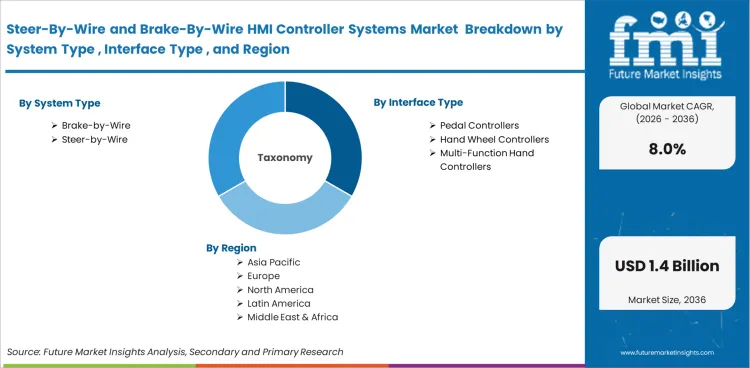
The market for steer-by-wire and brake-by-wire HMI controller systems is divided into groups based on system type, interface type, vehicle type, architecture, propulsion, sales channel, and region. There are brake-by-wire and steer-by-wire under system type. By interface type, the market includes pedal controllers, hand wheel controllers, and multi-function hand controllers. By vehicle type, the market covers passenger cars, light commercial vehicles, and heavy commercial vehicles. Based on architecture, it includes electro-hydraulic, electro-mechanical, and hybrid redundant systems. By propulsion, the market includes battery electric vehicles, hybrid electric vehicles, and internal combustion vehicles. By sales channel, the market is segmented into OEM fitment and aftermarket.
Insights into the System Type Segment
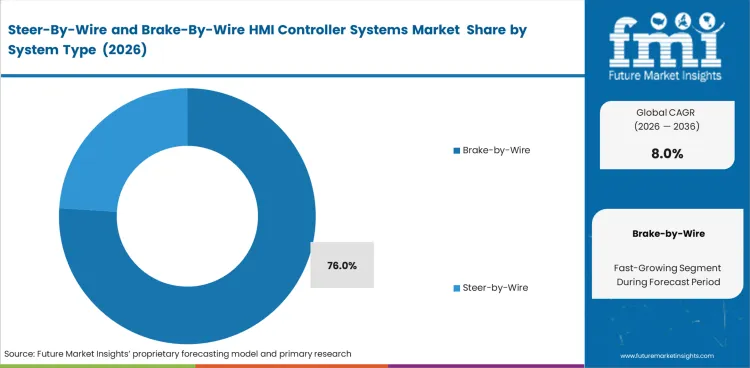
- Brake-By-Wire is expected to account for 76% share in 2026. Earlier serial adoption across decoupled braking programs supports larger near-term demand for pedal feel control and redundant input electronics.
- Brake-side sourcing is larger across this market as OEM validation paths are shorter and integration with regenerative braking is entering more passenger vehicle programs.
Insights into the Interface Type Segment
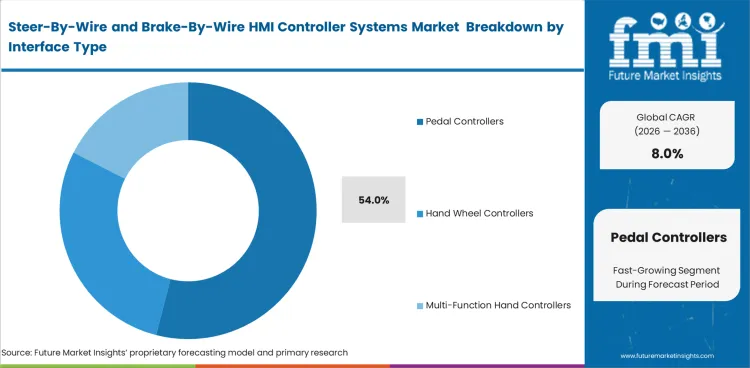
- Pedal Controllers are projected to contribute 54% of total demand in 2026. Larger deployment across brake-by-wire systems supports broader use across electrified passenger vehicle platforms.
- Pedal-side modules move into production faster across this market as brake feel simulation and redundancy management are now part of larger chassis electronics sourcing programs.
Insights into the Vehicle Type Segment
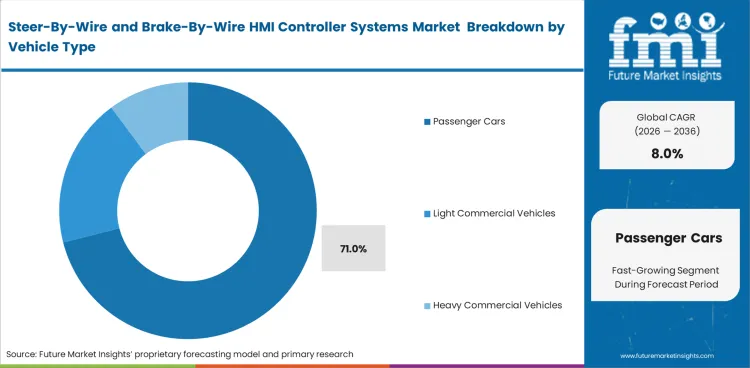
- Passenger Cars are set to represent 71% share in 2026. Premium EV launches and advanced chassis electronics adoption support broader controller demand across this vehicle group.
- Passenger vehicle intake is dominant across the market as digital cockpit design and higher software content lift the value of steering and braking input modules.
Insights into the Architecture Segment
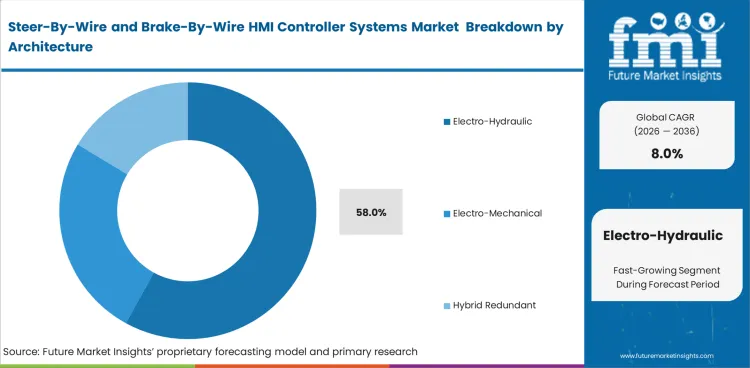
- Electro-Hydraulic architecture is projected to hold 58% share in 2026. Current brake-by-wire industrialization supports stronger use of layouts aligned with existing braking system integration practices.
- This architecture has a larger installed base across the market as manufacturers prefer a more familiar engineering path during the first wave of by-wire deployment.
Insights into the Sales Channel Segment
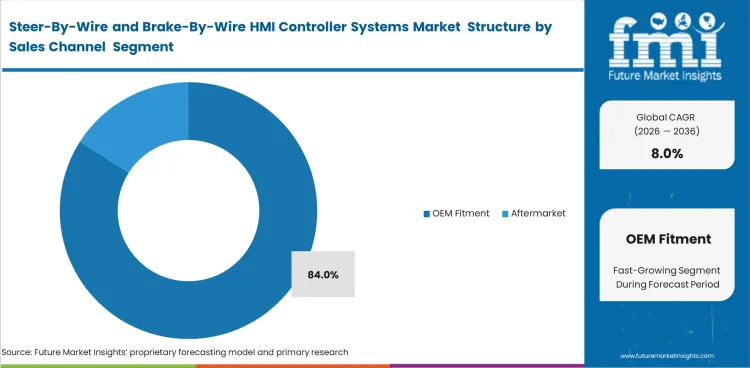
- OEM Fitment is expected to account for 84% share in 2026. Vehicle-level validation and platform integration support direct factory sourcing across almost all current by-wire controller programs.
- Factory demand is dominant across this market as steering feel calibration and brake response tuning require close engineering work during development and launch stages.
Insights into the Aftermarket Segment
- Aftermarket demand is projected to record a faster from a small base within sales channel segmentation as specialty retrofits and performance modifications gain selective interest.
- Limited retrofit programs and engineering customization support narrow opportunity across this segment as broader adoption is constrained by safety approval and vehicle integration needs.
Steer-By-Wire and Brake-By-Wire HMI Controller Systems Market Drivers, Restraints, and Opportunities
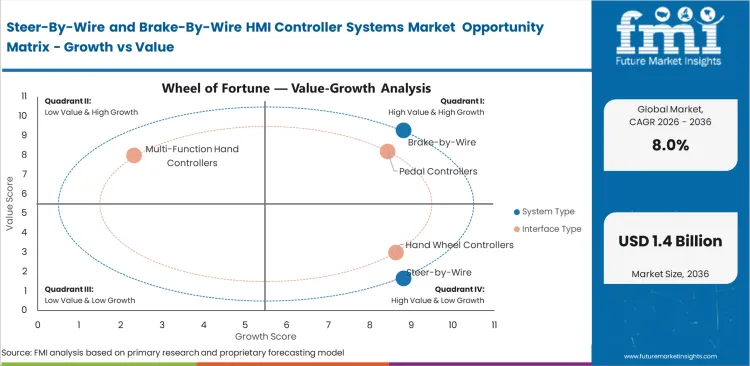
- EV volume is lifting demand for decoupled braking interfaces and compact cockpit packaging.
- Validation cost and redundant design complexity keep steer-side volume lower in near-term programs.
- Unified chassis controllers open room for richer input modules and software-upgradable feel tuning.
The market for steer by wire and brake by wire HMI controller systems keeps growing because electric vehicle platforms need decoupled braking controls and richer steering feel tuning. Approval progress in some regions is reducing launch risk for linkless steering systems. High validation costs raise development burden. Redundant design complexity and longer approval cycles slow steer by wire programs. Growth continues through brake by wire controller rollout and early serial deployment in premium vehicle programs.
EV Platform Packaging
Battery platforms benefit from more firewall design and better brake regeneration control. Bosch says brake-by-wire removes the mechanical link between the brake pedal and brake system. Such design freedom supports pedal controller demand on electric platforms. Demand is rising with EV brake integration platforms and broader chassis software consolidation.
Redundancy Cost and Validation Time
Linkless steering programs require high redundancy and more regional approval work. NIO and ZF present redundant steer by wire control in the ET9 program, and JTEKT said its backup power supply is installed in the Lexus RZ steer by wire sytem. Such requirements lift bill of material cost and extend sourcing cycles for steering-side interfaces.
Chassis Software Integration
Controller value rises as OEMs combine steering and braking with central software layers. Hyundai Mobis is building one integrated solution aimed at controlling vehicle movement with a single controller. Continental likewise positions complete by-wire architecture for software-defined vehicles. Such integration supports richer HMI modules rather than simple input hardware alone.
Steer-By-Wire and Brake-By-Wire HMI Controller Systems Market Analysis by Key Countries
.webp "Top Country Growth Comparison Steer By Wire And Brake By Wire Hmi Controller Systems Market Cagr (2026 2036)")
| Country | CAGR |
|---|---|
| China | 10.1% |
| Japan | 9.4% |
| South Korea | 9.1% |
| Germany | 8.6% |
| United States | 8.2% |
| India | 7.9% |
| United Kingdom | 7.5% |
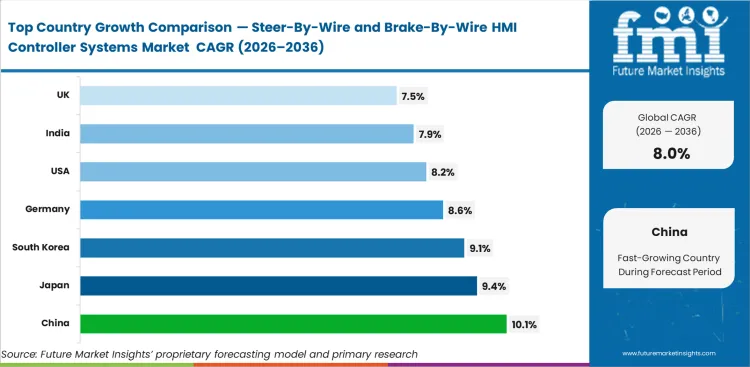
Steer-By-Wire and Brake-By-Wire HMI Controller Systems Market CAGR Analysis by Country
- China leads with an expected 10.1% CAGR, driven by very large EV output and early serial deployment of steer-by-wire systems across premium domestic programs. Program scale and faster by-wire industrialization are projected to keep China above the higher market average through 2036.
- Japan is expected to post a 9.4% CAGR, helped by strong steering system expertise and recent production use of steer-by-wire in high-value vehicle lines. South Korea follows at 9.1% CAGR, helped by advanced chassis electronics capability and export vehicle programs carrying richer control content.
- Germany is projected to expand at 8.6% CAGR, supported by premium vehicle production and deep supplier capability in steering and braking control systems. The United States is expected to record 8.2% CAGR, helped by broad vehicle demand and rising use of advanced braking interfaces across premium EV platforms.
- India is anticipated to register 7.9% CAGR, supported by rising premium vehicle sales and a gradual increase in advanced electronic control content. The United Kingdom is projected to reach 7.5% CAGR, with demand shaped by higher electric vehicle intake and imported premium models carrying by-wire ready architectures.
Global demand for steer-by-wire and brake-by-wire HMI controller systems is projected to expand at a steady pace from 2026 to 2036, supported by higher EV penetration and greater use of software-led chassis control. The study covers major automotive manufacturing countries, with East Asia expected to hold the strongest position during the forecast period.
Demand Outlook for the Steer-By-Wire and Brake-By-Wire HMI Controller Systems Market in China
China is projected to record a 10.1% CAGR over the forecast period. OICA reported 31,436,193 vehicle sales in 2024. NIO secured China’s first production approval for steer-by-wire and ET9 entered serial production with ZF technology. Such production supports the deepest near-term sourcing pool for brake-side interfaces and the fastest steer-side ramp.
- Local EV scale supports faster controller cost reduction across passenger car programs.
- Serial steer-by-wire entry reduces launch risk for domestic premium platforms.
Future Outlook for the Steer-By-Wire and Brake-By-Wire HMI Controller Systems Market in Japan
Japan is expected to expand at a 9.4% CAGR by 2036. OICA recorded 7,139,188 passenger cars produced in 2024. Lexus introduced the new RZ with a steer-by-wire system in March 2025 and JTEKT later confirmed its steer-by-wire system and backup power supply in the same vehicle line. Japan benefits from strong steering control know-how and disciplined OEM validation practice.
- Lexus program timing supports broader supplier confidence in linkless steering controllers.
- Domestic steering specialists support deep engineering support for OEM launch work.
Opportunity Analysis for the Steer-By-Wire and Brake-By-Wire HMI Controller Systems Market in South Korea
South Korea is anticipated to post a 9.1% CAGR during the assessment period. Hyundai Mobis is actively promoting X-by-Wire solutions across European mobility customers and HL Mando lists both brake-by-wire and steer-by-wire in its product portfolio. Such capability supports South Korea as a strong engineering and export base for by-wire controller systems.
- Export-oriented vehicle programs support early use of advanced chassis electronics.
- Supplier depth in braking and steering electronics supports long-term controller localization.
In-Depth Analysis of the Steer-By-Wire and Brake-By-Wire HMI Controller Systems Market in Germany
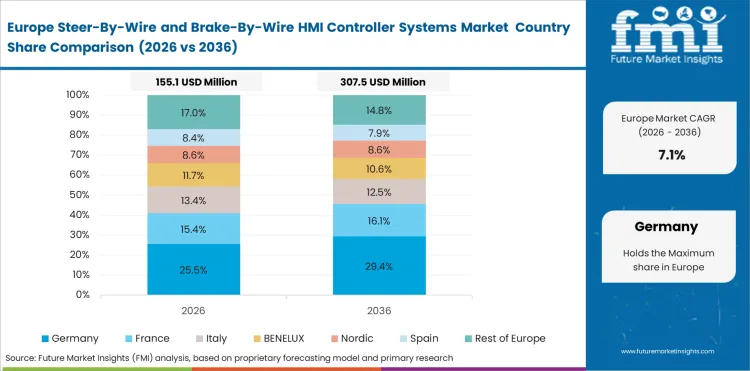
Germany is forecast to rise at an 8.6% CAGR during the assessment years. VDA reported 1.35 million electric cars produced in Germany during 2024 and said one in three passenger cars manufactured in Germany was electrically powered. Bosch completed public road testing for hydraulic brake-by-wire, and ZF secured a major brake-by-wire award for light vehicles. Germany combines premium OEM demand with top-tier chassis suppliers.
- Premium vehicle launches support high-value controller content and richer tuning requirements.
- Local supplier strength shortens engineering loops during platform validation work.
Sales Analysis of the Steer-By-Wire and Brake-By-Wire HMI Controller Systems Market in the United States
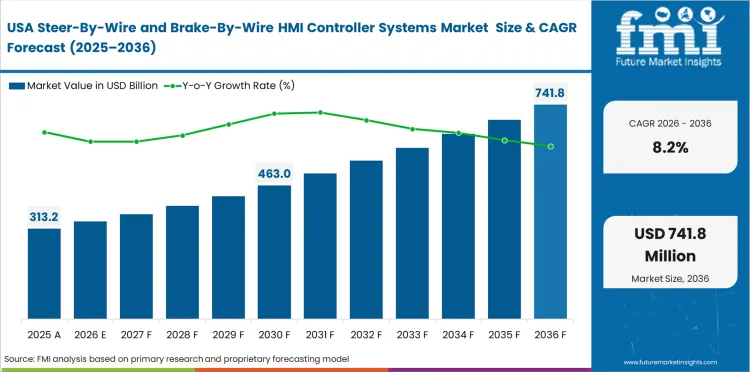
United States demand is projected to increase at an 8.2% CAGR over the forecast period. OICA reported 16,340,472 vehicle sales in 2024, and IEA said electric cars accounted for more than one in ten cars sold in the country. Nexteer launched its EMB brake-by-wire system in April 2025, and U.S. premium EV programs keep lifting controller content. Volume is meaningful while steer-side rollouts remain selective.
- Large vehicle demand supports brake-side scale across multiple propulsion formats.
- Controller revenue skews toward premium EV and software-heavy chassis programs.
Demand Outlook for the Steer-By-Wire and Brake-By-Wire HMI Controller Systems Market in India
India is projected to advance at a 7.9% CAGR by 2036. SIAM reported record passenger vehicle sales of 4.3 million units in FY 2024 to 2025. Current demand remains smaller due to cost sensitivity and slower by-wire rollout in mass models. Rising premium vehicle mix and local electronics work support medium-term controller demand across select OEM programs.
- Local auto volume supports future scale once premium EV fitment widens.
- Cost pressure keeps early demand centered on limited flagship and export programs.
Future Outlook for the Steer-By-Wire and Brake-By-Wire HMI Controller Systems Market in the United Kingdom
United Kingdom demand is expected to rise at a 7.5% CAGR through 2036. SMMT reported 2.02 million new car registrations in 2025 and said almost one in four buyers went electric. EV mix is improving despite a smaller domestic vehicle manufacturing scale compared with Germany and Japan. Imported premium EV programs shape most near-term controller demand.
- EV share improvement supports rising brake-side HMI controller fitment in new registrations.
- Import-led premium sales keep demand concentrated in higher specification vehicle lines.
Competitive Landscape and Strategic Positioning for Steer-By-Wire and Brake-By-Wire HMI Controller Systems Market
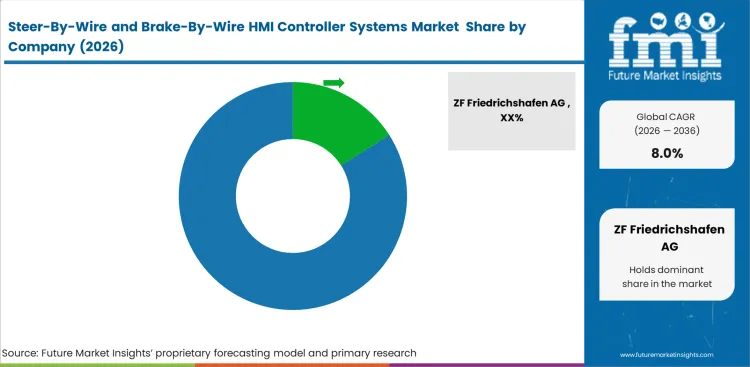
- Market concentration is moderate and leading suppliers hold the clearest advantage in safety validation and OEM access.
- Steering specialists compete on force feedback quality and backup architecture rather than price alone.
- Brake-side specialists compete on pedal feel tuning and software integration for regeneration blending.
ZF and Bosch benefit from broad chassis portfolios and direct work across steering and braking domains. Nexteer adds motion-by-wire breadth through steering heritage and its newer EMB program. JTEKT brings deep steering control capability and backup power expertise. Hyundai Mobis and Continental push integrated by-wire control visions suited for software-defined vehicles. Demand patterns line up with related automotive steer-by-wire actuator and automotive brake-by-wire pedal simulator fields.
Entry barriers stay high due to redundant sensing needs and long OEM qualification cycles. Force feedback accuracy and fault management require strong system engineering. Backup power support and fail-operational behavior add further cost and testing work. Smaller companies often win submodule business in force feedback devices or pedal components, but full-system controller awards favor established suppliers with global program support.
Key Companies in the Market
- Global chassis integrators include ZF Friedrichshafen AG, Robert Bosch GmbH, Continental AG, and Hyundai Mobis.
- Steering-led specialists include Nexteer Automotive and JTEKT Corporation with strong steer-side control expertise.
- Brake and chassis specialists include HL Mando with active brake-by-wire and steer-by-wire portfolio coverage.
Competitive Benchmarking for Steer-By-Wire and Brake-By-Wire HMI Controller Systems Market
| Company | By-Wire Breadth | Controller Integration | OEM Program Depth | Regional Strength |
|---|---|---|---|---|
| ZF Friedrichshafen AG | High | High | High | Europe and China |
| Robert Bosch GmbH | High | High | High | Europe and North America |
| Nexteer Automotive | Medium | Medium | High | North America and China |
| JTEKT Corporation | Medium | High | High | Japan |
| Hyundai Mobis | High | High | Medium | South Korea and Europe |
| Continental AG / AUMOVIO | High | Medium | High | Europe |
| HL Mando | Medium | Medium | Medium | South Korea and China |
Source: FMI analysis based on official company disclosures and public product positioning.
Key Developments for Steer-By-Wire and Brake-By-Wire HMI Controller Systems Market
- In January 2025 ZF announced planned volume production of brake-by-wire technology together with advanced steering in one vehicle class.
- In April 2025 Nexteer launched its Electro-Mechanical Brake system and linked the program with software-defined chassis integration.
- In March 2025 Lexus introduced the new RZ with a steer-by-wire system aimed at intuitive steering response and low-speed maneuverability.
- In October 2025 JTEKT said its steer-by-wire system and Libuddy backup power supply were installed in the Lexus RZ.
Key Players in Steer-By-Wire and Brake-By-Wire HMI Controller Systems Market
Major Global Players
- ZF Friedrichshafen AG
- Robert Bosch GmbH
- Continental AG / AUMOVIO
- Hyundai Mobis
- Nexteer Automotive
Specialized and Regional Players
- JTEKT Corporation
- HL Mando
Report Scope and Coverage
| Parameter | Details |
|---|---|
| Quantitative Units | USD Million |
| Market Values | 0.6 billion in 2026 to 1.3 billion in 2036 |
| CAGR | 8.0% from 2026 to 2036 |
| Market Definition | Driver input controller systems used in by-wire steering and by-wire braking |
| Regions Covered | North America, Europe, East Asia, South Asia and Pacific |
| Countries Covered | China, Japan, South Korea, Germany, United States, India, United Kingdom |
| Key Companies Profiled | ZF, Bosch, Nexteer, JTEKT, Hyundai Mobis, Continental, HL Mando |
| Research Approach | Bottom-up fitment model with public launch and vehicle demand validation |
Market by Segments
Steer-By-Wire and Brake-By-Wire HMI Controller Systems Market Segmented by System Type
- Brake-by-Wire
- Steer-by-Wire
Steer-By-Wire and Brake-By-Wire HMI Controller Systems Market Segmented by Interface Type
- Pedal Controllers
- Hand Wheel Controllers
- Multi-Function Hand Controllers
Steer-By-Wire and Brake-By-Wire HMI Controller Systems Market Segmented by Vehicle Type
- Passenger Cars
- Light Commercial Vehicles
- Heavy Commercial Vehicles
Steer-By-Wire and Brake-By-Wire HMI Controller Systems Market Segmented by Architecture
- Electro-Hydraulic
- Electro-Mechanical
- Hybrid Redundant
Steer-By-Wire and Brake-By-Wire HMI Controller Systems Market Segmented by Propulsion
- Battery Electric Vehicles
- Hybrid Electric Vehicles
- Internal Combustion Vehicles
Steer-By-Wire and Brake-By-Wire HMI Controller Systems Market Segmented by Sales Channel
- OEM Fitment
- Aftermarket
Steer-By-Wire and Brake-By-Wire HMI Controller Systems Market Segmented by Region
- North America
- USA
- Canada
- Mexico
- Latin America
- Brazil
- Chile
- Rest of Latin America
- Europe
- Germany
- UK
- Italy
- Spain
- France
- Rest of Europe
- East Asia
- China
- Japan
- South Korea
- South Asia and Pacific
- India
- ASEAN
- Australia & New Zealand
- Rest of South Asia and Pacific
- Middle East and Africa
- Saudi Arabia
- Other GCC Countries
- South Africa
- Rest of Middle East and Africa
Research Sources and Bibliography
- ZF Friedrichshafen AG. (2025, January 6). ZF secures substantial brake-by-wire technology business for light vehicles.
- Nexteer Automotive. (2025, April 15). Nexteer launches brake-by-wire system.
- Toyota Motor Corporation. (2025, March 12). Lexus presents the world premiere of the new “RZ” introducing steer-by-wire for next-generation steering feel, enhancing the driving experience.
- JTEKT Corporation. (2025, October 1). Steer-by-Wire System and Backup Power Supply (Libuddy®) are installed in LEXUS RZ.
- International Energy Agency. (2025). Global EV outlook 2025: Executive summary.
- NIO. (2025). Milestone in technology partnership – new NIO ET9’s “SkyRide” incorporates steer-by-wire system from ZF.
Bibliography is provided for reader reference and reflects sources used in the market build.
This Report Answers
- What is the current size of the steer-by-wire and brake-by-wire HMI controller systems market?
- How fast is demand expected to expand between 2026 and 2036?
- Which system type leads current revenue in this market?
- Which sales channel controls most revenue during early by-wire adoption?
- What is lifting brake-side interface demand across EV programs?
- How are serial steer-by-wire launches changing supplier confidence and sourcing behavior?
- Which countries are expected to expand faster through 2036?
- Which companies hold the strongest current position in by-wire HMI controller systems?
Frequently Asked Questions
What is the projected market size in 2026?
Market value for steer-by-wire and brake-by-wire HMI controller systems is projected to reach 0.6 billion in 2026.
How large can this market become by 2036?
Analyst modelling indicates a 1.3 billion market by 2036 under broader by-wire penetration across EV and premium vehicle programs.
What CAGR is expected from 2026 to 2036?
The market is expected to expand at a CAGR of 8.0% during the 2026 to 2036 forecast period.
Which system type leads current demand?
Brake-by-wire input controllers lead current demand due to faster production rollout and broader fitment across electrified vehicle architectures.
Why does OEM fitment lead procurement?
OEM programs lead sourcing due to full vehicle validation needs, redundant safety requirements, and platform-level calibration for pedal feel and steering feel.
OEM programs lead sourcing due to full vehicle validation needs, redundant safety requirements, and platform-level calibration for pedal feel and steering feel.
China is projected to expand at the fastest pace due to very large EV volume and early serial steer-by-wire deployment.
What is the core shift in this market today?
Demand is moving from isolated premium pilots into broader production sourcing for brake-side controllers, while steer-side interfaces enter early serial programs.
Preview the report firsthand - request a free sample
Get SampleGet the brochure for pricing and purchase details.
Get PDFTable of Content
- Executive Summary
- Global Market Outlook
- Demand-side Trends
- Supply-side Trends
- Technology Roadmap Analysis
- Analysis and Recommendations
- Market Overview
- Market Coverage / Taxonomy
- Market Definition / Scope / Limitations
- Research Methodology
- Chapter Orientation
- Analytical Lens and Working Hypotheses
- Market Structure, Signals, and Trend Drivers
- Benchmarking and Cross-market Comparability
- Market Sizing, Forecasting, and Opportunity Mapping
- Research Design and Evidence Framework
- Desk Research Programme (Secondary Evidence)
- Company Annual and Sustainability Reports
- Peer-reviewed Journals and Academic Literature
- Corporate Websites, Product Literature, and Technical Notes
- Earnings Decks and Investor Briefings
- Statutory Filings and Regulatory Disclosures
- Technical White Papers and Standards Notes
- Trade Journals, Industry Magazines, and Analyst Briefs
- Conference Proceedings, Webinars, and Seminar Materials
- Government Statistics Portals and Public Data Releases
- Press Releases and Reputable Media Coverage
- Specialist Newsletters and Curated Briefings
- Sector Databases and Reference Repositories
- FMI Internal Proprietary Databases and Historical Market Datasets
- Subscription Datasets and Paid Sources
- Social Channels, Communities, and Digital Listening Inputs
- Additional Desk Sources
- Expert Input and Fieldwork (Primary Evidence)
- Primary Modes
- Qualitative Interviews and Expert Elicitation
- Quantitative Surveys and Structured Data Capture
- Blended Approach
- Why Primary Evidence is Used
- Field Techniques
- Interviews
- Surveys
- Focus Groups
- Observational and In-context Research
- Social and Community Interactions
- Stakeholder Universe Engaged
- C-suite Leaders
- Board Members
- Presidents and Vice Presidents
- R&D and Innovation Heads
- Technical Specialists
- Domain Subject-matter Experts
- Scientists
- Physicians and Other Healthcare Professionals
- Governance, Ethics, and Data Stewardship
- Research Ethics
- Data Integrity and Handling
- Primary Modes
- Tooling, Models, and Reference Databases
- Desk Research Programme (Secondary Evidence)
- Data Engineering and Model Build
- Data Acquisition and Ingestion
- Cleaning, Normalisation, and Verification
- Synthesis, Triangulation, and Analysis
- Quality Assurance and Audit Trail
- Market Background
- Market Dynamics
- Drivers
- Restraints
- Opportunity
- Trends
- Scenario Forecast
- Demand in Optimistic Scenario
- Demand in Likely Scenario
- Demand in Conservative Scenario
- Opportunity Map Analysis
- Product Life Cycle Analysis
- Supply Chain Analysis
- Investment Feasibility Matrix
- Value Chain Analysis
- PESTLE and Porter’s Analysis
- Regulatory Landscape
- Regional Parent Market Outlook
- Production and Consumption Statistics
- Import and Export Statistics
- Market Dynamics
- Global Market Analysis 2021 to 2025 and Forecast, 2026 to 2036
- Historical Market Size Value (USD Million) Analysis, 2021 to 2025
- Current and Future Market Size Value (USD Million) Projections, 2026 to 2036
- Y-o-Y Growth Trend Analysis
- Absolute $ Opportunity Analysis
- Global Market Pricing Analysis 2021 to 2025 and Forecast 2026 to 2036
- Global Market Analysis 2021 to 2025 and Forecast 2026 to 2036, By System Type
- Introduction / Key Findings
- Historical Market Size Value (USD Million) Analysis By System Type , 2021 to 2025
- Current and Future Market Size Value (USD Million) Analysis and Forecast By System Type , 2026 to 2036
- Brake-by-Wire
- Steer-by-Wire
- Brake-by-Wire
- Y-o-Y Growth Trend Analysis By System Type , 2021 to 2025
- Absolute $ Opportunity Analysis By System Type , 2026 to 2036
- Global Market Analysis 2021 to 2025 and Forecast 2026 to 2036, By Interface Type
- Introduction / Key Findings
- Historical Market Size Value (USD Million) Analysis By Interface Type, 2021 to 2025
- Current and Future Market Size Value (USD Million) Analysis and Forecast By Interface Type, 2026 to 2036
- Pedal Controllers
- Hand Wheel Controllers
- Multi-Function Hand Controllers
- Pedal Controllers
- Y-o-Y Growth Trend Analysis By Interface Type, 2021 to 2025
- Absolute $ Opportunity Analysis By Interface Type, 2026 to 2036
- Global Market Analysis 2021 to 2025 and Forecast 2026 to 2036, By Vehicle Type
- Introduction / Key Findings
- Historical Market Size Value (USD Million) Analysis By Vehicle Type, 2021 to 2025
- Current and Future Market Size Value (USD Million) Analysis and Forecast By Vehicle Type, 2026 to 2036
- Passenger Cars
- Light Commercial Vehicles
- Heavy Commercial Vehicles
- Passenger Cars
- Y-o-Y Growth Trend Analysis By Vehicle Type, 2021 to 2025
- Absolute $ Opportunity Analysis By Vehicle Type, 2026 to 2036
- Global Market Analysis 2021 to 2025 and Forecast 2026 to 2036, By Architecture
- Introduction / Key Findings
- Historical Market Size Value (USD Million) Analysis By Architecture, 2021 to 2025
- Current and Future Market Size Value (USD Million) Analysis and Forecast By Architecture, 2026 to 2036
- Electro-Hydraulic
- Electro-Mechanical
- Hybrid Redundant
- Electro-Hydraulic
- Y-o-Y Growth Trend Analysis By Architecture, 2021 to 2025
- Absolute $ Opportunity Analysis By Architecture, 2026 to 2036
- Global Market Analysis 2021 to 2025 and Forecast 2026 to 2036, By Sales Channel
- Introduction / Key Findings
- Historical Market Size Value (USD Million) Analysis By Sales Channel, 2021 to 2025
- Current and Future Market Size Value (USD Million) Analysis and Forecast By Sales Channel, 2026 to 2036
- OEM Fitment
- Aftermarket
- OEM Fitment
- Y-o-Y Growth Trend Analysis By Sales Channel, 2021 to 2025
- Absolute $ Opportunity Analysis By Sales Channel, 2026 to 2036
- Global Market Analysis 2021 to 2025 and Forecast 2026 to 2036, By Region
- Introduction
- Historical Market Size Value (USD Million) Analysis By Region, 2021 to 2025
- Current Market Size Value (USD Million) Analysis and Forecast By Region, 2026 to 2036
- North America
- Latin America
- Western Europe
- Eastern Europe
- East Asia
- South Asia and Pacific
- Middle East & Africa
- Market Attractiveness Analysis By Region
- North America Market Analysis 2021 to 2025 and Forecast 2026 to 2036, By Country
- Historical Market Size Value (USD Million) Trend Analysis By Market Taxonomy, 2021 to 2025
- Market Size Value (USD Million) Forecast By Market Taxonomy, 2026 to 2036
- By Country
- USA
- Canada
- Mexico
- By System Type
- By Interface Type
- By Vehicle Type
- By Architecture
- By Sales Channel
- By Country
- Market Attractiveness Analysis
- By Country
- By System Type
- By Interface Type
- By Vehicle Type
- By Architecture
- By Sales Channel
- Key Takeaways
- Latin America Market Analysis 2021 to 2025 and Forecast 2026 to 2036, By Country
- Historical Market Size Value (USD Million) Trend Analysis By Market Taxonomy, 2021 to 2025
- Market Size Value (USD Million) Forecast By Market Taxonomy, 2026 to 2036
- By Country
- Brazil
- Chile
- Rest of Latin America
- By System Type
- By Interface Type
- By Vehicle Type
- By Architecture
- By Sales Channel
- By Country
- Market Attractiveness Analysis
- By Country
- By System Type
- By Interface Type
- By Vehicle Type
- By Architecture
- By Sales Channel
- Key Takeaways
- Western Europe Market Analysis 2021 to 2025 and Forecast 2026 to 2036, By Country
- Historical Market Size Value (USD Million) Trend Analysis By Market Taxonomy, 2021 to 2025
- Market Size Value (USD Million) Forecast By Market Taxonomy, 2026 to 2036
- By Country
- Germany
- UK
- Italy
- Spain
- France
- Nordic
- BENELUX
- Rest of Western Europe
- By System Type
- By Interface Type
- By Vehicle Type
- By Architecture
- By Sales Channel
- By Country
- Market Attractiveness Analysis
- By Country
- By System Type
- By Interface Type
- By Vehicle Type
- By Architecture
- By Sales Channel
- Key Takeaways
- Eastern Europe Market Analysis 2021 to 2025 and Forecast 2026 to 2036, By Country
- Historical Market Size Value (USD Million) Trend Analysis By Market Taxonomy, 2021 to 2025
- Market Size Value (USD Million) Forecast By Market Taxonomy, 2026 to 2036
- By Country
- Russia
- Poland
- Hungary
- Balkan & Baltic
- Rest of Eastern Europe
- By System Type
- By Interface Type
- By Vehicle Type
- By Architecture
- By Sales Channel
- By Country
- Market Attractiveness Analysis
- By Country
- By System Type
- By Interface Type
- By Vehicle Type
- By Architecture
- By Sales Channel
- Key Takeaways
- East Asia Market Analysis 2021 to 2025 and Forecast 2026 to 2036, By Country
- Historical Market Size Value (USD Million) Trend Analysis By Market Taxonomy, 2021 to 2025
- Market Size Value (USD Million) Forecast By Market Taxonomy, 2026 to 2036
- By Country
- China
- Japan
- South Korea
- By System Type
- By Interface Type
- By Vehicle Type
- By Architecture
- By Sales Channel
- By Country
- Market Attractiveness Analysis
- By Country
- By System Type
- By Interface Type
- By Vehicle Type
- By Architecture
- By Sales Channel
- Key Takeaways
- South Asia and Pacific Market Analysis 2021 to 2025 and Forecast 2026 to 2036, By Country
- Historical Market Size Value (USD Million) Trend Analysis By Market Taxonomy, 2021 to 2025
- Market Size Value (USD Million) Forecast By Market Taxonomy, 2026 to 2036
- By Country
- India
- ASEAN
- Australia & New Zealand
- Rest of South Asia and Pacific
- By System Type
- By Interface Type
- By Vehicle Type
- By Architecture
- By Sales Channel
- By Country
- Market Attractiveness Analysis
- By Country
- By System Type
- By Interface Type
- By Vehicle Type
- By Architecture
- By Sales Channel
- Key Takeaways
- Middle East & Africa Market Analysis 2021 to 2025 and Forecast 2026 to 2036, By Country
- Historical Market Size Value (USD Million) Trend Analysis By Market Taxonomy, 2021 to 2025
- Market Size Value (USD Million) Forecast By Market Taxonomy, 2026 to 2036
- By Country
- Kingdom of Saudi Arabia
- Other GCC Countries
- Turkiye
- South Africa
- Other African Union
- Rest of Middle East & Africa
- By System Type
- By Interface Type
- By Vehicle Type
- By Architecture
- By Sales Channel
- By Country
- Market Attractiveness Analysis
- By Country
- By System Type
- By Interface Type
- By Vehicle Type
- By Architecture
- By Sales Channel
- Key Takeaways
- Key Countries Market Analysis
- USA
- Pricing Analysis
- Market Share Analysis, 2025
- By System Type
- By Interface Type
- By Vehicle Type
- By Architecture
- By Sales Channel
- Canada
- Pricing Analysis
- Market Share Analysis, 2025
- By System Type
- By Interface Type
- By Vehicle Type
- By Architecture
- By Sales Channel
- Mexico
- Pricing Analysis
- Market Share Analysis, 2025
- By System Type
- By Interface Type
- By Vehicle Type
- By Architecture
- By Sales Channel
- Brazil
- Pricing Analysis
- Market Share Analysis, 2025
- By System Type
- By Interface Type
- By Vehicle Type
- By Architecture
- By Sales Channel
- Chile
- Pricing Analysis
- Market Share Analysis, 2025
- By System Type
- By Interface Type
- By Vehicle Type
- By Architecture
- By Sales Channel
- Germany
- Pricing Analysis
- Market Share Analysis, 2025
- By System Type
- By Interface Type
- By Vehicle Type
- By Architecture
- By Sales Channel
- UK
- Pricing Analysis
- Market Share Analysis, 2025
- By System Type
- By Interface Type
- By Vehicle Type
- By Architecture
- By Sales Channel
- Italy
- Pricing Analysis
- Market Share Analysis, 2025
- By System Type
- By Interface Type
- By Vehicle Type
- By Architecture
- By Sales Channel
- Spain
- Pricing Analysis
- Market Share Analysis, 2025
- By System Type
- By Interface Type
- By Vehicle Type
- By Architecture
- By Sales Channel
- France
- Pricing Analysis
- Market Share Analysis, 2025
- By System Type
- By Interface Type
- By Vehicle Type
- By Architecture
- By Sales Channel
- India
- Pricing Analysis
- Market Share Analysis, 2025
- By System Type
- By Interface Type
- By Vehicle Type
- By Architecture
- By Sales Channel
- ASEAN
- Pricing Analysis
- Market Share Analysis, 2025
- By System Type
- By Interface Type
- By Vehicle Type
- By Architecture
- By Sales Channel
- Australia & New Zealand
- Pricing Analysis
- Market Share Analysis, 2025
- By System Type
- By Interface Type
- By Vehicle Type
- By Architecture
- By Sales Channel
- China
- Pricing Analysis
- Market Share Analysis, 2025
- By System Type
- By Interface Type
- By Vehicle Type
- By Architecture
- By Sales Channel
- Japan
- Pricing Analysis
- Market Share Analysis, 2025
- By System Type
- By Interface Type
- By Vehicle Type
- By Architecture
- By Sales Channel
- South Korea
- Pricing Analysis
- Market Share Analysis, 2025
- By System Type
- By Interface Type
- By Vehicle Type
- By Architecture
- By Sales Channel
- Russia
- Pricing Analysis
- Market Share Analysis, 2025
- By System Type
- By Interface Type
- By Vehicle Type
- By Architecture
- By Sales Channel
- Poland
- Pricing Analysis
- Market Share Analysis, 2025
- By System Type
- By Interface Type
- By Vehicle Type
- By Architecture
- By Sales Channel
- Hungary
- Pricing Analysis
- Market Share Analysis, 2025
- By System Type
- By Interface Type
- By Vehicle Type
- By Architecture
- By Sales Channel
- Kingdom of Saudi Arabia
- Pricing Analysis
- Market Share Analysis, 2025
- By System Type
- By Interface Type
- By Vehicle Type
- By Architecture
- By Sales Channel
- Turkiye
- Pricing Analysis
- Market Share Analysis, 2025
- By System Type
- By Interface Type
- By Vehicle Type
- By Architecture
- By Sales Channel
- South Africa
- Pricing Analysis
- Market Share Analysis, 2025
- By System Type
- By Interface Type
- By Vehicle Type
- By Architecture
- By Sales Channel
- USA
- Market Structure Analysis
- Competition Dashboard
- Competition Benchmarking
- Market Share Analysis of Top Players
- By Regional
- By System Type
- By Interface Type
- By Vehicle Type
- By Architecture
- By Sales Channel
- Competition Analysis
- Competition Deep Dive
- ZF Friedrichshafen AG
- Overview
- Product Portfolio
- Profitability by Market Segments (Product/Age /Sales Channel/Region)
- Sales Footprint
- Strategy Overview
- Marketing Strategy
- Product Strategy
- Channel Strategy
- Robert Bosch GmbH
- Continental AG / AUMOVIO
- Hyundai Mobis
- Nexteer Automotive
- JTEKT Corporation
- HL Mando
- ZF Friedrichshafen AG
- Competition Deep Dive
- Assumptions & Acronyms Used


