

- Industry Size (2026)
- USD 2.0 Bn
- Forecast (2036)
- USD 5.2 Bn
- CAGR (2026 to 2036)
- 10.0%
Zonal Harness Systems Market Forecast and Outlook 2026 to 2036
The zonal harness systems market is expected to expand from USD 2.0 billion in 2026 to USD 5.2 billion by 2036, growing at a CAGR of 10.0%. Growth quality in this market is strongly shaped by application concentration within passenger vehicles and advanced EV platforms. Demand is heavily anchored to OEM programs that are redesigning electrical architectures around centralized computing and software-defined functionality, creating high dependency on a limited set of vehicle segments. This concentration improves volume visibility for suppliers once a platform is secured, but it also exposes revenues to platform timing, production ramps, and model lifecycle decisions.
Zonal harness systems are typically adopted at the architecture level, which stabilizes volumes over multi-year production cycles while limiting short-term flexibility. End-use dependency on high-volume passenger vehicles provides scale benefits, yet commercial and off-highway adoption remains uneven, adding asymmetry to demand. Growth is less about broad-based penetration and more about winning and retaining positions on a smaller number of high-impact platforms, where consistency of volumes matters more than unit pricing.
Quick Stats for Zonal Harness Systems Market
- Zonal Harness Systems Market Value (2026): USD 2.0 Billion
- Zonal Harness Systems Market Forecast Value (2036): USD 5.2 Billion
- Zonal Harness Systems Market Forecast CAGR 2026 to 2036: 10.0%
- Leading Vehicle Class in Zonal Harness Systems Market: Passenger Vehicles (67% share)
- Key Growth Regions in Zonal Harness Systems Market: Asia Pacific, Europe, North America, Latin America, Middle East & Africa
- Top Key Players in Zonal Harness Systems Market: Aptiv, Leoni, Sumitomo Wiring Systems, Yazaki, Furukawa Electric, Motherson, Lear, Kromberg & Schubert, PKC Group (Motherson), Nexans Autoelectric
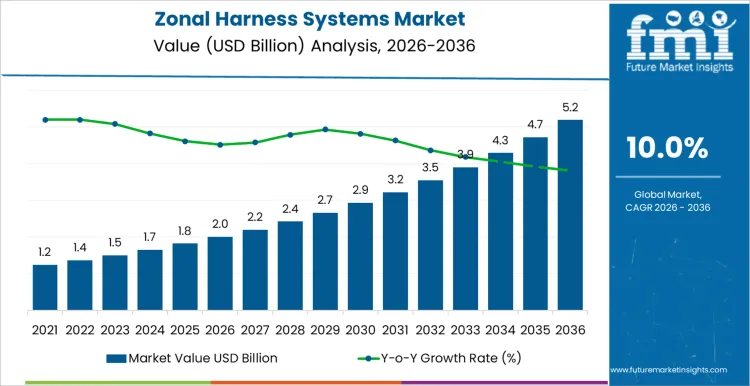
Zonal Harness Systems Market Key Takeaways
| Metric | Value |
|---|---|
| Zonal Harness Systems Market Value (2026) | USD 2.0 Billion |
| Zonal Harness Systems Market Forecast Value (2036) | USD 5.2 Billion |
| Zonal Harness Systems Market Forecast CAGR 2026 to 2036 | 10.0% |
How are Vehicle Electrical Architecture Shifts Accelerating the Zonal Harness Systems Market?
The zonal harness systems market is growing as automotive OEMs transition away from distributed, function-based wiring architectures toward centralized, software-defined vehicle platforms. Zonal architectures reorganize electrical systems around physical zones rather than individual functions, significantly reducing wiring length, connector count, and overall vehicle weight. For harness manufacturers and Tier-1 suppliers, this shift is redefining value creation from complex, labor-intensive harness assemblies to modular, zone-based subsystems integrated with centralized compute units.
Manufacturing and cost efficiency are central drivers of adoption. Traditional wiring harnesses are among the most complex and labor-heavy components in a vehicle, making them vulnerable to cost inflation and supply-chain disruption. Zonal harness systems simplify assembly, enable higher automation potential, and improve scalability across vehicle platforms. Suppliers capable of delivering standardized zone modules, integrated power/data distribution, and compatibility with high-speed communication protocols are gaining early design wins with OEMs pursuing next-generation EV and software-defined vehicle programs.
Platform scalability and lifecycle flexibility are further reinforcing demand. Zonal architectures support over-the-air updates, easier feature expansion, and improved diagnostics key requirements for connected, autonomous, and electric vehicles. As OEMs consolidate vehicle platforms globally, they are prioritizing suppliers that can support multi-region production with consistent quality and design-for-manufacturing expertise. For companies across the value chain, competitive advantage in the zonal harness systems market increasingly depends on system-level engineering, digital design capability, and close collaboration with OEM electrical architecture teams.
How Is The Zonal Harness Systems Market Structured By Vehicle Class And Conductor Type?
The zonal harness systems market is segmented by vehicle class and conductor type, reflecting how vehicle electrification levels, architecture complexity, and power distribution needs influence harness design. By vehicle class, passenger vehicles dominate adoption, as OEMs transition from traditional point-to-point wiring to zonal electrical architectures to reduce weight, complexity, and assembly time. Other vehicle classes include light commercial vehicles, heavy commercial vehicles, and off-highway vehicles, where adoption varies based on cost sensitivity and platform lifecycle. By conductor type, copper-rich conductors represent the leading choice, while aluminum or hybrid conductors and high-voltage shielded-only solutions are selected based on voltage load, thermal requirements, and weight optimization targets.
Why Do Passenger Vehicles Lead Adoption in the Zonal Harness Systems Market?
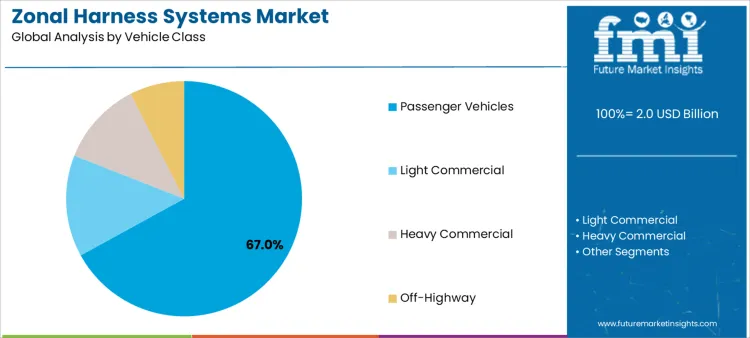
Passenger vehicles account for 67% share of the zonal harness systems market because they are at the forefront of adopting centralized and zonal electrical architectures. Modern passenger cars integrate advanced infotainment, ADAS, body electronics, and electrified powertrains, significantly increasing wiring complexity. Zonal harness systems simplify this complexity by consolidating connections within defined zones and reducing total wire length. OEMs benefit from faster assembly, improved scalability across platforms, and easier integration of new electronic features. High production volumes accelerate standardization of zonal designs. These architectural, manufacturing, and volume-driven factors explain why passenger vehicles remain the largest vehicle class segment.
Why Do Copper-Rich Conductors Dominate Conductor Type Selection In Zonal Harness Systems?
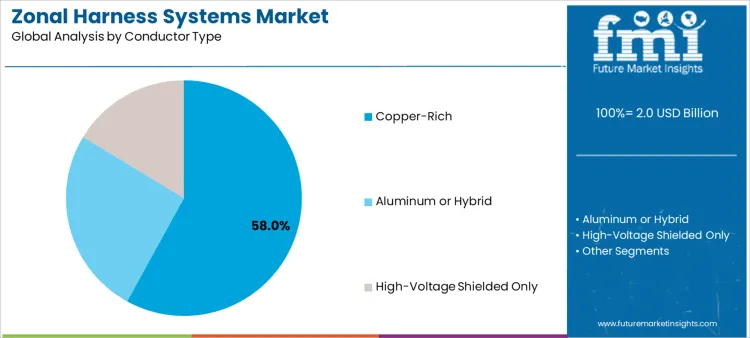
Copper-rich conductors hold 58% share of the zonal harness systems market because copper offers superior electrical conductivity, thermal stability, and long-term reliability. Zonal architectures concentrate multiple power and data lines into fewer harness paths, increasing current density and heat load. Copper conductors handle these demands more effectively than aluminum, particularly in mixed low-voltage and signal applications. OEMs prefer copper-rich solutions for critical zones supporting power distribution, safety systems, and high-speed data transmission. Established manufacturing processes and proven durability further support adoption. These performance, reliability, and integration advantages explain the dominance of copper-rich conductors.
What Are The Key Dynamics Of The Zonal Harness Systems Market?
The zonal harness systems market is driven by automotive manufacturers’ need to simplify wiring architectures, reduce vehicle weight, and improve manufacturing efficiency as vehicles become more electrified and technology-rich. Zonal harness systems regroup wiring looms by vehicle segments (front, center, rear, doors, and underbody zones), minimizing cable length, easing installation, and reducing service complexity. For harness manufacturers and Tier-1 suppliers, design modularity, standardization of connectors, harness quality, and ability to integrate with advanced driver assistance systems (ADAS), infotainment, electric powertrain components, and sensor networks are key factors that influence adoption. Cost optimization and quality consistency are central for securing long-term supply agreements.
How Are Automotive Trends And Technology Requirements Shaping This Market?
Automotive trends and technology requirements are reshaping the zonal harness systems market through increased vehicle electrification, connectivity, and integration of safety and driver assistance functionality. Electric vehicles (EVs), hybrid architectures, and high-voltage systems drive demand for robust, short-run harness configurations that reduce electrical losses and improve packaging efficiency. ADAS and sensor-rich systems (cameras, radars, and lidars) require harnesses with high-speed data capability and robust shielding to ensure signal integrity. Modular designs that support platform commonality across models enhance scalability for original equipment manufacturers (OEMs). For suppliers, offering digital design tools, harness simulation, and rapid prototyping support strengthens engineering collaboration with OEM design teams.
Why Do Integration, Standardization, And Cost Pressures Restrain Market Growth?
Integration, standardization, and cost pressures restrain growth in the zonal harness systems market by increasing complexity in design and manufacturing processes. Achieving cross-platform compatibility requires suppliers to develop scalable connector standards and harness modules that fit diverse vehicle architectures, which adds engineering and validation effort. Integration with existing legacy electronic and electrical architectures while supporting new high-bandwidth data networks can lengthen development cycles. Cost pressures from OEMs seeking lower bill of materials (BOM) and assembly expenses limit margins for suppliers and drive relentless focus on lean manufacturing and material substitution. These challenges can slow adoption in cost-sensitive segments or smaller production programs.
What is the Country-Wise Growth Outlook for the Zonal Harness Systems Market?
The zonal harness systems market is expanding rapidly as automotive OEMs transition from centralized electrical architectures to zonal and domain-based vehicle platforms. Zonal harness systems reduce wiring complexity, vehicle weight, and assembly time by localizing power distribution and data management within defined vehicle zones. Growth varies by country depending on adoption of software-defined vehicles, electrification intensity, and OEM investment in next-generation vehicle platforms. High-growth markets are driven by aggressive EV production and architecture redesign, while mature automotive regions focus on integrating zonal systems into premium and high-volume platforms.
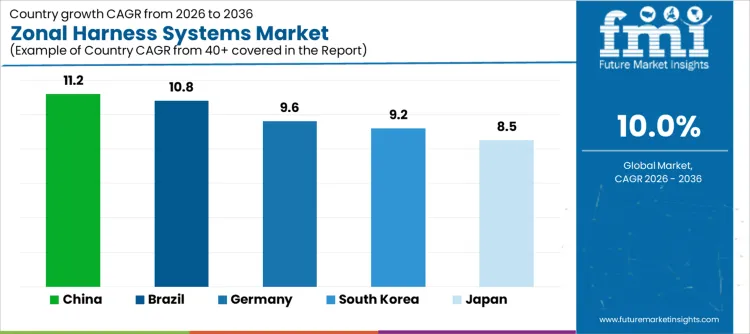
| Country | CAGR (%) |
|---|---|
| China | 11.2 |
| Brazil | 10.8 |
| Germany | 9.6 |
| South Korea | 9.2 |
| Japan | 8.5 |
Why Is China Leading Adoption Of Zonal Harness Systems?
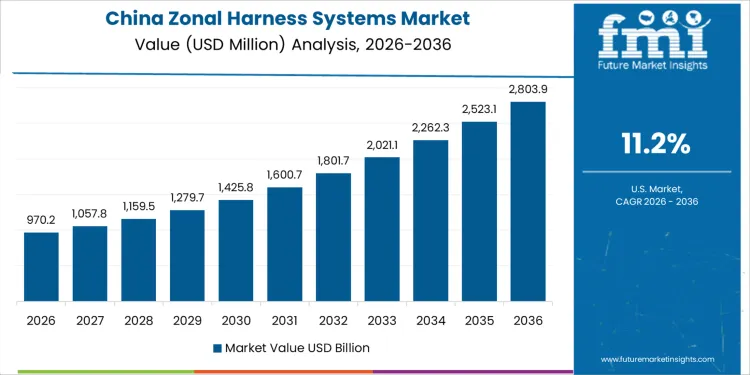
China’s zonal harness systems market is expanding at a CAGR of 11.2% during 2026-2036, driven by rapid transition toward software-defined vehicles and large-scale EV production. Chinese OEMs are redesigning vehicle electrical architectures to reduce wiring mass, simplify assembly, and enable faster software updates. Zonal harness systems support this shift by consolidating wiring into localized zones connected via high-speed data backbones. Buyers prioritize scalability, compatibility with Ethernet-based networks, and integration with centralized compute units.
Adoption is strongest in EV and smart vehicle platforms where frequent feature updates and advanced ADAS functions are required. Procurement decisions favor suppliers with high-volume manufacturing capability, design-for-automation expertise, and close co-development with OEM engineering teams. China represents a scale-driven market where success depends on manufacturing efficiency, rapid design iteration, and deep integration into next-generation vehicle platforms.
Why Is Brazil Emerging As A Fast-Growing Market For Zonal Harness Systems?
Brazil’s zonal harness systems market is growing at a CAGR of 10.8% during 2026-2036, supported by modernization of vehicle platforms and increasing localization of EV and hybrid production. OEMs operating in Brazil are adopting zonal architectures to reduce harness complexity and support new electronic features without extensive redesign. Buyers emphasize cost optimization, modularity, and ease of integration into mixed ICE and electrified platforms. Adoption is initially focused on higher-end and export-oriented vehicle lines before broader rollout.
Procurement decisions are influenced by supplier ability to localize production, manage cost pressures, and support phased architecture transitions. Market value is driven by gradual platform upgrades and alignment with global OEM electrical strategies. Brazil represents an emerging transition market where supplier success depends on flexible design approaches, localized manufacturing support, and the ability to bridge conventional and zonal architectures efficiently.
How Is Germany Integrating Zonal Harness Systems Into Premium Vehicle Platforms?
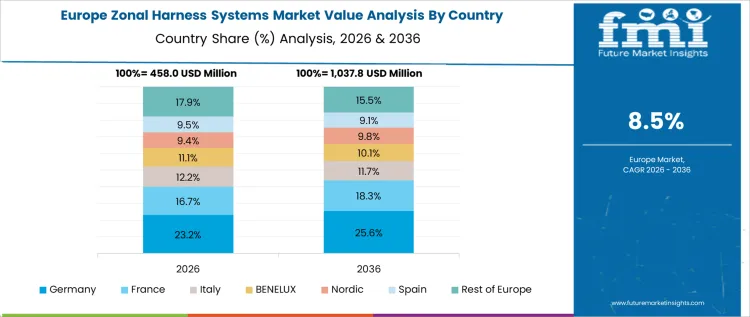
Germany’s zonal harness systems market is expanding at a CAGR of 9.6% during 2026-2036, shaped by strong emphasis on advanced vehicle engineering and premium automotive platforms. German OEMs are adopting zonal architectures to support centralized computing, high-speed data communication, and complex ADAS and infotainment systems. Buyers prioritize signal integrity, redundancy, and compliance with stringent automotive standards.
Zonal harness systems are integrated through long development cycles involving simulation, validation, and extensive testing. Procurement decisions favor Tier-1 suppliers with deep engineering expertise, proven reliability, and strong collaboration capabilities. Market value is driven by premium vehicle volumes and continuous refinement of E/E architectures. Germany represents a quality-driven market where success depends on engineering precision, documentation strength, and ability to meet exacting OEM specifications rather than sheer production scale.
Why Is South Korea Advancing Zonal Harness System Deployment?
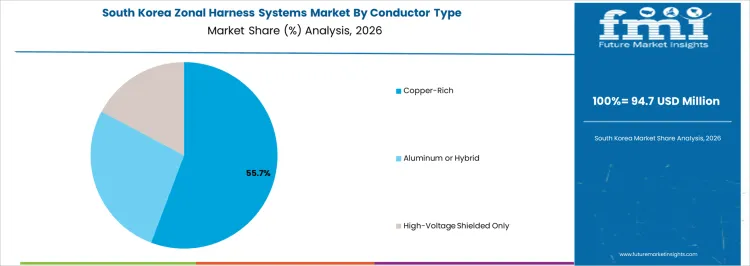
South Korea’s zonal harness systems market is growing at a CAGR of 9.2% during 2026-2036, supported by global EV platform development and strong electronics integration capabilities. OEMs are adopting zonal architectures to reduce wiring weight and improve system responsiveness in next-generation EVs. Buyers emphasize compatibility with centralized controllers, high-speed data protocols, and compact vehicle packaging. Adoption is closely linked to battery-electric platforms designed for global markets.
Procurement decisions favor suppliers with advanced manufacturing automation, electronics expertise, and strong co-development processes. Market value is driven by export-oriented vehicle production and rapid platform evolution. South Korea represents a technology-driven market where supplier success depends on integration expertise, manufacturing precision, and alignment with global vehicle architecture strategies.
How Is Japan Transitioning Toward Zonal Harness Architectures?
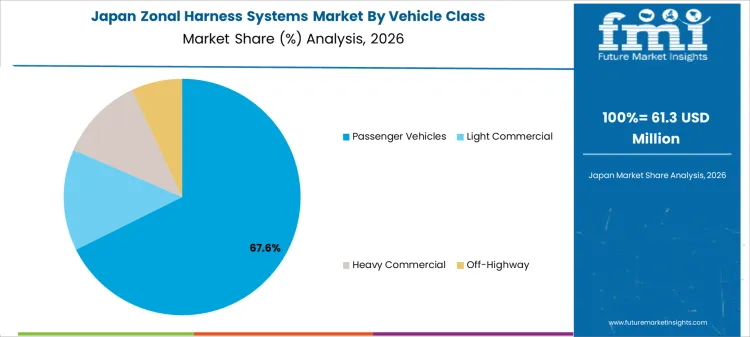
Japan’s zonal harness systems market is expanding at a CAGR of 8.5% during 2026-2036, reflecting a measured transition toward next-generation vehicle electrical architectures. Japanese OEMs emphasize reliability, incremental platform evolution, and long-term durability when adopting zonal systems. Buyers prioritize fault tolerance, simplified diagnostics, and compatibility with existing production processes. Adoption is gradual, often beginning with partial zonal implementations before full architecture shifts.
Procurement decisions involve extensive validation and long qualification cycles. Market value is driven by steady integration into hybrid and advanced ICE platforms alongside EV programs. Japan represents a disciplined market where growth is steady and supplier success depends on proven reliability, process consistency, and long-term partnership with OEMs.
How Are Suppliers Competing in the Zonal Harness Systems Market?
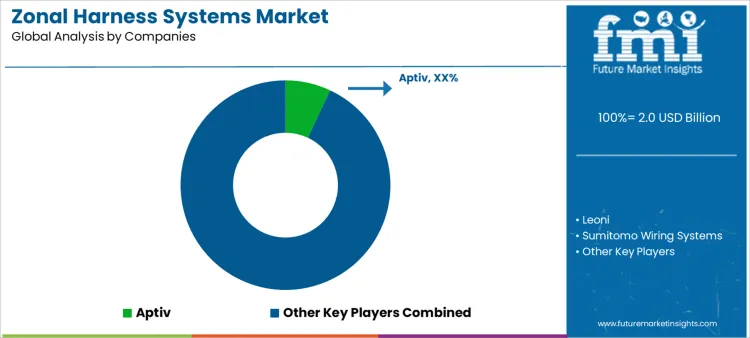
Competition in the zonal harness systems market is driven by architectural simplification, weight reduction, and seamless integration with centralized vehicle computing platforms. As OEMs transition from domain-based to zonal E/E architectures, suppliers are repositioning harness portfolios around shorter cable runs, standardized zones, and high-speed data compatibility. Aptiv leads this shift by aligning zonal harness systems with centralized controllers and high-voltage architectures, emphasizing reduced wiring complexity, improved signal integrity, and scalability for software-defined vehicles. Leoni competes through modular zonal harness concepts focused on lightweight materials, optimized routing, and compatibility with Ethernet-based communication.
Japanese wiring majors emphasize manufacturing scale and reliability. Sumitomo Wiring Systems and Yazaki position zonal harness systems around proven quality, high-volume production capability, and close OEM collaboration during vehicle platform development. Their strategies focus on balancing zonal modularity with legacy platform compatibility, supporting gradual OEM transitions. Furukawa Electric differentiates through advanced materials and signal transmission expertise suited for high-speed data and electrified power distribution.
European and global Tier-1s strengthen positioning through platform breadth. Motherson, including PKC Group, emphasizes zonal harness solutions for both passenger and commercial vehicles, focusing on cost optimization and global manufacturing footprint. Lear integrates zonal harnesses with electronic distribution modules, highlighting system-level optimization. Kromberg & Schubert and Nexans Autoelectric compete through customized zonal layouts and high-speed cabling expertise. Across the market, competitive advantage is defined by architectural alignment with OEM E/E roadmaps, weight and cost reduction, and manufacturability at scale rather than harness pricing alone.
Key Players in Zonal Harness Systems Market
- Aptiv
- Leoni
- Sumitomo Wiring Systems
- Yazaki
- Furukawa Electric
- Motherson
- Lear
- Kromberg & Schubert
- PKC Group (Motherson)
- Nexans Autoelectric
Scope of Report
| Attribute | Details |
|---|---|
| Market Size Unit | USD Billion |
| Vehicle Class Covered | Passenger Vehicles, Light Commercial Vehicles, Heavy Commercial Vehicles, Off-Highway Vehicles |
| Conductor Type Covered | Copper-Rich Harnesses, Aluminum or Hybrid Conductors, High-Voltage Shielded Harness Systems |
| Countries Covered | China, Japan, South Korea, India, Australia & New Zealand, ASEAN, Rest of Asia Pacific, Germany, United Kingdom, France, Italy, Spain, Nordic, BENELUX, Rest of Europe, United States, Canada, Mexico, Brazil, Chile, Rest of Latin America, Kingdom of Saudi Arabia, Other GCC Countries, Turkey, South Africa, Other African Union, Rest of Middle East & Africa |
| Regions Covered | Asia Pacific, Europe, North America, Latin America, Middle East & Africa |
| Key Companies Profiled | Aptiv, Leoni, Sumitomo Wiring Systems, Yazaki, Furukawa Electric, Motherson, Lear, Kromberg & Schubert, PKC Group (Motherson), Nexans Autoelectric |
| Additional Attributes | Dollar sales by vehicle class and conductor type are evaluated across next-generation vehicle electrical architectures. The scope analyzes wiring consolidation, weight reduction, high-voltage readiness, and integration with centralized compute platforms. Country-level assessment reflects EV penetration, software-defined vehicle adoption, and OEM transition toward zonal electrical architectures. |
Zonal Harness Systems Market by Key Segments
Vehicle Class:
- Passenger Vehicles
- Light Commercial
- Heavy Commercial
- Off‑Highway
Conductor Type:
- Copper‑Rich
- Aluminum or Hybrid
- High‑Voltage Shielded Only
Region:
- Asia Pacific
- China
- Japan
- South Korea
- India
- Australia & New Zealand
- ASEAN
- Rest of Asia Pacific
- Europe
- Germany
- United Kingdom
- France
- Italy
- Spain
- Nordic
- BENELUX
- Rest of Europe
- North America
- United States
- Canada
- Mexico
- Latin America
- Brazil
- Chile
- Rest of Latin America
- Middle East & Africa
- Kingdom of Saudi Arabia
- Other GCC Countries
- Turkey
- South Africa
- Other African Union
- Rest of Middle East & Africa
Bibiliography
- Park, C., & Park, S. (2023). Performance evaluation of zone-based in-vehicle network architecture for autonomous vehicles. Sensors, 23(2), 669.
- Maier, J., & Reuss, H. C. (2023). Design of zonal E/E architectures in vehicles using a coupled approach of k-means clustering and Dijkstra’s algorithm. Energies, 16(19), 6884.
- Park, C., Cui, C., & Park, S. (2024). Analysis of end-to-end delay and wiring harness in in-vehicle network with zonal architecture. Sensors, 24(10), 3248.
- Yao, Q., Peng, W., Ding, X., Zhang, Y., & Liu, X. (2024). Review of electrical and electronic architectures for autonomous vehicles: Topologies, cost, power consumption, and hardware components. Automotive Innovation, 7, 82-101.
- Shetiya, S. S., Vyas, V., & Renukuntla, S. (2024). Zonal architecture development with evolution of artificial intelligence (arXiv:2412.01840). arXiv.
Frequently Asked Questions
How big is the zonal harness systems market in 2026?
The global zonal harness systems market is estimated to be valued at USD 2.0 billion in 2026.
What will be the size of zonal harness systems market in 2036?
The market size for the zonal harness systems market is projected to reach USD 5.2 billion by 2036.
How much will be the zonal harness systems market growth between 2026 and 2036?
The zonal harness systems market is expected to grow at a 10.0% CAGR between 2026 and 2036.
What are the key product types in the zonal harness systems market?
The key product types in zonal harness systems market are passenger vehicles, light commercial, heavy commercial and off‑highway.
Which conductor type segment to contribute significant share in the zonal harness systems market in 2026?
In terms of conductor type, copper‑rich segment to command 58.0% share in the zonal harness systems market in 2026.
Preview the report firsthand - request a free sample
Get SampleGet the brochure for pricing and purchase details.
Get PDFTable of Content
- Executive Summary
- Global Market Outlook
- Demand-side Trends
- Supply-side Trends
- Technology Roadmap Analysis
- Analysis and Recommendations
- Market Overview
- Market Coverage / Taxonomy
- Market Definition / Scope / Limitations
- Market Background
- Market Dynamics
- Drivers
- Restraints
- Opportunity
- Trends
- Scenario Forecast
- Demand in Optimistic Scenario
- Demand in Likely Scenario
- Demand in Conservative Scenario
- Opportunity Map Analysis
- Product Life Cycle Analysis
- Supply Chain Analysis
- Investment Feasibility Matrix
- Value Chain Analysis
- PESTLE and Porter’s Analysis
- Regulatory Landscape
- Regional Parent Market Outlook
- Production and Consumption Statistics
- Import and Export Statistics
- Market Dynamics
- Global Market Analysis 2021 to 2025 and Forecast, 2026 to 2036
- Historical Market Size Value (USD Million) Analysis, 2021 to 2025
- Current and Future Market Size Value (USD Million) Projections, 2026 to 2036
- Y-o-Y Growth Trend Analysis
- Absolute $ Opportunity Analysis
- Global Market Pricing Analysis 2021 to 2025 and Forecast 2026 to 2036
- Global Market Analysis 2021 to 2025 and Forecast 2026 to 2036, By Vehicle Class
- Introduction / Key Findings
- Historical Market Size Value (USD Million) Analysis By Vehicle Class , 2021 to 2025
- Current and Future Market Size Value (USD Million) Analysis and Forecast By Vehicle Class , 2026 to 2036
- Passenger Vehicles
- Light Commercial
- Heavy Commercial
- Off‑Highway
- Passenger Vehicles
- Y-o-Y Growth Trend Analysis By Vehicle Class , 2021 to 2025
- Absolute $ Opportunity Analysis By Vehicle Class , 2026 to 2036
- Global Market Analysis 2021 to 2025 and Forecast 2026 to 2036, By Conductor Type
- Introduction / Key Findings
- Historical Market Size Value (USD Million) Analysis By Conductor Type, 2021 to 2025
- Current and Future Market Size Value (USD Million) Analysis and Forecast By Conductor Type, 2026 to 2036
- Copper‑Rich
- Aluminum or Hybrid
- High‑Voltage Shielded Only
- Copper‑Rich
- Y-o-Y Growth Trend Analysis By Conductor Type, 2021 to 2025
- Absolute $ Opportunity Analysis By Conductor Type, 2026 to 2036
- Global Market Analysis 2021 to 2025 and Forecast 2026 to 2036, By Region
- Introduction
- Historical Market Size Value (USD Million) Analysis By Region, 2021 to 2025
- Current Market Size Value (USD Million) Analysis and Forecast By Region, 2026 to 2036
- North America
- Latin America
- Western Europe
- Eastern Europe
- East Asia
- South Asia and Pacific
- Middle East & Africa
- Market Attractiveness Analysis By Region
- North America Market Analysis 2021 to 2025 and Forecast 2026 to 2036, By Country
- Historical Market Size Value (USD Million) Trend Analysis By Market Taxonomy, 2021 to 2025
- Market Size Value (USD Million) Forecast By Market Taxonomy, 2026 to 2036
- By Country
- USA
- Canada
- Mexico
- By Vehicle Class
- By Conductor Type
- By Country
- Market Attractiveness Analysis
- By Country
- By Vehicle Class
- By Conductor Type
- Key Takeaways
- Latin America Market Analysis 2021 to 2025 and Forecast 2026 to 2036, By Country
- Historical Market Size Value (USD Million) Trend Analysis By Market Taxonomy, 2021 to 2025
- Market Size Value (USD Million) Forecast By Market Taxonomy, 2026 to 2036
- By Country
- Brazil
- Chile
- Rest of Latin America
- By Vehicle Class
- By Conductor Type
- By Country
- Market Attractiveness Analysis
- By Country
- By Vehicle Class
- By Conductor Type
- Key Takeaways
- Western Europe Market Analysis 2021 to 2025 and Forecast 2026 to 2036, By Country
- Historical Market Size Value (USD Million) Trend Analysis By Market Taxonomy, 2021 to 2025
- Market Size Value (USD Million) Forecast By Market Taxonomy, 2026 to 2036
- By Country
- Germany
- UK
- Italy
- Spain
- France
- Nordic
- BENELUX
- Rest of Western Europe
- By Vehicle Class
- By Conductor Type
- By Country
- Market Attractiveness Analysis
- By Country
- By Vehicle Class
- By Conductor Type
- Key Takeaways
- Eastern Europe Market Analysis 2021 to 2025 and Forecast 2026 to 2036, By Country
- Historical Market Size Value (USD Million) Trend Analysis By Market Taxonomy, 2021 to 2025
- Market Size Value (USD Million) Forecast By Market Taxonomy, 2026 to 2036
- By Country
- Russia
- Poland
- Hungary
- Balkan & Baltic
- Rest of Eastern Europe
- By Vehicle Class
- By Conductor Type
- By Country
- Market Attractiveness Analysis
- By Country
- By Vehicle Class
- By Conductor Type
- Key Takeaways
- East Asia Market Analysis 2021 to 2025 and Forecast 2026 to 2036, By Country
- Historical Market Size Value (USD Million) Trend Analysis By Market Taxonomy, 2021 to 2025
- Market Size Value (USD Million) Forecast By Market Taxonomy, 2026 to 2036
- By Country
- China
- Japan
- South Korea
- By Vehicle Class
- By Conductor Type
- By Country
- Market Attractiveness Analysis
- By Country
- By Vehicle Class
- By Conductor Type
- Key Takeaways
- South Asia and Pacific Market Analysis 2021 to 2025 and Forecast 2026 to 2036, By Country
- Historical Market Size Value (USD Million) Trend Analysis By Market Taxonomy, 2021 to 2025
- Market Size Value (USD Million) Forecast By Market Taxonomy, 2026 to 2036
- By Country
- India
- ASEAN
- Australia & New Zealand
- Rest of South Asia and Pacific
- By Vehicle Class
- By Conductor Type
- By Country
- Market Attractiveness Analysis
- By Country
- By Vehicle Class
- By Conductor Type
- Key Takeaways
- Middle East & Africa Market Analysis 2021 to 2025 and Forecast 2026 to 2036, By Country
- Historical Market Size Value (USD Million) Trend Analysis By Market Taxonomy, 2021 to 2025
- Market Size Value (USD Million) Forecast By Market Taxonomy, 2026 to 2036
- By Country
- Kingdom of Saudi Arabia
- Other GCC Countries
- Turkiye
- South Africa
- Other African Union
- Rest of Middle East & Africa
- By Vehicle Class
- By Conductor Type
- By Country
- Market Attractiveness Analysis
- By Country
- By Vehicle Class
- By Conductor Type
- Key Takeaways
- Key Countries Market Analysis
- USA
- Pricing Analysis
- Market Share Analysis, 2025
- By Vehicle Class
- By Conductor Type
- Canada
- Pricing Analysis
- Market Share Analysis, 2025
- By Vehicle Class
- By Conductor Type
- Mexico
- Pricing Analysis
- Market Share Analysis, 2025
- By Vehicle Class
- By Conductor Type
- Brazil
- Pricing Analysis
- Market Share Analysis, 2025
- By Vehicle Class
- By Conductor Type
- Chile
- Pricing Analysis
- Market Share Analysis, 2025
- By Vehicle Class
- By Conductor Type
- Germany
- Pricing Analysis
- Market Share Analysis, 2025
- By Vehicle Class
- By Conductor Type
- UK
- Pricing Analysis
- Market Share Analysis, 2025
- By Vehicle Class
- By Conductor Type
- Italy
- Pricing Analysis
- Market Share Analysis, 2025
- By Vehicle Class
- By Conductor Type
- Spain
- Pricing Analysis
- Market Share Analysis, 2025
- By Vehicle Class
- By Conductor Type
- France
- Pricing Analysis
- Market Share Analysis, 2025
- By Vehicle Class
- By Conductor Type
- India
- Pricing Analysis
- Market Share Analysis, 2025
- By Vehicle Class
- By Conductor Type
- ASEAN
- Pricing Analysis
- Market Share Analysis, 2025
- By Vehicle Class
- By Conductor Type
- Australia & New Zealand
- Pricing Analysis
- Market Share Analysis, 2025
- By Vehicle Class
- By Conductor Type
- China
- Pricing Analysis
- Market Share Analysis, 2025
- By Vehicle Class
- By Conductor Type
- Japan
- Pricing Analysis
- Market Share Analysis, 2025
- By Vehicle Class
- By Conductor Type
- South Korea
- Pricing Analysis
- Market Share Analysis, 2025
- By Vehicle Class
- By Conductor Type
- Russia
- Pricing Analysis
- Market Share Analysis, 2025
- By Vehicle Class
- By Conductor Type
- Poland
- Pricing Analysis
- Market Share Analysis, 2025
- By Vehicle Class
- By Conductor Type
- Hungary
- Pricing Analysis
- Market Share Analysis, 2025
- By Vehicle Class
- By Conductor Type
- Kingdom of Saudi Arabia
- Pricing Analysis
- Market Share Analysis, 2025
- By Vehicle Class
- By Conductor Type
- Turkiye
- Pricing Analysis
- Market Share Analysis, 2025
- By Vehicle Class
- By Conductor Type
- South Africa
- Pricing Analysis
- Market Share Analysis, 2025
- By Vehicle Class
- By Conductor Type
- USA
- Market Structure Analysis
- Competition Dashboard
- Competition Benchmarking
- Market Share Analysis of Top Players
- By Regional
- By Vehicle Class
- By Conductor Type
- Competition Analysis
- Competition Deep Dive
- Aptiv
- Overview
- Product Portfolio
- Profitability by Market Segments (Product/Age /Sales Channel/Region)
- Sales Footprint
- Strategy Overview
- Marketing Strategy
- Product Strategy
- Channel Strategy
- Leoni
- Sumitomo Wiring Systems
- Yazaki
- Furukawa Electric
- Motherson
- Lear
- Kromberg & Schubert
- PKC Group (Motherson)
- Nexans Autoelectric
- Aptiv
- Competition Deep Dive
- Assumptions & Acronyms Used
- Research Methodology


