

- Industry Size (2026)
- USD 2.3 Bn
- Forecast (2036)
- USD 5.3 Bn
- CAGR (2026 to 2036)
- 8.7%
Off-Road Machine High-Durability Wiring Harness Systems Market Size, Market Forecast and Outlook By FMI
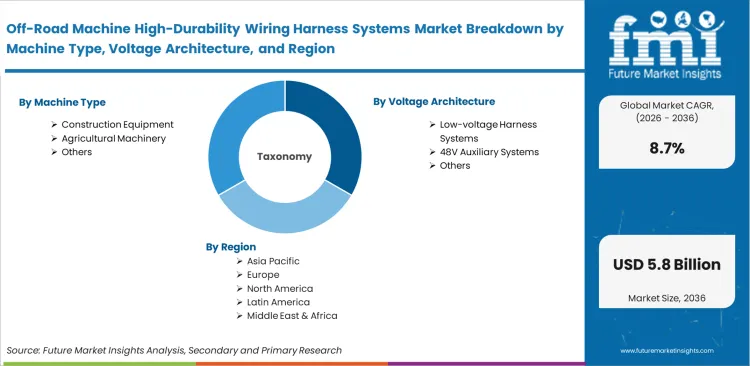
The off-highway vehicle wiring harness market was valued at USD 2.2 billion in 2025. Demand is estimated to surpass USD 2.3 billion in 2026 at a CAGR of 8.7% during forecast periods. Revenue expansion lifts total valuation of the off-road machine high-durability wiring harness systems market to USD 5.3 billion through 2036.
Heavy machinery manufacturers are finding it harder to manage electrical complexity across different equipment platforms. Custom wiring bundles for each machine type can increase stockholding costs and create delays on the production side. To reduce that burden, many buying teams are moving toward modular harness systems made for off-highway environments, where exposure to shock, dust, moisture, and chemicals is routine. This approach supports better uptime and more predictable warranty performance. FMI analysis suggests that OEMs using less durable electrical systems are more exposed to failures under real operating stress. Older architectures, especially those with poorly protected connections, can lead to repeated downtime and expensive service issues.
Summary of Off-Road Machine High-Durability Wiring Harness Systems Market
- Off-Road Machine High-Durability Wiring Harness Systems Market Definition
- Heavily protected electrical routing assemblies are built for heavy equipment used in severe operating environments. Robust sealing systems, reinforced materials, and high shock tolerance help these assemblies withstand dust, moisture, heat, vibration, and repeated impact during daily operation. Their construction supports stable power flow and signal transmission across mining, construction, forestry, and agricultural machinery. Strong durability and reduced failure risk make them essential for equipment expected to perform reliably under constant mechanical and environmental stress.
- Demand Drivers in the Market
- Stringent emission regulations mandate complex sensor integration requiring highly reliable data routing pathways.
- Aggressive equipment electrification trends force adoption of heavy gauge, highly insulated power distribution networks.
- Fleet telematics integration demands zero failure signal transmission across extreme vibration environments.
- Key Segments Analyzed in the FMI Report
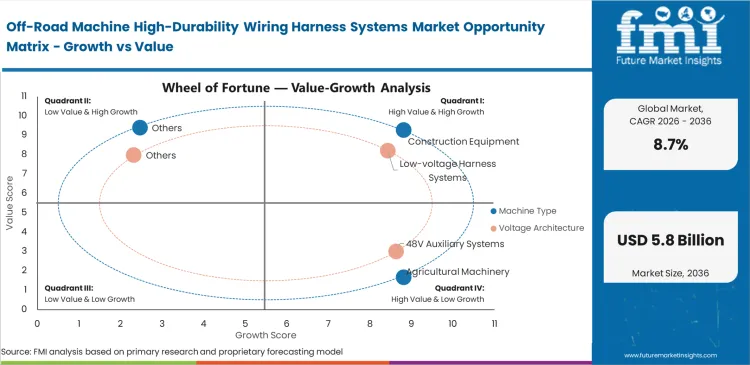
- Machine Type: Construction equipment is expected to hold 31.0% share in 2026, driven by massive global infrastructure spending requiring durable machinery.
- Voltage Architecture: Low-voltage harness system is anticipated to lead voltage architectures, matching legacy engine control unit requirements.
- Protection Standard: Sealed waterproof harnesses is set to capture 42.0% share, representing absolute baseline protection standards for outdoor operation.
- Sales Channel: OEM fitment is projected to account for 72.0% share, reflecting massive factory integration dominance over aftermarket repairs.
- India: 10.1% compound growth, supported by massive localized manufacturing expansion for domestic infrastructure projects.
- Analyst Opinion at FMI
- Nikhil Kaitwade, Principal Analyst, Automation, at FMI, states that, "Generalist assumptions suggest pure material cost remains the primary barrier to advanced harness adoption in heavy machinery. True structural friction actually exists within diagnostic capabilities on the factory floor. Once a systems engineer specifies a complex modular harness design for heavy machinery, legacy testing protocols become entirely obsolete. Re-qualifying continuity testing algorithms requires entirely new quality assurance cycles spanning months. Production managers at legacy equipment builders treat this lengthy diagnostic transition as a functional bottleneck, prioritizing simple splices over highly advanced sealed modularity to maintain assembly line speed."
- Strategic Implications / Executive Takeaways
- Procurement directors must secure dedicated component allocations before heavy electrification mandates trigger severe wire shortages.
- Engineering leaders face critical decisions regarding modularity transition when updating legacy hydraulic control networks to electronic actuation.
- Fleet maintenance managers gain significant uptime advantages by mandating IP69K rated connections across all new machine purchases.
- Methodology
- Primary Research: Sourcing executives and chief electrical engineers at global heavy machinery manufacturers.
- Desk Research: Technical routing patents, supplier conformity documentation, and harsh environment testing standards.
- Market-Sizing and Forecasting: Copper tonnage usage cross-referenced against annual off-highway vehicle production volumes.
- Data Validation and Update Cycle: Tier-1 supplier financial disclosures validate regional volume estimates annually.
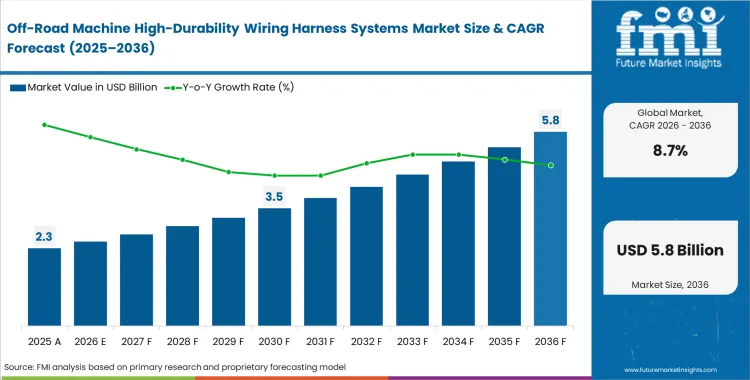
Heavy equipment manufacturers are dealing with a rapid increase in electronic control units as regulators push for lower emissions and stronger active safety performance. That shift is expanding the number of signal-routing paths needed in already tight machine layouts. Engineering leaders can no longer depend on older unsealed splice practices when systems are exposed to moisture, dust, and heavy shock loads. Fully sealed harness designs are becoming more important because weak protection can lead to persistent sensor faults over time.
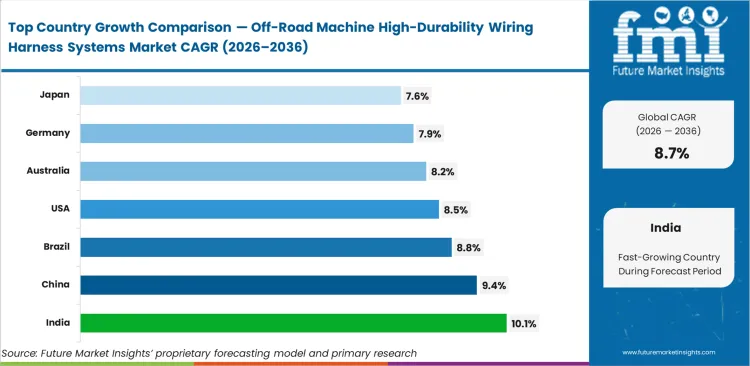
India leads expansion at 10.1% as massive infrastructure spending drives rapid localized production of heavy machinery. China tracks closely at 9.4% supported by intense electrification initiatives across domestic fleets. Brazil advances at 8.8% driven by extensive agricultural mechanization requirements in massive farming operations. The United States secures 8.5% through sustained infrastructure modernization programs. Australia reaches 8.2% via specialized autonomous extraction equipment integration. Germany hits 7.9% and Japan records 7.6% on legacy engineering hubs pivoting toward advanced telemetry development.
Off-Road Machine High-Durability Wiring Harness Systems Market Definition
Off-Road Machine High-Durability Wiring Harness Systems include specialized electrical routing assemblies designed explicitly for heavy equipment operating in extreme environments. Analytical boundaries dictate that these architectures must feature environmental sealing, abrasion resistance, and high shock tolerance far exceeding standard automotive specifications. Scope includes primary power distribution channels, sensitive data lines, and integrated connectors functioning in severe settings.
Off-Road Machine High-Durability Wiring Harness Systems Market Inclusions
Scope incorporates fully sealed connector assemblies, braided wire protection sleeves, and modular power distribution panels installed on heavy machinery. Evaluated components cover high current battery cables and delicate sensor wires bundled within unified protective conduits. FMI tracks integrated systems where manufacturer specifications mandate strict resistance to petroleum-based fluids and sustained mechanical vibration. Research boundaries include electric vehicle wiring harness segments explicitly engineered for battery-operated off-highway machinery and heavy municipal utility vehicles navigating demanding terrain profiles.
Off-Road Machine High-Durability Wiring Harness Systems Market Exclusions
Light duty passenger vehicle electrical systems and standard commercial truck harnesses fall completely outside analytical boundaries. Generic indoor industrial cabling and stationary manufacturing robotics wiring receive strict exclusion due to vastly different operational stress profiles. Component level wire spools lacking integrated connectors and protective sheathing remain excluded from system level tracking. Subsea cabling and aerospace electrical routing architectures face absolute exclusion.
Off-Road Machine High-Durability Wiring Harness Systems Market Research Methodology
- Primary Research: Sourcing executives and chief electrical engineers at global heavy machinery manufacturers.
- Desk Research: Technical routing patents, supplier conformity documentation, and harsh environment testing standards.
- Market-Sizing and Forecasting: Copper tonnage usage cross-referenced against annual off-highway vehicle production volumes.
- Data Validation and Update Cycle: Tier-1 supplier financial disclosures validate regional volume estimates annually.
Segmental Analysis
Off-Road Machine High-Durability Wiring Harness Systems Market Analysis by Machine Type
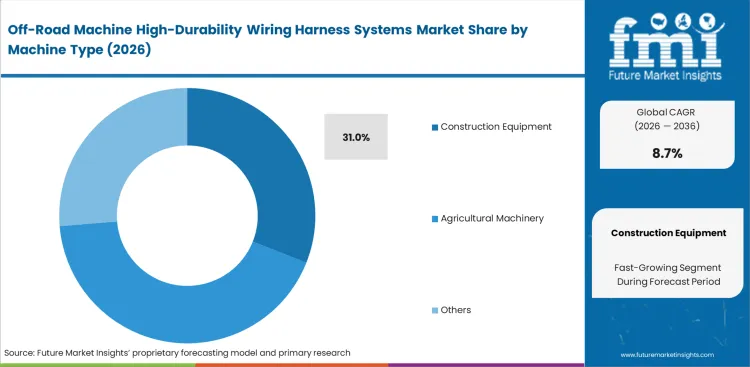
Vibration exposure plays a major role in determining which equipment categories need the strongest wire protection. Construction equipment accounts for 31.0% share because excavators, loaders, and other earthmoving machines put wiring systems under constant shock, flexing, and dust exposure. Engineers usually specify braided sheathing in exposed areas such as boom arms, where contact with debris and moving parts is difficult to avoid. Lower-grade routing materials can fail quickly when hydraulic lines rub against nearby wire bundles. Buyers understand that even one damaged data line can stop a high-value autonomous excavator and create major downtime. FMI also notes rising demand from agriculture and mining, where growing machine complexity is pushing harness protection requirements higher.
- Structural flex demands: Excavator boom arms require harnesses that survive millions of repetitive motion cycles. Systems engineers utilize specialized multi-strand copper specifically to prevent fatigue breakage inside moving joints.
- Harvest window criticality: Combine harvesters operate continuously for brief seasonal periods. Reliability managers specify extreme temperature insulation to prevent wire melting near overworked diesel exhaust components.
- Vibration resonance matching: Mining drills generate unique high frequency chassis vibrations. Acoustic engineers design specific mounting clips to prevent harness bundles from destroying themselves against internal metal bulkheads.
Off-Road Machine High-Durability Wiring Harness Systems Market Analysis by Voltage Architecture
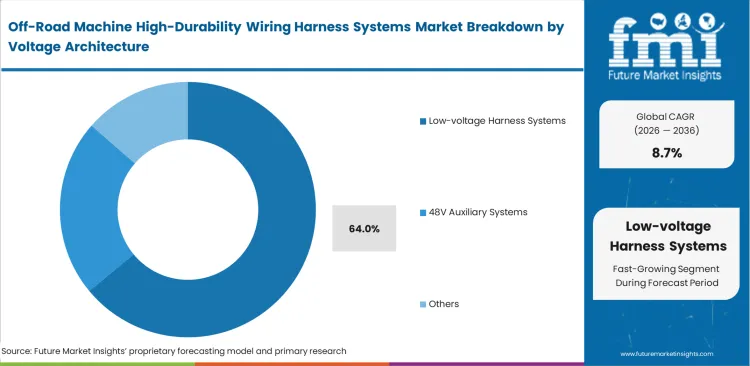
Low-voltage harness systems capture 64.0% share as bulk manufacturing infrastructure remains heavily optimized for these traditional power distribution requirements. Assembly line workers install these proven networks utilizing established connector topologies that require minimal specialized training. Relying on this established architecture allows massive scale production without requiring drastic factory retooling. According to FMI assessments, mixed voltage architectures in off-highway vehicles slowly disrupt this dominance as auxiliary components migrate toward 48V standards. Implementations pushing heavy cooling fans and high output actuators demand thicker gauge wiring capable of handling sustained current loads without thermal runaway.
- Legacy factory integration: Assembly line workers possess deep familiarity with low voltage connection mechanics. Plant managers justify continued reliance on old architecture to maintain peak production velocity.
- Thermal runaway risks: Pushing excessive auxiliary power through thin wires causes immediate insulation melting. Safety compliance officers mandate strict gauge increases when transitioning implement controls to electrical power.
- Pin density constraints: Modern control units require dozens of localized connections. Engineering directors struggle to fit bulky high current pins into compact junction boxes.
Off-Road Machine High-Durability Wiring Harness Systems Market Analysis by Protection Standard
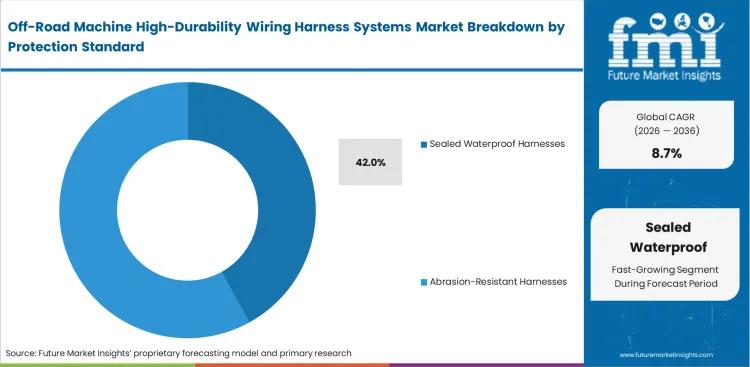
Moisture exposure continues to be one of the biggest risks for heavy machinery electrical systems. Sealed harnesses hold 42.0% share in construction equipment because operators expect wiring systems to withstand pressure washing, mud, and prolonged exposure to harsh outdoor conditions. Cleaning routines often involve chemical detergents and strong water pressure, so design teams are increasingly turning to heavy-duty connectors with more reliable sealing features. If waterproof harnesses are not specified, corrosion can build quickly and lead to erratic faults that are hard for technicians to diagnose. FMI notes that some component suppliers still do not fully account for the level of abuse these seals experience over time. In high-exposure conditions, including acidic slurry, standard rubber materials may fail far too early, pushing manufacturers toward more advanced sealing compounds.
- Pressure washing survival: Maintenance depots hit machinery with high PSI water jets daily. Quality engineers mandate IP69K rated seals to survive direct nozzle blasts without moisture ingress.
- Corrosive slurry exposure: Mining environments introduce highly acidic or basic mud to exposed wiring. Chemical specialists specify advanced outer jacketing completely resistant to severe pH fluctuations.
- Thermal cycling stress: Engine bays transition from freezing to boiling rapidly. Material scientists select specific potting compounds that expand and contract without fracturing internal solder joints.
Off-Road Machine High-Durability Wiring Harness Systems Market Analysis by Application Zone
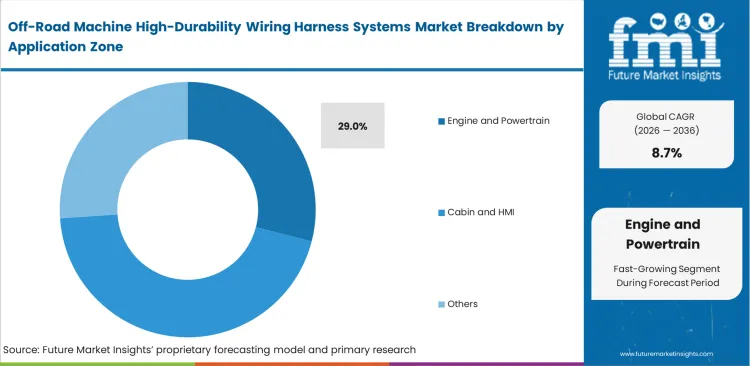
An engine wiring harness for construction equipment accounts for 29.0% share due to the intense proximity to extreme exhaust heat and continuous hydrocarbon exposure. Harness designers encapsulate these critical sensor pathways inside specialized fiberglass braiding to prevent direct thermal destruction. Providing continuous data from exhaust gas recirculation valves requires unassailable connections capable of surviving localized fire events. FMI analysis indicates that chassis routing presents a completely different challenge. Wires running along the underbody face continuous abrasion from rocks and debris kicked up by tracks and tires. Using standard thin-walled insulation in these impact zones guarantees rapid copper exposure. Chassis engineers mandate thick corrugated plastic tubing and specialized heavy duty connector housings to deflect sharp physical impacts safely, while a dedicated telematics harness for off-road machines must snake safely up into the cabin environment without pinching.
- Exhaust proximity routing: Diesel particulate filters generate high localized heat. Thermal engineers wrap adjacent sensor wires in reflective shielding to prevent insulation breakdown.
- Debris impact zones: Tracked vehicles throw sharp rocks violently against underbody components. Structural engineers design recessed chassis channels to hide critical harnesses from direct physical strikes.
- Cabin articulation flex: Articulated dump trucks bend completely in the middle during turning. Routing designers engineer specific torsion loops allowing thick power cables to twist thousands of times without tearing.
Off-Road Machine High-Durability Wiring Harness Systems Market Analysis by Sales Channel
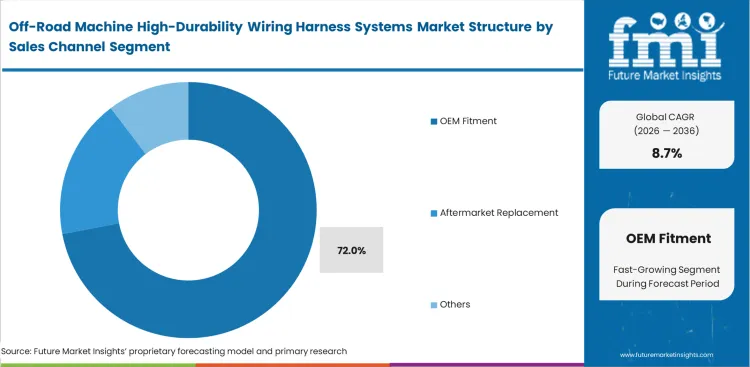
Primary harness systems are rarely changed after the machine leaves the factory as the installation process is too complex. OEM fitment holds 72.0% share as these harnesses are routed through the frame before major components are fully assembled. The work is typically done early on by trained factory teams using specialized tooling and automated support. For fleet managers, the cost and effort involved in replacing a full harness later often make that option unrealistic. That is why factory-installed cable assemblies remain central to quality and sourcing decisions. In the aftermarket, activity is usually limited to smaller, easier-to-reach wire repairs rather than full backbone replacement.
- Initial assembly sequencing: Main wiring drops into bare frames first. Production planners optimize routing paths explicitly for robotic installation speed rather than future service accessibility.
- Labor cost prohibitions: Dismantling a bulldozer to replace a central harness takes hundreds of hours. Service managers authorize localized splicing kits specifically to avoid total machine teardowns.
- Implement extension damage: Wires running to exposed hydraulic attachments suffer frequent tearing. Procurement teams stock large volumes of standardized extension cables for rapid field replacement by operators.
Off-Road Machine High-Durability Wiring Harness Systems Market Drivers, Restraints, and Opportunities
Heavy equipment manufacturers are under more pressure to build reliable data-routing systems as emissions compliance becomes more demanding. The addition of particulate monitors and exhaust gas temperature probes is expanding the number of sensor connections that must pass through already tight engine layouts. Engineering directors are dealing with more heat, less space, and higher reliability expectations at the same time. In this environment, secure sealed routing is necessary for certification. Treating it as a later upgrade can leave manufacturers unable to meet current regulatory standards.
Legacy diagnostic protocols create immense operational friction slowing rapid transition toward modular architectures. Once systems engineers specify complex multiplexed harness topologies, traditional continuity testing methods become useless. Re-qualifying electronic diagnostic algorithms requires entirely new testing hardware on factory floors. Production managers at mid-size builders treat this lengthy retooling protocol as severe vendor lock-in. Purchasing teams stick with simpler, outdated point-to-point wiring to avoid buying million-dollar automated testing rigs.
Opportunities in the Off-Road Machine High-Durability Wiring Harness Systems Market
- Compact fleet upgrades: The rapid electrification of compact construction equipment distributes massive current from heavy battery packs requiring entirely novel architectures. Systems architects bypass crowded low-voltage segments by targeting dedicated high-voltage traction networks.
- Driverless operations: Addressing autonomous off-road equipment wiring needs provides undeniable safety proof. Engineering directors command massive price premiums offering fail-safe steering and braking signal continuity.
- Advanced telematics integration: Integrating predictive maintenance sensors directly into primary wire bundles opens continuous data streams. R&D heads capture new subscription revenue by monitoring harness health directly from the cloud.
Regional Analysis
Based on regional analysis, Off-Road Machine High-Durability Wiring Harness Systems is segmented into East Asia, South Asia, North America, Europe, Latin America, and Oceania.
.webp "Top Country Growth Comparison Off Road Machine High Durability Wiring Harness Systems Market Cagr (2026 2036)")
| Country | CAGR (2026 to 2036) |
|---|---|
| India | 10.1% |
| China | 9.4% |
| Brazil | 8.8% |
| United States | 8.5% |
| Australia | 8.2% |
| Germany | 7.9% |
| Japan | 7.6% |
Source: Future Market Insights (FMI) analysis, based on proprietary forecasting model and primary research
South Asia Off-Road Machine High-Durability Wiring Harness Systems Market Analysis
Substantial government infrastructure spending fundamentally reshapes machinery production across localized manufacturing zones. Domestic builders scale aggressively to capture immense earthmoving equipment demand previously supplied by imports. Procurement directors secure vertically integrated construction equipment component contracts directly with regional wire suppliers. FMI analysis indicates this localized sourcing model bypasses traditional global supply chains, slashing transit costs significantly. Bypassing legacy import networks grants domestic OEMs unprecedented pricing flexibility. Facilities combining basic chassis welding with advanced local harness assembly achieve massive cost advantages over competitors reliant purely on imported electronic subsystems.
- India: In India, large highway and corridor construction projects are creating sustained demand for construction machinery, which in turn is supporting demand for related harness systems. The India market is projected to grow at a 10.1% CAGR over the forecast period, as equipment makers and sourcing teams lock in multi-year harness supply agreements early in the project cycle. These contracts give buyers better cost visibility and reduce supply risk across long-duration infrastructure programs. For suppliers, they also create a stronger foothold in equipment platforms tied to expanding transport networks, making it harder for later entrants to win share once projects move into active execution.
East Asia Off-Road Machine High-Durability Wiring Harness Systems Market Analysis
Government electrification mandates are shifting attention toward high-voltage system development in large industrial zones. Manufacturers with a long history in diesel equipment are reworking existing plants to support battery-powered heavy machinery. Supply chain managers are drawing on established assembly infrastructure to add electric traction harnesses into production more efficiently. According to FMI estimates, sites that once focused mainly on hydraulic machines are now dedicating a larger share of capacity to advanced electrical routing. As that transition gathers pace, demand for specialized high-voltage copper is becoming more competitive across the regional supply base.
- China: In China, state-backed battery production is giving heavy machinery manufacturers more confidence to scale electric equipment programs. That matters as construction rules in major cities increasingly favor low-emission or zero-emission machines, especially in dense urban projects. Manufacturers are responding by pushing further into electric loaders and other premium equipment categories where cleaner operation is becoming a commercial advantage. Better battery availability is also shortening procurement lead times and making rollout plans easier to execute. As a result, the China market is projected to grow at a 9.4% CAGR through 2036, supported by rising adoption of electric heavy machinery and stronger alignment with tightening emissions targets.
- Japan: Japan’s growth is being shaped by its demanding performance standards, particularly in systems where autonomous functions depend on stable and highly reliable sensor routing. In these applications, connection quality is not a secondary issue; it directly affects signal accuracy, fault resistance, and operating consistency. Suppliers that can meet strict validation requirements are finding stronger opportunities in advanced equipment programs built around precision and long-term reliability. This is expected to support 7.6% CAGR for the Japan segment over the forecast period, as buyers continue to favor proven connection systems for technically sensitive and accuracy-driven applications.
North America Off-Road Machine High-Durability Wiring Harness Systems Market Analysis
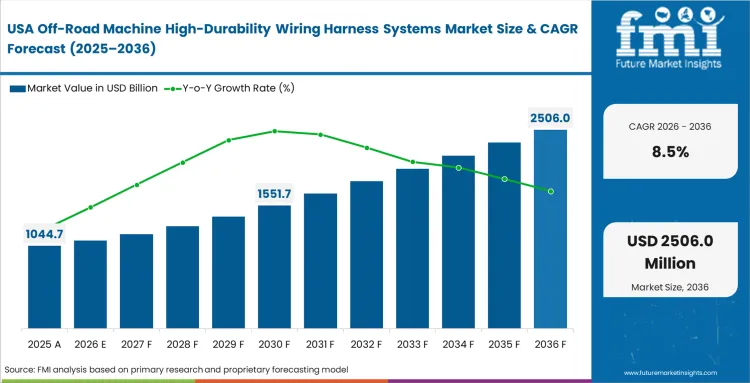
Deep domestic fleet modernization trends force local manufacturers to innovate beyond basic analog wiring. OEMs develop complex multiplexed architectures to isolate highly specific data signals for autonomous operation. R&D directors partner with major technology firms to validate telemetry efficacy for specialized mining equipment applications.
- United States: In the United States, established equipment manufacturers are working more closely with software developers, and that is speeding up the move toward more advanced control architectures. The benefit is not just better system design on paper. It also shows up in continuous telemetry improvements, faster response across connected equipment, and better coordination between hardware and software layers. Suppliers are using those gains to make their systems more adaptive and data-aware, which is becoming increasingly important as industrial platforms turn more digital. As a result, the USA market is expected to grow at a CAGR of 8.5% through 2036, supported by ongoing upgrades in connectivity, control logic, and equipment intelligence.
Europe Off-Road Machine High-Durability Wiring Harness Systems Market Analysis
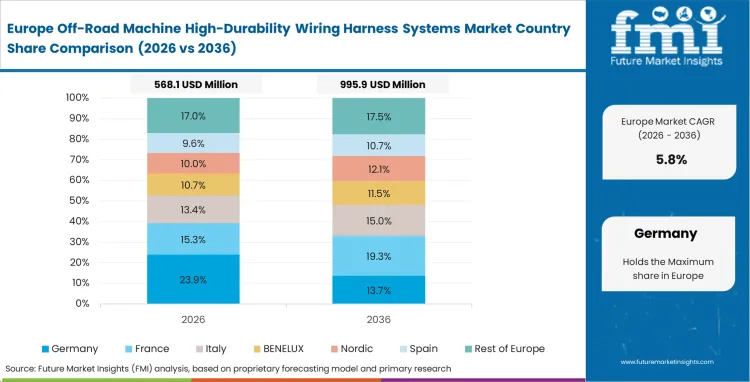
State mandates around electrification are accelerating the shift toward high-voltage architecture development in heavy equipment manufacturing. Companies that once focused on diesel machinery are turning their existing factory infrastructure toward battery-powered machines. Supply chain managers are using established assembly operations to handle the integration of electric traction harnesses and related electrical systems. FMI estimates show that facilities previously dedicated to hydraulic equipment are now reserving a larger share of capacity for electrical routing. This change is raising competition for high-voltage copper and other specialized conductive materials across regional supply chains.
- Germany: Germany’s strength in engineering is supporting the development of more compact, high-density connectors suited to increasingly crowded vehicle architectures. As under-hood systems take on more electrical functions within tighter layouts, manufacturers are focusing on routing components that can save space without compromising reliability. Improvements in connector design are helping boost packaging efficiency, maintain connection stability, and support long-term durability across dense electrical systems. That is expected to keep the Germany market growing at 7.9% CAGR, as demand continues for smaller, more dependable connector solutions in modern vehicle platforms.
Latin America Off-Road Machine High-Durability Wiring Harness Systems Market Analysis
Immense agricultural operations demand ultra-durable machinery capable of surviving punishing seasonal cycles without maintenance support. Regional OEMs design simplified, highly resilient electrical networks prioritizing raw durability over complex data transmission. Procurement teams secure these tough precision agriculture equipment harnesses locally to avoid import taxation.
- Brazil: In Brazil, the expansion of large-scale mechanized farming is lifting demand for more dependable machinery systems across the agricultural equipment base. Local copper wire availability is also giving manufacturers a practical advantage, helping them improve supply security, reduce reliance on imports, and support domestic sourcing objectives. That matters as equipment makers try to balance cost, durability, and local content expectations in a market where field performance remains critical. The Brazil market is projected to grow at 8.8% CAGR, supported by rising machinery demand in major farming regions and stronger alignment between local manufacturing inputs and equipment reliability needs.
Oceania Off-Road Machine High-Durability Wiring Harness Systems Market Analysis
Extreme remote mining operations require absolute electrical reliability as repair technicians remain thousands of miles away. Fleet managers mandate military grade sealing and extreme abrasion resistance on all autonomous haul trucks. Sourcing executives’ pay exorbitant premiums for these specialized electric construction equipment networks capable of surviving intense heat and corrosive dust.
- Australia: In Australia, remote autonomous mining sites are driving demand for equipment systems that can operate with very little tolerance for failure. Harsh field conditions, including constant vibration, heavy dust, high temperatures, and nonstop operating cycles, are pushing buyers toward more rugged connection components. Reliability matters more in these settings because even a small fault can interrupt production and raise maintenance costs in locations where repair response is not always immediate. That is expected to support 8.2% CAGR in Australia, as demand grows for durable components built for continuous performance in isolated mining operations.
Competitive Aligners for Market Players
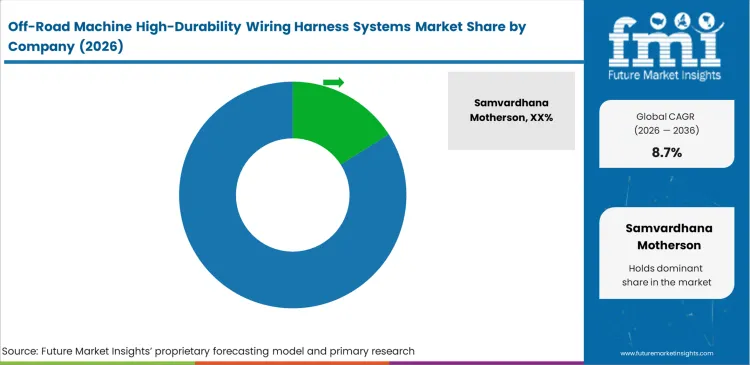
Raw copper availability shapes competitive advantage far more than basic connector assembly expertise. Companies locking up major metallurgical refining contracts effectively keep rivals away from premium wire manufacturing margins. Procurement directors looking to assess off-road harness suppliers skip mid-tier assemblers completely, pushing for direct integration with primary metal processors. This vertical integration model forces independent off-road wiring harness manufacturers to chase remaining spot market copper during unstable pricing periods. Identifying the right wiring harness supplier for heavy equipment OEM integration becomes much harder as major players consolidate primary material access, leaving smaller heavy equipment harness suppliers without enough critical raw materials.
Established harness manufacturers maintain massive proprietary vibration testing libraries built over decades of field data. Challengers may purchase identical wire extrusion machinery but cannot avoid mandatory long-term mechanical fatigue trials required by global OEMs. R&D directors at premium equipment brands resist vendor changes without these exhaustive simulated life cycle profiles. These large data libraries serve as an invisible moat, protecting established suppliers from aggressive pricing undercuts by new entrants offering outwardly identical braided assemblies.
Major machinery conglomerates resist this supplier consolidation by aggressively backing alternative optical data transmission platforms. Sourcing executives deliberately advance these fiber optic EMI shielding solutions to retain pricing leverage over traditional copper incumbents. Optical routing breaks data transmission away from heavy copper reliance, fundamentally altering long-term weight and cost economics. Assemblers that fail to integrate fiber optic capabilities face severe margin compression as massive OEMs successfully pit optical and copper suppliers directly against one another.
Key Players in Off-Road Machine High-Durability Wiring Harness Systems Market
- Samvardhana Motherson
- TE Connectivity
- LEONI
- Sumitomo Electric Industries
- Yazaki Corporation
- Furukawa Electric
- Kromberg & Schubert
Scope of the Report
| Metric | Value |
|---|---|
| Quantitative Units | USD 2.3 billion to USD 5.3 billion, at a CAGR of 8.7% |
| Market Definition | Specialized electrical routing assemblies designed explicitly for heavy equipment operating in extreme environments, featuring environmental sealing and high shock tolerance. |
| Segmentation | Machine Type, Voltage Architecture, Protection Standard, Application Zone, Sales Channel, Region |
| Regions Covered | North America, Latin America, Western Europe, Eastern Europe, Asia Pacific |
| Countries Covered | China, India, United States, Germany, Japan, Brazil, Australia |
| Key Companies Profiled | Samvardhana Motherson, TE Connectivity, LEONI, Sumitomo Electric Industries, Yazaki Corporation, Furukawa Electric, Kromberg & Schubert |
| Forecast Period | 2026 to 2036 |
| Approach | Copper tonnage usage cross-referenced against annual off-highway vehicle production volumes. |
Source: Future Market Insights (FMI) analysis, based on proprietary forecasting model and primary research
Off-Road Machine High-Durability Wiring Harness Systems Market Analysis by Segments
Machine Type:
- Construction equipment
- Agricultural machinery
- Mining equipment
- Forestry machines
- Utility and municipal machines
Voltage Architecture:
- Low-voltage harness systems
- 48V auxiliary systems
- High-voltage harness systems
- Hybrid mixed-voltage systems
- Signal and data sub-harnesses
Protection Standard:
- Sealed waterproof harnesses
- Abrasion-resistant harnesses
- High-temperature engine-bay harnesses
- EMI-shielded harnesses
- Chemical-resistant harnesses
Application Zone:
- Engine and powertrain
- Cabin and HMI
- Chassis and underbody
- Hydraulic and actuation systems
- Lighting, sensing, and telematics
Sales Channel:
- OEM fitment
- Aftermarket replacement
- Dealer service kits
- Retrofit programs
- Fleet maintenance supply
Region:
- North America
- Latin America
- Western Europe
- Eastern Europe
- Asia Pacific
Bibliography
- Deere & Company. (2025). Form 10-K for the fiscal year ended November 2, 2025.
- CNH Industrial N.V. (2026, February 26). Annual report on Form 10-K for the fiscal year ended December 31, 2025.
- Volvo Construction Equipment. (2026, January 28). Volvo Construction Equipment demonstrates better earnings driven by positive product mix and improved service business in Q4, 2025.
- Komatsu Ltd. (2026, January). Business results for three and nine months ended December 31, 2025.
This bibliography is provided for reader reference. The full FMI report contains the complete reference list with primary source documentation.
This Report Addresses
- Specific infrastructure investments required to consolidate heavy machinery electrical routing across fragmented assembly platforms.
- Stringent environmental regulations forcing category managers to mandate unified, highly sealed data pathways.
- Thermal runaway vulnerabilities exposing legacy thin gauge wiring to severe degradation during heavy actuator use.
- Localized Indian manufacturing moats heavily outmaneuvering traditional global component import networks entirely.
- Fluoropolymer material engineering strategies securing massive equipment uptime improvements over commercial grade rubber seals.
- Exclusive diagnostic protocol friction slowing transition between point-to-point wiring and advanced multiplexed architectures.
- Copper refining capacities enabling direct integration between massive OEMs and primary metal processors.
- Fiber optic data transmission technologies fundamentally disrupting traditional copper wire weight and cost paradigms.
Frequently Asked Questions
What causes harness failure in off-road equipment?
Operational vibration profiles destroy standard insulation rapidly. Using inferior commercial grade routing guarantees immediate short circuits when hydraulic lines inevitably rub against adjacent wire bundles, paralyzing million-dollar assets instantly.
Are off-highway harnesses different from automotive harnesses?
Yes. Off-highway environments introduce highly acidic mud, extreme flex requirements, and massive rock impacts. Engineers completely redesign automotive concepts using specialized fluoropolymers and heavily braided protective sheathing to survive conditions passenger cars never experience.
How does a sealed harness vs standard harness off-road compare?
Maintenance crews routinely clean equipment using aggressive chemical detergents and high-pressure water jets. Standard harnesses degrade in weeks under these conditions, whereas sealed harnesses utilize specialized silicone grommets to absolutely prevent fluid intrusion.
What dictates IP67 vs IP6K9K harness choice off-road?
The frequency and intensity of pressure washing protocols dictate this choice. IP69K rated seals survive direct, high-temperature nozzle blasts without moisture ingress, making them absolutely mandatory for heavily soiled earthmoving and mining machinery.
How do engineers prevent vibration failure in heavy equipment harnesses?
Mining drills and excavators generate unique high-frequency chassis vibrations. Acoustic engineers design specific mounting clips and utilize specialized multi-strand copper to prevent harness bundles from destroying themselves against internal metal bulkheads.
Why do low-voltage harness systems hold 64.0% share?
Legacy diesel engine controls historically relied on straightforward 12V and 24V networks. Assembly line workers install these proven networks utilizing established topologies, allowing massive scale production without requiring drastic factory retooling or new diagnostic equipment.
What secures OEM fitment 72.0% share?
Massive installation complexity prevents significant end-user modification of primary electrical backbones. Modern harnesses snake deep inside machine frames before engines are installed, making factory assembly the only viable integration point for massive cable bundles.
Why does construction equipment account for 31.0% volume?
Massive earthmoving machines subject their electrical arteries to constant impact, structural flex, and abrasive dust exposure. Systems engineers mandate heavily braided protective sheathing to survive direct rock strikes, prioritizing severe duty reliability over basic cost.
What accelerates expansion in India at 10.1%?
Massive infrastructure spending drives rapid localized production of heavy machinery. Domestic builders scale aggressively to capture immense earthmoving equipment demand, bypassing traditional global supply chains and securing highly efficient local wire assembly contracts.
How does China achieve 9.4% compound growth?
State-mandated electrification pivots sharp focus toward high-voltage architecture development. Operations directors push massive volumes by capturing electric loader contracts while satisfying strict zero-emission urban construction targets across domestic mega-cities.
What creates operational friction during architecture transitions?
Multiplexed harness topologies render traditional continuity testing methods useless. Re-qualifying electronic diagnostic algorithms requires entirely new testing hardware, forcing production managers to treat lengthy retooling protocols as severe functional bottlenecks on the assembly line.
How do massive OEMs resist copper supplier consolidation?
Large machinery conglomerates aggressively fund alternative optical data transmission technologies. Sourcing executives cultivate fiber optic solutions to maintain pricing leverage against traditional copper incumbents, decoupling critical data flow from heavy metal dependency.
What dictates material choice for engine bay harnesses?
Diesel particulate filters create intense concentrated heat in nearby areas. To protect surrounding sensor wires, thermal engineers use reflective fiberglass shielding and high-temperature insulation so the wiring can withstand sustained heavy-duty operation without melting.
How do mining environments destroy standard rubber seals?
Highly acidic or basic mud degrades traditional elastomers in weeks. Chemical specialists must specify advanced fluoropolymer outer jacketing completely resistant to severe pH fluctuations to prevent rapid pin corrosion and ghost electrical faults.
What threatens wire bundles running along chassis underbodies?
Tracked vehicles throw sharp rocks violently against underbody components. Structural engineers must mandate thick, corrugated plastic tubing and heavy connector housings while designing recessed chassis channels to hide critical harnesses from direct strikes.
How does agricultural machinery demand change wiring needs?
Precision farming implements become incredibly complex, operating continuously for brief seasonal periods. Reliability managers specify extreme temperature insulation and completely watertight industrial wire and cable networks to guarantee zero downtime during critical harvest windows.
Why do hybrid mixed-voltage systems face integration challenges?
Pushing heavy cooling fans and high output actuators demands thicker gauge wiring. Electrical architects attempting to force 48V power through legacy low-voltage pins experience catastrophic connector melting, requiring complete pin layout redesigns.
What limits rapid expansion of aftermarket harness replacement?
Replacing a main frame harness requires virtually dismantling the entire machine. Operations relying on complete aftermarket replacements face massive labor bills that often exceed the remaining depreciated value of the equipment itself.
How do autonomous control networks alter harness design?
Designing redundant data pathways provides undeniable safety proof for driverless platforms. Engineering directors implement dual routing to ensure fail-safe steering and braking signal continuity even if primary wires sever during operation.
What role do proprietary vibration databases play in vendor selection?
Incumbent manufacturers possess massive testing libraries spanning decades of field data. R&D directors refuse vendor switches without these exhaustive simulated life-cycle profiles, effectively blocking new entrants offering identical physical assemblies.
Why do predictive maintenance initiatives focus on wire harnesses?
Integrating specific sensors in heavy equipment directly into primary wire bundles opens continuous data streams. R&D heads capture new subscription revenue by monitoring electrical health and predicting shorts before they cause machine downtime.
How do Australian operations justify premium harness costs?
Extreme remote mining requires absolute electrical reliability as repair technicians remain thousands of miles away. Fleet managers mandate military-grade sealing and extreme abrasion resistance to maintain zero failure tolerance policies.
What forces European manufacturers toward new wire jacketing materials?
Strict environmental legislation dictates component material choices. Engineering teams eliminate halogenated plastics from wire jacketing to comply with aggressive recycling mandates, pushing adoption of sustainable synthetic rubbers.
Why do engineers avoid forcing high-current pins into existing boxes?
Modern control units require dozens of localized connections. Engineering directors struggle to fit bulky high-current pins into compact, environmentally sealed junction boxes without compromising necessary dielectric spacing and thermal dissipation requirements.
Preview the report firsthand - request a free sample
Get SampleGet the brochure for pricing and purchase details.
Get PDFTable of Content
- Executive Summary
- Global Market Outlook
- Demand-side Trends
- Supply-side Trends
- Technology Roadmap Analysis
- Analysis and Recommendations
- Market Overview
- Market Coverage / Taxonomy
- Market Definition / Scope / Limitations
- Research Methodology
- Chapter Orientation
- Analytical Lens and Working Hypotheses
- Market Structure, Signals, and Trend Drivers
- Benchmarking and Cross-market Comparability
- Market Sizing, Forecasting, and Opportunity Mapping
- Research Design and Evidence Framework
- Desk Research Programme (Secondary Evidence)
- Company Annual and Sustainability Reports
- Peer-reviewed Journals and Academic Literature
- Corporate Websites, Product Literature, and Technical Notes
- Earnings Decks and Investor Briefings
- Statutory Filings and Regulatory Disclosures
- Technical White Papers and Standards Notes
- Trade Journals, Industry Magazines, and Analyst Briefs
- Conference Proceedings, Webinars, and Seminar Materials
- Government Statistics Portals and Public Data Releases
- Press Releases and Reputable Media Coverage
- Specialist Newsletters and Curated Briefings
- Sector Databases and Reference Repositories
- FMI Internal Proprietary Databases and Historical Market Datasets
- Subscription Datasets and Paid Sources
- Social Channels, Communities, and Digital Listening Inputs
- Additional Desk Sources
- Expert Input and Fieldwork (Primary Evidence)
- Primary Modes
- Qualitative Interviews and Expert Elicitation
- Quantitative Surveys and Structured Data Capture
- Blended Approach
- Why Primary Evidence is Used
- Field Techniques
- Interviews
- Surveys
- Focus Groups
- Observational and In-context Research
- Social and Community Interactions
- Stakeholder Universe Engaged
- C-suite Leaders
- Board Members
- Presidents and Vice Presidents
- R&D and Innovation Heads
- Technical Specialists
- Domain Subject-matter Experts
- Scientists
- Physicians and Other Healthcare Professionals
- Governance, Ethics, and Data Stewardship
- Research Ethics
- Data Integrity and Handling
- Primary Modes
- Tooling, Models, and Reference Databases
- Desk Research Programme (Secondary Evidence)
- Data Engineering and Model Build
- Data Acquisition and Ingestion
- Cleaning, Normalisation, and Verification
- Synthesis, Triangulation, and Analysis
- Quality Assurance and Audit Trail
- Market Background
- Market Dynamics
- Drivers
- Restraints
- Opportunity
- Trends
- Scenario Forecast
- Demand in Optimistic Scenario
- Demand in Likely Scenario
- Demand in Conservative Scenario
- Opportunity Map Analysis
- Product Life Cycle Analysis
- Supply Chain Analysis
- Investment Feasibility Matrix
- Value Chain Analysis
- PESTLE and Porter’s Analysis
- Regulatory Landscape
- Regional Parent Market Outlook
- Production and Consumption Statistics
- Import and Export Statistics
- Market Dynamics
- Global Market Analysis 2021 to 2025 and Forecast, 2026 to 2036
- Historical Market Size Value (USD Million) Analysis, 2021 to 2025
- Current and Future Market Size Value (USD Million) Projections, 2026 to 2036
- Y-o-Y Growth Trend Analysis
- Absolute $ Opportunity Analysis
- Global Market Pricing Analysis 2021 to 2025 and Forecast 2026 to 2036
- Global Market Analysis 2021 to 2025 and Forecast 2026 to 2036, By Machine Type
- Introduction / Key Findings
- Historical Market Size Value (USD Million) Analysis By Machine Type , 2021 to 2025
- Current and Future Market Size Value (USD Million) Analysis and Forecast By Machine Type , 2026 to 2036
- Construction Equipment
- Agricultural Machinery
- Others
- Construction Equipment
- Y-o-Y Growth Trend Analysis By Machine Type , 2021 to 2025
- Absolute $ Opportunity Analysis By Machine Type , 2026 to 2036
- Global Market Analysis 2021 to 2025 and Forecast 2026 to 2036, By Voltage Architecture
- Introduction / Key Findings
- Historical Market Size Value (USD Million) Analysis By Voltage Architecture, 2021 to 2025
- Current and Future Market Size Value (USD Million) Analysis and Forecast By Voltage Architecture, 2026 to 2036
- Low-voltage Harness Systems
- 48V Auxiliary Systems
- Others
- Low-voltage Harness Systems
- Y-o-Y Growth Trend Analysis By Voltage Architecture, 2021 to 2025
- Absolute $ Opportunity Analysis By Voltage Architecture, 2026 to 2036
- Global Market Analysis 2021 to 2025 and Forecast 2026 to 2036, By Protection Standard
- Introduction / Key Findings
- Historical Market Size Value (USD Million) Analysis By Protection Standard, 2021 to 2025
- Current and Future Market Size Value (USD Million) Analysis and Forecast By Protection Standard, 2026 to 2036
- Sealed Waterproof Harnesses
- Abrasion-Resistant Harnesses
- Sealed Waterproof Harnesses
- Y-o-Y Growth Trend Analysis By Protection Standard, 2021 to 2025
- Absolute $ Opportunity Analysis By Protection Standard, 2026 to 2036
- Global Market Analysis 2021 to 2025 and Forecast 2026 to 2036, By Application Zone
- Introduction / Key Findings
- Historical Market Size Value (USD Million) Analysis By Application Zone, 2021 to 2025
- Current and Future Market Size Value (USD Million) Analysis and Forecast By Application Zone, 2026 to 2036
- Engine and Powertrain
- Cabin and HMI
- Others
- Engine and Powertrain
- Y-o-Y Growth Trend Analysis By Application Zone, 2021 to 2025
- Absolute $ Opportunity Analysis By Application Zone, 2026 to 2036
- Global Market Analysis 2021 to 2025 and Forecast 2026 to 2036, By Sales Channel
- Introduction / Key Findings
- Historical Market Size Value (USD Million) Analysis By Sales Channel, 2021 to 2025
- Current and Future Market Size Value (USD Million) Analysis and Forecast By Sales Channel, 2026 to 2036
- OEM Fitment
- Aftermarket Replacement
- Others
- OEM Fitment
- Y-o-Y Growth Trend Analysis By Sales Channel, 2021 to 2025
- Absolute $ Opportunity Analysis By Sales Channel, 2026 to 2036
- Global Market Analysis 2021 to 2025 and Forecast 2026 to 2036, By Region
- Introduction
- Historical Market Size Value (USD Million) Analysis By Region, 2021 to 2025
- Current Market Size Value (USD Million) Analysis and Forecast By Region, 2026 to 2036
- North America
- Latin America
- Western Europe
- Eastern Europe
- East Asia
- South Asia and Pacific
- Middle East & Africa
- Market Attractiveness Analysis By Region
- North America Market Analysis 2021 to 2025 and Forecast 2026 to 2036, By Country
- Historical Market Size Value (USD Million) Trend Analysis By Market Taxonomy, 2021 to 2025
- Market Size Value (USD Million) Forecast By Market Taxonomy, 2026 to 2036
- By Country
- USA
- Canada
- Mexico
- By Machine Type
- By Voltage Architecture
- By Protection Standard
- By Application Zone
- By Sales Channel
- By Country
- Market Attractiveness Analysis
- By Country
- By Machine Type
- By Voltage Architecture
- By Protection Standard
- By Application Zone
- By Sales Channel
- Key Takeaways
- Latin America Market Analysis 2021 to 2025 and Forecast 2026 to 2036, By Country
- Historical Market Size Value (USD Million) Trend Analysis By Market Taxonomy, 2021 to 2025
- Market Size Value (USD Million) Forecast By Market Taxonomy, 2026 to 2036
- By Country
- Brazil
- Chile
- Rest of Latin America
- By Machine Type
- By Voltage Architecture
- By Protection Standard
- By Application Zone
- By Sales Channel
- By Country
- Market Attractiveness Analysis
- By Country
- By Machine Type
- By Voltage Architecture
- By Protection Standard
- By Application Zone
- By Sales Channel
- Key Takeaways
- Western Europe Market Analysis 2021 to 2025 and Forecast 2026 to 2036, By Country
- Historical Market Size Value (USD Million) Trend Analysis By Market Taxonomy, 2021 to 2025
- Market Size Value (USD Million) Forecast By Market Taxonomy, 2026 to 2036
- By Country
- Germany
- UK
- Italy
- Spain
- France
- Nordic
- BENELUX
- Rest of Western Europe
- By Machine Type
- By Voltage Architecture
- By Protection Standard
- By Application Zone
- By Sales Channel
- By Country
- Market Attractiveness Analysis
- By Country
- By Machine Type
- By Voltage Architecture
- By Protection Standard
- By Application Zone
- By Sales Channel
- Key Takeaways
- Eastern Europe Market Analysis 2021 to 2025 and Forecast 2026 to 2036, By Country
- Historical Market Size Value (USD Million) Trend Analysis By Market Taxonomy, 2021 to 2025
- Market Size Value (USD Million) Forecast By Market Taxonomy, 2026 to 2036
- By Country
- Russia
- Poland
- Hungary
- Balkan & Baltic
- Rest of Eastern Europe
- By Machine Type
- By Voltage Architecture
- By Protection Standard
- By Application Zone
- By Sales Channel
- By Country
- Market Attractiveness Analysis
- By Country
- By Machine Type
- By Voltage Architecture
- By Protection Standard
- By Application Zone
- By Sales Channel
- Key Takeaways
- East Asia Market Analysis 2021 to 2025 and Forecast 2026 to 2036, By Country
- Historical Market Size Value (USD Million) Trend Analysis By Market Taxonomy, 2021 to 2025
- Market Size Value (USD Million) Forecast By Market Taxonomy, 2026 to 2036
- By Country
- China
- Japan
- South Korea
- By Machine Type
- By Voltage Architecture
- By Protection Standard
- By Application Zone
- By Sales Channel
- By Country
- Market Attractiveness Analysis
- By Country
- By Machine Type
- By Voltage Architecture
- By Protection Standard
- By Application Zone
- By Sales Channel
- Key Takeaways
- South Asia and Pacific Market Analysis 2021 to 2025 and Forecast 2026 to 2036, By Country
- Historical Market Size Value (USD Million) Trend Analysis By Market Taxonomy, 2021 to 2025
- Market Size Value (USD Million) Forecast By Market Taxonomy, 2026 to 2036
- By Country
- India
- ASEAN
- Australia & New Zealand
- Rest of South Asia and Pacific
- By Machine Type
- By Voltage Architecture
- By Protection Standard
- By Application Zone
- By Sales Channel
- By Country
- Market Attractiveness Analysis
- By Country
- By Machine Type
- By Voltage Architecture
- By Protection Standard
- By Application Zone
- By Sales Channel
- Key Takeaways
- Middle East & Africa Market Analysis 2021 to 2025 and Forecast 2026 to 2036, By Country
- Historical Market Size Value (USD Million) Trend Analysis By Market Taxonomy, 2021 to 2025
- Market Size Value (USD Million) Forecast By Market Taxonomy, 2026 to 2036
- By Country
- Kingdom of Saudi Arabia
- Other GCC Countries
- Turkiye
- South Africa
- Other African Union
- Rest of Middle East & Africa
- By Machine Type
- By Voltage Architecture
- By Protection Standard
- By Application Zone
- By Sales Channel
- By Country
- Market Attractiveness Analysis
- By Country
- By Machine Type
- By Voltage Architecture
- By Protection Standard
- By Application Zone
- By Sales Channel
- Key Takeaways
- Key Countries Market Analysis
- USA
- Pricing Analysis
- Market Share Analysis, 2025
- By Machine Type
- By Voltage Architecture
- By Protection Standard
- By Application Zone
- By Sales Channel
- Canada
- Pricing Analysis
- Market Share Analysis, 2025
- By Machine Type
- By Voltage Architecture
- By Protection Standard
- By Application Zone
- By Sales Channel
- Mexico
- Pricing Analysis
- Market Share Analysis, 2025
- By Machine Type
- By Voltage Architecture
- By Protection Standard
- By Application Zone
- By Sales Channel
- Brazil
- Pricing Analysis
- Market Share Analysis, 2025
- By Machine Type
- By Voltage Architecture
- By Protection Standard
- By Application Zone
- By Sales Channel
- Chile
- Pricing Analysis
- Market Share Analysis, 2025
- By Machine Type
- By Voltage Architecture
- By Protection Standard
- By Application Zone
- By Sales Channel
- Germany
- Pricing Analysis
- Market Share Analysis, 2025
- By Machine Type
- By Voltage Architecture
- By Protection Standard
- By Application Zone
- By Sales Channel
- UK
- Pricing Analysis
- Market Share Analysis, 2025
- By Machine Type
- By Voltage Architecture
- By Protection Standard
- By Application Zone
- By Sales Channel
- Italy
- Pricing Analysis
- Market Share Analysis, 2025
- By Machine Type
- By Voltage Architecture
- By Protection Standard
- By Application Zone
- By Sales Channel
- Spain
- Pricing Analysis
- Market Share Analysis, 2025
- By Machine Type
- By Voltage Architecture
- By Protection Standard
- By Application Zone
- By Sales Channel
- France
- Pricing Analysis
- Market Share Analysis, 2025
- By Machine Type
- By Voltage Architecture
- By Protection Standard
- By Application Zone
- By Sales Channel
- India
- Pricing Analysis
- Market Share Analysis, 2025
- By Machine Type
- By Voltage Architecture
- By Protection Standard
- By Application Zone
- By Sales Channel
- ASEAN
- Pricing Analysis
- Market Share Analysis, 2025
- By Machine Type
- By Voltage Architecture
- By Protection Standard
- By Application Zone
- By Sales Channel
- Australia & New Zealand
- Pricing Analysis
- Market Share Analysis, 2025
- By Machine Type
- By Voltage Architecture
- By Protection Standard
- By Application Zone
- By Sales Channel
- China
- Pricing Analysis
- Market Share Analysis, 2025
- By Machine Type
- By Voltage Architecture
- By Protection Standard
- By Application Zone
- By Sales Channel
- Japan
- Pricing Analysis
- Market Share Analysis, 2025
- By Machine Type
- By Voltage Architecture
- By Protection Standard
- By Application Zone
- By Sales Channel
- South Korea
- Pricing Analysis
- Market Share Analysis, 2025
- By Machine Type
- By Voltage Architecture
- By Protection Standard
- By Application Zone
- By Sales Channel
- Russia
- Pricing Analysis
- Market Share Analysis, 2025
- By Machine Type
- By Voltage Architecture
- By Protection Standard
- By Application Zone
- By Sales Channel
- Poland
- Pricing Analysis
- Market Share Analysis, 2025
- By Machine Type
- By Voltage Architecture
- By Protection Standard
- By Application Zone
- By Sales Channel
- Hungary
- Pricing Analysis
- Market Share Analysis, 2025
- By Machine Type
- By Voltage Architecture
- By Protection Standard
- By Application Zone
- By Sales Channel
- Kingdom of Saudi Arabia
- Pricing Analysis
- Market Share Analysis, 2025
- By Machine Type
- By Voltage Architecture
- By Protection Standard
- By Application Zone
- By Sales Channel
- Turkiye
- Pricing Analysis
- Market Share Analysis, 2025
- By Machine Type
- By Voltage Architecture
- By Protection Standard
- By Application Zone
- By Sales Channel
- South Africa
- Pricing Analysis
- Market Share Analysis, 2025
- By Machine Type
- By Voltage Architecture
- By Protection Standard
- By Application Zone
- By Sales Channel
- USA
- Market Structure Analysis
- Competition Dashboard
- Competition Benchmarking
- Market Share Analysis of Top Players
- By Regional
- By Machine Type
- By Voltage Architecture
- By Protection Standard
- By Application Zone
- By Sales Channel
- Competition Analysis
- Competition Deep Dive
- Samvardhana Motherson
- Overview
- Product Portfolio
- Profitability by Market Segments (Product/Age /Sales Channel/Region)
- Sales Footprint
- Strategy Overview
- Marketing Strategy
- Product Strategy
- Channel Strategy
- TE Connectivity
- LEONI
- Sumitomo Electric Industries
- Yazaki Corporation
- Furukawa Electric
- Samvardhana Motherson
- Competition Deep Dive
- Assumptions & Acronyms Used


