

- Market Size (2026)
- USD 2.5 Bn
- Forecast (2036)
- USD 4.1 Bn
- CAGR (2026 to 2036)
- 5.1%
Agricultural Machinery Power Transmission Belt Systems Market Size, Forecast, and Outlook By FMI
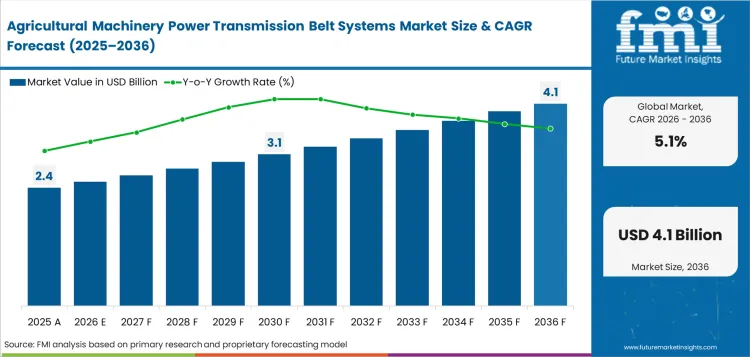
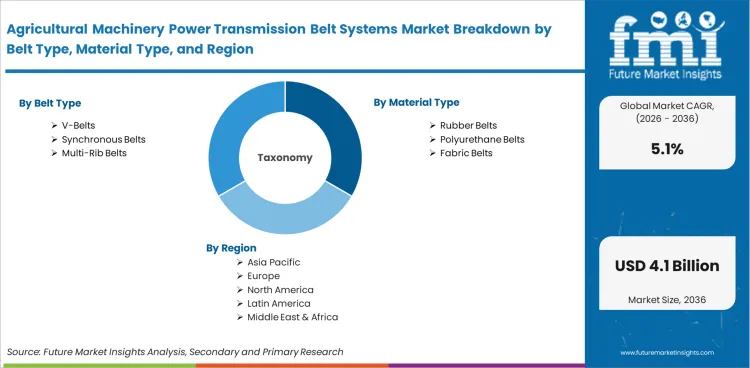
Agricultural machinery power transmission belt systems market was valued at USD 2.4 billion in 2025. Market value is set to reach USD 2.5 billion by 2026-end and expand at a CAGR of 5.1% between 2026 and 2036 to cross the valuation of USD 4.1 billion by 2036.
Summary of the Agricultural Machinery Power Transmission Belt Systems Market
- Demand and Growth Drivers
- Field downtime risk backs demand for replacement belt systems as tractors and harvesters need fast service during short operating periods.
- Older machine use increases aftermarket activity as many farms delays large equipment purchases and extend service life.
- Higher belt load requirements enhance demand for reinforced rubber and aramid belt designs across heavy farm machinery.
- Product and Segment View
- Aftermarket sales are forecast to account for 57.0% share in 2026 with replacement cycles driving repeat dealer orders.
- Rubber belts are projected to represent 52.0% of material demand in 2026 since farm drives face heat and abrasion exposure.
- V-Belts retain strong demand across tractors and harvesters using established pulley-based drive layouts for easier field replacement.
- Geography and Competitive Outlook
- India is expected to record a CAGR of 7.2% through 2036 as tractor production and local dealer networks expand.
- China is projected to expand at 6.4% CAGR by 2036 as local machinery output creates belt matching demand.
- Companies combining agricultural matching depth with broad dealer access are strengthening their market position during the forecast period.
- Analyst Opinion
- Nandini Roy Choudhury, Principal Consultant for the Process Automation domain at FMI, says, “Agricultural belt systems protect harvest uptime as small drive failures can stop field work. Replacement demand drives revenue as farms extend tractor use. Equipment dealers need accurate belt matching. Rubber compound depth lowers service errors under heat and dust exposure.”
- Agricultural Machinery Power Transmission Belt Systems Market Value Analysis
- Agricultural machinery power transmission belt systems demand is moving from simple belt replacement into structured service planning across dealer networks.
- Seasonal field operations make uptime a core reason for belt system use across tractors and harvesting machines.
- Market demand gains from deeper use of agricultural tractors across small and medium farms.
- Correct belt length and pulley compatibility guide demand across agricultural machinery platforms.
- Cost pressure continues as premium belts use rubber compounds and aramid reinforcement for higher load strength.
Key Takeaways, Market Size, and Forecast
- Agricultural machinery power transmission belt systems market was valued at USD 2.4 billion during 2025 through FMI’s replacement and OEM fitment estimate.
- By 2036, the agricultural machinery power transmission belt systems market is expected to be worth USD 4.1 billion.
- From 2026 to 2036, the market is projected to expand at a CAGR of 5.1%.
- The market is projected to create an incremental opportunity of USD 1.6 billion between 2026 and 2036.
- In 2026, aftermarket sales are expected to account for 57.0% of sales channel demand.
- India at 7.2% CAGR and China at 6.4% CAGR are expected to record faster demand expansion through 2036.
Fast belt replacement is now a practical service priority for farm machinery dealers. Continental’s November 2025 partnership with GRANIT PARTS improves dealer access through a network covering 28 countries and 40,000 specialist dealers. This reach helps workshops source replacement belts faster during harvest and repair periods. Gates added another important supply signal in May 2026 through its agreement to acquire Timken’s belts business with select manufacturing assets. The deal strengthens Gates’ North American belt supply base across OEM and aftermarket channels. Asian demand is also important for belt producers serving agricultural machinery programs. Bando Chemical reported in May 2025 a 28.4% increase in China and 20.5% increase in Asia for agricultural machinery power transmission belt sales. Regional stock planning is therefore becoming important for tractor and harvester belt programs. Suppliers with strong dealer access and local inventory depth are best placed to win repeat replacement orders.
Agricultural Machinery Power Transmission Belt Systems Market Definition
Agricultural machinery power transmission belt systems include belts used to transfer power inside tractors, combines, balers, sprayers, and harvesters. Scope includes V-belts, synchronous belts, multi-rib belts, variable-speed belts, and flat belts used in farm machinery drive systems. These products serve fan drives, feeder drives, cutter drives, and auxiliary farm equipment functions. Scope excludes conveyor belts used only for crop movement and complete transmission assemblies.
Agricultural Machinery Power Transmission Belt Systems Market Inclusions
Market scope covers all commercially traded agricultural machinery power transmission belt systems by belt type such as V-belts and synchronous belts; material type such as rubber belts and polyurethane belts; machinery type such as tractors and combines; sales channel such as OEM supply and aftermarket sales; and power rating such as low power and medium power systems. Revenue scope covers sales generated from eligible belt systems across OEM and replacement channels between 2026 and 2036. Key stakeholders include belt manufacturers and farm machinery OEMs; rubber compound and reinforcement material providers; pulley and drive component vendors; aftermarket distributors and dealer service networks; tractor and harvester producers; farm equipment operators; system integrators; testing labs and standards bodies.
Agricultural Machinery Power Transmission Belt Systems Market Exclusions
Scope does not include tires, chains, bearings, hydraulic hoses, complete gearboxes, crop conveyor belts, or factory-only industrial belt systems.
Agricultural Machinery Power Transmission Belt Systems Market Research Methodology
- Primary Research: Primary interviews conducted with the belt manufacturers, farm machinery OEMs, aftermarket distributors, dealer service teams, and regional parts vendors.
- Desk Research: Combined data from machinery associations, company product portfolios, technical belt references, and adjacent farm equipment demand indicators.
- Market sizing and forecasting: Added belt use across machinery types and channel groups from the bottom up.
- Data validation: Cross-checked every three months against tractor sales patterns and company power transmission belt portfolios.
Why is the Agricultural Machinery Power Transmission Belt Systems Market Expanding?
- Farms are using replacement belts earlier to reduce machinery stoppage during harvesting and spraying work.
- Dealer service teams are becoming important as belt matching errors can increase repeat repair visits.
- Manufacturers are using reinforced belt designs as modern machines carry higher load and speed requirements.
Field uptime pressure is increasing the service value of agricultural belt systems as softer equipment sales shift attention toward repair and maintenance spending. Dealers are likely to place greater focus on replacement belts and preventive service support as farms keep existing tractors and combines active for longer periods. Belt producers with strong aftermarket reach can protect recurring demand during slower new equipment cycles.
Replacement activity is affected by the condition of farm machinery sentiment in Europe. CEMA reported in January 2026 the European agricultural machinery business climate index moved from +4 to +2 points. A slow machinery climate can keep buyers focused on maintenance and smaller part replacements. This creates a useful service channel path for belt producers and regional dealer networks.
Market Segmentation Analysis
- Aftermarket sales lead the sales channel segment with a 57.0% share in 2026, supported by frequent belt replacement across active farm fleets.
- Rubber belts hold 52.0% of material type share, as farms continue to prefer durable belt options for dusty field environments.
- Tractors represent the largest machinery type segment at 46.0% in 2026, reflecting broad belt use across auxiliary drive systems.
- V-Belts capture 43.5% of belt type revenue segment, helped by their continued fit in established agricultural drive layouts.
- Medium power belts account for 41.0% within the power rating category, with adoption spread across tractor drives and baler applications.
The market for agricultural machinery power transmission belt systems is divided into five primary segment groups based on belt type, material type, machinery type, sales channel, and power rating. Belt type includes v-belts, synchronous belts, multi-rib belts, variable-speed belts, and flat belts. Material type includes rubber belts, polyurethane belts, fabric belts, aramid belts, and steel belts. Machinery type includes tractors, combines, balers, sprayers, and harvesters. Sales channel includes aftermarket sales, OEM supply, dealer replacement, and distributor sales. Power rating includes low power, medium power, and high power.
Insights into Agricultural Machinery Power Transmission Belt Systems Market by Belt Type
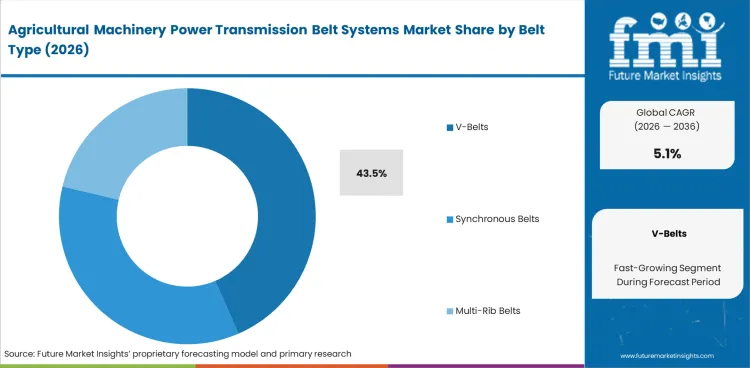
- In 2026, v-belts are estimated to make up 43.5% of the belt type segment across agricultural machinery drives. Their position reflects simple pulley layouts and broad replacement familiarity across older tractor platforms.
- Synchronous and multi-rib belts serve selected equipment layouts needing tighter power transfer. Their use improves in newer machinery requiring smoother motion control and lower belt slip.
Insights into Agricultural Machinery Power Transmission Belt Systems Market by Material Type
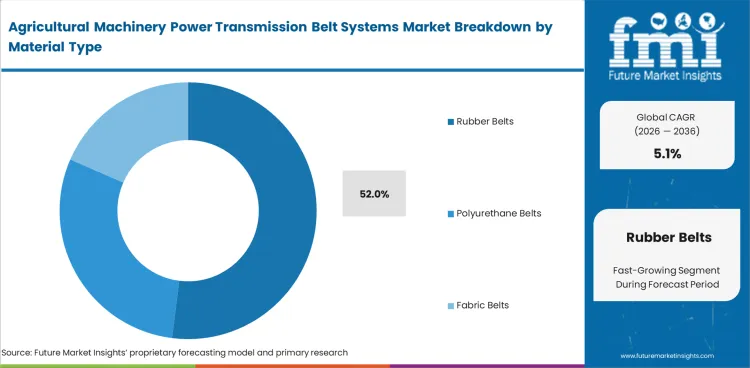
- Rubber belts are expected to hold 52.0% of the material type segment in 2026 across agricultural machinery power transmission systems. Rubber products handle dust exposure and heat stress across routine farm work.
- Polyurethane and aramid belt options serve selected high-wear applications requiring stronger dimensional stability. Their value improves in heavy-duty machinery with longer operating hours and tighter service intervals.
Insights into Agricultural Machinery Power Transmission Belt Systems Market by Machinery Type
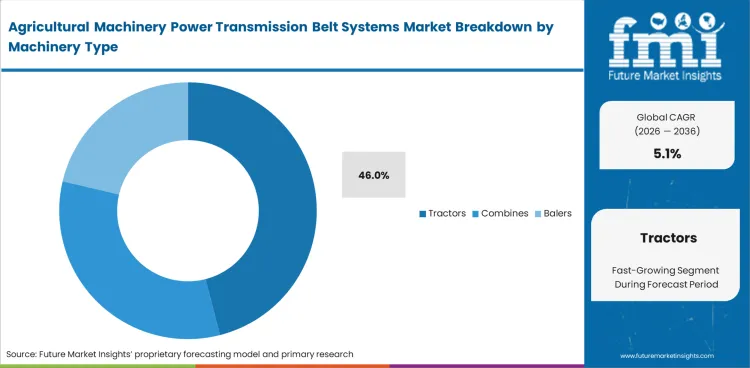
- In 2026, tractors are expected to contribute 46.0% share of the machinery type segment across power transmission belt demand. Tractor platforms use belts across fans and auxiliary drives during tillage and transport work.
- Combines and balers raise higher-value belt demand during seasonal operations. Their service needs rise during harvest periods with heavier crop intake and shorter repair windows.
Insights into Agricultural Machinery Power Transmission Belt Systems Market by Sales Channel
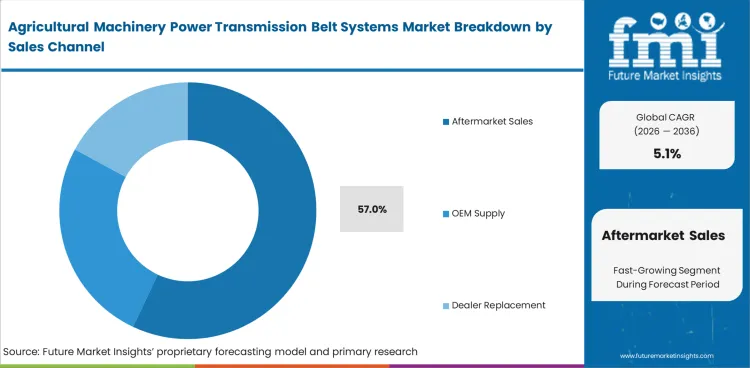
- In 2026, aftermarket sales are forecast to hold 57.0% of the sales channel segment across agricultural belt systems. Replacement activity reflects belt wear and dealer service needs across active farm machinery fleets.
- OEM supply serves new machinery programs requiring approved belt lengths and drive layouts. Dealer replacement serves urgent field repairs requiring fast access and accurate part matching.
Insights into Agricultural Machinery Power Transmission Belt Systems Market by Power Rating
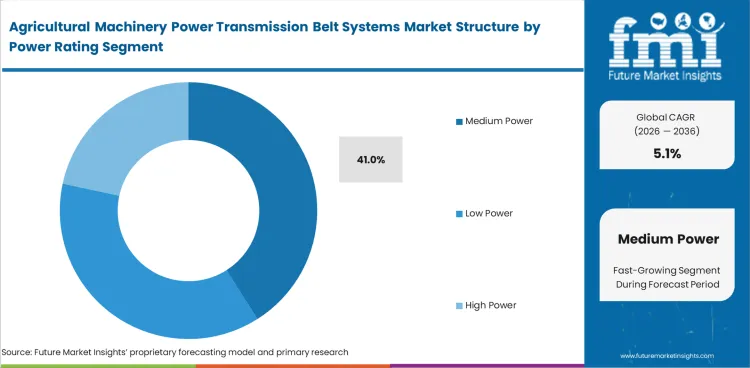
- In 2026, medium power belts are projected to account for 41.0% of the power rating segment across agricultural machinery drives. Their position reflects balanced use across tractors and balers with moderate load requirements.
- High-power belts serve combines and forage machines with heavier operating stress. Low-power belts address auxiliary drives and lighter equipment requiring simple replacement and controlled part cost.
Agricultural Machinery Power Transmission Belt Systems Market Drivers, Restraints, and Opportunities
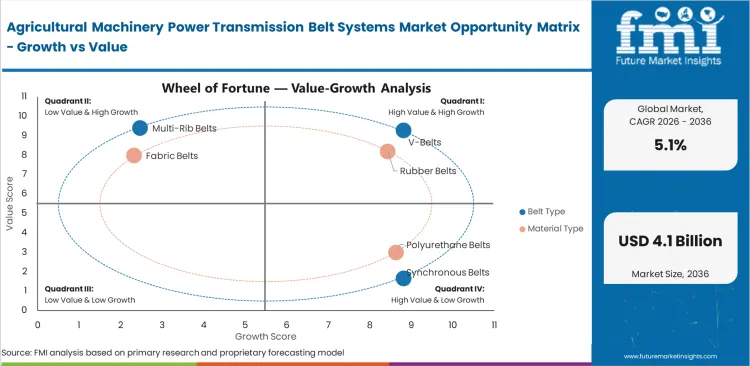
- Field repair pressure is creating structured demand for belts used in tractors and harvesting machinery.
- High-performance belt materials increase pricing pressure for smaller dealers serving cost-sensitive farms.
- Connected condition monitoring improves service opportunity through early warning of drive wear and belt slip.
Agricultural machinery power transmission belt systems keep gaining use as tractors and harvesters need dependable drive parts during seasonal field operations. Cost pressure and wrong belt matching can slow replacement decisions across small farms and local service networks. Market expansion continues through aftermarket replacement demand and stronger belt designs for higher-load farm machinery.
OEM Slowdown Is Pressuring Belt-System Quotes
In the agricultural machinery power transmission belt systems market, OEM belt pricing is facing tighter negotiation because new equipment demand has weakened. In February 2025, the Association of Equipment Manufacturers reported that January 2025 USA ag tractor sales fell 15.8% year over year, and the combine sales dropped 78.9%. This directly affects belt suppliers tied to tractor and combine build programs because lower equipment assembly volumes reduce short-term demand for fitted drive belts. It impacts suppliers connected to baler and harvester build programs since reduced production lowers demand for tensioning assemblies in the near term. The pricing implication is sharper quote competition on OEM contracts, and replacement belts are relatively more protected because downtime risk during planting and harvesting limits buyers’ willingness to delay critical purchases.
Farm-Cost Discipline Is Reshaping Aftermarket Pricing
Aftermarket belt-system prices are moving less on headline machinery demand and more on farmers’ operating-cost discipline. In February 2026, USDA Economic Research Service forecast USA farm production expenses at USD 477.7 billion for 2026, up USD 4.6 billion or 1.0% from the 2025 forecast of USD 473.1 billion in nominal terms, but down 0.9% after inflation. For power transmission belts this means buyers are likely to resist broad price increases but accept premiums for durable belts used in high load machinery. Suppliers with proven service life and faster dealer availability are better positioned to maintain a stronger pass-through room in competitive market conditions. They benefit from lower failure risk which gives them an advantage over sellers competing only on standard replacement belts.
Analysis of Agricultural Machinery Power Transmission Belt Systems Market By Key Countries
.webp "Top Country Growth Comparison Agricultural Machinery Power Transmission Belt Systems Market Cagr (2026 2036)")
| Country | CAGR |
|---|---|
| India | 7.2% |
| China | 6.4% |
| Brazil | 5.6% |
| USA | 4.6% |
| Germany | 3.8% |
Source: Future Market Insights, 2026.
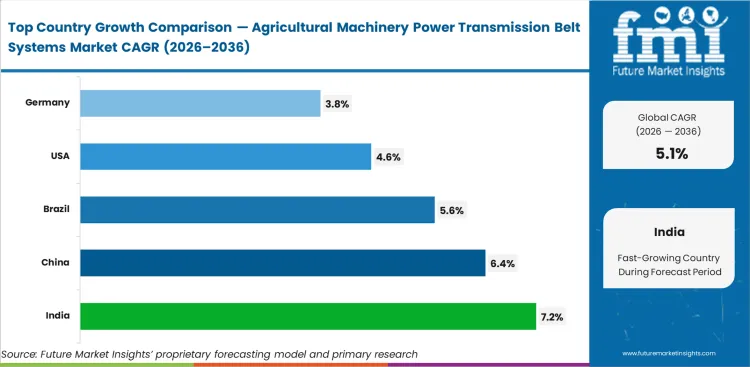
Agricultural Machinery Power Transmission Belt Systems Market CAGR Analysis By Country
- India records the leading forecast pace at 7.2% CAGR, supported by rising tractor output and expanding dealer networks.
- China is projected at 6.4% CAGR as domestic machinery production increases replacement belt requirements.
- Brazil reaches 5.6% CAGR with large farms using harvesters across commercial crop operations.
- USA demand is forecast to grow at 4.6% CAGR as mature fleets raise steady service belt replacement needs.
- Germany advances at 3.8% CAGR, supported by established machinery fleets and controlled replacement activity.
Demand for agricultural machinery power transmission belt systems is forecast to rise at 5.1% CAGR from 2026 to 2036. Country-level analysis covers the major markets contributing to this forecast, with the key markets listed below.
Demand Outlook for Agricultural Machinery Power Transmission Belt Systems Market in India
India’s agricultural machinery power transmission belt systems industry is projected to record a CAGR of 7.2% through 2036. Tractor production depth results in a broad base for new matching and replacement belt demand. India produced 104,329 tractors in June 2025 and 107,417 tractors in July 2025 according to TMA monthly data. Local belt producers can gain from service orders across tractors and attached implements.
- Local tractor output backs demand for V-belts and rubber belt replacements across farm service channels.
- Farm mechanization programs increase machine use and raise wear exposure for drive components.
- Domestic manufacturers need belt partners with fast channel response and broad matching records.
Sales Analysis of Agricultural Machinery Power Transmission Belt Systems Market in China
China’s agricultural machinery power transmission belt systems sector is expected to expand at a CAGR of 6.4% during the assessment period. Mechanized farming and local equipment production boost demand for belts used across tractors and harvesters. Belt systems used with agricultural equipment gain from domestic machine assembly and aftermarket replacement. Producers with regional stock depth can serve both OEM programs and repair channels.
- Local machinery production backs demand for reinforced belts used in medium and high-load applications.
- Farm machinery service networks need reliable belt supply for tractors and crop harvesting machines.
- Asian belt producers gain from proximity to local OEMs and regional dealer warehouses.
Demand Outlook for Agricultural Machinery Power Transmission Belt Systems Market in Brazil
Brazil’s agricultural machinery power transmission belt systems industry is forecast to grow at a CAGR of 5.6% by 2036. Large farms make space for heavy-use conditions for belts used in tractors and harvesters. Demand is strongest in applications connected with row crops and forage handling. Belt replacement gains practical value as farms use machinery for long field hours during planting or harvest periods.
- Large commercial farms back higher belt consumption across tractors and harvesting machinery.
- Replacement demand increases as farm operators seek lower downtime during crop work periods.
- Belt producers serving planting machinery channels can gain from seasonal service demand.
Opportunity Analysis of Agricultural Machinery Power Transmission Belt Systems Market in the United States
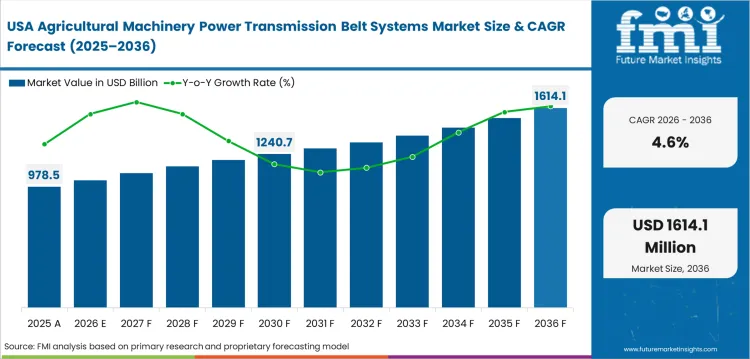
The USA agricultural machinery power transmission belt systems segment is expected to advance at 4.6% CAGR over the forecast years. Mature machinery fleets raise repeat demand for belts used in tractors and combines. AEM reported in January 2026 a 14.8% drop in USA total ag tractor sales during December 2025. This environment raises attention on replacement parts as farms manage existing equipment longer.
- Mature tractor fleets increase regular replacement need across fan drives and auxiliary belt systems.
- Softer new machinery sales increase focus on service parts and preventive replacement work.
- Belt demand connects with agricultural tires as farms manage broader maintenance spending.
Future Outlook for Agricultural Machinery Power Transmission Belt Systems Market in Germany
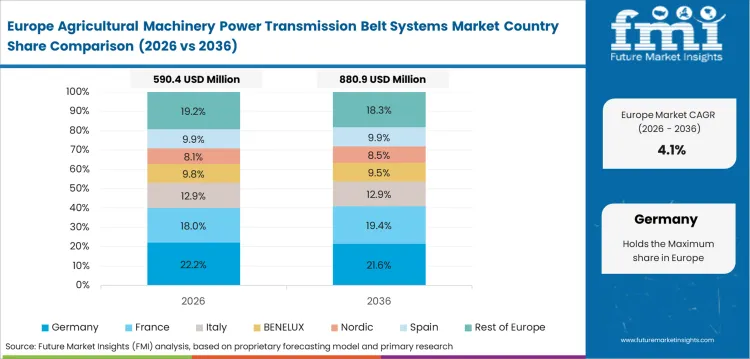
Germany’s agricultural machinery power transmission belt systems industry is expected to post 3.8% CAGR by2036. Advanced machinery use enhance demand for durable belts but limits fast volume expansion. CEMA reported the European agricultural machinery business climate index at +2 in January 2026 after a small decline. This environment favors replacement-based belt demand across mature equipment fleets.
- Mature machinery fleets boost steady demand for premium rubber and reinforced belt systems.
- Dealer service depth helps reduce downtime across tractors and harvesting equipment.
- German equipment users favor proven belt durability for agricultural sprayers and field machinery.
Competitive Landscape and Strategic Positioning
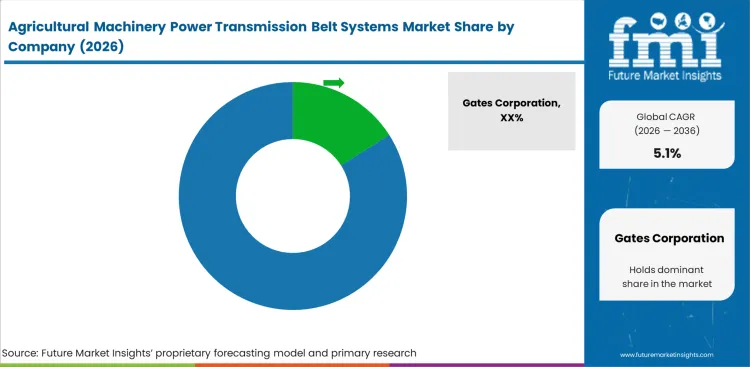
- Gates Corporation has an advantage through broad belt coverage and established access across OEM and replacement channels.
- Continental AG and Bando Chemical leverage agricultural belt lines backed by reinforced rubber material experience.
- Regional specialists serve repair-driven demand through custom belt sizes and quicker access for farm machinery workshops.
Competition in agricultural power transmission belts is shaped by how well suppliers cover machine models and replacement needs. Gates has a strong position through its broad product range across original equipment programs and service channels. Continental brings agricultural focus through AGRIDUR V-belts and dealer partnerships aimed at farm replacement demand. Bando Chemical adds depth through Asian power transmission belt sales and exposure to agricultural machinery users.
Supplier selection is often decided by fit accuracy and part availability during short service windows. Belt matching is a practical barrier since wrong length or profile can delay repairs and increase downtime. Companies with complete cross-reference data and durable belt materials are better placed to secure repeat replacement orders through reliable dealer access.
Key Companies in the Agricultural Machinery Power Transmission Belt Systems Market
Key global companies leading the agricultural machinery power transmission belt systems market include:
- Gates Corporation and Continental AG have strong belt portfolios for power transmission and agricultural equipment service.
- Bando Chemical Industries Ltd. and Mitsuboshi Belting Ltd. serve machinery customers through industrial belt ranges and channel access.
- Optibelt GmbH and PIX Transmissions Ltd. hold specialist positions across replacement belts and reinforced drive products.
Competitive Benchmarking: Agricultural Machinery Power Transmission Belt Systems Market
| Company | Agricultural Matching Depth | Reinforced Belt Portfolio | Aftermarket Channel Reach | Geographic Footprint |
|---|---|---|---|---|
| Gates Corporation | High | High | Strong | Global |
| Continental AG | High | High | Strong | Global |
| Bando Chemical Industries Ltd. | High | High | Moderate | Asia, Europe, North America |
| Mitsuboshi Belting Ltd. | Medium | High | Moderate | Asia, Europe, North America |
| The Timken Company | Medium | Medium | Strong | Global |
| AMMEGA Group | Medium | Medium | Strong | Global |
| Optibelt GmbH | Medium | High | Strong | Europe, Americas, Asia |
| PIX Transmissions Ltd. | Medium | Medium | Moderate | Asia, Europe, Americas |
| Fenner Drives | Medium | Medium | Moderate | North America, Europe |
Source: Future Market Insights, 2026.
Key Developments in Agricultural Machinery Power Transmission Belt Systems Market
- In September, 2025, ContiTech began offering round baler belts in original equipment quality for the agricultural aftermarket. The development is directly relevant because the belts target round baler repair and replacement demand, reduce downtime, and can be installed without fully dismantling the baler.
- In May, 2024, Bando Chemical Industries invested in inaho Inc., an agricultural robotics company, to build synergy between inaho’s farm robot technology and Bando’s agricultural-sector technologies, including transmission and conveyor belts. This is relevant because it links Bando’s belt know-how with automated farm machinery applications.
Key Players in the Agricultural Machinery Power Transmission Belt Systems Market
Major Global Players
- Gates Corporation
- Continental AG
- Bando Chemical Industries Ltd.
- Mitsuboshi Belting Ltd.
- AMMEGA Group
- Optibelt GmbH
Specialist Players
- PIX Transmissions Ltd.
- Fenner Drives
- Megadyne Group
Report Scope and Coverage
| Parameter | Details |
|---|---|
| Quantitative Units | USD 2.5 billion to USD 4.1 billion, at a CAGR of 5.1% |
| Market Definition | The market includes power transmission belt systems used in tractors, combines, balers, sprayers, and harvesters. |
| Regions Covered | North America, Latin America, Europe, East Asia, South Asia and Pacific, Middle East and Africa |
| Countries Covered | USA, Germany, China, India, Brazil, Japan, France, and 30 plus countries |
| Key Companies Profiled | Gates Corporation, Continental AG, Bando Chemical Industries Ltd., Mitsuboshi Belting Ltd., AMMEGA Group, Optibelt GmbH, PIX Transmissions Ltd., Fenner Drives |
| Forecast Period | 2026 to 2036 |
| Approach | Hybrid bottom-up and top-down methodology starts with belt replacement demand and verified machinery use patterns. |
Agricultural Machinery Power Transmission Belt Systems Market by Segments
Agricultural Machinery Power Transmission Belt Systems Market Segmented by Belt Type:
- V-Belts
- Synchronous Belts
- Multi-Rib Belts
- Variable-Speed Belts
- Flat Belts
Agricultural Machinery Power Transmission Belt Systems Market Segmented by Material Type:
- Rubber Belts
- Polyurethane Belts
- Fabric Belts
- Aramid Belts
- Steel Belts
Agricultural Machinery Power Transmission Belt Systems Market Segmented by Machinery Type:
- Tractors
- Combines
- Balers
- Sprayers
- Harvesters
Agricultural Machinery Power Transmission Belt Systems Market Segmented by Sales Channel:
- Aftermarket Sales
- OEM Supply
- Dealer Replacement
- Distributor Sales
Agricultural Machinery Power Transmission Belt Systems Market Segmented by Power Rating:
- Low Power
- Medium Power
- High Power
Agricultural Machinery Power Transmission Belt Systems Market by Region:
- North America
- USA
- Canada
- Mexico
- Latin America
- Brazil
- Chile
- Rest of Latin America
- Europe
- Germany
- UK
- Italy
- Spain
- France
- Rest of Europe
- East Asia
- China
- Japan
- South Korea
- South Asia and Pacific
- India
- ASEAN
- Australia & New Zealand
- Rest of South Asia and Pacific
- Middle East and Africa
- Saudi Arabia
- Other GCC Countries
- South Africa
- Rest of Middle East and Africa
Research Sources and Bibliography
- Continental AG. (2025, November 11). Continental and GRANIT PARTS: Strategic partnership for the agricultural aftermarket. Source link: Continental and GRANIT PARTS: Strategic Partnership for the Agricultural Aftermarket - Continental AG
- Gates Industrial Corporation plc. (2026, May 1). Gates Corporation to expand North American power transmission business with acquisition. Source link: Gates Industrial Corporation plc - Gates Corporation to Expand North American Power Transmission Business with Acquisition
- Bando Chemical Industries, Ltd. (2025, May 15). Financial results for the fiscal year ended March 31, 2025. Source link: financialresults2024.pdf
- USA Department of Agriculture, Economic Research Service. (2026, February 5). Farm sector income & finances: Farm sector income forecast. Farm Sector Income & Finances - Farm Sector Income Forecast | Economic Research Service
- Association of Equipment Manufacturers. (2025, February 12). USA sales of ag tractors & combines drop during first month of 2025. USA Sales of Ag Tractors & Combines Drop During First Month of 2025
- Association of Equipment Manufacturers. (2026, January 15). USA sales of agricultural tractors and combines decline in close out of 2025. Association of Equipment Manufacturers. Source link
- Bando Chemical Industries, Ltd. (2025). Sustainability: Focus AHEAD.1. CREATIING SUSTAINABLE VALUES | Sustainability | Bando Chemical Industries, Ltd.
- Continental AG. (2025, September 23). Agritechnica 2025: ContiTech now offers round baler belts in original equipment quality for the aftermarket. Agritechnica 2025: ContiTech Now Offers Round Baler Belts in Original Equipment Quality for the Aftermarket - Continental AG
- Tractor Manufacturers Association. (2025). Tractor compiled data: January 2025 onwards. Tractor Manufacturers Association. Source link
- CEMA. (2026, January 15). Business Barometer: January 2026. European Agricultural Machinery Association. Source link
- Continental AG. (2025, November 11). Strategic partnership with GRANIT PARTS for the agricultural aftermarket. Continental AG. Source link
- Bando Chemical Industries Ltd. (2025, May 15). Financial results for the fiscal year ended March 31, 2025. Bando Chemical Industries Ltd. Source link
- AMMEGA Group. (2024, February 7). AMMEGA Group announces USD 100 million investment in the Americas. AMMEGA Group. Source link
- Future Market Insights. (2026). Conveyor Belt. Future Market Insights. Source link
This bibliography is provided for reader reference and includes primary trade body, company, and official market-relevant sources used in the article.
This Report Answers
- What is the current and future size of the agricultural machinery power transmission belt systems market through 2036?
- How fast is demand expected to expand for belt systems between 2026 and 2036?
- Which sales channel is expected to account for the leading market share by 2026?
- Which material type is expected to lead demand across agricultural machinery belt systems?
- What factors are driving replacement demand for power transmission belts in farm machinery?
- How are tractor and harvester service cycles influencing aftermarket belt sales worldwide?
- Which countries are projected to record faster expansion through 2036?
- Who are the key companies active in agricultural machinery power transmission belt systems?
- How does FMI estimate and validate the agricultural machinery belt systems forecast?
Frequently Asked Questions
What is the global market demand for Agricultural Machinery Power Transmission Belt Systems in 2026?
In 2026, the global market for agricultural machinery power transmission belt systems is expected to be worth USD 2.5 billion.
How big will the market for Agricultural Machinery Power Transmission Belt Systems be in 2036?
By 2036, the market for agricultural machinery power transmission belt systems is expected to be worth USD 4.1 billion.
How much is demand for Agricultural Machinery Power Transmission Belt Systems expected to expand between 2026 and 2036?
Between 2026 and 2036, demand for agricultural machinery power transmission belt systems is expected to expand at a CAGR of 5.1%.
Which sales channel segment is expected to be the best seller globally by 2026?
Aftermarket sales will make up 57.0% of the sales channel segment in 2026.
Which material type segment is expected to lead global demand by 2026?
Rubber belts are expected to account for 52.0% of material type demand in 2026.
What is causing demand to rise in India during the forecast period through 2036?
The India agricultural machinery power transmission belt systems market is projected to record 7.2% CAGR through 2036.
What is causing demand to rise in China during the forecast period through 2036?
The China agricultural machinery power transmission belt systems market is projected to expand at 6.4% CAGR through 2036.
What does this report mean by Agricultural Machinery Power Transmission Belt Systems Market definition?
The market includes power transmission belts used inside tractors, combines, balers, sprayers, and harvesters.
How does FMI make the Agricultural Machinery Power Transmission Belt Systems forecast and check it?
Forecasting models use a hybrid bottom-up and top-down approach starting with belt replacement demand and verified machinery use patterns.
Preview the report firsthand - request a free sample
Get SampleGet the brochure for pricing and purchase details.
Get PDFTable of Content
- Executive Summary
- Global Market Outlook
- Demand-side Trends
- Supply-side Trends
- Technology Roadmap Analysis
- Analysis and Recommendations
- Market Overview
- Market Coverage / Taxonomy
- Market Definition / Scope / Limitations
- Research Methodology
- Chapter Orientation
- Analytical Lens and Working Hypotheses
- Market Structure, Signals, and Trend Drivers
- Benchmarking and Cross-market Comparability
- Market Sizing, Forecasting, and Opportunity Mapping
- Research Design and Evidence Framework
- Desk Research Programme (Secondary Evidence)
- Company Annual and Sustainability Reports
- Peer-reviewed Journals and Academic Literature
- Corporate Websites, Product Literature, and Technical Notes
- Earnings Decks and Investor Briefings
- Statutory Filings and Regulatory Disclosures
- Technical White Papers and Standards Notes
- Trade Journals, Industry Magazines, and Analyst Briefs
- Conference Proceedings, Webinars, and Seminar Materials
- Government Statistics Portals and Public Data Releases
- Press Releases and Reputable Media Coverage
- Specialist Newsletters and Curated Briefings
- Sector Databases and Reference Repositories
- FMI Internal Proprietary Databases and Historical Market Datasets
- Subscription Datasets and Paid Sources
- Social Channels, Communities, and Digital Listening Inputs
- Additional Desk Sources
- Expert Input and Fieldwork (Primary Evidence)
- Primary Modes
- Qualitative Interviews and Expert Elicitation
- Quantitative Surveys and Structured Data Capture
- Blended Approach
- Why Primary Evidence is Used
- Field Techniques
- Interviews
- Surveys
- Focus Groups
- Observational and In-context Research
- Social and Community Interactions
- Stakeholder Universe Engaged
- C-suite Leaders
- Board Members
- Presidents and Vice Presidents
- R&D and Innovation Heads
- Technical Specialists
- Domain Subject-matter Experts
- Scientists
- Physicians and Other Healthcare Professionals
- Governance, Ethics, and Data Stewardship
- Research Ethics
- Data Integrity and Handling
- Primary Modes
- Tooling, Models, and Reference Databases
- Desk Research Programme (Secondary Evidence)
- Data Engineering and Model Build
- Data Acquisition and Ingestion
- Cleaning, Normalisation, and Verification
- Synthesis, Triangulation, and Analysis
- Quality Assurance and Audit Trail
- Market Background
- Market Dynamics
- Drivers
- Restraints
- Opportunity
- Trends
- Scenario Forecast
- Demand in Optimistic Scenario
- Demand in Likely Scenario
- Demand in Conservative Scenario
- Opportunity Map Analysis
- Product Life Cycle Analysis
- Supply Chain Analysis
- Investment Feasibility Matrix
- Value Chain Analysis
- PESTLE and Porter’s Analysis
- Regulatory Landscape
- Regional Parent Market Outlook
- Production and Consumption Statistics
- Import and Export Statistics
- Market Dynamics
- Global Market Analysis 2021 to 2025 and Forecast, 2026 to 2036
- Historical Market Size Value (USD Million) Analysis, 2021 to 2025
- Current and Future Market Size Value (USD Million) Projections, 2026 to 2036
- Y-o-Y Growth Trend Analysis
- Absolute $ Opportunity Analysis
- Global Market Pricing Analysis 2021 to 2025 and Forecast 2026 to 2036
- Global Market Analysis 2021 to 2025 and Forecast 2026 to 2036, By Belt Type
- Introduction / Key Findings
- Historical Market Size Value (USD Million) Analysis By Belt Type , 2021 to 2025
- Current and Future Market Size Value (USD Million) Analysis and Forecast By Belt Type , 2026 to 2036
- V-Belts
- Synchronous Belts
- Multi-Rib Belts
- V-Belts
- Y-o-Y Growth Trend Analysis By Belt Type , 2021 to 2025
- Absolute $ Opportunity Analysis By Belt Type , 2026 to 2036
- Global Market Analysis 2021 to 2025 and Forecast 2026 to 2036, By Material Type
- Introduction / Key Findings
- Historical Market Size Value (USD Million) Analysis By Material Type, 2021 to 2025
- Current and Future Market Size Value (USD Million) Analysis and Forecast By Material Type, 2026 to 2036
- Rubber Belts
- Polyurethane Belts
- Fabric Belts
- Rubber Belts
- Y-o-Y Growth Trend Analysis By Material Type, 2021 to 2025
- Absolute $ Opportunity Analysis By Material Type, 2026 to 2036
- Global Market Analysis 2021 to 2025 and Forecast 2026 to 2036, By Machinery Type
- Introduction / Key Findings
- Historical Market Size Value (USD Million) Analysis By Machinery Type, 2021 to 2025
- Current and Future Market Size Value (USD Million) Analysis and Forecast By Machinery Type, 2026 to 2036
- Tractors
- Combines
- Balers
- Tractors
- Y-o-Y Growth Trend Analysis By Machinery Type, 2021 to 2025
- Absolute $ Opportunity Analysis By Machinery Type, 2026 to 2036
- Global Market Analysis 2021 to 2025 and Forecast 2026 to 2036, By Sales Channel
- Introduction / Key Findings
- Historical Market Size Value (USD Million) Analysis By Sales Channel, 2021 to 2025
- Current and Future Market Size Value (USD Million) Analysis and Forecast By Sales Channel, 2026 to 2036
- Aftermarket Sales
- OEM Supply
- Dealer Replacement
- Aftermarket Sales
- Y-o-Y Growth Trend Analysis By Sales Channel, 2021 to 2025
- Absolute $ Opportunity Analysis By Sales Channel, 2026 to 2036
- Global Market Analysis 2021 to 2025 and Forecast 2026 to 2036, By Power Rating
- Introduction / Key Findings
- Historical Market Size Value (USD Million) Analysis By Power Rating, 2021 to 2025
- Current and Future Market Size Value (USD Million) Analysis and Forecast By Power Rating, 2026 to 2036
- Medium Power
- Low Power
- High Power
- Medium Power
- Y-o-Y Growth Trend Analysis By Power Rating, 2021 to 2025
- Absolute $ Opportunity Analysis By Power Rating, 2026 to 2036
- Global Market Analysis 2021 to 2025 and Forecast 2026 to 2036, By Region
- Introduction
- Historical Market Size Value (USD Million) Analysis By Region, 2021 to 2025
- Current Market Size Value (USD Million) Analysis and Forecast By Region, 2026 to 2036
- North America
- Latin America
- Western Europe
- Eastern Europe
- East Asia
- South Asia and Pacific
- Middle East & Africa
- Market Attractiveness Analysis By Region
- North America Market Analysis 2021 to 2025 and Forecast 2026 to 2036, By Country
- Historical Market Size Value (USD Million) Trend Analysis By Market Taxonomy, 2021 to 2025
- Market Size Value (USD Million) Forecast By Market Taxonomy, 2026 to 2036
- By Country
- USA
- Canada
- Mexico
- By Belt Type
- By Material Type
- By Machinery Type
- By Sales Channel
- By Power Rating
- By Country
- Market Attractiveness Analysis
- By Country
- By Belt Type
- By Material Type
- By Machinery Type
- By Sales Channel
- By Power Rating
- Key Takeaways
- Latin America Market Analysis 2021 to 2025 and Forecast 2026 to 2036, By Country
- Historical Market Size Value (USD Million) Trend Analysis By Market Taxonomy, 2021 to 2025
- Market Size Value (USD Million) Forecast By Market Taxonomy, 2026 to 2036
- By Country
- Brazil
- Chile
- Rest of Latin America
- By Belt Type
- By Material Type
- By Machinery Type
- By Sales Channel
- By Power Rating
- By Country
- Market Attractiveness Analysis
- By Country
- By Belt Type
- By Material Type
- By Machinery Type
- By Sales Channel
- By Power Rating
- Key Takeaways
- Western Europe Market Analysis 2021 to 2025 and Forecast 2026 to 2036, By Country
- Historical Market Size Value (USD Million) Trend Analysis By Market Taxonomy, 2021 to 2025
- Market Size Value (USD Million) Forecast By Market Taxonomy, 2026 to 2036
- By Country
- Germany
- UK
- Italy
- Spain
- France
- Nordic
- BENELUX
- Rest of Western Europe
- By Belt Type
- By Material Type
- By Machinery Type
- By Sales Channel
- By Power Rating
- By Country
- Market Attractiveness Analysis
- By Country
- By Belt Type
- By Material Type
- By Machinery Type
- By Sales Channel
- By Power Rating
- Key Takeaways
- Eastern Europe Market Analysis 2021 to 2025 and Forecast 2026 to 2036, By Country
- Historical Market Size Value (USD Million) Trend Analysis By Market Taxonomy, 2021 to 2025
- Market Size Value (USD Million) Forecast By Market Taxonomy, 2026 to 2036
- By Country
- Russia
- Poland
- Hungary
- Balkan & Baltic
- Rest of Eastern Europe
- By Belt Type
- By Material Type
- By Machinery Type
- By Sales Channel
- By Power Rating
- By Country
- Market Attractiveness Analysis
- By Country
- By Belt Type
- By Material Type
- By Machinery Type
- By Sales Channel
- By Power Rating
- Key Takeaways
- East Asia Market Analysis 2021 to 2025 and Forecast 2026 to 2036, By Country
- Historical Market Size Value (USD Million) Trend Analysis By Market Taxonomy, 2021 to 2025
- Market Size Value (USD Million) Forecast By Market Taxonomy, 2026 to 2036
- By Country
- China
- Japan
- South Korea
- By Belt Type
- By Material Type
- By Machinery Type
- By Sales Channel
- By Power Rating
- By Country
- Market Attractiveness Analysis
- By Country
- By Belt Type
- By Material Type
- By Machinery Type
- By Sales Channel
- By Power Rating
- Key Takeaways
- South Asia and Pacific Market Analysis 2021 to 2025 and Forecast 2026 to 2036, By Country
- Historical Market Size Value (USD Million) Trend Analysis By Market Taxonomy, 2021 to 2025
- Market Size Value (USD Million) Forecast By Market Taxonomy, 2026 to 2036
- By Country
- India
- ASEAN
- Australia & New Zealand
- Rest of South Asia and Pacific
- By Belt Type
- By Material Type
- By Machinery Type
- By Sales Channel
- By Power Rating
- By Country
- Market Attractiveness Analysis
- By Country
- By Belt Type
- By Material Type
- By Machinery Type
- By Sales Channel
- By Power Rating
- Key Takeaways
- Middle East & Africa Market Analysis 2021 to 2025 and Forecast 2026 to 2036, By Country
- Historical Market Size Value (USD Million) Trend Analysis By Market Taxonomy, 2021 to 2025
- Market Size Value (USD Million) Forecast By Market Taxonomy, 2026 to 2036
- By Country
- Kingdom of Saudi Arabia
- Other GCC Countries
- Turkiye
- South Africa
- Other African Union
- Rest of Middle East & Africa
- By Belt Type
- By Material Type
- By Machinery Type
- By Sales Channel
- By Power Rating
- By Country
- Market Attractiveness Analysis
- By Country
- By Belt Type
- By Material Type
- By Machinery Type
- By Sales Channel
- By Power Rating
- Key Takeaways
- Key Countries Market Analysis
- USA
- Pricing Analysis
- Market Share Analysis, 2025
- By Belt Type
- By Material Type
- By Machinery Type
- By Sales Channel
- By Power Rating
- Canada
- Pricing Analysis
- Market Share Analysis, 2025
- By Belt Type
- By Material Type
- By Machinery Type
- By Sales Channel
- By Power Rating
- Mexico
- Pricing Analysis
- Market Share Analysis, 2025
- By Belt Type
- By Material Type
- By Machinery Type
- By Sales Channel
- By Power Rating
- Brazil
- Pricing Analysis
- Market Share Analysis, 2025
- By Belt Type
- By Material Type
- By Machinery Type
- By Sales Channel
- By Power Rating
- Chile
- Pricing Analysis
- Market Share Analysis, 2025
- By Belt Type
- By Material Type
- By Machinery Type
- By Sales Channel
- By Power Rating
- Germany
- Pricing Analysis
- Market Share Analysis, 2025
- By Belt Type
- By Material Type
- By Machinery Type
- By Sales Channel
- By Power Rating
- UK
- Pricing Analysis
- Market Share Analysis, 2025
- By Belt Type
- By Material Type
- By Machinery Type
- By Sales Channel
- By Power Rating
- Italy
- Pricing Analysis
- Market Share Analysis, 2025
- By Belt Type
- By Material Type
- By Machinery Type
- By Sales Channel
- By Power Rating
- Spain
- Pricing Analysis
- Market Share Analysis, 2025
- By Belt Type
- By Material Type
- By Machinery Type
- By Sales Channel
- By Power Rating
- France
- Pricing Analysis
- Market Share Analysis, 2025
- By Belt Type
- By Material Type
- By Machinery Type
- By Sales Channel
- By Power Rating
- India
- Pricing Analysis
- Market Share Analysis, 2025
- By Belt Type
- By Material Type
- By Machinery Type
- By Sales Channel
- By Power Rating
- ASEAN
- Pricing Analysis
- Market Share Analysis, 2025
- By Belt Type
- By Material Type
- By Machinery Type
- By Sales Channel
- By Power Rating
- Australia & New Zealand
- Pricing Analysis
- Market Share Analysis, 2025
- By Belt Type
- By Material Type
- By Machinery Type
- By Sales Channel
- By Power Rating
- China
- Pricing Analysis
- Market Share Analysis, 2025
- By Belt Type
- By Material Type
- By Machinery Type
- By Sales Channel
- By Power Rating
- Japan
- Pricing Analysis
- Market Share Analysis, 2025
- By Belt Type
- By Material Type
- By Machinery Type
- By Sales Channel
- By Power Rating
- South Korea
- Pricing Analysis
- Market Share Analysis, 2025
- By Belt Type
- By Material Type
- By Machinery Type
- By Sales Channel
- By Power Rating
- Russia
- Pricing Analysis
- Market Share Analysis, 2025
- By Belt Type
- By Material Type
- By Machinery Type
- By Sales Channel
- By Power Rating
- Poland
- Pricing Analysis
- Market Share Analysis, 2025
- By Belt Type
- By Material Type
- By Machinery Type
- By Sales Channel
- By Power Rating
- Hungary
- Pricing Analysis
- Market Share Analysis, 2025
- By Belt Type
- By Material Type
- By Machinery Type
- By Sales Channel
- By Power Rating
- Kingdom of Saudi Arabia
- Pricing Analysis
- Market Share Analysis, 2025
- By Belt Type
- By Material Type
- By Machinery Type
- By Sales Channel
- By Power Rating
- Turkiye
- Pricing Analysis
- Market Share Analysis, 2025
- By Belt Type
- By Material Type
- By Machinery Type
- By Sales Channel
- By Power Rating
- South Africa
- Pricing Analysis
- Market Share Analysis, 2025
- By Belt Type
- By Material Type
- By Machinery Type
- By Sales Channel
- By Power Rating
- USA
- Market Structure Analysis
- Competition Dashboard
- Competition Benchmarking
- Market Share Analysis of Top Players
- By Regional
- By Belt Type
- By Material Type
- By Machinery Type
- By Sales Channel
- By Power Rating
- Competition Analysis
- Competition Deep Dive
- Gates Corporation
- Overview
- Product Portfolio
- Profitability by Market Segments (Product/Age /Sales Channel/Region)
- Sales Footprint
- Strategy Overview
- Marketing Strategy
- Product Strategy
- Channel Strategy
- Continental AG
- Bando Chemical Industries Ltd.
- Mitsuboshi Belting Ltd.
- AMMEGA Group
- Optibelt GmbH
- Gates Corporation
- Competition Deep Dive
- Assumptions & Acronyms Used


