

- Market Size (2026)
- USD 1.4 Bn
- Forecast (2036)
- USD 2.1 Bn
- CAGR (2026 to 2036)
- 4.4%
Commercial Vehicle Transmission Oil Hose Systems Market Size, Forecast, and Outlook By FMI
Summary of the Commercial Vehicle Transmission Oil Hose Systems Market
- Demand and Growth Drivers
- Transmission heat control is forecast to lift demand for oil hose systems as commercial vehicles use higher-load drivetrain layouts and longer duty cycles.
- Fleet maintenance demand should stay steady because transmission oil leaks can damage gearbox assemblies and keep trucks out of service.
- OEM design review is gaining importance as emission rules and fuel-efficiency targets push truck makers to improve powertrain thermal control.
- Product and Segment View
- Cooler hoses are projected to stay the leading hose type as transmission oil temperature directly affects gearbox life and fleet uptime.
- Synthetic rubber is expected to hold the leading material position due to its oil resistance and lower replacement cost.
- Heavy trucks are forecast to form the main vehicle base as commercial truck fleets place higher stress on transmission cooling lines.
- Geography and Competitive Outlook
- India is expected to show the steady country pace as highway freight activity and fleet renewal increase hose replacement needs.
- China should keep a large demand base through commercial vehicle production and local truck platform development.
- Suppliers with oil-resistant compounds and local assembly capacity are more likely to secure OEM and fleet replacement programs.
- Analyst Opinion
- Nikhil Kaitwade, Principal Consultant at FMI says, “I view this market as a reliability-driven component space, not a simple hose replacement pool. Transmission oil hoses carry low value per vehicle. A leak can still stop a truck and create a costly repair event. Fleet operators care about uptime and service access. OEMs care about hose routing, compound validation, and fitting quality. Suppliers with proven rubber formulation and crimping discipline will protect their position. Clients should track automatic and automated manual transmission use in heavy trucks, since these platforms need better oil flow control. Cost pressure will stay active. Cheap hoses lose appeal when failure can park a freight vehicle.”
- Commercial Vehicle Transmission Oil Hose Systems Market Value Analysis
- Transmission oil hose systems create value by protecting gearbox fluid flow during high-load commercial vehicle operation.
- Cooler hoses hold the clearest value role as transmission temperature control affects gearbox life and fleet uptime.
- Heavy trucks create repeat demand because freight duty places steady heat and vibration stress on hose assemblies.
- OEM supply stays central as truck makers need validated routing and leak control before platform release.
- Supplier pricing depends on oil-resistant compounds and crimp quality because hose failure can create costly service downtime.
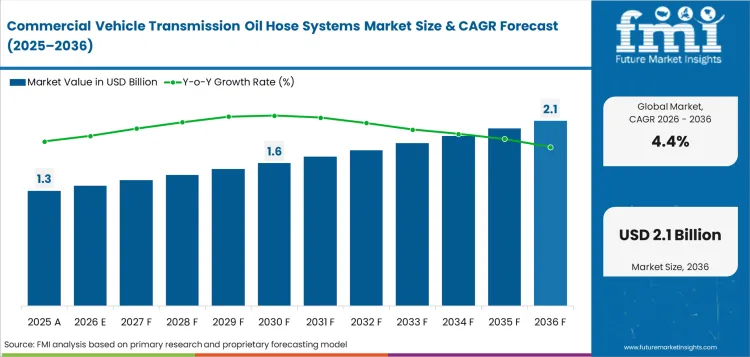
Key Takeaways, Market Size, and Forecast
- Commercial vehicle transmission oil hose systems market was valued at USD 1.3 billion in 2025.
- Heavy-duty fleets are placing more pressure on oil cooling systems, lifting the market toward USD 2.1 billion by 2036.
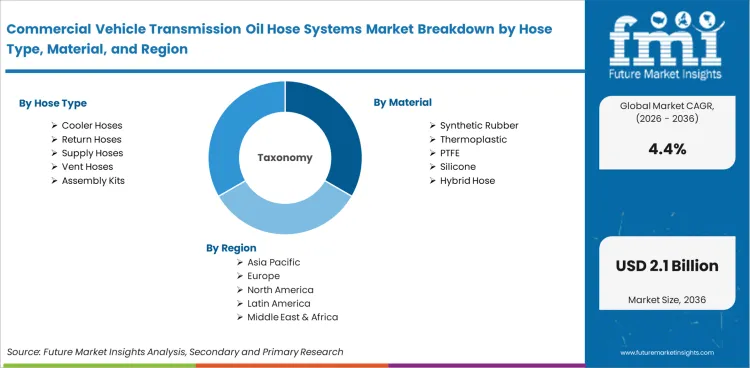
- From 2026 to 2036, demand for commercial vehicle transmission oil hose systems is projected to expand at 4.4% CAGR across OEM supply and service replacement channels.
- Between 2026 and 2036, the market is expected to create USD 0.7 billion in incremental opportunity.
- Cooler hoses are projected to lead hose type demand in 2026, with 38.0% share, since oil temperature control affects transmission service life.
- Cost balance and oil resistance support synthetic rubber, which is estimated to represent 47.0% of material demand in 2026.
- India is projected to record 6.2% CAGR through 2036, making it one of the country with significant growth prospects as fleet renewal lifts OEM and service demand.
- High-load duty cycles support heavy truck demand, with the segment anticipated to represent 41.0% of vehicle type demand in 2026.
Transmission temperature control is becoming a service issue for high-power commercial vehicles. Eaton stated in 2025 that oil cooling is required for engines 399 hp and above with overdrive transmissions and GCW above 90,000 lbs. Severe-duty applications therefore create recurring hose replacement demand. Proper routing becomes a service-quality requirement because hose restriction reduces cooling performance. Eaton stated in 2026 that coverage for oil cooler lines and hoses is limited to 3 years or 300,000 miles. Warranty exposure is likely to push fleets toward better hose selection and documented installation practice.
Commercial Vehicle Transmission Oil Hose Systems Market Definition
The commercial vehicle transmission oil hose systems market covers hose assemblies used to carry transmission fluid between gearboxes and cooling circuits. Scope includes cooler hoses, supply lines, return hoses, vent lines, fittings, clamps, and pre-assembled kits.
Commercial Vehicle Transmission Oil Hose Systems Market Inclusions
Market scope includes cooler hoses, return hoses, supply hoses, vent hoses, assembly kits, synthetic rubber, thermoplastic, PTFE, silicone, hybrid hose, OEM supply, aftermarket sales, distributors, fleet contracts, and global commercial vehicle applications. Stakeholders include commercial vehicle OEMs, hose system manufacturers, transmission suppliers, fleet service workshops, aftermarket distributors, and commercial fleet operators.
Commercial Vehicle Transmission Oil Hose Systems Market Exclusions
Market scope excludes passenger car hose systems, engine lubrication hoses, fuel hoses, brake lines, coolant-only assemblies, hydraulic steering hoses, off-road machinery hoses, and general industrial hose products.
Commercial Vehicle Transmission Oil Hose Systems Market Research Methodology
- Primary Research: FMI analysts reviewed inputs from hose suppliers and commercial vehicle OEM sourcing teams. Interviews covered replacement timing, fitting failure points, compound choice, and OEM validation needs.
- Desk Research: The study used vehicle production data, commercial fleet indicators, emission rule changes, and company product information. ACEA, EPA, OICA, SIAM, CAAM, and official company releases were used to check market direction.
- Market Sizing and Forecasting: The model combined commercial vehicle production, hose content per vehicle, replacement rates, average assembly pricing, and country-level service intensity. Forecasts were adjusted for transmission type mix and regional supplier presence.
- Data Validation: Forecast outputs were checked against vehicle registration trends, hose supplier footprints, and aftermarket channel behavior. Segment shares were reviewed through material usage and transmission heat-load patterns.
Why is the Commercial Vehicle Transmission Oil Hose Systems Market Growing?
- Automatic and automated manual transmissions need controlled oil flow as commercial vehicles carry heavier duty cycles.
- Fleet maintenance spending supports hose replacement since oil leaks can damage transmissions and create downtime.
- OEMs are using more packaged hose assemblies as routing space tightens around modern powertrain layouts, a pattern seen across commercial vehicle AMT transmission programs.
- Emission and efficiency rules push transmission thermal management into deeper design review for heavy-duty vehicles.
Commercial vehicle fleets are placing more value on transmission temperature control as automatic and automated manual platforms spread across trucks and buses. ACEA reported that trucks on EU roads averaged 14.1 years in its 2025 vehicle fleet report. The age profile points to steady inspection and replacement needs for oil hose assemblies. Workshops and distributors benefit when fleets choose pre-assembled lines that reduce fitting errors and shorten repair time.
Market Segmentation Analysis
- Cooler hoses are projected to account for 38.0% of hose type demand in 2026 as transmission heat control affects uptime.
- Synthetic rubber is estimated to hold 47.0% of material demand in 2026 with its balance of oil resistance and cost.
- Heavy trucks are anticipated to represent 41.0% of vehicle type demand in 2026 given higher loads and longer operating cycles.
- OEM supply is projected to account for 56.0% of sales channel demand in 2026 as factory-fit assemblies need validation.
- Automatic transmission layouts are expected to represent 44.0% of transmission type demand in 2026 as urban delivery and fleet comfort needs increase.
The market is segmented by hose type, material, vehicle type, sales channel, and transmission type. Hose type includes cooler hoses and return hoses. Supply hoses, vent hoses, and assembly kits complete the hose type scope. Material includes synthetic rubber and thermoplastic. PTFE, silicone, and hybrid hose form the remaining material scope. Vehicle type covers heavy trucks, medium trucks, buses, vans, and trailers. Sales channel includes OEM supply, aftermarket, distributors, and fleet contracts. Transmission type includes automatic, manual, automated manual, and hybrid layouts.
Commercial Vehicle Transmission Oil Hose Systems Market Analysis by Hose Type
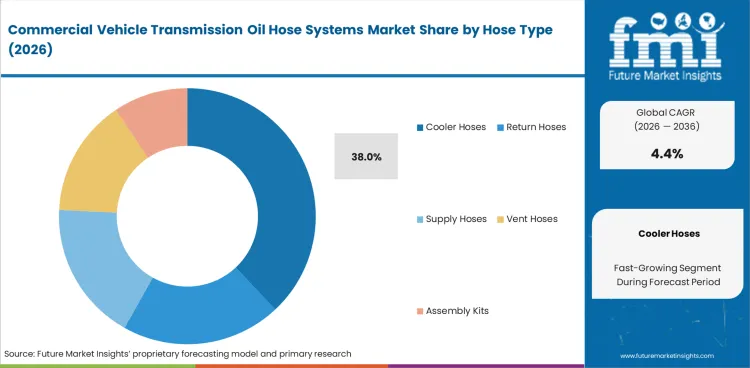
- By 2026, cooler hoses are forecast at 38.0%share owing to direct use in transmission oil temperature control across heavy trucks and buses.
- Return hoses and supply hoses keep steady demand because oil flow stability depends on matched line routing.
Commercial Vehicle Transmission Oil Hose Systems Market Analysis by Material
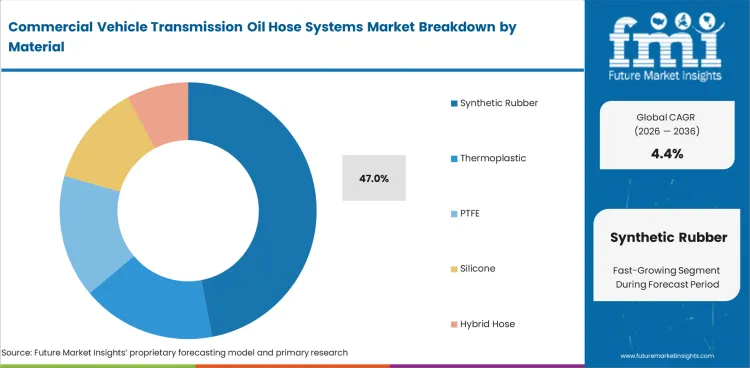
- Synthetic rubber is leading the material mix in 2026 with a 47.0% share. Fleet workshops and OEMs prefer it for oil resistance at a practical replacement cost.
- PTFE and thermoplastic hoses gain use in hotter zones that need tighter bend control.
Commercial Vehicle Transmission Oil Hose Systems Market Analysis by Vehicle Type
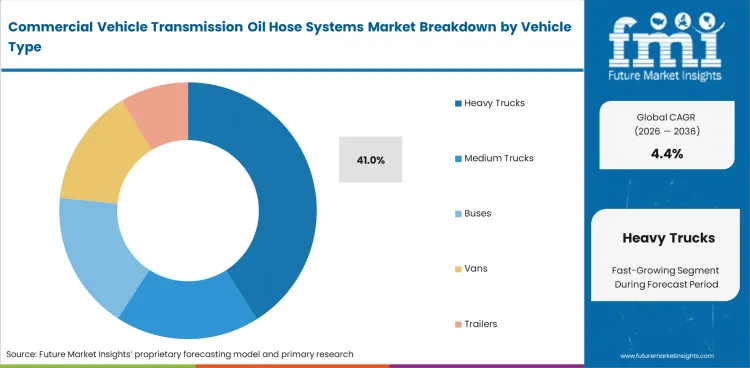
- Heavy trucks are anticipated to form the main vehicle type base at 41.0% in 2026. Freight and construction duty cycles create more heat stress on transmission cooling lines.
- Medium Trucks stay important in regional delivery fleets that need shorter hose assemblies.
Commercial Vehicle Transmission Oil Hose Systems Market Analysis by Sales Channel
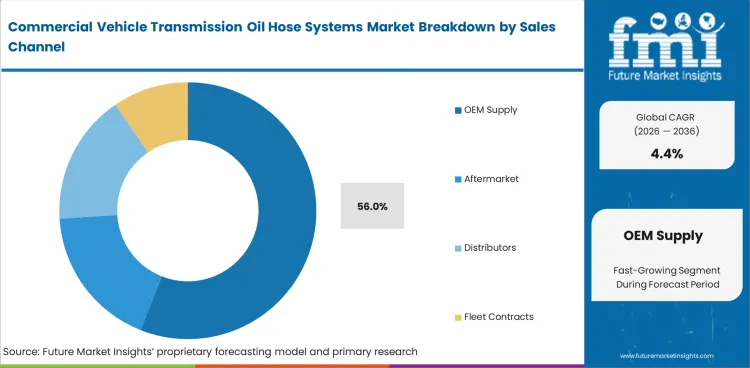
- OEM supply is forecast to form the main sales channel route at 56.0% in 2026. Truck makers need hose assemblies that match platform routing before production release.
- Aftermarket demand stays active as older fleets replace hardened hoses during scheduled maintenance, creating steady parts movement through the automotive aftermarket channel.
Commercial Vehicle Transmission Oil Hose Systems Market Analysis by Transmission Type
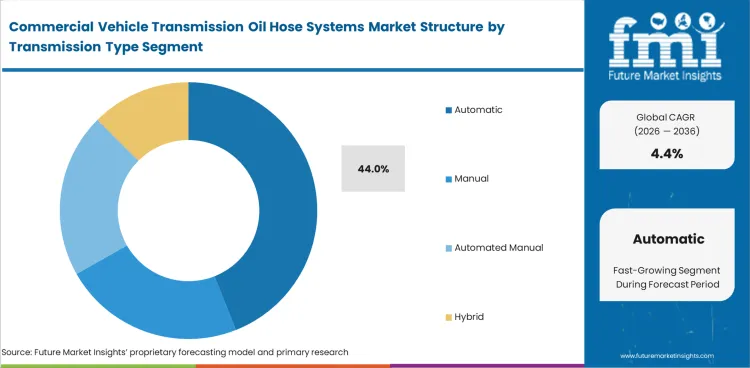
- Automatic layouts are expected to lead Transmission Type demand with 44.0% in 2026. Urban freight and bus fleets use these systems for smoother low-speed operation and better drivability.
- Automated manual systems add value in long-haul trucks that need efficiency with reduced driver effort.
Commercial Vehicle Transmission Oil Hose Systems Market Drivers, Restraints, and Opportunities
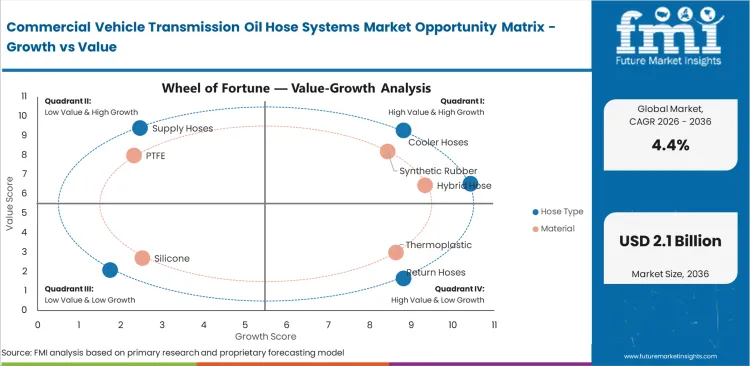
- Transmission heat control creates steady hose demand as commercial vehicles operate under heavier loads and longer duty cycles.
- OEM validation needs support pre-assembled hose systems as truck makers reduce leakage risk on assembly lines.
- Aftermarket replacement gains from aging fleets as oil hose hardening creates service events in older trucks.
- Material cost pressure limits premium hose use in price-sensitive repair channels.
- Hybrid commercial platforms open selective demand for higher-temperature hose and routing designs.
Transmission Heat Control
Transmission oil hose systems receive closer review in drivetrain reliability decisions as fleets carry heavier loads across mixed routes. EPA finalized Phase 3 greenhouse gas standards in March 2024 for heavy-duty vehicles beginning with model year 2027. Efficiency pressure keeps transmission thermal management under closer OEM review. Hose systems need stable oil flow and leak control so cooling performance does not weaken during long service cycles. Suppliers with compound validation and fitting consistency can defend pricing better than suppliers selling hose lengths.
OEM Hose Validation
Commercial vehicle makers are using more validated hose assemblies to reduce line-side errors and warranty risk. Continental started production at a USD 0.09 billion hydraulics facility in Aguascalientes, Mexico in 2025 to support regional hose supply and shorter response times. Regional manufacturing helps because hose assemblies often need vehicle-specific lengths and fittings. OEMs gain when suppliers can support quick changeovers and repeatable crimp quality. The opportunity is stronger for companies with local engineering support near truck plants.
Replacement Cost Pressure
Aftermarket channels stay cost-sensitive since workshops compare hose assemblies against downtime risk and part availability. ACEA reported around 30.1 million vans on EU roads in its 2025 fleet report, along with roughly 0.68 million buses. Large operating fleets create recurring replacement demand. Price pressure stays active when fleets replace hoses during scheduled maintenance. Suppliers can protect share by offering accurate fitment data and reliable kits reducing repeat repairs.
Analysis of Commercial Vehicle Transmission Oil Hose Systems Market By Key Countries
.webp "Top Country Growth Comparison Commercial Vehicle Transmission Oil Hose Systems Market Cagr (2026 2036)")
| Country | CAGR |
|---|---|
| India | 6.2% |
| China | 5.7% |
| Mexico | 5.1% |
| Brazil | 4.8% |
| United States | 4.5% |
| Germany | 3.6% |
| Japan | 3.3% |
Source: FMI analysis based on primary research and proprietary forecasting model.
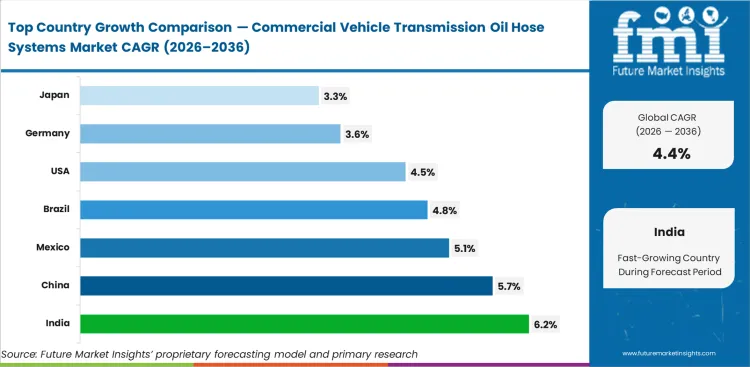
Commercial Vehicle Transmission Oil Hose Systems Market CAGR Analysis By Country
- India’s 6.2% CAGR during 2026 to 2036 reflects highway freight growth and higher replacement demand across organized truck fleets.
- By 2036, China demand is forecast to move at 5.7% CAGR as local truck platforms create steady need for oil hose assemblies.
- Mexico is forecast to grow at a 5.1% CAGR, outpacing the global average, as North American truck supply chains rely on local hose-assembly capacity.
- Across 2026 to 2036, Brazil records 4.8% CAGR through road freight dependence and long-distance truck service needs.
- The United States is assessed at 4.5% CAGR during the same forecast period as vocational truck fleets support repeat replacement demand.
- Germany’s market outlook stands at 3.6% CAGR for 2026 to 2036 due to mature OEM validation and slower fleet growth.
- Japan is forecast at 3.3% CAGR during 2026 to 2036 as compact vehicle design keeps quality standards high for hose suppliers.
- Global demand is projected to grow at 4.4% CAGR through 2036.
Demand Outlook for Commercial Vehicle Transmission Oil Hose Systems Market in India
India’s market benefits from freight growth across national highway corridors and heavy vehicle activity in industrial states. The country is projected to record 6.2% CAGR during 2026 to 2036 as fleet renewal increases OEM and replacement demand. Transmission oil hose suppliers gain when they can serve vehicle plants and regional service workshops. Reliable part availability across highway repair networks will decide replacement speed.
- Pune’s commercial vehicle supply base supports demand for pre-formed hose assemblies used in truck platforms.
- Chennai’s automotive corridor gives suppliers access to OEM programs and export-oriented component flows.
- Delhi Mumbai Industrial Corridor freight movement increases service demand near logistics hubs and highway repair points.
Sales Analysis of Commercial Vehicle Transmission Oil Hose Systems Market in China
China’s demand base is tied to truck production clusters and localized sourcing programs. The market is expected to move at 5.7% CAGR through 2036 as OEMs continue sourcing hose and fitting assemblies closer to vehicle plants. Domestic suppliers compete on cost control and platform-specific routing support. Export-oriented truck programs add demand for validated hose quality.
- Shandong’s truck manufacturing base supports demand for oil hose assemblies tied to heavy-duty vehicle production.
- Jiangsu’s component ecosystem gives hose suppliers access to rubber processing and vehicle parts networks.
- Coastal export routes raise demand for hose assemblies meeting OEM quality checks for overseas truck programs.
Demand Analysis of Commercial Vehicle Transmission Oil Hose Systems Market in Mexico
Mexico benefits from heavy vehicle supply links across northern and central manufacturing corridors. The industry in Mexico is forecast to record a 5.1% CAGR during the forecast period as local assembly demand and cross-border component flows strengthen. Suppliers with hose production near truck plants can reduce lead times. Aftermarket channels gain from freight movement across northern logistics routes.
- Aguascalientes supports hose production through ContiTech’s regional hydraulics manufacturing base.
- Nuevo León gives suppliers access to Monterrey’s truck parts network and cross-border freight lanes.
- Bajío manufacturing corridors support OEM supply programs needing shorter delivery windows for hose assemblies.
Opportunity Analysis of Commercial Vehicle Transmission Oil Hose Systems Market in Brazil
Brazil’s road freight structure keeps hose replacement tied to long-haul truck operation across industrial and agricultural regions. Demand is forecast at 4.8% CAGR by 2036 as fleet service remains active. Agricultural freight routes create repeated heat and vibration exposure for transmission oil lines. Distributor coverage outside major cities affects replacement speed.
- São Paulo’s service workshop base supports replacement demand for freight and intercity truck fleets.
- Mato Grosso grain routes create high-use conditions raising hose inspection needs during harvest movement.
- Paraná’s logistics links support aftermarket demand from refrigerated transport and regional freight operators.
Future Outlook for Commercial Vehicle Transmission Oil Hose Systems Market in the United States
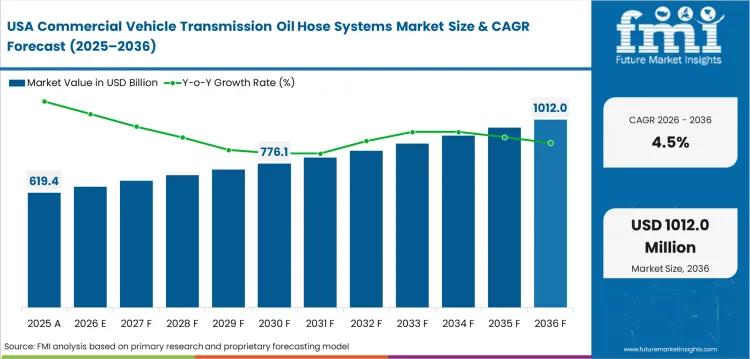
Commercial vehicle transmission oil hose systems are projected at 4.5% CAGR from 2026 to 2036. The United States has a large vocational and long-haul truck base across freight-intensive states. EPA Phase 3 rules keep drivetrain efficiency in platform planning. Suppliers with national distribution and OEM validation records have better access to service programs.
- Texas oilfield and freight activity supports replacement demand for hoses exposed to high load and heat.
- California port drayage fleets create frequent stop-start duty raising transmission cooling needs.
- Midwest truck service networks support demand for part-numbered hose kits across long-haul repair routes.
Demand Outlook for Commercial Vehicle Transmission Oil Hose Systems Market in Germany
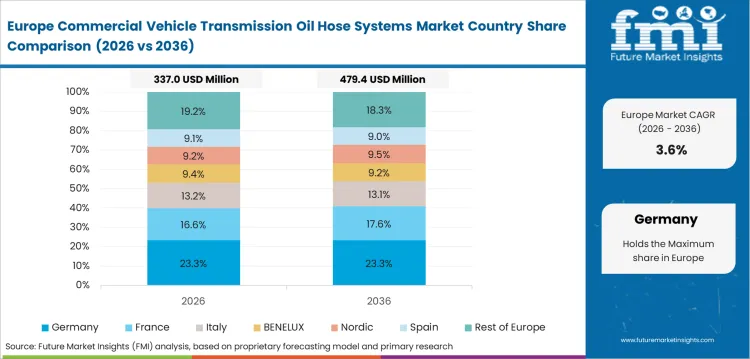
Germany’s market depends on strict OEM validation and established truck engineering capability. Mature truck production limits faster volume growth and commercial vehicle transmission oil hose demand is forecast at 3.6% CAGR across 2026 to 2036. Korbach has hose manufacturing relevance through established industrial rubber activity. Suppliers are focusing on material testing and crimp process control.
- Lower Saxony supports demand through truck engineering programs and commercial vehicle supplier networks.
- Baden-Württemberg gives hose suppliers access to advanced vehicle component testing and drivetrain engineering.
- Korbach strengthens Germany’s hose production base through industrial rubber processing and validation activity.
In-depth Analysis of Commercial Vehicle Transmission Oil Hose Systems Market in Japan
Japan’s market is shaped by compact routing needs and tight quality expectations across vehicle clusters. The country is expected to post 3.3% CAGR during 2026 to 2036 because local OEM programs prioritize low-defect hose assemblies. Sumitomo Riko and other domestic suppliers benefit from long platform relationships. Growth stays measured because replacement cycles are disciplined and quality standards are high.
- Aichi’s automotive cluster supports demand for compact hose routing in commercial vehicle platforms.
- Shizuoka’s component supply base helps hose makers serve drivetrain and thermal management programs.
- Japanese OEM quality systems favor suppliers showing low leakage risk across long service cycles.
Competitive Landscape and Strategic Positioning
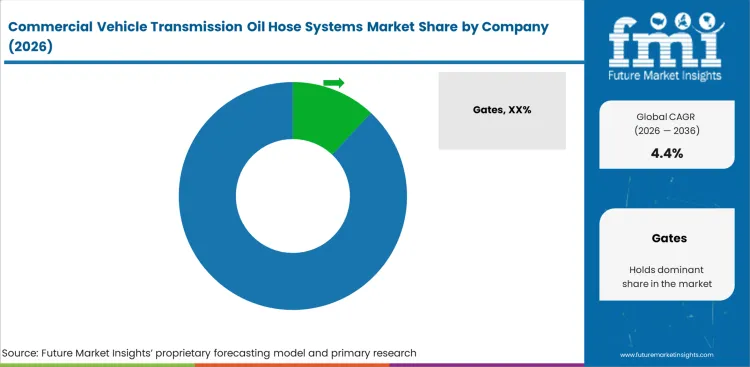
- Market concentration is moderate as global hose suppliers compete with regional molded rubber and assembly specialists.
- Leading companies compete through compound validation, crimp reliability and OEM platform access.
- Regional suppliers compete in aftermarket channels through part coverage and faster delivery.
- Entry barriers come from oil resistance testing with heat aging data and vehicle-specific routing approvals.
Competition in commercial vehicle transmission oil hose systems depends on reliability under heat and vibration, similar to other drivetrain components such as the commercial vehicle propeller shaft. OEMs need suppliers to validate hose material against transmission fluid exposure and maintain crimp quality across large batches. Continental AG’s group sector ContiTech started production at its Aguascalientes hydraulics plant in 2025 with a USD 0.09 billion investment in regional fluid power supply. The plant supports local hose availability and shorter response time for customers in the Americas. Local production matters because hose assemblies often need platform-specific routing and repeatable fitting quality.
Established suppliers hold an advantage when product breadth connects hose supply with OEM and aftermarket needs. Gates Industrial Corporation plc reports Power Transmission and Fluid Power as its core segments, with automotive OEM and aftermarket channels included in its end-market base. Parker-Hannifin Corporation lists Fluid Conveyance Hose & Tubing in its Diversified Industrial Segment and states that custom products are engineered to OEM specifications. These product portfolios help vehicle OEMs reduce supplier complexity during hose validation.
Specialist and regional suppliers compete through vehicle platform knowledge and local service support. Cooper Standard states that it supplies sealing and fluid handling systems and components for transportation and industrial markets. Sumitomo Riko Company Limited lists automotive hoses in its mobility portfolio and states that its automotive hoses hold the prominent market share in Japan based on company estimates. These positions matter when OEMs need long-term part consistency and fast response on routing changes. Smaller suppliers face difficulty when contracts need global engineering records and multi-region production support.
Key Companies in the Commercial Vehicle Transmission Oil Hose Systems Market
- Global Leaders: Gates and Continental have broad fluid power and vehicle drivetrain portfolios. Gates has power transmission and fluid power depth.
- Regional and OEM Specialists: Sumitomo Riko and Nichirin compete through automotive hose know-how and regional OEM relationships.
- Fluid Handling Specialists: Cooper Standard and TI Fluid Systems compete through vehicle fluid routing knowledge and component integration.
Competitive Benchmarking: Commercial Vehicle Transmission Oil Hose Systems Market
| Company | Oil-Resistant Hose Materials | Fitting and Crimp Control | OEM Platform Access | Geographic Footprint |
|---|---|---|---|---|
| Gates | High | Strong | Strong | Global |
| Continental | High | Strong | Strong | Global |
| Parker Hannifin | High | Strong | Moderate | Global |
| Eaton | Medium | Strong | Strong | Global |
| Sumitomo Riko | High | Strong | Strong | Asia and Global |
| Nichirin | Medium | Strong | Moderate | Asia and North America |
| Cooper Standard | Medium | Moderate | Strong | Global |
| Hutchinson | High | Moderate | Strong | Europe and Global |
| TI Fluid Systems | Medium | Moderate | Strong | Global |
| Toyoda Gosei | Medium | Moderate | Strong | Asia and Global |
Source: Future Market Insights competitive analysis, 2026. Ratings reflect relative positioning based on oil-resistant hose materials, fitting and crimp control, and OEM platform access.
Key Developments in Commercial Vehicle Transmission Oil Hose Systems Market
- In January 2025, Eaton expanded its aftermarket portfolio to include Endurant automated manual transmission parts. The expansion supports transmission repair channels and increases the need for compatible oil-line and service parts checks.
- In May 2025, Allison Transmission made its 3000 Series automatic transmission available with the CNG-powered Mack Granite for waste management customers.
Key Players in the Commercial Vehicle Transmission Oil Hose Systems Market
Global Leaders
- Gates
- Continental
- Parker Hannifin
- Eaton
Regional and OEM Specialists
- Sumitomo Riko
- Nichirin
- Hutchinson
- Toyoda Gosei
Fluid Handling Specialists
- Cooper Standard
- TI Fluid Systems
Report Scope and Coverage
| Parameter | Details |
|---|---|
| Quantitative Units | USD 1.4 billion to USD 2.1 billion, at a CAGR of 4.4% from 2026 to 2036 |
| Market Definition | Hose assemblies used to carry transmission oil across coolers, pumps, return circuits, vents, and transmission housings in commercial vehicles |
| Regions Covered | North America, Latin America, Europe, East Asia, South Asia and Pacific, Middle East and Africa |
| Countries Covered | India, China, Mexico, Brazil, United States, Germany, Japan, 30+ countries |
| Key Companies Profiled | Gates, Continental, Parker Hannifin, Eaton, Sumitomo Riko, Nichirin, Cooper Standard, Hutchinson, TI Fluid Systems, Toyoda Gosei |
| Forecast Period | 2026 to 2036 |
| Approach | Hybrid bottom-up and top-down methodology starting with verified vehicle and replacement data, projecting adoption velocity across segments and regions |
Commercial Vehicle Transmission Oil Hose Systems Market by Segments
Commercial Vehicle Transmission Oil Hose Systems Market Segmented by Hose Type:
- Cooler Hoses
- Return Hoses
- Supply Hoses
- Vent Hoses
- Assembly Kits
Commercial Vehicle Transmission Oil Hose Systems Market Segmented by Material:
- Synthetic Rubber
- Thermoplastic
- PTFE
- Silicone
- Hybrid Hose
Commercial Vehicle Transmission Oil Hose Systems Market Segmented by Vehicle Type:
- Heavy Trucks
- Medium Trucks
- Buses
- Vans
- Trailers
Commercial Vehicle Transmission Oil Hose Systems Market Segmented by Sales Channel:
- OEM Supply
- Aftermarket
- Distributors
- Fleet Contracts
Commercial Vehicle Transmission Oil Hose Systems Market Segmented by Transmission Type:
- Automatic
- Manual
- Automated Manual
- Hybrid
Commercial Vehicle Transmission Oil Hose Systems Market by Region:
- North America
- United States
- Canada
- Mexico
- Latin America
- Brazil
- Chile
- Rest of Latin America
- Western Europe
- Germany
- UK
- France
- Italy
- Spain
- Nordic
- BENELUX
- Rest of Western Europe
- Eastern Europe
- Poland
- Hungary
- Balkan and Baltic
- Rest of Eastern Europe
- East Asia
- China
- Japan
- South Korea
- South Asia and Pacific
- India
- ASEAN
- Australia and New Zealand
- Rest of South Asia and Pacific
- Middle East and Africa
- Kingdom of Saudi Arabia
- Other GCC Countries
- Turkiye
- South Africa
- Rest of Middle East and Africa
Research Sources and Bibliography
- European Automobile Manufacturers’ Association. (2025, January 29). Report: Vehicles on European roads 2025. ACEA.
- Continental AG. (2025, September 10). ContiTech launches production at new hydraulic plant in Aguascalientes. Continental.
- Gates Industrial Corporation plc. (2026, February 12). 2025 annual report. Gates Industrial Corporation plc.
- Parker-Hannifin Corporation. (2025, August 22). Form 10-K for the fiscal year ended June 30, 2025. Parker-Hannifin Corporation.
- Cooper-Standard Holdings Inc. (2026, February 13). Form 10-K for the fiscal year ended December 31, 2025. USA Securities and Exchange Commission.
- Sumitomo Riko Company Limited. (2026). Automotive (Mobility): Products. Sumitomo Riko Company Limited.
- Eaton Cummins Automated Transmission Technologies. (2025, August 20). Eaton Cummins Automated Transmission Technologies celebrates 500,000th Endurant transmission milestone with Werner. Eaton Cummins.
- Eaton. (2025, January 14). Eaton expands aftermarket portfolio to include Endurant automated manual transmission parts. Eaton.
- Allison Transmission. (2025, May 20). Allison Transmission 3000 Series™ now available with CNG-powered Mack Granite. Allison Transmission.
Bibliography is provided for reader reference and uses primary government, official association or company sources.
This Report Answers
- What is the current and future value of the commercial vehicle transmission oil hose systems market from 2026 to 2036?
- What CAGR is projected for commercial vehicle transmission oil hose systems during the 2026 to 2036 forecast period?
- Which hose type is projected to lead commercial vehicle transmission oil hose demand in 2026?
- Which material is estimated to hold a leading share in commercial vehicle transmission oil hose systems?
- What factors are driving transmission oil hose use in heavy trucks and commercial vans?
- How do emission rules and drivetrain efficiency needs affect hose supplier selection?
- Which countries are projected to record the highest CAGRs in commercial vehicle transmission oil hose systems?
- Which companies are positioned across hose materials and transmission fluid-handling assemblies?
- How does FMI define the commercial vehicle transmission oil hose systems market scope?
- What forecasting approach was used to estimate demand from 2026 to 2036?
Frequently Asked Questions
What is the global market demand for commercial vehicle transmission oil hose systems in 2026?
In 2026, global commercial vehicle transmission oil hose systems demand is expected to be worth USD 1.4 billion across OEM and service channels.
How big will the commercial vehicle transmission oil hose systems market be in 2036?
By 2036, the commercial vehicle transmission oil hose systems market is forecast to reach USD 2.1 billion with steady replacement demand.
What CAGR is projected for commercial vehicle transmission oil hose systems from 2026 to 2036?
The market is projected to grow at 4.4% CAGR from 2026 to 2036 as fleet service and OEM demand expand.
Which hose type is projected to lead demand in 2026?
Cooler hoses are projected to account for 38.0% of hose type demand in 2026 due to transmission oil heat-control needs.
Which material is estimated to hold the leading share in 2026?
Synthetic rubber is estimated to hold 47.0% of material demand in 2026 due to oil resistance and cost balance.
Which country is projected to record the highest CAGR through 2036?
India is projected to record a 6.2% CAGR through 2036 as freight fleet growth supports hose replacement and OEM demand.
What does FMI include in the commercial vehicle transmission oil hose systems market definition?
FMI includes hose assemblies carrying transmission oil across coolers, pumps, return circuits, vents and gearbox connections in commercial vehicles.
How does FMI estimate the commercial vehicle transmission oil hose systems forecast?
FMI uses vehicle production, hose content per vehicle, replacement rates, pricing checks and supplier interviews to estimate demand during the same period.
Preview the report firsthand - request a free sample
Get SampleGet the brochure for pricing and purchase details.
Get PDFTable of Content
- Key Takeaways
- Market Size and CAGR
- Top Growth Driver
- Fastest Growing Segment
- Leading Region
- Key Companies
- Emerging Opportunities
- Executive Summary
- Global Market Outlook
- Demand-side Trends
- Supply-side Trends
- Technology Roadmap Analysis
- Analysis and Recommendations
- Analyst Perspective (What is happening? Why now? What should investors know?)
- Key Questions Answered
- How large is the market?
- What is the CAGR?
- What are key trends?
- Which region dominates?
- Who are the leaders?
- Market Overview
- Market Coverage / Taxonomy
- Market Definition / Scope / Limitations
- Research Methodology
- Chapter Orientation
- Analytical Lens and Working Hypotheses
- Market Structure, Signals, and Trend Drivers
- Benchmarking and Cross-market Comparability
- Market Sizing, Forecasting, and Opportunity Mapping
- Research Design and Evidence Framework
- Desk Research Programme (Secondary Evidence)
- Expert Input and Fieldwork (Primary Evidence)
- Tooling, Models, and Reference Databases
- Data Engineering and Model Build
- Quality Assurance and Audit Trail
- Market Background
- Market Dynamics (Drivers, Restraints, Opportunity, Trends)
- Scenario Forecast (Optimistic, Likely, Conservative)
- Impact Analysis
- AI Impact
- Sustainability Impact
- Regulatory Impact
- Technology Impact
- Consumer / Buyer Analysis
- Purchase Drivers
- Adoption Barriers
- Buyer Journey
- Opportunity Map Analysis
- Product Life Cycle Analysis
- Supply Chain Analysis
- Investment Feasibility Matrix
- Value Chain Analysis
- PESTLE and Porter's Analysis
- Regulatory Landscape
- Regional Parent Market Outlook
- Production and Consumption Statistics
- Import and Export Statistics
- Global Market Analysis and Forecast, 2021 to 2036
- Historical Market Size Value (USD Billion) & Volume (Unit) Analysis, 2021 to 2025
- Current and Future Market Size Value (USD Billion) & Volume (Unit) Projections, 2026 to 2036
- Y-o-Y Growth Trend Analysis
- Absolute $ Opportunity Analysis
- Global Market Pricing Analysis, 2021 to 2036
- Global Market Analysis and Forecast, By Hose Type, 2021 to 2036
- Introduction / Key Findings
- Historical Market Size Value (USD Billion) & Volume (Unit) Analysis By Hose Type, 2021 to 2025
- Current and Future Market Size Value (USD Billion) & Volume (Unit) Analysis and Forecast By Hose Type, 2026 to 2036
- Cooler Hoses
- Return Hoses
- Supply Hoses
- Vent Hoses
- Assembly Kits
- Cooler Hoses
- Y-o-Y Growth Trend Analysis By Hose Type, 2021 to 2025
- Absolute $ Opportunity Analysis By Hose Type, 2026 to 2036
- Global Market Analysis and Forecast, By Material, 2021 to 2036
- Introduction / Key Findings
- Historical Market Size Value (USD Billion) & Volume (Unit) Analysis By Material, 2021 to 2025
- Current and Future Market Size Value (USD Billion) & Volume (Unit) Analysis and Forecast By Material, 2026 to 2036
- Synthetic Rubber
- Thermoplastic
- PTFE
- Silicone
- Hybrid Hose
- Synthetic Rubber
- Y-o-Y Growth Trend Analysis By Material, 2021 to 2025
- Absolute $ Opportunity Analysis By Material, 2026 to 2036
- Global Market Analysis and Forecast, By Vehicle Type, 2021 to 2036
- Introduction / Key Findings
- Historical Market Size Value (USD Billion) & Volume (Unit) Analysis By Vehicle Type, 2021 to 2025
- Current and Future Market Size Value (USD Billion) & Volume (Unit) Analysis and Forecast By Vehicle Type, 2026 to 2036
- Heavy Trucks
- Medium Trucks
- Buses
- Vans
- Trailers
- Heavy Trucks
- Y-o-Y Growth Trend Analysis By Vehicle Type, 2021 to 2025
- Absolute $ Opportunity Analysis By Vehicle Type, 2026 to 2036
- Global Market Analysis and Forecast, By Sales Channel, 2021 to 2036
- Introduction / Key Findings
- Historical Market Size Value (USD Billion) & Volume (Unit) Analysis By Sales Channel, 2021 to 2025
- Current and Future Market Size Value (USD Billion) & Volume (Unit) Analysis and Forecast By Sales Channel, 2026 to 2036
- OEM Supply
- Aftermarket
- Distributors
- Fleet Contracts
- OEM Supply
- Y-o-Y Growth Trend Analysis By Sales Channel, 2021 to 2025
- Absolute $ Opportunity Analysis By Sales Channel, 2026 to 2036
- Global Market Analysis and Forecast, By Transmission Type, 2021 to 2036
- Introduction / Key Findings
- Historical Market Size Value (USD Billion) & Volume (Unit) Analysis By Transmission Type, 2021 to 2025
- Current and Future Market Size Value (USD Billion) & Volume (Unit) Analysis and Forecast By Transmission Type, 2026 to 2036
- Automatic
- Manual
- Automated Manual
- Hybrid
- Automatic
- Y-o-Y Growth Trend Analysis By Transmission Type, 2021 to 2025
- Absolute $ Opportunity Analysis By Transmission Type, 2026 to 2036
- Global Market Analysis and Forecast, By Region, 2021 to 2036
- Introduction
- Historical Market Size Value (USD Billion) & Volume (Unit) Analysis By Region, 2021 to 2025
- Current Market Size Value (USD Billion) & Volume (Unit) Analysis and Forecast By Region, 2026 to 2036
- North America
- Latin America
- Western Europe
- Eastern Europe
- East Asia
- South Asia and Pacific
- Middle East & Africa
- Market Attractiveness Analysis By Region
- North America Market Analysis and Forecast, By Country, 2021 to 2036
- Historical Market Size Value (USD Billion) & Volume (Unit) Trend Analysis By Market Taxonomy, 2021 to 2025
- Market Size Value (USD Billion) & Volume (Unit) Forecast By Market Taxonomy, 2026 to 2036
- By Country
- USA
- Canada
- Mexico
- By Hose Type
- By Material
- By Vehicle Type
- By Sales Channel
- By Transmission Type
- By Country
- Market Attractiveness Analysis
- By Country
- By Hose Type
- By Material
- By Vehicle Type
- By Sales Channel
- By Transmission Type
- Key Takeaways
- Latin America Market Analysis and Forecast, By Country
- Historical Market Size Value (USD Billion) & Volume (Unit) Trend Analysis By Market Taxonomy, 2021 to 2025
- Market Size Value (USD Billion) & Volume (Unit) Forecast By Market Taxonomy, 2026 to 2036
- By Country
- Brazil
- Chile
- Rest of Latin America
- By Hose Type
- By Material
- By Vehicle Type
- By Sales Channel
- By Transmission Type
- By Country
- Market Attractiveness Analysis
- By Country
- By Hose Type
- By Material
- By Vehicle Type
- By Sales Channel
- By Transmission Type
- Key Takeaways
- Western Europe Market Analysis and Forecast, By Country
- Historical Market Size Value (USD Billion) & Volume (Unit) Trend Analysis By Market Taxonomy, 2021 to 2025
- Market Size Value (USD Billion) & Volume (Unit) Forecast By Market Taxonomy, 2026 to 2036
- By Country
- Germany
- UK
- Italy
- Spain
- France
- Nordic
- BENELUX
- Rest of Western Europe
- By Hose Type
- By Material
- By Vehicle Type
- By Sales Channel
- By Transmission Type
- By Country
- Market Attractiveness Analysis
- By Country
- By Hose Type
- By Material
- By Vehicle Type
- By Sales Channel
- By Transmission Type
- Key Takeaways
- Eastern Europe Market Analysis and Forecast, By Country
- Historical Market Size Value (USD Billion) & Volume (Unit) Trend Analysis By Market Taxonomy, 2021 to 2025
- Market Size Value (USD Billion) & Volume (Unit) Forecast By Market Taxonomy, 2026 to 2036
- By Country
- Russia
- Poland
- Hungary
- Balkan & Baltic
- Rest of Eastern Europe
- By Hose Type
- By Material
- By Vehicle Type
- By Sales Channel
- By Transmission Type
- By Country
- Market Attractiveness Analysis
- By Country
- By Hose Type
- By Material
- By Vehicle Type
- By Sales Channel
- By Transmission Type
- Key Takeaways
- East Asia Market Analysis and Forecast, By Country
- Historical Market Size Value (USD Billion) & Volume (Unit) Trend Analysis By Market Taxonomy, 2021 to 2025
- Market Size Value (USD Billion) & Volume (Unit) Forecast By Market Taxonomy, 2026 to 2036
- By Country
- China
- Japan
- South Korea
- By Hose Type
- By Material
- By Vehicle Type
- By Sales Channel
- By Transmission Type
- By Country
- Market Attractiveness Analysis
- By Country
- By Hose Type
- By Material
- By Vehicle Type
- By Sales Channel
- By Transmission Type
- Key Takeaways
- South Asia and Pacific Market Analysis and Forecast, By Country
- Historical Market Size Value (USD Billion) & Volume (Unit) Trend Analysis By Market Taxonomy, 2021 to 2025
- Market Size Value (USD Billion) & Volume (Unit) Forecast By Market Taxonomy, 2026 to 2036
- By Country
- India
- ASEAN
- Australia & New Zealand
- Rest of South Asia and Pacific
- By Hose Type
- By Material
- By Vehicle Type
- By Sales Channel
- By Transmission Type
- By Country
- Market Attractiveness Analysis
- By Country
- By Hose Type
- By Material
- By Vehicle Type
- By Sales Channel
- By Transmission Type
- Key Takeaways
- Middle East & Africa Market Analysis and Forecast, By Country
- Historical Market Size Value (USD Billion) & Volume (Unit) Trend Analysis By Market Taxonomy, 2021 to 2025
- Market Size Value (USD Billion) & Volume (Unit) Forecast By Market Taxonomy, 2026 to 2036
- By Country
- Kingdom of Saudi Arabia
- Other GCC Countries
- Türkiye
- South Africa
- Other African Union
- Rest of Middle East & Africa
- By Hose Type
- By Material
- By Vehicle Type
- By Sales Channel
- By Transmission Type
- By Country
- Market Attractiveness Analysis
- By Country
- By Hose Type
- By Material
- By Vehicle Type
- By Sales Channel
- By Transmission Type
- Key Takeaways
- Key Countries Market Analysis
- USA
- Pricing Analysis
- Market Share Analysis, 2025
- By Hose Type
- By Material
- By Vehicle Type
- By Sales Channel
- By Transmission Type
- Canada
- Pricing Analysis
- Market Share Analysis, 2025
- By Hose Type
- By Material
- By Vehicle Type
- By Sales Channel
- By Transmission Type
- Mexico
- Pricing Analysis
- Market Share Analysis, 2025
- By Hose Type
- By Material
- By Vehicle Type
- By Sales Channel
- By Transmission Type
- Brazil
- Pricing Analysis
- Market Share Analysis, 2025
- By Hose Type
- By Material
- By Vehicle Type
- By Sales Channel
- By Transmission Type
- Chile
- Pricing Analysis
- Market Share Analysis, 2025
- By Hose Type
- By Material
- By Vehicle Type
- By Sales Channel
- By Transmission Type
- Germany
- Pricing Analysis
- Market Share Analysis, 2025
- By Hose Type
- By Material
- By Vehicle Type
- By Sales Channel
- By Transmission Type
- UK
- Pricing Analysis
- Market Share Analysis, 2025
- By Hose Type
- By Material
- By Vehicle Type
- By Sales Channel
- By Transmission Type
- Italy
- Pricing Analysis
- Market Share Analysis, 2025
- By Hose Type
- By Material
- By Vehicle Type
- By Sales Channel
- By Transmission Type
- Spain
- Pricing Analysis
- Market Share Analysis, 2025
- By Hose Type
- By Material
- By Vehicle Type
- By Sales Channel
- By Transmission Type
- France
- Pricing Analysis
- Market Share Analysis, 2025
- By Hose Type
- By Material
- By Vehicle Type
- By Sales Channel
- By Transmission Type
- India
- Pricing Analysis
- Market Share Analysis, 2025
- By Hose Type
- By Material
- By Vehicle Type
- By Sales Channel
- By Transmission Type
- ASEAN
- Pricing Analysis
- Market Share Analysis, 2025
- By Hose Type
- By Material
- By Vehicle Type
- By Sales Channel
- By Transmission Type
- Australia & New Zealand
- Pricing Analysis
- Market Share Analysis, 2025
- By Hose Type
- By Material
- By Vehicle Type
- By Sales Channel
- By Transmission Type
- China
- Pricing Analysis
- Market Share Analysis, 2025
- By Hose Type
- By Material
- By Vehicle Type
- By Sales Channel
- By Transmission Type
- Japan
- Pricing Analysis
- Market Share Analysis, 2025
- By Hose Type
- By Material
- By Vehicle Type
- By Sales Channel
- By Transmission Type
- South Korea
- Pricing Analysis
- Market Share Analysis, 2025
- By Hose Type
- By Material
- By Vehicle Type
- By Sales Channel
- By Transmission Type
- Russia
- Pricing Analysis
- Market Share Analysis, 2025
- By Hose Type
- By Material
- By Vehicle Type
- By Sales Channel
- By Transmission Type
- Poland
- Pricing Analysis
- Market Share Analysis, 2025
- By Hose Type
- By Material
- By Vehicle Type
- By Sales Channel
- By Transmission Type
- Hungary
- Pricing Analysis
- Market Share Analysis, 2025
- By Hose Type
- By Material
- By Vehicle Type
- By Sales Channel
- By Transmission Type
- Kingdom of Saudi Arabia
- Pricing Analysis
- Market Share Analysis, 2025
- By Hose Type
- By Material
- By Vehicle Type
- By Sales Channel
- By Transmission Type
- Türkiye
- Pricing Analysis
- Market Share Analysis, 2025
- By Hose Type
- By Material
- By Vehicle Type
- By Sales Channel
- By Transmission Type
- South Africa
- Pricing Analysis
- Market Share Analysis, 2025
- By Hose Type
- By Material
- By Vehicle Type
- By Sales Channel
- By Transmission Type
- USA
- Market Structure Analysis
- Competition Dashboard
- Competition Benchmarking
- Market Share Analysis of Top Players
- By Regional
- By Hose Type
- By Material
- By Vehicle Type
- By Sales Channel
- By Transmission Type
- Emerging Startups
- Innovation Benchmarking
- Competition Analysis
- Competition Deep Dive
- Gates
- Overview
- Product Portfolio
- Profitability by Market Segments (Product/Region/Sales Channel)
- Sales Footprint
- Strategy Overview
- Marketing Strategy
- Product Strategy
- Channel Strategy
- Continental
- Parker Hannifin
- Eaton
- Sumitomo Riko
- Nichirin
- Cooper Standard
- Hutchinson
- TI Fluid Systems
- Toyoda Gosei
- Gates
- Case Studies
- Success Stories
- Recent Developments
- Competition Deep Dive
- Assumptions & Acronyms Used


