

- Market Size (2026)
- USD 13.4 Bn
- Forecast (2036)
- USD 22.3 Bn
- CAGR (2026 to 2036)
- 5.2%
Commercial Vehicle Suspension Overhaul Services Market Size, Market Forecast and Outlook By FMI
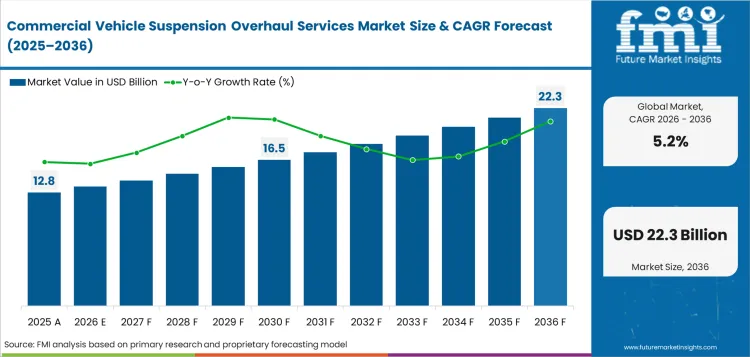
Commercial vehicle suspension overhaul services market was valued at USD 12.8 billion in 2025 and is projected to reach USD 13.4 billion in 2026. Demand is forecast to reach USD 22.3 billion by 2036 at 5.2% CAGR from 2026 to 2036. Leaf spring overhaul is anticipated to represent 31.5% of service type demand and heavy trucks are projected to hold 42.0% of vehicle type in 2026.
Summary of the Commercial Vehicle Suspension Overhaul Services Market
- Demand and Growth Drivers
- Suspension overhaul demand depends on fleet uptime, as worn springs and bushings increase tire wear and service stoppages.
- Long-haul freight fleets are adding structured suspension checks to control axle wear during high-mileage use.
- City bus and construction fleets need overhaul services to keep older vehicles safe under repeated load stress.
- Product and Segment View
- Leaf spring overhaul is projected to lead service demand as mechanical suspension systems are widely used across trucks and trailers.
- Heavy trucks are expected to form the largest vehicle demand base due to higher payload pressure and longer duty cycles.
- Independent workshops are forecast to gain steady service volume as fleets seek faster repairs near freight routes.
- Geography and Competitive Outlook
- India is forecast to record the fastest growth as highway freight movement raises repair frequency across regional fleets.
- China is expected to keep a large service base due to high commercial vehicle output and dense fleet activity.
- Companies with parts availability and trained suspension technicians are better placed to win repeat fleet service work.
- Analyst Opinion
- Nikhil Kaitwade, Principal Consultant at FMI says, “Commercial vehicle suspension overhaul is becoming a planned uptime decision for fleets. Long-haul operators need lower tire wear. City bus operators need ride stability. Construction fleets need durability under repeated load cycles. Service providers gain advantage when they combine correct parts with trained technicians. Cost pressure is high for smaller fleets, so independent workshops will continue to win work on price and access. OEM-backed workshops will protect premium fleet accounts through warranty support and diagnostic discipline. Clients should watch parts availability and technician depth before choosing a service partner. A low-cost overhaul can become expensive when alignment accuracy and load-rating checks are weak.”
- Commercial Vehicle Suspension Overhaul Services Market Value Analysis
- Suspension overhaul services create value by keeping commercial vehicles safe and available during high-mileage duty.
- Leaf spring overhaul stays central to spending as freight fleets prefer repairable mechanical systems with lower replacement cost.
- Heavy truck fleets generate repeat service work as payload stress increases spring wear and alignment needs.
- Independent workshops hold service value through route access and faster repair slots for regional fleet operators.
- Skilled technicians improve pricing power because suspension repair needs correct load rating and alignment accuracy.
Key Takeaways
- The commercial vehicle suspension overhaul services market was valued at USD 12.8 billion in 2025 based on service labor rates and fleet maintenance checks.
- By 2036, market value is forecast to reach USD 22.3 billion as aging freight fleets need more scheduled suspension rebuild work.
- Demand is projected to expand at 5.2% CAGR from 2026 to 2036 across truck and van service applications.
- The market is expected to create an incremental opportunity of USD 8.8 billion between 2026 and 2036.
- Leaf spring overhaul is anticipated to capture 31.5% of service type demand in 2026 as mechanical systems remain common in freight fleets.
- Heavy trucks are projected to represent 42.0% of vehicle type demand in 2026 due to higher axle load and longer operating hours.
- India is forecast to record 7.4% CAGR during the forecast period as highway freight activity expands across regional corridors.
- Independent workshops are estimated to hold 36.5% of service channel demand in 2026 due to lower labor cost and route-level access.
Commercial vehicle suspension overhaul is moving from reactive repair toward inspection-led fleet maintenance. The Federal Motor Carrier Safety Administration states that suspension components must be structurally sound and in safe working order. That makes axle, spring and air-suspension defects a compliance risk. SAF-HOLLAND stated in February 2025 that a higher aftermarket share supported adjusted margin during a weaker 2024 sales year. Overhaul activity therefore becomes a countercycle revenue base for suppliers and workshops. ZF Aftermarket stated in May 2024 that it introduced 36 new part numbers including 10 SACHS Continuous Damping Control shock part numbers. Damping replacement gives workshops a route into higher-value suspension service. Hendrickson also ties service support to air springs, height-control valves and pivot bushings. Accurate part identification is likely to reduce repair time for fleets that operate mixed truck and trailer platforms.
Commercial Vehicle Suspension Overhaul Services Market Definition
The commercial vehicle suspension overhaul services market includes inspection and repair work for suspension systems used in trucks and buses. The scope covers leaf springs, air bags, shock absorbers, bushings, hangers, torque rods, ride-height valves, and alignment work. New suspension system manufacturing is excluded from the market. Passenger vehicle suspension repair is outside the defined scope.
Commercial Vehicle Suspension Overhaul Services Market Inclusions
Market scope includes leaf spring overhaul, air suspension overhaul, shock absorber replacement, bushing replacement, axle alignment, heavy trucks, medium trucks, buses, trailers, vans, independent workshops, OEM workshops, fleet garages, mobile service, and regional service demand across global markets. Participants include commercial vehicle OEMs, fleet maintenance providers, heavy truck workshops, aftermarket distributors, fleet operators and online parts platforms.
Commercial Vehicle Suspension Overhaul Services Market Exclusions
The scope excludes passenger car suspension repair, new axle production, tire-only services, brake-only repair, chassis manufacturing, vehicle body repair, and aftermarket parts sold without installation labor.
Commercial Vehicle Suspension Overhaul Services Market Research Methodology
- Primary Research: FMI analysts reviewed service patterns with commercial vehicle workshop managers and fleet maintenance heads. Interviews focused on overhaul frequency and service pricing. Analysts also checked suspension failure patterns and downtime cost.
- Desk Research: The study used vehicle production data and freight activity indicators. Service network disclosures and commercial vehicle registration trends helped verify supplier participation. Company product information and official aftermarket updates were reviewed for market coverage.
- Market Sizing and Forecasting: The model combined service volume with average overhaul cost. Vehicle class mix and suspension type mix were assessed by country-level fleet use. Forecasts were tested against freight mileage trends and aftermarket network expansion.
- Data Validation: FMI checked assumptions against fleet age and truck mileage. Parts availability and service intensity by country were reviewed separately. Company portfolios and recent aftermarket moves were assessed before final value ranges were set.
Why is the Commercial Vehicle Suspension Overhaul Services Market Growing?
- Long-haul trucks need repeat suspension rebuild work as higher mileage raises leaf spring wear.
- Trailer fleets schedule axle alignment and spring repair to reduce uneven tire wear on highway routes.
- City bus operators use overhaul services to keep older vehicles safe during delayed fleet replacement.
- Construction fleets need heavy-duty suspension repair as rough-site operation increases shock damage.
- Air suspension systems raise service value through diagnostic checks and ride-height correction.
Freight mileage is the clearest service trigger for suspension overhaul demand. A truck that runs more miles places more stress on springs and bushings. The Federal Highway Administration’s 2025 vehicle miles traveled forecast projects single-unit truck VMT to grow by 2.0% per year through 2053. Higher truck use lengthens the service base for workshops that handle suspension rebuilds. Fleet operators can delay cosmetic repairs, but suspension faults can damage tires and reduce load stability. Suspension overhaul demand remains part of uptime planning as highway use increases.
Fleet renewal cycles create a second demand path for overhaul service providers. New vehicle additions do not remove repair demand for older trucks. Freight fleets often keep older units in regional duty to manage replacement cost. Older vehicles need more spring work and bushing replacement. Service providers gain repeat revenue when fleet owners spread capital spending across maintenance cycles.
Market Segmentation Analysis
- Leaf spring overhaul is anticipated to lead service type demand at 31.5% in 2026 as mechanical suspensions offer repairable and cost-controlled service work across trucks and trailers.
- A 42.0% share during the same period places heavy trucks ahead in vehicle type demand since higher axle loads raise spring fatigue and bushing wear.
- Within suspension type, leaf spring systems are estimated at 38.0% in 2026 due to wide parts availability and lower workshop complexity.
- Independent workshops are forecast to capture 36.5% of service channel demand in the assessment period as fleets seek faster service access near freight routes.
- Long-haul freight is expected to form 34.0% of fleet use demand because route mileage creates repeat need for spring overhaul and axle alignment.
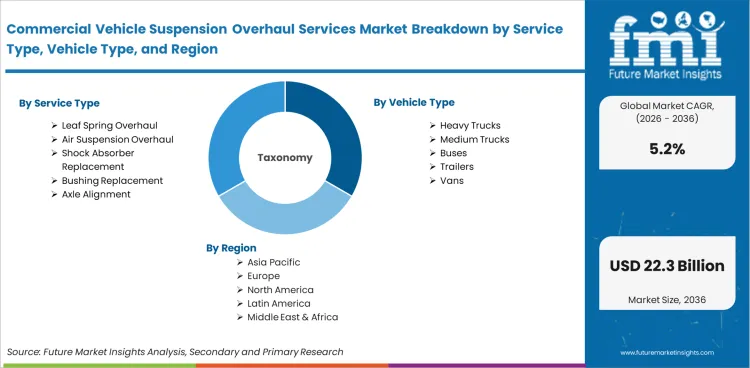
The Commercial Vehicle Suspension Overhaul Services Market is segmented by service type, vehicle type, suspension type, service channel, and fleet use. Service type includes Leaf Spring Overhaul, Air Suspension Overhaul, Shock Absorber Replacement, Bushing Replacement, and Axle Alignment. Vehicle type includes Heavy Trucks, Medium Trucks, Buses, Trailers, and Vans. Suspension type includes Leaf Spring, Air Suspension, Parabolic Spring, Rubber Suspension, and Electronic Suspension. Service channel includes Independent Workshops, OEM Workshops, Fleet Garages, Mobile Service, and Online Booking. Fleet use includes Long-Haul Freight, Urban Delivery, Construction Fleets, Public Transit, and Mining Fleets.
Insights into the Service Type Segment
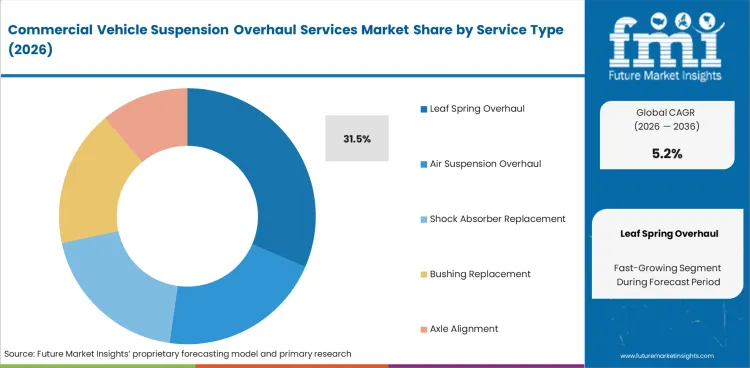
- Leaf Spring Overhaul is forecast at 31.5% of Service Type demand as freight fleets prefer repairable mechanical systems with lower replacement cost.
- Air Suspension Overhaul carries higher service value per job because buses and premium freight vehicles need ride-height correction.
- Shock Absorber Replacement gains routine work from fleets that want to control tire wear before suspension failure becomes costly.
Insights into the Vehicle Type Segment
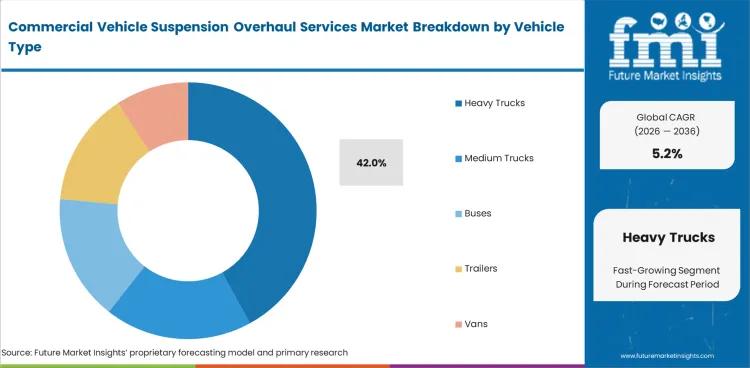
- A 42.0% share places Heavy Trucks ahead in Vehicle Type demand for 2026. Higher payload exposure raises spring fatigue and bushing wear across long-distance freight fleets.
- Medium Trucks create steady service work through urban delivery duty. Buses add repair value through ride comfort checks and fixed maintenance windows.
Insights into the Suspension Type Segment
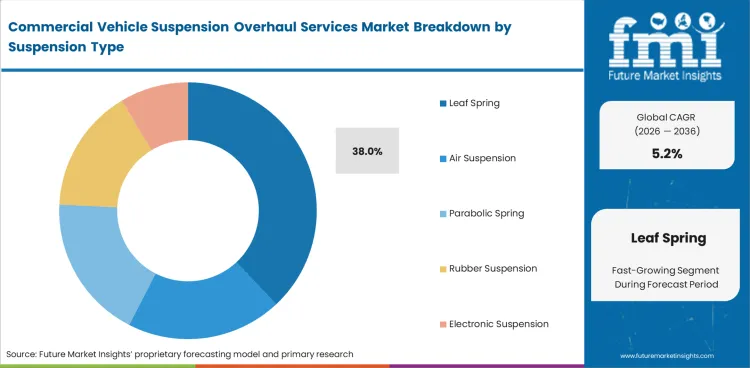
- Leaf Spring reaches 38.0% of Suspension Type demand by 2026. The segment leads because parts are widely available and workshop repair skills are easier to source.
- Air Suspension remains valuable in buses and higher-end freight vehicles since leaks and height-control faults need trained service support.
- Electronic Suspension stays smaller because diagnostic equipment limits workshop access.
Insights into the Service Channel Segment
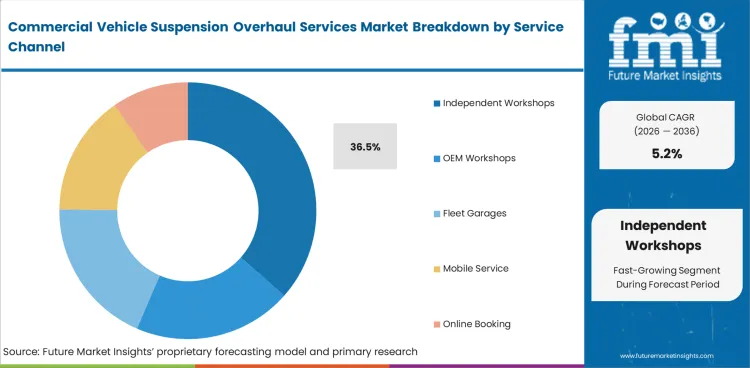
- Independent Workshops form the largest Service Channel base at 36.5% in 2026. Fleets use these workshops when quick access and lower labor cost matter more than dealer documentation.
- OEM Workshops continue serving warranty-linked fleets and newer vehicles. Fleet Garages help larger operators control routine checks without sending vehicles offsite.
Insights into the Fleet Use Segment
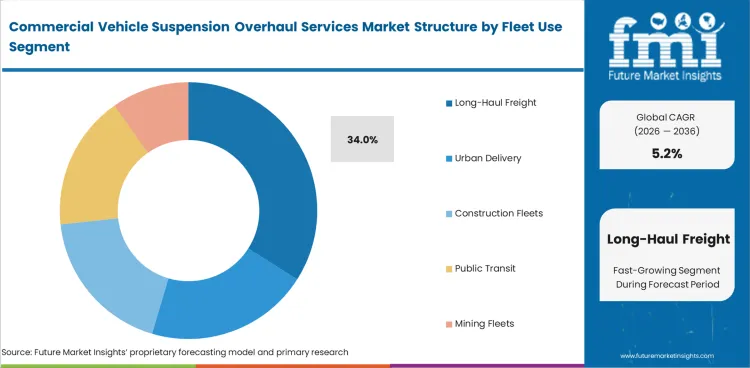
- Long-Haul Freight is expected to capture 34.0% of Fleet Use demand in 2026. Route mileage creates repeat need for spring overhaul and axle alignment.
- Urban Delivery creates steady bushing and shock absorber work because stop-start duty adds chassis stress.
- Public Transit demand follows scheduled inspection cycles and passenger comfort needs.
Commercial Vehicle Suspension Overhaul Services Market Drivers, Restraints, and Opportunities
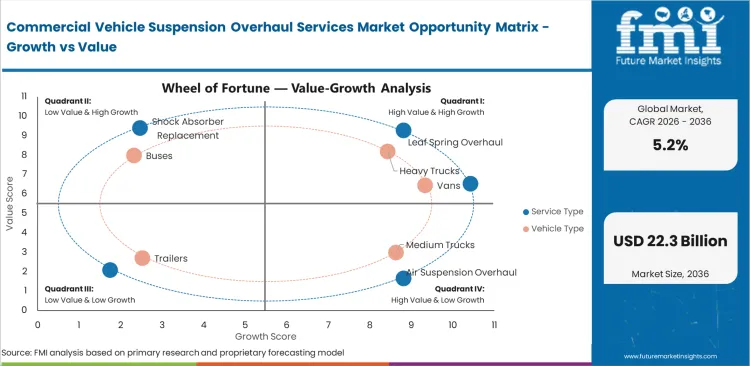
- Axle-load stress raises demand for spring and bushing overhaul across heavy trucks.
- Air suspension growth increases service value through diagnostic and ride-height correction work.
- Technician shortages restrain service capacity as suspension work needs correct torque and alignment practice.
- Mobile service creates opportunity for fleets that need minor suspension checks at depots.
- Parts standardization helps large service chains reduce turnaround time on repeat suspension jobs.
Axle Load Wear
Payload intensity creates repeat suspension overhaul work across freight fleets. Heavy trucks run under repeated axle stress that accelerates spring fatigue. China produced 4,260,835 commercial vehicles in 2025 according to OICA production statistics. OICA production data shows the depth of the commercial vehicle service base in a major fleet market. Workshops with stocked spring parts and alignment capability are better placed to capture repeat overhaul work. Freight fleets cannot treat suspension repair as a minor task because poor axle geometry can raise tire cost and reduce load stability.
Air System Service Cost
Air suspension creates higher service value than basic mechanical repair. Fleets pay more for air bag replacement and height-control adjustment. ZF Aftermarket expanded its TRW chassis line in July 2025 through an official company release. ZF’s July 2025 release supports that chassis coverage and parts access influence workshop service capacity. Service providers can convert air suspension complexity into revenue when technicians can diagnose leaks and correct ride height accurately. Fleet operators will prefer workshops that reduce repeat visits after suspension correction.
Workshop Capacity Gap
Service demand is constrained by technician availability and workshop space. Suspension overhaul often needs heavy lifts and torque-controlled fitting. In January 2025, FleetPride, Inc. acquired ARS Truck & Fleet Service. ARS operated 25 service bays and a 16-truck mobile service fleet in Delaware. The company release shows how service capacity expansion supports heavy-duty aftermarket repair demand. Larger service chains can serve more fleet accounts during peak freight periods. Smaller workshops can compete when they specialize in fast spring and bushing work.
Analysis of Commercial Vehicle Suspension Overhaul Services Market By Key Countries
.webp "Top Country Growth Comparison Commercial Vehicle Suspension Overhaul Services Market Cagr (2026 2036)")
| Country | CAGR |
|---|---|
| United States | 5.5% |
| China | 6.8% |
| India | 7.4% |
| Germany | 4.6% |
| United Kingdom | 4.3% |
| Brazil | 5.9% |
| Japan | 3.9% |
Source: FMI analysis based on primary research and proprietary forecasting model.
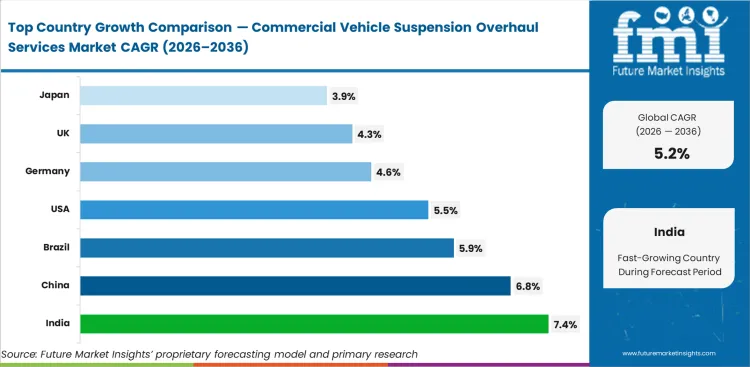
Commercial Vehicle Suspension Overhaul Services Market CAGR Analysis by Country
- United States demand is assessed at 5.5% CAGR during the forecast period as interstate freight mileage sustains scheduled suspension checks.
- China’s market outlook stands at 6.8% CAGR from 2026 to 2036 due to its large commercial vehicle service base and dense freight activity.
- India records the fastest outlook at 7.4% CAGR as highway freight growth raises spring and bushing service frequency through 2036.
- Germany is forecast at 4.6% CAGR across the assessment period because inspection discipline supports documented repair work.
- Van mileage and scheduled lorry upkeep support the United Kingdom’s 4.3% CAGR outlook through 2036.
- Brazil is forecast at 5.9% CAGR by 2036 as rough-road freight duty raises suspension wear.
- Japan’s 3.9% CAGR outlook reflects mature fleet routines and strict inspection practice during the forecast period.
- The global market is projected to expand at 5.2% CAGR from 2026 to 2036.
Demand Outlook for Commercial Vehicle Suspension Overhaul Services Market in the United States
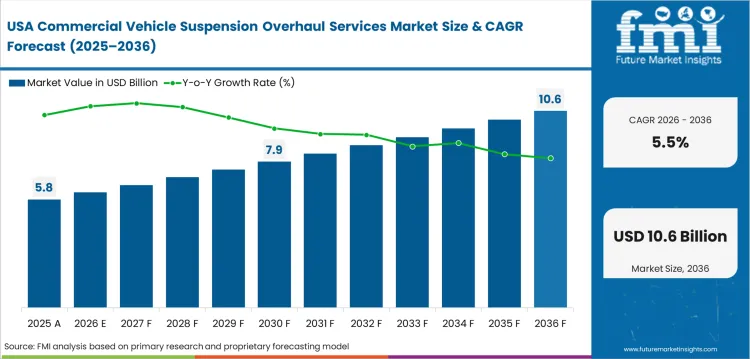
United States demand reflects long interstate routes and a large Class 8 service base. A 5.5% CAGR from 2026 to 2036 reflects steady suspension work based on freight mileage and fleet uptime planning. Texas routes around Dallas and Houston support heavy-truck repair demand. California port drayage around Los Angeles creates stop-start suspension stress. Midwest freight lanes through Illinois keep axle alignment demand active for trucks crossing long corridors.
- I-80 freight movement supports scheduled suspension checks for trucks crossing long east-west lanes.
- Appalachian routes raise shock absorber wear due to grade changes and heavier braking cycles.
- Large private fleets use in-house maintenance bays to control downtime on repeat suspension jobs.
Sales Analysis of Commercial Vehicle Suspension Overhaul Services Market in China
China has one of the deepest commercial vehicle repair bases in the world. China is expected to advance at 6.8% CAGR as freight fleets and bus operators need regular suspension service. Guangdong supports route-based workshop demand through export cargo movement. Jiangsu manufacturing clusters create repeat work for delivery trucks and regional haul fleets. Beijing and Shanghai bus operations add air suspension service demand through ride comfort needs.
- Henan’s central logistics position supports demand for quick repairs on interprovincial freight routes.
- Sichuan-Chongqing freight lanes create service need for trucks operating across hilly corridors.
- Cold northern provinces require bushing and rubber cushion checks after seasonal road exposure.
Demand Analysis of Commercial Vehicle Suspension Overhaul Services Market in India
India records the fastest outlook in this study because highway freight movement is rising across organized routes. The country is forecast at 7.4% CAGR from 2026 to 2036 as fleet operators keep older trucks active and repairable. Delhi-Mumbai freight movement supports spring overhaul demand on high-mileage tractors. Maharashtra and Gujarat add service density through port-linked freight. National highway expansion raises the need for scheduled alignment checks.
- Chennai-Bengaluru freight movement supports repair demand from automotive and electronics logistics.
- Rajasthan mining routes create heavy suspension wear on rigid trucks and tippers.
- State transport undertakings add scheduled bus suspension work through depot-based maintenance programs.
Opportunity Analysis of Commercial Vehicle Suspension Overhaul Services Market in Germany
Germany has a disciplined workshop structure and strict roadworthiness culture. Suspension overhaul demand is projected to grow at 4.6% CAGR by 2036 because fleets keep vehicles compliant through documented maintenance. Bavaria supports service work through manufacturing logistics. North Rhine-Westphalia adds repair demand through dense freight traffic. German bus operators create steady air suspension work tied to ride comfort and inspection cycles.
- Hamburg port freight supports trailer suspension checks linked to container movement.
- Baden-Württemberg logistics activity adds service demand from supplier routes serving manufacturing plants.
- TÜV inspection practice keeps documentation important for suspension repair and roadworthiness checks.
Future Outlook for Commercial Vehicle Suspension Overhaul Services Market in the United Kingdom
The United Kingdom market has a mixed service base across vans and lorries. From 2026 to 2036, the market is forecast at 4.3% CAGR as repair spending stays tied to fleet age and route use. Midlands logistics hubs support suspension repair for parcel fleets. Greater London creates bushing and shock absorber demand through van traffic. Scotland adds wear pressure through longer regional haul routes.
- Felixstowe-linked freight supports trailer and tractor repair demand on port access routes.
- Manchester and Leeds distribution corridors create routine suspension work for regional delivery fleets.
- Operator licensing checks keep maintenance records important for larger goods vehicle fleets.
Sales Outlook for Commercial Vehicle Suspension Overhaul Services Market in Brazil
Brazil has higher suspension wear risk due to long freight distances and uneven road conditions. The country is assessed at 5.9% CAGR from 2026 to 2036 because freight operators use repair services to extend truck life. São Paulo state supports dense workshop activity through industrial movement. Mato Grosso grain routes create heavy spring wear through agricultural haulage. Minas Gerais adds demand from mining and construction fleets.
- Paraná freight corridors support suspension service demand from agricultural export movement.
- BR-163 truck movement raises overhaul needs on long grain transport routes.
- Port access around Santos creates repeat alignment work for tractors and trailers.
In-depth Analysis of Commercial Vehicle Suspension Overhaul Services Market in Japan
Japan has a slower growth profile because fleet maintenance routines are more disciplined. The market is expected to post 3.9% CAGR from 2026 to 2036 as inspection schedules sustain steady overhaul work. Kanto logistics routes around Tokyo support planned suspension checks. Kansai freight movement around Osaka adds alignment and bushing service demand. Hokkaido road conditions increase seasonal suspension stress.
- Nagoya’s automotive supply routes support regular suspension checks for parts delivery trucks.
- Kyushu logistics corridors add service demand from regional freight and port movement.
- Shaken inspection requirements keep repair documentation important for commercial vehicle operators.
Competitive Landscape and Strategic Positioning
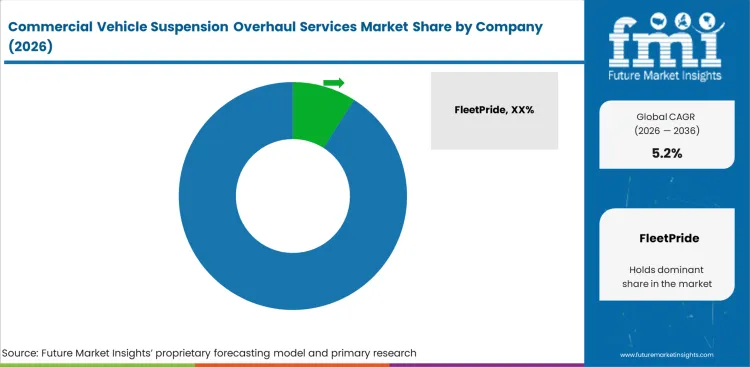
- Market concentration is moderate as large parts networks compete with local heavy-duty workshops.
- Leading suppliers compete through parts availability and technician training.
- Smaller workshops compete through route access and faster turnaround for spring work.
- Entry barriers come from lift equipment, trained labor and parts stocking.
Competition in this market centers on uptime control. Fleets judge service providers by repair accuracy and return-to-duty speed. In January 2025, ZF Aftermarket and HDA Truck Pride announced a partnership to distribute WABCO products to the independent commercial vehicle aftermarket through HDA Truck Pride’s distributor network. ZF stated that the partnership expands access to WABCO products such as air compressors and trailer anti-lock braking systems. The partnership helps workshops handle suspension jobs that uncover wheel-end or braking issues. Parts reach can decide repeat fleet accounts when vehicles need connected repairs in one visit.
Service capacity is a major competitive tool in heavy-duty aftermarket repair. In October 2025, FleetPride and TruckPro announced a strategic merger under the FleetPride name. The combined platform improves parts reach and gives fleet operators more uniform service access across regions. Suspension overhaul work depends on correct parts and trained technicians without long delays. National platforms can gain fleet accounts that value consistent repair standards across multiple locations.
Specialist suspension suppliers keep an advantage in difficult duty cycles. In July 2025, Hendrickson launched STEERTEK NXT steer axle advancements for International RH, LT, and MV series trucks. IC Bus CE series buses were included in the same launch. Hendrickson stated that the axle design provides up to 25 pounds of weight savings and added warranty coverage for selected parts. Product-level suspension knowledge helps aftermarket partners diagnose wear and choose correct replacement parts. Regional workshops can compete through focused skill in one vehicle class or duty cycle.
Key Companies in the Commercial Vehicle Suspension Overhaul Services Market
- Parts-Focused Aftermarket Networks: FleetPride, TruckPro, HDA Truck Pride, and ZF Aftermarket compete through parts coverage and route-level supply reach. FleetPride gains service depth through acquisitions and the TruckPro merger.
- Suspension System Suppliers: Hendrickson, SAF-HOLLAND, and Cummins-Meritor compete through suspension product depth and technical knowledge. Hendrickson carries strength in vocational suspensions and axle systems.
- Service Network Operators: Rush Truck Centers, Love’s Truck Care, and regional fleet service shops compete through physical service access and technician availability.
Competitive Benchmarking: Commercial Vehicle Suspension Overhaul Services Market
| Company | Suspension Parts Coverage | Service Bay Reach | Fleet Uptime Support | Geographic Footprint |
|---|---|---|---|---|
| FleetPride | High | Strong | Strong | North America |
| ZF Aftermarket | High | Medium | Strong | Global |
| Hendrickson | High | Medium | Strong | Global |
| SAF-HOLLAND | High | Medium | Strong | Global |
| Cummins-Meritor | High | Medium | Strong | Global |
| Rush Truck Centers | Medium | Strong | Strong | United States |
| Love’s Truck Care | Medium | Strong | Moderate | United States |
| HDA Truck Pride | High | Medium | Moderate | North America |
| TruckPro | High | Strong | Strong | North America |
| Ridewell Suspensions | Medium | Medium | Moderate | North America |
Source: Future Market Insights competitive analysis, 2026. Ratings reflect relative positioning based on suspension parts coverage, service bay reach, and fleet uptime support.
Key Developments in Commercial Vehicle Suspension Overhaul Services Market
- In March 2025, FleetPride, Inc. acquired OTR Fleet Service LLC in Houston. OTR operated service centers in Dallas, Houston and San Antonio with more than 30 mobile units. The deal expanded mobile maintenance capacity for heavy-duty fleets in Texas.
- In July 2025, Hendrickson launched STEERTEK NXT advancements for International RH, LT and MV series trucks.
Key Players in the Commercial Vehicle Suspension Overhaul Services Market
Parts-Focused Aftermarket Networks
- FleetPride
- TruckPro
- HDA Truck Pride
- ZF Aftermarket
Suspension System Suppliers
- Hendrickson
- SAF-HOLLAND
- Cummins-Meritor
- Ridewell Suspensions
Service Network Operators
- Rush Truck Centers
- Love’s Truck Care
- Regional Fleet Service Shops
Report Scope and Coverage
| Parameter | Details |
|---|---|
| Quantitative Units | USD 13.4 billion in 2026 to USD 22.3 billion by 2036, at 5.2% CAGR |
| Market Definition | Suspension inspection, repair, rebuilding, replacement, and alignment services for commercial trucks, buses, trailers, and vans. |
| Regions Covered | North America, Latin America, Europe, East Asia, South Asia and Pacific, Middle East and Africa |
| Countries Covered | United States, China, India, Germany, United Kingdom, Brazil, Japan, 30+ countries |
| Key Companies Profiled | FleetPride, ZF Aftermarket, Hendrickson, SAF-HOLLAND, Cummins-Meritor, Rush Truck Centers, Love’s Truck Care, HDA Truck Pride, TruckPro, Ridewell Suspensions |
| Forecast Period | 2026 to 2036 |
| Approach | Hybrid bottom-up and top-down methodology based on service pricing, fleet age, suspension type mix, and country-level utilization. |
Commercial Vehicle Suspension Overhaul Services Market by Segments
Commercial Vehicle Suspension Overhaul Services Market Segmented by Service Type:
- Leaf Spring Overhaul
- Air Suspension Overhaul
- Shock Absorber Replacement
- Bushing Replacement
- Axle Alignment
Commercial Vehicle Suspension Overhaul Services Market Segmented by Vehicle Type:
- Heavy Trucks
- Medium Trucks
- Buses
- Trailers
- Vans
Commercial Vehicle Suspension Overhaul Services Market Segmented by Suspension Type:
- Leaf Spring
- Air Suspension
- Parabolic Spring
- Rubber Suspension
- Electronic Suspension
Commercial Vehicle Suspension Overhaul Services Market Segmented by Service Channel:
- Independent Workshops
- OEM Workshops
- Fleet Garages
- Mobile Service
- Online Booking
Commercial Vehicle Suspension Overhaul Services Market Segmented by Fleet Use:
- Long-Haul Freight
- Urban Delivery
- Construction Fleets
- Public Transit
- Mining Fleets
Commercial Vehicle Suspension Overhaul Services Market by Region:
- North America
- United States
- Canada
- Mexico
- Latin America
- Brazil
- Chile
- Rest of Latin America
- Western Europe
- Germany
- UK
- Italy
- Spain
- France
- Nordic
- BENELUX
- Rest of Western Europe
- Eastern Europe
- Russia
- Poland
- Hungary
- Balkan & Baltic
- Rest of Eastern Europe
- East Asia
- China
- Japan
- South Korea
- South Asia and Pacific
- India
- ASEAN
- Australia & New Zealand
- Rest of South Asia and Pacific
- Middle East & Africa
- Kingdom of Saudi Arabia
- Other GCC Countries
- Turkiye
- South Africa
- Other African Union
- Rest of Middle East & Africa
Research Sources and Bibliography
- Federal Highway Administration. (2025, October 10). 2025 FHWA forecasts of vehicle miles traveled. USA Department of Transportation.
- International Organization of Motor Vehicle Manufacturers. (2026). Production statistics: 2025. OICA.
- ZF Friedrichshafen AG. (2025, July 22). ZF Aftermarket expands TRW chassis line, extending NA coverage to an additional 54 million vehicles in operation in 2025. ZF
- FleetPride, Inc. (2025, January 29). FleetPride acquires ARS Truck & Fleet Service of New Castle, Delaware.
- Hendrickson. (2025, July 22). STEERTEK NXT advancements at International. Hendrickson.
- ZF Friedrichshafen AG. (2025, January 21). ZF Aftermarket and HDA Truck Pride announce partnership to distribute WABCO products to the commercial vehicle independent aftermarket. ZF Press.
- FleetPride, Inc. (2025, October 28). FleetPride and TruckPro announce strategic merger. FleetPride
- FleetPride, Inc. (2025, March 18). FleetPride acquires OTR Fleet Service of Houston.
This Report Answers
- What is the current and future value of the commercial vehicle suspension overhaul services market from 2026 to 2036?
- What CAGR is expected for the commercial vehicle suspension overhaul services market during the forecast period?
- Which service type is projected to lead commercial vehicle suspension overhaul demand in 2026?
- Which vehicle type is expected to generate the highest suspension overhaul service revenue in 2026?
- What factors are driving suspension overhaul work across truck, bus, trailer, and van fleets?
- How do fleet age and freight mileage affect suspension overhaul service schedules?
- Which countries are expected to grow fastest in the commercial vehicle suspension overhaul services market?
- Which companies are positioned across suspension parts, overhaul service, and fleet support?
- How does FMI define the commercial vehicle suspension overhaul services market scope?
- What forecasting approach was used to estimate overhaul demand from 2026 to 2036?
Frequently Asked Questions
What is the current and future value of the commercial vehicle suspension overhaul services market from 2026 to 2036?
The commercial vehicle suspension overhaul services market is projected at USD 13.4 billion in 2026. Value is forecast to reach USD 22.3 billion by 2036.
What CAGR is expected for the commercial vehicle suspension overhaul services market during the forecast period?
The market is expected to grow at 5.2% CAGR during the forecast period as fleet operators prioritize suspension repair.
Which service type segment is projected to lead commercial vehicle suspension overhaul demand in 2026?
Leaf spring overhaul is anticipated to lead service type demand with 31.5% share due to broad use across trucks and trailers.
Which vehicle type is expected to hold the highest share in commercial vehicle suspension overhaul services?
Heavy trucks are projected to hold the highest vehicle type share at 42.0% in 2026 due to higher payload stress.
What factors are driving suspension overhaul use in truck and bus fleets?
Fleet age and freight mileage are driving scheduled suspension overhaul. Axle-load stress raises repair needs across commercial fleets.
How do repair accuracy and parts availability affect supplier selection?
Fleet operators prefer service providers that offer correct parts and trained technicians. Accurate alignment work helps reduce repeat repairs.
Which countries are expected to grow fastest in the commercial vehicle suspension overhaul services market?
India is forecast to grow fastest at 7.4% CAGR with China following at 6.8% CAGR. Brazil is expected to record 5.9% CAGR.
Which companies are positioned across suspension parts and fleet service support?
Fleet Pride and TruckPro are positioned in service support. ZF Aftermarket and Hendrickson hold positions across suspension parts.
How does FMI define the commercial vehicle suspension overhaul services market scope?
FMI defines the market as inspection and repair services for commercial vehicle suspension systems and includes rebuilding and alignment work.
What forecasting approach was used to estimate suspension overhaul demand from 2026 to 2036?
FMI used a hybrid bottom-up and top-down approach. Inputs included service pricing and fleet age.
Preview the report firsthand - request a free sample
Get SampleGet the brochure for pricing and purchase details.
Get PDFTable of Content
- Key Takeaways
- Market Size and CAGR
- Top Growth Driver
- Fastest Growing Segment
- Leading Region
- Key Companies
- Emerging Opportunities
- Executive Summary
- Global Market Outlook
- Demand-side Trends
- Supply-side Trends
- Technology Roadmap Analysis
- Analysis and Recommendations
- Analyst Perspective (What is happening? Why now? What should investors know?)
- Key Questions Answered
- How large is the market?
- What is the CAGR?
- What are key trends?
- Which region dominates?
- Who are the leaders?
- Market Overview
- Market Coverage / Taxonomy
- Market Definition / Scope / Limitations
- Research Methodology
- Chapter Orientation
- Analytical Lens and Working Hypotheses
- Market Structure, Signals, and Trend Drivers
- Benchmarking and Cross-market Comparability
- Market Sizing, Forecasting, and Opportunity Mapping
- Research Design and Evidence Framework
- Desk Research Programme (Secondary Evidence)
- Expert Input and Fieldwork (Primary Evidence)
- Tooling, Models, and Reference Databases
- Data Engineering and Model Build
- Quality Assurance and Audit Trail
- Market Background
- Market Dynamics (Drivers, Restraints, Opportunity, Trends)
- Scenario Forecast (Optimistic, Likely, Conservative)
- Impact Analysis
- AI Impact
- Sustainability Impact
- Regulatory Impact
- Technology Impact
- Consumer / Buyer Analysis
- Purchase Drivers
- Adoption Barriers
- Buyer Journey
- Opportunity Map Analysis
- Product Life Cycle Analysis
- Supply Chain Analysis
- Investment Feasibility Matrix
- Value Chain Analysis
- PESTLE and Porter's Analysis
- Regulatory Landscape
- Regional Parent Market Outlook
- Production and Consumption Statistics
- Import and Export Statistics
- Global Market Analysis and Forecast, 2021 to 2036
- Historical Market Size Value (USD Billion) & Volume (Unit) Analysis, 2021 to 2025
- Current and Future Market Size Value (USD Billion) & Volume (Unit) Projections, 2026 to 2036
- Y-o-Y Growth Trend Analysis
- Absolute $ Opportunity Analysis
- Global Market Pricing Analysis, 2021 to 2036
- Global Market Analysis and Forecast, By Service Type, 2021 to 2036
- Introduction / Key Findings
- Historical Market Size Value (USD Billion) & Volume (Unit) Analysis By Service Type, 2021 to 2025
- Current and Future Market Size Value (USD Billion) & Volume (Unit) Analysis and Forecast By Service Type, 2026 to 2036
- Leaf Spring Overhaul
- Air Suspension Overhaul
- Shock Absorber Replacement
- Bushing Replacement
- Axle Alignment
- Leaf Spring Overhaul
- Y-o-Y Growth Trend Analysis By Service Type, 2021 to 2025
- Absolute $ Opportunity Analysis By Service Type, 2026 to 2036
- Global Market Analysis and Forecast, By Vehicle Type, 2021 to 2036
- Introduction / Key Findings
- Historical Market Size Value (USD Billion) & Volume (Unit) Analysis By Vehicle Type, 2021 to 2025
- Current and Future Market Size Value (USD Billion) & Volume (Unit) Analysis and Forecast By Vehicle Type, 2026 to 2036
- Heavy Trucks
- Medium Trucks
- Buses
- Trailers
- Vans
- Heavy Trucks
- Y-o-Y Growth Trend Analysis By Vehicle Type, 2021 to 2025
- Absolute $ Opportunity Analysis By Vehicle Type, 2026 to 2036
- Global Market Analysis and Forecast, By Suspension Type, 2021 to 2036
- Introduction / Key Findings
- Historical Market Size Value (USD Billion) & Volume (Unit) Analysis By Suspension Type, 2021 to 2025
- Current and Future Market Size Value (USD Billion) & Volume (Unit) Analysis and Forecast By Suspension Type, 2026 to 2036
- Leaf Spring
- Air Suspension
- Parabolic Spring
- Rubber Suspension
- Electronic Suspension
- Leaf Spring
- Y-o-Y Growth Trend Analysis By Suspension Type, 2021 to 2025
- Absolute $ Opportunity Analysis By Suspension Type, 2026 to 2036
- Global Market Analysis and Forecast, By Service Channel, 2021 to 2036
- Introduction / Key Findings
- Historical Market Size Value (USD Billion) & Volume (Unit) Analysis By Service Channel, 2021 to 2025
- Current and Future Market Size Value (USD Billion) & Volume (Unit) Analysis and Forecast By Service Channel, 2026 to 2036
- Independent Workshops
- OEM Workshops
- Fleet Garages
- Mobile Service
- Online Booking
- Independent Workshops
- Y-o-Y Growth Trend Analysis By Service Channel, 2021 to 2025
- Absolute $ Opportunity Analysis By Service Channel, 2026 to 2036
- Global Market Analysis and Forecast, By Fleet Use, 2021 to 2036
- Introduction / Key Findings
- Historical Market Size Value (USD Billion) & Volume (Unit) Analysis By Fleet Use, 2021 to 2025
- Current and Future Market Size Value (USD Billion) & Volume (Unit) Analysis and Forecast By Fleet Use, 2026 to 2036
- Long-Haul Freight
- Urban Delivery
- Construction Fleets
- Public Transit
- Mining Fleets
- Long-Haul Freight
- Y-o-Y Growth Trend Analysis By Fleet Use, 2021 to 2025
- Absolute $ Opportunity Analysis By Fleet Use, 2026 to 2036
- Global Market Analysis and Forecast, By Region, 2021 to 2036
- Introduction
- Historical Market Size Value (USD Billion) & Volume (Unit) Analysis By Region, 2021 to 2025
- Current Market Size Value (USD Billion) & Volume (Unit) Analysis and Forecast By Region, 2026 to 2036
- North America
- Latin America
- Western Europe
- Eastern Europe
- East Asia
- South Asia and Pacific
- Middle East & Africa
- Market Attractiveness Analysis By Region
- North America Market Analysis and Forecast, By Country, 2021 to 2036
- Historical Market Size Value (USD Billion) & Volume (Unit) Trend Analysis By Market Taxonomy, 2021 to 2025
- Market Size Value (USD Billion) & Volume (Unit) Forecast By Market Taxonomy, 2026 to 2036
- By Country
- USA
- Canada
- Mexico
- By Service Type
- By Vehicle Type
- By Suspension Type
- By Service Channel
- By Fleet Use
- By Country
- Market Attractiveness Analysis
- By Country
- By Service Type
- By Vehicle Type
- By Suspension Type
- By Service Channel
- By Fleet Use
- Key Takeaways
- Latin America Market Analysis and Forecast, By Country
- Historical Market Size Value (USD Billion) & Volume (Unit) Trend Analysis By Market Taxonomy, 2021 to 2025
- Market Size Value (USD Billion) & Volume (Unit) Forecast By Market Taxonomy, 2026 to 2036
- By Country
- Brazil
- Chile
- Rest of Latin America
- By Service Type
- By Vehicle Type
- By Suspension Type
- By Service Channel
- By Fleet Use
- By Country
- Market Attractiveness Analysis
- By Country
- By Service Type
- By Vehicle Type
- By Suspension Type
- By Service Channel
- By Fleet Use
- Key Takeaways
- Western Europe Market Analysis and Forecast, By Country
- Historical Market Size Value (USD Billion) & Volume (Unit) Trend Analysis By Market Taxonomy, 2021 to 2025
- Market Size Value (USD Billion) & Volume (Unit) Forecast By Market Taxonomy, 2026 to 2036
- By Country
- Germany
- UK
- Italy
- Spain
- France
- Nordic
- BENELUX
- Rest of Western Europe
- By Service Type
- By Vehicle Type
- By Suspension Type
- By Service Channel
- By Fleet Use
- By Country
- Market Attractiveness Analysis
- By Country
- By Service Type
- By Vehicle Type
- By Suspension Type
- By Service Channel
- By Fleet Use
- Key Takeaways
- Eastern Europe Market Analysis and Forecast, By Country
- Historical Market Size Value (USD Billion) & Volume (Unit) Trend Analysis By Market Taxonomy, 2021 to 2025
- Market Size Value (USD Billion) & Volume (Unit) Forecast By Market Taxonomy, 2026 to 2036
- By Country
- Russia
- Poland
- Hungary
- Balkan & Baltic
- Rest of Eastern Europe
- By Service Type
- By Vehicle Type
- By Suspension Type
- By Service Channel
- By Fleet Use
- By Country
- Market Attractiveness Analysis
- By Country
- By Service Type
- By Vehicle Type
- By Suspension Type
- By Service Channel
- By Fleet Use
- Key Takeaways
- East Asia Market Analysis and Forecast, By Country
- Historical Market Size Value (USD Billion) & Volume (Unit) Trend Analysis By Market Taxonomy, 2021 to 2025
- Market Size Value (USD Billion) & Volume (Unit) Forecast By Market Taxonomy, 2026 to 2036
- By Country
- China
- Japan
- South Korea
- By Service Type
- By Vehicle Type
- By Suspension Type
- By Service Channel
- By Fleet Use
- By Country
- Market Attractiveness Analysis
- By Country
- By Service Type
- By Vehicle Type
- By Suspension Type
- By Service Channel
- By Fleet Use
- Key Takeaways
- South Asia and Pacific Market Analysis and Forecast, By Country
- Historical Market Size Value (USD Billion) & Volume (Unit) Trend Analysis By Market Taxonomy, 2021 to 2025
- Market Size Value (USD Billion) & Volume (Unit) Forecast By Market Taxonomy, 2026 to 2036
- By Country
- India
- ASEAN
- Australia & New Zealand
- Rest of South Asia and Pacific
- By Service Type
- By Vehicle Type
- By Suspension Type
- By Service Channel
- By Fleet Use
- By Country
- Market Attractiveness Analysis
- By Country
- By Service Type
- By Vehicle Type
- By Suspension Type
- By Service Channel
- By Fleet Use
- Key Takeaways
- Middle East & Africa Market Analysis and Forecast, By Country
- Historical Market Size Value (USD Billion) & Volume (Unit) Trend Analysis By Market Taxonomy, 2021 to 2025
- Market Size Value (USD Billion) & Volume (Unit) Forecast By Market Taxonomy, 2026 to 2036
- By Country
- Kingdom of Saudi Arabia
- Other GCC Countries
- Türkiye
- South Africa
- Other African Union
- Rest of Middle East & Africa
- By Service Type
- By Vehicle Type
- By Suspension Type
- By Service Channel
- By Fleet Use
- By Country
- Market Attractiveness Analysis
- By Country
- By Service Type
- By Vehicle Type
- By Suspension Type
- By Service Channel
- By Fleet Use
- Key Takeaways
- Key Countries Market Analysis
- USA
- Pricing Analysis
- Market Share Analysis, 2025
- By Service Type
- By Vehicle Type
- By Suspension Type
- By Service Channel
- By Fleet Use
- Canada
- Pricing Analysis
- Market Share Analysis, 2025
- By Service Type
- By Vehicle Type
- By Suspension Type
- By Service Channel
- By Fleet Use
- Mexico
- Pricing Analysis
- Market Share Analysis, 2025
- By Service Type
- By Vehicle Type
- By Suspension Type
- By Service Channel
- By Fleet Use
- Brazil
- Pricing Analysis
- Market Share Analysis, 2025
- By Service Type
- By Vehicle Type
- By Suspension Type
- By Service Channel
- By Fleet Use
- Chile
- Pricing Analysis
- Market Share Analysis, 2025
- By Service Type
- By Vehicle Type
- By Suspension Type
- By Service Channel
- By Fleet Use
- Germany
- Pricing Analysis
- Market Share Analysis, 2025
- By Service Type
- By Vehicle Type
- By Suspension Type
- By Service Channel
- By Fleet Use
- UK
- Pricing Analysis
- Market Share Analysis, 2025
- By Service Type
- By Vehicle Type
- By Suspension Type
- By Service Channel
- By Fleet Use
- Italy
- Pricing Analysis
- Market Share Analysis, 2025
- By Service Type
- By Vehicle Type
- By Suspension Type
- By Service Channel
- By Fleet Use
- Spain
- Pricing Analysis
- Market Share Analysis, 2025
- By Service Type
- By Vehicle Type
- By Suspension Type
- By Service Channel
- By Fleet Use
- France
- Pricing Analysis
- Market Share Analysis, 2025
- By Service Type
- By Vehicle Type
- By Suspension Type
- By Service Channel
- By Fleet Use
- India
- Pricing Analysis
- Market Share Analysis, 2025
- By Service Type
- By Vehicle Type
- By Suspension Type
- By Service Channel
- By Fleet Use
- ASEAN
- Pricing Analysis
- Market Share Analysis, 2025
- By Service Type
- By Vehicle Type
- By Suspension Type
- By Service Channel
- By Fleet Use
- Australia & New Zealand
- Pricing Analysis
- Market Share Analysis, 2025
- By Service Type
- By Vehicle Type
- By Suspension Type
- By Service Channel
- By Fleet Use
- China
- Pricing Analysis
- Market Share Analysis, 2025
- By Service Type
- By Vehicle Type
- By Suspension Type
- By Service Channel
- By Fleet Use
- Japan
- Pricing Analysis
- Market Share Analysis, 2025
- By Service Type
- By Vehicle Type
- By Suspension Type
- By Service Channel
- By Fleet Use
- South Korea
- Pricing Analysis
- Market Share Analysis, 2025
- By Service Type
- By Vehicle Type
- By Suspension Type
- By Service Channel
- By Fleet Use
- Russia
- Pricing Analysis
- Market Share Analysis, 2025
- By Service Type
- By Vehicle Type
- By Suspension Type
- By Service Channel
- By Fleet Use
- Poland
- Pricing Analysis
- Market Share Analysis, 2025
- By Service Type
- By Vehicle Type
- By Suspension Type
- By Service Channel
- By Fleet Use
- Hungary
- Pricing Analysis
- Market Share Analysis, 2025
- By Service Type
- By Vehicle Type
- By Suspension Type
- By Service Channel
- By Fleet Use
- Kingdom of Saudi Arabia
- Pricing Analysis
- Market Share Analysis, 2025
- By Service Type
- By Vehicle Type
- By Suspension Type
- By Service Channel
- By Fleet Use
- Türkiye
- Pricing Analysis
- Market Share Analysis, 2025
- By Service Type
- By Vehicle Type
- By Suspension Type
- By Service Channel
- By Fleet Use
- South Africa
- Pricing Analysis
- Market Share Analysis, 2025
- By Service Type
- By Vehicle Type
- By Suspension Type
- By Service Channel
- By Fleet Use
- USA
- Market Structure Analysis
- Competition Dashboard
- Competition Benchmarking
- Market Share Analysis of Top Players
- By Regional
- By Service Type
- By Vehicle Type
- By Suspension Type
- By Service Channel
- By Fleet Use
- Emerging Startups
- Innovation Benchmarking
- Competition Analysis
- Competition Deep Dive
- FleetPride
- Overview
- Product Portfolio
- Profitability by Market Segments (Product/Region/Sales Channel)
- Sales Footprint
- Strategy Overview
- Marketing Strategy
- Product Strategy
- Channel Strategy
- TruckPro
- HDA Truck Pride
- ZF Aftermarket
- Hendrickson
- SAF-HOLLAND
- Cummins-Meritor
- Ridewell Suspensions
- Rush Truck Centers
- Love’s Truck Care
- Regional Fleet Service Shops
- FleetPride
- Case Studies
- Success Stories
- Recent Developments
- Competition Deep Dive
- Assumptions & Acronyms Used


