

- Market Size (2026)
- USD 18.20 Bn
- Forecast (2036)
- USD 52.62 Bn
- CAGR (2026 to 2036)
- 11.2%
Commercial Vehicle Traction Battery Systems Market Size, Market Forecast and Outlook By FMI
Summary of the Commercial Vehicle Traction Battery Systems Market
- Demand and Growth Drivers
- Electric truck and bus deployment is expected to support battery system demand as fleet operators replace diesel assets on fixed or repeatable duty cycles.
- Battery procurement should rise as larger capacity bands move into regional haul and depot-based delivery programs.
- Charging upgrades and zero-emission vehicle targets should support battery orders across China, Europe, India, and North America. Demand patterns tracked in electric buses and electric light commercial vehicles point to the same procurement shift.
- Product and Segment View
- LFP battery systems are likely to remain the leading chemistry because they offer thermal stability and lower material exposure for fleet use. That chemistry direction matches broader demand in traction batteries.
- Light commercial vehicles are expected to stay ahead in unit demand because electric van deployment is widening in parcel delivery and urban service fleets.
- Cell-to-pack architecture is likely to hold a strong position because it improves energy density and reduces module complexity in volume programs.
- Geography and Competitive Outlook
- China is likely to remain the largest market because electric bus and truck deployment is already broad and local cell supply remains deep.
- India is expected to post fast expansion as bus electrification, delivery fleet upgrades, and domestic cell investment move forward together.
- Companies that can manage cycle life and pack safety under real fleet duty cycles are likely to improve their position during the forecast period.
- Analyst Opinion
- Principal Analyst at FMI, Nikhil Kaitwade, stated “As fleet electrification scales, competitive advantage will increasingly favor battery system suppliers that translate cycle life and thermal control into sustained fleet uptime and stronger operating economics across duty cycles through 2036.”
- Commercial Vehicle Traction Battery Systems Market Value Analysis
- The market is moving from early bus-led electrification into a broader commercial vehicle battery procurement cycle.
- Demand is being supported by larger battery capacity needs in trucks that serve regional haul and heavier payload conditions.
- Battery system suppliers are benefiting from integrated pack designs that improve space use and reduce assembly complexity.
- Market expansion remains linked to duty-cycle economics, charging access, and the ability to deliver longer service life under fleet utilization conditions.
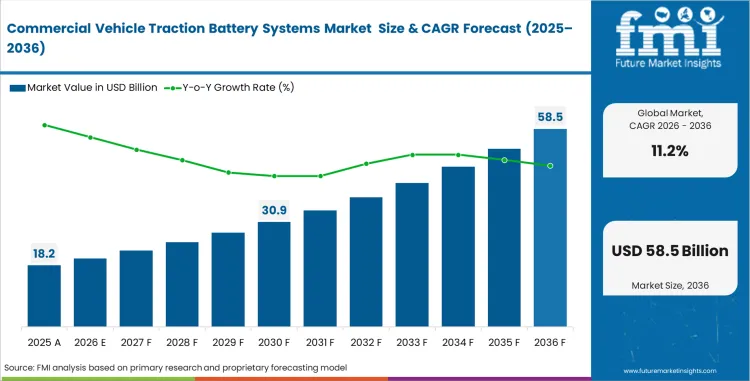
Key Takeaways
- The commercial vehicle traction battery systems market was valued at USD 16.37 billion in 2025.
- The market is projected to reach USD 52.62 billion by 2036.
- Industry is forecast to expand at a CAGR of 11.2% from 2026 to 2036.
- The market is projected to create an incremental opportunity of USD 34.42 billion between 2026 and 2036.
- LFP chemistry is expected to account for 48.0% of battery system demand in 2026 because fleets are prioritizing safety, cost discipline, and cycle life.
- China at 13.2% CAGR and India at 14.1% CAGR are expected to be the fastest growing national markets through 2036.
Commercial Vehicle Traction Battery Systems Market Definition
The commercial vehicle traction battery systems market includes complete propulsion battery systems used in electric vans, trucks, buses, and specialty commercial vehicles. These systems include cells, modules where applicable, battery management systems, thermal systems, pack housings, safety controls, and pack integration designed for traction duty in commercial transport.
Commercial Vehicle Traction Battery Systems Market Inclusions
Market scope covers commercially traded traction battery systems used in battery electric commercial vehicles across vehicle class, chemistry, pack architecture, capacity band, charging profile, sales channel, and region. Revenue reflects battery system value supplied for traction use in new vehicle production, fleet replacement programs, and selected retrofit programs during the 2026 to 2036 forecast period.
Commercial Vehicle Traction Battery Systems Market Exclusions
The scope does not include passenger car battery packs, stationary storage packs, raw battery materials sold without pack conversion, charging hardware, hydrogen fuel cell systems, or power electronics sold as stand-alone components.
Commercial Vehicle Traction Battery Systems Market Research Methodology
- Primary research: FMI analysts reviewed demand patterns across fleet operators, commercial vehicle OEMs, battery system suppliers, and charging ecosystem participants.
- Desk research: The study used official electric vehicle deployment data, transport registration data, and public industrial investment records.
- Market sizing and forecasting: Forecasting combined bottom-up battery system demand by vehicle class with chemistry mix, capacity band, and regional adoption curves.
- Data validation: Estimates were checked against electric truck and bus sales data, policy targets, and announced battery supply programs.
Why is the Commercial Vehicle Traction Battery Systems Market Growing?
- Commercial fleet electrification is creating direct demand for traction battery systems with higher usable energy and tighter thermal control.
- Heavy trucks are now adding a second layer of demand as larger packs and faster charging move into operating fleets.
Battery system demand is rising because policy support now focuses more directly on zero-emission freight and public transport. China remains the largest installed base for electric buses and trucks, while Europe and India continue to add programs that improve future battery procurement visibility.
Pack design now matters more because fleet operators compare payload impact, charging time, and total operating life. Cell-to-pack layouts and LFP chemistry are gaining ground in many applications, while higher-nickel systems still serve routes that require longer range.
Market Segmentation Analysis
- LFP chemistry is expected to account for 48.0% of market demand in 2026 because fleet operators prioritize safety and longer cycle life across repeat-route operations.
- Light commercial vehicles are projected to account for 41.0% of vehicle-class demand in 2026 because electric van deployment continues to widen in parcel delivery and urban maintenance fleets.
- Cell-to-pack architecture is likely to hold a leading position in new programs because it improves packaging efficiency and helps battery suppliers reduce module complexity in higher-volume production.
- The 101 to 250 kWh capacity band is expected to remain a leading range because it fits mainstream urban delivery and medium-duty operating requirements without imposing the cost burden of heavier long-haul battery systems.
- Depot charge systems are likely to lead the charging profile segment because commercial fleets still depend on overnight charging windows and predictable duty cycles for battery-electric vehicle use.
- OEM supply is expected to remain the leading sales channel because most traction battery systems continue to move through factory-integrated vehicle production rather than independent replacement or retrofit routes.
The market is segmented by vehicle class, chemistry, pack architecture, capacity band, charging profile, sales channel, and region. Vehicle class determines battery size and thermal requirement, while chemistry and pack design influence operating life and payload efficiency across commercial fleet applications.
Insights into the Light Commercial Vehicle Segment
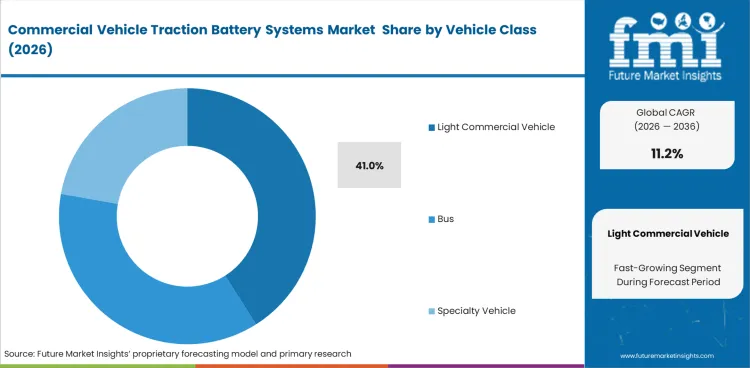
Commercial Vehicle Traction Battery Systems Market Analysis By Vehicle Class
- In 2026, light commercial vehicles are expected to account for 41.0% of market demand. The segment benefits from high route predictability and a strong replacement cycle in urban delivery operations.
- Electric vans and service vehicles usually operate in fixed coverage areas. That operating pattern supports battery sizing decisions that favor cost control and daily charging convenience.
Insights into the LFP Chemistry Segment
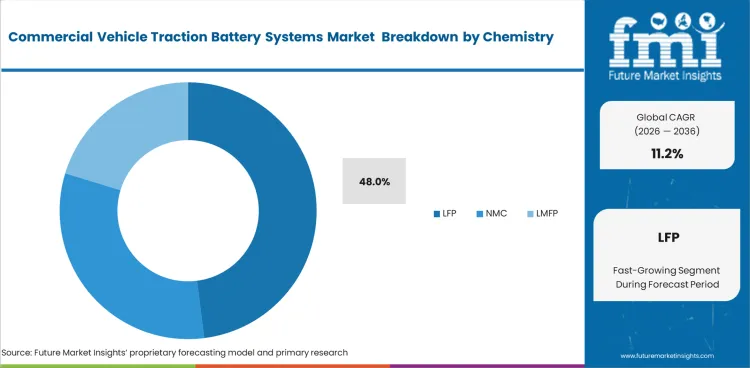
Commercial Vehicle Traction Battery Systems Market Analysis By Chemistry
- In 2026, LFP chemistry is expected to account for 48.0% of the market. Fleet operators continue to favor LFP systems because they support lower cost and stronger durability in commercial duty cycles.
- NMC chemistry still holds an important position in applications that require higher energy density or tighter packaging in premium vehicle platforms.
Insights into the Cell-to-pack Segment
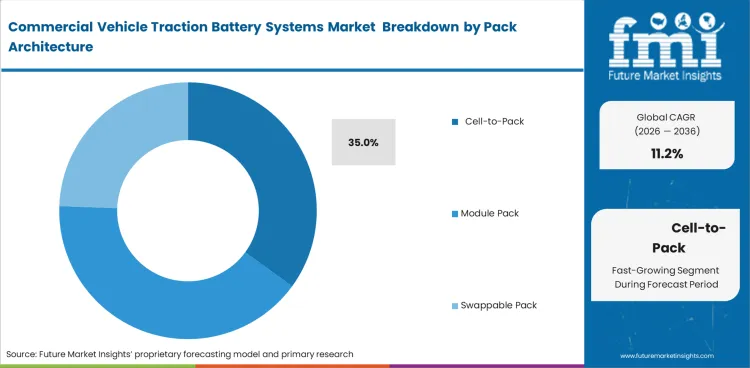
Commercial Vehicle Traction Battery Systems Market Analysis By Pack Architecture
- Cell-to-pack architecture is expected to hold the leading share in 2026 because it reduces module count and improves space utilization in battery system design.
- Module pack systems remain relevant where serviceability and multi-model compatibility still matter to OEM production programs.
Insights into the 101 to 250 kWh Segment
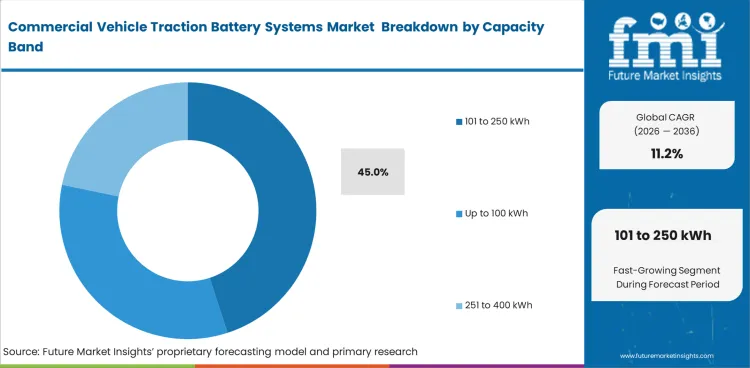
Commercial Vehicle Traction Battery Systems Market Analysis By Capacity Band
- The 101 to 250 kWh capacity band is expected to lead demand in 2026 because it aligns with the operating profile of urban delivery fleets and medium-duty vehicle programs.
- Battery systems above 400 kWh are gaining importance in heavy truck and high-capacity bus applications where route length and gross vehicle weight require much larger energy reserves.
Insights into the Depot Charge Segment
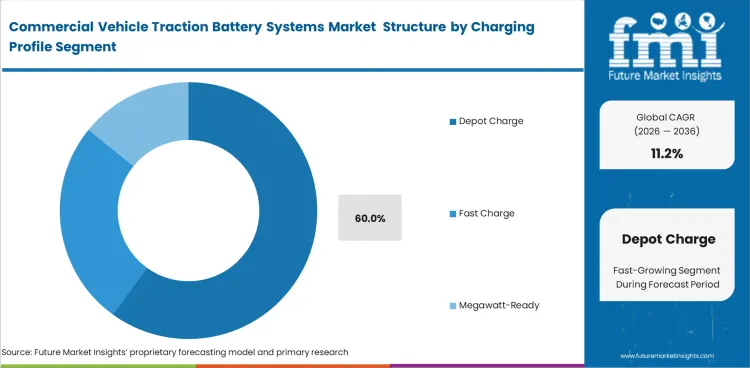
Commercial Vehicle Traction Battery Systems Market Analysis By Charging Profile
- Depot charge systems are expected to account for the leading share in 2026 because many commercial fleets still return to base on fixed schedules.
- Fast-charge and megawatt-ready systems are becoming more relevant in regional haul and higher-utilization operations where turnaround time directly affects vehicle productivity.
Insights into the OEM Segment
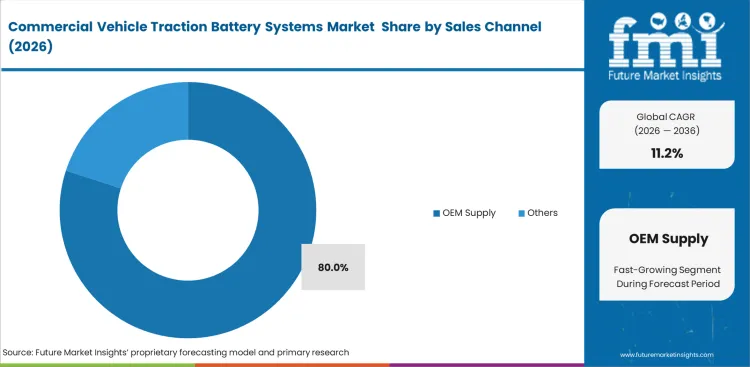
Commercial Vehicle Traction Battery Systems Market Analysis By Sales Channel
- OEM supply is expected to remain the leading sales channel in 2026 because most traction battery systems are installed through factory-built electric commercial vehicle programs.
- Fleet replacement and retrofit activity remains more limited because commercial operators usually prefer battery systems validated by the original vehicle platform manufacturer.
Commercial Vehicle Traction Battery Systems Market Drivers, Restraints, and Opportunities
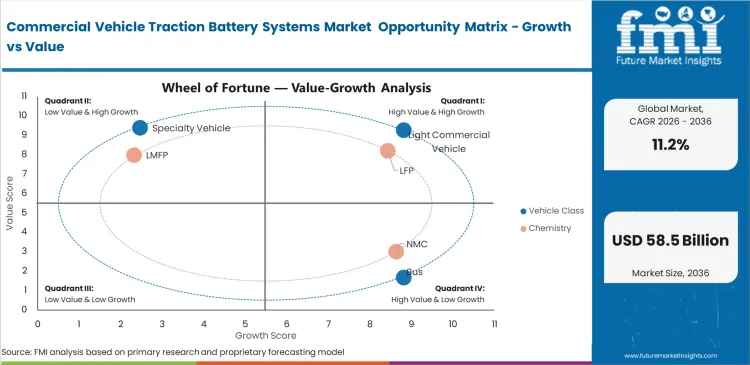
- Electric bus and truck deployment is expanding battery system demand across municipal transport and regional haul programs.
- High upfront battery cost and uneven charging build-out still constrain adoption in heavier duty cycles and smaller fleet budgets.
- Pack integration advances and larger domestic battery supply programs create room for wider use in freight and service vehicle fleets.
The market is expanding owing to increase in transport electrification which now reaches more commercial duty cycles. Delivery vans and buses formed the first wave of demand. Heavy-duty trucks are adding a larger value pool as pack sizes rise and public charging starts to support longer routes.
Cost pressure still limits adoption in some freight applications. Battery packs remain a major share of electric commercial vehicle cost. Charging access and grid readiness continue to influence how quickly fleets can shift from diesel to battery-electric platforms.
Opportunity remains strongest where fleet operators can predict routes and energy use with precision. Urban delivery, city buses, school transport and regional logistics continue to offer the clearest commercial case. Demand for electric low-entry buses and electric commercial vehicle MRO supports the same service-led operating model.
Fleet Electrification Programs
Public transit authorities and large logistics operators are committing more replacement budgets to zero-emission fleets. Battery demand rises with each procurement cycle. Suppliers that deliver repeatable pack performance under high-utilization duty cycles gain an advantage in these tenders.
Cost and Infrastructure Constraints
Battery systems still carry a large cost burden in commercial vehicles. Charging availability shapes real operating range and asset utilization. Slow depot upgrades or limited corridor charging can delay battery orders even when fleet interest is clear.
Pack Design and Duty-cycle Fit
Fleet operators now compare more than simple range claims. They assess charging time, payload impact and replacement interval. Battery system suppliers that tailor pack design to duty cycle and coordinate with battery management systems can secure stronger positions in OEM and fleet replacement programs.
Analysis of Commercial Vehicle Traction Battery Systems Market By Key Countries
.webp "Top Country Growth Comparison Commercial Vehicle Traction Battery Systems Market Cagr (2026 2036)")
| Country | CAGR |
|---|---|
| USA | 9.8% |
| UK | 10.4% |
| Germany | 10.9% |
| Italy | 11.0% |
| Sweden | 10.7% |
| China | 13.2% |
| India | 14.1% |
Source: FMI analysis based on primary research and proprietary forecasting model
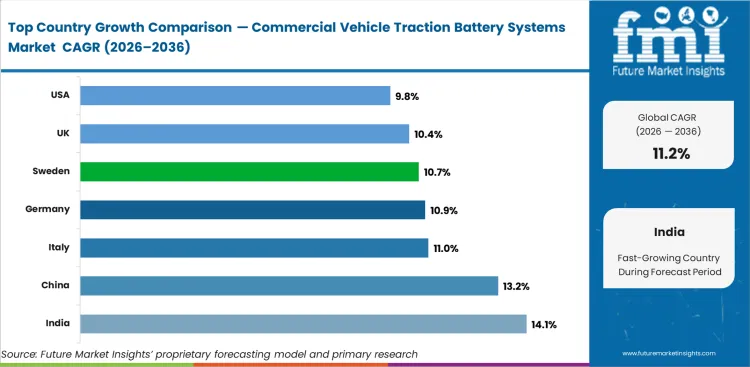
Commercial Vehicle Traction Battery Systems Market CAGR Analysis By Country
- India is projected to rise at a 14.1% CAGR owing to increasing electric bus orders and domestic manufacturing support in the country.
- China at 13.2% CAGR through 2036 remains close behind because its electric truck and bus base is already large and local battery supply remains broad.
- Italy and Germany show solid growth because electric bus and truck registrations continue to build from a lower installed base in Europe.
- The United States and the United Kingdom continue to expand as electric van adoption rises and commercial OEM battery programs deepen.
The global market is expected to grow at 11.2% per year from 2026 to 2036. The study covers more than 30 countries. The key markets are listed below.
Demand Outlook for Commercial Vehicle Traction Battery Systems Market in the United States
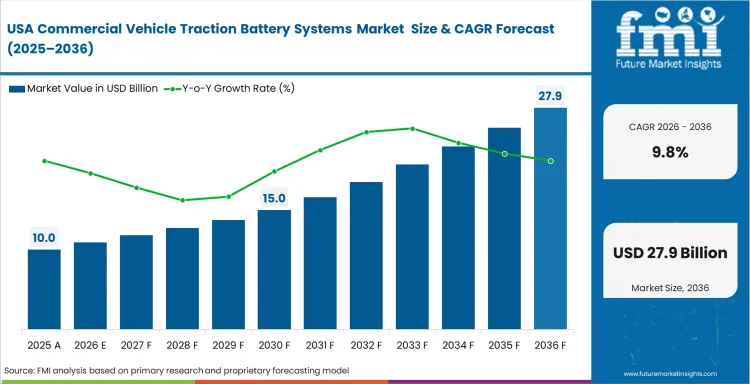
The United States commercial vehicle traction battery systems market is projected to grow at a CAGR of 9.8% through 2036. Electric van deployment with public funding for domestic battery manufacturing, and fleet interest in regional truck electrification are supporting battery demand.
- Federal battery manufacturing support is improving long-term supply confidence for commercial vehicle programs
- Electric van adoption remains the clearest volume driver in the U.S. market. Urban delivery fleets and service fleets continue to create stable battery demand in this vehicle class.
- Regional truck electrification is gaining visibility across selected freight corridors.
Future Outlook for Commercial Vehicle Traction Battery Systems Market in the United Kingdom
The United Kingdom commercial vehicle traction battery systems market is projected to grow at a CAGR of 10.4% through 2036. Electric van adoption remains the main volume driver, while bus electrification and urban fleet decarbonization add further battery demand.
- Delivery operators and urban service fleets remain the main source of volume.
- Municipal transport programs are helping maintain demand for traction battery systems in public transport use.
- Urban clean transport goals are strengthening the case for zero-emission commercial vehicles.
Opportunity Analysis of Commercial Vehicle Traction Battery Systems Market in Germany
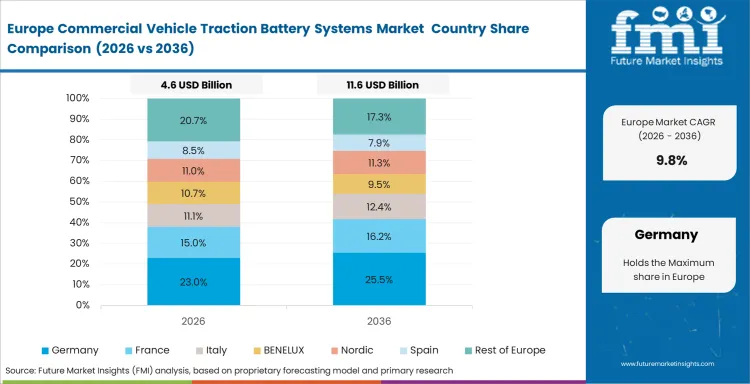
Germany is projected to grow at a CAGR of 10.9% through 2036. Electric bus registrations strengthened in 2025 and truck electrification remains an active industrial focus, which supports higher-value battery demand.
- Germany benefits from a strong industrial base in commercial vehicle engineering.
- Electric bus registrations improved in 2025 and lifted visibility for vehicle electrification in public transport. Battery suppliers gain from that broader market confidence.
- Heavy vehicle electrification remains an active strategic focus in Germany. This should support demand for higher-value battery packs in truck applications over time.
Sales Analysis of Commercial Vehicle Traction Battery Systems Market in Italy
Italy is projected to grow at a CAGR of 11.0% through 2036. Electric bus demand keeps the category visible, while logistics electrification adds another source of battery pack demand.
- Logistics electrification is widening the addressable market for battery pack suppliers.
- Electric vans and light commercial vehicles are adding another source of demand outside public transport.
- Commercial battery demand in Italy benefits from practical duty cycles in urban and intercity operations. Those operating patterns improve the fit for battery-electric platforms.
In-depth Analysis of Commercial Vehicle Traction Battery Systems Market in Sweden
Sweden is projected to grow at a CAGR of 10.7% through 2036. Battery demand benefits from strong electric bus growth and the country's visible role in heavy vehicle electrification.
- Sweden has a visible role in heavy vehicle electrification across Europe. That profile supports battery system demand in higher-capacity truck platforms.
- Electric bus growth has remained strong and reinforces the market for commercial traction packs. Public fleet adoption continues to support supplier activity.
- Local industry visibility in electric truck development gives Sweden added strategic importance.
Sales Analysis of Commercial Vehicle Traction Battery Systems Market in China
China is projected to grow at a CAGR of 13.2% through 2036. The country remains the largest commercial electric vehicle base by installed fleet and annual deployment, supported by broad local cell production.
- Local battery manufacturing depth gives the market a strong supply-side advantage.
- Suppliers can support large commercial programs with shorter lead times and stronger integration capacity.
- Electric truck and bus deployment is already established across multiple duty cycles in China. This should keep the country ahead in battery procurement through the forecast period.
In-depth Analysis of Commercial Vehicle Traction Battery Systems Market in India
India is projected to grow at a CAGR of 14.1% through 2036. Electric bus programs and delivery fleet deployment support battery demand, while domestic production efforts and policy support improve the long-term outlook.
- India leads the country growth outlook because electric bus programs are scaling in multiple cities.
- Delivery fleet electrification is adding another layer of battery demand in light commercial vehicles.
- Domestic production efforts and policy support are improving the long-term market base.
Competitive Landscape and Strategic Positioning
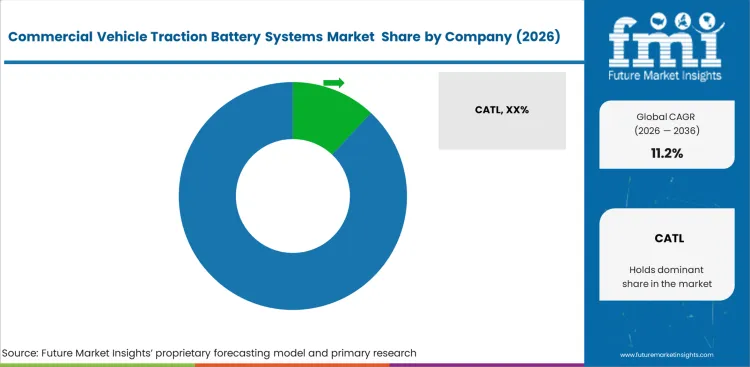
The market includes large cell manufacturers, pack specialists, and OEM-linked battery programs. CATL holds a strong position because it serves heavy commercial transport across multiple use cases and moved early with dedicated product lines. LG Energy Solution remains important in electric vans and commercial battery supply for Europe.
Scania, Volvo Trucks, MAN Truck & Bus, Daimler Truck, and bus-focused battery specialists shape demand through vehicle platform decisions and pack integration requirements. Competition depends on cycle life, charging speed and the ability to support fleet service conditions. Entry barriers remain high because suppliers must prove safety and reliable volume delivery.
Key Companies in the Commercial Vehicle Traction Battery Systems Market
Key global companies leading the commercial vehicle traction battery systems market include:
- CATL
- LG Energy Solution
- BYD
- Forsee Power
- Proterra Powered
- Scania
- Volvo Trucks
- Daimler Truck
- MAN Truck & Bus
- Northvolt Systems
Competitive Benchmarking: Commercial Vehicle Traction Battery Systems Market
| Company | Cycle Life Fit | Fast-charge Readiness | Commercial Fleet Access | Geographic Footprint |
|---|---|---|---|---|
| CATL | High | High | Strong | Global |
| LG Energy Solution | High | Medium | Strong | Global |
| BYD | Medium | Medium | Strong | Asia, Global |
| Forsee Power | High | Medium | Moderate | Europe, Global |
| Proterra Powered | Medium | Medium | Moderate | North America |
| Scania | High | Medium | Strong | Europe |
| Volvo Trucks | High | High | Strong | Global |
| Daimler Truck | High | High | Strong | Global |
| MAN Truck & Bus | Medium | Medium | Moderate | Europe |
| Northvolt Systems | Medium | Medium | Low | Europe |
Source: Future Market Insights competitive analysis, 2026.
Key Developments in Commercial Vehicle Traction Battery Systems Market
- In September 2024, CATL unveiled the Tectrans battery system for heavy-duty commercial vehicles and highlighted superfast charging and long-life variants.
- In October 2024, LG Energy Solution announced battery supply agreements totaling 109 GWh for Ford's electric commercial vans in Europe.
- In September 2024, Scania introduced a 4x2 electric tractor option with 728 kWh battery capacity for longer transport missions.
- In September 2024, Volvo Trucks announced a next-generation electric truck with a range of up to 600 km on one charge.
- In September 2024, MAN Truck & Bus presented the new MAN eTGL at IAA Transportation as part of its wider electric truck line-up.
Key Players in the Commercial Vehicle Traction Battery Systems Market:
Major Global Players:
- CATL
- LG Energy Solution
- BYD
- Daimler Truck
- Volvo Trucks
- Scania
- MAN Truck & Bus
Emerging Players / Specialists
- Forsee Power
- Proterra Powered
- Northvolt Systems
- XING Mobility
- Microvast
Report Scope and Coverage
| Parameter | Details |
|---|---|
| Quantitative Units | USD 18.20 billion to USD 52.62 billion, at a CAGR of 11.2% |
| Market Definition | The market includes traction battery systems used in electric commercial vans, trucks, buses, and specialty vehicles. |
| Regions Covered | North America, Latin America, Europe, East Asia, South Asia and Pacific, Middle East and Africa |
| Countries Covered | USA, UK, Germany, Italy, Sweden, China, India, and more than 30 countries |
| Key Companies Profiled | CATL, LG Energy Solution, BYD, Forsee Power, Proterra Powered, Scania, Volvo Trucks, Daimler Truck, MAN Truck & Bus, Northvolt Systems |
| Forecast Period | 2026 to 2036 |
| Historical Reference Year | 2025 |
| Approach | Hybrid bottom-up and top-down methodology using official EV deployment data, transport registrations, and announced battery supply programs |
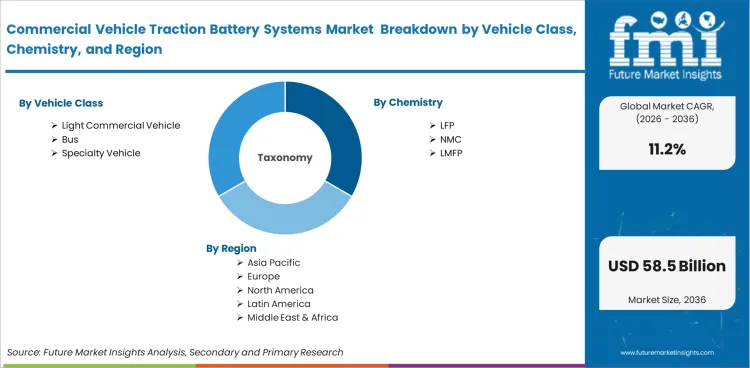
Commercial Vehicle Traction Battery Systems Market Breakdown By Vehicle Class, Chemistry, and Region
Commercial Vehicle Traction Battery Systems Market Segmented by Vehicle Class:
- Light Commercial Vehicle
- Medium-duty Truck
- Heavy-duty Truck
- Bus
- Specialty Vehicle
Commercial Vehicle Traction Battery Systems Market Segmented by Chemistry:
- LFP
- NMC
- LMFP
- LTO
- Other Chemistries
Commercial Vehicle Traction Battery Systems Market Segmented by Pack Architecture:
- Cell-to-pack
- Module Pack
- Swappable Pack
- Structural Pack
Commercial Vehicle Traction Battery Systems Market Segmented by Capacity Band:
- Up to 100 kWh
- 101 to 250 kWh
- 251 to 400 kWh
- Above 400 kWh
Commercial Vehicle Traction Battery Systems Market Segmented by Charging Profile:
- Depot Charge
- Fast Charge
- Megawatt-ready
- Swap-ready
Commercial Vehicle Traction Battery Systems Market by Region:
- North America
- Latin America
- Western Europe
- Eastern Europe
- East Asia
- South Asia and Pacific
- Middle East and Africa
Research Sources and Bibliography
- International Energy Agency. (2025). Global EV outlook 2025.
- International Energy Agency. (2025). Trends in heavy-duty electric vehicles.
- European Automobile Manufacturers' Association. (2026, January 29). New commercial vehicle registrations: Vans -8.8%, trucks -6.2%, buses +7.5% in 2025.
- European Automobile Manufacturers' Association. (2026, January 29). Press release commercial vehicle registrations full year 2025.
- USA Department of Energy. (2024). Biden-Harris administration announces $3.2 billion selections to boost domestic battery manufacturing.
- CATL. (2024, September 17). CATL unveils revolutionary TECTRANS battery system.
- CATL. (2024, November 25). CATL launches Tectrans battery for pure electric heavy-duty commercial vehicles in all scenarios.
- LG Energy Solution. (2024, October 15). LG Energy Solution to power electric versions of Ford's commercial vans in Europe.
- Scania. (2024, September 16). Bringing new energy for sustainable transport.
- Volvo Trucks. (2024, September 3). Breakthrough: Volvo to launch electric truck with 600 km range.
- MAN Truck & Bus. (2024, September 16). Simplifying business: MAN press kit for the IAA Transportation 2024.
This Report Answers
- What is the current and future size of the commercial vehicle traction battery systems market?
- How fast is the commercial vehicle traction battery systems market expected to grow between 2026 and 2036?
- Which chemistry segment is likely to lead the market by 2026?
- Which vehicle class is expected to account for the highest demand by 2026?
- What factors are driving demand for commercial vehicle traction battery systems globally?
- How are fleet electrification programs influencing battery system procurement?
- Why is LFP chemistry emerging as the leading commercial battery choice?
- How are charging upgrades affecting battery system adoption in commercial fleets?
- Which countries are projected to show the fastest growth through 2036?
- What is driving market expansion in China and India?
- Who are the key companies active in the commercial vehicle traction battery systems market?
- How does FMI estimate and validate the market forecast?
Frequently Asked Questions
What is the global market demand for commercial vehicle traction battery systems in 2026?
In 2026, the global commercial vehicle traction battery systems market is expected to be worth USD 18.20 billion.
How big will the market for commercial vehicle traction battery systems be in 2036?
By 2036, the commercial vehicle traction battery systems market is expected to be worth USD 52.62 billion.
How much is demand for commercial vehicle traction battery systems expected to grow between 2026 and 2036?
Between 2026 and 2036, demand for commercial vehicle traction battery systems is expected to grow at a CAGR of 11.2%.
Which chemistry segment is likely to be the best seller by 2026?
LFP is expected to account for 48.0% of the market in 2026 because fleet operators value lower cost and stronger cycle life.
What is causing demand to rise in China?
The China market is projected to grow at a CAGR of 13.2% through 2036 because electric buses and trucks already have broad operating presence.
What is causing demand to rise in India?
The India market is projected to grow at a CAGR of 14.1% through 2036 because bus electrification and delivery fleet upgrades are expanding.
What does this report mean by commercial vehicle traction battery systems market definition?
The market includes traction battery systems supplied for electric vans, trucks, buses, and specialty commercial vehicles.
How does FMI make the commercial vehicle traction battery systems forecast and check it?
Forecasting uses a hybrid bottom-up and top-down approach, then checks the model against official EV deployment and registration data.
Preview the report firsthand - request a free sample
Get SampleGet the brochure for pricing and purchase details.
Get PDFTable of Content
- Executive Summary
- Global Market Outlook
- Demand-side Trends
- Supply-side Trends
- Technology Roadmap Analysis
- Analysis and Recommendations
- Market Overview
- Market Coverage / Taxonomy
- Market Definition / Scope / Limitations
- Research Methodology
- Chapter Orientation
- Analytical Lens and Working Hypotheses
- Market Structure, Signals, and Trend Drivers
- Benchmarking and Cross-market Comparability
- Market Sizing, Forecasting, and Opportunity Mapping
- Research Design and Evidence Framework
- Desk Research Programme (Secondary Evidence)
- Company Annual and Sustainability Reports
- Peer-reviewed Journals and Academic Literature
- Corporate Websites, Product Literature, and Technical Notes
- Earnings Decks and Investor Briefings
- Statutory Filings and Regulatory Disclosures
- Technical White Papers and Standards Notes
- Trade Journals, Industry Magazines, and Analyst Briefs
- Conference Proceedings, Webinars, and Seminar Materials
- Government Statistics Portals and Public Data Releases
- Press Releases and Reputable Media Coverage
- Specialist Newsletters and Curated Briefings
- Sector Databases and Reference Repositories
- FMI Internal Proprietary Databases and Historical Market Datasets
- Subscription Datasets and Paid Sources
- Social Channels, Communities, and Digital Listening Inputs
- Additional Desk Sources
- Expert Input and Fieldwork (Primary Evidence)
- Primary Modes
- Qualitative Interviews and Expert Elicitation
- Quantitative Surveys and Structured Data Capture
- Blended Approach
- Why Primary Evidence is Used
- Field Techniques
- Interviews
- Surveys
- Focus Groups
- Observational and In-context Research
- Social and Community Interactions
- Stakeholder Universe Engaged
- C-suite Leaders
- Board Members
- Presidents and Vice Presidents
- R&D and Innovation Heads
- Technical Specialists
- Domain Subject-matter Experts
- Scientists
- Physicians and Other Healthcare Professionals
- Governance, Ethics, and Data Stewardship
- Research Ethics
- Data Integrity and Handling
- Primary Modes
- Tooling, Models, and Reference Databases
- Desk Research Programme (Secondary Evidence)
- Data Engineering and Model Build
- Data Acquisition and Ingestion
- Cleaning, Normalisation, and Verification
- Synthesis, Triangulation, and Analysis
- Quality Assurance and Audit Trail
- Market Background
- Market Dynamics
- Drivers
- Restraints
- Opportunity
- Trends
- Scenario Forecast
- Demand in Optimistic Scenario
- Demand in Likely Scenario
- Demand in Conservative Scenario
- Opportunity Map Analysis
- Product Life Cycle Analysis
- Supply Chain Analysis
- Investment Feasibility Matrix
- Value Chain Analysis
- PESTLE and Porter’s Analysis
- Regulatory Landscape
- Regional Parent Market Outlook
- Market Dynamics
- Global Market Analysis 2021 to 2025 and Forecast, 2026 to 2036
- Historical Market Size Value (USD Million) Analysis, 2021 to 2025
- Current and Future Market Size Value (USD Million) Projections, 2026 to 2036
- Y-o-Y Growth Trend Analysis
- Absolute $ Opportunity Analysis
- Global Market Pricing Analysis 2021 to 2025 and Forecast 2026 to 2036
- Global Market Analysis 2021 to 2025 and Forecast 2026 to 2036, By Vehicle Class
- Introduction / Key Findings
- Historical Market Size Value (USD Million) Analysis By Vehicle Class , 2021 to 2025
- Current and Future Market Size Value (USD Million) Analysis and Forecast By Vehicle Class , 2026 to 2036
- Light Commercial Vehicle
- Bus
- Specialty Vehicle
- Light Commercial Vehicle
- Y-o-Y Growth Trend Analysis By Vehicle Class , 2021 to 2025
- Absolute $ Opportunity Analysis By Vehicle Class , 2026 to 2036
- Global Market Analysis 2021 to 2025 and Forecast 2026 to 2036, By Chemistry
- Introduction / Key Findings
- Historical Market Size Value (USD Million) Analysis By Chemistry, 2021 to 2025
- Current and Future Market Size Value (USD Million) Analysis and Forecast By Chemistry, 2026 to 2036
- LFP
- NMC
- LMFP
- LFP
- Y-o-Y Growth Trend Analysis By Chemistry, 2021 to 2025
- Absolute $ Opportunity Analysis By Chemistry, 2026 to 2036
- Global Market Analysis 2021 to 2025 and Forecast 2026 to 2036, By Pack Architecture
- Introduction / Key Findings
- Historical Market Size Value (USD Million) Analysis By Pack Architecture, 2021 to 2025
- Current and Future Market Size Value (USD Million) Analysis and Forecast By Pack Architecture, 2026 to 2036
- Cell-to-Pack
- Module Pack
- Swappable Pack
- Cell-to-Pack
- Y-o-Y Growth Trend Analysis By Pack Architecture, 2021 to 2025
- Absolute $ Opportunity Analysis By Pack Architecture, 2026 to 2036
- Global Market Analysis 2021 to 2025 and Forecast 2026 to 2036, By Capacity Band
- Introduction / Key Findings
- Historical Market Size Value (USD Million) Analysis By Capacity Band, 2021 to 2025
- Current and Future Market Size Value (USD Million) Analysis and Forecast By Capacity Band, 2026 to 2036
- 101 to 250 kWh
- Up to 100 kWh
- 251 to 400 kWh
- 101 to 250 kWh
- Y-o-Y Growth Trend Analysis By Capacity Band, 2021 to 2025
- Absolute $ Opportunity Analysis By Capacity Band, 2026 to 2036
- Global Market Analysis 2021 to 2025 and Forecast 2026 to 2036, By Charging Profile
- Introduction / Key Findings
- Historical Market Size Value (USD Million) Analysis By Charging Profile, 2021 to 2025
- Current and Future Market Size Value (USD Million) Analysis and Forecast By Charging Profile, 2026 to 2036
- Depot Charge
- Fast Charge
- Megawatt-Ready
- Depot Charge
- Y-o-Y Growth Trend Analysis By Charging Profile, 2021 to 2025
- Absolute $ Opportunity Analysis By Charging Profile, 2026 to 2036
- Global Market Analysis 2021 to 2025 and Forecast 2026 to 2036, By Sales Channel
- Introduction / Key Findings
- Historical Market Size Value (USD Million) Analysis By Sales Channel, 2021 to 2025
- Current and Future Market Size Value (USD Million) Analysis and Forecast By Sales Channel, 2026 to 2036
- OEM Supply
- Others
- OEM Supply
- Y-o-Y Growth Trend Analysis By Sales Channel, 2021 to 2025
- Absolute $ Opportunity Analysis By Sales Channel, 2026 to 2036
- Global Market Analysis 2021 to 2025 and Forecast 2026 to 2036, By Region
- Introduction
- Historical Market Size Value (USD Million) Analysis By Region, 2021 to 2025
- Current Market Size Value (USD Million) Analysis and Forecast By Region, 2026 to 2036
- North America
- Latin America
- Western Europe
- Eastern Europe
- East Asia
- South Asia and Pacific
- Middle East & Africa
- Market Attractiveness Analysis By Region
- North America Market Analysis 2021 to 2025 and Forecast 2026 to 2036, By Country
- Historical Market Size Value (USD Million) Trend Analysis By Market Taxonomy, 2021 to 2025
- Market Size Value (USD Million) Forecast By Market Taxonomy, 2026 to 2036
- By Country
- USA
- Canada
- Mexico
- By Vehicle Class
- By Chemistry
- By Pack Architecture
- By Capacity Band
- By Charging Profile
- By Sales Channel
- By Country
- Market Attractiveness Analysis
- By Country
- By Vehicle Class
- By Chemistry
- By Pack Architecture
- By Capacity Band
- By Charging Profile
- By Sales Channel
- Key Takeaways
- Latin America Market Analysis 2021 to 2025 and Forecast 2026 to 2036, By Country
- Historical Market Size Value (USD Million) Trend Analysis By Market Taxonomy, 2021 to 2025
- Market Size Value (USD Million) Forecast By Market Taxonomy, 2026 to 2036
- By Country
- Brazil
- Chile
- Rest of Latin America
- By Vehicle Class
- By Chemistry
- By Pack Architecture
- By Capacity Band
- By Charging Profile
- By Sales Channel
- By Country
- Market Attractiveness Analysis
- By Country
- By Vehicle Class
- By Chemistry
- By Pack Architecture
- By Capacity Band
- By Charging Profile
- By Sales Channel
- Key Takeaways
- Western Europe Market Analysis 2021 to 2025 and Forecast 2026 to 2036, By Country
- Historical Market Size Value (USD Million) Trend Analysis By Market Taxonomy, 2021 to 2025
- Market Size Value (USD Million) Forecast By Market Taxonomy, 2026 to 2036
- By Country
- Germany
- UK
- Italy
- Spain
- France
- Nordic
- BENELUX
- Rest of Western Europe
- By Vehicle Class
- By Chemistry
- By Pack Architecture
- By Capacity Band
- By Charging Profile
- By Sales Channel
- By Country
- Market Attractiveness Analysis
- By Country
- By Vehicle Class
- By Chemistry
- By Pack Architecture
- By Capacity Band
- By Charging Profile
- By Sales Channel
- Key Takeaways
- Eastern Europe Market Analysis 2021 to 2025 and Forecast 2026 to 2036, By Country
- Historical Market Size Value (USD Million) Trend Analysis By Market Taxonomy, 2021 to 2025
- Market Size Value (USD Million) Forecast By Market Taxonomy, 2026 to 2036
- By Country
- Russia
- Poland
- Hungary
- Balkan & Baltic
- Rest of Eastern Europe
- By Vehicle Class
- By Chemistry
- By Pack Architecture
- By Capacity Band
- By Charging Profile
- By Sales Channel
- By Country
- Market Attractiveness Analysis
- By Country
- By Vehicle Class
- By Chemistry
- By Pack Architecture
- By Capacity Band
- By Charging Profile
- By Sales Channel
- Key Takeaways
- East Asia Market Analysis 2021 to 2025 and Forecast 2026 to 2036, By Country
- Historical Market Size Value (USD Million) Trend Analysis By Market Taxonomy, 2021 to 2025
- Market Size Value (USD Million) Forecast By Market Taxonomy, 2026 to 2036
- By Country
- China
- Japan
- South Korea
- By Vehicle Class
- By Chemistry
- By Pack Architecture
- By Capacity Band
- By Charging Profile
- By Sales Channel
- By Country
- Market Attractiveness Analysis
- By Country
- By Vehicle Class
- By Chemistry
- By Pack Architecture
- By Capacity Band
- By Charging Profile
- By Sales Channel
- Key Takeaways
- South Asia and Pacific Market Analysis 2021 to 2025 and Forecast 2026 to 2036, By Country
- Historical Market Size Value (USD Million) Trend Analysis By Market Taxonomy, 2021 to 2025
- Market Size Value (USD Million) Forecast By Market Taxonomy, 2026 to 2036
- By Country
- India
- ASEAN
- Australia & New Zealand
- Rest of South Asia and Pacific
- By Vehicle Class
- By Chemistry
- By Pack Architecture
- By Capacity Band
- By Charging Profile
- By Sales Channel
- By Country
- Market Attractiveness Analysis
- By Country
- By Vehicle Class
- By Chemistry
- By Pack Architecture
- By Capacity Band
- By Charging Profile
- By Sales Channel
- Key Takeaways
- Middle East & Africa Market Analysis 2021 to 2025 and Forecast 2026 to 2036, By Country
- Historical Market Size Value (USD Million) Trend Analysis By Market Taxonomy, 2021 to 2025
- Market Size Value (USD Million) Forecast By Market Taxonomy, 2026 to 2036
- By Country
- Kingdom of Saudi Arabia
- Other GCC Countries
- Turkiye
- South Africa
- Other African Union
- Rest of Middle East & Africa
- By Vehicle Class
- By Chemistry
- By Pack Architecture
- By Capacity Band
- By Charging Profile
- By Sales Channel
- By Country
- Market Attractiveness Analysis
- By Country
- By Vehicle Class
- By Chemistry
- By Pack Architecture
- By Capacity Band
- By Charging Profile
- By Sales Channel
- Key Takeaways
- Key Countries Market Analysis
- USA
- Pricing Analysis
- Market Share Analysis, 2025
- By Vehicle Class
- By Chemistry
- By Pack Architecture
- By Capacity Band
- By Charging Profile
- By Sales Channel
- Canada
- Pricing Analysis
- Market Share Analysis, 2025
- By Vehicle Class
- By Chemistry
- By Pack Architecture
- By Capacity Band
- By Charging Profile
- By Sales Channel
- Mexico
- Pricing Analysis
- Market Share Analysis, 2025
- By Vehicle Class
- By Chemistry
- By Pack Architecture
- By Capacity Band
- By Charging Profile
- By Sales Channel
- Brazil
- Pricing Analysis
- Market Share Analysis, 2025
- By Vehicle Class
- By Chemistry
- By Pack Architecture
- By Capacity Band
- By Charging Profile
- By Sales Channel
- Chile
- Pricing Analysis
- Market Share Analysis, 2025
- By Vehicle Class
- By Chemistry
- By Pack Architecture
- By Capacity Band
- By Charging Profile
- By Sales Channel
- Germany
- Pricing Analysis
- Market Share Analysis, 2025
- By Vehicle Class
- By Chemistry
- By Pack Architecture
- By Capacity Band
- By Charging Profile
- By Sales Channel
- UK
- Pricing Analysis
- Market Share Analysis, 2025
- By Vehicle Class
- By Chemistry
- By Pack Architecture
- By Capacity Band
- By Charging Profile
- By Sales Channel
- Italy
- Pricing Analysis
- Market Share Analysis, 2025
- By Vehicle Class
- By Chemistry
- By Pack Architecture
- By Capacity Band
- By Charging Profile
- By Sales Channel
- Spain
- Pricing Analysis
- Market Share Analysis, 2025
- By Vehicle Class
- By Chemistry
- By Pack Architecture
- By Capacity Band
- By Charging Profile
- By Sales Channel
- France
- Pricing Analysis
- Market Share Analysis, 2025
- By Vehicle Class
- By Chemistry
- By Pack Architecture
- By Capacity Band
- By Charging Profile
- By Sales Channel
- India
- Pricing Analysis
- Market Share Analysis, 2025
- By Vehicle Class
- By Chemistry
- By Pack Architecture
- By Capacity Band
- By Charging Profile
- By Sales Channel
- ASEAN
- Pricing Analysis
- Market Share Analysis, 2025
- By Vehicle Class
- By Chemistry
- By Pack Architecture
- By Capacity Band
- By Charging Profile
- By Sales Channel
- Australia & New Zealand
- Pricing Analysis
- Market Share Analysis, 2025
- By Vehicle Class
- By Chemistry
- By Pack Architecture
- By Capacity Band
- By Charging Profile
- By Sales Channel
- China
- Pricing Analysis
- Market Share Analysis, 2025
- By Vehicle Class
- By Chemistry
- By Pack Architecture
- By Capacity Band
- By Charging Profile
- By Sales Channel
- Japan
- Pricing Analysis
- Market Share Analysis, 2025
- By Vehicle Class
- By Chemistry
- By Pack Architecture
- By Capacity Band
- By Charging Profile
- By Sales Channel
- South Korea
- Pricing Analysis
- Market Share Analysis, 2025
- By Vehicle Class
- By Chemistry
- By Pack Architecture
- By Capacity Band
- By Charging Profile
- By Sales Channel
- Russia
- Pricing Analysis
- Market Share Analysis, 2025
- By Vehicle Class
- By Chemistry
- By Pack Architecture
- By Capacity Band
- By Charging Profile
- By Sales Channel
- Poland
- Pricing Analysis
- Market Share Analysis, 2025
- By Vehicle Class
- By Chemistry
- By Pack Architecture
- By Capacity Band
- By Charging Profile
- By Sales Channel
- Hungary
- Pricing Analysis
- Market Share Analysis, 2025
- By Vehicle Class
- By Chemistry
- By Pack Architecture
- By Capacity Band
- By Charging Profile
- By Sales Channel
- Kingdom of Saudi Arabia
- Pricing Analysis
- Market Share Analysis, 2025
- By Vehicle Class
- By Chemistry
- By Pack Architecture
- By Capacity Band
- By Charging Profile
- By Sales Channel
- Turkiye
- Pricing Analysis
- Market Share Analysis, 2025
- By Vehicle Class
- By Chemistry
- By Pack Architecture
- By Capacity Band
- By Charging Profile
- By Sales Channel
- South Africa
- Pricing Analysis
- Market Share Analysis, 2025
- By Vehicle Class
- By Chemistry
- By Pack Architecture
- By Capacity Band
- By Charging Profile
- By Sales Channel
- USA
- Market Structure Analysis
- Competition Dashboard
- Competition Benchmarking
- Market Share Analysis of Top Players
- By Regional
- By Vehicle Class
- By Chemistry
- By Pack Architecture
- By Capacity Band
- By Charging Profile
- By Sales Channel
- Competition Analysis
- Competition Deep Dive
- CATL
- Overview
- Product Portfolio
- Profitability by Market Segments (Product/Age /Sales Channel/Region)
- Sales Footprint
- Strategy Overview
- Marketing Strategy
- Product Strategy
- Channel Strategy
- LG Energy Solution
- BYD
- Forsee Power
- Proterra Powered
- Scania
- Volvo Trucks
- CATL
- Competition Deep Dive
- Assumptions & Acronyms Used


