

- Industry Size (2026)
- USD 432 Mn
- Forecast (2036)
- USD 683.8 Mn
- CAGR (2026 to 2036)
- 4.7%
Electric Low Entry Bus Market Forecast and Outlook 2026 to 2036
The electric low entry bus market is anticipated to experience significant growth over the next decade. In 2026, the industry valuation is projected to reach approximately USD 432 million, with expectations to climb to USD 683.8 million by 2036, representing a compound annual growth rate (CAGR) of 4.7%. This upward trend is primarily driven by procurement strategies and operational practices within city and regional transit systems that focus on long-term fleet planning. The selection of platforms is influenced by various factors such as route length, stop intervals, depot configurations, and the logistics of charging windows.
Transit operators are particularly attentive to aspects such as winter heating systems, ramp reliability, and maintenance access for batteries. Acceptance tests evaluate critical areas including braking systems, insulation resistance, door operations, and passenger information systems. Financial arrangements are often tied to milestone payments based on the phased delivery of vehicles.
Success in this competitive segment hinges more on operational efficiency, service availability, and adherence to parts disciplines rather than the variety of products offered in catalogs. The manufacturing process necessitates careful coordination of components including frames, axles, battery packs, and electrical systems, all scheduled for specific municipal delivery timelines. Quality control measures at release gates ensure software compliance, corrosion resistance, and electrical safety.
The readiness of depots can significantly impact delivery schedules. Essential replacement parts, such as body panels, doors, glazings, and power electronics, play a large role in inventory management. Warranty considerations inform decisions about component selection and operational derating policies. Feedback from operators often leads to improvements in cooling designs and maintenance access. Supplier performance metrics can influence future contracts and allocations.
Quick Stats for Electric Low Entry Bus Market
- Electric Low Entry Bus Market Value (2026): USD 432 million
- Electric Low Entry Bus Market Forecast Value (2036): USD 683.8 million
- Electric Low Entry Bus Market Forecast CAGR 2026 to 2036: 4.7%
- Leading Bus Type in Electric Low Entry Bus Market: Battery electric low-entry buses
- Leading Application in Electric Low Entry Bus Market: Urban public transport
- Key Growth Regions in Electric Low Entry Bus Market: Asia Pacific, Europe, North America
- Top Players in Electric Low Entry Bus Market: BYD, Volvo Buses, Solaris Bus & Coach, VDL Bus & Coach, King Long, Ebusco
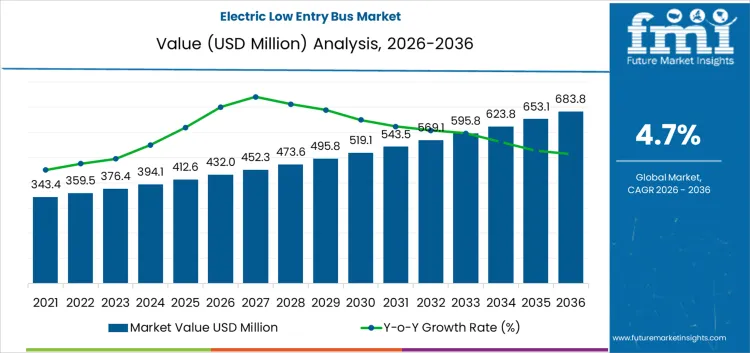
What Is the Growth Forecast for the Electric Low Entry Bus Market through 2036?
Procurement rules and depot operating patterns shape the electric low entry bus market more than general passenger demand levels. In 2026, at about USD 432 million, purchases concentrate within city and regional transit agencies that plan fleet changes through multi-year tenders. Vehicle layouts, door positions, and interior configurations tend to stay consistent across large orders, which ties demand to replacement cycles rather than to yearly budget swings. Uptake grows as operators extend electric fleets from pilot routes into core corridors that already have charging and maintenance capacity. The upward path reflects staged fleet conversion and gradual expansion of electric duty coverage rather than rapid system wide turnover.
Cost control and service reliability guide the later phase of the electric low entry bus market. As value approaches roughly USD 683.8 million by 2036, buyers place weight on battery life management, parts commonality, and workshop compatibility. Manufacturers respond by narrowing configuration ranges and standardizing components across models. Production effort shifts toward longer series builds that simplify training and spares stocking. The move from the low four hundred into the high six hundred reflects accumulated tender awards across many transit systems rather than a single policy driven surge. Suppliers that combine dependable delivery schedules, stable product support, and predictable operating costs tend to secure follow on contracts.
Electric Low Entry Bus Market Key Takeaways
| Metric | Value |
|---|---|
| Market Value (2026) | USD 432 million |
| Forecast Value (2036) | USD 683.8 million |
| Forecast CAGR 2026 to 2036 | 4.7% |
How Is the Electric Low Entry Bus Market Changing Urban Route Economics and Vehicle Utilization?
Electric low entry buses are designed with a flat, step free front section and a raised rear module, which suits frequent stops and mixed passenger flows. Earlier fleets relied on diesel low floor or conventional step entry layouts, which created noise, idling exposure, and access limits in dense corridors. Electric platforms shift route planning toward predictable daily mileage, depot charging windows, and scheduled turnarounds. Transit authorities specify these buses by passenger throughput, axle load limits, HVAC demand, and winter range behavior. Operators evaluate energy use per kilometer under stop start duty cycles rather than nominal range figures. Body and chassis integration matters because door layout, battery placement, and floor height affect dwell time, maintenance access, and inspection outcomes across long service lives in daily service.
Acquisition decisions are led by transport agencies, safety regulators, and fleet engineering teams, not by vehicle purchasing alone. Earlier orders were confined to demonstration routes, which kept specifications flexible and parts inventories thin. Current programs target fleet wide standardization, shared charging interfaces, and common diagnostic systems. Manufacturers compete on thermal control, battery life management, and uptime guarantees instead of peak motor output. Operators track total cost through energy spend, brake wear, availability, and midlife overhaul scope, not unit price. Depot operators add value through charging management and spare ratio planning. Over time, demand follows access rules, emissions targets, and budget cycles, with growth strongest on high frequency urban lines where boarding speed, noise limits, and predictable scheduling determine service quality and operating cost discipline.
What is the Segmentation Outlook for Electric Low Entry Bus Market?
Investment decisions in Electric Low Entry Bus Market are determined by public transport funding cycles, depot electrification programs, and regulatory fleet transition mandates. Vehicle procurement follows long planning horizons that integrate route scheduling, charging or power supply availability, and maintenance capability. Once a propulsion concept is approved within a city or operator framework, vehicle specifications are standardized across multiple purchase tranches. This ties demand to multi-year fleet replacement programs rather than to short term ridership variation. Segment structure reflects differences in energy supply method, operating range, and infrastructure dependency. Purchasing authorities emphasize service reliability, lifecycle cost control, and compliance documentation over initial vehicle acquisition price.
How Does Bus Type Selection Shape Infrastructure Commitment and Operating Economics in the Electric Low Entry Bus Market?
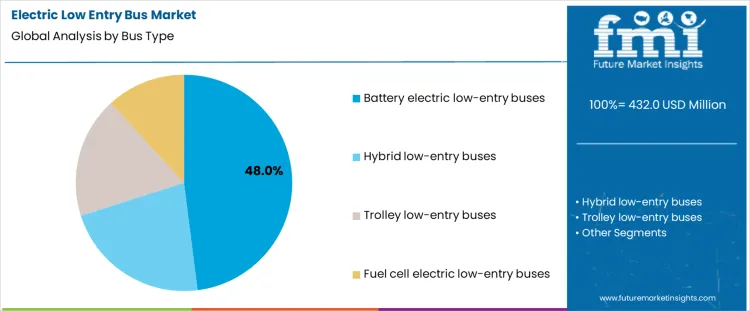
Battery electric low entry buses represent about 48% of demand in the Electric Low Entry Bus Market because they can be deployed without overhead line infrastructure and align with depot based charging strategies. Their adoption requires investment in chargers, power upgrades, and load management systems, which are typically planned at fleet or depot level. Hybrid low entry buses serve operators that require extended range or operational flexibility while limiting immediate infrastructure changes. Trolley low entry buses depend on fixed overhead power networks, which restrict deployment to existing corridors but provide stable energy supply and high daily utilization potential. Fuel cell electric low entry buses address routes requiring long range and rapid refueling, though they impose hydrogen supply and safety infrastructure requirements.
From an operating perspective, each bus type establishes a different cost and risk profile. Battery electric fleets concentrate cost in electrical infrastructure and battery replacement planning. Hybrid fleets retain fuel logistics and engine maintenance complexity. Trolley systems require ongoing catenary inspection and power system maintenance but reduce onboard energy storage dependency. Fuel cell fleets shift risk toward hydrogen supply reliability and system certification. Once an operator commits to a propulsion type, depot layout, training programs, spare parts inventories, and maintenance procedures are aligned accordingly. Changes in mix occur slowly because infrastructure and organizational processes are tightly coupled to the selected technology path.
Why Does Application Mix Determine Procurement Scale and Service Specification in the Electric Low Entry Bus Market?
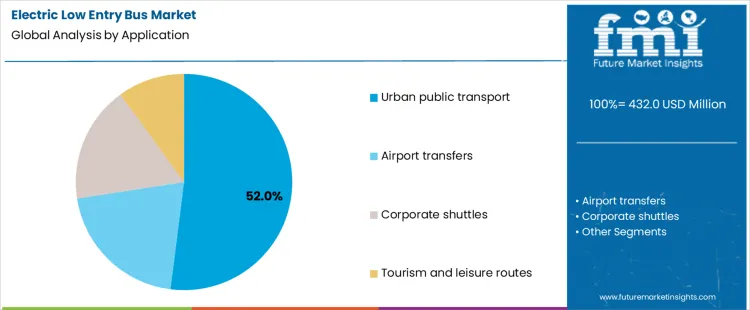
Urban public transport accounts for about 52% of demand in the Electric Low Entry Bus Market because city networks require high vehicle counts, standardized configurations, and continuous daily operation. These services prioritize accessibility, schedule adherence, and predictable turnaround times. Airport transfer services operate on fixed corridors with known duty cycles, which supports targeted deployment of specific propulsion types matched to route length and dwell time. Corporate shuttle services emphasize reliability and passenger comfort within controlled networks, often using smaller fleets with standardized service windows. Tourism and leisure routes involve variable schedules and seasonal utilization, which favors flexible deployment and careful asset utilization planning.
Application mix also influences procurement procedure and technical specification depth. Urban transit authorities purchase through large tenders with detailed compliance requirements and long term service contracts. Airport and corporate operators conduct more focused procurements aligned to specific route needs and service level agreements. Tourism operators often phase purchases in line with demand cycles and financing availability. The resulting demand structure concentrates volume in urban fleets, while other applications contribute smaller, specification driven orders. Segment shares therefore move with public funding decisions, route electrification programs, and service contract renewals rather than with short term changes in passenger traffic.
How Is the Electric Low Entry Bus Market Being Defined by Route Planning and Depot Operations?
The Electric Low Entry Bus Market is shaped by how transit agencies align vehicle range, passenger capacity, and charging schedules with daily route structures. Low entry buses operate on frequent stop routes where dwell time, passenger flow, and accessibility requirements matter as much as driving distance. Fleet planners evaluate vehicle selection based on depot layout, overnight charging capacity, and the ability to maintain timetable reliability. Electric propulsion changes maintenance routines and shift planning, which makes procurement decisions closely tied to operating models rather than to vehicle purchase price alone. This positions electric low entry buses as part of a system planning decision rather than as a simple fleet replacement item.
How Is Fleet Platform Consolidation Changing Buying Criteria in The Electric Low Entry Bus Market?
Transit operators increasingly seek to reduce complexity by limiting the number of bus platforms in service. This behavior is shifting expectations in the Electric Low Entry Bus Market toward vehicles that can cover multiple route types with consistent driver interfaces and maintenance procedures. Buyers prefer common components, shared diagnostic processes, and predictable parts supply. This reduces training time and inventory burden. As a result, vehicle evaluation focuses on platform stability, service network reach, and long-term parts support. Manufacturers that offer consistent vehicle families and clear upgrade paths are better positioned to become long-term fleet partners rather than one-off suppliers.
Where Is Long Term Deployment Volume Being Built in The Electric Low Entry Bus Market?
Long term volume is being built through phased fleet replacement programs rather than through single procurement events. City transport authorities often introduce electric low entry buses in batches, expanding deployment as charging capacity and operational confidence grow. The Electric Low Entry Bus Market benefits from this stepwise rollout model, which creates repeat orders tied to depot conversion schedules. There is also opportunity in standard route packages, where vehicles, chargers, and service agreements are bundled to simplify procurement. Suppliers that align with multi-year fleet planning cycles can secure ongoing deliveries linked to route group transitions rather than isolated tenders.
Why Do Infrastructure Coordination and Service Continuity Concerns Limit Faster Conversion in The Electric Low Entry Bus Market?
Conversion in the Electric Low Entry Bus Market is limited when depot electrical capacity, grid connections, or charger installation schedules do not align with vehicle delivery plans. Transit agencies also prioritize service continuity, which makes them cautious about introducing large numbers of new vehicles at once. Any reliability issue affects public schedules and operating credibility. Budget coordination across vehicles, charging equipment, and depot upgrades adds further complexity. These factors encourage gradual adoption and careful pilot phases, slowing the pace of change even when long-term plans support wider deployment.
What is the Demand for Electric Low Entry Bus by Country?
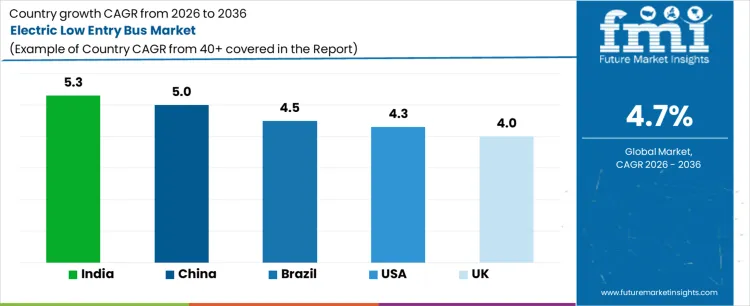
| Country | CAGR |
|---|---|
| USA | 4.3% |
| UK | 4.0% |
| China | 5.0% |
| India | 5.3% |
| Brazil | 4.5% |
Demand for electric low entry buses is increasing as city transport authorities modernize public transit fleets to improve accessibility, reduce urban emissions, and lower operating costs. India leads with a 5.3% CAGR, supported by government backed e bus procurement programs, expansion of city bus networks, and rising emphasis on accessible public transport. China follows at 5.0%, driven by large installed bases of electric buses and continued fleet replacement in urban transit systems. Brazil records 4.5%, reflecting pilot projects and gradual scaling in major cities. The USA grows at 4.3%, shaped by federal and state funding for clean transit. The UK, at 4.0%, reflects steady fleet renewal within regulated public transport frameworks.
How Do Urban Fleet Renewal Programs Shape Demand in the United States?
Transit agency replacement planning keeps the electric low entry bus market in the United States on a 4.3% CAGR path. Demand comes from city transport authorities, airport shuttle fleets, and campus operators. Vehicle selection focuses on floor height, passenger flow, and compatibility with depot charging layouts. Procurement decisions move through multi-year capital programs rather than single vehicle purchases. Route profiles influence battery capacity and thermal management requirements. Maintenance teams track uptime and parts availability across service districts. Federal and state incentive schemes influence purchase timing. Body builders and chassis suppliers coordinate during specification stages. Driver training programs affect rollout speed. Replacement of aging diesel fleets sustains baseline volume. Commercial position depends on framework inclusion and service network strength rather than competition for isolated fleet orders from small operators.
Why Do Public Procurement Rules and Accessibility Standards Guide Adoption in the United Kingdom?
Local transport policy places the electric low entry bus market in the United Kingdom on a 4.0% CAGR trajectory. City authorities, regional operators, and contract service providers represent core buyers. Vehicle approval follows accessibility standards, safety certification, and controlled supplier lists. Orders move through framework agreements serving multiple routes and depots. Charging infrastructure readiness shapes fleet sizing decisions. Duty cycle analysis influences battery and drivetrain configuration. Workshop capability affects acceptance of new platforms. Replacement schedules align with budget cycles and service contract renewals. Body configuration work occurs through specialist integrators. Training requirements for driver’s influence deployment pace. Residual value expectations shape leasing structures. Documentation for compliance audits remains part of fleet records. Commercial access depends on framework participation and service reliability rather than competition for small volume vehicle purchases.
What Role Do Mass Transit Expansion and Manufacturing Scale Play in China?
Urban transport expansion places the electric low entry bus market in China on a 5.0% growth path. Municipal transit fleets, airport routes, and suburban connectors account for most deliveries. Vehicle platforms follow standardized designs approved by large operators. Domestic manufacturing supports high volume supply and component availability. Procurement flows through city transport groups and state linked fleet managers. Charging network buildout shapes route assignment patterns. Workshop networks support routine maintenance and battery module replacement. Replacement cycles depend on utilization intensity rather than calendar age. Interior layout and door configuration receive attention during specification work. Data systems track energy use and availability. Payment schedules align with municipal investment plans. Commercial success depends on participation in large fleet programs and long term supply agreements rather than fragmented retail vehicle sales.
How Do Network Expansion and Contract Operations Shape Demand in India?
Public transport growth fixes the electric low entry bus market in India at a 5.3% CAGR. City corporations, state transport bodies, and private operators represent the main buyers. Procurement decisions focus on purchase cost, service support, and operating range under heat exposure. Many buses enter service through contract operation models. Charging access at depots influences route allocation. Body building work occurs through domestic integrators. Driver and technician training affects acceptance of new drivetrains. Maintenance planning centers on battery health and power electronics. Replacement demand follows utilization levels across corridors. Distribution coverage shapes brand preference among operators. Incentive programs influence timing of tenders. Inspection documentation remains mandatory. Commercial results depend on inclusion in long term fleet contracts and maintaining service reach rather than competition for one-time vehicle sales.
How Do Municipal Services and Regional Transit Programs Shape Spending in Brazil?
Fleet modernization keeps the electric low entry bus market in Brazil near a 4.5% CAGR. City operators, airport services, and regional transport companies form the main customer base. Vehicle choice reflects road conditions, passenger capacity needs, and service network coverage. Procurement often occurs through multi-year fleet tenders and operating concessions. Import procedures and local assembly influence delivery schedules. Charging access at depots shapes daily scheduling. Body builders handle interior layout and door integration. Workshop capability affects confidence in long term operation. Replacement cycles follow maintenance cost trends and utilization intensity. Training programs for driver’s influence service reliability. Residual value expectations shape financing structures. Documentation for compliance inspections remains part of fleet files. Commercial position depends on distributor coverage and fleet relationships rather than showroom competition for individual vehicle buyers.
How Do Manufacturers Compete for Platform Selection in the Electric Low Entry Bus Market?
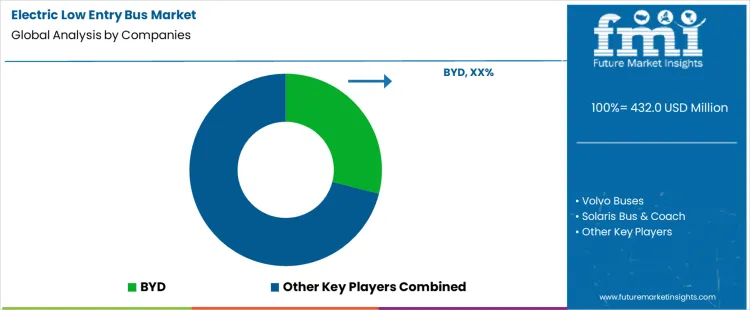
Electric low entry bus procurement starts with route geometry, dwell time, passenger flow, charging limits. Vehicle weight, axle loads, interior layout, heating loads, and door cycles define usable daily duty. BYD, Volvo Buses, Solaris, VDL, King Long, Ebusco compete at that specification stage in tenders. Once a platform enters drawings, substitutions trigger testing, documentation updates, depot retraining, and schedule risk. BYD uses battery integration and large series production to support municipal fleet programs at scale. Volvo Buses, Solaris, and VDL rely on homologation depth and long service histories across Europe. King Long focuses on cost control and build rate for high volume public tender’s programs. Ebusco positions lightweight structures and composite bodies for range sensitive city networks with tight schedules.
Evaluation focuses on uptime targets, parts logistics, technician training, warranty terms, and financing structures models. Operators review energy consumption profiles, winter heating impact, brake wear, tire life, and software support. BYD benefits from vertical supply and local assembly in several regions with tender preferences rules. Volvo Buses secures positions through framework agreements, depot integration experience, and stable residual value assumptions. Solaris and VDL win where operators demand proven winter performance and conservative service intervals planning. King Long competes on delivery speed, pricing discipline, and standardized configurations for city fleets procurement. Ebusco attracts buyers seeking weight reduction to preserve range within fixed axle limits and schedules. Award decisions reflect funding rules, charging readiness, service coverage, and political accountability in public transport.
Key Players in the Electric Low Entry Bus Market
- BYD
- Volvo Buses
- Solaris Bus & Coach
- VDL Bus & Coach
- King Long
- Ebusco
Scope of the Report
| Items | Values |
|---|---|
| Quantitative Units (2026) | USD million |
| Bus Type | Battery electric low-entry buses, Hybrid low-entry buses, Trolley low-entry buses, Fuel cell electric low-entry buses |
| Application | Urban public transport, Airport transfers, Corporate shuttles, Tourism and leisure routes |
| Region | Asia Pacific, Europe, North America, Latin America, Middle East & Africa |
| Countries Covered | China, Japan, South Korea, India, Australia & New Zealand, ASEAN, Germany, United Kingdom, France, Italy, Spain, Nordic, BENELUX, United States, Canada, Mexico, Brazil, Chile, Saudi Arabia, Turkey, South Africa, and other regional markets |
| Key Companies Profiled | BYD, Volvo Buses, Solaris Bus & Coach, VDL Bus & Coach, King Long, Ebusco |
| Additional Attributes | Dollar by sales by bus type and application; demand driven by public transit tenders and depot electrification; growth led by urban fleets; purchasing shaped by route structure, charging readiness, battery life management, parts commonality, uptime targets, and multi-year framework contracts rather than unit vehicle price. |
Electric Low Entry Bus Market Segmentation
Bus Type:
- Battery electric low-entry buses
- Hybrid low-entry buses
- Trolley low-entry buses
- Fuel cell electric low-entry buses
Application:
- Urban public transport
- Airport transfers
- Corporate shuttles
- Tourism and leisure routes
Region:
- Asia Pacific
- China
- Japan
- South Korea
- India
- Australia & New Zealand
- ASEAN
- Rest of Asia Pacific
- Europe
- Germany
- United Kingdom
- France
- Italy
- Spain
- Nordic
- BENELUX
- Rest of Europe
- North America
- United States
- Canada
- Mexico
- Latin America
- Brazil
- Chile
- Rest of Latin America
- Middle East & Africa
- Kingdom of Saudi Arabia
- Other GCC Countries
- Turkey
- South Africa
- Other African Union
- Rest of Middle East & Africa
Bibliography
- United Nations Economic Commission for Europe. (2024). UNECE Regulation No. 100: Uniform provisions concerning the approval of vehicles with regard to electric power train safety. UNECE.
- International Energy Agency. (2024). Global EV outlook 2024. International Energy Agency.
- International Association of Public Transport. (2023). World bus report: Electrification and zero-emission fleets. UITP.
- United Nations Development Programme. (2025). Guidance on electric bus procurement, operation and maintenance. United Nations Development Programme.
- International Energy Agency. (2025). Global EV outlook 2025. International Energy Agency.
Frequently Asked Questions
How big is the electric low entry bus market in 2026?
The global electric low entry bus market is estimated to be valued at USD 432.0 million in 2026.
What will be the size of electric low entry bus market in 2036?
The market size for the electric low entry bus market is projected to reach USD 683.8 million by 2036.
How much will be the electric low entry bus market growth between 2026 and 2036?
The electric low entry bus market is expected to grow at a 4.7% CAGR between 2026 and 2036.
What are the key product types in the electric low entry bus market?
The key product types in electric low entry bus market are battery electric low‑entry buses, hybrid low‑entry buses, trolley low‑entry buses and fuel cell electric low‑entry buses.
Which application segment to contribute significant share in the electric low entry bus market in 2026?
In terms of application, urban public transport segment to command 52.0% share in the electric low entry bus market in 2026.
Preview the report firsthand - request a free sample
Get SampleGet the brochure for pricing and purchase details.
Get PDFTable of Content
- Executive Summary
- Global Market Outlook
- Demand-side Trends
- Supply-side Trends
- Technology Roadmap Analysis
- Analysis and Recommendations
- Market Overview
- Market Coverage / Taxonomy
- Market Definition / Scope / Limitations
- Market Background
- Market Dynamics
- Drivers
- Restraints
- Opportunity
- Trends
- Scenario Forecast
- Demand in Optimistic Scenario
- Demand in Likely Scenario
- Demand in Conservative Scenario
- Opportunity Map Analysis
- Product Life Cycle Analysis
- Supply Chain Analysis
- Investment Feasibility Matrix
- Value Chain Analysis
- PESTLE and Porter’s Analysis
- Regulatory Landscape
- Regional Parent Market Outlook
- Production and Consumption Statistics
- Import and Export Statistics
- Market Dynamics
- Global Market Analysis 2021 to 2025 and Forecast, 2026 to 2036
- Historical Market Size Value (USD Million) Analysis, 2021 to 2025
- Current and Future Market Size Value (USD Million) Projections, 2026 to 2036
- Y-o-Y Growth Trend Analysis
- Absolute $ Opportunity Analysis
- Global Market Pricing Analysis 2021 to 2025 and Forecast 2026 to 2036
- Global Market Analysis 2021 to 2025 and Forecast 2026 to 2036, By Bus Type
- Introduction / Key Findings
- Historical Market Size Value (USD Million) Analysis By Bus Type , 2021 to 2025
- Current and Future Market Size Value (USD Million) Analysis and Forecast By Bus Type , 2026 to 2036
- Battery electric low‑entry buses
- Hybrid low‑entry buses
- Trolley low‑entry buses
- Fuel cell electric low‑entry buses
- Battery electric low‑entry buses
- Y-o-Y Growth Trend Analysis By Bus Type , 2021 to 2025
- Absolute $ Opportunity Analysis By Bus Type , 2026 to 2036
- Global Market Analysis 2021 to 2025 and Forecast 2026 to 2036, By Application
- Introduction / Key Findings
- Historical Market Size Value (USD Million) Analysis By Application, 2021 to 2025
- Current and Future Market Size Value (USD Million) Analysis and Forecast By Application, 2026 to 2036
- Urban public transport
- Airport transfers
- Corporate shuttles
- Tourism and leisure routes
- Urban public transport
- Y-o-Y Growth Trend Analysis By Application, 2021 to 2025
- Absolute $ Opportunity Analysis By Application, 2026 to 2036
- Global Market Analysis 2021 to 2025 and Forecast 2026 to 2036, By Region
- Introduction
- Historical Market Size Value (USD Million) Analysis By Region, 2021 to 2025
- Current Market Size Value (USD Million) Analysis and Forecast By Region, 2026 to 2036
- North America
- Latin America
- Western Europe
- Eastern Europe
- East Asia
- South Asia and Pacific
- Middle East & Africa
- Market Attractiveness Analysis By Region
- North America Market Analysis 2021 to 2025 and Forecast 2026 to 2036, By Country
- Historical Market Size Value (USD Million) Trend Analysis By Market Taxonomy, 2021 to 2025
- Market Size Value (USD Million) Forecast By Market Taxonomy, 2026 to 2036
- By Country
- USA
- Canada
- Mexico
- By Bus Type
- By Application
- By Country
- Market Attractiveness Analysis
- By Country
- By Bus Type
- By Application
- Key Takeaways
- Latin America Market Analysis 2021 to 2025 and Forecast 2026 to 2036, By Country
- Historical Market Size Value (USD Million) Trend Analysis By Market Taxonomy, 2021 to 2025
- Market Size Value (USD Million) Forecast By Market Taxonomy, 2026 to 2036
- By Country
- Brazil
- Chile
- Rest of Latin America
- By Bus Type
- By Application
- By Country
- Market Attractiveness Analysis
- By Country
- By Bus Type
- By Application
- Key Takeaways
- Western Europe Market Analysis 2021 to 2025 and Forecast 2026 to 2036, By Country
- Historical Market Size Value (USD Million) Trend Analysis By Market Taxonomy, 2021 to 2025
- Market Size Value (USD Million) Forecast By Market Taxonomy, 2026 to 2036
- By Country
- Germany
- UK
- Italy
- Spain
- France
- Nordic
- BENELUX
- Rest of Western Europe
- By Bus Type
- By Application
- By Country
- Market Attractiveness Analysis
- By Country
- By Bus Type
- By Application
- Key Takeaways
- Eastern Europe Market Analysis 2021 to 2025 and Forecast 2026 to 2036, By Country
- Historical Market Size Value (USD Million) Trend Analysis By Market Taxonomy, 2021 to 2025
- Market Size Value (USD Million) Forecast By Market Taxonomy, 2026 to 2036
- By Country
- Russia
- Poland
- Hungary
- Balkan & Baltic
- Rest of Eastern Europe
- By Bus Type
- By Application
- By Country
- Market Attractiveness Analysis
- By Country
- By Bus Type
- By Application
- Key Takeaways
- East Asia Market Analysis 2021 to 2025 and Forecast 2026 to 2036, By Country
- Historical Market Size Value (USD Million) Trend Analysis By Market Taxonomy, 2021 to 2025
- Market Size Value (USD Million) Forecast By Market Taxonomy, 2026 to 2036
- By Country
- China
- Japan
- South Korea
- By Bus Type
- By Application
- By Country
- Market Attractiveness Analysis
- By Country
- By Bus Type
- By Application
- Key Takeaways
- South Asia and Pacific Market Analysis 2021 to 2025 and Forecast 2026 to 2036, By Country
- Historical Market Size Value (USD Million) Trend Analysis By Market Taxonomy, 2021 to 2025
- Market Size Value (USD Million) Forecast By Market Taxonomy, 2026 to 2036
- By Country
- India
- ASEAN
- Australia & New Zealand
- Rest of South Asia and Pacific
- By Bus Type
- By Application
- By Country
- Market Attractiveness Analysis
- By Country
- By Bus Type
- By Application
- Key Takeaways
- Middle East & Africa Market Analysis 2021 to 2025 and Forecast 2026 to 2036, By Country
- Historical Market Size Value (USD Million) Trend Analysis By Market Taxonomy, 2021 to 2025
- Market Size Value (USD Million) Forecast By Market Taxonomy, 2026 to 2036
- By Country
- Kingdom of Saudi Arabia
- Other GCC Countries
- Turkiye
- South Africa
- Other African Union
- Rest of Middle East & Africa
- By Bus Type
- By Application
- By Country
- Market Attractiveness Analysis
- By Country
- By Bus Type
- By Application
- Key Takeaways
- Key Countries Market Analysis
- USA
- Pricing Analysis
- Market Share Analysis, 2025
- By Bus Type
- By Application
- Canada
- Pricing Analysis
- Market Share Analysis, 2025
- By Bus Type
- By Application
- Mexico
- Pricing Analysis
- Market Share Analysis, 2025
- By Bus Type
- By Application
- Brazil
- Pricing Analysis
- Market Share Analysis, 2025
- By Bus Type
- By Application
- Chile
- Pricing Analysis
- Market Share Analysis, 2025
- By Bus Type
- By Application
- Germany
- Pricing Analysis
- Market Share Analysis, 2025
- By Bus Type
- By Application
- UK
- Pricing Analysis
- Market Share Analysis, 2025
- By Bus Type
- By Application
- Italy
- Pricing Analysis
- Market Share Analysis, 2025
- By Bus Type
- By Application
- Spain
- Pricing Analysis
- Market Share Analysis, 2025
- By Bus Type
- By Application
- France
- Pricing Analysis
- Market Share Analysis, 2025
- By Bus Type
- By Application
- India
- Pricing Analysis
- Market Share Analysis, 2025
- By Bus Type
- By Application
- ASEAN
- Pricing Analysis
- Market Share Analysis, 2025
- By Bus Type
- By Application
- Australia & New Zealand
- Pricing Analysis
- Market Share Analysis, 2025
- By Bus Type
- By Application
- China
- Pricing Analysis
- Market Share Analysis, 2025
- By Bus Type
- By Application
- Japan
- Pricing Analysis
- Market Share Analysis, 2025
- By Bus Type
- By Application
- South Korea
- Pricing Analysis
- Market Share Analysis, 2025
- By Bus Type
- By Application
- Russia
- Pricing Analysis
- Market Share Analysis, 2025
- By Bus Type
- By Application
- Poland
- Pricing Analysis
- Market Share Analysis, 2025
- By Bus Type
- By Application
- Hungary
- Pricing Analysis
- Market Share Analysis, 2025
- By Bus Type
- By Application
- Kingdom of Saudi Arabia
- Pricing Analysis
- Market Share Analysis, 2025
- By Bus Type
- By Application
- Turkiye
- Pricing Analysis
- Market Share Analysis, 2025
- By Bus Type
- By Application
- South Africa
- Pricing Analysis
- Market Share Analysis, 2025
- By Bus Type
- By Application
- USA
- Market Structure Analysis
- Competition Dashboard
- Competition Benchmarking
- Market Share Analysis of Top Players
- By Regional
- By Bus Type
- By Application
- Competition Analysis
- Competition Deep Dive
- BYD
- Overview
- Product Portfolio
- Profitability by Market Segments (Product/Age /Sales Channel/Region)
- Sales Footprint
- Strategy Overview
- Marketing Strategy
- Product Strategy
- Channel Strategy
- Volvo Buses
- Solaris Bus & Coach
- VDL Bus & Coach
- King Long
- Ebusco
- BYD
- Competition Deep Dive
- Assumptions & Acronyms Used
- Research Methodology


