

- Market Size (2026)
- USD 700.0 Mn
- Forecast (2036)
- USD 2300.0 Mn
- CAGR (2026 to 2036)
- 12.6%
Low-Permeation EV Coolant Hoses Market Size, Market Forecast and Outlook By FMI
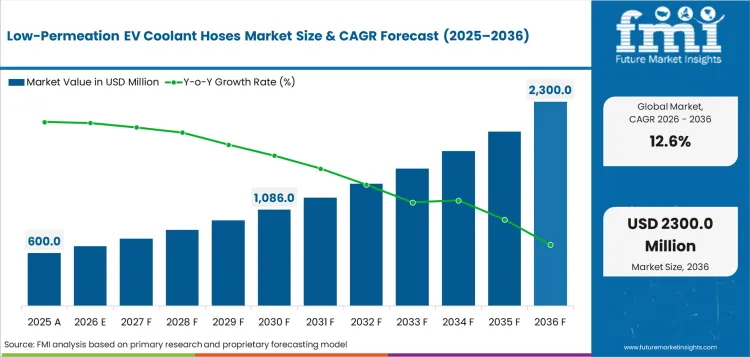
Low-permeation EV coolant hoses market was valued at USD 600.0 million in 2025 and is estimated at USD 700.0 million in 2026. Demand is projected to reach USD 2,300.0 million by 2036 at 12.6% CAGR during the forecast period. OEM line fit is anticipated to represent 83.0% of sales channel demand in 2026. Passenger BEVs are expected to account for 59.0% of vehicle type demand in 2026.
Key Takeaways, Market Size, and Forecast
- Low-permeation EV coolant hoses market stood at USD 600.0 million in 2025.
- By 2036, industry revenue is projected to reach USD 2,300.0 million.
- Industry value is expected to expand at 12.6% CAGR during the forecast period.
- Market revenue is projected to add USD 1,600.0 million in incremental opportunity over 2026 to 2036.
- OEM line fit is anticipated to represent 83.0% of sales channel demand in 2026.
- In 2026, passenger BEVs are expected to account for 59.0% of vehicle type demand.
- During the forecast period, China at 14.8% CAGR and India at 14.1% CAGR lead country-level expansion.
Summary of the Low-Permeation EV Coolant Hoses Market
- Demand and Growth Drivers
- EV batteries need steady cooling during charging and daily driving. Low-permeation hoses help keep coolant inside the system and reduce leak-related checks.
- Automakers are paying closer attention to hose material quality. Battery cooling parts must handle heat and coolant contact over long vehicle use.
- Fast charging creates more heat inside battery packs. Better coolant hoses support safer temperature control and help protect battery life.
- Product and Segment View
- EPDM barrier hoses are preferred because many OEMs already understand rubber hose production. Added barrier layers make them more useful for EV cooling systems.
- Battery coolant loops create steady demand because battery packs need controlled temperature. Hoses used in these loops must support stable coolant flow.
- Molded hose assemblies are gaining use because they fit better around battery trays. Pre-shaped hoses can reduce assembly errors at vehicle plants.
- Geography and Competitive Outlook
- China and India offer strong demand because EV production is expanding in both countries. Local suppliers can benefit if they meet hose testing needs.
- Germany and South Korea support demand through battery and vehicle technology depth. Japan adds support through polymer expertise and EV system experience. Suppliers across all three countries can support hose material testing and EV cooling system needs.
- Competition is based on material testing and sealing performance. Suppliers with proven coolant compatibility can win more EV platform work.
- Analyst Opinion
- Nikhil Kaitwade of FMI says, “Low-permeation coolant hoses are becoming a reliability decision for EV platforms. A small coolant loss can affect battery temperature control and service planning. Manufacturers with proven barrier performance and connector sealing will be preferred in BEV launch programs. Coolant compatibility records add another proof point during supplier selection.”
- Low-Permeation EV Coolant Hoses Market Value Analysis
- The low-permeation EV coolant hoses market is moving from basic fluid routing into a more important EV thermal safety area.
- Market value is supported by battery packs that need steady coolant flow during charging and daily driving.
- OEMs are placing more value on hoses that reduce vapor loss and keep coolant pressure stable inside sealed circuits.
- Market value is increasing as automakers use molded hose assemblies and quick-connect designs to make EV cooling systems easier to install and safer to service.
EV coolant hose design is becoming more important as automakers prepare for stricter emission rules. In April 2024, the USA EPA finalized vehicle emission standards for model years 2027 and later. This gives OEMs a stronger reason to approve cooling parts that can support larger EV programs. NORMA Group shows how this shift is reaching hose suppliers. In July 2024, NORMA Group said it won a contract worth more than EUR 30 million to supply about 1.4 million lightweight tubes per year from December 2026 for battery thermal management.
This shows that EV coolant hoses are moving from small part supply to platform-level contracts. Cooper Standard supports the material side of the same trend. Its 2024 report said PlastiCool multi-layer tubes for glycol systems can reduce weight by up to 60% compared with EPDM hoses. This gives suppliers a clear route to position low-permeation hoses for compact EV cooling systems.
Low-Permeation EV Coolant Hoses Market Definition
Low-permeation EV coolant hoses are specially designed hoses used in electric vehicles. They move coolant through battery packs and power electronics. Some hoses are used near electric drive units too. These hoses help reduce coolant vapor loss inside sealed cooling systems. Stable coolant flow is important because EV batteries need controlled temperature during charging and daily driving. Low-permeation hose materials support safer cooling performance and longer service life. They can reduce leak-related checks as well.
Low-Permeation EV Coolant Hoses Market Inclusions
Market scope covers low-permeation EV coolant hoses categorized by material type, including EPDM barrier hoses, multi-layer TPV hoses, reinforced silicone hoses and nylon hybrid hoses; cooling circuit, including battery coolant loops, e-axle loops, power electronics loops and cabin heat pump loops; vehicle type, including passenger BEVs, electric SUVs, electric vans and electric buses; and hose format, including molded assemblies, straight hoses, branched modules and quick-connect hoses.
The scope also includes hose assemblies used within EV liquid cooling systems where coolant routing, vapor control and connector sealing operate as part of one thermal management process. Revenue scope covers 2026 to 2036. Key stakeholders include EV OEMs, hose manufacturers, thermal module suppliers, coolant system suppliers, polymer compounders, connector makers, battery pack integrators, e-axle suppliers, service workshops and automotive testing providers.
Low-Permeation EV Coolant Hoses Market Exclusions
Scope excludes fuel hoses and brake hoses. Refrigerant-only lines and conventional radiator hoses used only in internal combustion vehicles sit outside the scope. Battery cooling plates and coolant pumps are excluded unless bundled with hose assemblies. Routine coolant replacement is excluded unless sold with hose service kits.
Low-Permeation EV Coolant Hoses Market Research Methodology
- Primary Research: FMI analysts reviewed hose makers and thermal module firms across major automotive countries.
- Desk Research: Public data from IEA and OICA were used for demand checks. ACEA and official national sources were used for validation.
- Market Sizing and Forecasting: Market size was estimated from EV output and liquid cooling circuit intensity.
- Data Validation: Forecast checks compared EV sales direction and supplier product activity across key manufacturing countries.
Why is the Low-Permeation EV Coolant Hoses Market Growing?
- Liquid-cooled battery packs need hoses built to limit coolant vapor loss during charging and daily driving.
- OEMs are reviewing hose materials more closely as glycol coolants and tight routing place more stress on hose walls.
- Validation cost can slow smaller manufacturers as EV hose assemblies need coolant aging and pressure cycling records.
Low-permeation hose demand is part of wider EV thermal system planning as automakers connect battery packs with power electronics and heat pump circuits. EV coolants specifications make material choice more important, since coolant chemistry can affect hose aging and wall stability. Automotive coolant distribution manifold for EV battery parts and automotive electric coolant valve units place hoses closer to compact modules. Hose makers need clean routing and stable sealing near valve bodies and manifolds.
EV production scale is increasing the need for reliable coolant hose systems. IEA reported electric car sales rose by above 20.0% year over year in 2025 and reached 21.0 million units. Each liquid-cooled EV needs hoses that can carry coolant safely between the battery pack and power electronics. Higher vehicle output gives hose suppliers a larger route into OEM programs.
Market Segmentation Analysis
- EPDM barrier hoses are expected to account for 44.0% share in 2026.
- Battery coolant loops are forecast to capture 51.0% of cooling circuit demand in 2026.
- Passenger BEVs are anticipated to represent vehicle type demand of 59.0% in 2026.
- OEM line fit is expected to hold 83.0% share in 2026.
- Molded hose assemblies are forecast to reach 47.0% of hose format demand in 2026.
The market is divided into five primary segment groups based on material type and cooling circuit. Vehicle type, sales channel and hose format complete the structure. Material type covers EPDM barrier hoses and multi-layer TPV hoses. Reinforced silicone hoses and nylon hybrid hoses complete the group. Cooling circuit covers battery coolant loops and e-axle loops. Power electronics loops and cabin heat pump loops are included. Vehicle type covers passenger BEVs and electric SUVs. Electric vans and electric buses complete the vehicle scope. Sales channel covers OEM line fit and service replacement. Thermal module supply completes the channel scope. Hose format covers molded assemblies and straight hoses. Branched modules and quick-connect hoses complete the format scope.
Insights into Low-Permeation EV Coolant Hoses Market by Material Type
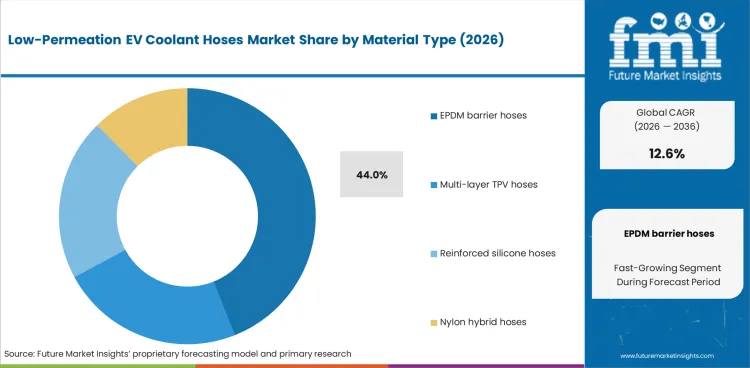
- EPDM barrier hoses are expected to account for 44.0% share in 2026 as OEMs already understand rubber hose production. Added barrier layers help reduce coolant vapor loss in sealed EV cooling loops.
- Multi-layer TPV hoses are expected to see wider use as automakers look for lighter hose materials. Material choice builds on automotive hoses and assemblies experience and radiator hose design knowledge.
Insights into Low-Permeation EV Coolant Hoses Market by Cooling Circuit
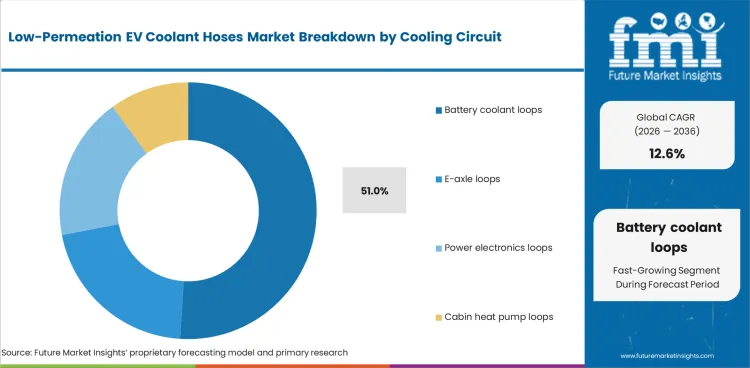
- Battery coolant loops are expected to account for 51.0% share in 2026 as liquid-cooled battery packs need steady coolant flow. Stable hose walls help keep battery temperature under control during charging.
- E-axle loops are expected to support steady hose demand as motors need heat control. Such use connects with e-axle cooling and lubrication system components and axle and differential oil cooling systems planning.
Insights into Low-Permeation EV Coolant Hoses Market by Vehicle Type
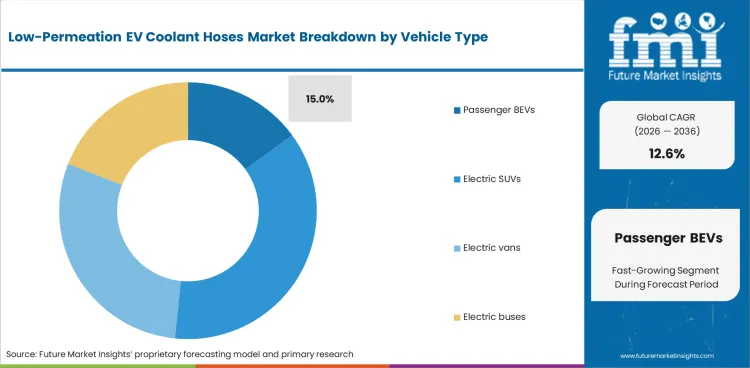
- Passenger BEVs are anticipated to represent 59.0% share in 2026 as high-volume platforms use several coolant hoses. Battery packs and inverters need reliable coolant flow in daily vehicle use.
- Electric vans and buses need longer hose routes because their batteries are larger. Premium EV needs connect with luxury car hoses and bev electric drive unit cooling layouts.
Insights into Low-Permeation EV Coolant Hoses Market by Sales Channel
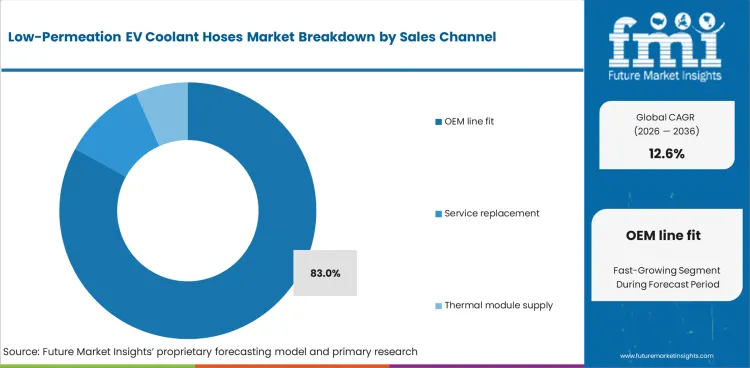
- OEM line fit is expected to capture 83.0% share in 2026 as coolant hoses must match battery pack layout before vehicle launch. Early approval helps reduce leak risk and assembly problems.
- Service replacement demand is expected to improve as older EVs need coolant leak checks. Replacement work can connect with electric coolant pump replacement parts as workshops inspect pumps and hoses together.
Insights into Low-Permeation EV Coolant Hoses Market by Hose Format
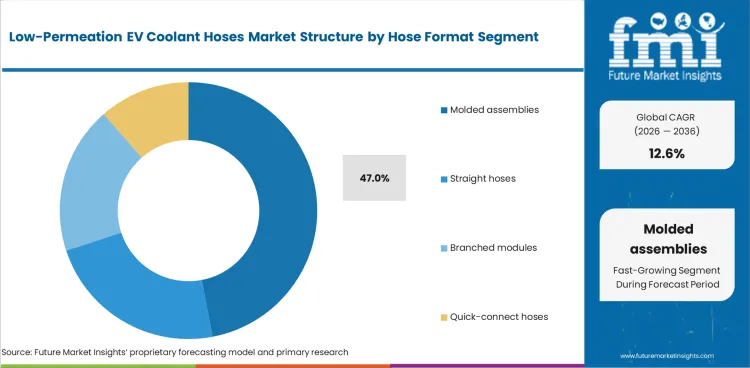
- Molded hose assemblies are expected to account for 47.0% share in 2026 as pre-shaped parts fit better around battery trays. Easier fitting can reduce assembly errors at vehicle plants.
- Branched modules and quick-connect hoses are expected to support faster coolant routing in EV platforms. Similar design needs appear in electric power steering cooling hose systems and engine coolant line quick couplings.
Low-Permeation EV Coolant Hoses Market Drivers, Restraints, and Opportunities
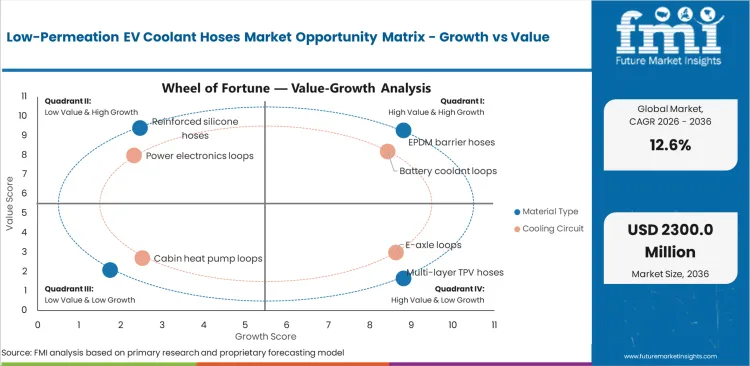
- Fast charging creates more heat inside EV battery packs. Low-permeation hoses help coolant move steadily and reduce vapor loss.
- EV coolant hoses need long testing before they can enter vehicle platforms. High testing cost makes it harder for new suppliers to win large programs.
- Integrated thermal modules are increasing demand for molded hoses and quick-connect assemblies. Automakers prefer parts that are easier to install and safer to seal.
Fast Charging Raises Hose Duty
Fast charging puts heat into battery packs within a short time. Coolant hoses must keep fluid movement stable between plates and manifolds. Hoses with low vapor loss support steady pressure inside sealed circuits. Battery programs need materials able to handle glycol exposure and repeated heat cycles. Stable hose performance lowers leak checks and supports easier service planning.
Material Testing Raises Entry Barriers
Material approval is harder as EV cooling circuits operate near high-voltage parts. In February 2025, Continental developed a synthetic EPDM cooling line for hydrogen powertrains to reduce ion transfer into the media circuit. Low ion movement and stable rubber chemistry protect coolant circuits near electrical systems. Hose manufacturers with heat aging and media testing records are better placed for battery cooling programs.
Integrated Thermal Modules Open Higher Value
Integrated thermal systems are pulling hoses closer to plates and valves. Connectors become part of the same design decision. In April 2026, Sumitomo Riko said it would exhibit a resin tube for BEV cooling piping at EVTF2026. The tube uses polypropylene on the inner layer and laser-welded fastening to reduce parts and pressure loss. Battery thermal plates and thermal management planning make hose design more important as automakers combine coolant flow with pack temperature control.
Analysis of Low-Permeation EV Coolant Hoses Market by Key Countries
.webp "Top Country Growth Comparison Low Permeation Ev Coolant Hoses Market Cagr (2026 2036)")
| Country | CAGR |
|---|---|
| United States | 10.9% |
| China | 14.8% |
| India | 14.1% |
| Germany | 12.2% |
| South Korea | 13.4% |
| Japan | 10.6% |
| United Kingdom | 11.8% |
Source: Future Market Insights, 2026.
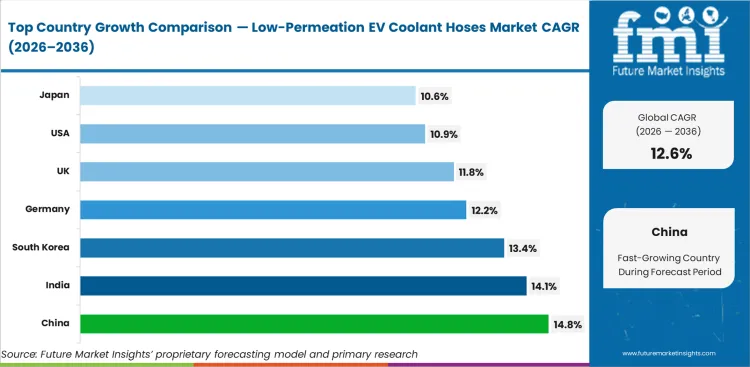
Low-Permeation EV Coolant Hoses Market CAGR Analysis by Country
- China is expected to record 14.8% CAGR through 2036 as NEV output gives hose makers large battery-cooling platform volumes.
- As EV manufacturing and local component sourcing deepen, India is forecast to expand at 14.1% CAGR by 2036.
- Battery and EV platform supply place South Korea at 13.4% CAGR during the forecast period.
- Germany is expected to post 12.2% CAGR by 2036 as BEV fleet expansion needs validated hose assemblies.
- Between 2026 and 2036, United Kingdom demand is forecast at 11.8% CAGR with ZEV rules supporting coolant loop planning.
- Hybrid and BEV platforms place the United States at 10.9% CAGR during the forecast period.
- Japan is expected to advance at 10.6% CAGR through 2036 with domestic polymer suppliers supporting hybrid and BEV thermal parts.
- Global demand for low-permeation EV coolant hoses is forecast to rise at 12.6% CAGR from 2026 to 2036.
Demand Outlook for Low-Permeation EV Coolant Hoses Market in the United States
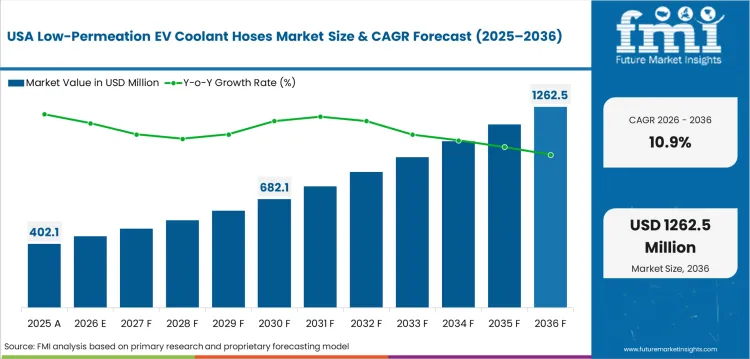
EV coolant hose demand in the United States is tied to BEV and plug-in hybrid platform planning. Argonne National Laboratory reported about 1.5 million plug-in electric vehicles sold in 2025. Battery electric vehicles made up over 80.0% of plug-in sales. The United States is expected to expand at 10.9% CAGR during the forecast period. Local testing support is likely to become important as automakers qualify hoses for battery packs and power electronics.
- Automakers need coolant hoses that seal well around battery packs. Stable sealing can reduce coolant loss and lower the risk of service checks.
- Regional content rules can support local hose assembly. Suppliers with nearby testing support can respond faster to OEM validation needs.
- Older EVs will need leak checks as mileage increases. Service channels can use replacement hoses built for battery cooling systems.
Sales Analysis of Low-Permeation EV Coolant Hoses Market in China
China is expected to record 14.8% CAGR through 2036 as NEV output supports large coolant hose volumes. NEV production reached nearly 13.02 million units during the first ten months of 2025. Higher BEV output raises hose use across battery packs and power electronics. Local platform scale gives hose manufacturers a wider route into OEM programs. Material quality will matter as EV makers serve both domestic and export models.
- Large NEV output gives hose suppliers steady demand from battery cooling programs. High platform volumes can support long production runs.
- Local EV standards increase the need for safer hose materials. Hose makers must prove heat resistance and stable coolant contact.
- Export-focused EV platforms need consistent hose quality across regions. Suppliers with clear testing records can support global vehicle programs.
Demand Outlook for Low-Permeation EV Coolant Hoses Market in India
India’s EV market is moving toward local component supply. NITI Aayog reported EV penetration at 7.6% of sales in 2024. Passenger EV use is lower than electric two-wheelers and buses. A 14.1% CAGR is forecast for India by 2036 as local EV assembly expands. Domestic hose suppliers need low-permeation materials and connector support to enter battery cooling systems.
- Local vehicle assembly can increase demand for hose parts made near EV plants. Shorter supply routes help OEMs manage quality and delivery.
- Electric buses need longer coolant hose routes as compared to passenger cars. Larger hose sizes can create a useful opening for domestic suppliers.
- Testing labs can help Indian suppliers prove hose safety. Validation support is needed before hoses enter BEV coolant systems.
Opportunity Analysis of Low-Permeation EV Coolant Hoses Market in Germany
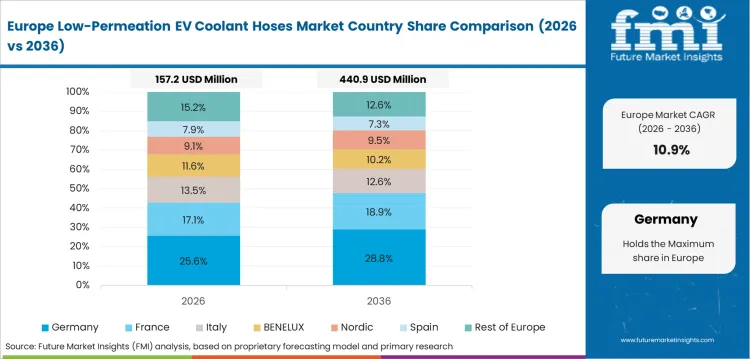
Germany has a large BEV fleet and a well-developed automotive supplier network. The BEV fleet crossed 2.0 million cars at the start of 2026. Premium EV platforms use more complex coolant routes for batteries and power electronics. Demand is expected to post 12.2% CAGR through 2036. Hose suppliers will need precise bends and low coolant loss to serve premium vehicle programs.
- Premium EV platforms need hoses built for tight routing near battery trays. Accurate hose shape can reduce assembly errors.
- European material rules support recyclable and lower-emission polymer choices. Hose makers with clean material records can be preferred.
- Replacement demand can rise as early BEV fleets age. Older vehicles need coolant checks and hose parts suited for electric platforms.
Sales Analysis of Low-Permeation EV Coolant Hoses Market in South Korea
South Korea benefits from battery manufacturing and EV platform supply. IEA reported electric car sales in Korea rose around 65.0% year over year to above 200,000 units in 2025. Battery pack knowledge supports local coolant loop development. South Korea is anticipated to move ahead at 13.4% CAGR during the forecast period. Export-focused automakers need hoses that can meet several regional standards.
- Battery manufacturing supports pack-level coolant hose demand. Hose suppliers can work closer to battery and vehicle engineers.
- Compact EV platforms need molded hoses with stable bend control. Better bend control helps hoses fit tight underbody spaces.
- Export programs need suppliers with fast testing support. Clear documents help automakers approve hoses across several regions.
Future Outlook for Low-Permeation EV Coolant Hoses Market in Japan
Japan has strong rubber and resin material expertise. Toyoda Gosei states cooling piping helps keep batteries at an optimum operating condition. Sumitomo Riko highlighted a resin tube for BEV cooling piping in April 2026. The product uses a polypropylene inner layer and laser-welded fastening to reduce parts and pressure loss in EV cooling systems. Japan is expected to advance at 10.6% CAGR through 2036. Supplier experience in polymer parts will support BEV and hybrid thermal programs.
- Domestic polymer firms can support low-permeation hose development. Rubber and resin knowledge can improve hose wall performance.
- Hybrid platforms keep coolant hose demand active as BEV volumes rise. Both vehicle types need reliable coolant routing.
- Long OEM relationships help suppliers enter early vehicle design stages. Early input can improve hose shape and connector choice.
Future Outlook for Low-Permeation EV Coolant Hoses Market in the United Kingdom
The United Kingdom’s EV outlook is linked to ZEV rules and plug-in vehicle demand. SMMT said BEV car share reached 23.4% in 2025 and is expected to reach 26.8% in 2026. Suppliers with fast engineering support can serve local EV programs and replacement channels. The United Kingdom is forecast at 11.8% CAGR by 2036. Technical support will be important as automakers manage platform changes.
- ZEV rules keep pressure on automakers to expand BEV model availability. More BEV models can increase coolant hose requirements.
- Service channels need reliable replacement hoses for older EVs. Hose quality matters as battery cooling faults can affect vehicle use.
- European supply routes can support UK demand. Suppliers with quick engineering response can serve local programs more effectively.
Competitive Landscape and Strategic Positioning
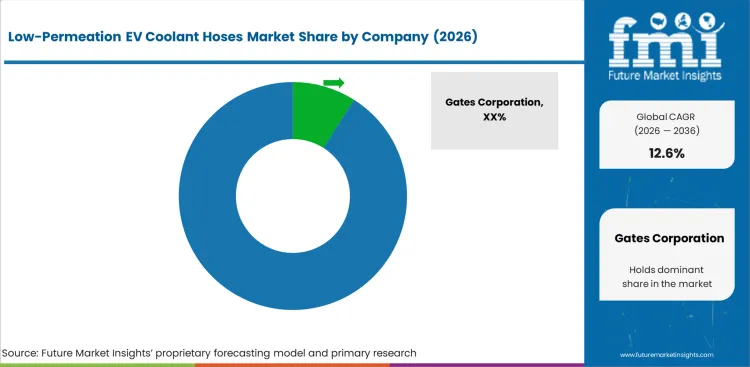
- Competition centers on barrier polymer performance and coolant compatibility records.
- Platform awards depend on molded geometry and connector sealing under heat cycling.
- Thermal module firms can improve bargaining power once hoses are packaged with coolant control parts.
- Entry barriers include material qualification and OEM launch support. Global production coverage supports large BEV platforms.
Competitive positioning depends on proof of low permeation and clean routing. Gates offers ThermalPro hoses with electric water pumps for thermal management. The same portfolio includes coolant valves for temperature control. Continental highlights EV thermal management systems with line systems and connections for heat exchange across vehicle parts. Automotive battery management system and EV transmission system needs keep coolant interfaces close to battery controllers and drive units.
In May 2025, Hutchinson presented electrification systems at Shanghai Auto Show 2025. The display included an Integrated Cooling Module designed to improve an electric vehicle cooling loop. Such activity fits low-permeation hose demand as EV thermal modules need stable fluid routing and sealed connections. Suppliers with cooling module knowledge can support hose design earlier in vehicle development.
Cooper Standard’s 2024 Corporate Responsibility Report, published in 2025, describes its Coolant Flow Hub for hybrid and BEV thermal coolant systems. The hub places connectors and tubing into a single unit. The same report states PlastiCool engineered multilayer tubes can reduce weight by up to 60.0% versus traditional EPDM hoses. Automotive energy recovery systems can increase coolant routing needs as automakers move heat across vehicle systems.
Key Companies in the Low-Permeation EV Coolant Hoses Market
- Barrier Hose Makers: Gates Corporation and Continental AG hold strong positions through hose materials and thermal management portfolios.
- Fluid Routing Specialists: TI Automotive and Hutchinson stand out with integrated fluid systems and customer engineering support.
- Polymer and Regional Specialists: Sumitomo Riko and Toyoda Gosei support EV hose demand through rubber and resin expertise. Cooper Standard adds TPV and fluid transfer depth.
Competitive Benchmarking: Low-Permeation EV Coolant Hoses Market
| Company | Barrier Layer Capability | Coolant Compatibility Testing | OEM Platform Support | Geographic Footprint |
|---|---|---|---|---|
| Gates Corporation | High | Medium | High | Global with North American strength |
| Continental AG | High | High | High | Global with German engineering depth |
| TI Automotive | Medium | High | High | Global Tier 1 fluid systems network |
| Hutchinson | Medium | High | Medium | Europe centered with global OEM reach |
| Sumitomo Riko | High | Medium | Medium | Japan centered with Asian platform depth |
| Toyoda Gosei | Medium | Medium | Medium | Japan and Asia production depth |
| Cooper Standard | High | Medium | Medium | North America and Europe centered |
Source: Future Market Insights competitive analysis, 2026.
Key Developments in Low-Permeation EV Coolant Hoses Market
- In February 2025, TI Fluid Systems launched its 12V Electric Coolant Pump for battery electric vehicles. The pump is designed for BEV thermal management and supports scalable power from 60W to 230W across different vehicle needs.
- In April 2025, Cooper Standard received 2025 Automotive News PACE Pilot recognition for its eCoFlow™ Switch Pump technology. The system combines an electric water pump and electrically driven valve in one coolant control module.
Key Players in the Low-Permeation EV Coolant Hoses Market
Major Global Players
- Gates Corporation
- Continental AG
- TI Automotive
- Hutchinson
- Cooper Standard
Specialist and Regional Players
- Sumitomo Riko Company Limited
- Toyoda Gosei Co., Ltd.
- Parker Hannifin Corporation
Report Scope and Coverage
| Parameter | Details |
|---|---|
| Quantitative Units | USD 700.0 million to USD 2,300.0 million at 12.6% CAGR |
| Market Definition | Low-permeation coolant hoses and hose assemblies used in EV liquid cooling circuits |
| Segments Covered | Material type, cooling circuit, vehicle type, sales channel, hose format, and region |
| Material Type | EPDM barrier hoses, multi-layer TPV hoses, reinforced silicone hoses, and nylon hybrid hoses |
| Cooling Circuit | Battery coolant loops, e-axle loops, power electronics loops, and cabin heat pump loops |
| Vehicle Type | Passenger BEVs, electric SUVs, electric vans, and electric buses |
| Sales Channel | OEM line fit, service replacement, and thermal module supply |
| Hose Format | Molded assemblies, straight hoses, branched modules, and quick-connect hoses |
| Regions Covered | North America, Latin America, Western Europe, Eastern Europe, East Asia, South Asia and Pacific, Middle East and Africa |
| Countries Covered | United States, China, India, Germany, South Korea, Japan, United Kingdom, and more than 30.0 countries |
| Key Companies Profiled | Gates Corporation, Continental AG, TI Automotive, Hutchinson, Cooper Standard, Sumitomo Riko Company Limited, and Toyoda Gosei Co., Ltd. |
| Forecast Period | 2026 to 2036 |
| Approach | Hybrid bottom-up and top-down method using EV output, coolant circuit intensity, hose format mix, material pricing, and supplier activity |
Source: Future Market Insights, 2026.
Low-Permeation EV Coolant Hoses Market Breakdown by Segment and Region
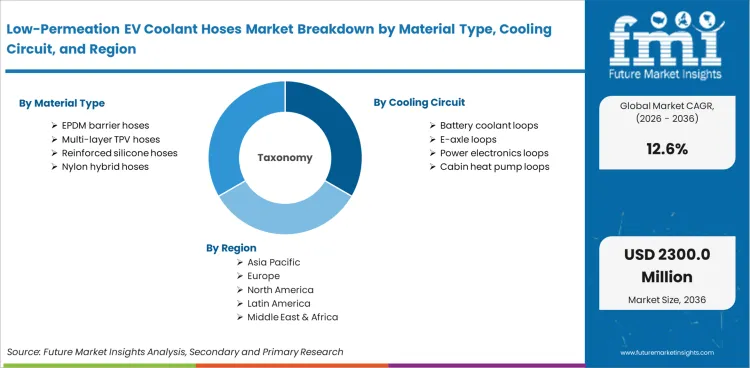
Low-Permeation EV Coolant Hoses Market Segmented by Material Type
- EPDM barrier hoses
- Multi-layer TPV hoses
- Reinforced silicone hoses
- Nylon hybrid hoses
Low-Permeation EV Coolant Hoses Market Segmented by Cooling Circuit
- Battery coolant loops
- E-axle loops
- Power electronics loops
- Cabin heat pump loops
Low-Permeation EV Coolant Hoses Market Segmented by Vehicle Type
- Passenger BEVs
- Electric SUVs
- Electric vans
- Electric buses
Low-Permeation EV Coolant Hoses Market Segmented by Sales Channel
- OEM line fit
- Service replacement
- Thermal module supply
Low-Permeation EV Coolant Hoses Market Segmented by Hose Format
- Molded assemblies
- Straight hoses
- Branched modules
- Quick-connect hoses
Low-Permeation EV Coolant Hoses Market by Region
- North America
- Latin America
- Western Europe
- Eastern Europe
- East Asia
- South Asia and Pacific
- Middle East and Africa
Research Sources and Bibliography
- Argonne National Laboratory. (2026, March). Light duty electric drive vehicles monthly sales updates. Argonne National Laboratory.
- Continental AG. (2025, February 11). Continental introduces solution for one of the greatest challenges in hydrogen powertrains. Continental AG.
- Cooper Standard. (2025, April 25). Cooper Standard receives 2025 Automotive News PACE Pilot recognition. Cooper Standard.
- Cooper Standard. (2025, May 14). 2024 Corporate Responsibility Report: Transformation: Change is constant. Cooper Standard.
- European Alternative Fuels Observatory. (2026, March 2). Germany’s BEV fleet surpasses 2 million units: Major milestone in electrification. European Commission.
- Hutchinson. (2025, May 12). Hutchinson unveils electrification innovations at Shanghai Auto Show 2025. Hutchinson.
- International Energy Agency. (2026). Technology: Electric vehicles. In Global Energy Review 2026. International Energy Agency.
- International Energy Agency. (2026). Trends in electric cars. In Global EV Outlook 2026. International Energy Agency.
- NITI Aayog. (2025, August). Unlocking a $200 billion opportunity: Electric vehicles in India. Government of India.
- Society of Motor Manufacturers and Traders. (2026, April). UK new car and van market data: Car market outlook, trends and forecast. Society of Motor Manufacturers and Traders.
- State Council of the People’s Republic of China. (2025, November 11). China’s NEV output, sales surge in first 10 months of 2025. State Council of the People’s Republic of China.
- Sumitomo Riko Co., Ltd. (2026, April 27). Sumitomo Riko to exhibit products addressing China’s EV sector challenges at EVTF2026. Sumitomo Riko Co., Ltd.
- Sumitomo Riko Co., Ltd. (2026, April 27). Sumitomo Riko to exhibit products addressing China’s EV sector challenges at EVTF2026. Sumitomo Riko Co., Ltd.
- TI Fluid Systems. (2025, February 11). Introducing eCP: The next generation of electric coolant pumps. TI Fluid Systems.
- Toyoda Gosei. (n.d.). Functional components. Toyoda Gosei Americas.
- Environmental Protection Agency. (2024, March 20). Final rule: Multi-pollutant emissions standards for model years 2027 and later light-duty and medium-duty vehicles. USA Environmental Protection Agency.
- NORMA Group. (2024, July 18). NORMA Group provides lightweight tubes for electric vehicles. NORMA Group.
This bibliography is provided for reader reference and is not exhaustive. The full report contains the complete reference list and detailed citations.
This Report Answers
- What is the current and future size of the low-permeation EV coolant hoses market?
- How fast will low-permeation EV coolant hose demand expand during the forecast period?
- Which material type is forecast to lead low-permeation EV coolant hoses in 2026?
- Which cooling circuit is anticipated to account for the leading share in 2026?
- How does OEM line fit influence coolant hose demand in EV platforms?
- Which countries are forecast to exceed the global CAGR between 2026 and 2036?
- Which manufacturers are active in low-permeation EV coolant hose systems?
- How does FMI size and validate the market forecast?
Frequently Asked Questions
What is the global market demand for low-permeation EV coolant hoses in 2026?
In 2026, the global low-permeation EV coolant hoses market is estimated at USD 700.0 million as liquid-cooled EV platforms expand.
How big will the low-permeation EV coolant hoses market be in 2036?
By 2036, low-permeation EV coolant hoses demand is projected to reach USD 2,300.0 million as BEV thermal loops become more complex.
How much will low-permeation EV coolant hose demand expand during the forecast period?
Low-permeation EV coolant hose demand is expected to expand at 12.6% CAGR from 2026 to 2036.
Which material type is forecast to lead the market in 2026?
EPDM barrier hoses are forecast to lead with 44.0% share in 2026 due to proven rubber processing and low-permeation layer options.
Which sales channel is forecast to lead demand?
OEM line fit is forecast to lead with 83.0% share in 2026 as coolant routing is approved during vehicle platform release.
Which country is forecast to advance fastest?
China is expected to record 14.8% CAGR through 2036 as NEV output supports large coolant hose assembly volumes.
What does the market include?
Scope includes low-permeation hoses and molded hose assemblies. Branched modules and quick-connect coolant hoses used in EV liquid cooling circuits are included.
How does FMI estimate the market forecast?
FMI uses EV output checks and coolant circuit review. Hose value assumptions and supplier evidence support the 2026 to 2036 forecast.
Why are low-permeation hoses important in EVs?
Low-permeation hoses reduce coolant vapor loss and help keep pressure stable across battery and e-axle cooling loops.
Which companies are active in the market?
Gates and Continental are active in thermal hose and fluid routing systems. TI Automotive and Hutchinson support fluid routing depth. Sumitomo Riko and Toyoda Gosei complete the active supplier group.
Preview the report firsthand - request a free sample
Get SampleGet the brochure for pricing and purchase details.
Get PDFTable of Content
- Executive Summary
- Global Market Outlook
- Demand-side Trends
- Supply-side Trends
- Technology Roadmap Analysis
- Analysis and Recommendations
- Market Overview
- Market Coverage / Taxonomy
- Market Definition / Scope / Limitations
- Research Methodology
- Chapter Orientation
- Analytical Lens and Working Hypotheses
- Market Structure, Signals, and Trend Drivers
- Benchmarking and Cross-market Comparability
- Market Sizing, Forecasting, and Opportunity Mapping
- Research Design and Evidence Framework
- Desk Research Programme (Secondary Evidence)
- Company Annual and Sustainability Reports
- Peer-reviewed Journals and Academic Literature
- Corporate Websites, Product Literature, and Technical Notes
- Earnings Decks and Investor Briefings
- Statutory Filings and Regulatory Disclosures
- Technical White Papers and Standards Notes
- Trade Journals, Industry Magazines, and Analyst Briefs
- Conference Proceedings, Webinars, and Seminar Materials
- Government Statistics Portals and Public Data Releases
- Press Releases and Reputable Media Coverage
- Specialist Newsletters and Curated Briefings
- Sector Databases and Reference Repositories
- FMI Internal Proprietary Databases and Historical Market Datasets
- Subscription Datasets and Paid Sources
- Social Channels, Communities, and Digital Listening Inputs
- Additional Desk Sources
- Expert Input and Fieldwork (Primary Evidence)
- Primary Modes
- Qualitative Interviews and Expert Elicitation
- Quantitative Surveys and Structured Data Capture
- Blended Approach
- Why Primary Evidence is Used
- Field Techniques
- Interviews
- Surveys
- Focus Groups
- Observational and In-context Research
- Social and Community Interactions
- Stakeholder Universe Engaged
- C-suite Leaders
- Board Members
- Presidents and Vice Presidents
- R&D and Innovation Heads
- Technical Specialists
- Domain Subject-matter Experts
- Scientists
- Physicians and Other Healthcare Professionals
- Governance, Ethics, and Data Stewardship
- Research Ethics
- Data Integrity and Handling
- Primary Modes
- Tooling, Models, and Reference Databases
- Desk Research Programme (Secondary Evidence)
- Data Engineering and Model Build
- Data Acquisition and Ingestion
- Cleaning, Normalisation, and Verification
- Synthesis, Triangulation, and Analysis
- Quality Assurance and Audit Trail
- Market Background
- Market Dynamics
- Drivers
- Restraints
- Opportunity
- Trends
- Scenario Forecast
- Demand in Optimistic Scenario
- Demand in Likely Scenario
- Demand in Conservative Scenario
- Opportunity Map Analysis
- Product Life Cycle Analysis
- Supply Chain Analysis
- Investment Feasibility Matrix
- Value Chain Analysis
- PESTLE and Porter’s Analysis
- Regulatory Landscape
- Regional Parent Market Outlook
- Production and Consumption Statistics
- Import and Export Statistics
- Market Dynamics
- Global Market Analysis 2021 to 2025 and Forecast, 2026 to 2036
- Historical Market Size Value (USD Million) Analysis, 2021 to 2025
- Current and Future Market Size Value (USD Million) Projections, 2026 to 2036
- Y-o-Y Growth Trend Analysis
- Absolute $ Opportunity Analysis
- Global Market Pricing Analysis 2021 to 2025 and Forecast 2026 to 2036
- Global Market Analysis 2021 to 2025 and Forecast 2026 to 2036, By Material Type
- Introduction / Key Findings
- Historical Market Size Value (USD Million) Analysis By Material Type , 2021 to 2025
- Current and Future Market Size Value (USD Million) Analysis and Forecast By Material Type , 2026 to 2036
- EPDM barrier hoses
- Multi-layer TPV hoses
- Reinforced silicone hoses
- Nylon hybrid hoses
- EPDM barrier hoses
- Y-o-Y Growth Trend Analysis By Material Type , 2021 to 2025
- Absolute $ Opportunity Analysis By Material Type , 2026 to 2036
- Global Market Analysis 2021 to 2025 and Forecast 2026 to 2036, By Cooling Circuit
- Introduction / Key Findings
- Historical Market Size Value (USD Million) Analysis By Cooling Circuit, 2021 to 2025
- Current and Future Market Size Value (USD Million) Analysis and Forecast By Cooling Circuit, 2026 to 2036
- Battery coolant loops
- E-axle loops
- Power electronics loops
- Cabin heat pump loops
- Battery coolant loops
- Y-o-Y Growth Trend Analysis By Cooling Circuit, 2021 to 2025
- Absolute $ Opportunity Analysis By Cooling Circuit, 2026 to 2036
- Global Market Analysis 2021 to 2025 and Forecast 2026 to 2036, By Vehicle Type
- Introduction / Key Findings
- Historical Market Size Value (USD Million) Analysis By Vehicle Type, 2021 to 2025
- Current and Future Market Size Value (USD Million) Analysis and Forecast By Vehicle Type, 2026 to 2036
- Passenger BEVs
- Electric SUVs
- Electric vans
- Electric buses
- Passenger BEVs
- Y-o-Y Growth Trend Analysis By Vehicle Type, 2021 to 2025
- Absolute $ Opportunity Analysis By Vehicle Type, 2026 to 2036
- Global Market Analysis 2021 to 2025 and Forecast 2026 to 2036, By Sales Channel
- Introduction / Key Findings
- Historical Market Size Value (USD Million) Analysis By Sales Channel, 2021 to 2025
- Current and Future Market Size Value (USD Million) Analysis and Forecast By Sales Channel, 2026 to 2036
- OEM line fit
- Service replacement
- Thermal module supply
- OEM line fit
- Y-o-Y Growth Trend Analysis By Sales Channel, 2021 to 2025
- Absolute $ Opportunity Analysis By Sales Channel, 2026 to 2036
- Global Market Analysis 2021 to 2025 and Forecast 2026 to 2036, By Hose Format
- Introduction / Key Findings
- Historical Market Size Value (USD Million) Analysis By Hose Format, 2021 to 2025
- Current and Future Market Size Value (USD Million) Analysis and Forecast By Hose Format, 2026 to 2036
- Molded assemblies
- Straight hoses
- Branched modules
- Quick-connect hoses
- Molded assemblies
- Y-o-Y Growth Trend Analysis By Hose Format, 2021 to 2025
- Absolute $ Opportunity Analysis By Hose Format, 2026 to 2036
- Global Market Analysis 2021 to 2025 and Forecast 2026 to 2036, By Region
- Introduction
- Historical Market Size Value (USD Million) Analysis By Region, 2021 to 2025
- Current Market Size Value (USD Million) Analysis and Forecast By Region, 2026 to 2036
- North America
- Latin America
- Western Europe
- Eastern Europe
- East Asia
- South Asia and Pacific
- Middle East & Africa
- Market Attractiveness Analysis By Region
- North America Market Analysis 2021 to 2025 and Forecast 2026 to 2036, By Country
- Historical Market Size Value (USD Million) Trend Analysis By Market Taxonomy, 2021 to 2025
- Market Size Value (USD Million) Forecast By Market Taxonomy, 2026 to 2036
- By Country
- USA
- Canada
- Mexico
- By Material Type
- By Cooling Circuit
- By Vehicle Type
- By Sales Channel
- By Hose Format
- By Country
- Market Attractiveness Analysis
- By Country
- By Material Type
- By Cooling Circuit
- By Vehicle Type
- By Sales Channel
- By Hose Format
- Key Takeaways
- Latin America Market Analysis 2021 to 2025 and Forecast 2026 to 2036, By Country
- Historical Market Size Value (USD Million) Trend Analysis By Market Taxonomy, 2021 to 2025
- Market Size Value (USD Million) Forecast By Market Taxonomy, 2026 to 2036
- By Country
- Brazil
- Chile
- Rest of Latin America
- By Material Type
- By Cooling Circuit
- By Vehicle Type
- By Sales Channel
- By Hose Format
- By Country
- Market Attractiveness Analysis
- By Country
- By Material Type
- By Cooling Circuit
- By Vehicle Type
- By Sales Channel
- By Hose Format
- Key Takeaways
- Western Europe Market Analysis 2021 to 2025 and Forecast 2026 to 2036, By Country
- Historical Market Size Value (USD Million) Trend Analysis By Market Taxonomy, 2021 to 2025
- Market Size Value (USD Million) Forecast By Market Taxonomy, 2026 to 2036
- By Country
- Germany
- UK
- Italy
- Spain
- France
- Nordic
- BENELUX
- Rest of Western Europe
- By Material Type
- By Cooling Circuit
- By Vehicle Type
- By Sales Channel
- By Hose Format
- By Country
- Market Attractiveness Analysis
- By Country
- By Material Type
- By Cooling Circuit
- By Vehicle Type
- By Sales Channel
- By Hose Format
- Key Takeaways
- Eastern Europe Market Analysis 2021 to 2025 and Forecast 2026 to 2036, By Country
- Historical Market Size Value (USD Million) Trend Analysis By Market Taxonomy, 2021 to 2025
- Market Size Value (USD Million) Forecast By Market Taxonomy, 2026 to 2036
- By Country
- Russia
- Poland
- Hungary
- Balkan & Baltic
- Rest of Eastern Europe
- By Material Type
- By Cooling Circuit
- By Vehicle Type
- By Sales Channel
- By Hose Format
- By Country
- Market Attractiveness Analysis
- By Country
- By Material Type
- By Cooling Circuit
- By Vehicle Type
- By Sales Channel
- By Hose Format
- Key Takeaways
- East Asia Market Analysis 2021 to 2025 and Forecast 2026 to 2036, By Country
- Historical Market Size Value (USD Million) Trend Analysis By Market Taxonomy, 2021 to 2025
- Market Size Value (USD Million) Forecast By Market Taxonomy, 2026 to 2036
- By Country
- China
- Japan
- South Korea
- By Material Type
- By Cooling Circuit
- By Vehicle Type
- By Sales Channel
- By Hose Format
- By Country
- Market Attractiveness Analysis
- By Country
- By Material Type
- By Cooling Circuit
- By Vehicle Type
- By Sales Channel
- By Hose Format
- Key Takeaways
- South Asia and Pacific Market Analysis 2021 to 2025 and Forecast 2026 to 2036, By Country
- Historical Market Size Value (USD Million) Trend Analysis By Market Taxonomy, 2021 to 2025
- Market Size Value (USD Million) Forecast By Market Taxonomy, 2026 to 2036
- By Country
- India
- ASEAN
- Australia & New Zealand
- Rest of South Asia and Pacific
- By Material Type
- By Cooling Circuit
- By Vehicle Type
- By Sales Channel
- By Hose Format
- By Country
- Market Attractiveness Analysis
- By Country
- By Material Type
- By Cooling Circuit
- By Vehicle Type
- By Sales Channel
- By Hose Format
- Key Takeaways
- Middle East & Africa Market Analysis 2021 to 2025 and Forecast 2026 to 2036, By Country
- Historical Market Size Value (USD Million) Trend Analysis By Market Taxonomy, 2021 to 2025
- Market Size Value (USD Million) Forecast By Market Taxonomy, 2026 to 2036
- By Country
- Kingdom of Saudi Arabia
- Other GCC Countries
- Turkiye
- South Africa
- Other African Union
- Rest of Middle East & Africa
- By Material Type
- By Cooling Circuit
- By Vehicle Type
- By Sales Channel
- By Hose Format
- By Country
- Market Attractiveness Analysis
- By Country
- By Material Type
- By Cooling Circuit
- By Vehicle Type
- By Sales Channel
- By Hose Format
- Key Takeaways
- Key Countries Market Analysis
- USA
- Pricing Analysis
- Market Share Analysis, 2025
- By Material Type
- By Cooling Circuit
- By Vehicle Type
- By Sales Channel
- By Hose Format
- Canada
- Pricing Analysis
- Market Share Analysis, 2025
- By Material Type
- By Cooling Circuit
- By Vehicle Type
- By Sales Channel
- By Hose Format
- Mexico
- Pricing Analysis
- Market Share Analysis, 2025
- By Material Type
- By Cooling Circuit
- By Vehicle Type
- By Sales Channel
- By Hose Format
- Brazil
- Pricing Analysis
- Market Share Analysis, 2025
- By Material Type
- By Cooling Circuit
- By Vehicle Type
- By Sales Channel
- By Hose Format
- Chile
- Pricing Analysis
- Market Share Analysis, 2025
- By Material Type
- By Cooling Circuit
- By Vehicle Type
- By Sales Channel
- By Hose Format
- Germany
- Pricing Analysis
- Market Share Analysis, 2025
- By Material Type
- By Cooling Circuit
- By Vehicle Type
- By Sales Channel
- By Hose Format
- UK
- Pricing Analysis
- Market Share Analysis, 2025
- By Material Type
- By Cooling Circuit
- By Vehicle Type
- By Sales Channel
- By Hose Format
- Italy
- Pricing Analysis
- Market Share Analysis, 2025
- By Material Type
- By Cooling Circuit
- By Vehicle Type
- By Sales Channel
- By Hose Format
- Spain
- Pricing Analysis
- Market Share Analysis, 2025
- By Material Type
- By Cooling Circuit
- By Vehicle Type
- By Sales Channel
- By Hose Format
- France
- Pricing Analysis
- Market Share Analysis, 2025
- By Material Type
- By Cooling Circuit
- By Vehicle Type
- By Sales Channel
- By Hose Format
- India
- Pricing Analysis
- Market Share Analysis, 2025
- By Material Type
- By Cooling Circuit
- By Vehicle Type
- By Sales Channel
- By Hose Format
- ASEAN
- Pricing Analysis
- Market Share Analysis, 2025
- By Material Type
- By Cooling Circuit
- By Vehicle Type
- By Sales Channel
- By Hose Format
- Australia & New Zealand
- Pricing Analysis
- Market Share Analysis, 2025
- By Material Type
- By Cooling Circuit
- By Vehicle Type
- By Sales Channel
- By Hose Format
- China
- Pricing Analysis
- Market Share Analysis, 2025
- By Material Type
- By Cooling Circuit
- By Vehicle Type
- By Sales Channel
- By Hose Format
- Japan
- Pricing Analysis
- Market Share Analysis, 2025
- By Material Type
- By Cooling Circuit
- By Vehicle Type
- By Sales Channel
- By Hose Format
- South Korea
- Pricing Analysis
- Market Share Analysis, 2025
- By Material Type
- By Cooling Circuit
- By Vehicle Type
- By Sales Channel
- By Hose Format
- Russia
- Pricing Analysis
- Market Share Analysis, 2025
- By Material Type
- By Cooling Circuit
- By Vehicle Type
- By Sales Channel
- By Hose Format
- Poland
- Pricing Analysis
- Market Share Analysis, 2025
- By Material Type
- By Cooling Circuit
- By Vehicle Type
- By Sales Channel
- By Hose Format
- Hungary
- Pricing Analysis
- Market Share Analysis, 2025
- By Material Type
- By Cooling Circuit
- By Vehicle Type
- By Sales Channel
- By Hose Format
- Kingdom of Saudi Arabia
- Pricing Analysis
- Market Share Analysis, 2025
- By Material Type
- By Cooling Circuit
- By Vehicle Type
- By Sales Channel
- By Hose Format
- Turkiye
- Pricing Analysis
- Market Share Analysis, 2025
- By Material Type
- By Cooling Circuit
- By Vehicle Type
- By Sales Channel
- By Hose Format
- South Africa
- Pricing Analysis
- Market Share Analysis, 2025
- By Material Type
- By Cooling Circuit
- By Vehicle Type
- By Sales Channel
- By Hose Format
- USA
- Market Structure Analysis
- Competition Dashboard
- Competition Benchmarking
- Market Share Analysis of Top Players
- By Regional
- By Material Type
- By Cooling Circuit
- By Vehicle Type
- By Sales Channel
- By Hose Format
- Competition Analysis
- Competition Deep Dive
- Gates Corporation
- Overview
- Product Portfolio
- Profitability by Market Segments (Product/Age /Sales Channel/Region)
- Sales Footprint
- Strategy Overview
- Marketing Strategy
- Product Strategy
- Channel Strategy
- Continental AG
- TI Automotive
- Hutchinson
- Sumitomo Riko
- Toyoda Gosei
- Cooper Standard
- Gates Corporation
- Competition Deep Dive
- Assumptions & Acronyms Used


