

- Industry Size (2026)
- USD 0.9 Bn
- Forecast (2036)
- USD 3.1 Bn
- CAGR (2026 to 2036)
- 13.2%
Automotive Coolant Distribution Manifold for EV Battery Market Size, Market Forecast and Outlook By FMI
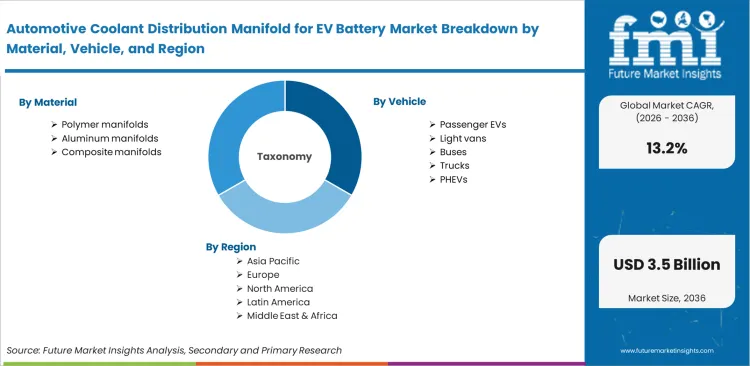
The automotive coolant distribution manifold for the EV battery market crossed a valuation of USD 0.8 billion in 2025. Sales expansion propels total valuation to USD 3.1 billion through 2036, establishing 13.2% CAGR starting from USD 0.9 billion in 2026.
Summary of Automotive Coolant Distribution Manifold for EV Battery Market
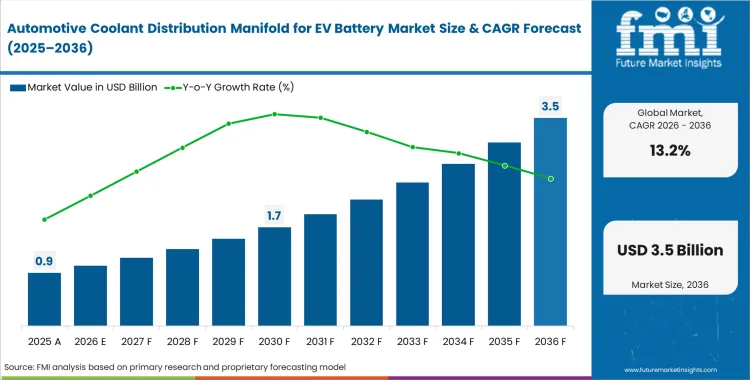
FMI analysis indicates that the shift from localized passive cooling toward pack-wide active liquid routing is steadily expanding demand, as battery systems require tighter thermal control under faster charging cycles and higher pack complexity.
Battery thermal architecture is being defined earlier in the vehicle development cycle as pack integration becomes more demanding. Weight reduction, cell temperature consistency, and packaging efficiency are pushing coolant manifold design into a more central role within battery system planning. Material choice between polymer and aluminum formats now carries greater importance, since lighter assemblies can support pack efficiency while fast-charging conditions place tighter demands on sealing strength and pressure tolerance. Cooling systems also need to manage stable flow, controlled pressure, and low mass at the same time. Programs that fail to account for pressure spikes or sealing fatigue during repeated fast-charging use may face leakage risk, module replacement, and higher lifecycle cost.
Platform standardization is also supporting wider use of integrated coolant distribution manifolds. Once multiple vehicle lines are built around a common battery layout, suppliers can spread tooling investment across larger production volumes. That scale improves the cost position of more complex molded designs and reduces the advantage once held by older multi-hose layouts. Pack-level active cooling is therefore becoming easier to justify through manufacturing efficiency as well as thermal control. This shift strengthens the case for manifold integration as a design decision tied to both performance and production economics.
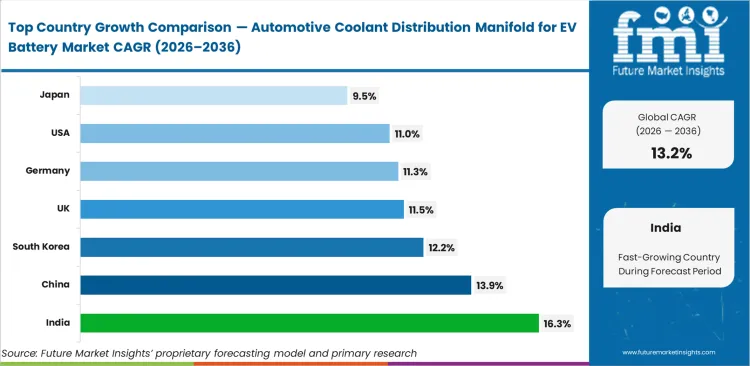
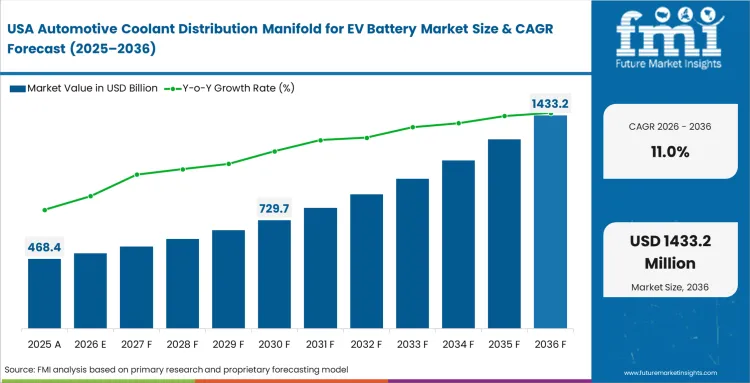
India is projected to expand at a CAGR of 16.3% through 2036 as domestic EV manufacturing capacity builds from a relatively low base and creates room for localized supply expansion. China is estimated to grow at 13.9%, supported by its large battery pack production base and broad electrified vehicle output. South Korea is expected to register 12.2% CAGR, where advanced battery engineering continues to support tighter thermal-management requirements. The United Kingdom and Germany are likely to record CAGRs of 11.5% and 11.3%, respectively, reflecting demand tied to high-performance thermal control standards. The United States is anticipated to rise at 11.0% during the forecast period, while Japan is projected to grow at 9.5% as adoption remains more measured across battery platform strategies. Differences across these markets reflect whether manufacturers are prioritizing high-volume battery assembly economics or more demanding fast-charging thermal precision.
Segmental Analysis
Automotive Coolant Distribution Manifold for EV Battery Market Analysis by Material
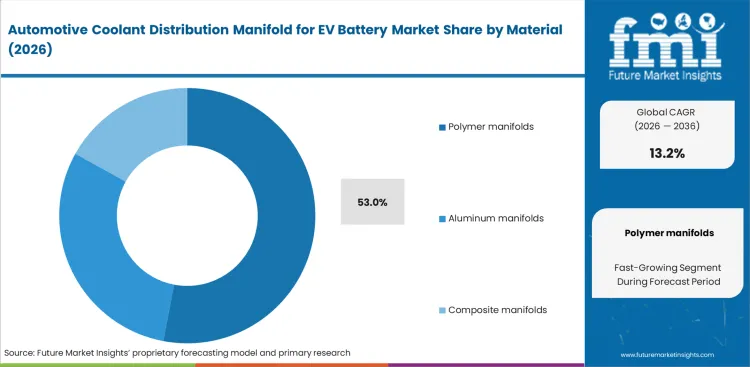
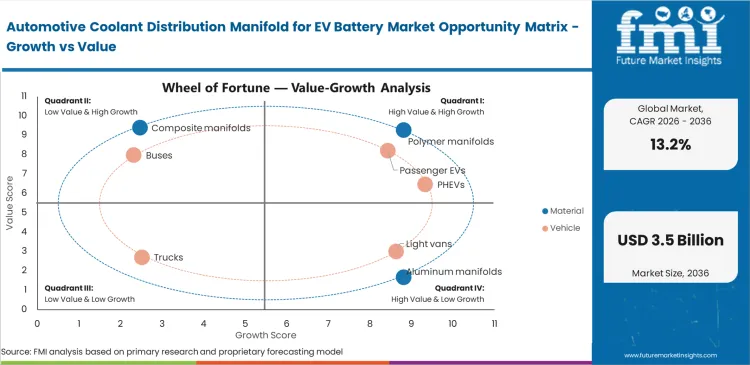
Material selection in battery coolant manifolds is shaped by a direct trade-off between weight reduction, molding complexity, and long-term dimensional control. Polymer manifolds are poised to account for 53.0% share in 2026 as EV platforms continue shifting toward reinforced plastics that help reduce enclosure mass and simplify part integration. Complex internal channels can be molded into one structure, which lowers assembly steps and supports tighter packaging inside the battery system. Integration with EV coolant filters and strainers also becomes important because small particles from manufacturing can obstruct narrow polymer passages more easily than larger metallic channels. Long manifold lengths still create a demanding production problem, since uneven shrinkage during molding can distort geometry under repeated temperature swings. Dimensional accuracy remains a qualification issue from the first tool trial through final OEM approval.
- Weight reduction economics: Reinforced polymer designs reduce assembly mass and allow multiple routing features to be consolidated into a single molded part.
- Dimensional stability failure: Uneven cooling during molding can distort manifold geometry and push parts out of tolerance before pack assembly begins.
- Late-stage validation lock-in: Once a resin system is approved for chemical and thermal compatibility, material substitution usually initiates a full new validation cycle.
Automotive Coolant Distribution Manifold for EV Battery Market Analysis by Vehicle
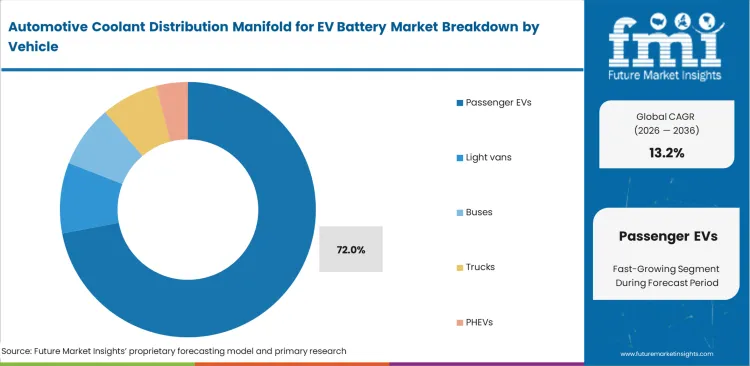
Vehicle layout sets the boundary conditions for manifold design, especially in EVs built around underfloor battery packs. Passenger vehicle applications are anticipated to secure 72.0% share in 2026, supported by the scale of mainstream EV programs and the packaging pressure created by low-profile pack designs. Floor-mounted batteries leave limited vertical space, which forces fluid routing into flatter and tighter geometries than those used in larger commercial platforms. Adding an automotive electric coolant valve into the same assembly helps reduce extra connection points while preserving pack height. Compact passenger layouts also make structural compromise more visible, because thin channels and flattened sections are harder to reinforce without affecting pressure drop. Cooling performance in these programs depends as much on packaging discipline as on fluid design.
- Packaging space constraints: Underfloor pack geometry forces very low-profile manifold routing and limits how much vertical clearance thermal systems can consume.
- Flow restriction compromises: Flat channel designs can increase resistance and may require higher pump effort to maintain target coolant circulation.
- Volume-driven standardization: Large passenger EV production volumes push suppliers toward automated welding, testing, and repeatable high-speed assembly methods.
Automotive Coolant Distribution Manifold for EV Battery Market Analysis by Cooling Circuit
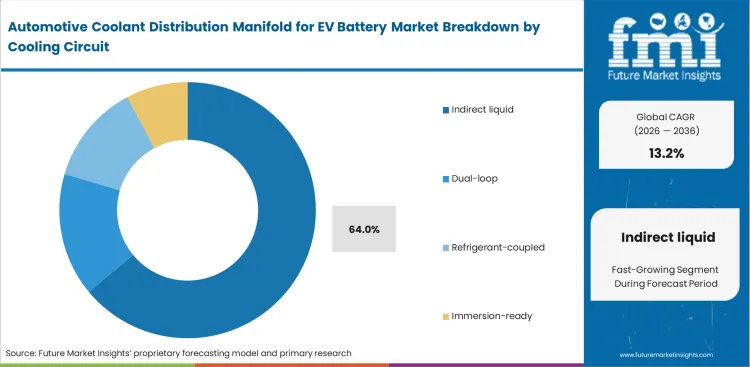
Cooling circuit architecture is defined first by electrical safety, then by heat rejection capability and sealing reliability. Indirect liquid circuits are projected to hold 64.0% share in 2026 because they keep coolant physically separated from live battery cells while still supporting scalable pack cooling. That arrangement remains attractive for EV manufacturers working within strict isolation requirements and established validation standards. Thermal transfer in these systems depends on several interfaces between the cell and the coolant path, and high-thermal-conductivity gap-fill adhesives for EV battery cooling plates often become necessary to reduce resistance across those layers. Fast-charging conditions place added pressure on this layout because higher flow demand increases stress at joints, seals, and connection points. Leak control remains central to circuit design because even a small fluid escape inside the pack can lead to immediate isolation faults.
- Isolation safety requirement: Indirect systems maintain physical separation between coolant flow and energized cell components, supporting a well-understood compliance path.
- Thermal bridging friction: Heat must cross multiple material layers before reaching the coolant, which raises dependence on interface quality and pump capacity.
- Leak detection imperative: Connection integrity remains critical because internal coolant leakage can disrupt pack operation and create immediate fault conditions.
Automotive Coolant Distribution Manifold for EV Battery Market Analysis by Battery Format
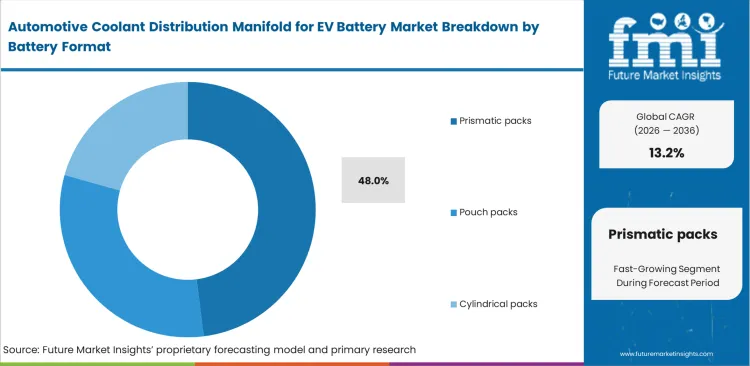
Battery format determines how coolant is distributed across the pack and how many branch connections the manifold must support. Prismatic pack layouts allow straight, flat-sided thermal interfaces that simplify external routing compared with more connection-heavy cylindrical arrangements. A prismatic battery pack coolant manifold is estimated to capture 48.0% share in 2026, reflecting the design efficiency of linear flow paths built around block-shaped cells. Straight manifold runs also work well with liquid cooling quick couplers, which help reduce installation time at the assembly stage. Fewer branch points mean fewer sealing interfaces across the pack, which improves system simplicity and lowers cumulative leak exposure. Format choice, therefore, affects not only module geometry but also production ease and long-term connection reliability.
- Geometry-driven routing: Prismatic cells support straighter manifold layouts and reduce the design complexity associated with dense branch networks.
- Connection point vulnerability: Every branch and seal still requires uniform seating pressure to avoid leak risk during final battery assembly.
- Automated assembly transition: Linear manifold geometry fits more easily into robotic insertion and repeatable high-throughput manufacturing processes.
Automotive Coolant Distribution Manifold for EV Battery Market Analysis by Sales Channel
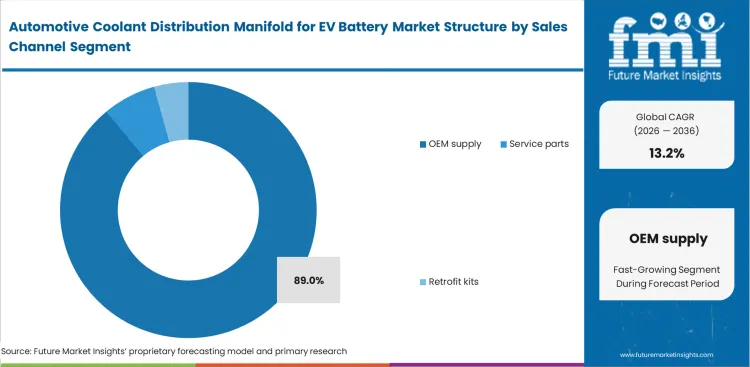
Channel structure in this market is shaped by pack serviceability rather than open replacement demand. Internal manifolds are buried inside sealed battery enclosures, which keeps replacement access limited across most vehicle life cycles. OEM supply is set to represent 89.0% share in 2026, since the manifold is specified during platform development and remains embedded in the pack for years. Service activity usually centers on fluid handling and automotive coolant replacement rather than direct manifold intervention. Suppliers therefore operate within a long-cycle OEM framework where part availability, storage obligations, and service support extend well beyond active vehicle production. Inventory burden remains part of the commercial equation because low-turnover legacy parts still need to be available for approved support programs.
- Initial platform bidding: OEM awards are tied to long production forecasts, which makes early design wins commercially important for manifold suppliers.
- Sealed-pack barrier: Internal manifold access is limited in service environments, so repairs often move to module-level replacement rather than part-level intervention.
- End-of-life obligation: Suppliers are often required to maintain matching parts and tooling support long after regular vehicle production has ended.
Automotive Coolant Distribution Manifold for EV Battery Market Drivers, Restraints, and Opportunities
Rising fast-charging requirements are strengthening demand for more advanced battery coolant manifold systems. As charging capacity moves from lower-power architectures toward 350-kilowatt environments, thermal management hardware faces tighter performance demands across the pack. Simple cooling layouts are less capable of handling the heat load created under these conditions, especially where uniform temperature control across cells remains critical. Manifold design is therefore becoming more important to battery integration, since weak thermal distribution can limit charge performance and reduce platform competitiveness. This shift is pushing manufacturers away from basic fitting arrangements and toward more controlled flow architectures built for higher thermal stress.
A key constraint on broader deployment remains the production challenge tied to large polymer manifold assemblies. Molding complex parts at scale is one step, though joining long sections without seam weakness introduces a separate manufacturing risk. Vibration welding for large-format components often requires specialized equipment, close process control, and extended validation before leak performance becomes reliable. Capital intensity also remains high, which can slow capacity expansion for newer manifold formats. Manufacturing readiness is therefore emerging as an important filter in supplier selection, especially where large-volume EV programs require both design precision and repeatable sealing performance.
Opportunities in the Automotive Coolant Distribution Manifold for EV Battery Market
- Integrated sensor channels: Temperature and pressure sensors can be embedded directly into the manifold molding. This eliminates secondary wiring harnesses and gives OEMs real-time fluid diagnostics.
- Direct immersion routing: Research departments preparing for next-generation dielectric cooling require specialized low-pressure distribution systems. Suppliers developing immersion-ready architectures gain a head start on future platforms.
- Modular extrusion blocks: Substituting expensive custom injection molds with modular liquid cold plates and adaptable manifold blocks allows suppliers to service low-volume commercial EV manufacturers profitably.
Regional Analysis
Based on regional analysis, automotive coolant distribution manifold for EV battery market is segmented into North America, Europe, Asia Pacific, and other regions across 40 plus countries.
.webp "Top Country Growth Comparison Automotive Coolant Distribution Manifold For Ev Battery Market Cagr (2026 2036)")
| Country | CAGR (2026 to 2036) |
|---|---|
| China | 13.9% |
| India | 16.3% |
| United States | 11.0% |
| Germany | 11.3% |
| South Korea | 12.2% |
| Japan | 9.5% |
| United Kingdom | 11.5% |
Source: Future Market Insights (FMI) analysis, based on proprietary forecasting model and primary research
Asia Pacific Automotive Coolant Distribution Manifold for EV Battery Market Analysis
Battery integrators prioritize ultra-high-volume production techniques, pushing suppliers to deliver heavily standardized manifold designs that slot easily into robotic assembly lines. Relentless price pressure at the local level forces tier‑1 fluid handlers to prioritize manufacturing speed instead of bespoke engineering. FMI points out how this relentless focus on scale creates a unique ecosystem where suppliers routinely handle production runs triple the size of Western counterparts, allowing them to iterate welding and quality control processes much faster.
- China: Massive battery pack output guarantees continuous high-volume orders for regional suppliers. The pursuit of the lowest global unit costs has established the China EV battery coolant manifold industry as a primary export base for finished battery modules. Sales of fluid distribution hardware in China are expected to increase at a CAGR of 13.9% during the forecast period. Manufacturers integrating smoothly with local gigafactories consistently capture unmatched market share.
- India: India is set to record a CAGR of 16.3% in automotive thermal manifold sales during the assessment period. Scaling from a smaller baseline provides significant room for localized electric vehicle thermal-content expansion. Production engineers actively transition from air-cooled two-wheelers to liquid-cooled passenger vehicles, accelerating the India EV battery coolant manifold industry. Early movers establishing local injection molding capacity secure long-term contracts with emerging domestic automakers.
- South Korea: Premium battery engineering pushes local manufacturers toward highly complex thermal architectures. Companies within the South Korea EV battery coolant manifold segment demand components capable of handling severe pressure spikes without failure. South Korea is projected to witness 12.2% CAGR in manifold adoption through 2036. Advancements perfected within this specific manufacturing hub consistently dictate exact technical standards for global premium vehicle platforms.
- Japan: Adoption in Japan is expected to remain measured as battery electric platforms expand alongside a still-relevant hybrid base. Demand for EV battery coolant manifolds in Japan is projected to rise at a CAGR of 9.5% during 2026 to 2036. Product development in this market continues to favor durability, sealing consistency, and long-term fluid control over aggressive charging performance targets. Qualification standards remain strict, which supports suppliers with proven reliability in automotive fluid routing applications.
FMI's report includes broader Southeast Asian markets not detailed above. Emerging assembly operations in adjacent nations increasingly rely on Chinese supply chains for initial manifold shipments before establishing domestic molding capabilities for the wider EV thermal system.
North America Automotive Coolant Distribution Manifold for EV Battery Market Analysis
Automaker preferences for large-format electric trucks and SUVs completely alter physical requirements of thermal distribution systems. Companies must route coolant across massive battery packs spanning entire chassis dimensions, demanding an electric truck battery coolant manifold physically longer and more rigid than those used in standard sedans. Increased scale exacerbates pressure drops and raises weld seam failure risks over long spans. Domestic tier-1 suppliers respond by exploring hybrid material approaches, utilizing aluminum for long straight runs and polymers for complex branch connections, attempting to balance cost against sheer size of thermal loops.
- United States: EV manifold demand across the United States is set to rise at an 11.0% CAGR through 2036. Uneven vehicle adoption across different states complicates volume forecasting for major component suppliers. Logistics operations in the United States EV battery coolant manifold industry struggle to balance inventory amid fluctuating automaker production schedules. Securing flexible manufacturing lines allows suppliers to adapt when OEMs abruptly shift vehicle volumes.
FMI's report includes Canada and Mexico within regional scope. Cross-border supply chains remain critical, as heavy manifold assemblies are frequently molded in Mexico to supply final vehicle integration plants in American Midwest facilities.
Europe Automotive Coolant Distribution Manifold for EV Battery Market Analysis
Strict regulatory environments and strong legacies of premium automotive engineering shape local sourcing decisions. European automakers prioritize advanced thermal architecture requirements, frequently specifying multi-loop systems managing cabin heating, battery cooling, and motor thermal loads simultaneously. Integrating multiple loops requires highly sophisticated automotive cooling circuit manifolds with embedded valving and precise flow control. Based on FMI's assessment, local suppliers focus heavily on using advanced recyclable polyamides to meet strict environmental mandates, adding severe chemical complexity to sourcing processes.
- Germany: Strict advanced thermal architecture requirements stem directly from dominance among luxury automakers. Thermal engineers navigating the Germany EV battery coolant manifold segment demand exact temperature uniformity to preserve battery life during continuous high-speed driving. German sector adoption is expected to register a CAGR of 11.3% in manifold sales during the forecast period. Suppliers delivering flawless flow dynamics consistently win high-margin flagship programs, completely locking out cheaper alternatives.
- United Kingdom: Concentrated investments in localized battery manufacturing hubs accelerate domestic demand for thermal components. Adoption of distribution manifolds in the United Kingdom is expected to move ahead at a CAGR of 11.5% from 2026 to 2036. Firms within the United Kingdom EV battery coolant manifold industry work aggressively to onshore critical plastic molding capabilities, establishing local tooling to avoid severe import friction.
FMI's report includes France, Italy, and Scandinavia. Nordic adoption rates create specific cold-weather engineering requirements, forcing manifold designs to accommodate viscous fluids at sub-zero startup conditions without stressing internal seals.
Competitive Aligners for Market Players
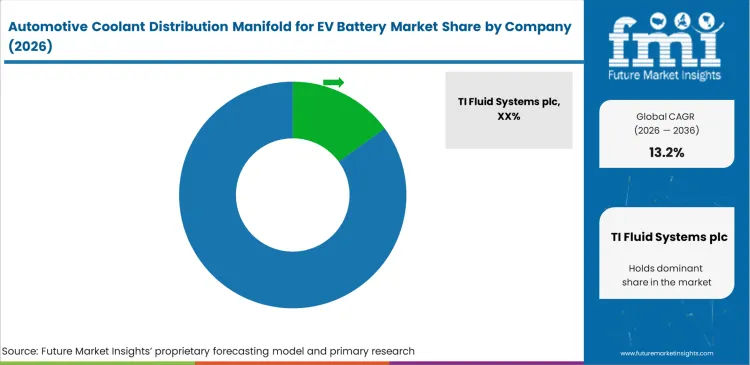
Established suppliers retain a strong position in this market because validation depth matters as much as production capacity. Long-term burst testing, flow behavior analysis, and thermal durability records remain central to coolant manifold qualification across battery platforms. Material data built around glass-filled polyamides, coolant exposure, and repeated fast-charging stress helps reduce leakage risk during platform approval. New entrants may secure molding capability relatively quickly, yet limited validation history often keeps them focused on less critical applications where qualification thresholds are lower.
Tier-1 fluid routing specialists also benefit from broader system integration capability. Coolant manifold design is increasingly tied to valves, sensors, and thermal control functions rather than standing alone as a molded plastic part. This integrated approach can reduce assembly complexity and improve packaging efficiency within the battery system. Suppliers limited to basic hose and fluid transfer components often find it harder to match this level of engineering scope. Competitive strength in this segment is therefore moving toward module-level capability instead of part supply alone.
Automakers still try to limit supplier dependence by using more standardized connection points across battery pack designs. Volume awards are often structured to maintain pricing discipline during early sourcing stages. Even so, internal flow geometry remains closely linked to pack architecture, cooling logic, and calibration requirements. A mid-program supplier change can introduce differences in flow resistance that affect thermal balance across the system. Pricing pressure may be strongest before tooling is finalized, though validated design fit typically becomes more important once production is underway.
Key Players in Automotive Coolant Distribution Manifold for EV Battery Market
- TI Fluid Systems plc
- Valeo
- Dana Incorporated
- Hanon Systems
- MAHLE GmbH
- Marelli Holdings Co., Ltd.
Scope of the Report
| Metric | Value |
|---|---|
| Quantitative Units | USD 0.9 billion to USD 3.1 billion, at a CAGR of 13.2% |
| Market Definition | Automotive coolant distribution manifolds for EV batteries are specialized fluid-routing structures that balance temperature across battery modules. They integrate supply and return channels into a single assembly, replacing discrete hoses to eliminate leak points and reduce weight inside the battery pack. |
| Segmentation | Material, Vehicle, Cooling circuit, Battery format, Sales channel, and Region |
| Regions Covered | North America, Latin America, Europe, Asia Pacific, Middle East and Africa |
| Countries Covered | United States, Canada, Brazil, Mexico, Germany, United Kingdom, France, Spain, Italy, China, Japan, South Korea, India, GCC, South Africa |
| Key Companies Profiled | TI Fluid Systems plc, Valeo, Dana Incorporated, Hanon Systems, MAHLE GmbH, Marelli Holdings Co., Ltd. |
| Forecast Period | 2026 to 2036 |
| Approach | Baseline established via annual EV battery pack production volumes multiplied by average manifold assembly value per pack architecture. |
Source: Future Market Insights (FMI) analysis, based on proprietary forecasting model and primary research
Automotive Coolant Distribution Manifold for EV Battery Market Analysis by Segments
By Material:
- Polymer manifolds
- Aluminum manifolds
- Composite manifolds
By Vehicle:
- Passenger EVs
- Light vans
- Buses
- Trucks
- PHEVs
By Cooling circuit:
- Indirect liquid
- Dual-loop
- Refrigerant-coupled
- Immersion-ready
By Battery format:
- Prismatic packs
- Pouch packs
- Cylindrical packs
By Sales channel:
- OEM supply
- Service parts
- Retrofit kits
By Region:
- North America
- United States
- Canada
- Latin America
- Brazil
- Mexico
- Europe
- Germany
- United Kingdom
- France
- Spain
- Italy
- Asia Pacific
- China
- Japan
- South Korea
- India
- Middle East and Africa
- GCC
- South Africa
Bibliography
- Hwang, F. S., Confrey, T., Reidy, C., Picovici, D., Callaghan, D., Culliton, D., & Nolan, C. (2024). Review of battery thermal management systems in electric vehicles. Renewable and Sustainable Energy Reviews, 192, 114171.
- Salehzadeh, F. J., & Heyhat, M. M. (2025). Direct and indirect cooling of Lithium-ion batteries with New manifold designs. Thermal Science and Engineering Progress, 68, 104325.
- Uwalaka, L. I., Yao, Q., Kollmeyer, P., & Emadi, A. (2024). Review of Production Electric Vehicle Battery Thermal Management Systems and Experimental Testing of a Production Battery Module. SAE Technical Paper 2024-01-2672.
- Saxon, A., Yang, C., Santhanagopalan, S., Keyser, M., & Colclasure, A. (2024). Li-Ion Battery Thermal Characterization for Thermal Management Design. Batteries, 10(4), 136.
- Tai, L. D., Garud, K. S., Hwang, S.-G., & Lee, M.-Y. (2024). A Review on Advanced Battery Thermal Management Systems for Fast Charging in Electric Vehicles. Batteries, 10(10), 372.
This bibliography is provided for reader reference. The full FMI report contains the complete reference list with primary source documentation.
This Report Addresses
- Polymer molding constraints impacting ev battery coolant manifold trends through 2036.
- Warranty risks associated with high-pressure fluid leaks in fast-charging battery packs.
- Operational friction preventing rapid transition from rigid aluminum extrusions to advanced polyamides.
- Exact mechanism driving tier-1 supplier lock-in during early-stage thermal architecture design.
- Consequences of failing dimensional stability tests for passenger EV flat-channel manifolds.
- Geographically distinct sourcing strategies between high-volume Asian assembly and premium European engineering.
- Differences in fluid routing across prismatic, pouch, and cylindrical battery formats.
- Implication of lifetime parts warehousing for sealed-pack thermal components.
Frequently Asked Questions
What is an EV battery coolant distribution manifold, and how does it function?
These are engineered conduits designed to route, balance, and manage thermal fluids across battery pack modules. They integrate supply and return channels into a single assembly, replacing discrete hoses to optimize flow rates and minimize internal pressure drops.
Why do EV battery packs need a coolant manifold instead of passive cooling?
Modern fast-charging profiles generate high localized heat that passive cooling cannot reject. Engineers require manifolds to force active liquid coolant uniformly across every cell, preventing degradation and thermal runaway.
How does a battery coolant manifold work in an electric vehicle?
The manifold acts as a central distribution hub. It receives pressurized fluid from the main vehicle pump and divides it equally into multiple branch channels that feed cold plates beneath or between the battery modules, returning the warmed fluid back to the chiller.
What materials are used in EV battery coolant manifolds?
The industry primarily relies on glass-filled polyamides (polymers) for mass savings and moldability. Aluminum extrusions remain common for heavy-duty applications requiring extreme rigidity, while advanced composite variations address specific chemical resistance needs.
How does a battery cooling plate vs coolant manifold comparison look?
A cooling plate sits directly against the battery cells to absorb heat, acting as the thermal interface. The manifold is the plumbing network that delivers the cold fluid to those plates and carries the hot fluid away.
What is the difference between an EV battery chiller vs coolant manifold?
The chiller is the active refrigeration component that removes heat from the liquid. The manifold is the passive distribution hardware that routes that chilled liquid through the battery pack itself.
Can fast charging change coolant manifold design?
Yes, charging at 350 kilowatts requires massive heat rejection, which demands much higher fluid flow rates. Manifolds must be redesigned with stronger joints and wider internal channels to handle the resulting pressure spikes without bursting.
What is the fast-charging impact on battery coolant manifold design regarding pressures?
High-kilowatt charging forces pumps to work harder, stressing every weld seam and connection point. Engineers must specify burst-tested polymers and vibration-welded joints to survive continuous high-pressure cycling.
Why is leak testing for ev battery coolant manifold components critical?
Fluid escaping inside a high-voltage battery pack causes immediate isolation faults and potential shorts. To guarantee safety, 100% of production units with trace helium gas must be tested before factory installation.
Can the EV battery thermal loop architecture explained briefly show the manifold's role?
The loop begins at the pump, pushes fluid through the chiller, and enters the battery pack via the main supply line. The manifold receives this line, splits the fluid across the module cold plates, and recombines it into the return line to complete the cycle.
How do engineers evaluate a battery manifold vs hose assembly in ev thermal systems?
Engineers replace traditional multi-hose assemblies with integrated manifolds because a single molded piece eliminates dozens of connection points, drastically reducing both assembly time and the statistical probability of a coolant leak.
Why do engineers prefer a prismatic vs cylindrical pack coolant manifold design?
Prismatic cells align in neat rows, allowing for simple, linear manifold structures with fewer branch connections. Cylindrical packs require highly complex micro-channel routing that complicates the injection molding process and increases failure risk.
What limits the adoption of full-pack immersion cooling manifolds?
Direct immersion requires completely dielectric fluids and massive volumes of coolant compared to indirect systems. Fluid handling equipment must scale up dramatically, necessitating highly specialized, low-pressure routing systems.
Why do automakers struggle to switch manifold suppliers mid-production?
Changing a manifold design alters the exact fluid pressure drop across the battery pack. Switching suppliers requires re-validating the entire thermal management software to ensure the rear modules still receive adequate coolant.
What difference explains India's faster growth compared to Japan?
India is rapidly scaling its localized battery assembly from a very small baseline, driving aggressive new tooling investments. Japan maintains a cautious, slow-moving transition toward full electrics, focusing heavily on proven reliability.
Why do passenger vehicles dominate the vehicle segment share?
Mass-market automakers concentrate heavily on passenger sedans and crossovers, prioritizing cabin space optimization. This forces thermal engineers to design ultra-flat, low-profile manifolds that fit beneath floorboards.
How do tier-1 suppliers protect their profit margins against OEM pricing pressure?
Ev battery coolant manifold key players integrate sensors, valves, and quick-connect couplers directly into the manifold molding. Providing a complete, validated cooling module prevents automakers from substituting cheaper, less integrated alternatives.
What makes indirect liquid cooling the preferred circuit architecture?
Indirect systems physically isolate the conductive coolant from the live battery terminals. The known safety profile drives reliance on cold plates and thermal gap fillers to transfer heat while avoiding liquid exposure to the cells.
Why is aftermarket demand almost non-existent for internal battery manifolds?
Manifolds are buried deep inside sealed enclosures designed to last the life of the vehicle. Service technicians cannot easily access them, meaning any internal thermal failure results in a complete module replacement.
What makes an electric bus battery coolant manifold different from passenger car designs?
Commercial vehicles run continuously under heavy load. Their manifolds must handle higher, consistent fluid volumes and are often built from more rigid aluminum extrusions to survive long operating cycles without vibration fatigue.
Why do European automakers require more complex manifold designs?
European regulations and consumer expectations create sophisticated thermal architectures that balance cabin heating, motor cooling, and battery temperature simultaneously. This multi-loop requirement forces manifolds to incorporate advanced valving.
What constraint slows the deployment of massive polymer manifolds for electric trucks?
Joining the two halves of a three-foot-long plastic manifold requires specialized vibration-welding machinery. Equipment lead times and the difficulty of preventing leaks along such a long weld seam severely restrict production capacity.
What is the primary advantage of integrating cold plates with modular manifold blocks?
Modular designs allow best suppliers for EV battery cooling manifolds to service low-volume commercial EV manufacturers profitably. Instead of cutting expensive custom injection molds, engineers assemble adaptable standard blocks to fit unique pack dimensions.
How does a phev battery coolant manifold differ from full battery electric models?
Plug-in hybrid electric vehicle packs are smaller and must share thermal loads with an internal combustion engine. The manifold routing must integrate seamlessly with traditional cooling loops, requiring sophisticated bypass valving to manage dual power sources.
Preview the report firsthand - request a free sample
Get SampleGet the brochure for pricing and purchase details.
Get PDFTable of Content
- Executive Summary
- Global Market Outlook
- Demand-side Trends
- Supply-side Trends
- Technology Roadmap Analysis
- Analysis and Recommendations
- Market Overview
- Market Coverage / Taxonomy
- Market Definition / Scope / Limitations
- Research Methodology
- Chapter Orientation
- Analytical Lens and Working Hypotheses
- Market Structure, Signals, and Trend Drivers
- Benchmarking and Cross-market Comparability
- Market Sizing, Forecasting, and Opportunity Mapping
- Research Design and Evidence Framework
- Desk Research Programme (Secondary Evidence)
- Company Annual and Sustainability Reports
- Peer-reviewed Journals and Academic Literature
- Corporate Websites, Product Literature, and Technical Notes
- Earnings Decks and Investor Briefings
- Statutory Filings and Regulatory Disclosures
- Technical White Papers and Standards Notes
- Trade Journals, Industry Magazines, and Analyst Briefs
- Conference Proceedings, Webinars, and Seminar Materials
- Government Statistics Portals and Public Data Releases
- Press Releases and Reputable Media Coverage
- Specialist Newsletters and Curated Briefings
- Sector Databases and Reference Repositories
- FMI Internal Proprietary Databases and Historical Market Datasets
- Subscription Datasets and Paid Sources
- Social Channels, Communities, and Digital Listening Inputs
- Additional Desk Sources
- Expert Input and Fieldwork (Primary Evidence)
- Primary Modes
- Qualitative Interviews and Expert Elicitation
- Quantitative Surveys and Structured Data Capture
- Blended Approach
- Why Primary Evidence is Used
- Field Techniques
- Interviews
- Surveys
- Focus Groups
- Observational and In-context Research
- Social and Community Interactions
- Stakeholder Universe Engaged
- C-suite Leaders
- Board Members
- Presidents and Vice Presidents
- R&D and Innovation Heads
- Technical Specialists
- Domain Subject-matter Experts
- Scientists
- Physicians and Other Healthcare Professionals
- Governance, Ethics, and Data Stewardship
- Research Ethics
- Data Integrity and Handling
- Primary Modes
- Tooling, Models, and Reference Databases
- Desk Research Programme (Secondary Evidence)
- Data Engineering and Model Build
- Data Acquisition and Ingestion
- Cleaning, Normalisation, and Verification
- Synthesis, Triangulation, and Analysis
- Quality Assurance and Audit Trail
- Market Background
- Market Dynamics
- Drivers
- Restraints
- Opportunity
- Trends
- Scenario Forecast
- Demand in Optimistic Scenario
- Demand in Likely Scenario
- Demand in Conservative Scenario
- Opportunity Map Analysis
- Product Life Cycle Analysis
- Supply Chain Analysis
- Investment Feasibility Matrix
- Value Chain Analysis
- PESTLE and Porter’s Analysis
- Regulatory Landscape
- Regional Parent Market Outlook
- Production and Consumption Statistics
- Import and Export Statistics
- Market Dynamics
- Global Market Analysis 2021 to 2025 and Forecast, 2026 to 2036
- Historical Market Size Value (USD Million) Analysis, 2021 to 2025
- Current and Future Market Size Value (USD Million) Projections, 2026 to 2036
- Y-o-Y Growth Trend Analysis
- Absolute $ Opportunity Analysis
- Global Market Pricing Analysis 2021 to 2025 and Forecast 2026 to 2036
- Global Market Analysis 2021 to 2025 and Forecast 2026 to 2036, By Material
- Introduction / Key Findings
- Historical Market Size Value (USD Million) Analysis By Material , 2021 to 2025
- Current and Future Market Size Value (USD Million) Analysis and Forecast By Material , 2026 to 2036
- Polymer manifolds
- Aluminum manifolds
- Composite manifolds
- Polymer manifolds
- Y-o-Y Growth Trend Analysis By Material , 2021 to 2025
- Absolute $ Opportunity Analysis By Material , 2026 to 2036
- Global Market Analysis 2021 to 2025 and Forecast 2026 to 2036, By Vehicle
- Introduction / Key Findings
- Historical Market Size Value (USD Million) Analysis By Vehicle, 2021 to 2025
- Current and Future Market Size Value (USD Million) Analysis and Forecast By Vehicle, 2026 to 2036
- Passenger EVs
- Light vans
- Buses
- Trucks
- PHEVs
- Passenger EVs
- Y-o-Y Growth Trend Analysis By Vehicle, 2021 to 2025
- Absolute $ Opportunity Analysis By Vehicle, 2026 to 2036
- Global Market Analysis 2021 to 2025 and Forecast 2026 to 2036, By Cooling Circuit
- Introduction / Key Findings
- Historical Market Size Value (USD Million) Analysis By Cooling Circuit, 2021 to 2025
- Current and Future Market Size Value (USD Million) Analysis and Forecast By Cooling Circuit, 2026 to 2036
- Indirect liquid
- Dual-loop
- Refrigerant-coupled
- Immersion-ready
- Indirect liquid
- Y-o-Y Growth Trend Analysis By Cooling Circuit, 2021 to 2025
- Absolute $ Opportunity Analysis By Cooling Circuit, 2026 to 2036
- Global Market Analysis 2021 to 2025 and Forecast 2026 to 2036, By Battery Format
- Introduction / Key Findings
- Historical Market Size Value (USD Million) Analysis By Battery Format, 2021 to 2025
- Current and Future Market Size Value (USD Million) Analysis and Forecast By Battery Format, 2026 to 2036
- Prismatic packs
- Pouch packs
- Cylindrical packs
- Prismatic packs
- Y-o-Y Growth Trend Analysis By Battery Format, 2021 to 2025
- Absolute $ Opportunity Analysis By Battery Format, 2026 to 2036
- Global Market Analysis 2021 to 2025 and Forecast 2026 to 2036, By Sales Channel
- Introduction / Key Findings
- Historical Market Size Value (USD Million) Analysis By Sales Channel, 2021 to 2025
- Current and Future Market Size Value (USD Million) Analysis and Forecast By Sales Channel, 2026 to 2036
- OEM supply
- Service parts
- Retrofit kits
- OEM supply
- Y-o-Y Growth Trend Analysis By Sales Channel, 2021 to 2025
- Absolute $ Opportunity Analysis By Sales Channel, 2026 to 2036
- Global Market Analysis 2021 to 2025 and Forecast 2026 to 2036, By Region
- Introduction
- Historical Market Size Value (USD Million) Analysis By Region, 2021 to 2025
- Current Market Size Value (USD Million) Analysis and Forecast By Region, 2026 to 2036
- North America
- Latin America
- Western Europe
- Eastern Europe
- East Asia
- South Asia and Pacific
- Middle East & Africa
- Market Attractiveness Analysis By Region
- North America Market Analysis 2021 to 2025 and Forecast 2026 to 2036, By Country
- Historical Market Size Value (USD Million) Trend Analysis By Market Taxonomy, 2021 to 2025
- Market Size Value (USD Million) Forecast By Market Taxonomy, 2026 to 2036
- By Country
- USA
- Canada
- Mexico
- By Material
- By Vehicle
- By Cooling Circuit
- By Battery Format
- By Sales Channel
- By Country
- Market Attractiveness Analysis
- By Country
- By Material
- By Vehicle
- By Cooling Circuit
- By Battery Format
- By Sales Channel
- Key Takeaways
- Latin America Market Analysis 2021 to 2025 and Forecast 2026 to 2036, By Country
- Historical Market Size Value (USD Million) Trend Analysis By Market Taxonomy, 2021 to 2025
- Market Size Value (USD Million) Forecast By Market Taxonomy, 2026 to 2036
- By Country
- Brazil
- Chile
- Rest of Latin America
- By Material
- By Vehicle
- By Cooling Circuit
- By Battery Format
- By Sales Channel
- By Country
- Market Attractiveness Analysis
- By Country
- By Material
- By Vehicle
- By Cooling Circuit
- By Battery Format
- By Sales Channel
- Key Takeaways
- Western Europe Market Analysis 2021 to 2025 and Forecast 2026 to 2036, By Country
- Historical Market Size Value (USD Million) Trend Analysis By Market Taxonomy, 2021 to 2025
- Market Size Value (USD Million) Forecast By Market Taxonomy, 2026 to 2036
- By Country
- Germany
- UK
- Italy
- Spain
- France
- Nordic
- BENELUX
- Rest of Western Europe
- By Material
- By Vehicle
- By Cooling Circuit
- By Battery Format
- By Sales Channel
- By Country
- Market Attractiveness Analysis
- By Country
- By Material
- By Vehicle
- By Cooling Circuit
- By Battery Format
- By Sales Channel
- Key Takeaways
- Eastern Europe Market Analysis 2021 to 2025 and Forecast 2026 to 2036, By Country
- Historical Market Size Value (USD Million) Trend Analysis By Market Taxonomy, 2021 to 2025
- Market Size Value (USD Million) Forecast By Market Taxonomy, 2026 to 2036
- By Country
- Russia
- Poland
- Hungary
- Balkan & Baltic
- Rest of Eastern Europe
- By Material
- By Vehicle
- By Cooling Circuit
- By Battery Format
- By Sales Channel
- By Country
- Market Attractiveness Analysis
- By Country
- By Material
- By Vehicle
- By Cooling Circuit
- By Battery Format
- By Sales Channel
- Key Takeaways
- East Asia Market Analysis 2021 to 2025 and Forecast 2026 to 2036, By Country
- Historical Market Size Value (USD Million) Trend Analysis By Market Taxonomy, 2021 to 2025
- Market Size Value (USD Million) Forecast By Market Taxonomy, 2026 to 2036
- By Country
- China
- Japan
- South Korea
- By Material
- By Vehicle
- By Cooling Circuit
- By Battery Format
- By Sales Channel
- By Country
- Market Attractiveness Analysis
- By Country
- By Material
- By Vehicle
- By Cooling Circuit
- By Battery Format
- By Sales Channel
- Key Takeaways
- South Asia and Pacific Market Analysis 2021 to 2025 and Forecast 2026 to 2036, By Country
- Historical Market Size Value (USD Million) Trend Analysis By Market Taxonomy, 2021 to 2025
- Market Size Value (USD Million) Forecast By Market Taxonomy, 2026 to 2036
- By Country
- India
- ASEAN
- Australia & New Zealand
- Rest of South Asia and Pacific
- By Material
- By Vehicle
- By Cooling Circuit
- By Battery Format
- By Sales Channel
- By Country
- Market Attractiveness Analysis
- By Country
- By Material
- By Vehicle
- By Cooling Circuit
- By Battery Format
- By Sales Channel
- Key Takeaways
- Middle East & Africa Market Analysis 2021 to 2025 and Forecast 2026 to 2036, By Country
- Historical Market Size Value (USD Million) Trend Analysis By Market Taxonomy, 2021 to 2025
- Market Size Value (USD Million) Forecast By Market Taxonomy, 2026 to 2036
- By Country
- Kingdom of Saudi Arabia
- Other GCC Countries
- Turkiye
- South Africa
- Other African Union
- Rest of Middle East & Africa
- By Material
- By Vehicle
- By Cooling Circuit
- By Battery Format
- By Sales Channel
- By Country
- Market Attractiveness Analysis
- By Country
- By Material
- By Vehicle
- By Cooling Circuit
- By Battery Format
- By Sales Channel
- Key Takeaways
- Key Countries Market Analysis
- USA
- Pricing Analysis
- Market Share Analysis, 2025
- By Material
- By Vehicle
- By Cooling Circuit
- By Battery Format
- By Sales Channel
- Canada
- Pricing Analysis
- Market Share Analysis, 2025
- By Material
- By Vehicle
- By Cooling Circuit
- By Battery Format
- By Sales Channel
- Mexico
- Pricing Analysis
- Market Share Analysis, 2025
- By Material
- By Vehicle
- By Cooling Circuit
- By Battery Format
- By Sales Channel
- Brazil
- Pricing Analysis
- Market Share Analysis, 2025
- By Material
- By Vehicle
- By Cooling Circuit
- By Battery Format
- By Sales Channel
- Chile
- Pricing Analysis
- Market Share Analysis, 2025
- By Material
- By Vehicle
- By Cooling Circuit
- By Battery Format
- By Sales Channel
- Germany
- Pricing Analysis
- Market Share Analysis, 2025
- By Material
- By Vehicle
- By Cooling Circuit
- By Battery Format
- By Sales Channel
- UK
- Pricing Analysis
- Market Share Analysis, 2025
- By Material
- By Vehicle
- By Cooling Circuit
- By Battery Format
- By Sales Channel
- Italy
- Pricing Analysis
- Market Share Analysis, 2025
- By Material
- By Vehicle
- By Cooling Circuit
- By Battery Format
- By Sales Channel
- Spain
- Pricing Analysis
- Market Share Analysis, 2025
- By Material
- By Vehicle
- By Cooling Circuit
- By Battery Format
- By Sales Channel
- France
- Pricing Analysis
- Market Share Analysis, 2025
- By Material
- By Vehicle
- By Cooling Circuit
- By Battery Format
- By Sales Channel
- India
- Pricing Analysis
- Market Share Analysis, 2025
- By Material
- By Vehicle
- By Cooling Circuit
- By Battery Format
- By Sales Channel
- ASEAN
- Pricing Analysis
- Market Share Analysis, 2025
- By Material
- By Vehicle
- By Cooling Circuit
- By Battery Format
- By Sales Channel
- Australia & New Zealand
- Pricing Analysis
- Market Share Analysis, 2025
- By Material
- By Vehicle
- By Cooling Circuit
- By Battery Format
- By Sales Channel
- China
- Pricing Analysis
- Market Share Analysis, 2025
- By Material
- By Vehicle
- By Cooling Circuit
- By Battery Format
- By Sales Channel
- Japan
- Pricing Analysis
- Market Share Analysis, 2025
- By Material
- By Vehicle
- By Cooling Circuit
- By Battery Format
- By Sales Channel
- South Korea
- Pricing Analysis
- Market Share Analysis, 2025
- By Material
- By Vehicle
- By Cooling Circuit
- By Battery Format
- By Sales Channel
- Russia
- Pricing Analysis
- Market Share Analysis, 2025
- By Material
- By Vehicle
- By Cooling Circuit
- By Battery Format
- By Sales Channel
- Poland
- Pricing Analysis
- Market Share Analysis, 2025
- By Material
- By Vehicle
- By Cooling Circuit
- By Battery Format
- By Sales Channel
- Hungary
- Pricing Analysis
- Market Share Analysis, 2025
- By Material
- By Vehicle
- By Cooling Circuit
- By Battery Format
- By Sales Channel
- Kingdom of Saudi Arabia
- Pricing Analysis
- Market Share Analysis, 2025
- By Material
- By Vehicle
- By Cooling Circuit
- By Battery Format
- By Sales Channel
- Turkiye
- Pricing Analysis
- Market Share Analysis, 2025
- By Material
- By Vehicle
- By Cooling Circuit
- By Battery Format
- By Sales Channel
- South Africa
- Pricing Analysis
- Market Share Analysis, 2025
- By Material
- By Vehicle
- By Cooling Circuit
- By Battery Format
- By Sales Channel
- USA
- Market Structure Analysis
- Competition Dashboard
- Competition Benchmarking
- Market Share Analysis of Top Players
- By Region
- By Material
- By Vehicle
- By Cooling Circuit
- By Battery Format
- By Sales Channel
- Competition Analysis
- Competition Deep Dive
- TI Fluid Systems plc
- Overview
- Product Portfolio
- Profitability by Market Segments (Product/Age /Sales Channel/Region)
- Sales Footprint
- Strategy Overview
- Marketing Strategy
- Product Strategy
- Channel Strategy
- Valeo
- Dana Incorporated
- Hanon Systems
- MAHLE GmbH
- Marelli Holdings Co., Ltd.
- TI Fluid Systems plc
- Competition Deep Dive
- Assumptions & Acronyms Used


