

- Industry Size (2026)
- USD 1.2 Bn
- Forecast (2036)
- USD 2.9 Bn
- CAGR (2026 to 2036)
- 9.2%
Liquid Cooling Quick Couplers Market Size and Share Forecast Outlook 2026 to 2036
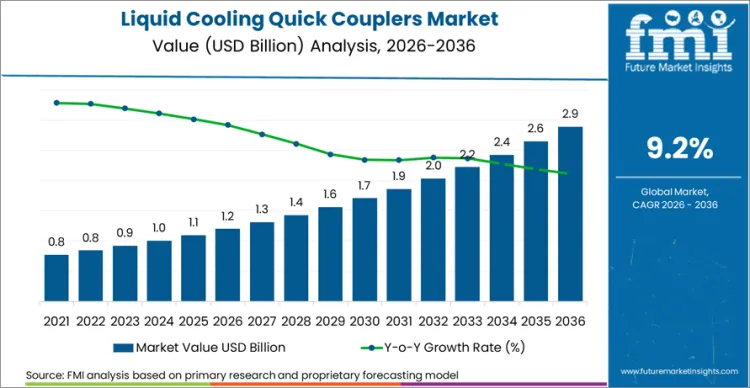
Liquid cooling quick couplers market revenue is projected to total USD 1.2 billion in 2026, increasing to USD 2.9 billion by 2036, at a CAGR of 9.2%. FMI analysis indicates the market is experiencing accelerated growth driven by the wholesale transition from permanent, brazed cooling loops to modular, serviceable architectures. The 2026 to 2027 period will be defined by the formal standardization of coupler interfaces and the integration of leak-detection capabilities directly into the coupling mechanism.
Growth is anchored in the operational demands of hyperscale data centers and electric vehicle battery pack production. The USA Department of Energy’s 2025 report on data center energy efficiency explicitly recommends quick-disconnect couplings as a best practice for maintaining liquid cooling system serviceability without facility-wide drainage. This endorsement pushes the technology from optional to essential in new data center designs.
Vertiv Holdings Co. announced in Q1 2026 the qualification of its new dry-break quick coupler series for use with 3M’s Novec 7100 and Engineered Fluids’ dielectric coolants. The couplers are rated for 50,000 mate/de-mate cycles and feature a proprietary double-valve mechanism that reduces fluid loss to less than 0.1ml per disconnect, addressing a major operational hurdle in server hot-swap environments.
Technical innovation focuses on reducing coupling force and enabling blind mating in dense racks. CoolIT Systems, Inc. disclosed a partnership with a major server OEM in late 2025 to develop a low-profile, push-to-connect coupler that integrates directly into the server tray blind-mate interface. This design allows a fully populated rack to be serviced from the front, eliminating the need for rear access and reducing service time by an estimated 70%.
Schneider Electric SE integrated smart quick couplers with embedded pressure and temperature sensors into its EcoStruxure IT platform in February 2026. The data from these couplers provides real-time flow verification and early warning of blockage or degradation, shifting maintenance from scheduled to predictive.
Rittal GmbH & Co. KG expanded its production capacity for stainless-steel quick couplers in early 2026, citing a 250% increase in demand from the industrial laser and semiconductor fabrication sectors, where couplers are used in chilled water systems for manufacturing equipment.
Summary of Liquid Cooling Quick Couplers Market
What is the Long-Term Growth Outlook for the Liquid Cooling Quick Coupler Market?
FMI projects the global liquid cooling quick coupler market to expand from USD 1.2 billion in 2026 to USD 2.9 billion by 2036, registering a 9.2% CAGR. Market expansion reflects the critical need for serviceability and modularity in liquid-cooled systems across data centers, EV manufacturing, and industrial processes. Quick couplers are no longer convenience items but are foundational components that determine system uptime, water usage efficiency, and operational flexibility.
This growth is propelled by the rapid scaling of AI cluster deployments requiring constant hardware refreshes, the stringent water conservation regulations in data-dense regions, and the automotive industry’s adoption of direct-cooled battery packs. Demand is accelerating for couplers that offer guaranteed dry-disconnect performance, high chemical compatibility, and fail-safe locking mechanisms.
FMI Research Approach: This projection is derived from FMI’s proprietary forecasting framework integrating data center retrofit rates, EV gigafactory construction timelines, industrial automation investment data, and primary interviews with facility managers and maintenance engineers.
How do FMI Analysts Expect the Liquid Cooling Quick Coupler Market to Evolve Structurally?
FMI analysts anticipate a rapid transition from a fragmented landscape of proprietary, vendor-locked coupling designs to a standardized ecosystem dominated by a few form factors. This evolution is driven by operator demand for interchangeability and the influence of consortiums like the Open Compute Project. The market will stratify into high-performance couplers for dielectric fluids and more economical couplers for water/glycol mixtures.
Innovations such as magnetic quick couplers for zero-force mating, couplers with self-sealing antimicrobial diaphragms, and couplers incorporating RFID tags for fluid lineage tracking are redefining performance benchmarks. The integration of couplers with flexible, retractable coolant hoses is also creating new product categories for dynamic applications.
FMI Research Approach: Insights are informed by analysis of interface standardization efforts, patent filings related to sealing technologies and sensor integration, and procurement specifications from cloud service providers and automotive OEMs.
Which Geographies Command the Largest Share of the Liquid Cooling Quick Coupler Market?
China leads the global market, advancing at an estimated 12.4% CAGR, driven by its massive build-out of liquid-cooled AI data centers and dominance in EV battery pack assembly. The United States follows with an 11.9% CAGR, underpinned by hyperscaler investments and Department of Defense specifications for deployable, rugged cooling systems.
The UK and Germany represent high-growth European markets at 10.9% and 10.8% CAGR, influenced by strict EU regulations on data center water usage and the region’s leadership in industrial automation requiring cooled machinery. Japan’s 9.7% CAGR is supported by its semiconductor fabrication industry and high-density urban data centers.
FMI Research Approach: Country-level forecasts are built using analysis of regional data center construction pipelines, national industrial policy, water stress maps, and supplier manufacturing footprint concentrations.
What Will Be the Market Size of Liquid Cooling Quick Couplers by 2036?
By 2036, the liquid cooling quick coupler market is expected to reach USD 2.9 billion. This growth will be supported by the near-universal adoption of quick-disconnect functionality in new liquid cooling installations and the large-scale retrofit of existing facilities to improve serviceability. The market will see a disproportionate revenue shift toward "smart" or "connected" couplers that offer diagnostic data, commanding a significant price premium over passive mechanical units.
FMI Research Approach: Long-term market sizing incorporates installed base analysis of liquid-cooled racks, average coupler count per system, replacement rate forecasts, and adoption curves for predictive maintenance technologies.
What are some Globally Distinct Trends Shaping the Liquid Cooling Quick Coupler Market?
Globally, the market is being shaped by the intersection of operational efficiency, sustainability, and supply chain resilience. The need for faster server deployment and repair in AI clusters is making tool-less, blind-mate quick couplers a de facto standard for new server designs. Sustainability regulations are pushing for couplers that minimize fluid loss and evaporation, directly conserving costly dielectric coolant and reducing environmental impact.
Concurrently, the risk of supply chain disruption for specialized seals and alloys is driving end-users to favor coupler designs that use standardized, commoditized components. This trend favors larger manufacturers with diversified sourcing over niche specialists reliant on single-source materials.
FMI Research Approach: Trend analysis is informed by operational data from colocation providers, sustainability reports from cloud companies, global trade data on rare earth elements used in magnets and seals, and warranty claim analysis related to coupling failures.
Liquid Cooling Quick Couplers Market Key Takeaways
| Metrics | Values |
|---|---|
| Expected Value (2026E) | USD 1.2 billion |
| Projected Value (2036F) | USD 2.9 billion |
| CAGR (2026 to 2036) | 9.2% |
Source: Future Market Insights (FMI) analysis, based on proprietary forecasting model and primary research
Why is the Liquid Cooling Quick Couplers Market Growing?
The operational model of AI infrastructure demands hardware agility. Nvidia’s 2026 platform architecture guide for its Blackwell GPUs includes a reference design for a liquid-cooled server tray that uses four specific quick coupler models for inlet and outlet connections. This vendor endorsement sets a direct technical requirement for the entire supply chain, compelling server OEMs and data center operators to stock and standardize around these coupler types, creating a surge in volume demand.
Water scarcity and cost are transforming coolant from a consumable into a capital asset to be conserved. Microsoft’s 2026 sustainability audit for its Arizona data centers revealed that reducing dielectric fluid loss via superior quick couplers was its single most effective lever for lowering water consumption associated with cooling. This finding is driving corporate procurement policies that mandate couplers with certified low-drip or dry-break performance, even at a 50-100% cost premium per unit.
Electric vehicle battery manufacturing is emerging as a major demand center. Tesla’s Giga Berlin implemented a new battery module assembly line in Q1 2026 where direct-cooling plates are filled and tested via automated quick-coupler stations before integration. These couplers must withstand thousands of cycles daily without failure and maintain a sterile connection to prevent coolant contamination. This industrial application requires couplers with significantly higher cycle life ratings than typical data center models, creating a specialized, high-reliability product segment.
How is Liquid Cooling Quick Couplers Market Segmented?
The liquid cooling quick coupler segment landscape is defined by the cooling subsystem they serve and the material compatibility required. Cold-plate manifold couplers dominate due to the high connection density at the server level, while aluminum remains favored for its corrosion resistance and weight. The AI/HPC rack segment drives innovation and tolerates higher price points for performance.
How is Server-Level Serviceability Driving Dominance for Cold-Plate Manifold Couplers?
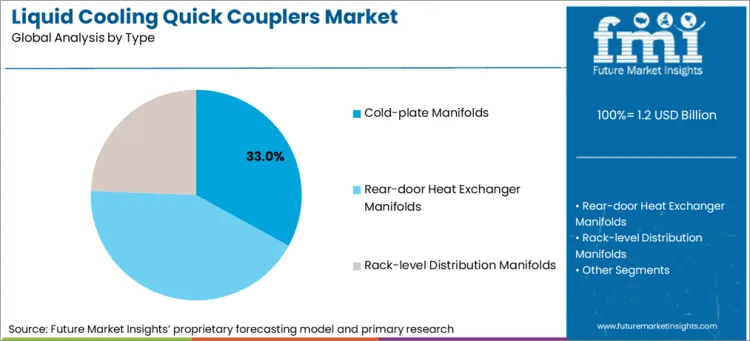
Cold-plate manifold couplers account for a 33% market share. This dominance is due to the direct connection point between the facility cooling distribution unit (CDU) and the individual server cold plates, which is the most frequent point of disconnection for hardware service. The Open Compute Project’s 2026 Advanced Cooling Module specification includes a standardized quick coupler interface for exactly this connection, aiming to ensure interoperability between any OCP-recognized server and any OCP-recognized rack CDU. This standardization effort is consolidating demand around a handful of compliant coupler designs.
Which Economic and Reliability Factors are Preserving Aluminum's Dominance?
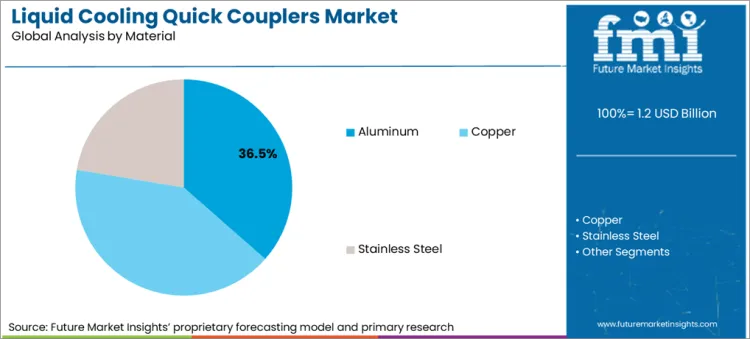
Aluminum commands a 36.5% share of the material segment. Its dominance is rooted in its excellent corrosion resistance when used with water/glycol mixes, its lightweight nature for overhead hose drops, and its cost-effectiveness for high-volume production.
Motivair Corporation’s 2026 release of an aluminum coupler with a PEEK internal sleeve solved historical issues with galvanic corrosion when mated with brass or copper fittings, extending the coupler’s service life in mixed-metal systems and further solidifying aluminum’s position.
What Role does the AI/HPC Rack Segment Play in Defining Global Innovation?
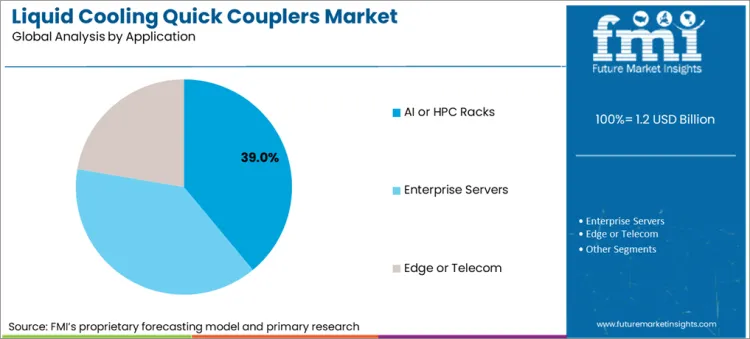
AI or HPC Racks represent the largest application segment with a 39% share. This segment is the primary driver for couplers that can handle extreme thermal cycling and high-pressure differentials. The USA Department of Energy’s Frontier exascale computer, in its 2026 upgrade cycle, specified quick couplers with an operating range of -40°C to 120°C to accommodate both chilled water and waste heat reuse scenarios. This requirement for extreme environmental tolerance pushes manufacturers to develop new elastomer seal compounds and locking mechanisms, setting a performance benchmark that filters into other segments.
What Drivers, Restraints, Opportunities, and Trends Prevail in the Liquid Cooling Quick Couplers Market?
Market expansion is driven by binding regulations on operational efficiency. The European Union’s Climate-Neutral Data Centre Pact, with its 2026 compliance checkpoint, includes a specific metric for "coolant containment efficiency." Data centers must demonstrate less than 1% annual coolant loss. This regulation makes high-performance quick couplers not just an engineering choice but a compliance necessity, forcing widespread adoption and upgrades across European facilities.
While demand surges, the industry faces significant technical restraints related to reliability. Failure analysis reports from a major colocation provider in early 2026 indicated that 34% of unplanned liquid cooling outages originated from quick coupler failures, primarily due to seal degradation from chemical incompatibility or physical damage during mating. This reliability gap is restraining more aggressive adoption in mission-critical enterprise environments until more robust, field-proven designs are established.
Technical innovation is defined by the integration of sensing and identification. Asetek A/S filed a patent in Q4 2025 for a quick coupler with an embedded microfluidic sensor that can detect particulate contamination or changes in coolant dielectric strength as it flows through the coupling. This allows for real-time fluid quality monitoring at every connection point.
The trend toward immersion cooling creates a unique coupler challenge. Green Revolution Cooling, Inc. developed a bulkhead quick coupler for its immersion tanks in 2026 that maintains a perfect seal while allowing a server sled to be inserted and removed through the fluid surface. This coupler must resist degradation from prolonged exposure to dielectric fluid and provide a reliable electrical ground path, representing a highly specialized niche.
Analysis of Liquid Cooling Quick Couplers Market by Key Countries
The following analysis examines the strategic evolution of the liquid cooling quick coupler market in China (12.4%), USA (11.9%), UK (10.9%), Germany (10.8%), and Japan (9.7%). These countries represent the core demand centers, each shaped by distinct industrial policies, environmental constraints, and technological leadership.
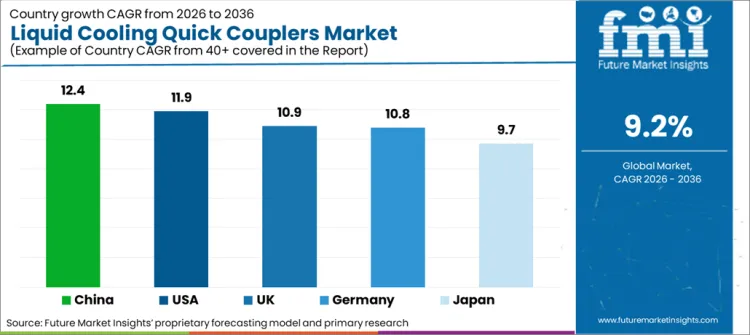
| Country | CAGR (2026-2036) |
|---|---|
| China | 12.4% |
| USA | 11.9% |
| UK | 10.9% |
| Germany | 10.8% |
| Japan | 9.7% |
Source: Future Market Insights (FMI) analysis, based on proprietary forecasting model and primary research
How are National Self-Sufficiency Policies Scaling the Chinese Market?
China’s 12.4% CAGR is propelled by its "Dual Circulation" strategy emphasizing technological self-reliance. The 2025-2030 plan for the data center industry mandates that core components, including precision fluid connectors, achieve 70% domestic sourcing by 2030. This has triggered state-backed investment in domestic quick coupler manufacturers, who are now required to meet or exceed the performance specifications of international leaders. This policy is creating a parallel, self-contained supply chain with its own standards and competitive dynamics.
Which Hyperscaler Engineering Priorities are defining Trends in USA’s Market?
USA’s 11.9% CAGR is closely tied to the engineering priorities of its domestic hyperscalers. Amazon Web Services’ Nitro system architecture and Google’s direct-chip cooling designs both rely on custom quick coupler interfaces to enable their proprietary server designs. These companies engage in deep co-engineering with select coupler suppliers, resulting in custom parts that are then produced at immense scale.
This model creates extraordinarily high volume for the chosen suppliers but erects a significant barrier to entry for others, as the couplers are not interchangeable with commercial-off-the-shelf products.
How are Stringent Planning Regulations Shaping the UK Market?
A rigorous planning permission process for data centers, particularly in London, heavily influences the UK’s 10.9% CAGR. The Greater London Authority now requires detailed maintenance and emergency procedures as part of the application. The ability to demonstrate that liquid cooling loops can be isolated and serviced quickly using reliable quick couplers, without draining entire systems or requiring fire department intervention, has become a critical factor in gaining approval. This regulatory environment prioritizes coupler reliability and dry-break performance above all other criteria.
What Role does Industrial Automation Play in the German Market?
Industrie 4.0 leadership drives Germany’s 10.8% CAGR. The adoption of liquid-cooled robotics, CNC machines, and laser cutters in smart factories requires quick couplers for easy tool changeover and maintenance. German engineering standards (DIN) for industrial fluid connectors are being extended to cover dielectric cooling fluids used in these applications.
Compliance with these standards, which emphasize durability and leak prevention over thousands of cycles, is a prerequisite for sales into the German industrial sector, favoring established hydraulic connector companies diversifying into electronics cooling.
How is Japan's High-Tech Manufacturing Influencing its Market?
Advanced manufacturing base underpins Japan’s 9.7% CAGR. Companies like Fanuc and Yaskawa use liquid-cooled servo drives and controllers. The need for uptime in 24/7 manufacturing lines makes quick coupler reliability non-negotiable.
Japan’s Green Transformation (GX) League corporate alliance has set voluntary standards for reducing industrial water use. Implementing quick couplers that eliminate coolant loss during equipment changeovers is a key tactic for member companies to meet these goals, driving steady, quality-focused demand.
What is the Competition Outlook for Liquid Cooling Quick Couplers?
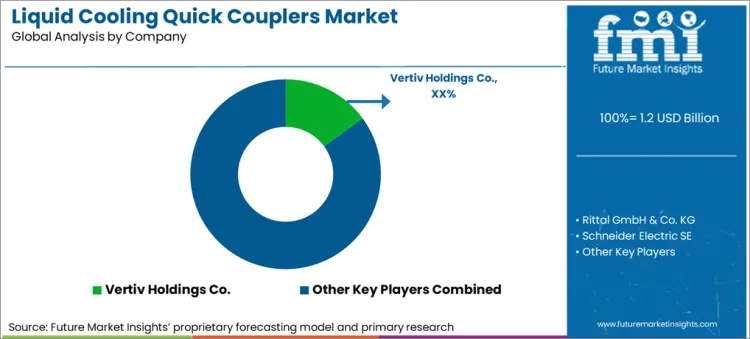
Competitive intensity reflects the market’s transition from a niche component to a volume-critical consumable. The landscape is divided between established fluid power companies applying hydraulic expertise to a new market and agile specialists focused on data center-specific challenges. Competition is increasingly based on reliability data, mean cycles between failure (MCBF) ratings, and the breadth of compatible fluids. Strategic partnerships with coolant manufacturers for joint validation are becoming a key differentiator.
Small specialists adapting hydraulic quick couplers for electronics cooling applications, often with mixed results regarding material compatibility, defined strategic evolution prior to 2024. The observable strategic direction for 2026 and beyond is the acquisition of niche coupling specialists by broader thermal management companies. For example, the acquisition of a specialist in dry-break coupling technology by a major data center infrastructure firm in late 2025 aimed to vertically integrate a critical component and secure supply for its integrated rack solutions.
Strategic leadership is shifting toward providing couplers as part of a certified fluid handling system. Liquid Cool Solutions, Inc. announced in early 2026 a "Coolant Integrity Guarantee" program for data center operators. The company guarantees zero fluid loss from its quick couplers over a 5-year period when used with its recommended coolants and maintenance procedures, bundling the component with a performance-based service agreement.
Recent Developments
- Vertiv Holdings Co. and 3M announced a joint development and supply agreement in February 2026 for quick couplers pre-validated and optimized for 3M’s Novec 649 fluid, ensuring chemical compatibility and long-term seal integrity.
- CoolIT Systems, Inc. received a USA General Services Administration (GSA) contract in November 2025 to supply its quick-connect systems for federal data center modernization projects, citing their dry-disconnect capability as a security and safety feature.
- A consortium led by Schneider Electric SE, including several server OEMs, published an open-source specification for a "Universal Coolant Connector" in Q1 2026, aiming to break vendor lock-in and reduce operational complexity for data center operators.
Key Players Profiled
- Vertiv Holdings Co.
- Rittal GmbH & Co. KG
- Schneider Electric SE
- CoolIT Systems, Inc.
- Asetek A/S
- Motivair Corporation
- Green Revolution Cooling, Inc.
- Chilldyne, Inc.
- Iceotope Technologies Limited
- Liquid Cool Solutions, Inc.
Market Definition
The liquid cooling quick couplers market comprises revenue generated from the design, manufacture, and supply of rapid-connect/disconnect fittings used to join sections of coolant piping or hose in liquid cooling systems. These couplers allow for the connection and separation of fluid lines with minimal spillage or air ingress. The market includes dry-break, wet-break, single-valve, and double-valve couplers constructed from aluminum, brass, stainless steel, and engineered plastics.
The market scope covers couplers used in data center server racks, high-performance computing systems, electric vehicle battery test and manufacturing equipment, and industrial machinery cooling loops. Revenue includes value from associated mounting brackets, dust caps, and validation testing for specific coolant compatibility. The market excludes permanent fittings, standard hydraulic couplers not rated for relevant coolants or temperatures, and couplings integrated into other products unless sold separately as a component.
Scope of Report
| Items | Values |
|---|---|
| Quantitative Units | USD 1.2 billion |
| Type | Cold-plate Manifolds; Rear-door Heat Exchanger Manifolds; Rack-level Distribution Manifolds |
| Material | Aluminum; Copper; Stainless Steel |
| Application | AI or HPC Racks; Enterprise Servers; Edge or Telecom |
| Regions Covered | North America, Western Europe, Eastern Europe, East Asia, South Asia & Pacific, Latin America, Middle East & Africa |
| Countries | China, USA, UK, Germany, Japan and 40+ countries |
| Key Companies | Vertiv Holdings Co.; Rittal GmbH & Co. KG; Schneider Electric SE; CoolIT Systems, Inc.; Asetek A/S; Motivair Corporation; Green Revolution Cooling, Inc.; Chilldyne, Inc.; Iceotope Technologies Limited; Liquid Cool Solutions, Inc. |
Source: Future Market Insights (FMI) analysis, based on proprietary forecasting model and primary research
Liquid Cooling Quick Couplers Market Key Segments
By Type:
- Cold-plate Manifolds
- Rear-door Heat Exchanger Manifolds
- Rack-level Distribution Manifolds
By Material:
- Aluminum
- Copper
- Stainless Steel
By Application:
- AI or HPC Racks
- Enterprise Servers
- Edge or Telecom
By Region:
- North America
- Western Europe
- Eastern Europe
- East Asia
- South Asia & Pacific
- Latin America
- Middle East & Africa
Bibliography
- Vertiv Holdings Co. (2026). Thermal Management Solutions: Product Reliability and Compatibility Report. Vertiv.
- Open Compute Project Foundation. (2026). Advanced Cooling Module: Mechanical Interface Specification v2.0.
- USA Department of Energy. (2025). Best Practices Guide for Energy-Efficient Data Center Cooling.
- Microsoft Corporation. (2026). Sustainability Report: Water Stewardship in Cloud Operations.
Frequently Asked Questions
What is the expected value of the liquid cooling quick couplers market in 2026?
The liquid cooling quick couplers market is expected to reach USD 1.2 billion in 2026, supported by the rapid deployment of serviceable liquid cooling systems in data centers and advanced manufacturing.
What is the projected value by 2036 and CAGR from 2026 to 2036?
By 2036, the market is projected to reach USD 2.9 billion, expanding at a CAGR of 9.2% between 2026 and 2036.
How is the shift to modular data center design influencing the market?
The need for hot-swappable servers and scalable cooling infrastructure in AI data centers is driving demand for reliable, dry-break quick couplers that enable hardware changes without system downtime or coolant loss, making them a fundamental component of modular design.
What role does coolant conservation play in shaping product development?
As dielectric coolants are expensive and subject to environmental regulations, minimizing loss is critical. This is pushing innovation toward couplers with zero-drip disconnect performance and integrated sensors to monitor for micro-leaks, transforming couplers from simple connectors into conservation devices.
Which application segment creates the most stringent performance requirements?
AI or HPC Racks create the most demanding requirements, necessitating couplers that can handle high flow rates, extreme thermal cycling, frequent mating cycles, and provide absolute reliability to prevent costly outages in compute-intensive environments.
Preview the report firsthand - request a free sample
Get SampleGet the brochure for pricing and purchase details.
Get PDFTable of Content
- Executive Summary
- Global Market Outlook
- Demand-side Trends
- Supply-side Trends
- Technology Roadmap Analysis
- Analysis and Recommendations
- Market Overview
- Market Coverage / Taxonomy
- Market Definition / Scope / Limitations
- Research Methodology
- Chapter Orientation
- Analytical Lens and Working Hypotheses
- Market Structure, Signals, and Trend Drivers
- Benchmarking and Cross-market Comparability
- Market Sizing, Forecasting, and Opportunity Mapping
- Research Design and Evidence Framework
- Desk Research Programme (Secondary Evidence)
- Company Annual and Sustainability Reports
- Peer-reviewed Journals and Academic Literature
- Corporate Websites, Product Literature, and Technical Notes
- Earnings Decks and Investor Briefings
- Statutory Filings and Regulatory Disclosures
- Technical White Papers and Standards Notes
- Trade Journals, Industry Magazines, and Analyst Briefs
- Conference Proceedings, Webinars, and Seminar Materials
- Government Statistics Portals and Public Data Releases
- Press Releases and Reputable Media Coverage
- Specialist Newsletters and Curated Briefings
- Sector Databases and Reference Repositories
- FMI Internal Proprietary Databases and Historical Market Datasets
- Subscription Datasets and Paid Sources
- Social Channels, Communities, and Digital Listening Inputs
- Additional Desk Sources
- Expert Input and Fieldwork (Primary Evidence)
- Primary Modes
- Qualitative Interviews and Expert Elicitation
- Quantitative Surveys and Structured Data Capture
- Blended Approach
- Why Primary Evidence is Used
- Field Techniques
- Interviews
- Surveys
- Focus Groups
- Observational and In-context Research
- Social and Community Interactions
- Stakeholder Universe Engaged
- C-suite Leaders
- Board Members
- Presidents and Vice Presidents
- R&D and Innovation Heads
- Technical Specialists
- Domain Subject-matter Experts
- Scientists
- Physicians and Other Healthcare Professionals
- Governance, Ethics, and Data Stewardship
- Research Ethics
- Data Integrity and Handling
- Primary Modes
- Tooling, Models, and Reference Databases
- Desk Research Programme (Secondary Evidence)
- Data Engineering and Model Build
- Data Acquisition and Ingestion
- Cleaning, Normalisation, and Verification
- Synthesis, Triangulation, and Analysis
- Quality Assurance and Audit Trail
- Market Background
- Market Dynamics
- Drivers
- Restraints
- Opportunity
- Trends
- Scenario Forecast
- Demand in Optimistic Scenario
- Demand in Likely Scenario
- Demand in Conservative Scenario
- Opportunity Map Analysis
- Product Life Cycle Analysis
- Supply Chain Analysis
- Investment Feasibility Matrix
- Value Chain Analysis
- PESTLE and Porter’s Analysis
- Regulatory Landscape
- Regional Parent Market Outlook
- Production and Consumption Statistics
- Import and Export Statistics
- Market Dynamics
- Global Market Analysis 2021 to 2025 and Forecast, 2026 to 2036
- Historical Market Size Value (USD Million) Analysis, 2021 to 2025
- Current and Future Market Size Value (USD Million) Projections, 2026 to 2036
- Y-o-Y Growth Trend Analysis
- Absolute $ Opportunity Analysis
- Global Market Pricing Analysis 2021 to 2025 and Forecast 2026 to 2036
- Global Market Analysis 2021 to 2025 and Forecast 2026 to 2036, By Type
- Introduction / Key Findings
- Historical Market Size Value (USD Million) Analysis By Type , 2021 to 2025
- Current and Future Market Size Value (USD Million) Analysis and Forecast By Type , 2026 to 2036
- Cold-plate Manifolds
- Rear-door Heat Exchanger Manifolds
- Rack-level Distribution Manifolds
- Cold-plate Manifolds
- Y-o-Y Growth Trend Analysis By Type , 2021 to 2025
- Absolute $ Opportunity Analysis By Type , 2026 to 2036
- Global Market Analysis 2021 to 2025 and Forecast 2026 to 2036, By Material
- Introduction / Key Findings
- Historical Market Size Value (USD Million) Analysis By Material, 2021 to 2025
- Current and Future Market Size Value (USD Million) Analysis and Forecast By Material, 2026 to 2036
- Aluminum
- Copper
- Stainless Steel
- Aluminum
- Y-o-Y Growth Trend Analysis By Material, 2021 to 2025
- Absolute $ Opportunity Analysis By Material, 2026 to 2036
- Global Market Analysis 2021 to 2025 and Forecast 2026 to 2036, By Application
- Introduction / Key Findings
- Historical Market Size Value (USD Million) Analysis By Application, 2021 to 2025
- Current and Future Market Size Value (USD Million) Analysis and Forecast By Application, 2026 to 2036
- AI or HPC Racks
- Enterprise Servers
- Edge or Telecom
- AI or HPC Racks
- Y-o-Y Growth Trend Analysis By Application, 2021 to 2025
- Absolute $ Opportunity Analysis By Application, 2026 to 2036
- Global Market Analysis 2021 to 2025 and Forecast 2026 to 2036, By Region
- Introduction
- Historical Market Size Value (USD Million) Analysis By Region, 2021 to 2025
- Current Market Size Value (USD Million) Analysis and Forecast By Region, 2026 to 2036
- North America
- Latin America
- Western Europe
- Eastern Europe
- East Asia
- South Asia and Pacific
- Middle East & Africa
- Market Attractiveness Analysis By Region
- North America Market Analysis 2021 to 2025 and Forecast 2026 to 2036, By Country
- Historical Market Size Value (USD Million) Trend Analysis By Market Taxonomy, 2021 to 2025
- Market Size Value (USD Million) Forecast By Market Taxonomy, 2026 to 2036
- By Country
- USA
- Canada
- Mexico
- By Type
- By Material
- By Application
- By Country
- Market Attractiveness Analysis
- By Country
- By Type
- By Material
- By Application
- Key Takeaways
- Latin America Market Analysis 2021 to 2025 and Forecast 2026 to 2036, By Country
- Historical Market Size Value (USD Million) Trend Analysis By Market Taxonomy, 2021 to 2025
- Market Size Value (USD Million) Forecast By Market Taxonomy, 2026 to 2036
- By Country
- Brazil
- Chile
- Rest of Latin America
- By Type
- By Material
- By Application
- By Country
- Market Attractiveness Analysis
- By Country
- By Type
- By Material
- By Application
- Key Takeaways
- Western Europe Market Analysis 2021 to 2025 and Forecast 2026 to 2036, By Country
- Historical Market Size Value (USD Million) Trend Analysis By Market Taxonomy, 2021 to 2025
- Market Size Value (USD Million) Forecast By Market Taxonomy, 2026 to 2036
- By Country
- Germany
- UK
- Italy
- Spain
- France
- Nordic
- BENELUX
- Rest of Western Europe
- By Type
- By Material
- By Application
- By Country
- Market Attractiveness Analysis
- By Country
- By Type
- By Material
- By Application
- Key Takeaways
- Eastern Europe Market Analysis 2021 to 2025 and Forecast 2026 to 2036, By Country
- Historical Market Size Value (USD Million) Trend Analysis By Market Taxonomy, 2021 to 2025
- Market Size Value (USD Million) Forecast By Market Taxonomy, 2026 to 2036
- By Country
- Russia
- Poland
- Hungary
- Balkan & Baltic
- Rest of Eastern Europe
- By Type
- By Material
- By Application
- By Country
- Market Attractiveness Analysis
- By Country
- By Type
- By Material
- By Application
- Key Takeaways
- East Asia Market Analysis 2021 to 2025 and Forecast 2026 to 2036, By Country
- Historical Market Size Value (USD Million) Trend Analysis By Market Taxonomy, 2021 to 2025
- Market Size Value (USD Million) Forecast By Market Taxonomy, 2026 to 2036
- By Country
- China
- Japan
- South Korea
- By Type
- By Material
- By Application
- By Country
- Market Attractiveness Analysis
- By Country
- By Type
- By Material
- By Application
- Key Takeaways
- South Asia and Pacific Market Analysis 2021 to 2025 and Forecast 2026 to 2036, By Country
- Historical Market Size Value (USD Million) Trend Analysis By Market Taxonomy, 2021 to 2025
- Market Size Value (USD Million) Forecast By Market Taxonomy, 2026 to 2036
- By Country
- India
- ASEAN
- Australia & New Zealand
- Rest of South Asia and Pacific
- By Type
- By Material
- By Application
- By Country
- Market Attractiveness Analysis
- By Country
- By Type
- By Material
- By Application
- Key Takeaways
- Middle East & Africa Market Analysis 2021 to 2025 and Forecast 2026 to 2036, By Country
- Historical Market Size Value (USD Million) Trend Analysis By Market Taxonomy, 2021 to 2025
- Market Size Value (USD Million) Forecast By Market Taxonomy, 2026 to 2036
- By Country
- Kingdom of Saudi Arabia
- Other GCC Countries
- Turkiye
- South Africa
- Other African Union
- Rest of Middle East & Africa
- By Type
- By Material
- By Application
- By Country
- Market Attractiveness Analysis
- By Country
- By Type
- By Material
- By Application
- Key Takeaways
- Key Countries Market Analysis
- USA
- Pricing Analysis
- Market Share Analysis, 2025
- By Type
- By Material
- By Application
- Canada
- Pricing Analysis
- Market Share Analysis, 2025
- By Type
- By Material
- By Application
- Mexico
- Pricing Analysis
- Market Share Analysis, 2025
- By Type
- By Material
- By Application
- Brazil
- Pricing Analysis
- Market Share Analysis, 2025
- By Type
- By Material
- By Application
- Chile
- Pricing Analysis
- Market Share Analysis, 2025
- By Type
- By Material
- By Application
- Germany
- Pricing Analysis
- Market Share Analysis, 2025
- By Type
- By Material
- By Application
- UK
- Pricing Analysis
- Market Share Analysis, 2025
- By Type
- By Material
- By Application
- Italy
- Pricing Analysis
- Market Share Analysis, 2025
- By Type
- By Material
- By Application
- Spain
- Pricing Analysis
- Market Share Analysis, 2025
- By Type
- By Material
- By Application
- France
- Pricing Analysis
- Market Share Analysis, 2025
- By Type
- By Material
- By Application
- India
- Pricing Analysis
- Market Share Analysis, 2025
- By Type
- By Material
- By Application
- ASEAN
- Pricing Analysis
- Market Share Analysis, 2025
- By Type
- By Material
- By Application
- Australia & New Zealand
- Pricing Analysis
- Market Share Analysis, 2025
- By Type
- By Material
- By Application
- China
- Pricing Analysis
- Market Share Analysis, 2025
- By Type
- By Material
- By Application
- Japan
- Pricing Analysis
- Market Share Analysis, 2025
- By Type
- By Material
- By Application
- South Korea
- Pricing Analysis
- Market Share Analysis, 2025
- By Type
- By Material
- By Application
- Russia
- Pricing Analysis
- Market Share Analysis, 2025
- By Type
- By Material
- By Application
- Poland
- Pricing Analysis
- Market Share Analysis, 2025
- By Type
- By Material
- By Application
- Hungary
- Pricing Analysis
- Market Share Analysis, 2025
- By Type
- By Material
- By Application
- Kingdom of Saudi Arabia
- Pricing Analysis
- Market Share Analysis, 2025
- By Type
- By Material
- By Application
- Turkiye
- Pricing Analysis
- Market Share Analysis, 2025
- By Type
- By Material
- By Application
- South Africa
- Pricing Analysis
- Market Share Analysis, 2025
- By Type
- By Material
- By Application
- USA
- Market Structure Analysis
- Competition Dashboard
- Competition Benchmarking
- Market Share Analysis of Top Players
- By Regional
- By Type
- By Material
- By Application
- Competition Analysis
- Competition Deep Dive
- Vertiv Holdings Co.
- Overview
- Product Portfolio
- Profitability by Market Segments (Product/Age /Sales Channel/Region)
- Sales Footprint
- Strategy Overview
- Marketing Strategy
- Product Strategy
- Channel Strategy
- Rittal GmbH & Co. KG
- Schneider Electric SE
- CoolIT Systems, Inc.
- Asetek A/S
- Motivair Corporation
- Green Revolution Cooling, Inc.
- Chilldyne, Inc.
- Iceotope Technologies Limited
- Liquid Cool Solutions, Inc.
- Vertiv Holdings Co.
- Competition Deep Dive
- Assumptions & Acronyms Used


