

- Industry Size (2026)
- USD 4.2 Bn
- Forecast (2036)
- USD 13.0 Bn
- CAGR (2026 to 2036)
- 12.0%
Liquid-Cooled Edge Data Center Market Forecast and Outlook 2026 to 2036
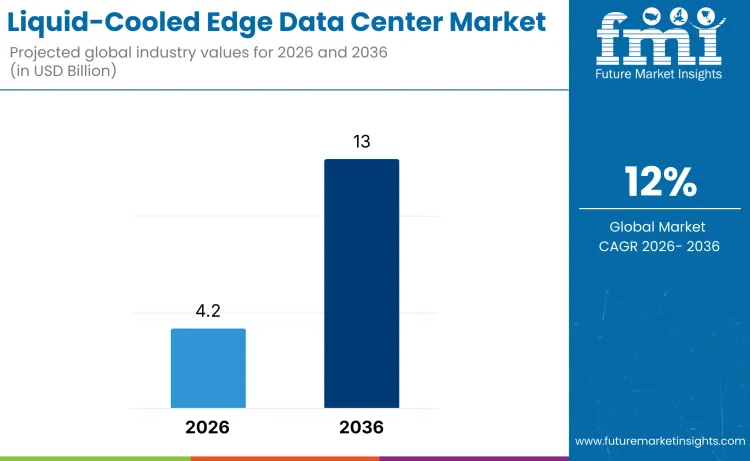
A climb from USD 4.2 billion in 2026 to USD 13.0 billion by 2036 places the liquid-cooled edge data center market on a 12.0% CAGR trajectory. Deployment decisions are driven less by energy efficiency targets and more by the cost of failure in latency sensitive and mission critical applications. In telecom nodes, financial trading infrastructure, and industrial control networks, thermal excursions translate directly into service outages and contractual penalties. Compliance pressure in regulated environments further raises the tolerance threshold for thermal risk. As a result, adoption concentrates in sectors and regions where uptime requirements, audit regimes, and service level enforcement are strict rather than in low consequence computing environments.
Operator risk tolerance plays a decisive role in shaping the pace and geography of deployment. Organizations with centralized operations teams and formal incident management frameworks adopt liquid cooling earlier because they can manage maintenance procedures and contingency planning. Smaller operators and lightly regulated edge sites continue to rely on air cooling due to simpler service models and lower perceived liability. Insurance terms, inspection requirements, and internal governance policies increasingly influence architecture choices. Market expansion therefore follows the distribution of high consequence workloads and compliance driven infrastructure, not the general growth of edge computing capacity alone.
Quick Stats for Liquid-Cooled Edge Data Center Market
- Liquid-Cooled Edge Data Center Market Value (2026): USD 4.2 billion
- Liquid-Cooled Edge Data Center Market Forecast Value (2036): USD 13.0 billion
- Liquid-Cooled Edge Data Center Market Forecast CAGR 2026 to 2036: 12.0%
- Leading Type in Liquid-Cooled Edge Data Center Market: Direct liquid cooling
- Key Growth Regions in Liquid-Cooled Edge Data Center Market: Asia Pacific, North America, Europe
- Top Players in Liquid-Cooled Edge Data Center Market: Digital Realty, Hewlett Packard Enterprise (HPE), Dell Technologies, Schneider Electric, Vertiv, CoolIT Systems
What is the Growth Forecast for Liquid-Cooled Edge Data Center Market through 2036?
The liquid-cooled edge data center market is being reshaped by a shift from compliance-driven spending to performance-driven spending. Early edge facilities were built to satisfy thermal and regulatory limits at the lowest acceptable cost, which kept cooling decisions conservative and air-based. As edge workloads move toward AI inference, real-time analytics, and high-density compute, thermal design becomes a throughput constraint rather than a compliance checkbox. Operators now size cooling systems around sustained performance targets, not peak safety margins. Liquid cooling enters not as an efficiency upgrade but as an enabler of higher rack power, stable clock speeds, and predictable latency. Investment decisions therefore move from facilities teams to performance engineering teams.
The rise in market toward USD 13 billion by 2036 follows this redefinition of what cooling is supposed to achieve. Once performance becomes the governing metric, liquid cooling stops being limited to flagship sites and begins to propagate into regional and micro-edge nodes running standardized high-density stacks. Deployment accelerates because designs are replicated, not reinvented. Value growth comes from higher cooling spend per site and higher compute density per square meter, not just from site count. Competitive advantage rests on integration reliability, serviceability, and operational predictability, since edge operators prioritize uptime and deterministic performance over theoretical efficiency gains or lowest capital cost.
Liquid-Cooled Edge Data Center Market Key Takeaways
| Metric | Value |
|---|---|
| Market Value (2026) | USD 4.2 billion |
| Forecast Value (2036) | USD 13.0 billion |
| Forecast CAGR 2026 to 2036 | 12.0% |
How Is the Liquid-Cooled Edge Data Center Market Addressing Process Stability and Variance Reduction?
As computing demands intensify at the network edge, maintaining precise thermal control has become critical for reliable performance. Liquid-cooled edge data centers are increasingly adopted to manage high-density server racks, minimize hotspots, and reduce thermal fluctuations. Traditional air-cooling systems often struggled under concentrated workloads, resulting in performance variability and higher energy consumption. Modern liquid-cooling solutions integrate direct-to-chip cold plates, precision flow regulation, and real-time monitoring to deliver uniform temperature distribution and consistent processing efficiency. Data center operators, cloud providers, and colocation facilities prioritize operational reliability, rapid deployment, and seamless integration with edge infrastructure. Early adoption focused on hyperscale and research facilities, while current demand spans AI processing hubs, telecom edge nodes, and industrial IoT deployments. Flow control, thermal stability, and maintenance efficiency guide system design and supplier selection.
Ensuring stable performance and reducing process variance are central to operational strategies in edge environments. Liquid-cooling solutions emphasize rapid heat extraction, uniform airflow within server enclosures, and reduced equipment stress compared with conventional air-cooled setups. Cost considerations include pump efficiency, heat exchanger quality, and coolant management, concentrating margins among suppliers capable of delivering reliable, high-performance systems. Operators adopt these solutions to maintain consistent processing throughput, extend component life, and meet stringent uptime requirements.
What Factors Are Shaping the Demand for Liquid-Cooled Edge Data Centers by Thermal Architecture and Deployment Pattern in 2026?
The liquid-cooled edge data center market in 2026 is segmented by cooling technology and by deployment model. By thermal architecture, demand is divided into direct liquid cooling, immersion cooling, rear door heat exchangers, and hybrid air liquid systems, each offering different tradeoffs between heat removal efficiency, retrofit complexity, and service procedures. By deployment model, demand is organized around telecom edge data centers, enterprise edge facilities, colocation edge sites, and micro edge pods, which differ in space constraints, uptime targets, and refresh cycles. These segments reflect how operators manage rising rack densities while keeping installation time, operating risk, and maintenance practices within acceptable limits.
Why Does Direct Liquid Cooling Lead Adoption in Edge Environments?
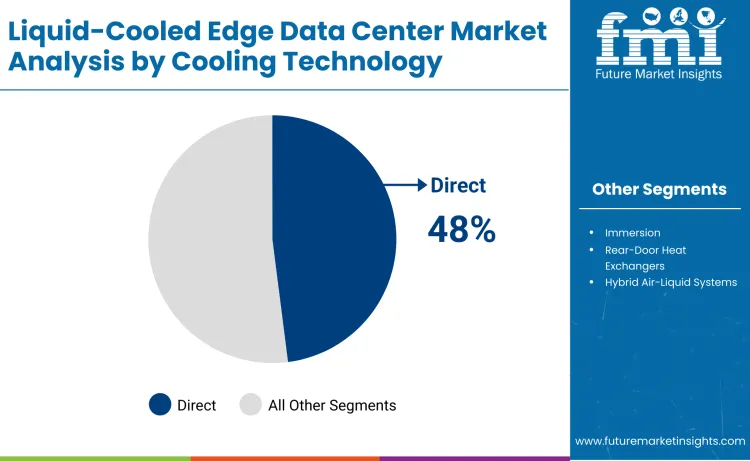
Direct liquid cooling accounts for about 48% of demand in 2026, reflecting its compatibility with existing server form factors and service workflows. This approach brings coolant directly to the hottest components, which allows high heat flux to be removed without enclosing the entire system in liquid. For operators, this reduces the perceived risk compared with full immersion while still delivering a large step up in thermal capacity over air. Installation can often be staged rack by rack, which suits incremental edge expansions. Vendor ecosystems for cold plates, manifolds, and quick connects are also maturing, which lowers integration uncertainty. This balance between performance gain and operational familiarity keeps direct liquid cooling as the preferred first step into liquid based thermal management.
Immersion and rear door systems address different constraints. Immersion offers very high heat removal capability, yet it requires new handling procedures and changes to maintenance routines. Rear door heat exchangers can be added to existing racks, but their capacity depends on airflow management and door space. Hybrid systems blend air and liquid to extend the life of existing layouts, yet they add control complexity. These options are chosen where specific site limits or density targets justify them. Their adoption grows in targeted projects, while direct liquid cooling continues to attract the largest share because it fits more easily into current operational models.
Why Do Telecom Edge Data Centers Represent the Largest Deployment Segment?
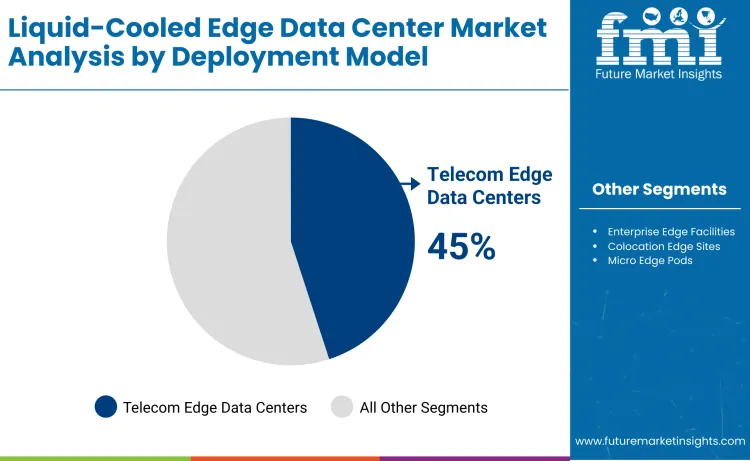
Telecom edge data centers represent about 45% of demand in 2026 because network operators are under pressure to place compute closer to users while keeping facilities small and power dense. 5G, content delivery, and network functions virtualization concentrate processing in compact sites with limited room for traditional cooling infrastructure. Liquid cooling allows these locations to host higher density racks without expanding building footprint or power distribution rooms. Telecom operators also tend to roll out similar site designs across many locations, which supports standardized cooling architectures. This combination of density pressure, space limits, and replicable site templates concentrates a large share of early liquid cooling adoption in the telecom edge segment.
Enterprise, colocation, and micro pod deployments follow different rollout patterns. Enterprises add edge capacity selectively near factories, campuses, or offices, which spreads investment over time. Colocation providers balance multiple customer requirements and therefore adopt new cooling methods more cautiously. Micro edge pods are deployed in small numbers and often prioritize speed and portability over maximum density. These segments are important and growing, yet their project volumes and standardization levels are lower. As a result, telecom operators, with their large scale, repeated deployments of similar facilities, continue to anchor the majority of liquid-cooled edge data center demand.
How Are Platform Consolidation, Switching Risk, and Vendor Rationalization Reshaping the Liquid-Cooled Edge Data Center Market through 2036?
The category is being defined by operating model decisions rather than by cooling hardware alone. As edge sites multiply, operators want fewer platforms and suppliers to simplify deployment, support, and lifecycle management. This creates an opportunity for vendor rationalization, but adoption is slowed by fear of lock in and the high risk of changing thermal architectures once sites are live. Liquid cooling touches power, racks, and IT equipment, so any platform choice becomes deeply embedded. At the same time, consolidation among suppliers and reference designs is reducing choice but increasing standardization. The result is a market shaped by governance, risk management, and portfolio scale economics more than by component level performance.
Why Is Vendor Rationalization Becoming a Major Opportunity in Liquid-Cooled Edge Data Centers?
Opportunity comes from operational complexity, not from technology novelty. Edge networks often grow through acquisitions and pilots, leaving operators with many site designs, suppliers, and support contracts. Each variation increases spare parts, training, and integration burden. Vendor rationalization programs aim to collapse this into a small number of approved platforms that can be deployed repeatedly. Liquid cooling amplifies this benefit because it interacts with racks, power distribution, and IT hardware. Once a standardized stack is defined, rollouts become faster and more predictable. This turns cooling from a site by site engineering decision into a programmatic infrastructure choice, unlocking scale efficiencies across dozens or hundreds of edge locations.
Why Are Switching Risk and Lock in Fears Slowing Platform Decisions?
The main barrier is architectural commitment. Liquid cooling is not a peripheral add on but part of the physical and thermal design of the site. Changing vendors later can require rack changes, plumbing rework, and IT compatibility checks, which means downtime and capital loss. Operators also worry about long term support, spare parts availability, and supplier financial stability. Because edge sites are often unmanned or lightly staffed, reliability risk carries high operational cost. As a result, buyers move slowly, run long pilots, and prefer proven partners. Even when consolidation would reduce complexity, fear of being trapped in the wrong platform delays decisive moves.
How Is Consolidation of Suppliers and Platforms Changing the Structure of the Market?
The trend is toward fewer, broader platforms rather than many specialized solutions. IT vendors, cooling specialists, and infrastructure integrators are bundling liquid cooling into repeatable edge data center architectures. This reduces interface risk for operators but also narrows the field of acceptable choices. Procurement is shifting from component sourcing to platform selection, often through multiyear framework agreements. Smaller or niche suppliers are being pushed into partnerships or out of large programs altogether. Over time, success depends less on selling a better cooling unit and more on being included in a certified, end to end edge infrastructure stack that can be deployed at scale.
What is the Demand for Liquid-Cooled Edge Data Centers by Country?
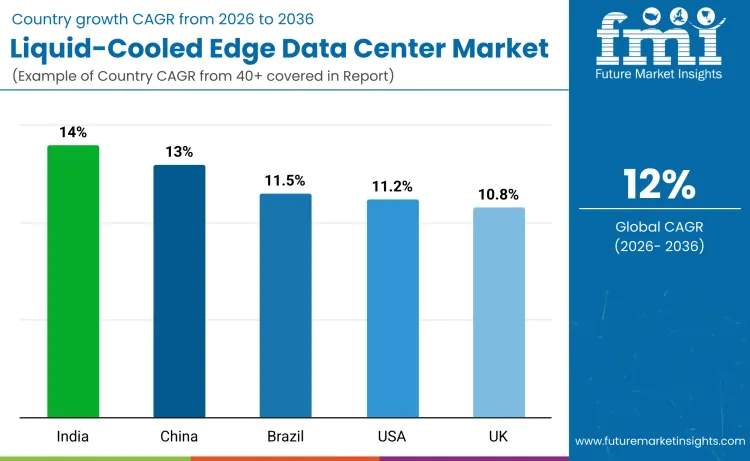
| Country | CAGR (%) |
|---|---|
| USA | 11.2% |
| UK | 10.8% |
| China | 13.0% |
| India | 14.0% |
| Brazil | 11.5% |
Demand for liquid-cooled edge data centers is rising as enterprises and cloud providers adopt advanced cooling solutions to enhance server performance, energy efficiency, and data processing capabilities. India leads with a 14.0% CAGR, driven by growth in regional data centers, rising demand for low-latency computing, and adoption of efficient cooling technologies. China follows at 13.0%, supported by expanding cloud infrastructure and high-density computing requirements. Brazil records 11.5% growth, shaped by deployment of edge computing facilities and demand for energy-efficient cooling. The USA grows at 11.2%, influenced by upgrades in data center infrastructure and high-performance computing needs. The UK shows 10.8% CAGR, reflecting steady adoption of liquid cooling in commercial and enterprise data centers.
How is the United States experiencing growth in the liquid-cooled edge data center market?
United States is experiencing growth at a CAGR of 11.2%, supported by stringent regulatory standards and a strong certification culture emphasizing energy efficiency, safety, and thermal management compliance. Public sector procurement plays a significant role in large-scale edge data center projects, particularly in federal and state digital infrastructure programs. Standard-setting organizations influence system specifications, but many operators also follow internal engineering guidelines. Enforcement of building and electrical codes is rigorous, with compliance behavior closely monitored. Trade policies and import rules affect high-performance cooling components, while local content requirements encourage partial domestic sourcing and integration. Growth reflects adoption of liquid cooling to meet efficiency and regulatory requirements.
- Regulatory and certification standards drive adoption.
- Public sector projects anchor demand.
- Enforcement rigor ensures compliance.
- Local content pressures influence sourcing strategies.
How is the United Kingdom witnessing growth in the liquid-cooled edge data center market?
United Kingdom is witnessing growth at a CAGR of 10.8%, driven by a structured certification culture emphasizing ISO and BREEAM standards for energy-efficient and safe liquid-cooled systems. Public sector procurement accounts for a substantial portion of early deployments in government and municipal edge data centers. Standard-setting bodies influence design choices, while operators maintain careful rule-following practices. Enforcement is consistent, with penalties for noncompliance. Trade policies and tariffs moderately affect imported cooling units, and local content pressures encourage use of domestic suppliers for components and installation services. Growth reflects regulatory alignment and government-backed adoption of advanced cooling infrastructure.
- ISO and BREEAM standards drive adoption.
- Public sector procurement anchors early deployments.
- Compliance enforcement ensures operational rigor.
- Local content pressure shapes sourcing strategies.
How is China experiencing growth in the liquid-cooled edge data center market?
China is experiencing growth at a CAGR of 13%, supported by strict government regulations and a certification culture emphasizing energy efficiency, thermal performance, and safety compliance. The public sector has substantial weight in procurement, particularly for large urban edge computing projects. Standard-setting bodies heavily influence system design, while operators actively follow guidelines. Enforcement is strict, with inspections and penalties for noncompliance. Trade rules and import duties affect high-performance components, but strong local manufacturing reduces dependency on imports. Growth reflects regulatory rigor, government-led projects, and local content policies encouraging domestic production and installation.
- Regulatory standards and certification culture drive adoption.
- Public sector procurement dominates project funding.
- Enforcement rigor ensures compliance.
- Local production reduces import reliance.
How is India witnessing growth in the liquid-cooled edge data center market?
India is witnessing growth at a CAGR of 14%, driven by regulatory frameworks promoting energy efficiency, safety, and certification adherence for high-performance data centers. The public sector is a key purchaser for state-run and smart city initiatives, influencing adoption. Standard-setting influence is significant, with operators required to comply with BIS and other codes. Enforcement is moderate but steadily increasing, encouraging proactive compliance. Import tariffs and trade rules impact advanced cooling components, while localization pressures push for greater domestic manufacturing and assembly of liquid cooling solutions. Growth reflects government-backed infrastructure expansion and increasing attention to energy-efficient edge facilities.
- Energy and safety regulations drive adoption.
- Public sector procurement influences market uptake.
- Enforcement and compliance behavior guide operators.
- Localization pressures encourage domestic component use.
How is Brazil experiencing growth in the liquid-cooled edge data center market?
Brazil is experiencing growth at a CAGR of 11.5%, supported by moderate regulatory strictness and certification requirements for energy efficiency and safety. Public sector investment drives some early edge data center deployments, particularly for government and municipal digital infrastructure. Standard-setting is influential but operators largely follow practical guidelines. Compliance enforcement is moderate, with audits and certifications applied selectively. Trade policies, import rules, and tariffs affect availability of high-performance cooling components, while local content and domestic assembly pressures are increasing. Growth reflects adoption of liquid cooling solutions to meet performance demands and partially satisfy domestic sourcing expectations.
- Regulatory standards and certifications support adoption.
- Public sector projects anchor early deployments.
- Enforcement is moderate but influential.
- Import rules and local content pressures guide sourcing.
How Does Cost-Led Competition Compare with Specification-Led Competition in the Liquid-Cooled Edge Data Center Market?
In the liquid-cooled edge data center market, cost-led competition centers on reducing upfront expenditure, integration simplicity, and total cost of ownership. Providers adopting a price-led positioning emphasize standardized liquid cooling modules, minimized customization, and compatibility with common rack architectures to drive down capital costs. These offerings appeal to customers deploying edge nodes at scale where budget constraints outweigh the need for peak thermal performance. Cost-led solutions typically favor established, commoditized cooling hardware, basic thermal management features, and vendor-agnostic integration to keep procurement and deployment predictable. Buyers focusing on near-term budget predictability or rapid roll-out in distributed locations often select these lower-cost options, accepting moderate performance and broader tolerances in heat extraction and fluid routing.
By contrast, specification-led competition prioritizes thermal performance, engineering refinement, and support for high-density compute loads typical of AI inference, high-performance analytics, or specialized workloads at the edge. Vendors with a performance orientation invest in advanced cold plates, two-phase cooling, precision flow control, and integration with monitoring and management stacks that preserve equipment life under elevated power densities. Specification-led positioning often commands premium pricing because it must satisfy demanding SLAs, tighter temperature and humidity control, and interoperability with heterogeneous hardware. Buyers in this segment value engineering depth, validated performance data, and scalability of thermal solutions to protect sensitive electronics and ensure uptime. This differentiation hinges on rigorous testing, performance certification, and demonstrable efficiency gains rather than on low entry cost. The market thus bifurcates: price-sensitive deployments favour simpler, lower-cost liquid cooling solutions, while performance-critical edge installations justify investment in high-specification systems to support demanding applications.
Key Players in the Liquid-Cooled Edge Data Center Market
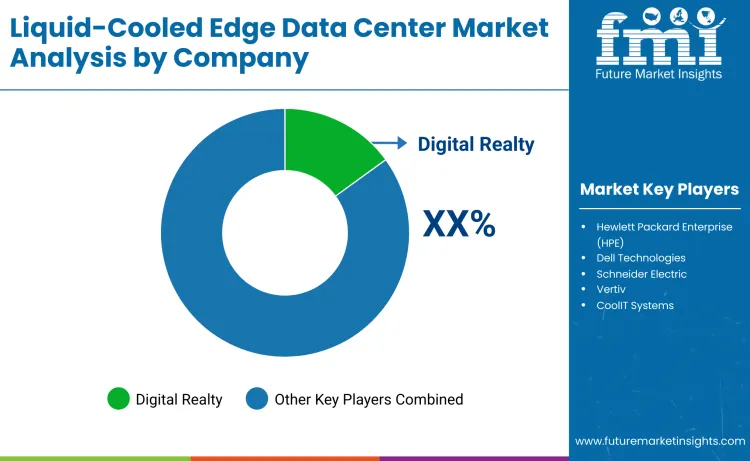
- Digital Realty
- Hewlett Packard Enterprise (HPE)
- Dell Technologies
- Schneider Electric
- Vertiv
- CoolIT Systems
Scope of the Report
| Items | Values |
|---|---|
| Quantitative Units (2026) | USD billion |
| Cooling Technology | Direct Liquid Cooling, Immersion Cooling, Rear-Door Heat Exchangers, Hybrid Air-Liquid Systems |
| Deployment Model | Telecom Edge Data Centers, Enterprise Edge Facilities, Colocation Edge Sites, Micro Edge Pods |
| Regions Covered | Asia Pacific, Europe, North America, Latin America, Middle East & Africa |
| Countries Covered | China, Japan, South Korea, India, Australia & New Zealand, ASEAN, Germany, United Kingdom, France, Italy, Spain, Nordic, BENELUX, United States, Canada, Mexico, Brazil, Chile, Saudi Arabia, Turkey, South Africa, and other regional markets |
| Key Companies Profiled | Digital Realty, Hewlett Packard Enterprise (HPE), Dell Technologies, Schneider Electric, Vertiv, CoolIT Systems |
| Additional Attributes | Dollar sales by cooling technology and deployment model; direct liquid cooling as the leading architecture; telecom edge as the largest deployment segment; demand driven by high-density compute, uptime risk, and performance targets; procurement shaped by platform standardization, vendor rationalization, and serviceability; adoption constrained by switching risk, lock-in concerns, and integration complexity. |
Liquid-Cooled Edge Data Center Market Segmentation
Cooling Technology:
- Direct liquid cooling
- Immersion cooling
- Rear-door heat exchangers
- Hybrid air-liquid systems
Deployment Model:
- Telecom edge data centers
- Enterprise edge facilities
- Colocation edge sites
- Micro edge pods
Region
- Asia Pacific
- China
- Japan
- South Korea
- India
- Australia & New Zealand
- ASEAN
- Rest of Asia Pacific
- Europe
- Germany
- United Kingdom
- France
- Italy
- Spain
- Nordic
- BENELUX
- Rest of Europe
- North America
- United States
- Canada
- Mexico
- Latin America
- Brazil
- Chile
- Rest of Latin America
- Middle East & Africa
- Kingdom of Saudi Arabia
- Other GCC Countries
- Turkey
- South Africa
- Other African Union
- Rest of Middle East & Africa
Bibliography
- Telecommunications Industry Association. (2024). TIA-942-D: Telecommunications infrastructure standard for data centers. TIA.
- European Committee for Standardization. (2024). EN 50600-3-1: Data centres — Facilities and infrastructures — Part 3-1: Management and operational information for energy efficiency. CEN.
- International Organization for Standardization. (2024). Data centre facilities and infrastructure — Energy use and cooling performance metrics (ISO/IEC 30134-9:2024). ISO.
Frequently Asked Questions
How big is the liquid cooled edge data center market in 2026?
The global liquid cooled edge data center market is estimated to be valued at USD 4.2 billion in 2026.
What will be the size of liquid cooled edge data center market in 2036?
The market size for the liquid cooled edge data center market is projected to reach USD 13.0 billion by 2036.
How much will be the liquid cooled edge data center market growth between 2026 and 2036?
The liquid cooled edge data center market is expected to grow at a 12.0% CAGR between 2026 and 2036.
What are the key product types in the liquid cooled edge data center market?
The key product types in liquid cooled edge data center market are direct liquid cooling, immersion cooling, rear‑door heat exchangers and hybrid air‑liquid systems.
Which deployment model segment to contribute significant share in the liquid cooled edge data center market in 2026?
In terms of deployment model, telecom edge data centers segment to command 45.0% share in the liquid cooled edge data center market in 2026.
Preview the report firsthand - request a free sample
Get SampleGet the brochure for pricing and purchase details.
Get PDFTable of Content
- Executive Summary
- Global Market Outlook
- Demand-side Trends
- Supply-side Trends
- Technology Roadmap Analysis
- Analysis and Recommendations
- Market Overview
- Market Coverage / Taxonomy
- Market Definition / Scope / Limitations
- Market Background
- Market Dynamics
- Drivers
- Restraints
- Opportunity
- Trends
- Scenario Forecast
- Demand in Optimistic Scenario
- Demand in Likely Scenario
- Demand in Conservative Scenario
- Opportunity Map Analysis
- Product Life Cycle Analysis
- Supply Chain Analysis
- Investment Feasibility Matrix
- Value Chain Analysis
- PESTLE and Porter’s Analysis
- Regulatory Landscape
- Regional Parent Market Outlook
- Production and Consumption Statistics
- Import and Export Statistics
- Market Dynamics
- Global Market Analysis 2021 to 2025 and Forecast, 2026 to 2036
- Historical Market Size Value (USD Million) Analysis, 2021 to 2025
- Current and Future Market Size Value (USD Million) Projections, 2026 to 2036
- Y-o-Y Growth Trend Analysis
- Absolute $ Opportunity Analysis
- Global Market Pricing Analysis 2021 to 2025 and Forecast 2026 to 2036
- Global Market Analysis 2021 to 2025 and Forecast 2026 to 2036, By Cooling Technology
- Introduction / Key Findings
- Historical Market Size Value (USD Million) Analysis By Cooling Technology, 2021 to 2025
- Current and Future Market Size Value (USD Million) Analysis and Forecast By Cooling Technology, 2026 to 2036
- Direct liquid cooling
- Immersion cooling
- Rear‑door heat exchangers
- Hybrid air‑liquid systems
- Direct liquid cooling
- Y-o-Y Growth Trend Analysis By Cooling Technology, 2021 to 2025
- Absolute $ Opportunity Analysis By Cooling Technology, 2026 to 2036
- Global Market Analysis 2021 to 2025 and Forecast 2026 to 2036, By Deployment Model
- Introduction / Key Findings
- Historical Market Size Value (USD Million) Analysis By Deployment Model, 2021 to 2025
- Current and Future Market Size Value (USD Million) Analysis and Forecast By Deployment Model, 2026 to 2036
- Telecom edge data centers
- Enterprise edge facilities
- Colocation edge sites
- Micro edge pods
- Telecom edge data centers
- Y-o-Y Growth Trend Analysis By Deployment Model, 2021 to 2025
- Absolute $ Opportunity Analysis By Deployment Model, 2026 to 2036
- Global Market Analysis 2021 to 2025 and Forecast 2026 to 2036, By Region
- Introduction
- Historical Market Size Value (USD Million) Analysis By Region, 2021 to 2025
- Current Market Size Value (USD Million) Analysis and Forecast By Region, 2026 to 2036
- North America
- Latin America
- Western Europe
- Eastern Europe
- East Asia
- South Asia and Pacific
- Middle East & Africa
- Market Attractiveness Analysis By Region
- North America Market Analysis 2021 to 2025 and Forecast 2026 to 2036, By Country
- Historical Market Size Value (USD Million) Trend Analysis By Market Taxonomy, 2021 to 2025
- Market Size Value (USD Million) Forecast By Market Taxonomy, 2026 to 2036
- By Country
- USA
- Canada
- Mexico
- By Cooling Technology
- By Deployment Model
- By Country
- Market Attractiveness Analysis
- By Country
- By Cooling Technology
- By Deployment Model
- Key Takeaways
- Latin America Market Analysis 2021 to 2025 and Forecast 2026 to 2036, By Country
- Historical Market Size Value (USD Million) Trend Analysis By Market Taxonomy, 2021 to 2025
- Market Size Value (USD Million) Forecast By Market Taxonomy, 2026 to 2036
- By Country
- Brazil
- Chile
- Rest of Latin America
- By Cooling Technology
- By Deployment Model
- By Country
- Market Attractiveness Analysis
- By Country
- By Cooling Technology
- By Deployment Model
- Key Takeaways
- Western Europe Market Analysis 2021 to 2025 and Forecast 2026 to 2036, By Country
- Historical Market Size Value (USD Million) Trend Analysis By Market Taxonomy, 2021 to 2025
- Market Size Value (USD Million) Forecast By Market Taxonomy, 2026 to 2036
- By Country
- Germany
- UK
- Italy
- Spain
- France
- Nordic
- BENELUX
- Rest of Western Europe
- By Cooling Technology
- By Deployment Model
- By Country
- Market Attractiveness Analysis
- By Country
- By Cooling Technology
- By Deployment Model
- Key Takeaways
- Eastern Europe Market Analysis 2021 to 2025 and Forecast 2026 to 2036, By Country
- Historical Market Size Value (USD Million) Trend Analysis By Market Taxonomy, 2021 to 2025
- Market Size Value (USD Million) Forecast By Market Taxonomy, 2026 to 2036
- By Country
- Russia
- Poland
- Hungary
- Balkan & Baltic
- Rest of Eastern Europe
- By Cooling Technology
- By Deployment Model
- By Country
- Market Attractiveness Analysis
- By Country
- By Cooling Technology
- By Deployment Model
- Key Takeaways
- East Asia Market Analysis 2021 to 2025 and Forecast 2026 to 2036, By Country
- Historical Market Size Value (USD Million) Trend Analysis By Market Taxonomy, 2021 to 2025
- Market Size Value (USD Million) Forecast By Market Taxonomy, 2026 to 2036
- By Country
- China
- Japan
- South Korea
- By Cooling Technology
- By Deployment Model
- By Country
- Market Attractiveness Analysis
- By Country
- By Cooling Technology
- By Deployment Model
- Key Takeaways
- South Asia and Pacific Market Analysis 2021 to 2025 and Forecast 2026 to 2036, By Country
- Historical Market Size Value (USD Million) Trend Analysis By Market Taxonomy, 2021 to 2025
- Market Size Value (USD Million) Forecast By Market Taxonomy, 2026 to 2036
- By Country
- India
- ASEAN
- Australia & New Zealand
- Rest of South Asia and Pacific
- By Cooling Technology
- By Deployment Model
- By Country
- Market Attractiveness Analysis
- By Country
- By Cooling Technology
- By Deployment Model
- Key Takeaways
- Middle East & Africa Market Analysis 2021 to 2025 and Forecast 2026 to 2036, By Country
- Historical Market Size Value (USD Million) Trend Analysis By Market Taxonomy, 2021 to 2025
- Market Size Value (USD Million) Forecast By Market Taxonomy, 2026 to 2036
- By Country
- Kingdom of Saudi Arabia
- Other GCC Countries
- Turkiye
- South Africa
- Other African Union
- Rest of Middle East & Africa
- By Cooling Technology
- By Deployment Model
- By Country
- Market Attractiveness Analysis
- By Country
- By Cooling Technology
- By Deployment Model
- Key Takeaways
- Key Countries Market Analysis
- USA
- Pricing Analysis
- Market Share Analysis, 2025
- By Cooling Technology
- By Deployment Model
- Canada
- Pricing Analysis
- Market Share Analysis, 2025
- By Cooling Technology
- By Deployment Model
- Mexico
- Pricing Analysis
- Market Share Analysis, 2025
- By Cooling Technology
- By Deployment Model
- Brazil
- Pricing Analysis
- Market Share Analysis, 2025
- By Cooling Technology
- By Deployment Model
- Chile
- Pricing Analysis
- Market Share Analysis, 2025
- By Cooling Technology
- By Deployment Model
- Germany
- Pricing Analysis
- Market Share Analysis, 2025
- By Cooling Technology
- By Deployment Model
- UK
- Pricing Analysis
- Market Share Analysis, 2025
- By Cooling Technology
- By Deployment Model
- Italy
- Pricing Analysis
- Market Share Analysis, 2025
- By Cooling Technology
- By Deployment Model
- Spain
- Pricing Analysis
- Market Share Analysis, 2025
- By Cooling Technology
- By Deployment Model
- France
- Pricing Analysis
- Market Share Analysis, 2025
- By Cooling Technology
- By Deployment Model
- India
- Pricing Analysis
- Market Share Analysis, 2025
- By Cooling Technology
- By Deployment Model
- ASEAN
- Pricing Analysis
- Market Share Analysis, 2025
- By Cooling Technology
- By Deployment Model
- Australia & New Zealand
- Pricing Analysis
- Market Share Analysis, 2025
- By Cooling Technology
- By Deployment Model
- China
- Pricing Analysis
- Market Share Analysis, 2025
- By Cooling Technology
- By Deployment Model
- Japan
- Pricing Analysis
- Market Share Analysis, 2025
- By Cooling Technology
- By Deployment Model
- South Korea
- Pricing Analysis
- Market Share Analysis, 2025
- By Cooling Technology
- By Deployment Model
- Russia
- Pricing Analysis
- Market Share Analysis, 2025
- By Cooling Technology
- By Deployment Model
- Poland
- Pricing Analysis
- Market Share Analysis, 2025
- By Cooling Technology
- By Deployment Model
- Hungary
- Pricing Analysis
- Market Share Analysis, 2025
- By Cooling Technology
- By Deployment Model
- Kingdom of Saudi Arabia
- Pricing Analysis
- Market Share Analysis, 2025
- By Cooling Technology
- By Deployment Model
- Turkiye
- Pricing Analysis
- Market Share Analysis, 2025
- By Cooling Technology
- By Deployment Model
- South Africa
- Pricing Analysis
- Market Share Analysis, 2025
- By Cooling Technology
- By Deployment Model
- USA
- Market Structure Analysis
- Competition Dashboard
- Competition Benchmarking
- Market Share Analysis of Top Players
- By Regional
- By Cooling Technology
- By Deployment Model
- Competition Analysis
- Competition Deep Dive
- Competition Deep Dive
- Assumptions & Acronyms Used
- Research Methodology


