

- Industry Size (2026)
- USD 1.46 Bn
- Forecast (2036)
- USD 3.1 Bn
- CAGR (2026 to 2036)
- 7.80%
Spin-On Dielectric Coating Materials Market Forecast and Outlook 2026 to 2036
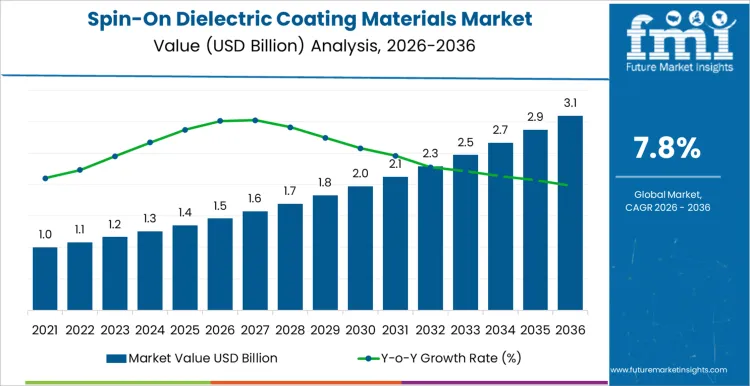
Spin-on dielectric coating materials revenues are estimated at USD 1.46 billion in 2026 and are forecast to reach USD 3.1 billion by 2036, growing at a CAGR of 7.8%. Value creation in this market is shaped more by cost discipline and integration depth than by shipment volume. Spin-on dielectric materials require tightly controlled resin chemistry, ultra-low contamination processing, and extensive qualification, which concentrates margin capture among suppliers with established fab relationships and proven process stability.
Raw material costs and purification steps create a high fixed-cost base, making scale efficiency and yield management critical to profitability. Pricing power is strongest where materials are qualified into advanced nodes or specific interconnect schemes, as replacement risk is high and switching costs for fabs are substantial. As a result, value accrues to suppliers embedded in logic, memory, and advanced packaging flows rather than those competing in commoditized planarization uses. Between 2026 and 2036, margin concentration is expected to increase as fabs standardize materials across multiple lines, reinforcing long-term contracts and favoring suppliers that combine technical support with consistent global supply.
Quick Stats for Spin-On Dielectric Coating Materials Market
- Spin-On Dielectric Coating Materials Market Value (2026): USD 1.46 Billion
- Spin-On Dielectric Coating Materials Market Forecast Value (2036): USD 3.1 Billion
- Spin-On Dielectric Coating Materials Market Forecast CAGR 2026 to 2036: 7.80%
- Leading Material Type in Spin-On Dielectric Coating Materials Market: Spin-On Glass (SOG) Materials (38% share)
- Key Growth Regions in Spin-On Dielectric Coating Materials Market: Asia Pacific, Europe, North America, Latin America, Middle East & Africa
- Top Key Players in Spin-On Dielectric Coating Materials Market: JSR Corporation, Tokyo Ohka Kogyo (TOK), Shin-Etsu Chemical, Dow, DuPont (Electronics & Imaging), Merck Group (EMD Performance Materials), Hitachi Chemical (Showa Denko Materials), AZ Electronic Materials, Sumitomo Chemical, Fuji Chemical Industrial
Spin-On Dielectric Coating Materials Market Key Takeaways
| Metric | Value |
|---|---|
| Spin-On Dielectric Coating Materials Market Value (2026) | USD 1.46 Billion |
| Spin-On Dielectric Coating Materials Market Forecast Value (2036) | USD 3.1 Billion |
| Spin-On Dielectric Coating Materials Market Forecast CAGR 2026 to 2036 | 7.80% |
How are Advanced Interconnect Scaling and Defect Sensitivity Driving the Spin-On Dielectric Coating Materials Market?
The spin-on dielectric (SOD) coating materials market is expanding as semiconductor manufacturers address increasing interconnect complexity and aggressive device scaling. SOD materials are widely used for gap-fill, planarization support, and low-k dielectric integration where conventional CVD processes struggle to achieve void-free fill in high-aspect-ratio features. For fabs, these materials play a critical role in maintaining electrical isolation, minimizing parasitic capacitance, and enabling reliable multilayer interconnect formation.
Process compatibility and defect control are central to adoption. Advanced logic and memory nodes require spin-on dielectrics with tightly controlled viscosity, uniform film thickness, and predictable cure behavior. Materials that integrate smoothly with CMP, etch-back, and annealing steps help reduce defectivity and line-to-line variability. Suppliers offering node-specific formulations optimized for trench fill, via fill, or sacrificial planarization are gaining preference as fabs seek to stabilize process windows across shrinking geometries.
Node migration and supply assurance are further reinforcing market growth. As fabs transition to more advanced nodes and expand capacity across regions, demand is increasing for SOD materials with consistent batch quality and global availability. Close collaboration between material suppliers, equipment OEMs, and fab process teams is becoming essential to qualify new formulations quickly. For suppliers, competitive advantage increasingly depends on integration expertise, purity control, and the ability to support multi-fab deployments positioning spin-on dielectric coating materials as yield-critical enablers in next-generation semiconductor manufacturing.
How is the Spin-On Dielectric Coating Materials Market Structured by Material Type and Application?
The spin-on dielectric coating materials market is segmented by material type and application, reflecting how dielectric performance, gap-fill capability, and process integration requirements influence material selection in semiconductor fabrication. By material type, spin-on glass (SOG) materials lead the market, supported by their established use in planarization and interlayer insulation. Other material types include low-k spin-on dielectrics, porous and hybrid dielectrics, and other specialty spin-on coatings developed for advanced nodes. By application, interlayer dielectric (ILD) deposition represents the largest demand area, followed by gap fill and planarization, passivation and protective layers, and other specialized uses.
Why Do Spin-On Glass (SOG) Materials Lead Material Type Adoption in the Spin-On Dielectric Coating Materials Market?
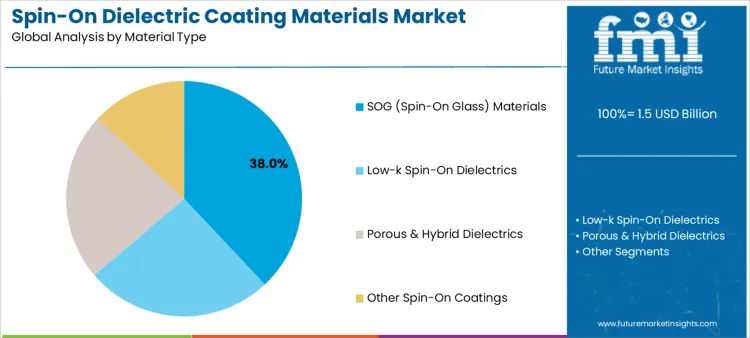
Spin-on glass materials account for 38% share of the spin-on dielectric coating materials market because they provide reliable planarization and dielectric insulation using well-established processing steps. SOG materials are widely used to smooth topography between metal layers, enabling uniform subsequent lithography. Their compatibility with standard spin-coating and curing processes supports repeatable performance across high-volume wafer production. Semiconductor manufacturers value SOG for predictable film thickness control and good adhesion to underlying layers. Broad qualification history and ease of integration into existing process flows further support adoption. These processing reliability and performance consistency factors explain why SOG materials remain the leading material type.
Why Do Interlayer Dielectric (ILD) Applications Dominate Demand In The Spin-On Dielectric Coating Materials Market?
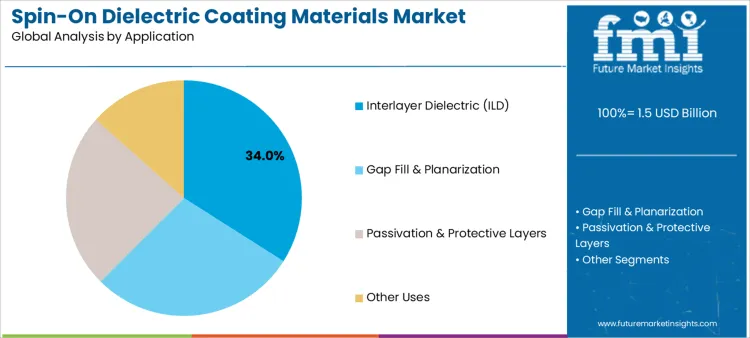
Interlayer dielectric applications hold 34% share of the spin-on dielectric coating materials market because dielectric isolation between conductive layers is fundamental to integrated circuit fabrication. ILD layers electrically separate metal interconnects while maintaining signal integrity and device reliability. Spin-on dielectrics are preferred in ILD applications for their ability to fill gaps and level surface irregularities efficiently. As device complexity increases, multiple ILD layers are required, driving repeated material consumption per wafer. High wafer throughput in logic and memory fabs sustains consistent demand. These process-critical and volume-driven requirements explain why ILD applications remain the dominant segment.
What are the Key Dynamics of the Spin-On Dielectric Coating Materials Market?
The spin-on dielectric coating materials market is driven by demand for advanced insulating films used in semiconductor manufacturing, MEMS, and microelectronic packaging where precise control of dielectric properties and film uniformity directly affects device performance and yield. Spin-on dielectrics (SODs) are formulated to provide controlled dielectric constant, low defect density, and excellent planarization for interlayer insulators, gap fills, and stress buffer layers in back-end-of-line and advanced packaging processes. For chemical suppliers, resin chemistry, consistent quality, compatibility with photolithography and CMP processes, and reproducible performance under varied thermal and cure profiles are key procurement criteria that influence adoption.
How do Technology and Application Trends Shape This Market?
Technology and application trends are shaping the spin-on dielectric coating materials market through device scaling, heterogeneous integration, and increased use of high-density interconnects that demand optimized dielectric performance. As logic, memory, and multi-chip packaging nodes advance, formulators must deliver materials with precise dielectric constants, low moisture uptake, minimal shrinkage on cure, and strong adhesion to varied substrates. Growth in 3D integration and advanced packaging increases spin-on dielectric use for gap fill between fine pitches and stress relief between layers. Suppliers that support integration with upstream photoresists, developers, and downstream planarization systems strengthen their value to fabs and packaging providers.
Why do Quality, Contamination Control, and Qualification Cycles Restrain Adoption?
Quality, contamination control, and qualification cycles restrain adoption in the spin-on dielectric coating materials market because semiconductor fabrication demands extremely tight process control and defect minimization. SOD materials must consistently deliver uniform thickness, low particulate content, controlled cure profiles, and stable electrical performance across entire wafer surfaces. Variability can lead to yield loss, dielectric breakdown, or integration issues, particularly at advanced nodes. Fabs require extensive qualification covering thermal stability, moisture resistance, chemical compatibility, and device reliability over time which extends time to production readiness and increases qualification cost. High scrutiny of material traceability and lot-to-lot consistency further elevates barriers for new entrants.
How is the Spin-On Dielectric Coating Materials Market Expanding across Key Countries?
The spin-on dielectric (SOD) coating materials market is growing steadily as semiconductor manufacturers adopt advanced interlayer dielectric solutions to support device scaling, planarization, and defect reduction. Spin-on dielectrics are widely used for gap filling, planar surfaces, and isolation layers in logic, memory, and specialty semiconductor devices. Country-wise growth varies based on wafer fabrication investments, node transition activity, and expansion of domestic semiconductor ecosystems. High-growth markets are supported by rising wafer starts and process complexity, while mature regions emphasize material consistency, integration with advanced lithography, and yield optimization.
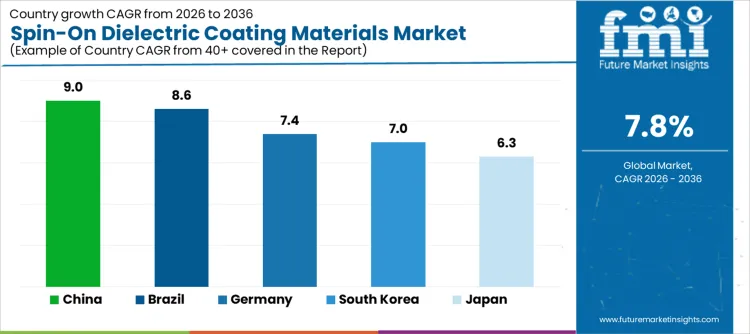
| Country | CAGR (%) |
|---|---|
| China | 9.0 |
| Brazil | 8.6 |
| Germany | 7.4 |
| South Korea | 7.0 |
| Japan | 6.3 |
Why Is China Leading the Spin-On Dielectric Coating Materials Market?
China’s spin-on dielectric coating materials market is expanding at a CAGR of 9.0% during 2026 to 2036, driven by aggressive investment in domestic semiconductor fabrication and localization of advanced materials. Rapid expansion of memory, logic, and power semiconductor fabs is increasing demand for spin-on dielectrics used in gap fill, planarization, and isolation layers. As device architectures become more complex, SOD materials are increasingly preferred for their ability to deliver uniform coverage and precise thickness control. Chinese fabs prioritize spin-on dielectric formulations with stable viscosity, low defect generation, and compatibility with high-throughput coating and curing tools. Domestic chemical suppliers are scaling electronic-grade production to meet strict impurity and process control requirements. Integration with automated track systems and fab-adjacent chemical delivery infrastructure further supports adoption. Procurement decisions emphasize purity certification, supply continuity, and qualification across multiple process nodes.
Why Is Brazil Emerging as a High-Growth Market for Spin-On Dielectric Materials?
Brazil’s spin-on dielectric coating materials market is growing at a CAGR of 8.6% during 2026 to 2036, supported by gradual expansion of semiconductor manufacturing, compound semiconductors, and advanced electronics production. While Brazil does not host large advanced logic fabs, demand is rising from specialty semiconductor lines, optoelectronics, and electronics packaging operations that use spin-on dielectrics for planarization and insulation. Manufacturers value spin-on dielectric materials for their ease of application, defect control, and suitability for small- to mid-scale wafer processing. Buyers prioritize formulation stability, consistent coating performance, and compatibility with existing spin-coating equipment. Adoption is supported by incremental upgrades in fabrication capabilities and increased localization of electronics manufacturing. Procurement decisions often favor suppliers with regional distribution, technical application support, and compliance with international semiconductor material standards.
How Is Germany Supporting Demand for Spin-On Dielectric Coating Materials?
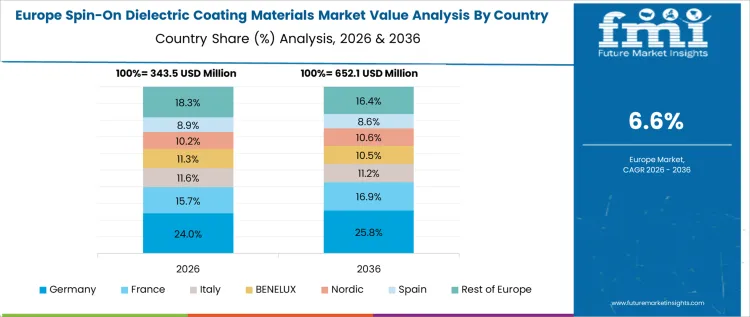
Germany’s spin-on dielectric coating materials market is expanding at a CAGR of 7.4% during 2026 to 2036, driven by demand from power semiconductors, sensors, automotive electronics, and industrial chip manufacturing. German fabs emphasize precision processing, long-term reliability, and tight defect control, making spin-on dielectrics a critical material for advanced device structures. Spin-on dielectric materials are widely used for gap fill and planarization in specialty semiconductor processes where uniformity and process repeatability are essential. Buyers prioritize reproducibility, traceability, and stable electrical properties. Adoption is driven by performance and quality requirements rather than volume scaling. Procurement decisions favor suppliers with certified quality systems, detailed technical documentation, and the ability to support long qualification cycles. Market growth is reinforced by Germany’s leadership in automotive semiconductors, industrial automation, and continued investment in advanced semiconductor manufacturing infrastructure.
How Is South Korea Expanding Use of Spin-On Dielectric Coating Materials?
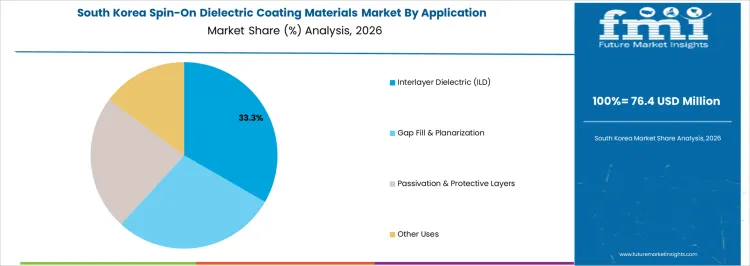
South Korea’s spin-on dielectric coating materials market is growing at a CAGR of 7.0% during 2026 to 2036, supported by strong demand from memory semiconductor manufacturing and advanced logic production. High wafer throughput and multi-layer device architectures drive sustained consumption of spin-on dielectrics for isolation and planarization applications. South Korean fabs emphasize ultra-low defect density, thickness uniformity, and compatibility with high-speed coating tools. Spin-on dielectric materials play a critical role in maintaining yield and process stability at advanced nodes. Buyers prioritize suppliers capable of delivering consistent quality at scale. Procurement decisions are influenced by supplier reliability, rapid technical response, and alignment with global semiconductor manufacturing standards. Market growth is supported by continued investment in memory fabs, node transitions, and increasing complexity of device structures.
What Is Driving Demand for Spin-On Dielectric Coating Materials in Japan?
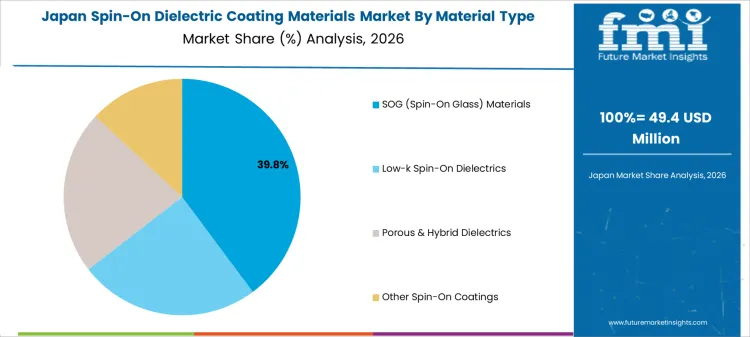
Japan’s spin-on dielectric coating materials market is expanding at a CAGR of 6.3% during 2026 to 2036, driven by demand from specialty semiconductors, sensors, and advanced materials manufacturing. Japanese fabs focus on precision, stability, and long qualification cycles, supporting steady adoption of spin-on dielectric solutions. Spin-on dielectrics are valued for predictable coating behavior, low defect generation, and compatibility with established process flows. Buyers emphasize material reliability, tight impurity control, and long-term supply assurance. Adoption is gradual and quality-driven rather than volume-led. Procurement decisions favor suppliers with strong technical credibility, proven performance records, and the ability to support conservative process integration strategies. Market growth is supported by incremental process upgrades and continued demand for high-reliability semiconductor devices.
How Are Suppliers Competing in the Spin-On Dielectric Coating Materials Market?
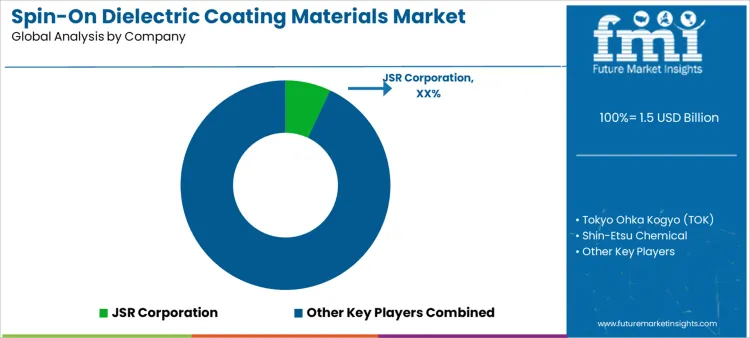
Competition in the spin-on dielectric coating materials market is defined by film uniformity, dielectric constant control, void-free coverage, and integration with advancing lithography and back-end interconnect processes used in semiconductor fabrication. Spin-on dielectrics are critical for gap fill, planarization assistance, and interlayer dielectric (ILD) performance, where even trace defects or variability can compromise yield. JSR Corporation positions its spin-on dielectrics around precise film thickness control and low defectivity, with product materials emphasizing tight control of k-values and excellent planarization across high-aspect-ratio structures. The company’s portfolio is aligned with advanced logic and memory nodes, appealing to wafer fabs seeking reproducible deposition results.
Japanese specialty chemical leaders compete on coated film stability and integration support. Tokyo Ohka Kogyo (TOK), Shin Etsu Chemical, and Sumitomo Chemical differentiate their spin-on dielectric materials with formulations tailored to specific equipment platforms and cleanroom compatibility, emphasizing low contamination and minimal outgassing during cure. Their product literature underlines tight lot traceability critical for high-volume manufacturing.
Global diversified chemical and semiconductor materials suppliers reinforce market competition. Dow and DuPont provide spin-on dielectrics integrated with broader process chemistries, focusing on stable deposition behavior, controlled shrinkage, and cross-process reliability. Merck Group and AZ Electronic Materials compete by combining dielectric innovation with photoresist and ancillary chemistries that support co-optimized process flows. Hitachi Chemical and Fuji Chemical Industrial add competitive breadth with spin-on materials engineered for specific cure profiles and wafer fab standards. Across all suppliers, competitive advantage is defined by verified dielectric performance, defect density control, and seamless process integration rather than price alone.
Key Players in Spin-On Dielectric Coating Materials Market
- JSR Corporation
- Tokyo Ohka Kogyo (TOK)
- Shin-Etsu Chemical
- Dow
- DuPont (electronics & imaging)
- Merck Group (EMD Performance Materials)
- Hitachi Chemical (Showa Denko Materials)
- AZ Electronic Materials (Merck)
- Sumitomo Chemical
- Fuji Chemical Industrial
Scope of Report
| Attribute | Details |
|---|---|
| Market Size Unit | USD Billion |
| Material Type Covered | SOG (Spin-On Glass) Materials, Low-k Spin-On Dielectrics, Porous & Hybrid Dielectrics, Other Spin-On Coatings |
| Application Covered | Interlayer Dielectric (ILD), Gap Fill & Planarization, Passivation & Protective Layers, Other Semiconductor Uses |
| Countries Covered | China, Japan, South Korea, India, Australia & New Zealand, ASEAN, Rest of Asia Pacific, Germany, United Kingdom, France, Italy, Spain, Nordic, BENELUX, Rest of Europe, United States, Canada, Mexico, Brazil, Chile, Rest of Latin America, Kingdom of Saudi Arabia, Other GCC Countries, Turkey, South Africa, Other African Union, Rest of Middle East & Africa |
| Regions Covered | Asia Pacific, Europe, North America, Latin America, Middle East & Africa |
| Key Companies Profiled | JSR Corporation, Tokyo Ohka Kogyo (TOK), Shin-Etsu Chemical, Dow, DuPont (Electronics & Imaging), Merck Group (EMD Performance Materials), Hitachi Chemical (Showa Denko Materials), AZ Electronic Materials, Sumitomo Chemical, Fuji Chemical Industrial |
| Additional Attributes | Dollar sales by material type and semiconductor application are evaluated across advanced and mature process nodes. The scope assesses dielectric constant optimization, planarization performance, gap-fill capability, and defect control. Country-level analysis reflects semiconductor fab expansions, lithography scaling trends, and demand from logic, memory, and advanced packaging manufacturing ecosystems. |
Spin-On Dielectric Coating Materials Market by Key Segments
Material Type:
- SOG (Spin-On Glass) Materials
- Low-k Spin-On Dielectrics
- Porous & Hybrid Dielectrics
- Other Spin-On Coatings
Application
- Interlayer Dielectric (ILD)
- Gap Fill & Planarization
- Passivation & Protective Layers
- Other Uses
Region:
- Asia Pacific
- China
- Japan
- South Korea
- India
- Australia & New Zealand
- ASEAN
- Rest of Asia Pacific
- Europe
- Germany
- United Kingdom
- France
- Italy
- Spain
- Nordic
- BENELUX
- Rest of Europe
- North America
- United States
- Canada
- Mexico
- Latin America
- Brazil
- Chile
- Rest of Latin America
- Middle East & Africa
- Kingdom of Saudi Arabia
- Other GCC Countries
- Turkey
- South Africa
- Other African Union
- Rest of Middle East & Africa
Bibliography
- International Roadmap for Devices and Systems. (2023). More Moore: Interconnect and dielectric materials requirements. IRDS.
- Baklanov, M. R., Ho, P. S., & Maex, K. (2023). Advanced low‑k and spin‑on dielectric materials for interconnect scaling. Microelectronic Engineering, 264, 111892.
- European Commission Joint Research Centre. (2024). Materials reliability and contamination control in semiconductor fabrication. JRC Science for Policy Report.
- imec. (2024). Interconnect scaling and dielectric material integration for advanced semiconductor nodes.
- Grill, A., & Gates, S. M. (2024). Integration limits of spin‑on dielectrics in advanced logic and memory nodes.
Frequently Asked Questions
How big is the spin-on dielectric coating materials market in 2026?
The global spin-on dielectric coating materials market is estimated to be valued at USD 1.5 billion in 2026.
What will be the size of spin-on dielectric coating materials market in 2036?
The market size for the spin-on dielectric coating materials market is projected to reach USD 3.1 billion by 2036.
How much will be the spin-on dielectric coating materials market growth between 2026 and 2036?
The spin-on dielectric coating materials market is expected to grow at a 7.8% CAGR between 2026 and 2036.
What are the key product types in the spin-on dielectric coating materials market?
The key product types in spin-on dielectric coating materials market are sog (spin-on glass) materials, low-k spin-on dielectrics, porous & hybrid dielectrics and other spin-on coatings.
Which application segment to contribute significant share in the spin-on dielectric coating materials market in 2026?
In terms of application, interlayer dielectric (ild) segment to command 34.0% share in the spin-on dielectric coating materials market in 2026.
Preview the report firsthand - request a free sample
Get SampleGet the brochure for pricing and purchase details.
Get PDFTable of Content
- Executive Summary
- Global Market Outlook
- Demand-side Trends
- Supply-side Trends
- Technology Roadmap Analysis
- Analysis and Recommendations
- Market Overview
- Market Coverage / Taxonomy
- Market Definition / Scope / Limitations
- Market Background
- Market Dynamics
- Drivers
- Restraints
- Opportunity
- Trends
- Scenario Forecast
- Demand in Optimistic Scenario
- Demand in Likely Scenario
- Demand in Conservative Scenario
- Opportunity Map Analysis
- Product Life Cycle Analysis
- Supply Chain Analysis
- Investment Feasibility Matrix
- Value Chain Analysis
- PESTLE and Porter’s Analysis
- Regulatory Landscape
- Regional Parent Market Outlook
- Production and Consumption Statistics
- Import and Export Statistics
- Market Dynamics
- Global Market Analysis 2021 to 2025 and Forecast, 2026 to 2036
- Historical Market Size Value (USD Million) Analysis, 2021 to 2025
- Current and Future Market Size Value (USD Million) Projections, 2026 to 2036
- Y-o-Y Growth Trend Analysis
- Absolute $ Opportunity Analysis
- Global Market Pricing Analysis 2021 to 2025 and Forecast 2026 to 2036
- Global Market Analysis 2021 to 2025 and Forecast 2026 to 2036, By Material Type
- Introduction / Key Findings
- Historical Market Size Value (USD Million) Analysis By Material Type , 2021 to 2025
- Current and Future Market Size Value (USD Million) Analysis and Forecast By Material Type , 2026 to 2036
- SOG (Spin-On Glass) Materials
- Low-k Spin-On Dielectrics
- Porous & Hybrid Dielectrics
- Other Spin-On Coatings
- SOG (Spin-On Glass) Materials
- Y-o-Y Growth Trend Analysis By Material Type , 2021 to 2025
- Absolute $ Opportunity Analysis By Material Type , 2026 to 2036
- Global Market Analysis 2021 to 2025 and Forecast 2026 to 2036, By Application
- Introduction / Key Findings
- Historical Market Size Value (USD Million) Analysis By Application, 2021 to 2025
- Current and Future Market Size Value (USD Million) Analysis and Forecast By Application, 2026 to 2036
- Interlayer Dielectric (ILD)
- Gap Fill & Planarization
- Passivation & Protective Layers
- Other Uses
- Interlayer Dielectric (ILD)
- Y-o-Y Growth Trend Analysis By Application, 2021 to 2025
- Absolute $ Opportunity Analysis By Application, 2026 to 2036
- Global Market Analysis 2021 to 2025 and Forecast 2026 to 2036, By Region
- Introduction
- Historical Market Size Value (USD Million) Analysis By Region, 2021 to 2025
- Current Market Size Value (USD Million) Analysis and Forecast By Region, 2026 to 2036
- North America
- Latin America
- Western Europe
- Eastern Europe
- East Asia
- South Asia and Pacific
- Middle East & Africa
- Market Attractiveness Analysis By Region
- North America Market Analysis 2021 to 2025 and Forecast 2026 to 2036, By Country
- Historical Market Size Value (USD Million) Trend Analysis By Market Taxonomy, 2021 to 2025
- Market Size Value (USD Million) Forecast By Market Taxonomy, 2026 to 2036
- By Country
- USA
- Canada
- Mexico
- By Material Type
- By Application
- By Country
- Market Attractiveness Analysis
- By Country
- By Material Type
- By Application
- Key Takeaways
- Latin America Market Analysis 2021 to 2025 and Forecast 2026 to 2036, By Country
- Historical Market Size Value (USD Million) Trend Analysis By Market Taxonomy, 2021 to 2025
- Market Size Value (USD Million) Forecast By Market Taxonomy, 2026 to 2036
- By Country
- Brazil
- Chile
- Rest of Latin America
- By Material Type
- By Application
- By Country
- Market Attractiveness Analysis
- By Country
- By Material Type
- By Application
- Key Takeaways
- Western Europe Market Analysis 2021 to 2025 and Forecast 2026 to 2036, By Country
- Historical Market Size Value (USD Million) Trend Analysis By Market Taxonomy, 2021 to 2025
- Market Size Value (USD Million) Forecast By Market Taxonomy, 2026 to 2036
- By Country
- Germany
- UK
- Italy
- Spain
- France
- Nordic
- BENELUX
- Rest of Western Europe
- By Material Type
- By Application
- By Country
- Market Attractiveness Analysis
- By Country
- By Material Type
- By Application
- Key Takeaways
- Eastern Europe Market Analysis 2021 to 2025 and Forecast 2026 to 2036, By Country
- Historical Market Size Value (USD Million) Trend Analysis By Market Taxonomy, 2021 to 2025
- Market Size Value (USD Million) Forecast By Market Taxonomy, 2026 to 2036
- By Country
- Russia
- Poland
- Hungary
- Balkan & Baltic
- Rest of Eastern Europe
- By Material Type
- By Application
- By Country
- Market Attractiveness Analysis
- By Country
- By Material Type
- By Application
- Key Takeaways
- East Asia Market Analysis 2021 to 2025 and Forecast 2026 to 2036, By Country
- Historical Market Size Value (USD Million) Trend Analysis By Market Taxonomy, 2021 to 2025
- Market Size Value (USD Million) Forecast By Market Taxonomy, 2026 to 2036
- By Country
- China
- Japan
- South Korea
- By Material Type
- By Application
- By Country
- Market Attractiveness Analysis
- By Country
- By Material Type
- By Application
- Key Takeaways
- South Asia and Pacific Market Analysis 2021 to 2025 and Forecast 2026 to 2036, By Country
- Historical Market Size Value (USD Million) Trend Analysis By Market Taxonomy, 2021 to 2025
- Market Size Value (USD Million) Forecast By Market Taxonomy, 2026 to 2036
- By Country
- India
- ASEAN
- Australia & New Zealand
- Rest of South Asia and Pacific
- By Material Type
- By Application
- By Country
- Market Attractiveness Analysis
- By Country
- By Material Type
- By Application
- Key Takeaways
- Middle East & Africa Market Analysis 2021 to 2025 and Forecast 2026 to 2036, By Country
- Historical Market Size Value (USD Million) Trend Analysis By Market Taxonomy, 2021 to 2025
- Market Size Value (USD Million) Forecast By Market Taxonomy, 2026 to 2036
- By Country
- Kingdom of Saudi Arabia
- Other GCC Countries
- Turkiye
- South Africa
- Other African Union
- Rest of Middle East & Africa
- By Material Type
- By Application
- By Country
- Market Attractiveness Analysis
- By Country
- By Material Type
- By Application
- Key Takeaways
- Key Countries Market Analysis
- USA
- Pricing Analysis
- Market Share Analysis, 2025
- By Material Type
- By Application
- Canada
- Pricing Analysis
- Market Share Analysis, 2025
- By Material Type
- By Application
- Mexico
- Pricing Analysis
- Market Share Analysis, 2025
- By Material Type
- By Application
- Brazil
- Pricing Analysis
- Market Share Analysis, 2025
- By Material Type
- By Application
- Chile
- Pricing Analysis
- Market Share Analysis, 2025
- By Material Type
- By Application
- Germany
- Pricing Analysis
- Market Share Analysis, 2025
- By Material Type
- By Application
- UK
- Pricing Analysis
- Market Share Analysis, 2025
- By Material Type
- By Application
- Italy
- Pricing Analysis
- Market Share Analysis, 2025
- By Material Type
- By Application
- Spain
- Pricing Analysis
- Market Share Analysis, 2025
- By Material Type
- By Application
- France
- Pricing Analysis
- Market Share Analysis, 2025
- By Material Type
- By Application
- India
- Pricing Analysis
- Market Share Analysis, 2025
- By Material Type
- By Application
- ASEAN
- Pricing Analysis
- Market Share Analysis, 2025
- By Material Type
- By Application
- Australia & New Zealand
- Pricing Analysis
- Market Share Analysis, 2025
- By Material Type
- By Application
- China
- Pricing Analysis
- Market Share Analysis, 2025
- By Material Type
- By Application
- Japan
- Pricing Analysis
- Market Share Analysis, 2025
- By Material Type
- By Application
- South Korea
- Pricing Analysis
- Market Share Analysis, 2025
- By Material Type
- By Application
- Russia
- Pricing Analysis
- Market Share Analysis, 2025
- By Material Type
- By Application
- Poland
- Pricing Analysis
- Market Share Analysis, 2025
- By Material Type
- By Application
- Hungary
- Pricing Analysis
- Market Share Analysis, 2025
- By Material Type
- By Application
- Kingdom of Saudi Arabia
- Pricing Analysis
- Market Share Analysis, 2025
- By Material Type
- By Application
- Turkiye
- Pricing Analysis
- Market Share Analysis, 2025
- By Material Type
- By Application
- South Africa
- Pricing Analysis
- Market Share Analysis, 2025
- By Material Type
- By Application
- USA
- Market Structure Analysis
- Competition Dashboard
- Competition Benchmarking
- Market Share Analysis of Top Players
- By Regional
- By Material Type
- By Application
- Competition Analysis
- Competition Deep Dive
- JSR Corporation
- Overview
- Product Portfolio
- Profitability by Market Segments (Product/Age /Sales Channel/Region)
- Sales Footprint
- Strategy Overview
- Marketing Strategy
- Product Strategy
- Channel Strategy
- Tokyo Ohka Kogyo (TOK)
- Shin-Etsu Chemical
- Dow
- DuPont (electronics & imaging)
- Merck Group (EMD Performance Materials)
- Hitachi Chemical (Showa Denko Materials)
- AZ Electronic Materials (Merck)
- Sumitomo Chemical
- Fuji Chemical Industrial
- JSR Corporation
- Competition Deep Dive
- Assumptions & Acronyms Used
- Research Methodology


