

- Industry Size (2026)
- USD 9.35 Bn
- Forecast (2036)
- USD 13.71 Bn
- CAGR (2026 to 2036)
- 3.9%
Coating Auxiliaries Market Size, Market Forecast and Outlook By FMI
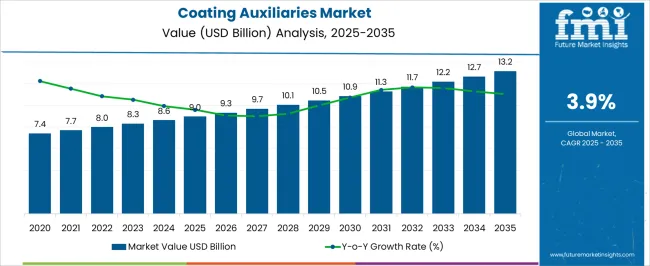
In 2025, the coating auxiliaries market was valued at USD 9.0 billion. Based on Future Market Insights' analysis, demand is estimated to reach USD 9.35 billion in 2026 and USD 13.2 billion by 2035, before rising further to approximately USD 13.71 billion by 2036. This trajectory reflects a CAGR of 3.9% during the forecast period.
Absolute dollar growth of more than USD 4.36 billion between 2026 and 2036 signals a market expanding at a steady pace, underpinned by sustained demand from construction and automotive sectors where coating performance requirements increasingly dictate auxiliary consumption. This value uplift reflects both volume growth and a structural mix shift toward higher-value specialty additives that enable compliance with tightening environmental regulations while maintaining application properties.
Summary of Coating Auxiliaries Market
- Demand Drivers in the Market
- Global construction activity drives architectural coating production, which requires dispersing agents for pigment stabilization, rheology modifiers for application properties, and defoamers for defect-free finishes. The construction sector accounts for 38.2% of coating auxiliaries consumption as the largest end-user segment.
- Automotive production and refinish demand require specialized auxiliaries that enable high-gloss finishes with excellent DOI while maintaining corrosion resistance and weatherability.
- Regulatory pressure for low-VOC and water-borne coatings creates technical challenges that advanced auxiliaries solve, including dispersion stability in water-based systems and rheology control across shear rate ranges.
- Key Segments Analyzed in the FMI Report
- Product Type: Dispersing agents, which account for 37.2% of market value in 2025 due to their essential role in pigment stabilization and color development across all coating types.
- Application: Architectural coatings, capturing 41.9% of market value as the largest application segment, driven by global construction and renovation activity.
- End User: Construction, holding 38.2% of market value as the dominant end-user category, reflecting the scale of building and infrastructure coating consumption.
- Analyst Opinion at FMI
- Nikhil Kaitwade, principal consultant for Chemicals & Materials at Future Market Insights states, "In the updated Coating Auxiliaries Market Report, formulators and procurement specialists will observe how the transition to sustainable coating technologies has elevated auxiliaries to critical enablers. Suppliers with deep understanding of surfactant chemistry, pigment interaction mechanisms, and regulatory compliance requirements maintain technical advantages in this increasingly specialized segment."
- Strategic Implications/Executive Takeaways
- Prioritize dispersing agent development for challenging pigments including organic colors and effect pigments, where stabilization requirements create higher-value opportunities than commodity carbon black dispersion.
- Align product portfolios with water-borne architectural coating growth by developing associative thickeners that provide shear-thinning behavior and sag resistance comparable to solvent-borne systems.
- Build application laboratory capabilities that help customers optimize auxiliary selection for specific formulations, reducing trial-and-error development cycles and strengthening technical partnership relationships.
- Methodology
- The market view is grounded in primary input from coatings manufacturers, raw material suppliers, and end-use industry specifiers, and in technical and policy sources focused on polymer chemistry, colloid science, and environmental regulations, avoiding reliance on secondary market research reports from competing providers.
North America, Europe, and Asia-Pacific account for the bulk of incremental revenues through 2036, but the underlying demand logic is distinct in each region. In North America, EPA guidelines limiting VOC emissions drive adoption of water-borne coating systems requiring advanced dispersing and rheology modifiers to achieve solvent-borne-equivalent performance.
In Europe, REACH compliance and sustainability mandates favor bio-based auxiliary development and high-performance formulations that reduce overall coating environmental footprint. Across Asia-Pacific, rapid urbanization, infrastructure investment, and expanding automotive production generate the highest growth rates, with China and India as primary demand centers supported by government infrastructure spending targets.
Coating Auxiliaries Market Definition
Coating auxiliaries are functional additives incorporated into paint and coating formulations to optimize manufacturing processes, enhance application properties, and improve final film performance. These specialized chemicals include dispersing agents that stabilize pigment suspensions, wetting agents that reduce surface tension for substrate coverage, defoamers that prevent air entrapment during mixing and application, and rheology modifiers that control flow and leveling behavior . For this report, the market covers coating auxiliaries used in architectural, automotive, and industrial coatings across construction, automotive, and general industrial end-user segments.
Coating Auxiliaries Market Inclusions
The report provides a comprehensive analysis of the coating auxiliaries market, covering global and regional market sizes in value terms and a 10-year forecast from 2026 to 2036. It includes segmental breakdowns by product type, application, and end user, across core regions including North America, Latin America, Western Europe, Eastern Europe, East Asia, South Asia & Pacific, and the Middle East & Africa.
Coating Auxiliaries Market Exclusions
The scope excludes base resin binders, pigments, and fillers that constitute the primary film-forming components of coatings. It also omits solvents and coalescing agents whose primary function is dissolution rather than performance modification. Very low-volume, custom-synthesized auxiliaries for specialized research applications that do not contribute meaningfully to global revenue pools are likewise outside the quantified scope.
Coating Auxiliaries Market Research Methodology
- Primary research: Structured interviews were conducted with coatings formulators, raw material procurement specialists, and technical service managers at paint manufacturing companies, alongside construction material specifiers and automotive coating engineers on performance requirements and selection criteria.
- Desk research: Technical documentation and application guides from major coating auxiliary manufacturers, together with academic publications on colloid chemistry and end-use sector reports from government agencies and industry associations, were assessed to benchmark performance and to align market modeling with the latest data on construction activity and automotive production.
- Market-sizing and forecasting: A hybrid top-down and bottom-up modeling framework was applied, reconstructing coating auxiliary demand from architectural paint production volumes, automotive OEM coating consumption, and industrial maintenance coating activity, then validating outputs against publicly available data from government statistical agencies and industry associations.
- Data validation and update cycle: Model outputs undergo consistency checks across regions, product types, and applications, with iterative calibration using new regulatory guidance, manufacturer capacity announcements, and emerging data on end-use industry activity.
Segmental Analysis
Coating Auxiliaries Market Analysis by Product Type
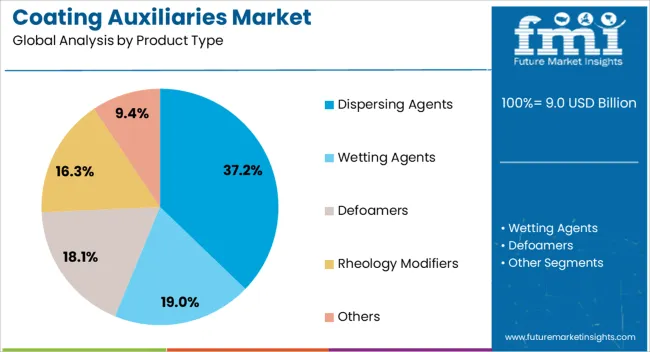
Based on FMI's coating auxiliaries market assessment, Dispersing Agents constitute 37.2% of global market value in 2026, establishing their position as the leading product category. These surface-active chemicals adsorb onto pigment particle surfaces, providing steric or electrostatic stabilization that prevents agglomeration and settling during storage and application . Effective dispersion directly determines color strength, opacity, gloss, and hiding power-fundamental quality attributes that cannot be achieved through post-formation correction.
Wetting Agents follow in significance, reducing dynamic surface tension to enable rapid substrate coverage and prevent defects such as crawling and cratering . Defoamers control air entrapment during manufacturing and application, preventing pinholes and surface imperfections that compromise coating integrity and appearance. Rheology modifiers adjust flow behavior across shear rate ranges, providing sag resistance during application while enabling leveling for smooth finishes. Other auxiliaries including biocides, adhesion promoters, and matting agents serve specialized functions in specific formulations.
Coating Auxiliaries Market Analysis by Application
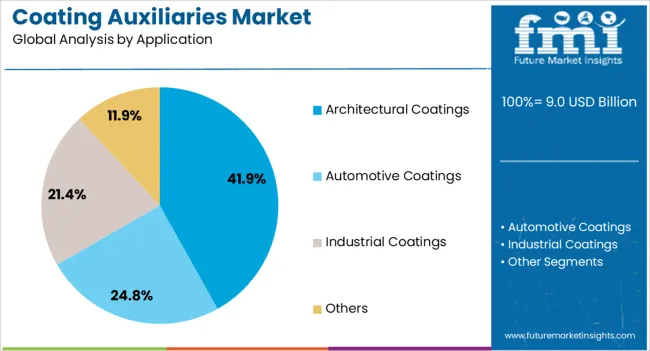
Architectural Coatings represent the largest application segment for coating auxiliaries, capturing 41.9% of market value in 2026. Interior and exterior paints for residential and commercial buildings consume significant volumes of dispersants for titanium dioxide and color pigment stabilization, rheology modifiers for application properties, and defoamers for bubble-free finishes. The segment benefits from consistent demand through both new construction and renovation cycles.
Automotive Coatings follow as a significant application, requiring high-performance auxiliaries that enable defect-free appearance in demanding OEM and refinish environments. Dispersing agents for effect pigments including metallics and pearlescents require specialized chemistries to achieve desired optical effects. Industrial Coatings encompass protective and decorative coatings for machinery, equipment, and manufactured products, requiring auxiliaries tailored to specific application methods and performance requirements.
Coating Auxiliaries Market Analysis by End User
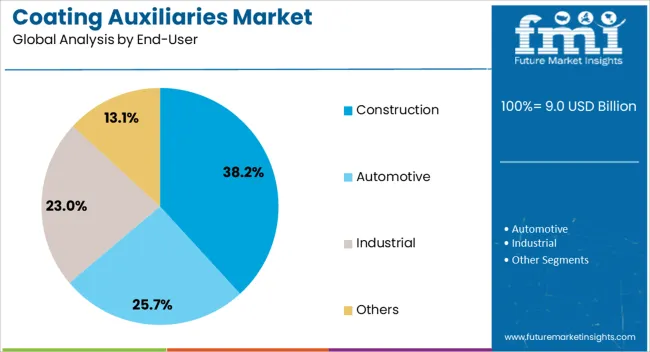
The construction end-user segment accounts for 38.2% of coating auxiliaries market value in 2026, reflecting the scale of architectural coating consumption in building and infrastructure projects. Commercial and residential construction, renovation activity, and public infrastructure investment all contribute to sustained demand. Professional painters and DIY consumers apply coatings requiring consistent performance across varying conditions, driving auxiliary requirements for robust formulation.
Automotive end users include OEM assembly plants requiring coatings with precise rheology for robotic application, and refinish shops needing auxiliaries that enable repair coatings to match original appearance. Industrial end users span manufacturing sectors including appliances, machinery, and electronics, each with specific coating performance requirements that drive auxiliary selection.
Coating Auxiliaries Market Drivers, Restraints, Opportunities and Trends
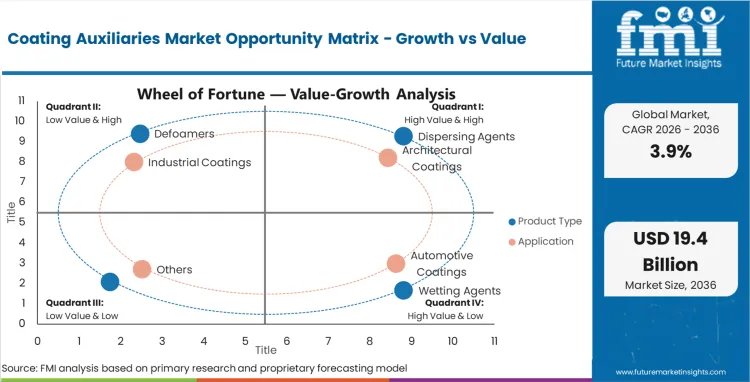
Drivers
Global Construction Activity Driving Architectural Coating Demand
The construction industry's continued expansion, particularly in emerging economies, directly drives coating auxiliaries consumption through architectural paint production. Infrastructure development, residential construction, and commercial building projects all require protective and decorative coatings that depend on dispersants, rheology modifiers, and defoamers for performance. Government infrastructure spending programs in China, India, and Southeast Asia create sustained demand for construction coatings and their enabling auxiliaries .
Automotive Production and Refinish Requirements
Global vehicle production exceeding 90 million units annually generates substantial OEM coating consumption requiring specialized auxiliaries for defect-free application and appearance. The growing vehicle parc creates ongoing refinish demand, with repair coatings requiring auxiliaries that enable color matching and application properties comparable to original finishes. Electric vehicle production growth adds new coating requirements for battery enclosures and lightweight substrates, creating auxiliary formulation opportunities.
Regulatory Push for Low-VOC and Water-Borne Coatings
Stricter environmental regulations limiting VOC emissions across North America and Europe drive formulation transitions that increase auxiliary consumption. Water-borne coatings require more sophisticated dispersant systems to stabilize pigments in aqueous media, associative thickeners to achieve solvent-borne rheology, and defoamers that perform in high-surface-energy systems . These technical challenges create value opportunities for advanced auxiliaries that enable compliant formulations without performance compromise .
Restraints
Raw Material Price Volatility
Coating auxiliaries depend on specialty chemical feedstocks including ethylene oxide, propylene oxide, and fatty alcohols derived from petrochemical and oleochemical sources . Crude oil price fluctuations and supply chain disruptions create cost uncertainty for manufacturers, making long-term pricing agreements difficult and compressing margins during periods of rapid feedstock inflation.
Formulation Complexity and Technical Barriers
Achieving optimal auxiliary performance requires sophisticated understanding of pigment chemistry, surface interactions, and application rheology. End-users lacking formulation expertise may struggle to select appropriate auxiliaries or optimize dosage levels, resulting in suboptimal performance that discourages adoption of advanced additive technologies . This technical barrier limits market penetration in regions with less developed coatings formulation capabilities.
Opportunities
Specialty Dispersants for Effect Pigments
Growth in automotive and industrial coatings using metallic, pearlescent, and interference pigments creates demand for dispersing agents that stabilize these challenging particles without disturbing their orientation-dependent optical effects. Suppliers developing chemistries specifically for effect pigment dispersion capture higher value than those serving commodity titanium dioxide applications.
Bio-Based and Sustainable Auxiliary Development
Sustainability initiatives across the coatings value chain drive interest in auxiliaries derived from renewable resources. Bio-based wetting agents, defoamers from vegetable oils, and rheology modifiers from cellulosic sources offer differentiation opportunities for manufacturers serving customers with renewable content procurement targets. These products must match conventional performance while enabling sustainability claims.
Regional Analysis
.webp "Top Country Growth Comparison Coating Auxiliaries Market Cagr (2026 2036)")
| Countries | Value CAGR (2026 to 2036) |
|---|---|
| China | 6.1% |
| India | 6.8% |
| Germany | 3.7% |
| France | 3.4% |
| United States | 4.3% |
Source: Future Market Insights analysis, supported by proprietary forecasting model and primary research
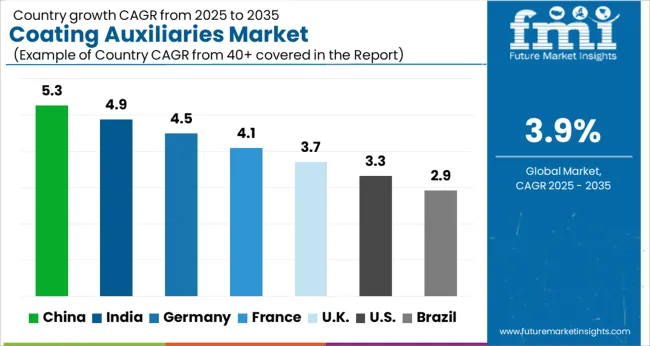
United States
The United States coating auxiliaries market is projected to grow at a 4.3% CAGR from 2026 to 2036, driven by steady construction activity and stringent environmental regulations favoring water-borne coating formulations that require advanced additive packages.
The USA paints and coatings market benefits from a vast industrial base encompassing machinery, equipment, consumer goods, aerospace, and heavy industry where coatings require specialized auxiliaries for performance. EPA guidelines limiting VOC emissions drive adoption of water-borne systems that increase auxiliary consumption per coating unit.
Germany
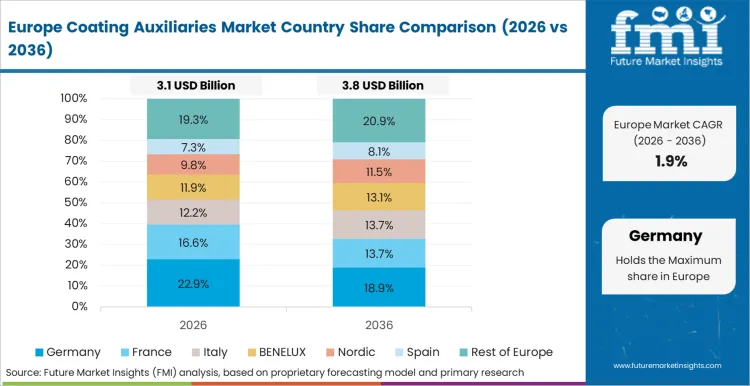
Germany's market is forecast to grow at a 3.7% CAGR from 2026 to 2036, reflecting the country's robust manufacturing sector and automotive industry leadership. The European Union's REACH regulations and sustainability mandates drive adoption of advanced auxiliaries that enable compliant formulations while maintaining high-performance standards. German coatings manufacturers lead in developing high-durability industrial coatings requiring sophisticated additive packages for demanding applications.
France
France's coating auxiliaries market is projected to grow at a 3.4% CAGR from 2026 to 2036. The country's construction sector generates steady demand for architectural coatings and their enabling auxiliaries.
French cosmetic and personal care manufacturing, while not directly consuming coating auxiliaries, demonstrates the broader specialty chemical expertise that supports the coatings additives industry. Regulatory alignment with EU environmental standards maintains pressure for low-VOC formulations requiring advanced additive systems.
China
China's coating auxiliaries market is expected to grow at a 6.1% CAGR from 2026 to 2036, the highest among key countries. The country's booming construction activity and position as the world's largest automotive manufacturer generate substantial coating consumption and corresponding auxiliary demand.
Environmental enforcement tightening in industrial provinces accelerates transition to water-borne coatings, increasing auxiliary consumption per coating unit as formulators compensate for water-borne technical challenges. China's domestic coating production capacity expansion creates sustained demand for imported and locally manufactured auxiliaries.
India
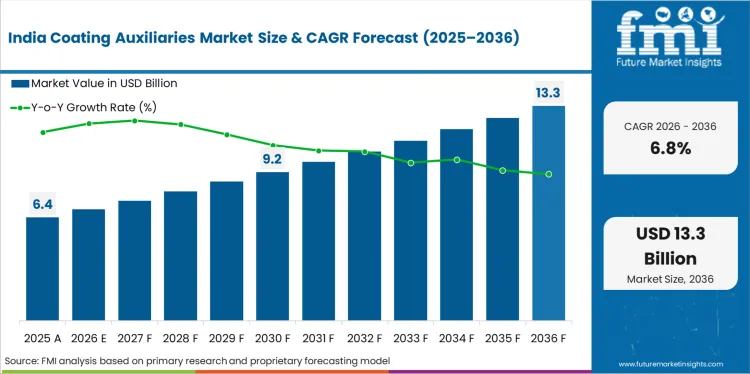
India's market is projected to expand at a 6.8% CAGR from 2026 to 2036, underpinned by rapid urbanization, government infrastructure spending, and expanding automotive production. The National Infrastructure Pipeline targets substantial capital expenditure, driving demand for protective and decorative coatings in bridges, ports, railways, and public buildings.
Smart Cities Mission and Housing for All initiatives boost architectural coating consumption, with premium segments requiring advanced auxiliaries for superior performance. Expanding automotive production and manufacturing sector growth generate industrial coating demand and corresponding auxiliary consumption.
Competitive Aligners for Market Players
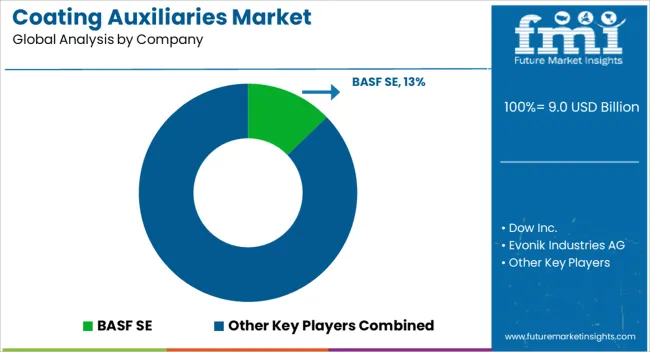
The coating auxiliaries market features a mix of global specialty chemical manufacturers with deep formulation expertise and regional suppliers serving local markets. Competitive positioning hinges on surfactant chemistry understanding, pigment interaction knowledge, regulatory compliance capabilities, and relationships with major coatings manufacturers.
Leading players such as BASF SE, Evonik Industries AG, and Dow Inc. leverage their broad specialty chemical portfolios and global technical service networks to serve multinational coating companies. Their expertise in ethylene oxide and propylene oxide chemistry enables development of tailored surfactants for specific dispersion and wetting challenges.
BYK-Chemie GmbH, as part of Altana AG, focuses exclusively on additives and instruments for coatings and plastics, developing deep application knowledge that translates into technically superior products. Elementis plc specializes in rheology modification through its rheological additives portfolio, serving construction and industrial coating applications where flow control is critical.
Regional players including Asian manufacturers serve domestic markets with cost-competitive products, though often with less technical sophistication than global leaders. The market remains fragmented with numerous small suppliers serving niche applications or geographic segments.
From a strategic perspective, differentiation is moving beyond basic surfactant production toward demonstrable capability in three areas. These include application-specific formulation expertise that solves customer technical challenges; regulatory support helping customers navigate VOC limits and chemical registration requirements; and sustainable chemistry development enabling renewable content claims and reduced environmental footprint.
Key Developments
- BASF SE has expanded its dispersing agent portfolio for water-borne architectural coatings, developing new polymer architectures that provide pigment stabilization across wider pH and temperature ranges. The company's commitment to sustainable chemistry includes development of bio-based wetting agents derived from renewable feedstocks.
- Evonik Industries AG has introduced new defoamer technologies for high-gloss water-borne coatings, addressing the challenge of microfoam that compromises appearance in demanding architectural and industrial applications. The company's TEGO® brand continues to innovate in silicone and polymer-based additives.
- BYK-Chemie GmbH has developed specialized dispersing agents for effect pigments used in automotive coatings, enabling metallic and pearlescent finishes with improved color development and orientation control. These products address the growing demand for distinctive appearance in premium vehicle segments.
- Elementis plc has advanced its rheology modifier portfolio with new associative thickeners that provide improved sag resistance and leveling balance in water-borne architectural paints, enabling formulation simplification and reduced raw material complexity.
Key Players Profiled
- BASF SE
- Evonik Industries AG
- Dow Inc.
- Clariant AG
- Arkema Group
- Ashland Global Holdings Inc.
- Eastman Chemical Company
- Solvay S.A.
- Croda International Plc
- Huntsman Corporation
- Akzo Nobel N.V.
- PPG Industries, Inc.
- The Sherwin-Williams Company
- Wacker Chemie AG
- Momentive Performance Materials Inc.
- BYK-Chemie GmbH
- Elementis plc
- Lubrizol Corporation
Scope of the Report
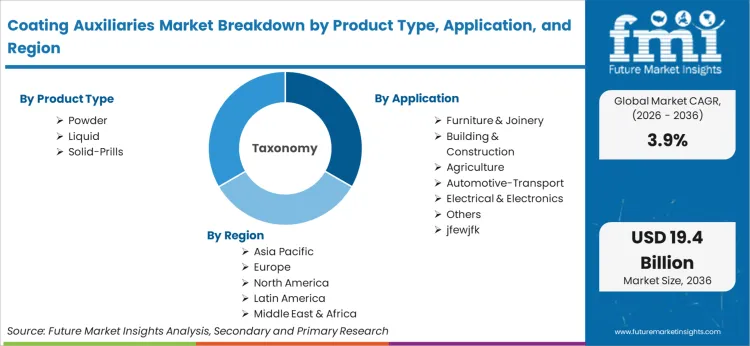
| Metric | Value |
|---|---|
| Quantitative Units | USD 9.35 billion (2026) to approximately USD 13.71 billion (2036), at a CAGR of 3.9%, with 2025 historic value of USD 9.0 billion |
| Market Definition | Coating auxiliaries are functional additives incorporated into paint and coating formulations to optimize manufacturing processes, enhance application properties, and improve final film performance, including dispersing agents, wetting agents, defoamers, and rheology modifiers used in architectural, automotive, and industrial coatings. |
| Product Type Segmentation | Dispersing Agents (37.2% in 2025); Wetting Agents; Defoamers; Rheology Modifiers; Others |
| Application Coverage | Architectural Coatings (41.9% in 2025); Automotive Coatings; Industrial Coatings; Others |
| End User Coverage | Construction (38.2% in 2025); Automotive; Industrial; Others |
| Regions Covered | North America, Latin America, Western Europe, Eastern Europe, East Asia, South Asia & Pacific, Middle East & Africa |
| Countries Covered | United States, Germany, France, China, India |
| Key Companies Profiled | BASF SE; Evonik Industries AG; Dow Inc.; Clariant AG; Arkema Group; Ashland Global Holdings Inc.; Eastman Chemical Company; Solvay S.A.; Croda International Plc; Huntsman Corporation; Akzo Nobel N.V.; PPG Industries, Inc.; The Sherwin-Williams Company; Wacker Chemie AG; Momentive Performance Materials Inc.; BYK-Chemie GmbH; Elementis plc; Lubrizol Corporation |
| Forecast Period | 2026 to 2036 |
| Approach | Hybrid top-down and bottom-up market modeling validated through primary interviews with coatings manufacturers, raw material suppliers, and end-use industry specifiers, supported by benchmarking against construction spending data, automotive production statistics, and regulatory compliance requirements. |
Coating Auxiliaries Market Analysis by Segments
Product Type:
- Dispersing Agents
- Wetting Agents
- Defoamers
- Rheology Modifiers
- Others
Application:
- Architectural Coatings
- Automotive Coatings
- Industrial Coatings
- Others
End User:
- Construction
- Automotive
- Industrial
- Others
Region:
- North America
- Latin America
- Western Europe
- Eastern Europe
- East Asia
- South Asia & Pacific
- Middle East & Africa
Bibliography
- Organisation for Economic Co-operation and Development. (2025). Global construction outlook 2025-2035. OECD Publishing.
- United Nations Human Settlements Programme. (2024). World Cities Report 2024: Urbanization and infrastructure development. UN-Habitat.
- International Council of Chemical Associations. (2024). Surfactants and dispersants in coating applications. ICCA Technical Brief.
- European Commission. (2024). Study on the potential for reducing emissions from the use of solvents in decorative paints and varnishes. Publications Office of the European Union.
- International Energy Agency. (2025). Global EV Outlook 2025: Trends in electric vehicle adoption. IEA Publications.
- USA Energy Information Administration. (2025). Petroleum & other liquids: Spot prices. EIA.
- BASF SE. (2024). Dispersing agents for water-borne coatings. BASF Technical Information.
- American Coatings Association. (2025). Coatings industry market analysis. ACA.
- United Nations Comtrade Database. (2025). Chemical products international trade statistics. UN Comtrade.
- United Nations Industrial Development Organization. (2025). International Yearbook of Industrial Statistics. UNIDO.
- German Federal Statistical Office. (2025). Chemical industry production statistics. Destatis.
- National Bureau of Statistics of China. (2025). China statistical yearbook on construction. China Statistics Press.
- Government of India, Ministry of Statistics and Programme Implementation. (2025). Infrastructure statistics. MOSPI.
- Korea International Trade Association. (2025). Korea's chemical industry export trends. KITA.
- French Ministry of Ecological Transition. (2025). Construction and housing statistics. MTECT.
This Report Addresses
- Market intelligence to enable structured strategic decision-making across coating auxiliary manufacturers, coatings formulators, and industry investors.
- Market size estimation and 10-year revenue forecasts from 2026 to 2036, including validated CAGR and absolute dollar opportunity sizing.
- Growth opportunity mapping across Product Type, Application, End User, and regional demand pockets, with emphasis on dispersing agent adoption and construction-driven consumption patterns.
- Segment and regional forecasting covering dispersing agents and architectural coatings, alongside end-user-specific demand trajectories across construction and automotive applications.
- Competition strategy assessment, including surfactant chemistry expertise, pigment interaction knowledge, and buyer leverage dynamics shaping sourcing decisions.
- Product and technology tracking focused on water-borne formulation compatibility, effect pigment dispersion, and sustainable auxiliary development.
- Regional construction activity analysis covering infrastructure investment, housing starts, and automotive production trends influencing coating auxiliary procurement.
- Report delivery in PDF, Excel, and presentation-ready formats to support executive planning, capacity investment decisions, and competitive benchmarking.
Frequently Asked Questions
What is the size of the global coating auxiliaries market in 2025 and how fast is it expected to grow through 2036?
The global coating auxiliaries market is valued at USD 9.0 billion in 2025 and is projected to grow at a 3.9% CAGR, reaching about USD 9.35 billion in 2026 and approximately USD 13.71 billion by 2036.
Why do Dispersing Agents hold 37.2% of the market in 2026?
Dispersing agents account for 37.2% of market value because they are essential for pigment stabilization, preventing agglomeration and settling that would otherwise compromise color strength, opacity, gloss, and hiding power—fundamental quality attributes that cannot be corrected after formulation .
What drives Architectural Coatings as the largest application segment at 41.9%?
Architectural coatings represent the largest application due to the scale of global construction and renovation activity, with interior and exterior paints for residential and commercial buildings consuming significant volumes of dispersants, rheology modifiers, and defoamers.
Why is Construction the leading end-user segment at 38.2%?
Construction leads as the largest end-user because building and infrastructure projects consume architectural coatings in substantial volumes, with commercial, residential, and public works all requiring performance coatings that depend on advanced auxiliaries.
How do environmental regulations affect coating auxiliary demand?
Stricter VOC limits across North America and Europe drive formulation transitions to water-borne coatings that require more sophisticated dispersant systems, associative thickeners, and defoamers to achieve performance comparable to solvent-borne systems, increasing auxiliary consumption per coating unit.
What role does the automotive industry play in market growth?
Global vehicle production exceeding 90 million units annually generates substantial OEM coating consumption requiring specialized auxiliaries for defect-free application. The vehicle parc creates ongoing refinish demand, while electric vehicle transition adds new coating requirements for battery enclosures and lightweight substrates.
Why is China's coating auxiliaries market projected to grow at a 6.1% CAGR?
China's 6.1% CAGR reflects booming construction activity, position as the world's largest automotive manufacturer, and environmental enforcement tightening that accelerates transition to water-borne coatings, increasing auxiliary consumption per coating unit.
What drives India's 6.8% CAGR between 2026 and 2036?
India's 6.8% CAGR is driven by rapid urbanization, government infrastructure spending under the National Infrastructure Pipeline, Smart Cities Mission, and Housing for All initiatives boosting architectural coating consumption and corresponding auxiliary demand.
How do raw material price fluctuations affect the market?
Coating auxiliaries depend on specialty chemical feedstocks derived from petrochemical and oleochemical sources. Crude oil price fluctuations create cost uncertainty, making long-term pricing agreements difficult and compressing margins during rapid feedstock inflation.
What opportunities exist in specialty dispersants for effect pigments?
Growth in automotive and industrial coatings using metallic, pearlescent, and interference pigments creates demand for dispersing agents that stabilize these challenging particles without disturbing orientation-dependent optical effects, capturing higher value than commodity applications.
How do bio-based auxiliaries create market differentiation?
Sustainability initiatives drive interest in auxiliaries from renewable resources-bio-based wetting agents, defoamers from vegetable oils, and cellulosic rheology modifiers-offering differentiation for manufacturers serving customers with renewable content procurement targets.
What are the main technical barriers in coating auxiliary formulation?
Achieving optimal auxiliary performance requires sophisticated understanding of pigment chemistry, surface interactions, and application rheology. End-users lacking formulation expertise may struggle to select appropriate auxiliaries or optimize dosage levels.
How does construction activity in emerging economies drive demand?
Infrastructure development, residential construction, and commercial building projects in emerging economies create sustained demand for architectural coatings and their enabling auxiliaries, with government spending programs ensuring long-term consumption.
What is the significance of rheology modifiers in water-borne coatings?
Rheology modifiers provide shear-thinning behavior for application and sag resistance while enabling leveling for smooth finishes, critical functions in water-borne coatings that cannot rely on solvent-borne rheology mechanisms.
How do defoamers contribute to coating quality?
Defoamers control air entrapment during manufacturing and application, preventing pinholes and surface imperfections that compromise coating integrity and appearance, particularly critical in high-gloss and clear coat applications.
What opportunities exist in industrial coating applications?
Industrial coatings for machinery, equipment, and manufactured products require auxiliaries tailored to specific application methods and performance requirements, creating opportunities for specialized products serving niche manufacturing segments.
How does the European regulatory framework influence auxiliary development?
REACH compliance and sustainability mandates favor development of advanced auxiliaries that enable compliant formulations while maintaining high-performance standards, with German and French manufacturers leading in high-durability industrial coatings.
What role do wetting agents play in coating performance?
Wetting agents reduce dynamic surface tension to enable rapid substrate coverage and prevent defects such as crawling and cratering, particularly important in water-borne systems with inherently higher surface tension than solvent-borne alternatives.
Preview the report firsthand - request a free sample
Get SampleGet the brochure for pricing and purchase details.
Get PDFTable of Content
- Executive Summary
- Global Market Outlook
- Demand-side Trends
- Supply-side Trends
- Technology Roadmap Analysis
- Analysis and Recommendations
- Market Overview
- Market Coverage / Taxonomy
- Market Definition / Scope / Limitations
- Research Methodology
- Chapter Orientation
- Analytical Lens and Working Hypotheses
- Market Structure, Signals, and Trend Drivers
- Benchmarking and Cross-market Comparability
- Market Sizing, Forecasting, and Opportunity Mapping
- Research Design and Evidence Framework
- Desk Research Programme (Secondary Evidence)
- Company Annual and Sustainability Reports
- Peer-reviewed Journals and Academic Literature
- Corporate Websites, Product Literature, and Technical Notes
- Earnings Decks and Investor Briefings
- Statutory Filings and Regulatory Disclosures
- Technical White Papers and Standards Notes
- Trade Journals, Industry Magazines, and Analyst Briefs
- Conference Proceedings, Webinars, and Seminar Materials
- Government Statistics Portals and Public Data Releases
- Press Releases and Reputable Media Coverage
- Specialist Newsletters and Curated Briefings
- Sector Databases and Reference Repositories
- FMI Internal Proprietary Databases and Historical Market Datasets
- Subscription Datasets and Paid Sources
- Social Channels, Communities, and Digital Listening Inputs
- Additional Desk Sources
- Expert Input and Fieldwork (Primary Evidence)
- Primary Modes
- Qualitative Interviews and Expert Elicitation
- Quantitative Surveys and Structured Data Capture
- Blended Approach
- Why Primary Evidence is Used
- Field Techniques
- Interviews
- Surveys
- Focus Groups
- Observational and In-context Research
- Social and Community Interactions
- Stakeholder Universe Engaged
- C-suite Leaders
- Board Members
- Presidents and Vice Presidents
- R&D and Innovation Heads
- Technical Specialists
- Domain Subject-matter Experts
- Scientists
- Physicians and Other Healthcare Professionals
- Governance, Ethics, and Data Stewardship
- Research Ethics
- Data Integrity and Handling
- Primary Modes
- Tooling, Models, and Reference Databases
- Desk Research Programme (Secondary Evidence)
- Data Engineering and Model Build
- Data Acquisition and Ingestion
- Cleaning, Normalisation, and Verification
- Synthesis, Triangulation, and Analysis
- Quality Assurance and Audit Trail
- Market Background
- Market Dynamics
- Drivers
- Restraints
- Opportunity
- Trends
- Scenario Forecast
- Demand in Optimistic Scenario
- Demand in Likely Scenario
- Demand in Conservative Scenario
- Opportunity Map Analysis
- Product Life Cycle Analysis
- Supply Chain Analysis
- Investment Feasibility Matrix
- Value Chain Analysis
- PESTLE and Porter’s Analysis
- Regulatory Landscape
- Regional Parent Market Outlook
- Production and Consumption Statistics
- Import and Export Statistics
- Market Dynamics
- Global Market Analysis 2021 to 2025 and Forecast, 2026 to 2036
- Historical Market Size Value (USD Million) Analysis, 2021 to 2025
- Current and Future Market Size Value (USD Million) Projections, 2026 to 2036
- Y-o-Y Growth Trend Analysis
- Absolute $ Opportunity Analysis
- Global Market Pricing Analysis 2021 to 2025 and Forecast 2026 to 2036
- Global Market Analysis 2021 to 2025 and Forecast 2026 to 2036, By Product Type
- Introduction / Key Findings
- Historical Market Size Value (USD Million) Analysis By Product Type , 2021 to 2025
- Current and Future Market Size Value (USD Million) Analysis and Forecast By Product Type , 2026 to 2036
- Dispersing Agents
- Wetting Agents
- Defoamers
- Rheology Modifiers
- Dispersing Agents
- Y-o-Y Growth Trend Analysis By Product Type , 2021 to 2025
- Absolute $ Opportunity Analysis By Product Type , 2026 to 2036
- Global Market Analysis 2021 to 2025 and Forecast 2026 to 2036, By Application
- Introduction / Key Findings
- Historical Market Size Value (USD Million) Analysis By Application, 2021 to 2025
- Current and Future Market Size Value (USD Million) Analysis and Forecast By Application, 2026 to 2036
- Architectural Coatings
- Automotive Coatings
- Industrial Coatings
- Others
- Architectural Coatings
- Y-o-Y Growth Trend Analysis By Application, 2021 to 2025
- Absolute $ Opportunity Analysis By Application, 2026 to 2036
- Global Market Analysis 2021 to 2025 and Forecast 2026 to 2036, By End User
- Introduction / Key Findings
- Historical Market Size Value (USD Million) Analysis By End User, 2021 to 2025
- Current and Future Market Size Value (USD Million) Analysis and Forecast By End User, 2026 to 2036
- Construction
- Automotive
- Industrial
- Others
- Construction
- Y-o-Y Growth Trend Analysis By End User, 2021 to 2025
- Absolute $ Opportunity Analysis By End User, 2026 to 2036
- Global Market Analysis 2021 to 2025 and Forecast 2026 to 2036, By Region
- Introduction
- Historical Market Size Value (USD Million) Analysis By Region, 2021 to 2025
- Current Market Size Value (USD Million) Analysis and Forecast By Region, 2026 to 2036
- North America
- Latin America
- Western Europe
- Eastern Europe
- East Asia
- South Asia and Pacific
- Middle East & Africa
- Market Attractiveness Analysis By Region
- North America Market Analysis 2021 to 2025 and Forecast 2026 to 2036, By Country
- Historical Market Size Value (USD Million) Trend Analysis By Market Taxonomy, 2021 to 2025
- Market Size Value (USD Million) Forecast By Market Taxonomy, 2026 to 2036
- By Country
- USA
- Canada
- Mexico
- By Product Type
- By Application
- By End User
- By Country
- Market Attractiveness Analysis
- By Country
- By Product Type
- By Application
- By End User
- Key Takeaways
- Latin America Market Analysis 2021 to 2025 and Forecast 2026 to 2036, By Country
- Historical Market Size Value (USD Million) Trend Analysis By Market Taxonomy, 2021 to 2025
- Market Size Value (USD Million) Forecast By Market Taxonomy, 2026 to 2036
- By Country
- Brazil
- Chile
- Rest of Latin America
- By Product Type
- By Application
- By End User
- By Country
- Market Attractiveness Analysis
- By Country
- By Product Type
- By Application
- By End User
- Key Takeaways
- Western Europe Market Analysis 2021 to 2025 and Forecast 2026 to 2036, By Country
- Historical Market Size Value (USD Million) Trend Analysis By Market Taxonomy, 2021 to 2025
- Market Size Value (USD Million) Forecast By Market Taxonomy, 2026 to 2036
- By Country
- Germany
- UK
- Italy
- Spain
- France
- Nordic
- BENELUX
- Rest of Western Europe
- By Product Type
- By Application
- By End User
- By Country
- Market Attractiveness Analysis
- By Country
- By Product Type
- By Application
- By End User
- Key Takeaways
- Eastern Europe Market Analysis 2021 to 2025 and Forecast 2026 to 2036, By Country
- Historical Market Size Value (USD Million) Trend Analysis By Market Taxonomy, 2021 to 2025
- Market Size Value (USD Million) Forecast By Market Taxonomy, 2026 to 2036
- By Country
- Russia
- Poland
- Hungary
- Balkan & Baltic
- Rest of Eastern Europe
- By Product Type
- By Application
- By End User
- By Country
- Market Attractiveness Analysis
- By Country
- By Product Type
- By Application
- By End User
- Key Takeaways
- East Asia Market Analysis 2021 to 2025 and Forecast 2026 to 2036, By Country
- Historical Market Size Value (USD Million) Trend Analysis By Market Taxonomy, 2021 to 2025
- Market Size Value (USD Million) Forecast By Market Taxonomy, 2026 to 2036
- By Country
- China
- Japan
- South Korea
- By Product Type
- By Application
- By End User
- By Country
- Market Attractiveness Analysis
- By Country
- By Product Type
- By Application
- By End User
- Key Takeaways
- South Asia and Pacific Market Analysis 2021 to 2025 and Forecast 2026 to 2036, By Country
- Historical Market Size Value (USD Million) Trend Analysis By Market Taxonomy, 2021 to 2025
- Market Size Value (USD Million) Forecast By Market Taxonomy, 2026 to 2036
- By Country
- India
- ASEAN
- Australia & New Zealand
- Rest of South Asia and Pacific
- By Product Type
- By Application
- By End User
- By Country
- Market Attractiveness Analysis
- By Country
- By Product Type
- By Application
- By End User
- Key Takeaways
- Middle East & Africa Market Analysis 2021 to 2025 and Forecast 2026 to 2036, By Country
- Historical Market Size Value (USD Million) Trend Analysis By Market Taxonomy, 2021 to 2025
- Market Size Value (USD Million) Forecast By Market Taxonomy, 2026 to 2036
- By Country
- Kingdom of Saudi Arabia
- Other GCC Countries
- Turkiye
- South Africa
- Other African Union
- Rest of Middle East & Africa
- By Product Type
- By Application
- By End User
- By Country
- Market Attractiveness Analysis
- By Country
- By Product Type
- By Application
- By End User
- Key Takeaways
- Key Countries Market Analysis
- USA
- Pricing Analysis
- Market Share Analysis, 2025
- By Product Type
- By Application
- By End User
- Canada
- Pricing Analysis
- Market Share Analysis, 2025
- By Product Type
- By Application
- By End User
- Mexico
- Pricing Analysis
- Market Share Analysis, 2025
- By Product Type
- By Application
- By End User
- Brazil
- Pricing Analysis
- Market Share Analysis, 2025
- By Product Type
- By Application
- By End User
- Chile
- Pricing Analysis
- Market Share Analysis, 2025
- By Product Type
- By Application
- By End User
- Germany
- Pricing Analysis
- Market Share Analysis, 2025
- By Product Type
- By Application
- By End User
- UK
- Pricing Analysis
- Market Share Analysis, 2025
- By Product Type
- By Application
- By End User
- Italy
- Pricing Analysis
- Market Share Analysis, 2025
- By Product Type
- By Application
- By End User
- Spain
- Pricing Analysis
- Market Share Analysis, 2025
- By Product Type
- By Application
- By End User
- France
- Pricing Analysis
- Market Share Analysis, 2025
- By Product Type
- By Application
- By End User
- India
- Pricing Analysis
- Market Share Analysis, 2025
- By Product Type
- By Application
- By End User
- ASEAN
- Pricing Analysis
- Market Share Analysis, 2025
- By Product Type
- By Application
- By End User
- Australia & New Zealand
- Pricing Analysis
- Market Share Analysis, 2025
- By Product Type
- By Application
- By End User
- China
- Pricing Analysis
- Market Share Analysis, 2025
- By Product Type
- By Application
- By End User
- Japan
- Pricing Analysis
- Market Share Analysis, 2025
- By Product Type
- By Application
- By End User
- South Korea
- Pricing Analysis
- Market Share Analysis, 2025
- By Product Type
- By Application
- By End User
- Russia
- Pricing Analysis
- Market Share Analysis, 2025
- By Product Type
- By Application
- By End User
- Poland
- Pricing Analysis
- Market Share Analysis, 2025
- By Product Type
- By Application
- By End User
- Hungary
- Pricing Analysis
- Market Share Analysis, 2025
- By Product Type
- By Application
- By End User
- Kingdom of Saudi Arabia
- Pricing Analysis
- Market Share Analysis, 2025
- By Product Type
- By Application
- By End User
- Turkiye
- Pricing Analysis
- Market Share Analysis, 2025
- By Product Type
- By Application
- By End User
- South Africa
- Pricing Analysis
- Market Share Analysis, 2025
- By Product Type
- By Application
- By End User
- USA
- Market Structure Analysis
- Competition Dashboard
- Competition Benchmarking
- Market Share Analysis of Top Players
- By Regional
- By Product Type
- By Application
- By End User
- Competition Analysis
- Competition Deep Dive
- BASF SE
- Overview
- Product Portfolio
- Profitability by Market Segments (Product/Age /Sales Channel/Region)
- Sales Footprint
- Strategy Overview
- Marketing Strategy
- Product Strategy
- Channel Strategy
- Evonik Industries AG
- Dow Inc.
- Clariant AG
- Arkema Group
- Ashland Global Holdings Inc.
- BASF SE
- Competition Deep Dive
- Assumptions & Acronyms Used


