

- Industry Size (2026)
- USD 1.5 Bn
- Forecast (2036)
- USD 2.8 Bn
- CAGR (2026 to 2036)
- 6.5%
PVOH Coatings Market Size, Market Forecast and Outlook By FMI
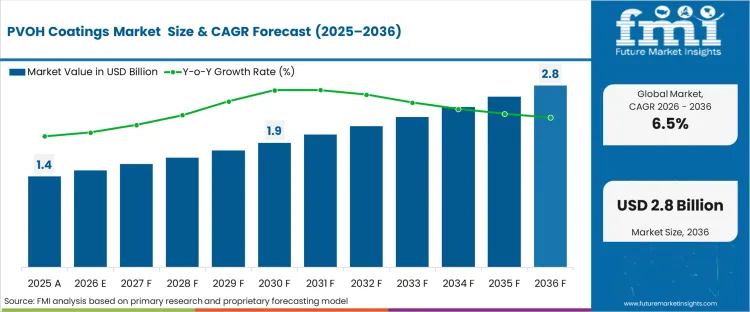
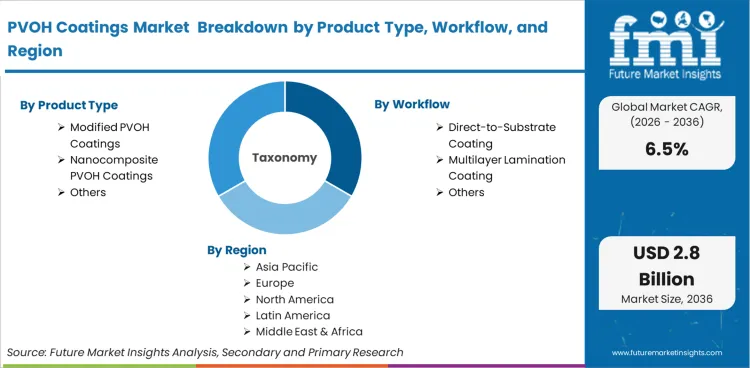
The PVOH coatings market was valued at USD 1.4 billion in 2025. The market is projected to reach USD 1.5 billion in 2026 and USD 2.8 billion by 2036, expanding at a CAGR of 6.5% during the forecast period. Modified PVOH coatings are expected to lead product type with a 38.7% share in 2026. Direct-to-substrate coating is projected to remain the leading workflow with a 57.4% share in 2026. Further, food packaging is expected to lead end-user demand with a 46.8% share in 2026.
Summary of PVOH Coatings Market
- Key Drivers
- Paperization pressure: Brand owners need oxygen and grease barriers on paper structures as regulation and retailer mandates push replacement of plastic-heavy formats.
- Barrier-performance demand: PVOH coatings deliver strong film formation and barrier performance where clarity, printability, and water-based processing matter.
- Compliance-ready chemistry: Food-contact familiarity and recyclability-focused coating systems support adoption in regulated packaging applications.
- Key Segments Analyzed in the Report
- Product type: standard PVOH coatings, modified PVOH coatings, nanocomposite PVOH coatings, and others
- Workflow: direct-to-substrate coating, multilayer lamination coating, and converting and finishing
- End user: food packaging, pharmaceutical packaging, paper and board converting, electronics and specialty applications, and others
- Region: North America, Latin America, Western Europe, Eastern Europe, East Asia, South Asia and Pacific, and Middle East and Africa
- Analyst Opinion
- Nandini Roy Choudhury, Principal Analyst at Future Market Insights says, "Value in the PVOH coatings market pools where barrier performance, machine runnability, and recyclability evidence come together in one formulation. Suppliers that help converters meet oxygen and grease targets without breaking repulpability economics are building the strongest commercial position."
- PVOH Coatings Market Definition
- The PVOH coatings market includes water-based coating systems built on polyvinyl alcohol chemistry for barrier, adhesion, release, and surface-functional applications. It covers standard hydrolyzed grades, modified humidity-resistant grades, composite and nanocomposite formulations, and formulated coatings applied on paper, paperboard, plastic films, and specialty substrates. These coatings serve packaging converters, paper and board processors, pharmaceutical packagers, and selected specialty manufacturing operations where oxygen barrier, grease resistance, print surface quality, and coating uniformity are commercially important.
- PVOH Coatings Market Inclusions
- PVOH-based coatings sold as formulated barrier, primer, release, or specialty surface-treatment systems for commercial use
- Resin-linked and formulated coating revenue associated with packaging, converting, and specialty industrial applications
- Regional demand across mature and emerging converting markets where paper, board, and film substrates are coated at industrial scale
- PVOH Coatings Market Exclusions
- Standalone PVOH films and molded water-soluble films except where coating use is the commercial benchmark
- Finished packaged-goods revenue generated by food, pharmaceutical, or consumer brands
- General adhesives, binders, and textile sizing products not sold as coating systems
- PVOH Coatings Market Research Methodology
- The study evaluates the PVOH coatings market across product type, workflow, end user, and region with 2025 as the base year and forecasts from 2026 to 2036. Market size is expressed in value terms as supplier and converter-level coating revenue. Evidence inputs include European packaging regulation developments, paper-packaging recyclability guidance, FDA food-contact provisions for polyvinyl alcohol, company product literature, sustainability announcements, and technical literature on oxygen, grease, and humidity barrier performance. Final estimates are built through triangulation across substrate demand, coating-load economics, end-use adoption rates, and supplier positioning in paperization and high-barrier packaging.
Key Drivers, Restraints, and Trends in PVOH Coatings Market
Drivers
Pressure to replace plastic-heavy barrier layers is raising demand for water-based coatings that can work on paper and paperboard without destroying converting efficiency. The shift matters because packaging regulation in Europe is tightening recyclability expectations and brand owners are redesigning structures ahead of 2030 compliance windows. PVOH gains from this change because it forms dense films with strong oxygen and grease barrier characteristics, making it useful in dry food, sachet, wrap, and carton applications. Demand also rises as converters seek one chemistry platform that can support food-contact use, printability, and coating consistency across several substrates. Supplier focus on paperization makes adoption more practical at commercial scale.
Restraints
Humidity sensitivity remains the biggest commercial constraint because barrier performance drops when moisture exposure rises. That limits broader use in fresh-food and wet-chain applications unless modified grades or multi-layer structures are introduced. Qualification cycles also slow adoption because converters and brand owners need food-contact documentation, repulpability evidence, and machine-run validation before switching systems. Supply concentration in a limited set of global PVOH producers creates exposure to pricing and lead-time risk. Smaller converters also face cost pressure when they move from simple wax or polyethylene alternatives to specialty coated structures.
Trends
The market is moving toward modified and composite PVOH coatings that keep oxygen barrier performance at higher relative humidity. Suppliers are also positioning PVOH inside broader paperization programs rather than selling it as a standalone polymer. Commercial activity increasingly links barrier performance with recyclability claims, food-contact readiness, and process compatibility on existing coaters. Another visible shift is collaboration between chemistry suppliers and equipment partners to make flexible paper packaging commercially scalable. This is turning the market from a resin-led sale into an application-engineering sale.
Segmental Analysis
PVOH Coatings Market Analysis by Product Type
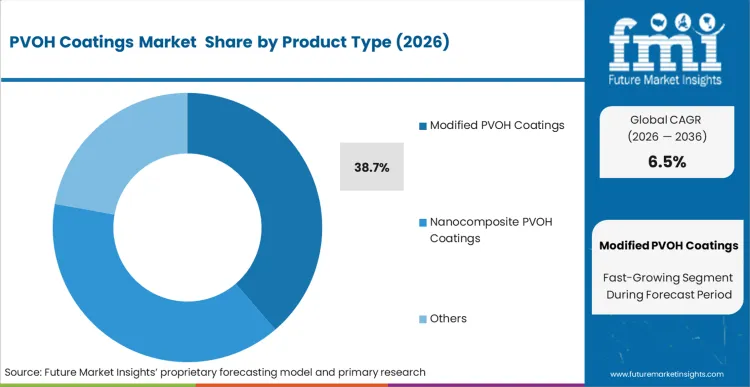
Modified PVOH coatings are expected to account for 38.7% of the market in 2026. They lead because converters need stronger humidity tolerance than standard grades can offer in demanding food-packaging and paper-wrap applications. The commercial advantage is simple: buyers want the barrier benefits of PVOH without losing performance as ambient moisture rises, and modified systems reduce that tradeoff. Sekisui Specialty Chemicals stated in 2026 that Selvol and Selvol PC grades are being positioned for oxygen, oil, and grease resistance in recyclable paper structures, which supports the lead position of modified formulations.
PVOH Coatings Market Analysis by Workflow
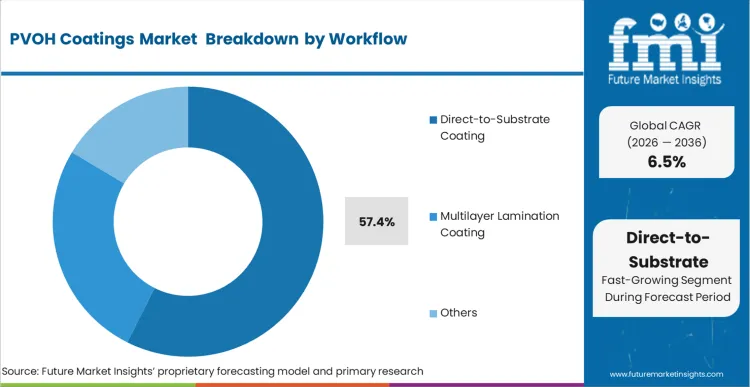
Direct-to-substrate coating is projected to hold 57.4% of 2026 market value. It leads because coating the barrier layer directly onto paper, paperboard, or film gives converters tighter control over coat weight, line speed, and total structure cost. This workflow is central in blade, rod, film-press, and curtain-coating environments where barrier functionality must be added without creating a bulky laminate. Kuraray notes that its PVOH grades are widely used in coated papers and can run through commonly used coating methods, reinforcing the strength of this workflow at industrial scale.
Competitive Aligners for Market Players
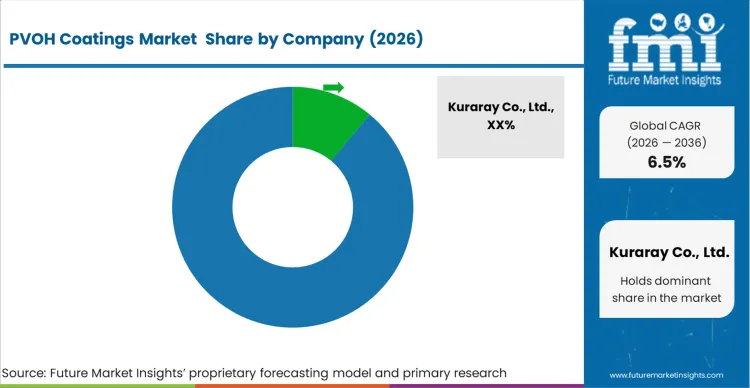
Competitive advantage in PVOH coatings does not come from polymer breadth alone. Buyers need barrier chemistry, food-contact confidence, repulpability evidence, converting support, and dependable supply in one package. The strongest firms combine resin control with application guidance and proof that coated structures work on existing lines. Michelman positions VaporCoat as a recyclable water-based high-barrier system for paper packaging, while Solenis pushed paperization through barrier-coating programs and, in 2024, announced a flexible-paper barrier process collaboration with HEIDELBERG. Kuraray has also linked its PVOH portfolio to sustainable packaging and ISCC PLUS-certified supply. Market leadership is being built around application performance, documentation quality, and the ability to industrialize paper replacement programs for converters and brand owners.
Key Players in PVOH Coatings Market
- Kuraray Co., Ltd.
- Sekisui Specialty Chemicals
- Michelman, Inc.
- Solenis LLC
- Chang Chun Group
- Anhui Wanwei Group Co., Ltd.
- Japan VAM & POVAL Co., Ltd.
- BASF SE
- Cosmo Films Ltd.
- Mitsubishi Chemical Group Corporation
Strategic Outlook by FMI on PVOH Coatings Market
The PVOH coatings market is shifting from a polymer-selection business to a barrier-system business. The next phase of expansion will be shaped by humidity-resistant formulations, converter-ready coating packages, and proof that paper-based structures can meet barrier targets without breaking recyclability pathways. Companies with secure upstream PVOH access, strong application labs, and credible paperization partnerships will capture the best value.
Scope of the Report
| Metric | Value |
|---|---|
| Market Value | USD 1.5 billion in 2026 to USD 2.8 billion by 2036 |
| CAGR | 6.5% from 2026 to 2036 |
| Base Year | 2025 |
| Forecast Period | 2026 to 2036 |
| Product Type Segmentation | Standard PVOH Coatings, Modified PVOH Coatings, Nanocomposite PVOH Coatings, Others |
| Workflow Segmentation | Direct-to-Substrate Coating, Multilayer Lamination Coating, Converting and Finishing |
| End User Segmentation | Food Packaging, Pharmaceutical Packaging, Paper and Board Converting, Electronics and Specialty Applications, Others |
| Regions Covered | North America, Latin America, Western Europe, Eastern Europe, East Asia, South Asia and Pacific, Middle East and Africa |
Bibliography
- European Parliament and Council. 2025. Regulation (EU) 2025/40 of 19 December 2024 on packaging and packaging waste.
- CEPI. 2020. Paper-Based Packaging Recyclability Guidelines.
- eCFR. Current. 21 CFR § 177.1670, Polyvinyl alcohol film.
- Kuraray. 2025. Barrier Coatings for Packaging.
- Sekisui Specialty Chemicals. 2026. Paperization Trend in Packaging: Selvol PVOH Coatings.
- Michelman. Current. VaporCoat Barrier Coatings for Paper.
- Solenis and HEIDELBERG. 2024. Solenis and HEIDELBERG Collaborate To Develop Print-Applied, Eco-Friendly Barrier Coatings for Paper Packaging.
Frequently Asked Questions
What is the projected value of the PVOH coatings market by 2036?
The PVOH coatings market is projected to grow from USD 1.5 billion in 2026 to USD 2.8 billion by 2036.
What is the CAGR of the PVOH coatings market from 2026 to 2036?
The PVOH coatings market is expected to expand at a CAGR of 6.5% during the 2026 to 2036 forecast period.
Which product type leads the PVOH coatings market in 2026?
Modified PVOH coatings are expected to lead the PVOH coatings market in 2026 with a 38.7% share because they provide better humidity tolerance than standard grades.
Which workflow accounts for the largest share in the PVOH coatings market?
Direct-to-substrate coating is projected to hold the largest share in the PVOH coatings market in 2026, accounting for 57.4% of market value.
Which end-use industry dominates the PVOH coatings market?
Food packaging is expected to dominate the PVOH coatings market in 2026 with a 46.8% share, supported by demand for oxygen barrier, grease resistance, and food-contact-ready coatings.
What is driving growth in the PVOH coatings market?
Growth in the PVOH coatings market is being supported by paperization pressure, demand for water-based high-barrier coatings, and converter interest in recyclable paper-based packaging solutions.
Preview the report firsthand - request a free sample
Get SampleGet the brochure for pricing and purchase details.
Get PDFTable of Content
- Executive Summary
- Global Market Outlook
- Demand-side Trends
- Supply-side Trends
- Technology Roadmap Analysis
- Analysis and Recommendations
- Market Overview
- Market Coverage / Taxonomy
- Market Definition / Scope / Limitations
- Research Methodology
- Chapter Orientation
- Analytical Lens and Working Hypotheses
- Market Structure, Signals, and Trend Drivers
- Benchmarking and Cross-market Comparability
- Market Sizing, Forecasting, and Opportunity Mapping
- Research Design and Evidence Framework
- Desk Research Programme (Secondary Evidence)
- Company Annual and Sustainability Reports
- Peer-reviewed Journals and Academic Literature
- Corporate Websites, Product Literature, and Technical Notes
- Earnings Decks and Investor Briefings
- Statutory Filings and Regulatory Disclosures
- Technical White Papers and Standards Notes
- Trade Journals, Industry Magazines, and Analyst Briefs
- Conference Proceedings, Webinars, and Seminar Materials
- Government Statistics Portals and Public Data Releases
- Press Releases and Reputable Media Coverage
- Specialist Newsletters and Curated Briefings
- Sector Databases and Reference Repositories
- FMI Internal Proprietary Databases and Historical Market Datasets
- Subscription Datasets and Paid Sources
- Social Channels, Communities, and Digital Listening Inputs
- Additional Desk Sources
- Expert Input and Fieldwork (Primary Evidence)
- Primary Modes
- Qualitative Interviews and Expert Elicitation
- Quantitative Surveys and Structured Data Capture
- Blended Approach
- Why Primary Evidence is Used
- Field Techniques
- Interviews
- Surveys
- Focus Groups
- Observational and In-context Research
- Social and Community Interactions
- Stakeholder Universe Engaged
- C-suite Leaders
- Board Members
- Presidents and Vice Presidents
- R&D and Innovation Heads
- Technical Specialists
- Domain Subject-matter Experts
- Scientists
- Physicians and Other Healthcare Professionals
- Governance, Ethics, and Data Stewardship
- Research Ethics
- Data Integrity and Handling
- Primary Modes
- Tooling, Models, and Reference Databases
- Desk Research Programme (Secondary Evidence)
- Data Engineering and Model Build
- Data Acquisition and Ingestion
- Cleaning, Normalisation, and Verification
- Synthesis, Triangulation, and Analysis
- Quality Assurance and Audit Trail
- Market Background
- Market Dynamics
- Drivers
- Restraints
- Opportunity
- Trends
- Scenario Forecast
- Demand in Optimistic Scenario
- Demand in Likely Scenario
- Demand in Conservative Scenario
- Opportunity Map Analysis
- Product Life Cycle Analysis
- Supply Chain Analysis
- Investment Feasibility Matrix
- Value Chain Analysis
- PESTLE and Porter’s Analysis
- Regulatory Landscape
- Regional Parent Market Outlook
- Production and Consumption Statistics
- Import and Export Statistics
- Market Dynamics
- Global Market Analysis 2021 to 2025 and Forecast, 2026 to 2036
- Historical Market Size Value (USD Million) Analysis, 2021 to 2025
- Current and Future Market Size Value (USD Million) Projections, 2026 to 2036
- Y-o-Y Growth Trend Analysis
- Absolute $ Opportunity Analysis
- Global Market Pricing Analysis 2021 to 2025 and Forecast 2026 to 2036
- Global Market Analysis 2021 to 2025 and Forecast 2026 to 2036, By Product Type
- Introduction / Key Findings
- Historical Market Size Value (USD Million) Analysis By Product Type , 2021 to 2025
- Current and Future Market Size Value (USD Million) Analysis and Forecast By Product Type , 2026 to 2036
- Modified PVOH Coatings
- Nanocomposite PVOH Coatings
- Others
- Modified PVOH Coatings
- Y-o-Y Growth Trend Analysis By Product Type , 2021 to 2025
- Absolute $ Opportunity Analysis By Product Type , 2026 to 2036
- Global Market Analysis 2021 to 2025 and Forecast 2026 to 2036, By Workflow
- Introduction / Key Findings
- Historical Market Size Value (USD Million) Analysis By Workflow, 2021 to 2025
- Current and Future Market Size Value (USD Million) Analysis and Forecast By Workflow, 2026 to 2036
- Direct-to-Substrate Coating
- Multilayer Lamination Coating
- Others
- Direct-to-Substrate Coating
- Y-o-Y Growth Trend Analysis By Workflow, 2021 to 2025
- Absolute $ Opportunity Analysis By Workflow, 2026 to 2036
- Global Market Analysis 2021 to 2025 and Forecast 2026 to 2036, By Region
- Introduction
- Historical Market Size Value (USD Million) Analysis By Region, 2021 to 2025
- Current Market Size Value (USD Million) Analysis and Forecast By Region, 2026 to 2036
- North America
- Latin America
- Western Europe
- Eastern Europe
- East Asia
- South Asia and Pacific
- Middle East & Africa
- Market Attractiveness Analysis By Region
- North America Market Analysis 2021 to 2025 and Forecast 2026 to 2036, By Country
- Historical Market Size Value (USD Million) Trend Analysis By Market Taxonomy, 2021 to 2025
- Market Size Value (USD Million) Forecast By Market Taxonomy, 2026 to 2036
- By Country
- USA
- Canada
- Mexico
- By Product Type
- By Workflow
- By Country
- Market Attractiveness Analysis
- By Country
- By Product Type
- By Workflow
- Key Takeaways
- Latin America Market Analysis 2021 to 2025 and Forecast 2026 to 2036, By Country
- Historical Market Size Value (USD Million) Trend Analysis By Market Taxonomy, 2021 to 2025
- Market Size Value (USD Million) Forecast By Market Taxonomy, 2026 to 2036
- By Country
- Brazil
- Chile
- Rest of Latin America
- By Product Type
- By Workflow
- By Country
- Market Attractiveness Analysis
- By Country
- By Product Type
- By Workflow
- Key Takeaways
- Western Europe Market Analysis 2021 to 2025 and Forecast 2026 to 2036, By Country
- Historical Market Size Value (USD Million) Trend Analysis By Market Taxonomy, 2021 to 2025
- Market Size Value (USD Million) Forecast By Market Taxonomy, 2026 to 2036
- By Country
- Germany
- UK
- Italy
- Spain
- France
- Nordic
- BENELUX
- Rest of Western Europe
- By Product Type
- By Workflow
- By Country
- Market Attractiveness Analysis
- By Country
- By Product Type
- By Workflow
- Key Takeaways
- Eastern Europe Market Analysis 2021 to 2025 and Forecast 2026 to 2036, By Country
- Historical Market Size Value (USD Million) Trend Analysis By Market Taxonomy, 2021 to 2025
- Market Size Value (USD Million) Forecast By Market Taxonomy, 2026 to 2036
- By Country
- Russia
- Poland
- Hungary
- Balkan & Baltic
- Rest of Eastern Europe
- By Product Type
- By Workflow
- By Country
- Market Attractiveness Analysis
- By Country
- By Product Type
- By Workflow
- Key Takeaways
- East Asia Market Analysis 2021 to 2025 and Forecast 2026 to 2036, By Country
- Historical Market Size Value (USD Million) Trend Analysis By Market Taxonomy, 2021 to 2025
- Market Size Value (USD Million) Forecast By Market Taxonomy, 2026 to 2036
- By Country
- China
- Japan
- South Korea
- By Product Type
- By Workflow
- By Country
- Market Attractiveness Analysis
- By Country
- By Product Type
- By Workflow
- Key Takeaways
- South Asia and Pacific Market Analysis 2021 to 2025 and Forecast 2026 to 2036, By Country
- Historical Market Size Value (USD Million) Trend Analysis By Market Taxonomy, 2021 to 2025
- Market Size Value (USD Million) Forecast By Market Taxonomy, 2026 to 2036
- By Country
- India
- ASEAN
- Australia & New Zealand
- Rest of South Asia and Pacific
- By Product Type
- By Workflow
- By Country
- Market Attractiveness Analysis
- By Country
- By Product Type
- By Workflow
- Key Takeaways
- Middle East & Africa Market Analysis 2021 to 2025 and Forecast 2026 to 2036, By Country
- Historical Market Size Value (USD Million) Trend Analysis By Market Taxonomy, 2021 to 2025
- Market Size Value (USD Million) Forecast By Market Taxonomy, 2026 to 2036
- By Country
- Kingdom of Saudi Arabia
- Other GCC Countries
- Turkiye
- South Africa
- Other African Union
- Rest of Middle East & Africa
- By Product Type
- By Workflow
- By Country
- Market Attractiveness Analysis
- By Country
- By Product Type
- By Workflow
- Key Takeaways
- Key Countries Market Analysis
- USA
- Pricing Analysis
- Market Share Analysis, 2025
- By Product Type
- By Workflow
- Canada
- Pricing Analysis
- Market Share Analysis, 2025
- By Product Type
- By Workflow
- Mexico
- Pricing Analysis
- Market Share Analysis, 2025
- By Product Type
- By Workflow
- Brazil
- Pricing Analysis
- Market Share Analysis, 2025
- By Product Type
- By Workflow
- Chile
- Pricing Analysis
- Market Share Analysis, 2025
- By Product Type
- By Workflow
- Germany
- Pricing Analysis
- Market Share Analysis, 2025
- By Product Type
- By Workflow
- UK
- Pricing Analysis
- Market Share Analysis, 2025
- By Product Type
- By Workflow
- Italy
- Pricing Analysis
- Market Share Analysis, 2025
- By Product Type
- By Workflow
- Spain
- Pricing Analysis
- Market Share Analysis, 2025
- By Product Type
- By Workflow
- France
- Pricing Analysis
- Market Share Analysis, 2025
- By Product Type
- By Workflow
- India
- Pricing Analysis
- Market Share Analysis, 2025
- By Product Type
- By Workflow
- ASEAN
- Pricing Analysis
- Market Share Analysis, 2025
- By Product Type
- By Workflow
- Australia & New Zealand
- Pricing Analysis
- Market Share Analysis, 2025
- By Product Type
- By Workflow
- China
- Pricing Analysis
- Market Share Analysis, 2025
- By Product Type
- By Workflow
- Japan
- Pricing Analysis
- Market Share Analysis, 2025
- By Product Type
- By Workflow
- South Korea
- Pricing Analysis
- Market Share Analysis, 2025
- By Product Type
- By Workflow
- Russia
- Pricing Analysis
- Market Share Analysis, 2025
- By Product Type
- By Workflow
- Poland
- Pricing Analysis
- Market Share Analysis, 2025
- By Product Type
- By Workflow
- Hungary
- Pricing Analysis
- Market Share Analysis, 2025
- By Product Type
- By Workflow
- Kingdom of Saudi Arabia
- Pricing Analysis
- Market Share Analysis, 2025
- By Product Type
- By Workflow
- Turkiye
- Pricing Analysis
- Market Share Analysis, 2025
- By Product Type
- By Workflow
- South Africa
- Pricing Analysis
- Market Share Analysis, 2025
- By Product Type
- By Workflow
- USA
- Market Structure Analysis
- Competition Dashboard
- Competition Benchmarking
- Market Share Analysis of Top Players
- By Regional
- By Product Type
- By Workflow
- Competition Analysis
- Competition Deep Dive
- Kuraray Co., Ltd.
- Overview
- Product Portfolio
- Profitability by Market Segments (Product/Age /Sales Channel/Region)
- Sales Footprint
- Strategy Overview
- Marketing Strategy
- Product Strategy
- Channel Strategy
- Sekisui Specialty Chemicals
- Michelman, Inc.
- Solenis LLC
- Chang Chun Group
- Anhui Wanwei Group Co., Ltd.
- Japan VAM & POVAL Co., Ltd.
- Kuraray Co., Ltd.
- Competition Deep Dive
- Assumptions & Acronyms Used


