

- Industry Size (2026)
- USD 1.6 Bn
- Forecast (2036)
- USD 7.0 Bn
- CAGR (2026 to 2036)
- 15.9%
Immersion Cooling Cabinets Market Forecast and Outlook 2026 to 2036
Immersion cooling cabinets market revenue is projected to total USD 1.6 billion in 2026, soaring to USD 7.0 billion by 2036, at a CAGR of 15.9%. FMI analysis indicates the market is crossing the chasm from early-adopter HPC to broad-scale commercialization in AI training and enterprise edge applications. The 2026–2027 period will be defined by the release of standardized cabinet form factors by hyperscalers and the maturation of two-phase fluid chemistries for higher heat flux components.
Growth is anchored in the thermodynamic limits of conventional cooling and the strategic push for energy and water conservation. The USA Department of Energy’s 2025 "Energy Efficiency Roadmap for Data Centers" explicitly identifies immersion cooling as the only currently deployable technology capable of supporting rack densities above 100kW while achieving a power usage effectiveness (PUE) below 1.03, making it a cornerstone for federal data center modernization grants.
3M Company announced in Q1 2026 a strategic capacity expansion for its Novec 7100 and 649 engineered fluids, citing a multi-year supply agreement with a consortium of North American colocation providers. The agreement is tied to the rollout of standardized immersion cabinet pods, signaling a shift from pilot projects to fleet deployment.
Technical innovation focuses on cabinet-level power distribution and fluid dynamics optimization. LiquidStack Limited, following its 2025 joint venture with a major server OEM, unveiled its Data Tank 2.0 cabinet in early 2026. The design incorporates in-tank, fluid-cooled PSUs and rack-mounted TOR switches, removing all air-cooled ancillary heat sources and pushing cabinet-level heat capture beyond 95%.
Submer Technologies, S.L. launched its SmartPodX series in late 2025, featuring an integrated dielectric fluid health monitoring system with automated particulate filtering and dielectric strength restoration, extending fluid service life and reducing operational expenditure.
Green Revolution Cooling, Inc. secured a landmark contract in February 2026 to retrofit a 50MW legacy data center in Texas with its immersion cabinet systems, a project driven by the facility's inability to secure additional grid power due to air cooling limitations. This underscores immersion's role as an enabling technology for capacity expansion within fixed power envelopes.
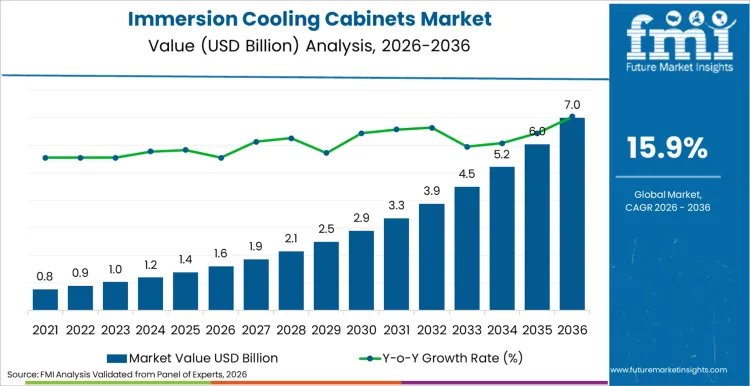
Summary of Immersion Cooling Cabinets Market
What is the Long-Term Growth Outlook for the Immersion Cooling Cabinets Market?
FMI projects the global immersion cooling cabinets market to expand from USD 1.6 billion in 2026 to USD 7.0 billion by 2036, registering a 15.9% CAGR. Market expansion reflects a fundamental re-architecture of data center thermal management, where the cabinet becomes a sealed, fluid-filled computational cell. This transition is driven by the end of Moore's Law for cooling, as increases in chip transistor density no longer yield proportionate increases in air-cooling efficiency.
This growth is propelled by the exponential energy demands of frontier AI models, the critical need to reduce water consumption in data-dense regions, and the economic imperative to reclaim waste heat. Demand is accelerating for cabinet systems that offer plug-and-play deployment, integrated monitoring, and guaranteed performance specifications for specific workloads like AI training.
FMI Research Approach: This projection is derived from FMI’s proprietary forecasting framework integrating hyperscaler and colocation provider sustainability commitments, chip thermal design power (TDP) roadmaps, regional water stress and energy cost analysis, and total cost of ownership models comparing immersion to alternative cooling technologies.
How do FMI Analysts Expect the Immersion Cooling Cabinets Market to Evolve Structurally?
FMI analysts anticipate a rapid market bifurcation into standardized, volume-produced cabinet lines for cloud and AI workloads, and highly customized cabinets for specialized applications like quantum computing or cryptographic vaults. This evolution is driven by the need for supply chain efficiency at scale and the unique requirements of niche high-performance sectors. The market will see a convergence where cabinet manufacturers also become fluid service providers, managing the entire coolant lifecycle.
Innovations such as cabinets with integrated cold plates for hybrid cooling of high-heat-flux components, cabinets designed for direct waste heat exchange to district heating networks, and the use of biodegradable dielectric fluids are redefining system boundaries. The immersion cabinet is evolving from a container to an intelligent, networked thermal node in a larger facility ecosystem.
FMI Research Approach: Insights are informed by analysis of hyperscaler data center design patents, fluid chemistry development pipelines, district heating project feasibility studies, and procurement frameworks from national research laboratories.
Which Geographies Command the Largest Share of the Immersion Cooling Cabinets Market?
China leads the global immersion cooling cabinets market, advancing at an estimated 16.4% CAGR, driven by national policy linking computing power growth to extreme energy efficiency mandates. The United States follows with a 15.9% CAGR, underpinned by private capital investment in AI infrastructure and direct tax incentives for ultra-efficient cooling systems.
The UK and South Korea represent high-growth innovation corridors, expanding at 14.9% and 14.4% CAGR, respectively. The UK’s growth is fueled by a scarcity of both power and water for new data centers, while South Korea’s is tied to its leadership in memory semiconductor manufacturing and testing, which requires precise thermal control.
FMI Research Approach: Country-level forecasts are built using analysis of national computing and net-zero strategies, utility grid upgrade timelines, semiconductor fab investment locations, and the stringency of local planning regulations on data center water and energy use.
What Will Be the Market Size of Immersion Cooling Cabinets by 2036?
By 2036, the immersion cooling cabinets market is expected to reach USD 7.0 billion. This explosive growth will be supported by immersion becoming the default solution for new AI cluster deployments, widespread retrofit of existing high-performance computing facilities, and adoption by financial trading firms and research institutions where computational speed is gated by thermal limits. The market will be characterized by a shift from selling cabinets to selling computational density per square foot, with immersion as the enabling delivery model.
FMI Research Approach: Long-term market sizing incorporates AI cluster build-out forecasts, analysis of the retrofit potential of existing HPC and crypto mining facilities, technology adoption curves in financial services, and the projected cost parity point between immersion and advanced air-cooled infrastructure.
What are some Globally Distinct Trends Shaping the Immersion Cooling Cabinets Market?
Globally, the market is being shaped by the trilemma of energy cost, computational demand, and sustainability reporting. The commercial viability of waste heat reuse from immersion cabinets, particularly in colder climates, is transforming them from cost centers into potential revenue-generating assets. New sustainability reporting standards, such as the EU’s Corporate Sustainability Reporting Directive (CSRD), are making the embodied carbon and energy efficiency of IT infrastructure a board-level concern, favoring immersion’s superior metrics.
Concurrently, the need for hardware security and electromagnetic interference (EMI) shielding in defense and financial applications is driving demand for immersion cabinets that provide inherent signal attenuation and physical isolation, adding a security dimension to the thermal value proposition.
FMI Research Approach: Trend analysis is informed by monitoring district heating offtake agreements, analyzing CSRD and SEC climate disclosure filings from technology firms, and reviewing procurement specifications from defense contractors and national security agencies.
Immersion Cooling Cabinets Market Key Takeaways
| Metrics | Values |
|---|---|
| Expected Value (2026E) | USD 1.6 billion |
| Projected Value (2036F) | USD 7.0 billion |
| CAGR (2026-2036) | 15.9% |
Source: Future Market Insights (FMI) analysis, based on proprietary forecasting model and primary research
Why is the Immersion Cooling Cabinets Market Growing?
The economics of AI training are fundamentally reliant on immersion cooling. A 2026 total cost of ownership study by a tier-one investment bank concluded that for a 100MW AI training cluster, immersion cooling cabinets reduce the capital expenditure for cooling infrastructure by 40% and the operational energy cost by 50% compared to chilled water systems with rear-door heat exchangers. This direct economic advantage is compressing adoption timelines from years to quarters for well-capitalized AI firms.
Water scarcity is rendering alternative cooling technologies un-permittable. The Arizona Department of Water Resources' 2026 moratorium on new groundwater permits for industrial cooling in the Phoenix metro area effectively mandates dry or closed-loop cooling for all new data centers. This regulatory action has instantly made immersion cooling cabinets, which consume zero water for heat rejection, the only viable option for major developments already planned in the region, creating a concentrated demand surge.
The rise of modular, decentralized computing is a natural fit for immersion technology. ExxonMobil's 2026 deployment of mobile immersion cabinet "skids" for offshore seismic data processing exemplifies this trend. These self-contained units, deployed on oil rigs, use the surrounding seawater for heat rejection via a plate heat exchanger, enabling high-performance computing in extreme environments without dedicated infrastructure. This model is being replicated for tactical military edge computing and remote research stations.
How is Immersion Cooling Cabinets Market Segmented?
The immersion cooling cabinets market segment landscape is defined by the phase change dynamics of the fluid, the chemical composition of the coolant, and the computational workload driving adoption. Single-phase immersion dominates for its simplicity and reliability, synthetic dielectric fluids lead due to their material compatibility and environmental profile, and the HPC/AI segment is the primary engine for market volume and innovation.
What Factors Sustain the Dominance of Single-Phase Immersion?
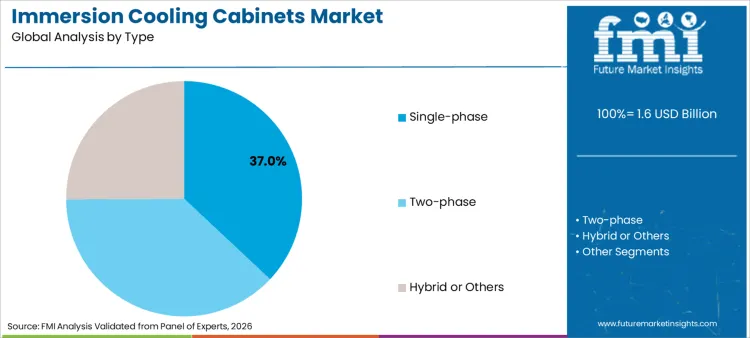
Single-phase immersion cabinets account for a 37% market share. Their dominance is anchored in operational simplicity, lower initial fluid cost, and proven reliability in diverse environments. Fujitsu Limited's 2026 contract with the Japanese Aerospace Exploration Agency (JAXA) for a next-generation supercomputer specified single-phase immersion using a tailored mineral oil. The decision was based on the requirement for 10-year system longevity with minimal maintenance intervention, a strength of the passive, single-phase approach where fluid degradation is slower and system complexity is lower.
Why Do Synthetic Dielectric Fluids Command the Coolant Market?
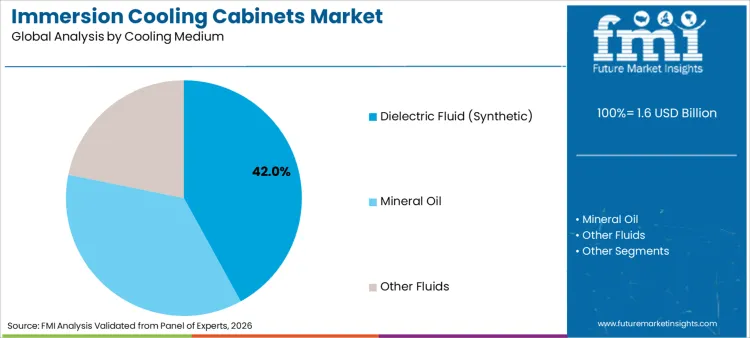
Dielectric fluid (synthetic) commands a 42% share of the cooling medium segment. This leadership is due to superior environmental, health, and safety (EHS) profiles, including zero ozone depletion potential, low global warming potential, and non-flammability. The Boyd Corporation's 2026 launch of its "Aegis Fluid Management System," paired with a popular synthetic dielectric, includes a fluid analysis-as-a-service subscription. This service monitors fluid health and predicts maintenance, directly addressing end-user concerns about long-term fluid management and cementing the role of synthetic fluids in large-scale, operator-focused deployments.
How is the HPC/AI Segment Defining Technical Requirements?
The HPC or AI segment represents the largest end-user segment with a 40% share. This segment sets the performance benchmark for heat flux density and reliability. The UK's Atomic Weapons Establishment (AWE) selection of Asetek A/S's immersion cabinets for its 2026 "Valiant" supercomputer upgrade required cabinets to meet TEMPEST-grade electromagnetic emission standards for classified computing. This required specialized cabinet shielding and fluid treatment to prevent static discharge, demonstrating how HPC-driven requirements cascade into highly specialized technical specifications that push manufacturer capabilities.
What Drivers, Restraints, Opportunities, and Trends Prevail in the Immersion Cooling Cabinets Market?
Market expansion is driven by the grid power availability crisis. In Ireland, where data center power consumption is projected to reach 30% of the national grid by 2028, the Commission for Regulation of Utilities (CRU) issued a 2026 policy stating that new data center connections will be prioritized for facilities demonstrating a PUE of 1.15 or lower. This policy makes immersion cooling cabinets a prerequisite for market entry, acting as a powerful regulatory driver overriding purely economic calculations.
A primary restraint is the ecosystem lock-in and asset repurposing challenge. The shift to immersion requires compatible servers, often with removed fans and specially coated components. A 2026 survey by Uptime Institute found that 65% of enterprise IT managers cited "irreversibility of hardware investment" as the top barrier to immersion adoption. This creates a dichotomy between greenfield deployments, which are embracing immersion, and brownfield facilities, where the sunk cost in air-cooled hardware slows transition.
A key trend is the development of hybrid or "targeted" immersion cabinets. CoolIT Systems, Inc.'s 2026 collaboration with AMD on a hybrid cabinet design immerses only the CPU and GPU trays, while memory and storage remain in a sealed air-cooled zone within the same chassis. This approach aims to balance the extreme cooling capability of immersion for the hottest components with the cost and compatibility benefits of air cooling for others, potentially broadening the addressable market.
The trend toward circular economy integration presents a major opportunity. Midas Green Technologies LLC pioneered a Fluid Recovery Bond in 2026. Customers pay a reduced upfront cost for the dielectric fluid but are contractually bound to return spent fluid to Midas for purification and re-sale. This model reduces initial capital expenditure, ensures proper end-of-life fluid handling, and creates a recurring service revenue stream for the manufacturer.
Analysis of Immersion Cooling Cabinets Market by Key Countries
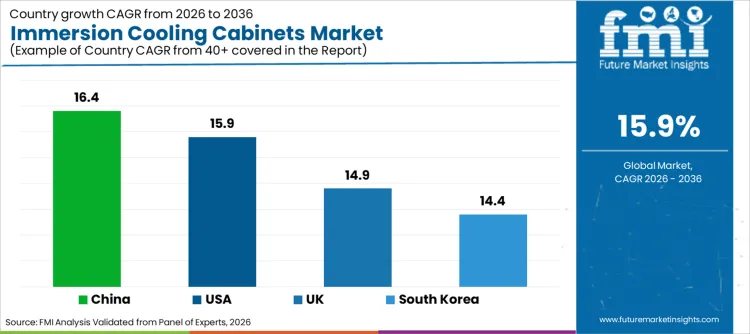
| Country | CAGR (2026–2036) |
|---|---|
| China | 16.4% |
| USA | 15.9% |
| UK | 14.9% |
| South Korea | 14.4% |
Source: Future Market Insights (FMI) analysis, based on proprietary forecasting model and primary research
How is China's National Computing Initiative Structuring Demand?
China's 16.4% CAGR is orchestrated by its National Integrated Computing Power Network strategy. The 2026 implementation guidelines for this strategy mandate that all new national computing hubs in western provinces must achieve an annual average PUE of ≤1.15 and a WUE of 0. These targets are technologically unattainable with air cooling in hot, arid regions like Ningxia.
State-directed tenders for these hubs explicitly require immersion cooling solutions. This has led to the formation of joint ventures between domestic server manufacturers like Inspur and immersion cabinet specialists to produce national standard immersion cabinets, creating a parallel, policy-driven supply chain.
What Role do Tax Incentives and Power Constraints Play in USA?
USA’s 15.9% CAGR is fueled by the intersection of revised tax policy and physical grid limitations. The 2026 update to the Internal Revenue Code Section 48C (Qualifying Advanced Energy Project Credit) expanded eligibility to include integrated data center cooling systems that enable a minimum 40% reduction in facility energy use. Immersion cabinet installations now qualify for a 30% investment tax credit.
Utility companies in key markets like Northern Virginia are imposing multi-year moratoriums on new data center connections unless they demonstrate a PUE below 1.2. This combination of financial carrot and regulatory stick is creating an unprecedented, simultaneous push-pull effect on adoption.
How is UK's Planning System Driving a Specific Cabinet Design Philosophy?
A rigorous town and country planning system uniquely shape the UK’s 14.9% CAGR. The Greater London Authority's 2026 Sustainable Data Centre Supplementary Planning Document introduces noise pollution limits for data center cooling systems. Air-cooled chillers and cooling towers often exceed these limits, while immersion cabinets with sealed, internal pumps operate below them.
This has made immersion the only viable cooling technology for new builds in dense urban areas like London and Slough. Planning approvals are contingent on a detailed decommissioning plan. Immersion cabinet suppliers are now providing full lifecycle plans, including fluid reclamation and cabinet recycling, as part of their planning application support packages.
Why is South Korea's Semiconductor Industry a Critical Early-Adopter Segment?
South Korea's 14.4% CAGR is deeply linked to its semiconductor industry's pre-competitive R&D needs. Samsung Electronics' and SK Hynix's joint research center for next-generation memory such as High Bandwidth Memory 4 requires continuous, vibration-free cooling at exact temperatures to test silicon integrity.
In 2026, the center deployed immersion cabinets from a local integrator using a low-viscosity dielectric fluid to achieve temperature stability within ±0.05°C across the entire tank, a specification impossible with any other cooling method. This industrial R&D application serves as a high-stakes testing ground for immersion technology, with innovations in fluid dynamics and sensor integration later diffusing into commercial data center products.
What is the Competition Outlook for Immersion Cooling Cabinets?
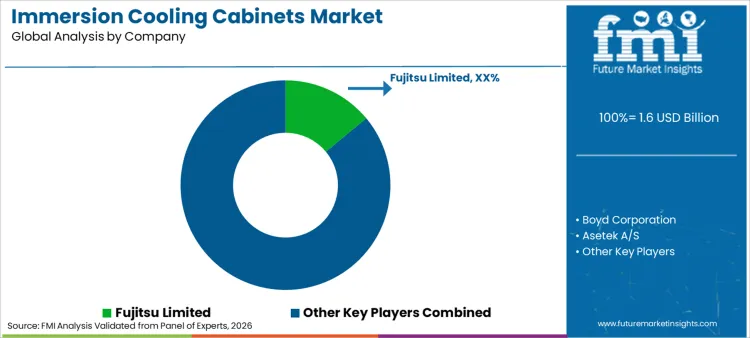
Competitive intensity reflects the market's maturation from technology demonstration to global supply chain execution. The landscape is consolidating around firms that can deliver not just cabinets, but full-stack immersion solutions encompassing fluid management, compatible server hardware, and global service networks. Competition is increasingly based on performance guarantees energy efficiency warranties, and the depth of integration with DCIM software.
Numerous start-ups and specialists developing proprietary cabinet and fluid designs, resulting in a fragmented market with interoperability concerns, characterized strategic evolution prior to 2025. The observable strategic direction for 2026 and beyond is the formation of strategic ecosystems.
The 2025 alliance between 3M, Submer, and Digital Realty aims to create a standardized, pre-validated immersion "pod" that can be deployed identically across multiple global regions, reducing risk and deployment time for customers.
Strategic leadership is shifting toward providing immersion infrastructure as a managed service. LiquidStack Limited's 2026 announcement of its Cooling Capacity as a Service (CCaaS) model allows a colocation customer to pay per kilowatt of immersion-cooled IT load installed, with LiquidStack retaining ownership of the cabinets and fluid and handling all maintenance. This removes capital expenditure barriers and aligns vendor incentives with system uptime and efficiency.
Recent Developments
- Fujitsu Limited and KDDI Corporation announced a partnership in February 2026 to build a network of edge data centers across Japan utilizing Fujitsu's immersion cabinets, targeting latency-sensitive applications for autonomous vehicles and smart factories.
- The USA Department of Defense awarded the Boyd Corporation in late 2025 to supply ruggedized, transportable immersion cabinets for battlefield AI processing units, meeting MIL-STD-810H for shock and vibration.
- A consortium including Asetek A/S, CoolIT Systems, Inc., and several server OEMs submitted a proposed open standard for immersion cabinet server interfaces to the Open Compute Project (OCP) in Q1 2026, aiming to break vendor lock-in at the hardware level.
Key Players Profiled
- Fujitsu Limited
- Boyd Corporation
- Asetek A/S
- CoolIT Systems, Inc.
- LiquidStack Limited
- Submer Technologies, S.L.
- Green Revolution Cooling, Inc.
- 3M Company
- Midas Green Technologies LLC
Market Definition
The immersion cooling cabinets market comprises revenue generated from the design, manufacture, and supply of sealed enclosures designed to house IT hardware submerged in a dielectric coolant for the purpose of direct heat removal. These cabinets are complete thermal management systems that include the tank structure, fluid distribution, heat exchangers, pumps, and monitoring sensors. The market includes single-phase, two-phase, and hybrid immersion cabinets utilizing mineral oil, synthetic dielectric fluids, or other engineered liquids.
The market scope covers cabinets sold to data center operators, hyperscalers, research institutions, and enterprises for cooling servers, storage, and networking equipment. Revenue includes value from the cabinet assembly, integrated cooling and monitoring systems, and initial fluid fill. The market excludes standalone dielectric fluids sold separately, custom-built tanks for specialized industrial processes, and immersion cooling services unless tied to the sale of the physical cabinet hardware.
Scope of Report
| Items | Values |
|---|---|
| Quantitative Units | USD 1.6 billion |
| Type | Single-phase; Two-phase; Hybrid or Other |
| Cooling Medium | Dielectric fluid (synthetic); Mineral oil; Other fluids |
| End User | HPC or AI; Crypto or Blockchain; Enterprise or Edge |
| Regions Covered | North America, Western Europe, Eastern Europe, East Asia, South Asia & Pacific, Latin America, Middle East & Africa |
| Countries | China, USA, UK, South Korea and 40+ countries |
| Key Companies | Fujitsu Limited; Boyd Corporation; Asetek A/S; CoolIT Systems, Inc.; LiquidStack Limited; Submer Technologies, S.L.; Green Revolution Cooling, Inc.; 3M Company; Midas Green Technologies LLC |
Source: Future Market Insights (FMI) analysis, based on proprietary forecasting model and primary research
Immersion Cooling Cabinets Market Key Segments
By Type
- Single-phase
- Two-phase
- Hybrid or Others
By Cooling Medium
- Dielectric Fluid (Synthetic)
- Mineral Oil
- Other Fluids
By End User
- HPC or AI
- Crypto or Blockchain
- Enterprise or Edge
By Region
- North America
- Western Europe
- Eastern Europe
- East Asia
- South Asia & Pacific
- Latin America
- Middle East & Africa
Bibliography
- USA Department of Energy. (2025). Energy Efficiency Roadmap for Data Centers: 2025-2035.
- Uptime Institute. (2026). Global Data Center Survey: Adoption Barriers for Advanced Cooling.
- Open Compute Project (OCP). (2026). Advanced Cooling Solutions: Immersion Subgroup Charter.
- Greater London Authority. (2026). Sustainable Data Centre Supplementary Planning Document.
- Commission for Regulation of Utilities (Ireland). (2026). Statement on Data Centre Connection Policy.
-
Frequently Asked Questions
- What is the expected value of the immersion cooling cabinets market in 2026?
- The immersion cooling cabinets market is expected to reach USD 1.6 billion in 2026, supported by the urgent need to cool AI clusters and overcome power and water constraints in new data center deployments.
- What is the projected value by 2036 and CAGR from 2026 to 2036?
- By 2036, the market is projected to reach USD 7.0 billion, expanding at a CAGR of 15.9% between 2026 and 2036.
- How is the AI infrastructure boom influencing this market?
- The massive power density and continuous operation requirements of AI training clusters make air and liquid cooling inefficient and costly. Immersion cooling cabinets provide the only scalable path to achieve the required thermal performance while drastically reducing energy and water overhead, making them an enabling technology for the AI infrastructure build-out.
- What role do environmental regulations play in shaping the market?
- Regulations limiting power consumption (PUE mandates), water usage (WUE mandates), and greenhouse gas emissions are making traditional cooling methods obsolete for new, large-scale facilities. Immersion cooling cabinets inherently excel in these metrics, transforming regulatory compliance from a challenge into a key driver for adoption.
- Which end-user segment is the primary catalyst for innovation and volume?
- The HPC or AI segment is the primary catalyst, due to its extreme performance requirements, rapid hardware refresh cycles, and access to capital. Innovations in cabinet design, fluid chemistry, and heat exchange developed for this segment subsequently filter down to enterprise and edge applications.
Frequently Asked Questions
How big is the immersion cooling cabinets market in 2026?
The global immersion cooling cabinets market is estimated to be valued at USD 1.6 billion in 2026.
What will be the size of immersion cooling cabinets market in 2036?
The market size for the immersion cooling cabinets market is projected to reach USD 7.0 billion by 2036.
How much will be the immersion cooling cabinets market growth between 2026 and 2036?
The immersion cooling cabinets market is expected to grow at a 15.9% CAGR between 2026 and 2036.
What are the key product types in the immersion cooling cabinets market?
The key product types in immersion cooling cabinets market are single-phase, two-phase and hybrid or others.
Which cooling medium segment to contribute significant share in the immersion cooling cabinets market in 2026?
In terms of cooling medium, dielectric fluid (synthetic) segment to command 42.0% share in the immersion cooling cabinets market in 2026.
Preview the report firsthand - request a free sample
Get SampleGet the brochure for pricing and purchase details.
Get PDFTable of Content
- Executive Summary
- Global Market Outlook
- Demand-side Trends
- Supply-side Trends
- Technology Roadmap Analysis
- Analysis and Recommendations
- Market Overview
- Market Coverage / Taxonomy
- Market Definition / Scope / Limitations
- Market Background
- Market Dynamics
- Drivers
- Restraints
- Opportunity
- Trends
- Scenario Forecast
- Demand in Optimistic Scenario
- Demand in Likely Scenario
- Demand in Conservative Scenario
- Opportunity Map Analysis
- Product Life Cycle Analysis
- Supply Chain Analysis
- Investment Feasibility Matrix
- Value Chain Analysis
- PESTLE and Porter’s Analysis
- Regulatory Landscape
- Regional Parent Market Outlook
- Production and Consumption Statistics
- Import and Export Statistics
- Market Dynamics
- Global Market Analysis 2021 to 2025 and Forecast, 2026 to 2036
- Historical Market Size Value (USD Million) Analysis, 2021 to 2025
- Current and Future Market Size Value (USD Million) Projections, 2026 to 2036
- Y-o-Y Growth Trend Analysis
- Absolute $ Opportunity Analysis
- Global Market Pricing Analysis 2021 to 2025 and Forecast 2026 to 2036
- Global Market Analysis 2021 to 2025 and Forecast 2026 to 2036, By Type
- Introduction / Key Findings
- Historical Market Size Value (USD Million) Analysis By Type , 2021 to 2025
- Current and Future Market Size Value (USD Million) Analysis and Forecast By Type , 2026 to 2036
- Single-phase
- Two-phase
- Hybrid or Others
- Single-phase
- Y-o-Y Growth Trend Analysis By Type , 2021 to 2025
- Absolute $ Opportunity Analysis By Type , 2026 to 2036
- Global Market Analysis 2021 to 2025 and Forecast 2026 to 2036, By Cooling Medium
- Introduction / Key Findings
- Historical Market Size Value (USD Million) Analysis By Cooling Medium, 2021 to 2025
- Current and Future Market Size Value (USD Million) Analysis and Forecast By Cooling Medium, 2026 to 2036
- Dielectric Fluid (Synthetic)
- Mineral Oil
- Other Fluids
- Dielectric Fluid (Synthetic)
- Y-o-Y Growth Trend Analysis By Cooling Medium, 2021 to 2025
- Absolute $ Opportunity Analysis By Cooling Medium, 2026 to 2036
- Global Market Analysis 2021 to 2025 and Forecast 2026 to 2036, By Region
- Introduction
- Historical Market Size Value (USD Million) Analysis By Region, 2021 to 2025
- Current Market Size Value (USD Million) Analysis and Forecast By Region, 2026 to 2036
- North America
- Latin America
- Western Europe
- Eastern Europe
- East Asia
- South Asia and Pacific
- Middle East & Africa
- Market Attractiveness Analysis By Region
- North America Market Analysis 2021 to 2025 and Forecast 2026 to 2036, By Country
- Historical Market Size Value (USD Million) Trend Analysis By Market Taxonomy, 2021 to 2025
- Market Size Value (USD Million) Forecast By Market Taxonomy, 2026 to 2036
- By Country
- USA
- Canada
- Mexico
- By Type
- By Cooling Medium
- By Country
- Market Attractiveness Analysis
- By Country
- By Type
- By Cooling Medium
- Key Takeaways
- Latin America Market Analysis 2021 to 2025 and Forecast 2026 to 2036, By Country
- Historical Market Size Value (USD Million) Trend Analysis By Market Taxonomy, 2021 to 2025
- Market Size Value (USD Million) Forecast By Market Taxonomy, 2026 to 2036
- By Country
- Brazil
- Chile
- Rest of Latin America
- By Type
- By Cooling Medium
- By Country
- Market Attractiveness Analysis
- By Country
- By Type
- By Cooling Medium
- Key Takeaways
- Western Europe Market Analysis 2021 to 2025 and Forecast 2026 to 2036, By Country
- Historical Market Size Value (USD Million) Trend Analysis By Market Taxonomy, 2021 to 2025
- Market Size Value (USD Million) Forecast By Market Taxonomy, 2026 to 2036
- By Country
- Germany
- UK
- Italy
- Spain
- France
- Nordic
- BENELUX
- Rest of Western Europe
- By Type
- By Cooling Medium
- By Country
- Market Attractiveness Analysis
- By Country
- By Type
- By Cooling Medium
- Key Takeaways
- Eastern Europe Market Analysis 2021 to 2025 and Forecast 2026 to 2036, By Country
- Historical Market Size Value (USD Million) Trend Analysis By Market Taxonomy, 2021 to 2025
- Market Size Value (USD Million) Forecast By Market Taxonomy, 2026 to 2036
- By Country
- Russia
- Poland
- Hungary
- Balkan & Baltic
- Rest of Eastern Europe
- By Type
- By Cooling Medium
- By Country
- Market Attractiveness Analysis
- By Country
- By Type
- By Cooling Medium
- Key Takeaways
- East Asia Market Analysis 2021 to 2025 and Forecast 2026 to 2036, By Country
- Historical Market Size Value (USD Million) Trend Analysis By Market Taxonomy, 2021 to 2025
- Market Size Value (USD Million) Forecast By Market Taxonomy, 2026 to 2036
- By Country
- China
- Japan
- South Korea
- By Type
- By Cooling Medium
- By Country
- Market Attractiveness Analysis
- By Country
- By Type
- By Cooling Medium
- Key Takeaways
- South Asia and Pacific Market Analysis 2021 to 2025 and Forecast 2026 to 2036, By Country
- Historical Market Size Value (USD Million) Trend Analysis By Market Taxonomy, 2021 to 2025
- Market Size Value (USD Million) Forecast By Market Taxonomy, 2026 to 2036
- By Country
- India
- ASEAN
- Australia & New Zealand
- Rest of South Asia and Pacific
- By Type
- By Cooling Medium
- By Country
- Market Attractiveness Analysis
- By Country
- By Type
- By Cooling Medium
- Key Takeaways
- Middle East & Africa Market Analysis 2021 to 2025 and Forecast 2026 to 2036, By Country
- Historical Market Size Value (USD Million) Trend Analysis By Market Taxonomy, 2021 to 2025
- Market Size Value (USD Million) Forecast By Market Taxonomy, 2026 to 2036
- By Country
- Kingdom of Saudi Arabia
- Other GCC Countries
- Turkiye
- South Africa
- Other African Union
- Rest of Middle East & Africa
- By Type
- By Cooling Medium
- By Country
- Market Attractiveness Analysis
- By Country
- By Type
- By Cooling Medium
- Key Takeaways
- Key Countries Market Analysis
- USA
- Pricing Analysis
- Market Share Analysis, 2025
- By Type
- By Cooling Medium
- Canada
- Pricing Analysis
- Market Share Analysis, 2025
- By Type
- By Cooling Medium
- Mexico
- Pricing Analysis
- Market Share Analysis, 2025
- By Type
- By Cooling Medium
- Brazil
- Pricing Analysis
- Market Share Analysis, 2025
- By Type
- By Cooling Medium
- Chile
- Pricing Analysis
- Market Share Analysis, 2025
- By Type
- By Cooling Medium
- Germany
- Pricing Analysis
- Market Share Analysis, 2025
- By Type
- By Cooling Medium
- UK
- Pricing Analysis
- Market Share Analysis, 2025
- By Type
- By Cooling Medium
- Italy
- Pricing Analysis
- Market Share Analysis, 2025
- By Type
- By Cooling Medium
- Spain
- Pricing Analysis
- Market Share Analysis, 2025
- By Type
- By Cooling Medium
- France
- Pricing Analysis
- Market Share Analysis, 2025
- By Type
- By Cooling Medium
- India
- Pricing Analysis
- Market Share Analysis, 2025
- By Type
- By Cooling Medium
- ASEAN
- Pricing Analysis
- Market Share Analysis, 2025
- By Type
- By Cooling Medium
- Australia & New Zealand
- Pricing Analysis
- Market Share Analysis, 2025
- By Type
- By Cooling Medium
- China
- Pricing Analysis
- Market Share Analysis, 2025
- By Type
- By Cooling Medium
- Japan
- Pricing Analysis
- Market Share Analysis, 2025
- By Type
- By Cooling Medium
- South Korea
- Pricing Analysis
- Market Share Analysis, 2025
- By Type
- By Cooling Medium
- Russia
- Pricing Analysis
- Market Share Analysis, 2025
- By Type
- By Cooling Medium
- Poland
- Pricing Analysis
- Market Share Analysis, 2025
- By Type
- By Cooling Medium
- Hungary
- Pricing Analysis
- Market Share Analysis, 2025
- By Type
- By Cooling Medium
- Kingdom of Saudi Arabia
- Pricing Analysis
- Market Share Analysis, 2025
- By Type
- By Cooling Medium
- Turkiye
- Pricing Analysis
- Market Share Analysis, 2025
- By Type
- By Cooling Medium
- South Africa
- Pricing Analysis
- Market Share Analysis, 2025
- By Type
- By Cooling Medium
- USA
- Market Structure Analysis
- Competition Dashboard
- Competition Benchmarking
- Market Share Analysis of Top Players
- By Regional
- By Type
- By Cooling Medium
- Competition Analysis
- Competition Deep Dive
- Fujitsu Limited
- Overview
- Product Portfolio
- Profitability by Market Segments (Product/Age /Sales Channel/Region)
- Sales Footprint
- Strategy Overview
- Marketing Strategy
- Product Strategy
- Channel Strategy
- Boyd Corporation
- Asetek A/S
- CoolIT Systems, Inc.
- LiquidStack Limited
- Submer Technologies, S.L.
- Green Revolution Cooling, Inc.
- 3M Company
- Midas Green Technologies LLC
- Fujitsu Limited
- Competition Deep Dive
- Assumptions & Acronyms Used
- Research Methodology


