

- Industry Size (2025)
- USD 8.4 Bn
- Forecast (2035)
- USD 12.0 Bn
- CAGR (2025 to 2035)
- 3.6%
Automotive Coolant Market Size and Share Forecast Outlook 2025 to 2035
The Automotive Coolant Market is estimated to be valued at USD 8.4 billion in 2025 and is projected to reach USD 12.0 billion by 2035, registering a compound annual growth rate (CAGR) of 3.6% over the forecast period. In the initial phase from 2020 to 2025, the market grows from USD 7.0 billion to USD 8.1 billion, driven by rising vehicle production globally and heightened regulatory requirements targeting emissions and engine efficiency. The increasing complexity of internal combustion engines, coupled with the growing adoption of hybrid and electric vehicles, necessitates advanced coolant formulations to manage thermal conditions effectively and ensure optimal performance.
This period also sees growing demand for environmentally friendly and extended-life coolants that reduce maintenance costs and environmental impact. Between 2026 and 2030, the market advances from USD 8.4 billion to USD 9.7 billion, supported by continuous technological innovations in coolant chemistry that enhance heat transfer capabilities, corrosion resistance, and compatibility with diverse engine types. Expanding automotive sales in emerging economies further propels demand during this phase. The final phase from 2031 to 2035 witnesses accelerated growth from USD 10.1 billion to USD 12.0 billion, driven by stricter environmental regulations promoting the use of eco-friendly, non-toxic, and recyclable coolants. Increased focus on thermal management for electric vehicle batteries and powertrains also bolsters market expansion. Overall, the automotive coolant market is positioned for sustained and robust growth through 2035, fueled by evolving automotive technologies, regulatory pressures, and expanding global vehicle fleets.
Quick Stats for Automotive Coolant Market
- Automotive Coolant Market Value (2025): USD 8.4 billion
- Automotive Coolant Market Forecast Value (2035): USD 12.0 billion
- Automotive Coolant Market Forecast CAGR: 3.6%
- Leading Segment in Automotive Coolant Market in 2025: Ethylene Glycol-Based Coolants (56.7%)
- Key Growth Regions in Automotive Coolant Market: North America, Asia-Pacific, Europe
- Top Key Players in Automotive Coolant Market: SinclairOilCorporation, BlueStarLubricationTechnology, Shell, LukoilPetrons, AshlandCorporation, Chevron, ExxonMobil
Automotive Coolant Market Key Takeaways
| Metric | Value |
|---|---|
| Automotive Coolant Market Estimated Value in (2025 E) | USD 8.4 billion |
| Automotive Coolant Market Forecast Value in (2035 F) | USD 12.0 billion |
| Forecast CAGR (2025 to 2035) | 3.6% |
Why is the Automotive Coolant Market Growing?
The automotive coolant market is undergoing transformative growth as manufacturers adapt to increasingly complex engine architectures and environmental mandates. Ethylene glycol, propylene glycol, and hybrid formulations are being refined to offer improved thermal stability, anti-corrosive performance, and compatibility with modern engine materials. The growing preference for coolants that extend drain intervals and reduce maintenance frequency has encouraged the adoption of advanced additive technologies and formulations tailored to high-performance and fuel-efficient engines.
Passenger car production, especially in emerging economies, continues to grow steadily, creating sustained demand for reliable and long-life coolant solutions. Additionally, the introduction of electric and hybrid vehicles has expanded the scope of thermal management systems beyond traditional combustion engines, opening new avenues for innovation in coolant technologies.
As global vehicle fleets grow and urbanization increases pressure on transport infrastructure, the demand for efficient and durable cooling solutions is expected to remain strong. Future growth is expected to be shaped by OEM partnerships, tighter OEM standards, and the integration of sensor-based monitoring systems in next-generation cooling systems.
Segmental Analysis
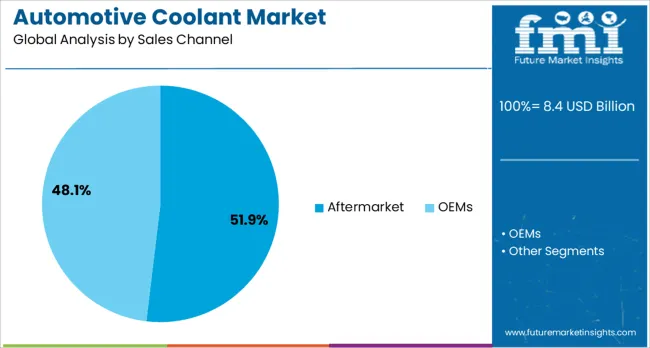
The automotive coolant market is segmented by product type, vehicle type, technology, sales channel, and geographic regions. By product type, the automotive coolant market is divided into Ethylene Glycol-Based Coolants, Propylene Glycol-Based Coolants, and Glycerin-Based Coolants. In terms of vehicle type, the automotive coolant market is classified into Passenger Cars, Light Commercial Vehicles (LCVs), Heavy Commercial Vehicles (HCVs), and Two-Wheelers. Based on technology, the automotive coolant market is segmented into Organic Acid Technology (OAT), Hybrid Organic Acid Technology (HOAT), and Inorganic Acid Technology (IAT). The sales channel of the automotive coolant market is segmented into Aftermarket and OEMs. Regionally, the automotive coolant industry is classified into North America, Latin America, Western Europe, Eastern Europe, Balkan & Baltic Countries, Russia & Belarus, Central Asia, East Asia, South Asia & Pacific, and the Middle East & Africa.
Insights into the Ethylene Glycol-Based Coolants Segment
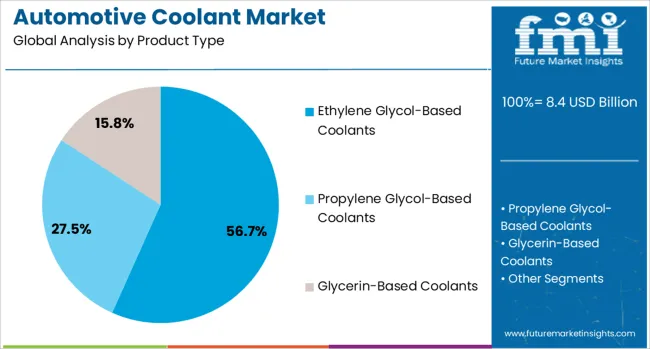
Ethylene glycol-based coolants are expected to account for 56.7% of the total automotive coolant market revenue in 2025, making them the leading product type. Their dominance can be attributed to superior heat transfer capabilities, cost-effectiveness, and extensive compatibility with a wide range of engine materials. These coolants have been favored across regions due to their ability to deliver consistent performance across a broad temperature range and in diverse climatic conditions.
The formulation flexibility of ethylene glycol-based products allows easy blending with corrosion inhibitors and additives, supporting extended service intervals and reduced maintenance costs. Automotive OEMs have continued to prefer ethylene glycol formulations due to the established global infrastructure for distribution, recycling, and performance validation.
Their effectiveness in internal combustion engines, coupled with evolving formulations that meet stricter environmental and technical standards, has strengthened their position in both OEM and aftermarket channels. As vehicle production continues to expand globally, the demand for this coolant type is expected to remain robust in the coming years.
Insights into the Passenger Cars Segment
Passenger cars are projected to contribute 51.2% of the overall revenue share in the automotive coolant market in 2025, maintaining their position as the dominant vehicle category. The widespread adoption of personal mobility, particularly in densely populated and fast-growing economies, has significantly influenced coolant demand across this segment. Increasing vehicle ownership rates, combined with growing awareness of preventive maintenance, have supported regular coolant replacement cycles in passenger vehicles.
Automakers have also integrated compact and turbocharged engines in newer models, which require more efficient and durable coolant solutions to ensure optimal thermal performance. Furthermore, urban driving conditions with frequent stop-and-go traffic create additional heat stress on engines, reinforcing the need for high-quality coolants.
As manufacturers seek to enhance fuel economy and reduce emissions, the role of efficient thermal management has become more critical. These factors, along with the growing trend of extended warranty periods and OEM-specified maintenance standards, have contributed to the sustained growth of coolants within the passenger car segment.
Insights into the Organic Acid Technology (OAT) Segment
Organic Acid Technology is expected to account for 39.8% of the total automotive coolant market revenue in 2025, emerging as the preferred technology. The growth of this segment is supported by its long-life performance characteristics and minimal environmental impact compared to traditional silicate-based formulations. OAT-based coolants use organic carboxylate inhibitors that provide extended protection against corrosion and scaling, making them suitable for modern engine systems that demand longer service intervals.
This technology has been increasingly adopted by global OEMs due to its ability to remain effective over distances exceeding 150000 kilometers, reducing the need for frequent coolant changes. OAT coolants are also compatible with aluminum and plastic components used in modern engine assemblies, which contributes to reduced wear and improved heat dissipation.
The transition toward lightweight, high-efficiency powertrains has further strengthened the adoption of OAT-based solutions. Additionally, the reduced use of phosphate, nitrate, and amine additives aligns well with emerging environmental regulations, ensuring long-term viability in diverse regional markets.
What are the Drivers, Restraints, and Key Trends of the Automotive Coolant Market?
The automotive coolant market is expanding through rising vehicle production, a shift toward long-life formulations, climate-adapted product strategies, and strong aftermarket growth supported by service network expansion.
Rising Vehicle Production Driving Coolant Demand
Global automotive coolant consumption is being propelled by rising vehicle manufacturing volumes across passenger and commercial segments. Increased production in emerging economies such as China, India, and Southeast Asia is contributing significantly to aftermarket and OEM coolant requirements. Expanding fleets in these regions, combined with consumer preference for vehicles offering longer maintenance intervals, are boosting demand for high-performance coolants. OEMs are standardizing advanced formulations to meet engine protection and extended drain interval needs. Growth in hybrid and electric vehicles, which require specialized thermal management fluids, is also influencing market dynamics. This trend is expected to shape new product launches as manufacturers address diverse climatic conditions and regulatory standards for performance and safety.
Shift Toward Long-Life Coolant Formulations
The market is witnessing a clear transition toward long-life organic acid technology (OAT) and hybrid organic acid technology (HOAT) coolants. These advanced formulations offer extended service intervals, improved corrosion resistance, and reduced environmental impact compared to conventional inorganic additive technology (IAT) products. OEM endorsements and factory-fill adoption have accelerated OAT usage in both passenger and commercial vehicles. Reduced replacement frequency appeals to cost-conscious fleet operators and private owners, creating a notable aftermarket shift. Expansion in high-performance vehicles, where thermal stability is critical, has also reinforced demand for premium coolant chemistries. This shift aligns with industry trends emphasizing lifecycle efficiency and maintenance cost reduction.
Impact of Regional Climate and Regulatory Factors
Regional temperature variations significantly influence coolant product selection, driving manufacturers to adapt formulations for optimal performance under different climatic conditions. In colder regions such as North America and Europe, antifreeze protection and freeze-point depression remain priorities, while in warmer markets like the Middle East and Southeast Asia, heat dissipation and anti-boiling properties are critical. Regulatory frameworks in multiple countries mandate coolant compositions that limit certain additives for environmental and safety compliance. These requirements encourage R&D investment in low-toxicity and biodegradable formulations without compromising performance. Compliance with regional standards has become a strategic differentiator for coolant producers seeking OEM partnerships and aftermarket dominance.
Aftermarket Expansion and Service Network Growth
The automotive coolant aftermarket is benefiting from extended vehicle ownership cycles and growing consumer awareness regarding preventive maintenance. Authorized service centers, quick-lube facilities, and independent workshops are actively promoting premium coolant upgrades during routine servicing. Strategic partnerships between coolant manufacturers and service networks are enhancing brand visibility and driving market penetration. Packaging innovations such as pre-mixed and ready-to-use coolants are simplifying end-user adoption. In fast-growing economies, improved service infrastructure is enabling greater reach in rural and semi-urban areas, capturing untapped replacement demand. The combination of OEM supply channels and aftermarket networks positions manufacturers to secure sustained revenue streams.
Analysis of Automotive Coolant Market By Key Countries
| Country | CAGR |
|---|---|
| China | 4.9% |
| India | 4.6% |
| Germany | 4.2% |
| France | 3.8% |
| UK | 3.5% |
| USA | 3.1% |
| Brazil | 2.7% |
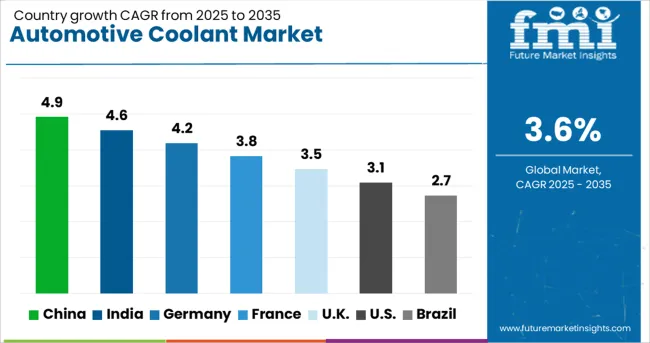
The automotive coolant market is projected to grow globally at a CAGR of 3.6% from 2025 to 2035, supported by rising vehicle parc, expansion in aftermarket servicing, and increasing adoption of advanced coolant formulations for both ICE and electric vehicles. China leads with a CAGR of 4.9%, driven by rapid fleet expansion, high production volumes, and growing penetration of long-life organic acid technology coolants. India follows at 4.6%, fueled by robust automotive manufacturing growth and a rising focus on preventive maintenance. France records 3.8%, supported by demand in both passenger and light commercial vehicle segments. The United Kingdom grows at 3.5% due to expanding electric vehicle adoption and related coolant innovations, while the United States stands at 3.1%, influenced by a mature aftermarket and stable vehicle replacement rates. These nations set critical performance benchmarks, helping suppliers refine product portfolios, regional distribution strategies, and OEM partnerships to capture long-term growth in the automotive thermal management space.
Market Expansion of Automotive Coolant in China
China is projected to post a CAGR of 4.9% for 2025–2035, higher than the nearly 4.3% recorded during 2020–2024. This uplift is supported by continued growth in domestic vehicle production, increasing adoption of long-life coolants, and a robust aftermarket service industry. Expanding EV production has also created demand for advanced thermal management solutions. The commercial vehicle segment continues to drive high-volume coolant consumption, while OEM requirements are pushing for improved chemical formulations. The aftermarket is benefiting from rising consumer awareness about preventive maintenance schedules, ensuring more frequent coolant replacement cycles.
- OEM adoption of extended-life coolants accelerates market penetration.
- Commercial vehicles contribute significantly to overall volume demand.
- Growing EV adoption drives thermal management innovations.
Market Dynamics of Automotive Coolant in India
India is expected to achieve a CAGR of 4.6% for 2025–2035, up from about 4.1% seen between 2020–2024. The upward shift is due to rising automotive production capacity, fleet growth, and greater adoption of organic acid technology coolants in both passenger and commercial vehicles. Tier-II and Tier-III cities are emerging as strong aftermarket hubs due to rising vehicle ownership. OEM partnerships with lubricant and coolant suppliers have strengthened, ensuring consistent quality and brand trust in both factory-fill and service channels. Increasing vehicle export volumes are also pushing domestic manufacturers to meet global coolant performance standards.
- Expansion of aftermarket networks supports sustained replacement demand.
- OEM tie-ups ensure consistent product quality and availability.
- Exports create opportunities for premium coolant formulations.
Performance Outlook of Automotive Coolant in France

France is projected to grow at a CAGR of 3.8% for 2025–2035, compared to approximately 3.4% during 2020–2024. This growth improvement is attributed to greater integration of advanced coolant systems in hybrid and electric vehicles, as well as a steady aftermarket demand from the aging ICE vehicle fleet. OEM-led product standardization is boosting adoption of high-performance coolants that meet both European and global specifications. The aftermarket remains resilient due to strict maintenance regulations and high consumer awareness. Growing demand in light commercial vehicles for urban logistics also contributes to long-term coolant consumption stability.
- Hybrid and EV models increase premium coolant usage.
- Stringent maintenance norms support aftermarket volumes.
- Urban logistics boost demand in commercial vehicle fleets.
Growth Analysis of Automotive Coolant in the United Kingdom
The United Kingdom is forecasted to achieve a CAGR of 3.5% for 2025–2035, up from roughly 3.0% registered between 2020–2024. This increase is driven by rising adoption of specialized coolants for electric and hybrid vehicles, alongside a gradual recovery in automotive sales. The aftermarket is witnessing stable growth due to higher consumer awareness and more frequent servicing intervals. OEMs are collaborating with suppliers to introduce formulations that enhance corrosion resistance and reduce environmental impact without compromising performance. Fleet operators are increasingly opting for long-life coolants to minimize downtime and operational costs.
- Fleet operators adopt extended-life coolant solutions.
- EV and hybrid segments drive premium coolant demand.
- OEM partnerships improve market penetration and product reach.
Industry Outlook for Automotive Coolant in the United States
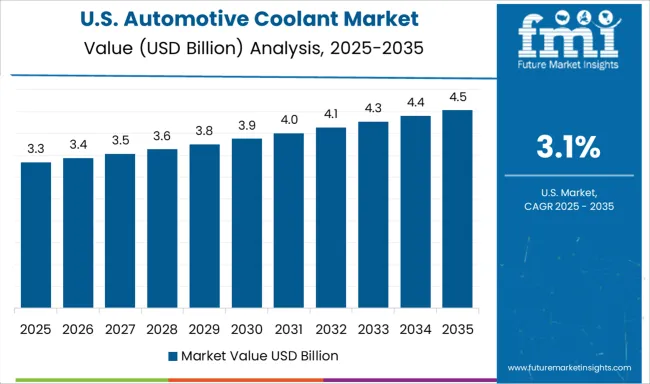
The United States is expected to post a CAGR of 3.1% for 2025–2035, slightly higher than the 2.7% recorded during 2020–2024. Growth is being fueled by an aging vehicle parc, steady replacement rates, and the rising need for advanced coolants in both ICE and EV platforms. The commercial vehicle segment accounts for a substantial portion of demand, driven by long-haul operations that require optimal thermal performance. Increasing consumer education on preventive maintenance is leading to more timely coolant changes. Domestic manufacturing capacity and distribution channels remain strong, ensuring product availability across service centers and retail outlets.
- Aging fleet sustains consistent aftermarket demand.
- Commercial vehicle operations require advanced coolant performance.
- Retail and service channels ensure widespread product accessibility.
Competitive Landscape of Automotive Coolant Market
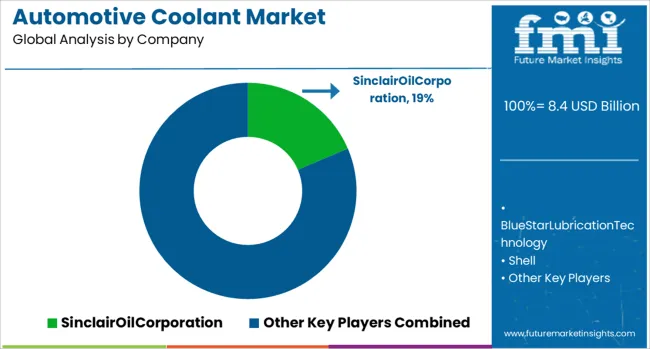
The automotive coolant market is increasingly competitive, with Sinclair Oil Corporation emerging as a leading player, leveraging its extensive portfolio of high-performance coolants and aftermarket fluids for passenger vehicles, commercial trucks, and industrial engines. Sinclair’s leadership is supported by its long-standing industry presence, strong brand recognition, and focus on product reliability, thermal stability, and corrosion protection across diverse climatic and operational conditions. Key players such as BASF SE, The Dow Chemical Company, Chevron Corporation, and ExxonMobil continue to hold significant shares by offering OEM-compliant formulations, extended-life coolants, and multi-vehicle compatibility, ensuring consistent performance and meeting evolving regulatory standards.
Emerging players including Prestone Products Corporation, Valvoline Inc., and FUCHS Group are expanding their presence by introducing hybrid organic acid technology (HOAT) and fully organic acid technology (OAT) formulations, focusing on eco-friendly and biodegradable options. Market dynamics are driven by rising vehicle production, increasing engine efficiency requirements, and consumer demand for low-maintenance, long-life coolants. Strategies across the competitive landscape include enhancing additive packages, optimizing freezing and boiling point ranges, targeting hybrid and electric vehicle thermal management, and improving corrosion resistance. Innovations in nano-enhanced coolants, sustainable fluid formulations, and long-service technologies are expected to shape competitive positioning and drive continued growth in the global automotive coolant market.
Scope of the Report
| Item | Value |
|---|---|
| Quantitative Units | USD 8.4 Billion |
| Product Type | Ethylene Glycol-Based Coolants, Propylene Glycol-Based Coolants, and Glycerin-Based Coolants |
| Vehicle Type | Passenger Cars, Light Commercial Vehicles (LCVs), Heavy Commercial Vehicles (HCVs), and Two-Wheelers |
| Technology | Organic Acid Technology (OAT), Hybrid Organic Acid Technology (HOAT), and Inorganic Acid Technology (IAT) |
| Sales Channel | Aftermarket and OEMs |
| Regions Covered | North America, Europe, Asia-Pacific, Latin America, Middle East & Africa |
| Country Covered | United States, Canada, Germany, France, United Kingdom, China, Japan, India, Brazil, South Africa |
| Key Companies Profiled | SinclairOilCorporation, BlueStarLubricationTechnology, Shell, LukoilPetrons, AshlandCorporation, Chevron, and ExxonMobil |
| Additional Attributes | Dollar sales, share by region and product type, competitive landscape, regulatory requirements, raw material trends, distribution channels, pricing dynamics, and growth opportunities in emerging segments. |
Automotive Coolant Market by Segments
Product Type:
- Ethylene Glycol-Based Coolants
- Propylene Glycol-Based Coolants
- Glycerin-Based Coolants
Vehicle Type:
- Passenger Cars
- Light Commercial Vehicles (LCVs)
- Heavy Commercial Vehicles (HCVs)
- Two-Wheelers
Technology:
- Organic Acid Technology (OAT)
- Hybrid Organic Acid Technology (HOAT)
- Inorganic Acid Technology (IAT)
Sales Channel:
- Aftermarket
- OEMs
Region:
- North America
- USA
- Canada
- Mexico
- Latin America
- Brazil
- Chile
- Rest of Latin America
- Western Europe
- Germany
- UK
- Italy
- Spain
- France
- Nordic
- BENELUX
- Rest of Western Europe
- Eastern Europe
- Russia
- Poland
- Hungary
- Balkan & Baltic
- Rest of Eastern Europe
- East Asia
- China
- Japan
- South Korea
- South Asia and Pacific
- India
- ASEAN
- Australia & New Zealand
- Rest of South Asia and Pacific
- Middle East & Africa
- Kingdom of Saudi Arabia
- Other GCC Countries
- Turkiye
- South Africa
- Other African Union
- Rest of Middle East & Africa
Frequently Asked Questions
How big is the automotive coolant market in 2025?
The global automotive coolant market is estimated to be valued at USD 8.4 billion in 2025.
What will be the size of automotive coolant market in 2035?
The market size for the automotive coolant market is projected to reach USD 12.0 billion by 2035.
How much will be the automotive coolant market growth between 2025 and 2035?
The automotive coolant market is expected to grow at a 3.6% CAGR between 2025 and 2035.
What are the key product types in the automotive coolant market?
The key product types in automotive coolant market are ethylene glycol-based coolants, propylene glycol-based coolants and glycerin-based coolants.
Which vehicle type segment to contribute significant share in the automotive coolant market in 2025?
In terms of vehicle type, passenger cars segment to command 51.2% share in the automotive coolant market in 2025.
Preview the report firsthand - request a free sample
Get SampleGet the brochure for pricing and purchase details.
Get PDFTable of Content
- Executive Summary
- Global Market Outlook
- Demand-side Trends
- Supply-side Trends
- Technology Roadmap Analysis
- Analysis and Recommendations
- Market Overview
- Market Coverage / Taxonomy
- Market Definition / Scope / Limitations
- Market Background
- Market Dynamics
- Drivers
- Restraints
- Opportunity
- Trends
- Scenario Forecast
- Demand in Optimistic Scenario
- Demand in Likely Scenario
- Demand in Conservative Scenario
- Opportunity Map Analysis
- Product Life Cycle Analysis
- Supply Chain Analysis
- Investment Feasibility Matrix
- Value Chain Analysis
- PESTLE and Porter’s Analysis
- Regulatory Landscape
- Regional Parent Market Outlook
- Production and Consumption Statistics
- Import and Export Statistics
- Market Dynamics
- Global Automotive Coolant Market Analysis 2020-2024 and Forecast, 2025-2035
- Historical Market Size Value (USD Mn) Analysis, 2020-2024
- Current and Future Market Size Value (USD Mn) Projections, 2025-2035
- Y-o-Y Growth Trend Analysis
- Absolute Dollar Opportunity Analysis
- Global Automotive Coolant Market Pricing Analysis 2020-2024 and Forecast 2025-2035
- Global Automotive Coolant Market Analysis 2020-2024 and Forecast 2025-2035, By Product Type
- Introduction / Key Findings
- Historical Market Size Value (USD Mn) Analysis By Product Type , 2020-2024
- Current and Future Market Size Value (USD Mn) Analysis and Forecast By Product Type , 2025-2035
- Ethylene Glycol-Based Coolants
- Propylene Glycol-Based Coolants
- Glycerin-Based Coolants
- Y-o-Y Growth Trend Analysis By Product Type , 2020-2024
- Absolute Dollar Opportunity Analysis By Product Type , 2025-2035
- Global Automotive Coolant Market Analysis 2020-2024 and Forecast 2025-2035, By Vehicle Type
- Introduction / Key Findings
- Historical Market Size Value (USD Mn) Analysis By Vehicle Type, 2020-2024
- Current and Future Market Size Value (USD Mn) Analysis and Forecast By Vehicle Type, 2025-2035
- Passenger Cars
- Light Commercial Vehicles (LCVs)
- Heavy Commercial Vehicles (HCVs)
- Two-Wheelers
- Y-o-Y Growth Trend Analysis By Vehicle Type, 2020-2024
- Absolute Dollar Opportunity Analysis By Vehicle Type, 2025-2035
- Global Automotive Coolant Market Analysis 2020-2024 and Forecast 2025-2035, By Technology
- Introduction / Key Findings
- Historical Market Size Value (USD Mn) Analysis By Technology, 2020-2024
- Current and Future Market Size Value (USD Mn) Analysis and Forecast By Technology, 2025-2035
- Organic Acid Technology (OAT)
- Hybrid Organic Acid Technology (HOAT)
- Inorganic Acid Technology (IAT)
- Y-o-Y Growth Trend Analysis By Technology, 2020-2024
- Absolute Dollar Opportunity Analysis By Technology, 2025-2035
- Global Automotive Coolant Market Analysis 2020-2024 and Forecast 2025-2035, By Sales Channel
- Introduction / Key Findings
- Historical Market Size Value (USD Mn) Analysis By Sales Channel, 2020-2024
- Current and Future Market Size Value (USD Mn) Analysis and Forecast By Sales Channel, 2025-2035
- Aftermarket
- OEMs
- Y-o-Y Growth Trend Analysis By Sales Channel, 2020-2024
- Absolute Dollar Opportunity Analysis By Sales Channel, 2025-2035
- Global Automotive Coolant Market Analysis 2020-2024 and Forecast 2025-2035, By Region
- Introduction
- Historical Market Size Value (USD Mn) Analysis By Region, 2020-2024
- Current Market Size Value (USD Mn) Analysis and Forecast By Region, 2025-2035
- North America
- Latin America
- Western Europe
- Eastern Europe
- East Asia
- South Asia and Pacific
- Middle East & Africa
- Market Attractiveness Analysis By Region
- North America Automotive Coolant Market Analysis 2020-2024 and Forecast 2025-2035, By Country
- Historical Market Size Value (USD Mn) Trend Analysis By Market Taxonomy, 2020-2024
- Market Size Value (USD Mn) Forecast By Market Taxonomy, 2025-2035
- By Country
- USA
- Canada
- Mexico
- By Product Type
- By Vehicle Type
- By Technology
- By Sales Channel
- By Country
- Market Attractiveness Analysis
- By Country
- By Product Type
- By Vehicle Type
- By Technology
- By Sales Channel
- Key Takeaways
- Latin America Automotive Coolant Market Analysis 2020-2024 and Forecast 2025-2035, By Country
- Historical Market Size Value (USD Mn) Trend Analysis By Market Taxonomy, 2020-2024
- Market Size Value (USD Mn) Forecast By Market Taxonomy, 2025-2035
- By Country
- Brazil
- Chile
- Rest of Latin America
- By Product Type
- By Vehicle Type
- By Technology
- By Sales Channel
- By Country
- Market Attractiveness Analysis
- By Country
- By Product Type
- By Vehicle Type
- By Technology
- By Sales Channel
- Key Takeaways
- Western Europe Automotive Coolant Market Analysis 2020-2024 and Forecast 2025-2035, By Country
- Historical Market Size Value (USD Mn) Trend Analysis By Market Taxonomy, 2020-2024
- Market Size Value (USD Mn) Forecast By Market Taxonomy, 2025-2035
- By Country
- Germany
- UK
- Italy
- Spain
- France
- Nordic
- BENELUX
- Rest of Western Europe
- By Product Type
- By Vehicle Type
- By Technology
- By Sales Channel
- By Country
- Market Attractiveness Analysis
- By Country
- By Product Type
- By Vehicle Type
- By Technology
- By Sales Channel
- Key Takeaways
- Eastern Europe Automotive Coolant Market Analysis 2020-2024 and Forecast 2025-2035, By Country
- Historical Market Size Value (USD Mn) Trend Analysis By Market Taxonomy, 2020-2024
- Market Size Value (USD Mn) Forecast By Market Taxonomy, 2025-2035
- By Country
- Russia
- Poland
- Hungary
- Balkan & Baltic
- Rest of Eastern Europe
- By Product Type
- By Vehicle Type
- By Technology
- By Sales Channel
- By Country
- Market Attractiveness Analysis
- By Country
- By Product Type
- By Vehicle Type
- By Technology
- By Sales Channel
- Key Takeaways
- East Asia Automotive Coolant Market Analysis 2020-2024 and Forecast 2025-2035, By Country
- Historical Market Size Value (USD Mn) Trend Analysis By Market Taxonomy, 2020-2024
- Market Size Value (USD Mn) Forecast By Market Taxonomy, 2025-2035
- By Country
- China
- Japan
- South Korea
- By Product Type
- By Vehicle Type
- By Technology
- By Sales Channel
- By Country
- Market Attractiveness Analysis
- By Country
- By Product Type
- By Vehicle Type
- By Technology
- By Sales Channel
- Key Takeaways
- South Asia and Pacific Automotive Coolant Market Analysis 2020-2024 and Forecast 2025-2035, By Country
- Historical Market Size Value (USD Mn) Trend Analysis By Market Taxonomy, 2020-2024
- Market Size Value (USD Mn) Forecast By Market Taxonomy, 2025-2035
- By Country
- India
- ASEAN
- Australia & New Zealand
- Rest of South Asia and Pacific
- By Product Type
- By Vehicle Type
- By Technology
- By Sales Channel
- By Country
- Market Attractiveness Analysis
- By Country
- By Product Type
- By Vehicle Type
- By Technology
- By Sales Channel
- Key Takeaways
- Middle East & Africa Automotive Coolant Market Analysis 2020-2024 and Forecast 2025-2035, By Country
- Historical Market Size Value (USD Mn) Trend Analysis By Market Taxonomy, 2020-2024
- Market Size Value (USD Mn) Forecast By Market Taxonomy, 2025-2035
- By Country
- Kingdom of Saudi Arabia
- Other GCC Countries
- Turkiye
- South Africa
- Other African Union
- Rest of Middle East & Africa
- By Product Type
- By Vehicle Type
- By Technology
- By Sales Channel
- By Country
- Market Attractiveness Analysis
- By Country
- By Product Type
- By Vehicle Type
- By Technology
- By Sales Channel
- Key Takeaways
- Key Countries Automotive Coolant Market Analysis
- USA
- Pricing Analysis
- Market Share Analysis, 2024
- By Product Type
- By Vehicle Type
- By Technology
- By Sales Channel
- Canada
- Pricing Analysis
- Market Share Analysis, 2024
- By Product Type
- By Vehicle Type
- By Technology
- By Sales Channel
- Mexico
- Pricing Analysis
- Market Share Analysis, 2024
- By Product Type
- By Vehicle Type
- By Technology
- By Sales Channel
- Brazil
- Pricing Analysis
- Market Share Analysis, 2024
- By Product Type
- By Vehicle Type
- By Technology
- By Sales Channel
- Chile
- Pricing Analysis
- Market Share Analysis, 2024
- By Product Type
- By Vehicle Type
- By Technology
- By Sales Channel
- Germany
- Pricing Analysis
- Market Share Analysis, 2024
- By Product Type
- By Vehicle Type
- By Technology
- By Sales Channel
- UK
- Pricing Analysis
- Market Share Analysis, 2024
- By Product Type
- By Vehicle Type
- By Technology
- By Sales Channel
- Italy
- Pricing Analysis
- Market Share Analysis, 2024
- By Product Type
- By Vehicle Type
- By Technology
- By Sales Channel
- Spain
- Pricing Analysis
- Market Share Analysis, 2024
- By Product Type
- By Vehicle Type
- By Technology
- By Sales Channel
- France
- Pricing Analysis
- Market Share Analysis, 2024
- By Product Type
- By Vehicle Type
- By Technology
- By Sales Channel
- India
- Pricing Analysis
- Market Share Analysis, 2024
- By Product Type
- By Vehicle Type
- By Technology
- By Sales Channel
- ASEAN
- Pricing Analysis
- Market Share Analysis, 2024
- By Product Type
- By Vehicle Type
- By Technology
- By Sales Channel
- Australia & New Zealand
- Pricing Analysis
- Market Share Analysis, 2024
- By Product Type
- By Vehicle Type
- By Technology
- By Sales Channel
- China
- Pricing Analysis
- Market Share Analysis, 2024
- By Product Type
- By Vehicle Type
- By Technology
- By Sales Channel
- Japan
- Pricing Analysis
- Market Share Analysis, 2024
- By Product Type
- By Vehicle Type
- By Technology
- By Sales Channel
- South Korea
- Pricing Analysis
- Market Share Analysis, 2024
- By Product Type
- By Vehicle Type
- By Technology
- By Sales Channel
- Russia
- Pricing Analysis
- Market Share Analysis, 2024
- By Product Type
- By Vehicle Type
- By Technology
- By Sales Channel
- Poland
- Pricing Analysis
- Market Share Analysis, 2024
- By Product Type
- By Vehicle Type
- By Technology
- By Sales Channel
- Hungary
- Pricing Analysis
- Market Share Analysis, 2024
- By Product Type
- By Vehicle Type
- By Technology
- By Sales Channel
- Kingdom of Saudi Arabia
- Pricing Analysis
- Market Share Analysis, 2024
- By Product Type
- By Vehicle Type
- By Technology
- By Sales Channel
- Turkiye
- Pricing Analysis
- Market Share Analysis, 2024
- By Product Type
- By Vehicle Type
- By Technology
- By Sales Channel
- South Africa
- Pricing Analysis
- Market Share Analysis, 2024
- By Product Type
- By Vehicle Type
- By Technology
- By Sales Channel
- USA
- Market Structure Analysis
- Competition Dashboard
- Competition Benchmarking
- Market Share Analysis of Top Players
- By Regional
- By Product Type
- By Vehicle Type
- By Technology
- By Sales Channel
- Competition Analysis
- Competition Deep Dive
- SinclairOilCorporation
- Overview
- Product Portfolio
- Profitability by Market Segments (Product/Age /Sales Channel/Region)
- Sales Footprint
- Strategy Overview
- Marketing Strategy
- Product Strategy
- Channel Strategy
- BlueStarLubricationTechnology
- Shell
- LukoilPetrons
- AshlandCorporation
- Chevron
- ExxonMobil
- SinclairOilCorporation
- Competition Deep Dive
- Assumptions & Acronyms Used
- Research Methodology


