

- Industry Size (2026)
- USD 300 Mn
- Forecast (2036)
- USD 820 Mn
- CAGR (2026 to 2036)
- 10.6%
Automotive Battery Pack Compression Pad Market Size, Market Forecast and Outlook By FMI
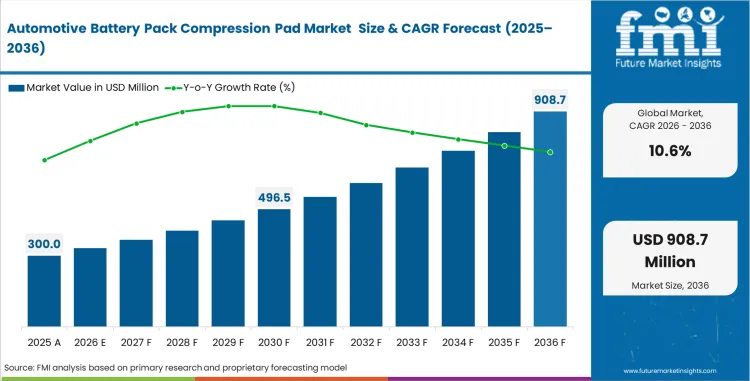
The automotive battery pack compression pad market was valued at USD 270 million in 2025. Sector is estimated to cross USD 300 million in 2026, expanding at a CAGR of 10.6% during the forecast period. Total valuation is projected to reach USD 820 million by 2036 as higher-energy cell designs raise the need for controlled compression inside battery packs.
Summary of Automotive Battery Pack Compression Pad Market
- The market is forecast to reach USD 820 million by 2036.
- The market is expected to grow at a CAGR of 10.6% from 2026 to 2036.
- The market was estimated at USD 270 million in 2025.
- The forecast period represents an incremental opportunity of USD 520 million.
- Demand is driven by the need to control cell swelling, maintain compression stability, and improve battery pack durability in EVs.
- Polyurethane foam is projected to account for 43% of the material segment in 2026 due to its lightweight and compression performance advantages.
- Prismatic cell formats are expected to hold 48% share in 2026, reflecting their dominance in high-volume EV battery pack designs.
- Passenger electric vehicles are anticipated to contribute 71% of the vehicle segment share in 2026.
- China, India, and South Korea are the fastest-growing markets, while the United States and Germany remain key engineering and validation hubs.
Key Takeaways, Market Size, and Forecast
- Automotive Battery Pack Compression Pad Market is projected to grow from USD 300 million in 2026 to USD 820 million by 2036, at a CAGR of 10.6%.
- The automotive battery pack compression pad market was valued at USD 270 million in 2025.
- By 2036, the Automotive Battery Pack Compression Pad Market is expected to be worth USD 820 million.
- From 2026 to 2036, the market is projected to expand at a CAGR of 10.6%.
- The market is expected to create an incremental opportunity of USD 520 million between 2026 and 2036.
- In 2026, polyurethane foam is expected to account for 43.0% of the material segment.
- China (11.9%) and India (11.2%) are two of the fastest‑growing markets.
Automotive Battery Pack Compression Pad Market Key Takeaways
| Metric | Details |
|---|---|
| Industry Size (2026) | USD 300 million |
| Industry Value (2036) | USD 820 million |
| CAGR (2026 to 2036) | 10.6% |
Source: Future Market Insights (FMI) analysis, based on proprietary forecasting model and primary research
Engineering chiefs face a direct trade-off between energy density and cycle life. Squeezing more active material into confined pack architectures raises inter-cell expansion pressure, threatening early separator failure if physical compression drops below specific PSI thresholds. Legacy electric vehicle battery designs solved expansion through structural metal bands, but weight penalties make elastomeric padding more attractive. Suppliers delaying transition protocols for high-recovery foam compounds risk exclusion from next-generation vehicle programs demanding fast charging cycles.
Pre-compression at the module assembly stage supports wider use of compression pads by giving battery engineers tighter control over pack build consistency. Applying the required pressure before busbar laser welding helps keep cells within the intended compression window during final assembly. That shifts the pad from a simple spacing material to a functional component that supports cell stability and service life.
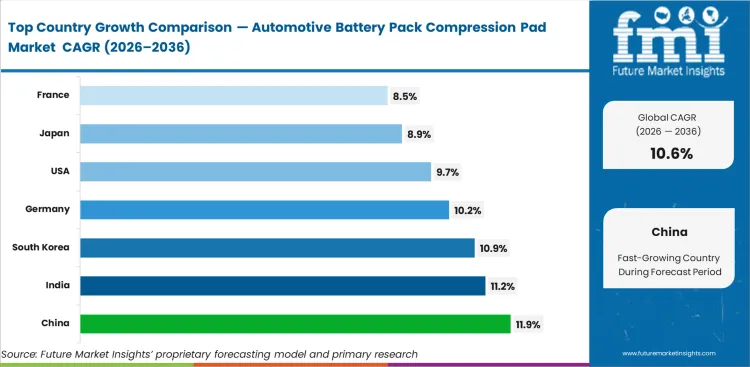
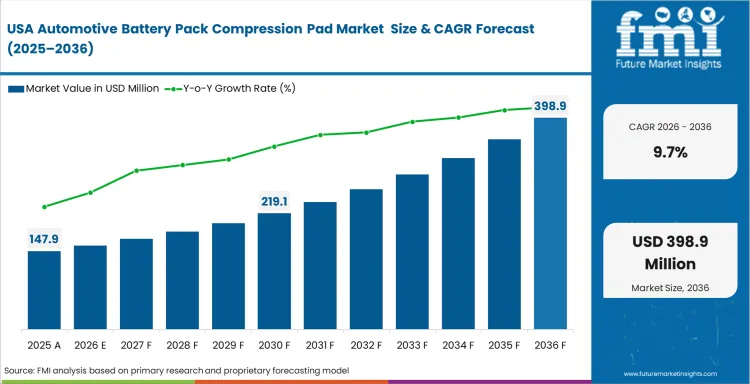
China is projected to expand at a CAGR of 11.9% during 2026 to 2036, supported by large-scale cell manufacturing and tighter integration of battery pack production. India follows at 11.2% as domestic battery manufacturing capacity builds under incentive-led localization. South Korea is forecast to rise at 10.9%, helped by strong concentration in prismatic cell production and continued scaling of battery supply chains. Germany is expected to register 10.2% CAGR through 2036, as premium electric vehicle programs require tighter control over cell swelling and pack durability. The United States is likely to grow at 9.7% with new battery plants adding local pack-material demand. Japan is projected to advance at 8.9%, supported by its established battery technology base and measured electrification rollout. France is anticipated to record 8.5% growth over the forecast period, aided by broader European battery capacity expansion. Asia remain more volume-led, while Europe continues to emphasize tighter engineering requirements in pack integration.
Segmental Analysis
Automotive Battery Pack Compression Pad Market Analysis by Material
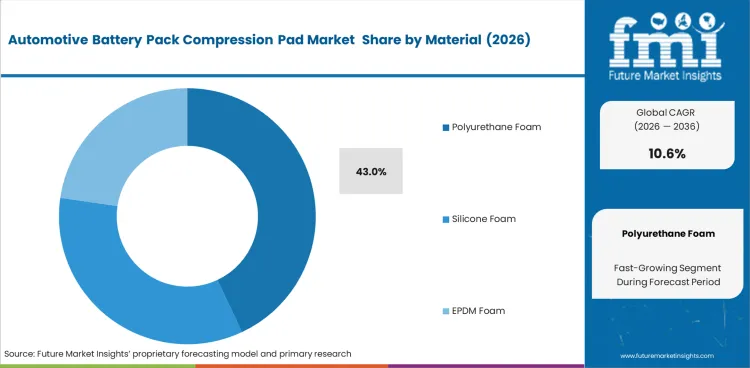
The polyurethane foam segment is expected to account for 43.0% share in 2026. Legacy rubbers fail to deliver the consistent rebound pressure required by modern high-density chemistries, causing premature capacity fade as cells deform. Battery design engineers specify these microcellular structures because they maintain optimal face pressure without incurring the cost penalties associated with pure silicone alternatives. The material dominance hides a specific processing vulnerability: polyurethane's sensitivity to environmental humidity during curing requires pack integrators to invest heavily in climate-controlled storage and handling facilities. Teams prioritizing initial material savings frequently encounter downstream quality rejections when improperly stored foam absorbs moisture, altering compression curves and failing battery separator coatings alignment tolerances. Suppliers providing moisture-resistant formulations gain an immediate commercial advantage.
- Initial screening: Baseline thermal conductivity dictates entry into supply evaluations. Sourcing directors eliminate materials failing immediate flame retardancy tests.
- Cycle validation: Retained thickness after 1000 simulated charge cycles confirms viability. Test engineers require foams to survive continuous mechanical stress.
- Volume scaling: Automated dispensing compatibility drives final contract awards. Operations managers reject formulations causing robotic picker malfunctions.
Automotive Battery Pack Compression Pad Market Analysis by Cell format
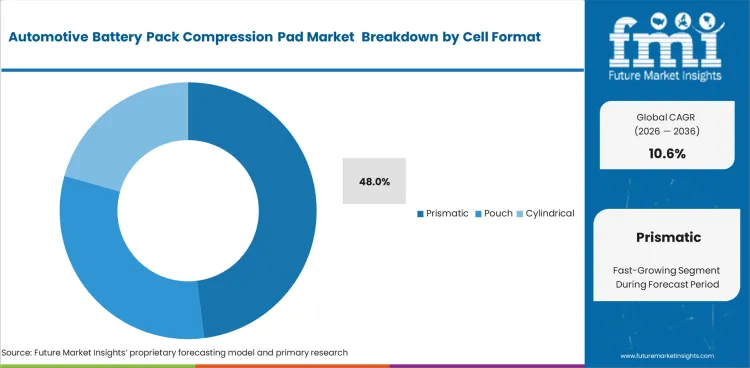
Large rigid exterior casings direct internal expansion forces strictly outward against adjacent units, requiring substantial external counter-pressure. Pack architects deploy extensive pad networks to manage this planar swelling. Prismatic cells are projected to secure 48.0% share in 2026. Tier-1 buyers consolidate purchases around suppliers capable of delivering precision-die-cut sheets matching exact cell face dimensions. Surface-level lithium ion battery separator analysis misses how microscopic thickness variations across a single prismatic pad accumulate across a 100-cell module, generating asymmetric stress that physically warps aluminum housings. Engineers neglecting tight thickness tolerance specifications face module failure during end-of-line compression testing, forcing total teardowns. This tight tolerance requirement restricts the supplier pool to specialized converters.
- Raw ingredient savings: Bulk chemical purchasing lowers base formulation costs. Sourcing leads negotiate global polymer volume pricing.
- Processing waste: Edge trim during die-cutting generates heavy scrap ratios. Financial controllers factor unrecoverable offcuts into unit economics.
- Lifetime value: Preventing single-cell warranty replacements justifies premium initial pad pricing. Risk actuaries calculate exact lifecycle cost advantages.
Automotive Battery Pack Compression Pad Market Analysis by Function
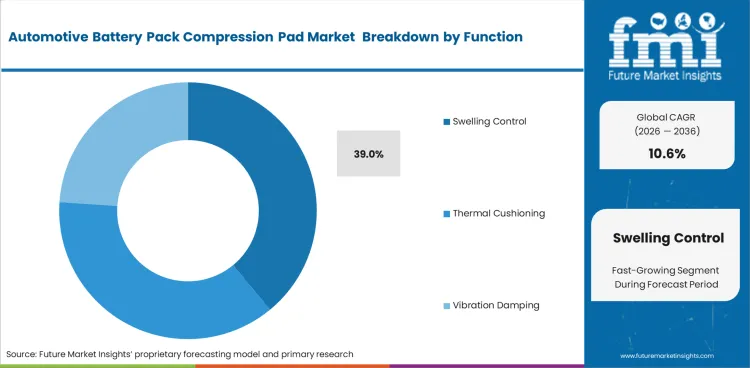
The swelling control category is likely to represent 39.0% of the market in 2026. Thermal runaway mitigation competes directly against volumetric energy density goals within constrained battery enclosures. Automakers transition toward silicon-blended anodes exhibiting expansion rates exceeding 10%. Safety compliance officers demand materials capable of absorbing this geometric change without transferring destructive loads to neighboring assemblies or delicate battery thermal plates. The pad formulators achieve this by manipulating cell wall structures to collapse sequentially rather than simultaneously. Purchasers specifying pads based solely on baseline thermal conductivity miss how expansion compression alters thermal transfer coefficients; a fully squeezed pad acts as a heat bridge, accelerating thermal runaway propagation. Design teams ignoring dynamic thermal metrics risk vehicle fires during charging scenarios. Addressing this dynamic shift defines the next generation of EV battery cell swelling control material.
- Deflection limits: Pads failing to compress properly crack delicate ceramic separators. Cell engineers ensure minimum deformation targets are met.
- Aging degradation: Long-term compression set permanently reduces rebound pressure. Hardware directors design systems accommodating gradual foam collapse.
- Systematic integration: Complete containment requires specialized venting channel integration. Pack architects route escaping gases around compressed barriers.
Automotive Battery Pack Compression Pad Market Analysis by Vehicle class
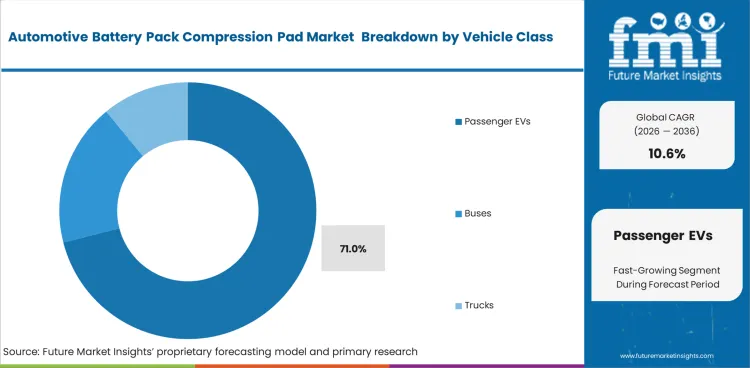
Consumer demand for longer range pulls against stringent weight reduction mandates. Platform chief engineers prioritize ultra-lightweight foam formulations to offset heavy battery mass, pushing density limits lower. This establishes the baseline volume necessary for material suppliers to scale specialized production lines. Passenger EVs are expected to contribute 71.0% of total market share in 2026. It has been observed that this volume dominance masks a critical supply chain fragility, customized formulations developed for specific passenger car geometries leave suppliers unable to pivot production toward commercial vehicle demands during market fluctuations. Suppliers locking into single-source proprietary light-weight pads risk halting production entirely if ev coolants leaks degrade incompatible foam batches, requiring total material re-qualification. Suppliers must balance bespoke passenger platforms with scalable commercial formulations.
- Domestic pioneers: Asian gigafactories establish initial material specifications. R&D directors test early formulations in controlled fleets.
- European followers: Premium automakers adopt proven pads while demanding stricter recyclability. Compliance officers rewrite material data sheets accordingly.
- Commercial holdouts: Heavy truck manufacturers await extreme-durability variants before converting. Fleet managers require million-mile warranty coverage.
Automotive Battery Pack Compression Pad Market Analysis by Pack integration point
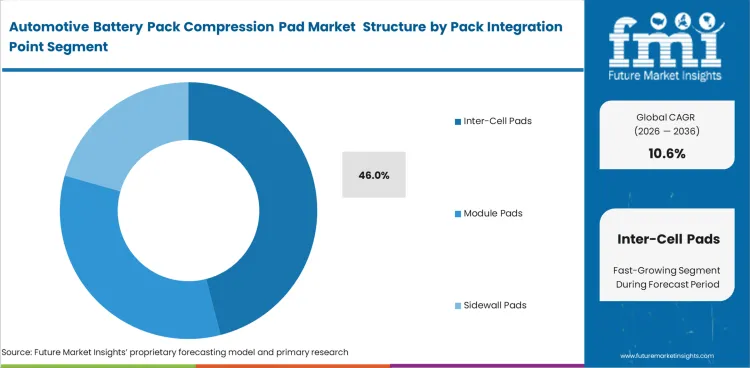
The inter-cell pads segment is anticipated to emerge with 46.0% market share in 2026. Direct cell-to-cell thermal propagation remains a primary certification hurdle for high-density architectures. Pack integration directors deploy these materials to absorb normal breathing expansion while acting as firewalls during fault events. Reliance on physical battery pack sealants and pads obscures how module-free designs transfer structural chassis loads directly into fragile battery casings. Engineers calibrate pad firmness not just for swelling, but for torsional vehicle stiffness, turning a thermal barrier into a load-bearing suspension component. Teams treating inter-cell foam purely as insulation face warranty claims when chassis flex crushes cells over rough terrain. Sourcing teams prioritize materials offering torsional rigidity alongside thermal cushioning.
- Baseline expectations: Standard commuting profiles generate minimal thermal stress. Pack engineers specify low-cost polyurethane for benign environments.
- Extreme edge cases: Repeated rapid charging creates severe localized hotspots. Materials scientists push silicone boundaries to survive these abuse conditions.
- Qualification criteria: End-of-life pressure retention determines ultimate acceptance. Quality directors reject any material dropping below 80% original force.
Automotive Battery Pack Compression Pad Market Drivers, Restraints, and Opportunities
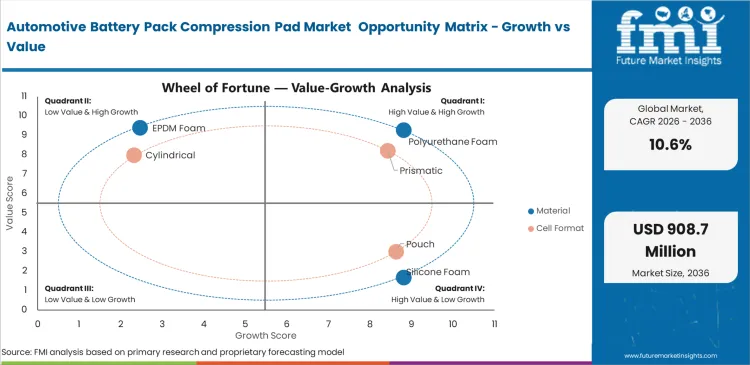
Fast-charging consumer expectations force automakers to push battery cells to higher thermal limits, causing rapid expansion events. Battery system architects specify advanced silicone pads capable of surviving extreme temperature spikes without losing elasticity. Delaying this material upgrade leaves legacy polyurethane pads vulnerable to permanent compression set under continuous thermal loads. Upgrading ensures vehicles pass stringent rapid-charge certification protocols without degrading long-term pack architecture.
Robotic assembly limitations present massive operational friction during automated module construction. Soft, highly compressible pads inherently resist clean robotic picking, often folding or sticking to suction effectors. Tooling engineers attempt to mitigate this by applying rigid PET carrier films, but this adds material cost and introduces a secondary waste stream on the factory floor. Balancing necessary compressibility with handling rigidity slows high-volume production rollouts.
Opportunities in the Automotive Battery Pack Compression Pad Market
- Structural integration: Formulating pads that dual-function as weak adhesives reduces component counts. Pack architects eliminate secondary fastening steps.
- Cooling synergy: Engineering foams compatible with direct-immersion dielectrics opens high-performance channels. System designers push limits using ev battery heating system fluids.
- Smart sensor embedding: Printing pressure sensors directly onto pad surfaces enables real-time swelling monitoring. Software engineers utilize this data for predictive maintenance.
Regional Analysis
Based on regional analysis, Automotive Battery Pack Compression Pad is segmented into North America, Latin America, Western Europe, Eastern Europe, and Asia Pacific across 40 plus countries.
.webp "Top Country Growth Comparison Automotive Battery Pack Compression Pad Market Cagr (2026 2036)")
| Country | CAGR (2026 to 2036) |
|---|---|
| China | 11.9% |
| India | 11.2% |
| South Korea | 10.9% |
| Germany | 10.2% |
| United States | 9.7% |
| Japan | 8.9% |
| France | 8.5% |
Source: Future Market Insights (FMI) analysis, based on proprietary forecasting model and primary research
Asia Pacific Automotive Battery Pack Compression Pad Market Analysis
Gigafactory expansion across Asia is reshaping how compression pad materials are sourced, converted, and supplied. Cell producers are bringing more pack assembly work in-house, which is raising the need for regional foam and pad production that can support faster delivery, lower freight exposure, and tighter coordination with pack design teams. Tariff exposure on specialty silicones is also pushing buyers to qualify suppliers within the region. For material companies, local converting capability is no longer a secondary advantage. It is becoming a basic requirement for serving concentrated battery manufacturing clusters.
- China: High-volume standardization defines purchasing in China, where battery makers favor scalable pad formats over highly customized thermal designs. The market in China is projected to expand at a CAGR of 11.9% through 2036. Pack engineers are aligning designs with materials that are already widely available in the domestic supply chain, including debonding on demand adhesives and compression pads. This gives local manufacturers an advantage in contract capture and makes it harder for overseas specialty suppliers to compete unless they localize production or technical support.
- India: Extreme operating temperatures keep material selection tightly focused on thermal resilience rather than swelling control alone. As domestic battery assembly capacity expands, the market in India is set to advance at a CAGR of 11.2% through 2036. System upgrades are supporting wider use of compression pads that can perform reliably under hotter conditions and uneven duty cycles. Companies that establish local converting operations early are in a stronger position than import-dependent suppliers facing longer lead times and less predictable delivery.
- South Korea: South Korea is expected to record 10.9% CAGR in the market during the forecast period. The country’s battery sector remains heavily driven by advanced cell development, and that is pushing demand toward more specialized multi-layer pad structures for new pack architectures. Domestic R&D centers continue to shape material specifications used not only in Korea but also in global vehicle programs. Qualification in this market often carries broader strategic value because it can open access to related assembly programs in Europe and other export platforms.
- Japan: Solid-state battery programs are changing the material logic for compression pads in Japan, where design priorities are moving away from the thermal behavior associated with liquid-electrolyte systems. Japan is forecast to register 8.9% CAGR in this market over the study period. Suppliers are adjusting formulations and constructional designs to suit more rigid cell configurations and different swelling behavior. That shift is keeping the market on a steady positive trend as developers prepare for next-stage battery commercialization.
FMI's report includes Australia and ASEAN nations. Southeast Asian assembly locations are creating fresh demand for local die-cutting and converting support, particularly where electric two-wheeler production is starting to scale and supply chains are still taking shape.
Western Europe Automotive Battery Pack Compression Pad Market Analysis
Western Europe is tying material selection more closely to compliance, traceability, and sustainability performance. Automakers are no longer assessing compression pads only on thermal or mechanical behavior. Recyclability, PFAS exposure, and production emissions are becoming part of supplier qualification. This is pushing material producers to adjust chemistry, certification, and manufacturing processes at the same time. Buyers are also tightening supplier codes to align internal pack components with broader decarbonization targets.
- Germany: Premium vehicle programs in Germany are raising the bar for thermal isolation performance, especially in packs using high-nickel chemistries. The industry outlook in Germany points to 10.2% CAGR through 2036. Engineering teams are specifying advanced hybrid laminates where failure tolerance and safety margins must meet stricter internal requirements. Suppliers that can satisfy these standards are in a stronger commercial position, with better scope to defend pricing and secure long-duration supply relationships.
- France: European battery alliance investments are helping build localized gigafactory ecosystems in France, and that is creating direct demand for nearby material conversion and supply capacity. France is anticipated to move ahead at a CAGR of 8.5% during the assessment period. Local sourcing expectations are supporting the use of regional compression pad suppliers that can serve new plants with shorter lead times and better integration support. Converters located close to these facilities are better placed to win long-term supply programs as capacity ramps up.
FMI's report includes Italy, Spain, and United Kingdom. Regional battery passport regulations require component-level tracking, forcing pad suppliers to integrate scannable material data directly into carrier films.
North America Automotive Battery Pack Compression Pad Market Analysis
North America is restructuring its battery materials supply base around local-content rules tied to public incentives. Tax credit eligibility is pushing automakers and integrators to replace established overseas sourcing arrangements with regional supply options. That shift is creating a clear opening for foam and pad producers with local compounding, formulation, and conversion capacity. Supply location is now closely linked to qualification strategy, not just cost or material performance.
- United States: Federal incentives tied to domestic battery content are accelerating reshoring across the compression pad supply chain. The market in the United States is forecast to register 9.7% CAGR over the study period. Vehicle and battery manufacturers are qualifying domestic suppliers to protect eligibility under subsidy frameworks and reduce dependence on imported materials. Producers that establish formulation and manufacturing capacity in North America are well placed to secure committed volumes as regional gigafactory programs scale further.
FMI's report includes Canada. Access to critical mineral refining and upstream battery inputs strengthens the position of northern production hubs, especially where manufacturers are building more vertically integrated battery ecosystems around localized supply chains.
Competitive Aligners for Market Players
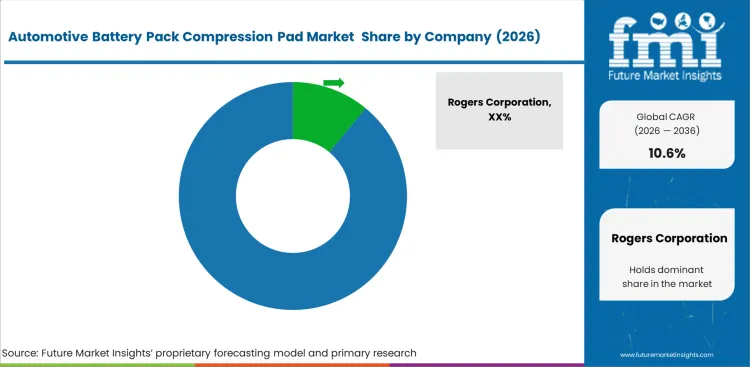
Material performance metrics define baseline entry, but localized conversion capabilities separate dominant suppliers from niche participants. 3M and Rogers Corporation secure footprint by maintaining global networks of precision die-cutting partners. Pack engineering directors prioritize suppliers capable of delivering ready-to-assemble geometries directly to the factory floor, minimizing material waste and handling steps. Suppliers lacking downstream converting relationships struggle to translate superior chemical formulations into commercial volume, as automakers refuse to manage raw foam rolls internally.
Incumbents defend their positions through proprietary libraries of long-term compression set data. Battery program managers demand 10-year aging simulations before qualifying any material for inclusion next to expensive hybrid silane terminated polymer adhesives. Zotefoams plc and Elkem ASA leverage established relationships to bypass initial screening phases, relying on historical performance metrics. Challengers entering this space fund expensive independent accelerated aging tests simply to initiate procurement conversations, creating a capital barrier to entry regardless of material cost advantages.
High-volume tier-1 integrators resist single-source chemical dependencies by forcing material standardization across distinct vehicle platforms. Supply teams specify performance bands rather than proprietary formulas, ensuring multiple vendors bid on specific high thermal conductivity gap fill requirements. Advancing past 2030, material value shifts toward integrated solutions where pads combine adhesives and thermal barriers into single deployable units, forcing chemical suppliers into strategic partnerships to survive.
Key Players in Automotive Battery Pack Compression Pad Market
- Rogers Corporation
- Saint-Gobain Tape Solutions
- 3M
- Zotefoams plc
- Elkem ASA
- Wacker Chemie AG
- ElringKlinger AG
Scope of the Report
| Metric | Value |
|---|---|
| Quantitative Units | USD 300 million to USD 820 million, at a CAGR of 10.6% |
| Market Definition | Compression pads act as engineered elastomeric buffers within electric vehicle battery packs, absorbing cell expansion during charge cycles while providing thermal insulation. |
| Segmentation | Material, Cell format, Function, Vehicle class, Pack integration point, Region |
| Regions Covered | North America, Latin America, Western Europe, Eastern Europe, Asia Pacific |
| Countries Covered | China, India, South Korea, Germany, United States, Japan, France |
| Key Companies Profiled | Rogers Corporation, Saint-Gobain Tape Solutions, 3M, Zotefoams plc, Elkem ASA, Wacker Chemie AG, ElringKlinger AG |
| Forecast Period | 2026 to 2036 |
| Approach | Global gigafactory output volumes and average cell-to-pack material ratios form baseline calculations. |
Source: Future Market Insights (FMI) analysis, based on proprietary forecasting model and primary research
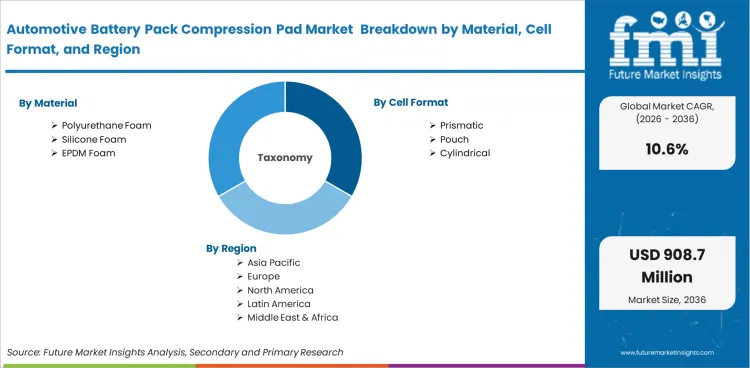
Automotive Battery Pack Compression Pad Market Analysis by Segments
Material:
- Polyurethane foam
- Silicone foam
- EPDM foam
- Hybrid laminates
Cell format:
- Prismatic
- Pouch
- Cylindrical
Function:
- Swelling control
- Thermal cushioning
- Vibration damping
- Gap compensation
Vehicle class:
- Passenger EVs
- Light commercial
- Buses
- Trucks
Pack integration point:
- Inter-cell pads
- Module pads
- Sidewall pads
- End plates
Region:
- North America
- Latin America
- Western Europe
- Eastern Europe
- Asia Pacific
Bibliography
- 3M. (2025). 2025 global impact report.
- Elkem. (2025, April 29). The Battery Show Europe 2025.
- International Energy Agency. (2025). Global EV outlook 2025: Electric vehicle batteries.
- Ministry of Road Transport and Highways, Government of India. (2025, December 12). Expansion of EV charging infrastructure.
- Saint-Gobain Tape Solutions. (2025, June 17). Thermal runaway protection solutions enhance EV safety.
This bibliography is provided for reader reference. The full FMI report contains the complete reference list with primary source documentation.
This Report Addresses
- Silicon-anode expansion mechanics driving elastomeric foam material upgrades across passenger EV platforms.
- Polyurethane curing infrastructure costs limiting mid-tier tier-1 pack assembler margins.
- Automated robotic placement speeds defining commercial viability for soft silicone formulations.
- Prismatic cell planar swelling requiring tight thickness tolerances in die-cut pad components.
- North American domestic content subsidies forcing supply chain realignment away from Asian compounders.
- Thermal runaway isolation mandates elevating inter-cell padding to primary safety firewall status.
- Hybrid laminate architectures integrating load-bearing resins directly into thermal compression buffers.
- European battery passport regulations necessitating scannable material data on individual pad release liners.
Frequently Asked Questions
How large is this sector projected to be?
Valuation is expected to cross USD 300 million in 2026 and reach USD 820 million by 2036, driven by silicon-anode chemistry.
What specific metric drives revenue expansion?
Total square meters of required foam scales linearly with global gigafactory output volumes and cell-to-pack integration density.
Why does polyurethane foam hold dominant share?
Pack integrators specify polyurethane to manage normal breathing expansion without incurring the steep purchasing costs of pure silicone.
What function dictates material selection?
Swelling control leads demand, as battery engineers prioritize compression set resistance to maintain constant face pressure on active materials.
Which cell format requires the most padding?
Prismatic cells demand extensive padding because rigid flat casings direct internal expansion forces strictly outward against adjacent units.
What hidden friction slows new formulation adoption?
Tooling engineers frequently reject superior soft formulations because highly compressible materials jam automated robotic placement effectors during module assembly.
How do structural module designs change material requirements?
Designers must calibrate pad firmness to act as load-bearing suspension components rather than pure thermal insulation against road vibrations.
Why does China expand at 11.9%?
Suppliers lock in massive standardized contracts with local converting partners to circumvent import tariffs on specialty polymers.
What distinguishes South Korea's material requirements?
Tier-1 designers pioneer customized multi-layer laminates to support advanced nickel-rich cathodes, establishing global specification standards for overseas assembly.
How do North American sourcing priorities differ?
Federal subsidies mandate localized battery component origins, forcing tier-1 integrators to break Asian supply contracts for regional foam producers.
What happens when materials fail compression tests?
Pads losing rebound pressure allow microscopic cell deformation, causing early capacity fade and exposing pack engineers to warranty liabilities.
Why are thermal properties critical during charging?
Fast-charging profiles generate severe localized temperature spikes. Pad formulations must survive these thermal loads without acting as heat bridges.
What battery cell module and pack swelling measurement systems data matters most?
Quality directors evaluate end-of-life pressure retention, rejecting formulations that drop below 80% original compressive force after simulated aging regimens.
How do rigid packaging films affect production?
Adding PET carrier films to soft pads enables automated robotic handling, avoiding line stoppages while creating secondary factory waste.
Why do incumbents maintain strong positions?
Battery program managers demand 10-year historical aging data before qualifying any high-voltage material, heavily favoring established chemical conglomerates.
What limits challenger entry?
Funding independent accelerated aging tests creates capital barriers, meaning superior chemical formulations require extensive third-party validation to gain traction.
How will integrated solutions change sourcing?
Material value shifts toward battery thermal pump couplings and products integrating structural adhesives and thermal barriers into deployable units.
Why do premium brands favor specific materials?
German engineering teams specify advanced hybrid laminates capable of absorbing both extreme heat and violent geometric expansion simultaneously.
What role does environmental humidity play?
Polyurethane formulations remain sensitive to ambient moisture. Improper storage alters compression curves, leading to unexpected end-of-line module rejection.
How does commercial vehicle adoption differ from passenger EVs?
Heavy truck manufacturers demand extreme-durability variants capable of million-mile lifecycles, requiring entirely different compression set resistance than typical commuters.
Why is thickness tolerance critical for prismatic pads?
Microscopic variations accumulate across large module assemblies, generating asymmetric stress vectors that physically tear laser-welded busbars during daily operation.
What advantage do converting partners provide?
Automakers refuse to process raw foam rolls, forcing chemical companies to partner with precision die-cutters for ready-to-assemble geometries.
Preview the report firsthand - request a free sample
Get SampleGet the brochure for pricing and purchase details.
Get PDFTable of Content
- Executive Summary
- Global Market Outlook
- Demand-side Trends
- Supply-side Trends
- Technology Roadmap Analysis
- Analysis and Recommendations
- Market Overview
- Market Coverage / Taxonomy
- Market Definition / Scope / Limitations
- Research Methodology
- Chapter Orientation
- Analytical Lens and Working Hypotheses
- Market Structure, Signals, and Trend Drivers
- Benchmarking and Cross-market Comparability
- Market Sizing, Forecasting, and Opportunity Mapping
- Research Design and Evidence Framework
- Desk Research Programme (Secondary Evidence)
- Company Annual and Sustainability Reports
- Peer-reviewed Journals and Academic Literature
- Corporate Websites, Product Literature, and Technical Notes
- Earnings Decks and Investor Briefings
- Statutory Filings and Regulatory Disclosures
- Technical White Papers and Standards Notes
- Trade Journals, Industry Magazines, and Analyst Briefs
- Conference Proceedings, Webinars, and Seminar Materials
- Government Statistics Portals and Public Data Releases
- Press Releases and Reputable Media Coverage
- Specialist Newsletters and Curated Briefings
- Sector Databases and Reference Repositories
- FMI Internal Proprietary Databases and Historical Market Datasets
- Subscription Datasets and Paid Sources
- Social Channels, Communities, and Digital Listening Inputs
- Additional Desk Sources
- Expert Input and Fieldwork (Primary Evidence)
- Primary Modes
- Qualitative Interviews and Expert Elicitation
- Quantitative Surveys and Structured Data Capture
- Blended Approach
- Why Primary Evidence is Used
- Field Techniques
- Interviews
- Surveys
- Focus Groups
- Observational and In-context Research
- Social and Community Interactions
- Stakeholder Universe Engaged
- C-suite Leaders
- Board Members
- Presidents and Vice Presidents
- R&D and Innovation Heads
- Technical Specialists
- Domain Subject-matter Experts
- Scientists
- Physicians and Other Healthcare Professionals
- Governance, Ethics, and Data Stewardship
- Research Ethics
- Data Integrity and Handling
- Primary Modes
- Tooling, Models, and Reference Databases
- Desk Research Programme (Secondary Evidence)
- Data Engineering and Model Build
- Data Acquisition and Ingestion
- Cleaning, Normalisation, and Verification
- Synthesis, Triangulation, and Analysis
- Quality Assurance and Audit Trail
- Market Background
- Market Dynamics
- Drivers
- Restraints
- Opportunity
- Trends
- Scenario Forecast
- Demand in Optimistic Scenario
- Demand in Likely Scenario
- Demand in Conservative Scenario
- Opportunity Map Analysis
- Product Life Cycle Analysis
- Supply Chain Analysis
- Investment Feasibility Matrix
- Value Chain Analysis
- PESTLE and Porter’s Analysis
- Regulatory Landscape
- Regional Parent Market Outlook
- Production and Consumption Statistics
- Import and Export Statistics
- Market Dynamics
- Global Market Analysis 2021 to 2025 and Forecast, 2026 to 2036
- Historical Market Size Value (USD Million) Analysis, 2021 to 2025
- Current and Future Market Size Value (USD Million) Projections, 2026 to 2036
- Y-o-Y Growth Trend Analysis
- Absolute $ Opportunity Analysis
- Global Market Pricing Analysis 2021 to 2025 and Forecast 2026 to 2036
- Global Market Analysis 2021 to 2025 and Forecast 2026 to 2036, By Material
- Introduction / Key Findings
- Historical Market Size Value (USD Million) Analysis By Material , 2021 to 2025
- Current and Future Market Size Value (USD Million) Analysis and Forecast By Material , 2026 to 2036
- Polyurethane Foam
- Silicone Foam
- EPDM Foam
- Polyurethane Foam
- Y-o-Y Growth Trend Analysis By Material , 2021 to 2025
- Absolute $ Opportunity Analysis By Material , 2026 to 2036
- Global Market Analysis 2021 to 2025 and Forecast 2026 to 2036, By Cell Format
- Introduction / Key Findings
- Historical Market Size Value (USD Million) Analysis By Cell Format, 2021 to 2025
- Current and Future Market Size Value (USD Million) Analysis and Forecast By Cell Format, 2026 to 2036
- Prismatic
- Pouch
- Cylindrical
- Prismatic
- Y-o-Y Growth Trend Analysis By Cell Format, 2021 to 2025
- Absolute $ Opportunity Analysis By Cell Format, 2026 to 2036
- Global Market Analysis 2021 to 2025 and Forecast 2026 to 2036, By Function
- Introduction / Key Findings
- Historical Market Size Value (USD Million) Analysis By Function, 2021 to 2025
- Current and Future Market Size Value (USD Million) Analysis and Forecast By Function, 2026 to 2036
- Swelling Control
- Thermal Cushioning
- Vibration Damping
- Swelling Control
- Y-o-Y Growth Trend Analysis By Function, 2021 to 2025
- Absolute $ Opportunity Analysis By Function, 2026 to 2036
- Global Market Analysis 2021 to 2025 and Forecast 2026 to 2036, By Vehicle Class
- Introduction / Key Findings
- Historical Market Size Value (USD Million) Analysis By Vehicle Class, 2021 to 2025
- Current and Future Market Size Value (USD Million) Analysis and Forecast By Vehicle Class, 2026 to 2036
- Passenger EVs
- Buses
- Trucks
- Passenger EVs
- Y-o-Y Growth Trend Analysis By Vehicle Class, 2021 to 2025
- Absolute $ Opportunity Analysis By Vehicle Class, 2026 to 2036
- Global Market Analysis 2021 to 2025 and Forecast 2026 to 2036, By Pack Integration Point
- Introduction / Key Findings
- Historical Market Size Value (USD Million) Analysis By Pack Integration Point, 2021 to 2025
- Current and Future Market Size Value (USD Million) Analysis and Forecast By Pack Integration Point, 2026 to 2036
- Inter-Cell Pads
- Module Pads
- Sidewall Pads
- Inter-Cell Pads
- Y-o-Y Growth Trend Analysis By Pack Integration Point, 2021 to 2025
- Absolute $ Opportunity Analysis By Pack Integration Point, 2026 to 2036
- Global Market Analysis 2021 to 2025 and Forecast 2026 to 2036, By Region
- Introduction
- Historical Market Size Value (USD Million) Analysis By Region, 2021 to 2025
- Current Market Size Value (USD Million) Analysis and Forecast By Region, 2026 to 2036
- North America
- Latin America
- Western Europe
- Eastern Europe
- East Asia
- South Asia and Pacific
- Middle East & Africa
- Market Attractiveness Analysis By Region
- North America Market Analysis 2021 to 2025 and Forecast 2026 to 2036, By Country
- Historical Market Size Value (USD Million) Trend Analysis By Market Taxonomy, 2021 to 2025
- Market Size Value (USD Million) Forecast By Market Taxonomy, 2026 to 2036
- By Country
- USA
- Canada
- Mexico
- By Material
- By Cell Format
- By Function
- By Vehicle Class
- By Pack Integration Point
- By Country
- Market Attractiveness Analysis
- By Country
- By Material
- By Cell Format
- By Function
- By Vehicle Class
- By Pack Integration Point
- Key Takeaways
- Latin America Market Analysis 2021 to 2025 and Forecast 2026 to 2036, By Country
- Historical Market Size Value (USD Million) Trend Analysis By Market Taxonomy, 2021 to 2025
- Market Size Value (USD Million) Forecast By Market Taxonomy, 2026 to 2036
- By Country
- Brazil
- Chile
- Rest of Latin America
- By Material
- By Cell Format
- By Function
- By Vehicle Class
- By Pack Integration Point
- By Country
- Market Attractiveness Analysis
- By Country
- By Material
- By Cell Format
- By Function
- By Vehicle Class
- By Pack Integration Point
- Key Takeaways
- Western Europe Market Analysis 2021 to 2025 and Forecast 2026 to 2036, By Country
- Historical Market Size Value (USD Million) Trend Analysis By Market Taxonomy, 2021 to 2025
- Market Size Value (USD Million) Forecast By Market Taxonomy, 2026 to 2036
- By Country
- Germany
- UK
- Italy
- Spain
- France
- Nordic
- BENELUX
- Rest of Western Europe
- By Material
- By Cell Format
- By Function
- By Vehicle Class
- By Pack Integration Point
- By Country
- Market Attractiveness Analysis
- By Country
- By Material
- By Cell Format
- By Function
- By Vehicle Class
- By Pack Integration Point
- Key Takeaways
- Eastern Europe Market Analysis 2021 to 2025 and Forecast 2026 to 2036, By Country
- Historical Market Size Value (USD Million) Trend Analysis By Market Taxonomy, 2021 to 2025
- Market Size Value (USD Million) Forecast By Market Taxonomy, 2026 to 2036
- By Country
- Russia
- Poland
- Hungary
- Balkan & Baltic
- Rest of Eastern Europe
- By Material
- By Cell Format
- By Function
- By Vehicle Class
- By Pack Integration Point
- By Country
- Market Attractiveness Analysis
- By Country
- By Material
- By Cell Format
- By Function
- By Vehicle Class
- By Pack Integration Point
- Key Takeaways
- East Asia Market Analysis 2021 to 2025 and Forecast 2026 to 2036, By Country
- Historical Market Size Value (USD Million) Trend Analysis By Market Taxonomy, 2021 to 2025
- Market Size Value (USD Million) Forecast By Market Taxonomy, 2026 to 2036
- By Country
- China
- Japan
- South Korea
- By Material
- By Cell Format
- By Function
- By Vehicle Class
- By Pack Integration Point
- By Country
- Market Attractiveness Analysis
- By Country
- By Material
- By Cell Format
- By Function
- By Vehicle Class
- By Pack Integration Point
- Key Takeaways
- South Asia and Pacific Market Analysis 2021 to 2025 and Forecast 2026 to 2036, By Country
- Historical Market Size Value (USD Million) Trend Analysis By Market Taxonomy, 2021 to 2025
- Market Size Value (USD Million) Forecast By Market Taxonomy, 2026 to 2036
- By Country
- India
- ASEAN
- Australia & New Zealand
- Rest of South Asia and Pacific
- By Material
- By Cell Format
- By Function
- By Vehicle Class
- By Pack Integration Point
- By Country
- Market Attractiveness Analysis
- By Country
- By Material
- By Cell Format
- By Function
- By Vehicle Class
- By Pack Integration Point
- Key Takeaways
- Middle East & Africa Market Analysis 2021 to 2025 and Forecast 2026 to 2036, By Country
- Historical Market Size Value (USD Million) Trend Analysis By Market Taxonomy, 2021 to 2025
- Market Size Value (USD Million) Forecast By Market Taxonomy, 2026 to 2036
- By Country
- Kingdom of Saudi Arabia
- Other GCC Countries
- Turkiye
- South Africa
- Other African Union
- Rest of Middle East & Africa
- By Material
- By Cell Format
- By Function
- By Vehicle Class
- By Pack Integration Point
- By Country
- Market Attractiveness Analysis
- By Country
- By Material
- By Cell Format
- By Function
- By Vehicle Class
- By Pack Integration Point
- Key Takeaways
- Key Countries Market Analysis
- USA
- Pricing Analysis
- Market Share Analysis, 2025
- By Material
- By Cell Format
- By Function
- By Vehicle Class
- By Pack Integration Point
- Canada
- Pricing Analysis
- Market Share Analysis, 2025
- By Material
- By Cell Format
- By Function
- By Vehicle Class
- By Pack Integration Point
- Mexico
- Pricing Analysis
- Market Share Analysis, 2025
- By Material
- By Cell Format
- By Function
- By Vehicle Class
- By Pack Integration Point
- Brazil
- Pricing Analysis
- Market Share Analysis, 2025
- By Material
- By Cell Format
- By Function
- By Vehicle Class
- By Pack Integration Point
- Chile
- Pricing Analysis
- Market Share Analysis, 2025
- By Material
- By Cell Format
- By Function
- By Vehicle Class
- By Pack Integration Point
- Germany
- Pricing Analysis
- Market Share Analysis, 2025
- By Material
- By Cell Format
- By Function
- By Vehicle Class
- By Pack Integration Point
- UK
- Pricing Analysis
- Market Share Analysis, 2025
- By Material
- By Cell Format
- By Function
- By Vehicle Class
- By Pack Integration Point
- Italy
- Pricing Analysis
- Market Share Analysis, 2025
- By Material
- By Cell Format
- By Function
- By Vehicle Class
- By Pack Integration Point
- Spain
- Pricing Analysis
- Market Share Analysis, 2025
- By Material
- By Cell Format
- By Function
- By Vehicle Class
- By Pack Integration Point
- France
- Pricing Analysis
- Market Share Analysis, 2025
- By Material
- By Cell Format
- By Function
- By Vehicle Class
- By Pack Integration Point
- India
- Pricing Analysis
- Market Share Analysis, 2025
- By Material
- By Cell Format
- By Function
- By Vehicle Class
- By Pack Integration Point
- ASEAN
- Pricing Analysis
- Market Share Analysis, 2025
- By Material
- By Cell Format
- By Function
- By Vehicle Class
- By Pack Integration Point
- Australia & New Zealand
- Pricing Analysis
- Market Share Analysis, 2025
- By Material
- By Cell Format
- By Function
- By Vehicle Class
- By Pack Integration Point
- China
- Pricing Analysis
- Market Share Analysis, 2025
- By Material
- By Cell Format
- By Function
- By Vehicle Class
- By Pack Integration Point
- Japan
- Pricing Analysis
- Market Share Analysis, 2025
- By Material
- By Cell Format
- By Function
- By Vehicle Class
- By Pack Integration Point
- South Korea
- Pricing Analysis
- Market Share Analysis, 2025
- By Material
- By Cell Format
- By Function
- By Vehicle Class
- By Pack Integration Point
- Russia
- Pricing Analysis
- Market Share Analysis, 2025
- By Material
- By Cell Format
- By Function
- By Vehicle Class
- By Pack Integration Point
- Poland
- Pricing Analysis
- Market Share Analysis, 2025
- By Material
- By Cell Format
- By Function
- By Vehicle Class
- By Pack Integration Point
- Hungary
- Pricing Analysis
- Market Share Analysis, 2025
- By Material
- By Cell Format
- By Function
- By Vehicle Class
- By Pack Integration Point
- Kingdom of Saudi Arabia
- Pricing Analysis
- Market Share Analysis, 2025
- By Material
- By Cell Format
- By Function
- By Vehicle Class
- By Pack Integration Point
- Turkiye
- Pricing Analysis
- Market Share Analysis, 2025
- By Material
- By Cell Format
- By Function
- By Vehicle Class
- By Pack Integration Point
- South Africa
- Pricing Analysis
- Market Share Analysis, 2025
- By Material
- By Cell Format
- By Function
- By Vehicle Class
- By Pack Integration Point
- USA
- Market Structure Analysis
- Competition Dashboard
- Competition Benchmarking
- Market Share Analysis of Top Players
- By Regional
- By Material
- By Cell Format
- By Function
- By Vehicle Class
- By Pack Integration Point
- Competition Analysis
- Competition Deep Dive
- Rogers Corporation
- Overview
- Product Portfolio
- Profitability by Market Segments (Product/Age /Sales Channel/Region)
- Sales Footprint
- Strategy Overview
- Marketing Strategy
- Product Strategy
- Channel Strategy
- Saint-Gobain Tape Solutions
- 3M
- Zotefoams plc
- Elkem ASA
- Wacker Chemie AG
- Rogers Corporation
- Competition Deep Dive
- Assumptions & Acronyms Used


