

- Industry Size (2026)
- USD 282.4 Mn
- Forecast (2036)
- USD 496.2 Mn
- CAGR (2026 to 2036)
- 5.8%
Automotive Brake Pad Wear Sensor Harness Market Size, Market Forecast and Outlook By FMI
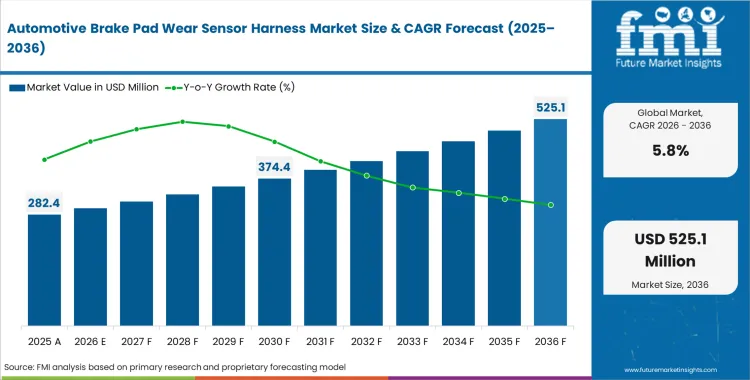
The automotive brake pad wear sensor harness market crossed a valuation of USD 266.9 million in 2025. Revenue is projected to reach USD 282.4 million in 2026 and grow to USD 496.2 million by 2036, registering a CAGR of 5.8% during the forecast period. Growth is supported by the increasing integration of friction-condition monitoring systems across mainstream vehicle platforms rather than being limited to premium models.
Summary of Automotive Brake Pad Wear Sensor Harness Market
- The market is forecast to reach USD 496.2 million by 2036.
- The market is expected to grow at a CAGR of 5.8% from 2026 to 2036.
- The market was estimated at USD 266.9 million in 2025.
- The forecast period represents an incremental opportunity of USD 213.9 million.
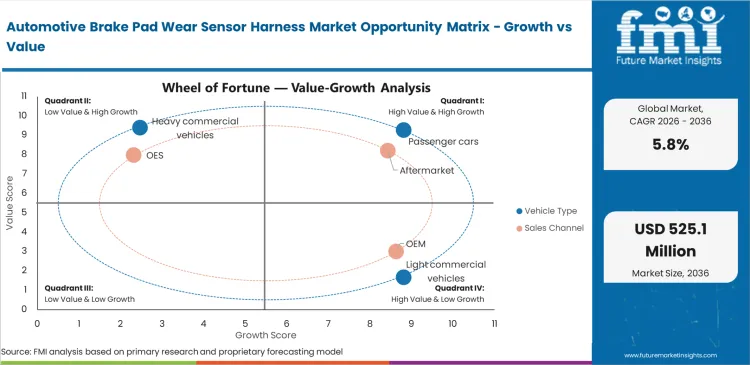
- Passenger cars lead the vehicle type segment with 69.0% share, driven by widespread adoption of disc brakes and wear sensors.
- Aftermarket dominates the sales channel with 58.0% share, supported by frequent replacement cycles.
- Single-stage systems account for 62.0% share in circuit type, reflecting simpler and widely compatible designs.
- Front axle leads the segment with 57.0% share, as front brake pads experience higher wear rates.
- Copper core dominates the conductor material segment with 74.0% share, due to reliability and thermal performance.
- Key companies in the market include Bosch, Brembo, Delphi, TRW, Apec, and febi.
Brake service planning is becoming less predictable because pad wear now changes more noticeably across driving styles, vehicle loads, and braking setups. Fixed inspection intervals no longer give manufacturers and service networks enough accuracy, especially in electrified vehicles where regenerative braking reduces friction brake use unevenly. This shift is increasing demand for harnesses that can carry stable signals despite heat, moisture, corrosion, and constant vibration near the wheel end. Basic circuit function is no longer enough on its own, since connector quality, insulation strength, and sealing reliability all influence how accurately brake pad condition can be tracked over time. Growing use of real-time wear data in maintenance planning is making dependable signal transmission more valuable across connected vehicle and fleet service systems.
Brake monitoring is also moving beyond simple warning functions and toward clearer diagnostic visibility. Under that change, a harness once seen as a routine electrical link is becoming more important because cleaner wear-status data helps support better maintenance timing and stronger system oversight. Importance rises further in vehicle platforms where electronic safety content continues to widen and brake health information is expected to connect with broader onboard diagnostic systems. This leaves the automotive brake pad wear sensor harness in a more important position within brake system design, with its role extending well beyond a basic replacement component.
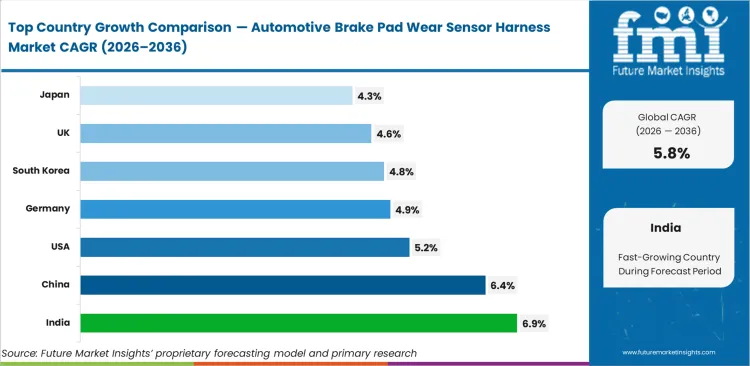
India is projected to see automotive brake pad wear sensor harness demand expand at a CAGR of 6.9% during 2026-2036, supported by rising electronic safety content across a wider domestic vehicle base. China is expected to record a CAGR of 6.4% over the forecast period as electronically managed braking systems become more common in new energy vehicles. In the United States, demand is likely to grow at a CAGR of 5.2% during 2026-2036, helped by replacement needs across a large installed vehicle parc. Germany is estimated to post a CAGR of 4.9% through 2036, reflecting stronger brake-warning integration in premium vehicle platforms. South Korea is anticipated to expand at a CAGR of 4.8% over the same period as platform upgrades continue to raise electronic braking content. In the United Kingdom, demand is projected to increase at a CAGR of 4.6% during 2026-2036, supported by more standardized electronic wear reporting across service systems. Japan is expected to see a CAGR of 4.3% over the forecast period, with demand shaped by a mature vehicle base and slower replacement movement.
Segmental Analysis
Automotive Brake Pad Wear Sensor Harness Market Analysis by Vehicle Type
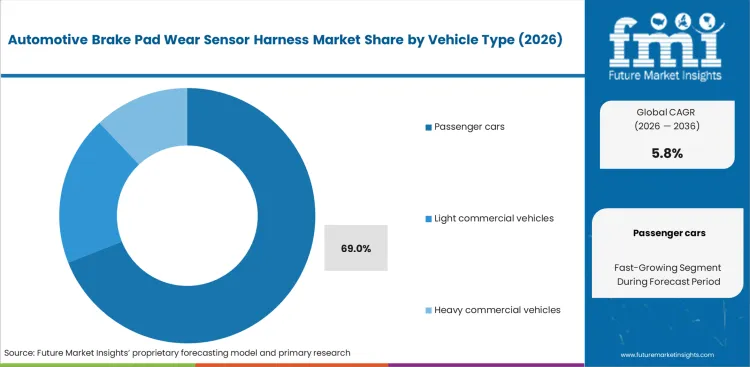
Passenger cars are projected to account for 69.0% share in 2026. High-volume vehicle programs depend on tight component standardization to control cost and simplify sourcing. Platform commonality pushes suppliers to develop routing harnesses that can serve multiple chassis layouts with limited redesign. Simplified connector angles and wire lengths also make service replacement easier across broad dealer and workshop networks. Integration with the global automotive wiring harness architecture remains a major screening factor during supplier selection. Segment volume is substantial, but pricing pressure remains and limits margin expansion compared with more specialized commercial platforms. Smaller suppliers that fail to reach cost efficiency quickly often lose access to OE programs.
- Initial fitment: Brake layouts define resistance targets early, and sensor positioning is approved only after thermal shielding requirements are validated.
- Qualification testing: Harness designs must pass severe salt-spray exposure and repeated temperature cycling without connector seal failure.
- Platform expansion: Once validated on a lead architecture, sensor harness programs often carry forward into additional vehicle lines.
Automotive Brake Pad Wear Sensor Harness Market Analysis by Sales Channel
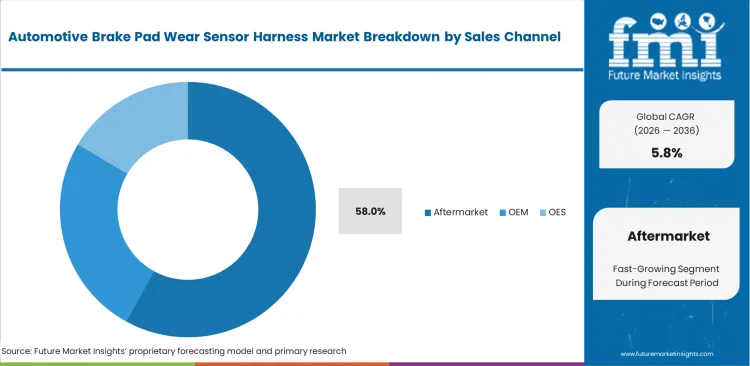
Replacement cycles are expected to shape channel demand more strongly than original factory fitment in this market. Automotive brake pad wear sensor harness sales through the aftermarket channel are estimated to account for 58.0% share in 2026, supported by the large global vehicle parc moving deeper into recurring brake service intervals. Independent workshops often replace sensor harnesses alongside friction components, which is sustaining repeat demand across aging vehicle fleets. Channel performance is influenced further by distribution depth, as repair outlets prefer immediate access to a broad range of application-specific parts. Regional availability of automotive sensors directly affects service turnaround time and installer choice. Unit movement is rising further in some vehicle groups because harness removal during replacement can cause damage even when the original wear event is limited. Suppliers that do not align sensors with broader brake repair kit offerings may lose visibility in a channel that increasingly favors complete service solutions.
- Purchase leverage: Large aftermarket distributors are estimated to hold cost advantages through high-volume sourcing across wide application coverage.
- Hidden failure costs: Poor connector alignment can delay installation and weaken supplier acceptance across service networks.
- Total lifecycle reality: Vehicles entering multiple brake service cycles are expected to generate repeated sensor harness demand well beyond initial fitment.
Automotive Brake Pad Wear Sensor Harness Market Analysis by Circuit Type
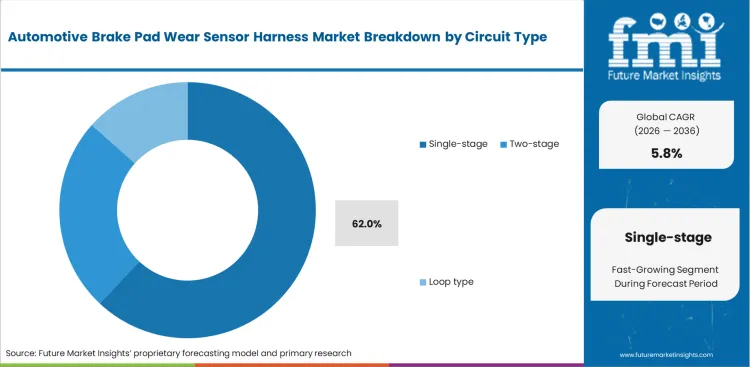
Circuit architecture is generally selected based on cost, signal simplicity, and control-module requirements. A basic grounded loop remains a practical choice where vehicle electronics do not require progressive wear feedback. Single-stage variants are estimated to account for 62.0% share in 2026 because they deliver a straightforward warning function without the added complexity of advanced signal interpretation. Platform selection is influenced further by the broader automotive brake system design and its monitoring requirements. Basic conductive-wire layouts continue to hold a cost advantage over resistance-based and continuous monitoring concepts. Their main limitation is that drivers receive an alert only when friction material is already close to depletion, which leaves limited room for predictive service planning. This trade-off is becoming more visible as maintenance visibility gains importance across newer vehicle programs.
- Thermal degradation: Continuous rotor heat can weaken insulation and trigger false warnings even when usable friction material remains.
- Residual corrosion risk: Moisture entry through damaged wire sheathing can alter conductivity and create intermittent warning faults.
- Full benefit capture: Fleet operators still depend on manual inspections when single-stage layouts do not provide early wear progression visibility.
Automotive Brake Pad Wear Sensor Harness Market Analysis by Axle Location
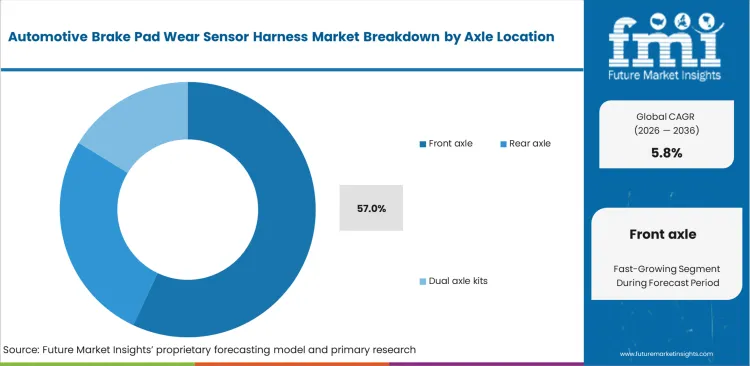
Brake load distribution remains the main reason sensor installation stays concentrated at the front axle. Pad condition at the steering axle directly influences vehicle control, which keeps front-end monitoring central to brake system design. Routing complexity rises further around steering knuckles, where the wire harness must withstand articulation, vibration, and abrasion without losing signal continuity. Front axle applications are estimated to account for 57.0% share in 2026 because front-biased braking continues to generate faster friction wear across most vehicle architectures. This position also carries heavier validation requirements for flex life and packaging durability. Blended braking in electric vehicles is beginning to shift part of the wear pattern toward the rear axle, yet front axle monitoring continues to represent the main volume base. Suppliers that remain aligned only with conventional layouts may face weaker positioning as axle-level sensing requirements become more distributed.
- Production scaling: Standardized front-axle sensor designs are expected to support higher-volume output and better manufacturing efficiency.
- Routing constraints: Tight packaging around steering hardware creates careful trade-offs between protective sheathing and overall package size.
- Future supply landscape: Electrified platforms are increasing demand for more coordinated multi-axle sensor monitoring solutions.
Automotive Brake Pad Wear Sensor Harness Market Analysis by Conductor Material
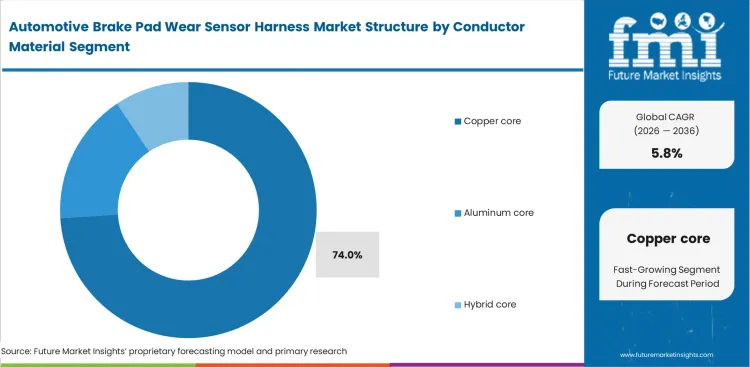
Copper-core layouts remain well suited to sensor harnesses that move continuously with suspension travel and steering input because their mechanical durability supports stable performance under repeated stress. Selection must also match the thermal and operating demands associated with automotive brake friction products. Copper continues to hold preference despite raw material cost pressure, as lower-cost substitutes can raise failure risk at terminal joints and under cyclic loading. Copper core variants are estimated to account for 74.0% share in 2026. Unit weight remains limited, yet high production volumes are still encouraging some manufacturers to assess lighter conductor options for future vehicle programs. Even with that evaluation underway, copper remains the preferred benchmark where field reliability carries more weight than modest material savings.
- Extreme temperature limits: High brake-area temperatures can accelerate oxidation, which increases the need for heat-resistant surface treatment evaluation.
- Edge condition gaps: Alkaline wheel-cleaning chemicals may raise corrosion risk where terminal sealing is weak or inconsistent.
- Qualification thresholds: Approved suppliers are expected to demonstrate stable resistance performance across repeated thermal shock and environmental chamber testing.
Automotive Brake Pad Wear Sensor Harness Market Drivers, Restraints, and Opportunities
Rising focus on brake-related particulate output is increasing the need for more active friction monitoring across modern vehicle platforms. Estimated pad life is becoming less sufficient where manufacturers need clearer visibility into actual wear conditions, braking efficiency, and service timing. Mechanical wear indicators provide only limited feedback, which is increasing the relevance of electronic sensing in systems that require cleaner condition data. Value is rising further in vehicles where brake health information is expected to support broader diagnostic and safety functions. This shift is strengthening demand for brake pad wear sensor harnesses as brake monitoring moves toward more data-based control.
Harness installation remains constrained by the compact packaging of modern multi-link suspension systems. Limited clearance around suspension components leaves electrical routing exposed to debris, ice buildup, and sustained brake heat, which increases durability risk over time. Mid-route wire damage can extend service effort because fault tracing becomes harder once access is restricted by wheel-end geometry. Braided or reinforced shielding can improve protection, yet extra bulk often creates fitment pressure in tightly packaged chassis layouts. Manufacturers must balance wire protection, movement flexibility, and package size within the same layout. Such trade-offs continue to shape harness design limits and remain a practical restraint across this market.
Opportunities in the Automotive Brake Pad Wear Sensor Harness Market
- Continuous resistance loop integration: Brake pad systems are moving toward calibrated resistance paths that can provide clearer wear progression data rather than a final-stage alert alone.
- Wireless wheel-end nodes: Interest is increasing in cable-free sensing concepts that may reduce routing complexity around EPB actuator and caliper module wiring.
- Fleet telematics connectivity: Wear-status data is becoming more useful when linked with fleet maintenance systems that help support more proactive service scheduling.
Regional Analysis
Based on regional analysis, automotive brake pad wear sensor harness market is segmented into North America, Europe, Asia Pacific, and other key regions across 40 plus countries.
.webp "Top Country Growth Comparison Automotive Brake Pad Wear Sensor Harness Market Cagr (2026 2036)")
| Country | CAGR (2026 to 2036) |
|---|---|
| India | 6.9% |
| China | 6.4% |
| United States | 5.2% |
| Germany | 4.9% |
| South Korea | 4.8% |
| United Kingdom | 4.6% |
| Japan | 4.3% |
Source: Future Market Insights (FMI) analysis, based on proprietary forecasting model and primary research
Asia Pacific Automotive Brake Pad Wear Sensor Harness Market Analysis
Automakers across Asian assembly bases are moving from basic mechanical wear tabs toward electronic monitoring as digital dashboard diagnostics become more common in mainstream vehicle programs. Regional brake system volume remains concentrated in standard cast-iron architectures, since automotive carbon ceramic brakes continue to see limited adoption across most high-volume platforms. Fleet operators are adding to this demand base because electronic wear reporting supports more structured maintenance planning across large vehicle networks. Suppliers with localized harness extrusion and connector molding capacity are better placed to serve this market, as regional production improves cost competitiveness against imported components.
- India: Domestic vehicle production increasingly integrates electronic safety features to align with tightening local regulations. Demand for automotive brake pad wear sensor harnesses in India is anticipated to rise at a CAGR of 6.9% through 2036. Automakers require ultra-low-cost sensor variants to maintain vehicle affordability. Suppliers securing early original equipment contracts effectively block competitors out of future platform refreshes.
- China: Electric vehicle platform engineers require precise friction data to optimize blended braking algorithms. China is set to record a CAGR of 6.4% in automotive brake pad wear sensor harnesses during the assessment period. Rapid expansion in electronic braking architectures across new energy vehicles accelerates sensor fitment globally. Domestic manufacturers actively capture market share from established global suppliers using aggressive pricing strategies.
- South Korea: Steady platform modernization keeps sensor integration rates high across domestic production lines. Automakers prioritize defect-free delivery records over marginal cost savings when selecting wiring suppliers. South Korea is likely to post a CAGR of 4.8% in automotive brake pad wear sensor harnesses by 2036. Manufacturers adopting advanced continuous-loop designs immediately gain a competitive technical advantage in critical export markets.
- Japan: Automotive brake pad wear sensor harness sales in Japan are poised to grow at a CAGR of 4.3% during the assessment period. Mature domestic vehicle parc and conservative replacement cycles shape a highly stable demand environment. Quality engineers insist on extensive field validation before approving new supplier materials. High engineering focus on zero-defect manufacturing supersedes pure volume growth in this geography.
FMI's report includes detailed assessments of emerging Southeast Asian assembly hubs. Component localization mandates in these developing markets force global wiring manufacturers to establish regional joint ventures.
North America Automotive Brake Pad Wear Sensor Harness Market Analysis
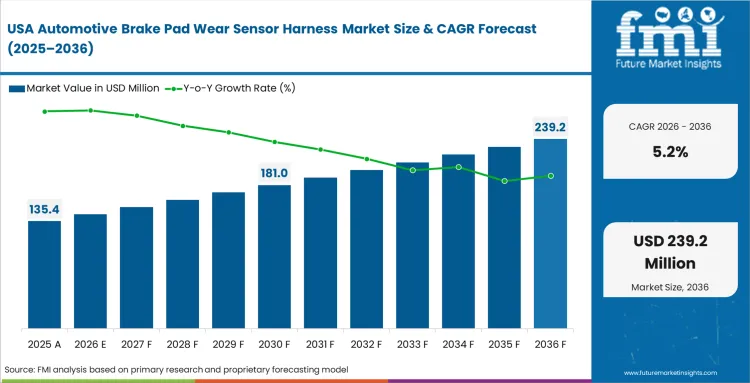
Replacement fleet requirements are increasing demand for reliable aftermarket sensor solutions that can withstand harsh winter road treatment exposure. Maintenance networks continue to consume high volumes of replacement harnesses during routine brake pad service, which keeps aftermarket movement steady across aging vehicle fleets. Pricing power often concentrates with large automotive parts distributors because bundled sourcing across multiple brake and service categories strengthens their negotiating position. Demand is more specialized in heavy-duty pickup applications, where brake system complexity can increase the need for dual-axle sensor kit configurations. Interstate delivery fleets are adding to this requirement because continuous wear reporting helps support compliance-focused maintenance planning and reduces the risk of service disruption during highway inspection cycles.
- United States: Aftermarket channels lead to steady consumption of direct-fit replacement sensors across diverse vehicle platforms. Automotive brake pad wear sensor harness sales in the United States are expected to grow at a CAGR of 5.2% during the study period. Independent garage networks penalize brands with poor connector fitment. Distributors securing exclusive supply agreements with premium brake pad manufacturers capture dominant aftermarket positions.
FMI's report includes comprehensive analysis of Canadian and Mexican manufacturing environments. Cross-border supply chains dictate where harness assemblies are manually pinned and tested before final vehicle integration.
Europe Automotive Brake Pad Wear Sensor Harness Market Analysis
Premium vehicle architectures specify two-stage warning logic, defining strict component expectations across European production lines. Regulatory pressure surrounding particulate emissions forces engineers to track friction degradation actively. Independent service chains rapidly standardize electronic wear reporting to maintain parity with franchised dealer networks. FMI observes that automotive brake booster and master cylinder performance maps increasingly rely on sensor data to verify mechanical braking capability. High-speed Autobahn driving scenarios demand absolute sensor reliability, pushing suppliers toward premium high-temperature insulation polymers.
- Germany: Premium German automakers specify complex routing harnesses capable of surviving extreme Autobahn braking heat. Chassis engineers reject standard wiring in favor of advanced fluoropolymers. Demand across Germany is anticipated to see automotive brake pad wear sensor harnesses grow at a CAGR of 4.9% over the forecast period. Manufacturers successfully validating high-temperature sensor assemblies gain immediate access to global luxury contracts.
- United Kingdom: Service networks standardize electronic wear reporting to streamline mandatory annual safety inspections. Automotive brake pad wear sensor harness adoption in the United Kingdom is expected to move ahead at a CAGR of 4.6% through 2036. Garage mechanics demand bundled sensor-and-pad kits to accelerate repair bay turnover. Transitioning toward electric vehicle fleets forces mechanics to relearn wear patterns altered by regenerative braking systems.
FMI's report includes extensive coverage of Eastern European component manufacturing hubs. Wiring harness assembly remains highly dependent on manual labor availability within these critical supply corridors.
Competitive Aligners for Market Players
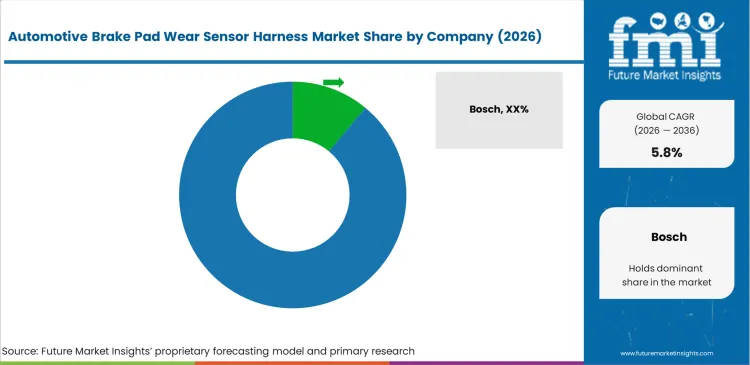
Strict qualification standards in braking components keep supplier replacement difficult once a design clears production approval. Friction material manufacturers seldom change a sensor harness source after wire gauge, connector sealing, and durability performance pass homologation. Established suppliers hold an advantage because brake sensor harness programs are often aligned with wider wheel-end component supply. Smaller participants face a tighter entry window, since matching proven thermal endurance is expected before any cost benefit gains attention. Market access stays limited unless performance validation is already in place.
Broad connector compatibility and fitment coverage across existing vehicle platforms continue to support incumbent positioning. Building similar tooling depth demands meaningful capital, which slows how quickly smaller brake pad wear sensor harness suppliers can widen aftermarket reach. Competitive strength improves further when probe geometry, retention features, and fitment layouts already match established vehicle architectures. New participants are more likely to gain ground by focusing on a narrower group of high-volume platforms instead of chasing full catalog breadth too early. Early expansion remains selective because platform-specific credibility matters more than broad ambition.
Aftermarket demand still leaves room for secondary sourcing on high-volume part numbers, especially where distributors want better supply balance. Fit consistency, wire durability, and pricing discipline remain central to supplier selection across repeat service cycles. Pressure is rising from brake pad formats that embed sensing functions more directly into the friction material itself. As integration shifts in that direction, demand for external wire harness suppliers is likely to become more selective unless product design evolves with changing sensor architecture. Competitive relevance will increasingly depend on fitment adaptability rather than catalog size alone.
Key Players in Automotive Brake Pad Wear Sensor Harness Market
- Bosch
- Brembo
- Delphi
- TRW
- Apec
- Febi
Scope of the Report
| Metric | Value |
|---|---|
| Quantitative Units | USD 282.4 million to USD 496.2 million, at a CAGR of 5.8% |
| Market Definition | Automotive Brake Pad Wear Sensor Harness represents electrical assemblies designed to initiate diagnostic alerts when brake friction material reaches minimum safe operating thickness. Components include specialized high-temperature wiring, encapsulated probe heads, and weatherproof connectors linking wheel-end environments to central control modules. |
| Segmentation | Vehicle Type, Sales Channel, Circuit Type, Axle Location, Conductor Material, and Region |
| Regions Covered | North America, Latin America, Europe, Asia Pacific, Middle East and Africa |
| Countries Covered | United States, Canada, Brazil, Mexico, Germany, United Kingdom, France, Spain, Italy, China, Japan, South Korea, India, GCC Countries, South Africa |
| Key Companies Profiled | Bosch, Brembo, Delphi, TRW, Apec, febi |
| Forecast Period | 2026 to 2036 |
| Approach | Global vehicle production volumes cross-referenced with regional electronic braking system fitment rates and aftermarket replacement cycles. |
Source: Future Market Insights (FMI) analysis, based on proprietary forecasting model and primary research
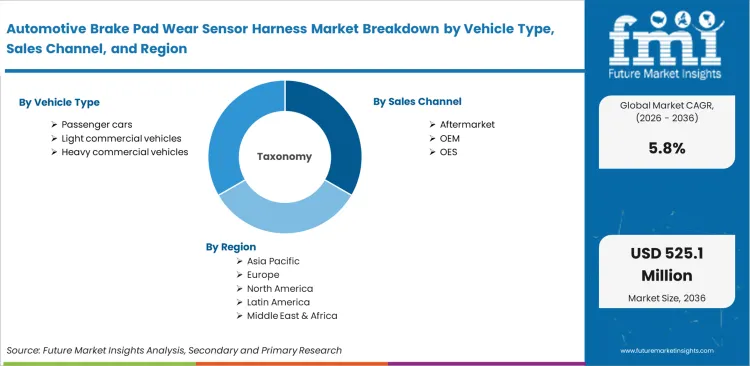
Automotive Brake Pad Wear Sensor Harness Market Analysis by Segments
By Vehicle Type:
- Passenger cars
- Light commercial vehicles
- Heavy commercial vehicles
By Sales Channel:
- OEM
- Aftermarket
- OES
By Circuit Type:
- Single-stage
- Two-stage
- Loop type
By Axle Location:
- Front axle
- Rear axle
- Dual axle kits
By Conductor Material:
- Copper core
- Aluminum core
- Hybrid core
Region:
- North America
- United States
- Canada
- Europe
- Germany
- United Kingdom
- France
- Italy
- Spain
- Asia Pacific
- China
- Japan
- South Korea
- Taiwan
- Singapore
- Latin America
- Brazil
- Mexico
- Argentina
- Middle East & Africa
- GCC Countries
- South Africa
Bibliography
- Iqbal, S., Bhambri, M., & Iahase, R. (2024). Brake pad life monitoring system using machine learning. SAE Technical Paper Series.
- Jensen, K. M., Santos, I. F., & Corstens, H. J. P. (2024). Estimation of brake pad wear and remaining useful life from fused sensor system, statistical data processing, and passenger car longitudinal dynamics. Wear, 538–539, 205220.
- Jensen, K. M., & Santos, I. F. (2025). Estimation of passenger car brake pad temperatures and wear from on-road data and lumped multi-physical models. Wear, 578–579, 206138.
- Remaidi, M., Derraz, M., Ennawaoui, A., El Hmamsy, Y., Mastouri, H., Ennawaoui, C., & Hajjaji, A. (2025). Innovative autonomous lead-free hybrid piezo-pyroelectric sensor for real-time wear assessment of disc brake pads. Results in Engineering, 26, 104617.
- Xia, K., Zhu, Q., Yuan, Q., & Wang, J. (2025). Prediction of automotive wire harness aging based on CNN-biLSTM-attention. Sensors, 25(9), 2910.
- Voloacă, Ş., Badea-Romero, A., Badea-Romero, F., & Toma, M. F. (2025). Motor vehicle brake pad wear, A review. Vehicles, 7(2), 52.
This bibliography is provided for reader reference. The full FMI report contains the complete reference list with primary source documentation.
This Report Addresses
- Component volume variations across OEM, OES, and independent aftermarket channels.
- Specific transition timelines from single stage to continuous monitoring resistance loops.
- High-temperature polymer sourcing constraints impacting global harness manufacturers.
- Differences in sensor fitment between internal combustion and electric vehicle platforms.
- Regional adoption rates driven by domestic safety regulations versus export requirements.
- Raw material shifts from pure copper cores toward lightweight hybrid alloy conductors.
- Axle-specific routing challenges dictated by advanced multi-link suspension geometries.
- Hidden installation labor costs shaping aftermarket distributor sourcing strategies.
Frequently Asked Questions
What is the projected size of the industry in 2026?
Demand is anticipated to reach USD 282.4 million in 2026. This baseline reflects massive aftermarket consumption alongside increasing factory fitment of electronic diagnostics across global passenger car platforms.
What is the forecasted valuation by 2036?
Revenue is set to advance to USD 496.2 million by 2036. Strict emission monitoring requirements compel automakers to transition from passive mechanical scrapers to active electronic friction measurement systems.
What is the projected CAGR during the forecast period?
Sales are poised to expand at a 5.8% CAGR between 2026 and 2036. Fleet maintenance officials actively seek reliable diagnostic data to optimize vehicle uptime, directly accelerating sensor adoption.
What is a brake pad wear sensor harness?
It is an electrical assembly that signals the vehicle dashboard when brake pads thin down to a critical limit. It utilizes conductive loops embedded directly within the friction material to provide real-time wear updates.
How does a brake pad wear sensor harness work?
The sensor functions by breaking or completing an electrical circuit as the brake pad degrades against the rotor. This disruption activates a warning light, alerting the driver that friction material requires replacement.
When should a brake wear sensor harness be replaced?
Replacement is mandatory during every brake pad service interval because sensors degrade physically alongside the friction material. Reusing an old sensor severely risks circuit failure and disables dashboard warning functions.
Is the market mostly OEM or aftermarket?
The Aftermarket channel holds the majority volume because a single vehicle consumes multiple sets of brake pads throughout its lifespan. Independent garages create massive recurring demand for replacement wire harnesses.
What is the difference in a brake pad wear sensor harness vs full sensor assembly?
The harness refers strictly to the electrical wiring, connector seals, and conductive loop. A full sensor assembly often includes specialized mounting brackets or clips permanently attached to the pad backing plate.
How does a mechanical wear indicator vs electronic wear sensor compare?
Mechanical indicators rely on an audible metal scraping sound to warn drivers of low pad thickness. Electronic sensors provide precise digital dashboard alerts, enabling predictive maintenance scheduling and active safety system integration.
What factors determine brake pad wear sensor replacement cost?
Service centers calculate costs based on parts availability, specific vehicle architecture, and routing complexity. Premium vehicles requiring dual-axle sensor kits or complex connector resets face significantly higher replacement expenses.
Why do single-stage circuits maintain high volume?
Basic grounded loops satisfy minimum dashboard warning requirements without complex signal processing. Automakers favor single-stage designs for budget platforms because they eliminate expensive analog-to-digital converter chips.
How does thermal cycling affect sensor reliability?
Extreme rotor heat oxidizes standard copper wiring and melts basic PVC insulation. Suppliers must upgrade to advanced fluoropolymers to prevent false dashboard warnings caused by heat-induced short circuits.
Why is connector sealing critical during qualification?
Wheel-end environments expose electrical contacts to highly alkaline wheel cleaners and pressurized water. Component engineers reject any harness design allowing moisture ingress, as internal corrosion alters resistance values.
Why does India grow faster than the global average?
Domestic automakers are rapidly integrating safety electronics to align with tightening local regulations. Firms aggressively localize harness manufacturing to undercut imported component costs.
How does regenerative braking alter sensor demand?
Electric vehicles utilize blended braking, drastically changing traditional mechanical friction wear patterns. Mechanics encounter unpredictable pad degradation, making electronic sensors mandatory for safe EV maintenance schedules.
Why do independent harness makers struggle against incumbents?
Established suppliers hold massive proprietary catalogs of connector molds matching specific chassis architectures. Replicating this tooling library requires high capital, effectively blocking new entrants from broad aftermarket distribution.
What advantage do continuous resistance loops provide?
Advanced loops communicate actual remaining friction thickness rather than just giving a final warning light. Fleet dispatchers utilize this precise data to schedule service proactively before total brake failure occurs.
Why do front axles account for higher sensor volume?
Vehicle stopping dynamics inherently transfer weight forward, accelerating front friction material degradation. Chassis designers prioritize steering-axle monitoring because complete pad failure here severely compromises directional control.
How do pricing pressures affect aftermarket product design?
Distributors negotiate aggressive volume discounts, forcing manufacturers to consolidate overlapping part numbers. Suppliers design adaptable routing clips allowing one sensor model to fit multiple vehicle nameplates.
Why do premium European vehicles specify two-stage logic?
Autobahn driving speeds demand early warning intervals to ensure safe deceleration capability. German automakers specify two-stage sensors to provide drivers an initial service alert weeks before critical pad exhaustion.
What prevents immediate adoption of wireless sensor nodes?
Localized energy harvesting near brake rotors remains technologically challenging due to extreme heat cycles. Chassis engineers stick with wired harnesses until battery-free wireless transmission achieves absolute reliability.
Why do suppliers experiment with hybrid conductor alloys?
While individual sensor wires weigh very little, cumulative mass across massive vehicle harnesses impacts overall fuel efficiency. Engineers test aluminum and alloy cores to satisfy strict automaker weight-reduction mandates.
How do fleet telematics influence sensor procurement?
Logistics operators link wear data directly to central maintenance software to prevent highway out-of-service violations. Components compatible with active CAN bus reporting rather than isolated dashboard lamps are demanded.
What causes misaligned connector pins in aftermarket repairs?
Offshore manufacturers sometimes utilize inaccurate mold dimensions when cloning OE designs. Mechanics encountering poor fitment waste labor hours, causing service managers to blacklist unreliable aftermarket brands.
Preview the report firsthand - request a free sample
Get SampleGet the brochure for pricing and purchase details.
Get PDFTable of Content
- Executive Summary
- Global Market Outlook
- Demand-side Trends
- Supply-side Trends
- Technology Roadmap Analysis
- Analysis and Recommendations
- Market Overview
- Market Coverage / Taxonomy
- Market Definition / Scope / Limitations
- Research Methodology
- Chapter Orientation
- Analytical Lens and Working Hypotheses
- Market Structure, Signals, and Trend Drivers
- Benchmarking and Cross-market Comparability
- Market Sizing, Forecasting, and Opportunity Mapping
- Research Design and Evidence Framework
- Desk Research Programme (Secondary Evidence)
- Company Annual and Sustainability Reports
- Peer-reviewed Journals and Academic Literature
- Corporate Websites, Product Literature, and Technical Notes
- Earnings Decks and Investor Briefings
- Statutory Filings and Regulatory Disclosures
- Technical White Papers and Standards Notes
- Trade Journals, Industry Magazines, and Analyst Briefs
- Conference Proceedings, Webinars, and Seminar Materials
- Government Statistics Portals and Public Data Releases
- Press Releases and Reputable Media Coverage
- Specialist Newsletters and Curated Briefings
- Sector Databases and Reference Repositories
- FMI Internal Proprietary Databases and Historical Market Datasets
- Subscription Datasets and Paid Sources
- Social Channels, Communities, and Digital Listening Inputs
- Additional Desk Sources
- Expert Input and Fieldwork (Primary Evidence)
- Primary Modes
- Qualitative Interviews and Expert Elicitation
- Quantitative Surveys and Structured Data Capture
- Blended Approach
- Why Primary Evidence is Used
- Field Techniques
- Interviews
- Surveys
- Focus Groups
- Observational and In-context Research
- Social and Community Interactions
- Stakeholder Universe Engaged
- C-suite Leaders
- Board Members
- Presidents and Vice Presidents
- R&D and Innovation Heads
- Technical Specialists
- Domain Subject-matter Experts
- Scientists
- Physicians and Other Healthcare Professionals
- Governance, Ethics, and Data Stewardship
- Research Ethics
- Data Integrity and Handling
- Primary Modes
- Tooling, Models, and Reference Databases
- Desk Research Programme (Secondary Evidence)
- Data Engineering and Model Build
- Data Acquisition and Ingestion
- Cleaning, Normalisation, and Verification
- Synthesis, Triangulation, and Analysis
- Quality Assurance and Audit Trail
- Market Background
- Market Dynamics
- Drivers
- Restraints
- Opportunity
- Trends
- Scenario Forecast
- Demand in Optimistic Scenario
- Demand in Likely Scenario
- Demand in Conservative Scenario
- Opportunity Map Analysis
- Product Life Cycle Analysis
- Supply Chain Analysis
- Investment Feasibility Matrix
- Value Chain Analysis
- PESTLE and Porter’s Analysis
- Regulatory Landscape
- Regional Parent Market Outlook
- Production and Consumption Statistics
- Import and Export Statistics
- Market Dynamics
- Global Market Analysis 2021 to 2025 and Forecast, 2026 to 2036
- Historical Market Size Value (USD Million) Analysis, 2021 to 2025
- Current and Future Market Size Value (USD Million) Projections, 2026 to 2036
- Y-o-Y Growth Trend Analysis
- Absolute $ Opportunity Analysis
- Global Market Pricing Analysis 2021 to 2025 and Forecast 2026 to 2036
- Global Market Analysis 2021 to 2025 and Forecast 2026 to 2036, By Vehicle Type
- Introduction / Key Findings
- Historical Market Size Value (USD Million) Analysis By Vehicle Type , 2021 to 2025
- Current and Future Market Size Value (USD Million) Analysis and Forecast By Vehicle Type , 2026 to 2036
- Passenger cars
- Light commercial vehicles
- Heavy commercial vehicles
- Passenger cars
- Y-o-Y Growth Trend Analysis By Vehicle Type , 2021 to 2025
- Absolute $ Opportunity Analysis By Vehicle Type , 2026 to 2036
- Global Market Analysis 2021 to 2025 and Forecast 2026 to 2036, By Sales Channel
- Introduction / Key Findings
- Historical Market Size Value (USD Million) Analysis By Sales Channel, 2021 to 2025
- Current and Future Market Size Value (USD Million) Analysis and Forecast By Sales Channel, 2026 to 2036
- Aftermarket
- OEM
- OES
- Aftermarket
- Y-o-Y Growth Trend Analysis By Sales Channel, 2021 to 2025
- Absolute $ Opportunity Analysis By Sales Channel, 2026 to 2036
- Global Market Analysis 2021 to 2025 and Forecast 2026 to 2036, By Circuit Type
- Introduction / Key Findings
- Historical Market Size Value (USD Million) Analysis By Circuit Type, 2021 to 2025
- Current and Future Market Size Value (USD Million) Analysis and Forecast By Circuit Type, 2026 to 2036
- Single-stage
- Two-stage
- Loop type
- Single-stage
- Y-o-Y Growth Trend Analysis By Circuit Type, 2021 to 2025
- Absolute $ Opportunity Analysis By Circuit Type, 2026 to 2036
- Global Market Analysis 2021 to 2025 and Forecast 2026 to 2036, By Axle Location
- Introduction / Key Findings
- Historical Market Size Value (USD Million) Analysis By Axle Location, 2021 to 2025
- Current and Future Market Size Value (USD Million) Analysis and Forecast By Axle Location, 2026 to 2036
- Front axle
- Rear axle
- Dual axle kits
- Front axle
- Y-o-Y Growth Trend Analysis By Axle Location, 2021 to 2025
- Absolute $ Opportunity Analysis By Axle Location, 2026 to 2036
- Global Market Analysis 2021 to 2025 and Forecast 2026 to 2036, By Conductor Material
- Introduction / Key Findings
- Historical Market Size Value (USD Million) Analysis By Conductor Material, 2021 to 2025
- Current and Future Market Size Value (USD Million) Analysis and Forecast By Conductor Material, 2026 to 2036
- Copper core
- Aluminum core
- Hybrid core
- Copper core
- Y-o-Y Growth Trend Analysis By Conductor Material, 2021 to 2025
- Absolute $ Opportunity Analysis By Conductor Material, 2026 to 2036
- Global Market Analysis 2021 to 2025 and Forecast 2026 to 2036, By Region
- Introduction
- Historical Market Size Value (USD Million) Analysis By Region, 2021 to 2025
- Current Market Size Value (USD Million) Analysis and Forecast By Region, 2026 to 2036
- North America
- Latin America
- Western Europe
- Eastern Europe
- East Asia
- South Asia and Pacific
- Middle East & Africa
- Market Attractiveness Analysis By Region
- North America Market Analysis 2021 to 2025 and Forecast 2026 to 2036, By Country
- Historical Market Size Value (USD Million) Trend Analysis By Market Taxonomy, 2021 to 2025
- Market Size Value (USD Million) Forecast By Market Taxonomy, 2026 to 2036
- By Country
- USA
- Canada
- Mexico
- By Vehicle Type
- By Sales Channel
- By Circuit Type
- By Axle Location
- By Conductor Material
- By Country
- Market Attractiveness Analysis
- By Country
- By Vehicle Type
- By Sales Channel
- By Circuit Type
- By Axle Location
- By Conductor Material
- Key Takeaways
- Latin America Market Analysis 2021 to 2025 and Forecast 2026 to 2036, By Country
- Historical Market Size Value (USD Million) Trend Analysis By Market Taxonomy, 2021 to 2025
- Market Size Value (USD Million) Forecast By Market Taxonomy, 2026 to 2036
- By Country
- Brazil
- Chile
- Rest of Latin America
- By Vehicle Type
- By Sales Channel
- By Circuit Type
- By Axle Location
- By Conductor Material
- By Country
- Market Attractiveness Analysis
- By Country
- By Vehicle Type
- By Sales Channel
- By Circuit Type
- By Axle Location
- By Conductor Material
- Key Takeaways
- Western Europe Market Analysis 2021 to 2025 and Forecast 2026 to 2036, By Country
- Historical Market Size Value (USD Million) Trend Analysis By Market Taxonomy, 2021 to 2025
- Market Size Value (USD Million) Forecast By Market Taxonomy, 2026 to 2036
- By Country
- Germany
- UK
- Italy
- Spain
- France
- Nordic
- BENELUX
- Rest of Western Europe
- By Vehicle Type
- By Sales Channel
- By Circuit Type
- By Axle Location
- By Conductor Material
- By Country
- Market Attractiveness Analysis
- By Country
- By Vehicle Type
- By Sales Channel
- By Circuit Type
- By Axle Location
- By Conductor Material
- Key Takeaways
- Eastern Europe Market Analysis 2021 to 2025 and Forecast 2026 to 2036, By Country
- Historical Market Size Value (USD Million) Trend Analysis By Market Taxonomy, 2021 to 2025
- Market Size Value (USD Million) Forecast By Market Taxonomy, 2026 to 2036
- By Country
- Russia
- Poland
- Hungary
- Balkan & Baltic
- Rest of Eastern Europe
- By Vehicle Type
- By Sales Channel
- By Circuit Type
- By Axle Location
- By Conductor Material
- By Country
- Market Attractiveness Analysis
- By Country
- By Vehicle Type
- By Sales Channel
- By Circuit Type
- By Axle Location
- By Conductor Material
- Key Takeaways
- East Asia Market Analysis 2021 to 2025 and Forecast 2026 to 2036, By Country
- Historical Market Size Value (USD Million) Trend Analysis By Market Taxonomy, 2021 to 2025
- Market Size Value (USD Million) Forecast By Market Taxonomy, 2026 to 2036
- By Country
- China
- Japan
- South Korea
- By Vehicle Type
- By Sales Channel
- By Circuit Type
- By Axle Location
- By Conductor Material
- By Country
- Market Attractiveness Analysis
- By Country
- By Vehicle Type
- By Sales Channel
- By Circuit Type
- By Axle Location
- By Conductor Material
- Key Takeaways
- South Asia and Pacific Market Analysis 2021 to 2025 and Forecast 2026 to 2036, By Country
- Historical Market Size Value (USD Million) Trend Analysis By Market Taxonomy, 2021 to 2025
- Market Size Value (USD Million) Forecast By Market Taxonomy, 2026 to 2036
- By Country
- India
- ASEAN
- Australia & New Zealand
- Rest of South Asia and Pacific
- By Vehicle Type
- By Sales Channel
- By Circuit Type
- By Axle Location
- By Conductor Material
- By Country
- Market Attractiveness Analysis
- By Country
- By Vehicle Type
- By Sales Channel
- By Circuit Type
- By Axle Location
- By Conductor Material
- Key Takeaways
- Middle East & Africa Market Analysis 2021 to 2025 and Forecast 2026 to 2036, By Country
- Historical Market Size Value (USD Million) Trend Analysis By Market Taxonomy, 2021 to 2025
- Market Size Value (USD Million) Forecast By Market Taxonomy, 2026 to 2036
- By Country
- Kingdom of Saudi Arabia
- Other GCC Countries
- Turkiye
- South Africa
- Other African Union
- Rest of Middle East & Africa
- By Vehicle Type
- By Sales Channel
- By Circuit Type
- By Axle Location
- By Conductor Material
- By Country
- Market Attractiveness Analysis
- By Country
- By Vehicle Type
- By Sales Channel
- By Circuit Type
- By Axle Location
- By Conductor Material
- Key Takeaways
- Key Countries Market Analysis
- USA
- Pricing Analysis
- Market Share Analysis, 2025
- By Vehicle Type
- By Sales Channel
- By Circuit Type
- By Axle Location
- By Conductor Material
- Canada
- Pricing Analysis
- Market Share Analysis, 2025
- By Vehicle Type
- By Sales Channel
- By Circuit Type
- By Axle Location
- By Conductor Material
- Mexico
- Pricing Analysis
- Market Share Analysis, 2025
- By Vehicle Type
- By Sales Channel
- By Circuit Type
- By Axle Location
- By Conductor Material
- Brazil
- Pricing Analysis
- Market Share Analysis, 2025
- By Vehicle Type
- By Sales Channel
- By Circuit Type
- By Axle Location
- By Conductor Material
- Chile
- Pricing Analysis
- Market Share Analysis, 2025
- By Vehicle Type
- By Sales Channel
- By Circuit Type
- By Axle Location
- By Conductor Material
- Germany
- Pricing Analysis
- Market Share Analysis, 2025
- By Vehicle Type
- By Sales Channel
- By Circuit Type
- By Axle Location
- By Conductor Material
- UK
- Pricing Analysis
- Market Share Analysis, 2025
- By Vehicle Type
- By Sales Channel
- By Circuit Type
- By Axle Location
- By Conductor Material
- Italy
- Pricing Analysis
- Market Share Analysis, 2025
- By Vehicle Type
- By Sales Channel
- By Circuit Type
- By Axle Location
- By Conductor Material
- Spain
- Pricing Analysis
- Market Share Analysis, 2025
- By Vehicle Type
- By Sales Channel
- By Circuit Type
- By Axle Location
- By Conductor Material
- France
- Pricing Analysis
- Market Share Analysis, 2025
- By Vehicle Type
- By Sales Channel
- By Circuit Type
- By Axle Location
- By Conductor Material
- India
- Pricing Analysis
- Market Share Analysis, 2025
- By Vehicle Type
- By Sales Channel
- By Circuit Type
- By Axle Location
- By Conductor Material
- ASEAN
- Pricing Analysis
- Market Share Analysis, 2025
- By Vehicle Type
- By Sales Channel
- By Circuit Type
- By Axle Location
- By Conductor Material
- Australia & New Zealand
- Pricing Analysis
- Market Share Analysis, 2025
- By Vehicle Type
- By Sales Channel
- By Circuit Type
- By Axle Location
- By Conductor Material
- China
- Pricing Analysis
- Market Share Analysis, 2025
- By Vehicle Type
- By Sales Channel
- By Circuit Type
- By Axle Location
- By Conductor Material
- Japan
- Pricing Analysis
- Market Share Analysis, 2025
- By Vehicle Type
- By Sales Channel
- By Circuit Type
- By Axle Location
- By Conductor Material
- South Korea
- Pricing Analysis
- Market Share Analysis, 2025
- By Vehicle Type
- By Sales Channel
- By Circuit Type
- By Axle Location
- By Conductor Material
- Russia
- Pricing Analysis
- Market Share Analysis, 2025
- By Vehicle Type
- By Sales Channel
- By Circuit Type
- By Axle Location
- By Conductor Material
- Poland
- Pricing Analysis
- Market Share Analysis, 2025
- By Vehicle Type
- By Sales Channel
- By Circuit Type
- By Axle Location
- By Conductor Material
- Hungary
- Pricing Analysis
- Market Share Analysis, 2025
- By Vehicle Type
- By Sales Channel
- By Circuit Type
- By Axle Location
- By Conductor Material
- Kingdom of Saudi Arabia
- Pricing Analysis
- Market Share Analysis, 2025
- By Vehicle Type
- By Sales Channel
- By Circuit Type
- By Axle Location
- By Conductor Material
- Turkiye
- Pricing Analysis
- Market Share Analysis, 2025
- By Vehicle Type
- By Sales Channel
- By Circuit Type
- By Axle Location
- By Conductor Material
- South Africa
- Pricing Analysis
- Market Share Analysis, 2025
- By Vehicle Type
- By Sales Channel
- By Circuit Type
- By Axle Location
- By Conductor Material
- USA
- Market Structure Analysis
- Competition Dashboard
- Competition Benchmarking
- Market Share Analysis of Top Players
- By Region
- By Vehicle Type
- By Sales Channel
- By Circuit Type
- By Axle Location
- By Conductor Material
- Competition Analysis
- Competition Deep Dive
- Bosch
- Overview
- Product Portfolio
- Profitability by Market Segments (Product/Age /Sales Channel/Region)
- Sales Footprint
- Strategy Overview
- Marketing Strategy
- Product Strategy
- Channel Strategy
- Brembo
- Delphi
- TRW
- Apec
- Febi
- Bosch
- Competition Deep Dive
- Assumptions & Acronyms Used


