

- Industry Size (2026)
- USD 139.0 Mn
- Forecast (2036)
- USD 394.7 Mn
- CAGR (2026 to 2036)
- 11.0%
Automotive Battery Pack Pressure Equalization Membrane Market Size, Market Forecast and Outlook By FMI
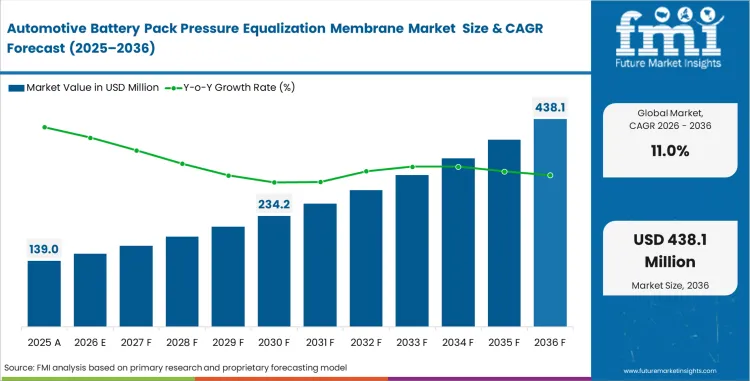
The automotive battery pack pressure equalization membrane market was valued at USD 125.2 million in 2025. Demand is expected to cross USD 139.0 million in 2026 at a CAGR of 11.00% during the forecast period. Market size is projected to reach USD 394.7 million by 2036 as tighter battery safety requirements increase the need for reliable gas release alongside continuous passive breathing.
Summary of Automotive Battery Pack Pressure Equalization Membrane Market
- The market is forecast to reach USD 394.7 million by 2036.
- The market is expected to grow at a CAGR of 11.0% from 2026 to 2036.
- The market was estimated at USD 125.2 million in 2025.
- The forecast period represents an incremental opportunity of USD 255.7 million.
- Demand is driven by the need for pressure equalization in sealed EV battery packs while maintaining protection against water, dust, and contaminants.
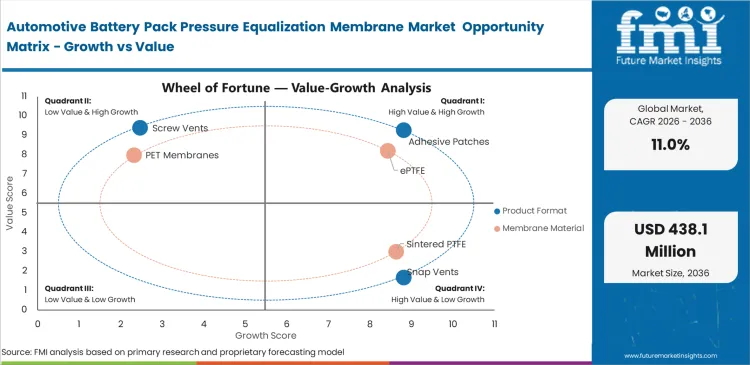
- ePTFE membranes are projected to account for 52% of the material segment in 2026 due to strong hydrophobic and airflow performance.
- Adhesive patch formats are expected to hold 41% share in 2026, supported by ease of integration into compact battery designs.
- Passenger electric vehicles are anticipated to contribute 63% of the vehicle segment share in 2026.
- China, India, and the United Kingdom are the fastest-growing markets, while the United States and Germany remain key high-value and validation-driven markets.
Key Takeaways, Market Size, and Forecast
- The Automotive Battery Pack Pressure Equalization Membrane Market is projected to grow from USD 139.0 million in 2026 to USD 394.7 million by 2036, registering a CAGR of 11.0%.
- The market was valued at USD 125.2 million in 2025, reflecting rising adoption linked to EV battery safety requirements.
- By 2036, the automotive battery pack pressure equalization membrane market is expected to reach USD 394.7 million in total value.
- From 2026 to 2036, the market is forecast to expand at a steady 11.0% CAGR driven by sealed high‑voltage battery architectures.
- The market is projected to create an incremental opportunity of USD 255.7 million between 2026 and 2036.
- In 2026, adhesive patches are expected to account for 41.0% of the product format segment due to ease of automated integration.
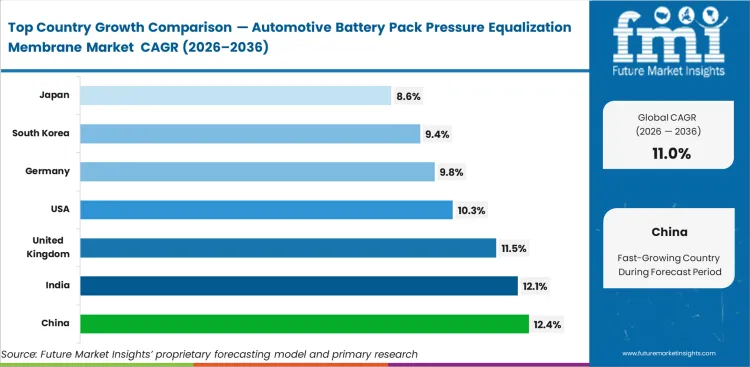
- China (12.4%) and India (12.1%) are among the fastest‑growing national markets during the forecast period.
Automotive Battery Pack Pressure Equalization Membrane Market Key Takeaways
| Metric | Details |
|---|---|
| Industry Size (2026) | USD 139.0 million |
| Industry Value (2036) | USD 394.7 million |
| CAGR (2026-2036) | 11.00% |
Source: Future Market Insights (FMI) analysis, based on proprietary forecasting model and primary research
Thermal runaway containment protocols force automotive buyers to re-evaluate how enclosures handle rapid internal pressure spikes. Battery engineers previously treated pressure equalization as a secondary waterproofing concern. Cell chemistry shifts toward high-nickel cathodes now compel development teams to specify dual-stage pressure relief mechanisms. Failure to integrate adequate ventilation layers can push programs into enclosure redesign if early-stage off-gassing causes permanent deformation. FMI's automotive battery vent membrane forecast indicates this requirement pushes integrators toward advanced battery safety vents capable of maintaining continuous airflow under heavy contaminant loads. Heavy adoption of specialized battery pack sealants complicates internal breathing dynamics, making membrane permeability critical.
Implementation of 800-volt architectures triggers a categorical shift in venting requirements. Cell-to-pack configurations reduce empty internal volume, leaving very little buffer space for normal expansion. Thermal management leads specify higher flow-rate components immediately upon finalizing high-density pack layouts. High-voltage platforms increase the need for rapid pressure normalization alongside sophisticated thermal management materials to prevent casing stress fractures during rapid-charge sequences.
China is set to witness adoption at 12.4% from 2026 to 2036 as domestic battery manufacturers standardize integrated venting on mass-market platforms. India’s market growth reflects operating conditions rather than policy signaling alone. Battery enclosure designs must tolerate high ambient heat, monsoon moisture, and uneven road exposure, which keeps demand centered on membranes with reliable moisture blocking and attachment integrity; under these conditions, adoption is projected to grow at a 12.1% CAGR. The United Kingdom is set to expand at 11.5% CAGR by 2036, where recycling rules and end‑of‑life handling requirements favor removable vent configurations over permanent seals. In the United States, demand rises at a 10.3% CAGR as truck electrification expands pack size and forces higher vent density. Germany’s 9.8% trajectory is shaped by premium OEM requirements for proprietary vent geometries, while South Korea’s projected 9.4% growth reflects sustained investment in localized ePTFE capacity tied closely to domestic battery programs. Japan is anticipated to rise at 8.6% as solid‑state testing reshapes baseline breathing requirements without immediate volume scale.
Segmental Analysis
Automotive Battery Pack Pressure Equalization Membrane Market Analysis by Product format
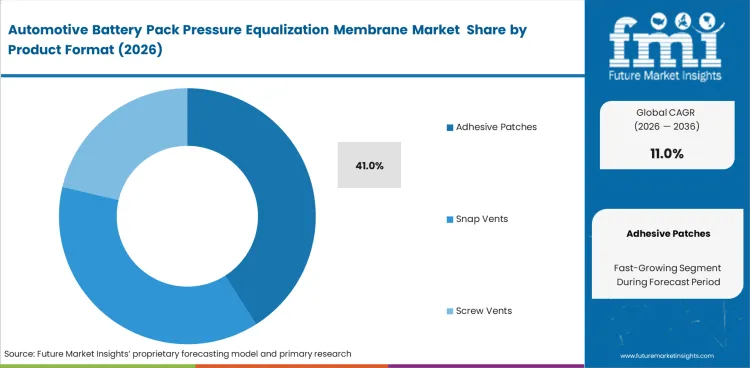
Automated assembly line integration drives architectural preference for simple component formats reducing cycle times. Adhesive patches are expected to account for 41.0% share in 2026 as manufacturing engineers prioritize peel-and-stick application methods over complex mechanical fastening. Evaluating an adhesive vent patch vs snap vent reveals that low-profile patches consume almost zero external clearance, simplifying underbody aerodynamic profiling. The high-speed robotic placement systems deploy adhesive membranes at triple the rate of threaded alternatives. Over-reliance on adhesives creates hidden vulnerabilities: prolonged exposure to internal solvent off-gassing degrades bonding agents over five-year cycles. Packaging specialists must carefully balance rapid production speeds against long-term vibration resistance. Integration alongside thermal interface materials requires precise surface tension compatibility. Delaying transition to mechanical fixation on high-vibration off-road platforms frequently results in localized moisture intrusion failures.
- Initial specification: Battery design engineers select adhesive formats strictly to hit targeted assembly cycle times on high-volume production lines. Automated placement systems handle flexible patches without requiring complex torque-control tooling.
- Qualification parameters: Quality assurance leads validate adhesion strength against prolonged heat cycling and chemical exposure. Testers confirm bonding agents resist degradation when subjected to vaporized electrolyte compounds.
- Lifecycle replacement: Service technicians struggle to cleanly remove degraded patches during routine maintenance without leaving residue. Poor surface preparation during replacement frequently compromises IP-rated seals on subsequent installations.
Automotive Battery Pack Pressure Equalization Membrane Market Analysis by Membrane material
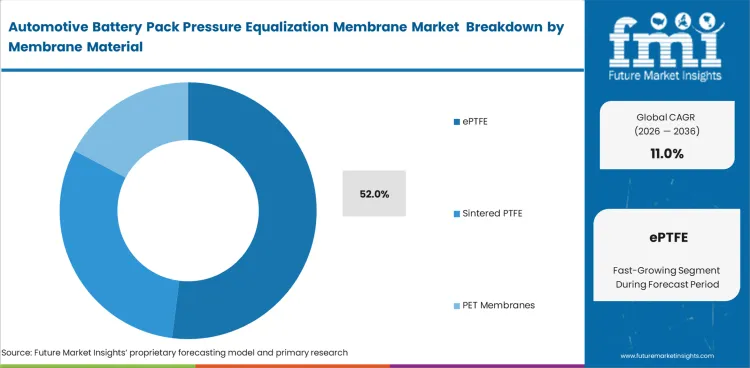
High-tensile porosity structures deliver essential chemical resistance against vaporized electrolytes escaping from stressed cells. Specifying an ePTFE membrane for EV battery packs secures an estimated 52.0% share in 2026 because extreme chemical inertness prevents material degradation during thermal events. Buyers tolerate premium pricing on fluoropolymer rolls specifically to guarantee consistent airflow rates under heavy particulate loading. Comparing ePTFE vs sintered PTFE vent membrane performance shows internal outgassing heavily fouls inferior membrane alternatives. It has been observed that specification teams routinely over-engineer material selections to ensure compliance with strict inspection and certification requirements. Battery pack vent membrane chemical resistance dictates that sintered plastics cannot match precise micropore consistency achieved through advanced stretching processes. Cost-reduction initiatives attempting substitution with basic olefins inevitably face elevated warranty claims regarding compromised breathing capacity.
- Performance baseline: Thermal management engineers mandate fluoropolymers to guarantee uninterrupted passive breathing despite continuous exposure to corrosive battery fluids. Extreme hydrophobicity repels external moisture while allowing internal pressure normalization.
- Edge condition degradation: Extended exposure to highly concentrated electrolyte vapors eventually causes localized pore swelling. Severe contamination events permanently blind microporous structures, demanding immediate component replacement.
- Acceptability thresholds: Compliance officers require verified material data sheets proving absolute resistance against specific cathode chemistries. Any deviation from validated chemical inertness profiles triggers immediate vendor disqualification.
Automotive Battery Pack Pressure Equalization Membrane Market Analysis by Protection class
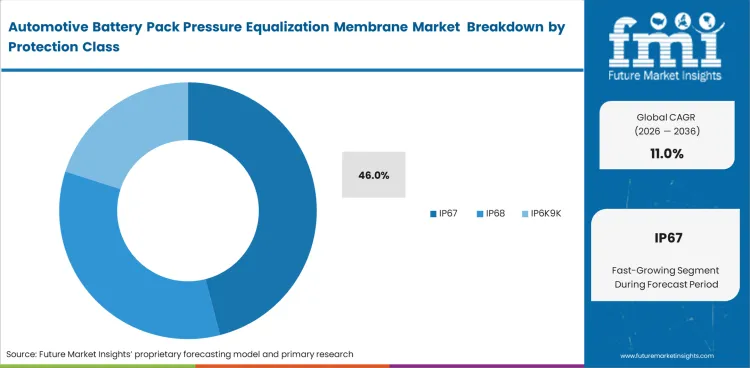
Baseline immersion protection standards dictate minimum component requirements for standard passenger vehicle platforms. IP67 battery vent membrane is anticipated to emerge with 46.0% market share in 2026 as cost-conscious integrators balance adequate water resistance against necessary airflow volume. Battery housing designers select this specific threshold to survive mandatory thirty-minute submersion tests without severely restricting passive gas exchange. Specifying higher protection classes exponentially increases airflow resistance, forcing engineers to deploy larger membrane surface areas to achieve identical breathing rates. Managing battery pack integrity-critical fasteners requires careful alignment with selected membrane IP ratings. Transitioning toward advanced electric vehicle battery architectures complicates simple rating selections. Organizations incorrectly treating IP68 as a universal upgrade frequently discover complete failure of internal pressure normalization during rapid altitude changes.
- Procurement savings: Sourcing managers secure volume discounts by standardizing IP67 components across mass-market commuter platforms. Avoiding over-specification directly improves per-unit margin on highly competitive vehicle lines.
- Operational friction: Assembly line technicians must handle mid-tier membranes with extreme care to prevent micro-tears during installation. Subtle handling damage compromises stated ingress protection ratings entirely.
- Total lifecycle cost: Warranty teams track minor moisture intrusion events resulting from high-pressure underbody washing systems. Upgrading specific vulnerable node locations proves more economical than adopting higher ratings universally.
Automotive Battery Pack Pressure Equalization Membrane Market Analysis by Vehicle type
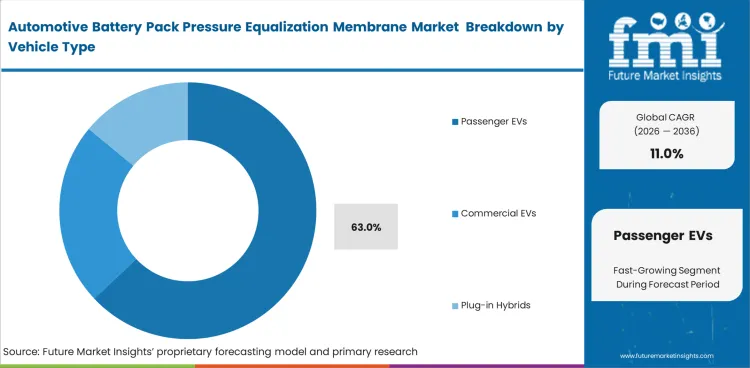
Global volume scale and standardized flat-pack module configurations consolidate demand within dominant transport categories. Passenger EVs are projected to secure 63.0% share in 2026 as major automakers transition legacy internal combustion platforms toward dedicated electric skateboards. Chief engineering officers face immense pressure to optimize enclosure weight while maintaining absolute thermal safety. Sourcing a vent membrane for high-voltage battery pack designs requires accounting for massive internal free-volume variations depending on specific cell form factors. Validating specific battery platforms dictates precise membrane sizing strategies. Integrating specialized separator coatings impacts total pack off-gassing rates. Passenger platforms rarely encounter extreme wading depths required by commercial off-road equivalents, allowing deployment of highly permeable thin-film barriers. Failing to adjust membrane specifications when modifying passenger platforms for rugged crossover duty guarantees rapid moisture ingress.
- Early adoption: Luxury automakers deploy sophisticated multi-node equalization arrays to guarantee absolute reliability on flagship sedans. Early engineering teams prioritize safety margins over component cost optimization.
- Subsequent integration: Mass-market brands adopt single-vent architectures to simplify manufacturing complexity on budget-focused hatchbacks. Cost reduction strategies eliminate redundant passive breathing paths.
- Final conversion: Budget fleet operators eventually demand identical safety hardware parity before committing to large-scale electrification. Fleet managers require proven ventilation track records before risking capital deployment.
Automotive Battery Pack Pressure Equalization Membrane Market Analysis by Application area
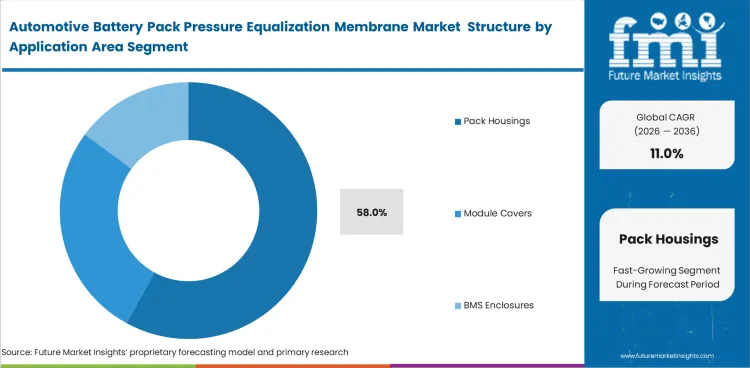
Primary external pressure boundaries require immediate environmental equalization to prevent catastrophic mechanical failure. A battery housing pressure equalization membrane represents an estimated 58.0% share in 2026 because main enclosures endure maximum differential stress during rapid temperature shifts. Engineers place high-capacity vents directly on main casings to manage volumetric expansion during charging events. The decentralized venting across a BMS enclosure vent membrane or junction box vent membrane for EVs remains mechanically complex due to internal gas routing requirements. Testing specific propagation test systems confirms central housing vents provide superior evacuation metrics. Interfacing with complex battery connector arrays requires careful spatial planning for vent placement. Relying entirely on primary housing vents creates dangerous internal pressure pockets if battery modules lack adequate cross-ventilation pathways.
- Prevented failure: Proper main enclosure ventilation prevents volumetric ballooning during aggressive altitude climbs. Large-format membranes immediately neutralize pressure differentials threatening main casing seals.
- Residual vulnerability: Internal pack geometry often creates isolated zones unable to quickly exchange gas with primary external vents. Deeply buried modules suffer localized pressure spikes despite adequate external membrane capacity.
- Full capture requirement: Design leads must model internal fluid dynamics to ensure unobstructed airflow from individual cells toward main housing vents. Proper internal baffling remains critical for comprehensive pressure equalization.
Automotive Battery Pack Pressure Equalization Membrane Market Drivers, Restraints, and Opportunities
Thermal runaway containment regulations compel battery design engineers to specify a battery pack pressure compensation vent capable of continuous passive breathing. UN ECE mandate deadlines force automotive tier-1 suppliers to guarantee passenger evacuation timeframes during catastrophic cell failures. Delaying integration of advanced gas-evacuation hardware exposes automakers to immediate sales embargoes in heavily regulated jurisdictions. Mechanical leads pivot away from simple burst disks toward complex EV battery pressure equalization membrane market solutions providing ongoing pressure normalization and emergency volume displacement. Deploying sophisticated battery thermal plates demands reliable environmental breathing to manage constant temperature cycling.
Membrane fouling from internal electrolyte off-gassing heavily restricts long-term breathing capacity across high-mileage vehicle platforms. Normal cell aging produces complex chemical vapors that condense directly onto microporous structures, blinding critical gas-exchange pathways. Engineers struggle to formulate oleophobic coatings capable of resisting prolonged exposure to vaporized solvents without increasing baseline airflow resistance. Current filtration patches require oversizing to account for gradual permeability loss, inflating component footprint on densely packed module covers. Interfacing with recycled device enclosure plastics introduces unknown off-gassing variables complicating membrane longevity.
Opportunities in the Automotive Battery Pack Pressure Equalization Membrane Market
- Directional airflow structures: Materials scientists developing asymmetrical pore geometries enable rapid internal evacuation while presenting absolute resistance against external pressure washing.
- Integrated diagnostic sensors: Component engineers embedding trace-gas detection layers directly into membrane assemblies provide immediate BMS warnings regarding premature cell venting.
- High-temperature substrates: Buyers securing specialized formation testing validated materials achieve superior survival rates during severe thermal propagation events.
Regional Analysis
Based on regional analysis, automotive battery pack pressure equalization membrane market is segmented into North America, Latin America, Western Europe, Eastern Europe, Asia Pacific, and Middle East & Africa across 40 plus countries.
.webp "Top Country Growth Comparison Automotive Battery Pack Pressure Equalization Membrane Market Cagr (2026 2036)")
| Country | CAGR (2026 to 2036) |
|---|---|
| China | 12.4% |
| India | 12.1% |
| United Kingdom | 11.5% |
| United States | 10.3% |
| Germany | 9.8% |
| South Korea | 9.4% |
| Japan | 8.6% |
Source: Future Market Insights (FMI) analysis, based on proprietary forecasting model and primary research
Asia Pacific Automotive Battery Pack Pressure Equalization Membrane Market Analysis
Asia Pacific remains one of the prominent production base for electric vehicle batteries, so membrane demand is shaped by scale, cost discipline, and fast product rollout cycles. Thermal safety requirements are tightening across the region, which is pushing battery integrators toward more advanced vent designs and more standardized membrane formats that can move smoothly through high-volume assembly programs. Cell-to-pack architectures are also leaving less internal space inside battery systems, so engineering teams are specifying higher-permeability venting components that can manage pressure changes without complicating pack design. Cost pressure is equally visible. Local suppliers are replacing imported fluoropolymer-heavy inputs with more localized sintered plastic variants where performance targets allow, especially on price-sensitive commuter platforms. Fast-charging infrastructure is expanding across the region, and that raises the need for enclosure breathing systems that can tolerate sharper temperature swings during repeated charging cycles.
- China: The market in China is projected to expand at a CAGR of 12.4% through 2036. The country’s advantage comes from scale, supplier depth, and direct alignment with domestic battery manufacturing programs. Battery producers are standardizing integrated venting hardware to stay aligned with strict thermal safety requirements and to simplify sourcing across large production volumes. Local production of advanced ePTFE materials and converted membrane formats also gives buyers more room to control cost without slowing qualification timelines.
- India: India’s operating environment puts more emphasis on moisture management and mechanical reliability than many other markets. Battery enclosure designers must handle high ambient temperatures, monsoon exposure, and rougher vibration profiles at the same time, which raises the need for laminates that can vent heat-driven pressure while still protecting against water ingress. The industry outlook in India points to 12.1% CAGR through 2036. That operating profile is also keeping buyer preference tilted toward mechanically secure attachment formats in programs exposed to harsher road conditions.
- South Korea: South Korea benefits from strong local battery engineering capability and a supplier base that is moving deeper into specialized membrane production. Manufacturers are investing in local ePTFE capacity to reduce dependence on imported technical textiles and to align more closely with domestic battery programs. Engineering teams in the country also remain active in highly integrated venting assemblies, where membrane performance is tied closely to proprietary cell chemistry and pack layout decisions. South Korea is expected to record 9.4% CAGR in this market during the forecast period. This keeps the country well positioned in technically demanding battery programs.
- Japan: The sector in Japan is on a positive trend at 8.6% CAGR through 2036. Tier-1 suppliers are also working on multi-stage vent concepts that combine passive membranes with more controlled pressure-release functions for future vehicle platforms. Japan’s position is shaped by material durability, long service-life expectations, and next-generation battery development. Solid-state battery testing is already influencing how suppliers think about pressure management, especially where vehicle programs require stable permeability over longer operating lives.
FMI’s report includes detailed analysis covering Australia, ASEAN countries, and emerging manufacturing hubs across Southeast Asia. These markets are still building membrane capability, so technology transfer, supplier partnerships, and local fabrication support remain central to regional expansion.
Western Europe Automotive Battery Pack Pressure Equalization Membrane Market Analysis
Western Europe is defined by strict engineering standards, high validation requirements, and growing pressure to align battery components with recyclability and end-of-life expectations. Premium vehicle programs in the region often require customized vent geometries, which raises converting complexity and keeps supplier qualification demanding. Battery safety teams are also working to protect enclosure integrity under tougher crash and abuse conditions, so membrane selection is tied closely to pack-level test performance rather than simple component substitution. Recycling rules and extended producer responsibility are influencing material choices as well, especially where automakers want components that remain stable over long vehicle lives and can be removed or disassembled more cleanly. Cross-border sourcing adds another layer of scrutiny, making quality control and supply consistency critical for approved vendors.
- United Kingdom: The United Kingdom is pushing more battery enclosure and EV system localization as zero-emission vehicle targets move from policy into manufacturing decisions. That is creating room for weld-on and tamper-resistant membrane formats suited to controlled assembly environments and later-life vehicle handling requirements. Adoption in the United Kingdom is anticipated to move ahead at a CAGR of 11.5% during the assessment period. Reversible fastening and disassembly-friendly designs are also drawing attention as recyclability and second-life planning become more relevant in supplier selection.
- Germany: Germany remains a specification-heavy market where premium vehicle programs set a high technical bar for membrane suppliers. Buyers are securing long-term supply arrangements for higher-grade fluoropolymer materials because enclosure components must continue to perform under demanding road exposure, including sustained rain and high-speed operating conditions. Germany is forecast to register 9.8% CAGR in this market over the study period. The country’s role in technical standard-setting also gives approved suppliers deeper integration opportunities across future luxury and performance EV platforms.
FMI’s report includes comprehensive assessments tracking France, Italy, Spain, and Nordic electric vehicle deployment patterns. Cold-weather durability remains a meaningful issue across northern Europe, and suppliers must prove membrane flexibility and sealing reliability under prolonged low-temperature exposure.
North America Automotive Battery Pack Pressure Equalization Membrane Market Analysis
North America is being shaped by truck electrification, larger battery enclosures, and a stronger preference for mechanically robust components. Heavy-duty and off-road platforms create bigger internal air volumes, so pack designers are often forced to use multiple equalization points rather than relying on a single venting location. Battery systems in the region also face stricter expectations around impact survival and mechanical retention, which is pushing suppliers toward thicker-film constructions and better-protected mounting formats. Ruggedized fastening methods remain important because many vehicle programs are built around harsher duty cycles, including off-road use and higher shock exposure. At the same time, new gigafactory investment is changing sourcing patterns, with more membrane slitting, converting, and final packaging work moving closer to battery assembly operations.
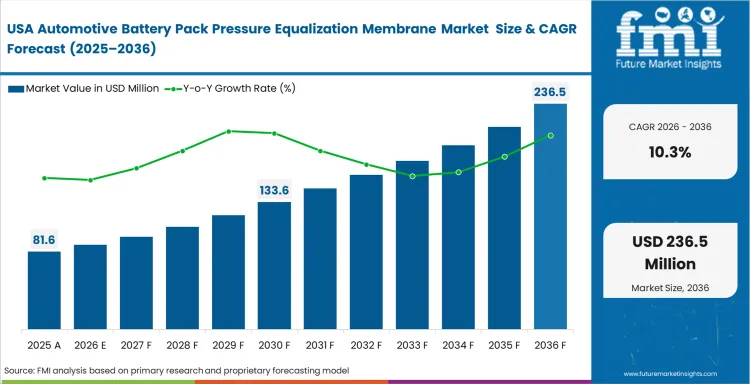
- United States: The United States market is closely tied to large-format battery packs used in pickups, commercial vehicles, and larger EV platforms. These programs require multi-point ventilation layouts to prevent localized pressure buildup during aggressive charging and operating cycles, which raises the need for high-flow membrane designs. The United States is likely to post 10.3% CAGR in the sector by 2036. Domestic content and assembly proximity are also pushing suppliers to localize more membrane conversion and packaging activity near battery manufacturing sites.
FMI’s report includes detailed evaluation tracking Canadian cold-weather testing facilities and emerging Mexican manufacturing corridors. Cross-border sourcing and final assembly routing continue to influence where thermal management and venting components are qualified and installed.
Competitive Aligners for Market Players
Automotive tier-1 suppliers compete strictly on automated integration compatibility rather than raw membrane permeability. EV battery pack venting membrane suppliers secure volume contracts by providing integrated assembly modules that eliminate complex handling procedures on OEM production lines. Supplying pre-tested snap-fit assemblies containing pre-welded ePTFE addresses labor bottlenecks slowing down battery pack fabrication. Integrators explicitly select EV battery vent membrane manufacturers capable of delivering defect-free units scaling directly with gigafactory output schedules.
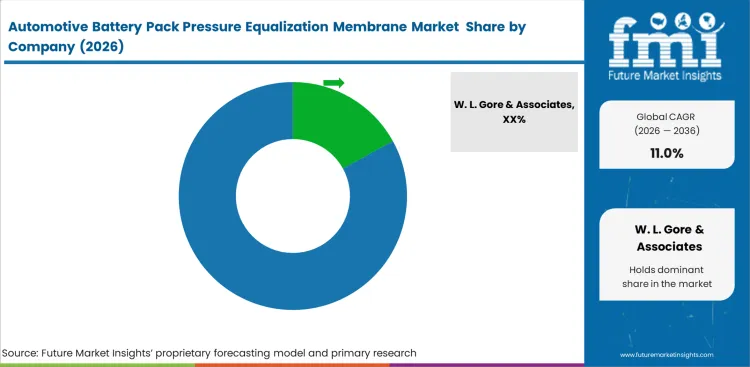
Established fluoropolymer manufacturers possess immense proprietary libraries detailing chemical resistance against specific electrolyte formulations. W. L. Gore & Associates leverages decades of material science validation data, creating an insurmountable barrier against budget textile suppliers attempting market entry. Securing mandatory automotive certifications requires minimum two-year testing cycles evaluating extended vibration exposure and chemical degradation. Engineering teams integrating advanced polymer adhesives rely heavily on battery vent membrane suppliers for EV OEMs providing verified compatibility matrices preventing catastrophic bonding failures.
Large-scale automotive buyers aggressively resist vendor lock-in by mandating standardized mounting geometries across all vehicle platforms. Suppliers routinely split massive volume contracts between primary innovators and secondary volume-fabricators to ensure pricing leverage. Evolving thermal propagation regulations continuously reset required capability baselines, forcing all competitors to heavily reinvest in advanced automated inspection systems.
Key Players in Automotive Battery Pack Pressure Equalization Membrane Market
- W. L. Gore & Associates
- Donaldson Company, Inc.
- Porex Corporation
- Nitto Denko Corporation
- MANN+HUMMEL
- Parker Hannifin Corporation
- SABEU GmbH & Co. KG
Scope of the Report
| Metric | Value |
|---|---|
| Quantitative Units | USD 139.0 million to USD 394.7 million, at a CAGR of 11.00% |
| Market Definition | Semi-permeable microporous barriers integrated into EV energy enclosures facilitate continuous bi-directional airflow. Components neutralize internal pressure fluctuations caused by temperature cycling while repelling water and contaminants to prevent physical casing deformation. |
| Segmentation | Product format, Membrane material, Protection class, Vehicle type, Application area, and Region |
| Regions Covered | North America, Latin America, Western Europe, Eastern Europe, Asia Pacific, Middle East & Africa |
| Countries Covered | China, India, United Kingdom, United States, Germany, South Korea, Japan |
| Key Companies Profiled | W. L. Gore & Associates, Donaldson Company, Inc., Porex Corporation, Nitto Denko Corporation, MANN+HUMMEL, Parker Hannifin Corporation, SABEU GmbH & Co. KG |
| Forecast Period | 2026 to 2036 |
| Approach | Automotive EV production volumes cross-referenced with average vent unit counts per specific pack geometry. |
Source: Future Market Insights (FMI) analysis, based on proprietary forecasting model and primary research
Automotive Battery Pack Pressure Equalization Membrane Market Analysis by Segments
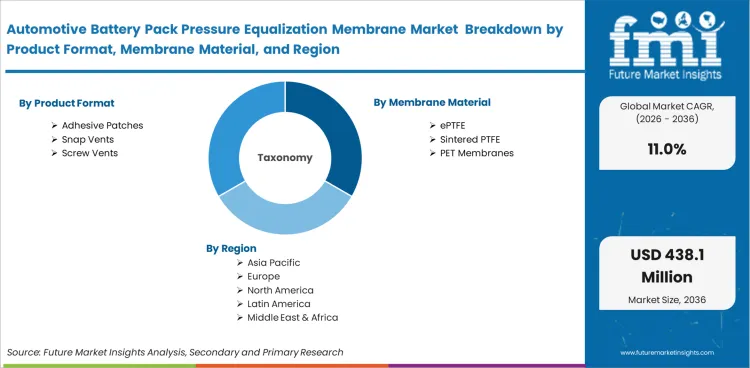
Product format:
- Adhesive patches
- Snap vents
- Screw vents
- Weld vents
Membrane material:
- ePTFE
- Sintered PTFE
- Olefin blends
- PET membranes
Protection class:
- IP67
- IP68
- IP6K9K
- Custom grades
Vehicle type:
- Passenger EVs
- Commercial EVs
- Plug-in hybrids
- Hybrid vehicles
Application area:
- Pack housings
- Module covers
- BMS enclosures
- Junction boxes
Region:
- North America
- United States
- Latin America
- Western Europe
- Germany
- United Kingdom
- Eastern Europe
- Asia Pacific
- China
- India
- Japan
- South Korea
- Middle East & Africa
Bibliography
- International Energy Agency. (2025, May 14). Global EV Outlook 2025.
- European Automobile Manufacturers’ Association. (2026, January 27). New car registrations: +1.8% in 2025; battery-electric 17.4% market share.
- Torres-Castro, L., Bates, A. M., Johnson, N. B., Quintana, G., & Gray, L. S. (2024, 13 February). Early detection of Li-ion battery thermal runaway using commercial diagnostic technologies. Journal of The Electrochemical Society, 171(2).
- Peng, R., Kong, D., Ping, P., Gao, W., Wang, G., Gong, S., Yang, C., Gao, X., & He, X. (2025, January). Experimental investigation of the influence of venting gases on thermal runaway propagation in lithium-ion batteries with enclosed packaging. eTransportation, 100388.
- Fedoryshyna, Y., et al. (2024, September 30). Quantification of venting behavior of cylindrical lithium-ion batteries during thermal runaway. Journal of Power Sources.
This bibliography is provided for reader reference. The full FMI report contains the complete reference list with primary source documentation.
This Report Addresses
- Battery integration engineers evaluating specific dimensional tolerances required for high-volume automated patch placement systems.
- Vendors analyzing mechanical vulnerability risks associated with inferior non-fluoropolymer equalization barriers.
- Compliance officers tracking exact passive breathing specifications mandated by updated UN ECE thermal propagation rules.
- Thermal management leads assessing internal differential pressure mapping requirements across high-density cell-to-pack architectures.
- Heavy-duty vehicle designers specifying IP6K9K-rated enclosure vents capable of enduring rigorous underbody steam-cleaning protocols.
- Supplier strategy directors targeting precise OEM membrane customization demands across European zero-emission vehicle production hubs.
- Quality assurance teams testing precise vaporized electrolyte degradation metrics against standard ePTFE chemical resistance profiles.
- Logistics coordinators mapping regional specialized microporous textile manufacturing capabilities against localized gigafactory assembly demands.
Frequently Asked Questions
What is an automotive battery pack pressure equalization membrane?
Semi-permeable microporous barriers neutralize internal pressure fluctuations while repelling water, preventing chassis-level casing deformation in EV enclosures.
Why do EV battery packs need pressure equalization?
Rapid heating causes internal air expansion. Evacuating this pressure prevents integrity-based seal failures and protects the battery management system.
How does a vent membrane differ from an emergency safety vent?
Passive membranes manage daily pressure fluctuations continuously, whereas emergency valves deploy only during catastrophic thermal runaway events.
What materials are used in EV battery vent membranes?
Expanded polytetrafluoroethylene maintains absolute chemical inertness, repelling corrosive vaporized electrolytes while guaranteeing consistent airflow during thermal events.
Which vehicle segments use the most pack vent membranes?
Passenger electric vehicles dominate unit demand as mass-market automotive brands transition toward dedicated flat-pack module configurations.
What IP rating is typically required for battery vent membranes?
Engineers deploy IP67 vents to achieve mandatory immersion benchmarks while maintaining adequate passive breathing rates without expanding surface areas.
Which companies supply pressure equalization membranes for EV battery packs?
Major suppliers include W. L. Gore & Associates, Donaldson Company, Porex Corporation, Nitto Denko, MANN+HUMMEL, Parker Hannifin, and SABEU.
Which countries are growing fastest in this market?
China leads expansion through centralized thermal mandates, while India follows closely by adopting specialized monsoon-resistant laminate materials.
How large is the market in 2026 and 2036?
The market crosses USD 139.0 million in 2026 and accelerates toward USD 394.7 million by 2036.
What factors limit adoption or slow supplier switching?
Mandatory automotive certifications require two-year testing cycles evaluating extended vibration exposure and multi-year compatibility against specific cathode chemistries.
How do 800-volt architectures change venting requirements?
High-voltage platforms eliminate internal buffer volume, demanding highly responsive equalization membranes capable of instantaneous high-volume gas exchange.
Why do adhesive patches dominate product format selections?
Automated assembly line integration favors simple patches, enabling robotic placement systems to accelerate production without complex torque-control tooling.
What hidden vulnerabilities affect adhesive patch lifecycle?
Internal solvent off-gassing degrades bonding agents over extended lifespans, requiring meticulous surface preparation during routine maintenance replacements.
What causes premature membrane permeability degradation?
Chemical vapors from normal cell aging condense onto microporous structures, blinding gas-exchange pathways and destroying passive breathing capacity.
How do commercial EV requirements differ from passenger platforms?
Commercial trucks demand multi-point equalization arrays and ruggedized mechanical fasteners to endure severe off-road vibration loads.
Why do solid-state battery developments affect membrane engineering?
Solid-state architectures alter expansion profiles and baseline vapor emissions, requiring completely recalibrated porosity structures to prevent material fouling.
What prevents battery designers from using standard industrial vents?
Industrial equivalents lack validated chemical resistance against lithium-ion electrolytes, inviting catastrophic casing failures when vaporized solvents degrade structures.
How do recycling mandates influence component selection?
Extended producer responsibility targets end-of-life disassembly, pushing integrators toward reversible mechanical vent assemblies for clean component-level separation.
Why do premium automakers demand custom venting geometries?
Proprietary aerodynamic underbody paneling requires low-profile integration, demanding highly tailored asymmetric membrane housings to hit drag-coefficient targets.
What can push programs into enclosure redesign during early testing?
Inadequate passive breathing traps evolving gases during early off-gassing events, permanently warping precision-machined casing seals and destroying IP ratings.
How does over-specifying protection classes impact vehicle costs?
Extreme submersion ratings choke necessary airflow, forcing teams to deploy redundant ventilation nodes that heavily inflate component spend.
Why do battery engineers avoid decentralized module-level venting?
Complex internal gas routing creates localized pressure spikes, rendering decentralized architectures inferior to centrally located main enclosure vents.
What advantage do integrated assembly modules provide tier-1 suppliers?
Pre-tested snap-fit assemblies eliminate complex handling procedures on OEM lines, resolving severe labor bottlenecks during battery pack fabrication.
What specific data secures vendor qualification approvals?
Compliance officers demand verified multi-year compatibility matrices proving absolute chemical resistance against exact cathode chemistries across long lifecycles.
Preview the report firsthand - request a free sample
Get SampleGet the brochure for pricing and purchase details.
Get PDFTable of Content
- Executive Summary
- Global Market Outlook
- Demand-side Trends
- Supply-side Trends
- Technology Roadmap Analysis
- Analysis and Recommendations
- Market Overview
- Market Coverage / Taxonomy
- Market Definition / Scope / Limitations
- Research Methodology
- Chapter Orientation
- Analytical Lens and Working Hypotheses
- Market Structure, Signals, and Trend Drivers
- Benchmarking and Cross-market Comparability
- Market Sizing, Forecasting, and Opportunity Mapping
- Research Design and Evidence Framework
- Desk Research Programme (Secondary Evidence)
- Company Annual and Sustainability Reports
- Peer-reviewed Journals and Academic Literature
- Corporate Websites, Product Literature, and Technical Notes
- Earnings Decks and Investor Briefings
- Statutory Filings and Regulatory Disclosures
- Technical White Papers and Standards Notes
- Trade Journals, Industry Magazines, and Analyst Briefs
- Conference Proceedings, Webinars, and Seminar Materials
- Government Statistics Portals and Public Data Releases
- Press Releases and Reputable Media Coverage
- Specialist Newsletters and Curated Briefings
- Sector Databases and Reference Repositories
- FMI Internal Proprietary Databases and Historical Market Datasets
- Subscription Datasets and Paid Sources
- Social Channels, Communities, and Digital Listening Inputs
- Additional Desk Sources
- Expert Input and Fieldwork (Primary Evidence)
- Primary Modes
- Qualitative Interviews and Expert Elicitation
- Quantitative Surveys and Structured Data Capture
- Blended Approach
- Why Primary Evidence is Used
- Field Techniques
- Interviews
- Surveys
- Focus Groups
- Observational and In-context Research
- Social and Community Interactions
- Stakeholder Universe Engaged
- C-suite Leaders
- Board Members
- Presidents and Vice Presidents
- R&D and Innovation Heads
- Technical Specialists
- Domain Subject-matter Experts
- Scientists
- Physicians and Other Healthcare Professionals
- Governance, Ethics, and Data Stewardship
- Research Ethics
- Data Integrity and Handling
- Primary Modes
- Tooling, Models, and Reference Databases
- Desk Research Programme (Secondary Evidence)
- Data Engineering and Model Build
- Data Acquisition and Ingestion
- Cleaning, Normalisation, and Verification
- Synthesis, Triangulation, and Analysis
- Quality Assurance and Audit Trail
- Market Background
- Market Dynamics
- Drivers
- Restraints
- Opportunity
- Trends
- Scenario Forecast
- Demand in Optimistic Scenario
- Demand in Likely Scenario
- Demand in Conservative Scenario
- Opportunity Map Analysis
- Product Life Cycle Analysis
- Supply Chain Analysis
- Investment Feasibility Matrix
- Value Chain Analysis
- PESTLE and Porter’s Analysis
- Regulatory Landscape
- Regional Parent Market Outlook
- Production and Consumption Statistics
- Import and Export Statistics
- Market Dynamics
- Global Market Analysis 2021 to 2025 and Forecast, 2026 to 2036
- Historical Market Size Value (USD Million) Analysis, 2021 to 2025
- Current and Future Market Size Value (USD Million) Projections, 2026 to 2036
- Y-o-Y Growth Trend Analysis
- Absolute $ Opportunity Analysis
- Global Market Pricing Analysis 2021 to 2025 and Forecast 2026 to 2036
- Global Market Analysis 2021 to 2025 and Forecast 2026 to 2036, By Product Format
- Introduction / Key Findings
- Historical Market Size Value (USD Million) Analysis By Product Format , 2021 to 2025
- Current and Future Market Size Value (USD Million) Analysis and Forecast By Product Format , 2026 to 2036
- Adhesive Patches
- Snap Vents
- Screw Vents
- Adhesive Patches
- Y-o-Y Growth Trend Analysis By Product Format , 2021 to 2025
- Absolute $ Opportunity Analysis By Product Format , 2026 to 2036
- Global Market Analysis 2021 to 2025 and Forecast 2026 to 2036, By Membrane Material
- Introduction / Key Findings
- Historical Market Size Value (USD Million) Analysis By Membrane Material, 2021 to 2025
- Current and Future Market Size Value (USD Million) Analysis and Forecast By Membrane Material, 2026 to 2036
- ePTFE
- Sintered PTFE
- PET Membranes
- ePTFE
- Y-o-Y Growth Trend Analysis By Membrane Material, 2021 to 2025
- Absolute $ Opportunity Analysis By Membrane Material, 2026 to 2036
- Global Market Analysis 2021 to 2025 and Forecast 2026 to 2036, By Protection Class
- Introduction / Key Findings
- Historical Market Size Value (USD Million) Analysis By Protection Class, 2021 to 2025
- Current and Future Market Size Value (USD Million) Analysis and Forecast By Protection Class, 2026 to 2036
- IP67
- IP68
- IP6K9K
- IP67
- Y-o-Y Growth Trend Analysis By Protection Class, 2021 to 2025
- Absolute $ Opportunity Analysis By Protection Class, 2026 to 2036
- Global Market Analysis 2021 to 2025 and Forecast 2026 to 2036, By Vehicle Type
- Introduction / Key Findings
- Historical Market Size Value (USD Million) Analysis By Vehicle Type, 2021 to 2025
- Current and Future Market Size Value (USD Million) Analysis and Forecast By Vehicle Type, 2026 to 2036
- Passenger EVs
- Commercial EVs
- Plug-in Hybrids
- Passenger EVs
- Y-o-Y Growth Trend Analysis By Vehicle Type, 2021 to 2025
- Absolute $ Opportunity Analysis By Vehicle Type, 2026 to 2036
- Global Market Analysis 2021 to 2025 and Forecast 2026 to 2036, By Application Area
- Introduction / Key Findings
- Historical Market Size Value (USD Million) Analysis By Application Area, 2021 to 2025
- Current and Future Market Size Value (USD Million) Analysis and Forecast By Application Area, 2026 to 2036
- Pack Housings
- Module Covers
- BMS Enclosures
- Pack Housings
- Y-o-Y Growth Trend Analysis By Application Area, 2021 to 2025
- Absolute $ Opportunity Analysis By Application Area, 2026 to 2036
- Global Market Analysis 2021 to 2025 and Forecast 2026 to 2036, By Region
- Introduction
- Historical Market Size Value (USD Million) Analysis By Region, 2021 to 2025
- Current Market Size Value (USD Million) Analysis and Forecast By Region, 2026 to 2036
- North America
- Latin America
- Western Europe
- Eastern Europe
- East Asia
- South Asia and Pacific
- Middle East & Africa
- Market Attractiveness Analysis By Region
- North America Market Analysis 2021 to 2025 and Forecast 2026 to 2036, By Country
- Historical Market Size Value (USD Million) Trend Analysis By Market Taxonomy, 2021 to 2025
- Market Size Value (USD Million) Forecast By Market Taxonomy, 2026 to 2036
- By Country
- USA
- Canada
- Mexico
- By Product Format
- By Membrane Material
- By Protection Class
- By Vehicle Type
- By Application Area
- By Country
- Market Attractiveness Analysis
- By Country
- By Product Format
- By Membrane Material
- By Protection Class
- By Vehicle Type
- By Application Area
- Key Takeaways
- Latin America Market Analysis 2021 to 2025 and Forecast 2026 to 2036, By Country
- Historical Market Size Value (USD Million) Trend Analysis By Market Taxonomy, 2021 to 2025
- Market Size Value (USD Million) Forecast By Market Taxonomy, 2026 to 2036
- By Country
- Brazil
- Chile
- Rest of Latin America
- By Product Format
- By Membrane Material
- By Protection Class
- By Vehicle Type
- By Application Area
- By Country
- Market Attractiveness Analysis
- By Country
- By Product Format
- By Membrane Material
- By Protection Class
- By Vehicle Type
- By Application Area
- Key Takeaways
- Western Europe Market Analysis 2021 to 2025 and Forecast 2026 to 2036, By Country
- Historical Market Size Value (USD Million) Trend Analysis By Market Taxonomy, 2021 to 2025
- Market Size Value (USD Million) Forecast By Market Taxonomy, 2026 to 2036
- By Country
- Germany
- UK
- Italy
- Spain
- France
- Nordic
- BENELUX
- Rest of Western Europe
- By Product Format
- By Membrane Material
- By Protection Class
- By Vehicle Type
- By Application Area
- By Country
- Market Attractiveness Analysis
- By Country
- By Product Format
- By Membrane Material
- By Protection Class
- By Vehicle Type
- By Application Area
- Key Takeaways
- Eastern Europe Market Analysis 2021 to 2025 and Forecast 2026 to 2036, By Country
- Historical Market Size Value (USD Million) Trend Analysis By Market Taxonomy, 2021 to 2025
- Market Size Value (USD Million) Forecast By Market Taxonomy, 2026 to 2036
- By Country
- Russia
- Poland
- Hungary
- Balkan & Baltic
- Rest of Eastern Europe
- By Product Format
- By Membrane Material
- By Protection Class
- By Vehicle Type
- By Application Area
- By Country
- Market Attractiveness Analysis
- By Country
- By Product Format
- By Membrane Material
- By Protection Class
- By Vehicle Type
- By Application Area
- Key Takeaways
- East Asia Market Analysis 2021 to 2025 and Forecast 2026 to 2036, By Country
- Historical Market Size Value (USD Million) Trend Analysis By Market Taxonomy, 2021 to 2025
- Market Size Value (USD Million) Forecast By Market Taxonomy, 2026 to 2036
- By Country
- China
- Japan
- South Korea
- By Product Format
- By Membrane Material
- By Protection Class
- By Vehicle Type
- By Application Area
- By Country
- Market Attractiveness Analysis
- By Country
- By Product Format
- By Membrane Material
- By Protection Class
- By Vehicle Type
- By Application Area
- Key Takeaways
- South Asia and Pacific Market Analysis 2021 to 2025 and Forecast 2026 to 2036, By Country
- Historical Market Size Value (USD Million) Trend Analysis By Market Taxonomy, 2021 to 2025
- Market Size Value (USD Million) Forecast By Market Taxonomy, 2026 to 2036
- By Country
- India
- ASEAN
- Australia & New Zealand
- Rest of South Asia and Pacific
- By Product Format
- By Membrane Material
- By Protection Class
- By Vehicle Type
- By Application Area
- By Country
- Market Attractiveness Analysis
- By Country
- By Product Format
- By Membrane Material
- By Protection Class
- By Vehicle Type
- By Application Area
- Key Takeaways
- Middle East & Africa Market Analysis 2021 to 2025 and Forecast 2026 to 2036, By Country
- Historical Market Size Value (USD Million) Trend Analysis By Market Taxonomy, 2021 to 2025
- Market Size Value (USD Million) Forecast By Market Taxonomy, 2026 to 2036
- By Country
- Kingdom of Saudi Arabia
- Other GCC Countries
- Turkiye
- South Africa
- Other African Union
- Rest of Middle East & Africa
- By Product Format
- By Membrane Material
- By Protection Class
- By Vehicle Type
- By Application Area
- By Country
- Market Attractiveness Analysis
- By Country
- By Product Format
- By Membrane Material
- By Protection Class
- By Vehicle Type
- By Application Area
- Key Takeaways
- Key Countries Market Analysis
- USA
- Pricing Analysis
- Market Share Analysis, 2025
- By Product Format
- By Membrane Material
- By Protection Class
- By Vehicle Type
- By Application Area
- Canada
- Pricing Analysis
- Market Share Analysis, 2025
- By Product Format
- By Membrane Material
- By Protection Class
- By Vehicle Type
- By Application Area
- Mexico
- Pricing Analysis
- Market Share Analysis, 2025
- By Product Format
- By Membrane Material
- By Protection Class
- By Vehicle Type
- By Application Area
- Brazil
- Pricing Analysis
- Market Share Analysis, 2025
- By Product Format
- By Membrane Material
- By Protection Class
- By Vehicle Type
- By Application Area
- Chile
- Pricing Analysis
- Market Share Analysis, 2025
- By Product Format
- By Membrane Material
- By Protection Class
- By Vehicle Type
- By Application Area
- Germany
- Pricing Analysis
- Market Share Analysis, 2025
- By Product Format
- By Membrane Material
- By Protection Class
- By Vehicle Type
- By Application Area
- UK
- Pricing Analysis
- Market Share Analysis, 2025
- By Product Format
- By Membrane Material
- By Protection Class
- By Vehicle Type
- By Application Area
- Italy
- Pricing Analysis
- Market Share Analysis, 2025
- By Product Format
- By Membrane Material
- By Protection Class
- By Vehicle Type
- By Application Area
- Spain
- Pricing Analysis
- Market Share Analysis, 2025
- By Product Format
- By Membrane Material
- By Protection Class
- By Vehicle Type
- By Application Area
- France
- Pricing Analysis
- Market Share Analysis, 2025
- By Product Format
- By Membrane Material
- By Protection Class
- By Vehicle Type
- By Application Area
- India
- Pricing Analysis
- Market Share Analysis, 2025
- By Product Format
- By Membrane Material
- By Protection Class
- By Vehicle Type
- By Application Area
- ASEAN
- Pricing Analysis
- Market Share Analysis, 2025
- By Product Format
- By Membrane Material
- By Protection Class
- By Vehicle Type
- By Application Area
- Australia & New Zealand
- Pricing Analysis
- Market Share Analysis, 2025
- By Product Format
- By Membrane Material
- By Protection Class
- By Vehicle Type
- By Application Area
- China
- Pricing Analysis
- Market Share Analysis, 2025
- By Product Format
- By Membrane Material
- By Protection Class
- By Vehicle Type
- By Application Area
- Japan
- Pricing Analysis
- Market Share Analysis, 2025
- By Product Format
- By Membrane Material
- By Protection Class
- By Vehicle Type
- By Application Area
- South Korea
- Pricing Analysis
- Market Share Analysis, 2025
- By Product Format
- By Membrane Material
- By Protection Class
- By Vehicle Type
- By Application Area
- Russia
- Pricing Analysis
- Market Share Analysis, 2025
- By Product Format
- By Membrane Material
- By Protection Class
- By Vehicle Type
- By Application Area
- Poland
- Pricing Analysis
- Market Share Analysis, 2025
- By Product Format
- By Membrane Material
- By Protection Class
- By Vehicle Type
- By Application Area
- Hungary
- Pricing Analysis
- Market Share Analysis, 2025
- By Product Format
- By Membrane Material
- By Protection Class
- By Vehicle Type
- By Application Area
- Kingdom of Saudi Arabia
- Pricing Analysis
- Market Share Analysis, 2025
- By Product Format
- By Membrane Material
- By Protection Class
- By Vehicle Type
- By Application Area
- Turkiye
- Pricing Analysis
- Market Share Analysis, 2025
- By Product Format
- By Membrane Material
- By Protection Class
- By Vehicle Type
- By Application Area
- South Africa
- Pricing Analysis
- Market Share Analysis, 2025
- By Product Format
- By Membrane Material
- By Protection Class
- By Vehicle Type
- By Application Area
- USA
- Market Structure Analysis
- Competition Dashboard
- Competition Benchmarking
- Market Share Analysis of Top Players
- By Regional
- By Product Format
- By Membrane Material
- By Protection Class
- By Vehicle Type
- By Application Area
- Competition Analysis
- Competition Deep Dive
- W. L. Gore & Associates
- Overview
- Product Portfolio
- Profitability by Market Segments (Product/Age /Sales Channel/Region)
- Sales Footprint
- Strategy Overview
- Marketing Strategy
- Product Strategy
- Channel Strategy
- Donaldson Company, Inc.
- Porex Corporation
- Nitto Denko Corporation
- MANN+HUMMEL
- Parker Hannifin Corporation
- W. L. Gore & Associates
- Competition Deep Dive
- Assumptions & Acronyms Used


