

- Industry Size (2026)
- USD 3.0 Bn
- Forecast (2036)
- USD 9.0 Bn
- CAGR (2026 to 2036)
- 11.6%
Battery Separator Coatings Market Forecast and Outlook 2026 to 2036
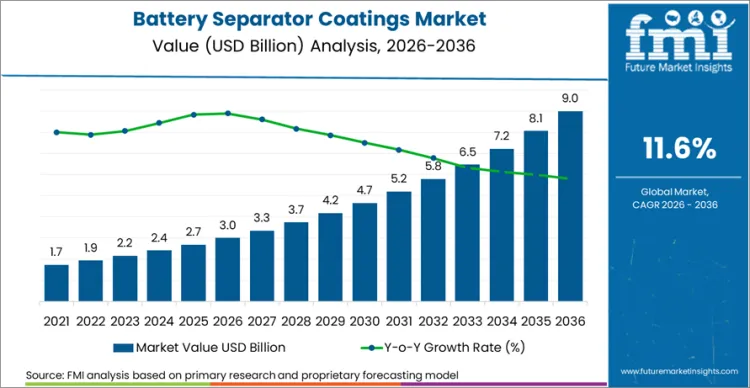
Battery separator coatings revenues will expect to total USD 3.0 billion by 2026. FMI anticipates this valuation to rise further to USD 9.0 billion by 2036, with an expected CAGR of 11.6%. The battery separator coatings market is characterized by multi-billion dollar onshoring projects and strategic vertical integration. A primary driver of this shift is the North American electric vehicle supply chain, where major players are establishing integrated facilities to combine base-film manufacturing with advanced coating processes.
A cornerstone of this expansion is the Asahi Kasei and Honda partnership. In November 2024, the two companies finalized a shareholders’ agreement to convert a Canadian subsidiary into a joint venture, Asahi Kasei Honda Battery Separator Corporation. This entity is currently constructing a ¥180 billion integrated facility in Port Colborne, Ontario, designed to produce approximately 700 million square meters of coated film annually starting in 2027. This localization strategy is further reinforced by a March 2025 capacity rights agreement between Asahi Kasei and Toyota Tsusho, ensuring a dedicated supply of coated Hipore™ separators for the USA market from a separate facility in North Carolina.
In USA, ENTEK is executing a USD 1.5 billion expansion in Terre Haute, Indiana. Supported by a USD 200 million USA Department of Energy grant, the site is projected to reach a production capacity of 1.4 billion square meters of ceramic-coated separators by 2027. Regarding the long-term strategic relevance of such domestic footprints, Larry Keith, CEO of ENTEK, stated:
“With I Squared’s capital, strategic expertise, and global network, we will expand the USA.’s manufacturing footprint, create high-quality jobs, and meet surging demand for batteries across critical applications, from EVs and energy storage to military defense equipment and data centers.”
This mirrors a global trend toward high-heat-resistance solutions, as evidenced by LG Chem’s December 2025 acquisition of Toray’s remaining 50% stake in their Hungarian joint venture. By taking full control of LG Toray Hungary Battery Separator Kft., LG Chem has streamlined the integration of its proprietary coating technology with existing film production.
Technological evolution in 2026 is shaped by strategic collaborations like the February 3, 2026, MoU between Arkema and Senior Technology. This partnership focuses on advancing adhesion technologies and precision coating for next-generation semi-solid batteries. Collectively, these actions indicate a market pivot toward high-performance, coated membranes that are produced within regional trade blocs to satisfy domestic-content requirements.
Summary of Battery Separator Coatings Market
What is Growth Outlook for Battery Separator Coatings Market as per Future Market Insights Projection?
Future Market Insights projects the battery separator coatings market to expand at a CAGR of 11.6% from 2026 to 2036, increasing from USD 3.0 billion in 2026 to USD 9.0 billion by 2036.
FMI Research Approach: FMI proprietary forecasting model integrating EV and stationary storage deployment, domestic battery supply chain localization, and adoption of high-heat-resistance separator technologies across regional gigafactory networks.
How do FMI Analysts Perceive Battery Separator Coatings Market to Evolve?
FMI analysts perceive the market evolving from component-level sourcing toward vertically integrated, regionally anchored manufacturing ecosystems. Separator coatings are increasingly treated as safety-critical materials rather than commoditized inputs, with performance, qualification depth, and supply assurance shaping long-term procurement decisions. Growth is being driven by localization mandates, high-nickel battery architectures, and tighter safety requirements in traction battery platforms.
FMI Research Approach: Assessment of battery OEM localization strategies, coating qualification timelines, and capital deployment into integrated film-and-coating production facilities.
Which Country Holds Largest Share in Global Battery Separator Coatings Market?
China holds the largest share of the global battery separator coatings market, supported by large-scale integrated separator manufacturing clusters, rapid capacity expansion, and sustained demand from domestic EV and energy storage production.
FMI Research Approach: Country-level modeling based on separator production capacity, battery cell output, and integration of coating technologies within national battery manufacturing hubs.
How Large will the Battery Separator Coatings Market be by 2036?
The global battery separator coatings market is projected to reach USD 9.0 billion by 2036.
FMI Research Approach: Long-term revenue forecasting derived from EV penetration rates, expansion of high-performance battery chemistries, and rising material intensity of coated separators in next-generation cells.
What is the Definition of Battery Separator Coatings Market?
The battery separator coatings market comprises functional coating materials applied to polyolefin and specialty separator films to enhance thermal stability, safety, and mechanical integrity in lithium-ion batteries used across electric vehicles, stationary storage, and industrial applications.
FMI Research Approach: FMI market taxonomy and inclusion–exclusion framework covering separator types, coating chemistries, and end-use battery applications requiring enhanced thermal and safety performance.
What are some Globally Unique Trends Shaping Battery Separator Coatings Market?
Globally unique trends include the shift toward ceramic and mineral-based coatings, consolidation of coating operations into integrated gigafactory ecosystems, growing adoption of lightweight high-heat-resistance layers, and increasing collaboration between separator producers and battery OEMs to co-develop safety-critical coating solutions.
FMI Research Approach: Synthesis of battery safety regulations, manufacturing localization policies, and technology roadmaps across major EV-producing regions.
Battery Separator Coatings Market Key Takeaways
| Metrics | Values |
|---|---|
| Expected Value (2026E) | USD 3.0 billion |
| Projected Value (2036F) | USD 9.0 billion |
| CAGR (2026-2036) | 11.6% |
Source: Future Market Insights (FMI) analysis, based on proprietary forecasting model and primary research
Why is the Battery Separator Coatings Market Growing?
Battery separator coatings demand is seeing a shift toward consolidating production in high-capacity hubs to maximize efficiency. In November 2025, Sumitomo Chemical announced the restructuring of its separator business, with plans to cease production at its Ohe Works in Japan by March 2026. The company is consolidating its manufacturing functions at its subsidiary site in South Korea, specifically to leverage greater capacity and higher productivity for its heat-resistant separator lines. This move is designed to enhance competitiveness within the medium-to-long-term global electric vehicle market.
Significant capital is being deployed through government-backed grants to establish domestic material supply chains. In late 2024 and throughout 2025, the USA Department of Energy (DOE) finalized agreements for massive infrastructure projects, including a $178 million grant to Solvay for a new facility in Augusta, Georgia. This site, expected to be operational in 2026, is dedicated to producing specialized materials used for separator coatings. The DOE disbursed the first instalment of an up to $1.3 billion loan to ENTEK in September 2025 to finance a major manufacturing facility in Indiana, marking a significant step in establishing a resident-owned production base in North America.
Strategic alliances are accelerating the deployment of materials for next-generation energy storage. On February 3, 2026, Arkema and Senior Technology signed a Memorandum of Understanding to deepen technical cooperation. This development focuses on the industrialization of materials for emerging semi-solid battery manufacturing. By combining expertise in specialty materials with advanced industrialization capabilities, the collaboration aims to validate new deposition and coating processes on electrodes to support the global transition toward high-performance electric mobility.
How is Battery Separator Coatings Market Segmented?
The market is primarily bifurcated by the underlying manufacturing process of the polyolefin base, the chemical composition of the added functional layer, and the final application of the battery cell. Current market activity is heavily concentrated in the wet-processed polyolefin segment, which accounts for 37% of the separator type category.
In terms of chemistry, ceramic or alumina-based coatings lead with a 35% share due to their superior thermal stability. From an application standpoint, EV Traction Batteries represent the dominant end-use segment, commanding 41% of the market share as global automotive supply chains transition to localized production.
How is the Shift toward Integrated Regional Hubs Redefining Wet-Process Production?
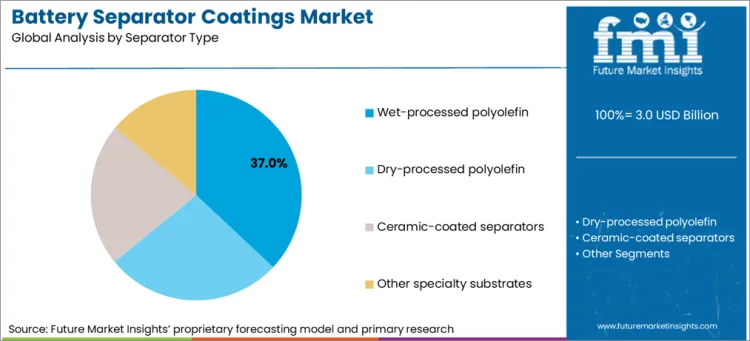
Wet-processed polyolefin holds a leading 37% market share, a dominance driven by the material's superior pore uniformity and mechanical strength. A significant development in this space is the move toward integrated mega-sites that combine film extrusion and coating on a single line to eliminate logistical damage. On October 31, 2024, Asahi Kasei announced a landmark investment of approximately ¥40 billion to install new coating lines specifically for its wet-process Hipore™ separators.
This development is not limited to a single geography but is a coordinated global expansion across the United States, Japan, and South Korea, with a scheduled start-up in the first half of 2026. This strategic move aims to increase the company’s total coating capacity to 1.2 billion square meters per year, effectively providing enough material for 1.7 million electric vehicles. By locating these lines within existing facilities in Charlotte, North Carolina, and Pyeongtaek, South Korea, the company is shortening the supply chain between base-film production and the final coated product.
Will Mineral Substitution and Weight Reduction Set New Standards for Heat-Resistant Layers?
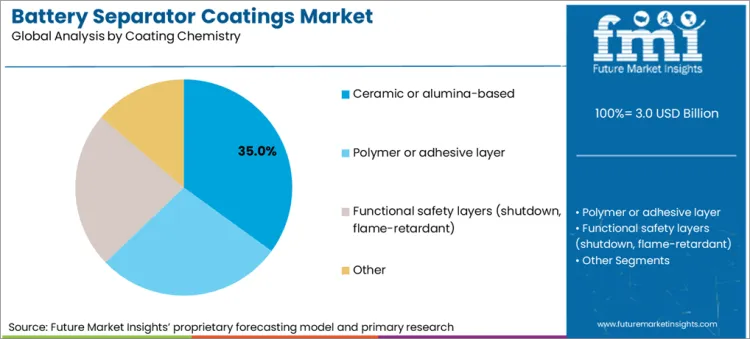
Ceramic or alumina-based solutions represent 35% of the market, primarily valued for preventing internal shorts during high-temperature events. Recent developments show a shift toward "lightweighting" these layers to boost overall cell energy density without sacrificing safety. In October 2025, at the North America Battery Show, Semcorp unveiled a new generation of flame-retardant separators that achieved a 40% reduction in coating weight compared to traditional alumina ceramic coatings.
By utilizing innovative heat-absorbing materials that release flame-inhibiting gases, the company addressed the dual requirement of fire suppression and weight efficiency. Furthermore, the industry is seeing a transition from alumina to boehmite particles, cited for their lower hardness and superior thermal stability. Examples of this are evident in Sumitomo Chemical’s late 2025 decision to consolidate its coating operations in South Korea by March 2026, a move designed to scale the production of these advanced mineral-coated membranes for the high-performance automotive sector.
Can Cross-Conglomerate Partnerships Stabilize the Surge in Traction Battery Demand?
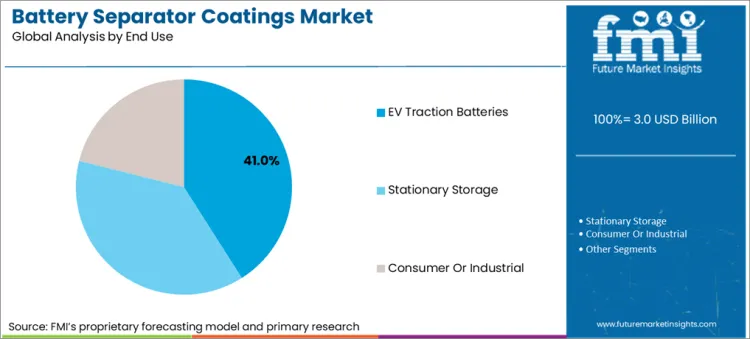
EV traction batteries remain the largest end-use driver with a 41% market share, necessitating unprecedented levels of cross-industry collaboration to secure supply. A unique development in this sector is the April 15, 2025, agreement between historical rivals LG Energy Solution and SK IE Technology (SKIET). Under this deal, SKIET began supplying base separator film to LG’s North American facilities for localized coating and assembly.
This partnership is specifically designed to meet the surging demand for domestic-content-compliant batteries in the USA market, with an initial target of supplying material for 300,000 EVs. Similarly, LG Chem demonstrated its commitment to this segment at InterBattery 2025 by introducing Nexula™, a specialized thermal runaway suppression coating. These developments signify a shift where the traction battery segment is no longer just buying a component, but is co-developing protective coating ecosystems with material scientists to ensure the long-term reliability of high-nickel vehicle platforms.
What Drivers, Restraints, Opportunities, and Trends Prevail in the Battery Separator Coatings Market?
The primary driver for the market is the formation of strategic alliances between Asian material specialists and North American battery manufacturers to secure supply ahead of 2026 production targets. In March 2025, SK IE Technology (SKIET) signed a Memorandum of Understanding with Gotion High-Tech to supply separators for the latter's upcoming manufacturing facilities in Illinois, USA, and Slovakia. This partnership is specifically designed to leverage regional strengths and ensure a stable supply of coated membranes for both EV and ESS markets, reflecting a broader trend where separator producers are following battery cell makers into localized trade blocs.
High capital intensity and long qualification timelines for new production lines continue to act as significant restraints. IEA’s Global EV Outlook 2025 expects the battery component industry to face a demanding reality characterized by rising capital costs and global overcapacity in certain sub-sectors. These factors force long-term validation periods before a facility can reach commercial start of production. This challenge was emphasized in a January 2026 announcement from Morrow Batteries, which noted that European manufacturers must prioritize cash preservation and strategic partnerships to navigate price pressures from low-cost imports while scaling their own industrial capabilities.
Expansion into high-voltage battery architectures presents a substantial opportunity for specialty coating providers. Celgard and Morrow Batteries have entered into a multi-year joint development agreement to commercialize dry-process separators for LNMO cells. As Morrow prepares for series production at its Norwegian gigafactory in 2026, this collaboration highlights an opportunity to move beyond standard chemistries toward high-voltage systems that require proprietary, heat-resistant coatings to maintain safety and longevity in extreme operating conditions.
Participants face a dual threat from aggressive pricing strategies and the need for painful structural reforms. Toray Industries, in its 2025 Integrated Report, detailed its Darwin Project, a strategy to reform businesses where capital investment has not yielded sufficient returns due to the rise of competitors and the commoditization of mainstay products. As noted in SKIET’s 2025 strategic disclosures, the industry is currently navigating a period of intensive restructuring. Companies that fail to differentiate through high-performance coatings risk being marginalized in a market increasingly defined by cost-competitiveness and rapid technological turnover.
Analysis of Battery Separator Coatings Market by Key Countries
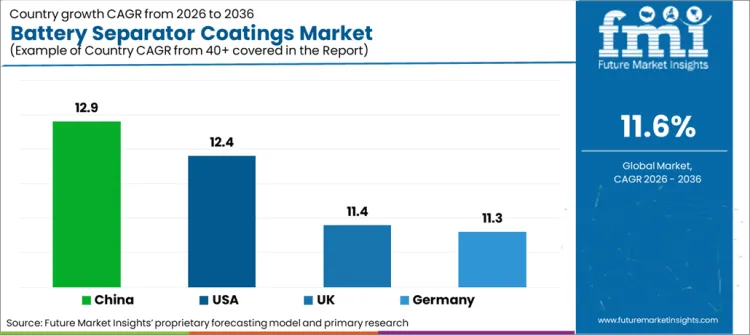
The global landscape is defined by aggressive expansion in Asia to sustain high-volume demand, while North American and European markets are focused on establishing first-of-its-kind domestic production to meet upcoming regulatory deadlines. China remains the volume leader, whereas the USA and Europe are prioritizing the integration of specialty chemicals into regional gigafactory networks to reduce reliance on trans-continental logistics.
| Country | CAGR (2026-2036) |
|---|---|
| China | 12.9% |
| USA | 12.4% |
| UK | 11.4% |
| Germany | 11.3% |
Source: Future Market Insights (FMI) analysis, based on proprietary forecasting model and primary research
Can China’s Transition to Integrated High-Scale Clusters Sustain its Dominance?
China remains the largest market for separator coatings, with an anticipated CAGR of 12.9% through 2036. A significant shift is occurring as major producers move from standalone coating plants to massive, integrated industrial bases. On November 17, 2025, SEMCORP officially commenced the second phase of its lithium battery separator project in Yuxi City, Yunnan Province.
This project represents a Yuan 4.5 billion investment to establish an annual production capacity of 1.6 billion square meters. Unlike previous expansions, this facility is designed as an efficient industrial base that integrates production, storage, and material recycling on a single site, aiming to stabilize the domestic supply of high-performance coated membranes by 2026.
How is the Made-in-USA Mandate driving new Off-Take Alliances?
USA is projected to grow at a CAGR of 12.4%, fueled by the rapid construction of domestic gigafactories. A key development in this region is the formation of strategic off-take agreements between specialty material suppliers and domestic cell manufacturers.
On September 2, 2025, Microporous signed a strategic Memorandum of Understanding with American Battery Factory (ABF) to supply separator materials for ABF’s network of lithium-iron-phosphate (LFP) gigafactories. This partnership is central to ABF’s goal of establishing a fully localized "Made-in-USA" battery ecosystem, with sustained demand for localized materials expected to surge starting in 2026.
Will Specialized Nano-Material Hubs Bridge the UK’s Production Gap?
UK, with a projected CAGR of 11.4%, is pivoting toward high-tech material hubs to support its automotive sector. In 2024 and 2025, companies like Integrals Power Limited (IPL) in Milton Keynes have begun scaling next-generation battery nano-materials. This includes the development of scalable, high-performance materials designed for use in LFP battery cells.
The Faraday Institution’s January 2026 report highlights a national shift toward treating gigafactories as strategic infrastructure, with a focus on narrowing the supply gap through coordinated national strategies that prioritize domestic coating and chemical supply chains to keep pace with international competitors.
Is Germany Leveraging Specialty Chemical Infrastructure to Secure Battery Safety?
Germany is expected to witness a CAGR of 11.3%, with a strong emphasis on leveraging its legacy in specialty chemicals to enhance battery safety. Evonik, a leader in metal oxides, is expanding its global production infrastructure, including significant investments in its Marl site through 2025.
In February 2026, the company announced further expansions of its high-performance materials, such as AEROXIDE® Alu 130, which are used to create thin ceramic coatings on separators. These coatings are specifically designed to suppress dendrite growth and prevent thermal runaway, supporting the German automotive industry's transition to high-safety, next-generation battery architectures.
What is the Competition Outlook for Battery Separator Coatings?
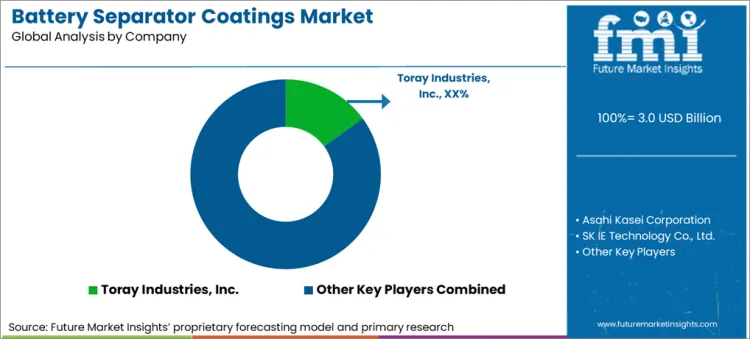
The competitive landscape for battery separator coatings is defined by a shift from simple mechanical manufacturing to sophisticated chemical engineering. Producers are increasingly moving away from standalone coating facilities toward integrated mega-sites to enhance yield and ensure supply chain resilience.
This structural evolution is evidenced by Sumitomo Chemical’s strategic decision to consolidate its PERVIO® aramid-coating operations into its high-productivity South Korean hub by March 2026. This move optimizes the production of heat-resistant separators that are critical for high-nickel EV platforms.
Expansion is also aided through commercialization of novel binder chemistries. For example, Arkema’s December 2025 partnership with Semcorp focuses on integrating innovative materials into international separator lines, targeting the growing requirement for high-precision coatings that maintain structural integrity during extreme thermal excursions.
The strategic focus is pivoting toward functionalized and high-voltage interfaces. Manufacturers are increasingly prioritizing the development of thinner, higher-strength films that do not compromise on safety. An example is the growing adoption of boehmite and alumina-based ceramic layers, which are projected to see accelerated deployment as automakers elevate thermal-propagation safeguards.
In North America, this is manifesting in large-scale infrastructure investments, such as UBE Corporation’s construction of a massive chemical plant in Louisiana, scheduled to begin operations in the second half of 2026. By becoming a domestic supplier of high-purity electrolytes and materials, UBE is positioning itself as a central node in the localized EV ecosystem, ensuring that a robust, regionalized chemical supply chain supports next-generation coatings.
Key Players Profiled
- Toray Industries, Inc.
- Asahi Kasei Corporation
- SK IE Technology Co., Ltd.
- Mitsubishi Chemical Corporation
- Sumitomo Chemical Co., Ltd.
- Celgard, LLC
- UBE Corporation
- ENTEK, LLC
- W-SCOPE Corporation
- Senior Technology Material Co., Ltd.
Market Definition
The battery separator coatings market comprises functional coating layers applied to polymer-based battery separator films to enhance thermal stability, mechanical strength, safety performance, and electrochemical reliability in rechargeable batteries. These coatings are engineered to prevent thermal shrinkage, suppress internal short circuits, and improve electrolyte wettability under high-temperature and high-voltage operating conditions. The market is linked to the evolution of lithium-ion battery architectures, where higher energy density and fast-charging requirements have elevated separator coatings from optional enhancements to safety-critical components in modern battery systems.
The report includes ceramic, polymeric, and hybrid coating systems applied to wet-processed and dry-processed polyolefin separators used in EV traction batteries, stationary energy storage systems, and selected consumer and industrial batteries. It covers alumina- and boehmite-based ceramic coatings, polymer or adhesive layers, and functional safety coatings such as shutdown or flame-retardant layers. The scope encompasses coatings produced through integrated or standalone processes and supplied to battery cell manufacturers across major global regions where gigafactory investments and domestic-content requirements are shaping material demand.
The scope excludes uncoated base separator films, finished battery cells and packs, electrolyte formulations, electrodes, and battery management systems. It also excludes coating equipment, pilot-scale or laboratory-only material development, and non-lithium battery technologies outside mainstream rechargeable battery markets. Recycling activities, raw material mining, and downstream battery assembly operations not directly related to separator coating production fall outside the defined market boundary.
Scope of Report
| Items | Values |
|---|---|
| Quantitative Units | USD 3.0 billion |
| Separator Type | Wet-processed polyolefin, Dry-processed polyolefin, Ceramic-coated separators, Other specialty substrates |
| Coating Chemistry | Ceramic or alumina-based, Polymer or adhesive layer, Functional safety layers (shutdown, flame-retardant), Other Coating Chemistries |
| End Use | EV Traction Batteries, Stationary Storage, Consumer or Industrial |
| Regions Covered | North America, Western Europe, Eastern Europe, East Asia, South Asia & Pacific, Latin America, Middle East & Africa |
| Key Companies | Toray Industries, Inc., Asahi Kasei Corporation, SK IE Technology Co., Ltd., Mitsubishi Chemical Corporation, Sumitomo Chemical Co., Ltd., Celgard, LLC, UBE Corporation, ENTEK, LLC, W-SCOPE Corporation, Senior Technology Material Co., Ltd. |
Source: Future Market Insights (FMI) analysis, based on proprietary forecasting model and primary research
Battery Separator Coatings Market Key Segments
Separator Type
- Wet-processed polyolefin
- Dry-processed polyolefin
- Ceramic-coated separators
- Other specialty substrates
Coating Chemistry
- Ceramic or alumina-based
- Polymer or adhesive layer
- Functional safety layers (shutdown, flame-retardant)
- Other Coating Chemistries
End Use
- EV Traction Batteries
- Stationary Storage
- Consumer Or Industrial
Region
- North America
- Western Europe
- Eastern Europe
- East Asia
- South Asia & Pacific
- Latin America
- Middle East & Africa
Bibliography
- Arora, P., & Zhang, Z. (2024). Battery separators. Chemical Reviews, 124(5), 2681–2734.
- Goodenough, J. B., & Kim, Y. (2023). Challenges for rechargeable lithium batteries. Chemistry of Materials, 35(18), 7115–7136.
- International Electrotechnical Commission. (2024). IEC 62660-2: Secondary lithium-ion cells for the propulsion of electric road vehicles — Reliability and abuse testing. IEC Publishing.
- Li, Y., Wang, X., Sun, J., & Chen, L. (2025). Ceramic-coated separators for high-energy-density lithium-ion batteries: Materials, processing, and safety performance. Journal of Power Sources, 612, 233221.
- Tarascon, J.-M., & Armand, M. (2024). Issues and challenges facing rechargeable lithium batteries. Nature Energy, 9(1), 11–23.
- Asahi Kasei Corporation. (2025). Heat-resistant separator technologies for next-generation lithium-ion batteries. Technical Materials White Paper.
- ENTEK, LLC. (2025). Ceramic-coated polyolefin separators for EV and stationary energy storage applications. Separator Technology Brief.
- Xu, K., Zhang, S. S., & Lee, H. (2024). Separator and interfacial stability in high-voltage lithium-ion batteries. Energy Storage Materials, 58, 450–468.
Frequently Asked Questions
How large is the battery separator coatings market from a materials standpoint?
The battery separator coatings market is valued at around USD 3.0 billion in 2026, reflecting the growing material intensity of safety-critical coatings used in lithium-ion batteries.
What material functions are driving demand for separator coatings?
Demand is driven by the need for enhanced thermal stability, shutdown behavior, and resistance to internal short circuits, particularly in high-energy-density and high-voltage battery cells.
Which coating chemistries dominate current material adoption?
Ceramic and alumina-based coatings dominate due to their superior heat resistance and mechanical stability, followed by polymer and functional safety layers designed to improve adhesion and flame-retardant performance.
Why are coated separators increasingly specified over uncoated films?
Coated separators provide an added safety margin by maintaining structural integrity during thermal events, making them essential for EV traction batteries and other applications with stringent safety requirements.
What factors constrain faster scale-up of advanced separator coating materials?
Key constraints include high capital requirements for coating lines, long qualification cycles tied to battery platforms, and the need to balance coating weight with energy density and cost efficiency.
Preview the report firsthand - request a free sample
Get SampleGet the brochure for pricing and purchase details.
Get PDFTable of Content
- Executive Summary
- Global Market Outlook
- Demand-side Trends
- Supply-side Trends
- Technology Roadmap Analysis
- Analysis and Recommendations
- Market Overview
- Market Coverage / Taxonomy
- Market Definition / Scope / Limitations
- Research Methodology
- Chapter Orientation
- Analytical Lens and Working Hypotheses
- Market Structure, Signals, and Trend Drivers
- Benchmarking and Cross-market Comparability
- Market Sizing, Forecasting, and Opportunity Mapping
- Research Design and Evidence Framework
- Desk Research Programme (Secondary Evidence)
- Company Annual and Sustainability Reports
- Peer-reviewed Journals and Academic Literature
- Corporate Websites, Product Literature, and Technical Notes
- Earnings Decks and Investor Briefings
- Statutory Filings and Regulatory Disclosures
- Technical White Papers and Standards Notes
- Trade Journals, Industry Magazines, and Analyst Briefs
- Conference Proceedings, Webinars, and Seminar Materials
- Government Statistics Portals and Public Data Releases
- Press Releases and Reputable Media Coverage
- Specialist Newsletters and Curated Briefings
- Sector Databases and Reference Repositories
- FMI Internal Proprietary Databases and Historical Market Datasets
- Subscription Datasets and Paid Sources
- Social Channels, Communities, and Digital Listening Inputs
- Additional Desk Sources
- Expert Input and Fieldwork (Primary Evidence)
- Primary Modes
- Qualitative Interviews and Expert Elicitation
- Quantitative Surveys and Structured Data Capture
- Blended Approach
- Why Primary Evidence is Used
- Field Techniques
- Interviews
- Surveys
- Focus Groups
- Observational and In-context Research
- Social and Community Interactions
- Stakeholder Universe Engaged
- C-suite Leaders
- Board Members
- Presidents and Vice Presidents
- R&D and Innovation Heads
- Technical Specialists
- Domain Subject-matter Experts
- Scientists
- Physicians and Other Healthcare Professionals
- Governance, Ethics, and Data Stewardship
- Research Ethics
- Data Integrity and Handling
- Primary Modes
- Tooling, Models, and Reference Databases
- Desk Research Programme (Secondary Evidence)
- Data Engineering and Model Build
- Data Acquisition and Ingestion
- Cleaning, Normalisation, and Verification
- Synthesis, Triangulation, and Analysis
- Quality Assurance and Audit Trail
- Market Background
- Market Dynamics
- Drivers
- Restraints
- Opportunity
- Trends
- Scenario Forecast
- Demand in Optimistic Scenario
- Demand in Likely Scenario
- Demand in Conservative Scenario
- Opportunity Map Analysis
- Product Life Cycle Analysis
- Supply Chain Analysis
- Investment Feasibility Matrix
- Value Chain Analysis
- PESTLE and Porter’s Analysis
- Regulatory Landscape
- Regional Parent Market Outlook
- Production and Consumption Statistics
- Import and Export Statistics
- Market Dynamics
- Global Market Analysis 2021 to 2025 and Forecast, 2026 to 2036
- Historical Market Size Value (USD Million) Analysis, 2021 to 2025
- Current and Future Market Size Value (USD Million) Projections, 2026 to 2036
- Y-o-Y Growth Trend Analysis
- Absolute $ Opportunity Analysis
- Global Market Pricing Analysis 2021 to 2025 and Forecast 2026 to 2036
- Global Market Analysis 2021 to 2025 and Forecast 2026 to 2036, By Separator Type
- Introduction / Key Findings
- Historical Market Size Value (USD Million) Analysis By Separator Type , 2021 to 2025
- Current and Future Market Size Value (USD Million) Analysis and Forecast By Separator Type , 2026 to 2036
- Wet-processed polyolefin
- Dry-processed polyolefin
- Ceramic-coated separators
- Other specialty substrates
- Wet-processed polyolefin
- Y-o-Y Growth Trend Analysis By Separator Type , 2021 to 2025
- Absolute $ Opportunity Analysis By Separator Type , 2026 to 2036
- Global Market Analysis 2021 to 2025 and Forecast 2026 to 2036, By Coating Chemistry
- Introduction / Key Findings
- Historical Market Size Value (USD Million) Analysis By Coating Chemistry, 2021 to 2025
- Current and Future Market Size Value (USD Million) Analysis and Forecast By Coating Chemistry, 2026 to 2036
- Ceramic or alumina-based
- Polymer or adhesive layer
- Functional safety layers (shutdown, flame-retardant)
- Other
- Ceramic or alumina-based
- Y-o-Y Growth Trend Analysis By Coating Chemistry, 2021 to 2025
- Absolute $ Opportunity Analysis By Coating Chemistry, 2026 to 2036
- Global Market Analysis 2021 to 2025 and Forecast 2026 to 2036, By End Use
- Introduction / Key Findings
- Historical Market Size Value (USD Million) Analysis By End Use, 2021 to 2025
- Current and Future Market Size Value (USD Million) Analysis and Forecast By End Use, 2026 to 2036
- EV Traction Batteries
- Stationary Storage
- Consumer Or Industrial
- EV Traction Batteries
- Y-o-Y Growth Trend Analysis By End Use, 2021 to 2025
- Absolute $ Opportunity Analysis By End Use, 2026 to 2036
- Global Market Analysis 2021 to 2025 and Forecast 2026 to 2036, By Region
- Introduction
- Historical Market Size Value (USD Million) Analysis By Region, 2021 to 2025
- Current Market Size Value (USD Million) Analysis and Forecast By Region, 2026 to 2036
- North America
- Latin America
- Western Europe
- Eastern Europe
- East Asia
- South Asia and Pacific
- Middle East & Africa
- Market Attractiveness Analysis By Region
- North America Market Analysis 2021 to 2025 and Forecast 2026 to 2036, By Country
- Historical Market Size Value (USD Million) Trend Analysis By Market Taxonomy, 2021 to 2025
- Market Size Value (USD Million) Forecast By Market Taxonomy, 2026 to 2036
- By Country
- USA
- Canada
- Mexico
- By Separator Type
- By Coating Chemistry
- By End Use
- By Country
- Market Attractiveness Analysis
- By Country
- By Separator Type
- By Coating Chemistry
- By End Use
- Key Takeaways
- Latin America Market Analysis 2021 to 2025 and Forecast 2026 to 2036, By Country
- Historical Market Size Value (USD Million) Trend Analysis By Market Taxonomy, 2021 to 2025
- Market Size Value (USD Million) Forecast By Market Taxonomy, 2026 to 2036
- By Country
- Brazil
- Chile
- Rest of Latin America
- By Separator Type
- By Coating Chemistry
- By End Use
- By Country
- Market Attractiveness Analysis
- By Country
- By Separator Type
- By Coating Chemistry
- By End Use
- Key Takeaways
- Western Europe Market Analysis 2021 to 2025 and Forecast 2026 to 2036, By Country
- Historical Market Size Value (USD Million) Trend Analysis By Market Taxonomy, 2021 to 2025
- Market Size Value (USD Million) Forecast By Market Taxonomy, 2026 to 2036
- By Country
- Germany
- UK
- Italy
- Spain
- France
- Nordic
- BENELUX
- Rest of Western Europe
- By Separator Type
- By Coating Chemistry
- By End Use
- By Country
- Market Attractiveness Analysis
- By Country
- By Separator Type
- By Coating Chemistry
- By End Use
- Key Takeaways
- Eastern Europe Market Analysis 2021 to 2025 and Forecast 2026 to 2036, By Country
- Historical Market Size Value (USD Million) Trend Analysis By Market Taxonomy, 2021 to 2025
- Market Size Value (USD Million) Forecast By Market Taxonomy, 2026 to 2036
- By Country
- Russia
- Poland
- Hungary
- Balkan & Baltic
- Rest of Eastern Europe
- By Separator Type
- By Coating Chemistry
- By End Use
- By Country
- Market Attractiveness Analysis
- By Country
- By Separator Type
- By Coating Chemistry
- By End Use
- Key Takeaways
- East Asia Market Analysis 2021 to 2025 and Forecast 2026 to 2036, By Country
- Historical Market Size Value (USD Million) Trend Analysis By Market Taxonomy, 2021 to 2025
- Market Size Value (USD Million) Forecast By Market Taxonomy, 2026 to 2036
- By Country
- China
- Japan
- South Korea
- By Separator Type
- By Coating Chemistry
- By End Use
- By Country
- Market Attractiveness Analysis
- By Country
- By Separator Type
- By Coating Chemistry
- By End Use
- Key Takeaways
- South Asia and Pacific Market Analysis 2021 to 2025 and Forecast 2026 to 2036, By Country
- Historical Market Size Value (USD Million) Trend Analysis By Market Taxonomy, 2021 to 2025
- Market Size Value (USD Million) Forecast By Market Taxonomy, 2026 to 2036
- By Country
- India
- ASEAN
- Australia & New Zealand
- Rest of South Asia and Pacific
- By Separator Type
- By Coating Chemistry
- By End Use
- By Country
- Market Attractiveness Analysis
- By Country
- By Separator Type
- By Coating Chemistry
- By End Use
- Key Takeaways
- Middle East & Africa Market Analysis 2021 to 2025 and Forecast 2026 to 2036, By Country
- Historical Market Size Value (USD Million) Trend Analysis By Market Taxonomy, 2021 to 2025
- Market Size Value (USD Million) Forecast By Market Taxonomy, 2026 to 2036
- By Country
- Kingdom of Saudi Arabia
- Other GCC Countries
- Turkiye
- South Africa
- Other African Union
- Rest of Middle East & Africa
- By Separator Type
- By Coating Chemistry
- By End Use
- By Country
- Market Attractiveness Analysis
- By Country
- By Separator Type
- By Coating Chemistry
- By End Use
- Key Takeaways
- Key Countries Market Analysis
- USA
- Pricing Analysis
- Market Share Analysis, 2025
- By Separator Type
- By Coating Chemistry
- By End Use
- Canada
- Pricing Analysis
- Market Share Analysis, 2025
- By Separator Type
- By Coating Chemistry
- By End Use
- Mexico
- Pricing Analysis
- Market Share Analysis, 2025
- By Separator Type
- By Coating Chemistry
- By End Use
- Brazil
- Pricing Analysis
- Market Share Analysis, 2025
- By Separator Type
- By Coating Chemistry
- By End Use
- Chile
- Pricing Analysis
- Market Share Analysis, 2025
- By Separator Type
- By Coating Chemistry
- By End Use
- Germany
- Pricing Analysis
- Market Share Analysis, 2025
- By Separator Type
- By Coating Chemistry
- By End Use
- UK
- Pricing Analysis
- Market Share Analysis, 2025
- By Separator Type
- By Coating Chemistry
- By End Use
- Italy
- Pricing Analysis
- Market Share Analysis, 2025
- By Separator Type
- By Coating Chemistry
- By End Use
- Spain
- Pricing Analysis
- Market Share Analysis, 2025
- By Separator Type
- By Coating Chemistry
- By End Use
- France
- Pricing Analysis
- Market Share Analysis, 2025
- By Separator Type
- By Coating Chemistry
- By End Use
- India
- Pricing Analysis
- Market Share Analysis, 2025
- By Separator Type
- By Coating Chemistry
- By End Use
- ASEAN
- Pricing Analysis
- Market Share Analysis, 2025
- By Separator Type
- By Coating Chemistry
- By End Use
- Australia & New Zealand
- Pricing Analysis
- Market Share Analysis, 2025
- By Separator Type
- By Coating Chemistry
- By End Use
- China
- Pricing Analysis
- Market Share Analysis, 2025
- By Separator Type
- By Coating Chemistry
- By End Use
- Japan
- Pricing Analysis
- Market Share Analysis, 2025
- By Separator Type
- By Coating Chemistry
- By End Use
- South Korea
- Pricing Analysis
- Market Share Analysis, 2025
- By Separator Type
- By Coating Chemistry
- By End Use
- Russia
- Pricing Analysis
- Market Share Analysis, 2025
- By Separator Type
- By Coating Chemistry
- By End Use
- Poland
- Pricing Analysis
- Market Share Analysis, 2025
- By Separator Type
- By Coating Chemistry
- By End Use
- Hungary
- Pricing Analysis
- Market Share Analysis, 2025
- By Separator Type
- By Coating Chemistry
- By End Use
- Kingdom of Saudi Arabia
- Pricing Analysis
- Market Share Analysis, 2025
- By Separator Type
- By Coating Chemistry
- By End Use
- Turkiye
- Pricing Analysis
- Market Share Analysis, 2025
- By Separator Type
- By Coating Chemistry
- By End Use
- South Africa
- Pricing Analysis
- Market Share Analysis, 2025
- By Separator Type
- By Coating Chemistry
- By End Use
- USA
- Market Structure Analysis
- Competition Dashboard
- Competition Benchmarking
- Market Share Analysis of Top Players
- By Regional
- By Separator Type
- By Coating Chemistry
- By End Use
- Competition Analysis
- Competition Deep Dive
- Toray Industries, Inc.
- Overview
- Product Portfolio
- Profitability by Market Segments (Product/Age /Sales Channel/Region)
- Sales Footprint
- Strategy Overview
- Marketing Strategy
- Product Strategy
- Channel Strategy
- Asahi Kasei Corporation
- SK IE Technology Co., Ltd.
- Mitsubishi Chemical Corporation
- Sumitomo Chemical Co., Ltd.
- Celgard, LLC
- UBE Corporation
- ENTEK, LLC
- W-SCOPE Corporation
- Senior Technology Material Co., Ltd.
- Toray Industries, Inc.
- Competition Deep Dive
- Assumptions & Acronyms Used


