

- Industry Size (2026)
- USD 220 Mn
- Forecast (2036)
- USD 630 Mn
- CAGR (2026 to 2036)
- 11%
Battery Recycling Process Quality and Purity Test Instruments Market Size, Market Forecast and Outlook By FMI
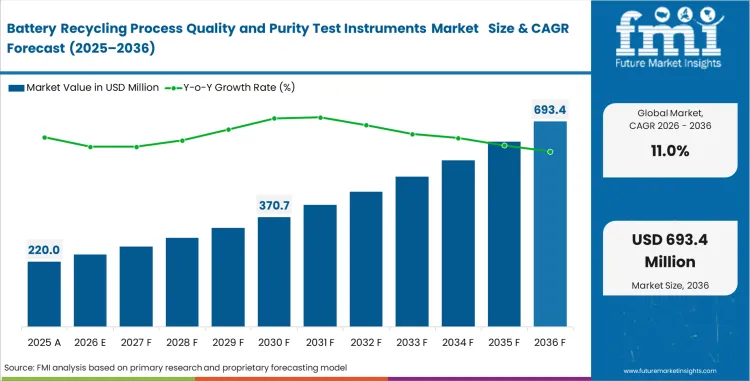
The battery recycling process quality and purity test instruments market was valued at USD 198 million in 2025. The industry is expected to reach USD 220 million in 2026 at a CAGR of 11% during the forecast period. Sustained investment carries total valuation to USD 630 million through 2036 as battery recyclers move from occasional lab confirmation to routine process-linked purity control across feed acceptance, black mass grading, and recovered-material release. Related activity in battery materials recycling supports that direction across adjacent recycling workflows.
Summary of Battery Recycling Process Quality and Purity Test Instruments Market
- Battery Recycling Process Quality and Purity Test Instruments Market Snapshot
- Battery recycling process quality and purity test instruments market is valued at USD 198 million in 2025 and is projected to reach USD 630 million by 2036.
- The industry is expected to grow at a 11% CAGR from 2026 to 2036, creating an incremental opportunity of USD 410 million over the period.
- This category covers analytical instruments used to verify elemental composition, impurity levels, moisture, halogens, and particle characteristics in black mass, leach liquor, feedstock scrap, and recovered salts generated during battery recycling.
- Supply decisions remain tied to assay repeatability, calibration stability across chemistries, lab traceability, and whether instruments can support both incoming scrap screening and downstream purity release work.
- Demand and Growth Drivers
- Battery recycling capacity is moving higher across Asia, North America, and Europe, which lifts demand for process-linked assay tools at pretreatment, hydromet, and refining stages.
- Recycled-content verification is becoming more formal in battery value chains, which raises the need for instruments that can support auditable composition and impurity records rather than only fast internal screening.
- Black mass, recovered lithium salts, and nickel-, cobalt-, and manganese-bearing streams are seeing tighter quality checks because recovery economics shift quickly when feed variability is not measured early.
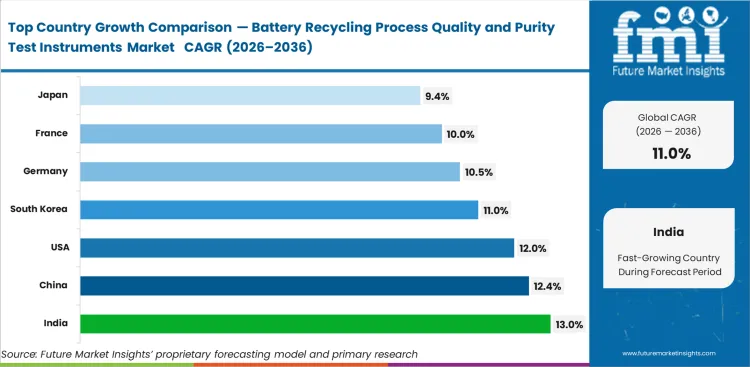
- Among key countries, India is estimated to rise at 13% CAGR by 2036, followed by China at 12.4%, the United States at 12%, South Korea at 11%, Germany at 10.5%, France at 10%, and Japan at 9.4% in the same time period.
- Adoption still slows when recyclers depend on outsourced testing, because handoff delays can interrupt process tuning and postpone material release decisions.
- Product and Segment View
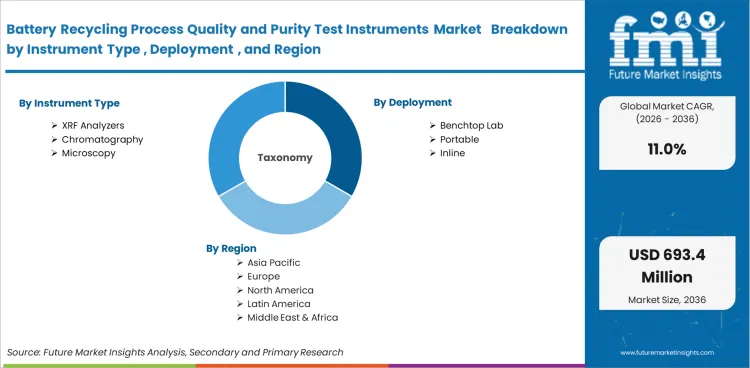
- The market covers XRF analyzers, ICP systems, chromatography systems, microscopy tools, and thermal analyzers used for composition control, impurity checks, moisture testing, halogen testing, and particle analysis.
- Applications span incoming battery scrap sorting, black mass grading, leach liquor process control, and recovered-salt release testing across battery recycling lines and associated refining workflows.
- XRF analyzers lead the Instrument Type segment with 31% share because recyclers need fast, non-destructive screening before committing samples to slower wet-chemistry or trace-level lab methods.
- As formal release testing, method validation, and cross-chemistry repeatability still sit mainly inside plant and central laboratory setups, Benchtop lab leads the Deployment segment with 54% share.
- Elemental assay leads the Test Function segment with 38% share because pricing, process tuning, and downstream recovery decisions depend on reliable quantification of lithium, nickel, cobalt, manganese, copper, aluminum, and iron.
- Black mass leads the Sample Stream segment with 46% share because it is the core intermediate where composition drift and impurity carryover affect recovery yields and refining economics.
- Since Recyclers carry the earliest and most frequent testing burden across feed acceptance, process adjustment, and product release, they lead the End User segment with 57% share.
- Scope includes stand-alone and integrated quality and purity test instruments used in battery recycling workflows, but excludes shredders, leaching reactors, furnaces, and general plant automation sold without dedicated analytical functionality.
- Geography and Competitive Outlook
- India, China, and the United States represent the fastest-rising national demand bases, while Germany, France, and Japan remain more mature but technically exacting destinations for higher-spec analytical systems.
- Competition centers on method coverage, calibration credibility, local service response, and the ability to support both fast plant decisions and defensible purity documentation.
- The field remains moderately fragmented, with the leading supplier estimated at 12.4% share, because buyers often assemble instrument stacks from several vendors rather than standardize a full site around one brand.
Key Takeaways, Market Size, and Forecast
- The Battery Recycling Process Quality and Purity Test Instruments Market is projected to grow from USD 220 million in 2026 to USD 630 million by 2036, expanding at a CAGR of 11%.
- The market was valued at USD 198 million in 2025, reflecting early-stage but accelerating adoption of process-linked analytical testing in battery recycling operations.
- By 2036, the Battery Recycling Process Quality and Purity Test Instruments Market is expected to reach a total value of USD 630 million, supported by routine in‑plant purity verification and documentation needs.
- From 2026 to 2036, the market is forecast to expand at a steady 11% CAGR, tracking the scale‑up of battery recycling capacity and tighter quality control requirements.
- The market is projected to generate an incremental opportunity of USD 410 million between 2026 and 2036 as recyclers increase internal analytical depth.
- In 2026, XRF analyzers are expected to account for 31% of the instrument type segment, driven by demand for fast, non‑destructive screening of incoming battery scrap and black mass.
- India (13%) and China (12.4%) are among the fastest growing national markets, supported by rapid recycling capacity additions and first‑wave laboratory investments
Battery Recycling Process Quality and Purity Test Instruments Market Key Takeaways
| Metric | Details (2026-2036) |
|---|---|
| Industry Size | USD 220 million |
| Industry Value | USD 630 million |
| CAGR | 11% |
Source: Future Market Insights analysis, based on proprietary forecasting model and primary research
Laboratories no longer use these systems only for occasional chemistry reports. Plants need instruments that narrow the gap between uncertain incoming feed and operating action on the same day. Mixed scrap, changing cathode mixes, and tighter purity thresholds are pushing labs toward methods that are fast enough for production support and defensible enough for customer review. Assay platforms are now being compared on cycle time, calibration carryover, local service depth, and method continuity rather than on capital cost alone. Coverage in battery testing equipment shows how battery quality work is becoming more formal and method dependent.
Adoption becomes easier when a recycler runs more testing inside the plant rather than relying on external laboratories for every release point. Internal assay capacity cuts handoff delays, gives operators faster visibility on feed variation, and lets commercial teams speak with more confidence about material quality. Similar logic appears in lead acid recycling, where repeatable verification matters because output acceptance depends on confidence in composition and impurity control.
India is projected to advance at 13% CAGR through 2036, followed by China at 12.4%, the United States at 12%, South Korea at 11%, Germany at 10.5%, France at 10%, and Japan at 9.4%. Faster expansion in India and China reflects ongoing capacity buildout, lower installed analytical depth, and wider room for first-time method deployment. Germany, France, and Japan remain technically exacting markets where spending is estimated to come more from upgrades, method expansion, and tighter documentation needs than from first-wave laboratory setup.
Segmental Analysis
Battery Recycling Process Quality and Purity Test Instruments Market Analysis by Instrument Type
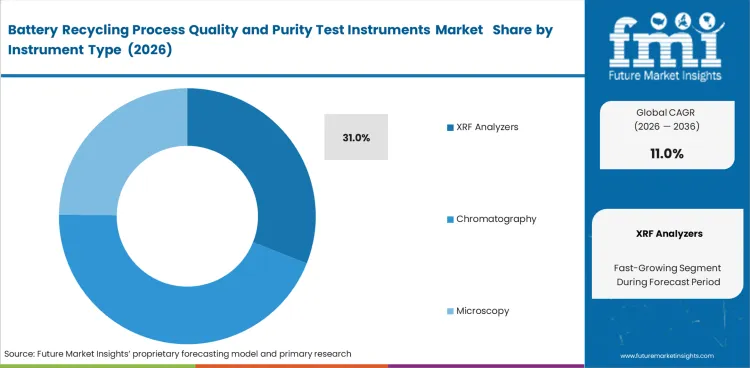
Screening speed matters early in battery recycling because operators need a rapid reading of feed composition before deciding which samples deserve deeper laboratory work. XRF analyzers are expected to account for 31% share in 2026 because they shorten the first decision cycle and help plants sort mixed incoming material without destroying the sample and gains traction when throughput pressure is high and feed variability can damage recovery economics if it is discovered too late. ICP systems, chromatography, microscopy, and thermal analyzers remain essential, though they usually enter later in the method stack where deeper compositional or impurity work is required. Underinvestment in fast front-end screening can send poor feed into a slower laboratory queue, delaying both process correction and material pricing.
- Rapid screening: Fast composition checks help operators separate routine feed from material that needs deeper confirmation, which reduces avoidable lab congestion.
- Non-destructive use: Samples stay intact during first-pass testing, which supports follow-up work when a batch needs tighter impurity review.
- Workflow timing: Early signal quality improves feed acceptance decisions before downstream recovery steps lock in a costly process route.
Battery Recycling Process Quality and Purity Test Instruments Market Analysis by Deployment
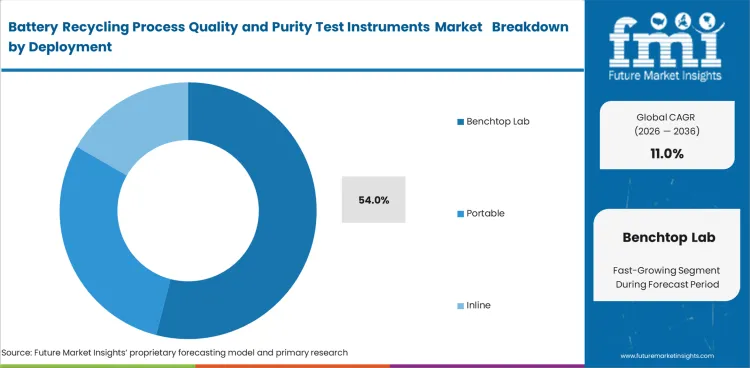
Laboratory control remains the center of this market because purity release and method validation still require stable operating conditions and repeatable workflows. . Benchtop lab is projected to contribute 54% share in 2026, reflecting the need to compare mixed chemistries under controlled settings rather than rely only on portable or inline readings. Most plants build around lab systems first and then decide whether portable or at-line tools should handle screening closer to the line. The order matters because instrument stacks in recycling plants are assembled around traceability and defensibility rather than speed alone. Treating deployment mainly as a portability decision can create data gaps between plant screening and final release work.
- Controlled conditions: Stable sample preparation and calibration routines make lab systems more dependable when purity claims must hold up under customer review.
- Method continuity: Benchtop platforms make it easier to compare feed, intermediate, and output samples inside one validated workflow.
- Release discipline: Plants that skip strong lab coverage may still screen material quickly, though they risk weaker evidence at the point of commercial release.
Battery Recycling Process Quality and Purity Test Instruments Market Analysis by Test Function
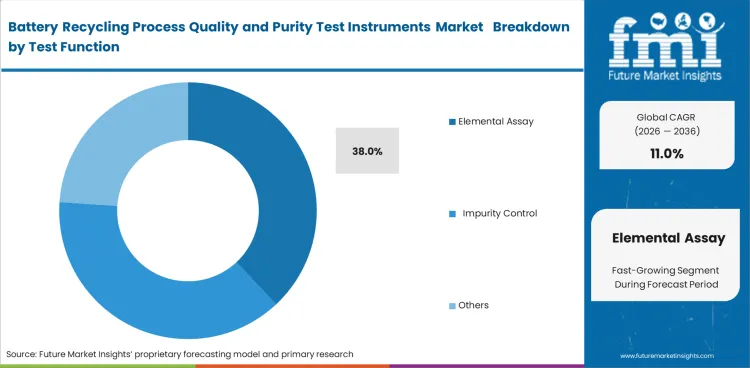
Pricing discipline in battery recycling depends on knowing what is present in the material, not on broad assumptions about chemistry families. Elemental assay is forecast to represent 38% share in 2026 because nickel, cobalt, manganese, lithium, copper, aluminum, and iron measurements sit at the center of feed valuation and process correction. Quality managers use this function to decide whether a batch matches the route planned for it and whether impurity carryover is starting to threaten recovery targets. That makes elemental work the anchor around which moisture testing, halogen checks, particle analysis, and impurity control methods are added. Plants that delay accurate elemental confirmation often discover feed mismatch after process chemistry has already moved in the wrong direction.
- Composition certainty: Reliable elemental data gives operators a firmer basis for route selection and batch pricing before process losses accumulate.
- Impurity visibility: Primary assay work also shows where contamination risk is building, which helps labs decide what confirmatory tests to run next.
- Recovery tuning: Process adjustments are easier when chemistry drift is measured early enough to correct leach and refining conditions.
Battery Recycling Process Quality and Purity Test Instruments Market Analysis by Sample Stream
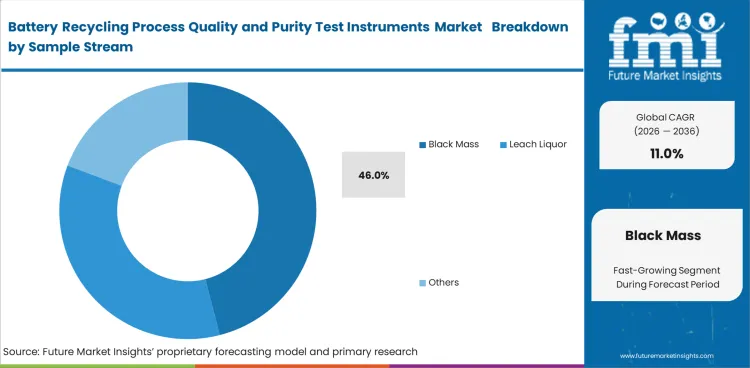
Black mass draws the heaviest testing attention because it is the intermediate where value concentration, contamination, and downstream recovery potential become commercially visible. Market estimates place black mass at 46% share in 2026. Leadership comes from its role as the material most likely to be traded, refined, or moved into further chemical processing on the basis of documented composition. Leach liquor, feedstock scrap, and recovered salts also require testing, though black mass carries the broadest mix of valuation and process-control demands. FMI analysis treats this stream as the point where weak assay discipline creates the fastest commercial penalties. Misreading black mass quality can reduce margin through both weaker refining efficiency and lower confidence at release.
- Intermediate value: Black mass sits at the handoff between physical recycling and chemical recovery, so composition errors carry through the rest of the process.
- Trade readiness: Material that is sold or transferred needs stronger analytical backing than a stream used only for internal experimentation.
- Yield exposure: Small purity or composition errors at this stage can widen losses across later recovery and refining steps.
Battery Recycling Process Quality and Purity Test Instruments Market Analysis by End User
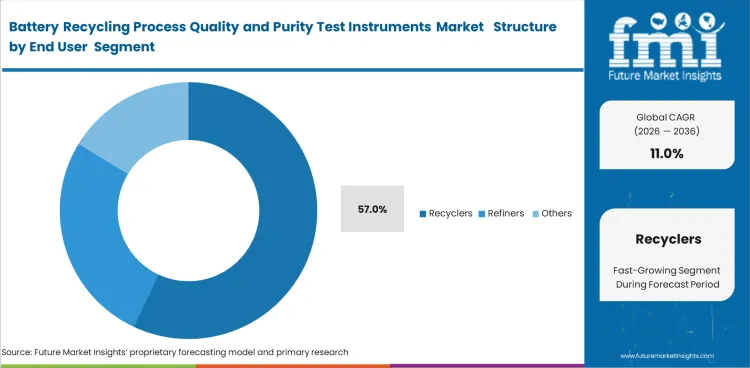
Testing demand sits closest to the recycler because incoming uncertainty meets process economics at that point. Recyclers are expected to make up 57% share in 2026, ahead of refiners, battery makers, and R&D labs. Operations in this group need instruments that can support feed acceptance, line adjustment, and output release within one connected routine. Refiners and battery makers remain important demand pockets, though their spending often follows after recyclers establish the first layer of compositional control which indicates that recyclers gain the most from faster assay feedback because delays at that stage can hold up the entire conversion chain. Heavy reliance on outside confirmation can leave production decisions trailing incoming material reality.
- Feed acceptance: Recyclers need quick evidence on incoming material before committing labor, chemicals, and line time to it.
- Process response: In-house testing lets operators correct recovery conditions while the batch is still active, not after it has moved forward.
- Commercial release: Documented purity data strengthens negotiations when recycled outputs are sold into downstream refining or battery materials channels.
Battery Recycling Process Quality and Purity Test Instruments Market Drivers, Restraints, and Opportunities
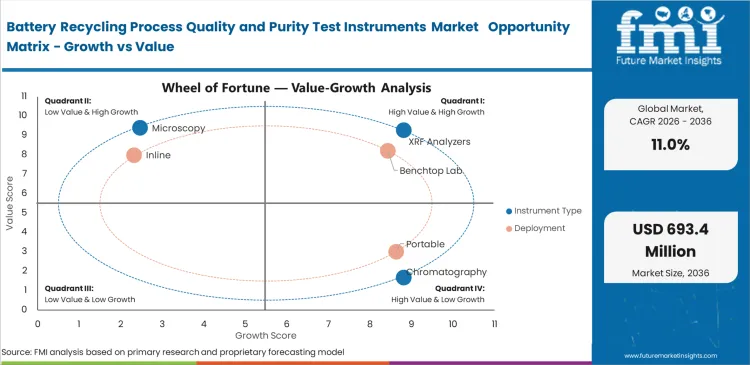
Assay capability is increasingly treated as part of recycling line design rather than as a support function outside the process. Teams need testing depth that can handle mixed chemistries, variable scrap conditions, and tighter evidence requirements around recovered-material quality. Demand therefore rises for instruments that move from fast screening to defensible purity confirmation without breaking method continuity. Commercial risk increases when material value depends on documented composition, because weak testing can distort feed pricing, delay release, or force rework inside the plant.
Qualification cycles remain a practical restraint. Quality teams may agree that deeper in-house testing is needed, though capital approval, method validation, and customer acceptance can move slower than recycling throughput growth. Skills gaps add to that pressure when plants expand faster than they build experienced analytical staff. Outsourced labs offer a partial answer, but handoff delays and weaker process visibility can still leave operators reacting after a batch has already moved too far through the line.
Opportunities in the Battery Recycling Process Quality and Purity Test Instruments Market
- Black mass grading: Recyclers that tighten first-pass compositional screening can shorten the gap between feed arrival and route selection, which improves throughput discipline and pricing confidence.
- Purity documentation: Refiners and battery-material buyers can capture value when they use stronger release testing to back commercial claims around recovered salts and intermediate products.
- Plant integration: Instrument vendors that align lab methods with at-line decisions can win where buyers want faster process feedback without giving up traceable analytical records.
Regional Analysis
Based on the regional analysis, the battery recycling process quality and purity test instruments market is segmented into North America, Latin America, Western Europe, Eastern Europe, East Asia, South Asia & Pacific, and Middle East & Africa across 40 plus countries.
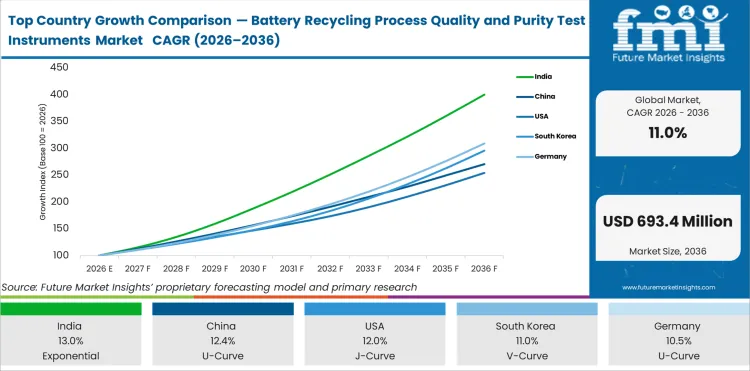
| Country | CAGR (2026 to 2036) |
|---|---|
| India | 13% |
| China | 12.4% |
| United States | 12% |
| South Korea | 11% |
| Germany | 10.5% |
| France | 10% |
| Japan | 9.4% |
Source: Future Market Insights analysis, based on proprietary forecasting model and primary research
Asia Pacific Battery Recycling Process Quality and Purity Test Instruments Market Analysis
Asia Pacific remains the main demand center because recycling capacity, black mass processing, and downstream battery-material activity are building at the same time. Regional demand is rising not only on scale but also on the need for tighter purity records as output moves toward refining or reuse. Labs must handle uneven feed chemistry, variable scrap quality, and faster release schedules, which keeps instrument selection tied to both speed and defensible analytical evidence.
- India: Demand for battery recycling process quality and purity test instruments in India is expected to rise at 13% CAGR through 2036. The country remains one of the strongest growth pockets in this industry because recycling and downstream recovery capacity are still adding dedicated analytical depth. Much of that increase is linked to first-wave laboratory investment around black mass grading, impurity control, and release testing for intermediate materials. Local operators benefit when assay work moves in-house, since outsourced testing can slow route selection and batch release. Cost discipline still matters, yet underinvestment in core laboratory capability can create larger losses later through weaker process control and delayed material qualification.
- China: China operates at a scale that keeps assay speed and repeatability under constant pressure, especially where mixed chemistries and active black mass flows move through large recycling lines. Industry is projected to expand at 12.4% CAGR through 2036. Commercial success depends less on adding one more instrument and more on keeping methods aligned across feed acceptance, intermediate control, and release of recovered products. Laboratories that cannot match plant throughput risk pushing uncertainty too far into hydromet or refining steps. Stronger front-end screening, stable calibration routines, and quick confirmation methods remain central because small analytical delays can widen yield loss and slow customer release across high-volume operations.
- South Korea: Battery manufacturing depth gives South Korea a tighter connection between recovered-material quality and downstream acceptance, so analytical credibility carries unusual weight in this market. Battery recycling process quality and purity test instruments in South Korea are anticipated to grow at 11% CAGR through 2036. Local operations tend to feel the cost of weak method discipline quickly because quality gaps can interrupt commercial handoffs into refining and battery-material supply chains. Expansion is therefore likely to come from systems that support repeatable elemental work, impurity visibility, and clean documentation rather than from broad instrument accumulation. Service response and calibration continuity also matter because downtime can disrupt tightly managed process schedules.
- Japan: Method discipline, installed analytical depth, and strict quality routines make Japan a more mature destination for this category. A 9.4% CAGR is expected for battery recycling process quality and purity test instruments in Japan through 2036, with demand leaning more toward upgrades and method expansion than toward first-time laboratory buildout. Laboratories in this market often place more value on stability, reproducibility, and documentation quality than on headline throughput claims. Spending is therefore estimated to stay concentrated in higher-spec methods that improve traceability across black mass, leach liquor, and recovered salts. Systems that reduce ambiguity without complicating workflow fit local operating priorities more closely.
FMI’s report includes ASEAN, Australia, and New Zealand within the wider regional scope. Patterns across those countries point to selective investment, where buyers add analytical depth when recycling capacity, export readiness, or customer specification pressure becomes strong enough to justify in-house capability.
North America Battery Recycling Process Quality and Purity Test Instruments Market Analysis
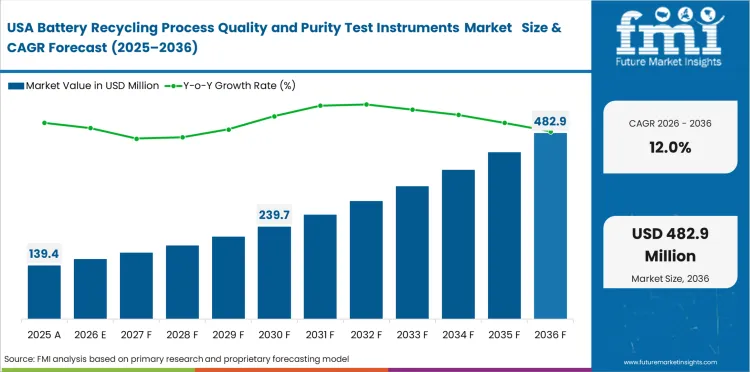
North America is being shaped less by volume alone and more by how closely analytical work is tied to process localization, release discipline, and customer-facing quality evidence. Recycling lines in the region are moving beyond pilot activity and into routines that need repeatable commercial output. Instruments that support both plant decisions and defensible purity records are therefore gaining priority as traceability expectations rise across battery value chains.
- United States: Process localization and pilot-to-commercial conversion keep the United States at the front of the regional outlook. Battery recycling process quality and purity test instruments in the country are likely to increase at 12% CAGR through 2036. Growth is tied to the need for repeatable assay routines that can support feed grading, process correction, and documented release of recovered outputs within one operating cycle. In-house analytical depth matters because delayed confirmation can pull plant decisions and release timing in different directions. Market development is also likely to favor systems that combine speed with defensible records, since laboratories must support both daily operations and later review of material quality claims.
FMI’s report also tracks Canada and Mexico within the regional frame. Demand across those countries tends to strengthen when recycling flows, downstream refining links, and customer qualification requirements become dense enough to support dedicated analytical investment.
Europe Battery Recycling Process Quality and Purity Test Instruments Market Analysis
Europe is defined more by documentation demands and recycled-material scrutiny than by throughput alone. Analytical systems here must support customer review, serial-level records, and stronger purity evidence across several handoff points. Method defensibility, calibration continuity, and service reliability therefore carry more weight than simple test speed. Battery passport work and recycled-content verification keep purity evidence closely tied to commercial acceptance.
- Germany: Germany combines industrial method discipline with a high bar for documentation, which keeps quality evidence central to instrument selection. Battery recycling process quality and purity test instruments in Germany are set to expand at 10.5% CAGR over 2026 to 2036. Laboratories in this market usually prioritize repeatability, service continuity, and calibration confidence because customer review can become more formal once recovered outputs move into refining or battery-material channels. Growth is likely to come from upgrades, added analytical depth, and cleaner integration of methods across feed, intermediate, and release stages. Systems that look capable but weaken record quality are less likely to gain traction in this environment.
- France: France is forecast to post 10% CAGR through 2036, supported by growing emphasis on recycled-material verification and plant-level traceability. Analytical coverage matters here because proving quality late in the commercial cycle can raise cost, delay shipments, and weaken confidence in recovered outputs. Laboratories are therefore likely to favor methods that support both elemental confirmation and stronger impurity control across intermediate and finished streams. Expansion should remain measured rather than abrupt, with spending directed toward systems that improve documentation quality and release readiness. Clear method continuity carries added value because it reduces the risk of rechecking material after operational decisions have already been made.
FMI’s report includes the U.K., Italy, Spain, and other European countries beyond the bullets above. Adoption across that wider set depends less on one shared pattern and more on how closely recycling activity, customer qualification pressure, and documentation rules align inside each national supply base.
Competitive Aligners for Market Players
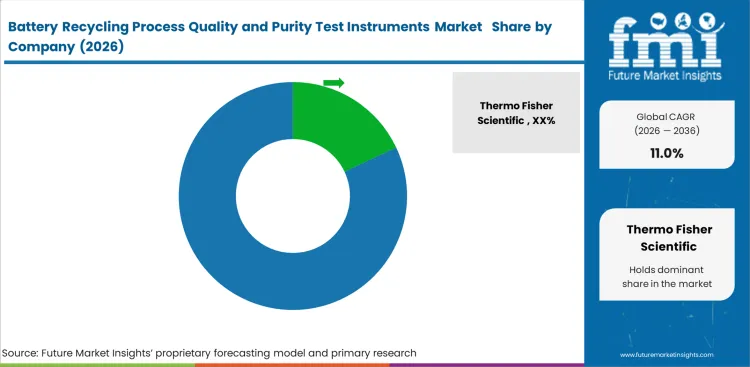
Competition remains moderate because recycling plants rarely source every testing requirement from one supplier. Most sites combine fast screening tools, deeper laboratory systems, and chemistry-specific methods from several vendors. Thermo Fisher Scientific, Bruker, Hitachi High-Tech, Agilent Technologies, AMETEK SPECTRO, Malvern Panalytical, and Metrohm remain relevant because each can cover different points in the analytical workflow. Market position depends less on broad catalog size and more on whether a system performs reliably at the exact stage where a plant needs an answer, whether at feed intake, impurity review, or final release.
Established suppliers hold an advantage when calibration continuity, application guidance, and local service can be delivered without forcing a customer to rebuild its method stack. Smaller challengers still have room where they offer faster front-end screening, narrower black mass specialization, or cleaner workflow fit for smaller plants. Instruments that look capable on paper but create sample bottlenecks, inconsistent methods, or slower service responses tend to lose ground after installation.
Large accounts are likely to resist hard lock-in by splitting purchases across instrument classes and method needs. Vendors will keep trying to widen their footprint by linking plant screening more closely with purity documentation and adjacent battery analytics. Fragmentation should therefore remain in place through 2036, even as leading suppliers strengthen their position around service depth, application credibility, and method fit inside active recycling operations.
Key Players in Battery Recycling Process Quality and Purity Test Instruments Market
- Thermo Fisher Scientific
- Bruker
- Hitachi High-Tech
- Agilent Technologies
- AMETEK SPECTRO
- Malvern Panalytical
- Metrohm
Scope of the Report
| Metric | Value |
|---|---|
| Quantitative Units | USD 220 million to USD 630 million, at a CAGR of 11% |
| Market Definition | Analytical instruments used to verify composition, purity, impurity levels, moisture, halogens, and particle characteristics across battery recycling streams including black mass, leach liquor, feedstock scrap, and recovered salts. |
| Instrument Type Segmentation | XRF analyzers, ICP systems, chromatography, microscopy, thermal analyzers |
| Deployment Segmentation | Benchtop lab, portable, inline, at-line |
| Test Function Segmentation | Elemental assay, impurity control, moisture testing, halogen testing, particle analysis |
| Sample Stream Segmentation | Black mass, leach liquor, feedstock scrap, recovered salts |
| End User Segmentation | Recyclers, refiners, battery makers, R&D labs |
| Regions Covered | North America, Latin America, Western Europe, Eastern Europe, East Asia, South Asia & Pacific, Middle East & Africa |
| Countries Covered | India, China, United States, South Korea, Germany, France, Japan, and 40 plus countries |
| Key Companies Profiled | Thermo Fisher Scientific, Bruker, Hitachi High-Tech, Agilent Technologies, AMETEK SPECTRO, Malvern Panalytical, Metrohm |
| Forecast Period | 2026 to 2036 |
| Approach | FMI combines primary interviews with quality teams, recycling plant decision-makers, and analytical-instrument stakeholders. Baseline sizing is anchored to battery recycling workflow intensity, instrument-stack logic, and country-level capacity formation. Forecasts are validated through cross-checks against recycling buildout, purity-verification needs, and method adoption across adjacent battery testing categories. |
Source: Future Market Insights analysis, based on proprietary forecasting model and primary research
Battery Recycling Process Quality and Purity Test Instruments Market Analysis by Segments
Instrument Type:
- XRF analyzers
- ICP systems
- Chromatography
- Microscopy
- Thermal analyzers
Deployment:
- Benchtop lab
- Portable
- Inline
- At-line
Test Function:
- Elemental assay
- Impurity control
- Moisture testing
- Halogen testing
- Particle analysis
Sample Stream
- Black mass
- Leach liquor
- Feedstock scrap
- Recovered salts
End User:
- Recyclers
- Refiners
- Battery makers
- R&D labs
Region:
- North America
- United States
- Canada
- Mexico
- Latin America
- Brazil
- Western Europe
- Germany
- France
- UK
- Italy
- Spain
- Eastern Europe
- East Asia
- China
- Japan
- South Korea
- South Asia & Pacific
- India
- ASEAN
- Australia & New Zealand
- Middle East & Africa
Bibliography
- Bobba, S., Mathieux, F., Ardente, F., Blengini, G. A., & Tolle, R. (2024, March). Technical specification for a harmonised methodology to calculate the carbon footprint of electric vehicle batteries according to Regulation (EU) 2023/1542. Publications Office of the European Union.
- Federal Consortium for Advanced Batteries. (2024, August). FY2023 end of year report update. USA Department of Energy.
- European Commission. (2025, March 5). New battery-related waste codes update set to boost circular management of batteries and their critical raw materials.
- Guimaraes, L. F., Tenorio, J. A. S., Vaccari, M., Espinosa, D. C. R., & Botelho Junior, A. B. (2024, August 28). Characterization of lithium-ion batteries from recycling perspective towards circular economy. Minerals, 14(9), 878.
- González-Camejo J., a, N. Kamergi b, E. Mino b, A.L. Eusebi, & F. Fatone (2025, June). Worldwide replicability of alternative water recovery technologies to close water loops in decentralised populations, 348, 125481.
This Report Addresses
- How large the market is in 2025, 2026, and 2036.
- What drives demand for quality and purity test instruments inside battery recycling workflows.
- Why XRF analyzers, benchtop lab systems, elemental assay, black mass testing, and recycler demand lead their respective segments.
- Which countries are expanding faster and why their trajectories differ.
- How supply logic is shifting from occasional lab validation toward routine process-linked testing.
- What slows adoption even when recyclers want deeper in-house analytical capability.
- Which companies are active and how competition is structured.
- What remains inside scope and what sits outside the defined market boundary.
Frequently Asked Questions
What is covered in the Battery Recycling Process Quality and Purity Test Instruments Market?
Coverage includes analytical instruments used to measure composition, impurity levels, moisture, halogens, and particle characteristics across battery recycling streams such as black mass, leach liquor, feedstock scrap, and recovered salts.
How large is this market in 2025?
The market is valued at USD 197.8 million in 2025. That figure reflects demand tied to recycling-linked analytical systems rather than the wider battery testing or recycling plant equipment base.
What is the expected value in 2026?
FMI estimates the market at USD 220.0 million in 2026. Buyers are still balancing in-house lab investment against outsourced testing, so spending remains tightly linked to process scale and compliance needs.
How large can the market become by 2036?
FMI projects the market to reach USD 630.0 million by 2036. Expansion depends on how quickly battery recycling capacity turns into recurring assay demand across incoming feed, process control, and release testing.
What CAGR is expected through 2036?
The market is forecast to expand at a 11.10% CAGR from 2026 to 2036. That pace reflects a specialized instrument category tied to a fast-rising recycling workflow rather than a mature replacement-only lab segment.
Which instrument type leads demand?
XRF analyzers are expected to account for 31% share in 2026. Plants use them early because they give fast, non-destructive screening before committing samples to slower laboratory methods.
Why do benchtop lab systems remain ahead of portable and inline options?
Benchtop lab systems are projected to contribute 54% share in 2026. Release testing, method validation, and cross-chemistry comparability still depend on controlled laboratory conditions.
Which test function carries the highest share?
Elemental assay is expected to represent 38% share in 2026. Recyclers need that data to judge feed value, adjust process chemistry, and confirm output purity.
Which sample stream matters most in this market?
Black mass is forecast to secure 46% share in 2026. Buyers focus on it because composition drift at that stage can change downstream recovery economics quickly.
Which end users account for the largest share?
Recyclers are expected to make up 57% share in 2026. They face the earliest and most frequent testing burden across feed acceptance, process tuning, and product release.
Which country records the fastest growth?
India leads the country outlook with 13% CAGR through 2036. Installed analytical capacity is still building, so each new recycling and refining step adds fresh instrument demand.
How does China compare with other countries?
China follows at 12.4% CAGR. Scale matters there because large recycling throughput supports both routine screening and deeper composition control across multiple battery chemistries.
What supports demand in the United States?
The United States is projected to grow at 12% CAGR. Process localization, pilot-to-commercial scale-up, and stricter material traceability expectations keep testing spend active.
Why does South Korea remain an important market?
South Korea is expected to post 11% CAGR through 2036. Battery manufacturing depth and recycling integration create a tighter link between recovered-material quality and commercial acceptance.
What keeps Germany relevant in this category?
Germany is forecast to expand at 10.5% CAGR. Buyers there tend to focus on method credibility, repeatability, and documentation that can withstand customer and compliance review.
How is France positioned?
France is set to record 10% CAGR by 2036. Demand is supported by wider European battery traceability and recycled-content verification requirements.
Why is Japan below the top growth tier?
Japan is expected to grow at 9.4% CAGR. Demand remains technically exacting, though a more established installed base makes replacement and upgrade cycles more visible than greenfield expansion.
Who are the main companies active in this market?
Thermo Fisher Scientific, Bruker, Hitachi High-Tech, Agilent Technologies, AMETEK SPECTRO, Malvern Panalytical, and Metrohm are among the key participants. Buyers usually compare them on method coverage, service depth, and calibration confidence rather than on price alone.
What do buyers compete on when selecting instruments?
Quality teams and plant managers usually weigh repeatability, method suitability for mixed chemistries, local service response, and how well a system fits incoming scrap screening alongside formal purity release work.
What slows adoption even when demand exists?
Qualification cycles remain a practical brake. Buyers may want faster testing, though internal method validation and customer acceptance can delay the purchase decision.
Is this market concentrated or fragmented?
It is moderately fragmented. The leading supplier is estimated at 12.4% share because many sites buy a stack of instruments from several vendors rather than standardize all testing around one brand.
What is excluded from market scope?
Scope excludes shredders, leaching reactors, furnaces, and general plant automation sold without dedicated analytical functionality.
Preview the report firsthand - request a free sample
Get SampleGet the brochure for pricing and purchase details.
Get PDFTable of Content
- Executive Summary
- Global Market Outlook
- Demand-side Trends
- Supply-side Trends
- Technology Roadmap Analysis
- Analysis and Recommendations
- Market Overview
- Market Coverage / Taxonomy
- Market Definition / Scope / Limitations
- Research Methodology
- Chapter Orientation
- Analytical Lens and Working Hypotheses
- Market Structure, Signals, and Trend Drivers
- Benchmarking and Cross-market Comparability
- Market Sizing, Forecasting, and Opportunity Mapping
- Research Design and Evidence Framework
- Desk Research Programme (Secondary Evidence)
- Company Annual and Sustainability Reports
- Peer-reviewed Journals and Academic Literature
- Corporate Websites, Product Literature, and Technical Notes
- Earnings Decks and Investor Briefings
- Statutory Filings and Regulatory Disclosures
- Technical White Papers and Standards Notes
- Trade Journals, Industry Magazines, and Analyst Briefs
- Conference Proceedings, Webinars, and Seminar Materials
- Government Statistics Portals and Public Data Releases
- Press Releases and Reputable Media Coverage
- Specialist Newsletters and Curated Briefings
- Sector Databases and Reference Repositories
- FMI Internal Proprietary Databases and Historical Market Datasets
- Subscription Datasets and Paid Sources
- Social Channels, Communities, and Digital Listening Inputs
- Additional Desk Sources
- Expert Input and Fieldwork (Primary Evidence)
- Primary Modes
- Qualitative Interviews and Expert Elicitation
- Quantitative Surveys and Structured Data Capture
- Blended Approach
- Why Primary Evidence is Used
- Field Techniques
- Interviews
- Surveys
- Focus Groups
- Observational and In-context Research
- Social and Community Interactions
- Stakeholder Universe Engaged
- C-suite Leaders
- Board Members
- Presidents and Vice Presidents
- R&D and Innovation Heads
- Technical Specialists
- Domain Subject-matter Experts
- Scientists
- Physicians and Other Healthcare Professionals
- Governance, Ethics, and Data Stewardship
- Research Ethics
- Data Integrity and Handling
- Primary Modes
- Tooling, Models, and Reference Databases
- Desk Research Programme (Secondary Evidence)
- Data Engineering and Model Build
- Data Acquisition and Ingestion
- Cleaning, Normalisation, and Verification
- Synthesis, Triangulation, and Analysis
- Quality Assurance and Audit Trail
- Market Background
- Market Dynamics
- Drivers
- Restraints
- Opportunity
- Trends
- Scenario Forecast
- Demand in Optimistic Scenario
- Demand in Likely Scenario
- Demand in Conservative Scenario
- Opportunity Map Analysis
- Product Life Cycle Analysis
- Supply Chain Analysis
- Investment Feasibility Matrix
- Value Chain Analysis
- PESTLE and Porter’s Analysis
- Regulatory Landscape
- Regional Parent Market Outlook
- Production and Consumption Statistics
- Import and Export Statistics
- Market Dynamics
- Global Market Analysis 2021 to 2025 and Forecast, 2026 to 2036
- Historical Market Size Value (USD Million) Analysis, 2021 to 2025
- Current and Future Market Size Value (USD Million) Projections, 2026 to 2036
- Y-o-Y Growth Trend Analysis
- Absolute $ Opportunity Analysis
- Global Market Pricing Analysis 2021 to 2025 and Forecast 2026 to 2036
- Global Market Analysis 2021 to 2025 and Forecast 2026 to 2036, By Instrument Type
- Introduction / Key Findings
- Historical Market Size Value (USD Million) Analysis By Instrument Type , 2021 to 2025
- Current and Future Market Size Value (USD Million) Analysis and Forecast By Instrument Type , 2026 to 2036
- XRF Analyzers
- Chromatography
- Microscopy
- XRF Analyzers
- Y-o-Y Growth Trend Analysis By Instrument Type , 2021 to 2025
- Absolute $ Opportunity Analysis By Instrument Type , 2026 to 2036
- Global Market Analysis 2021 to 2025 and Forecast 2026 to 2036, By Deployment
- Introduction / Key Findings
- Historical Market Size Value (USD Million) Analysis By Deployment, 2021 to 2025
- Current and Future Market Size Value (USD Million) Analysis and Forecast By Deployment, 2026 to 2036
- Benchtop Lab
- Portable
- Inline
- Benchtop Lab
- Y-o-Y Growth Trend Analysis By Deployment, 2021 to 2025
- Absolute $ Opportunity Analysis By Deployment, 2026 to 2036
- Global Market Analysis 2021 to 2025 and Forecast 2026 to 2036, By Test Function
- Introduction / Key Findings
- Historical Market Size Value (USD Million) Analysis By Test Function, 2021 to 2025
- Current and Future Market Size Value (USD Million) Analysis and Forecast By Test Function, 2026 to 2036
- Elemental Assay
- Impurity Control
- Others
- Elemental Assay
- Y-o-Y Growth Trend Analysis By Test Function, 2021 to 2025
- Absolute $ Opportunity Analysis By Test Function, 2026 to 2036
- Global Market Analysis 2021 to 2025 and Forecast 2026 to 2036, By Sample Stream
- Introduction / Key Findings
- Historical Market Size Value (USD Million) Analysis By Sample Stream, 2021 to 2025
- Current and Future Market Size Value (USD Million) Analysis and Forecast By Sample Stream, 2026 to 2036
- Black Mass
- Leach Liquor
- Others
- Black Mass
- Y-o-Y Growth Trend Analysis By Sample Stream, 2021 to 2025
- Absolute $ Opportunity Analysis By Sample Stream, 2026 to 2036
- Global Market Analysis 2021 to 2025 and Forecast 2026 to 2036, By End User
- Introduction / Key Findings
- Historical Market Size Value (USD Million) Analysis By End User, 2021 to 2025
- Current and Future Market Size Value (USD Million) Analysis and Forecast By End User, 2026 to 2036
- Recyclers
- Refiners
- Others
- Recyclers
- Y-o-Y Growth Trend Analysis By End User, 2021 to 2025
- Absolute $ Opportunity Analysis By End User, 2026 to 2036
- Global Market Analysis 2021 to 2025 and Forecast 2026 to 2036, By Region
- Introduction
- Historical Market Size Value (USD Million) Analysis By Region, 2021 to 2025
- Current Market Size Value (USD Million) Analysis and Forecast By Region, 2026 to 2036
- North America
- Latin America
- Western Europe
- Eastern Europe
- East Asia
- South Asia and Pacific
- Middle East & Africa
- Market Attractiveness Analysis By Region
- North America Market Analysis 2021 to 2025 and Forecast 2026 to 2036, By Country
- Historical Market Size Value (USD Million) Trend Analysis By Market Taxonomy, 2021 to 2025
- Market Size Value (USD Million) Forecast By Market Taxonomy, 2026 to 2036
- By Country
- USA
- Canada
- Mexico
- By Instrument Type
- By Deployment
- By Test Function
- By Sample Stream
- By End User
- By Country
- Market Attractiveness Analysis
- By Country
- By Instrument Type
- By Deployment
- By Test Function
- By Sample Stream
- By End User
- Key Takeaways
- Latin America Market Analysis 2021 to 2025 and Forecast 2026 to 2036, By Country
- Historical Market Size Value (USD Million) Trend Analysis By Market Taxonomy, 2021 to 2025
- Market Size Value (USD Million) Forecast By Market Taxonomy, 2026 to 2036
- By Country
- Brazil
- Chile
- Rest of Latin America
- By Instrument Type
- By Deployment
- By Test Function
- By Sample Stream
- By End User
- By Country
- Market Attractiveness Analysis
- By Country
- By Instrument Type
- By Deployment
- By Test Function
- By Sample Stream
- By End User
- Key Takeaways
- Western Europe Market Analysis 2021 to 2025 and Forecast 2026 to 2036, By Country
- Historical Market Size Value (USD Million) Trend Analysis By Market Taxonomy, 2021 to 2025
- Market Size Value (USD Million) Forecast By Market Taxonomy, 2026 to 2036
- By Country
- Germany
- UK
- Italy
- Spain
- France
- Nordic
- BENELUX
- Rest of Western Europe
- By Instrument Type
- By Deployment
- By Test Function
- By Sample Stream
- By End User
- By Country
- Market Attractiveness Analysis
- By Country
- By Instrument Type
- By Deployment
- By Test Function
- By Sample Stream
- By End User
- Key Takeaways
- Eastern Europe Market Analysis 2021 to 2025 and Forecast 2026 to 2036, By Country
- Historical Market Size Value (USD Million) Trend Analysis By Market Taxonomy, 2021 to 2025
- Market Size Value (USD Million) Forecast By Market Taxonomy, 2026 to 2036
- By Country
- Russia
- Poland
- Hungary
- Balkan & Baltic
- Rest of Eastern Europe
- By Instrument Type
- By Deployment
- By Test Function
- By Sample Stream
- By End User
- By Country
- Market Attractiveness Analysis
- By Country
- By Instrument Type
- By Deployment
- By Test Function
- By Sample Stream
- By End User
- Key Takeaways
- East Asia Market Analysis 2021 to 2025 and Forecast 2026 to 2036, By Country
- Historical Market Size Value (USD Million) Trend Analysis By Market Taxonomy, 2021 to 2025
- Market Size Value (USD Million) Forecast By Market Taxonomy, 2026 to 2036
- By Country
- China
- Japan
- South Korea
- By Instrument Type
- By Deployment
- By Test Function
- By Sample Stream
- By End User
- By Country
- Market Attractiveness Analysis
- By Country
- By Instrument Type
- By Deployment
- By Test Function
- By Sample Stream
- By End User
- Key Takeaways
- South Asia and Pacific Market Analysis 2021 to 2025 and Forecast 2026 to 2036, By Country
- Historical Market Size Value (USD Million) Trend Analysis By Market Taxonomy, 2021 to 2025
- Market Size Value (USD Million) Forecast By Market Taxonomy, 2026 to 2036
- By Country
- India
- ASEAN
- Australia & New Zealand
- Rest of South Asia and Pacific
- By Instrument Type
- By Deployment
- By Test Function
- By Sample Stream
- By End User
- By Country
- Market Attractiveness Analysis
- By Country
- By Instrument Type
- By Deployment
- By Test Function
- By Sample Stream
- By End User
- Key Takeaways
- Middle East & Africa Market Analysis 2021 to 2025 and Forecast 2026 to 2036, By Country
- Historical Market Size Value (USD Million) Trend Analysis By Market Taxonomy, 2021 to 2025
- Market Size Value (USD Million) Forecast By Market Taxonomy, 2026 to 2036
- By Country
- Kingdom of Saudi Arabia
- Other GCC Countries
- Turkiye
- South Africa
- Other African Union
- Rest of Middle East & Africa
- By Instrument Type
- By Deployment
- By Test Function
- By Sample Stream
- By End User
- By Country
- Market Attractiveness Analysis
- By Country
- By Instrument Type
- By Deployment
- By Test Function
- By Sample Stream
- By End User
- Key Takeaways
- Key Countries Market Analysis
- USA
- Pricing Analysis
- Market Share Analysis, 2025
- By Instrument Type
- By Deployment
- By Test Function
- By Sample Stream
- By End User
- Canada
- Pricing Analysis
- Market Share Analysis, 2025
- By Instrument Type
- By Deployment
- By Test Function
- By Sample Stream
- By End User
- Mexico
- Pricing Analysis
- Market Share Analysis, 2025
- By Instrument Type
- By Deployment
- By Test Function
- By Sample Stream
- By End User
- Brazil
- Pricing Analysis
- Market Share Analysis, 2025
- By Instrument Type
- By Deployment
- By Test Function
- By Sample Stream
- By End User
- Chile
- Pricing Analysis
- Market Share Analysis, 2025
- By Instrument Type
- By Deployment
- By Test Function
- By Sample Stream
- By End User
- Germany
- Pricing Analysis
- Market Share Analysis, 2025
- By Instrument Type
- By Deployment
- By Test Function
- By Sample Stream
- By End User
- UK
- Pricing Analysis
- Market Share Analysis, 2025
- By Instrument Type
- By Deployment
- By Test Function
- By Sample Stream
- By End User
- Italy
- Pricing Analysis
- Market Share Analysis, 2025
- By Instrument Type
- By Deployment
- By Test Function
- By Sample Stream
- By End User
- Spain
- Pricing Analysis
- Market Share Analysis, 2025
- By Instrument Type
- By Deployment
- By Test Function
- By Sample Stream
- By End User
- France
- Pricing Analysis
- Market Share Analysis, 2025
- By Instrument Type
- By Deployment
- By Test Function
- By Sample Stream
- By End User
- India
- Pricing Analysis
- Market Share Analysis, 2025
- By Instrument Type
- By Deployment
- By Test Function
- By Sample Stream
- By End User
- ASEAN
- Pricing Analysis
- Market Share Analysis, 2025
- By Instrument Type
- By Deployment
- By Test Function
- By Sample Stream
- By End User
- Australia & New Zealand
- Pricing Analysis
- Market Share Analysis, 2025
- By Instrument Type
- By Deployment
- By Test Function
- By Sample Stream
- By End User
- China
- Pricing Analysis
- Market Share Analysis, 2025
- By Instrument Type
- By Deployment
- By Test Function
- By Sample Stream
- By End User
- Japan
- Pricing Analysis
- Market Share Analysis, 2025
- By Instrument Type
- By Deployment
- By Test Function
- By Sample Stream
- By End User
- South Korea
- Pricing Analysis
- Market Share Analysis, 2025
- By Instrument Type
- By Deployment
- By Test Function
- By Sample Stream
- By End User
- Russia
- Pricing Analysis
- Market Share Analysis, 2025
- By Instrument Type
- By Deployment
- By Test Function
- By Sample Stream
- By End User
- Poland
- Pricing Analysis
- Market Share Analysis, 2025
- By Instrument Type
- By Deployment
- By Test Function
- By Sample Stream
- By End User
- Hungary
- Pricing Analysis
- Market Share Analysis, 2025
- By Instrument Type
- By Deployment
- By Test Function
- By Sample Stream
- By End User
- Kingdom of Saudi Arabia
- Pricing Analysis
- Market Share Analysis, 2025
- By Instrument Type
- By Deployment
- By Test Function
- By Sample Stream
- By End User
- Turkiye
- Pricing Analysis
- Market Share Analysis, 2025
- By Instrument Type
- By Deployment
- By Test Function
- By Sample Stream
- By End User
- South Africa
- Pricing Analysis
- Market Share Analysis, 2025
- By Instrument Type
- By Deployment
- By Test Function
- By Sample Stream
- By End User
- USA
- Market Structure Analysis
- Competition Dashboard
- Competition Benchmarking
- Market Share Analysis of Top Players
- By Regional
- By Instrument Type
- By Deployment
- By Test Function
- By Sample Stream
- By End User
- Competition Analysis
- Competition Deep Dive
- Thermo Fisher Scientific
- Overview
- Product Portfolio
- Profitability by Market Segments (Product/Age /Sales Channel/Region)
- Sales Footprint
- Strategy Overview
- Marketing Strategy
- Product Strategy
- Channel Strategy
- Bruker
- Hitachi High-Tech
- Agilent Technologies
- AMETEK SPECTRO
- Malvern Panalytical
- Thermo Fisher Scientific
- Competition Deep Dive
- Assumptions & Acronyms Used


