

- Industry Size (2026)
- USD 341.6 Mn
- Forecast (2036)
- USD 904.6 Mn
- CAGR (2026 to 2036)
- 10.20%
Battery Module Vent Gas & Propagation Test Systems Market Forecast and Outlook 2026 to 2036
The global battery module vent gas & propagation test systems market, valued at USD 341.6 million in 2026, is projected to reach USD 904.6 million by 2036, growing at a CAGR of 10.20%. This market plays a crucial role in ensuring the safety and performance of battery modules, particularly as electric vehicle (EV) and energy storage adoption grows. With increasing battery capacities and heightened safety standards, the need for advanced testing solutions to evaluate vent gas emissions and thermal propagation has become vital. These systems simulate worst-case scenarios, including overcharging and short-circuiting, to validate the battery's resilience to catastrophic failures such as thermal runaway, thereby protecting both users and manufacturers.
Quick Stats for Battery Module Vent Gas & Propagation Test Systems Market
- Battery Module Vent Gas & Propagation Test Systems Market Value (2026): USD 341.6 Million
- Battery Module Vent Gas & Propagation Test Systems Market Forecast Value (2036): USD 904.6 Million
- Battery Module Vent Gas & Propagation Test Systems Market Forecast CAGR (2026-2036): 10.20%
- Leading Test System Type in Battery Module Vent Gas & Propagation Test Systems Market: Thermal Runaway Propagation Rigs
- Key Growth Regions in Battery Module Vent Gas & Propagation Test Systems Market: Asia Pacific
- Top Key Players in Battery Module Vent Gas & Propagation Test Systems Market: UL Solutions, Intertek, TÜV Rheinland, Weiss Technik, ESPEC, Thermotron, HORIBA, AVL, Chroma ATE, CSA Group
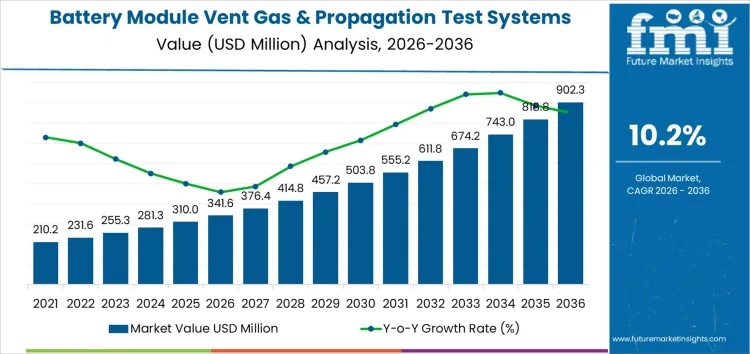
Strategically, the expansion is driven by the automotive industry's shift towards electric mobility, which depends heavily on reliable, high-performance battery systems. Battery manufacturers and OEMs are increasingly investing in specialized test platforms to ensure compliance with stringent regulations. Testing solutions also support the evolution of new battery chemistries and the development of high-energy-density batteries, while addressing regulatory concerns around safety and environmental impact. As manufacturers race to meet consumer demand for longer-lasting, safer, and more efficient batteries, the demand for vent gas and propagation test systems is expected to grow, making this market crucial to the future of energy storage and electric transportation.
Battery Module Vent Gas & Propagation Test Systems Market Key Takeaways
| Metric | Value |
|---|---|
| Industry Value (2026) | USD 341.6 Million |
| Forecast Value (2036) | USD 904.6 Million |
| Forecast CAGR (2026-2036) | 10.20% |
How is the Global Battery Module Vent Gas & Propagation Test Systems Market Advancing?
The global battery module vent gas and propagation test systems market is witnessing significant growth as demand for electric vehicles (EVs) and renewable energy storage solutions continues to rise. These test systems are critical for evaluating the safety and performance of battery modules, particularly in terms of vent gas management and the propagation of potential thermal runaway events. As battery technology advances and high-capacity batteries become more common, ensuring the safe operation of battery modules is of utmost importance. Testing vent gas emissions and thermal propagation ensures that batteries are resilient to failure, reducing the risk of accidents or hazardous events.
Demand is growing due to the increasing demand for high-performance batteries in EVs, grid storage, and portable devices, all of which require stringent safety standards. The ability to simulate real-world conditions and predict how a battery module will behave under stress, such as overcharging or short-circuiting, is a key factor driving the adoption of vent gas and propagation test systems. As the need for more energy-efficient, longer-lasting, and safer batteries grows, these testing systems are essential in ensuring that battery modules meet global safety regulations and performance benchmarks. The ongoing advancements in battery technology will continue to drive the need for these critical testing solutions over the next decade.
What is the Segment-Wise Analysis for the Battery Module Vent Gas & Propagation Test Systems Market?
The battery module vent gas & propagation test systems market is segmented by test system type and end user. Thermal runaway propagation rigs lead the market with a 34% share, followed by vent gas collection & analysis, abuse testing, and environmental & aging chambers. These systems are essential for ensuring the safety, performance, and longevity of battery modules by simulating real-world failure conditions. In terms of end users, cell & module manufacturers hold the largest share at 40%, driven by the need for rigorous testing to meet safety standards.
How Do Thermal Runaway Propagation Rigs Lead the Battery Module Vent Gas & Propagation Test Systems Market?
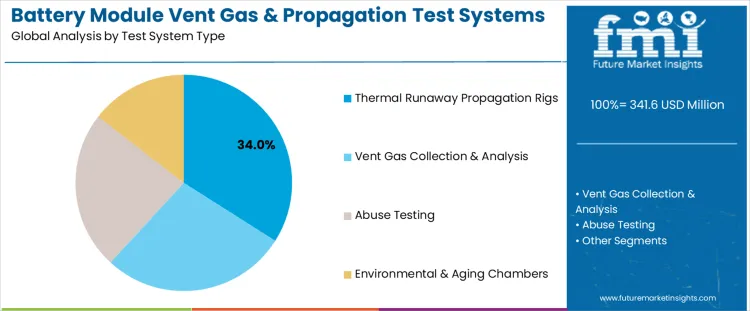
Thermal runaway propagation rigs account for 34% of the battery module vent gas and propagation test systems market share due to their ability to simulate extreme failure conditions in battery cells and modules. These rigs are crucial for testing the safety of battery systems by inducing thermal runaway and evaluating how the failure propagates through the battery modules. They help manufacturers and regulatory bodies ensure that battery packs can withstand real-world conditions and prevent dangerous scenarios like fires or explosions. With the increasing focus on battery safety in electric vehicles and energy storage systems, thermal runaway propagation rigs continue to be a key component in the testing process, solidifying their dominance in the market.
How Do Cell & Module Manufacturers Contribute to the Battery Module Vent Gas & Propagation Test Systems Market?
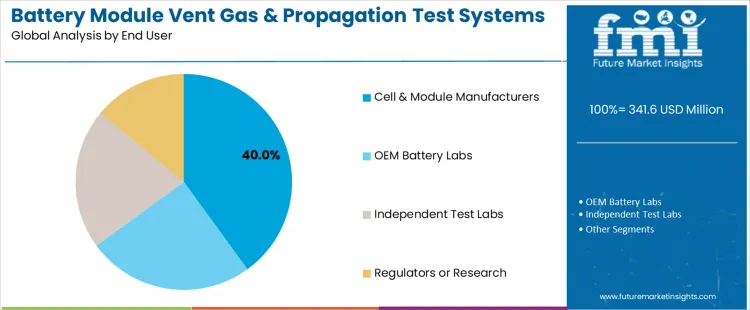
Cell & module manufacturers represent 40% of the market share in the battery module vent gas and propagation test systems market. These manufacturers are responsible for producing the core components of battery systems, including cells and modules, and are required to conduct extensive testing to ensure that their products meet safety, performance, and regulatory standards. Battery safety is a critical concern for manufacturers, especially as demand grows for electric vehicles and large-scale energy storage solutions. To meet these demands, manufacturers rely on advanced test systems to verify their designs, evaluate thermal stability, and assess vent gas emissions during thermal events, ensuring the safe deployment of their products in various applications.
What Are the Key Dynamics for the Battery Module Vent Gas & Propagation Test Systems Market?
The battery module vent gas and propagation test systems market is shaped by the global surge in battery adoption across electric vehicles (EVs), energy storage systems (ESS), consumer electronics, and industrial applications. As battery energy density increases, safety concerns related to thermal runaway, vent gas emissions, and cell to cell fire propagation become more critical. Test systems are essential to assess how battery modules react under extreme conditions and to validate compliance with international safety standards.
How Are the Key Drivers Shaping the Battery Module Vent Gas & Propagation Test Systems Market?
Growth in this market is primarily driven by increasing demand for safer, more reliable battery systems, especially in automotive and energy storage sectors. Stringent government regulations and safety standards require battery manufacturers to conduct vent gas emission and propagation tests to understand failure modes and mitigate risks. Continuous advancements in battery chemistries such as high energy lithium ion formulations intensify the need for robust test platforms that can simulate worst case scenarios, including thermal runaway and gas release. OEMs and battery developers are investing in comprehensive test infrastructure to enhance product quality, reduce recalls, and support innovation in next generation battery technologies.
What Are the Key Trends Shaping the Battery Module Vent Gas & Propagation Test Systems Market?
One major trend is the integration of advanced sensors and real time data acquisition technologies that provide high resolution insights into vent gas composition, temperature gradients, and propagation pathways. Digital twin and simulation tools are increasingly used to complement physical testing, enabling developers to model failure scenarios before physical validation. Cloud based test data management platforms are facilitating collaborative analysis and long term trend tracking across distributed engineering teams. There are also a shift toward modular and scalable test systems that can adapt to different battery sizes and formats, supporting flexible deployment and future proofing test infrastructure.
What is the Growth Outlook for the Battery Module Vent Gas & Propagation Test Systems Market by Country?
| Country | CAGR (%) |
|---|---|
| China | 12.2% |
| Brazil | 11.2% |
| USA | 9.6% |
| Germany | 9.6% |
| UK | 9.4% |
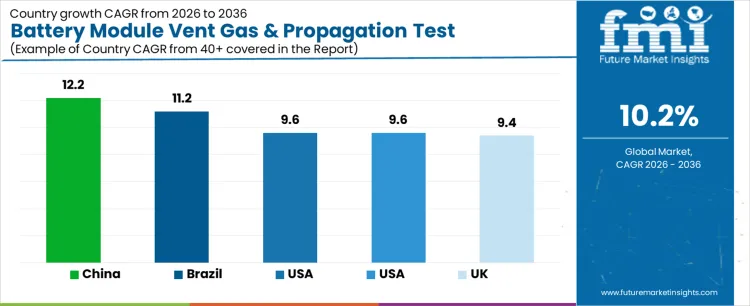
The battery module vent gas & propagation test systems market is experiencing robust growth, with China leading at a 12.2% CAGR, driven by its rapid adoption of electric vehicles and substantial investments in battery technology and infrastructure. Brazil follows with 11.2%, fueled by the growing electric vehicle market and renewable energy initiatives. The USA’s market grows at 9.6%, supported by the rising demand for safe and reliable battery systems in EVs and energy storage solutions. The UK’s market grows at 9.4%, driven by government policies promoting electric mobility and clean energy. Germany’s market also grows at 9.6%, supported by its automotive industry’s shift toward electric vehicles and focus on battery safety.
What is Driving the Growth of the Battery Module Vent Gas & Propagation Test Systems Market in China?
China’s battery module vent gas & propagation test systems market is growing at 12.2%, driven by the rapid growth of its electric vehicle (EV) industry and increasing demand for advanced battery safety testing solutions. As China continues to lead the global EV market, the need for reliable test systems that ensure battery safety, particularly with respect to vent gas emissions and thermal propagation, grows significantly. The country’s government policies supporting green energy and EV adoption, along with increased investments in battery production and technology, further boost the market. With the growing focus on battery performance, reliability, and safety, China is positioning itself as a key player in the battery test systems market.
What is Contributing to the Growth of the Battery Module Vent Gas & Propagation Test Systems Market in Brazil?
Brazil’s battery module vent gas & propagation test systems market is growing at 11.2%, supported by the country’s increasing adoption of electric vehicles and renewable energy projects. As Brazil shifts toward electric mobility, there is a growing need for advanced testing systems to ensure the safety and reliability of batteries used in EVs. The government’s incentives to promote green energy and clean technologies further contribute to the growth of the market. Brazil’s investment in electric vehicle infrastructure, including charging stations and battery manufacturing, also supports the demand for vent gas and propagation test systems. With rising concerns about battery safety, especially regarding thermal runaway and gas emissions, the need for these testing solutions is expected to increase in the coming years.
How is the Battery Module Vent Gas & Propagation Test Systems Market Expanding in the USA?
The USA’s battery module vent gas & propagation test systems market is growing at 9.6%, driven by the country’s significant investments in electric vehicles, renewable energy, and battery storage systems. As the EV market in the USA expands, there is an increasing demand for advanced testing systems that ensure the safety of battery modules, particularly in terms of vent gas emissions and propagation risks. The growing focus on battery safety standards and regulatory requirements further drives market growth. The USA’s commitment to clean energy and transportation solutions, along with its leadership in innovation and technology development, makes it a key player in the battery test systems market. As the EV industry continues to mature, the demand for these testing systems will likely continue to grow.
Why is the Battery Module Vent Gas & Propagation Test Systems Market Growing in the UK?
The UK’s battery module vent gas & propagation test systems market is growing at 9.4%, supported by the country’s push towards electric vehicles and the development of battery technology for renewable energy storage. The UK government’s policies promoting green energy and electric mobility, combined with the increasing adoption of EVs, contribute significantly to the demand for reliable battery testing systems. As automakers in the UK continue to focus on EV production, battery safety has become a top priority. This drives the need for advanced testing solutions that can monitor vent gas and thermal propagation risks. With continued investments in battery technology and the rise of energy solutions, the UK market for battery module test systems is set to grow further.
What is Driving the Growth of the Battery Module Vent Gas & Propagation Test Systems Market in Germany?
Germany’s battery module vent gas & propagation test systems market is growing at 9.6%, driven by the country’s leadership in the automotive industry and its transition towards electric vehicles. As Germany’s automotive manufacturers invest heavily in electric mobility, the demand for safe, reliable battery testing solutions has increased. With stringent safety regulations and a growing focus on the development of high-performance, long-lasting batteries, testing for vent gas emissions and propagation is crucial. Germany’s commitment to sustainability and innovation in the automotive and energy sectors, along with its focus on renewable energy technologies, further fuels the demand for these testing solutions. As battery safety remains a key concern, Germany is expected to continue seeing strong growth in the market.
How Are Companies Competing in the Battery Module Vent Gas & Propagation Test Systems Market?
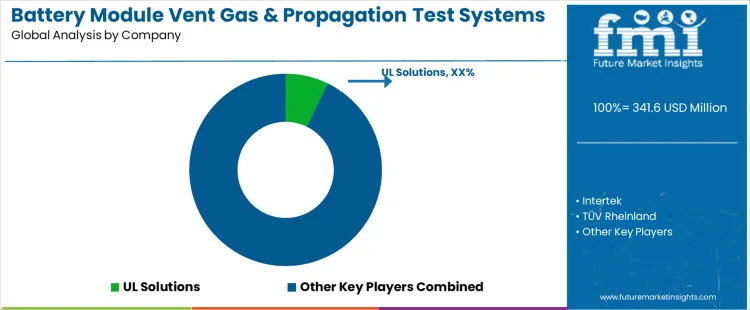
Competition in the battery module vent gas and propagation test systems market is anchored in safety validation, regulatory compliance, test repeatability, and integration with broader battery test workflows. UL Solutions leads with well recognized safety test frames and protocols that align with global standards, and its product materials emphasize rigorous vent gas collection and propagation control methods. Intertek competes with comprehensive test systems that blend environmental conditioning with safety stress testing, marketed to help manufacturers demonstrate compliance with stringent regulatory requirements. TÜV Rheinland differentiates through its deep certification expertise, offering test platforms paired with advisory services that guide customers from test design through report generation.
Manufacturers of environmental chambers and test rigs such as Weiss Technik, ESPEC, and Thermotron focus on robust, climate controlled test environments that support vent gas evaluation under varied temperatures and humidity levels. Their collateral highlights precise chamber control, safety interlocks, and repeatability across long test sequences. HORIBA and AVL extend their position with integrated systems that combine vent gas analysis with powertrain and energy efficiency testing, appealing to EV developers seeking unified validation workflows.
Chroma ATE brings modular test systems designed for battery pack and cell propagation evaluation, with product brochures stressing automation and data logging. CSA Group rounds out the field with test platforms backed by compliance and certification services, helping customers meet global safety benchmarks. Across vendors, product documentation is crafted to underscore accuracy, safety assurance, and alignment with evolving battery test standards.
Key Players in Battery Module Vent Gas & Propagation Test Systems Market
- UL Solutions
- Intertek
- TÜV Rheinland
- Weiss Technik
- ESPEC
- Thermotron
- HORIBA
- AVL
- Chroma ATE
- CSA Group
Scope of Report
| Items | Values |
|---|---|
| Quantitative Unit (2026) | USD million |
| Test System Type | Thermal Runaway Propagation Rigs, Vent Gas Collection & Analysis, Abuse Testing, Environmental & Aging Chambers |
| Battery Format | Prismatic, Pouch, Cylindrical, Mixed |
| End User | Cell & Module Manufacturers, OEM Battery Labs, Independent Test Labs, Regulators or Research |
| Regions Covered | Asia Pacific, Europe, North America, Latin America, Middle East & Africa |
| Countries Covered | USA, China, Japan, South Korea, India, Australia & New Zealand, ASEAN, Germany, UK, France, Italy, Spain, Nordic, BENELUX, Brazil, Chile, Mexico, Saudi Arabia, Other GCC Countries, Turkey, South Africa, Other African Union |
| Key Companies Profiled | UL Solutions, Intertek, TÜV Rheinland, Weiss Technik, ESPEC, Thermotron, HORIBA, AVL, Chroma ATE, CSA Group |
| Additional Attributes | Dollar sales segmented by test system type, battery format, and end user. Regional CAGR and growth outlook are provided, offering insights into market dynamics and expected trends across the global market, including detailed forecasts for each segment and region. |
Battery Module Vent Gas & Propagation Test Systems Market by Key Segments
Test System Type
- Thermal Runaway Propagation Rigs
- Vent Gas Collection & Analysis
- Abuse Testing
- Environmental & Aging Chambers
Battery Format
- Prismatic
- Pouch
- Cylindrical
- Mixed
End User
- Cell & Module Manufacturers
- OEM Battery Labs
- Independent Test Labs
- Regulators or Research
Region
- Asia Pacific
- China
- Japan
- South Korea
- India
- Australia & New Zealand
- ASEAN
- Rest of Asia Pacific
- Europe
- Germany
- United Kingdom
- France
- Italy
- Spain
- Nordic
- BENELUX
- Rest of Europe
- North America
- United States
- Canada
- Mexico
- Latin America
- Brazil
- Chile
- Rest of Latin America
- Middle East & Africa
- Kingdom of Saudi Arabia
- Other GCC Countries
- Turkey
- South Africa
- Other African Union
- Rest of Middle East & Africa
Bibliography
- UL Solutions. (2023). Safety test systems for battery modules and thermal runaway propagation testing. UL Solutions.
- Intertek. (2023). Comprehensive test platforms for vent gas collection and propagation analysis. Intertek.
- TÜV Rheinland. (2023). Certification and testing solutions for battery module vent gas and propagation analysis. TÜV Rheinland.
Frequently Asked Questions
How big is the battery module vent gas & propagation test systems market in 2026?
The global battery module vent gas & propagation test systems market is estimated to be valued at USD 341.6 million in 2026.
What will be the size of battery module vent gas & propagation test systems market in 2036?
The market size for the battery module vent gas & propagation test systems market is projected to reach USD 902.3 million by 2036.
How much will be the battery module vent gas & propagation test systems market growth between 2026 and 2036?
The battery module vent gas & propagation test systems market is expected to grow at a 10.2% CAGR between 2026 and 2036.
What are the key product types in the battery module vent gas & propagation test systems market?
The key product types in battery module vent gas & propagation test systems market are thermal runaway propagation rigs, vent gas collection & analysis, abuse testing and environmental & aging chambers.
Which battery format segment to contribute significant share in the battery module vent gas & propagation test systems market in 2026?
In terms of battery format, prismatic segment to command 38.0% share in the battery module vent gas & propagation test systems market in 2026.
Preview the report firsthand - request a free sample
Get SampleGet the brochure for pricing and purchase details.
Get PDFTable of Content
- Executive Summary
- Global Market Outlook
- Demand-side Trends
- Supply-side Trends
- Technology Roadmap Analysis
- Analysis and Recommendations
- Market Overview
- Market Coverage / Taxonomy
- Market Definition / Scope / Limitations
- Market Background
- Market Dynamics
- Drivers
- Restraints
- Opportunity
- Trends
- Scenario Forecast
- Demand in Optimistic Scenario
- Demand in Likely Scenario
- Demand in Conservative Scenario
- Opportunity Map Analysis
- Product Life Cycle Analysis
- Supply Chain Analysis
- Investment Feasibility Matrix
- Value Chain Analysis
- PESTLE and Porter’s Analysis
- Regulatory Landscape
- Regional Parent Market Outlook
- Production and Consumption Statistics
- Import and Export Statistics
- Market Dynamics
- Global Market Analysis 2021 to 2025 and Forecast, 2026 to 2036
- Historical Market Size Value (USD Million) Analysis, 2021 to 2025
- Current and Future Market Size Value (USD Million) Projections, 2026 to 2036
- Y-o-Y Growth Trend Analysis
- Absolute $ Opportunity Analysis
- Global Market Pricing Analysis 2021 to 2025 and Forecast 2026 to 2036
- Global Market Analysis 2021 to 2025 and Forecast 2026 to 2036, By Test System Type
- Introduction / Key Findings
- Historical Market Size Value (USD Million) Analysis By Test System Type , 2021 to 2025
- Current and Future Market Size Value (USD Million) Analysis and Forecast By Test System Type , 2026 to 2036
- Thermal Runaway Propagation Rigs
- Vent Gas Collection & Analysis
- Abuse Testing
- Environmental & Aging Chambers
- Thermal Runaway Propagation Rigs
- Y-o-Y Growth Trend Analysis By Test System Type , 2021 to 2025
- Absolute $ Opportunity Analysis By Test System Type , 2026 to 2036
- Global Market Analysis 2021 to 2025 and Forecast 2026 to 2036, By Battery Format
- Introduction / Key Findings
- Historical Market Size Value (USD Million) Analysis By Battery Format, 2021 to 2025
- Current and Future Market Size Value (USD Million) Analysis and Forecast By Battery Format, 2026 to 2036
- Prismatic
- Pouch
- Cylindrical
- Mixed
- Prismatic
- Y-o-Y Growth Trend Analysis By Battery Format, 2021 to 2025
- Absolute $ Opportunity Analysis By Battery Format, 2026 to 2036
- Global Market Analysis 2021 to 2025 and Forecast 2026 to 2036, By End User
- Introduction / Key Findings
- Historical Market Size Value (USD Million) Analysis By End User, 2021 to 2025
- Current and Future Market Size Value (USD Million) Analysis and Forecast By End User, 2026 to 2036
- Cell & Module Manufacturers
- OEM Battery Labs
- Independent Test Labs
- Regulators or Research
- Cell & Module Manufacturers
- Y-o-Y Growth Trend Analysis By End User, 2021 to 2025
- Absolute $ Opportunity Analysis By End User, 2026 to 2036
- Global Market Analysis 2021 to 2025 and Forecast 2026 to 2036, By Region
- Introduction
- Historical Market Size Value (USD Million) Analysis By Region, 2021 to 2025
- Current Market Size Value (USD Million) Analysis and Forecast By Region, 2026 to 2036
- North America
- Latin America
- Western Europe
- Eastern Europe
- East Asia
- South Asia and Pacific
- Middle East & Africa
- Market Attractiveness Analysis By Region
- North America Market Analysis 2021 to 2025 and Forecast 2026 to 2036, By Country
- Historical Market Size Value (USD Million) Trend Analysis By Market Taxonomy, 2021 to 2025
- Market Size Value (USD Million) Forecast By Market Taxonomy, 2026 to 2036
- By Country
- USA
- Canada
- Mexico
- By Test System Type
- By Battery Format
- By End User
- By Country
- Market Attractiveness Analysis
- By Country
- By Test System Type
- By Battery Format
- By End User
- Key Takeaways
- Latin America Market Analysis 2021 to 2025 and Forecast 2026 to 2036, By Country
- Historical Market Size Value (USD Million) Trend Analysis By Market Taxonomy, 2021 to 2025
- Market Size Value (USD Million) Forecast By Market Taxonomy, 2026 to 2036
- By Country
- Brazil
- Chile
- Rest of Latin America
- By Test System Type
- By Battery Format
- By End User
- By Country
- Market Attractiveness Analysis
- By Country
- By Test System Type
- By Battery Format
- By End User
- Key Takeaways
- Western Europe Market Analysis 2021 to 2025 and Forecast 2026 to 2036, By Country
- Historical Market Size Value (USD Million) Trend Analysis By Market Taxonomy, 2021 to 2025
- Market Size Value (USD Million) Forecast By Market Taxonomy, 2026 to 2036
- By Country
- Germany
- UK
- Italy
- Spain
- France
- Nordic
- BENELUX
- Rest of Western Europe
- By Test System Type
- By Battery Format
- By End User
- By Country
- Market Attractiveness Analysis
- By Country
- By Test System Type
- By Battery Format
- By End User
- Key Takeaways
- Eastern Europe Market Analysis 2021 to 2025 and Forecast 2026 to 2036, By Country
- Historical Market Size Value (USD Million) Trend Analysis By Market Taxonomy, 2021 to 2025
- Market Size Value (USD Million) Forecast By Market Taxonomy, 2026 to 2036
- By Country
- Russia
- Poland
- Hungary
- Balkan & Baltic
- Rest of Eastern Europe
- By Test System Type
- By Battery Format
- By End User
- By Country
- Market Attractiveness Analysis
- By Country
- By Test System Type
- By Battery Format
- By End User
- Key Takeaways
- East Asia Market Analysis 2021 to 2025 and Forecast 2026 to 2036, By Country
- Historical Market Size Value (USD Million) Trend Analysis By Market Taxonomy, 2021 to 2025
- Market Size Value (USD Million) Forecast By Market Taxonomy, 2026 to 2036
- By Country
- China
- Japan
- South Korea
- By Test System Type
- By Battery Format
- By End User
- By Country
- Market Attractiveness Analysis
- By Country
- By Test System Type
- By Battery Format
- By End User
- Key Takeaways
- South Asia and Pacific Market Analysis 2021 to 2025 and Forecast 2026 to 2036, By Country
- Historical Market Size Value (USD Million) Trend Analysis By Market Taxonomy, 2021 to 2025
- Market Size Value (USD Million) Forecast By Market Taxonomy, 2026 to 2036
- By Country
- India
- ASEAN
- Australia & New Zealand
- Rest of South Asia and Pacific
- By Test System Type
- By Battery Format
- By End User
- By Country
- Market Attractiveness Analysis
- By Country
- By Test System Type
- By Battery Format
- By End User
- Key Takeaways
- Middle East & Africa Market Analysis 2021 to 2025 and Forecast 2026 to 2036, By Country
- Historical Market Size Value (USD Million) Trend Analysis By Market Taxonomy, 2021 to 2025
- Market Size Value (USD Million) Forecast By Market Taxonomy, 2026 to 2036
- By Country
- Kingdom of Saudi Arabia
- Other GCC Countries
- Turkiye
- South Africa
- Other African Union
- Rest of Middle East & Africa
- By Test System Type
- By Battery Format
- By End User
- By Country
- Market Attractiveness Analysis
- By Country
- By Test System Type
- By Battery Format
- By End User
- Key Takeaways
- Key Countries Market Analysis
- USA
- Pricing Analysis
- Market Share Analysis, 2025
- By Test System Type
- By Battery Format
- By End User
- Canada
- Pricing Analysis
- Market Share Analysis, 2025
- By Test System Type
- By Battery Format
- By End User
- Mexico
- Pricing Analysis
- Market Share Analysis, 2025
- By Test System Type
- By Battery Format
- By End User
- Brazil
- Pricing Analysis
- Market Share Analysis, 2025
- By Test System Type
- By Battery Format
- By End User
- Chile
- Pricing Analysis
- Market Share Analysis, 2025
- By Test System Type
- By Battery Format
- By End User
- Germany
- Pricing Analysis
- Market Share Analysis, 2025
- By Test System Type
- By Battery Format
- By End User
- UK
- Pricing Analysis
- Market Share Analysis, 2025
- By Test System Type
- By Battery Format
- By End User
- Italy
- Pricing Analysis
- Market Share Analysis, 2025
- By Test System Type
- By Battery Format
- By End User
- Spain
- Pricing Analysis
- Market Share Analysis, 2025
- By Test System Type
- By Battery Format
- By End User
- France
- Pricing Analysis
- Market Share Analysis, 2025
- By Test System Type
- By Battery Format
- By End User
- India
- Pricing Analysis
- Market Share Analysis, 2025
- By Test System Type
- By Battery Format
- By End User
- ASEAN
- Pricing Analysis
- Market Share Analysis, 2025
- By Test System Type
- By Battery Format
- By End User
- Australia & New Zealand
- Pricing Analysis
- Market Share Analysis, 2025
- By Test System Type
- By Battery Format
- By End User
- China
- Pricing Analysis
- Market Share Analysis, 2025
- By Test System Type
- By Battery Format
- By End User
- Japan
- Pricing Analysis
- Market Share Analysis, 2025
- By Test System Type
- By Battery Format
- By End User
- South Korea
- Pricing Analysis
- Market Share Analysis, 2025
- By Test System Type
- By Battery Format
- By End User
- Russia
- Pricing Analysis
- Market Share Analysis, 2025
- By Test System Type
- By Battery Format
- By End User
- Poland
- Pricing Analysis
- Market Share Analysis, 2025
- By Test System Type
- By Battery Format
- By End User
- Hungary
- Pricing Analysis
- Market Share Analysis, 2025
- By Test System Type
- By Battery Format
- By End User
- Kingdom of Saudi Arabia
- Pricing Analysis
- Market Share Analysis, 2025
- By Test System Type
- By Battery Format
- By End User
- Turkiye
- Pricing Analysis
- Market Share Analysis, 2025
- By Test System Type
- By Battery Format
- By End User
- South Africa
- Pricing Analysis
- Market Share Analysis, 2025
- By Test System Type
- By Battery Format
- By End User
- USA
- Market Structure Analysis
- Competition Dashboard
- Competition Benchmarking
- Market Share Analysis of Top Players
- By Regional
- By Test System Type
- By Battery Format
- By End User
- Competition Analysis
- Competition Deep Dive
- UL Solutions
- Overview
- Product Portfolio
- Profitability by Market Segments (Product/Age /Sales Channel/Region)
- Sales Footprint
- Strategy Overview
- Marketing Strategy
- Product Strategy
- Channel Strategy
- Intertek
- TÜV Rheinland
- Weiss Technik
- ESPEC
- Thermotron
- HORIBA
- AVL
- Chroma ATE
- CSA Group
- UL Solutions
- Competition Deep Dive
- Assumptions & Acronyms Used
- Research Methodology


