

- Industry Size (2026)
- USD 293.4 Mn
- Forecast (2036)
- USD 812.6 Mn
- CAGR (2026 to 2036)
- 10.7%
Battery Fire and Explosion Containment Test Chambers Market Size, Market Forecast and Outlook By FMI
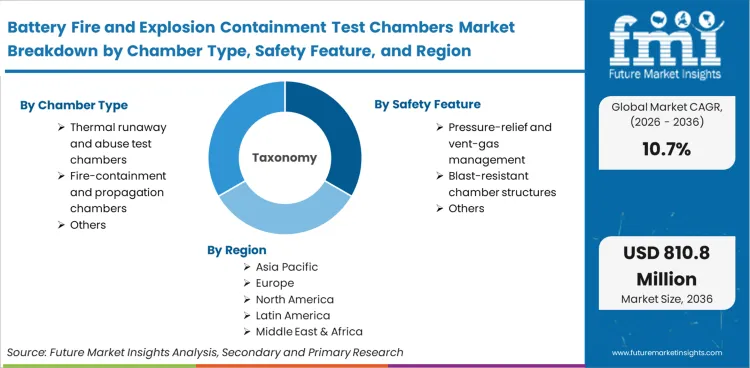
The battery fire and explosion test chamber market crossed a valuation of USD 268.0 million in 2025. Demand is poised to reach USD 293.4 million in 2026 at a CAGR of 10.7% during the forecast period. Continued investment is expected to bring cumulative revenue to USD 812.6 million by 2036, as rising battery cell energy density pushes testing needs beyond the containment limits of standard environmental protocols.
Safety validation directors at automotive OEMs face a rapidly shrinking gap between cell chemistry innovation and physical containment failure limits. Cell developers push higher silicon anode ratios and denser packing configurations, forcing testing facilities to upgrade legacy thermal chambers into blast-proof bunkers capable of managing uncontained propagation events. Delaying infrastructure upgrades leaves certification labs rejecting next-generation cell testing contracts due to inadequate battery testing inspection safety ratings. Analyzing the lithium ion battery abuse chamber market, what generalist engineering firms miss is that containment vessel steel thickness matters less than active gas extraction speed during catastrophic thermal runaway.
Summary of Battery Fire and Explosion Containment Test Chambers Market
- Battery Fire and Explosion Containment Test Chambers Market Definition
- Engineered for destructive battery abuse testing, these structural enclosures contain and survive catastrophic cell or pack failure events under controlled conditions. They are built to manage explosion risks, thermal discharge, flame propagation, and fragment ejection during deliberate failure simulations. Their heavy-duty containment design enables safe observation of violent battery behavior while preserving test reliability, laboratory protection, and compliance with advanced validation protocols used across modern battery development environments.
- Demand Drivers in the Market:
- Higher silicon anode energy densities force OEM safety homologation leads to commission high-pressure blast-resistant validation cells, fueling the battery fire containment chamber market.
- Stringent UN 38.3 transport safety mandates require third-party certification lab managers to upgrade gas extraction capabilities.
- Rapid thermal propagation events push R&D directors to abandon legacy thermal cycling systems for dedicated fire-containment bunkers.
- Key Segments Analyzed in the FMI Report:
- Chamber Type: Thermal runaway and abuse test chambers is expected to hold 32.0% share in 2026, as targeted destructive testing replaces predictive simulation models.
- Safety Feature: Pressure-relief and vent-gas management systems is projected to capture 27.0% share in 2026, because surviving explosive outgassing requires active pressure venting over static armor.
- Battery Test Application: EV cell, module, and pack abuse testing is anticipated to lead with 38.0% share in 2026, driven by automotive mandates demanding pack-level propagation survival data.
- End User: Battery manufacturers and cell developers is set to dominate with 31.0% share in 2026, internalizing qualification loops before third-party certification.
- Installation Type: Fixed laboratory chamber systems is estimated to command 63.0% share in 2026, reflecting heavy infrastructure requirements for managing toxic effluent.
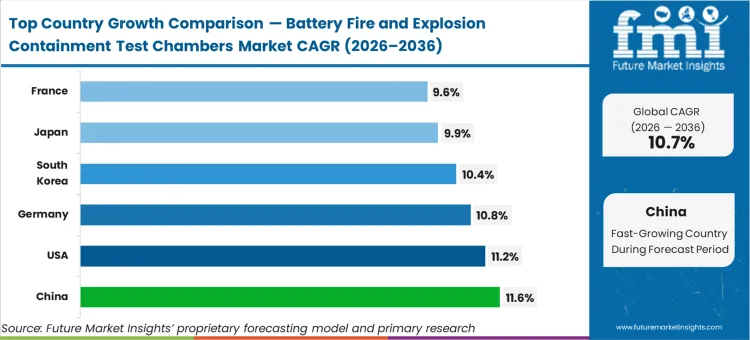
- China: 11.6% compound growth, sustained by aggressive domestic testing mandates out-pacing global homologation timelines.
- Analyst Opinion at FMI:
- Nikhil Kaitwade, Principal Analyst, Automation, at FMI, points out, "Validation facility directors assume specifying thicker blast walls solves high-density cell propagation testing risks. In reality, static structural reinforcement becomes irrelevant if gas extraction systems cannot clear toxic, highly explosive vent gases before secondary ignition occurs. Procurement teams over-index on raw blast ratings while under-investing in active pressure management. This measurement gap traps certification labs: they build bunkers strong enough to survive an initial cell rupture but fail qualification audits because their extraction flow rates cannot prevent a volatile gas buildup during cascade thermal runaway events. Real capital flows toward active venting integration, not just passive steel armor."
- Strategic Implications / Executive Takeaways:
- Certification lab managers face immediate revenue loss unless they upgrade extraction capacities to handle pack-level volatile off-gassing.
- Cell development R&D directors gain faster iteration cycles by internalizing modular abuse testing rather than outsourcing destructive validation.
- Automotive Tier-1 safety engineering heads reduce homologation delays by aligning internal chamber specifications directly with regulatory third-party test cell designs.
- Methodology:
- Primary Research: Direct interviews with validation facility directors and OEM safety homologation leads map actual procurement triggers.
- Desk Research: Analysis of specific UL 9540A compliance filings and EUCAR hazard registries validates equipment specification requirements.
- Market-Sizing and Forecasting: Baseline anchored to capital expenditure allocations for destructive test facility upgrades at major cell developers.
- Data Validation and Update Cycle: Forecast cross-validated using specialized chamber manufacturer shipment manifests mapped against gigafactory lab completions.
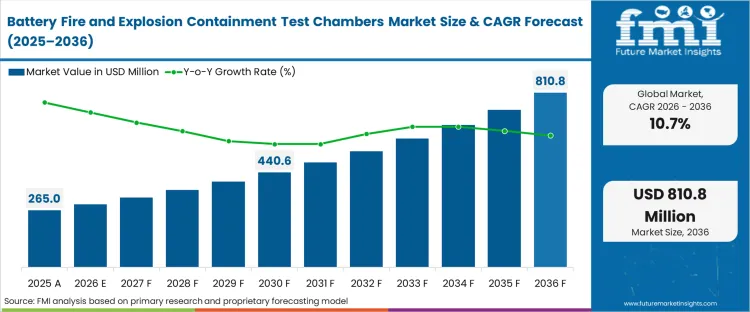
Regulatory enforcement of destructive EUCAR Hazard Level 7 testing for solid-state battery prototypes rapidly displaces legacy test infrastructure. Standard chambers built for thermal cycling cannot safely manage deliberate internal blast events under abuse conditions. Specialized containment systems with pressure-resistant architecture become essential, turning battery validation into a far more severe structural safety discipline. This transition creates strong momentum in the battery explosion proof test chamber market.
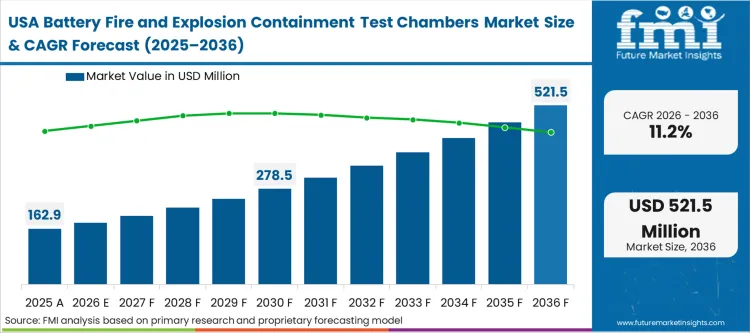
China is projected to lead at 11.6%, driven by demanding local homologation frameworks that are prompting battery manufacturers to construct dedicated abuse bunkers. The United States follows at 11.2%, backed by increasing validation requirements across new gigafactory capacity. Germany grows at 10.8% as premium automakers embed pack-level propagation testing into qualification programs. South Korea reaches 10.4% with incumbent battery producers upgrading chambers through modular replaceable-liner designs. India expands at 10.1% as indigenous testing capability continues to improve. Japan registers 9.9%, and France records 9.6%. The structural split across regions reflects differing enforcement intensity, especially between full-pack destructive testing and module-level thermal validation.
Battery Fire and Explosion Containment Test Chambers Market Key Takeaways
| Metric | Details |
|---|---|
| Industry Size (2026) | USD 293.4 million |
| Industry Value (2036) | USD 812.6 million |
| CAGR (2026 to 2036) | 10.7% |
Source: Future Market Insights (FMI) analysis, based on proprietary forecasting model and primary research
Battery Fire and Explosion Containment Test Chambers Market Definition
Functional boundaries separating abuse testing infrastructure from standard environmental simulation define this category. Equipment must structurally withstand, actively suppress, and safely vent deliberate catastrophic battery failures including violent thermal runaway, explosive outgassing, and ballistic fragment ejection. Standard temperature cycling chambers lacking reinforced blast mitigation architecture fall outside this classification entirely.
Battery Fire and Explosion Containment Test Chambers Market Inclusions
Scope covers reinforced abuse bunkers, walk in battery fire test chambers, and blast-resistant environmental systems equipped with specialized fire suppression systems. Integrated pressure-relief management solutions and toxic gas extraction modules designed specifically for lithium ion battery failure testing remain strictly included within the broader battery safety testing equipment market.
Battery Fire and Explosion Containment Test Chambers Market Exclusions
General-purpose thermal cycling chambers without active blast mitigation lack inclusion. Standalone gas detection equipment not physically integrated into a reinforced testing enclosure sits outside analytical boundaries. Standard environmental test chambers for batteries lacking explosive containment capabilities fail to meet structural criteria.
Battery Fire and Explosion Containment Test Chambers Market Research Methodology
- Primary Research: Validation facility directors, OEM safety homologation leads, and third-party certification lab managers.
- Desk Research: EUCAR hazard level certification registries, UN 38.3 testing procedure documentation, and specific UL 9540A compliance filings.
- Market-Sizing and Forecasting: Annual capital expenditure allocations for destructive test facility upgrades among tier-1 cell developers.
- Data Validation and Update Cycle: Chamber manufacturer shipment manifests cross-referenced against announced gigafactory R&D laboratory commissioning schedules.
Segmental Analysis
Battery Fire and Explosion Containment Test Chambers Market Analysis by Chamber Type
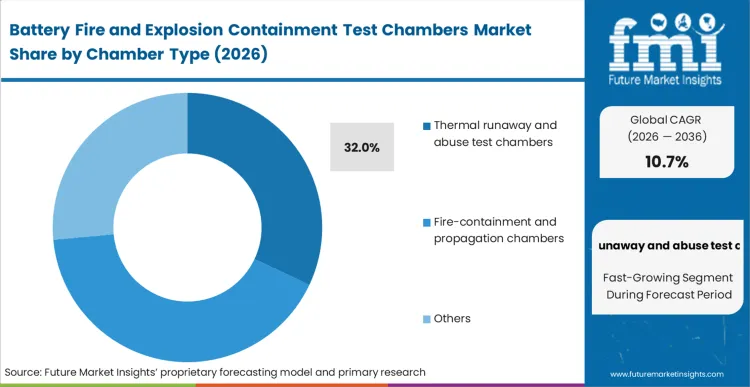
Destructive validation logic dictates why thermal runaway and abuse test chambers hold their dominant 32.0% share position. Cell engineering teams cannot rely on software simulation to prove uncontained propagation behaviors. FMI's analysis indicates validation facility directors require physical environments where prototypes undergo deliberate failure without compromising surrounding laboratory infrastructure. Moving from theoretical modeling to physical environmental test chambers changes daily workflow; technicians now manage highly toxic effluent streams alongside raw data collection. Standard temperature cycling chambers look identical to abuse units from outside, but internal blast reinforcement completely alters usable testing volumes. Evaluating the thermal runaway test chamber market, R&D laboratory managers realize too late that specifying EUCAR Hazard Level 7 containment drastically reduces chamber interior capacity, forcing them to procure larger footprints than originally budgeted. Relying on retrofitted standard chambers for destructive testing courts catastrophic facility damage and invalidates rigorous homologation test results.
- Initial specification trigger: Validation facility directors specify fully reinforced abuse chambers when next-generation cell chemistries exceed legacy pressure-venting calculations. Procurement teams face immediate capital outlay increases.
- Qualification validation protocol: Cell engineering technicians prove chamber efficacy by initiating controlled thermal runaway events using physical nail penetration methods. Surviving this deliberate failure validates internal blast armor integrity.
- Expansion cycle mechanics: Test laboratory managers procure modular replaceable-liner abuse chambers after realizing toxic soot permanently contaminates permanent fixtures. Modular designs maintain throughput speeds.
Battery Fire and Explosion Containment Test Chambers Market Analysis by Safety Feature
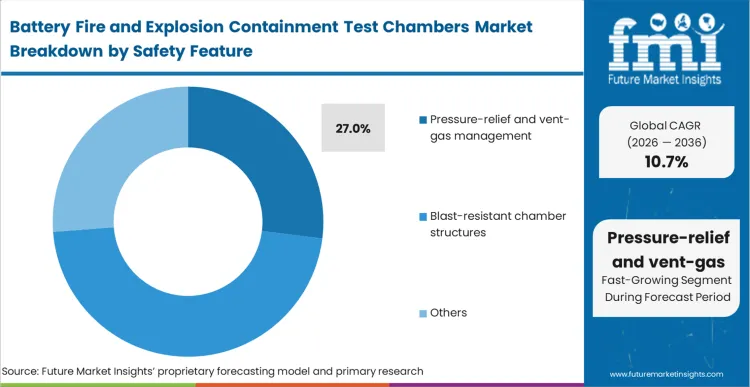
Surviving catastrophic cell outgassing requires immediate active venting, explaining why pressure-relief and vent-gas management systems capture 27.0% share. Static armor alone fails when expanding explosive gases lack rapid escape routes. FMI's assessment shows safety homologation leads prioritize high-volume extraction flow rates above raw structural plate thickness. Managing battery pack venting limits secondary ignition risks during cascade propagation tests. A pressure relief battery explosion chamber prevents massive pressure differentials capable of buckling a reinforced battery test chamber door system inward. Facility engineers must balance extraction velocity with precise make-up air injection to maintain structural equilibrium during tests inside the UL 9540A test chamber market. Procuring a gas venting battery abuse chamber or a dedicated fire suppression battery test chamber ensures volatile clouds disperse safely. Under-sizing relief valves transforms a secure testing chamber into an unguided fragmentation weapon during violent pack failures.
- Containment failure prevention: Rapid extraction modules prevent explosive gas accumulation during initial cell venting stages. Safety engineering teams avoid catastrophic secondary detonations completely.
- Residual toxicity risks: Active gas management systems safely extract volatile compounds but leave heavy particulate residue inside ductwork. Maintenance supervisors must schedule hazardous cleaning protocols weekly.
- Full benefit capture: Homologation directors maximize system efficacy by coupling extraction fans with integrated fire suppression modules. Coordinated activation prevents thermal propagation while safely clearing opaque smoke.
Battery Fire and Explosion Containment Test Chambers Market Analysis by Battery Test Application
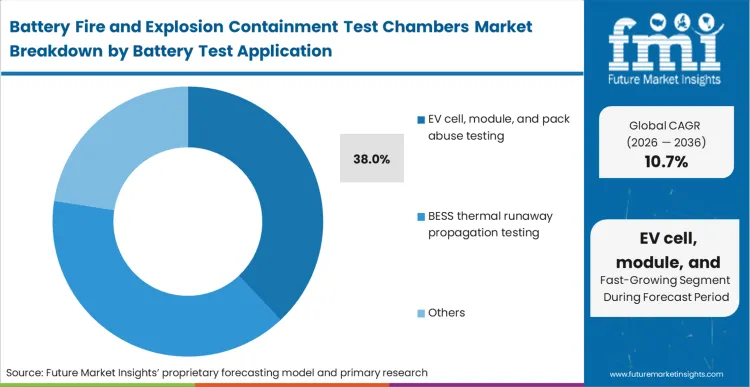
Automotive homologation mandates drive EV cell, module, and pack abuse testing toward its dominant 38.0% position. Safety validation directors abandon predictive software for empirical destructive EV test equipment. Moving physical testing in-house reduces lengthy external certification queues. According to FMI's estimates, standard industrial ovens simulate thermal cycles, but deliberate abuse requires explosive fragment containment capability. Demand for pack level battery fire test chambers surges as safety engineers induce single-cell thermal runaway to verify adjacent cells remain stable, expanding the battery thermal propagation testing market. Test lab managers often underestimate how massive pack-level failures warp standard steel enclosures, rendering them unusable for subsequent tests. Skimping on battery propagation test chamber systems forces catastrophic facility shutdowns during violent propagation failures.
- Extreme temperature validation: High-voltage engineering directors push pack abuse testing beyond intended operational boundaries. Capturing failure points validates baseline safety margins.
- Propagation limit testing: Safety engineers induce single-cell thermal runaway to verify adjacent cells remain stable. Failure cascades demand immediate containment system activation.
- Regulatory homologation compliance: Quality assurance leads submit physical blast survival data to automotive regulatory bodies. Passing physical abuse tests unlocks vehicle production phases.
Battery Fire and Explosion Containment Test Chambers Market Analysis by End User
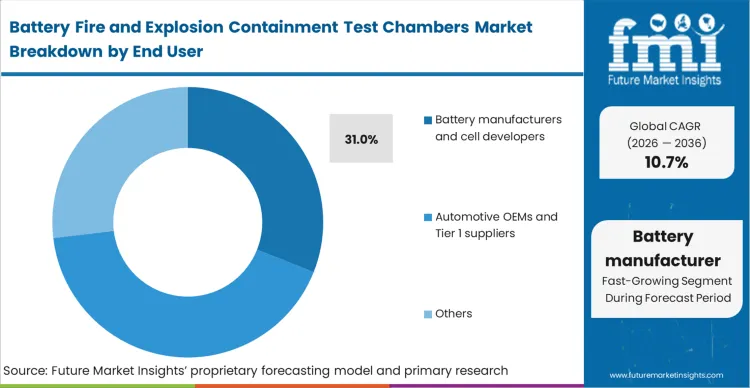
Internalizing qualification loops enables battery manufacturers and cell developers to secure 31.0% share. R&D directors refuse to share pre-production battery management system prototypes with external labs during vulnerable early-stage failure testing. As per FMI's projection, managing destructive validation internally accelerates iteration cycles tremendously. Expanding investments in the battery certification lab equipment market ensures proprietary designs remain secure. What procurement officers ignore is how integrating blast bunkers demands massive facility HVAC upgrades to handle sudden toxic venting. Delaying internal abuse testing capabilities hands competitor engineering teams months of head-start advantage.
- Tier-1 early adopters: Cell development directors procure specialized bunkers to test experimental chemistries privately. Faster physical iteration yields superior patent filings.
- OEM safety integration: Automotive engineering heads build in-house test chambers replicating third-party certification environments. Internal pre-testing guarantees eventual formal homologation success.
- Late-adopting integrators: Smaller pack assemblers eventually purchase compact modular chambers when outsourced testing bottlenecks stall product launches. Bringing testing in-house restores schedule control.
Battery Fire and Explosion Containment Test Chambers Market Analysis by Installation Type
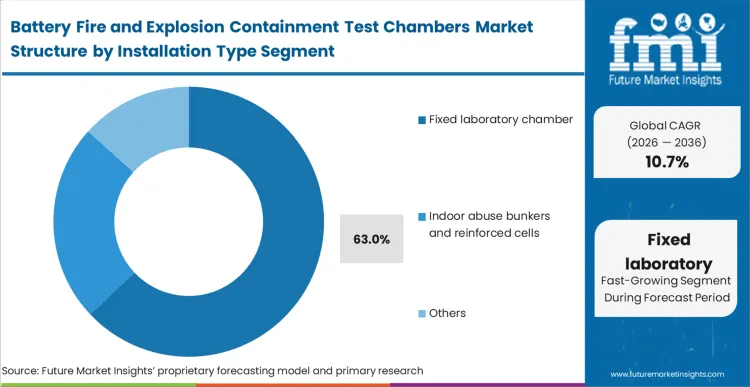
Managing immense toxic effluent volumes pushes fixed laboratory chamber systems toward 63.0% share. Permanent installations allow facility engineers to construct dedicated high-volume exhaust stacks necessary for energy storage system destructive testing. In FMI's view, dedicated permanent test cells provide superior blast anchoring compared to portable variants. Laboratories procuring explosion containment chambers for battery testing realize generalist facility planners overlook how heavy water-deluge fire suppression requirements necessitate specialized subterranean drainage systems resistant to highly corrosive hydrofluoric acid runoff. Trying to conduct full-pack destruction in semi-permanent structures risks catastrophic environmental contamination.
- Procurement capital optimization: Facility planning directors amortize massive fixed laboratory bunker costs across decades. Permanent reinforced concrete structures outlast multiple equipment upgrade cycles.
- Operational hidden maintenance: Facility managers discover high-volume scrubber fluid disposal costs exceed initial capital expenditure estimates. Corrosive waste handling demands specialized contractor relationships.
- Lifecycle total accounting: Chief financial officers evaluating fixed systems realize localized permitting delays cost more than physical chamber fabrication. True system cost includes extensive regulatory compliance delays.
Battery Fire and Explosion Containment Test Chambers Market Drivers, Restraints, and Opportunities
Higher energy density solid-state battery designs introduce propagation behaviors that conventional safety models cannot reliably predict. Digital simulations struggle to reproduce the real blast dynamics created when next-generation cells fail violently. OEMs face severe program disruption if third-party destructive testing uncovers uncontrolled cascade events. A dedicated EV battery thermal runaway containment chamber moves validation away from theoretical assumptions and into measurable physical proof. Without that investment, engineering teams may discover critical failure modes only after costly prototype development.
Toxic effluent management infrastructure creates severe operational friction slowing rapid chamber deployment across urban testing facilities. High-capacity abuse testing requires massive volumes of contaminated water processing and complex scrubber systems for highly corrosive vent gases. Installing standalone hazardous area equipment proves straightforward; building exterior plumbing and HVAC modifications to safely exhaust hydrofluoric acid gas takes months of permitting. Facility managers face neighborhood zoning disputes when requesting permits for controlled explosion venting systems near populated industrial parks. Emerging closed-loop scrubber attachments offer partial mitigation but remain severely bottlenecked by expensive consumable filter replacements.
Opportunities in the Battery Fire and Explosion Containment Test Chambers Market
- Modular abuse chamber liners for battery testing: Fragment shield and debris-containment systems built into transportable ISO containers bypass lengthy facility construction permitting. Laboratory operations managers rapidly scale testing capacity.
- Integrated thermal-acoustic diagnostic tracking: Equipping the battery abuse bunker systems market infrastructure with high-speed electric vehicle safety systems sensors allows granular failure mapping. R&D directors capture micro-second blast progression data.
- Automated post-test inserting protocols: Developing robotic or automated inserting sequences protects technicians during chamber opening post-failure. Facility safety officers drastically reduce human exposure to toxic residue.
Regional Analysis
Based on regional analysis, Battery Fire and Explosion Containment Test Chambers Market is segmented into North America, Latin America, Europe, East Asia, South Asia and Pacific, and Middle East and Africa across 40 plus countries.
.webp "Top Country Growth Comparison Battery Fire And Explosion Containment Test Chambers Market Cagr (2026 2036)")
| Country | CAGR (2026 to 2036) |
|---|---|
| China | 11.6% |
| United States | 11.2% |
| Germany | 10.8% |
| South Korea | 10.4% |
| Japan | 9.9% |
| France | 9.6% |
Source: Future Market Insights (FMI) analysis, based on proprietary forecasting model and primary research
East Asia Battery Fire and Explosion Containment Test Chambers Market Analysis
Aggressive domestic homologation schedules in East Asia compel cell manufacturers to internalize destructive testing rather than waiting for global certification lab availability. FMI's estimates indicate rapid gigafactory scaling creates unprecedented demand for localized abuse bunkers capable of testing massive cell formats. Transitioning from outsourced validation to in-house destructive testing accelerates overall electric vehicle battery development cycles. Regional facility managers prioritize walk-in integrated chamber systems designed for continuous, high-throughput failure testing.
- China: Domestic OEM safety leads are being compelled to establish reinforced bunker-style facilities as mandatory pack-level propagation protocols become more demanding. China records 11.6% compound growth, supported by regulatory frameworks that are advancing faster than international UN 38.3 requirements. Companies winning contracts for advanced extraction technology are gaining an early advantage in market positioning.
- South Korea: High-density cell architecture roadmaps require R&D engineering teams to push thermal limits during prototype validation. South Korea expands at 10.4% through 2036. What generalists miss is how incumbent players utilize legacy environmental chambers solely for climatic cycling while reserving new investments strictly for catastrophic blast containment.
- Japan: Japan’s stringent urban zoning requirements are driving validation facility directors to procure compact, modular abuse chambers integrated with closed-loop toxic gas scrubbing systems. The market is set to expand at 9.9% over the forecast period as domestic operators seek testing solutions suited to land-constrained industrial zones. Building safe urban testing capability materially improves organizational responsiveness, since battery developers can conduct destructive validation within city-adjacent facilities while reducing delays linked to remote testing locations, complex transport logistics, and extended scheduling constraints.
FMI's report includes Taiwan and other emerging manufacturing hubs. Dedicated cell-level abuse facilities multiply across secondary battery supply chain nodes.
North America Battery Fire and Explosion Containment Test Chambers Market Analysis
Expanding gigafactory footprints across North America force validation facility directors to construct massive localized testing capabilities. Importing hazardous prototype cells for overseas destructive testing violates strict transport safety mandates. FMI observers note regional certification lab managers analyzing the BESS fire testing equipment market rapidly upgrade legacy infrastructure to handle volatile thermal runaway events specific to high-capacity grid storage modules. Managing massive explosive outgassing dictates new facility architectural choices.
- United States: In the United States, broader gigafactory validation requirements are prompting immediate purchases of walk-in battery fire test chambers. The battery abuse chamber market is projected to register 11.2% CAGR as manufacturers build deeper in-house testing capabilities. R&D teams that bring these validation processes under direct control can materially reduce battery energy storage system approval timelines and improve overall development agility.
FMI's report includes Canada. Cross-border testing integration simplifies homologation cycles for regional automotive assembly networks.
Europe Battery Fire and Explosion Containment Test Chambers Market Analysis
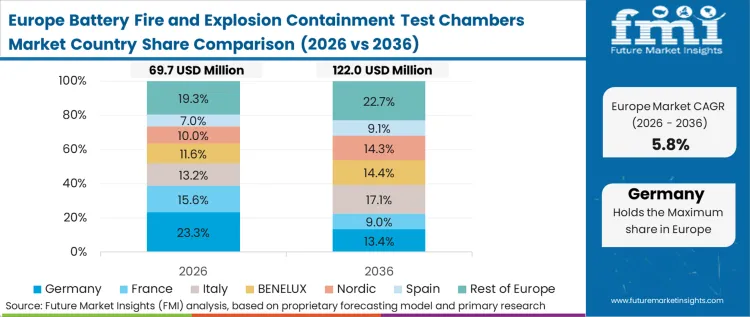
Premium automakers standardizing extreme pack-level propagation protocols reshape European testing infrastructure requirements. European safety homologation leads demand verifiable physical blast containment over purely predictive software models. According to FMI's analysis, strict regional emissions mandates require automotive testing inspection facilities to utilize closed-loop toxic gas scrubbing during any destructive testing. Environmental compliance dictates rigorous effluent management strategies.
- Germany: Deep automotive supply chain integration compels Tier-1 testing labs to install modular replaceable-liner abuse chambers. Germany advances at 10.8% compound growth. Surpassing basic EUCAR requirements grants domestic engineering firms substantial global influence regarding baseline safety metrics.
- France: Specialized aerospace battery validation drives demand for blast-resistant environmental systems capable of extreme pressure differentials. France witnesses 9.6% growth through 2036. What generalist metrics miss is how aviation battery pack testing requires significantly different vent-gas management systems compared to standard automotive layouts.
The FMI report includes the United Kingdom and Italy. Tightening battery regulations across the region are compelling independent labs to align testing procedures across borders.
Competitive Aligners for Market Players
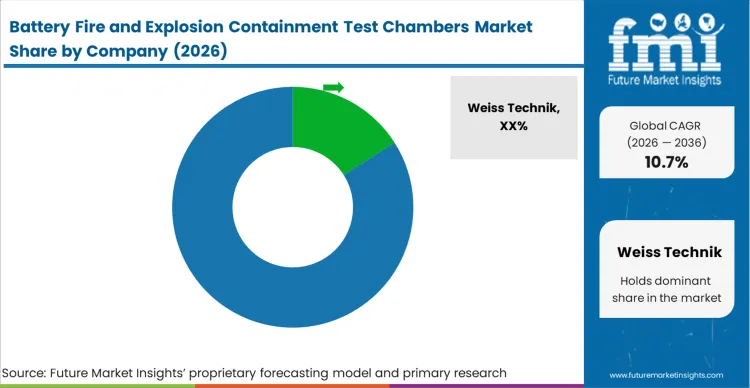
In the battery abuse test chamber market, procurement directors favor proven survival performance over standard structural specifications. Competitive strength is determined by a supplier’s ability to validate chamber integrity across multiple EUCAR Hazard Level 7 destructive tests. Companies including Weiss Technik and BINDER strengthen their position by offering integrated engineering services that pair toxic gas flow modeling with chamber hardware. Buyers require confidence that extraction systems will disperse explosive off-gassing before any secondary ignition develops. Chamber hardware may commoditize; though proprietary gas management capabilities continue to command distinction.
Legacy chamber manufacturers maintain broad libraries of empirical blast survivability records that remain difficult for new entrants to duplicate quickly. Procurement decisions by safety engineering leaders are shaped by the value of long-term validation data showing reliable containment across diverse battery chemistries. FMI’s assessment highlights that challengers face intense skepticism because one unsuccessful blast event can erase credibility at once. Earning trust usually requires public proof, which may involve deliberately sacrificing several high-value chambers under extreme testing conditions.
Third-party certification labs fiercely resist vendor lock-in regarding consumable chamber liners and proprietary toxic gas scrubber filters. Independent testing facility managers structure procurement contracts requiring universal sensor integration, avoiding proprietary diagnostic tracking software. As pack sizes increase, competitive battlegrounds center on customized modular bunker construction rather than standardized cabinet sales. Large automotive OEMs leverage their massive validation volume to force chamber manufacturers into joint development partnerships, securing exclusive access to next-generation renewable energy storage rapid-inerting technologies, significantly reshaping the EV battery abuse testing equipment market.
Key Players in Battery Fire and Explosion Containment Test Chambers Market
- Weiss Technik
- Thermotron Industries
- ESPEC
- BINDER
- Sanwood Technology
- Angelantoni Test Technologies / ACS
- CTS
Scope of the Report
| Metric | Value |
|---|---|
| Quantitative Units | USD 293.4 million to USD 812.6 million, at a CAGR of 10.7% |
| Market Definition | Specialized structural enclosures engineered specifically to contain, vent, and survive deliberate catastrophic battery cell or pack failures during destructive abuse testing procedures. |
| Segmentation | Chamber Type, Safety Feature, Battery Test Application, End User, Installation Type, Region |
| Regions Covered | North America, Latin America, Europe, East Asia, South Asia and Pacific, Middle East and Africa |
| Countries Covered | China, United States, Germany, South Korea, India, Japan, France |
| Key Companies Profiled | Weiss Technik, Thermotron Industries, ESPEC, BINDER, Sanwood Technology, Angelantoni Test Technologies / ACS, CTS |
| Forecast Period | 2026 to 2036 |
| Approach | Annual capital expenditure allocations for destructive test facility upgrades among tier-1 cell developers |
Source: Future Market Insights (FMI) analysis, based on proprietary forecasting model and primary research
Battery Fire and Explosion Containment Test Chambers Market Analysis by Segments
Chamber Type:
- Thermal runaway and abuse test chambers
- Fire-containment and propagation chambers
- Explosion-containment environmental chambers
- Pack-level abuse bunkers and reinforced test cells
- Walk-in battery fire test chambers
- Modular replaceable-liner abuse chambers
Safety Feature:
- Pressure-relief and vent-gas management systems
- Blast-resistant chamber structures
- Fire suppression and inerting systems
- Gas detection and extraction systems
- Reinforced doors, locks, and latches
- Fragment shield and debris-containment systems
Battery Test Application:
- EV cell, module, and pack abuse testing
- BESS thermal runaway propagation testing
- Transport and UN 38.3 related safety testing
- OEM validation and homologation abuse testing
- R&D failure-mode and root-cause analysis testing
- Certification-lab battery fire and explosion testing
End User:
- Battery manufacturers and cell developers
- Automotive OEMs and Tier 1 suppliers
- Independent testing and certification labs
- Research institutes and universities
- Energy storage system developers
- Defense and aerospace battery programs
Installation Type:
- Fixed laboratory chamber systems
- Indoor abuse bunkers and reinforced cells
- Walk-in integrated chamber systems
- Portable or modular chamber units
Region:
- North America
- Latin America
- Europe
- East Asia
- South Asia and Pacific
- Middle East and Africa
Bibliography
- Fire Protection Research Foundation. (2024, September 18). Research update: Li-ion battery fires & post-incident considerations.
- Finegan, D. P., Billman, J., Darst, J., Hughes, P., Trillo, J., Sharp, M., Benson, A., Pham, M., Kesuma, I., Buckwell, M., Reid, H. T., Kirchner-Burles, C., Fransson, M., Petrushenko, D., Heenan, T. M. M., Jervis, R., Owen, R., Patel, D., Broche, L., … Darcy, E. (2024). The battery failure databank: Insights from an open-access database of thermal runaway behaviors of Li-ion cells and a resource for benchmarking risks. Journal of Power Sources, 597, 234106.
- USA Department of Energy. (2024, February 28). Hazard and accident analysis handbook (DOE-HDBK-1224-2024).
- Hu, Q., Yang, H., Wang, K., Wang, X., Yan, K., Yuan, M., & Qian, X. (2024). Explosion-venting overpressure structures and hazards of lithium-ion batteries thermal runaway gas induced by multiple vents of energy storage system container. Journal of Energy Storage, 99, 113173.
This bibliography is provided for reader reference. The full FMI report contains the complete reference list with primary source documentation.
This Report Addresses
- Validation facility directors procuring next-generation destructive testing infrastructure.
- Safety engineering heads evaluating active pressure-relief capabilities against blast-armor requirements.
- Certification lab managers mapping future toxic effluent management requirements.
- Automotive OEMs calculating pack-level propagation survival thresholds.
- Procurement officers modeling lifetime maintenance costs for closed-loop scrubber systems.
- Facility planners balancing fixed laboratory bunkers against modular replaceable-liner formats.
- R&D directors internalizing physical abuse validation processes before formal homologation.
- Engineering services outsourcing divisions designing specialized hydrofluoric acid drainage networks.
Frequently Asked Questions
What is a battery fire containment test chamber?
These specialized structural enclosures physically contain, actively vent, and survive deliberate catastrophic battery cell failures. They transform standard thermal validation cycles into high-stakes ballistic containment exercises.
Why do battery abuse tests need explosion containment chambers?
Software models fail to accurately predict uncontained propagation cascade behaviors in high-density solid-state architectures. Empirical physical destruction remains mandatory for final homologation, requiring massive structural blast mitigation.
Estimate price per battery explosion containment chamber?
Pricing heavily depends on extraction flow rates and EUCAR Hazard Level ratings. Specialized waste management plumbing and extensive regulatory compliance delays often exceed the physical chamber fabrication costs.
Which companies make battery fire and explosion test chambers?
Prominent incumbent suppliers include Weiss Technik, Thermotron Industries, ESPEC, and BINDER. These manufacturers possess deep libraries of empirical blast survivability data that challengers cannot quickly replicate.
What standards drive battery fire test chamber demand?
Mandatory destructive abuse protocols require specialized pressure vessels engineered for deliberate internal explosions. Outdated empirical data guarantees certification failure during final review phases for transport and safety directives.
Are UL 9540A and SAE J2464 relevant to battery chamber design?
These strict guidelines dictate required active pressure-relief capabilities and blast-armor metrics. Passing physical abuse tests governed by these standards directly unlocks subsequent vehicle or grid storage production phases.
What is the market size of battery abuse test chambers?
The valuation crossed USD 268.0 million in 2025. Unpredictable propagation behaviors in higher energy density architectures force safety validation directors to overhaul their entire physical testing methodology globally.
Explain the battery fire and explosion containment test chambers market?
This sector provides reinforced abuse bunkers and environmental systems equipped with specialized fire suppression capabilities. Equipment must structurally withstand violent thermal runaway, explosive outgassing, and ballistic fragment ejection.
Build a market outlook for battery abuse test chambers?
Sustained investment propels cumulative revenue to USD 812.6 million through 2036. Cell developers pushing higher silicon anode ratios force testing facilities to immediately upgrade legacy thermal chambers into blast-proof bunkers.
Who are the top suppliers of thermal runaway test chambers?
Established engineering firms providing comprehensive toxic gas flow modeling alongside physical hardware dominate procurement evaluations. Buyers demand guarantees that extraction systems will clear explosive off-gassing before secondary ignition.
Compare fire containment and explosion proof battery chambers?
Containment units manage thermal propagation and smoke, while explosion-proof variants physically survive deliberate internal detonations. The latter requires specialized pressure vessels capable of managing sudden, violent ballistic fragment ejection.
Which countries will lead battery abuse chamber demand?
China, the United States, and Germany drive massive capital expenditure. Aggressive domestic homologation schedules force cell manufacturers to internalize destructive testing rather than waiting for global certification lab availability.
What regulations affect battery fire test chamber design?
Environmental compliance regarding hydrofluoric acid runoff and volatile off-gassing dictates rigorous effluent management strategies. Facility managers face severe neighborhood zoning disputes when requesting permits for controlled explosion venting systems.
Why do pressure-relief systems matter more than steel thickness?
Static steel armor buckles under massive internal pressure if explosive gases cannot escape. Active high-volume extraction flow rates prevent secondary ignition events by clearing volatile clouds instantly.
What accelerates South Korean adoption?
High-density cell architecture roadmaps compel R&D teams to verify extreme thermal limits. Incumbents upgrade modular replaceable-liner chambers exclusively for catastrophic blast containment.
How does Japan navigate testing expansion?
Stringent urban zoning constraints dictate highly compact chamber specifications. Validation directors procure modular abuse enclosures featuring advanced closed-loop toxic gas scrubbing capabilities.
Why do new chamber manufacturers struggle?
Failing one uncontained test blast instantly destroys brand credibility. Establishing trust requires challengers to physically sacrifice multiple high-value chambers during public demonstrations.
What changes inside the testing laboratory workflow?
Technicians transition from standard data collection toward managing highly toxic effluent streams. Destructive physical testing introduces severe operational hazardous material handling requirements.
How do independent labs avoid vendor lock-in?
Facility managers structure procurement contracts insisting upon universal sensor integration. Rejecting proprietary diagnostic software ensures testing flexibility across varied battery material chemistries.
What distinguishes aerospace battery testing?
Aviation battery pack validation requires specialized vent-gas management systems capable of extreme pressure differentials. These systems differ radically from standard automotive environmental testing layouts.
How do safety homologation leads capture data?
Equipping reinforced abuse bunkers with high-speed thermal-acoustic sensors enables micro-second blast progression mapping. Granular failure tracking precisely identifies exact thermal runaway trigger points.
What limits rapid testing expansion?
Complex toxic effluent management infrastructure creates severe bottlenecks. Processing massive volumes of contaminated scrubber water requires specialized plumbing and highly restrictive municipal zoning permits.
Preview the report firsthand - request a free sample
Get SampleGet the brochure for pricing and purchase details.
Get PDFTable of Content
- Executive Summary
- Global Market Outlook
- Demand-side Trends
- Supply-side Trends
- Technology Roadmap Analysis
- Analysis and Recommendations
- Market Overview
- Market Coverage / Taxonomy
- Market Definition / Scope / Limitations
- Research Methodology
- Chapter Orientation
- Analytical Lens and Working Hypotheses
- Market Structure, Signals, and Trend Drivers
- Benchmarking and Cross-market Comparability
- Market Sizing, Forecasting, and Opportunity Mapping
- Research Design and Evidence Framework
- Desk Research Programme (Secondary Evidence)
- Company Annual and Sustainability Reports
- Peer-reviewed Journals and Academic Literature
- Corporate Websites, Product Literature, and Technical Notes
- Earnings Decks and Investor Briefings
- Statutory Filings and Regulatory Disclosures
- Technical White Papers and Standards Notes
- Trade Journals, Industry Magazines, and Analyst Briefs
- Conference Proceedings, Webinars, and Seminar Materials
- Government Statistics Portals and Public Data Releases
- Press Releases and Reputable Media Coverage
- Specialist Newsletters and Curated Briefings
- Sector Databases and Reference Repositories
- FMI Internal Proprietary Databases and Historical Market Datasets
- Subscription Datasets and Paid Sources
- Social Channels, Communities, and Digital Listening Inputs
- Additional Desk Sources
- Expert Input and Fieldwork (Primary Evidence)
- Primary Modes
- Qualitative Interviews and Expert Elicitation
- Quantitative Surveys and Structured Data Capture
- Blended Approach
- Why Primary Evidence is Used
- Field Techniques
- Interviews
- Surveys
- Focus Groups
- Observational and In-context Research
- Social and Community Interactions
- Stakeholder Universe Engaged
- C-suite Leaders
- Board Members
- Presidents and Vice Presidents
- R&D and Innovation Heads
- Technical Specialists
- Domain Subject-matter Experts
- Scientists
- Physicians and Other Healthcare Professionals
- Governance, Ethics, and Data Stewardship
- Research Ethics
- Data Integrity and Handling
- Primary Modes
- Tooling, Models, and Reference Databases
- Desk Research Programme (Secondary Evidence)
- Data Engineering and Model Build
- Data Acquisition and Ingestion
- Cleaning, Normalisation, and Verification
- Synthesis, Triangulation, and Analysis
- Quality Assurance and Audit Trail
- Market Background
- Market Dynamics
- Drivers
- Restraints
- Opportunity
- Trends
- Scenario Forecast
- Demand in Optimistic Scenario
- Demand in Likely Scenario
- Demand in Conservative Scenario
- Opportunity Map Analysis
- Product Life Cycle Analysis
- Supply Chain Analysis
- Investment Feasibility Matrix
- Value Chain Analysis
- PESTLE and Porter’s Analysis
- Regulatory Landscape
- Regional Parent Market Outlook
- Production and Consumption Statistics
- Import and Export Statistics
- Market Dynamics
- Global Market Analysis 2021 to 2025 and Forecast, 2026 to 2036
- Historical Market Size Value (USD Million) Analysis, 2021 to 2025
- Current and Future Market Size Value (USD Million) Projections, 2026 to 2036
- Y-o-Y Growth Trend Analysis
- Absolute $ Opportunity Analysis
- Global Market Pricing Analysis 2021 to 2025 and Forecast 2026 to 2036
- Global Market Analysis 2021 to 2025 and Forecast 2026 to 2036, By Chamber Type
- Introduction / Key Findings
- Historical Market Size Value (USD Million) Analysis By Chamber Type , 2021 to 2025
- Current and Future Market Size Value (USD Million) Analysis and Forecast By Chamber Type , 2026 to 2036
- Thermal runaway and abuse test chambers
- Fire-containment and propagation chambers
- Others
- Thermal runaway and abuse test chambers
- Y-o-Y Growth Trend Analysis By Chamber Type , 2021 to 2025
- Absolute $ Opportunity Analysis By Chamber Type , 2026 to 2036
- Global Market Analysis 2021 to 2025 and Forecast 2026 to 2036, By Safety Feature
- Introduction / Key Findings
- Historical Market Size Value (USD Million) Analysis By Safety Feature, 2021 to 2025
- Current and Future Market Size Value (USD Million) Analysis and Forecast By Safety Feature, 2026 to 2036
- Pressure-relief and vent-gas management
- Blast-resistant chamber structures
- Others
- Pressure-relief and vent-gas management
- Y-o-Y Growth Trend Analysis By Safety Feature, 2021 to 2025
- Absolute $ Opportunity Analysis By Safety Feature, 2026 to 2036
- Global Market Analysis 2021 to 2025 and Forecast 2026 to 2036, By Battery Test Application
- Introduction / Key Findings
- Historical Market Size Value (USD Million) Analysis By Battery Test Application, 2021 to 2025
- Current and Future Market Size Value (USD Million) Analysis and Forecast By Battery Test Application, 2026 to 2036
- EV cell, module, and pack abuse testing
- BESS thermal runaway propagation testing
- Others
- EV cell, module, and pack abuse testing
- Y-o-Y Growth Trend Analysis By Battery Test Application, 2021 to 2025
- Absolute $ Opportunity Analysis By Battery Test Application, 2026 to 2036
- Global Market Analysis 2021 to 2025 and Forecast 2026 to 2036, By End User
- Introduction / Key Findings
- Historical Market Size Value (USD Million) Analysis By End User, 2021 to 2025
- Current and Future Market Size Value (USD Million) Analysis and Forecast By End User, 2026 to 2036
- Battery manufacturers and cell developers
- Automotive OEMs and Tier 1 suppliers
- Others
- Battery manufacturers and cell developers
- Y-o-Y Growth Trend Analysis By End User, 2021 to 2025
- Absolute $ Opportunity Analysis By End User, 2026 to 2036
- Global Market Analysis 2021 to 2025 and Forecast 2026 to 2036, By Installation Type
- Introduction / Key Findings
- Historical Market Size Value (USD Million) Analysis By Installation Type, 2021 to 2025
- Current and Future Market Size Value (USD Million) Analysis and Forecast By Installation Type, 2026 to 2036
- Fixed laboratory chamber
- Indoor abuse bunkers and reinforced cells
- Others
- Fixed laboratory chamber
- Y-o-Y Growth Trend Analysis By Installation Type, 2021 to 2025
- Absolute $ Opportunity Analysis By Installation Type, 2026 to 2036
- Global Market Analysis 2021 to 2025 and Forecast 2026 to 2036, By Region
- Introduction
- Historical Market Size Value (USD Million) Analysis By Region, 2021 to 2025
- Current Market Size Value (USD Million) Analysis and Forecast By Region, 2026 to 2036
- North America
- Latin America
- Western Europe
- Eastern Europe
- East Asia
- South Asia and Pacific
- Middle East & Africa
- Market Attractiveness Analysis By Region
- North America Market Analysis 2021 to 2025 and Forecast 2026 to 2036, By Country
- Historical Market Size Value (USD Million) Trend Analysis By Market Taxonomy, 2021 to 2025
- Market Size Value (USD Million) Forecast By Market Taxonomy, 2026 to 2036
- By Country
- USA
- Canada
- Mexico
- By Chamber Type
- By Safety Feature
- By Battery Test Application
- By End User
- By Installation Type
- By Country
- Market Attractiveness Analysis
- By Country
- By Chamber Type
- By Safety Feature
- By Battery Test Application
- By End User
- By Installation Type
- Key Takeaways
- Latin America Market Analysis 2021 to 2025 and Forecast 2026 to 2036, By Country
- Historical Market Size Value (USD Million) Trend Analysis By Market Taxonomy, 2021 to 2025
- Market Size Value (USD Million) Forecast By Market Taxonomy, 2026 to 2036
- By Country
- Brazil
- Chile
- Rest of Latin America
- By Chamber Type
- By Safety Feature
- By Battery Test Application
- By End User
- By Installation Type
- By Country
- Market Attractiveness Analysis
- By Country
- By Chamber Type
- By Safety Feature
- By Battery Test Application
- By End User
- By Installation Type
- Key Takeaways
- Western Europe Market Analysis 2021 to 2025 and Forecast 2026 to 2036, By Country
- Historical Market Size Value (USD Million) Trend Analysis By Market Taxonomy, 2021 to 2025
- Market Size Value (USD Million) Forecast By Market Taxonomy, 2026 to 2036
- By Country
- Germany
- UK
- Italy
- Spain
- France
- Nordic
- BENELUX
- Rest of Western Europe
- By Chamber Type
- By Safety Feature
- By Battery Test Application
- By End User
- By Installation Type
- By Country
- Market Attractiveness Analysis
- By Country
- By Chamber Type
- By Safety Feature
- By Battery Test Application
- By End User
- By Installation Type
- Key Takeaways
- Eastern Europe Market Analysis 2021 to 2025 and Forecast 2026 to 2036, By Country
- Historical Market Size Value (USD Million) Trend Analysis By Market Taxonomy, 2021 to 2025
- Market Size Value (USD Million) Forecast By Market Taxonomy, 2026 to 2036
- By Country
- Russia
- Poland
- Hungary
- Balkan & Baltic
- Rest of Eastern Europe
- By Chamber Type
- By Safety Feature
- By Battery Test Application
- By End User
- By Installation Type
- By Country
- Market Attractiveness Analysis
- By Country
- By Chamber Type
- By Safety Feature
- By Battery Test Application
- By End User
- By Installation Type
- Key Takeaways
- East Asia Market Analysis 2021 to 2025 and Forecast 2026 to 2036, By Country
- Historical Market Size Value (USD Million) Trend Analysis By Market Taxonomy, 2021 to 2025
- Market Size Value (USD Million) Forecast By Market Taxonomy, 2026 to 2036
- By Country
- China
- Japan
- South Korea
- By Chamber Type
- By Safety Feature
- By Battery Test Application
- By End User
- By Installation Type
- By Country
- Market Attractiveness Analysis
- By Country
- By Chamber Type
- By Safety Feature
- By Battery Test Application
- By End User
- By Installation Type
- Key Takeaways
- South Asia and Pacific Market Analysis 2021 to 2025 and Forecast 2026 to 2036, By Country
- Historical Market Size Value (USD Million) Trend Analysis By Market Taxonomy, 2021 to 2025
- Market Size Value (USD Million) Forecast By Market Taxonomy, 2026 to 2036
- By Country
- India
- ASEAN
- Australia & New Zealand
- Rest of South Asia and Pacific
- By Chamber Type
- By Safety Feature
- By Battery Test Application
- By End User
- By Installation Type
- By Country
- Market Attractiveness Analysis
- By Country
- By Chamber Type
- By Safety Feature
- By Battery Test Application
- By End User
- By Installation Type
- Key Takeaways
- Middle East & Africa Market Analysis 2021 to 2025 and Forecast 2026 to 2036, By Country
- Historical Market Size Value (USD Million) Trend Analysis By Market Taxonomy, 2021 to 2025
- Market Size Value (USD Million) Forecast By Market Taxonomy, 2026 to 2036
- By Country
- Kingdom of Saudi Arabia
- Other GCC Countries
- Turkiye
- South Africa
- Other African Union
- Rest of Middle East & Africa
- By Chamber Type
- By Safety Feature
- By Battery Test Application
- By End User
- By Installation Type
- By Country
- Market Attractiveness Analysis
- By Country
- By Chamber Type
- By Safety Feature
- By Battery Test Application
- By End User
- By Installation Type
- Key Takeaways
- Key Countries Market Analysis
- USA
- Pricing Analysis
- Market Share Analysis, 2025
- By Chamber Type
- By Safety Feature
- By Battery Test Application
- By End User
- By Installation Type
- Canada
- Pricing Analysis
- Market Share Analysis, 2025
- By Chamber Type
- By Safety Feature
- By Battery Test Application
- By End User
- By Installation Type
- Mexico
- Pricing Analysis
- Market Share Analysis, 2025
- By Chamber Type
- By Safety Feature
- By Battery Test Application
- By End User
- By Installation Type
- Brazil
- Pricing Analysis
- Market Share Analysis, 2025
- By Chamber Type
- By Safety Feature
- By Battery Test Application
- By End User
- By Installation Type
- Chile
- Pricing Analysis
- Market Share Analysis, 2025
- By Chamber Type
- By Safety Feature
- By Battery Test Application
- By End User
- By Installation Type
- Germany
- Pricing Analysis
- Market Share Analysis, 2025
- By Chamber Type
- By Safety Feature
- By Battery Test Application
- By End User
- By Installation Type
- UK
- Pricing Analysis
- Market Share Analysis, 2025
- By Chamber Type
- By Safety Feature
- By Battery Test Application
- By End User
- By Installation Type
- Italy
- Pricing Analysis
- Market Share Analysis, 2025
- By Chamber Type
- By Safety Feature
- By Battery Test Application
- By End User
- By Installation Type
- Spain
- Pricing Analysis
- Market Share Analysis, 2025
- By Chamber Type
- By Safety Feature
- By Battery Test Application
- By End User
- By Installation Type
- France
- Pricing Analysis
- Market Share Analysis, 2025
- By Chamber Type
- By Safety Feature
- By Battery Test Application
- By End User
- By Installation Type
- India
- Pricing Analysis
- Market Share Analysis, 2025
- By Chamber Type
- By Safety Feature
- By Battery Test Application
- By End User
- By Installation Type
- ASEAN
- Pricing Analysis
- Market Share Analysis, 2025
- By Chamber Type
- By Safety Feature
- By Battery Test Application
- By End User
- By Installation Type
- Australia & New Zealand
- Pricing Analysis
- Market Share Analysis, 2025
- By Chamber Type
- By Safety Feature
- By Battery Test Application
- By End User
- By Installation Type
- China
- Pricing Analysis
- Market Share Analysis, 2025
- By Chamber Type
- By Safety Feature
- By Battery Test Application
- By End User
- By Installation Type
- Japan
- Pricing Analysis
- Market Share Analysis, 2025
- By Chamber Type
- By Safety Feature
- By Battery Test Application
- By End User
- By Installation Type
- South Korea
- Pricing Analysis
- Market Share Analysis, 2025
- By Chamber Type
- By Safety Feature
- By Battery Test Application
- By End User
- By Installation Type
- Russia
- Pricing Analysis
- Market Share Analysis, 2025
- By Chamber Type
- By Safety Feature
- By Battery Test Application
- By End User
- By Installation Type
- Poland
- Pricing Analysis
- Market Share Analysis, 2025
- By Chamber Type
- By Safety Feature
- By Battery Test Application
- By End User
- By Installation Type
- Hungary
- Pricing Analysis
- Market Share Analysis, 2025
- By Chamber Type
- By Safety Feature
- By Battery Test Application
- By End User
- By Installation Type
- Kingdom of Saudi Arabia
- Pricing Analysis
- Market Share Analysis, 2025
- By Chamber Type
- By Safety Feature
- By Battery Test Application
- By End User
- By Installation Type
- Turkiye
- Pricing Analysis
- Market Share Analysis, 2025
- By Chamber Type
- By Safety Feature
- By Battery Test Application
- By End User
- By Installation Type
- South Africa
- Pricing Analysis
- Market Share Analysis, 2025
- By Chamber Type
- By Safety Feature
- By Battery Test Application
- By End User
- By Installation Type
- USA
- Market Structure Analysis
- Competition Dashboard
- Competition Benchmarking
- Market Share Analysis of Top Players
- By Regional
- By Chamber Type
- By Safety Feature
- By Battery Test Application
- By End User
- By Installation Type
- Competition Analysis
- Competition Deep Dive
- Weiss Technik
- Overview
- Product Portfolio
- Profitability by Market Segments (Product/Age /Sales Channel/Region)
- Sales Footprint
- Strategy Overview
- Marketing Strategy
- Product Strategy
- Channel Strategy
- Thermotron Industries
- ESPEC
- BINDER
- Sanwood Technology
- Weiss Technik
- Competition Deep Dive
- Assumptions & Acronyms Used


