

- Market Size (2026)
- USD 289.0 Mn
- Forecast (2036)
- USD 601.2 Mn
- CAGR (2026 to 2036)
- 7.60%
Renewable Fuel Quality and Regulatory Compliance Test Instruments Market Size, Market Forecast and Outlook By FMI
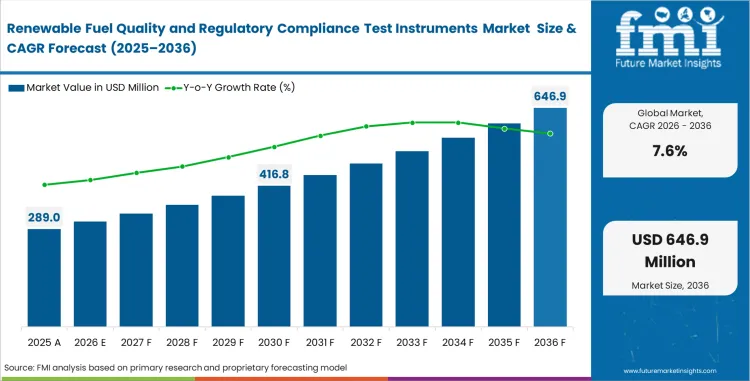
Renewable fuel quality and regulatory compliance test instruments market was valued at USD 268.6 million in 2025. Sector is estimated to reach USD 289.0 million in 2026 at a CAGR of 7.60% during the forecast period. Total opportunity is projected to arrive at USD 601.2 million by 2036 as renewable diesel, biodiesel, ethanol blending, and SAF programs keep laboratories under pressure to certify each batch against tighter fuel-quality requirements.
Summary of Renewable Fuel Quality and Regulatory Compliance Test Instruments Market
- Market valuation is expected to reach USD 601.2 million by 2036.
- The category is forecast to expand at a 7.6% CAGR from 2026 to 2036.
- Renewable fuel test instruments generated USD 268.6 million in 2025.
- Market value is expected to rise to USD 289 million in 2026.
- Physical properties testing is projected to remain the leading test function with 27% share in 2026.
- ASTM methods are set to lead compliance standards at 46% share in 2026.
- Benchtop systems continue to anchor deployment, with 63% share expected in 2026.
- Among the countries covered, the Netherlands shows the fastest growth profile through 2036.
Key Takeaways, Market Size, and Forecast
- Renewable Fuel Quality and Regulatory Compliance Test Instruments Market is projected to grow from USD 289.0 million in 2026 to USD 601.2 million by 2036, at a CAGR of 7.6%.
- The renewable fuel quality and regulatory compliance test instruments market was valued at USD 268.6 million in 2025.
- By 2036, the Renewable Fuel Quality and Regulatory Compliance Test Instruments Market is expected to be worth USD 601.2 million.
- From 2026 to 2036, the market is projected to expand at a CAGR of 7.6%.
- The market is predicted to create an incremental opportunity of USD 312.2 million between 2026 and 2036.
- In 2026, Density Meters are expected to account for 18.6% of the instrument type segment.
- Netherlands (9.2%) and the United Kingdom (8.9%) are expected to be two of the fastest growing markets.
Renewable Fuel Quality and Regulatory Compliance Test Instruments Market Key Takeaways
| Metric | Value |
|---|---|
| Market Size (2025) | USD 268.6 million |
| Market Size (2026) | USD 289 million |
| Market Size (2036) | USD 601.2 million |
| CAGR (2026-2036) | 7.6% |
| Incremental Opportunity | USD 312.2 million |
| Leading Instrument Type | Density Meters (18.6%) |
| Leading Test Function | Physical Properties (27%) |
| Leading Fuel Type | Biodiesel (26%) |
| Leading Compliance Standard | ASTM Methods (46%) |
| Leading Deployment | Benchtop (63%) |
| Leading End Use | Production Labs (36%) |
| Leading Automation | Semi-automated (44%) |
| Leading Sales Channel | Direct Sales (52%) |
Source: Future Market Insights (FMI) analysis, based on proprietary forecasting model and primary research
Quality teams are no longer selecting instruments only for isolated property checks. Current evaluation now centers on whether one installed base can cover routine release testing, specification verification, method alignment, and traceable reporting without creating duplicate workflows across biodiesel, renewable diesel, and aviation fuel streams. Overlap is lifting interest in adjacent categories such as advanced biofuels and sustainable aviation fuel because assay breadth now affects how quickly laboratories can clear material for blending, transfer, or dispatch. Delay carries a practical cost, since each added manual handoff raises the chance of rechecks, slower release timing, and added method-validation work.
Installed equipment becomes easier to justify once laboratories can standardize method coverage across more than one renewable fuel pathway. Lab heads, terminal operators, and airport fuel teams trigger that move when compliance work starts to span conventional blends, drop-in fuels, and referee testing under one reporting process. Wider adoption becomes easier after that point because replacement cycles start to follow workflow fit instead of one-off instrument need.
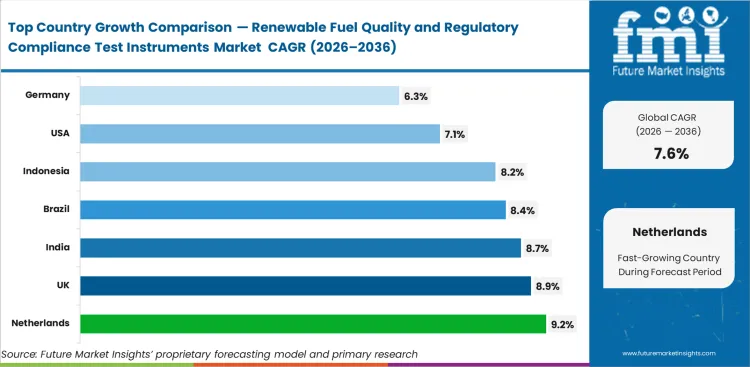
Netherlands is anticipated to post a CAGR of 9.2% in this market through 2036, followed by the United Kingdom at 8.9%, India at 8.7%, Brazil at 8.4%, Indonesia at 8.2%, the United States at 7.1%, and Germany at 6.3%. Faster countries are tied more closely to new blending programs, airport-fuel qualification work, or export-facing compliance needs, while mature territories carry a heavier replacement mix and a slower first-installation pace.
Segmental Analysis
Key Facts About Segments
- Frequent release-stage testing keeps density meters at the front of instrument demand, with 18.6% share projected in 2026. Early-stage property checks and repeated use across fuel types continue to support their position.
- Routine batch clearance requirements keep physical properties as the leading test function, with 27% share expected in 2026. Density, viscosity, and flash point checks continue to dominate daily laboratory workflows.
- Established blending programs keep biodiesel at the center of testing activity, with 26% share anticipated in 2026. Broad use across production and downstream verification sustains consistent instrument demand.
- Method alignment continues to guide equipment selection, with ASTM methods projected to hold 46% share in 2026. Strong global acceptance and trade-linked testing workflows support their dominance.
- Controlled laboratory conditions keep benchtop systems ahead, with 63% share expected in 2026. Higher repeatability, easier calibration, and stronger audit acceptance continue to favor fixed setups.
- Source-level verification keeps production labs as the leading end-use segment, with 36% share projected in 2026. Batch certification requirements at the origin of fuel production drive consistent testing demand.
- Balanced workflow improvement keeps semi-automated systems in the lead, with 44% share expected in 2026. Laboratories continue to favor moderate automation without fully redesigning operations.
- Application-driven purchasing keeps direct sales as the primary channel, with 52% share anticipated in 2026. Need for validation support, method guidance, and installation clarity sustains this route.
Renewable Fuel Quality and Regulatory Compliance Test Instruments Market Analysis by Instrument Type
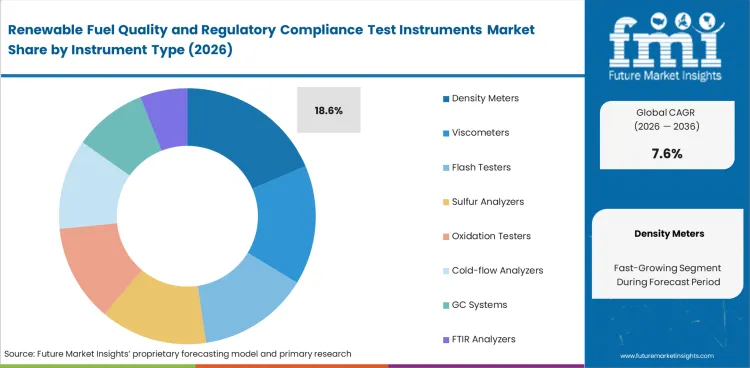
Release testing starts with property confirmation, which keeps density meters central to many renewable fuel workflows. Laboratories use them repeatedly across biodiesel, renewable diesel, SAF, and blended-fuel checks, making the category difficult to displace even when more specialized analyzers carry stronger value for narrower methods. Density meters are expected to account for 18.6% share in 2026 within Instrument Type because they fit easily into existing lab benches, require less adjustment from operators, and remain in frequent use through the workday. Density data also sits close to other pass-fail checkpoints in the sequence, helping teams avoid unnecessary idle time between tests. Viscometers, sulfur analyzers, and GC systems remain essential, though they usually enter the workflow later or under more specific method requirements. Laboratories that underinvest here often feel the effect through slower sample movement well before a specification failure becomes visible. Liquid density meters remain closely aligned with this replacement pattern.
- Workflow priority: Density measurement appears early in routine acceptance work. Faster clearance at that stage helps laboratory teams keep later tests from stacking up.
- Bench continuity: Existing lab layouts usually absorb density meter replacement with limited retraining. Easier installation lowers disruption during method transition.
- Method frequency: Repeated use across more than one renewable fuel category keeps utilization high. Better utilization strengthens the case for earlier replacement.
Renewable Fuel Quality and Regulatory Compliance Test Instruments Market Analysis by Test Function
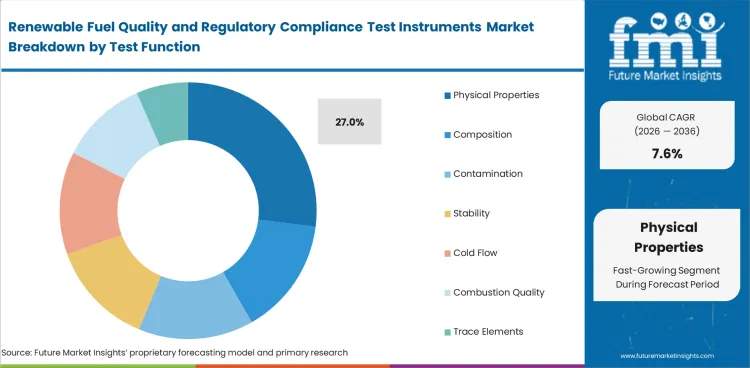
Daily laboratory discipline in renewable fuels is shaped first by the checks that determine whether a batch can move. Physical property testing stays ahead for that reason, since density, viscosity, flash point, and cold-flow behavior are reviewed repeatedly in routine release work. In 2026, physical properties are likely to represent 27% of total market share within Test Function, reflecting how often those parameters must be confirmed before fuel changes hands. Laboratories rarely build their installed base around occasional premium assays. Equipment budgets usually follow the methods that control release timing at the plant, terminal, or airport laboratory. Composition, contamination, and stability testing remain important, but their use is often more conditional or tied to particular fuels and verification stages.
- Release gate: Physical property checks often determine whether a batch moves to the next handling step. Any delay at this point affects the full testing queue.
- Routine burden: High-frequency methods absorb more labor hours than occasional specialty assays. Equipment that reduces repetition pressure carries stronger value here.
- Queue control: Laboratories use property testing to keep daily sample flow manageable. Weak throughput in this function creates retest and scheduling strain.
Renewable Fuel Quality and Regulatory Compliance Test Instruments Market Analysis by Fuel Type
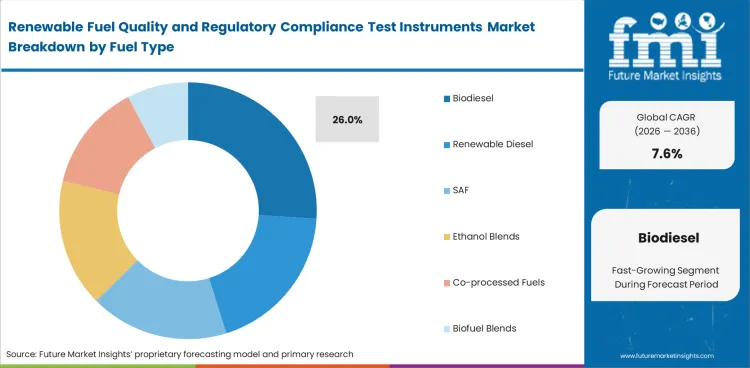
Established blending programs keep biodiesel at the center of renewable fuel testing activity across production, storage, and downstream verification points. Producers, terminals, and contract laboratories encounter biodiesel-related checks often enough to keep the category broad, familiar, and recurring. Biodiesel is anticipated to represent 26% of the market in 2026 within Fuel Type because its method burden remains spread across more operating settings than many alternatives. Renewable diesel and SAF are drawing greater attention as each adds new technical demands, yet biodiesel still generates the more widely distributed laboratory workload. Ethanol blends remain relevant in selected geographies, while co-processed fuels and broader biofuel blends add complexity without matching the same installed routine. Teams that plan future testing capacity only around aviation fuel or drop-in pathways can miss how much present laboratory activity still sits inside established biodiesel programs. Ethanol and hydrotreated vegetable oil remain adjacent demand references for this balance.
- Installed habit: Biodiesel testing is already embedded in many lab routines. Existing familiarity lowers hesitation when equipment budgets are reviewed.
- Blend coverage: Biodiesel touches both production and downstream verification. Wider touchpoints keep recurring test need distributed across more sites.
- Method depth: Oxidation stability, cold-flow, and composition checks add method variety. Broader test needs support instrument replacement over a longer cycle.
Renewable Fuel Quality and Regulatory Compliance Test Instruments Market Analysis by Compliance Standard
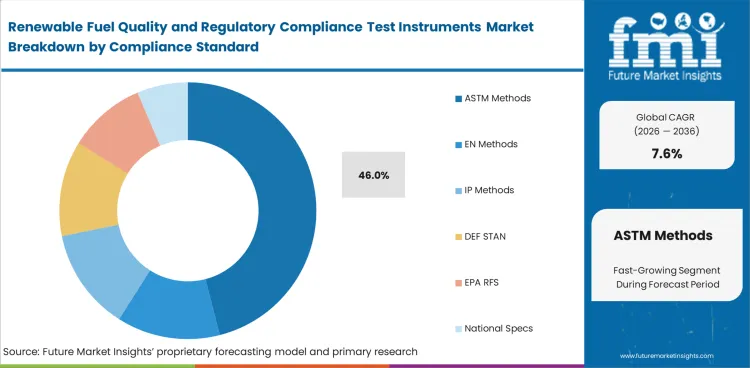
Method alignment often decides instrument choice before price becomes the main discussion. Laboratories handling USA-linked trade flows, multinational product movement, or cross-referenced internal manuals usually favor analyzers that fit ASTM routines with minimal interpretation burden. ASTM Methods are forecast to represent 46% share in 2026 within Compliance Standard because they remain deeply embedded in biodiesel, renewable diesel, and aviation-fuel verification across a wide range of commercial workflows. EN methods, IP methods, DEF STAN references, EPA-linked routines, and national specifications all remain relevant, yet ASTM compatibility continues to shape more shortlists than any other standard group. Value here comes from more than running a method correctly. Laboratories also want outputs that stand up during audits, inter-lab review, and result disputes. Teams that understate that requirement often discover later that the real burden sits in documentation friction rather than in the test itself. Automatic distillation analyzers and process liquid analyzers connect naturally to this method-led selection pattern.
- Method fit: ASTM familiarity narrows the risk of choosing instruments that require extra workaround steps. Cleaner method matching reduces validation effort.
- Audit confidence: Standard-aligned outputs help laboratories defend results during review. Clearer records matter when batches are disputed.
- Trade readiness: Cross-border or multi-site fuel handling favors commonly recognized methods. Better recognition shortens approval time across linked operations.
Renewable Fuel Quality and Regulatory Compliance Test Instruments Market Analysis by Deployment
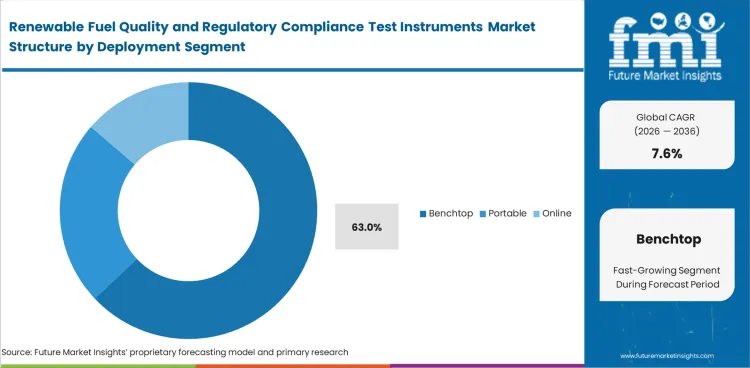
Controlled laboratory conditions still define most regulated fuel verification work, and that keeps benchtop instruments firmly in the lead. Repeatability, environmental control, service access, and operator familiarity all favor fixed laboratory setups when results must stand up under specification review. Benchtop systems are expected to account for 63% share in 2026 within Deployment, reflecting how most referee work, batch certification, and dispute-sensitive testing is still carried out. Portable analyzers remain useful where indicative field checks matter, while online systems continue to gain relevance in continuous or process-linked environments. Even so, final acceptance work still returns to fixed lab instruments when reproducibility and documentation carry the most weight. Teams that rely too heavily on portable tools for jobs better suited to the bench often create extra confirmation work later. Process liquid analyzers remain relevant where continuous measurement begins to support those bench-led routines.
- Result control: Benchtop systems operate under tighter environmental conditions. More stable conditions support repeatable outputs during formal verification.
- Service access: Fixed installations are easier to calibrate and maintain on schedule. Better service continuity limits downtime risk.
- Referee value: Final acceptance work often returns to the laboratory bench. Stronger referee positioning protects result credibility when questions arise.
Renewable Fuel Quality and Regulatory Compliance Test Instruments Market Analysis by End Use
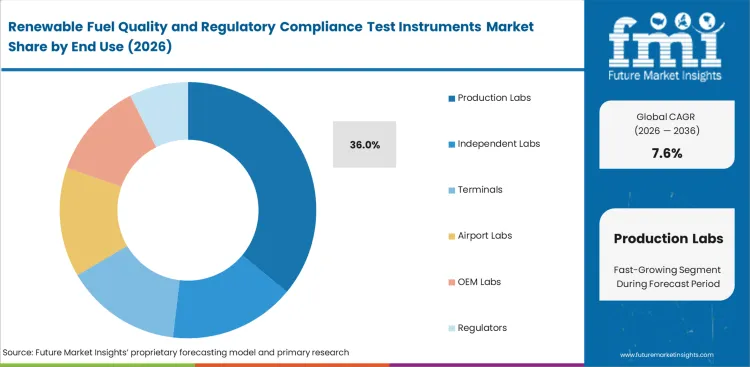
Fuel release responsibility begins at the production site, which keeps production labs in the leading position within End Use. Every batch requires a decision before it can move onward, placing producer-side laboratories under constant pressure to verify quality quickly and consistently. Production labs are projected to account for 36% share in 2026 within End Use because first-pass certification starts at the source and remains difficult to bypass. Independent laboratories gain importance where arbitration, third-party confirmation, or specialized methods are needed, while terminals and airport labs rise in relevance as renewable fuel movement becomes broader. OEM labs and regulators remain part of the mix, although their activity is narrower and often more intermittent. Strong instrument need at the production stage reflects recurring use rather than installed count alone. A plant laboratory that falls behind on release work can slow product movement even when downstream testing capacity is available. Industrial biofuel processing machinery provides a useful adjacent signal for where plant-led quality control continues to matter most.
- Source control: Batch certification begins before the fuel leaves production. Early verification keeps later handling steps from absorbing avoidable delays.
- Utilization load: Production labs run tests more frequently than many downstream settings. Higher instrument use supports earlier replacement decisions.
- Dispatch timing: Delays at the plant laboratory can hold back movement across the rest of the chain. Faster release work protects operating continuity.
Renewable Fuel Quality and Regulatory Compliance Test Instruments Market Analysis by Automation
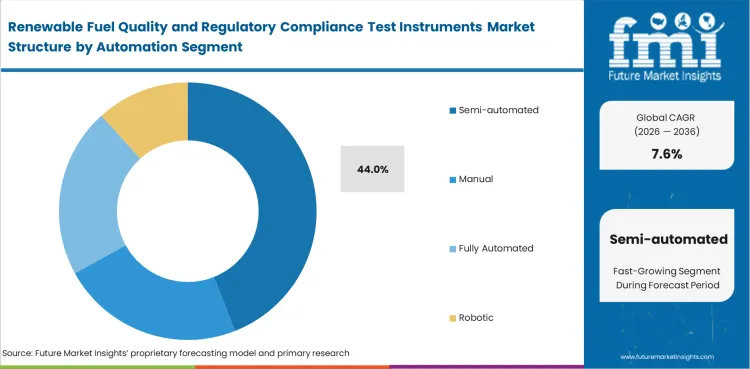
Many renewable fuel laboratories do not move directly from manual work to fully robotic testing. Most prefer an intermediate setup that improves repeatability, lowers operator burden, and raises sample throughput without forcing a complete redesign of daily routines. Semi-automated systems are expected to make up 44% of the market in 2026 within Automation because they balance labor savings with a more manageable capital requirement. Full automation is attractive where sample volumes are high and method uniformity is stronger, yet many laboratories in this category still run mixed workflows that make partial automation the more practical option. Manual setups remain in place where budgets are tighter or throughput is modest, though that position becomes harder to defend as documentation needs rise. Semi-automated platforms fit current operating reality well because they improve consistency without requiring laboratories to rebuild the full process around one equipment philosophy. Weak automation choices usually become visible first through operator dependence and uneven repeatability.
- Labor balance: Semi-automated systems lower repetitive handling without removing operator oversight. That balance fits mixed-workflow laboratories better than an all-manual or fully robotic extreme.
- Repeatability gain: Better control over routine steps improves result consistency. Consistency matters when laboratories compare outputs across fuel types.
- Capital discipline: Partial automation spreads improvement across the workflow without forcing the largest capital move at once. Easier budget approval supports adoption.
Renewable Fuel Quality and Regulatory Compliance Test Instruments Market Analysis by Sales Channel
Method-specific selling remains common in this category, which keeps direct sales ahead of broader channel models. Laboratories rarely choose renewable fuel analyzers as interchangeable catalog items because installation fit, standards coverage, service access, and validation support weigh too heavily during selection. Direct Sales are expected to account for 52.0% share in 2026 within Sales Channel, a lead tied closely to the need for application guidance and after-installation support. Distributors remain relevant in selected geographies, service contracts help retain installed accounts, and OEM bundles can win where equipment is sold inside a broader laboratory package. Even so, vendor-led selling stays strong because technical clarification often decides the purchase. Teams that underestimate post-installation support can face longer ramp-up periods and more method-approval work than expected. Fuel additives and aviation fuel additives remain useful adjacent references where application-led selling is also common.
- Application support: Direct engagement gives laboratories clearer answers on standards coverage and fit. Better guidance reduces selection mistakes.
- Validation help: New installs often need method familiarization and setup support. Stronger vendor contact shortens the path to routine use.
- Service continuity: Ongoing maintenance and troubleshooting matter after the sale. Reliable support helps protect instrument uptime and result confidence.
Renewable Fuel Quality and Regulatory Compliance Test Instruments Market Drivers, Restraints, and Opportunities
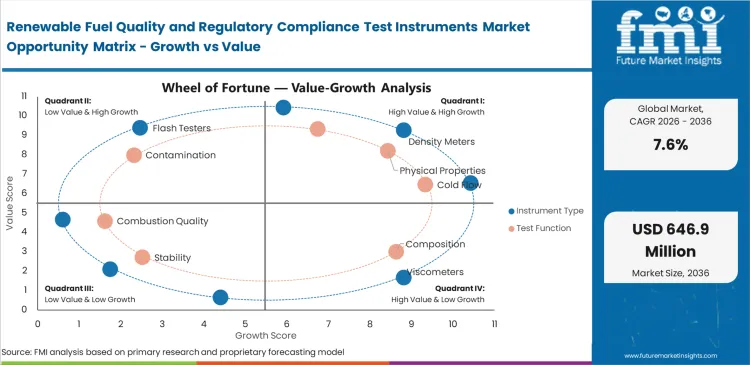
Laboratory heads are being pushed toward broader test coverage because renewable fuel handling no longer stops at a single familiar blend pathway. Biodiesel remains important, yet renewable diesel, ethanol programs, and SAF qualification work are widening the set of methods many sites must support. That reality is increasing interest in instrument combinations that can deliver routine property checks, composition work, and traceable documentation without creating separate operating silos. Quality teams place value on that range because retesting, result disputes, and slow release timing can erode the benefit of a lower-priced instrument decision. Current industry direction therefore favors vendors that can reduce method handoffs and keep compliance work aligned across more than one fuel category.
Capital approval and installed-equipment inertia still slow replacement decisions in many laboratories. Existing analyzers often continue to perform well enough for familiar test routines, which makes full replacement harder to justify until compliance work becomes broader or audit pressure becomes heavier. Service access, calibration timing, operator familiarity, and method-validation effort also keep some laboratories tied to older setups longer than they would prefer. Partial upgrades help, yet they do not always solve the full reporting or workflow burden. Result is a measured replacement cycle even when laboratories clearly recognize the need for better coverage.
Opportunities in the Renewable Fuel Quality and Regulatory Compliance Test Instruments Market
- Aviation-fuel qualification: SAF testing adds a demanding layer of quality verification. Vendors that help airport fuel labs and aviation-linked test sites handle that burden can win higher-value placements.
- Multi-fuel laboratories: Sites handling biodiesel, renewable diesel, ethanol blends, and related fuels need equipment choices that reduce method fragmentation. Suppliers offering clearer cross-method fit can capture that replacement wave.
- Service-led retention: Installed accounts often revisit instrument choices when support quality declines. Providers that combine application guidance with reliable maintenance can widen account retention. Gas chromatography systems offer a useful adjacent reference where service depth also influences vendor stickiness.
Regional Analysis
Key Facts About Country
- Export-linked fuel handling and aviation testing activity keep the Netherlands in the strongest growth position, with demand projected to rise at 9.2% CAGR through 2036.
- The United Kingdom is expected to grow at a 8.9% CAGR through 2036, supported by rising SAF verification and tighter compliance routines.
- Expanding ethanol blending and growing laboratory capacity place India among the faster-growing markets, with demand projected at 8.7% CAGR through 2036.
- Blend-driven testing and recurring biodiesel verification keep Brazil on a steady expansion path, with growth estimated at 8.4% CAGR through 2036.
- With the market forecast to expand at 8.2% CAGR through 2036, policy-driven biodiesel programs and repeated quality checks support Indonesia’s position.
- Large installed base and upgrade-led demand keep the United States in a stable growth bracket, where demand is projected at 7.1% CAGR through 2036.
- Mature laboratory systems and selective replacement cycles place Germany at the lower end of the range, expected to grow at 6.3% CAGR through 2036.
Based on the regional analysis, the Renewable Fuel Quality and Regulatory Compliance Test Instruments Market is segmented into Americas, Europe, and Asia Pacific across 40 plus countries.
.webp "Top Country Growth Comparison Renewable Fuel Quality And Regulatory Compliance Test Instruments Market Cagr (2026 2036)")
| Country | CAGR (2026 to 2036) |
|---|---|
| Netherlands | 9.2% |
| United Kingdom | 8.9% |
| India | 8.7% |
| Brazil | 8.4% |
| Indonesia | 8.2% |
| United States | 7.1% |
| Germany | 6.3% |
Source: Future Market Insights (FMI) analysis, based on proprietary forecasting model and primary research
Americas Renewable Fuel Quality and Regulatory Compliance Test Instruments Market Analysis
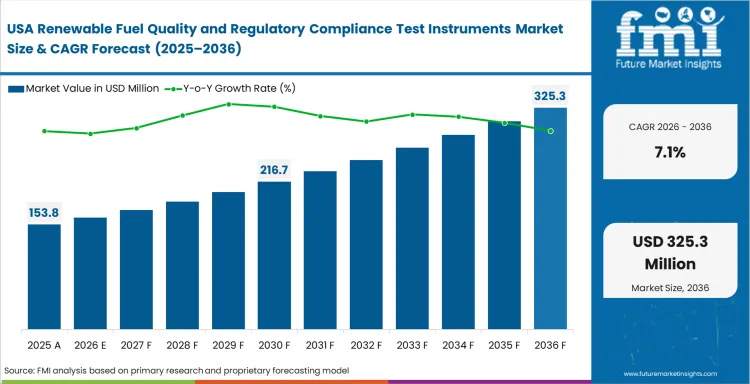
Fuel-quality investment across the Americas is shaped by two distinct operating realities. Activity in the United States comes from a large installed testing base spread across renewable fuel plants, terminals, and independent laboratories, while Brazil adds a faster-moving blend-led requirement tied to recurring biodiesel handling and quality verification. Laboratories in this region are often balancing replacement need with broader method coverage, especially where export-facing checks and blend assurance sit close to day-to-day release work. Equipment choice therefore depends heavily on whether analyzers can support wider compliance routines without slowing sample flow. Transportation biofuel remains a useful adjacent read because transport-fuel policy and handling practice continue to influence analytical need.
- United States: Industry outlook in the United States points to a CAGR of 7.1% through 2036 in this market because new requirement increasingly comes from upgrading how laboratories work rather than from first-time placement alone. Existing laboratory capacity gives the United States a large installed base, yet replacement decisions are becoming more selective as sites look for better cross-method coverage rather than one-for-one swaps. Renewable diesel activity, biodiesel verification, and blending oversight keep quality teams active, but many facilities already own core analyzers and now focus more on method breadth, software support, and service reliability. Mature site coverage keeps volume meaningful, though later-stage expansion depends heavily on whether vendors can reduce retest burden and simplify compliance records.
- Brazil: Blend-linked testing work keeps Brazil in a stronger expansion position than many mature laboratory territories. Biodiesel handling remains broad across production and downstream verification points, which means instrument need is tied to recurring quality checks rather than to occasional project work. Laboratory teams also need dependable equipment that can handle routine property verification without creating service gaps or method inconsistency across regions. Renewable Fuel Quality and Regulatory Compliance Test Instruments demand analysis in Brazil is expected to register a CAGR of 8.4% during 2026 to 2036, supported by that repeated testing burden. Steady advance here reflects the fact that routine blending activity keeps instrument use practical and recurrent, making replacement easier to justify than in lower-frequency settings.
FMI's report includes Canada, Mexico, Argentina, Colombia, and Chile. Installed laboratory maturity varies across those countries, yet territories with stronger blending activity or export-linked quality verification tend to move sooner toward instruments that reduce reporting burden and keep release timing under control.
Europe Renewable Fuel Quality and Regulatory Compliance Test Instruments Market Analysis
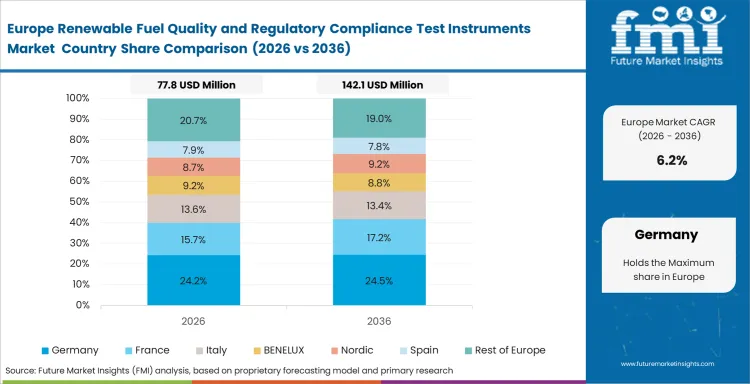
Europe remains a high-discipline testing region where method consistency and traceable reporting weigh heavily in analyzer selection. Refiners, independent laboratories, terminals, and airport fuel teams often work inside tighter specification routines, which raises the importance of repeatable outputs and clean documentation. Regional activity also benefits from renewable diesel trade flows and aviation-fuel qualification work around major handling hubs. Equipment decisions here are judged as much on result credibility and service depth as on raw test speed, particularly where one laboratory may need to support more than one renewable fuel pathway. Aviation drop-in biomass renewable fuels and first generation biofuel remain closely connected themes because Europe’s compliance intensity often extends across more than one renewable fuel stream.
- Netherlands: Port-linked fuel handling and aviation-fuel qualification activity keep the Netherlands in a leading position for this category. Laboratories there often sit close to export-oriented product movement, blending checks, and transfer points where method reliability matters immediately. Faster replacement is easier to justify when a result delay can slow more than one downstream step. Renewable Fuel Quality and Regulatory Compliance Test Instruments valuation in the Netherlands is likely to post a CAGR of 9.2% through 2036, the strongest rate among the countries assessed. High technical scrutiny at major handling hubs helps explain why the country stays ahead of slower replacement-led territories.
- United Kingdom: Demand for renewable fuel quality and regulatory compliance test instruments in the United Kingdom is forecast to expand at an annual rate of 8.9% during the study period. SAF compliance work and tighter fuel-verification routines are giving the United Kingdom a more active testing profile than many established markets. Airport fuel laboratories and related quality teams need analyzers that can support aviation-linked checks without weakening day-to-day verification discipline across other renewable fuel categories. Result traceability also matters, since method disputes and release delays can add cost quickly in regulated fuel handling. Stronger advance here reflects not only added activity, but also a narrower tolerance for instruments that create extra handoffs in compliance work.
- Germany: Industrial discipline and method familiarity keep Germany an important country, yet current activity leans more toward measured replacement than toward a wave of first-time installs. Laboratories already operating within mature fuel-testing routines tend to compare new equipment carefully on service quality, repeatability, and reporting fit before approving capital spend. That reality keeps adoption below faster-building territories even when technical standards remain demanding. Germany is forecast to register a CAGR of 6.3% in this market through 2036. Lower pace does not imply weak relevance, as the country still carries a solid installed base and a high bar for analyzer approval.
FMI's report includes France, Italy, Spain, Belgium, Sweden, and other European countries. Benelux and Nordic regions are especially relevant because processing and fuel-handling activity in those areas support specialized verification routines and keep advanced method discipline close to day-to-day laboratory work.
Asia Pacific Renewable Fuel Quality and Regulatory Compliance Test Instruments Market Analysis
Asia Pacific carries a more expansion-oriented profile because renewable fuel programs in several countries are still broadening their operational reach. Laboratories across the region are often dealing with a practical mix of new blending targets, uneven installed capacity, and a need for dependable analyzers that can support both routine quality checks and rising compliance scrutiny. Instrument need here is helped by the fact that many sites are still building out how they test rather than only replacing what is already there. Suppliers therefore have room to compete on application fit, service responsiveness, and method coverage rather than on installed-base loyalty alone. Ethanol biofuel and advanced biofuels remain useful adjacent references for how blending programs can widen laboratory need in the region.
- India: India is expected to record a CAGR of 8.7% in renewable fuel quality and regulatory compliance test instruments industry during 2026 to 2036. Ethanol blending progression is widening the scope of fuel-quality work in India, and that is raising the need for instruments that can support routine property verification with dependable repeatability. Laboratory investment is also influenced by the need to keep batch clearance practical as blending activity expands across more touchpoints. Teams evaluating new analyzers tend to focus on method fit, uptime, and service access because interruptions can create real operating delays. Faster advance reflects an environment where laboratory capability is still being built out in response to a broader compliance workload.
- Indonesia: Biodiesel policy and continued blend-related quality work keep Indonesia in a strong position within the regional picture. Repeated verification needs across production and handling points mean laboratories cannot rely on occasional testing cycles. Daily operating pressure favors instruments that can sustain repeat use and minimize result inconsistency across batches. Renewable fuel quality and regulatory compliance test instruments industry outlook in Indonesia points to a CAGR of 8.2% through 2036. Rate remains above the global average because testing need is tied to recurring blend activity rather than to isolated project-based installs, and that supports a steadier replacement path.
FMI's report includes China, Japan, South Korea, Thailand, Malaysia, Australia, and New Zealand. Country performance across Asia Pacific depends heavily on how quickly blending activity, certification routines, and laboratory capability rise together, since instrument need remains limited when one of those elements lags the others.
Competitive Aligners for Market Players
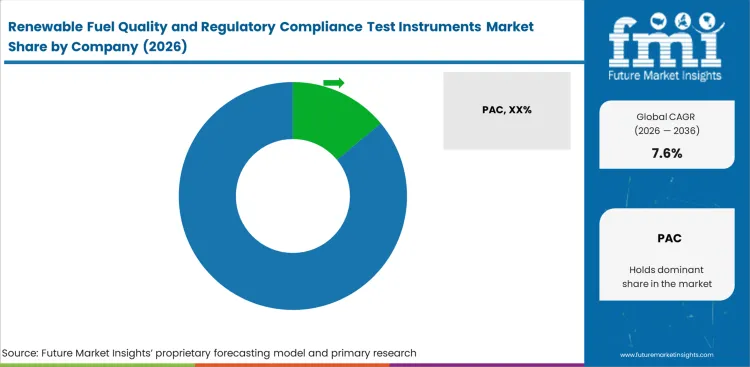
Method coverage remains one of the clearest dividing lines in this category. Laboratories responsible for renewable diesel, biodiesel, ethanol blends, or SAF do not compare instruments only on list price. They examine whether the equipment can sit inside accepted routines, produce repeatable outputs, and hold up under review when a batch result is questioned. PAC, Anton Paar, Metrohm, Tanaka Scientific, XOS, eralytics, and Koehler Instrument benefit when they can present clear application fit across multiple renewable fuel pathways. Accounts usually separate stronger vendors from weaker ones through result consistency, service responsiveness, calibration support, and confidence that method alignment will not become a reporting problem later.
Installed-base depth also matters because many laboratories prefer continuity where operator familiarity and service planning are already in place. Incumbents gain from that preference when they can combine known method coverage with dependable support and easier integration into existing laboratory routines. Challenger brands can still win where accounts are opening new renewable fuel capacity, broadening into fresh test categories, or reviewing older systems that no longer fit current compliance work. process liquid analyzers remain relevant here because adjacent analytical categories show a similar preference for vendors that reduce method burden rather than simply offer lower upfront pricing.
Account power remains meaningful because laboratories can delay full replacement, add equipment in stages, or divide requirements across more than one supplier if no single vendor covers the full method range cleanly. Result is a field that does not tighten too quickly around one name. Competition is likely to remain moderately fragmented, because service depth, application fit, and installed familiarity all matter, yet no single supplier removes the need for careful method-by-method comparison.
Key Players in Renewable Fuel Quality and Regulatory Compliance Test Instruments Market
- PAC
- Anton Paar
- Metrohm
- Tanaka Scientific
- XOS
- eralytics
- Koehler Instrument
Scope of the Report
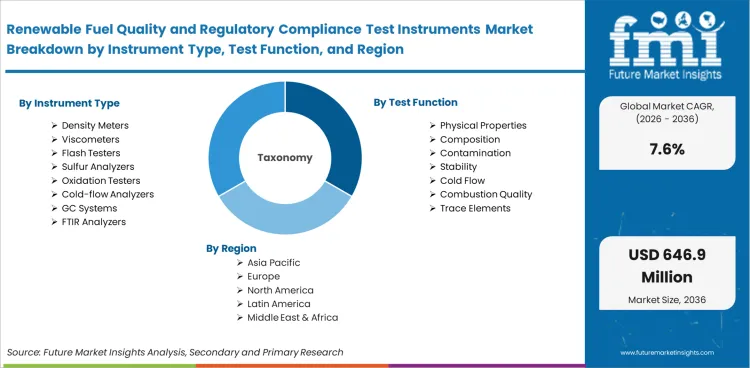
| Metric | Value |
|---|---|
| Quantitative Units | USD 289 million to USD 601.2 million, at a CAGR of 7.6% |
| Market Definition | Renewable Fuel Quality and Regulatory Compliance Test Instruments Market covers analytical instruments used to verify finished renewable fuels and blends against applicable quality requirements before commercial movement or use. Focus remains on test systems used for property verification, composition checks, contamination assessment, stability checks, and related compliance work across renewable fuel pathways. |
| Instrument Type Segmentation | Density Meters, Viscometers, Flash Testers, Sulfur Analyzers, Oxidation Testers, Cold-flow Analyzers, GC Systems, FTIR Analyzers |
| Test Function Segmentation | Physical Properties, Composition, Contamination, Stability, Cold Flow, Combustion Quality, Trace Elements |
| Fuel Type Segmentation | Biodiesel, Renewable Diesel, SAF, Ethanol Blends, Co-processed Fuels, Biofuel Blends |
| Compliance Standard Segmentation | ASTM Methods, EN Methods, IP Methods, DEF STAN, EPA RFS, National Specs |
| Deployment Segmentation | Benchtop, Portable, Online |
| End Use Segmentation | Production Labs, Independent Labs, Terminals, Airport Labs, OEM Labs, Regulators |
| Automation Segmentation | Semi-automated, Manual, Fully Automated, Robotic |
| Sales Channel Segmentation | Direct Sales, Distributors, Service Contracts, OEM Bundles |
| Regions Covered | Americas, Europe, Asia Pacific |
| Countries Covered | Netherlands, United Kingdom, India, Brazil, Indonesia, United States, Germany, and 40 plus countries |
| Key Companies Profiled | PAC, Anton Paar, Metrohm, Tanaka Scientific, XOS, eralytics, Koehler Instrument |
| Forecast Period | 2026 to 2036 |
| Approach | FMI combined primary discussions with laboratory and fuel-quality participants, desk review of applicable quality methods and compliance guidance, and a bottom-up read of testing points across renewable fuel value chains. Market sizing was anchored to recurring quality-verification need across production, storage, transfer, and certification settings. Forecasts were checked against renewable fuel program expansion, replacement timing, and active vendor participation in relevant analyzer categories. |
Source: Future Market Insights (FMI) analysis, based on proprietary forecasting model and primary research
Renewable Fuel Quality and Regulatory Compliance Test Instruments Market Analysis by Segments
Instrument Type:
- Density Meters
- Viscometers
- Flash Testers
- Sulfur Analyzers
- Oxidation Testers
- Cold-flow Analyzers
- GC Systems
- FTIR Analyzers
Test Function:
- Physical Properties
- Composition
- Contamination
- Stability
- Cold Flow
- Combustion Quality
- Trace Elements
Fuel Type:
- Biodiesel
- Renewable Diesel
- SAF
- Ethanol Blends
- Co-processed Fuels
- Biofuel Blends
Compliance Standard:
- ASTM Methods
- EN Methods
- IP Methods
- DEF STAN
- EPA RFS
- National Specs
Deployment:
- Benchtop
- Portable
- Online
- End Use:
- Production Labs
- Independent Labs
- Terminals
- Airport Labs
- OEM Labs
- Regulators
Automation:
- Semi-automated
- Manual
- Fully Automated
- Robotic
Sales Channel:
- Direct Sales
- Distributors
- Service Contracts
- OEM Bundles
Region:
- Americas
- United States
- Brazil
- Europe
- Netherlands
- United Kingdom
- Germany
- Asia Pacific
- India
- Indonesia
Bibliography
- USA Energy Information Administration. (2025, September 26). USA Renewable Diesel Fuel and Other Biofuels Plant Production Capacity. USA Energy Information Administration.
- USA Energy Information Administration. (2025, September 26). USA Biodiesel Plant Production Capacity. USA Energy Information Administration.
- International Energy Agency. (2025, January). Renewable transport. Renewables 2025.
- USA Environmental Protection Agency. (2026, March 27). Final Renewable Fuel Standards for 2026 and 2027. USA Environmental Protection Agency.
- European Commission. (2025, January). ReFuelEU aviation. Mobility and Transport.
This bibliography is provided for reader reference. The full report contains the complete reference list with primary source documentation.
This Report Addresses
- Market size and forecast for Renewable Fuel Quality and Regulatory Compliance Test Instruments from 2026 to 2036.
- Key forces influencing replacement, first-time installs, and method-breadth decisions across renewable fuel laboratories.
- Leading subsegments by Instrument Type, Test Function, Fuel Type, Compliance Standard, Deployment, End Use, Automation, and Sales Channel.
- Country-level outlook for the United States, Brazil, Netherlands, United Kingdom, Germany, India, and Indonesia.
- Competitive position of leading instrument suppliers active in renewable fuel quality and compliance testing.
- Operating factors influencing analyzer choice across production, terminal, independent, and airport fuel laboratory settings.
- Scope boundaries covering what is included and excluded in the market definition.
- Primary research and forecast approach used by FMI in this study.
Frequently Asked Questions
What does the Renewable Fuel Quality and Regulatory Compliance Test Instruments Market cover?
It covers analytical instruments used to verify whether renewable fuels and related blends meet required quality specifications before movement or use.
How large is the Renewable Fuel Quality and Regulatory Compliance Test Instruments Market in 2025?
FMI estimates the market at USD 268.6 million in 2025. That base reflects testing need across production sites, terminals, independent laboratories, and aviation-linked fuel verification settings.
What is the expected market value in 2026?
Industry valuation is estimated at USD 289 million in 2026. That level reflects continuing need for instruments that support compliance work across more than one renewable fuel pathway.
What is the expected market value by 2036?
FMI projects the market to reach USD 601.2 million by 2036. Long-term expansion depends on broader renewable fuel testing activity and continuing replacement of analyzers that no longer fit current compliance routines.
What CAGR is expected for the market during 2026 to 2036?
FMI projects a CAGR of 7.6% for 2026 to 2036. Rate remains within the range expected for specification-driven industrial analytical equipment with policy-linked support.
Which instrument category is expected to lead the market in 2026?
Density meters are expected to lead Instrument Type with 18.6% share in 2026. Frequent use across more than one renewable fuel category keeps that category difficult to displace.
Why do density meters remain so important in renewable fuel testing?
Laboratories often use density checks near the beginning of acceptance and release work. Faster, repeatable performance at that stage helps prevent sample queues from building through the rest of the workflow.
Which test function leads the market in 2026?
Physical properties lead Test Function with 27% share in 2026. Density, viscosity, flash point, and cold-flow checks remain central to routine batch verification.
Why does physical property testing stay ahead of other test functions?
Most fuel lots cannot move forward until core property checks are cleared. Repeated operational burden keeps physical property testing at the center of day-to-day analyzer use.
Which fuel type is expected to contribute the largest share in 2026?
Biodiesel is expected to contribute 26% share in 2026 within Fuel Type. Long-established blend programs and recurring downstream verification keep its testing base broad.
Why do ASTM Methods lead the compliance standard segment?
ASTM-linked routines remain deeply embedded in U.S.-connected and trade-facing renewable fuel workflows. Instruments that align well with those methods usually face less resistance during selection and validation.
What deployment mode leads the market?
Benchtop systems lead Deployment with 63% share in 2026. Regulated release work still depends heavily on controlled laboratory conditions and repeatable documentation.
Which end-use setting leads the market in 2026?
Production labs lead End Use with 36% share in 2026. Release certification starts at the source, so producer-side laboratories face recurring test need before product movement begins.
Why are semi-automated systems expected to stay ahead of manual and fully automated setups?
Semi-automated systems improve repeatability and lower repetitive operator burden without demanding a complete redesign of the lab routine. That balance suits many renewable fuel laboratories better than either extreme.
Why does direct sales lead the sales channel segment?
Analyzer selection in this category often depends on application fit, installation guidance, and method-validation support. Vendor-led engagement remains valuable when those issues influence purchase decisions.
Which country is expected to post the fastest CAGR through 2036?
Netherlands is expected to post the highest CAGR at 9.2% through 2036. Port-linked fuel handling and aviation-fuel qualification activity keep testing activity more active than in slower replacement-led territories.
Why does the United Kingdom rank close behind the Netherlands?
United Kingdom benefits from a stronger aviation-fuel compliance angle and tighter verification needs at airport-related fuel settings. That gives laboratory teams a stronger reason to review equipment fit earlier.
Why is the United States growing below the fastest countries even though it remains a major market?
Large installed capacity already exists in the United States, so more activity now comes from replacement and method-breadth improvement than from first-time placement. That keeps the rate below faster build-out territories.
What keeps Germany below the global average?
Germany remains a mature testing territory with established laboratory practice. New analyzer activity depends more on clear replacement justification, service quality, and reporting fit than on fresh site creation.
What do laboratories usually compare when selecting renewable fuel analyzers?
Method coverage, repeatability, service support, calibration continuity, and reporting clarity usually matter more than a simple upfront price comparison. Teams also look closely at whether one installed base can support a broader mix of renewable fuel workflows.
Is this market concentrated or fragmented?
Market remains moderately fragmented through 2036. No single vendor removes the need for careful method-by-method comparison, although established suppliers benefit from installed familiarity and service depth.
Who are the main companies active in this market?
PAC, Anton Paar, Metrohm, Tanaka Scientific, XOS, eralytics, and Koehler Instrument are among the main active companies. Competition centers on method fit, service dependability, and ease of use inside compliance-sensitive laboratory routines.
What is the biggest restraint on faster analyzer replacement?
Installed-equipment inertia remains one of the main restraints. Many laboratories can keep older analyzers working for familiar methods, which delays replacement until compliance burden or reporting needs become harder to manage.
Where do the strongest opportunities sit over the forecast period?
Aviation-fuel qualification, multi-fuel laboratory upgrades, and service-led account retention offer the clearest opportunities. Each area rewards vendors that reduce method burden and improve result consistency across a wider testing routine.
Preview the report firsthand - request a free sample
Get SampleGet the brochure for pricing and purchase details.
Get PDFTable of Content
- Executive Summary
- Global Market Outlook
- Demand-side Trends
- Supply-side Trends
- Technology Roadmap Analysis
- Analysis and Recommendations
- Market Overview
- Market Coverage / Taxonomy
- Market Definition / Scope / Limitations
- Research Methodology
- Chapter Orientation
- Analytical Lens and Working Hypotheses
- Market Structure, Signals, and Trend Drivers
- Benchmarking and Cross-market Comparability
- Market Sizing, Forecasting, and Opportunity Mapping
- Research Design and Evidence Framework
- Desk Research Programme (Secondary Evidence)
- Company Annual and Sustainability Reports
- Peer-reviewed Journals and Academic Literature
- Corporate Websites, Product Literature, and Technical Notes
- Earnings Decks and Investor Briefings
- Statutory Filings and Regulatory Disclosures
- Technical White Papers and Standards Notes
- Trade Journals, Industry Magazines, and Analyst Briefs
- Conference Proceedings, Webinars, and Seminar Materials
- Government Statistics Portals and Public Data Releases
- Press Releases and Reputable Media Coverage
- Specialist Newsletters and Curated Briefings
- Sector Databases and Reference Repositories
- FMI Internal Proprietary Databases and Historical Market Datasets
- Subscription Datasets and Paid Sources
- Social Channels, Communities, and Digital Listening Inputs
- Additional Desk Sources
- Expert Input and Fieldwork (Primary Evidence)
- Primary Modes
- Qualitative Interviews and Expert Elicitation
- Quantitative Surveys and Structured Data Capture
- Blended Approach
- Why Primary Evidence is Used
- Field Techniques
- Interviews
- Surveys
- Focus Groups
- Observational and In-context Research
- Social and Community Interactions
- Stakeholder Universe Engaged
- C-suite Leaders
- Board Members
- Presidents and Vice Presidents
- R&D and Innovation Heads
- Technical Specialists
- Domain Subject-matter Experts
- Scientists
- Physicians and Other Healthcare Professionals
- Governance, Ethics, and Data Stewardship
- Research Ethics
- Data Integrity and Handling
- Primary Modes
- Tooling, Models, and Reference Databases
- Desk Research Programme (Secondary Evidence)
- Data Engineering and Model Build
- Data Acquisition and Ingestion
- Cleaning, Normalisation, and Verification
- Synthesis, Triangulation, and Analysis
- Quality Assurance and Audit Trail
- Market Background
- Market Dynamics
- Drivers
- Restraints
- Opportunity
- Trends
- Scenario Forecast
- Demand in Optimistic Scenario
- Demand in Likely Scenario
- Demand in Conservative Scenario
- Opportunity Map Analysis
- Product Life Cycle Analysis
- Supply Chain Analysis
- Investment Feasibility Matrix
- Value Chain Analysis
- PESTLE and Porter’s Analysis
- Regulatory Landscape
- Regional Parent Market Outlook
- Production and Consumption Statistics
- Import and Export Statistics
- Market Dynamics
- Global Market Analysis 2021 to 2025 and Forecast, 2026 to 2036
- Historical Market Size Value (USD Million) Analysis, 2021 to 2025
- Current and Future Market Size Value (USD Million) Projections, 2026 to 2036
- Y-o-Y Growth Trend Analysis
- Absolute $ Opportunity Analysis
- Global Market Pricing Analysis 2021 to 2025 and Forecast 2026 to 2036
- Global Market Analysis 2021 to 2025 and Forecast 2026 to 2036, By Instrument Type
- Introduction / Key Findings
- Historical Market Size Value (USD Million) Analysis By Instrument Type , 2021 to 2025
- Current and Future Market Size Value (USD Million) Analysis and Forecast By Instrument Type , 2026 to 2036
- Density Meters
- Viscometers
- Flash Testers
- Sulfur Analyzers
- Oxidation Testers
- Cold-flow Analyzers
- GC Systems
- FTIR Analyzers
- Density Meters
- Y-o-Y Growth Trend Analysis By Instrument Type , 2021 to 2025
- Absolute $ Opportunity Analysis By Instrument Type , 2026 to 2036
- Global Market Analysis 2021 to 2025 and Forecast 2026 to 2036, By Test Function
- Introduction / Key Findings
- Historical Market Size Value (USD Million) Analysis By Test Function, 2021 to 2025
- Current and Future Market Size Value (USD Million) Analysis and Forecast By Test Function, 2026 to 2036
- Physical Properties
- Composition
- Contamination
- Stability
- Cold Flow
- Combustion Quality
- Trace Elements
- Physical Properties
- Y-o-Y Growth Trend Analysis By Test Function, 2021 to 2025
- Absolute $ Opportunity Analysis By Test Function, 2026 to 2036
- Global Market Analysis 2021 to 2025 and Forecast 2026 to 2036, By Fuel Type
- Introduction / Key Findings
- Historical Market Size Value (USD Million) Analysis By Fuel Type, 2021 to 2025
- Current and Future Market Size Value (USD Million) Analysis and Forecast By Fuel Type, 2026 to 2036
- Biodiesel
- Renewable Diesel
- SAF
- Ethanol Blends
- Co-processed Fuels
- Biofuel Blends
- Biodiesel
- Y-o-Y Growth Trend Analysis By Fuel Type, 2021 to 2025
- Absolute $ Opportunity Analysis By Fuel Type, 2026 to 2036
- Global Market Analysis 2021 to 2025 and Forecast 2026 to 2036, By Compliance Standard
- Introduction / Key Findings
- Historical Market Size Value (USD Million) Analysis By Compliance Standard, 2021 to 2025
- Current and Future Market Size Value (USD Million) Analysis and Forecast By Compliance Standard, 2026 to 2036
- ASTM Methods
- EN Methods
- IP Methods
- DEF STAN
- EPA RFS
- National Specs
- ASTM Methods
- Y-o-Y Growth Trend Analysis By Compliance Standard, 2021 to 2025
- Absolute $ Opportunity Analysis By Compliance Standard, 2026 to 2036
- Global Market Analysis 2021 to 2025 and Forecast 2026 to 2036, By Deployment
- Introduction / Key Findings
- Historical Market Size Value (USD Million) Analysis By Deployment, 2021 to 2025
- Current and Future Market Size Value (USD Million) Analysis and Forecast By Deployment, 2026 to 2036
- Benchtop
- Portable
- Online
- Benchtop
- Y-o-Y Growth Trend Analysis By Deployment, 2021 to 2025
- Absolute $ Opportunity Analysis By Deployment, 2026 to 2036
- Global Market Analysis 2021 to 2025 and Forecast 2026 to 2036, By End Use
- Introduction / Key Findings
- Historical Market Size Value (USD Million) Analysis By End Use, 2021 to 2025
- Current and Future Market Size Value (USD Million) Analysis and Forecast By End Use, 2026 to 2036
- Production Labs
- Independent Labs
- Terminals
- Airport Labs
- OEM Labs
- Regulators
- Production Labs
- Y-o-Y Growth Trend Analysis By End Use, 2021 to 2025
- Absolute $ Opportunity Analysis By End Use, 2026 to 2036
- Global Market Analysis 2021 to 2025 and Forecast 2026 to 2036, By Automation
- Introduction / Key Findings
- Historical Market Size Value (USD Million) Analysis By Automation, 2021 to 2025
- Current and Future Market Size Value (USD Million) Analysis and Forecast By Automation, 2026 to 2036
- Semi-automated
- Manual
- Fully Automated
- Robotic
- Semi-automated
- Y-o-Y Growth Trend Analysis By Automation, 2021 to 2025
- Absolute $ Opportunity Analysis By Automation, 2026 to 2036
- Global Market Analysis 2021 to 2025 and Forecast 2026 to 2036, By Region
- Introduction
- Historical Market Size Value (USD Million) Analysis By Region, 2021 to 2025
- Current Market Size Value (USD Million) Analysis and Forecast By Region, 2026 to 2036
- North America
- Latin America
- Western Europe
- Eastern Europe
- East Asia
- South Asia and Pacific
- Middle East & Africa
- Market Attractiveness Analysis By Region
- North America Market Analysis 2021 to 2025 and Forecast 2026 to 2036, By Country
- Historical Market Size Value (USD Million) Trend Analysis By Market Taxonomy, 2021 to 2025
- Market Size Value (USD Million) Forecast By Market Taxonomy, 2026 to 2036
- By Country
- USA
- Canada
- Mexico
- By Instrument Type
- By Test Function
- By Fuel Type
- By Compliance Standard
- By Deployment
- By End Use
- By Automation
- By Country
- Market Attractiveness Analysis
- By Country
- By Instrument Type
- By Test Function
- By Fuel Type
- By Compliance Standard
- By Deployment
- By End Use
- By Automation
- Key Takeaways
- Latin America Market Analysis 2021 to 2025 and Forecast 2026 to 2036, By Country
- Historical Market Size Value (USD Million) Trend Analysis By Market Taxonomy, 2021 to 2025
- Market Size Value (USD Million) Forecast By Market Taxonomy, 2026 to 2036
- By Country
- Brazil
- Chile
- Rest of Latin America
- By Instrument Type
- By Test Function
- By Fuel Type
- By Compliance Standard
- By Deployment
- By End Use
- By Automation
- By Country
- Market Attractiveness Analysis
- By Country
- By Instrument Type
- By Test Function
- By Fuel Type
- By Compliance Standard
- By Deployment
- By End Use
- By Automation
- Key Takeaways
- Western Europe Market Analysis 2021 to 2025 and Forecast 2026 to 2036, By Country
- Historical Market Size Value (USD Million) Trend Analysis By Market Taxonomy, 2021 to 2025
- Market Size Value (USD Million) Forecast By Market Taxonomy, 2026 to 2036
- By Country
- Germany
- UK
- Italy
- Spain
- France
- Nordic
- BENELUX
- Rest of Western Europe
- By Instrument Type
- By Test Function
- By Fuel Type
- By Compliance Standard
- By Deployment
- By End Use
- By Automation
- By Country
- Market Attractiveness Analysis
- By Country
- By Instrument Type
- By Test Function
- By Fuel Type
- By Compliance Standard
- By Deployment
- By End Use
- By Automation
- Key Takeaways
- Eastern Europe Market Analysis 2021 to 2025 and Forecast 2026 to 2036, By Country
- Historical Market Size Value (USD Million) Trend Analysis By Market Taxonomy, 2021 to 2025
- Market Size Value (USD Million) Forecast By Market Taxonomy, 2026 to 2036
- By Country
- Russia
- Poland
- Hungary
- Balkan & Baltic
- Rest of Eastern Europe
- By Instrument Type
- By Test Function
- By Fuel Type
- By Compliance Standard
- By Deployment
- By End Use
- By Automation
- By Country
- Market Attractiveness Analysis
- By Country
- By Instrument Type
- By Test Function
- By Fuel Type
- By Compliance Standard
- By Deployment
- By End Use
- By Automation
- Key Takeaways
- East Asia Market Analysis 2021 to 2025 and Forecast 2026 to 2036, By Country
- Historical Market Size Value (USD Million) Trend Analysis By Market Taxonomy, 2021 to 2025
- Market Size Value (USD Million) Forecast By Market Taxonomy, 2026 to 2036
- By Country
- China
- Japan
- South Korea
- By Instrument Type
- By Test Function
- By Fuel Type
- By Compliance Standard
- By Deployment
- By End Use
- By Automation
- By Country
- Market Attractiveness Analysis
- By Country
- By Instrument Type
- By Test Function
- By Fuel Type
- By Compliance Standard
- By Deployment
- By End Use
- By Automation
- Key Takeaways
- South Asia and Pacific Market Analysis 2021 to 2025 and Forecast 2026 to 2036, By Country
- Historical Market Size Value (USD Million) Trend Analysis By Market Taxonomy, 2021 to 2025
- Market Size Value (USD Million) Forecast By Market Taxonomy, 2026 to 2036
- By Country
- India
- ASEAN
- Australia & New Zealand
- Rest of South Asia and Pacific
- By Instrument Type
- By Test Function
- By Fuel Type
- By Compliance Standard
- By Deployment
- By End Use
- By Automation
- By Country
- Market Attractiveness Analysis
- By Country
- By Instrument Type
- By Test Function
- By Fuel Type
- By Compliance Standard
- By Deployment
- By End Use
- By Automation
- Key Takeaways
- Middle East & Africa Market Analysis 2021 to 2025 and Forecast 2026 to 2036, By Country
- Historical Market Size Value (USD Million) Trend Analysis By Market Taxonomy, 2021 to 2025
- Market Size Value (USD Million) Forecast By Market Taxonomy, 2026 to 2036
- By Country
- Kingdom of Saudi Arabia
- Other GCC Countries
- Turkiye
- South Africa
- Other African Union
- Rest of Middle East & Africa
- By Instrument Type
- By Test Function
- By Fuel Type
- By Compliance Standard
- By Deployment
- By End Use
- By Automation
- By Country
- Market Attractiveness Analysis
- By Country
- By Instrument Type
- By Test Function
- By Fuel Type
- By Compliance Standard
- By Deployment
- By End Use
- By Automation
- Key Takeaways
- Key Countries Market Analysis
- USA
- Pricing Analysis
- Market Share Analysis, 2025
- By Instrument Type
- By Test Function
- By Fuel Type
- By Compliance Standard
- By Deployment
- By End Use
- By Automation
- Canada
- Pricing Analysis
- Market Share Analysis, 2025
- By Instrument Type
- By Test Function
- By Fuel Type
- By Compliance Standard
- By Deployment
- By End Use
- By Automation
- Mexico
- Pricing Analysis
- Market Share Analysis, 2025
- By Instrument Type
- By Test Function
- By Fuel Type
- By Compliance Standard
- By Deployment
- By End Use
- By Automation
- Brazil
- Pricing Analysis
- Market Share Analysis, 2025
- By Instrument Type
- By Test Function
- By Fuel Type
- By Compliance Standard
- By Deployment
- By End Use
- By Automation
- Chile
- Pricing Analysis
- Market Share Analysis, 2025
- By Instrument Type
- By Test Function
- By Fuel Type
- By Compliance Standard
- By Deployment
- By End Use
- By Automation
- Germany
- Pricing Analysis
- Market Share Analysis, 2025
- By Instrument Type
- By Test Function
- By Fuel Type
- By Compliance Standard
- By Deployment
- By End Use
- By Automation
- UK
- Pricing Analysis
- Market Share Analysis, 2025
- By Instrument Type
- By Test Function
- By Fuel Type
- By Compliance Standard
- By Deployment
- By End Use
- By Automation
- Italy
- Pricing Analysis
- Market Share Analysis, 2025
- By Instrument Type
- By Test Function
- By Fuel Type
- By Compliance Standard
- By Deployment
- By End Use
- By Automation
- Spain
- Pricing Analysis
- Market Share Analysis, 2025
- By Instrument Type
- By Test Function
- By Fuel Type
- By Compliance Standard
- By Deployment
- By End Use
- By Automation
- France
- Pricing Analysis
- Market Share Analysis, 2025
- By Instrument Type
- By Test Function
- By Fuel Type
- By Compliance Standard
- By Deployment
- By End Use
- By Automation
- India
- Pricing Analysis
- Market Share Analysis, 2025
- By Instrument Type
- By Test Function
- By Fuel Type
- By Compliance Standard
- By Deployment
- By End Use
- By Automation
- ASEAN
- Pricing Analysis
- Market Share Analysis, 2025
- By Instrument Type
- By Test Function
- By Fuel Type
- By Compliance Standard
- By Deployment
- By End Use
- By Automation
- Australia & New Zealand
- Pricing Analysis
- Market Share Analysis, 2025
- By Instrument Type
- By Test Function
- By Fuel Type
- By Compliance Standard
- By Deployment
- By End Use
- By Automation
- China
- Pricing Analysis
- Market Share Analysis, 2025
- By Instrument Type
- By Test Function
- By Fuel Type
- By Compliance Standard
- By Deployment
- By End Use
- By Automation
- Japan
- Pricing Analysis
- Market Share Analysis, 2025
- By Instrument Type
- By Test Function
- By Fuel Type
- By Compliance Standard
- By Deployment
- By End Use
- By Automation
- South Korea
- Pricing Analysis
- Market Share Analysis, 2025
- By Instrument Type
- By Test Function
- By Fuel Type
- By Compliance Standard
- By Deployment
- By End Use
- By Automation
- Russia
- Pricing Analysis
- Market Share Analysis, 2025
- By Instrument Type
- By Test Function
- By Fuel Type
- By Compliance Standard
- By Deployment
- By End Use
- By Automation
- Poland
- Pricing Analysis
- Market Share Analysis, 2025
- By Instrument Type
- By Test Function
- By Fuel Type
- By Compliance Standard
- By Deployment
- By End Use
- By Automation
- Hungary
- Pricing Analysis
- Market Share Analysis, 2025
- By Instrument Type
- By Test Function
- By Fuel Type
- By Compliance Standard
- By Deployment
- By End Use
- By Automation
- Kingdom of Saudi Arabia
- Pricing Analysis
- Market Share Analysis, 2025
- By Instrument Type
- By Test Function
- By Fuel Type
- By Compliance Standard
- By Deployment
- By End Use
- By Automation
- Turkiye
- Pricing Analysis
- Market Share Analysis, 2025
- By Instrument Type
- By Test Function
- By Fuel Type
- By Compliance Standard
- By Deployment
- By End Use
- By Automation
- South Africa
- Pricing Analysis
- Market Share Analysis, 2025
- By Instrument Type
- By Test Function
- By Fuel Type
- By Compliance Standard
- By Deployment
- By End Use
- By Automation
- USA
- Market Structure Analysis
- Competition Dashboard
- Competition Benchmarking
- Market Share Analysis of Top Players
- By Regional
- By Instrument Type
- By Test Function
- By Fuel Type
- By Compliance Standard
- By Deployment
- By End Use
- By Automation
- Competition Analysis
- Competition Deep Dive
- PAC
- Overview
- Product Portfolio
- Profitability by Market Segments (Product/Age /Sales Channel/Region)
- Sales Footprint
- Strategy Overview
- Marketing Strategy
- Product Strategy
- Channel Strategy
- Anton Paar
- Metrohm
- Tanaka Scientific
- XOS
- eralytics
- Koehler Instrument
- PAC
- Competition Deep Dive
- Assumptions & Acronyms Used


