

- Market Size (2026)
- USD 265 Mn
- Forecast (2036)
- USD 773 Mn
- CAGR (2026 to 2036)
- 11%
PFAS Ultra-Trace Water Analysis Test Instruments Market Size, Market Forecast and Outlook By FMI
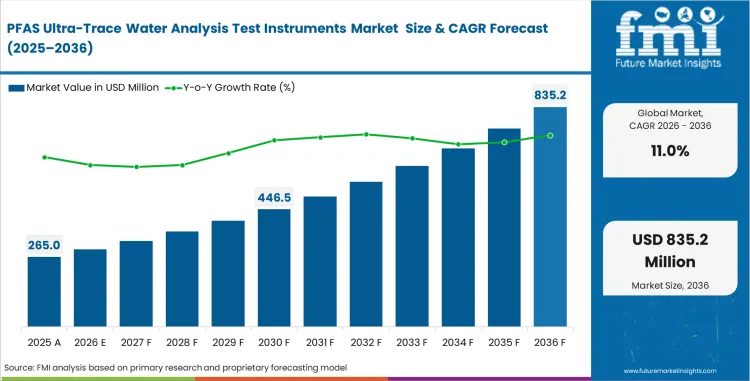
PFAS ultra-trace water analysis test instruments market was valued at USD 238 million in 2025. Sector is estimated to reach USD 265 million in 2026 at a CAGR of 11% during the forecast period. Revenue buildup is expected to take the market to USD 773 million by 2036 as routine low-level PFAS measurement becomes a regular part of water testing across drinking and environmental matrices.
Summary of PFAS Ultra-Trace Water Analysis Test Instruments Market
- PFAS Ultra-Trace Water Analysis Test Instruments Market Snapshot
- PFAS ultra-trace water analysis test instruments market is valued at USD 238 million in 2025 and is projected to reach USD 773 million by 2036.
- Industry outlook indicates a 11% CAGR from 2026 to 2036, creating an incremental opportunity of USD 508 million over the forecast period.
- This category sits within compliance-led analytical instrumentation for ultra-trace PFAS measurement in water, where LC-MS/MS systems, sample-prep discipline, and contamination control matter more than low acquisition cost.
- Regulated water monitoring is keeping this sector on a positive trend, supported by enforceable drinking-water limits, approved test methods, and the need to measure PFAS at very low reporting levels across controlled water matrices.
- PFAS Ultra-Trace Water Analysis Test Instruments Market Demand and Growth Drivers
- UCMR 5 is expanding the testing burden across public water systems, and that is pushing more laboratories toward instrument capacity built for routine PFAS analysis.
- LC-MS/MS remains the preferred analytical route because EPA Methods 533 and 537.1, along with Method 1633A for broader matrices, rely on liquid chromatography with tandem mass spectrometry for low-level quantitation.
- National and regional tightening in drinking-water PFAS oversight across Canada, the EU, Australia, Japan, and the United Kingdom is widening the installed base beyond U.S. compliance laboratories.
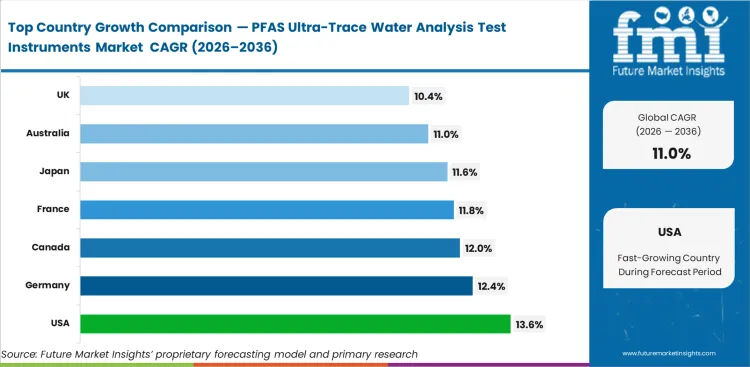
- Among key countries, the United States is projected to advance at a 13.6% CAGR through 2036, followed by Germany at 12.4%, Canada at 11.9%, France at 11.8%, Japan at 11.6%, Australia at 10.9%, and the United Kingdom at 10.4%.
- High instrument cost, PFAS background-contamination control, method-validation burden, and continued reliance on third-party laboratories by many utilities are keeping adoption from moving faster.
- PFAS Ultra-Trace Water Analysis Test Instruments Market Product and Segment View
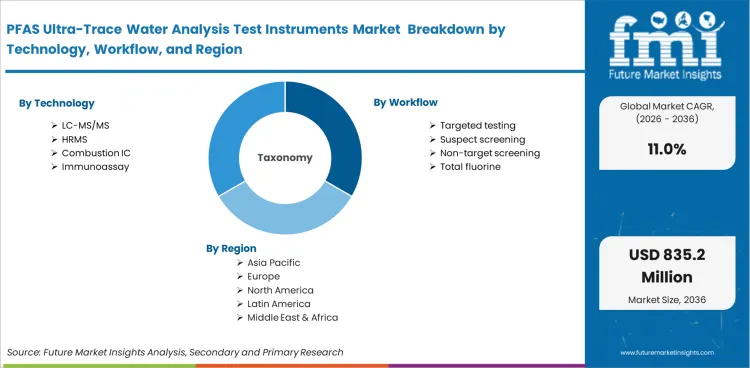
- This market covers LC-MS/MS, HRMS, combustion ion chromatography, and related ultra-trace water-testing workflows used for regulatory, confirmatory, and screening work across drinking water, groundwater, surface water, and wastewater.
- Commercial labs remain the leading end-user category because regulated PFAS testing still sits mainly with accredited specialist laboratories rather than being distributed broadly across utilities.
- Method fit is keeping LC-MS/MS in front. In 2026, this technology is expected to account for 58% share, supported by EPA method alignment and the routine use of triple-quadrupole workflows for quantitation.
- Defined analyte lists continue to guide laboratory workflow choices, which is why targeted testing is anticipated to represent 64% share in 2026. Open-ended suspect and non-target screening still matter, but they do not yet carry the same routine compliance weight.
- Manual prep remains common in laboratories balancing method discipline with capex control, and the segment is projected to secure 43% share in 2026. Automated SPE is rising where sample throughput is becoming harder to manage manually.
- Accredited external testing networks continue to absorb a large share of regulated sample flow, leaving commercial labs likely to represent 46% of the market in 2026.
- Public-water compliance work is keeping drinking water at the center of instrument demand. By 2026, drinking water is expected to contribute 49% share, supported by UCMR- and NPDWR-linked monitoring activity.
- Scope includes standalone analytical instruments, front-end sample-prep workflows, and PFAS-safe water-analysis setups. Remediation systems, laboratory testing services, and broad non-water PFAS instrumentation are excluded.
- PFAS Ultra-Trace Water Analysis Test Instruments Market Geography and Competitive Outlook
- United States, Germany, and Canada are emerging as the fastest-expanding centers for instrument demand, while France and Japan are also advancing as monitoring requirements become firmer and laboratory readiness improves.
- Competition is centering on sensitivity improvement, contamination-control design, higher-throughput workflows, direct-injection capability, and SPE automation rather than on scale alone.
Key Takeaways, Market Size, and Forecast
- PFAS Ultra-Trace Water Analysis Test Instruments Market is forecast to grow from USD 265 million in 2026 to USD 773 million by 2036, at a CAGR of 11.0%.
- The PFAS ultra-trace water analysis test instruments market was valued at USD 238 million in 2025.
- By 2036, the PFAS Ultra-Trace Water Analysis Test Instruments Market is likely to reach USD 773 million.
- Over the 2026 to 2036 period, the market is anticipated to expand at a CAGR of 11.0%.
- The market is expected to generate an incremental opportunity of USD 508 million during the forecast period.
- In 2026, LC-MS/MS is projected to account for 58% of the technology segment.
- The United States (13.6% CAGR) and Germany (12.4% CAGR) are expected to be the fastest growing country markets.
Laboratory managers are no longer choosing equipment only on whether PFAS can be detected at low levels. Current buying decisions revolve around whether a platform can support repeatable ultra-trace analysis, keep contamination under control, and handle method-ready sample flow without forcing frequent reruns. Upfront capex still matters, yet delayed installation can leave accredited labs under pressure as reporting obligations widen and turnaround expectations tighten. Sensitivity alone does not settle instrument selection in this category. Daily usability, contamination discipline, and method-ready workflow design carry equal weight once sample volume starts rising.
Method confidence is the point that changes category pace. Once laboratory networks have enough validation comfort and enough sample visibility to justify moving beyond adapted environmental LC-MS routines into PFAS-focused water workflows, automation and standardized handling become easier to support. Each additional installation then adds practical value because reporting routines, staff familiarity, and sample throughput become more consistent.
United States is projected to record 13.6% CAGR from 2026 to 2036, supported by a larger compliance base and a broader approved-laboratory network. Germany follows at 12.4%, while Canada is set to post 11.9% over the same period as national water guidance tightens analytical expectations. France is likely to register 11.8%, Japan 11.6%, Australia 10.9%, and the United Kingdom 10.4% during the assessment period. Variation across this range comes from how quickly laboratory obligations are turning into installed instrument demand rather than from awareness alone.
PFAS Ultra-Trace Water Analysis Test Instruments Market Key Takeaways
| Metric | Details |
|---|---|
| Industry Size (2026) | USD 265 million |
| Industry Value (2036) | USD 773 million |
| CAGR (2026–2036) | 11% |
Source: Future Market Insights (FMI) analysis, based on proprietary forecasting model and primary research
Segmental Analysis
PFAS Ultra-Trace Water Analysis Test Instruments Market Analysis by Technology
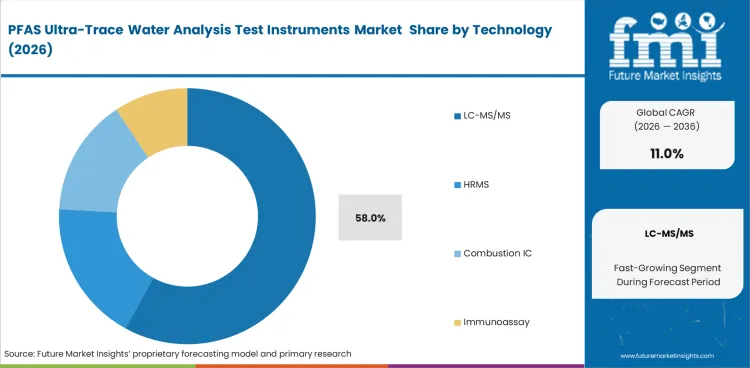
Method fit carries more weight in this category than broad analytical range. Laboratories working with regulated PFAS water samples need systems that can move from qualification into routine reporting without adding avoidable uncertainty around contamination control, calibration stability, or low-level repeatability. In 2026, LC-MS/MS is expected to account for 58% share because it aligns most closely with how accredited water laboratories already run established PFAS methods and comparable low-level workflows elsewhere. Application fit matters here as much as raw instrument capability. High-resolution systems keep their place in screening-heavy or research-led work, yet routine compliance labs usually prefer platforms that hold operating burden down and keep reporting logic clearer. Buyers choosing only on flexibility can end up paying for range they do not use while still falling short on the workflow discipline required for daily PFAS water analysis, a pattern that also supports interest in chromatography instrumentation and liquid chromatography systems.
- Method alignment: LC-MS/MS follows the dominant compliance route for regulated PFAS water analysis. Laboratory teams can move from installation to reportable routine use with less friction.
- Run discipline: Stable triple-quadrupole workflows help limit rerun exposure in high-volume regulated testing. Turnaround planning becomes easier for accredited laboratories.
- Qualification ease: Buyers selecting familiar LC/MS workflows usually face less resistance during validation. Capex decisions improve when operating logic is already well understood.
PFAS Ultra-Trace Water Analysis Test Instruments Market Analysis by Workflow
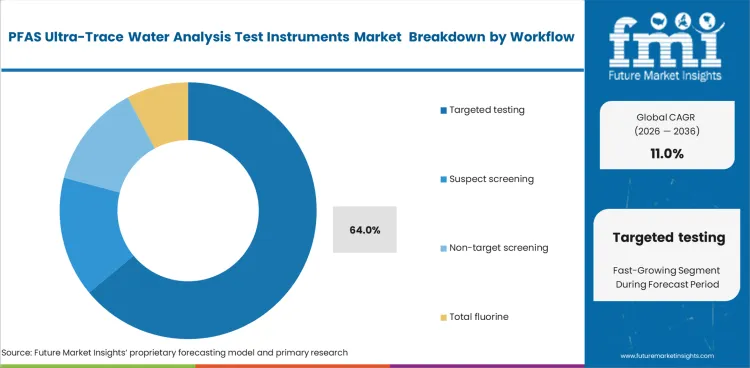
Targeted testing is anticipated to represent 64% of total market share in 2026, and that position comes from routine compliance logic rather than technical caution. Defined analyte lists continue to shape most laboratory spending in this category. Water labs asked to report against approved PFAS panels are not treating open-ended screening as the default commercial answer, because reporting clarity, method acceptance, and turnaround discipline carry more weight than identifying every possible compound in each run. Suspect and non-target screening still retain value where investigation work is broadening, especially in more complex contamination cases. Routine water programs, though, still favor workflows that keep quantitation, documentation, and repeatability on firmer ground. Laboratories that overinvest too early in broad-screen capability can find that their most expensive workflows are serving the narrowest share of billable sample volume, which is why adjacent demand is also visible across environment testing and certification and chemical residue analysis services.
- Reporting clarity: Targeted methods keep analyte ownership and quantitation logic clean. Clients receive results that are easier to align with formal limits and guidance.
- Throughput control: Routine laboratories can scale targeted workflows with less data-handling burden. Staff time stays centered on reportable sample volume rather than exploratory review.
- Use-case boundary: Suspect and non-target work still matters in investigative settings. Commercial value remains strongest where the question goes beyond routine compliance reporting.
PFAS Ultra-Trace Water Analysis Test Instruments Market Analysis by Automation
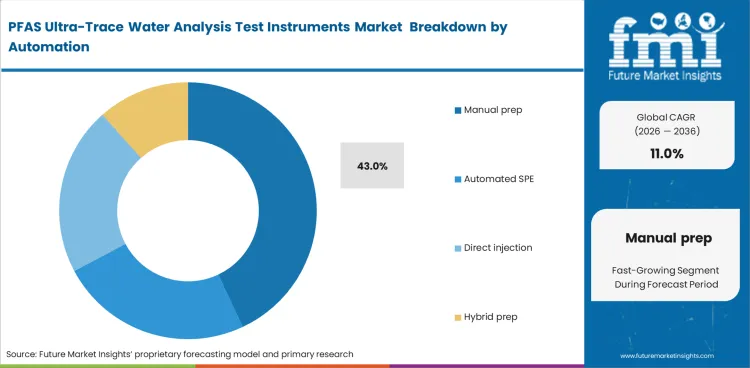
Manual prep stays deeply rooted because many PFAS water labs are still balancing method discipline against capex caution. SPE cleanup, contamination control, consumable handling, and sample batching all require close attention, so smaller laboratories often remain with technician-led preparation even as sample volume rises. Manual prep is projected to secure 43% share in 2026, largely because installed lab habits and budget discipline continue to favor familiar workflows. That lead does not mean automation lacks a case. Automated SPE becomes more attractive once sample counts build and reruns start cutting into schedule capacity. Time pressure changes the economics quickly. Laboratories delaying automation may keep initial spending lower, but they often carry higher handling burden, less even throughput, and a tighter ceiling on how many PFAS water samples they can process consistently. Similar buying logic is supporting interest in automated solid-phase extraction, lab automation, and laboratory benchtop automation.
- Labor habit: Manual prep remains attractive where teams already know the method and sample volume stays manageable. Familiarity helps laboratories control early validation risk.
- Capacity ceiling: Technician-led workflows become harder to defend once PFAS sample loads build. Turnaround pressure rises before headcount can adjust.
- Automation trigger: Automated SPE draws more attention when repeatability and labor efficiency begin to matter more than the lowest upfront spend. Higher-volume labs feel that pressure first.
PFAS Ultra-Trace Water Analysis Test Instruments Market Analysis by End User
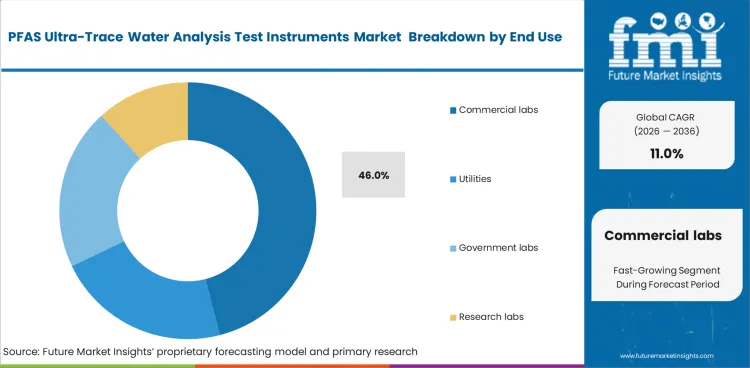
Accredited third-party laboratories sit closest to immediate instrument spending in this market. Utilities and public agencies still depend heavily on outside analytical capacity while reporting obligations are widening, and that keeps early capex concentrated in specialized testing networks rather than spread across every water operator. Commercial labs are expected to account for 46% share in 2026. That position comes from operational readiness as much as from sample volume. Established accredited labs already have method teams, contamination-control routines, and reporting systems that can absorb PFAS water workflows faster than first-time in-house entrants. Utilities evaluating internal capability usually move more cautiously because staff depth, quality systems, and long-run instrument use all need to line up. Laboratories combining method support with dependable turnaround are in a stronger position to retain work as rule coverage expands, reinforcing links with service laboratory and industrial water analysis.
- Accreditation base: Commercial labs already operate under reportable analytical discipline. Entry into PFAS water work is faster where quality systems are already in place.
- Outsource logic: Utilities often compare turnaround and capex before building internal capability. External laboratory access stays commercially rational in early expansion phases.
- Service burden: Winning repeat business depends on more than detection limits. Reporting reliability and sample-handling consistency help keep clients from switching.
PFAS Ultra-Trace Water Analysis Test Instruments Market Analysis by Water Matrix
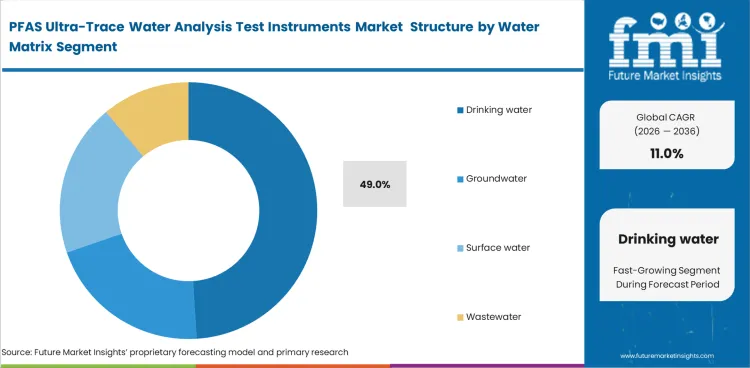
Drinking water carries the heaviest immediate instrument pull because it sits at the center of current rulemaking, public scrutiny, and compliance planning. Laboratories can delay investment in some investigative or non-routine matrices, but public-water testing leaves less room for hesitation once monitoring calendars are active. A 49% share is anticipated for drinking water in 2026, reflecting where formal PFAS measurement pressure is most visible today. Matrix leadership here comes from reporting urgency rather than analytical simplicity. Groundwater, surface water, and wastewater continue to matter, especially where contamination tracing or broader environmental programs are expanding. Installed systems built around drinking-water workflows often become the first platform from which labs branch into adjacent water matrices. Buyers misreading that sequence can invest too broadly at the outset and weaken near-term return on equipment placed for regulated water work, while related category movement continues across water testing analysis, water analysis instrumentation, and water treatment.
- Compliance priority: Drinking-water work carries the clearest near-term reporting need. Instrument budgets move faster where public-water obligations are formalized.
- Expansion path: Labs often build PFAS capability around drinking water first. Matrix breadth tends to widen after operating routines are proven.
- Return discipline: Starting with the most urgent matrix improves equipment utilization. Early overexpansion can dilute capex efficiency.
PFAS Ultra-Trace Water Analysis Test Instruments Market Drivers, Restraints, and Opportunities
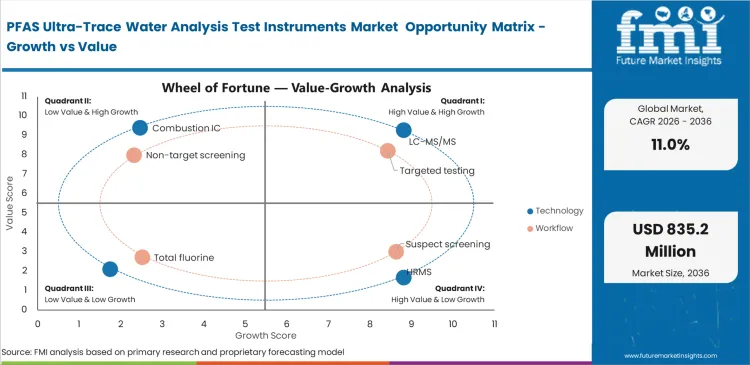
Water laboratories are being pushed toward better PFAS capability by a direct operating problem of low-level reporting is becoming harder to postpone. Public-water testing programs, updated drinking-water objectives, and harmonized monitoring obligations are turning PFAS analysis from periodic investigative work into a recurring laboratory service line. Commercial labs feel this first because outsourced sample volume builds quickly when utilities need reportable results without building internal capability at once. Method fit also matters. Platforms and workflows closest to validated LC-MS/MS water methods reach commercial use faster, which is why capex is moving toward instruments that lower rerun exposure and support steadier sample turnaround. That same logic is widening interest in PFAS detection devices and related environmental test equipment.
High instrument cost is only one part of what holds adoption back. Contamination-control discipline, method validation work, staff readiness, and ongoing sample-prep burden often slow internal laboratory buildout even where interest is already present. Smaller laboratories can struggle to justify PFAS-dedicated hardware if sample volume is still uncertain, while public utilities may hesitate because installing equipment is easier than operating it at regulated low levels every day. Partial answers are improving. Automation, method packages, and vendor application support reduce part of the handling burden, yet they do not remove the need for clean workflows, trained staff, and defensible reporting routines. Weak execution in any of those areas can leave expensive instruments underused or pushed back toward non-routine testing.
Opportunities in the PFAS Ultra-Trace Water Analysis Test Instruments Market
- Workflow standardization: Laboratories packaging instruments with method-ready sample prep and contamination-control routines can shorten the path from purchase to usable reporting. Accredited service labs are likely to capture this first because install-to-output time carries clear commercial value.
- Automation depth: Rising PFAS sample volume improves the case for automated SPE and streamlined water workflows. Vendors supporting automated sample preparation can widen their reach where technician time is becoming the binding limit.
- Regional compliance buildout: Country-level water guidance updates are widening installed-base opportunity beyond the United States. Application support tied to local methods, training, and reporting expectations can help suppliers win earlier in underpenetrated laboratory networks, while adjacent investment is also building across water testing kits.
Regional Analysis
Based on the regional analysis, the PFAS Ultra-Trace Water Analysis Test Instruments market is segmented into North America, Europe, Asia Pacific, Latin America, and Middle East and Africa across 40 plus countries.
.webp "Top Country Growth Comparison Pfas Ultra Trace Water Analysis Test Instruments Market Cagr (2026 2036)")
| Country | CAGR (2026 to 2036) |
|---|---|
| United States | 13.6% |
| Germany | 12.4% |
| Canada | 12% |
| France | 11.8% |
| Japan | 11.6% |
| Australia | 11% |
| United Kingdom | 10.4% |
Source: Future Market Insights (FMI) analysis, based on proprietary forecasting model and primary research
North America PFAS Ultra-Trace Water Analysis Test Instruments Market Analysis
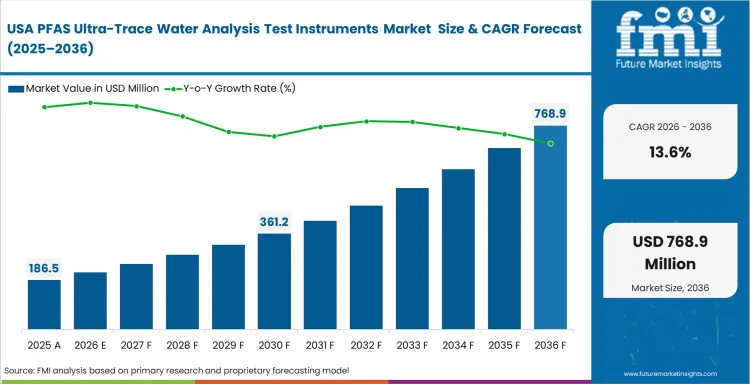
North America sets the commercial tone for this category because water-testing obligations are already translating into routine laboratory workload. Accredited external labs carry much of that burden, which brings instrument spending forward faster than in regions still working through method adoption and testing allocation. Internal laboratory buildout by utilities remains selective, since low-level PFAS work needs more than instrument access; it also needs trained teams, clean workflows, and dependable repeatability. Industry outlook across this region stays firm because instrument decisions are now being tied to reporting discipline, turnaround performance, and contamination control rather than to broad analytical flexibility alone.
- United States: Federal drinking-water enforcement and method-led laboratory activity keep the United States at the front of this market. Commercial labs sit in a strong position because regulated sample volume is already large enough to justify dedicated PFAS capacity, while utilities continue to rely on outside analytical support for reportable results. The market in the United States is projected to expand at a CAGR of 13.6% through 2036. Buyer preference here leans toward platforms that can move quickly from validation into routine use without creating extra rerun burden. Service support and application readiness matter because instrument uptime has direct consequences for laboratory turnaround and contract retention.
- Canada: Industry outlook in Canada points to an estimated 12% CAGR through 2036. Canada is building category depth through tighter water-quality expectations and a clearer need for disciplined low-level PFAS analysis. Buying activity is more measured than in the United States, yet the operating direction is similar; laboratories are adding capability where client reporting requirements are becoming more defined and internal confidence in PFAS workflows is improving. Mid-paragraph economics matter in this market, because smaller sample pools can delay instrument decisions until labs see steadier testing volume. Suppliers that reduce validation burden and keep sample handling practical are likely to gain more traction than those relying only on specification breadth.
FMI’s report includes Mexico and the wider North American water-testing base beyond the countries highlighted above. Regional direction continues to favor laboratories that can convert water guidance into dependable routine analytical service rather than occasional investigative work.
Europe PFAS Ultra-Trace Water Analysis Test Instruments Market Analysis
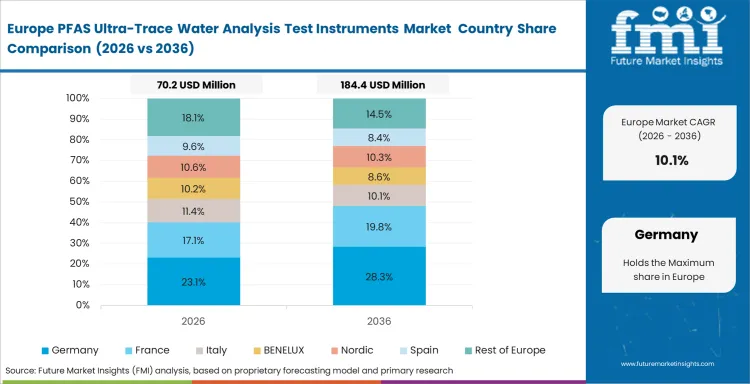
Europe presents a more distributed market pattern. Laboratory capability is already well established across several countries, yet spending does not move at the same pace everywhere because national testing priorities, implementation timing, and installed laboratory roles vary. Instrument adoption rises fastest where PFAS monitoring expectations are being translated into repeatable water-testing programs rather than remaining policy discussion. Commercial logic in Europe also rests on method familiarity and service depth, since many labs already have sophisticated analytical infrastructure and are evaluating whether PFAS water workflows can be absorbed efficiently into existing operations. That makes execution quality more important than headline instrument claims.
- Germany: Germany benefits from a deep environmental testing base and a laboratory culture that values operational discipline. Instrument decisions are often made carefully, but once method relevance is clear, capital allocation tends to follow with purpose because laboratories already understand what repeatable low-level analysis requires. Buyers in this country usually compare throughput, reporting consistency, and service support together instead of isolating one criterion. Germany is likely to post 12.4% CAGR in this sector by 2036. Strong engineering capability across the local analytical ecosystem also helps, since labs are better placed to integrate demanding workflows without prolonged setup inefficiency. That keeps Germany near the front of the European industry outlook.
- France: France is advancing because water-quality scrutiny is becoming harder for laboratories to treat as a niche issue. The sector in France is on a positive trend at 11.8% CAGR through 2036. PFAS-related testing expectations are pushing more labs to evaluate whether current systems can handle sustained low-level water analysis without compromising turnaround or operating discipline. Sample-prep burden matters here, since technician time can tighten quickly when PFAS workflows are added to existing environmental programs. Laboratories that convert that trajectory into reliable routine service will be better placed than those adding capacity without tightening contamination control, reporting discipline, and internal method execution. Practical readiness, rather than broad platform ownership alone, is likely to decide who secures repeat analytical work.
- United Kingdom: United Kingdom laboratories have a strong analytical base, yet instrument buying remains more selective because the commercial trigger is less immediate than in countries facing faster formalization of PFAS water monitoring. External laboratory networks still matter greatly, as many water operators prefer specialist testing access over immediate in-house installation. Validation effort is a central consideration, since laboratories want workflows that fit routine teams rather than highly specialized setups that are harder to operate consistently. In the United Kingdom, the PFAS ultra‑trace water analysis test instruments market is expected to expand at a 10.4% CAGR from 2026 to 2036. Supplier advantage is likely to come from making qualification easier and keeping daily handling practical. That is where UK buying patterns are most likely to settle.
FMI’s report includes Benelux and Nordic regions. Processing and analytical facilities in these areas often function as wider European hubs for method-intensive environmental testing, which gives surrounding countries indirect access to PFAS capability even where domestic installation remains lighter.
Asia Pacific PFAS Ultra-Trace Water Analysis Test Instruments Market Analysis
Asia Pacific shows a less uniform but still meaningful opportunity set. Category expansion depends heavily on how quickly water-quality concern is turning into formal laboratory routines, accreditation work, and recurring testing volume that can justify dedicated PFAS installations. Mature analytical centers can move faster because technical capability is already present, while broader adoption still depends on whether low-level PFAS work becomes regular enough to support workflow specialization. Supplier success in this region is tied closely to training support, validation practicality, and local service coverage. Buyers are rarely looking only for instrument performance; they are also judging whether their teams can operate the workflow efficiently after installation.
- Japan: Japan is forecast to register 11.6% CAGR in this market over the study period. Japan enters this market with strong analytical discipline and a laboratory base that values repeatability, controlled handling, and dependable day-to-day operation. Those strengths support PFAS instrumentation, though adoption still moves carefully because testing intensity is narrower than in the United States and does not always justify rapid category-wide buildout. Local evaluation tends to be detail-driven, with strong attention paid to operating consistency and service dependability after installation. Vendors that support clear method transfer and steady post-install service are likely to do better than those leaning mainly on wider platform flexibility. Reliability carries real commercial weight in this country.
- Australia: Australia is benefiting from updated drinking-water guidance and a more formal need for laboratories to treat PFAS analysis as repeatable work rather than an occasional specialty service. Market size remains smaller than in North America or Western Europe, yet the business case for disciplined low-level testing is becoming more visible across utility and contracted laboratory environments. Workflow burden still matters, because local teams need solutions that fit available staffing and sample volume without creating heavy operating strain. Toward the latter part of the paragraph, the valuation picture becomes clearer that Australia is expected to rise at a CAGR of 11% through 2036. Suppliers that keep installation, handling, and validation manageable are likely to benefit most from this trajectory.
FMI’s report includes South Korea, Singapore, and selected Southeast Asian markets where environmental analytical capability is already strong enough to support more specialized PFAS workflows. Regional progress is likely to stay uneven, yet laboratories with better service access and stronger validation readiness are in a better place to convert emerging testing requirements into instrument demand.
Competitive Aligners for Market Players
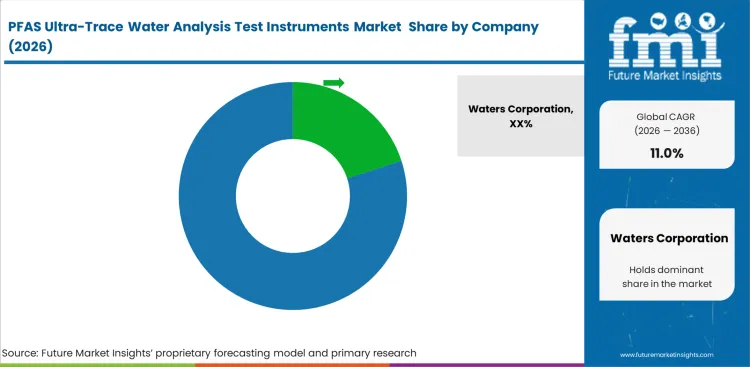
Competitive intensity in this category is moderate rather than fully concentrated. Entry is not limited only by instrument engineering; buyers also compare method familiarity, contamination-control discipline, application support, service access, and how comfortably a platform fits routine low-level water work. Waters Corporation, Agilent Technologies, Thermo Fisher Scientific, Danaher through SCIEX, Shimadzu Corporation, PerkinElmer, and Metrohm matter because each can participate across parts of the PFAS analytical workflow. Buyer preference rarely turns on price alone. Install confidence, method readiness, and dependable laboratory support often decide whether a shortlist turns into a purchase.
Incumbents hold an advantage where installed LC/MS familiarity, field support, and method-linked workflow packages reduce validation drag for laboratory teams. Waters and Agilent benefit from how closely their PFAS application material aligns with current water-testing practice, while Thermo Fisher, SCIEX, and Shimadzu remain relevant where broader analytical depth and established service reach help laboratories extend beyond narrow single-method use. Challengers can still win. Faster response, clearer application onboarding, and lower handling burden create room in accounts where buyers are less loyal to the existing installed base.
Buyer leverage remains meaningful because laboratories do not want an instrument decision to lock them into avoidable rerun burden, weak service coverage, or a workflow that only a few specialists can operate comfortably. Large accredited labs will keep pressing vendors for easier qualification, cleaner method packages, and more practical automation support. Competitive concentration is unlikely to tighten sharply through 2036. Category direction favors suppliers that can make ultra-trace PFAS water analysis easier to run every day, not merely easier to demonstrate once.
Key Players in PFAS Ultra-Trace Water Analysis Test Instruments Market
- Waters Corporation
- Agilent Technologies
- Thermo Fisher Scientific
- Danaher Corporation
- Shimadzu Corporation
- PerkinElmer
- Metrohm
Scope of the Report
| Metric | Value |
|---|---|
| Quantitative Units | USD 265 million to USD 773 million, at a CAGR of 11% |
| Market Definition | PFAS Ultra-Trace Water Analysis Test Instruments Market covers low-level analytical systems and linked sample-prep workflows used to detect and quantify PFAS in water under regulated or method-led laboratory conditions. Boundary focuses on instrument demand tied to water analysis rather than remediation, destruction, or outsourced testing revenue. |
| Technology Segmentation | LC-MS/MS, HRMS, Combustion IC, Immunoassay |
| Workflow Segmentation | Targeted testing, Suspect screening, Non-target screening, Total fluorine |
| Automation Segmentation | Manual prep, Automated SPE, Direct injection, Hybrid prep |
| End User Segmentation | Commercial labs, Utilities, Government labs, Research labs |
| Water Matrix Segmentation | Drinking water, Groundwater, Surface water, Wastewater |
| Regions Covered | North America, Europe, Asia Pacific, Latin America, Middle East and Africa |
| Countries Covered | United States, Germany, Canada, France, Japan, Australia, United Kingdom, and 40 plus countries |
| Key Companies Profiled | Waters Corporation, Agilent Technologies, Thermo Fisher Scientific, Danaher Corporation, Shimadzu Corporation, PerkinElmer, Metrohm |
| Forecast Period | 2026 to 2036 |
| Approach | FMI combined primary interviews with laboratory decision-makers and application specialists with desk review of water methods, public-water guidance, and vendor disclosures. Baseline estimates were anchored to method-led instrument demand and laboratory capacity needs in PFAS water analysis. Forecast direction was cross-checked against water rule implementation timing, workflow adoption, and regional laboratory readiness. |
Source: Future Market Insights (FMI) analysis, based on proprietary forecasting model and primary research
PFAS Ultra-Trace Water Analysis Test Instruments Market Analysis by Segments
Technology:
- LC-MS/MS
- HRMS
- Combustion IC
- Immunoassay
Workflow:
- Targeted testing
- Suspect screening
- Non-target screening
- Total fluorine
Automation:
- Manual prep
- Automated SPE
- Direct injection
- Hybrid prep
End User:
- Commercial labs
- Utilities
- Government labs
- Research labs
Water Matrix:
- Drinking water
- Groundwater
- Surface water
- Wastewater
Region:
- North America
- Europe
- Asia Pacific
- Latin America
- Middle East and Africa
Bibliography
- U.S. Environmental Protection Agency. (2025, April 24). EPA PFAS Drinking Water Laboratory Methods.
- Health Canada. (2024, August 9). Objective for Canadian drinking water quality: Per- and polyfluoroalkyl substances.
- National Health and Medical Research Council. (2025, June 25). Updated Australian Drinking Water Guidelines.
- National Health and Medical Research Council. (2025, June 25). NHMRC Review of PFAS in Australian drinking water.
- U.S. Environmental Protection Agency. (2025, December 4). PFAS Analytical Methods Development and Sampling Research.
This bibliography is provided for reader reference. The full FMI report contains the complete reference list with primary source documentation.
This Report Addresses
- Market intelligence to support strategic decision making across LC-MS/MS systems, PFAS sample-prep workflows, automation platforms, and ultra-trace water-analysis setups
- Market size estimation and 10-year revenue forecasts from 2026 to 2036, supported by method-led demand modeling and primary interviews with laboratory decision-makers
- Opportunity mapping across technology, workflow, automation, end user, and water matrix categories with emphasis on method readiness and laboratory throughput
- Segment and regional revenue forecasts covering LC-MS/MS, targeted testing, manual prep, commercial labs, and drinking water across regulated water-testing environments
- Competition assessment including method support, service access, contamination-control discipline, installed-base familiarity, and workflow onboarding depth
- Product and capability tracking including LC-MS/MS, HRMS, combustion ion chromatography, automated SPE, and direct-injection water workflows
- Market access analysis covering drinking-water monitoring obligations, accredited laboratory expansion, outsourced testing logic, and low-level reporting requirements
- Market report delivery in PDF, Excel, PPT, and interactive dashboard formats for executive strategy, laboratory planning, and operating benchmark review
Frequently Asked Questions
How large is the market in 2026?
Market valuation is estimated at USD 265 million in 2026, reflecting a specialized category entering broader routine laboratory use.
What will the market be worth by 2036?
FMI estimates valuation will reach USD 773 million by 2036 as routine PFAS water testing becomes more established.
What CAGR is projected?
FMI projects a CAGR of 11% from 2026 to 2036, supported by wider low-level testing requirements.
Which technology segment leads?
LC-MS/MS leads technology and is expected to account for 58% share in 2026 because method fit matters most.
Which workflow segment leads?
Targeted testing leads workflow and is anticipated to represent 64% share in 2026 due to defined analyte reporting.
Which automation segment leads?
Manual prep leads automation with 43% share expected in 2026, supported by familiar lab routines and budget caution.
What is pushing the market ahead?
Routine low-level reporting requirements are rising, pushing laboratories toward instruments that support repeatability, contamination control, and steady sample flow.
What is the main restraint?
Method validation burden, contamination control, staff readiness, and sample-prep discipline slow wider adoption despite clear analytical need.
Which country is expanding fastest?
United States leads with projected CAGR of 13.6% from 2026 to 2036 due to stronger compliance pressure.
Why does drinking water lead by matrix?
Drinking water leads because current PFAS monitoring pressure is strongest there, supporting 49% share in 2026.
Why does LC-MS/MS remain ahead?
Routine laboratories prefer platforms matching established water methods, clearer quantitation needs, and lower reporting uncertainty.
What do buyers compare most closely?
Method fit, contamination control, application support, service access, and routine workflow practicality usually decide shortlist outcomes.
Why do commercial labs lead by end user?
Commercial labs lead with 46% share expected in 2026 because outsourced PFAS testing still handles major workload.
Why does targeted testing stay ahead?
Current compliance programs focus on defined PFAS lists, making targeted workflows easier to align with reporting needs.
Where is automation opportunity strongest?
Automation opportunity is strongest in higher-volume laboratories where technician time and rerun burden start restricting throughput.
Why are utilities slower to build internal capability?
Utilities need staff depth, quality routines, validation confidence, and steady instrument use before internal capability becomes practical.
How does the United States differ from Canada?
United States converts analytical obligations into capex faster, while Canada is moving forward with a more measured pace.
Why is Germany ahead within Europe?
Germany benefits from strong environmental lab capability, disciplined operations, and quicker translation of method relevance into spending.
Why is the United Kingdom lower than Germany and France?
UK laboratory capability is solid, yet current buying pace is more measured because compliance timing differs.
What does Australia indicate for Asia Pacific?
Australia shows that updated water guidance can improve laboratory investment even in smaller PFAS testing markets.
Will the market become highly concentrated by 2036?
FMI does not expect very tight concentration because buyers still compare suppliers across several operating criteria.
What sits outside market scope?
Remediation systems, filtration media, destruction units, consumer kits, and outsourced testing revenue fall outside this market.
Preview the report firsthand - request a free sample
Get SampleGet the brochure for pricing and purchase details.
Get PDFTable of Content
- Executive Summary
- Global Market Outlook
- Demand-side Trends
- Supply-side Trends
- Technology Roadmap Analysis
- Analysis and Recommendations
- Market Overview
- Market Coverage / Taxonomy
- Market Definition / Scope / Limitations
- Research Methodology
- Chapter Orientation
- Analytical Lens and Working Hypotheses
- Market Structure, Signals, and Trend Drivers
- Benchmarking and Cross-market Comparability
- Market Sizing, Forecasting, and Opportunity Mapping
- Research Design and Evidence Framework
- Desk Research Programme (Secondary Evidence)
- Company Annual and Sustainability Reports
- Peer-reviewed Journals and Academic Literature
- Corporate Websites, Product Literature, and Technical Notes
- Earnings Decks and Investor Briefings
- Statutory Filings and Regulatory Disclosures
- Technical White Papers and Standards Notes
- Trade Journals, Industry Magazines, and Analyst Briefs
- Conference Proceedings, Webinars, and Seminar Materials
- Government Statistics Portals and Public Data Releases
- Press Releases and Reputable Media Coverage
- Specialist Newsletters and Curated Briefings
- Sector Databases and Reference Repositories
- FMI Internal Proprietary Databases and Historical Market Datasets
- Subscription Datasets and Paid Sources
- Social Channels, Communities, and Digital Listening Inputs
- Additional Desk Sources
- Expert Input and Fieldwork (Primary Evidence)
- Primary Modes
- Qualitative Interviews and Expert Elicitation
- Quantitative Surveys and Structured Data Capture
- Blended Approach
- Why Primary Evidence is Used
- Field Techniques
- Interviews
- Surveys
- Focus Groups
- Observational and In-context Research
- Social and Community Interactions
- Stakeholder Universe Engaged
- C-suite Leaders
- Board Members
- Presidents and Vice Presidents
- R&D and Innovation Heads
- Technical Specialists
- Domain Subject-matter Experts
- Scientists
- Physicians and Other Healthcare Professionals
- Governance, Ethics, and Data Stewardship
- Research Ethics
- Data Integrity and Handling
- Primary Modes
- Tooling, Models, and Reference Databases
- Desk Research Programme (Secondary Evidence)
- Data Engineering and Model Build
- Data Acquisition and Ingestion
- Cleaning, Normalisation, and Verification
- Synthesis, Triangulation, and Analysis
- Quality Assurance and Audit Trail
- Market Background
- Market Dynamics
- Drivers
- Restraints
- Opportunity
- Trends
- Scenario Forecast
- Demand in Optimistic Scenario
- Demand in Likely Scenario
- Demand in Conservative Scenario
- Opportunity Map Analysis
- Product Life Cycle Analysis
- Supply Chain Analysis
- Investment Feasibility Matrix
- Value Chain Analysis
- PESTLE and Porter’s Analysis
- Regulatory Landscape
- Regional Parent Market Outlook
- Production and Consumption Statistics
- Import and Export Statistics
- Market Dynamics
- Global Market Analysis 2021 to 2025 and Forecast, 2026 to 2036
- Historical Market Size Value (USD Million) Analysis, 2021 to 2025
- Current and Future Market Size Value (USD Million) Projections, 2026 to 2036
- Y-o-Y Growth Trend Analysis
- Absolute $ Opportunity Analysis
- Global Market Pricing Analysis 2021 to 2025 and Forecast 2026 to 2036
- Global Market Analysis 2021 to 2025 and Forecast 2026 to 2036, By Technology
- Introduction / Key Findings
- Historical Market Size Value (USD Million) Analysis By Technology , 2021 to 2025
- Current and Future Market Size Value (USD Million) Analysis and Forecast By Technology , 2026 to 2036
- LC-MS/MS
- HRMS
- Combustion IC
- Immunoassay
- LC-MS/MS
- Y-o-Y Growth Trend Analysis By Technology , 2021 to 2025
- Absolute $ Opportunity Analysis By Technology , 2026 to 2036
- Global Market Analysis 2021 to 2025 and Forecast 2026 to 2036, By Workflow
- Introduction / Key Findings
- Historical Market Size Value (USD Million) Analysis By Workflow, 2021 to 2025
- Current and Future Market Size Value (USD Million) Analysis and Forecast By Workflow, 2026 to 2036
- Targeted testing
- Suspect screening
- Non-target screening
- Total fluorine
- Targeted testing
- Y-o-Y Growth Trend Analysis By Workflow, 2021 to 2025
- Absolute $ Opportunity Analysis By Workflow, 2026 to 2036
- Global Market Analysis 2021 to 2025 and Forecast 2026 to 2036, By Automation
- Introduction / Key Findings
- Historical Market Size Value (USD Million) Analysis By Automation, 2021 to 2025
- Current and Future Market Size Value (USD Million) Analysis and Forecast By Automation, 2026 to 2036
- Manual prep
- Automated SPE
- Direct injection
- Hybrid prep
- Manual prep
- Y-o-Y Growth Trend Analysis By Automation, 2021 to 2025
- Absolute $ Opportunity Analysis By Automation, 2026 to 2036
- Global Market Analysis 2021 to 2025 and Forecast 2026 to 2036, By End Use
- Introduction / Key Findings
- Historical Market Size Value (USD Million) Analysis By End Use, 2021 to 2025
- Current and Future Market Size Value (USD Million) Analysis and Forecast By End Use, 2026 to 2036
- Commercial labs
- Utilities
- Government labs
- Research labs
- Commercial labs
- Y-o-Y Growth Trend Analysis By End Use, 2021 to 2025
- Absolute $ Opportunity Analysis By End Use, 2026 to 2036
- Global Market Analysis 2021 to 2025 and Forecast 2026 to 2036, By Water Matrix
- Introduction / Key Findings
- Historical Market Size Value (USD Million) Analysis By Water Matrix, 2021 to 2025
- Current and Future Market Size Value (USD Million) Analysis and Forecast By Water Matrix, 2026 to 2036
- Drinking water
- Groundwater
- Surface water
- Wastewater
- Drinking water
- Y-o-Y Growth Trend Analysis By Water Matrix, 2021 to 2025
- Absolute $ Opportunity Analysis By Water Matrix, 2026 to 2036
- Global Market Analysis 2021 to 2025 and Forecast 2026 to 2036, By Region
- Introduction
- Historical Market Size Value (USD Million) Analysis By Region, 2021 to 2025
- Current Market Size Value (USD Million) Analysis and Forecast By Region, 2026 to 2036
- North America
- Latin America
- Western Europe
- Eastern Europe
- East Asia
- South Asia and Pacific
- Middle East & Africa
- Market Attractiveness Analysis By Region
- North America Market Analysis 2021 to 2025 and Forecast 2026 to 2036, By Country
- Historical Market Size Value (USD Million) Trend Analysis By Market Taxonomy, 2021 to 2025
- Market Size Value (USD Million) Forecast By Market Taxonomy, 2026 to 2036
- By Country
- USA
- Canada
- Mexico
- By Technology
- By Workflow
- By Automation
- By End Use
- By Water Matrix
- By Country
- Market Attractiveness Analysis
- By Country
- By Technology
- By Workflow
- By Automation
- By End Use
- By Water Matrix
- Key Takeaways
- Latin America Market Analysis 2021 to 2025 and Forecast 2026 to 2036, By Country
- Historical Market Size Value (USD Million) Trend Analysis By Market Taxonomy, 2021 to 2025
- Market Size Value (USD Million) Forecast By Market Taxonomy, 2026 to 2036
- By Country
- Brazil
- Chile
- Rest of Latin America
- By Technology
- By Workflow
- By Automation
- By End Use
- By Water Matrix
- By Country
- Market Attractiveness Analysis
- By Country
- By Technology
- By Workflow
- By Automation
- By End Use
- By Water Matrix
- Key Takeaways
- Western Europe Market Analysis 2021 to 2025 and Forecast 2026 to 2036, By Country
- Historical Market Size Value (USD Million) Trend Analysis By Market Taxonomy, 2021 to 2025
- Market Size Value (USD Million) Forecast By Market Taxonomy, 2026 to 2036
- By Country
- Germany
- UK
- Italy
- Spain
- France
- Nordic
- BENELUX
- Rest of Western Europe
- By Technology
- By Workflow
- By Automation
- By End Use
- By Water Matrix
- By Country
- Market Attractiveness Analysis
- By Country
- By Technology
- By Workflow
- By Automation
- By End Use
- By Water Matrix
- Key Takeaways
- Eastern Europe Market Analysis 2021 to 2025 and Forecast 2026 to 2036, By Country
- Historical Market Size Value (USD Million) Trend Analysis By Market Taxonomy, 2021 to 2025
- Market Size Value (USD Million) Forecast By Market Taxonomy, 2026 to 2036
- By Country
- Russia
- Poland
- Hungary
- Balkan & Baltic
- Rest of Eastern Europe
- By Technology
- By Workflow
- By Automation
- By End Use
- By Water Matrix
- By Country
- Market Attractiveness Analysis
- By Country
- By Technology
- By Workflow
- By Automation
- By End Use
- By Water Matrix
- Key Takeaways
- East Asia Market Analysis 2021 to 2025 and Forecast 2026 to 2036, By Country
- Historical Market Size Value (USD Million) Trend Analysis By Market Taxonomy, 2021 to 2025
- Market Size Value (USD Million) Forecast By Market Taxonomy, 2026 to 2036
- By Country
- China
- Japan
- South Korea
- By Technology
- By Workflow
- By Automation
- By End Use
- By Water Matrix
- By Country
- Market Attractiveness Analysis
- By Country
- By Technology
- By Workflow
- By Automation
- By End Use
- By Water Matrix
- Key Takeaways
- South Asia and Pacific Market Analysis 2021 to 2025 and Forecast 2026 to 2036, By Country
- Historical Market Size Value (USD Million) Trend Analysis By Market Taxonomy, 2021 to 2025
- Market Size Value (USD Million) Forecast By Market Taxonomy, 2026 to 2036
- By Country
- India
- ASEAN
- Australia & New Zealand
- Rest of South Asia and Pacific
- By Technology
- By Workflow
- By Automation
- By End Use
- By Water Matrix
- By Country
- Market Attractiveness Analysis
- By Country
- By Technology
- By Workflow
- By Automation
- By End Use
- By Water Matrix
- Key Takeaways
- Middle East & Africa Market Analysis 2021 to 2025 and Forecast 2026 to 2036, By Country
- Historical Market Size Value (USD Million) Trend Analysis By Market Taxonomy, 2021 to 2025
- Market Size Value (USD Million) Forecast By Market Taxonomy, 2026 to 2036
- By Country
- Kingdom of Saudi Arabia
- Other GCC Countries
- Turkiye
- South Africa
- Other African Union
- Rest of Middle East & Africa
- By Technology
- By Workflow
- By Automation
- By End Use
- By Water Matrix
- By Country
- Market Attractiveness Analysis
- By Country
- By Technology
- By Workflow
- By Automation
- By End Use
- By Water Matrix
- Key Takeaways
- Key Countries Market Analysis
- USA
- Pricing Analysis
- Market Share Analysis, 2025
- By Technology
- By Workflow
- By Automation
- By End Use
- By Water Matrix
- Canada
- Pricing Analysis
- Market Share Analysis, 2025
- By Technology
- By Workflow
- By Automation
- By End Use
- By Water Matrix
- Mexico
- Pricing Analysis
- Market Share Analysis, 2025
- By Technology
- By Workflow
- By Automation
- By End Use
- By Water Matrix
- Brazil
- Pricing Analysis
- Market Share Analysis, 2025
- By Technology
- By Workflow
- By Automation
- By End Use
- By Water Matrix
- Chile
- Pricing Analysis
- Market Share Analysis, 2025
- By Technology
- By Workflow
- By Automation
- By End Use
- By Water Matrix
- Germany
- Pricing Analysis
- Market Share Analysis, 2025
- By Technology
- By Workflow
- By Automation
- By End Use
- By Water Matrix
- UK
- Pricing Analysis
- Market Share Analysis, 2025
- By Technology
- By Workflow
- By Automation
- By End Use
- By Water Matrix
- Italy
- Pricing Analysis
- Market Share Analysis, 2025
- By Technology
- By Workflow
- By Automation
- By End Use
- By Water Matrix
- Spain
- Pricing Analysis
- Market Share Analysis, 2025
- By Technology
- By Workflow
- By Automation
- By End Use
- By Water Matrix
- France
- Pricing Analysis
- Market Share Analysis, 2025
- By Technology
- By Workflow
- By Automation
- By End Use
- By Water Matrix
- India
- Pricing Analysis
- Market Share Analysis, 2025
- By Technology
- By Workflow
- By Automation
- By End Use
- By Water Matrix
- ASEAN
- Pricing Analysis
- Market Share Analysis, 2025
- By Technology
- By Workflow
- By Automation
- By End Use
- By Water Matrix
- Australia & New Zealand
- Pricing Analysis
- Market Share Analysis, 2025
- By Technology
- By Workflow
- By Automation
- By End Use
- By Water Matrix
- China
- Pricing Analysis
- Market Share Analysis, 2025
- By Technology
- By Workflow
- By Automation
- By End Use
- By Water Matrix
- Japan
- Pricing Analysis
- Market Share Analysis, 2025
- By Technology
- By Workflow
- By Automation
- By End Use
- By Water Matrix
- South Korea
- Pricing Analysis
- Market Share Analysis, 2025
- By Technology
- By Workflow
- By Automation
- By End Use
- By Water Matrix
- Russia
- Pricing Analysis
- Market Share Analysis, 2025
- By Technology
- By Workflow
- By Automation
- By End Use
- By Water Matrix
- Poland
- Pricing Analysis
- Market Share Analysis, 2025
- By Technology
- By Workflow
- By Automation
- By End Use
- By Water Matrix
- Hungary
- Pricing Analysis
- Market Share Analysis, 2025
- By Technology
- By Workflow
- By Automation
- By End Use
- By Water Matrix
- Kingdom of Saudi Arabia
- Pricing Analysis
- Market Share Analysis, 2025
- By Technology
- By Workflow
- By Automation
- By End Use
- By Water Matrix
- Turkiye
- Pricing Analysis
- Market Share Analysis, 2025
- By Technology
- By Workflow
- By Automation
- By End Use
- By Water Matrix
- South Africa
- Pricing Analysis
- Market Share Analysis, 2025
- By Technology
- By Workflow
- By Automation
- By End Use
- By Water Matrix
- USA
- Market Structure Analysis
- Competition Dashboard
- Competition Benchmarking
- Market Share Analysis of Top Players
- By Regional
- By Technology
- By Workflow
- By Automation
- By End Use
- By Water Matrix
- Competition Analysis
- Competition Deep Dive
- Waters Corporation
- Overview
- Product Portfolio
- Profitability by Market Segments (Product/Age /Sales Channel/Region)
- Sales Footprint
- Strategy Overview
- Marketing Strategy
- Product Strategy
- Channel Strategy
- Agilent Technologies
- Thermo Fisher Scientific
- Danaher Corporation
- Shimadzu Corporation
- PerkinElmer
- Metrohm
- Waters Corporation
- Competition Deep Dive
- Assumptions & Acronyms Used


