

- Industry Size (2026)
- USD 1.9 Bn
- Forecast (2036)
- USD 3.6 Bn
- CAGR (2026 to 2036)
- 6.5%
Aviation Drop-In Biomass Renewable Fuels Market Forecast and Outlook 2026 to 2036
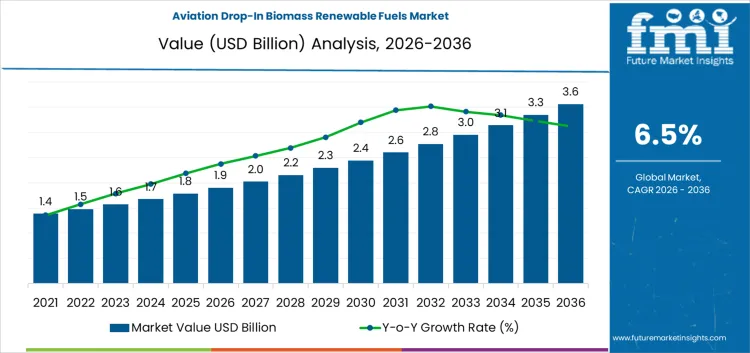
The aviation drop-in biomass renewable fuels market is valued at USD 1.9 billion in 2026 and is projected to reach USD 3.6 billion by 2036, reflecting a CAGR of 6.5%. Market performance is influenced by concentration among fuel producers capable of converting biomass into drop-in aviation fuels compliant with existing jet engine specifications. Cost structures are shaped by feedstock sourcing, conversion technology, and certification requirements. Pricing authority is concentrated among suppliers demonstrating validated performance and regulatory compliance. Margin concentration favors companies that integrate production, certification, and logistical support, capturing value from operational reliability rather than fuel volume alone.
Market outcomes are determined by alignment with airline fuel programs, sustainability mandates, and long-term procurement contracts. Adoption varies regionally depending on feedstock availability, government incentives, and airline decarbonization goals. Operators providing certified, multi-feedstock renewable fuels with verified energy performance achieve higher margins. Fragmentation persists among smaller or regional producers, whereas established suppliers secure concentrated value through production control, validated performance, and integration with airline fuel supply chains rather than fuel volume alone.
Quick Stats of the Aviation Drop-In Biomass Renewable Fuels Market
- Aviation Drop-In Biomass Renewable Fuels Market Value (2026): USD 1.9 billion
- Aviation Drop-In Biomass Renewable Fuels Forecast Value (2036): USD 3.6 billion
- Aviation Drop-In Biomass Renewable Fuels Forecast CAGR 2026 to 2036: 6.5%
- Leading Fuel Pathway in Aviation Renewable Fuels Market: HEFA-SAF (46% share)
- Leading Feedstock in Aviation Renewable Fuels Market: Waste Oils & Fats (49% share)
- Key Growth Regions in Aviation Renewable Fuels Market: USA, Netherlands, UK, Brazil
- Top Players in Aviation Drop-In Biomass Renewable Fuels Market: Neste, World Energy, TotalEnergies, Shell Aviation, BP Bioenergy, Eni Sustainable Mobility
What is the Growth Forecast for Aviation Drop-In Biomass Renewable Fuels Market through 2036?
Between 2026 and 2031, the aviation drop-in biomass renewable fuels market is projected to grow from USD 1.9 billion to USD 2.4 billion, generating an absolute increase of USD 0.5 billion and reflecting a CAGR of 6.5%. Growth is driven by adoption of HEFA-SAF, FT-SPK, ATJ, and co-processed SAF across commercial, military, and business aviation. Key feedstocks include waste oils, agricultural residues, MSW, and energy crops. Expansion is supported by airline sustainability initiatives, carbon reduction mandates, and blending requirements. Suppliers focus on fuel certification, performance consistency, and integration into existing fuel infrastructure.
From 2031 to 2036, the market is expected to expand from USD 2.4 billion to USD 3.6 billion, adding USD 1.1 billion. Growth is fueled by wider adoption of drop-in SAF, increased aviation fuel consumption, and regulatory incentives for carbon-neutral operations. Market drivers include decarbonization targets, sustainable feedstock sourcing, and airline commitments to net-zero emissions. Competitive advantage favors suppliers offering validated, high-performance SAF, scalable production, and strong partnerships with airlines and fuel distributors. Leading companies include Neste, World Energy, TotalEnergies, Shell Aviation, BP Bioenergy, and Eni Sustainable Mobility.
Aviation Drop in Biomass Renewable Fuels Market Key Takeaways
| Metric | Value |
|---|---|
| Market Value (2026) | USD 1.9 billion |
| Forecast Value (2036) | USD 3.6 billion |
| Forecast CAGR 2026 to 2036 | 6.50% |
What Is Driving Demand for Aviation Drop-In Biomass Renewable Fuels?
Aviation drop-in biomass renewable fuels are increasingly adopted to reduce greenhouse gas emissions, maintain aircraft performance, and comply with carbon reduction mandates. Historically, conventional jet fuel relied solely on fossil sources, contributing to high carbon intensity in aviation operations. Modern drop-in biofuels are produced from biomass feedstocks such as agricultural residues, algae, and waste oils, and are chemically compatible with existing jet engines and fuel infrastructure. Airlines, airport authorities, and fuel suppliers prioritize fuel certification, energy density, and supply chain reliability. Early adoption focused on demonstration flights and limited routes, while current demand spans commercial airlines, cargo carriers, and military aviation, driven by environmental regulations, carbon offset goals, and corporate sustainability commitments. Feedstock availability, production scalability, and fuel certification influence adoption and procurement.
Increasing pressure to reduce aviation emissions, regulatory incentives, and airline sustainability targets are shaping market growth. Compared with conventional jet fuel, drop-in biomass fuels emphasize carbon footprint reduction, engine compatibility, and lifecycle greenhouse gas performance. Cost structures depend on biomass sourcing, conversion technology, and certification processes, concentrating margins among suppliers capable of producing consistent, certified fuels. Airlines adopt these fuels to comply with emission regulations, reduce environmental impact, and support long-term decarbonization goals. By 2036, aviation drop-in biomass renewable fuels are expected to be widely integrated into commercial and military aviation, supporting emission reduction, operational continuity, and environmental compliance across global air transport.
What Factors Are Shaping the Demand for Aviation Drop-In Biomass Renewable Fuels in Terms of Fuel Pathway and Feedstock?
The demand for aviation drop-in biomass renewable fuels is segmented by fuel pathway and feedstock type. Fuel pathways include HEFA-SAF, FT-SPK, ATJ, co-processed SAF, and PtL blends. Feedstocks include waste oils and fats, agricultural residues, municipal solid waste, energy crops, and industrial by-products. Adoption is influenced by sustainability mandates, lifecycle carbon reduction targets, and compatibility with conventional aircraft engines. Uptake is driven by airline decarbonization initiatives, government incentives, and operational reliability. Fuel pathway and feedstock selection depend on availability, processing efficiency, and lifecycle emissions, ensuring scalable, safe, and compliant integration into commercial and regional aviation operations.
Why Is HEFA-SAF Leading the Fuel Pathway Segment in Aviation Renewable Fuels?
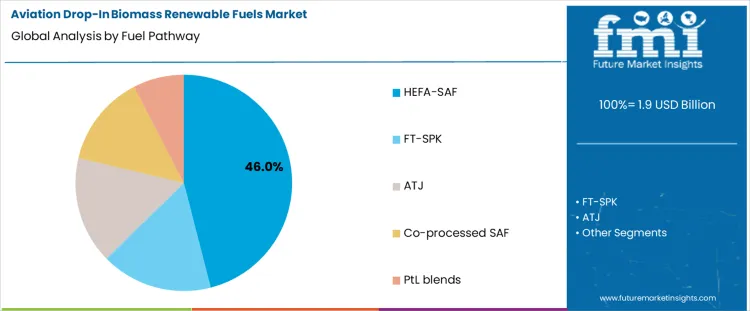
HEFA-SAF accounts for 46% of total fuel pathway demand, making it the leading category. This pathway converts waste oils and fats into sustainable aviation fuel compatible with existing aircraft engines. Adoption is driven by proven processing technology, predictable conversion yields, high energy density, and low lifecycle carbon emissions. Airlines integrate HEFA-SAF to meet sustainability targets while maintaining operational reliability. Operational considerations include feedstock sourcing, refining efficiency, quality certification, and compliance with ASTM standards. Process design emphasizes energy recovery, contaminant management, and scalability to satisfy commercial airline requirements.
HEFA-SAF performance further supports adoption. Fuel must meet freezing point, viscosity, and thermal stability requirements for high-altitude operations. Supply chains ensure consistent feedstock availability and redundancy. The segment leads because HEFA-SAF offers measurable carbon reduction, operational reliability, regulatory compliance, and ease of integration into existing refueling infrastructure, making it the primary choice for commercial and regional aviation operations seeking sustainable alternatives.
Why Are Waste Oils and Fats Representing the Largest Feedstock Segment in Aviation Renewable Fuels?

Waste oils and fats account for 49% of total feedstock demand, making them the largest category. Adoption is driven by the widespread availability of used cooking oil, animal fats, and industrial residues suitable for HEFA-SAF and co-processed SAF production. These feedstocks provide high energy content, low sulfur, and compatibility with conventional refining processes. Operational planning includes collection, purification, storage logistics, and quality monitoring to ensure continuous supply. Airlines and fuel producers implement traceability, contamination control, and performance verification protocols to maintain fuel reliability and compliance.
Functional and operational factors further reinforce adoption. Feedstock variability, moisture content, and contaminants must be managed to avoid yield loss or operational issues. Waste oils and fats lead because they provide predictable conversion, operational efficiency, and sustainability benefits, supporting scalable integration of renewable fuels into aviation operations while maintaining regulatory compliance and meeting decarbonization objectives.
How Are Drop-In Biomass Fuels Enabling Sustainable Flight Operations?
Drop-in biomass renewable fuels are increasingly adopted by commercial airlines and cargo carriers to lower carbon emissions while maintaining compatibility with conventional jet engines. Adoption is strongest in regions with established biomass supply chains, supportive government incentives, and sustainability-focused airline programs. Fuels are selected for energy density, storage stability, and ASTM certification compliance. Growth is driven by regulatory carbon reduction mandates, corporate sustainability targets, and growing environmental awareness among passengers. Investment focuses on feedstock sourcing, conversion technologies, and supply chain logistics. Operators prioritize fuels that reduce lifecycle emissions while maintaining engine performance and operational reliability.
Why Are Regional Carbon Policies and Biofuel Infrastructure Driving Adoption?
Demand is influenced by local mandates on aviation emissions, alternative fuel blending requirements, and climate goals for sustainable transport. Airlines adopt drop-in biomass fuels to achieve emission targets without modifying aircraft systems. Fuels offering consistent energy output, storage stability, and low lifecycle carbon footprint gain preference. Adoption is concentrated in regions with supportive biofuel policies, strong aviation activity, and established production infrastructure. Carbon compliance, operational reliability, and environmental performance drive procurement more than cost. Suppliers providing certified, high-quality fuels gain competitive advantage among carriers and fuel distributors.
What Challenges Restrict Broader Deployment of Aviation Biomass Fuels?
Limited biomass feedstock availability, high production costs, and conversion complexity restrict adoption. Fuel quality can vary based on feedstock and processing methods, affecting energy density and storage stability. Certification, blending standards, and distribution logistics add operational complexity. Smaller carriers or regions with limited biofuel infrastructure adopt fuels more slowly. These factors concentrate early deployment among large airlines, cargo operators, and regions with robust biofuel networks and technical expertise.
How Are Technological Innovation and Industry Partnerships Shaping Market Growth?
Advancements include improved hydroprocessing, catalytic conversion technologies, and diversified feedstock sourcing for reliable fuel production. Collaboration between fuel producers, airlines, and regulators ensures compliance, engine compatibility, and emission verification. Pilot flights test fuel performance, blending ratios, and operational reliability before large-scale adoption. Quality monitoring, traceability, and supply chain standardization maintain consistency. Focus is on emission reduction, operational efficiency, and fuel reliability rather than cost or throughput. Collaborative initiatives enable broader adoption of aviation drop-in biomass renewable fuels, supporting sustainable aviation and regional carbon reduction goals.
What is the Demand for Aviation Drop-In Biomass Renewable Fuels by Country?
| Country | CAGR |
|---|---|
| USA | 6.5% |
| Netherlands | 6.0% |
| UK | 5.8% |
| Brazil | 5.5% |
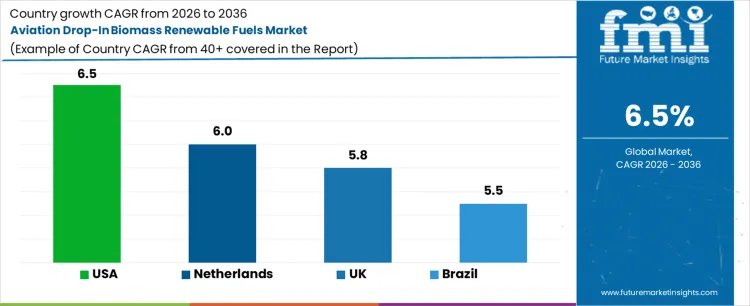
Demand for aviation drop-in biomass renewable fuels is rising as airlines and aviation stakeholders adopt sustainable fuels to reduce carbon emissions and comply with environmental regulations. The USA leads with a 6.5% CAGR, driven by government incentives, airline initiatives for carbon reduction, and investments in biofuel production capacity. The Netherlands follows at 6.0%, supported by EU renewable energy policies and adoption in commercial aviation. The UK records 5.8% growth, shaped by fleet modernization and sustainability programs. Brazil grows at 5.5%, influenced by domestic biofuel availability, regulatory support, and adoption in commercial aviation operations.
How Is the United States Experiencing Growth in the Aviation Drop-In Biomass Renewable Fuels Market?
United States is experiencing growth at a CAGR of 6.5%, supported by adoption of drop-in biomass renewable fuels in commercial and military aviation to reduce carbon emissions and comply with sustainability targets. Fuel producers and airlines are deploying fuels optimized for compatibility with existing jet engines, energy density, and thermal stability. Demand is concentrated in major airports, airline hubs, and aerospace manufacturing regions. Investments focus on fuel production efficiency, certification compliance, and integration with existing supply chains rather than large-scale fleet expansion. Growth reflects increasing airline adoption of sustainable aviation fuels, regulatory support, and industrial initiatives for low-carbon aviation solutions.
- Sustainable aviation initiatives drive adoption.
- Fuels are compatible with existing jet engines.
- Airports and airline hubs concentrate demand.
- Fuel production efficiency and certification compliance guide investment.
How Is the Netherlands Witnessing Growth with Renewable Aviation Programs?
Netherlands is witnessing growth at a CAGR of 6%, supported by adoption of drop-in biomass renewable fuels in commercial aviation to reduce greenhouse gas emissions and comply with European sustainability regulations. Fuel producers and airlines are implementing fuels optimized for energy density, thermal stability, and engine compatibility. Demand is concentrated in major airports, airline hubs, and fuel distribution centers. Investments prioritize production efficiency, regulatory adherence, and integration with aviation logistics rather than large-scale fleet deployment. Growth reflects government incentives for renewable aviation fuels, industrial adoption in airline operations, and rising focus on low-carbon flight solutions.
- Renewable aviation programs drive adoption.
- Fuels ensure engine compatibility and energy efficiency.
- Airports and airline hubs concentrate demand.
- Production efficiency and regulatory adherence guide investment.
How Is the United Kingdom Experiencing Growth with Sustainable Flight Initiatives?
United Kingdom is experiencing growth at a CAGR of 5.8%, supported by adoption of drop-in biomass renewable fuels in commercial aviation to reduce emissions and support sustainability goals. Airlines and fuel producers are deploying fuels optimized for jet engine performance, energy density, and thermal stability. Demand is concentrated in major airport hubs, airline operations centers, and fuel logistics facilities. Investments focus on production efficiency, certification compliance, and integration with existing supply chains rather than fleet-scale expansion. Growth reflects industrial adoption of sustainable aviation fuels, government support for emission reduction, and airline initiatives for low-carbon operations.
- Sustainable flight initiatives drive adoption.
- Fuels optimize engine performance and stability.
- Airport hubs and logistics facilities concentrate demand.
- Production efficiency and certification compliance guide investment.
How Is Brazil Witnessing Moderate Growth with Low-Carbon Aviation Efforts?
Brazil is witnessing growth at a CAGR of 5.5%, fueled by adoption of drop-in biomass renewable fuels in commercial and regional aviation to reduce carbon emissions and meet sustainability targets. Airlines and fuel producers are deploying fuels optimized for thermal stability, energy density, and engine compatibility. Demand is concentrated in major airports, airline hubs, and aviation logistics centers. Investments prioritize production efficiency, regulatory compliance, and integration with existing fuel infrastructure rather than fleet expansion. Growth reflects government initiatives supporting sustainable aviation, industrial adoption of low-carbon fuels, and increasing focus on eco-friendly airline operations.
- Low-carbon aviation efforts drive adoption.
- Fuels ensure engine compatibility and stability.
- Airports and airline hubs concentrate demand.
- Production efficiency and regulatory compliance guide investment.
Who Competes in the Aviation Drop-In Biomass Renewable Fuels Market and What Defines Their Capabilities?
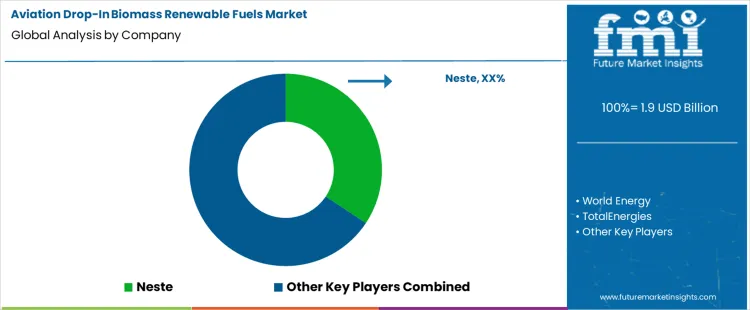
Competition in the aviation drop-in biomass renewable fuels market is defined by feedstock sourcing, fuel certification compliance, and integration with conventional jet fuel supply chains. Neste supplies drop-in aviation biofuels produced from waste and residue oils, meeting ASTM D7566 specifications for compatibility with existing aircraft engines. World Energy develops biomass-derived jet fuel solutions optimized for blending with conventional jet fuel and distribution through airport supply chains. TotalEnergies provides renewable aviation fuels sourced from waste oils and lipids, designed to reduce lifecycle carbon intensity. Shell Aviation delivers certified drop-in biofuels for commercial aviation with established distribution networks. BP Bioenergy develops aviation biofuels emphasizing lifecycle emissions reduction and scalability.
Eni Sustainable Mobility focuses on producing and distributing sustainable aviation fuels derived from waste and biomass feedstocks, compliant with ASTM standards. Other participants include regional and specialty renewable fuel producers targeting airport-based blending and local distribution. Differentiation arises from feedstock availability, production capacity, certification compliance, and integration with airline refueling infrastructure. Market positioning is influenced by lifecycle carbon intensity, compatibility with conventional jet engines, supply chain reliability, and the ability to meet growing airline demand for low-carbon, drop-in renewable fuels.
Key Players in the Aviation Drop-In Biomass Renewable Fuels Market
- Neste
- World Energy
- TotalEnergies
- Shell Aviation
- BP Bioenergy
- Eni Sustainable Mobility
Scope of the Report
| Items | Values |
|---|---|
| Quantitative Units (2026) | USD billion |
| Fuel Pathway | HEFA-SAF, FT-SPK, ATJ, Co-processed SAF, PtL blends |
| Feedstock | Waste oils & fats, Agricultural residue, Municipal solid waste / Industrial waste, Energy crops |
| End User | Commercial airlines, Military aviation, Business aviation |
| Region | Asia Pacific, Europe, North America, Latin America, Middle East & Africa |
| Key Countries Covered | USA, Netherlands, UK, Brazil, China, Japan, Germany, France, India, Australia |
| Key Companies Profiled | Neste, World Energy, TotalEnergies, Shell Aviation, BP Bioenergy, Eni Sustainable Mobility |
| Additional Attributes | Dollar sales by fuel pathway, feedstock, and end-user; regional CAGR, value and volume growth projections; adoption across commercial, military, and business aviation; lifecycle carbon intensity and regulatory compliance; feedstock availability and sourcing logistics; integration with existing fuel infrastructure; ASTM certification and operational reliability; scalability of production and blending; supply chain traceability and consistency; partnerships with airlines and fuel distributors. |
Aviation Drop-In Biomass Renewable Fuels Market Segmentation
Fuel Pathway:
- HEFA-SAF
- FT-SPK
- ATJ
- Co-processed SAF
- PtL blends
Feedstock:
- Waste oils & fats
- Agri residue
- MSW / industrial waste
- Energy crops
End User:
- Commercial airlines
- Military aviation
- Business aviation
Region:
- Asia Pacific
- China
- Japan
- South Korea
- India
- Australia & New Zealand
- ASEAN
- Rest of Asia Pacific
- Europe
- Germany
- United Kingdom
- France
- Italy
- Spain
- Nordic
- BENELUX
- Rest of Europe
- North America
- United States
- Canada
- Mexico
- Latin America
- Brazil
- Chile
- Rest of Latin America
- Middle East & Africa
- Kingdom of Saudi Arabia
- Other GCC Countries
- Turkey
- South Africa
- Other African Union
- Rest of Middle East & Africa
Bibliography
- International Civil Aviation Organization (ICAO). (2024). ICAO guidance on policy measures for SAF development and deployment (Version 3). ICAO Environmental Protection Publications.
- Federal Aviation Administration (FAA). (2023). Putting Our Heads Together: FAA Invests $35M in Environmental Partnership with Top Universities (FAA Fact Sheet, March 2023). U.S. Department of Transportation, FAA.
- Biomass Research and Development Board. (2025). Sustainable Aviation Fuel Grand Challenge: October 2021–September 2024 Progress Report. U.S. Government Interagency Report (hosted by U.S. Department of Energy).
- European Union Aviation Safety Agency (EASA). (2024). State of the EU SAF market in 2023: Fuel reference prices, SAF capacity assessments. EASA General Publication.
- European Parliament and Council of the European Union. (2023). Regulation (EU) 2023/2405 on ensuring a level playing field for sustainable air transport (ReFuelEU Aviation). Official Journal of the European Union.
Frequently Asked Questions
How big is the aviation drop-in biomass renewable fuels market in 2026?
The global aviation drop-in biomass renewable fuels market is estimated to be valued at USD 1.9 billion in 2026.
What will be the size of aviation drop-in biomass renewable fuels market in 2036?
The market size for the aviation drop-in biomass renewable fuels market is projected to reach USD 3.6 billion by 2036.
How much will be the aviation drop-in biomass renewable fuels market growth between 2026 and 2036?
The aviation drop-in biomass renewable fuels market is expected to grow at a 6.5% CAGR between 2026 and 2036.
What are the key product types in the aviation drop-in biomass renewable fuels market?
The key product types in aviation drop-in biomass renewable fuels market are HEFA-SAF, FT-SPK, ATJ, co-processed SAF, and PtL blends.
Which feedstock segment to contribute significant share in the aviation drop-in biomass renewable fuels market in 2026?
In terms of feedstock, waste oils & fats segment to command 49.0% share in the aviation drop-in biomass renewable fuels market in 2026.
Preview the report firsthand - request a free sample
Get SampleGet the brochure for pricing and purchase details.
Get PDFTable of Content
- Executive Summary
- Global Market Outlook
- Demand-side Trends
- Supply-side Trends
- Technology Roadmap Analysis
- Analysis and Recommendations
- Market Overview
- Market Coverage / Taxonomy
- Market Definition / Scope / Limitations
- Market Background
- Market Dynamics
- Drivers
- Restraints
- Opportunity
- Trends
- Scenario Forecast
- Demand in Optimistic Scenario
- Demand in Likely Scenario
- Demand in Conservative Scenario
- Opportunity Map Analysis
- Product Life Cycle Analysis
- Supply Chain Analysis
- Investment Feasibility Matrix
- Value Chain Analysis
- PESTLE and Porter’s Analysis
- Regulatory Landscape
- Regional Parent Market Outlook
- Production and Consumption Statistics
- Import and Export Statistics
- Market Dynamics
- Global Market Analysis 2021 to 2025 and Forecast, 2026 to 2036
- Historical Market Size Value (USD Million) Analysis, 2021 to 2025
- Current and Future Market Size Value (USD Million) Projections, 2026 to 2036
- Y-o-Y Growth Trend Analysis
- Absolute $ Opportunity Analysis
- Global Market Pricing Analysis 2021 to 2025 and Forecast 2026 to 2036
- Global Market Analysis 2021 to 2025 and Forecast 2026 to 2036, By Fuel Pathway
- Introduction / Key Findings
- Historical Market Size Value (USD Million) Analysis By Fuel Pathway , 2021 to 2025
- Current and Future Market Size Value (USD Million) Analysis and Forecast By Fuel Pathway , 2026 to 2036
- HEFA-SAF
- FT-SPK
- ATJ
- Co-processed SAF
- PtL blends
- HEFA-SAF
- Y-o-Y Growth Trend Analysis By Fuel Pathway , 2021 to 2025
- Absolute $ Opportunity Analysis By Fuel Pathway , 2026 to 2036
- Global Market Analysis 2021 to 2025 and Forecast 2026 to 2036, By Feedstock
- Introduction / Key Findings
- Historical Market Size Value (USD Million) Analysis By Feedstock, 2021 to 2025
- Current and Future Market Size Value (USD Million) Analysis and Forecast By Feedstock, 2026 to 2036
- Waste oils & fats
- Agri residue
- MSW / industrial waste
- Energy crops
- Waste oils & fats
- Y-o-Y Growth Trend Analysis By Feedstock, 2021 to 2025
- Absolute $ Opportunity Analysis By Feedstock, 2026 to 2036
- Global Market Analysis 2021 to 2025 and Forecast 2026 to 2036, By End User
- Introduction / Key Findings
- Historical Market Size Value (USD Million) Analysis By End User, 2021 to 2025
- Current and Future Market Size Value (USD Million) Analysis and Forecast By End User, 2026 to 2036
- Commercial airlines
- Military aviation
- Business aviation
- Commercial airlines
- Y-o-Y Growth Trend Analysis By End User, 2021 to 2025
- Absolute $ Opportunity Analysis By End User, 2026 to 2036
- Global Market Analysis 2021 to 2025 and Forecast 2026 to 2036, By Region
- Introduction
- Historical Market Size Value (USD Million) Analysis By Region, 2021 to 2025
- Current Market Size Value (USD Million) Analysis and Forecast By Region, 2026 to 2036
- North America
- Latin America
- Western Europe
- Eastern Europe
- East Asia
- South Asia and Pacific
- Middle East & Africa
- Market Attractiveness Analysis By Region
- North America Market Analysis 2021 to 2025 and Forecast 2026 to 2036, By Country
- Historical Market Size Value (USD Million) Trend Analysis By Market Taxonomy, 2021 to 2025
- Market Size Value (USD Million) Forecast By Market Taxonomy, 2026 to 2036
- By Country
- USA
- Canada
- Mexico
- By Fuel Pathway
- By Feedstock
- By End User
- By Country
- Market Attractiveness Analysis
- By Country
- By Fuel Pathway
- By Feedstock
- By End User
- Key Takeaways
- Latin America Market Analysis 2021 to 2025 and Forecast 2026 to 2036, By Country
- Historical Market Size Value (USD Million) Trend Analysis By Market Taxonomy, 2021 to 2025
- Market Size Value (USD Million) Forecast By Market Taxonomy, 2026 to 2036
- By Country
- Brazil
- Chile
- Rest of Latin America
- By Fuel Pathway
- By Feedstock
- By End User
- By Country
- Market Attractiveness Analysis
- By Country
- By Fuel Pathway
- By Feedstock
- By End User
- Key Takeaways
- Western Europe Market Analysis 2021 to 2025 and Forecast 2026 to 2036, By Country
- Historical Market Size Value (USD Million) Trend Analysis By Market Taxonomy, 2021 to 2025
- Market Size Value (USD Million) Forecast By Market Taxonomy, 2026 to 2036
- By Country
- Germany
- UK
- Italy
- Spain
- France
- Nordic
- BENELUX
- Rest of Western Europe
- By Fuel Pathway
- By Feedstock
- By End User
- By Country
- Market Attractiveness Analysis
- By Country
- By Fuel Pathway
- By Feedstock
- By End User
- Key Takeaways
- Eastern Europe Market Analysis 2021 to 2025 and Forecast 2026 to 2036, By Country
- Historical Market Size Value (USD Million) Trend Analysis By Market Taxonomy, 2021 to 2025
- Market Size Value (USD Million) Forecast By Market Taxonomy, 2026 to 2036
- By Country
- Russia
- Poland
- Hungary
- Balkan & Baltic
- Rest of Eastern Europe
- By Fuel Pathway
- By Feedstock
- By End User
- By Country
- Market Attractiveness Analysis
- By Country
- By Fuel Pathway
- By Feedstock
- By End User
- Key Takeaways
- East Asia Market Analysis 2021 to 2025 and Forecast 2026 to 2036, By Country
- Historical Market Size Value (USD Million) Trend Analysis By Market Taxonomy, 2021 to 2025
- Market Size Value (USD Million) Forecast By Market Taxonomy, 2026 to 2036
- By Country
- China
- Japan
- South Korea
- By Fuel Pathway
- By Feedstock
- By End User
- By Country
- Market Attractiveness Analysis
- By Country
- By Fuel Pathway
- By Feedstock
- By End User
- Key Takeaways
- South Asia and Pacific Market Analysis 2021 to 2025 and Forecast 2026 to 2036, By Country
- Historical Market Size Value (USD Million) Trend Analysis By Market Taxonomy, 2021 to 2025
- Market Size Value (USD Million) Forecast By Market Taxonomy, 2026 to 2036
- By Country
- India
- ASEAN
- Australia & New Zealand
- Rest of South Asia and Pacific
- By Fuel Pathway
- By Feedstock
- By End User
- By Country
- Market Attractiveness Analysis
- By Country
- By Fuel Pathway
- By Feedstock
- By End User
- Key Takeaways
- Middle East & Africa Market Analysis 2021 to 2025 and Forecast 2026 to 2036, By Country
- Historical Market Size Value (USD Million) Trend Analysis By Market Taxonomy, 2021 to 2025
- Market Size Value (USD Million) Forecast By Market Taxonomy, 2026 to 2036
- By Country
- Kingdom of Saudi Arabia
- Other GCC Countries
- Turkiye
- South Africa
- Other African Union
- Rest of Middle East & Africa
- By Fuel Pathway
- By Feedstock
- By End User
- By Country
- Market Attractiveness Analysis
- By Country
- By Fuel Pathway
- By Feedstock
- By End User
- Key Takeaways
- Key Countries Market Analysis
- USA
- Pricing Analysis
- Market Share Analysis, 2025
- By Fuel Pathway
- By Feedstock
- By End User
- Canada
- Pricing Analysis
- Market Share Analysis, 2025
- By Fuel Pathway
- By Feedstock
- By End User
- Mexico
- Pricing Analysis
- Market Share Analysis, 2025
- By Fuel Pathway
- By Feedstock
- By End User
- Brazil
- Pricing Analysis
- Market Share Analysis, 2025
- By Fuel Pathway
- By Feedstock
- By End User
- Chile
- Pricing Analysis
- Market Share Analysis, 2025
- By Fuel Pathway
- By Feedstock
- By End User
- Germany
- Pricing Analysis
- Market Share Analysis, 2025
- By Fuel Pathway
- By Feedstock
- By End User
- UK
- Pricing Analysis
- Market Share Analysis, 2025
- By Fuel Pathway
- By Feedstock
- By End User
- Italy
- Pricing Analysis
- Market Share Analysis, 2025
- By Fuel Pathway
- By Feedstock
- By End User
- Spain
- Pricing Analysis
- Market Share Analysis, 2025
- By Fuel Pathway
- By Feedstock
- By End User
- France
- Pricing Analysis
- Market Share Analysis, 2025
- By Fuel Pathway
- By Feedstock
- By End User
- India
- Pricing Analysis
- Market Share Analysis, 2025
- By Fuel Pathway
- By Feedstock
- By End User
- ASEAN
- Pricing Analysis
- Market Share Analysis, 2025
- By Fuel Pathway
- By Feedstock
- By End User
- Australia & New Zealand
- Pricing Analysis
- Market Share Analysis, 2025
- By Fuel Pathway
- By Feedstock
- By End User
- China
- Pricing Analysis
- Market Share Analysis, 2025
- By Fuel Pathway
- By Feedstock
- By End User
- Japan
- Pricing Analysis
- Market Share Analysis, 2025
- By Fuel Pathway
- By Feedstock
- By End User
- South Korea
- Pricing Analysis
- Market Share Analysis, 2025
- By Fuel Pathway
- By Feedstock
- By End User
- Russia
- Pricing Analysis
- Market Share Analysis, 2025
- By Fuel Pathway
- By Feedstock
- By End User
- Poland
- Pricing Analysis
- Market Share Analysis, 2025
- By Fuel Pathway
- By Feedstock
- By End User
- Hungary
- Pricing Analysis
- Market Share Analysis, 2025
- By Fuel Pathway
- By Feedstock
- By End User
- Kingdom of Saudi Arabia
- Pricing Analysis
- Market Share Analysis, 2025
- By Fuel Pathway
- By Feedstock
- By End User
- Turkiye
- Pricing Analysis
- Market Share Analysis, 2025
- By Fuel Pathway
- By Feedstock
- By End User
- South Africa
- Pricing Analysis
- Market Share Analysis, 2025
- By Fuel Pathway
- By Feedstock
- By End User
- USA
- Market Structure Analysis
- Competition Dashboard
- Competition Benchmarking
- Market Share Analysis of Top Players
- By Regional
- By Fuel Pathway
- By Feedstock
- By End User
- Competition Analysis
- Competition Deep Dive
- Neste
- Overview
- Product Portfolio
- Profitability by Market Segments (Product/Age /Sales Channel/Region)
- Sales Footprint
- Strategy Overview
- Marketing Strategy
- Product Strategy
- Channel Strategy
- World Energy
- TotalEnergies
- Shell Aviation
- BP Bioenergy
- Eni Sustainable Mobility
- Neste
- Competition Deep Dive
- Assumptions & Acronyms Used
- Research Methodology


