

- Industry Size (2026)
- USD 250.23 Mn
- Forecast (2036)
- USD 460.97 Mn
- CAGR (2026 to 2036)
- 6.30%
Renewable Energy Contactor Market size, market forecast and outlook by FMI
The renewable energy contactor market was valued at USD 235.40 million in 2025, projected to reach USD 250.23 million in 2026, and is forecast to expand to USD 460.97 million by 2036 at a 6.30% CAGR. Based on Future Market Insights analysis, the market is set to add an incremental opportunity worth USD 210.74 million over the forecast period. As per FMI, the market landscape for renewable energy contactor is being reshaped by evolving regulatory frameworks, regional deployment acceleration, and shifting competitive dynamics.
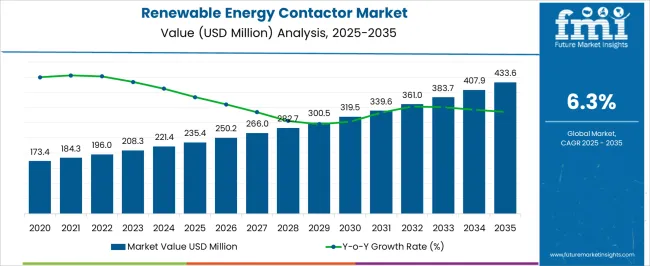
Three forces are accelerating the renewable energy contactor market beyond traditional industrial switching demand. First, the voltage levels in renewable energy systems are rising as PV string voltages migrate to 1500V DC and battery storage systems adopt 800V to 1500V DC architectures, requiring contactors with higher voltage ratings and more capable arc suppression systems than conventional industrial products can deliver. Second, the cycling frequency in renewable energy applications far exceeds traditional motor control duty cycles, because solar inverters and battery management systems switch contactors multiple times per day compared to the infrequent switching events in industrial motor applications, creating accelerated replacement demand and driving specification toward higher-endurance contactor designs. Third, the geographic distribution of renewable energy installation activity is expanding into markets with less established industrial component supply chains, creating opportunities for contactor manufacturers that can establish local inventory and technical support in emerging renewable energy markets.
Across tracked geographies, China sets the pace at 8.50% CAGR. India follows at 7.90%. Germany follows at 7.20%. UK follows at 6.00%. USA follows at 5.40%.
Summary of Renewable Energy Contactor Market
- Renewable Energy Contactor Market definition
- Renewable energy contactors are electromechanical and solid-state switching devices designed for DC and AC power circuit control in solar inverters, battery energy storage systems, wind turbine converters, and EV charging infrastructure, rated for high-voltage DC interruption, arc suppression, and continuous cycling duty under the demanding operating profiles of renewable energy generation and storage applications.
- Demand drivers in the market
- Solar PV installation volumes are expanding globally, and each string inverter and central inverter requires DC contactors rated for photovoltaic system voltages up to 1500V DC to perform pre-charge, disconnect, and fault isolation functions.
- Battery energy storage system deployments are multiplying the number of DC contactors per installation because each battery rack requires dedicated switching devices for charge/discharge control, cell balancing isolation, and emergency disconnect at DC bus voltages exceeding 800V.
- EV charging infrastructure buildout is creating a new volume application for DC contactors rated for continuous cycling at charge voltages up to 1000V DC, with each fast-charging station requiring multiple contactor units for power path switching and safety isolation.
- Key segments analyzed in the FMI report
- DC Contactors product: 58.3% share in 2026, reflecting established procurement specifications and market positioning.
- China: 8.50% compound growth, supported by domestic policy frameworks and rising deployment.
- Analyst opinion at FMI
- Nikhil Kaitwade, Principal Consultant for Oil and Gas, opines, the renewable energy contactor market is structurally linked to renewable energy installation rates and the voltage migration trend that is pushing system architects toward higher DC voltages. FMI is of the opinion that the DC contactor segment will capture the majority of incremental growth because the transition to higher-voltage PV and battery systems creates a specification upgrade cycle where existing lower-voltage contactors must be replaced with higher-rated alternatives. The competitive advantage belongs to manufacturers that offer hermetically sealed, gas-filled arc chambers rated for 1500V DC interruption, because open-air contactor designs cannot achieve the arc suppression performance required at these voltage levels.
- Strategic implications / executive takeaways
- Contactor manufacturers must expand 1500V DC rated product portfolios to capture the specification upgrade cycle driven by higher-voltage PV and battery system architectures.
- Solar inverter and battery system OEMs should qualify at least two contactor suppliers per voltage rating to mitigate single-source dependency on a component that determines system safety certification compliance.
- Distribution partners serving emerging renewable energy markets should establish local contactor inventory for the most common voltage ratings to capture installation demand where lead times from centralized distribution cannot meet project commissioning schedules.
Renewable Energy Contactor Market key takeaways
| Metric | Details |
|---|---|
| Industry Size (2026) | USD 250.23 million |
| Industry Value (2036) | USD 460.97 million |
| CAGR (2026 to 2036) | 6.30% |
Source: Future Market Insights, 2026
Renewable Energy Contactor Market definition
Renewable energy contactors represent the power switching component category engineered for the high DC voltage, bidirectional current flow, and frequent cycling conditions inherent in photovoltaic systems, battery storage installations, wind power conversion, and electric vehicle charging infrastructure. These devices perform circuit connection, disconnection, and fault isolation functions within power electronics architectures.
Renewable Energy Contactor Market inclusions
Market scope includes all commercially traded renewable energy contactors segmented by product type (DC contactors, AC contactors, hybrid contactors) and application (solar PV systems, battery energy storage, wind power, EV charging infrastructure). Revenue sizing spans the 2026 to 2036 forecast period.
Renewable Energy Contactor Market exclusions
The scope excludes standard industrial motor contactors not rated for renewable energy duty cycles, circuit breakers, disconnect switches, and power relays below 100A rating. Contactor coil drivers and control electronics sold separately are outside the defined boundary.
Renewable Energy Contactor Market research methodology
- Primary research: FMI analysts conducted interviews with procurement directors, project developers, and policy specialists across key renewable energy contactor organizations to map decision gates and market dynamics.
- Desk research: Data collection aggregated regulatory filings, trade association publications, standards body documentation, and company annual reports to establish verifiable baseline parameters.
- Market sizing and forecasting: Baseline values derive from a bottom-up aggregation of renewable energy contactor transaction volumes, applying region-specific policy scenarios and pricing indices to project demand through 2036.
- Data validation and update cycle: Projections are tested against publicly reported deployment statistics, market transaction data, and company financial disclosures on a quarterly refresh schedule.
Why is the Renewable Energy Contactor Market Growing?
Deployment of solar PV, wind, and battery storage infrastructure has accelerated, creating substantial demand for efficient contactors that ensure reliable switching, system safety, and energy efficiency.
Growth is being influenced by policy mandates for grid stability, rising investments in off-grid renewables, and rapid advancements in inverter technologies. Manufacturers are focusing on high-voltage, high-current contactors with arc suppression capabilities, especially in energy storage applications.
Additionally, the evolution of distributed energy systems and hybrid power plants is driving demand for contactors with enhanced performance and integration flexibility. In the coming years, technology developments in solid-state switching and wide-bandgap semiconductors are expected to augment the capabilities and reliability of contactor solutions across renewable installations.
Segmental Analysis
The renewable energy contactor market is segmented by product and geographic regions. A byproduct of the renewable energy contractor market is divided into DC Contactors and AC Contactors. Regionally, the renewable energy contactor industry is classified into North America, Latin America, Western Europe, Eastern Europe, Balkan & Baltic Countries, Russia & Belarus, Central Asia, East Asia, South Asia & Pacific, and the Middle East & Africa.
Insights into the DC Contactors Product Segment
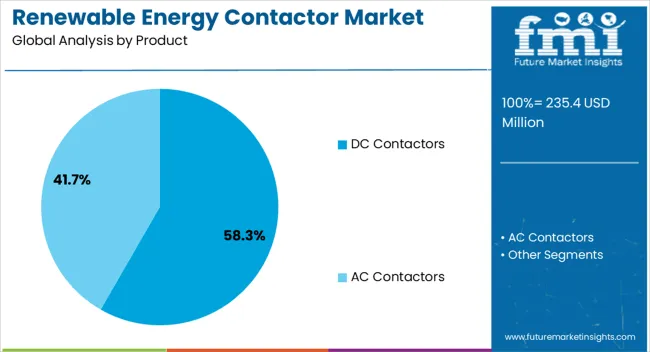
DC contactors are projected to hold 58.3% of the total market revenue in 2026, making them the leading product segment in the renewable energy contactor market. Their dominance is being driven by increased installation of DC-based renewable systems such as solar photovoltaics and battery energy storage solutions.
DC contactors are specifically engineered to handle unidirectional current flow, resist arc formation, and support safe, long-duration operations in high-voltage environments. Their compatibility with energy storage systems and EV charging infrastructure has further strengthened their market position.
The adoption of modular energy systems and rising reliance on direct current in microgrids and hybrid installations have reinforced the need for robust DC switching mechanisms. As energy architecture transitions from centralized grids to decentralized, digitally managed assets, the operational reliability and long service life of DC contactors continue to make them a critical component across utility-scale and distributed renewable deployments.
What are the Drivers, Restraints, and Key Trends of the Renewable Energy Contactor Market?
The renewable energy contactor market is growing as renewable power generation expands globally, driven by the need for reliable electrical switching components in solar, wind, and other clean energy systems. These contactors manage electrical loads and protect equipment from faults, ensuring safety and operational efficiency. Rising investments in renewable infrastructure, grid modernization, and smart energy management systems support demand. Challenges include product cost, performance under harsh environmental conditions, and compatibility with evolving energy technologies. Innovations in design and materials, along with growing adoption in emerging markets, offer significant growth opportunities.
Increasing Demand from Expanding Renewable Energy Installations
As countries accelerate renewable energy capacity additions, the demand for specialized electrical components like contactors rises. Solar photovoltaic and wind power installations require contactors to safely control high current loads and enable smooth integration into power grids. Government incentives and policies promoting clean energy adoption drive large-scale projects, increasing need for reliable switching solutions. Grid modernization efforts also involve upgrading existing electrical infrastructure with contactors that support smart grid features and energy storage integration. This demand is further boosted by increasing electrification and decentralization of energy systems. Manufacturers focus on developing contactors that meet stringent performance standards while adapting to various renewable energy applications worldwide.
Challenges Related to Cost and Environmental Durability
Renewable energy contactors must endure harsh environmental conditions such as extreme temperatures, humidity, dust, and vibration, especially in offshore wind farms or remote solar sites. Ensuring durability and long operational life under these conditions can increase manufacturing complexity and costs. Additionally, balancing product affordability with high performance is critical for large-scale deployments. Compatibility with evolving renewable technologies and electrical standards requires continuous innovation and rigorous testing. Supply chain disruptions and raw material price volatility can also impact production and pricing. These factors present challenges for manufacturers striving to deliver cost-effective, robust contactors that meet industry requirements while maintaining competitive pricing.
Innovation in Design and Material Technology
Advancements in contactor design and materials are improving efficiency, reliability, and lifespan of components used in renewable energy systems. Use of high-quality alloys, enhanced insulation materials, and improved contact mechanisms reduce wear and energy losses during switching operations. Miniaturization and modular designs allow easier integration into compact renewable energy devices and control panels. Developments in electronic control and monitoring features enable predictive maintenance and remote operation, aligning with smart grid trends. Manufacturers collaborate with renewable technology developers to customize products for specific applications, such as solar inverters or wind turbine controllers. These innovations enhance overall system performance and reduce downtime, providing strong incentives for market growth and adoption.
Market Expansion Supported by Emerging Regions and Infrastructure Investments
Emerging economies in the Asia Pacific, Latin America, and Africa are increasing renewable energy installations to meet growing electricity demand and reduce carbon emissions. These regions offer significant growth potential for renewable energy contactors as infrastructure investments and grid upgrades accelerate. Governments and private sector initiatives drive project financing and technology adoption. Market players are expanding their presence through partnerships, local manufacturing, and tailored solutions to address regional needs. Additionally, the global push toward electrification and decarbonization boosts demand for advanced contactors compatible with hybrid energy systems and storage solutions. Navigating diverse regulatory frameworks and maintaining supply chain resilience are important for sustained expansion in these markets.
Analysis of Renewable Energy Contactor Market By Key Countries
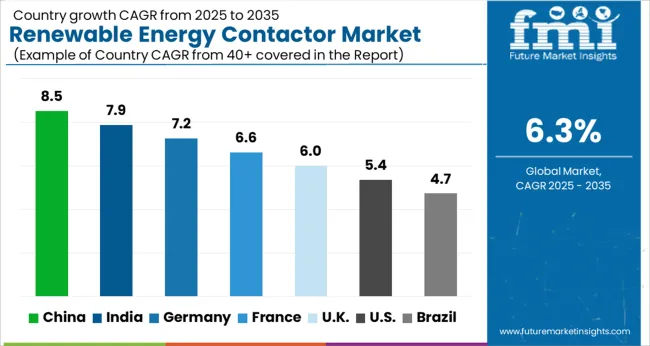
The renewable energy contactor market is expanding at a 6.3% CAGR, driven by the global shift toward sustainable energy solutions. China leads with 8.5% growth, supported by extensive renewable energy projects and strong manufacturing capabilities. India follows at 7.9%, fueled by government initiatives and growing demand for green technologies. Germany records 7.2% growth, reflecting advanced regulatory frameworks and innovation. The United Kingdom grows at 6.0%, driven by investments in renewable infrastructure. The United States, a mature market, shows 5.4% growth, shaped by regulatory compliance and technological advancements. These countries collectively influence market trends through improvements in efficiency, durability, and integration with renewable systems. This report includes insights on 40+ countries; the top countries are shown here for reference.
Renewable Energy Contactor Market Growth in China
China renewable energy contactor market is expanding at an impressive 8.5% CAGR, fueled by rapid renewable capacity additions and government initiatives to reduce carbon emissions. The country’s large-scale solar and wind projects demand reliable contactors designed for high efficiency and durability under varied environmental conditions. Domestic manufacturers lead innovation in smart and energy-efficient contactor technologies to support grid integration and automation. Compared to other countries, China benefits from strong policy support and extensive infrastructure investments, accelerating market growth. The rise of electric vehicle charging stations further boosts demand for specialized contactors. Industry collaboration with research institutes enhances product development tailored to renewable sector needs.
- Government initiatives drive large-scale renewable infrastructure growth
- Innovation in smart and energy-efficient contactors supports grid automation
- Rising electric vehicle charging infrastructure increases demand
Renewable Energy Contactor Market Expansion in India
India renewable energy contactor market grows at a 7.9% CAGR, powered by ambitious solar and wind power targets and growing industrial electrification. Increasing government subsidies and private investments spur adoption of advanced contactor technologies optimized for harsh climatic conditions. India’s market focuses on durable and cost-effective products to ensure reliable operation in rural and urban renewable projects. Unlike China, India’s infrastructure is still maturing but rapidly evolving, with rising local manufacturing capabilities. Training programs for technicians and engineers improve installation and maintenance practices. Expanding microgrid projects and distributed energy systems create additional opportunities for contactors.
- Government subsidies accelerate renewable capacity additions
- Focus on durable, cost-effective contactors for diverse climates
- Growth in microgrids and distributed energy systems
Renewable Energy Contactor Market Trends in Germany
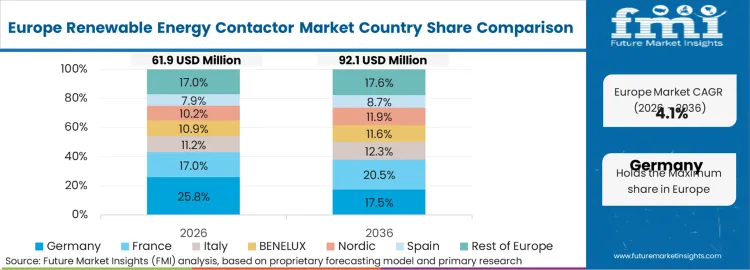
Germany renewable energy contactor market grows steadily at a 7.2% CAGR, driven by the country’s Energiewende policy aiming for renewable energy transition. Demand centers on highly reliable, certified contactors that comply with strict EU standards and support efficient integration with smart grids. Compared to Asian markets, Germany prioritizes product quality, safety, and long service life. Industrial automation and energy storage solutions increase contactor application diversity. Research collaborations with universities foster innovation in new materials and control systems. Market growth benefits from a mature renewable sector with high consumer and government environmental consciousness.
- Strict compliance with EU safety and quality standards
- Integration with smart grids and energy storage solutions
- Strong research collaborations drive innovation
Renewable Energy Contactor Market Progress in the United Kingdom
The United Kingdom market grows at a 6% CAGR, supported by government policies encouraging offshore wind and solar power expansion. The market demands contactors capable of withstanding maritime conditions and integrating with advanced control systems. Compared to Germany, the UK market is smaller but focused on cutting-edge technology adoption and smart grid compatibility. Infrastructure upgrades and modernization projects drive demand for energy-efficient and digitally connected contactors. Industry partnerships facilitate knowledge sharing and faster adoption of best practices. Government incentives continue to encourage innovation and deployment in renewable energy sectors.
- Demand for contactors suited to offshore wind environments
- Focus on digital connectivity and smart grid compatibility
- Industry partnerships accelerate technology adoption
Renewable Energy Contactor Market Insights in the United States
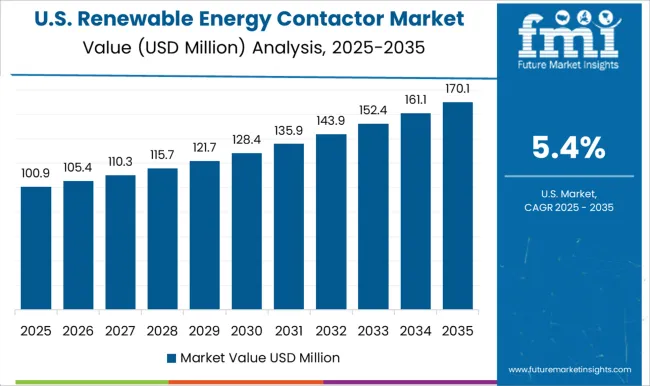
United States renewable energy contactor market grows at 5.4% CAGR, supported by expanding renewable installations and modernization of the power grid. The market features a mix of domestic and international manufacturers offering advanced contactors with high reliability and energy efficiency. Compared to European and Asian markets, the USA market faces regulatory variability across states but benefits from strong industrial demand. Investments in solar farms, wind turbines, and battery storage create broad application opportunities. Collaboration between manufacturers, utilities, and research organizations enhances product customization and innovation. Growing focus on grid resilience and automation supports sustained market growth.
- Strong industrial demand drives contactor innovation
- Collaboration with utilities enhances product customization
- Focus on grid resilience and automation boosts adoption
Competitive Landscape of Renewable Energy Contactor Market
The renewable energy contactor market is rapidly evolving as the global shift toward sustainable energy intensifies. Leading companies such as Schneider Electric, ABB, Carlo Gavazzi, Curtiss-Wright, Eaton, and Fuji Electric FA Components & Systems Co., Ltd. play pivotal roles by delivering advanced contactor solutions designed specifically for renewable energy applications.
These contactors are critical components in managing electrical loads, ensuring efficient energy transfer, and protecting renewable power systems like solar and wind installations. Key market players also include GEYA Electrical Equipment Supply, K.A. Schmersal GmbH & Co. KG, L&T, LOVATO Electric S.p.A., LS ELECTRIC, Mitsubishi Electric Corporation, Rockwell Automation, Schaltbau, Sensata Technologies, Inc., Siemens, TE Connectivity, and Toshiba International Corporation.
These companies focus on innovation, durability, and compatibility with smart grid technologies to meet the growing complexity of renewable energy infrastructures. The demand for renewable energy contactors is driven by the increasing adoption of solar photovoltaic (PV) systems, wind turbines, and energy storage solutions worldwide. Features like high electrical endurance, safety, reliability under fluctuating load conditions, and integration with automated control systems are becoming standard requirements.
Additionally, these contactors must withstand harsh environmental conditions and comply with stringent industry standards to ensure longevity and operational safety. Technological advancements such as smart contactors with IoT-enabled monitoring, predictive maintenance capabilities, and enhanced energy efficiency are differentiating products in this market. Geographically, strong growth is observed in regions pushing for aggressive renewable energy targets, including North America, Europe, and Asia-Pacific. The Renewable Energy Contactor Market is positioned for robust growth as energy producers and utilities continue to prioritize green energy solutions, driving demand for more sophisticated, reliable, and efficient contactor technologies.
Key Developments in Renewable Energy Contactor Market
Several leading companies are driving innovations in the renewable energy contactor market, expanding their portfolios to address the growing demand for energy-efficient and reliable contactors in renewable energy applications. Schneider Electric: Known for its advanced electrical solutions, Schneider Electric has been focusing on developing smart contactors for renewable energy applications, integrating IoT technology for enhanced automation and control in systems like solar PV and wind energy.
Siemens offers a range of contactors designed for high-efficiency renewable energy systems, including solar, wind, and hybrid energy systems. The company is heavily involved in the digitization of renewable energy systems and the development of contactors for smart grid applications.
Scope of the report
| Metric | Value |
|---|---|
| Quantitative Units | USD 250.23 million to USD 460.97 million, at a CAGR of 6.30% |
| Market Definition | Renewable energy contactors are electromechanical and solid-state switching devices designed for DC and AC power circuit control in solar inverters, battery energy storage systems, wind turbine converters, and EV charging infrastructure, rated for high-voltage DC interruption, arc suppression, and continuous cycling duty under the demanding operating profiles of renewable energy generation and storage applications. |
| Segmentation | Product (DC Contactors) |
| Regions Covered | North America, Latin America, Europe, East Asia, South Asia, Oceania, Middle East and Africa |
| Countries Covered | India, China, USA, Canada, UK, Germany, Japan, and 40 plus countries |
| Key Companies Profiled | Schneider Electric, ABB, Eaton, Siemens, TE Connectivity, Sensata Technologies, Panasonic, Mitsubishi Electric, Fuji Electric, Hongfa Technology |
| Forecast Period | 2026 to 2036 |
| Approach | Hybrid bottom-up and top-down methodology starting with verified renewable energy contactor transaction data, projecting adoption velocity across segments and regions. |
Renewable Energy Contactor Market by Segments
Product:
- DC Contactors
- AC Contactors
Region:
- North America
- USA
- Canada
- Mexico
- Latin America
- Brazil
- Chile
- Rest of Latin America
- Western Europe
- Germany
- UK
- Italy
- Spain
- France
- Nordic
- BENELUX
- Rest of Western Europe
- Eastern Europe
- Russia
- Poland
- Hungary
- Balkan & Baltic
- Rest of Eastern Europe
- East Asia
- China
- Japan
- South Korea
- South Asia and Pacific
- India
- ASEAN
- Australia & New Zealand
- Rest of South Asia and Pacific
- Middle East & Africa
- Kingdom of Saudi Arabia
- Other GCC Countries
- Turkiye
- South Africa
- Other African Union
- Rest of Middle East & Africa
Bibliography
- 1. International Electrotechnical Commission. (2024). IEC 61810: Electromechanical Elementary Relays. IEC.
- 2. Underwriters Laboratories. (2024). UL 508: Industrial Control Equipment. UL.
- 3. International Energy Agency. (2024). Renewables 2024: Solar PV and Battery Storage Deployment Statistics. IEA.
- 4. European Committee for Electrotechnical Standardization. (2024). EN 61810: Low-Voltage Switchgear, Contactors. CENELEC.
- 5. National Renewable Energy Laboratory. (2024). PV System Component Reliability Assessment. NREL.
- 6. Organisation for Economic Co-operation and Development. (2024). OECD Clean Energy Technology Guide: Power Electronics Components. OECD.
This bibliography is provided for reader reference. The full FMI report contains the complete reference list with primary research documentation.
Frequently Asked Questions
How large is the demand for Renewable Energy Contactor in the global market in 2026?
Demand for renewable energy contactor in the global market is estimated to be valued at USD 250.23 million in 2026.
What will be the market size of Renewable Energy Contactor by 2036?
Market size for renewable energy contactor is projected to reach USD 460.97 million by 2036.
What is the expected demand growth for Renewable Energy Contactor between 2026 and 2036?
Demand for renewable energy contactor is expected to grow at a CAGR of 6.30% between 2026 and 2036.
Which Product is poised to lead global demand by 2026?
DC Contactors accounts for 58.3% in 2026, reflecting established procurement patterns.
How is the second segment driving Renewable Energy Contactor adoption?
The secondary segment represents a meaningful share of segment demand as end-use requirements favor this category.
What is driving demand in China?
China registers a 8.50% CAGR through 2036, propelled by domestic policy frameworks and rising deployment.
What does Renewable Energy Contactor Market definition mean in this report?
Renewable energy contactors are electromechanical and solid-state switching devices designed for DC and AC power circuit control in solar inverters, battery energy storage systems, wind turbine converters, and EV charging infrastructure, rated for high-voltage DC interruption, arc suppression, and continuous cycling duty under the demanding operating profiles of renewable energy generation and storage applications.
How does FMI build and validate the Renewable Energy Contactor forecast?
Forecasting models apply a hybrid bottom-up methodology starting with verified transaction data, cross-validated against publicly reported statistics and company financial disclosures.
Preview the report firsthand - request a free sample
Get SampleGet the brochure for pricing and purchase details.
Get PDFTable of Content
- Executive Summary
- Global Market Outlook
- Demand-side Trends
- Supply-side Trends
- Market Overview
- Market Coverage / Taxonomy
- Market Definition / Scope / Limitations
- Research Methodology
- Chapter Orientation
- Analytical Lens and Working Hypotheses
- Market Structure, Signals, and Trend Drivers
- Benchmarking and Cross-market Comparability
- Market Sizing, Forecasting, and Opportunity Mapping
- Research Design and Evidence Framework
- Desk Research Programme (Secondary Evidence)
- Technical White Papers and Standards Notes
- Trade Journals, Industry Magazines, and Analyst Briefs
- Conference Proceedings, Webinars, and Seminar Materials
- Government Statistics Portals and Public Data Releases
- Press Releases and Reputable Media Coverage
- Specialist Newsletters and Curated Briefings
- Sector Databases and Reference Repositories
- FMI Internal Proprietary Databases and Historical Market Datasets
- Subscription Datasets and Paid Sources
- Social Channels, Communities, and Digital Listening Inputs
- Additional Desk Sources
- Expert Input and Fieldwork (Primary Evidence)
- Primary Modes
- Qualitative Interviews and Expert Elicitation
- Quantitative Surveys and Structured Data Capture
- Blended Approach
- Why Primary Evidence is Used
- Field Techniques
- Interviews
- Surveys
- Focus Groups
- Observational and In-context Research
- Social and Community Interactions
- Stakeholder Universe Engaged
- C-suite Leaders
- Board Members
- Presidents and Vice Presidents
- R&D and Innovation Heads
- Technical Specialists
- Domain Subject-matter Experts
- Scientists
- Physicians and Other Healthcare Professionals
- Governance, Ethics, and Data Stewardship
- Research Ethics
- Data Integrity and Handling
- Primary Modes
- Tooling, Models, and Reference Databases
- Desk Research Programme (Secondary Evidence)
- Data Engineering and Model Build
- Data Acquisition and Ingestion
- Cleaning, Normalisation, and Verification
- Synthesis, Triangulation, and Analysis
- Quality Assurance and Audit Trail
- Market Background
- Market Dynamics
- Drivers
- Restraints
- Opportunity
- Trends
- Scenario Forecast
- Demand in Optimistic Scenario
- Demand in Likely Scenario
- Demand in Conservative Scenario
- Opportunity Map Analysis
- Product Life Cycle Analysis
- Supply Chain Analysis
- Investment Feasibility Matrix
- Value Chain Analysis
- PESTLE and Porter’s Analysis
- Regulatory Landscape
- Regional Parent Market Outlook
- Production and Consumption Statistics
- Import and Export Statistics
- Market Dynamics
- Global Market Analysis 2021 to 2025 and Forecast, 2026 to 2036
- Historical Market Size Value (USD Million) Analysis, 2021 to 2025
- Current and Future Market Size Value (USD Million) Projections, 2026 to 2036
- Y-o-Y Growth Trend Analysis
- Absolute $ Opportunity Analysis
- Global Market Pricing Analysis 2021 to 2025 and Forecast 2026 to 2036
- Global Market Analysis 2021 to 2025 and Forecast 2026 to 2036, By Product
- Introduction / Key Findings
- Historical Market Size Value (USD Million) Analysis By Product , 2021 to 2025
- Current and Future Market Size Value (USD Million) Analysis and Forecast By Product , 2026 to 2036
- DC Contactors
- AC Contactors
- DC Contactors
- Y-o-Y Growth Trend Analysis By Product , 2021 to 2025
- Absolute $ Opportunity Analysis By Product , 2026 to 2036
- Global Market Analysis 2021 to 2025 and Forecast 2026 to 2036, By Company
- Introduction / Key Findings
- Historical Market Size Value (USD Million) Analysis By Company, 2021 to 2025
- Current and Future Market Size Value (USD Million) Analysis and Forecast By Company, 2026 to 2036
- Schneider Electric
- ABB
- Carlo Gavazzi
- Curtiss-Wright
- Eaton
- Fuji Electric FA Components & Systems Co., Ltd.
- GEYA Electrical Equipment Supply
- K.A. Schmersal GmbH & Co. KG
- L&T
- LOVATO Electric S.p.A.
- LS ELECTRIC
- Y-o-Y Growth Trend Analysis By Company, 2021 to 2025
- Absolute $ Opportunity Analysis By Company, 2026 to 2036
- Schneider Electric
- Global Market Analysis 2021 to 2025 and Forecast 2026 to 2036, By Region
- Introduction
- Historical Market Size Value (USD Million) Analysis By Region, 2021 to 2025
- Current Market Size Value (USD Million) Analysis and Forecast By Region, 2026 to 2036
- North America
- Latin America
- Western Europe
- Eastern Europe
- East Asia
- South Asia and Pacific
- Middle East & Africa
- Market Attractiveness Analysis By Region
- North America Market Analysis 2021 to 2025 and Forecast 2026 to 2036, By Country
- Historical Market Size Value (USD Million) Trend Analysis By Market Taxonomy, 2021 to 2025
- Market Size Value (USD Million) Forecast By Market Taxonomy, 2026 to 2036
- By Country
- USA
- Canada
- Mexico
- By Product
- By Company
- By Country
- Market Attractiveness Analysis
- By Country
- By Product
- By Company
- Key Takeaways
- Latin America Market Analysis 2021 to 2025 and Forecast 2026 to 2036, By Country
- Historical Market Size Value (USD Million) Trend Analysis By Market Taxonomy, 2021 to 2025
- Market Size Value (USD Million) Forecast By Market Taxonomy, 2026 to 2036
- By Country
- Brazil
- Chile
- Rest of Latin America
- By Product
- By Company
- By Country
- Market Attractiveness Analysis
- By Country
- By Product
- By Company
- Key Takeaways
- Western Europe Market Analysis 2021 to 2025 and Forecast 2026 to 2036, By Country
- Historical Market Size Value (USD Million) Trend Analysis By Market Taxonomy, 2021 to 2025
- Market Size Value (USD Million) Forecast By Market Taxonomy, 2026 to 2036
- By Country
- Germany
- UK
- Italy
- Spain
- France
- Nordic
- BENELUX
- Rest of Western Europe
- By Product
- By Company
- By Country
- Market Attractiveness Analysis
- By Country
- By Product
- By Company
- Key Takeaways
- Eastern Europe Market Analysis 2021 to 2025 and Forecast 2026 to 2036, By Country
- Historical Market Size Value (USD Million) Trend Analysis By Market Taxonomy, 2021 to 2025
- Market Size Value (USD Million) Forecast By Market Taxonomy, 2026 to 2036
- By Country
- Russia
- Poland
- Hungary
- Balkan & Baltic
- Rest of Eastern Europe
- By Product
- By Company
- By Country
- Market Attractiveness Analysis
- By Country
- By Product
- By Company
- Key Takeaways
- East Asia Market Analysis 2021 to 2025 and Forecast 2026 to 2036, By Country
- Historical Market Size Value (USD Million) Trend Analysis By Market Taxonomy, 2021 to 2025
- Market Size Value (USD Million) Forecast By Market Taxonomy, 2026 to 2036
- By Country
- China
- Japan
- South Korea
- By Product
- By Company
- By Country
- Market Attractiveness Analysis
- By Country
- By Product
- By Company
- Key Takeaways
- South Asia and Pacific Market Analysis 2021 to 2025 and Forecast 2026 to 2036, By Country
- Historical Market Size Value (USD Million) Trend Analysis By Market Taxonomy, 2021 to 2025
- Market Size Value (USD Million) Forecast By Market Taxonomy, 2026 to 2036
- By Country
- India
- ASEAN
- Australia & New Zealand
- Rest of South Asia and Pacific
- By Product
- By Company
- By Country
- Market Attractiveness Analysis
- By Country
- By Product
- By Company
- Key Takeaways
- Middle East & Africa Market Analysis 2021 to 2025 and Forecast 2026 to 2036, By Country
- Historical Market Size Value (USD Million) Trend Analysis By Market Taxonomy, 2021 to 2025
- Market Size Value (USD Million) Forecast By Market Taxonomy, 2026 to 2036
- By Country
- Kingdom of Saudi Arabia
- Other GCC Countries
- Turkiye
- South Africa
- Other African Union
- Rest of Middle East & Africa
- By Product
- By Company
- By Country
- Market Attractiveness Analysis
- By Country
- By Product
- By Company
- Key Takeaways
- Key Countries Market Analysis
- USA
- Pricing Analysis
- Market Share Analysis, 2025
- By Product
- By Company
- Canada
- Pricing Analysis
- Market Share Analysis, 2025
- By Product
- By Company
- Mexico
- Pricing Analysis
- Market Share Analysis, 2025
- By Product
- By Company
- Brazil
- Pricing Analysis
- Market Share Analysis, 2025
- By Product
- By Company
- Chile
- Pricing Analysis
- Market Share Analysis, 2025
- By Product
- By Company
- Germany
- Pricing Analysis
- Market Share Analysis, 2025
- By Product
- By Company
- UK
- Pricing Analysis
- Market Share Analysis, 2025
- By Product
- By Company
- Italy
- Pricing Analysis
- Market Share Analysis, 2025
- By Product
- By Company
- Spain
- Pricing Analysis
- Market Share Analysis, 2025
- By Product
- By Company
- France
- Pricing Analysis
- Market Share Analysis, 2025
- By Product
- By Company
- India
- Pricing Analysis
- Market Share Analysis, 2025
- By Product
- By Company
- ASEAN
- Pricing Analysis
- Market Share Analysis, 2025
- By Product
- By Company
- Australia & New Zealand
- Pricing Analysis
- Market Share Analysis, 2025
- By Product
- By Company
- China
- Pricing Analysis
- Market Share Analysis, 2025
- By Product
- By Company
- Japan
- Pricing Analysis
- Market Share Analysis, 2025
- By Product
- By Company
- South Korea
- Pricing Analysis
- Market Share Analysis, 2025
- By Product
- By Company
- Russia
- Pricing Analysis
- Market Share Analysis, 2025
- By Product
- By Company
- Poland
- Pricing Analysis
- Market Share Analysis, 2025
- By Product
- By Company
- Hungary
- Pricing Analysis
- Market Share Analysis, 2025
- By Product
- By Company
- Kingdom of Saudi Arabia
- Pricing Analysis
- Market Share Analysis, 2025
- By Product
- By Company
- Turkiye
- Pricing Analysis
- Market Share Analysis, 2025
- By Product
- By Company
- South Africa
- Pricing Analysis
- Market Share Analysis, 2025
- By Product
- By Company
- USA
- Market Structure Analysis
- Competition Dashboard
- Competition Benchmarking
- Market Share Analysis of Top Players
- By Regional
- By Product
- By Company
- Competition Analysis
- Competition Deep Dive
- Competition Deep Dive
- Assumptions & Acronyms Used


