

- Industry Size (2026)
- USD 0.39 Bn
- Forecast (2036)
- USD 3.67 Bn
- CAGR (2026 to 2036)
- 25.3%
Energy Storage Sodium Ion Battery Market Size, Market Forecast and Outlook By FMI
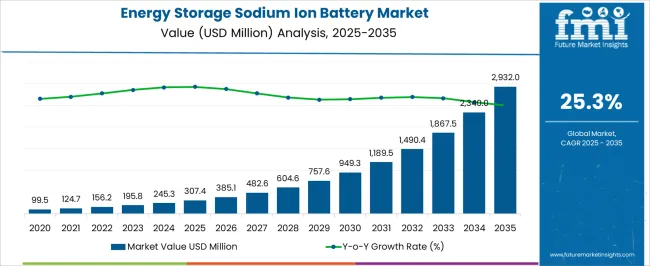
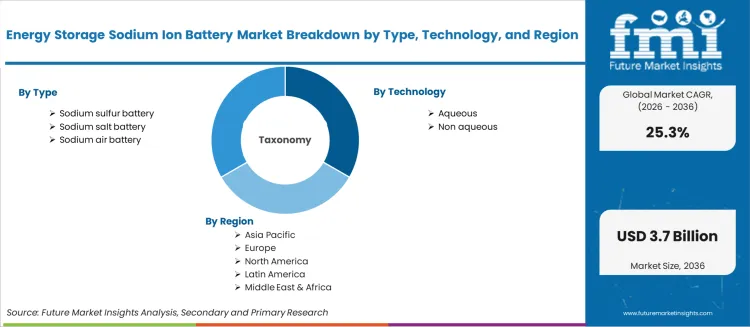
The energy storage sodium ion battery market was valued at USD 0.31 billion in 2025, projected to reach USD 0.39 billion in 2026, and is forecast to expand to USD 3.67 billion by 2036 at a 25.3% CAGR. Sodium ion battery technology is transitioning from laboratory development to commercial scale energy storage deployment, driven by sodium's global abundance and freedom from lithium and cobalt supply chain constraints. As per FMI, the rapid scale up of sodium ion cell manufacturing capacity in China, combined with grid scale storage mandates and cost reduction trajectories below lithium iron phosphate pricing, is establishing sodium ion as a structurally competitive stationary storage chemistry.
Summary of Energy Storage Sodium Ion Battery Market
- Market Overview
- The market is valued at USD 0.31 billion in 2025 and is projected to reach USD 3.67 billion by 2036.
- The industry is expected to grow at a 25.3% CAGR from 2026 to 2036, creating an incremental opportunity of USD 3.29 billion.
- The market is an emerging energy storage chemistry category where manufacturing scale, cost per kilowatt hour trajectory, and grid scale performance validation define competitive positioning against incumbent lithium ion systems.
- Demand and Growth Drivers
- Demand is surging as grid scale storage mandates and lithium supply chain diversification priorities create procurement opportunities for sodium ion battery technology.
- Manufacturing capacity scale up in China is driving cost per kilowatt hour below lithium iron phosphate levels for multi-hour stationary storage applications.
- Sodium raw material abundance and freedom from cobalt and lithium supply chain constraints are attracting utility and grid developer procurement interest.
- Among countries, China (34.2% CAGR), India (31.6% CAGR), Germany (29.1% CAGR), France (26.6% CAGR), UK (24% CAGR), USA (21.5% CAGR), Brazil (19% CAGR).
- Product and Segment View
- Sodium sulfur battery leads by Type with 48% share in 2026.
- Aqueous leads by Technology with 65% share in 2026.
- Geography and Competitive Outlook
- China and India are the fastest growing markets, while mature economies sustain demand through technology upgrade and compliance driven procurement cycles.
- Key players include Contemporary Amperex Technology Co., Ltd. (CATL), Faradion Limited, Natron Energy, Inc., Tiamat Energy, HiNa Battery Technology Co., Ltd., Altris AB.
- Analyst Opinion at FMI
- Nikhil Kaitwade, Principal Consultant for Energy Storage, opines: 'In my analysis, I have observed that sodium ion battery technology is crossing the commercialization threshold where manufacturing scale economies are beginning to deliver cost per kilowatt hour below lithium iron phosphate for stationary storage applications. Grid storage developers who delay sodium ion qualification for their project pipelines risk missing the cost crossover window that early adopters are already capturing in Chinese and European storage tenders.'
- Strategic Implications / Executive Takeaways
- Battery manufacturers must scale sodium ion cell production to gigawatt hour capacity to achieve the cost per kilowatt hour levels required to win grid scale storage tenders against lithium iron phosphate incumbents.
- Grid storage project developers should begin sodium ion battery qualification testing now to position for cost advantage capture as manufacturing scale reduces cell pricing below lithium alternatives through 2028.
- Utility procurement teams need to update storage technology specifications to include sodium ion chemistry as a qualified option alongside lithium ion for multi-hour duration stationary storage applications.
Energy Storage Sodium Ion Battery Market Key Takeaways
| Metric | Details |
|---|---|
| Industry Size (2026) | USD 0.39 Billion |
| Industry Value (2036) | USD 3.67 Billion |
| CAGR (2026 to 2036) | 25.3% |
Source: Future Market Insights, 2026
The incremental opportunity of USD 3.29 billion between 2026 and 2036 reflects the exponential phase of sodium ion technology commercialization as manufacturing capacity scales from pilot lines to gigawatt hour production facilities. Sodium sulfur batteries hold the largest type share because they deliver high energy density suitable for grid scale storage applications with multi-hour discharge requirements. Aqueous technology leads because it offers inherent safety advantages and lower manufacturing complexity compared to non-aqueous electrolyte systems. China's dominance reflects its concentrated battery manufacturing ecosystem and government mandates for non-lithium stationary storage deployment.
All major regional markets reflect differentiated growth trajectories. China leads with a 34.2% CAGR, India follows at 31.6%, Germany follows at 29.1%, France follows at 26.6%, UK follows at 24%, USA follows at 21.5%, and Brazil registers 19% growth. China's dominant growth rate reflects CATL and other manufacturers scaling dedicated sodium ion production lines alongside existing lithium ion capacity. India's pace is supported by stationary storage mandates and interest in supply chain diversification away from lithium dependence. Germany and France are advancing through EU battery manufacturing programs and research funding for alternative chemistry commercialization.
Energy Storage Sodium Ion Battery Market Definition
The energy storage sodium ion battery market encompasses rechargeable battery systems using sodium based electrode chemistries designed for stationary energy storage applications. Battery types include sodium sulfur, sodium salt (ZEBRA), and sodium air configurations utilizing aqueous or non-aqueous electrolyte technologies. These batteries are deployed for grid scale energy storage, renewable energy integration, and backup power applications where sodium's cost and abundance advantages offset its lower energy density relative to lithium ion systems.
Energy Storage Sodium Ion Battery Market Inclusions
Market scope includes sodium ion battery cells and systems sold for stationary energy storage applications. Global and regional market sizes, battery type and electrolyte technology segment breakdowns, and forecast projections from 2026 to 2036 are covered.
Energy Storage Sodium Ion Battery Market Exclusions
The scope excludes lithium ion batteries, lead acid batteries, flow batteries, and sodium ion cells designed for electric vehicle traction applications. Battery management systems and power conversion equipment sold separately from sodium ion battery systems are also excluded.
Energy Storage Sodium Ion Battery Market Research Methodology
- Primary Research: Analysts engaged with battery manufacturing executives, grid scale storage project developers, and utility procurement managers to map technology selection criteria, cost trajectory expectations, and deployment scale requirements.
- Desk Research: Data collection aggregated published sodium ion cell manufacturing capacity announcements, grid storage tender specifications, battery chemistry performance benchmarking studies, and government energy storage mandate timelines.
- Market Sizing and Forecasting: Baseline values derive from a bottom up aggregation of sodium ion battery manufacturing capacity ramp projections, applying regional pricing trajectories and grid storage deployment schedules to project market growth.
- Data Validation and Update Cycle: Projections are tested against published battery manufacturer capacity expansion announcements, grid storage installation statistics, and government energy storage procurement targets.
Why is the Energy Storage Sodium Ion Battery Market Growing?
The market is experiencing notable growth as demand for sustainable and cost-effective energy storage solutions increases across various sectors. With sodium-based chemistries offering advantages in raw material availability and lower cost compared to lithium-based counterparts, adoption is gaining momentum in stationary storage, grid balancing, and renewable integration applications.
Advancements in electrode materials, electrolyte formulations, and manufacturing processes are improving performance, cycle life, and safety profiles, enhancing the competitiveness of sodium ion technologies. Government policies promoting clean energy deployment and localized battery manufacturing are further accelerating market uptake.
The market outlook remains positive, supported by increasing renewable penetration, decentralized energy systems, and industrial decarbonization initiatives As production scales and supply chains mature, sodium ion batteries are expected to capture a larger share of the global energy storage space, positioning them as a viable alternative for both short and long-duration storage requirements.
Segmental Analysis
The energy storage sodium ion battery market is segmented by type, technology, and geographic regions. By type, energy storage sodium ion battery market is divided into sodium sulfur battery, sodium salt battery, and sodium air battery. In terms of technology, energy storage sodium ion battery market is classified into aqueous and non aqueous. Regionally, the energy storage sodium ion battery industry is classified into North America, Latin America, Western Europe, Eastern Europe, Balkan & Baltic Countries, Russia & Belarus, Central Asia, East Asia, South Asia & Pacific, and the Middle East & Africa.
Insights into the Sodium Sulfur Battery Technology Segment
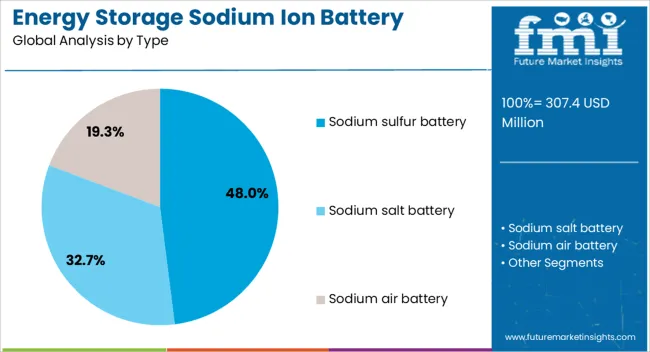
The sodium sulfur battery technology segment is projected to hold 48% of the energy storage sodium ion battery market revenue share in 2026, making it the leading technology type. This dominance has been driven by the technology’s high energy density, long cycle life, and strong performance in large-scale stationary storage applications. Its capability to operate efficiently in high-temperature environments has made it suitable for grid-scale deployments, particularly in renewable integration and peak load shifting. The segment has benefited from ongoing innovations in materials engineering that enhance thermal stability and reduce degradation rates, thereby lowering total cost of ownership. The compatibility of sodium sulfur batteries with long-duration storage needs has strengthened their position in utility-scale projects Additionally, increased investment from power utilities and industrial sectors in resilient and scalable storage infrastructure has reinforced the adoption of this technology, ensuring its continued leadership in the market.
Insights into the Aqueous Technology Segment
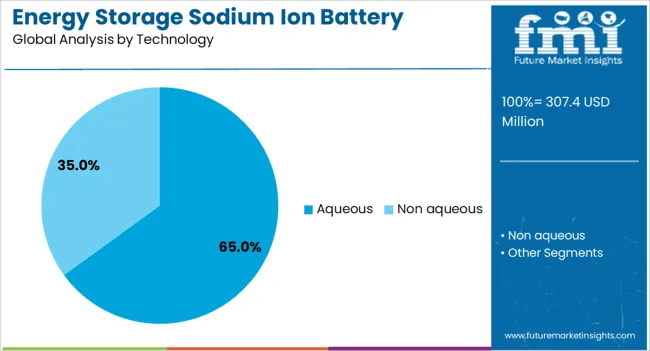
The aqueous technology segment is anticipated to command 65% of the market revenue share in 2026, establishing it as the dominant technology format. Growth in this segment has been supported by its inherent safety advantages, as aqueous electrolytes significantly reduce fire risks compared to non-aqueous alternatives. The segment has also gained traction due to cost efficiencies in manufacturing and the abundance of raw materials, aligning with the growing emphasis on sustainable and localized production. Aqueous systems exhibit strong performance in moderate-temperature environments, making them suitable for commercial, residential, and certain grid-level applications. Furthermore, research advancements have improved energy density and extended operational lifespan, enabling broader adoption in distributed energy systems The ability to integrate with renewable energy sources and provide reliable storage without complex thermal management systems has made aqueous technology an attractive choice, reinforcing its leadership within the market.
What are the Drivers, Restraints, and Key Trends of the Energy Storage Sodium Ion Battery Market?
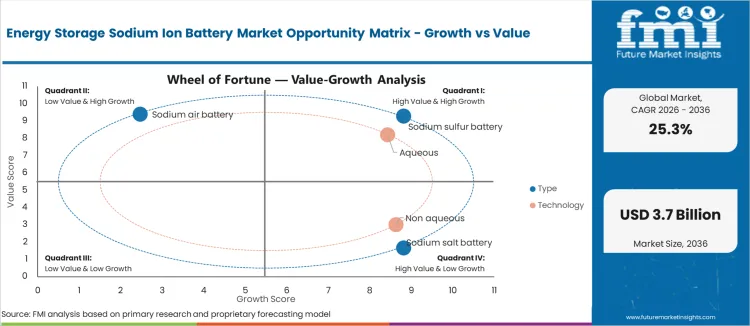
The sodium ion battery industry is shaped by rising grid demand, cost efficiency, growing mobility applications, and technical challenges. Its affordability and resource abundance position it as a strong alternative to lithium-based systems.
Rising Demand from Grid-Level Applications
The energy storage sodium ion battery industry is experiencing heightened demand as governments and utilities prioritize grid stability. Renewable integration requires reliable storage, and sodium ion technology offers a cost-effective alternative to lithium-based systems. These batteries are being adopted in peak load management, renewable balancing, and rural electrification projects. Their reliance on abundant sodium resources provides an economic advantage, making them attractive in regions with high energy needs but limited lithium access. With performance improvements enabling stable cycling and enhanced safety, sodium ion batteries are gradually gaining trust in utility-scale deployments. Their role in strengthening power networks positions them as an important solution for growing global energy requirements.
Cost Advantages Supporting Broader Adoption
Affordability is a decisive factor propelling sodium ion battery adoption across both developed and emerging markets. Unlike lithium, sodium is inexpensive and widely available, reducing dependence on geographically concentrated supply chains. This economic advantage makes sodium ion batteries appealing for large-scale stationary storage, where cost per cycle is critical. Manufacturers are scaling pilot projects that demonstrate competitiveness in terms of price while ensuring adequate performance. Lower raw material costs, combined with simplified extraction and processing, continue to support industry expansion. These cost-related strengths reinforce sodium ion batteries as a pragmatic choice for applications requiring scalable and economical energy storage.
Expanding Opportunities in Electric Mobility
Sodium ion batteries are finding growing relevance in the electric mobility sector, particularly for two-wheelers, three-wheelers, and small EVs where cost and safety are prioritized over high energy density. Their thermal stability and lower flammability risks enhance safety compared to certain lithium chemistries. Manufacturers in Asia are testing sodium ion batteries as substitutes for lead-acid systems, offering improved efficiency and reduced lifecycle costs. While not yet dominant in passenger EVs, their adoption in light mobility represents an expanding opportunity. This trend illustrates how sodium ion technology is carving a niche in mobility solutions that demand affordability, reliability, and resilience.
Challenges in Energy Density and Lifespan
Sodium ion batteries continue to face challenges related to energy density and cycle life when compared to advanced lithium-ion counterparts. Their lower storage capacity limits application in high-performance EVs and energy-intensive devices. Shorter cycle life also raises concerns over long-term reliability, especially for large-scale grid storage requiring extensive durability. Manufacturers are focusing on refining electrode materials and optimizing system design to address these hurdles. Although these constraints hinder penetration into certain premium applications, steady improvements and cost benefits ensure continued adoption. Overcoming these technical barriers will be key to unlocking broader opportunities across multiple industries.
Analysis of Energy Storage Sodium Ion Battery Market By Key Countries
.webp "Top Country Growth Comparison Energy Storage Sodium Ion Battery Market Cagr (2026 2036)")
| Country | CAGR |
|---|---|
| China | 34.2% |
| India | 31.6% |
| Germany | 29.1% |
| France | 26.6% |
| UK | 24.0% |
| USA | 21.5% |
| Brazil | 19.0% |
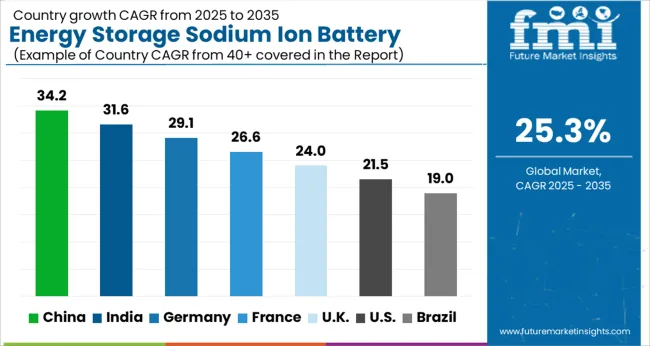
The energy storage sodium ion battery market is projected to expand globally at a CAGR of 25.3% from 2026 to 2036, supported by its affordability, raw material abundance, and suitability for large-scale storage applications. China leads with a CAGR of 34.2%, driven by government-backed energy transition programs, mass-scale renewable integration, and domestic manufacturing capacity. India follows at 31.6%, supported by electrification initiatives, rising renewable power installations, and early adoption in two- and three-wheeler EVs. France posts 26.6%, shaped by renewable integration projects and defense-related storage applications. The United Kingdom achieves 24.0%, with growth influenced by the inclusion of sodium ion technology in energy diversification and smart grid strategies. The United States records 21.5%, reflecting steady but slower adoption due to mature lithium-ion infrastructure, though progress is driven by pilot projects in grid-scale storage and transportation. This performance highlights Asia-Pacific as the fastest-growing region, Europe as a research- and compliance-driven market, and North America as a gradually advancing but mature adopter within the sodium ion battery ecosystem.
Expanding Energy Storage Sodium Ion Battery Deployment in China
China is projected to record a CAGR of 34.2% for 2026-2036, surpassing the global average of 25.3%. During 2020-2024, growth was near 28.7%, supported by pilot deployments in renewable energy storage and localized EV trials. The increase to 34.2% is driven by government-backed renewable integration, domestic manufacturing expansion, and active R&D programs. Large-scale adoption in grid stabilization projects and electric mobility, coupled with cost advantages due to abundant sodium resources, has provided a solid foundation. Provincial subsidies and industrial park investments have accelerated capacity building. In my view, China will continue to dominate global deployment as production scales and export demand rises.
- Renewable integration projects strengthened grid-level adoption.
- Manufacturing expansion ensured supply chain reliability.
- Provincial subsidies accelerated industrial adoption.
Accelerating Energy Storage Sodium Ion Battery Market Growth in India
India is forecasted to achieve a CAGR of 31.6% for 2026-2036, above the global 25.3% baseline. Between 2020-2024, CAGR stood at 26.9%, propelled by rural electrification programs, distributed energy systems, and initial EV trials. The progression to 31.6% is shaped by expanding solar and wind projects, government funding for energy diversification, and rising demand for cost-efficient storage technologies. Local startups and public-private collaborations are advancing sodium ion battery adoption across telecom, mobility, and grid balancing applications. In my assessment, India’s growth trajectory signals its emerging role as a leading hub for affordable storage solutions.
- Rural electrification projects encouraged adoption in microgrids.
- Government-backed initiatives expanded renewable integration.
- Local partnerships improved cost-effective deployments.
Strengthening Adoption for Energy Storage Sodium Ion Battery in France
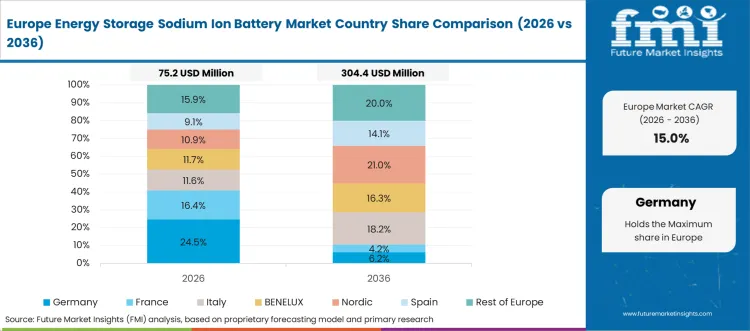
France is anticipated to post a CAGR of 26.6% across 2026-2036, higher than the global benchmark of 25.3%. During 2020-2024, CAGR was about 22.1%, driven by EU-backed research programs and trial deployments in grid flexibility projects. The increase reflects strong government support for renewable integration, aerospace-linked research collaborations, and defense-related energy storage needs. France’s policy-driven ecosystem has encouraged domestic manufacturers to invest in sodium ion battery pilot lines while utilities test grid-scale applications. From my perspective, France is set to maintain its growth path as regulatory compliance and innovation clusters strengthen adoption across multiple sectors.
- EU programs funded early-stage R&D projects.
- Defense-linked projects created niche adoption cases.
- Utilities expanded pilot-scale grid storage systems.
Expansion Path for Energy Storage Sodium Ion Battery in the United Kingdom
The United Kingdom is projected to register a CAGR of 24.0% for 2026-2036, compared with around 19.8% during 2020-2024, slightly below the global 25.3% benchmark. Early growth was moderate due to limited funding and lithium’s dominance in legacy projects. The shift to 24.0% stems from greater emphasis on grid balancing, offshore renewable projects, and trials of sodium ion technology in urban transport. National energy diversification strategies and collaborations with European technology firms have contributed to momentum. My view is that the UK’s improved adoption pace reflects its transition toward diversified storage options, ensuring long-term resilience.
- Offshore renewable integration increased adoption needs.
- Government diversification strategy boosted deployments.
- Collaborations with EU partners advanced pilot projects.
Growth of Energy Storage Sodium Ion Battery in the United States
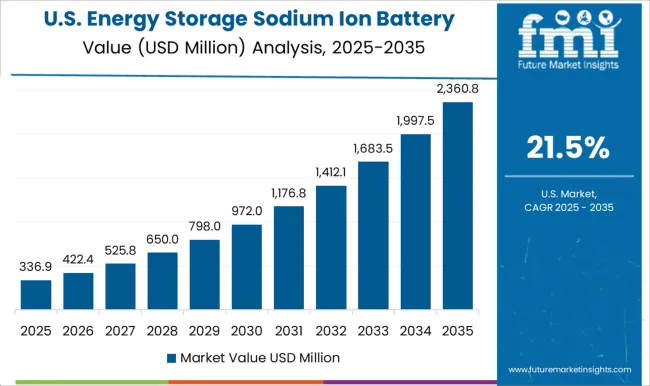
The United States is expected to deliver a CAGR of 21.5% for 2026-2036, compared with an estimated 17.2% in 2020-2024, under the global 25.3% benchmark. Early adoption was shaped by pilot deployments in universities, research labs, and localized grid storage. The rise to 21.5% is explained by greater interest from utilities, federal research grants, and deployment of sodium ion technology in telecom and mobility sectors. While lithium-ion remains dominant, sodium ion’s cost advantage and resource security are improving its role in diversification strategies. In my opinion, the US will witness gradual but steady growth as policy support and private sector investments evolve.
- Federal research grants supported demonstration projects.
- Utilities initiated pilot storage deployments.
- Telecom and mobility applications improved adoption rate.
Competitive Landscape of Energy Storage Sodium Ion Battery Market
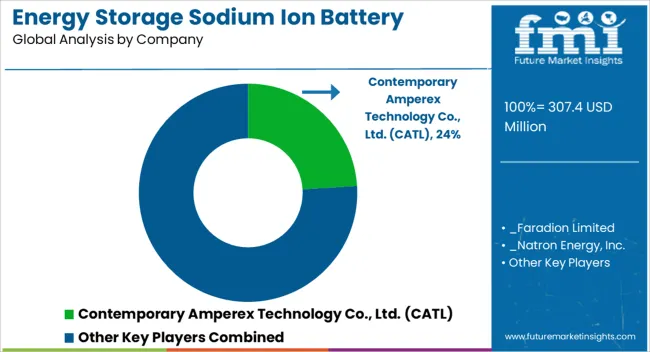
The energy storage sodium ion battery market is shaped by a mix of global leaders and specialized innovators, including Contemporary Amperex Technology Co., Ltd. (CATL), Faradion Limited, Natron Energy, Inc., TIAMAT / Tiamat Energy, HiNa Battery Technology Co., Ltd., Altris AB, and other manufacturers. These companies compete on scalability, material innovation, cost efficiency, and integration into grid, mobility, and consumer applications. CATL has emerged as the dominant force, leveraging its large-scale manufacturing capacity and partnerships with automotive OEMs to accelerate sodium ion deployment. Faradion, recognized as one of the early pioneers, has built strong credibility in Europe with a focus on commercializing cost-effective sodium ion technology for mobility and stationary storage. Natron Energy emphasizes its Prussian blue electrode technology, offering enhanced cycle life and rapid charge capabilities.
TIAMAT Energy and HiNa Battery Technology have advanced research-driven portfolios, with HiNa leading pilot-scale commercial projects in China and Tiamat driving adoption across European applications. Altris AB is positioning itself through innovations in cathode materials and expanding partnerships across Nordic energy ecosystems. Other regional players and start-ups are entering the market with tailored solutions, often backed by government funding and R&D programs. The competitive landscape reflects a balance between large incumbents with scale advantages and smaller innovators driving breakthroughs in chemistry and performance. Strategic directions focus on expanding pilot deployments, improving cycle stability, reducing production costs, and integrating sodium ion batteries into mainstream energy storage and mobility applications. Industry growth is expected to accelerate as collaborations between utilities, automotive manufacturers, and research institutions mature, positioning sodium ion batteries as a viable alternative to lithium-ion in the coming years.
Key Players in the Energy Storage Sodium Ion Battery Market
- Contemporary Amperex Technology Co., Ltd. (CATL)
- Faradion Limited
- Natron Energy, Inc.
- Tiamat Energy
- HiNa Battery Technology Co., Ltd.
- Altris AB
Scope of the Report
| Metric | Value |
|---|---|
| Quantitative Units | USD 0.39 Billion to USD 3.67 Billion, at a CAGR of 25.3% |
| Market Definition | The energy storage sodium ion battery market encompasses rechargeable battery systems using sodium based electrode chemistries designed for stationary energy storage applications. Battery types includ... |
| Segmentation | Type: Sodium sulfur battery, Sodium salt battery, Sodium air battery; Technology: Aqueous, Non aqueous |
| Regions Covered | North America, Latin America, Europe, East Asia, South Asia, Oceania, Middle East & Africa |
| Countries Covered | China, India, Germany, France, UK, USA, Brazil, and 40 plus countries |
| Key Companies Profiled | Contemporary Amperex Technology Co., Ltd. (CATL), Faradion Limited, Natron Energy, Inc., Tiamat Energy, HiNa Battery Technology Co., Ltd., Altris AB |
| Forecast Period | 2026 to 2036 |
| Approach | Hybrid bottom up methodology combining primary research, supply chain analysis, and proprietary forecasting models. |
Energy Storage Sodium Ion Battery Market by Segments
Type:
- Sodium sulfur battery
- Sodium salt battery
- Sodium air battery
Technology:
- Aqueous
- Non aqueous
Region:
- North America
- USA
- Canada
- Mexico
- Latin America
- Brazil
- Chile
- Rest of Latin America
- Western Europe
- Germany
- UK
- Italy
- Spain
- France
- Nordic
- BENELUX
- Rest of Western Europe
- Eastern Europe
- Russia
- Poland
- Hungary
- Balkan & Baltic
- Rest of Eastern Europe
- East Asia
- China
- Japan
- South Korea
- South Asia and Pacific
- India
- ASEAN
- Australia & New Zealand
- Rest of South Asia and Pacific
- Middle East & Africa
- Kingdom of Saudi Arabia
- Other GCC Countries
- Turkiye
- South Africa
- Other African Union
- Rest of Middle East & Africa
Bibliography
- 1. International Energy Agency. (2025). Energy storage technology outlook 2025. IEA.
- 2. European Commission. (2024). European battery regulation: Implementation guidance for alternative chemistries. European Commission.
- 3. China National Energy Administration. (2025). Energy storage deployment targets and technology roadmap update. NEA.
- 4. Contemporary Amperex Technology Co., Ltd. (2025). Annual report 2024: Sodium ion battery division. CATL.
- 5. USA Department of Energy. (2024). Energy storage grand challenge: Sodium ion technology assessment. DOE.
- 6. World Bank Group. (2024). Battery storage for grid applications: Technology and market review. World Bank.
This bibliography is provided for reader reference. The full Future Market Insights report contains the complete reference list with primary research documentation.
Frequently Asked Questions
How large is the demand for Energy Storage Sodium Ion Battery in the global market in 2026?
Demand for Energy Storage Sodium Ion Battery in the global market is estimated to be valued at USD 0.39 billion in 2026.
What will be the market size of Energy Storage Sodium Ion Battery in the global market by 2036?
Market size for Energy Storage Sodium Ion Battery is projected to reach USD 3.67 billion by 2036.
What is the expected demand growth for Energy Storage Sodium Ion Battery in the global market between 2026 and 2036?
Demand for Energy Storage Sodium Ion Battery is expected to grow at a CAGR of 25.3% between 2026 and 2036.
Which Type is poised to lead global sales by 2026?
Sodium sulfur battery accounts for 48% share in 2026.
How significant is Aqueous in driving Energy Storage Sodium Ion Battery adoption in 2026?
Aqueous represents 65% of segment share in 2026.
What is driving demand in China?
China leads with a 34.2% CAGR through 2036.
What is Energy Storage Sodium Ion Battery and what is it mainly used for?
The energy storage sodium ion battery market encompasses rechargeable battery systems using sodium based electrode chemistries designed for stationary energy storage applications. Battery types includ.
What is included in the scope of this Energy Storage Sodium Ion Battery report?
Market scope includes sodium ion battery cells and systems sold for stationary energy storage applications. Global and regional market sizes, battery type and electrolyte technology segment breakdowns, and forecast projections from 2026 to 2036 are covered.
Preview the report firsthand - request a free sample
Get SampleGet the brochure for pricing and purchase details.
Get PDFTable of Content
- Executive Summary
- Global Market Outlook
- Demand-side Trends
- Supply-side Trends
- Technology Roadmap Analysis
- Analysis and Recommendations
- Market Overview
- Market Coverage / Taxonomy
- Market Definition / Scope / Limitations
- Research Methodology
- Chapter Orientation
- Analytical Lens and Working Hypotheses
- Market Structure, Signals, and Trend Drivers
- Benchmarking and Cross-market Comparability
- Market Sizing, Forecasting, and Opportunity Mapping
- Research Design and Evidence Framework
- Desk Research Programme (Secondary Evidence)
- Company Annual and Sustainability Reports
- Peer-reviewed Journals and Academic Literature
- Corporate Websites, Product Literature, and Technical Notes
- Earnings Decks and Investor Briefings
- Statutory Filings and Regulatory Disclosures
- Technical White Papers and Standards Notes
- Trade Journals, Industry Magazines, and Analyst Briefs
- Conference Proceedings, Webinars, and Seminar Materials
- Government Statistics Portals and Public Data Releases
- Press Releases and Reputable Media Coverage
- Specialist Newsletters and Curated Briefings
- Sector Databases and Reference Repositories
- FMI Internal Proprietary Databases and Historical Market Datasets
- Subscription Datasets and Paid Sources
- Social Channels, Communities, and Digital Listening Inputs
- Additional Desk Sources
- Expert Input and Fieldwork (Primary Evidence)
- Primary Modes
- Qualitative Interviews and Expert Elicitation
- Quantitative Surveys and Structured Data Capture
- Blended Approach
- Why Primary Evidence is Used
- Field Techniques
- Interviews
- Surveys
- Focus Groups
- Observational and In-context Research
- Social and Community Interactions
- Stakeholder Universe Engaged
- C-suite Leaders
- Board Members
- Presidents and Vice Presidents
- R&D and Innovation Heads
- Technical Specialists
- Domain Subject-matter Experts
- Scientists
- Physicians and Other Healthcare Professionals
- Governance, Ethics, and Data Stewardship
- Research Ethics
- Data Integrity and Handling
- Primary Modes
- Tooling, Models, and Reference Databases
- Desk Research Programme (Secondary Evidence)
- Data Engineering and Model Build
- Data Acquisition and Ingestion
- Cleaning, Normalisation, and Verification
- Synthesis, Triangulation, and Analysis
- Quality Assurance and Audit Trail
- Market Background
- Market Dynamics
- Drivers
- Restraints
- Opportunity
- Trends
- Scenario Forecast
- Demand in Optimistic Scenario
- Demand in Likely Scenario
- Demand in Conservative Scenario
- Opportunity Map Analysis
- Product Life Cycle Analysis
- Supply Chain Analysis
- Investment Feasibility Matrix
- Value Chain Analysis
- PESTLE and Porter’s Analysis
- Regulatory Landscape
- Regional Parent Market Outlook
- Production and Consumption Statistics
- Import and Export Statistics
- Market Dynamics
- Global Market Analysis 2021 to 2025 and Forecast, 2026 to 2036
- Historical Market Size Value (USD Million) Analysis, 2021 to 2025
- Current and Future Market Size Value (USD Million) Projections, 2026 to 2036
- Y-o-Y Growth Trend Analysis
- Absolute $ Opportunity Analysis
- Global Market Pricing Analysis 2021 to 2025 and Forecast 2026 to 2036
- Global Market Analysis 2021 to 2025 and Forecast 2026 to 2036, By Type
- Introduction / Key Findings
- Historical Market Size Value (USD Million) Analysis By Type , 2021 to 2025
- Current and Future Market Size Value (USD Million) Analysis and Forecast By Type , 2026 to 2036
- Sodium sulfur battery
- Sodium salt battery
- Sodium air battery
- Sodium sulfur battery
- Y-o-Y Growth Trend Analysis By Type , 2021 to 2025
- Absolute $ Opportunity Analysis By Type , 2026 to 2036
- Global Market Analysis 2021 to 2025 and Forecast 2026 to 2036, By Technology
- Introduction / Key Findings
- Historical Market Size Value (USD Million) Analysis By Technology, 2021 to 2025
- Current and Future Market Size Value (USD Million) Analysis and Forecast By Technology, 2026 to 2036
- Aqueous
- Non aqueous
- Aqueous
- Y-o-Y Growth Trend Analysis By Technology, 2021 to 2025
- Absolute $ Opportunity Analysis By Technology, 2026 to 2036
- Global Market Analysis 2021 to 2025 and Forecast 2026 to 2036, By Region
- Introduction
- Historical Market Size Value (USD Million) Analysis By Region, 2021 to 2025
- Current Market Size Value (USD Million) Analysis and Forecast By Region, 2026 to 2036
- North America
- Latin America
- Western Europe
- Eastern Europe
- East Asia
- South Asia and Pacific
- Middle East & Africa
- Market Attractiveness Analysis By Region
- North America Market Analysis 2021 to 2025 and Forecast 2026 to 2036, By Country
- Historical Market Size Value (USD Million) Trend Analysis By Market Taxonomy, 2021 to 2025
- Market Size Value (USD Million) Forecast By Market Taxonomy, 2026 to 2036
- By Country
- USA
- Canada
- Mexico
- By Type
- By Technology
- By Country
- Market Attractiveness Analysis
- By Country
- By Type
- By Technology
- Key Takeaways
- Latin America Market Analysis 2021 to 2025 and Forecast 2026 to 2036, By Country
- Historical Market Size Value (USD Million) Trend Analysis By Market Taxonomy, 2021 to 2025
- Market Size Value (USD Million) Forecast By Market Taxonomy, 2026 to 2036
- By Country
- Brazil
- Chile
- Rest of Latin America
- By Type
- By Technology
- By Country
- Market Attractiveness Analysis
- By Country
- By Type
- By Technology
- Key Takeaways
- Western Europe Market Analysis 2021 to 2025 and Forecast 2026 to 2036, By Country
- Historical Market Size Value (USD Million) Trend Analysis By Market Taxonomy, 2021 to 2025
- Market Size Value (USD Million) Forecast By Market Taxonomy, 2026 to 2036
- By Country
- Germany
- UK
- Italy
- Spain
- France
- Nordic
- BENELUX
- Rest of Western Europe
- By Type
- By Technology
- By Country
- Market Attractiveness Analysis
- By Country
- By Type
- By Technology
- Key Takeaways
- Eastern Europe Market Analysis 2021 to 2025 and Forecast 2026 to 2036, By Country
- Historical Market Size Value (USD Million) Trend Analysis By Market Taxonomy, 2021 to 2025
- Market Size Value (USD Million) Forecast By Market Taxonomy, 2026 to 2036
- By Country
- Russia
- Poland
- Hungary
- Balkan & Baltic
- Rest of Eastern Europe
- By Type
- By Technology
- By Country
- Market Attractiveness Analysis
- By Country
- By Type
- By Technology
- Key Takeaways
- East Asia Market Analysis 2021 to 2025 and Forecast 2026 to 2036, By Country
- Historical Market Size Value (USD Million) Trend Analysis By Market Taxonomy, 2021 to 2025
- Market Size Value (USD Million) Forecast By Market Taxonomy, 2026 to 2036
- By Country
- China
- Japan
- South Korea
- By Type
- By Technology
- By Country
- Market Attractiveness Analysis
- By Country
- By Type
- By Technology
- Key Takeaways
- South Asia and Pacific Market Analysis 2021 to 2025 and Forecast 2026 to 2036, By Country
- Historical Market Size Value (USD Million) Trend Analysis By Market Taxonomy, 2021 to 2025
- Market Size Value (USD Million) Forecast By Market Taxonomy, 2026 to 2036
- By Country
- India
- ASEAN
- Australia & New Zealand
- Rest of South Asia and Pacific
- By Type
- By Technology
- By Country
- Market Attractiveness Analysis
- By Country
- By Type
- By Technology
- Key Takeaways
- Middle East & Africa Market Analysis 2021 to 2025 and Forecast 2026 to 2036, By Country
- Historical Market Size Value (USD Million) Trend Analysis By Market Taxonomy, 2021 to 2025
- Market Size Value (USD Million) Forecast By Market Taxonomy, 2026 to 2036
- By Country
- Kingdom of Saudi Arabia
- Other GCC Countries
- Turkiye
- South Africa
- Other African Union
- Rest of Middle East & Africa
- By Type
- By Technology
- By Country
- Market Attractiveness Analysis
- By Country
- By Type
- By Technology
- Key Takeaways
- Key Countries Market Analysis
- USA
- Pricing Analysis
- Market Share Analysis, 2025
- By Type
- By Technology
- Canada
- Pricing Analysis
- Market Share Analysis, 2025
- By Type
- By Technology
- Mexico
- Pricing Analysis
- Market Share Analysis, 2025
- By Type
- By Technology
- Brazil
- Pricing Analysis
- Market Share Analysis, 2025
- By Type
- By Technology
- Chile
- Pricing Analysis
- Market Share Analysis, 2025
- By Type
- By Technology
- Germany
- Pricing Analysis
- Market Share Analysis, 2025
- By Type
- By Technology
- UK
- Pricing Analysis
- Market Share Analysis, 2025
- By Type
- By Technology
- Italy
- Pricing Analysis
- Market Share Analysis, 2025
- By Type
- By Technology
- Spain
- Pricing Analysis
- Market Share Analysis, 2025
- By Type
- By Technology
- France
- Pricing Analysis
- Market Share Analysis, 2025
- By Type
- By Technology
- India
- Pricing Analysis
- Market Share Analysis, 2025
- By Type
- By Technology
- ASEAN
- Pricing Analysis
- Market Share Analysis, 2025
- By Type
- By Technology
- Australia & New Zealand
- Pricing Analysis
- Market Share Analysis, 2025
- By Type
- By Technology
- China
- Pricing Analysis
- Market Share Analysis, 2025
- By Type
- By Technology
- Japan
- Pricing Analysis
- Market Share Analysis, 2025
- By Type
- By Technology
- South Korea
- Pricing Analysis
- Market Share Analysis, 2025
- By Type
- By Technology
- Russia
- Pricing Analysis
- Market Share Analysis, 2025
- By Type
- By Technology
- Poland
- Pricing Analysis
- Market Share Analysis, 2025
- By Type
- By Technology
- Hungary
- Pricing Analysis
- Market Share Analysis, 2025
- By Type
- By Technology
- Kingdom of Saudi Arabia
- Pricing Analysis
- Market Share Analysis, 2025
- By Type
- By Technology
- Turkiye
- Pricing Analysis
- Market Share Analysis, 2025
- By Type
- By Technology
- South Africa
- Pricing Analysis
- Market Share Analysis, 2025
- By Type
- By Technology
- USA
- Market Structure Analysis
- Competition Dashboard
- Competition Benchmarking
- Market Share Analysis of Top Players
- By Regional
- By Type
- By Technology
- Competition Analysis
- Competition Deep Dive
- Contemporary Amperex Technology Co., Ltd. (CATL)
- Overview
- Product Portfolio
- Profitability by Market Segments (Product/Age /Sales Channel/Region)
- Sales Footprint
- Strategy Overview
- Marketing Strategy
- Product Strategy
- Channel Strategy
- Faradion Limited
- Natron Energy, Inc.
- Tiamat Energy
- HiNa Battery Technology Co., Ltd.
- Altris AB
- Contemporary Amperex Technology Co., Ltd. (CATL)
- Competition Deep Dive
- Assumptions & Acronyms Used


