

- Industry Size (2026)
- USD 3.1 Bn
- Forecast (2036)
- USD 8.0 Bn
- CAGR (2026 to 2036)
- 9.9%
Battery Pack Busbars Market Forecast and Outlook 2026 to 2036
Battery pack busbars market revenue is likely to total USD 3.1 billion in 2026, rising further to USD 8.0 billion by 2036, at a CAGR of 9.9%. As per Future Market Insights’ analysis, battery pack busbars are undergoing a structural transformation, characterized by a transition from traditional component supply to the delivery of integrated, high-voltage power distribution architectures. As of 2025 and 2026, this expansion is supported by intense scaling of stationary energy storage and the technical requirements of next-generation EV platforms.
Growth is anchored by major capacity expansions aimed at internalizing the battery supply chain. In September 2025, Tesla announced the development of a new manufacturing facility near Houston, Texas, dedicated to its Megapack 3 systems.
With production slated to begin in the second half of 2026, this facility targets a high annual output to support utility-scale storage, which utilizes integrated busbar architectures for improved thermal management and density.
BorgWarner updated its strategic roadmap in May 2025, emphasizing a consolidation of its North American battery systems to align with shifting market dynamics, projecting significant operational efficiencies by 2026 through the integration of electronic power components.
Technical innovation is moving toward modular and solderless solutions to meet the rigorous safety standards of high-voltage systems. Interplex and Ennovi recently advanced their BusMate series, which utilizes pluggable, high-temperature connectors rated up to 150°C to replace traditional permanent joints. This shift facilitates easier assembly and higher vibration resistance in EV powertrains.
Mersen’s July 2025 financial disclosures highlight a trend where increased capital expenditure is being funneled into its Electrical Power segment to support organic growth in the EV and power grid sectors.
Rogers Corporation announced a restructuring of its European manufacturing operations in mid-2025 to optimize its AES portfolio, focusing resources on high-growth areas like power semiconductor substrates and busbar-integrated laminates.
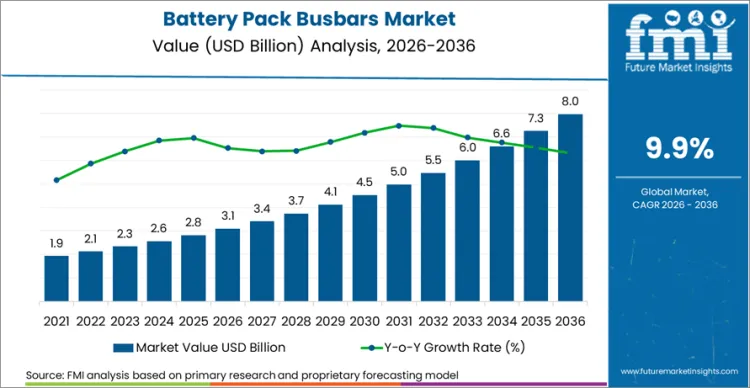
Summary of Battery Pack Busbars Market
What is the Long-Term Growth Outlook for the Battery Pack Busbar Market?
FMI projects the global battery pack busbar market to expand from USD 3.1 billion in 2026 to USD 8.0 billion by 2036, registering a 9.9% CAGR over the forecast period. Market expansion reflects a structural shift in battery engineering, where busbars are evolving from discrete conductive components into integrated, high-voltage power distribution architectures central to EV platforms and stationary energy storage systems.
This acceleration is reinforced by the rapid scaling of utility-scale BESS, next-generation 800V–1500V EV architectures, and the electrification of industrial processes. As battery pack complexity increases, demand is rising for thermally optimized, modular, and safety-compliant interconnect solutions capable of operating under extreme voltage and temperature conditions.
FMI Research Approach: This projection is derived from FMI’s proprietary forecasting framework integrating announced capacity expansions by OEMs and Tier-1 suppliers, capital expenditure disclosures from power electronics manufacturers, and deployment trajectories of EV and grid-scale storage platforms across North America, Europe, and East Asia.
How do FMI Analysts Expect the Battery Pack Busbar Market to Evolve Structurally?
FMI analysts anticipate the market transitioning from traditional stamped or welded interconnects toward integrated, modular, and solderless busbar systems. This evolution is driven by heightened safety standards, the adoption of high-voltage architectures, and the need for faster, automation-friendly battery pack assembly.
Innovations such as pluggable connectors, liquid-cooled busbars, and busbar-integrated laminates are redefining system-level design, enabling higher power density while simplifying maintenance and end-of-life disassembly. Busbars are increasingly being engineered as multifunctional components that combine electrical conduction, thermal management, and mechanical reinforcement.
FMI Research Approach: Insights are informed by analysis of product roadmaps from leading interconnect suppliers, patent filings related to modular and insulated busbar technologies, and OEM disclosures on next-generation EV and stationary storage architectures.
Which Geographies Command the Largest Share of the Battery Pack Busbar Market?
China leads the global battery pack busbar market, advancing at an estimated 11.4% CAGR, supported by aggressive EV production, large-scale grid storage deployments, and the enforcement of the world’s most stringent battery safety standards. The United States follows closely with a 10.9% CAGR, underpinned by domestic manufacturing incentives and utility-scale energy storage investments.
UK and Germany represent high-value European markets, expanding at 9.9% and 9.6% CAGR, respectively, as grid reform, industrial electrification, and sustainability mandates reshape battery system design requirements.
FMI Research Approach: Country-level forecasts are built using policy analysis, domestic content regulations, battery manufacturing capacity tracking, and grid modernization programs, supplemented by primary interviews with regional suppliers and integrators.
What Will Be the Market Size of Battery Pack Busbars by 2036?
By 2036, the battery pack busbar market is expected to reach USD 8.0 billion, supported by sustained growth in passenger EV production, the proliferation of stationary energy storage, and the electrification of industrial infrastructure. Utility-scale BESS and high-density data center power systems are emerging as critical demand centers, requiring high-ampacity, thermally efficient interconnect solutions.
FMI Research Approach: Long-term market sizing incorporates EV production forecasts, grid-scale storage deployment scenarios, industrial electrification trends, and technology adoption curves for high-voltage battery systems.
What are some Globally Distinct Trends Shaping the Battery Pack Busbar Market?
Globally, the market is being shaped by a convergence of high-voltage adoption, safety-driven redesign, and circularity mandates. The shift toward 800V–1500V systems is accelerating demand for insulated, thermally stable busbars, while new safety regulations are forcing interconnects to withstand thermal runaway conditions without propagating failure.
Sustainability requirements are driving a move away from permanent joints toward modular, weldless assemblies that support easier repair, recycling, and compliance with emerging battery passport regulations. Concurrently, busbars are increasingly being integrated into structural battery designs, serving both electrical and mechanical functions.
FMI Research Approach: Trend analysis is informed by regulatory tracking, sustainability disclosures, technology validation data from OEM pilot programs, and lifecycle assessments of battery components across major automotive and energy storage markets.
Battery Pack Busbars Market Key Takeaways
| Metrics | Values |
|---|---|
| Expected Value (2026E) | USD 3.1 billion |
| Projected Value (2036F) | USD 8.0 billion |
| CAGR (2026-2036) | 9.9% |
Source: Future Market Insights (FMI) analysis, based on proprietary forecasting model and primary research
Why is the Battery Pack Busbars Market Growing?
Expansion of AI infrastructure is initiating a fundamental redesign of power distribution within high-density computing environments. JLL’s 2026 Global Data Center Outlook forecasts that hyperscalers are entering an infrastructure investment supercycle projected to reach $3 trillion by 2030, with tenants spending up to $2 trillion on IT equipment fit-outs alone. As rack densities approach 100 kW, traditional cabling is being superseded by low-loss busbar architectures capable of managing extreme power loads. This shift is further intensified by a bring your own power trend in regions such as Texas and Dublin, where operators are integrating on-site BESS to bypass multi-year grid connection delays.
Utility-scale energy storage is simultaneously scaling to meet the demands of a global transition toward renewable-heavy power grids. The International Energy Agency reports in its Electricity 2026 outlook that global electricity demand is rising 2.5 times faster than overall energy demand, marking the onset of the Age of Electricity.
Reliance Industries, in response, confirmed in January 2026 that its battery giga-factory at the Dhirubhai Ambani Green Energy Complex is on track to commence operations in the second half of the year. The facility will initially deliver 40 GWh of annual capacity, focusing on containerized BESS and modular pack solutions that utilize complex busbar networks to stabilize intermittent solar and wind inputs.
Industrial process electrification is emerging as a critical priority for energy-intensive sectors seeking to decouple growth from fossil fuel volatility. ABB Electrification highlighted in its 2026 strategy updates that manufacturing processes are rapidly shifting to electric furnaces and high-capacity heat pumps. This transition has moved industrial energy storage from a sustainability initiative to a core P&L strategy, as companies deploy on-site microgrids to manage fluctuating loads and ensure operational continuity.
How is Battery Pack Busbars Market Segmented?
The battery back busbars segment landscape is defined by a clear hierarchy. Copper dominates high-power applications for its thermal efficiency, while rigid configurations remain the structural anchor for the rapidly expanding utility storage sector.
The passenger EV segment serves as the high-volume incubator for technical innovations, such as 800V-ready insulated busbars, which are subsequently adapted for broader industrial and grid-scale use cases.
How is Material Dominance Sustained in High-Current Applications?
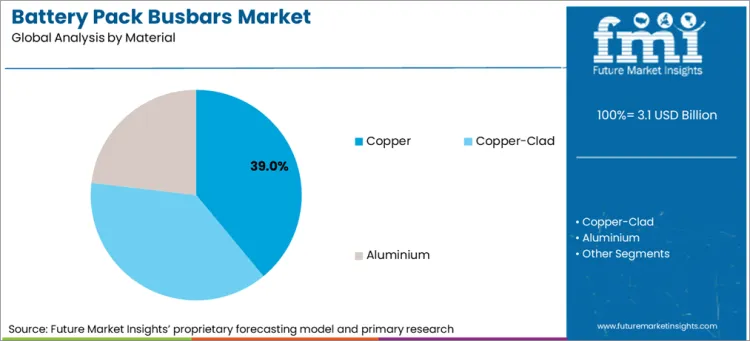
Copper battery pack busbars account for a 39% market share due to its non-negotiable status in high-voltage power electronics where volumetric efficiency is paramount. Hitachi Energy leveraged this material’s superior thermal properties in January 2026 to scale its liquid-cooled power conversion platforms, supporting 1500 VDC ratings for utility-scale battery storage.
This technical preference is highlighted by the 35.8 MWh Matsuyama BESS in Japan, which relies on high-purity copper interconnects to manage the high-frequency fluctuations of renewable grid inputs while maintaining system longevity.
Which Structural Factors are Preserving the Dominance of Fixed Interconnects?
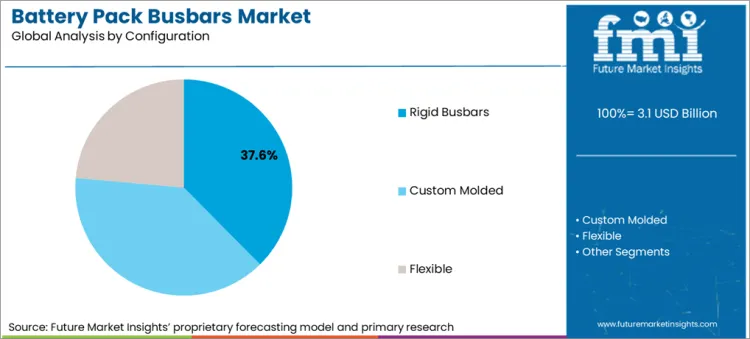
Rigid busbars command a 37.6% share of the configuration segment, serving as the default standard for the mechanical stresses of large-scale Battery Energy Storage Systems (BESS). ABB’s February 2026 strategy updates indicate that these solid-bar assemblies are critical for integrating digital monitoring sensors directly onto the conductive path for industrial microgrids.
The National Grid UK’s current Great Grid Upgrade underscores this architectural size, which utilizes prefabricated rigid busbars to bypass the labor-intensive cabling traditionally required for new substation commissioning.
What Role does the Passenger EV Sector Play in defining Global Volume?
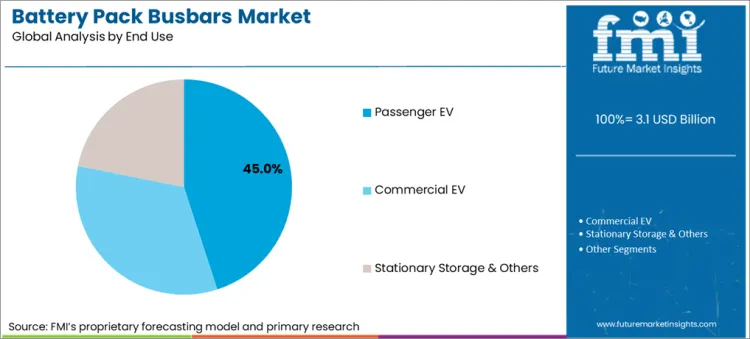
Passenger EVs represent the largest end-use segment with a 45% market share, acting as the primary driver for high-volume manufacturing innovations. During its February 3, 2026 earnings call, Tesla reported a 20.1% gross margin, partly attributed to the operational efficiencies of its automated, high-density battery pack assembly lines.
Current momentum in passenger EVs is fueled by the Government of India’s PLI scheme, which is actively localizing the supply of advanced interconnects to support a new generation of high-voltage passenger platforms entering production in mid-2026.
What Drivers, Restraints, Opportunities, and Trends Prevail in the Battery Pack Busbars Market?
Battery pack busbar market expansion is supported by federal interventions designed to solve the national energy emergency caused by the explosive growth of AI. The USA Department of Energy launched the Speed to Power initiative in September 2025, specifically prioritizing multi-gigawatt transmission and storage projects.
This program acts as a massive demand catalyst, as it de-risks large-scale grid infrastructure intended to support AI data center corridors and domestic reindustrialization. Consequently, busbar manufacturers are shifting production capacity toward utility-scale, high-ampacity assemblies to meet these accelerated federal timelines.
While demand remains robust, manufacturers face a period of intensified fiscal discipline and regulatory pressure. Financial disclosures from early 2026, such as those from Mersen, indicate that rising raw material costs for copper and aluminium continue to exert pressure on operating margins, necessitating a focus on high-margin, smart interconnects.
The EU Battery Regulation introduces a critical compliance milestone in February 2026, requiring mandatory carbon-footprint declarations for industrial batteries. This shift is forcing a transformation in the supply chain, as manufacturers must now verify the sustainability profile of their conductor materials to maintain access to the European market.
Technical innovation is defined by native electric architectures that integrate electrical paths directly into structural components. BYD’s deployment of CTC technology in early 2026, currently entering service in transit fleets across Budapest and Singapore. represents this trend, where the busbar serves as both a high-voltage conduit and a load-bearing element. The shift toward high-voltage systems is further evidenced by Samsung SDI’s transition of solid-state battery technology to the pre-production phase, which targets limited commercial integration by late 2026.
Sustainability and ease of maintenance are driving a move away from permanent joints toward modular and weldless assemblies. Industry leaders like Ennovi and Interplex have pivoted their 2026 product roadmaps toward pluggable, solderless connectors capable of withstanding temperatures up to 150°C. These designs facilitate the Battery Passport requirements for easier disassembly and recycling, allowing operators to replace specific zones of a pack rather than the entire unit.
Analysis of Battery Pack Busbars Market by Key Countries
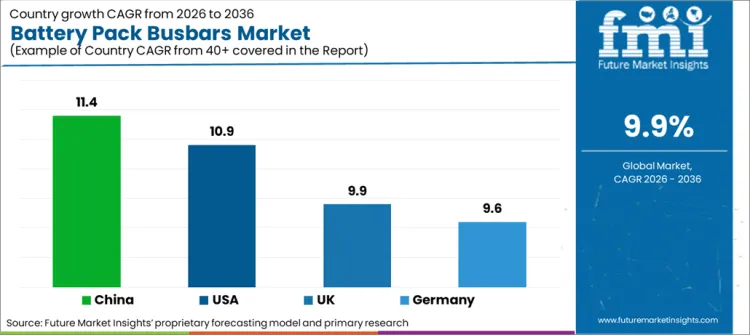
The following analysis examines the strategic evolution of the battery pack busbar market in USA (10.9%), China (11.4%), UK (9.9%), and Germany (9.6%). These countries represent the primary growth corridors through 2036, each shaped by distinct fiscal incentives, safety mandates, and grid-integration reforms that are redefining the requirements for high-voltage interconnects.
| Country | CAGR (2026-2036) |
|---|---|
| USA | 10.9% |
| UK | 9.9% |
| Germany | 9.6% |
| China | 11.4% |
Source: Future Market Insights (FMI) analysis, based on proprietary forecasting model and primary research
How is Domestic Manufacturing Integration Scaling the USA Market?
USA is projected to expand at a 10.9% CAGR through 2036, driven primarily by the transition from simple assembly to localized, vertically integrated manufacturing. Under the January 2025 updated guidelines from the IRS, utility-scale battery projects under construction by the end of 2026 must hit a 50% domestic content threshold to qualify for a full 10% tax credit bonus. This policy is forcing a radical shift in procurement, as developers must now source battery packaging including internal busbar networks from domestically based manufacturers to meet the required production percentages.
This growth is further sustained by the August 2025 federal directives that shift focus toward energy independence through circularity. Future funding for battery infrastructure will prioritize projects that utilize domestically recycled conductor materials. For busbar suppliers, this necessitates the development of closed-loop supply chains that can process scrap copper and aluminium within USA, ensuring that the components used in the next generation of grid-scale storage units contribute to the rising domestic value-added requirements.
Which Policy Reforms are Facilitating Energy Transition Initiatives involving Battery Pack Busbars in UK?
In UK, the market is set for a 9.9% CAGR, fueled by a growing disparity between forecasted demand and confirmed domestic capacity. APC has identified a critical 5 GWh shortfall in domestic battery production that will materialize by late 2025, prompting an urgent wave of investment in localized component lines. This environment is particularly conducive to specialized, high-performance megawatt-scale busbar production, as UK’s diverse ecosystem of luxury and niche manufacturers requires low-volume, highly customized interconnect solutions that cannot be easily fulfilled by global mass-production hubs.
Simultaneously, the Faraday Institution’s UltraStore initiative is entering its large-scale research phase in Q2 2026, targeting the development of ultra-low-cost, long-duration energy storage. This project is exploring radical new architectures capable of discharging to the grid for over 100 hours, which demands a total rethink of traditional busbar layouts to manage the thermal profiles of non-lithium chemistries. As the UK moves to bridge its production gap, the focus is shifting toward these "frontier" technologies, creating a high-value market for interconnects that can survive the extreme cycle-life requirements of national decarbonization projects.
What Role does Grid Fee Liberalization Play in the German Industrial Sector?
Germany’s battery busbar market is forecasted at a 9.6% CAGR, largely influenced by the 2026 Grid Fee Reform which abolishes the long-standing 7000-hour rule. Energy-intensive industries formerly benefited from subsidies for maintaining constant electricity consumption, but the new framework forces a shift toward flexibility. German industrial facilities are installing on-site battery storage to cap peak loads and shift consumption to hours of high renewable generation. This industrial shift is creating a sustained demand for robust, plug-and-play busbar systems that can be integrated into existing factory power distribution networks.
The regulatory landscape is being further reshaped by the German Battery Implementation Act, which mandates full alignment with sustainability rules by January 15, 2026. This law requires every battery category to be linked to a certified Organization for Manufacturer Responsibility to ensure end-of-life recovery and material tracing. For manufacturers, this means that the busbars of 2026 must be designed for rapid disassembly and labeled with unique identifiers to comply with the new recycling mandates, effectively making design-for-disassembly a mandatory engineering standard.
How is the World's Strictest Safety Standard Defining the Chinese Market?
China leads the global market with an 11.4% CAGR, underpinned by the implementation of the GB38031-2025 safety standard, which officially takes effect on July 1, 2026. This mandatory national standard is the first in the world to require that battery systems remain fire and explosion-free for at least two hours following an internal thermal runaway event. This no fire, no explosion mandate is forcing an industry-wide redesign of busbar insulation and venting paths, as the interconnects must now maintain electrical and structural integrity under extreme heat to prevent the propagation of fire across cells.
Complementing these safety rules is a new digital tracking mandate issued by the Ministry of Industry and Information Technology in January 2026. This regulation requires every power battery to carry a unique digital ID that tracks its entire journey from production to replacement and scrapping. As China prepares for an estimated 1 million metric tons of battery retirements annually by 2030, this tracking system is driving the adoption of smart busbars equipped with embedded RFID or QR-coded markings. This ensures that when a vehicle is scrapped, its internal components can be accurately identified and routed to authorized recycling channels.
What is the Competition Outlook for Battery Pack Busbars?
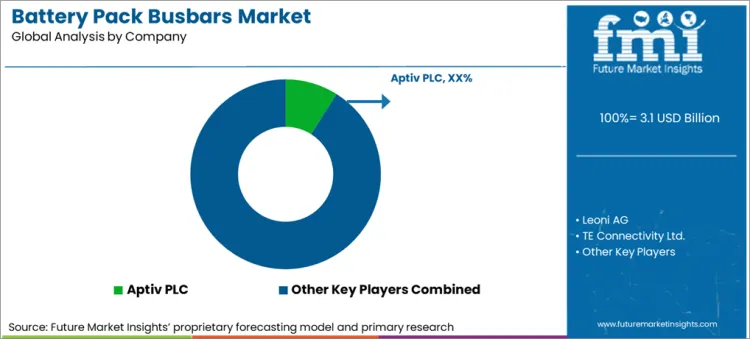
Competitive intensity reflects a transition in vehicle and grid architecture, where busbars are no longer viewed as passive conductors but as critical thermal and structural integration points. This environment is characterized by architectural lock-in where tier-one suppliers are securing multi-year platform contracts by embedding proprietary sensor and cooling technologies directly into the busbar assembly. Barriers to entry have risen, favoring diversified giants who possess the cross-disciplinary expertise to merge power electronics with mechanical shielding.
Macro-level policies are further dictating these corporate strategies, specifically the transition toward regionalized resilience. As global trade barriers and local-content mandates take effect, players are forced to replicate their manufacturing footprints within domestic corridors. This local-for-local production trend is not merely a logistics choice but a survival policy, as companies reorganize their global operations to bypass carbon tariffs and ensure supply chain continuity for domestic OEM giga-factories.
Strategic Evolution and Observable Direction pre-2024
Competition was defined by aggressive M&A to secure high-voltage capabilities before 2024. A landmark example was Aptiv’s acquisition of Intercable Automotive Solutions, which allowed the firm to integrate advanced busbar manufacturing into its broader electrical distribution portfolio.
Suppliers focused on creating pre-validated modular busbars to help OEMs reduce development timelines. This era established the baseline for rigid-to-flexible hybrid designs, allowing companies like Yazaki to dominate high-volume passenger vehicle programs by offering standardized interconnects that could be adapted to various battery cell formats.
Observable Strategic Direction for 2026 and Beyond
A primary strategic direction for 2026 is the de-merging of diversified portfolios to create pure-play power entities. Aptiv is executing a landmark spin-off of EDS business as Versigent slated for April 1 2026. This move allows the parent company to focus on high-margin intelligent systems while the new entity optimizes high-volume power distribution hardware.
Strategic leadership is shifting toward firms that integrate dismantling and material recovery into the product lifecycle. DENSO, as of early 2026, has successfully piloted an automated precision dismantling system. This technology aims to recover nearly 90% of a vehicle’s weight as raw materials for new vehicle production, effectively moving the busbar from a consumable component to a permanent part of a circular car-to-car resource loop.
Recent Developments
- Aptiv reported a USD 20.4 billion annual revenue in February 2026 signalling a strategic reorganization of its Engineered Components group to focus exclusively on high-voltage architecture and intelligent systems.
- In July 2025, Leoni AG Successfully integrated with Luxshare-ICT, creating a strategic bridge to serve Chinese OEMs expanding into European and American markets with specialized wiring systems.
- TE Connectivity announced in Novemnber 2025 its high-reliability connection solutions for 1500 VDC commercial vehicle platforms, utilizing segmented radial crimping technology to enhance durability in high-vibration environments.
Key Players Profiled
- Aptiv PLC
- Leoni AG
- TE Connectivity Ltd.
- Samvardhana Motherson Peguform GmbH
- Lear Corporation
- NTN Trading Corporation
- Karl E. Brinkmann GmbH & Co. KG
- Yazaki Corporation
Market Definition
The battery pack busbars market comprises revenue generated from the design, manufacture, and supply of conductive interconnect systems used for internal power distribution within battery packs. These busbars enable electrical connectivity between cells, modules, and power electronics while supporting thermal performance, mechanical stability, and high-voltage safety requirements. The market includes rigid, flexible laminated, and custom-molded busbars manufactured from copper, copper-clad aluminum, and aluminum alloys.
The market scope covers busbars supplied as standalone components or as integrated assemblies within high-voltage battery architectures used in passenger EVs, commercial EVs, and stationary energy storage systems. Revenue includes value-added features bundled with busbar supply, such as insulation, overmolding, thermal integration, and embedded identification or sensing elements.
The market excludes raw conductive material manufacturing, complete battery pack or cell production, and general electrical cabling or wiring harnesses unless specifically engineered as internal battery pack busbar solutions.
Scope of Report
| Items | Values |
|---|---|
| Quantitative Units | USD 3.1 billion |
| Material | Copper, Copper-Clad Aluminium |
| Configuration | Rigid Busbars, Custom Molded, Flexible Laminated Busbars |
| End Use | Passenger EV, Commercial EV, Stationary Storage & Others |
| Regions Covered | North America, Western Europe, Eastern Europe, East Asia, South Asia & Pacific, Latin America, Middle East & Africa |
| Countries | USA, UK, Germany, China and 40+ countries |
| Key Companies | Aptiv PLC, Leoni AG, TE Connectivity Ltd., Samvardhana Motherson Peguform GmbH, Lear Corporation, NTN Trading Corporation, Karl E. Brinkmann GmbH & Co. KG , Yazaki Corporation, Ryoden Kasei Co. Ltd. |
Source: Future Market Insights (FMI) analysis, based on proprietary forecasting model and primary research
Battery Pack Busbars Market Key Segments
Material
- Copper
- Copper-Clad
- Aluminium
Configuration
- Rigid Busbars
- Custom Molded
- Flexible Laminated Busbars
End Use
- Passenger EV
- Commercial EV
- Stationary Storage & Others
Region
- North America
- Western Europe
- Eastern Europe
- East Asia
- South Asia & Pacific
- Latin America
- Middle East & Africa
Bibliography
- ABB Group. (2026). Electrification strategy update and industrial energy storage outlook. ABB Ltd.
- Tesla, Inc. (2026). Form 10-K annual report for the fiscal year ended December 31, 2025. USA Securities and Exchange Commission.
- Mersen S.A. (2025). Universal registration document and annual financial report. Mersen Group.
- Rogers Corporation. (2025). Annual report and Form 10-K. Rogers Corporation.
- Hitachi Energy. (2026). High-voltage direct current and grid-scale battery integration technical white paper. Hitachi Energy Ltd.
- Faraday Institution. (2026). UltraStore program: Long-duration energy storage research roadmap. Faraday Institution.
- Aptiv PLC. (2026). Annual report and strategic business update. Aptiv PLC.
Frequently Asked Questions
What is the expected value of the battery pack busbars market in 2026?
The battery pack busbars market is expected to reach USD 3.1 billion in 2026, supported by rising EV production and large-scale stationary energy storage deployments.
What is the projected value by 2036 and CAGR from 2026 to 2036?
By 2036, the market is projected to reach USD 8.0 billion, expanding at a CAGR of 9.9% between 2026 and 2036.
How is high-voltage system adoption influencing busbar design trends?
The shift toward 800V–1500V architectures in EVs and grid storage is driving demand for insulated, thermally efficient, and modular busbar designs capable of handling higher power densities.
What role does sustainability regulation play in shaping the market?
Regulations such as the EU Battery Regulation and carbon-footprint disclosure requirements are accelerating adoption of recyclable materials, modular assemblies, and design-for-disassembly busbars.
Which end-use segment is driving the highest volume demand?
Passenger EVs lead demand, accounting for the largest share due to high-volume production and rapid innovation in battery pack architectures.
Preview the report firsthand - request a free sample
Get SampleGet the brochure for pricing and purchase details.
Get PDFTable of Content
- Executive Summary
- Global Market Outlook
- Demand-side Trends
- Supply-side Trends
- Technology Roadmap Analysis
- Analysis and Recommendations
- Market Overview
- Market Coverage / Taxonomy
- Market Definition / Scope / Limitations
- Research Methodology
- Chapter Orientation
- Analytical Lens and Working Hypotheses
- Market Structure, Signals, and Trend Drivers
- Benchmarking and Cross-market Comparability
- Market Sizing, Forecasting, and Opportunity Mapping
- Research Design and Evidence Framework
- Desk Research Programme (Secondary Evidence)
- Company Annual and Sustainability Reports
- Peer-reviewed Journals and Academic Literature
- Corporate Websites, Product Literature, and Technical Notes
- Earnings Decks and Investor Briefings
- Statutory Filings and Regulatory Disclosures
- Technical White Papers and Standards Notes
- Trade Journals, Industry Magazines, and Analyst Briefs
- Conference Proceedings, Webinars, and Seminar Materials
- Government Statistics Portals and Public Data Releases
- Press Releases and Reputable Media Coverage
- Specialist Newsletters and Curated Briefings
- Sector Databases and Reference Repositories
- FMI Internal Proprietary Databases and Historical Market Datasets
- Subscription Datasets and Paid Sources
- Social Channels, Communities, and Digital Listening Inputs
- Additional Desk Sources
- Expert Input and Fieldwork (Primary Evidence)
- Primary Modes
- Qualitative Interviews and Expert Elicitation
- Quantitative Surveys and Structured Data Capture
- Blended Approach
- Why Primary Evidence is Used
- Field Techniques
- Interviews
- Surveys
- Focus Groups
- Observational and In-context Research
- Social and Community Interactions
- Stakeholder Universe Engaged
- C-suite Leaders
- Board Members
- Presidents and Vice Presidents
- R&D and Innovation Heads
- Technical Specialists
- Domain Subject-matter Experts
- Scientists
- Physicians and Other Healthcare Professionals
- Governance, Ethics, and Data Stewardship
- Research Ethics
- Data Integrity and Handling
- Primary Modes
- Tooling, Models, and Reference Databases
- Desk Research Programme (Secondary Evidence)
- Data Engineering and Model Build
- Data Acquisition and Ingestion
- Cleaning, Normalisation, and Verification
- Synthesis, Triangulation, and Analysis
- Quality Assurance and Audit Trail
- Market Background
- Market Dynamics
- Drivers
- Restraints
- Opportunity
- Trends
- Scenario Forecast
- Demand in Optimistic Scenario
- Demand in Likely Scenario
- Demand in Conservative Scenario
- Opportunity Map Analysis
- Product Life Cycle Analysis
- Supply Chain Analysis
- Investment Feasibility Matrix
- Value Chain Analysis
- PESTLE and Porter’s Analysis
- Regulatory Landscape
- Regional Parent Market Outlook
- Production and Consumption Statistics
- Import and Export Statistics
- Market Dynamics
- Global Market Analysis 2021 to 2025 and Forecast, 2026 to 2036
- Historical Market Size Value (USD Million) Analysis, 2021 to 2025
- Current and Future Market Size Value (USD Million) Projections, 2026 to 2036
- Y-o-Y Growth Trend Analysis
- Absolute $ Opportunity Analysis
- Global Market Pricing Analysis 2021 to 2025 and Forecast 2026 to 2036
- Global Market Analysis 2021 to 2025 and Forecast 2026 to 2036, By Material
- Introduction / Key Findings
- Historical Market Size Value (USD Million) Analysis By Material , 2021 to 2025
- Current and Future Market Size Value (USD Million) Analysis and Forecast By Material , 2026 to 2036
- Copper
- Copper-Clad
- Aluminium
- Copper
- Y-o-Y Growth Trend Analysis By Material , 2021 to 2025
- Absolute $ Opportunity Analysis By Material , 2026 to 2036
- Global Market Analysis 2021 to 2025 and Forecast 2026 to 2036, By Configuration
- Introduction / Key Findings
- Historical Market Size Value (USD Million) Analysis By Configuration, 2021 to 2025
- Current and Future Market Size Value (USD Million) Analysis and Forecast By Configuration, 2026 to 2036
- Rigid Busbars
- Custom Molded
- Flexible
- Rigid Busbars
- Y-o-Y Growth Trend Analysis By Configuration, 2021 to 2025
- Absolute $ Opportunity Analysis By Configuration, 2026 to 2036
- Global Market Analysis 2021 to 2025 and Forecast 2026 to 2036, By End Use
- Introduction / Key Findings
- Historical Market Size Value (USD Million) Analysis By End Use, 2021 to 2025
- Current and Future Market Size Value (USD Million) Analysis and Forecast By End Use, 2026 to 2036
- Passenger EV
- Commercial EV
- Stationary Storage & Others
- Passenger EV
- Y-o-Y Growth Trend Analysis By End Use, 2021 to 2025
- Absolute $ Opportunity Analysis By End Use, 2026 to 2036
- Global Market Analysis 2021 to 2025 and Forecast 2026 to 2036, By Region
- Introduction
- Historical Market Size Value (USD Million) Analysis By Region, 2021 to 2025
- Current Market Size Value (USD Million) Analysis and Forecast By Region, 2026 to 2036
- North America
- Latin America
- Western Europe
- Eastern Europe
- East Asia
- South Asia and Pacific
- Middle East & Africa
- Market Attractiveness Analysis By Region
- North America Market Analysis 2021 to 2025 and Forecast 2026 to 2036, By Country
- Historical Market Size Value (USD Million) Trend Analysis By Market Taxonomy, 2021 to 2025
- Market Size Value (USD Million) Forecast By Market Taxonomy, 2026 to 2036
- By Country
- USA
- Canada
- Mexico
- By Material
- By Configuration
- By End Use
- By Country
- Market Attractiveness Analysis
- By Country
- By Material
- By Configuration
- By End Use
- Key Takeaways
- Latin America Market Analysis 2021 to 2025 and Forecast 2026 to 2036, By Country
- Historical Market Size Value (USD Million) Trend Analysis By Market Taxonomy, 2021 to 2025
- Market Size Value (USD Million) Forecast By Market Taxonomy, 2026 to 2036
- By Country
- Brazil
- Chile
- Rest of Latin America
- By Material
- By Configuration
- By End Use
- By Country
- Market Attractiveness Analysis
- By Country
- By Material
- By Configuration
- By End Use
- Key Takeaways
- Western Europe Market Analysis 2021 to 2025 and Forecast 2026 to 2036, By Country
- Historical Market Size Value (USD Million) Trend Analysis By Market Taxonomy, 2021 to 2025
- Market Size Value (USD Million) Forecast By Market Taxonomy, 2026 to 2036
- By Country
- Germany
- UK
- Italy
- Spain
- France
- Nordic
- BENELUX
- Rest of Western Europe
- By Material
- By Configuration
- By End Use
- By Country
- Market Attractiveness Analysis
- By Country
- By Material
- By Configuration
- By End Use
- Key Takeaways
- Eastern Europe Market Analysis 2021 to 2025 and Forecast 2026 to 2036, By Country
- Historical Market Size Value (USD Million) Trend Analysis By Market Taxonomy, 2021 to 2025
- Market Size Value (USD Million) Forecast By Market Taxonomy, 2026 to 2036
- By Country
- Russia
- Poland
- Hungary
- Balkan & Baltic
- Rest of Eastern Europe
- By Material
- By Configuration
- By End Use
- By Country
- Market Attractiveness Analysis
- By Country
- By Material
- By Configuration
- By End Use
- Key Takeaways
- East Asia Market Analysis 2021 to 2025 and Forecast 2026 to 2036, By Country
- Historical Market Size Value (USD Million) Trend Analysis By Market Taxonomy, 2021 to 2025
- Market Size Value (USD Million) Forecast By Market Taxonomy, 2026 to 2036
- By Country
- China
- Japan
- South Korea
- By Material
- By Configuration
- By End Use
- By Country
- Market Attractiveness Analysis
- By Country
- By Material
- By Configuration
- By End Use
- Key Takeaways
- South Asia and Pacific Market Analysis 2021 to 2025 and Forecast 2026 to 2036, By Country
- Historical Market Size Value (USD Million) Trend Analysis By Market Taxonomy, 2021 to 2025
- Market Size Value (USD Million) Forecast By Market Taxonomy, 2026 to 2036
- By Country
- India
- ASEAN
- Australia & New Zealand
- Rest of South Asia and Pacific
- By Material
- By Configuration
- By End Use
- By Country
- Market Attractiveness Analysis
- By Country
- By Material
- By Configuration
- By End Use
- Key Takeaways
- Middle East & Africa Market Analysis 2021 to 2025 and Forecast 2026 to 2036, By Country
- Historical Market Size Value (USD Million) Trend Analysis By Market Taxonomy, 2021 to 2025
- Market Size Value (USD Million) Forecast By Market Taxonomy, 2026 to 2036
- By Country
- Kingdom of Saudi Arabia
- Other GCC Countries
- Turkiye
- South Africa
- Other African Union
- Rest of Middle East & Africa
- By Material
- By Configuration
- By End Use
- By Country
- Market Attractiveness Analysis
- By Country
- By Material
- By Configuration
- By End Use
- Key Takeaways
- Key Countries Market Analysis
- USA
- Pricing Analysis
- Market Share Analysis, 2025
- By Material
- By Configuration
- By End Use
- Canada
- Pricing Analysis
- Market Share Analysis, 2025
- By Material
- By Configuration
- By End Use
- Mexico
- Pricing Analysis
- Market Share Analysis, 2025
- By Material
- By Configuration
- By End Use
- Brazil
- Pricing Analysis
- Market Share Analysis, 2025
- By Material
- By Configuration
- By End Use
- Chile
- Pricing Analysis
- Market Share Analysis, 2025
- By Material
- By Configuration
- By End Use
- Germany
- Pricing Analysis
- Market Share Analysis, 2025
- By Material
- By Configuration
- By End Use
- UK
- Pricing Analysis
- Market Share Analysis, 2025
- By Material
- By Configuration
- By End Use
- Italy
- Pricing Analysis
- Market Share Analysis, 2025
- By Material
- By Configuration
- By End Use
- Spain
- Pricing Analysis
- Market Share Analysis, 2025
- By Material
- By Configuration
- By End Use
- France
- Pricing Analysis
- Market Share Analysis, 2025
- By Material
- By Configuration
- By End Use
- India
- Pricing Analysis
- Market Share Analysis, 2025
- By Material
- By Configuration
- By End Use
- ASEAN
- Pricing Analysis
- Market Share Analysis, 2025
- By Material
- By Configuration
- By End Use
- Australia & New Zealand
- Pricing Analysis
- Market Share Analysis, 2025
- By Material
- By Configuration
- By End Use
- China
- Pricing Analysis
- Market Share Analysis, 2025
- By Material
- By Configuration
- By End Use
- Japan
- Pricing Analysis
- Market Share Analysis, 2025
- By Material
- By Configuration
- By End Use
- South Korea
- Pricing Analysis
- Market Share Analysis, 2025
- By Material
- By Configuration
- By End Use
- Russia
- Pricing Analysis
- Market Share Analysis, 2025
- By Material
- By Configuration
- By End Use
- Poland
- Pricing Analysis
- Market Share Analysis, 2025
- By Material
- By Configuration
- By End Use
- Hungary
- Pricing Analysis
- Market Share Analysis, 2025
- By Material
- By Configuration
- By End Use
- Kingdom of Saudi Arabia
- Pricing Analysis
- Market Share Analysis, 2025
- By Material
- By Configuration
- By End Use
- Turkiye
- Pricing Analysis
- Market Share Analysis, 2025
- By Material
- By Configuration
- By End Use
- South Africa
- Pricing Analysis
- Market Share Analysis, 2025
- By Material
- By Configuration
- By End Use
- USA
- Market Structure Analysis
- Competition Dashboard
- Competition Benchmarking
- Market Share Analysis of Top Players
- By Regional
- By Material
- By Configuration
- By End Use
- Competition Analysis
- Competition Deep Dive
- Aptiv PLC
- Overview
- Product Portfolio
- Profitability by Market Segments (Product/Age /Sales Channel/Region)
- Sales Footprint
- Strategy Overview
- Marketing Strategy
- Product Strategy
- Channel Strategy
- Leoni AG
- TE Connectivity Ltd.
- Samvardhana Motherson Peguform GmbH
- Lear Corporation
- NTN Trading Corporation
- Karl E. Brinkmann GmbH & Co. KG
- Yazaki Corporation
- Aptiv PLC
- Competition Deep Dive
- Assumptions & Acronyms Used


