

- Industry Size (2026)
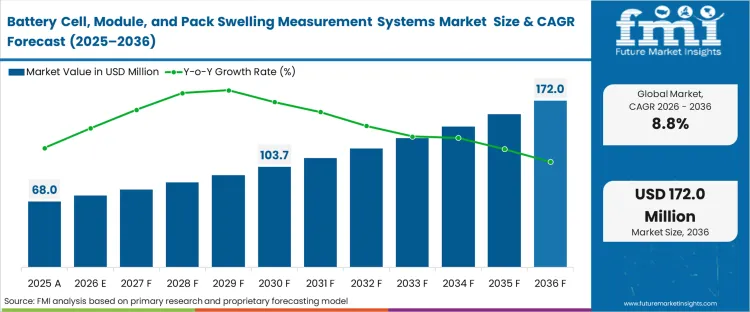
- USD 74.0 Mn
- Forecast (2036)
- USD 172.0 Mn
- CAGR (2026 to 2036)
- 8.80%
Battery Cell, Module, and Pack Swelling Measurement Systems Market Size, Market Forecast and Outlook By FMI
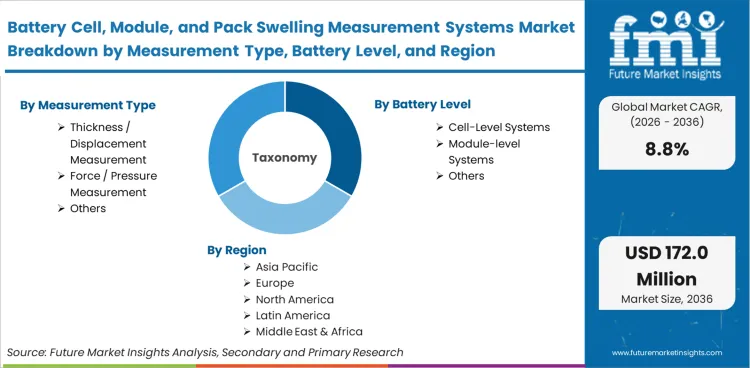
The battery cell, module, and pack swelling measurement systems market surpassed a value of USD 68.0 million in 2025. Sales are expected to reach USD 74.0 million in 2026 at a battery swelling measurement systems CAGR of 8.80% during the forecast period. Ongoing investment propels total valuation to USD 172.0 million through 2036 as high-silicon anode and solid-state battery developments force manufacturers to transition mechanical stress monitoring from a post-mortem quality check to a mandatory in-line requirement.
An immediate transition from basic end-of-line dimension tolerance checks to continuous operando pressure mapping confronts quality directors dimension tolerance checks to dynamic operando pressure mapping. Moving toward cell-to-pack architectures removes mechanical buffers that previously absorbed expansion. Every millimeter of volumetric change now directly transfers stress to vehicle chassis or adjacent modules. Relying on legacy static fixtures to validate these new architectures guarantees field failures. Commercial stakes are absolute: OEMs increasingly reject entire cell batches if suppliers cannot provide synchronized mechanical-electrochemical expansion data across full temperature operating windows. A critical non-obvious reality is that cells passing standard electrical capacity tests often exhibit dangerous internal stress gradients visible only through integrated battery testing equipment. Failure to map these gradients during validation exposes battery cell swelling measurement workflows to catastrophic pack-level recalls down the line.
Summary of Battery Cell, Module, and Pack Swelling Measurement Systems Market
- Battery Cell, Module, and Pack Swelling Measurement Systems Market Definition:
- Specialized instrumentation that synchronizes precise mechanical displacement and force measurements with electrochemical cycling to monitor physical expansion of energy storage devices under active electrical load.
- Demand Drivers in the Market:
- High-silicon anode chemistries require gigafactory quality managers to implement continuous lithium-ion battery swelling test equipment tracking to prevent severe degradation.
- Cell-to-pack architectures force automotive tier-1 structural engineers to map exact module-level expansion forces.
- Solid-state battery development pushes R&D directors to procure fixtures capable of applying and monitoring extreme precise pre-loads during cycling.
- Key Segments Analyzed in the FMI Report:
- Equipment Type: Thickness / displacement measurement is set to hold 42.0% share in 2026, establishing foundational metrics for pouch cell outgassing behavior.
- Deployment Stage: Cell-level systems are projected to capture 58.0% share in 2026, providing earliest isolation of mechanical failure modes before module integration.
- End user: R&D and validation labs are estimated to command 46.0% share in 2026, driven by intense validation requirements for next-generation chemistries.
- India: 10.8% compound growth, driven by massive state-subsidized scaling of domestic greenfield gigafactories demanding immediate validation parity.
- Analyst Opinion at FMI:
- Ronak Shah, Principal Analyst for Consumer Product at FMI, notes that, "Industry assumes capturing maximum displacement during a cell's cycle life equates to comprehensive safety validation. Standard practice involves measuring how much a cell swells at full state of charge. In reality, the critical metric for high-silicon and solid-state architectures is the rate of mechanical relaxation: how efficiently a cell recovers its original shape post-discharge. Standard static measurement fixtures completely fail to capture this dynamic hysteresis curve. Quality directors relying solely on peak-thickness data approve cells that appear stable but possess severely degraded internal separator structures due to delayed relaxation. This creates a massive blind spot in qualification protocols that only integrated, high-frequency Multiphysics systems can actually illuminate."
- Strategic Implications / Executive Takeaways:
- Primary Research: Procurement directors, gigafactory quality assurance managers, and battery R&D lead engineers at Tier-1 cell manufacturing firms
- Desk Research: UN 38.3 testing protocol updates, EU Battery Regulation technical annexes, and patent filings for operando dilatometry fixtures
- Market-Sizing and Forecasting: Capital expenditure allocations for physical validation equipment per gigawatt-hour of planned production capacity
- Data Validation and Update Cycle: Equipment procurement cycles cross-referenced against public gigafactory commissioning timelines and OEM qualification standards
When dominant automakers enforce mandatory mechanical constraint thresholds for multi-cell modules, entire qualification requirements change overnight. When a dominant automaker specifies exact allowable expansion forces for an entire module lifecycle, Tier-1 suppliers must instantly upgrade to EV battery swelling measurement equipment. This specific specification shift immediately renders legacy single-cell fixtures obsolete for final validation. Suppliers crossing this threshold lock in multi-year procurement contracts because they can prove compliance with new structural safety mandates.
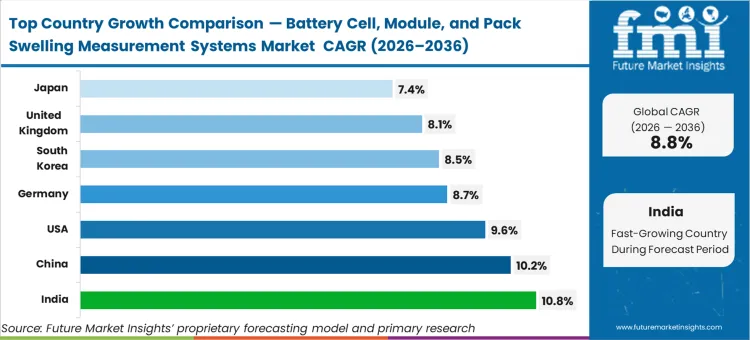
India leads at 10.8% as aggressive local production-linked incentive schemes force newly established manufacturing sites to rapidly install gigafactory battery quality testing equipment. China follows at 10.2% driven by massive throughput requirements for advanced prismatic formats. United States tracks at 9.6% supported by localized high-silicon anode commercialization efforts. Germany expands at 8.7% due to premium automotive OEMs demanding stringent module-level mechanical data. South Korea advances at 8.5% as established cell manufacturers upgrade legacy R&D lines. United Kingdom grows at 8.1% anchored by specialized solid-state research hubs. Japan registers 7.4% as incumbent players refine existing highly automated qualification procedures. Divergence across this spectrum stems directly from whether a region is building net-new gigafactories or retrofitting mature production lines with Multiphysics capabilities.
Battery Cell, Module, and Pack Swelling Measurement Systems Market Key Takeaways
| Metric | Details |
|---|---|
| Industry Size (2026) | USD 74.0 million |
| Industry Value (2036) | USD 172.0 million |
| CAGR (2026-2036) | 8.80% |
Source: Future Market Insights (FMI) analysis, based on proprietary forecasting model and primary research
Battery Cell, Module, and Pack Swelling Measurement Systems Market Definition
Equipment specifically designed to quantify mechanical expansion, volumetric change, and internal pressure generation of energy storage devices during electrochemical cycling. These battery thickness measurement systems couple precise physical measurement instruments with battery testing channels to capture operando physical changes under specific thermal and electrical loads. Boundary conditions cover only hardware and integrated software dedicated to synchronized thermomechanical-electrical profiling.
Battery Cell, Module, and Pack Swelling Measurement Systems Market Inclusions
Scope covers continuous multi-axis force fixtures, optical displacement mapping units, and integrated pressure distribution sensors designed for dynamic battery breathing measurement. Perimeter parameters encompass electric vehicle test equipment specifically engineered to apply defined pre-loads while monitoring dynamic expansion. Data acquisition modules that synchronize physical measurements with external cyclers fall entirely within the analytical boundary.
Battery Cell, Module, and Pack Swelling Measurement Systems Market Exclusions
Standard universal testing machines used strictly for static crush or nail penetration tests sit outside this boundary. General-purpose coordinate measuring machines performing static post-mortem dimensional checks lack operando cycling integration required for in-situ swelling analysis battery evaluation. Standalone battery cyclers without integrated physical displacement tracking capabilities belong to a separate category entirely.
Battery Cell, Module, and Pack Swelling Measurement Systems Market Research Methodology
- Primary Research: Procurement directors, gigafactory quality assurance managers, and battery R&D lead engineers at Tier-1 cell manufacturing firms
- Desk Research: UN 38.3 testing protocol updates, EU Battery Regulation technical annexes, and patent filings for operando dilatometry fixtures
- Market-Sizing and Forecasting: Capital expenditure allocations for physical validation equipment per gigawatt-hour of planned production capacity
- Data Validation and Update Cycle: Equipment procurement cycles cross-referenced against public gigafactory commissioning timelines and OEM qualification standards
Segmental Analysis
Battery Cell, Module, and Pack Swelling Measurement Systems Market Analysis by Measurement type
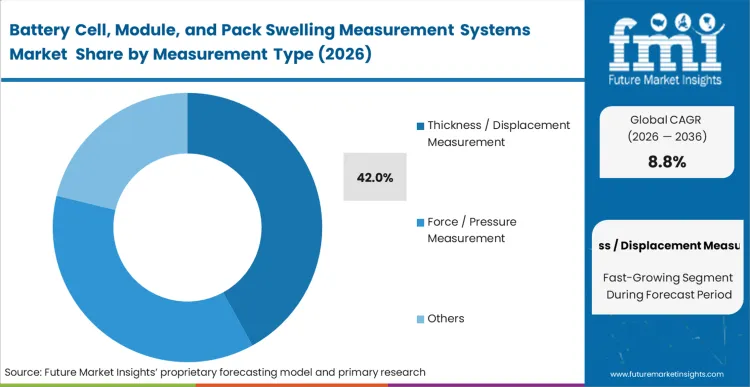
Legacy validation protocols prioritizing outward dimensional changes drive the 42.0% share thickness and displacement measurement holds in 2026. Battery testing engineers rely on these systems as primary gatekeepers for identifying severe outgassing events before cells reach advanced qualification stages. FMI's analysis indicates this segment sustains dominance because basic linear variable differential transformers integrate relatively easily with existing lithium ion battery cycler channels. Procurement teams evaluating contact vs optical battery swelling measurement often favor contact sensors due to lower capital cost per channel compared to full volumetric optical mapping. Surface-level displacement tracking masks a critical vulnerability; a cell can register within acceptable external dimensional tolerances while simultaneously developing acute localized internal stress gradients. Quality assurance managers who rely exclusively on single-point thickness data frequently pass cells that eventually rupture under rigid confinement of a vehicle pack. Relying strictly on this foundational measurement method without secondary force tracking leaves cell suppliers exposed to massive liability during module-level integration.
- Initial screening: Baseline outgassing validation triggers initial purchases of multi-channel fixture units. Battery testing engineers gain low-cost methods to flag catastrophic failures early in formation cycles.
- Protocol compliance: Verification against basic OEM dimensional tolerances validates continued use of thickness sensors. Quality assurance managers face immediate batch rejection if baseline expansion limits exceed contracted specifications.
- Expansion limits: Transitioning to high-silicon anodes drives renewal requirements for higher-resolution displacement sensors. Procurement teams must upgrade sensor accuracy to capture minute pre-lithiation swelling or risk passing fundamentally flawed cell designs.
Battery Cell, Module, and Pack Swelling Measurement Systems Market Analysis by Battery level
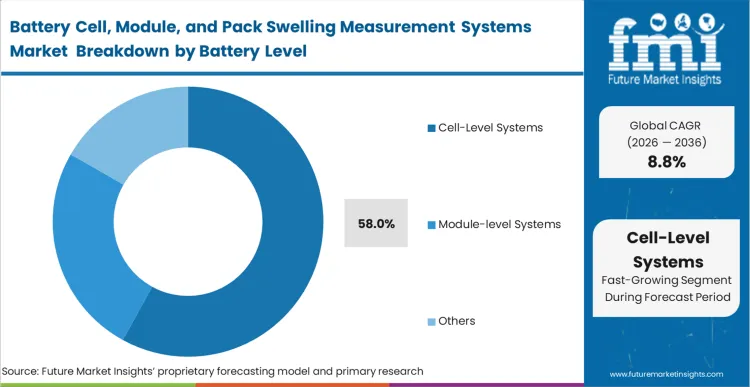
Destroying expensive components during fully assembled module testing is economically unviable. Such reality forces validation upstream to individual units. This economic reality secures the 58.0% position cell-level systems maintain in 2026 as R&D directors attempt to isolate mechanical failure modes before packaging. Based on FMI's assessment, applying precise mechanical pre-loads to single cells using a cell compression and swelling test bench provides clean data regarding intrinsic active material expansion. Formulators require this uncorrupted signal to refine new cathode and anode geometries without interference from module casing dynamics. Yet, isolated cell testing generates dangerous false confidence; unconstrained single-cell behavior rarely mirrors cascading mechanical propagation that occurs when fifty cells expand unevenly within rigid housings. Structural engineers who extrapolate cell-level swelling data directly into electric vehicle battery pack designs consistently underestimate localized pressure concentrations. Delaying investment in larger module compression validation equipment ensures costly late-stage redesigns when initial prototypes buckle under collective expansion.
- Constraint rupture: Single-cell fixtures prevent fundamental active material degradation by identifying excessive absolute expansion. Cell formulators avoid advancing unstable chemistries into costly pilot-line production phases.
- Extrapolation errors: Cascading pressure dynamics remain entirely hidden during isolated cell tests. Structural engineers face unexpected module casing deformation because collective expansion behaves non-linearly.
- Integration mapping: Capturing true operational reality requires buyers to eventually step beyond isolated cells. R&D directors must synthesize unit-level data with complex pack modeling to prevent field failures.
Battery Cell, Module, and Pack Swelling Measurement Systems Market Analysis by Deployment
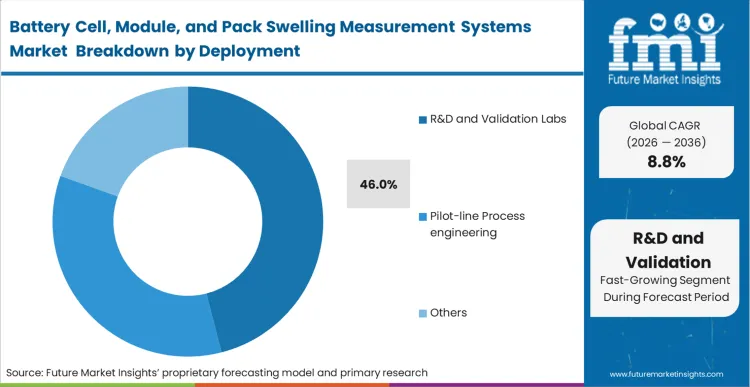
Severe capital constraints battle against unprecedented demands for new chemistry validation, placing research facilities at the center of procurement cycles. R&D and validation labs capture 46.0% share in 2026, serving as proving grounds for exotic silicon and solid-state architectures. Lead research scientists require ultimate flexibility, prioritizing highly configurable fixtures capable of varying pressure, temperature, and electrical load simultaneously. According to FMI's estimates, these environments demand ultra-high-precision battery dilatometer instruments to characterize fundamental breathing behavior of novel materials. A hidden trap emerges during commercialization; bespoke slow-throughput equipment used to generate pristine R&D data possesses virtually no correlation with automated high-speed qualification tools required on pilot lines. Manufacturing engineers attempting to replicate R&D swelling metrics on production-scale equipment invariably encounter massive data discrepancies. Failing to procure battery deformation monitoring systems that share software architecture with production-grade battery manufacturing machines guarantees painful delayed scale-up processes.
- Initial discovery: Academic and corporate research scientists adopt ultra-precision dilatometers first to characterize fundamental material breathing. These buyers gain deep mechanistic insight but sacrifice testing volume.
- Scale transition: Pilot-line process engineers follow by attempting to adapt high-fidelity R&D metrics to continuous production. These engineers face severe data correlation challenges when transitioning from single-cell bespoke fixtures to multi-channel trays.
- Automated qualification: End-of-line quality managers reach this measurement paradigm last. These buyers must sacrifice absolute precision for speed, forcing compromises that often miss subtle slow-developing mechanical defects.
Battery Cell, Module, and Pack Swelling Measurement Systems Market Analysis by Cell format focus
Catastrophic seal ruptures and rapid outgassing events compel manufacturers to scrutinize flexible packaging above all other geometries. Pouch cell swelling test systems account for 37.0% share in 2026 due to acute susceptibility to unconstrained volumetric expansion. Packaging engineers utilize precise multi-point thickness mapping to verify internal gas generation does not compromise delicate foil perimeters. As per FMI's projection, inherent lack of rigid structural support in pouch designs mandates continuous monitoring across entire cell faces rather than central point tracking. However, intense historical focus on pouch expansion creates a dangerous blind spot regarding large-format components. Quality directors assume rigid aluminum casings naturally contain swelling, missing severe internal electrode buckling that occurs when expansion forces have nowhere to go. Ignoring prismatic battery swelling measurement systems while obsessing over pouch architectures leaves automakers vulnerable to sudden invisible internal short circuits.
- Baseline monitoring: Multi-point displacement sensors exceed expectations when mapping soft uniform faces of standard pouch designs. Packaging engineers successfully identify localized outgassing long before perimeter seals experience critical stress.
- Rigid containment: Performance gaps appear rapidly when standard pouch fixtures attempt to measure rigid prismatic casings. Quality directors fail to detect internal jelly-roll deformation because aluminum shells absorb displacement.
- Qualification limits: Passing rigorous OEM validation requires transitioning to multi-axis force sensing regardless of format. Testing engineers must quantify exact outward pressure exerted by any cell geometry against fixed battery module vent structures.
Battery Cell, Module, and Pack Swelling Measurement Systems Market Analysis by End use
Chief technology officers at major automakers must decide exactly how much mechanical buffer space to eliminate to achieve maximum vehicle ranges. Ruthless pursuit of energy density propels EV battery development to 61.0% share in 2026. Automotive pack designers strip away passive structural constraints, requiring absolute certainty regarding how much active cells will expand under rapid fast-charging loads. FMI observes that capital expenditure flowing from automotive sectors completely dwarfs other applications, driving specialized battery pack swelling measurement systems development. Yet, a massive contradiction exists in testing ecosystems; while EV budgets dictate equipment design, stationary grid storage applications actually experience far more severe cumulative swelling issues due to twenty-year operational requirements. Energy storage system architects using equipment optimized for ten-year EV lifecycles routinely fail to capture late-stage mechanical fatigue unique to grid applications. Attempting to validate stationary lithium ion battery storage using automotive-grade swelling profiles ensures premature mechanical failure of massive grid installations.
- Validation expenditure: Automotive mandates for extreme energy density drive initial procurement of multi-physics test rigs. Chief technology officers secure necessary safety data but incur massive upfront capital costs for specialized high-channel-count systems.
- Operational fatigue: Hidden costs emerge rapidly when EV-optimized testing systems evaluate long-duration grid storage assets. Energy storage system architects face unexpected late-stage degradation because equipment lacks stability for multi-year operando monitoring.
- Lifecycle parity: True total cost of ownership analysis reveals necessity of application-specific measurement durations. Procurement managers must specify ultra-stable thermal chambers and drift-free sensors to prevent invalidating months of continuous cycling data.
Battery Cell, Module, and Pack Swelling Measurement Systems Market Drivers, Restraints, and Opportunities
Commercial deployment of high-silicon anodes forces tier-1 cell formulators to solve massive volumetric expansion before securing OEM supply contracts. Silicon expands drastically during lithiation, instantly shattering standard electrode structures and buckling traditional cell casings. Delaying integration of silicon anode swelling measurement equipment into formation cycles means advancing fundamentally flawed chemistries that inevitably rupture in field operations. Procurement directors cannot simply rely on end-of-line static thickness checks; they require dynamic real-time pressure mapping across thousands of cycles using battery preload force measurement equipment to prove novel binder matrices actually contain mechanical stress. Automakers explicitly tie multi-billion dollar ultra fast charging EV battery off-take agreements to supplier ability to demonstrate tightly controlled mechanical breathing behavior over full warranty periods.
Synchronizing continuous mechanical fixture data with complex electrochemical cycling channels generates massive software integration bottlenecks. Testing facility managers confront proprietary communication protocols preventing mechanical load cells from speaking directly to standard battery cyclers. Structural friction forces laboratories to build custom API layers or rely on clunky post-test data merging that destroys real-time feedback capabilities. Inability to dynamically adjust electrical load based on instantaneous physical expansion limits utility of hardware. While emerging unified control software attempts to bridge gaps, persistent installed bases of closed-ecosystem cyclers heavily restrict seamless Multiphysics integration.
Opportunities in the Battery Cell, Module, and Pack Swelling Measurement Systems Market
- In-line formation feedback: Integrating physical displacement sensors directly into gigafactory formation trays creates massive competitive advantages. Process engineers gain ability to dynamically adjust charging currents based on real-time cell expansion, optimizing formation time.
- Solid-state pressure control: Developing fixtures acting as a solid-state battery stack pressure test system opens new revenue streams. R&D directors require exact capabilities to prevent dendrite formation in novel solid-state cathode materials.
- Thermal-mechanical mapping: Coupling high-resolution thermal imaging with pack breathing and clamp force validation tracking provides unprecedented diagnostic value. Pack designers avoid catastrophic thermal runaway by pinpointing exact moments internal physical deformation causes localized heating.
Regional Analysis
Based on regional analysis, battery cell, module, and pack swelling measurement systems market is segmented into North America, Latin America, Western Europe, Eastern Europe, East Asia, South Asia and Pacific, and Middle East and Africa across 40 plus countries.
.webp "Top Country Growth Comparison Battery Cell, Module, And Pack Swelling Measurement Systems Market Cagr (2026 2036)")
| Country | CAGR (2026 to 2036) |
|---|---|
| India | 10.8% |
| China | 10.2% |
| United States | 9.6% |
| Germany | 8.7% |
| South Korea | 8.5% |
| United Kingdom | 8.1% |
| Japan | 7.4% |
Source: Future Market Insights (FMI) analysis, based on proprietary forecasting model and primary research
South Asia and Pacific Battery Cell, Module, and Pack Swelling Measurement Systems Market Analysis
Local cell manufacturers cannot afford multi-year learning curves associated with legacy mechanical qualification protocols. Relying on basic dimensional checks while attempting to rapidly scale unfamiliar active materials results in immediate batch failures. Aggressive production-linked incentive schemes push domestic manufacturers to bypass intermediate evolutionary steps and immediately deploy globally competitive gigafactories. Urgency stems from requirements to validate indigenously developed cell chemistries against punishing local thermal conditions without relying on imported historical data. FMI analysts note that compressed timelines demand immediate installation of advanced fully integrated Multiphysics measurement systems right at facility commissioning stages.
- India: Revenue expansion carries total valuation forward at a 10.8% CAGR, as massive state-subsidized scaling of domestic greenfield facilities mandates immediate validation infrastructure parity. Quality assurance managers require India battery swelling measurement systems providing high-throughput data to prove local cell viability to demanding automotive OEMs. Suppliers providing rapid integration of mechanical testing with formation cyclers secure dominant share in rapidly industrializing landscapes.
FMI's report includes Australia, ASEAN countries, and rest of South Asia and Pacific. Testing equipment suppliers must navigate fragmented local calibration standards when deploying complex Multiphysics fixtures across emerging jurisdictions.
East Asia Battery Cell, Module, and Pack Swelling Measurement Systems Market Analysis
Failure to automate physical measurement creates critical bottlenecks paralyzing entire gigafactory wings. According to FMI's estimates, sheer volume of output means test engineers cannot manually transfer cells between cyclers and mechanical fixtures. Dominant production scale forces testing equipment out of laboratories and directly onto continuous manufacturing lines. Structural necessity dictates fully automated robotic handling systems that integrate operando dilatometry without slowing primary production throughput. Regional absolute leadership in prismatic cell architectures dictates massive requirements for rigid-casing expansion measurement rather than flexible pouch tracking.
- China: Unprecedented throughput requirements for advanced structural cell designs dictate massive procurement of automated testing lines. Demand is set to expand at a 10.2% CAGR, since manufacturing engineers must validate continuous mechanical expansion utilizing China battery swelling measurement systems without disrupting millions of units of weekly output. Successful integration of robotic handling with precision dilatometry entirely defines competitive positioning against legacy manual testing paradigms.
- South Korea: Established cell manufacturers aggressively upgrade legacy R&D lines to support high-silicon anode commercialization. R&D directors need extreme-precision fixtures that integrate perfectly with decades of proprietary cycling data. Transitions upgrade fundamental operational outcomes, shifting regional focus from volume validation to absolute precision mapping, with revenue tracking at an 8.5% CAGR.
- Japan: Sales are projected to advance at a 7.4% CAGR as incumbent players ruthlessly refine existing battery testing inspection procedures for next-generation safety standards. Quality managers demand zero-drift sensors capable of functioning flawlessly over multi-year validation cycles. Trajectories point strictly toward ultra-high-reliability systems eliminating operator variance entirely.
FMI's report includes rest of East Asia. Drives toward localized solid-state commercialization heavily dictate specialized high-pressure fixtures required across broader regional footprints.
North America Battery Cell, Module, and Pack Swelling Measurement Systems Market Analysis
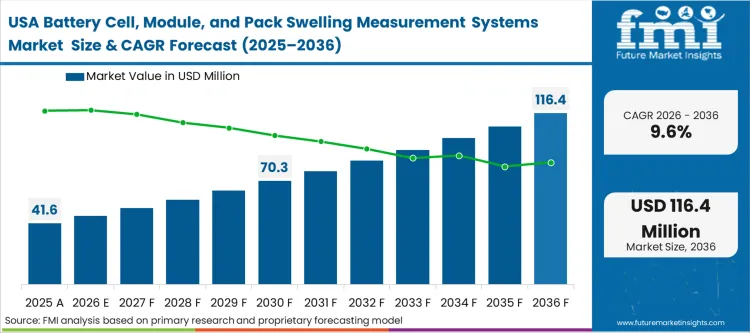
Attempting to use rigid format-specific measurement fixtures leaves domestic laboratories unable to adapt to rapidly shifting requirements of local electric vehicle startups. Compressed qualification windows place immense pressure on independent validation laboratories and tier-1 quality centers. Strict localization requirements tied to federal tax incentives force automotive OEMs to rapidly qualify domestic cell suppliers. Test facility managers require highly flexible equipment because domestic cell designs have not yet converged on standard formats or form factors. Based on FMI's assessment, strong regional focus on scaling unproven silicon-dominant chemistries demands measurement systems capable of handling extreme non-linear volumetric expansion.
- United States: Intense federal funding for localized high-silicon anode commercialization drives immediate procurement of United States battery swelling test equipment tools. Total opportunity is set to increase at a 9.6% CAGR because lead testing engineers must provide incontrovertible mechanical stability data to secure subsequent rounds of governmental scaling grants. Practitioner reality confirms equipment flexibility trumps absolute throughput as laboratories must test dozens of competing cell architectures monthly.
FMI's report includes Canada. Cross-border integration of battery material supply chains necessitates harmonized mechanical testing protocols ensuring seamless data correlation between mining extraction and final cell assembly.
Western Europe Battery Cell, Module, and Pack Swelling Measurement Systems Market Analysis
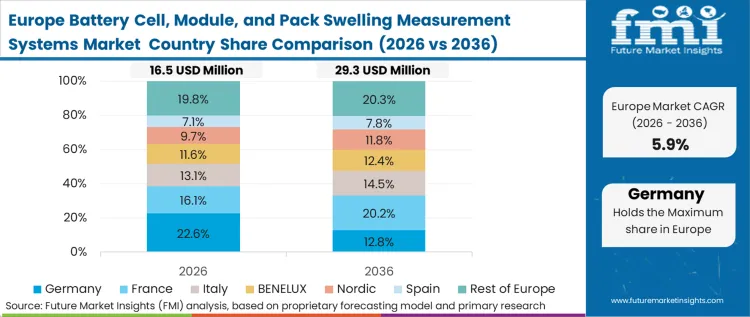
A heavy reliance on centralized third-party testing institutes accelerates the deployment of high-capacity Multiphysics dilatometers. Failing to provide comprehensive operando pressure mapping instantly disqualifies cell manufacturers from securing lucrative European off-take agreements. Premium automotive OEMs driving rigorous pack-level validation protocols shape the procurement landscape across this region. According to FMI's estimates, stringent safety directives force test facility managers to upgrade legacy setups to capture dynamic multi-axis expansion profiles. Cell-to-pack integration mandates push tier-1 suppliers to provide flawless mechanical load data before components enter European assembly lines.
- Germany: Premium automotive programs in Germany are pushing local tier-1 suppliers to build stronger module-level force monitoring into their validation work. Facility teams need a much clearer view of structural tolerance limits as rigid next-generation cell casings move into larger domestic vehicle platforms. That added testing discipline is becoming important for winning and holding supplier contracts, and it is helping the market move at an 8.7% CAGR.
- United Kingdom: In the United Kingdom, growth is being shaped more by specialized solid-state battery research clusters than by broad manufacturing scale. The market is expanding at 8.1% CAGR as research teams work with high-precision fixtures to maintain stable electrochemical cycling under demanding mechanical pre-load conditions. Continuous pressure mapping is also becoming more important, especially in projects where early technical insight can support longer-term intellectual property advantage.
FMI's report includes France, Italy, and the rest of Western Europe. Localized grid-storage deployments require specific long-duration mechanical fatigue testing protocols to align with strict continental sustainability mandates.
Competitive Aligners for Market Players
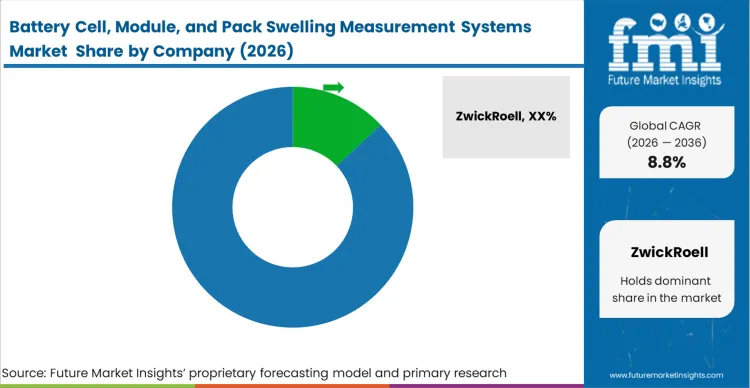
Competition in this area still starts with the large precision testing companies that have spent years building expertise in materials testing. That background gives them a strong position in hardware, especially where ultra-rigid frames, stable sensors, and accurate dilatometry matter. Companies such as ZwickRoell and Instron also benefit from broad installed bases in automotive battery testing, which makes it easier for them to extend into more specialized compression fixtures. Even so, the real competitive pressure is moving toward software. Lab teams increasingly care about how well mechanical force data can be matched with voltage and current behavior inside the cycling systems they already use every day.
Established testing firms also benefit from something newer entrants often lack, which is a proven calibration and compliance foundation. Third-party accredited labs usually cannot work with equipment unless force generation and measurement can be traced through recognized standards. That creates a high barrier for startups. Building a working fixture is one part of the challenge, though winning acceptance from global automotive OEMs also requires a much deeper compliance structure. Without that, newer Multiphysics tools are more likely to stay in research settings than move into high-value qualification lines at large battery plants. The next step for challengers is to show that newer thermal and physical tracking methods can fit into commercial EV battery validation programs without adding integration complexity.
At the same time, large gigafactory buyers are trying to avoid getting tied too closely to any one vendor. Quality and procurement teams want testing systems that can share data openly instead of locking it inside proprietary software. That is making interface flexibility more important in supplier selection. Vendors that can provide API access and support integration with broader manufacturing and test data systems are in a stronger position. The market is gradually moving away from standalone fixtures and toward modular measurement systems that fit more easily into the buyer’s existing data architecture.
Key Players in Battery Cell, Module, and Pack Swelling Measurement Systems Market
- ZwickRoell
- Instron
- Maccor
- Chroma ATE
- HORIBA FuelCon
- NEWARE
- IEST
Scope of the Report
| Metric | Value |
|---|---|
| Quantitative Units | USD 74.0 million in 2026 to USD 172.0 million by 2036, at a CAGR of 8.80% |
| Market Definition | Equipment designed to quantify mechanical expansion, volumetric change, and internal pressure generation of energy storage devices during electrochemical cycling by coupling precise physical measurement instruments with battery testing channels. |
| Segmentation | By Measurement type, By Battery level, By Deployment, By Cell format focus, By End use, By Region |
| Regions Covered | North America, Latin America, Western Europe, Eastern Europe, East Asia, South Asia and Pacific, Middle East and Africa |
| Countries Covered | United States, Canada, Germany, United Kingdom, France, Italy, Spain, Russia, China, Japan, South Korea, India, ASEAN, ANZ, Brazil, Mexico |
| Key Companies Profiled | ZwickRoell, Instron, Maccor, Chroma ATE, HORIBA FuelCon, NEWARE, IEST |
| Forecast Period | 2026 to 2036 |
| Approach | Capital expenditure allocations for physical validation equipment per gigawatt-hour of planned production capacity cross-referenced against global OEM protocols. |
Source: Future Market Insights (FMI) analysis, based on proprietary forecasting model and primary research
Battery Cell, Module, and Pack Swelling Measurement Systems Market Analysis by Segments
Measurement type:
- Thickness / displacement measurement
- Force / pressure measurement
- Optical / 3D volumetric measurement
- Integrated multiphysics swelling measurement
Battery level:
- Cell-level systems
- Module-level systems
- Pack-level systems
Deployment:
- R&D and validation labs
- Pilot-line process engineering
- Quality control / qualification labs
- Third-party test institutes
Cell format focus:
- Pouch-cell measurement
- Prismatic-cell measurement
- Cylindrical-cell measurement
- Mixed-format systems
End use:
- EV battery development
- Stationary energy storage
- Consumer and electronics batteries
- University / national lab research
Region:
- Asia Pacific
- India
- China
- Japan
- South Korea
- Indonesia
- Australia & New Zealand
- ASEAN
- Rest of Asia Pacific
- Europe
- Germany
- Italy
- France
- United Kingdom
- Spain
- Benelux
- Nordics
- Central & Eastern Europe
- Rest of Europe
- North America
- United States
- Canada
- Mexico
- Latin America
- Brazil
- Argentina
- Chile
- Rest of Latin America
- Middle East & Africa
- Kingdom of Saudi Arabia
- United Arab Emirates
- South Africa
- Turkey
- Rest of Middle East & Africa
Bibliography
- International Energy Agency. (2025). Global EV Outlook 2025.
- International Energy Agency. (2026, February 13). Global battery markets are growing strongly and so are the supply risks.
- Bang, J., Chun, B., Kim, M., Lim, J., Han, Y., & So, H. (2025). Rapid thermal runaway detection of lithium-ion battery via swelling-based state-of-charge monitoring using piezoresistive sponge sensor. eTransportation, 24, 100404.
- Office for Product Safety and Standards. (2025, January 29). PLEV battery safety research: Executive summary and conclusions. GOV.UK.
- Liu, Q., Wang, X., Zhu, J., Jiang, G., Wei, X., & Dai, H. (2025). Experimental study on distributed measurement of internal pressure in lithium-ion batteries using thin-film sensors. World Electric Vehicle Journal, 16(5), 270.
This bibliography is provided for reader reference. The full FMI report contains the complete reference list with primary source documentation.
This Report Addresses
- Specific mechanical constraints required to validate high-silicon anode volumetric expansion limits.
- Capital expenditure shifts from post-mortem static fixtures to operando continuous dilatometry.
- Structural blind spots in relying solely on single-cell testing for module-level propagation.
- Data synchronization bottlenecks between standalone force load cells and battery cycler software.
- Strategic transition toward high-throughput robotic physical measurement on pilot production lines.
- Discrepancies between EV-optimized test durations and massive stationary storage mechanical fatigue requirements.
- Qualification infrastructure required to satisfy emerging OEM cell-to-pack structural tolerance specifications.
- Vendor lock-in risks associated with proprietary closed-ecosystem physical testing and formation APIs.
Frequently Asked Questions
How are pouch cell swelling tests performed?
Engineers perform pouch cell swelling tests using precise multi-point thickness mapping across the full cell face while continuously monitoring operando changes during cycling.
What equipment measures battery thickness growth?
Battery thickness growth is measured using linear variable differential transformers, optical mapping systems, and other displacement-sensing tools integrated with cycling setups.
How do buyers typically request quote battery cell swelling measurement system configurations?
Buyers usually request quotes by specifying channel count, displacement accuracy, communication requirements, and API compatibility with existing manufacturing systems.
How to compare battery swelling test systems for pouch and prismatic cells?
Pouch cell systems are compared on multi-point surface displacement capability, while prismatic cell systems are assessed on multi-axis force sensing and casing pressure measurement.
What is the average battery pack swelling measurement system price?
Battery pack swelling measurement system prices vary widely based on channel density, automation level, and integration complexity, ranging from standard R&D budgets to multi-million-dollar installations.
What defines the best battery swelling measurement system for pouch cells?
The best pouch cell swelling measurement systems offer configurable fixtures that vary pressure, temperature, and electrical load while maintaining software continuity with production environments.
What critical blind spot exists in current thickness measurement protocols?
A major blind spot in current thickness measurement protocols is that external dimensions can appear normal while severe internal stress gradients and jelly-roll deformation develop.
Why do cell-level systems maintain a dominant position over module testing?
Cell-level systems remain dominant because they isolate variables more precisely and avoid damaging expensive module structures during validation.
How does isolated cell testing fail structural engineers?
Isolated cell testing fails structural engineers because it does not replicate uneven multi-cell expansion and localized pressure buildup inside rigid module housings.
Why is data synchronization a primary friction point for testing facilities?
Data synchronization is a major friction point because proprietary communication protocols often prevent direct real-time coordination between mechanical load systems and battery cyclers.
How does the focus on pouch formats obscure other critical failures?
The strong focus on pouch formats can obscure internal buckling and hidden deformation risks in rigid prismatic cells that surface sensors fail to capture.
Why do EV-optimized testing fixtures fail stationary storage applications?
EV-optimized testing fixtures often fail stationary storage applications because they are designed for shorter automotive lifecycles and miss long-duration mechanical fatigue effects.
What structural advantage do incumbent materials testing firms possess?
Incumbent materials testing firms hold an advantage through internationally traceable calibration libraries and established compliance credentials trusted by top-tier buyers.
What shifts when a dominant automaker specifies precise module expansion forces?
When a dominant automaker specifies exact module expansion forces, suppliers must shift from legacy single-cell tools to continuous multi-cell force monitoring systems.
Why do pilot-line process engineers struggle with R&D swelling data?
Pilot-line process engineers struggle with R&D swelling data because ultra-precision lab instruments often generate results that do not correlate well with high-speed production tools.
What role does the rate of mechanical relaxation play in qualification?
The rate of mechanical relaxation is critical in qualification because it reveals how effectively cells recover shape after discharge and exposes hidden structural degradation.
Why is India expanding at a rapid 10.8% compound annual rate?
India is expanding rapidly because production-linked incentive schemes are pushing manufacturers to install advanced integrated measurement systems alongside new gigafactory builds.
How does Chinese market demand differ structurally from other regions?
Chinese demand differs structurally because large-scale prismatic cell production requires fully automated operando dilatometry integrated into continuous high-throughput manufacturing lines.
What specific operational outcome occurs when R&D labs upgrade equipment?
When R&D labs upgrade equipment, researchers gain the ability to map swelling and breathing behavior under tightly controlled pressure, temperature, and electrical conditions.
How does high-silicon anode commercialization directly force equipment upgrades?
High-silicon anode commercialization forces equipment upgrades because extreme expansion during lithiation requires continuous real-time pressure and deformation monitoring over long cycling periods.
What competitive necessity drives the development of in-line formation feedback?
The need to reduce formation time and improve factory throughput drives the development of in-line formation feedback based on real-time physical expansion limits.
Why must solid-state battery testing systems generate extreme physical pressure?
Solid-state battery testing systems must generate extreme physical pressure because stable cycling and dendrite suppression depend on tightly controlled high-compression conditions.
How do thermal imaging and mechanical force tracking combine diagnostically?
Thermal imaging and mechanical force tracking combine diagnostically by correlating deformation events with localized heating to identify early structural failure points.
What prevents the widespread adoption of unified control software?
The widespread adoption of unified control software is limited by installed bases of closed-ecosystem cyclers that restrict third-party multiphysics integration.
Preview the report firsthand - request a free sample
Get SampleGet the brochure for pricing and purchase details.
Get PDFTable of Content
- Executive Summary
- Global Market Outlook
- Demand-side Trends
- Supply-side Trends
- Technology Roadmap Analysis
- Analysis and Recommendations
- Market Overview
- Market Coverage / Taxonomy
- Market Definition / Scope / Limitations
- Research Methodology
- Chapter Orientation
- Analytical Lens and Working Hypotheses
- Market Structure, Signals, and Trend Drivers
- Benchmarking and Cross-market Comparability
- Market Sizing, Forecasting, and Opportunity Mapping
- Research Design and Evidence Framework
- Desk Research Programme (Secondary Evidence)
- Company Annual and Sustainability Reports
- Peer-reviewed Journals and Academic Literature
- Corporate Websites, Product Literature, and Technical Notes
- Earnings Decks and Investor Briefings
- Statutory Filings and Regulatory Disclosures
- Technical White Papers and Standards Notes
- Trade Journals, Industry Magazines, and Analyst Briefs
- Conference Proceedings, Webinars, and Seminar Materials
- Government Statistics Portals and Public Data Releases
- Press Releases and Reputable Media Coverage
- Specialist Newsletters and Curated Briefings
- Sector Databases and Reference Repositories
- FMI Internal Proprietary Databases and Historical Market Datasets
- Subscription Datasets and Paid Sources
- Social Channels, Communities, and Digital Listening Inputs
- Additional Desk Sources
- Expert Input and Fieldwork (Primary Evidence)
- Primary Modes
- Qualitative Interviews and Expert Elicitation
- Quantitative Surveys and Structured Data Capture
- Blended Approach
- Why Primary Evidence is Used
- Field Techniques
- Interviews
- Surveys
- Focus Groups
- Observational and In-context Research
- Social and Community Interactions
- Stakeholder Universe Engaged
- C-suite Leaders
- Board Members
- Presidents and Vice Presidents
- R&D and Innovation Heads
- Technical Specialists
- Domain Subject-matter Experts
- Scientists
- Physicians and Other Healthcare Professionals
- Governance, Ethics, and Data Stewardship
- Research Ethics
- Data Integrity and Handling
- Primary Modes
- Tooling, Models, and Reference Databases
- Desk Research Programme (Secondary Evidence)
- Data Engineering and Model Build
- Data Acquisition and Ingestion
- Cleaning, Normalisation, and Verification
- Synthesis, Triangulation, and Analysis
- Quality Assurance and Audit Trail
- Market Background
- Market Dynamics
- Drivers
- Restraints
- Opportunity
- Trends
- Scenario Forecast
- Demand in Optimistic Scenario
- Demand in Likely Scenario
- Demand in Conservative Scenario
- Opportunity Map Analysis
- Product Life Cycle Analysis
- Supply Chain Analysis
- Investment Feasibility Matrix
- Value Chain Analysis
- PESTLE and Porter’s Analysis
- Regulatory Landscape
- Regional Parent Market Outlook
- Production and Consumption Statistics
- Import and Export Statistics
- Market Dynamics
- Global Market Analysis 2021 to 2025 and Forecast, 2026 to 2036
- Historical Market Size Value (USD Million) Analysis, 2021 to 2025
- Current and Future Market Size Value (USD Million) Projections, 2026 to 2036
- Y-o-Y Growth Trend Analysis
- Absolute $ Opportunity Analysis
- Global Market Pricing Analysis 2021 to 2025 and Forecast 2026 to 2036
- Global Market Analysis 2021 to 2025 and Forecast 2026 to 2036, By Measurement Type
- Introduction / Key Findings
- Historical Market Size Value (USD Million) Analysis By Measurement Type , 2021 to 2025
- Current and Future Market Size Value (USD Million) Analysis and Forecast By Measurement Type , 2026 to 2036
- Thickness / Displacement Measurement
- Force / Pressure Measurement
- Others
- Thickness / Displacement Measurement
- Y-o-Y Growth Trend Analysis By Measurement Type , 2021 to 2025
- Absolute $ Opportunity Analysis By Measurement Type , 2026 to 2036
- Global Market Analysis 2021 to 2025 and Forecast 2026 to 2036, By Battery Level
- Introduction / Key Findings
- Historical Market Size Value (USD Million) Analysis By Battery Level, 2021 to 2025
- Current and Future Market Size Value (USD Million) Analysis and Forecast By Battery Level, 2026 to 2036
- Cell-Level Systems
- Module-level Systems
- Others
- Cell-Level Systems
- Y-o-Y Growth Trend Analysis By Battery Level, 2021 to 2025
- Absolute $ Opportunity Analysis By Battery Level, 2026 to 2036
- Global Market Analysis 2021 to 2025 and Forecast 2026 to 2036, By Deployment
- Introduction / Key Findings
- Historical Market Size Value (USD Million) Analysis By Deployment, 2021 to 2025
- Current and Future Market Size Value (USD Million) Analysis and Forecast By Deployment, 2026 to 2036
- R&D and Validation Labs
- Pilot-line Process engineering
- Others
- R&D and Validation Labs
- Y-o-Y Growth Trend Analysis By Deployment, 2021 to 2025
- Absolute $ Opportunity Analysis By Deployment, 2026 to 2036
- Global Market Analysis 2021 to 2025 and Forecast 2026 to 2036, By Region
- Introduction
- Historical Market Size Value (USD Million) Analysis By Region, 2021 to 2025
- Current Market Size Value (USD Million) Analysis and Forecast By Region, 2026 to 2036
- North America
- Latin America
- Western Europe
- Eastern Europe
- East Asia
- South Asia and Pacific
- Middle East & Africa
- Market Attractiveness Analysis By Region
- North America Market Analysis 2021 to 2025 and Forecast 2026 to 2036, By Country
- Historical Market Size Value (USD Million) Trend Analysis By Market Taxonomy, 2021 to 2025
- Market Size Value (USD Million) Forecast By Market Taxonomy, 2026 to 2036
- By Country
- USA
- Canada
- Mexico
- By Measurement Type
- By Battery Level
- By Deployment
- By Country
- Market Attractiveness Analysis
- By Country
- By Measurement Type
- By Battery Level
- By Deployment
- Key Takeaways
- Latin America Market Analysis 2021 to 2025 and Forecast 2026 to 2036, By Country
- Historical Market Size Value (USD Million) Trend Analysis By Market Taxonomy, 2021 to 2025
- Market Size Value (USD Million) Forecast By Market Taxonomy, 2026 to 2036
- By Country
- Brazil
- Chile
- Rest of Latin America
- By Measurement Type
- By Battery Level
- By Deployment
- By Country
- Market Attractiveness Analysis
- By Country
- By Measurement Type
- By Battery Level
- By Deployment
- Key Takeaways
- Western Europe Market Analysis 2021 to 2025 and Forecast 2026 to 2036, By Country
- Historical Market Size Value (USD Million) Trend Analysis By Market Taxonomy, 2021 to 2025
- Market Size Value (USD Million) Forecast By Market Taxonomy, 2026 to 2036
- By Country
- Germany
- UK
- Italy
- Spain
- France
- Nordic
- BENELUX
- Rest of Western Europe
- By Measurement Type
- By Battery Level
- By Deployment
- By Country
- Market Attractiveness Analysis
- By Country
- By Measurement Type
- By Battery Level
- By Deployment
- Key Takeaways
- Eastern Europe Market Analysis 2021 to 2025 and Forecast 2026 to 2036, By Country
- Historical Market Size Value (USD Million) Trend Analysis By Market Taxonomy, 2021 to 2025
- Market Size Value (USD Million) Forecast By Market Taxonomy, 2026 to 2036
- By Country
- Russia
- Poland
- Hungary
- Balkan & Baltic
- Rest of Eastern Europe
- By Measurement Type
- By Battery Level
- By Deployment
- By Country
- Market Attractiveness Analysis
- By Country
- By Measurement Type
- By Battery Level
- By Deployment
- Key Takeaways
- East Asia Market Analysis 2021 to 2025 and Forecast 2026 to 2036, By Country
- Historical Market Size Value (USD Million) Trend Analysis By Market Taxonomy, 2021 to 2025
- Market Size Value (USD Million) Forecast By Market Taxonomy, 2026 to 2036
- By Country
- China
- Japan
- South Korea
- By Measurement Type
- By Battery Level
- By Deployment
- By Country
- Market Attractiveness Analysis
- By Country
- By Measurement Type
- By Battery Level
- By Deployment
- Key Takeaways
- South Asia and Pacific Market Analysis 2021 to 2025 and Forecast 2026 to 2036, By Country
- Historical Market Size Value (USD Million) Trend Analysis By Market Taxonomy, 2021 to 2025
- Market Size Value (USD Million) Forecast By Market Taxonomy, 2026 to 2036
- By Country
- India
- ASEAN
- Australia & New Zealand
- Rest of South Asia and Pacific
- By Measurement Type
- By Battery Level
- By Deployment
- By Country
- Market Attractiveness Analysis
- By Country
- By Measurement Type
- By Battery Level
- By Deployment
- Key Takeaways
- Middle East & Africa Market Analysis 2021 to 2025 and Forecast 2026 to 2036, By Country
- Historical Market Size Value (USD Million) Trend Analysis By Market Taxonomy, 2021 to 2025
- Market Size Value (USD Million) Forecast By Market Taxonomy, 2026 to 2036
- By Country
- Kingdom of Saudi Arabia
- Other GCC Countries
- Turkiye
- South Africa
- Other African Union
- Rest of Middle East & Africa
- By Measurement Type
- By Battery Level
- By Deployment
- By Country
- Market Attractiveness Analysis
- By Country
- By Measurement Type
- By Battery Level
- By Deployment
- Key Takeaways
- Key Countries Market Analysis
- USA
- Pricing Analysis
- Market Share Analysis, 2025
- By Measurement Type
- By Battery Level
- By Deployment
- Canada
- Pricing Analysis
- Market Share Analysis, 2025
- By Measurement Type
- By Battery Level
- By Deployment
- Mexico
- Pricing Analysis
- Market Share Analysis, 2025
- By Measurement Type
- By Battery Level
- By Deployment
- Brazil
- Pricing Analysis
- Market Share Analysis, 2025
- By Measurement Type
- By Battery Level
- By Deployment
- Chile
- Pricing Analysis
- Market Share Analysis, 2025
- By Measurement Type
- By Battery Level
- By Deployment
- Germany
- Pricing Analysis
- Market Share Analysis, 2025
- By Measurement Type
- By Battery Level
- By Deployment
- UK
- Pricing Analysis
- Market Share Analysis, 2025
- By Measurement Type
- By Battery Level
- By Deployment
- Italy
- Pricing Analysis
- Market Share Analysis, 2025
- By Measurement Type
- By Battery Level
- By Deployment
- Spain
- Pricing Analysis
- Market Share Analysis, 2025
- By Measurement Type
- By Battery Level
- By Deployment
- France
- Pricing Analysis
- Market Share Analysis, 2025
- By Measurement Type
- By Battery Level
- By Deployment
- India
- Pricing Analysis
- Market Share Analysis, 2025
- By Measurement Type
- By Battery Level
- By Deployment
- ASEAN
- Pricing Analysis
- Market Share Analysis, 2025
- By Measurement Type
- By Battery Level
- By Deployment
- Australia & New Zealand
- Pricing Analysis
- Market Share Analysis, 2025
- By Measurement Type
- By Battery Level
- By Deployment
- China
- Pricing Analysis
- Market Share Analysis, 2025
- By Measurement Type
- By Battery Level
- By Deployment
- Japan
- Pricing Analysis
- Market Share Analysis, 2025
- By Measurement Type
- By Battery Level
- By Deployment
- South Korea
- Pricing Analysis
- Market Share Analysis, 2025
- By Measurement Type
- By Battery Level
- By Deployment
- Russia
- Pricing Analysis
- Market Share Analysis, 2025
- By Measurement Type
- By Battery Level
- By Deployment
- Poland
- Pricing Analysis
- Market Share Analysis, 2025
- By Measurement Type
- By Battery Level
- By Deployment
- Hungary
- Pricing Analysis
- Market Share Analysis, 2025
- By Measurement Type
- By Battery Level
- By Deployment
- Kingdom of Saudi Arabia
- Pricing Analysis
- Market Share Analysis, 2025
- By Measurement Type
- By Battery Level
- By Deployment
- Turkiye
- Pricing Analysis
- Market Share Analysis, 2025
- By Measurement Type
- By Battery Level
- By Deployment
- South Africa
- Pricing Analysis
- Market Share Analysis, 2025
- By Measurement Type
- By Battery Level
- By Deployment
- USA
- Market Structure Analysis
- Competition Dashboard
- Competition Benchmarking
- Market Share Analysis of Top Players
- By Regional
- By Measurement Type
- By Battery Level
- By Deployment
- Competition Analysis
- Competition Deep Dive
- ZwickRoell
- Overview
- Product Portfolio
- Profitability by Market Segments (Product/Age /Sales Channel/Region)
- Sales Footprint
- Strategy Overview
- Marketing Strategy
- Product Strategy
- Channel Strategy
- Instron
- Maccor
- Chroma ATE
- HORIBA FuelCon
- NEWARE
- ZwickRoell
- Competition Deep Dive
- Assumptions & Acronyms Used


