

- Industry Size (2026)
- USD 790.9 Mn
- Forecast (2036)
- USD 2327.9 Mn
- CAGR (2026 to 2036)
- 11.4%
Cell-to-Pack Structural Fasteners Market Forecast and Outlook 2026 to 2036
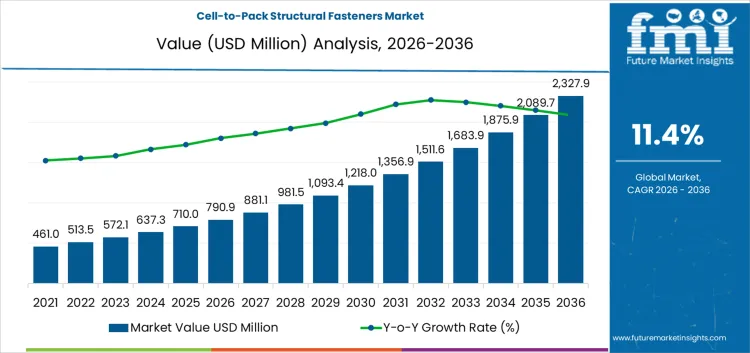
The cell-to-pack structural fasteners market is likely to be valued at USD 790.9 million in 2026 and is projected to reach USD 2,327.9 million by 2036, reflecting a CAGR of 11.4%. Market dynamics are driven by the growing adoption of high-capacity EV battery packs where structural fasteners ensure mechanical integrity, thermal stability, and crash resistance. Regional concentration is highest in areas with established EV manufacturing and advanced battery assembly capabilities. Smaller suppliers face barriers in meeting multi-region crash safety certifications and high-precision torque requirements. Companies capturing the most value provide fasteners engineered for multi-cell compression, vibration resistance, and thermal expansion accommodation.
Competitive advantage is achieved through integration with battery module assembly lines, material traceability, and validated performance under operational stress. Profitability depends on adherence to stringent battery safety standards, system compatibility, and design flexibility rather than volume alone. Adoption timelines and supplier leverage are influenced by regional EV production scale, regulatory compliance, and battery program rollout schedules.
Quick Stats of the Cell-to-Pack Structural Fasteners Market
- Cell-to-Pack Structural Fasteners Market Value (2026): USD 790.9 million
- Cell-to-Pack Structural Fasteners Forecast Value (2036): USD 2,327.9 million
- Cell-to-Pack Structural Fasteners Forecast CAGR 2026 to 2036: 11.4%
- Leading Fastener Type in Cell-to-Pack Fasteners Market: Structural bolts (34 % share)
- Leading Pack Architecture in Cell-to-Pack Structural Fasteners Market: Cell-to-pack (CTP) (54 % share)
- Key Growth Regions in Cell-to-Pack Structural Fasteners Market: China, India, USA, South Korea, Germany
- Top Players in Cell-to-Pack Structural Fasteners Market: KAMAX, Böllhoff, LISI Automotive, Stanley Engineered Fastening, Bossard Group, SFS Group, Nedschroef, Bulten, Sundram Fasteners
What is the Growth Forecast for Cell-to-Pack Structural Fasteners Market through 2036?
Between 2026 and 2031, the cell-to-pack structural fasteners market is projected to grow from USD 790.9 million to USD 1,217.9 million, an increase of USD 427 million, reflecting a CAGR of 11.4%. Growth is driven by adoption of structural bolts, adhesive-compatible fasteners, self-piercing rivets (SPR), and other fasteners across cell-to-pack (CTP), cell-to-body (CTB), and module-based pack architectures. Zinc-nickel coated, aluminum, and stainless steel dominate materials. Expansion is supported by OEM/Tier 1 supply, contract assembly, and aftermarket service channels, increasing EV production, and higher structural integrity requirements for battery packs. Suppliers focus on fastening strength, durability, and regulatory compliance.
From 2031 to 2036, the market is expected to expand from USD 1,217.9 million to USD 2,327.9 million, adding USD 1,110 million. Growth is fueled by broader adoption across CTP and CTB architectures, larger battery modules, and rising EV deployment. Market drivers include structural reliability, safety compliance, and assembly efficiency. Competitive advantage favors suppliers offering validated fasteners, high-performance materials, and strong OEM partnerships. Leading companies include KAMAX, Böllhoff, LISI Automotive, Stanley Engineered Fastening, Bossard Group, SFS Group, Nedschroef, Bulten, and Sundram Fasteners.
Cell to Pack Structural Fasteners Market Key Takeaways
| Metric | Value |
|---|---|
| Market Value (2026) | USD 790.9 million |
| Forecast Value (2036) | USD 2,327.90 million |
| Forecast CAGR 2026 to 2036 | 11.40% |
How Structural Fasteners Are Reinforcing Cell-to-Pack Battery Assemblies?
Cell-to-pack structural fasteners are increasingly adopted to secure individual battery cells directly within battery packs, enhancing mechanical stability, crash resilience, and thermal management. Historically, battery modules relied on intermediate frames or brackets, increasing weight and assembly complexity while limiting structural integrity. Modern fasteners use high-strength alloys, corrosion-resistant coatings, and precision threading to maintain uniform compression, resist vibration, and ensure long-term durability under operational and crash conditions. EV manufacturers, battery pack integrators, and energy storage providers prioritize fastener reliability, safety compliance, and compatibility with high-density pack designs. Early adoption focused on high-capacity EV battery packs, while current demand spans passenger vehicles, commercial electric fleets, and stationary energy storage systems, driven by performance optimization, weight reduction goals, and safety regulations. Fastener strength, torque retention, and material stability influence supplier selection.
Rising EV adoption, battery energy density increases, and crashworthiness standards are shaping market growth. Compared with conventional mounting solutions, cell-to-pack fasteners emphasize direct structural support, reduced module weight, and improved thermal contact. Cost factors depend on material selection, precision manufacturing, and quality testing, concentrating margins among suppliers capable of delivering certified, high-performance components. OEMs and pack integrators adopt these fasteners to maintain pack integrity, enhance safety, and improve thermal and mechanical performance. By 2036, cell-to-pack structural fasteners are expected to become standard in EV and stationary battery systems, supporting structural reliability, safety compliance, and optimized battery pack efficiency.
How Do Fastener Types Influence Cell-to-Pack Structural Integrity in EV Battery Modules?
The demand for cell-to-pack (CTP) structural fasteners is segmented by fastener type and pack architecture. Fastener types include structural bolts, adhesive-compatible fasteners, self-piercing rivets, and other specialized solutions. Pack architectures include cell-to-pack, cell-to-body (CTB), module-based packs, and other configurations. Adoption is influenced by mechanical stability, vibration resistance, and thermal cycling performance. Uptake is driven by high-energy-density cells, electric vehicle performance requirements, and safety compliance. Fastener type and pack architecture selection depend on clamping force, material compatibility, and assembly methodology, ensuring durable, reliable, and safe battery packs for passenger EVs, commercial vehicles, and energy storage applications.
Why Are Structural Bolts Leading the Fastener Type Segment in Cell-to-Pack Battery Systems?
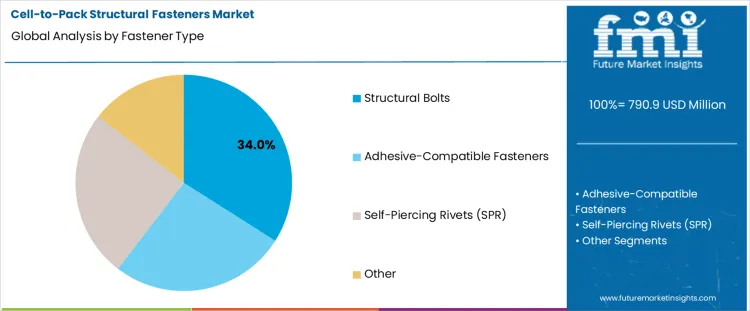
Structural bolts account for approximately 34% of total fastener type demand, making them the leading category. These bolts provide high-strength connections between cells and the pack frame, ensuring consistent mechanical pressure and alignment during charge-discharge cycles. Adoption is driven by the need to prevent cell movement, maintain electrical contact, and reduce stress concentrations that could degrade battery life. Operational procedures include torque calibration, inspection of thread engagement, and periodic verification under thermal expansion. Structural bolts are compatible with CTP designs that require uniform compression across multiple cells, enabling high-energy-density pack assemblies while supporting reliable heat dissipation and modular replacement.
Operational and mechanical factors further reinforce adoption. Bolts must resist vibration, shock, and thermal cycling without loosening or deforming. Structural bolts lead because they deliver predictable mechanical performance, maintain pack structural integrity, and support safety-critical battery operation. Adoption ensures even cell compression, minimizes risk of short circuits, and supports scalable manufacturing of high-capacity EV battery packs for passenger and commercial vehicles.
Why Is Cell-to-Pack Architecture Representing the Largest Segment in Structural Fasteners?
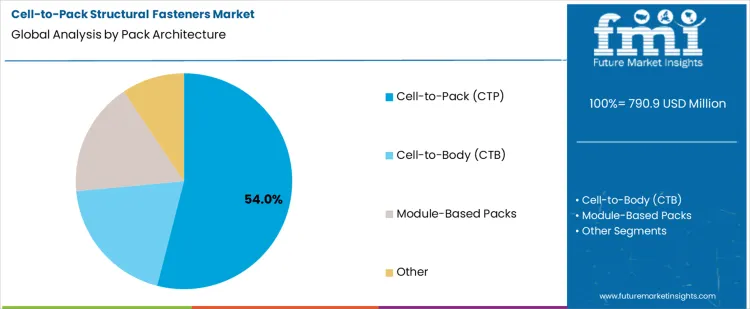
Cell-to-pack (CTP) configurations account for approximately 54% of total pack architecture demand, making them the largest segment. Adoption is driven by compact design, improved volumetric energy density, and simplified module assembly. Fasteners in CTP systems must maintain secure cell alignment, manage mechanical loads from thermal expansion, and withstand vibration over vehicle life. Operational procedures include torque application, alignment checks, and verification of clamping uniformity across the pack. CTP designs benefit from standardized fastener integration, enabling efficient assembly and minimizing manufacturing errors.
Thermal and operational stresses further reinforce adoption. Fasteners must sustain repeated charge-discharge cycles, mechanical shocks, and vibration while preserving cell alignment. CTP architecture leads because fasteners provide reliable mechanical stability, consistent compression, and long-term safety. Their use ensures enhanced battery performance, structural durability, and scalable assembly, making CTP the preferred configuration for modern electric vehicle packs.
How Are Structural Fasteners Supporting Battery Pack Integrity?
Cell-to-pack structural fasteners are increasingly adopted in electric vehicles and stationary energy storage systems to secure battery cells and modules within packs while maintaining structural rigidity. Adoption is strongest in regions with high EV production, large-scale battery assembly, and rigorous safety testing requirements. Fasteners are selected for mechanical strength, thermal expansion tolerance, and vibration resistance. Growth is driven by the need to maintain pack integrity under dynamic driving conditions, ensure consistent cell alignment, and support long-term battery performance. Investment focuses on material toughness, torque precision, and compatibility with modular pack designs. OEMs prioritize fasteners that prevent movement, improve thermal stability, and maintain electrical contact.
Why Are Pack Design Complexity and Thermal Expansion Challenges Driving Demand?
Demand is shaped by multi-cell pack architectures, high energy density requirements, and thermal management needs. Manufacturers adopt fasteners capable of accommodating cell expansion, mechanical loads, and vibration without loosening or deforming. Components offering predictable deformation, high fatigue resistance, and corrosion protection gain preference. Adoption is concentrated in regions with advanced EV manufacturing and high-density battery pack deployment. Operational reliability, structural integrity, and thermal stability drive procurement more than cost. Suppliers providing validated, durable fasteners gain advantage among battery pack integrators and EV OEMs.
What Factors Limit Broader Deployment of Cell-to-Pack Fasteners?
High precision installation, torque consistency, and material compatibility restrict adoption. Fastener performance can be affected by repeated charge-discharge cycles, vibration, and temperature fluctuations. Integration with complex pack layouts, cooling systems, and electrical busbars requires technical expertise. Smaller manufacturers or regions with limited battery assembly infrastructure adopt solutions more slowly. Early deployment is concentrated among premium EV OEMs, large battery integrators, and regions with established high-density pack manufacturing capabilities.
How Are Load Distribution and Material Selection Influencing Market Dynamics?
Fasteners are designed to provide uniform clamping, withstand vibration, and tolerate thermal cycling while maintaining cell alignment. Collaboration between fastener suppliers, battery module designers, and OEM engineers ensures pack rigidity, operational durability, and safe handling. Pilot testing evaluates torque retention, thermal tolerance, and mechanical stability before full-scale adoption. Quality monitoring, standardized installation procedures, and material certification maintain consistent performance. Focus is on structural integrity, thermal management, and pack reliability rather than cost or volume. These approaches enable broader adoption of cell-to-pack structural fasteners across EV and energy storage applications.
What is the Demand for Cell-to-Pack Structural Fasteners by Country?
| Country | CAGR (%) |
|---|---|
| China | 11.7% |
| India | 11.1% |
| USA | 10.4% |
| South Korea | 10.0% |
| Germany | 9.6% |
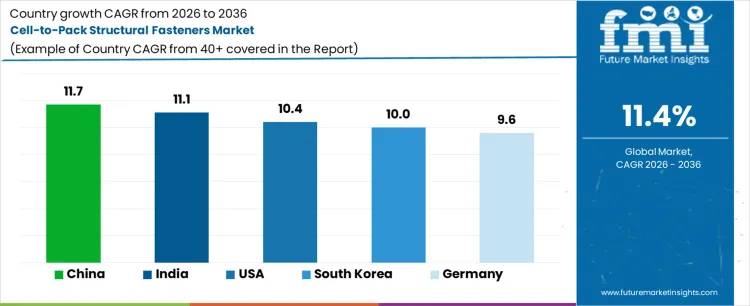
Demand for cell-to-pack structural fasteners is rising as electric vehicle and battery manufacturers focus on enhancing battery pack safety, structural integrity, and energy efficiency. China leads with an 11.7% CAGR, driven by rapid EV adoption, large-scale battery assembly, and integration of high-performance structural fasteners. India follows at 11.1%, supported by expanding EV production, domestic battery manufacturing, and adoption of advanced fastening solutions. The USA grows at 10.4%, shaped by electrification initiatives, fleet deployment, and emphasis on battery pack durability. South Korea records 10.0% growth, influenced by global battery supply chains and export-oriented EV production. Germany shows 9.6% CAGR, reflecting strong adoption in European EVs and industrial battery packs.
How is China experiencing growth in the cell-to-pack structural fasteners market?
China is experiencing growth at a CAGR of 11.7%, supported by adoption of cell-to-pack structural fasteners market solutions to improve battery module assembly, structural stability, and safety in electric vehicle and energy storage systems. Manufacturers and suppliers are producing fasteners optimized for high tensile strength, vibration resistance, and thermal stability. Demand is concentrated in EV manufacturing hubs, battery module production centers, and research facilities. Investments focus on material performance, system reliability, and compliance with automotive and battery safety standards rather than large-scale deployment. Growth reflects rising EV production, industrial adoption of high-performance fasteners, and increasing demand for durable, safe battery systems.
- EV battery assembly drives adoption.
- Fasteners enhance tensile strength, vibration resistance, and thermal stability.
- EV hubs and battery production centers concentrate demand.
- Material performance and safety compliance guide investment.
How is India witnessing growth in the cell-to-pack structural fasteners market?
India is witnessing growth at a CAGR of 11.1%, fueled by adoption of cell-to-pack structural fasteners market solutions to ensure structural reliability, thermal management, and operational safety in battery module assemblies. Manufacturers and suppliers are deploying fasteners optimized for vibration resistance, load-bearing capacity, and integration with battery packs. Demand is concentrated in EV manufacturing hubs, battery production facilities, and industrial R&D centers. Investments prioritize material durability, system performance, and adherence to automotive and battery safety standards rather than fleet-scale deployment. Growth reflects increasing EV adoption, industrial focus on battery safety, and integration of high-performance fasteners.
- Battery module reliability drives adoption.
- Fasteners improve vibration resistance, load capacity, and thermal performance.
- EV hubs and R&D centers concentrate demand.
- Material durability and compliance guide investment.
How is the United States experiencing growth in the cell-to-pack structural fasteners market?
United States is experiencing growth at a CAGR of 10.4%, supported by adoption of cell-to-pack structural fasteners market solutions to enhance structural integrity, thermal stability, and safety in EV and energy storage battery modules. Manufacturers and suppliers are producing fasteners optimized for load-bearing capacity, vibration resistance, and high-temperature performance. Demand is concentrated in EV manufacturing hubs, battery module production facilities, and research centers. Investments focus on material quality, system reliability, and compliance with automotive and battery standards rather than large-scale deployment. Growth reflects industrial adoption of EV technologies and demand for durable, high-performance battery assemblies.
- EV and energy storage adoption drives growth.
- Fasteners optimize load capacity, vibration resistance, and thermal stability.
- EV hubs and battery production centers concentrate demand.
- Material quality and compliance guide investment.
How is South Korea witnessing growth in the cell-to-pack structural fasteners market?
South Korea is witnessing growth at a CAGR of 10%, fueled by adoption of cell-to-pack structural fasteners market solutions to support battery module structural integrity, vibration resistance, and thermal management in electric vehicles. Manufacturers and suppliers are deploying fasteners optimized for tensile strength, high-temperature performance, and load-bearing reliability. Demand is concentrated in EV manufacturing hubs, battery module facilities, and industrial R&D centers. Investments prioritize material performance, system reliability, and compliance with battery and automotive safety standards rather than fleet-scale deployment. Growth reflects industrial adoption of EV technologies and focus on safe, durable battery modules.
- Structural integrity drives adoption.
- Fasteners enhance vibration resistance, load-bearing, and thermal performance.
- EV hubs and battery module facilities concentrate demand.
- Material performance and compliance guide investment.
How is Germany experiencing growth in the cell-to-pack structural fasteners market?
Germany is experiencing growth at a CAGR of 9.6%, supported by adoption of cell-to-pack structural fasteners market solutions to improve battery module assembly reliability, thermal stability, and safety in electric vehicles and energy storage systems. Manufacturers and suppliers are producing fasteners optimized for vibration resistance, load-bearing strength, and thermal performance. Demand is concentrated in EV production hubs, battery manufacturing facilities, and R&D centers. Investments focus on material durability, system reliability, and adherence to automotive and battery safety standards rather than large-scale deployment. Growth reflects industrial adoption of high-performance fasteners and increasing focus on battery safety and module reliability.
- Battery module assembly drives adoption.
- Fasteners optimize vibration resistance, load-bearing, and thermal performance.
- EV hubs and battery manufacturing centers concentrate demand.
- Material durability and compliance guide investment.
Who Competes in the Cell-to-Pack Structural Fasteners Market and What Defines Their Capabilities?
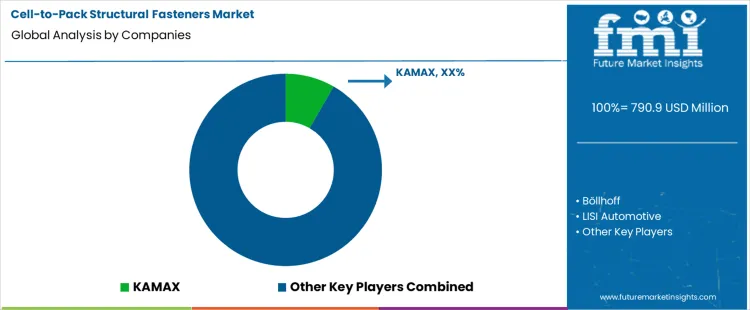
Competition in the cell-to-pack structural fasteners market is defined by mechanical strength, thermal tolerance, and compliance with electric vehicle battery assembly requirements. KAMAX supplies high-strength fasteners engineered to maintain structural integrity and uniform clamping in cell-to-pack connections. Böllhoff provides fasteners optimized for vibration resistance, torque consistency, and thermal stability in battery pack assemblies. LISI Automotive develops precision fasteners ensuring secure module attachment while supporting high-volume production. Stanley Engineered Fastening delivers components designed for durability under repeated thermal and mechanical cycling. Bossard Group supplies modular fasteners optimized for uniform compression and structural reliability.
SFS Group provides high-precision fasteners compatible with diverse cell-to-pack configurations. Nedschroef supplies durable fasteners engineered for thermal and mechanical stability. Bulten delivers high-strength fasteners optimized for EV battery pack integration. Sundram Fasteners provides large-volume production solutions for structural battery fastening. Other regional and specialty suppliers focus on fasteners for uniform load distribution, high-voltage insulation compatibility, and corrosion resistance. Competitive differentiation arises from mechanical reliability, thermal tolerance, torque precision, and ability to maintain structural integrity in multi-cell battery pack assemblies.
Key Players in the Cell-to-Pack Structural Fasteners Market
- KAMAX
- Böllhoff
- LISI Automotive
- Stanley Engineered Fastening
- Bossard Group
- SFS Group
- Nedschroef
- Bulten
- Sundram Fasteners
Scope of the Report
| Items | Values |
|---|---|
| Quantitative Units (2026) | USD million |
| Fastener Type | Structural Bolts, Adhesive-Compatible Fasteners, Self-Piercing Rivets (SPR), Other |
| Pack Architecture | Cell-to-Pack (CTP), Cell-to-Body (CTB), Module-Based Packs, Other |
| Material/Coating | Zinc-Nickel Coated, Aluminum, Stainless Steel, Other |
| Sales Channel | OEM/Tier 1 Supply, Contract Assembly, Aftermarket Service, Other |
| Region | Asia Pacific, Europe, North America, Latin America, Middle East & Africa |
| Key Countries Covered | China, India, USA, South Korea, Germany |
| Key Companies Profiled | KAMAX, Böllhoff, LISI Automotive, Stanley Engineered Fastening, Bossard Group, SFS Group, Nedschroef, Bulten, Sundram Fasteners |
| Additional Attributes | Dollar sales by fastener type, pack architecture, and material; regional CAGR, volume and value growth projections; adoption across CTP, CTB, and module-based battery packs; focus on structural integrity, thermal stability, and vibration resistance; margins concentrated among suppliers delivering certified, high-performance fasteners; competitive advantage from OEM partnerships, validated thermal and mechanical performance, and integration with multi-cell battery pack assemblies. |
Cell-to-Pack Structural Fasteners Market Segmentation
Fastener Type:
- Structural Bolts
- Adhesive-Compatible Fasteners
- Self-Piercing Rivets (SPR)
- Other
Pack Architecture:
- Cell-to-Pack (CTP)
- Cell-to-Body (CTB)
- Module-Based Packs
- Other
Material/Coating:
- Zinc-Nickel Coated
- Aluminum
- Stainless Steel
- Other
Sales Channel:
- OEM/Tier 1 Supply
- Contract Assembly
- Aftermarket Service
- Other
Region:
- Asia Pacific
- China
- Japan
- South Korea
- India
- Australia & New Zealand
- ASEAN
- Rest of Asia Pacific
- Europe
- Germany
- United Kingdom
- France
- Italy
- Spain
- Nordic
- BENELUX
- Rest of Europe
- North America
- United States
- Canada
- Mexico
- Latin America
- Brazil
- Chile
- Rest of Latin America
- Middle East & Africa
- Kingdom of Saudi Arabia
- Other GCC Countries
- Turkey
- South Africa
- Other African Union
- Rest of Middle East & Africa
Bibliography
- United Nations Economic Commission for Europe (UNECE). (2024). UN Regulation No. 100 - Uniform provisions concerning the approval of vehicles with regard to electric powertrain safety, including battery mechanical integrity and crash safety.
- National Highway Traffic Safety Administration (NHTSA). (2024). Federal Motor Vehicle Safety Standards (FMVSS) No. 305 - Electric-powered vehicles: Electrolyte spillage and electrical shock protection.
- International Electrotechnical Commission (IEC). (2024). IEC 62660-1 - Secondary lithium-ion cells for the propulsion of electric road vehicles: Performance testing.
- European Commission, Joint Research Centre (JRC). (2024). Battery safety, crashworthiness, and structural integration of traction battery packs in electric vehicles.
Frequently Asked Questions
How big is the cell-to-pack structural fasteners market in 2026?
The global cell-to-pack structural fasteners market is estimated to be valued at USD 790.9 million in 2026.
What will be the size of cell-to-pack structural fasteners market in 2036?
The market size for the cell-to-pack structural fasteners market is projected to reach USD 2,327.9 million by 2036.
How much will be the cell-to-pack structural fasteners market growth between 2026 and 2036?
The cell-to-pack structural fasteners market is expected to grow at a 11.4% CAGR between 2026 and 2036.
What are the key product types in the cell-to-pack structural fasteners market?
The key product types in cell-to-pack structural fasteners market are structural bolts, adhesive-compatible fasteners, self-piercing rivets (spr) and other.
Which pack architecture segment to contribute significant share in the cell-to-pack structural fasteners market in 2026?
In terms of pack architecture, cell-to-pack (ctp) segment to command 54.0% share in the cell-to-pack structural fasteners market in 2026.
Preview the report firsthand - request a free sample
Get SampleGet the brochure for pricing and purchase details.
Get PDFTable of Content
- Executive Summary
- Global Market Outlook
- Demand-side Trends
- Supply-side Trends
- Technology Roadmap Analysis
- Analysis and Recommendations
- Market Overview
- Market Coverage / Taxonomy
- Market Definition / Scope / Limitations
- Market Background
- Market Dynamics
- Drivers
- Restraints
- Opportunity
- Trends
- Scenario Forecast
- Demand in Optimistic Scenario
- Demand in Likely Scenario
- Demand in Conservative Scenario
- Opportunity Map Analysis
- Product Life Cycle Analysis
- Supply Chain Analysis
- Investment Feasibility Matrix
- Value Chain Analysis
- PESTLE and Porter’s Analysis
- Regulatory Landscape
- Regional Parent Market Outlook
- Production and Consumption Statistics
- Import and Export Statistics
- Market Dynamics
- Global Market Analysis 2021 to 2025 and Forecast, 2026 to 2036
- Historical Market Size Value (USD Million) Analysis, 2021 to 2025
- Current and Future Market Size Value (USD Million) Projections, 2026 to 2036
- Y-o-Y Growth Trend Analysis
- Absolute $ Opportunity Analysis
- Global Market Pricing Analysis 2021 to 2025 and Forecast 2026 to 2036
- Global Market Analysis 2021 to 2025 and Forecast 2026 to 2036, By Fastener Type
- Introduction / Key Findings
- Historical Market Size Value (USD Million) Analysis By Fastener Type , 2021 to 2025
- Current and Future Market Size Value (USD Million) Analysis and Forecast By Fastener Type , 2026 to 2036
- Structural Bolts
- Adhesive-Compatible Fasteners
- Self-Piercing Rivets (SPR)
- Other
- Structural Bolts
- Y-o-Y Growth Trend Analysis By Fastener Type , 2021 to 2025
- Absolute $ Opportunity Analysis By Fastener Type , 2026 to 2036
- Global Market Analysis 2021 to 2025 and Forecast 2026 to 2036, By Pack Architecture
- Introduction / Key Findings
- Historical Market Size Value (USD Million) Analysis By Pack Architecture, 2021 to 2025
- Current and Future Market Size Value (USD Million) Analysis and Forecast By Pack Architecture, 2026 to 2036
- Cell-to-Pack (CTP)
- Cell-to-Body (CTB)
- Module-Based Packs
- Other
- Cell-to-Pack (CTP)
- Y-o-Y Growth Trend Analysis By Pack Architecture, 2021 to 2025
- Absolute $ Opportunity Analysis By Pack Architecture, 2026 to 2036
- Global Market Analysis 2021 to 2025 and Forecast 2026 to 2036, By Material/Coating
- Introduction / Key Findings
- Historical Market Size Value (USD Million) Analysis By Material/Coating, 2021 to 2025
- Current and Future Market Size Value (USD Million) Analysis and Forecast By Material/Coating, 2026 to 2036
- Zinc-Nickel Coated
- Aluminum
- Stainless Steel
- Other
- Zinc-Nickel Coated
- Y-o-Y Growth Trend Analysis By Material/Coating, 2021 to 2025
- Absolute $ Opportunity Analysis By Material/Coating, 2026 to 2036
- Global Market Analysis 2021 to 2025 and Forecast 2026 to 2036, By Sales Channel
- Introduction / Key Findings
- Historical Market Size Value (USD Million) Analysis By Sales Channel, 2021 to 2025
- Current and Future Market Size Value (USD Million) Analysis and Forecast By Sales Channel, 2026 to 2036
- OEM and Tier 1 Supply
- Contract Assembly
- Aftermarket Service
- Other
- OEM and Tier 1 Supply
- Y-o-Y Growth Trend Analysis By Sales Channel, 2021 to 2025
- Absolute $ Opportunity Analysis By Sales Channel, 2026 to 2036
- Global Market Analysis 2021 to 2025 and Forecast 2026 to 2036, By Region
- Introduction
- Historical Market Size Value (USD Million) Analysis By Region, 2021 to 2025
- Current Market Size Value (USD Million) Analysis and Forecast By Region, 2026 to 2036
- North America
- Latin America
- Western Europe
- Eastern Europe
- East Asia
- South Asia and Pacific
- Middle East & Africa
- Market Attractiveness Analysis By Region
- North America Market Analysis 2021 to 2025 and Forecast 2026 to 2036, By Country
- Historical Market Size Value (USD Million) Trend Analysis By Market Taxonomy, 2021 to 2025
- Market Size Value (USD Million) Forecast By Market Taxonomy, 2026 to 2036
- By Country
- USA
- Canada
- Mexico
- By Fastener Type
- By Pack Architecture
- By Material/Coating
- By Sales Channel
- By Country
- Market Attractiveness Analysis
- By Country
- By Fastener Type
- By Pack Architecture
- By Material/Coating
- By Sales Channel
- Key Takeaways
- Latin America Market Analysis 2021 to 2025 and Forecast 2026 to 2036, By Country
- Historical Market Size Value (USD Million) Trend Analysis By Market Taxonomy, 2021 to 2025
- Market Size Value (USD Million) Forecast By Market Taxonomy, 2026 to 2036
- By Country
- Brazil
- Chile
- Rest of Latin America
- By Fastener Type
- By Pack Architecture
- By Material/Coating
- By Sales Channel
- By Country
- Market Attractiveness Analysis
- By Country
- By Fastener Type
- By Pack Architecture
- By Material/Coating
- By Sales Channel
- Key Takeaways
- Western Europe Market Analysis 2021 to 2025 and Forecast 2026 to 2036, By Country
- Historical Market Size Value (USD Million) Trend Analysis By Market Taxonomy, 2021 to 2025
- Market Size Value (USD Million) Forecast By Market Taxonomy, 2026 to 2036
- By Country
- Germany
- UK
- Italy
- Spain
- France
- Nordic
- BENELUX
- Rest of Western Europe
- By Fastener Type
- By Pack Architecture
- By Material/Coating
- By Sales Channel
- By Country
- Market Attractiveness Analysis
- By Country
- By Fastener Type
- By Pack Architecture
- By Material/Coating
- By Sales Channel
- Key Takeaways
- Eastern Europe Market Analysis 2021 to 2025 and Forecast 2026 to 2036, By Country
- Historical Market Size Value (USD Million) Trend Analysis By Market Taxonomy, 2021 to 2025
- Market Size Value (USD Million) Forecast By Market Taxonomy, 2026 to 2036
- By Country
- Russia
- Poland
- Hungary
- Balkan & Baltic
- Rest of Eastern Europe
- By Fastener Type
- By Pack Architecture
- By Material/Coating
- By Sales Channel
- By Country
- Market Attractiveness Analysis
- By Country
- By Fastener Type
- By Pack Architecture
- By Material/Coating
- By Sales Channel
- Key Takeaways
- East Asia Market Analysis 2021 to 2025 and Forecast 2026 to 2036, By Country
- Historical Market Size Value (USD Million) Trend Analysis By Market Taxonomy, 2021 to 2025
- Market Size Value (USD Million) Forecast By Market Taxonomy, 2026 to 2036
- By Country
- China
- Japan
- South Korea
- By Fastener Type
- By Pack Architecture
- By Material/Coating
- By Sales Channel
- By Country
- Market Attractiveness Analysis
- By Country
- By Fastener Type
- By Pack Architecture
- By Material/Coating
- By Sales Channel
- Key Takeaways
- South Asia and Pacific Market Analysis 2021 to 2025 and Forecast 2026 to 2036, By Country
- Historical Market Size Value (USD Million) Trend Analysis By Market Taxonomy, 2021 to 2025
- Market Size Value (USD Million) Forecast By Market Taxonomy, 2026 to 2036
- By Country
- India
- ASEAN
- Australia & New Zealand
- Rest of South Asia and Pacific
- By Fastener Type
- By Pack Architecture
- By Material/Coating
- By Sales Channel
- By Country
- Market Attractiveness Analysis
- By Country
- By Fastener Type
- By Pack Architecture
- By Material/Coating
- By Sales Channel
- Key Takeaways
- Middle East & Africa Market Analysis 2021 to 2025 and Forecast 2026 to 2036, By Country
- Historical Market Size Value (USD Million) Trend Analysis By Market Taxonomy, 2021 to 2025
- Market Size Value (USD Million) Forecast By Market Taxonomy, 2026 to 2036
- By Country
- Kingdom of Saudi Arabia
- Other GCC Countries
- Turkiye
- South Africa
- Other African Union
- Rest of Middle East & Africa
- By Fastener Type
- By Pack Architecture
- By Material/Coating
- By Sales Channel
- By Country
- Market Attractiveness Analysis
- By Country
- By Fastener Type
- By Pack Architecture
- By Material/Coating
- By Sales Channel
- Key Takeaways
- Key Countries Market Analysis
- USA
- Pricing Analysis
- Market Share Analysis, 2025
- By Fastener Type
- By Pack Architecture
- By Material/Coating
- By Sales Channel
- Canada
- Pricing Analysis
- Market Share Analysis, 2025
- By Fastener Type
- By Pack Architecture
- By Material/Coating
- By Sales Channel
- Mexico
- Pricing Analysis
- Market Share Analysis, 2025
- By Fastener Type
- By Pack Architecture
- By Material/Coating
- By Sales Channel
- Brazil
- Pricing Analysis
- Market Share Analysis, 2025
- By Fastener Type
- By Pack Architecture
- By Material/Coating
- By Sales Channel
- Chile
- Pricing Analysis
- Market Share Analysis, 2025
- By Fastener Type
- By Pack Architecture
- By Material/Coating
- By Sales Channel
- Germany
- Pricing Analysis
- Market Share Analysis, 2025
- By Fastener Type
- By Pack Architecture
- By Material/Coating
- By Sales Channel
- UK
- Pricing Analysis
- Market Share Analysis, 2025
- By Fastener Type
- By Pack Architecture
- By Material/Coating
- By Sales Channel
- Italy
- Pricing Analysis
- Market Share Analysis, 2025
- By Fastener Type
- By Pack Architecture
- By Material/Coating
- By Sales Channel
- Spain
- Pricing Analysis
- Market Share Analysis, 2025
- By Fastener Type
- By Pack Architecture
- By Material/Coating
- By Sales Channel
- France
- Pricing Analysis
- Market Share Analysis, 2025
- By Fastener Type
- By Pack Architecture
- By Material/Coating
- By Sales Channel
- India
- Pricing Analysis
- Market Share Analysis, 2025
- By Fastener Type
- By Pack Architecture
- By Material/Coating
- By Sales Channel
- ASEAN
- Pricing Analysis
- Market Share Analysis, 2025
- By Fastener Type
- By Pack Architecture
- By Material/Coating
- By Sales Channel
- Australia & New Zealand
- Pricing Analysis
- Market Share Analysis, 2025
- By Fastener Type
- By Pack Architecture
- By Material/Coating
- By Sales Channel
- China
- Pricing Analysis
- Market Share Analysis, 2025
- By Fastener Type
- By Pack Architecture
- By Material/Coating
- By Sales Channel
- Japan
- Pricing Analysis
- Market Share Analysis, 2025
- By Fastener Type
- By Pack Architecture
- By Material/Coating
- By Sales Channel
- South Korea
- Pricing Analysis
- Market Share Analysis, 2025
- By Fastener Type
- By Pack Architecture
- By Material/Coating
- By Sales Channel
- Russia
- Pricing Analysis
- Market Share Analysis, 2025
- By Fastener Type
- By Pack Architecture
- By Material/Coating
- By Sales Channel
- Poland
- Pricing Analysis
- Market Share Analysis, 2025
- By Fastener Type
- By Pack Architecture
- By Material/Coating
- By Sales Channel
- Hungary
- Pricing Analysis
- Market Share Analysis, 2025
- By Fastener Type
- By Pack Architecture
- By Material/Coating
- By Sales Channel
- Kingdom of Saudi Arabia
- Pricing Analysis
- Market Share Analysis, 2025
- By Fastener Type
- By Pack Architecture
- By Material/Coating
- By Sales Channel
- Turkiye
- Pricing Analysis
- Market Share Analysis, 2025
- By Fastener Type
- By Pack Architecture
- By Material/Coating
- By Sales Channel
- South Africa
- Pricing Analysis
- Market Share Analysis, 2025
- By Fastener Type
- By Pack Architecture
- By Material/Coating
- By Sales Channel
- USA
- Market Structure Analysis
- Competition Dashboard
- Competition Benchmarking
- Market Share Analysis of Top Players
- By Regional
- By Fastener Type
- By Pack Architecture
- By Material/Coating
- By Sales Channel
- Competition Analysis
- Competition Deep Dive
- KAMAX
- Overview
- Product Portfolio
- Profitability by Market Segments (Product/Age /Sales Channel/Region)
- Sales Footprint
- Strategy Overview
- Marketing Strategy
- Product Strategy
- Channel Strategy
- Böllhoff
- LISI Automotive
- Stanley Engineered Fastening
- Bossard Group
- SFS Group
- Nedschroef
- Bulten
- Sundram Fasteners
- KAMAX
- Competition Deep Dive
- Assumptions & Acronyms Used
- Research Methodology


