

- Market Size (2026)
- USD 0.82 Bn
- Forecast (2036)
- USD 6.82 Bn
- CAGR (2026 to 2036)
- 23.6%
Second-Life Automotive Battery Module Systems Market Size, Market Forecast and Outlook by FMI
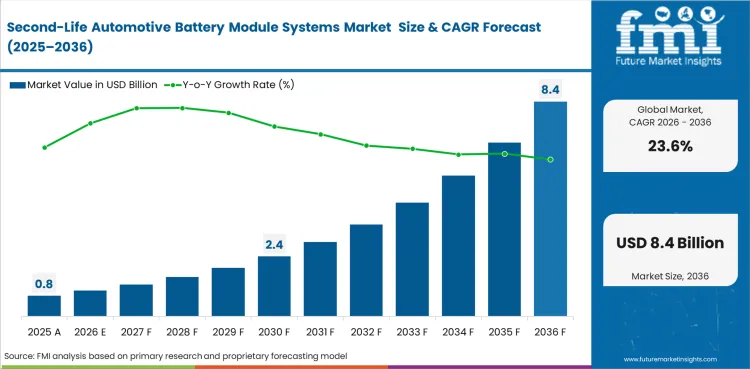
The industry is estimated at USD 0.66 billion in 2025 and is projected to reach USD 0.82 billion in 2026 before advancing to USD 6.82 billion by 2036. That implies a CAGR of 23.6% and an incremental opportunity of USD 6.00 billion.
Summary of Second-Life Automotive Battery Module Systems Market
- The market is estimated at USD 0.82 billion in 2026 and is forecast to reach USD 6.82 billion by 2036.
- The market was valued at USD 0.66 billion in 2025.
- The ten-year outlook reflects a CAGR of 23.6% and an incremental opportunity of USD 6.0 billion.
- NMC modules are expected to remain the leading chemistry block with 43.0% share in 2026.
- Passenger EVs are projected to stay the largest source vehicle stream with 58.0% share in 2026.
- Grid support is expected to remain the leading application route with 34.0% share in 2026.
- Containerized systems are likely to lead integration formats with 39.0% share in 2026.
- Commercial industrial deployments are expected to hold the largest end-use share at 36.0% in 2026.
Key Takeaways, Market Size, and Forecast
- Second-Life Automotive Battery Module Systems Market is projected to grow from USD 0.82 billion in 2026 to USD 6.82 billion by 2036, at a CAGR of 23.6%.
- The second-life automotive battery module systems market was valued at USD 0.66 billion in 2025.
- By 2036, the Second-Life Automotive Battery Module Systems Market is expected to be worth USD 6.82 billion.
- From 2026 to 2036, the market is anticipated to expand at a CAGR of 23.6%.
- The market is predicted to create an incremental opportunity of USD 6.00 billion between 2026 and 2036.
- In 2026, NMC Modules are expected to account for 43.0% of the chemistry segment.
- India (27.4%) and China (25.8%) are projected to be two of the fastest growing markets.
Second-Life Automotive Battery Module Systems Market Key Takeaways
| Parameter | Details |
|---|---|
| Market value (2026) | USD 0.82 billion |
| Forecast value (2036) | USD 6.82 billion |
| CAGR (2026 to 2036) | 23.6% |
| Estimated market value (2025) | USD 0.66 billion |
| Incremental opportunity | USD 6.00 billion |
| Leading chemistry | NMC modules with 43.0% share |
| Leading application | Grid support with 34.0% share |
| Leading source vehicle | Passenger EVs with 58.0% share |
| Leading sales channel | Direct OEM deals with 52.0% share |
| Key players | Connected Energy, Element Energy, Moment Energy, B2U Storage Solutions, BeePlanet Factory, Smartville, ECO STOR |
Source: Future Market Insights, 2026
Growth is being supported by larger future return volumes from first-life EVs and rising emphasis on lifecycle traceability. Second-life storage systems are now included in broader battery energy storage systems and grid-scale storage investment, although value still depends on disciplined diagnostics and safe packaging. Demand is predicted to be generated from applications where cost sensitivity is high and battery condition can be managed with software and power controls. Charging depots, logistics sites, commercial campuses, and public facilities often need storage that is cheaper than new batteries while still remaining dependable. That is why stationary storage execution and materials recycling all are influential factors in the forecast, as they decied both residual value and final recovery options.
India is expected to post the stable growth at 27.4% CAGR through 2036 as battery demand and future end-of-life availability are both rising from a lower starting point. China is projected at 25.8% CAGR due to unmatched EV scale and large retired battery volumes. The United States is estimated at 24.1% CAGR as reuse funding and charging-linked storage demand remain supportive. Germany at 22.6%, the United Kingdom at 21.9% CAGR, South Korea at 21.3% CAGR, and Japan at 20.7% CAGR should still record strong gains, although each market is likely to move through tighter testing and compliance screens as scale increases.
Second-Life Automotive Battery Module Systems Market Definition
The market includes stationary energy systems built mainly from battery modules or packs that have completed first-life service in electric cars, buses, vans, or trucks. It covers grading, reconfiguration, controls, thermal management, safety hardware, system integration, and operating software used to deploy retired automotive batteries in non-automotive applications.
Second-Life Automotive Battery Module Systems Market Inclusions
Scope includes repurposed lithium-ion automotive modules integrated into containers, cabinets, racks, or skid-based systems for charging support, backup power, renewable balancing, microgrids, and site resilience. It also includes module diagnostics, battery management, thermal controls, and project integration supplied by repurposing specialists or their partners.
Second-Life Automotive Battery Module Systems Market Exclusions
Scope excludes fresh EV batteries sold into vehicles, pure battery recycling revenues, black mass processing as a standalone business, cell manufacturing, and non-automotive batteries without a first-life vehicle origin. Software-only tools are excluded unless they are sold inside a repurposed battery module system.
Second-Life Automotive Battery Module Systems Market Research Methodology
- Primary Research: Public disclosures and current announcements from repurposing specialists, integrators, and policy bodies were reviewed to understand project scale, application fit, and qualification barriers.
- Desk Research: Official publications from energy agencies, transport regulators, and environmental ministries were used to track EV expansion, battery demand, circularity rules, and country-specific policy direction.
- Market Sizing and Forecasting: The model combines retired battery availability, repurposing yield assumptions, average realized system revenue, and deployment demand by application and geography.
- Data Validation and Update Cycle: Values were checked against current project sizes, country EV trends, battery lifecycle rules, and evidence from live second-use demonstrations.
Why Is the Second-Life Automotive Battery Module Systems Market Growing?
- Retired battery availability is expanding as the EV parc grows and more first-generation packs move toward stationary reuse windows.
- Charging hubs and commercial sites need storage that costs less than fresh batteries while still offering dependable operating life.
- Battery tracking rules and circularity programs are pushing automakers and reuse specialists to formalize second-life pathways.
The reuse industry does not scale on sustainability language alone. It scales when the upstream stream of spent batteries becomes large enough to support sorting and system integration at industrial cadence. Global EV sales exceeded 17 million in 2024, and that matters because future second-life supply depends on the batteries entering service today. Project developers also need downstream demand that can accept variable module age and chemistry. That demand is forming in charging as a service and EV chargers, where customers often value lower capex and flexible discharge profiles more than peak energy density.
Demand is also being supported by more visible project execution. DOE announced intent to fund up to USD 70 million for projects that improve battery recovery and re-use economics, and that support helps the industry invest in faster state-of-health testing and safer qualification methods. Moment Energy announced a US$20.3 million DOE award for a certified repurposing facility in the United States, while Forsee Power and Connected Energy agreed to work on reuse of electric bus batteries for larger storage projects. Related movement in charging stations and bidirectional charging strengthens the case for site-level storage that can absorb reused modules.
Segmental Analysis
- NMC modules are anticipated to remain the leading chemistry block with a 43.0% share in 2026.
- Passenger EVs are expected to stay the leading source vehicle stream with 58.0% share in 2026.
- Direct OEM deals and integrator-led procurement are projected to shape most bankable deployments.
Segmentation in the industry reflect both battery origin and stationary deployment economics. Chemistry affects thermal design and warranty assumptions, while source vehicle type shapes module geometry and return timing. Application mix is crucial as some use cases can tolerate wider performance variation than others. Integration format and sales route all influence project economics as well. A technically usable battery module is not automatically a commercially useful asset. Value depends on how efficiently suppliers can screen and support it for one clear duty cycle.
Insights into the Chemistry Segment
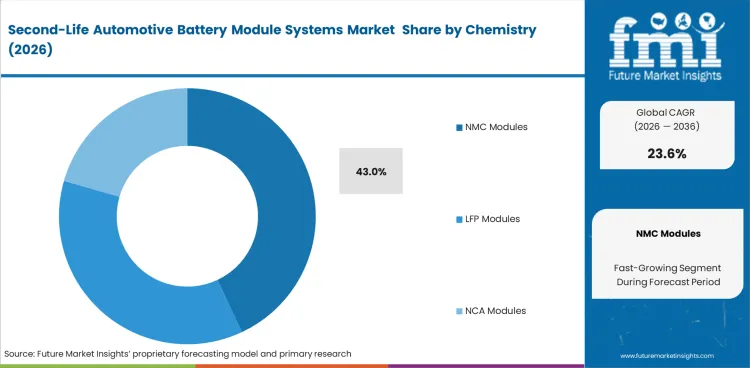
NMC modules are expected to account for 43.0% share in 2026. Their lead comes from the large installed base of earlier passenger EV fleets in Europe, China, and North America. These batteries often retain enough usable capacity for charging support, backup power, and commercial peak shaving after vehicle retirement. NMC also fits many repurposing workflows because operators already have more experience with its degradation behavior and thermal requirements. EV battery demand is expected to move from about 1 TWh in 2024 to more than 3 TWh in 2030, which means chemistry-specific reuse streams should deepen over time. Closer alignment with battery platforms and lithium-ion batteries should keep informing system design and project economics.
Insights into the Source Vehicle Segment
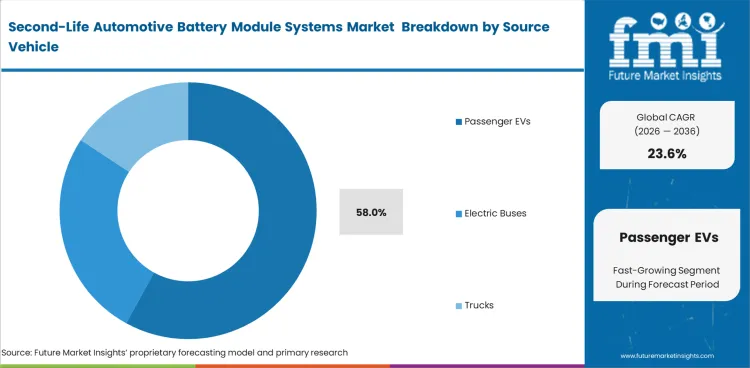
Passenger EVs are projected to contribute 58.0% of total market share in 2026. Their lead reflects the simple fact that passenger cars far outnumber buses, trucks, and vans in cumulative deployments. That gives repurposing firms a broader and steadier feedstock stream even though module formats remain fragmented across brands. Germany recorded 545,142 new BEV passenger car registrations in 2025, and similar trends across other large vehicle markets should enlarge future return volumes. Bus batteries still hold importance as se they are large and easier to trace through fleet channels, but passenger cars create the scale needed for industrial reuse.
Insights into the Application Segment
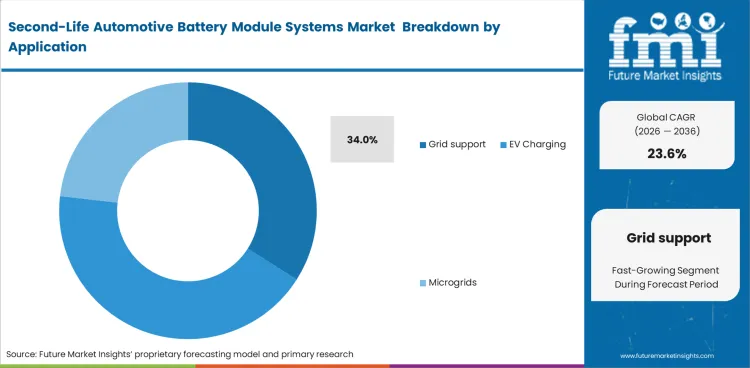
Grid support is likely to secure 34.0% share in 2026 because it offers one of the clearest value pools for repurposed modules. Site owners can use second-life systems to shave peaks, buffer charging loads, and support renewable output without paying for new packs in every case. The Smartville 360 project funded by DOE uses a 50 kW and 500 kWh system based on second-life EV batteries, showing how this format is already being commercialized. Developers still need strict controls around safety, module matching, and performance forecasting, but the application remains attractive because duty cycles can be tuned around battery condition. Related demand in ultra-fast charging batteries and industrial batteries remains supportive.
Insights into the Integration Format Segment
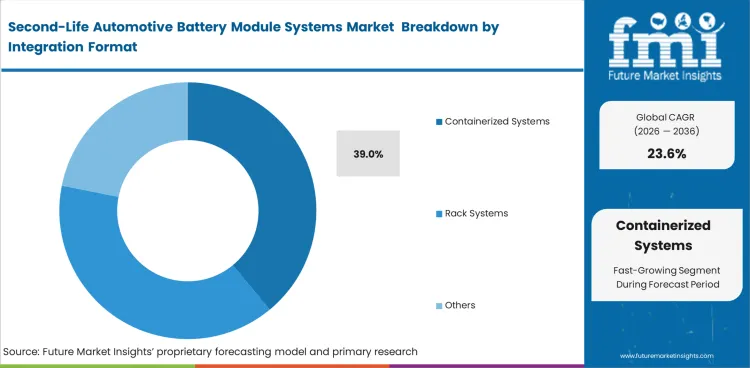
Containerized systems are set to make up 39.0% of the market in 2026. They lead because they simplify field deployment, isolate safety systems, and let suppliers standardize power electronics and thermal controls across multiple projects. Container units also suit the reality that repurposed battery inventories arrive in uneven batches and need controlled assembly off site before installation. Element Energy’s 53 MWh Texas commissioning showed that project developers are pushing second-life storage into larger formats rather than staying at pilot scale. Containers are not the best fit for every site, but they remain the easiest route for industrial customers that want turnkey installation with limited engineering burden. Current investment around battery energy storage systems supports this direction.
Insights into the Power Range Segment
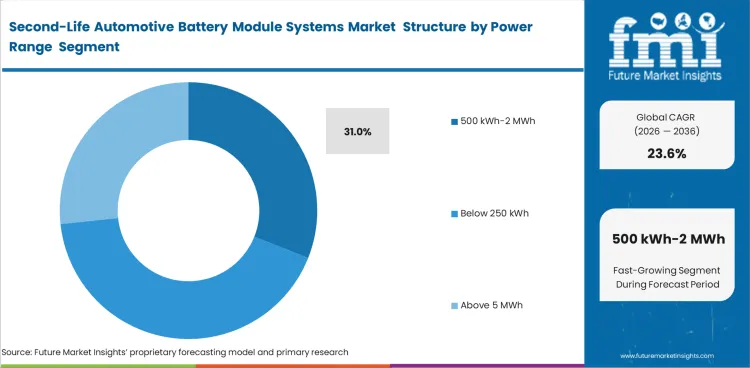
Market estimates place 500 kWh-2 MWh at 31.0% share in 2026. This range fits many charging depots, commercial buildings, logistics yards, and public infrastructure sites that need meaningful storage without moving into utility-scale project complexity. It is large enough to absorb mixed module inventories while still remaining manageable for installation and warranty control. Very small systems struggle to absorb qualification and engineering costs, while very large systems still require deeper proof of long-run performance from reused modules. That middle band therefore offers a workable balance between economics and technical risk. It also links closely with battery leasing services in some project structures.
Insights into the End Use Segment
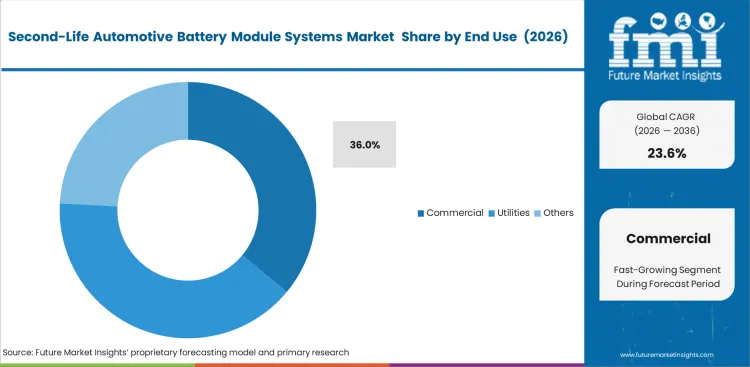
Commercial industrial deployments are expected to represent 36.0% of the market in 2026. This end-use lead reflects the growing need for demand charge control and charging support at facilities that cannot always justify fresh battery pricing. The United Kingdom added almost half a million BEVs in 2025, which should increase local need for charging-linked storage as fleets and workplaces electrify. Commercial customers also value project timeline and system cost more directly than some utility buyers, which gives second-life systems an easier entry point. Utilities remain important for visibility and scale, but many reuse projects should continue starting in private sites where economics are simpler to prove.
Insights into the Sales Channel Segment
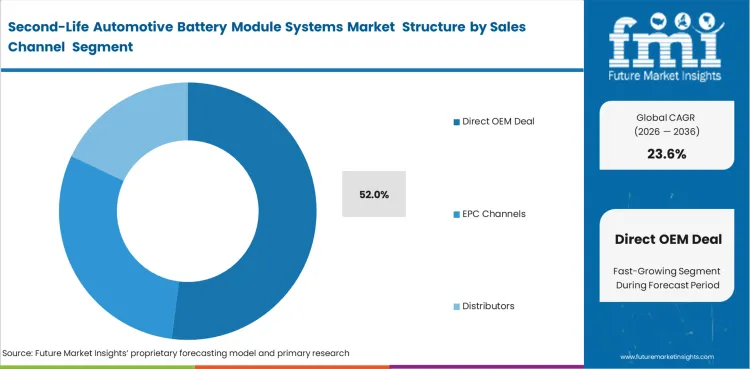
Direct OEM deals are expected to hold 52.0% share in 2026 as traceable battery intake is still one of the hardest constraints in this industry. Repurposers need known battery histories, predictable return streams, and cleaner transfer of assets. That is why agreements with automakers, fleet owners, and battery holders are more valuable than spot-market sourcing at this stage. Connected Energy’s June 2024 work with a Nissan-led consortium and its collaboration with Altilium both point to this route. System integrators and EPC channels will still matter as downstream sales paths, but upstream control over battery origin remains the strongest commercial lever in the current industry structure.
What Are the Drivers, Restraints, and Key Trends in the Second-Life Automotive Battery Module Systems Market?
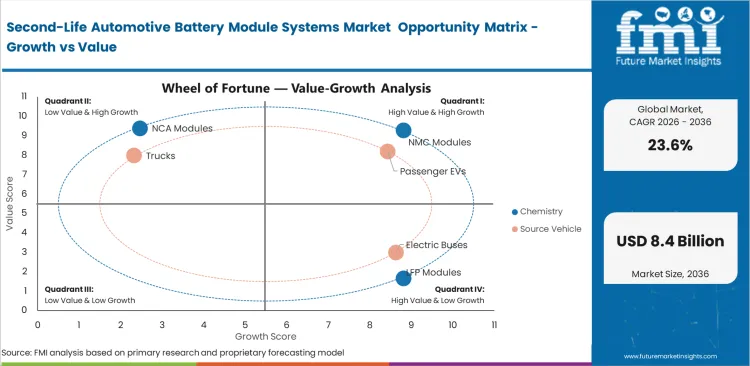
- Driver: rising EV retirement volumes are improving the economics of battery intake, grading, and reuse project planning.
- Restraint: module condition variance still forces expensive diagnostics, safety checks, and warranty conservatism.
- Trend: more projects are linking reuse with formal traceability, battery passport preparation, and downstream recycling arrangements.
Revenue generation opportunity in the industry is present between automotive afterlife management and stationary storage deployment, so it inherits complexity from both sides. Feedstock quality is uneven, the cost of testing remains material, and project buyers still expect bankable system behavior. Yet the direction is improving as countries move toward battery tracking and circularity rules that make reuse easier to document. Competitive advantage is therefore built less on battery volume and more on the ability to convert uncertain retired modules into predictable stationary assets. Suppliers that can shorten qualification time, improve traceability, and secure battery origin are likely to widen their lead during the forecast period.
Certification Burden
State-of-health measurement remains one of the heaviest cost centers in reuse projects. South Korea’s policy direction shows why. The country plans to establish a battery life cycle tracking system by 2027 and has already outlined recycled material certification and pre-removal performance evaluation. Those measures should support safer transactions over time, but they also raise the need for robust grading records, handling rules, and test data. This is one reason why many developers still focus on mid-size commercial projects rather than very large utility contracts. Better alignment with black mass processing and downstream recovery should gradually reduce that friction.
Channel Expansion
Commercial demand is widening around charging depots, logistics sites, municipal assets, and industrial plants where grid constraints and tariff exposure are rising. India’s battery demand is projected to increase from 16 GWh in 2023 to 248 GWh by 2035, while end-of-life availability rises from 19 kT to 233 kT. Those figures suggest a large future pool for reuse even though current circular infrastructure is still developing. Reuse suppliers that connect site-level storage with charging and renewable balancing should benefit first. Related activity in swapping infrastructure also shows how operators are seeking flexible battery-backed power options.
Product Improvement
System design is improving as repurposers get better at combining used modules with fresh controls, thermal management, and software supervision. Forsee Power’s May 2025 tie-up with Connected Energy and Element Energy’s 53 MWh commissioning both show that project ambition is moving upward. Better power electronics and software reduce the penalty of mixed module inventories because operators can manage duty cycle and degradation more closely. That does not remove chemistry variation, but it makes larger and more reliable stationary deployments more feasible. This also strengthens the role of EV chargers and site-integrated storage around real operating loads.
Sourcing Concentration
Battery origin remains a major commercial filter. Japan’s 2025 strategic energy plan aims for a domestic production base of 150 GWh per year by 2030 and explicitly notes promotion of reuse of vehicle-mounted storage batteries. China, meanwhile, expects retired power batteries to reach 1.04 million tonnes in 2025 and 3.5 million tonnes by 2030. Those signals show how feedstock depth and industrial policy can shape regional leadership. Companies with access to OEM-linked return streams are in a stronger position than firms trying to build projects from uncertain spot supply, especially as buyers ask for traceable provenance. Closely related activity in battery swap hardware remains relevant to the broader infrastructure buildout.
Analysis of Second-Life Automotive Battery Module Systems Market by Key Countries
- India is expected to lead at 27.4% CAGR through 2036 as battery demand and future end-of-life availability both rise quickly.
- China is projected at 25.8% CAGR because its huge EV base creates the deepest reuse feedstock pool.
- The United States at 24.1% CAGR remains supported by DOE re-use funding and charging-linked storage demand.
- Germany, the United Kingdom, South Korea, and Japan should all post growth above 20% as traceability systems mature.
.webp "Top Country Growth Comparison Second Life Automotive Battery Module Systems Market Cagr (2026 2036)")
| Country | CAGR |
|---|---|
| India | 27.4% |
| China | 25.8% |
| United States | 24.1% |
| Germany | 22.6% |
| United Kingdom | 21.9% |
| South Korea | 21.3% |
| Japan | 20.7% |
Source: FMI analysis based on primary research and proprietary forecasting model
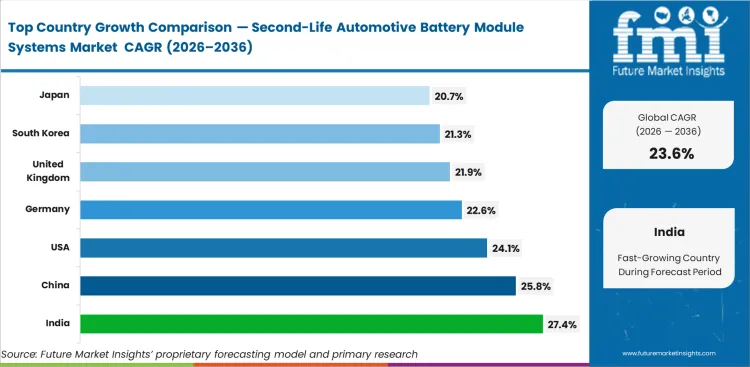
Country growth patterns differ mainly by feedstock depth, policy clarity, diagnostics capacity, and the maturity of stationary storage demand. India and China sit above the global base because both offer strong long-run battery availability, although their commercial pathways differ. The United States benefits from reuse funding and higher-value site applications, while Germany and the United Kingdom are shaped by strong vehicle transition trends and tighter compliance expectations. South Korea and Japan should remain important because policy support for lifecycle management is becoming more explicit.
Demand Outlook for Second-Life Automotive Battery Module Systems Market in India
India is projected to record a CAGR of 27.4% through 2036. The core reason is the expected rise in both battery demand and eventual end-of-life supply that can support reuse projects over the next decade. NITI Aayog estimates lithium-ion battery demand will rise from 16 GWh in 2023 to 248 GWh by 2035, while end-of-life availability climbs from 19 kT to 233 kT. That scale should attract module grading and charging-linked storage projects once collection and diagnostics infrastructure deepens. India is still early in formal circular systems and that smaller base leaves more room for growth in second-life deployments.
- India keeps adding first-life EV or battery infrastructure that will widen future reuse supply.
- India is building formalizing circularity and traceability rules around retired batteries.
- India offers clear demand from charging support or local grid balancing projects.
Demand Outlook for Second-Life Automotive Battery Module Systems Market in China
China is expected to register 25.8% CAGR through 2036. Its advantage comes from unmatched EV scale and a very large future stream of retired batteries that can be redirected into stationary uses. Official Chinese communication indicates retired power batteries should reach 1.04 million tonnes in 2025 and 3.5 million tonnes by 2030. That feedstock depth supports industrial reuse at a level other countries are still trying to establish. The main challenge is disciplined sortingand integration into storage projects with clear performance boundaries.
- China keeps adding first-life EV or battery infrastructure that will widen future reuse supply.
- The country is building or formalizing circularity or traceability rules around retired batteries.
- China offers clear demand from charging support or local grid balancing projects.
Demand Outlook for Second-Life Automotive Battery Module Systems Market in United States
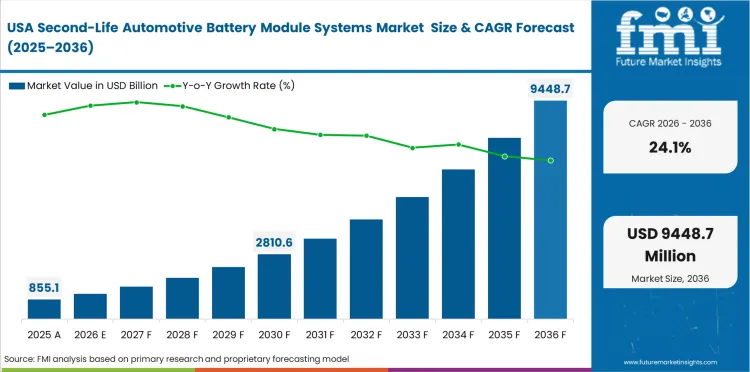
Demand in the United States is expected to rise at a CAGR of 24.1% through 2036. Federal support is helping shape the market early, especially for reuse diagnostics and demonstration projects. DOE announced intent to fund up to USD 70 million for projects that improve battery recovery and re-use economics, and the Smartville 360 award also shows real systems moving into the field. Commercial demand around charging, backup power, and site resilience gives reused modules an opening where cost matters strongly. The United States faces fragmented battery return channels, but stronger repurposing facilities and OEM partnerships should improve that picture over time.
- United States keeps adding first-life EV or battery infrastructure that will widen future reuse supply.
- United States is building or formalizing circularity, diagnostics, or traceability rules around retired batteries.
- United States offers clear demand from charging support, commercial resilience, or local grid balancing projects.
Demand Outlook for Second-Life Automotive Battery Module Systems Market in Germany
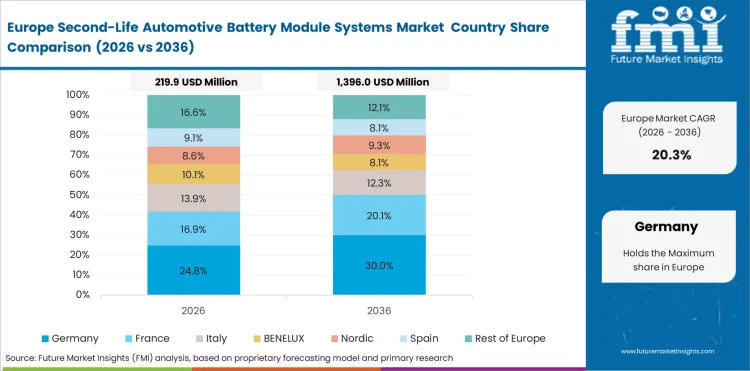
Germany is forecast to post 22.6% CAGR through 2036. The country is a critical future source of retired passenger EV batteries because its first-life electric car base keeps expanding. KBA reported 545,142 new BEV passenger car registrations in 2025, up 43.2% from the prior year. That does not translate into immediate second-life supply, yet it does build a sizable future stream for module repurposing. Germany also offers strong industrial demand for power quality, charging support, and renewable integration, which are practical entry points for reused systems. Growth will depend on how efficiently suppliers align battery traceability, diagnostics, and stationary certification.
- Germany keeps adding first-life EV or battery infrastructure that will widen future reuse supply.
- Germany is building or formalizing circularity, diagnostics, or traceability rules around retired batteries.
- Germany offers clear demand from charging support, commercial resilience, or local grid balancing projects.
Demand Outlook for Second-Life Automotive Battery Module Systems Market in United Kingdom
The United Kingdom is likely to see this business advance at a CAGR of 21.9% through 2036. The market benefits from a large and still-growing electric car base, while public policy keeps pushing vehicle electrification and battery sector capability. SMMT reported 2,020,520 new car registrations in 2025 and said almost half a million new BEVs joined the road during the year. That installed base should create a stronger future return stream for battery reuse projects. The UK also has visible interest in second-life safety and battery sector mapping, which supports more formal market development. Charging sites, logistics depots, and commercial facilities are likely to remain the main adoption points first.
- United Kingdom keeps adding first-life EV or battery infrastructure that will widen future reuse supply.
- United Kingdom is building or formalizing circularity, diagnostics, or traceability rules around retired batteries.
- United Kingdom offers clear demand from charging support, commercial resilience, or local grid balancing projects.
Demand Outlook for Second-Life Automotive Battery Module Systems Market in South Korea
South Korea is expected to expand at 21.3% CAGR during the assessment period. Growth should be supported by a tighter policy foundation for battery tracking, recycling certification, and performance evaluation before battery removal from vehicles. The government has said it aims to establish a battery life cycle tracking system and integrated portal by 2027, while the Korea Battery Circulation Cluster already includes extensive testing and diagnostic equipment. This matters because second-life system scale depends on trusted data and orderly channel movement after vehicle retirement. South Korea also benefits from strong battery manufacturing capability, which should support reuse know-how even though compliance remains demanding.
- South Korea keeps adding first-life EV or battery infrastructure that will widen future reuse supply.
- South Korea is building or formalizing circularity, diagnostics, or traceability rules around retired batteries.
- South Korea offers clear demand from charging support, commercial resilience, or local grid balancing projects.
Demand Outlook for Second-Life Automotive Battery Module Systems Market in Japan
Japan is set to expand at a CAGR of 20.7% over the forecast period. Growth is slower than in India or China, yet the country has clear industrial support for battery lifecycle management. Japan’s 2025 strategic energy plan aims for a domestic battery production base of 150 GWh per year by 2030 and explicitly notes promotion of reuse of vehicle-mounted storage batteries. That policy direction gives second-life systems a recognized place inside a broader energy and manufacturing strategy. Reuse should find traction first in industrial sites, charging support, and local power balancing rather than purely utility-scale deployments. Commercial pace will still depend on how quickly traceability and warranty structures mature.
- Japan keeps adding first-life EV or battery infrastructure that will widen future reuse supply.
- Japan is building or formalizing circularity, diagnostics, or traceability rules around retired batteries.
- Japan offers clear demand from charging support, commercial resilience, or local grid balancing projects.
Competitive Landscape of Second-Life Automotive Battery Module Systems Market
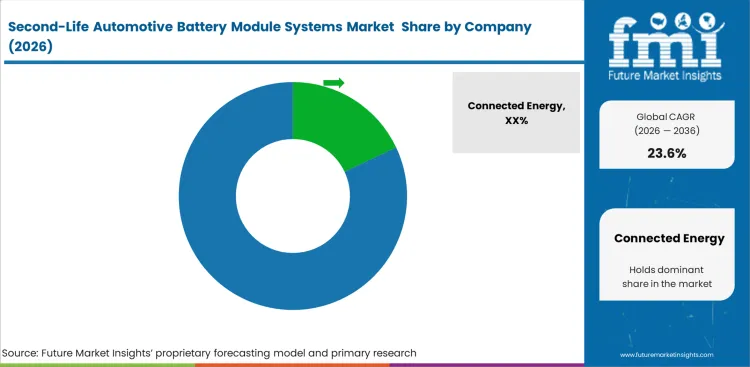
- The industry remains fragmented, although a small group of reuse specialists is building stronger project pipelines and OEM links.
- Leading firms compete on feedstock access, diagnostics capability, safety architecture, and the ability to deliver bankable stationary systems.
- Specialists still have room to win because many large battery or automotive groups have not industrialized second-life deployment at scale.
Competition in this field is shaped by more than system price. Companies need access to known battery streams, accurate grading tools, strong controls, and integration partners that can support live site operation. That combination is why the field still favors specialists with deep reuse experience. Connected Energy, Element Energy, Moment Energy, and B2U have all built visible positions around project execution rather than simple circularity messaging. The market remains fragmented because no single company controls both the largest return streams and the full stationary deployment channel across all regions.
Incumbent advantages usually come from feedstock relationships and data quality. Suppliers that work directly with automakers or fleet owners can document battery origin more clearly and improve system design around known module behavior. This matters because project buyers are cautious about performance variance, thermal safety, and future maintenance support. Connected Energy’s collaborations with Nissan, Volvo-linked sites, and Altilium show how firms are building stronger lifecycle chains. Moment Energy’s funding and Element Energy’s large Texas commissioning show that scale credibility is also becoming more important.
Specialists can still beat larger diversified groups in selected opportunities. They often move faster on diagnostics workflows, module matching, and system packaging for commercial customers with clear use cases. BeePlanet Factory, Smartville, and ECO STOR illustrate how the field still rewards focused engineering and local deployment knowledge. Yet entry remains difficult because reuse projects need both battery domain expertise and stationary system execution. A new entrant can source batteries or build cabinets, but doing both safely and repeatedly is a harder barrier.
Over time, competitive standing should increasingly depend on warranty support, automated state-of-health testing, and end-of-use recovery planning. Buyers want confidence that reused batteries can be serviced, monitored, and ultimately recycled without uncertain chain-of-custody. That is why partnerships between repurposing specialists, battery owners, and recycling firms are becoming more common. Firms that turn retired automotive modules into traceable and serviceable storage assets with clear service commitments should gain share fastest over the next decade.
Major Industry Players
The supplier base spans focused repurposing specialists, project developers, and battery-adjacent system companies.
- Global Player: Connected Energy, Element Energy, Moment Energy, and B2U Storage Solutions fit this group because they are building branded repurposing platforms, visible project references, and broader partner networks across charging, industrial, and utility-adjacent use cases.
- Regional Player: BeePlanet Factory, ECO STOR, and Smartville fit here because their positioning is tied more closely to regional deployment pathways, local project economics, and specific customer groups, while still showing strong technical credibility in reuse and storage integration.
- Emerging Players: The field still has room for newer participants that specialize in grading software, safety systems, container integration, and module remanufacturing services, particularly where local traceability rules or charging demand create early anchors for second-life storage.
Competitive Benchmarking: Second-Life Automotive Battery Module Systems Market
| Company | Feedstock Access | Diagnostics Depth | System Integration | Geographic Footprint |
|---|---|---|---|---|
| Connected Energy | High | High | Strong | Multi-region |
| Element Energy | High | High | Strong | North America |
| Moment Energy | High | High | Strong | North America |
| B2U Storage Solutions | High | Medium | Strong | United States |
| BeePlanet Factory | Medium | Medium | Moderate | Europe |
| Smartville | Medium | High | Moderate | United States |
| ECO STOR | Medium | Medium | Moderate | Europe |
| Forsee Power | Medium | Medium | Moderate | Europe |
| LOHUM | Medium | Medium | Moderate | India |
| Nissan | High | Low | Low | Global |
Source: Future Market Insights competitive analysis, 2026. Ratings reflect relative positioning based on feedstock access, diagnostics depth, and system integration capability.
Key Developments in Second-Life Automotive Battery Module Systems Market
- In 2024, B2U Storage Solutions announced that B2U said 25 MWh of second-life EV battery capacity was operational at its Lancaster, California hybrid solar and storage facility using 1,300 used Honda and Nissan EV batteries.
- In November 2024, Element Energy announced that Element Energy announced commissioning of a 53 MWh second-life battery storage project in Texas and a deployment partnership with LG Energy Solution Vertech.
- In January 2024, Cactos announced that Cactos raised over EUR 26 million to expand its battery energy storage system portfolio, supported by infrastructure-focused investors.
- In April 2025, Nissan announced that Nissan highlighted reuse projects in which retired LEAF batteries provide up to 1.7 MWh at a backup facility in Melilla and support factory AGVs and building peak shaving.
Key Players in the Second-Life Automotive Battery Module Systems Market
Major Global Players
- Connected Energy
- Element Energy
- Moment Energy
- B2U Storage Solutions
Key Emerging Players/Startups
- BeePlanet Factory
- Smartville
- ECO STOR
Scope of the Report
| Metric | Value |
|---|---|
| Quantitative Units | USD billion and CAGR from 2026 to 2036 |
| Market Definition | Stationary energy systems built from automotive battery modules or packs after first-life vehicle use. |
| Segmentation |
|
| Regions Covered | North America, Europe, East Asia, South Asia and Pacific |
| Countries Covered | India, China, United States, Germany, United Kingdom, South Korea, Japan |
| Key Companies Profiled | Connected Energy, Element Energy, Moment Energy, B2U Storage Solutions, BeePlanet Factory, Smartville, ECO STOR |
| Forecast Period | 2026 to 2036 |
| Approach | Bottom-up revenue modeling using retired battery availability, repurposing yield, average system value, and deployment demand. |
Second-Life Automotive Battery Module Systems Market by Segments
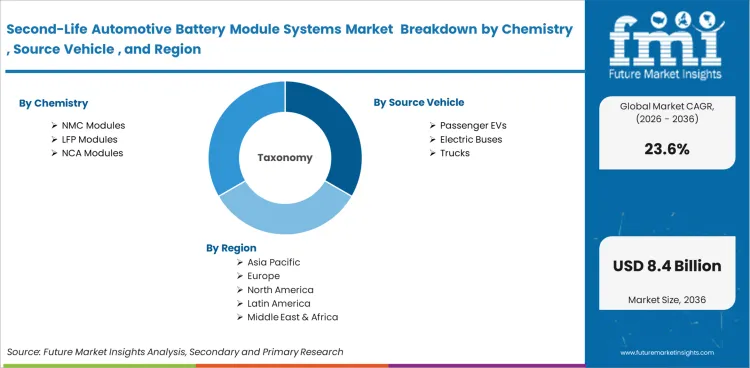
Second-Life Automotive Battery Module Systems Market Segmented as Chemistry
- NMC modules
- LFP modules
- NCA modules
- Mixed packs
Second-Life Automotive Battery Module Systems Market Classified by Application
- Grid support
- EV charging
- Backup power
- Microgrids
- Renewable firming
Second-Life Automotive Battery Module Systems Market Analysed by Source Vehicle and Format
- Passenger EVs
- Electric buses
- Light vans
- Trucks
- Containerized systems
- Cabinet systems
- Rack systems
- Skid systems
Second-Life Automotive Battery Module Systems Market Classified by Sales Channel
- Direct OEM deals
- System integrators
- EPC channels
- Distributors
Second-Life Automotive Battery Module Systems Market by Region and Country
- North America - United States
- Europe - Germany
- Europe - United Kingdom
- East Asia - China
- East Asia - Japan
- East Asia - South Korea
- South Asia and Pacific - India
Bibliography
- International Energy Agency. (2025, May 14). Global EV Outlook 2025: Executive summary.
- International Energy Agency. (2025, May 14). Global EV Outlook 2025: Electric vehicle batteries.
- State Council Information Office. (2025, June 5). China's EV battery recycling boom fuels green transition.
- USA Department of Energy. (2024, September 20). Notice of Intent: $70 Million in Infrastructure Investment and Jobs Act Funding for Electric Drive Vehicle Battery Recycling and Re-Use.
- Kraftfahrt-Bundesamt. (2026, January 16). Neuzulassungen von Personenkraftwagen (Pkw) im Jahresverlauf 2025 sowie mit Elektro-Antrieben.
- Society of Motor Manufacturers and Traders. (2026, January 6). UK new car market breaches two million as almost one in four buyers go electric.
- NITI Aayog. (2026, January). Advancing Circular Economy of Waste Electronic and Electrical Equipment (E-waste) and Lithium-Ion Batteries in India.
- Agency for Natural Resources and Energy. (2025, February). Strategic energy plan.
- Ministry of Environment, Republic of Korea. (2024, July 10). Establishing an integrated management system for used batteries to support the formation of a new market.
- USA Department of Energy. (2024, June 26). Second Life Smart Systems.
- Connected Energy. (2024, July 8). Altilium and Connected Energy collaborate to extend the lifecycle of EV batteries.
- Connected Energy. (2024, June 18). Connected Energy collaborates with Nissan on project to boost EV battery sustainability.
- Connected Energy. (2024, March 21). Energy storage systems help Volvo truck dealerships to electrify.
- Moment Energy. (2024, October 23). Moment Energy awarded US$20.3 million by USA Dept of Energy to establish first certified EV battery repurposing facility in the USA
- Moment Energy. (2025, January 16). Moment Energy secures USD $15 million Series A funding to build world’s first second-life battery gigafactory in the USA
- Forsee Power. (2025, May 6). Connected Energy and Forsee Power to develop grid-scale energy storage using second life batteries from electric buses.
- Element Energy. (2024, November 21). News.
- Cactos. (2024, January 11). Finnish startup Cactos raises over €26M to increase its battery energy storage system portfolio.
- Nissan. (2025, April 23). A new life for repurposed LEAF batteries.
Bibliography is provided for reader reference and source follow-up.
This Report Addresses
- Market sizing and revenue forecasting for second-life automotive battery module systems from 2026 to 2036.
- Segmentation analysis across chemistry, source vehicle, application, integration format, power range, end use, and sales channel.
- Regional and country-level analysis covering seven key national demand and supply formation points.
- Competitive assessment of repurposing specialists, project developers, and battery-linked system suppliers.
- Review of policy direction on battery traceability, lifecycle management, and circular use support.
- Evaluation of project opportunities in charging support, backup power, renewable balancing, and commercial resilience.
- Supply chain interpretation from retired vehicle battery intake through second-use deployment and eventual recycling.
- Current company development tracking across funding, partnerships, project commissioning, and deployment expansion.
Frequently Asked Questions
How large is the Second-Life Automotive Battery Module Systems Market in 2026?
The market is estimated at USD 0.82 billion in 2026, supported by rising reuse projects tied to charging, resilience, and stationary storage applications.
What is the forecast value of the Second-Life Automotive Battery Module Systems Market by 2036?
The industry is projected to reach USD 6.82 billion by 2036 as larger retired battery pools support wider commercial deployment.
What CAGR is expected for the Second-Life Automotive Battery Module Systems Market?
The market is forecast to expand at a CAGR of 23.6% from 2026 to 2036 under the base-case model.
Which chemistry segment leads the Second-Life Automotive Battery Module Systems Market?
NMC modules lead the chemistry mix and are expected to account for 43.0% share in 2026.
Which application leads the Second-Life Automotive Battery Module Systems Market?
Grid support leads the application mix with an expected 34.0% share in 2026 due to strong fit with repurposed storage economics.
Which country is expected to grow fastest in the Second-Life Automotive Battery Module Systems Market?
India is projected to post the fastest growth at 27.4% CAGR through 2036.
What does the Second-Life Automotive Battery Module Systems Market include?
It includes stationary energy systems built from retired automotive battery modules together with diagnostics, controls, integration, and safety hardware.
How was the forecast for the Second-Life Automotive Battery Module Systems Market developed?
The forecast combines retired battery availability, reuse yield, average system revenue, and country-level deployment demand for stationary applications.
Preview the report firsthand - request a free sample
Get SampleGet the brochure for pricing and purchase details.
Get PDFTable of Content
- Executive Summary
- Global Market Outlook
- Demand-side Trends
- Supply-side Trends
- Technology Roadmap Analysis
- Analysis and Recommendations
- Market Overview
- Market Coverage / Taxonomy
- Market Definition / Scope / Limitations
- Research Methodology
- Chapter Orientation
- Analytical Lens and Working Hypotheses
- Market Structure, Signals, and Trend Drivers
- Benchmarking and Cross-market Comparability
- Market Sizing, Forecasting, and Opportunity Mapping
- Research Design and Evidence Framework
- Desk Research Programme (Secondary Evidence)
- Company Annual and Sustainability Reports
- Peer-reviewed Journals and Academic Literature
- Corporate Websites, Product Literature, and Technical Notes
- Earnings Decks and Investor Briefings
- Statutory Filings and Regulatory Disclosures
- Technical White Papers and Standards Notes
- Trade Journals, Industry Magazines, and Analyst Briefs
- Conference Proceedings, Webinars, and Seminar Materials
- Government Statistics Portals and Public Data Releases
- Press Releases and Reputable Media Coverage
- Specialist Newsletters and Curated Briefings
- Sector Databases and Reference Repositories
- FMI Internal Proprietary Databases and Historical Market Datasets
- Subscription Datasets and Paid Sources
- Social Channels, Communities, and Digital Listening Inputs
- Additional Desk Sources
- Expert Input and Fieldwork (Primary Evidence)
- Primary Modes
- Qualitative Interviews and Expert Elicitation
- Quantitative Surveys and Structured Data Capture
- Blended Approach
- Why Primary Evidence is Used
- Field Techniques
- Interviews
- Surveys
- Focus Groups
- Observational and In-context Research
- Social and Community Interactions
- Stakeholder Universe Engaged
- C-suite Leaders
- Board Members
- Presidents and Vice Presidents
- R&D and Innovation Heads
- Technical Specialists
- Domain Subject-matter Experts
- Scientists
- Physicians and Other Healthcare Professionals
- Governance, Ethics, and Data Stewardship
- Research Ethics
- Data Integrity and Handling
- Primary Modes
- Tooling, Models, and Reference Databases
- Desk Research Programme (Secondary Evidence)
- Data Engineering and Model Build
- Data Acquisition and Ingestion
- Cleaning, Normalisation, and Verification
- Synthesis, Triangulation, and Analysis
- Quality Assurance and Audit Trail
- Market Background
- Market Dynamics
- Drivers
- Restraints
- Opportunity
- Trends
- Scenario Forecast
- Demand in Optimistic Scenario
- Demand in Likely Scenario
- Demand in Conservative Scenario
- Opportunity Map Analysis
- Product Life Cycle Analysis
- Supply Chain Analysis
- Investment Feasibility Matrix
- Value Chain Analysis
- PESTLE and Porter’s Analysis
- Regulatory Landscape
- Regional Parent Market Outlook
- Production and Consumption Statistics
- Import and Export Statistics
- Market Dynamics
- Global Market Analysis 2021 to 2025 and Forecast, 2026 to 2036
- Historical Market Size Value (USD Million) Analysis, 2021 to 2025
- Current and Future Market Size Value (USD Million) Projections, 2026 to 2036
- Y-o-Y Growth Trend Analysis
- Absolute $ Opportunity Analysis
- Global Market Pricing Analysis 2021 to 2025 and Forecast 2026 to 2036
- Global Market Analysis 2021 to 2025 and Forecast 2026 to 2036, By Chemistry
- Introduction / Key Findings
- Historical Market Size Value (USD Million) Analysis By Chemistry , 2021 to 2025
- Current and Future Market Size Value (USD Million) Analysis and Forecast By Chemistry , 2026 to 2036
- NMC Modules
- LFP Modules
- NCA Modules
- NMC Modules
- Y-o-Y Growth Trend Analysis By Chemistry , 2021 to 2025
- Absolute $ Opportunity Analysis By Chemistry , 2026 to 2036
- Global Market Analysis 2021 to 2025 and Forecast 2026 to 2036, By Source Vehicle
- Introduction / Key Findings
- Historical Market Size Value (USD Million) Analysis By Source Vehicle, 2021 to 2025
- Current and Future Market Size Value (USD Million) Analysis and Forecast By Source Vehicle, 2026 to 2036
- Passenger EVs
- Electric Buses
- Trucks
- Passenger EVs
- Y-o-Y Growth Trend Analysis By Source Vehicle, 2021 to 2025
- Absolute $ Opportunity Analysis By Source Vehicle, 2026 to 2036
- Global Market Analysis 2021 to 2025 and Forecast 2026 to 2036, By Application
- Introduction / Key Findings
- Historical Market Size Value (USD Million) Analysis By Application, 2021 to 2025
- Current and Future Market Size Value (USD Million) Analysis and Forecast By Application, 2026 to 2036
- Grid support
- EV Charging
- Microgrids
- Grid support
- Y-o-Y Growth Trend Analysis By Application, 2021 to 2025
- Absolute $ Opportunity Analysis By Application, 2026 to 2036
- Global Market Analysis 2021 to 2025 and Forecast 2026 to 2036, By Integration Format
- Introduction / Key Findings
- Historical Market Size Value (USD Million) Analysis By Integration Format, 2021 to 2025
- Current and Future Market Size Value (USD Million) Analysis and Forecast By Integration Format, 2026 to 2036
- Containerized Systems
- Rack Systems
- Others
- Containerized Systems
- Y-o-Y Growth Trend Analysis By Integration Format, 2021 to 2025
- Absolute $ Opportunity Analysis By Integration Format, 2026 to 2036
- Global Market Analysis 2021 to 2025 and Forecast 2026 to 2036, By Power Range
- Introduction / Key Findings
- Historical Market Size Value (USD Million) Analysis By Power Range, 2021 to 2025
- Current and Future Market Size Value (USD Million) Analysis and Forecast By Power Range, 2026 to 2036
- 500 kWh-2 MWh
- Below 250 kWh
- Above 5 MWh
- 500 kWh-2 MWh
- Y-o-Y Growth Trend Analysis By Power Range, 2021 to 2025
- Absolute $ Opportunity Analysis By Power Range, 2026 to 2036
- Global Market Analysis 2021 to 2025 and Forecast 2026 to 2036, By End Use
- Introduction / Key Findings
- Historical Market Size Value (USD Million) Analysis By End Use, 2021 to 2025
- Current and Future Market Size Value (USD Million) Analysis and Forecast By End Use, 2026 to 2036
- Commercial
- Utilities
- Others
- Commercial
- Y-o-Y Growth Trend Analysis By End Use, 2021 to 2025
- Absolute $ Opportunity Analysis By End Use, 2026 to 2036
- Global Market Analysis 2021 to 2025 and Forecast 2026 to 2036, By Sales Channel
- Introduction / Key Findings
- Historical Market Size Value (USD Million) Analysis By Sales Channel, 2021 to 2025
- Current and Future Market Size Value (USD Million) Analysis and Forecast By Sales Channel, 2026 to 2036
- Direct OEM Deal
- EPC Channels
- Distributors
- Direct OEM Deal
- Y-o-Y Growth Trend Analysis By Sales Channel, 2021 to 2025
- Absolute $ Opportunity Analysis By Sales Channel, 2026 to 2036
- Global Market Analysis 2021 to 2025 and Forecast 2026 to 2036, By Region
- Introduction
- Historical Market Size Value (USD Million) Analysis By Region, 2021 to 2025
- Current Market Size Value (USD Million) Analysis and Forecast By Region, 2026 to 2036
- North America
- Latin America
- Western Europe
- Eastern Europe
- East Asia
- South Asia and Pacific
- Middle East & Africa
- Market Attractiveness Analysis By Region
- North America Market Analysis 2021 to 2025 and Forecast 2026 to 2036, By Country
- Historical Market Size Value (USD Million) Trend Analysis By Market Taxonomy, 2021 to 2025
- Market Size Value (USD Million) Forecast By Market Taxonomy, 2026 to 2036
- By Country
- USA
- Canada
- Mexico
- By Chemistry
- By Source Vehicle
- By Application
- By Integration Format
- By Power Range
- By End Use
- By Sales Channel
- By Country
- Market Attractiveness Analysis
- By Country
- By Chemistry
- By Source Vehicle
- By Application
- By Integration Format
- By Power Range
- By End Use
- By Sales Channel
- Key Takeaways
- Latin America Market Analysis 2021 to 2025 and Forecast 2026 to 2036, By Country
- Historical Market Size Value (USD Million) Trend Analysis By Market Taxonomy, 2021 to 2025
- Market Size Value (USD Million) Forecast By Market Taxonomy, 2026 to 2036
- By Country
- Brazil
- Chile
- Rest of Latin America
- By Chemistry
- By Source Vehicle
- By Application
- By Integration Format
- By Power Range
- By End Use
- By Sales Channel
- By Country
- Market Attractiveness Analysis
- By Country
- By Chemistry
- By Source Vehicle
- By Application
- By Integration Format
- By Power Range
- By End Use
- By Sales Channel
- Key Takeaways
- Western Europe Market Analysis 2021 to 2025 and Forecast 2026 to 2036, By Country
- Historical Market Size Value (USD Million) Trend Analysis By Market Taxonomy, 2021 to 2025
- Market Size Value (USD Million) Forecast By Market Taxonomy, 2026 to 2036
- By Country
- Germany
- UK
- Italy
- Spain
- France
- Nordic
- BENELUX
- Rest of Western Europe
- By Chemistry
- By Source Vehicle
- By Application
- By Integration Format
- By Power Range
- By End Use
- By Sales Channel
- By Country
- Market Attractiveness Analysis
- By Country
- By Chemistry
- By Source Vehicle
- By Application
- By Integration Format
- By Power Range
- By End Use
- By Sales Channel
- Key Takeaways
- Eastern Europe Market Analysis 2021 to 2025 and Forecast 2026 to 2036, By Country
- Historical Market Size Value (USD Million) Trend Analysis By Market Taxonomy, 2021 to 2025
- Market Size Value (USD Million) Forecast By Market Taxonomy, 2026 to 2036
- By Country
- Russia
- Poland
- Hungary
- Balkan & Baltic
- Rest of Eastern Europe
- By Chemistry
- By Source Vehicle
- By Application
- By Integration Format
- By Power Range
- By End Use
- By Sales Channel
- By Country
- Market Attractiveness Analysis
- By Country
- By Chemistry
- By Source Vehicle
- By Application
- By Integration Format
- By Power Range
- By End Use
- By Sales Channel
- Key Takeaways
- East Asia Market Analysis 2021 to 2025 and Forecast 2026 to 2036, By Country
- Historical Market Size Value (USD Million) Trend Analysis By Market Taxonomy, 2021 to 2025
- Market Size Value (USD Million) Forecast By Market Taxonomy, 2026 to 2036
- By Country
- China
- Japan
- South Korea
- By Chemistry
- By Source Vehicle
- By Application
- By Integration Format
- By Power Range
- By End Use
- By Sales Channel
- By Country
- Market Attractiveness Analysis
- By Country
- By Chemistry
- By Source Vehicle
- By Application
- By Integration Format
- By Power Range
- By End Use
- By Sales Channel
- Key Takeaways
- South Asia and Pacific Market Analysis 2021 to 2025 and Forecast 2026 to 2036, By Country
- Historical Market Size Value (USD Million) Trend Analysis By Market Taxonomy, 2021 to 2025
- Market Size Value (USD Million) Forecast By Market Taxonomy, 2026 to 2036
- By Country
- India
- ASEAN
- Australia & New Zealand
- Rest of South Asia and Pacific
- By Chemistry
- By Source Vehicle
- By Application
- By Integration Format
- By Power Range
- By End Use
- By Sales Channel
- By Country
- Market Attractiveness Analysis
- By Country
- By Chemistry
- By Source Vehicle
- By Application
- By Integration Format
- By Power Range
- By End Use
- By Sales Channel
- Key Takeaways
- Middle East & Africa Market Analysis 2021 to 2025 and Forecast 2026 to 2036, By Country
- Historical Market Size Value (USD Million) Trend Analysis By Market Taxonomy, 2021 to 2025
- Market Size Value (USD Million) Forecast By Market Taxonomy, 2026 to 2036
- By Country
- Kingdom of Saudi Arabia
- Other GCC Countries
- Turkiye
- South Africa
- Other African Union
- Rest of Middle East & Africa
- By Chemistry
- By Source Vehicle
- By Application
- By Integration Format
- By Power Range
- By End Use
- By Sales Channel
- By Country
- Market Attractiveness Analysis
- By Country
- By Chemistry
- By Source Vehicle
- By Application
- By Integration Format
- By Power Range
- By End Use
- By Sales Channel
- Key Takeaways
- Key Countries Market Analysis
- USA
- Pricing Analysis
- Market Share Analysis, 2025
- By Chemistry
- By Source Vehicle
- By Application
- By Integration Format
- By Power Range
- By End Use
- By Sales Channel
- Canada
- Pricing Analysis
- Market Share Analysis, 2025
- By Chemistry
- By Source Vehicle
- By Application
- By Integration Format
- By Power Range
- By End Use
- By Sales Channel
- Mexico
- Pricing Analysis
- Market Share Analysis, 2025
- By Chemistry
- By Source Vehicle
- By Application
- By Integration Format
- By Power Range
- By End Use
- By Sales Channel
- Brazil
- Pricing Analysis
- Market Share Analysis, 2025
- By Chemistry
- By Source Vehicle
- By Application
- By Integration Format
- By Power Range
- By End Use
- By Sales Channel
- Chile
- Pricing Analysis
- Market Share Analysis, 2025
- By Chemistry
- By Source Vehicle
- By Application
- By Integration Format
- By Power Range
- By End Use
- By Sales Channel
- Germany
- Pricing Analysis
- Market Share Analysis, 2025
- By Chemistry
- By Source Vehicle
- By Application
- By Integration Format
- By Power Range
- By End Use
- By Sales Channel
- UK
- Pricing Analysis
- Market Share Analysis, 2025
- By Chemistry
- By Source Vehicle
- By Application
- By Integration Format
- By Power Range
- By End Use
- By Sales Channel
- Italy
- Pricing Analysis
- Market Share Analysis, 2025
- By Chemistry
- By Source Vehicle
- By Application
- By Integration Format
- By Power Range
- By End Use
- By Sales Channel
- Spain
- Pricing Analysis
- Market Share Analysis, 2025
- By Chemistry
- By Source Vehicle
- By Application
- By Integration Format
- By Power Range
- By End Use
- By Sales Channel
- France
- Pricing Analysis
- Market Share Analysis, 2025
- By Chemistry
- By Source Vehicle
- By Application
- By Integration Format
- By Power Range
- By End Use
- By Sales Channel
- India
- Pricing Analysis
- Market Share Analysis, 2025
- By Chemistry
- By Source Vehicle
- By Application
- By Integration Format
- By Power Range
- By End Use
- By Sales Channel
- ASEAN
- Pricing Analysis
- Market Share Analysis, 2025
- By Chemistry
- By Source Vehicle
- By Application
- By Integration Format
- By Power Range
- By End Use
- By Sales Channel
- Australia & New Zealand
- Pricing Analysis
- Market Share Analysis, 2025
- By Chemistry
- By Source Vehicle
- By Application
- By Integration Format
- By Power Range
- By End Use
- By Sales Channel
- China
- Pricing Analysis
- Market Share Analysis, 2025
- By Chemistry
- By Source Vehicle
- By Application
- By Integration Format
- By Power Range
- By End Use
- By Sales Channel
- Japan
- Pricing Analysis
- Market Share Analysis, 2025
- By Chemistry
- By Source Vehicle
- By Application
- By Integration Format
- By Power Range
- By End Use
- By Sales Channel
- South Korea
- Pricing Analysis
- Market Share Analysis, 2025
- By Chemistry
- By Source Vehicle
- By Application
- By Integration Format
- By Power Range
- By End Use
- By Sales Channel
- Russia
- Pricing Analysis
- Market Share Analysis, 2025
- By Chemistry
- By Source Vehicle
- By Application
- By Integration Format
- By Power Range
- By End Use
- By Sales Channel
- Poland
- Pricing Analysis
- Market Share Analysis, 2025
- By Chemistry
- By Source Vehicle
- By Application
- By Integration Format
- By Power Range
- By End Use
- By Sales Channel
- Hungary
- Pricing Analysis
- Market Share Analysis, 2025
- By Chemistry
- By Source Vehicle
- By Application
- By Integration Format
- By Power Range
- By End Use
- By Sales Channel
- Kingdom of Saudi Arabia
- Pricing Analysis
- Market Share Analysis, 2025
- By Chemistry
- By Source Vehicle
- By Application
- By Integration Format
- By Power Range
- By End Use
- By Sales Channel
- Turkiye
- Pricing Analysis
- Market Share Analysis, 2025
- By Chemistry
- By Source Vehicle
- By Application
- By Integration Format
- By Power Range
- By End Use
- By Sales Channel
- South Africa
- Pricing Analysis
- Market Share Analysis, 2025
- By Chemistry
- By Source Vehicle
- By Application
- By Integration Format
- By Power Range
- By End Use
- By Sales Channel
- USA
- Market Structure Analysis
- Competition Dashboard
- Competition Benchmarking
- Market Share Analysis of Top Players
- By Regional
- By Chemistry
- By Source Vehicle
- By Application
- By Integration Format
- By Power Range
- By End Use
- By Sales Channel
- Competition Analysis
- Competition Deep Dive
- Connected Energy
- Overview
- Product Portfolio
- Profitability by Market Segments (Product/Age /Sales Channel/Region)
- Sales Footprint
- Strategy Overview
- Marketing Strategy
- Product Strategy
- Channel Strategy
- Element Energy
- Moment Energy
- B2U Storage Solutions
- BeePlanet Factory
- Smartville
- Connected Energy
- Competition Deep Dive
- Assumptions & Acronyms Used


