

- Market Size (2026)
- USD 3.74 Bn
- Forecast (2036)
- USD 14.49 Bn
- CAGR (2026 to 2036)
- 14.5%
Heavy-Duty Truck Megapack Battery Systems Market Market Size, Market Forecast and Outlook by FMI
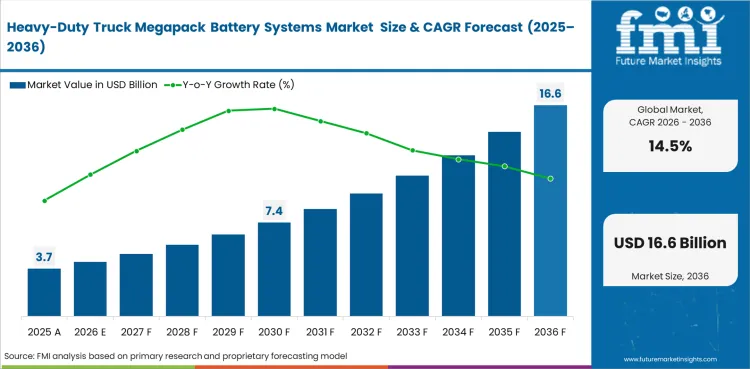
The heavy-duty truck megapack battery systems market is estimated at USD 3.26 billion in 2025 and is projected to reach USD 3.74 billion in 2026. Future Market Insights analysis indicates value likely to cross USD 14.49 billion by 2036, implying a CAGR of 14.5% and an incremental opportunity of USD 10.75 billion.
Summary of Heavy-Duty Truck Megapack Battery Systems Market
- The industry is expected to reach USD 14.49 billion by 2036 from USD 3.74 billion in 2026.
- Industry expansion is forecast at 14.5% CAGR from 2026 to 2036.
- The market is USD 3.26 billion on a modelled basis.
- Incremental opportunity from 2026 to 2036 is assessed at USD 10.75 billion.
- LFP chemistry is expected to lead with 61.0% share in 2026.
- Tractor trucks are projected to remain the leading truck class with 42.0% share in 2026.
- Liquid-cooled systems are likely to lead thermal design with 72.0% share in 2026.
- OEM fitment is expected to remain the main route to revenue with 79.0% share in 2026.
- China remains the largest demand base while India and the Netherlands are among the faster growth pockets.
Key Takeaways, Market Size, and Forecast
- Heavy-Duty Truck Megapack Battery Systems Market is projected to grow from USD 3.74 billion in 2026 to USD 14.49 billion by 2036, at a CAGR of 14.5%.
- The heavy-duty truck megapack battery systems market was valued at USD 3.26 billion in 2025.
- By 2036, the Heavy-Duty Truck Megapack Battery Systems Market is expected to be worth USD 14.49 billion.
- From 2026 to 2036, the market is anticipated to expand at a CAGR of 14.5%.
- The market is predicted to create an incremental opportunity of USD 10.75 billion between 2026 and 2036.
- In 2026, LFP Chemistry is expected to account for 61.0% of the chemistry segment.
- China (16.8%) and India (15.4%) are projected to be two of the fastest growing markets.
Heavy-Duty Truck Megapack Battery Systems Market Key Takeaways
| Parameter | Details |
|---|---|
| Market value (2026) | USD 3.74 billion |
| Forecast value (2036) | USD 14.49 billion |
| CAGR (2026 to 2036) | 14.5% |
| Estimated market value (2025) | USD 3.26 billion |
| Incremental opportunity | USD 10.75 billion |
| Leading chemistry | LFP (61.0%) |
| Leading vehicle type | Tractor trucks (42.0%) |
| Leading cooling system | Liquid-cooled (72.0%) |
| Leading sales channel | OEM fitment (79.0%) |
| Key players | CATL, BYD, BorgWarner, Forsee Power, Microvast, Octillion, Samsung SDI |
Source: Future Market Insights, 2026
China already has strong and sizeable demand for heavy‑duty truck megapack battery systems because electric truck adoption there is happening at scale. In contrast, North America and Europe are in an early phase, where most purchases are limited to pilot projects or government‑supported demonstrations. Untapped opportunity is opening in heavier regional haul segments that were difficult to electrify with standard pack sizes. Fleet operators now weigh aspects like charging time, warranty confidence, pack safety, and usable payload in the same buying decision. This raises the value of scalable pack families that can serve several truck layouts without a full redesign.
China is projected to grow at 16.8% CAGR through 2036 as domestic truck electrification and local battery supply remain closely aligned. India is expected to advance at 15.4% CAGR because national support now includes direct incentives for electric trucks. The Netherlands is forecast at 14.9% CAGR as corridor electrification moves earlier than in most of Europe. Germany is expected to register 12.8% CAGR during the forecast period as the demand scale remains solid.
Heavy-Duty Truck Megapack Battery Systems Market Definition
This market covers integrated battery systems sold for battery-electric heavy-duty trucks, including cells assembled into modules or packs with thermal management, battery management electronics, enclosures, safety devices, and pack-level controls. It includes systems used in tractor trucks, rigid trucks, and selected vocational heavy trucks. Revenue is counted at the battery system level rather than raw cell output alone.
Heavy-Duty Truck Megapack Battery Systems Market Inclusions
Scope includes lithium-ion heavy truck battery systems based on LFP, NMC, and related variants; pack-level thermal systems; enclosure structures; high-voltage wiring; battery management controls; and pack integration supplied directly to truck manufacturers or approved integrators. It also includes modular systems configured for different heavy truck layouts and duty cycles.
Heavy-Duty Truck Megapack Battery Systems Market Exclusions
Scope excludes passenger EV battery packs, light commercial vehicle packs, stationary storage containers, battery raw materials sold separately, charging hardware sold separately, and repair revenue not tied to full or major pack systems. Fuel-cell stacks and hydrogen tanks are also outside the boundary unless supplied as part of a battery-hybrid heavy truck system.
Heavy-Duty Truck Megapack Battery Systems Market Research Methodology
- Primary Research: Market structure and buying priorities were interpreted through public fleet, supplier, and vehicle manufacturer disclosures released in 2024 to 2026.
- Desk Research: Non-commercial data from IEA, ICCT, ACEA, CALSTART, and official government releases were used to anchor truck deployments, battery demand, and policy movement.
- Market Sizing and Forecasting: A bottom-up model combined heavy truck electric deployment, battery capacity assumptions, and system value per kilowatt-hour with region weighting and adoption pacing.
- Data Validation and Update Cycle: Results were cross-checked against public supplier activity, truck registrations, and battery price direction, then normalized into a 2026 to 2036 forecast view.
Why Is the Heavy-Duty Truck Megapack Battery Systems Market Growing
- Demand is rising as fleets move from trial units to repeat purchase programs on routes that can support charging discipline.
- Battery prices have fallen enough to improve large truck pack economics even though vehicle purchase prices remain high.
- System content per truck is increasing because longer routes need better thermal control, stronger battery management, and durable enclosure design.
Global demand for electric‑vehicle batteries reached a major milestone in 2024, crossing 1 TWh, with trucks accounting for nearly 3% of that total. This marks a much stronger foundation for heavy‑duty electrification than existed a few years ago. China continues to anchor demand, while Europe and North America are gradually scaling from smaller heavy‑truck volumes. As the installed base grows, fleet operators benefit from improved service experience and better spare‑parts planning, supporting smoother long‑term adoption.
Public policy is now playing a more decisive role in accelerating electric truck deployment. In India, the PM E‑DRIVE scheme allocated ₹500 crore to support around 5,500 electric trucks, offering incentives of ₹5,000 per kWh within defined limits. China has moved even faster, with zero‑emission medium‑ and heavy‑duty vehicle sales exceeding 230,000 units in 2024 and battery‑electric heavy truck share reaching 20.9% in December. Together, these measures are strengthening demand visibility and market confidence.
Segmental Analysis
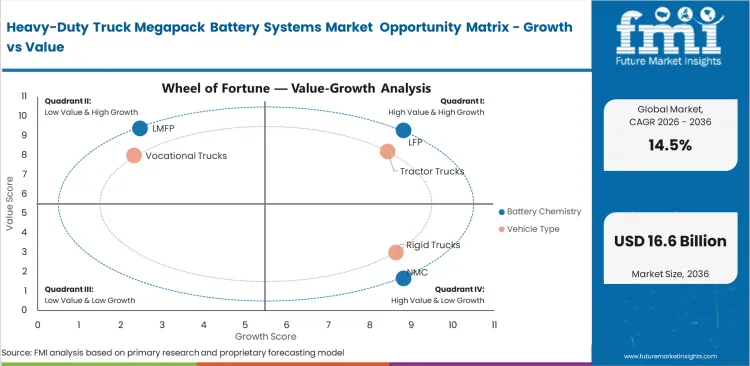
- LFP chemistry is anticipated to lead the battery chemistry split with 61.0% share in 2026 because heavy truck operators prioritize cycle life and lower cost.
- Tractor trucks are expected to remain the leading vehicle type with 42.0% share in 2026 as freight decarbonization first targets tractor-led haulage fleets.
- OEM fitment is projected to dominate the sales channel with 79.0% share in 2026 since pack design and homologation remain tightly linked to truck platforms.
Segmentation outlook in this market is shaped factors including payload and service support. Battery systems for heavy trucks must balance cost with usable range, while pack size cannot rise too far without affecting vehicle mass and packaging. Chemistry along with thermal design and channel structure therefore interact more directly here than in lighter vehicle categories.
Insights into the Battery Chemistry Segment
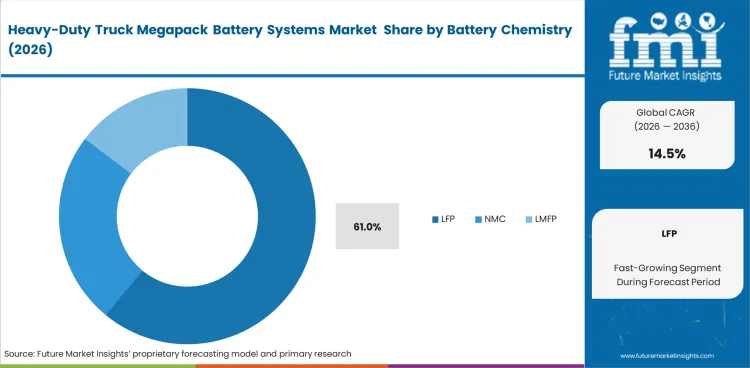
LFP is expected to account for 61.0% share in 2026 because heavy truck duty cycles reward lower cost chemistry with longer usable life and better tolerance for repeated charging. ICCT notes that LFP batteries continued to dominate China’s heavy truck segment in 2024, with popular pack sizes clustered around 282 kWh, 350 kWh, and 423 kWh. NMC still has a role in applications that need higher energy density, but the broader case remains strongest for LFP in mainstream fleet programs.
Insights into the Vehicle Type Segment
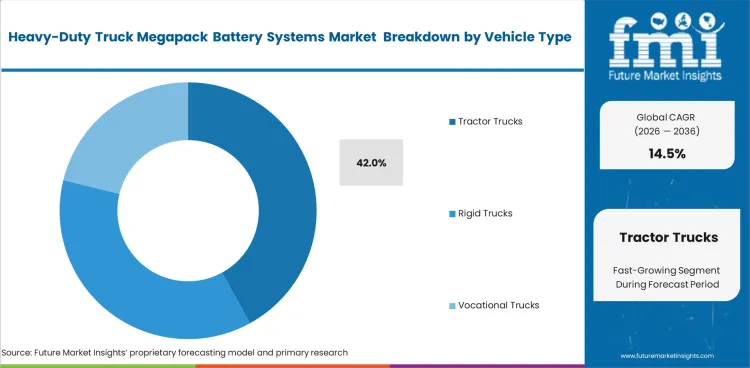
FMI analysis estimates the tractor trucks is likely to hold a 42.0% share in 2026 because decarbonization pressure is rising first in organized freight fleets that run repeatable routes and high annual mileage. Rigid and vocational trucks also support demand, yet their battery needs are more fragmented by body style and use profile. In the United States, heavy electric truck registrations reached 1,103 units in 2024 and were 34% above 2023, showing that heavier segments are no longer limited to one-off pilots.
Insights into the Sales Channel Segment
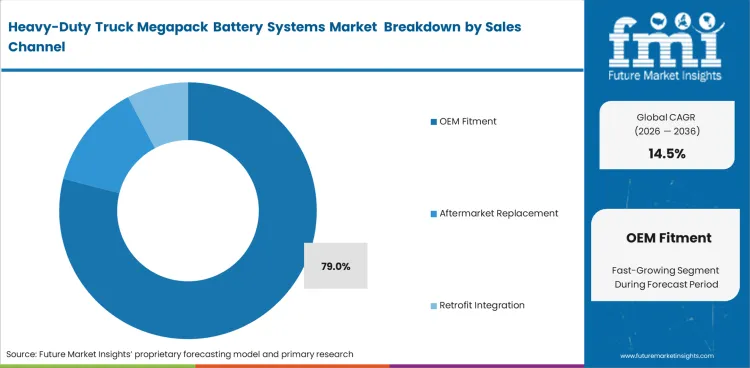
OEM fitment is set to make up 79.0% of the market in 2026 because heavy truck battery systems must be validated at the vehicle architecture level and supported through long warranty periods. Retrofit demand remains narrow because certification, payload, and service complexity raise conversion costs. The commercial structure therefore favors suppliers that can deliver complete pack systems with controls, cooling, and safety functions rather than cells or modules alone.
What Are the Drivers, Restraints, and Key Trends in the Heavy-Duty Truck Megapack Battery Systems Market
- Larger fleet orders are becoming easier to justify as battery prices and route planning improve.
- High truck purchase prices and charging constraints still slow wider diesel replacement.
- Suppliers are moving toward modular platforms that support higher energy windows and faster charging with fewer redesign cycles.
The market is gaining momentum, but it is not stable yet. Demand improves when fleets can match an electric truck to a stable route and predictable dwell time, while adoption slows when charging access or payload loss becomes uncertain. Battery systems drive that balance because range, uptime, safety, and service cost all flow through the pack.
Input Cost Pressure
Battery prices have improved the outlook, but heavy truck systems still require a large upfront spend because pack sizes are much larger than those used in most passenger vehicles. That keeps cost pressure alive for fleets comparing electric trucks with diesel replacements. The IEA noted that lower battery prices and better infrastructure use rates can make battery-electric trucks competitive with diesel trucks in major regions by 2030, yet that shift still depends on utilization.
Testing and Validation Needs
As battery systems become larger and more application-specific, validation work becomes more expensive and more visible in supplier selection. Heavy trucks are exposed to high vibration, repeated fast charging, longer operating hours, and stronger temperature swings than many lighter-duty applications. This raises demand for formation consistency, pack-level controls, and thermal runaway protection during both vehicle launch and field use.
Production Scale Shift
Production is starting to move from demonstration series into broader industrial planning. In Europe, ACEA reported that electrically chargeable trucks above 3.5 tonnes reached 4.2% of new truck registrations in 2025, up from 2.3% in 2024. That is still a small share of the total truck base, yet the trend matters because battery systems benefit when production runs become larger and more standardized.
Analysis of Heavy-Duty Truck Megapack Battery Systems Market by Key Countries
- China is expected to post 16.8% CAGR through 2036 and remains the largest current demand center for heavy truck batteries.
- India is projected to advance at 15.4% CAGR through 2036 as national policy now directly supports electric truck adoption.
- The Netherlands is likely to rise at 14.9% CAGR through 2036 as corridor activity keeps adoption ahead of most of Europe.
- The United States is forecast to grow at 13.6% CAGR through 2036 as fleet trials increasingly convert into repeat orders.
.webp "Top Country Growth Comparison Heavy Duty Truck Megapack Battery Systems Market Cagr (2026 2036)")
| Country | CAGR |
|---|---|
| China | 16.8% |
| India | 15.4% |
| Netherlands | 14.9% |
| United States | 13.6% |
| Germany | 12.8% |
| France | 12.3% |
| European Union | 11.5% |
Source: FMI analysis based on primary research and proprietary forecasting model
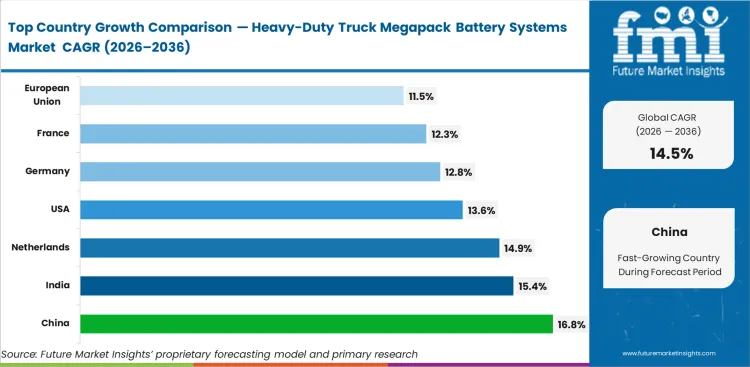
Country demand patterns still vary because freight structure, charging readiness, and public support differ across regions. China leads on present volume, while the United States and Europe are still scaling from smaller heavy truck penetration. Within Europe, the Netherlands and Germany are moving earlier than the regional average, while France is improving through fleet renewal and industrial policy. India remains a high-growth market because formal support for electric trucks is newer.
Demand Outlook for Heavy-Duty Truck Megapack Battery Systems Market in China
China is projected to register 16.8% CAGR through 2036 and remains the main volume anchor for heavy-duty truck battery systems. ICCT reported that sales of zero-emission medium- and heavy-duty vehicles in China exceeded 230,000 units in 2024, while battery electric heavy truck share reached 20.9% in December. That scale gives battery suppliers a stronger manufacturing and field-service base than in any other major region. LFP remains dominant and popular battery sizes of 282 kWh, 350 kWh, and 423 kWh show that freight use is shaping procurement.
- Battery swapping is active in selected mining and port routes.
- Domestic OEM groups are helping standardize pack demand.
- China remains the clearest early large-volume procurement market.
Sales Analysis of Heavy-Duty Truck Megapack Battery Systems Market in India
India is expected to expand at 15.4% CAGR through 2036 because the policy base for truck electrification has become more direct. The PM E-DRIVE program created a ₹500 crore allocation intended to support around 5,500 electric trucks and offers incentives of ₹5,000 per kWh within defined caps. That does not solve the full cost gap and it lowers the first purchase barrier and improves project visibility for OEMs and battery suppliers. India is likely to remain one of the faster growth markets as freight electrification moves from pilots into supported deployment.
- State-backed support has improved visibility for early truck orders.
- Cost sensitivity remains high, so incentives still matter.
- India offers strong upside for suppliers that can localize.
Industry Analysis of Heavy-Duty Truck Megapack Battery Systems Market in the Netherlands
The Netherlands is forecast to record 14.9% CAGR through 2036 and stands out as one of Europe’s faster moving truck electrification markets. ACEA reported that electrically chargeable trucks represented 6.8% of Dutch new truck registrations in 2025, ahead of the EU average. A smaller national truck base helps pilot corridors scale more visibly, while logistics concentration supports faster learning on charging patterns and route selection. Battery suppliers benefit from a market where early use cases are becoming clearer.
- Dense freight corridors support clearer route matching.
- Dutch adoption remains above the EU average.
- The country offers an early European test bed.
Demand Outlook for Heavy-Duty Truck Megapack Battery Systems Market in the United States
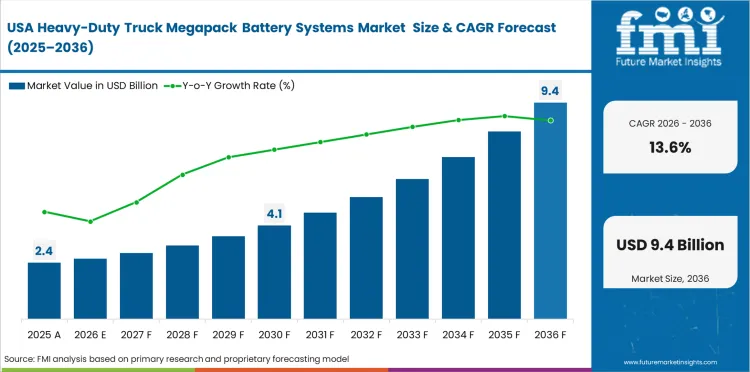
The United States is projected to grow at 13.6% CAGR through 2036 as commercial fleets add electric heavy trucks more steadily than before. CALSTART reported 1,109 deployed or ordered battery-electric trucks in the United States and Canada in 2024, up from 953 in 2023, while the ICCT counted 1,103 USA registrations in 2024. The current base remains small relative to the diesel fleet, so suppliers still need patient capacity planning. Uptake is strongest where regulation, grants, and depot charging line up with repeatable duty cycles.
- California remains a major reference state for deployment signals.
- Grant-backed programs continue to support early purchases.
- North American growth is real, but still phased.
Heavy-Duty Truck Megapack Battery Systems Market Analysis in Germany
Germany is likely to see 12.8% CAGR through 2036 and remains one of Europe’s key battery demand centers by industrial scale. ACEA noted that Germany was one of the main drivers of EU electrically chargeable truck growth in 2025 with registrations up 39.6%. The country combines large freight activity, strong truck manufacturing depth, and rising attention to corridor charging. That supports demand for battery systems with better durability and pack layouts that fit higher-utilization operations.
- German manufacturing depth supports supplier validation and localization.
- Corridor charging progress matters for larger pack demand.
- Germany remains a main reference point for European programs.
Heavy-Duty Truck Megapack Battery Systems Market Analysis in France
France is expected to advance at 12.3% CAGR through 2036 as its heavy truck electrification path improves from a modest base. ACEA reported that France was one of the three main drivers of EU electrically chargeable truck growth in 2025 with registrations up 30.5%. The pace remains below the Netherlands because the starting point and operating structure are different, yet the direction is favorable for battery suppliers with strong OEM and service relationships. Demand should stay centered on organized freight operators and selected municipal-linked heavy applications.
- Public and corporate decarbonization commitments are aiding fleet renewal.
- French adoption is improving even though the base remains smaller than diesel.
- Battery suppliers gain when OEM programs align with charging readiness.
In-Depth Analysis of Heavy-Duty Truck Megapack Battery Systems Market in the European Union
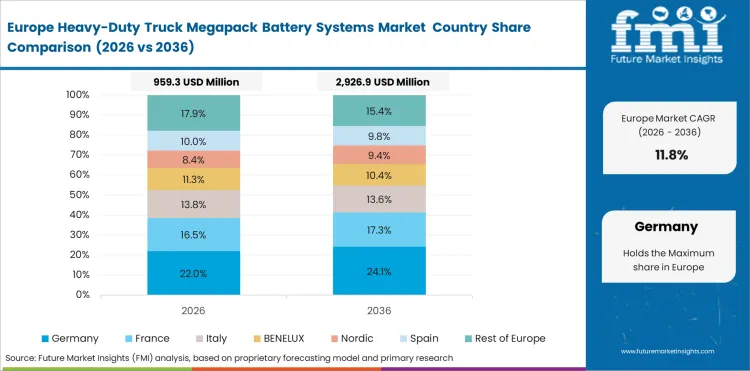
The European Union is projected to expand at 11.5% CAGR through 2036, which keeps it below the faster national leaders but above very early-stage regions. ACEA reported that electrically chargeable trucks above 3.5 tonnes reached 4.2% of new truck registrations in 2025, up from 2.3% in 2024, while about 6 million trucks were on EU roads and only 0.1% were electrically chargeable in fleet stock. That shows progress in new registrations alongside a large diesel base that will take time to replace. Battery suppliers therefore face a market with improving momentum and a long conversion runway.
- Fleet stock conversion in Europe will trail new registration growth.
- Regional growth still depends heavily on a few national leaders.
- Battery demand should benefit from the long EU replacement runway.
Competitive Landscape of Heavy-Duty Truck Megapack Battery Systems Market
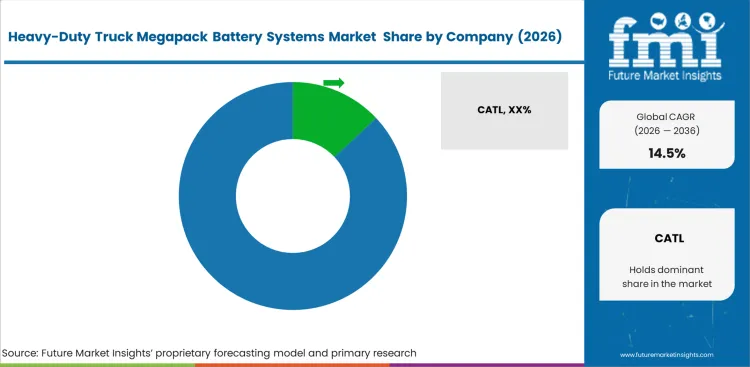
- The market remains moderately concentrated because a small group of suppliers and integrated OEMs hold the strongest positions.
- Leading companies compete on cost per usable kilowatt-hour, safety validation, thermal performance, and support for truck OEM launch schedules.
- Room remains for specialists where modular designs or regional service capability solve application-specific problems faster than larger rivals.
Competition is shaped by application fit more than headline scale alone. Heavy-duty truck battery systems must survive harsh use cycles, repeated charging, and long warranty exposure, which means pack design and field support matter almost as much as chemistry choice. Large suppliers such as CATL and BYD benefit from scale, but specialist firms can still win with modular systems that shorten engineering time.
Entry is difficult because truck battery systems are not simple drop-in products. Vehicle packaging, axle load, thermal safety, charging compatibility, and homologation all need to align before an OEM can move into production. That favors suppliers with proven commercial vehicle experience and with electronics, software, and service capability built into the offer.
The next layer of competition will focus on fast charging, long life, and regional manufacturing support. CATL’s TECTRANS launch highlighted both faster charging and longer-life options, while Samsung SDI and Microvast used IAA Transportation 2024 to present commercial vehicle battery solutions aimed at heavier applications. Fleets increasingly compare charging time, downtime risk, thermal stability, and after-delivery support.
Market concentration is meaningful but not absolute. CATL likely holds the leading position because China remains the largest heavy truck battery demand center and the company has strong exposure to commercial vehicle electrification. BYD stays important because it combines battery capability with electric truck manufacturing. Yet different truck classes and route patterns still leave room for regional specialists.
Major Industry Players
The supplier landscape includes scale leaders, regional specialists, and emerging pack integrators serving truck manufacturers and fleet programs.
- Global Player: CATL, BYD, Samsung SDI, and LG Energy Solution fit this tier because they combine battery manufacturing depth with broad electrification exposure. CATL and BYD carry the strongest direct connection to electric trucks, while Samsung SDI and LG Energy Solution add relevance through industrial scale.
- Regional Player: BorgWarner, Forsee Power, and Microvast fit this group because their commercial vehicle activity is clearer in selected regions and customer programs. They compete through modular design, truck or bus experience, and closer engineering support for OEM-led launches.
- Emerging Players: Octillion Power Systems and other focused pack integrators are included in the emerging group because they are expanding geographic reach and product breadth from a smaller base. Their edge comes from flexible pack engineering and faster customization.
Competitive Benchmarking: Heavy-Duty Truck Megapack Battery Systems Market
| Company | Pack Integration Depth | Commercial Vehicle Fit | Serviceability | Geographic Footprint |
|---|---|---|---|---|
| CATL | High | High | Strong | Global |
| BYD | High | Medium | Strong | Global |
| BorgWarner | Medium | High | Moderate | Multi-region |
| Forsee Power | Medium | High | Moderate | Multi-region |
| Microvast | Medium | Medium | Moderate | Multi-region |
| Octillion Power Systems | Medium | Medium | Moderate | Multi-region |
| Samsung SDI | Medium | High | Moderate | Global |
| LG Energy Solution | Medium | Medium | Moderate | Global |
| Volvo Energy | Low | Medium | Moderate | Regional |
| MAN Truck & Bus | Low | Medium | Moderate | Regional |
Source: Future Market Insights competitive analysis, 2026. Ratings reflect relative positioning based on pack integration depth, commercial vehicle fit, and serviceability.
Key Developments in Heavy-Duty Truck Megapack Battery Systems Market
- In September 2024, CATL introduced TECTRANS heavy truck batteries with one version offering 70% charge in 15 minutes and another focused on long service life.
- In February 2024, Forsee Power said BAE Systems selected its ZEN PLUS battery system for a Class 7 demonstration truck using 231 kWh across three packs.
- In September 2024, Volvo disclosed that its next long-range FH Electric will target up to 600 km per charge and go on sale in the second half of 2025.
- In January 2024, MAN highlighted eTGX and eTGS configurations with three to six packs and up to 480 kWh usable battery capacity.
Key Players in the Heavy-Duty Truck Megapack Battery Systems Market
Major Global Players
- CATL
- BYD
- Samsung SDI
- LG Energy Solution
Key Emerging Players/Startups
- BorgWarner
- Forsee Power
- Microvast
- Octillion Power Systems
Scope of the Report
| Metric | Value |
|---|---|
| Quantitative Units | USD billion for value and % CAGR for growth rates. |
| Market Definition | Integrated battery systems used in battery-electric heavy-duty trucks including pack hardware, battery controls, cooling, enclosure, and high-voltage integration. |
| Segmentation |
|
| Regions Covered | North America, Europe, Asia Pacific, and Rest of the World. |
| Countries Covered | China, India, Netherlands, United States, Germany, France, European Union. |
| Key Companies Profiled | CATL, BYD, BorgWarner, Forsee Power, Microvast, Octillion Power Systems, Samsung SDI. |
| Forecast Period | 2026 to 2036. |
| Approach | Bottom-up modelling from electric heavy truck battery demand, pack value assumptions, regional adoption trends, and supplier activity cross-checks. |
Heavy-Duty Truck Megapack Battery Systems Market by Segments
Battery Chemistry
- LFP
- NMC
- LMFP
Capacity Band
- Below 300 kWh
- 300-500 kWh
- Above 500 kWh
Pack Architecture
- Modular packs
- Cell‑to‑pack
- Swappable packs
Vehicle Type
- Tractor trucks
- Rigid trucks
- Vocational trucks
Cooling System
- Liquid‑cooled
- Air‑cooled
- Passive
Sales Channel
- OEM fitment
- Aftermarket replacement
- Retrofit integration
Heavy-Duty Truck Megapack Battery Systems Market by Region and Country
- North America
- USA
- Canada
- Mexico
- Latin America
- Brazil
- Chile
- Rest of Latin America
- Western Europe
- Germany
- UK
- Italy
- Spain
- France
- Nordic
- BENELUX
- Rest of Western Europe
- Eastern Europe
- Russia
- Poland
- Hungary
- Balkan & Baltic
- Rest of Eastern Europe
- East Asia
- China
- Japan
- South Korea
- South Asia and Pacific
- India
- ASEAN
- Australia & New Zealand
- Rest of South Asia and Pacific
- Middle East & Africa
- Kingdom of Saudi Arabia
- Other GCC Countries
- Turkiye
- South Africa
- Other African Union
- Rest of Middle East & Africa
Bibliography
- International Energy Agency. (2025, May 14). Global EV outlook 2025.
- International Energy Agency. (2025). Electric vehicle batteries.
- International Council on Clean Transportation. (2025, March 25). Zero-emission medium- and heavy-duty vehicle market in China, 2024.
- International Council on Clean Transportation. (2025, June 24). Race to zero: Zero-emission bus and truck market in the United States in 2024.
- ACEA. (2026, January 29). New commercial vehicle registrations: vans -8.8%, trucks -6.2%, buses -7.5% in 2025.
- ACEA. (2025, January 29). Report - Vehicles on European roads 2025.
- ACEA. (2026, April 1). Economic and market report.
- ACEA. (2025, August 25). Pocket guide 2025/2026.
- International Council on Clean Transportation. (2025, July 15). Why India’s e-truck incentive scheme can be a gamechanger for the economy and the environment.
- Contemporary Amperex Technology Co., Limited. (2024, September 17). CATL unveils revolutionary TECTRANS battery system.
- Forsee Power. (2024, February 1). Forsee Power to provide battery system for BAE Systems' Class 7 demonstration truck powertrain in North America.
- BorgWarner. (2024, January 10). BorgWarner announces new joint venture for business growth in the Chinese electric commercial vehicle market.
- BorgWarner. (2024, August 27). BorgWarner showcases latest innovations in clean mobility technologies at IAA Transportation 2024.
- Microvast Holdings, Inc. (2024, September 16). Microvast powers the next generation of electric commercial vehicles with groundbreaking battery technology at IAA Transportation 2024.
- Octillion Power Systems. (2024, September 16). Octillion to showcase latest battery technology at IAA 2024.
- AB Volvo. (2024, September 3). Breakthrough: Volvo to launch electric truck with 600 km range.
- MAN Truck & Bus. (2024, January 23). Successful market launch of the new MAN eTruck.
- LG Energy Solution. (2024, October 15). LG Energy Solution to power electric versions of Ford's commercial vans in Europe.
- Samsung SDI. (2024, September 18). SAMSUNG SDI showcases optimal battery solutions for electric commercial vehicles at IAA 2024.
The bibliography is provided for reader reference.
This Report Addresses
- Market sizing and revenue forecasting for heavy-duty truck battery systems from 2026 to 2036.
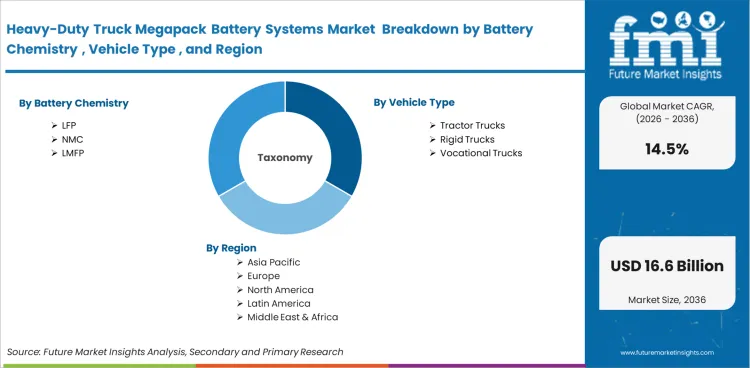
- Segmentation analysis across chemistry, capacity, architecture, cooling system, truck type, and sales channel.
- Regional and country-level analysis covering China, India, the United States, Germany, France, the Netherlands, and the European Union.
- Competitive assessment of major battery system suppliers and vehicle-linked participants.
- Technology discussion covering pack design, thermal control, fast charging, and battery validation needs.
- Policy and compliance review covering truck electrification support and fleet adoption conditions.
- Supply chain interpretation from battery manufacturing depth to heavy truck program execution.
- Commercial guidance on where battery system value is rising faster than truck unit growth.
Frequently Asked Questions
How large is the market in 2026?
The market is projected to reach USD 3.74 billion in 2026 based on modelled heavy truck battery system revenue across key regions.
What value is expected by 2036?
Demand is projected to expand to USD 14.49 billion by 2036 as electric heavy truck deployment and system value per vehicle keep rising.
What is the forecast CAGR?
The market is forecast to grow at a CAGR of 14.5% from 2026 to 2036.
Which battery chemistry leads?
LFP is expected to lead the chemistry split in 2026 with 61.0% share because fleets prioritize cycle life and lower system cost.
Which sales channel is strongest?
OEM fitment leads the channel mix with 79.0% share in 2026 because validation and warranty control stay tied to truck manufacturers.
Which country grows fastest?
China is the fastest among the selected countries at 16.8% CAGR through 2036, with India close behind at 15.4% CAGR.
What is included in this market?
The scope includes integrated heavy truck battery packs, controls, cooling systems, enclosures, and high-voltage integration for battery-electric heavy trucks.
How was the forecast built?
The forecast combines heavy truck electric deployment, battery capacity assumptions, pack system value, regional policy support, and supplier cross-checks.
Preview the report firsthand - request a free sample
Get SampleGet the brochure for pricing and purchase details.
Get PDFTable of Content
- Executive Summary
- Global Market Outlook
- Supply-side Trends
- Technology Roadmap Analysis
- Analysis and Recommendations
- Market Overview
- Market Coverage / Taxonomy
- Market Definition / Scope / Limitations
- Research Methodology
- Chapter Orientation
- Market Sizing, Forecasting, and Opportunity Mapping
- Research Design and Evidence Framework
- Desk Research Programme (Secondary Evidence)
- Company Annual and Sustainability Reports
- Peer-reviewed Journals and Academic Literature
- Corporate Websites, Product Literature, and Technical Notes
- Earnings Decks and Investor Briefings
- Statutory Filings and Regulatory Disclosures
- Technical White Papers and Standards Notes
- Trade Journals, Industry Magazines, and Analyst Briefs
- Conference Proceedings, Webinars, and Seminar Materials
- Government Statistics Portals and Public Data Releases
- Press Releases and Reputable Media Coverage
- Specialist Newsletters and Curated Briefings
- Sector Databases and Reference Repositories
- FMI Internal Proprietary Databases and Historical Market Datasets
- Subscription Datasets and Paid Sources
- Social Channels, Communities, and Digital Listening Inputs
- Additional Desk Sources
- Expert Input and Fieldwork (Primary Evidence)
- Primary Modes
- Qualitative Interviews and Expert Elicitation
- Observational and In-context Research
- Social and Community Interactions
- Stakeholder Universe Engaged
- C-suite Leaders
- Board Members
- Presidents and Vice Presidents
- R&D and Innovation Heads
- Technical Specialists
- Domain Subject-matter Experts
- Scientists
- Physicians and Other Healthcare Professionals
- Governance, Ethics, and Data Stewardship
- Research Ethics
- Data Integrity and Handling
- Primary Modes
- Tooling, Models, and Reference Databases
- Desk Research Programme (Secondary Evidence)
- Data Engineering and Model Build
- Data Acquisition and Ingestion
- Cleaning, Normalisation, and Verification
- Synthesis, Triangulation, and Analysis
- Quality Assurance and Audit Trail
- Market Background
- Market Dynamics
- Drivers
- Restraints
- Opportunity
- Trends
- Scenario Forecast
- Demand in Optimistic Scenario
- Demand in Likely Scenario
- Demand in Conservative Scenario
- Opportunity Map Analysis
- Product Life Cycle Analysis
- Supply Chain Analysis
- Investment Feasibility Matrix
- Value Chain Analysis
- PESTLE and Porter’s Analysis
- Regulatory Landscape
- Regional Parent Market Outlook
- Production and Consumption Statistics
- Import and Export Statistics
- Market Dynamics
- Global Market Analysis 2021 to 2025 and Forecast, 2026 to 2036
- Historical Market Size Value (USD Million) Analysis, 2021 to 2025
- Current and Future Market Size Value (USD Million) Projections, 2026 to 2036
- Y-o-Y Growth Trend Analysis
- Absolute $ Opportunity Analysis
- Global Market Pricing Analysis 2021 to 2025 and Forecast 2026 to 2036
- Global Market Analysis 2021 to 2025 and Forecast 2026 to 2036, By Battery Chemistry
- Introduction / Key Findings
- Historical Market Size Value (USD Million) Analysis By Battery Chemistry , 2021 to 2025
- Current and Future Market Size Value (USD Million) Analysis and Forecast By Battery Chemistry , 2026 to 2036
- LFP
- NMC
- LMFP
- LFP
- Y-o-Y Growth Trend Analysis By Battery Chemistry , 2021 to 2025
- Absolute $ Opportunity Analysis By Battery Chemistry , 2026 to 2036
- Global Market Analysis 2021 to 2025 and Forecast 2026 to 2036, By Vehicle Type
- Introduction / Key Findings
- Historical Market Size Value (USD Million) Analysis By Vehicle Type, 2021 to 2025
- Current and Future Market Size Value (USD Million) Analysis and Forecast By Vehicle Type, 2026 to 2036
- Tractor Trucks
- Rigid Trucks
- Vocational Trucks
- Tractor Trucks
- Y-o-Y Growth Trend Analysis By Vehicle Type, 2021 to 2025
- Absolute $ Opportunity Analysis By Vehicle Type, 2026 to 2036
- Global Market Analysis 2021 to 2025 and Forecast 2026 to 2036, By Sales Channel
- Introduction / Key Findings
- Historical Market Size Value (USD Million) Analysis By Sales Channel, 2021 to 2025
- Current and Future Market Size Value (USD Million) Analysis and Forecast By Sales Channel, 2026 to 2036
- OEM Fitment
- Aftermarket Replacement
- Retrofit Integration
- OEM Fitment
- Y-o-Y Growth Trend Analysis By Sales Channel, 2021 to 2025
- Absolute $ Opportunity Analysis By Sales Channel, 2026 to 2036
- Global Market Analysis 2021 to 2025 and Forecast 2026 to 2036, By Region
- Introduction
- Historical Market Size Value (USD Million) Analysis By Region, 2021 to 2025
- Current Market Size Value (USD Million) Analysis and Forecast By Region, 2026 to 2036
- North America
- Latin America
- Western Europe
- Eastern Europe
- East Asia
- South Asia and Pacific
- Middle East & Africa
- Market Attractiveness Analysis By Region
- North America Market Analysis 2021 to 2025 and Forecast 2026 to 2036, By Country
- Historical Market Size Value (USD Million) Trend Analysis By Market Taxonomy, 2021 to 2025
- Market Size Value (USD Million) Forecast By Market Taxonomy, 2026 to 2036
- By Country
- USA
- Canada
- Mexico
- By Battery Chemistry
- By Vehicle Type
- By Sales Channel
- By Country
- Market Attractiveness Analysis
- By Country
- By Battery Chemistry
- By Vehicle Type
- By Sales Channel
- Key Takeaways
- Latin America Market Analysis 2021 to 2025 and Forecast 2026 to 2036, By Country
- Historical Market Size Value (USD Million) Trend Analysis By Market Taxonomy, 2021 to 2025
- Market Size Value (USD Million) Forecast By Market Taxonomy, 2026 to 2036
- By Country
- Brazil
- Chile
- Rest of Latin America
- By Battery Chemistry
- By Vehicle Type
- By Sales Channel
- By Country
- Market Attractiveness Analysis
- By Country
- By Battery Chemistry
- By Vehicle Type
- By Sales Channel
- Key Takeaways
- Western Europe Market Analysis 2021 to 2025 and Forecast 2026 to 2036, By Country
- Historical Market Size Value (USD Million) Trend Analysis By Market Taxonomy, 2021 to 2025
- Market Size Value (USD Million) Forecast By Market Taxonomy, 2026 to 2036
- By Country
- Germany
- UK
- Italy
- Spain
- France
- Nordic
- BENELUX
- Rest of Western Europe
- By Battery Chemistry
- By Vehicle Type
- By Sales Channel
- By Country
- Market Attractiveness Analysis
- By Country
- By Battery Chemistry
- By Vehicle Type
- By Sales Channel
- Key Takeaways
- Eastern Europe Market Analysis 2021 to 2025 and Forecast 2026 to 2036, By Country
- Historical Market Size Value (USD Million) Trend Analysis By Market Taxonomy, 2021 to 2025
- Market Size Value (USD Million) Forecast By Market Taxonomy, 2026 to 2036
- By Country
- Russia
- Poland
- Hungary
- Balkan & Baltic
- Rest of Eastern Europe
- By Battery Chemistry
- By Vehicle Type
- By Sales Channel
- By Country
- Market Attractiveness Analysis
- By Country
- By Battery Chemistry
- By Vehicle Type
- By Sales Channel
- Key Takeaways
- East Asia Market Analysis 2021 to 2025 and Forecast 2026 to 2036, By Country
- Historical Market Size Value (USD Million) Trend Analysis By Market Taxonomy, 2021 to 2025
- Market Size Value (USD Million) Forecast By Market Taxonomy, 2026 to 2036
- By Country
- China
- Japan
- South Korea
- By Battery Chemistry
- By Vehicle Type
- By Sales Channel
- By Country
- Market Attractiveness Analysis
- By Country
- By Battery Chemistry
- By Vehicle Type
- By Sales Channel
- Key Takeaways
- South Asia and Pacific Market Analysis 2021 to 2025 and Forecast 2026 to 2036, By Country
- Historical Market Size Value (USD Million) Trend Analysis By Market Taxonomy, 2021 to 2025
- Market Size Value (USD Million) Forecast By Market Taxonomy, 2026 to 2036
- By Country
- India
- ASEAN
- Australia & New Zealand
- Rest of South Asia and Pacific
- By Battery Chemistry
- By Vehicle Type
- By Sales Channel
- By Country
- Market Attractiveness Analysis
- By Country
- By Battery Chemistry
- By Vehicle Type
- By Sales Channel
- Key Takeaways
- Middle East & Africa Market Analysis 2021 to 2025 and Forecast 2026 to 2036, By Country
- Historical Market Size Value (USD Million) Trend Analysis By Market Taxonomy, 2021 to 2025
- Market Size Value (USD Million) Forecast By Market Taxonomy, 2026 to 2036
- By Country
- Kingdom of Saudi Arabia
- Other GCC Countries
- Turkiye
- South Africa
- Other African Union
- Rest of Middle East & Africa
- By Battery Chemistry
- By Vehicle Type
- By Sales Channel
- By Country
- Market Attractiveness Analysis
- By Country
- By Battery Chemistry
- By Vehicle Type
- By Sales Channel
- Key Takeaways
- Key Countries Market Analysis
- USA
- Pricing Analysis
- Market Share Analysis, 2025
- By Battery Chemistry
- By Vehicle Type
- By Sales Channel
- Canada
- Pricing Analysis
- Market Share Analysis, 2025
- By Battery Chemistry
- By Vehicle Type
- By Sales Channel
- Mexico
- Pricing Analysis
- Market Share Analysis, 2025
- By Battery Chemistry
- By Vehicle Type
- By Sales Channel
- Brazil
- Pricing Analysis
- Market Share Analysis, 2025
- By Battery Chemistry
- By Vehicle Type
- By Sales Channel
- Chile
- Pricing Analysis
- Market Share Analysis, 2025
- By Battery Chemistry
- By Vehicle Type
- By Sales Channel
- Germany
- Pricing Analysis
- Market Share Analysis, 2025
- By Battery Chemistry
- By Vehicle Type
- By Sales Channel
- UK
- Pricing Analysis
- Market Share Analysis, 2025
- By Battery Chemistry
- By Vehicle Type
- By Sales Channel
- Italy
- Pricing Analysis
- Market Share Analysis, 2025
- By Battery Chemistry
- By Vehicle Type
- By Sales Channel
- Spain
- Pricing Analysis
- Market Share Analysis, 2025
- By Battery Chemistry
- By Vehicle Type
- By Sales Channel
- France
- Pricing Analysis
- Market Share Analysis, 2025
- By Battery Chemistry
- By Vehicle Type
- By Sales Channel
- India
- Pricing Analysis
- Market Share Analysis, 2025
- By Battery Chemistry
- By Vehicle Type
- By Sales Channel
- ASEAN
- Pricing Analysis
- Market Share Analysis, 2025
- By Battery Chemistry
- By Vehicle Type
- By Sales Channel
- Australia & New Zealand
- Pricing Analysis
- Market Share Analysis, 2025
- By Battery Chemistry
- By Vehicle Type
- By Sales Channel
- China
- Pricing Analysis
- Market Share Analysis, 2025
- By Battery Chemistry
- By Vehicle Type
- By Sales Channel
- Japan
- Pricing Analysis
- Market Share Analysis, 2025
- By Battery Chemistry
- By Vehicle Type
- By Sales Channel
- South Korea
- Pricing Analysis
- Market Share Analysis, 2025
- By Battery Chemistry
- By Vehicle Type
- By Sales Channel
- Russia
- Pricing Analysis
- Market Share Analysis, 2025
- By Battery Chemistry
- By Vehicle Type
- By Sales Channel
- Poland
- Pricing Analysis
- Market Share Analysis, 2025
- By Battery Chemistry
- By Vehicle Type
- By Sales Channel
- Hungary
- Pricing Analysis
- Market Share Analysis, 2025
- By Battery Chemistry
- By Vehicle Type
- By Sales Channel
- Kingdom of Saudi Arabia
- Pricing Analysis
- Market Share Analysis, 2025
- By Battery Chemistry
- By Vehicle Type
- By Sales Channel
- Turkiye
- Pricing Analysis
- Market Share Analysis, 2025
- By Battery Chemistry
- By Vehicle Type
- By Sales Channel
- South Africa
- Pricing Analysis
- Market Share Analysis, 2025
- By Battery Chemistry
- By Vehicle Type
- By Sales Channel
- USA
- Market Structure Analysis
- Competition Dashboard
- Competition Benchmarking
- Market Share Analysis of Top Players
- By Regional
- By Battery Chemistry
- By Vehicle Type
- By Sales Channel
- Competition Analysis
- Competition Deep Dive
- CATL
- Overview
- Product Portfolio
- Profitability by Market Segments (Product/Age /Sales Channel/Region)
- Sales Footprint
- Strategy Overview
- Marketing Strategy
- Product Strategy
- Channel Strategy
- BYD
- Samsung SDI
- LG Energy Solution
- BorgWarner
- Forsee Power
- CATL
- Competition Deep Dive
- Assumptions & Acronyms Used


